Lesson 1 of 9 · about 24 minutes
Colonial Self-Government
You'll be able to
- Describe what the Virginia assembly of 1619, the Mayflower Compact and the Fundamental Orders of Connecticut each set up and who was left out
- Explain how New England town meetings and colonial assemblies worked and why control of taxes mattered so much to them
- State what Edmund Burke meant by 'a wise and salutary neglect' and what changed when it ended
- Read the Albany Plan of 1754 and Franklin's Join, or Die cartoon as the first attempt at a union of the colonies, and say why it failed
On July 30, 1619, a group of men filed into the choir of a timber church on Jamestown Island and sat down to make law. Governor Sir George Yeardley took his accustomed seat. The Council of Estate sat on either side of him. The Speaker sat in front, with a clerk beside him and a sergeant at the bar. Twenty-two burgesses, chosen by the settlements of Virginia, took their places among them.12 The clerk wrote down what happened next. It is one of the plainest sentences in American history: "The most convenient place we could finde to sitt in was the Quire of the Churche."2
Before they did a thing, they prayed. The record says why: "for as muche as mens affaires doe little prosper where Gods service is neglected," all the burgesses took their places in the choir until the minister, Mr. Bucke, asked God to "guide us & sanctifie all our proceedings."2 Then each man was called by name and took the oath of supremacy. Then they argued over whether Captain Warde, who had planted a settlement without a commission from the Treasurer, Council and Company in England, could sit. After "much debate" they let him in on condition that he get his papers.2
That is a legislature at work: a prayer, an oath, a credentials fight, a compromise. Nothing about it looks grand. But the colonists who rose against Parliament in the 1760s had behind them a century and a half of habits like these.
Virginia's assembly, 1619
The Virginia General Assembly began as one body. The governor, his appointed council and the elected burgesses sat together. In 1642, at Governor William Berkeley's urging, the Assembly split into two houses, and the House of Burgesses met apart from the Council. Even after Cromwell's forces took over the colony in 1652, the settlers kept their Assembly and kept the rule that only taxes the Assembly agreed to could be levied.1 The House of Burgesses lasted until 1776, when it turned into the Virginia House of Delegates.1
Look at what 1619 did and did not do. It put elected men in the room where the laws were made. It also left the Company in London holding the charter, and the quarrel over Captain Warde shows the burgesses checking a man's papers against the Company's own rules. That is not self-government as we use the phrase now. It was a start, and a start that held.
The same summer carried a darker fact. In late August 1619, within weeks of the first assembly, the privateer White Lion put in at Point Comfort with Africans taken from a Spanish slave ship, and traded some of them for supplies. The National Park Service now dates the landing to about August 25.3 Virginia's first representative assembly and the first enslaved Africans in English-occupied North America arrived within weeks of each other. Any honest account of colonial self-government has to carry both. The colonists who learned to rule themselves were, in large numbers, ruling over others who had no say at all. That contradiction runs through the next 170 years, and the lessons on the Constitution and the Bill of Rights will keep coming back to it.
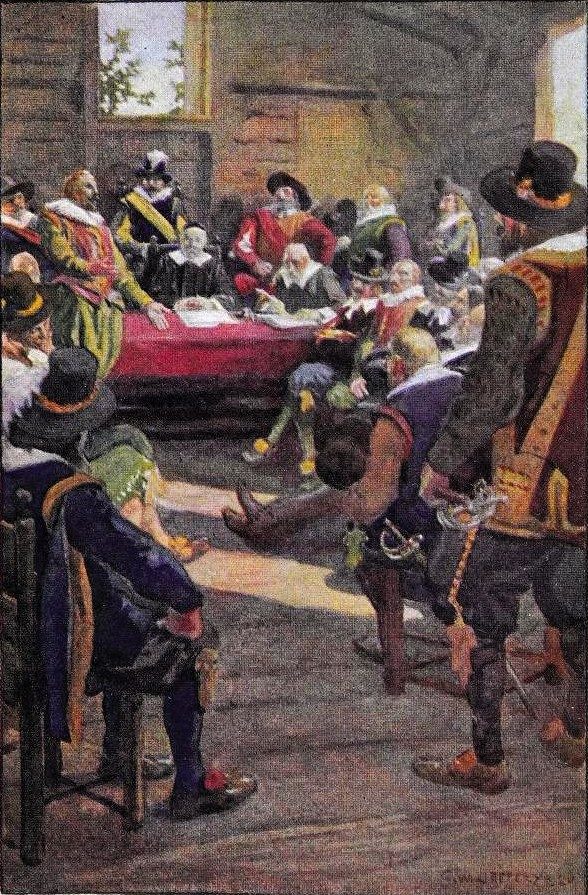
The Mayflower Compact, 1620
The Pilgrims had a patent for Virginia. In November 1620 the Mayflower lay off Cape Cod, outside it. Governor William Bradford wrote years later that the Compact was "occasioned partly by the discontented and mutinous speeches that some of the strangers amongst them had let fall from them in the ship: That when they came ashore they would use their own liberty, for none had power to command them, the patent they had being for Virginia and not for New England."4
So a practical problem produced a constitutional answer. If no outside authority could command the settlers, they would command themselves, by agreement. On November 11, 1620, forty-one men signed.5
"We, whose names are underwritten, the Loyal Subjects of our dread Sovereign Lord King James ... Do by these Presents, solemnly and mutually, in the Presence of God and one another, covenant and combine ourselves together into a civil Body Politick, for our better Ordering and Preservation, and Furtherance of the Ends aforesaid: And by Virtue hereof do enact, constitute, and frame, such just and equal Laws, Ordinances, Acts, Constitutions, and Officers, from time to time, as shall be thought most meet and convenient for the general Good of the Colony; unto which we promise all due Submission and Obedience."
The Mayflower Compact, November 11, 1620. 5
Read it slowly. The signers call themselves loyal subjects of King James, so this is no declaration of independence. They also call themselves a "civil Body Politick" and promise "all due Submission and Obedience" to laws they have not yet written and officers they have not yet chosen. The authority comes from the promise. And the promise is made "in the Presence of God and one another," in that order.
That word, covenant, is the one to hold onto. A contract trades goods or services between parties who stay separate. A covenant makes a people. It binds the signers to each other and to a purpose beyond their own interest, with God as witness. The Connecticut settlers would open their own plan of government the same way, with an appeal to God and a promise to each other. The ordered liberty that this course returns to, liberty joined to a shared duty, has an early American root right here: free people promising obedience to laws they themselves will make, for the general good.
Be careful with the claims people attach to it. The text names no officers. It sets up no assembly, no courts and no tax. It is a short promise, made by men with no other authority to appeal to, and its weight comes from the idea inside it: that a people may bind itself.
The Fundamental Orders of Connecticut, 1639
Nineteen years later, on the Connecticut River, three towns wrote down something longer. Windsor, Hartford and Wethersfield had been governed by a commission from Massachusetts Bay, and when it ran out a year later, in March 1637, the settlers went on governing themselves. On May 31, 1638, the Reverend Thomas Hooker preached in Hartford that the choice of magistrates belongs to the people by God's allowance, and that those who choose officers also set the limits of their power.6 On January 14, 1639 (old style), the settlers adopted eleven orders.6
The preamble begins with the people, not the king: "well knowing where a people are gathered together the word of God requires that to maintain the peace and union of such a people there should be an orderly and decent Government established according to God," they "associate and conjoin" themselves "as one Public State or Commonwealth."7 The document says nothing about the Crown at all, and that silence is the reason people call it the first written constitution in America.6 Some historians doubt the title, since the Orders skip the things we expect a constitution to do, such as list rights. The safest claim is the modest one. It is an early, clear example of a colony organizing itself by written rules.
What the rules say is worth reading in detail. Freemen elect a governor and six magistrates every year, by written ballot, and no one may be governor more than once in two years. Each town sends four deputies to a General Court that meets twice a year, in April and September.7 The General Court holds "the supreme power of the Commonwealth." Only it may "make laws or repeal them" and "grant levies."7 When the court votes a tax, a committee with an equal number from each town sets what each town pays.7
Order 6 is the one to underline. If the governor and magistrates "neglect or refuse" to call the court, the freemen themselves may "give order to the Constables of the several Towns" to do it, choose a moderator, and "proceed to do any act of power which any other General Courts may."7 In plain words, if the officials refuse to do their duty, the people may do it for them. This is accountability written into the founding text, 137 years before the Declaration used the same idea on a king.
The limits matter too. Only admitted freemen voted. The governor had to be "a member of some approved Congregation."7 The preamble pledges the settlers to maintain "the liberty and purity of the Gospel of our Lord Jesus which we now profess," and its authors did not imagine a society open to every belief. Self-government in the seventeenth century meant government by the settled, church-going men of a town. Later generations widened the circle. They could do it because the principle was already on the page.
Three founding documents, three different jobs. Virginia in 1619 was a legislature working inside a Company's charter. The Mayflower Compact was a promise to obey laws yet to be made. The Fundamental Orders was a full plan of government, with elections, an assembly and a tax rule, written by the governed themselves.
| Document | Date and place | Who acted | What it set up |
|---|---|---|---|
| First General Assembly | July 30, 1619, Jamestown, Virginia | Governor, council and 22 elected burgesses | A representative assembly under the Virginia Company |
| Mayflower Compact | November 11, 1620, Cape Cod | 41 men aboard the Mayflower | A civil body politic bound by a covenant to future laws |
| Fundamental Orders | January 14, 1639 (old style), Hartford | Freemen of Windsor, Hartford and Wethersfield | Annual elections, a General Court, a tax rule, a duty on officials to call the court |
Town meetings in New England
Below the colony sat the town, and the town ran on a meeting. In a New England town meeting the residents gather to act as the town's legislature, and a board of selectmen carries out what they decide. Records of the earliest meetings are thin, and historians still debate where the form came from. One view traces it to English parish vestries. Another points back to the Mayflower Compact.8 Either way, by the 1690s the question of who held the last word was settled in law. In 1692 the Massachusetts General Court declared that final authority on bylaws belonged to the town meeting, not to the selectmen. Two years later it took the power to appoint assessors away from the selectmen and gave it to the town meeting. In 1715 it recognized the meeting's right to choose its own moderator, which many towns had done for years.8
This was politics at arm's length. A man who wanted a road repaired or a schoolmaster paid stood up in front of his neighbors and said so, and then he voted, and then he paid. Tocqueville, writing in 1835, thought the town was where Americans learned freedom.
"Nevertheless local assemblies of citizens constitute the strength of free nations. Town-meetings are to liberty what primary schools are to science; they bring it within the people's reach, they teach men how to use and how to enjoy it."
Alexis de Tocqueville, Democracy in America, vol. 1, ch. 5, 1835. 9
When Bostonians wanted to decide what to do after the shootings of March 5, 1770, they held a town meeting at Faneuil Hall, and the selectmen asked the acting governor to move the troops out of the city.10 They were using a tool they had used for generations.
Assemblies and the power of the purse
By 1775 the colonies each had a popular assembly. Edmund Burke described them to the House of Commons on March 22, 1775, in the last weeks before the war. "Their governments are popular in an high degree," he said of the colonies; "some are merely popular; in all, the popular representative is the most weighty; and this share of the people in their ordinary government never fails to inspire them with lofty sentiments, and with a strong aversion from whatever tends to deprive them of their chief importance."11
Burke knew where that weight came from. The assemblies voted the money. He asked the Commons to recognize "the LEGAL COMPETENCY of the Colony Assemblies for the support of their government in peace, and for public aids in time of war," and he pointed to the "whole tenor of their Acts of Supply."11 The Fundamental Orders had put the tax power with the General Court from the start. Virginia's Assembly held on to it through the Cromwell years.71
When the Sugar Act of 1764 became the first tax Parliament passed for the specific purpose of raising revenue in the colonies, the colonists did not see only a new tax.12 They saw an attack on a system. Burke saw it too. He put it to the Commons this way, in one of his resolutions: the proposal was "to establish the equity and justice of a taxation of America by GRANT, and not by IMPOSITION," and to show the "BENEFIT OF THEIR GRANTS and the FUTILITY OF PARLIAMENTARY TAXATION as a method of supply."11 Grant meant the colonial assembly voted the money. Imposition meant Parliament simply took it. Everything in the next lesson turns on that difference.
Salutary neglect
Why had the colonies been left alone so long? Burke's editor, Sidney Newsom, gave a list in a footnote: the struggle of Charles I with Parliament, the confusion after the Restoration, the Revolution of 1688, the attitude of France in favoring the cause of the Stuarts, and the ascendency of the Whigs.13 A kingdom with its own survival to worry about had little attention left for its colonies. The colonists got used to that.
Burke, in the same speech, gave the habit its name. He told the Commons that the colonies "owe little or nothing to any care of ours, and that they are not squeezed into this happy form by the constraints of watchful and suspicious government, but that, through a wise and salutary neglect, a generous nature has been suffered to take her own way to perfection."11 Then, remarkably, he drew a conclusion that cut against the ministry he was addressing: "when I see how profitable they have been to us, I feel all the pride of power sink, and all presumption in the wisdom of human contrivances melt and die away."11
Burke's phrase has become shorthand for the whole period, and it needs some care. Parliament had passed trade laws and used duties to regulate the empire's commerce.12 The claim of authority was there. What Parliament had not done, before 1764, was tax the colonies to raise money for itself. A people who run their own affairs for a century and a half, with a claim of outside authority hanging over them that nobody presses, will naturally come to treat the arrangement as their right.
Then came 1763. The war with France ended, Britain had a huge debt, and the ministry decided the colonies would help pay. Neglect ended. The colonists felt it as a change in the rules, which it was.
The Albany Plan and Join, or Die, 1754
One more piece of the pre-1763 story deserves attention, because it came before the quarrel with Britain and failed for reasons that tell you something about the colonies. In May 1754 a Virginia militia force under a young George Washington ambushed a French patrol at Jumonville Glen, and the fighting that became the French and Indian War began.14 That summer, more than twenty delegates from several colonies met at Albany, New York, to plan their defense. Benjamin Franklin, then 48 and a Pennsylvania delegate, offered a plan of union.15
The Albany Plan asked Parliament to pass an act under which "one general government may be formed in America, including all the said colonies, within and under which government each colony may retain its present constitution."16 A President-General, appointed and paid by the Crown, would carry out the laws. A Grand Council of 48 members, "chosen by the representatives of the people of the several Colonies met in their respective assemblies," would make them. Massachusetts and Virginia would each send seven. The council could "lay and levy such general duties, imposts, or taxes, as to them shall appear most equal and just." It could raise soldiers and build forts, but it could not "impress men in any Colony, without the consent of the Legislature." And its laws, though "agreeable to the laws of England," would go to the King in Council and stand unless he rejected them within three years.16
Look at what Franklin did. He kept the colonial assemblies in place as the electors of the council. He gave the general government a real tax power, which the Articles of Confederation, as lesson 4 shows, would later withhold. He left the colonies their own constitutions. He put a royal officer at the head. It reads like a first sketch of federalism, and it asked Parliament to create it.
It went nowhere. Franklin wrote in his Autobiography that "its fate was singular: the assemblies did not adopt it, as they all thought there was too much prerogative in it, and in England it was judg'd to have too much of the democratic."17 Colonial legislatures guarded their purses. They did not want a council in Philadelphia telling them what to raise. London, for its part, did not want a united America at all.
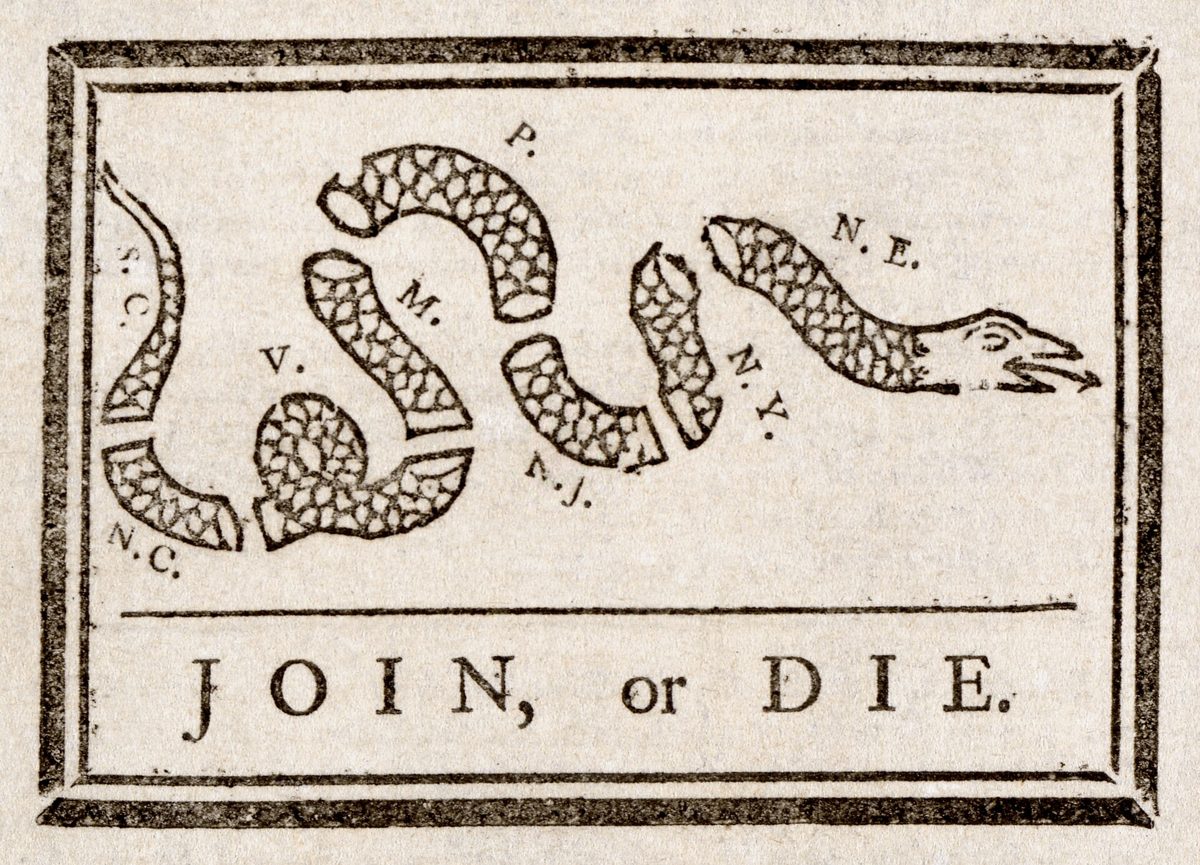
Franklin put his argument in a picture. On May 9, 1754, the Pennsylvania Gazette printed a woodcut of a snake cut into eight pieces, each labeled with the initials of a colony or region, under the words "JOIN, or DIE." It is the earliest known pictorial representation of colonial union made by an American colonist.18 The snake rested on a superstition that a severed snake would come back to life if its pieces were put together before sunset.18 In 1754 the cartoon argued for unity against France. In 1765 colonists used it to urge unity against Parliament.18
The snake, and the plan behind it, tell you where the colonies stood in 1754. Each one had a working government and a strong sense of its own rights, and the assemblies would not hand any of it to a council in Philadelphia. That would take a crisis.
What the colonists carried into 1763
By the time the French and Indian War ended, Virginia had been seating burgesses for 144 years. Connecticut had run its elections by written rules since 1639. New England towns had their meetings. The assemblies had the taxes, and Burke could tell the Commons in 1775 that the people's share in ordinary government "never fails to inspire them with lofty sentiments."11
The useful point is about what holds a free people together. The colonists did not defend their liberties only as private persons guarding private property. They defended a system in which they sat in the room, voted the money and bound themselves by their own laws. That is the picture of ordered liberty this course keeps coming back to: liberty tied to duty, with the duty running both ways. The people owed obedience to laws they had a hand in making. The government owed them the room in which to make those laws. When the second half of that bargain broke in 1765, the first half came under strain.
- 1619 The Virginia General Assembly meets at Jamestown on July 30.
- 1620 Forty-one men sign the Mayflower Compact off Cape Cod on November 11.
- 1639 Windsor, Hartford and Wethersfield adopt the Fundamental Orders.
- 1642 Virginia's Assembly divides into two houses.
- 1692 Massachusetts declares that the town meeting, not the selectmen, has the last word on bylaws.
- 1754 Franklin's Join, or Die appears on May 9. The Albany Congress adopts his plan of union in July, and the colonial assemblies reject it.
- 1763 The French and Indian War ends and Britain begins to claim what it had long left unclaimed.
Learn more
- The General Assembly Convenes (1619): the clerk's own account of the first day, in the original spelling.
- The Mayflower Compact: the whole text is one long sentence and takes two minutes to read.
- The Fundamental Orders of 1639: eleven orders on how Connecticut would elect and govern itself.
- Bradford on the Compact: why the passengers wrote it, in the governor's words.
- Burke, Speech on Conciliation with America: the best contemporary description of why the colonists behaved as they did.
- The Albany Plan of Union: twenty-five short articles for a general government.
- Franklin's Autobiography: his own telling of the Albany plan and its fate.
- What Ordered Liberty Means: the idea behind this whole course, in module 52.
Notes
- "House of Burgesses," Wikipedia, sections on the 1619 assembly, the 1642 division into two houses and the 1652 settlement with Parliament. Twenty-two burgesses sat in 1619. Read it online. ↩
- General Assembly, "The General Assembly Convenes (1619)," Journals of the House of Burgesses of Virginia, 1619-1658/59, ed. H. R. McIlwaine (Richmond: Virginia State Library, 1915), 4. Transcription with original spelling at Encyclopedia Virginia. Read it online. ↩
- National Park Service, "400 Years of African American History," on the landing of the first enslaved Africans at Point Comfort in late August 1619, "now believed to be August 25." Read it online. ↩
- William Bradford, Of Plymouth Plantation, 75-76, as printed in The Founders' Constitution, vol. 1, ch. 17, doc. 1. Spelling as in that edition. Read it online. ↩
- "The Mayflower Compact," November 11, 1620, in Francis Newton Thorpe, ed., The Federal and State Constitutions, Colonial Charters, and Other Organic Laws (Washington: Government Printing Office, 1909), via the Avalon Project. The list of signers on that page names forty-one men. Read it online. ↩
- "Fundamental Orders of Connecticut," Wikipedia, on the adoption date, Thomas Hooker's sermon of May 31, 1638, and the document's silence about the Crown. Read it online. ↩
- "Fundamental Orders of 1639," preamble and Orders 1, 4, 6, 10 and 11, Avalon Project, from Thorpe, Federal and State Constitutions. Read it online. ↩
- "Town meeting," Wikipedia, on the debated origins of New England town meeting and on the Massachusetts General Court's acts of 1692, 1694 and 1715. Read it online. ↩
- Alexis de Tocqueville, Democracy in America, vol. 1, ch. 5, trans. Henry Reeve (1835), Project Gutenberg ebook 815. Read it online. ↩
- "Boston Massacre," Wikipedia, on the town meeting at Faneuil Hall and the selectmen's request to move the troops. Read it online. ↩
- Edmund Burke, Speech on Conciliation with America, delivered March 22, 1775, Project Gutenberg ebook 5655 (Newsom edition). The passages used here are Burke's description of the colonial assemblies, his statement of his resolutions on taxation by grant, and the "salutary neglect" sentence near the end. Read it online. ↩
- "Townshend Acts," Wikipedia, introduction: Parliament had earlier used its trade laws to regulate commerce, and with the Sugar Act of 1764 it sought, for the first time, to tax the colonies for the specific purpose of raising revenue. Read it online. ↩
- Sidney Carleton Newsom, ed., Burke's Speech on Conciliation with America, editor's footnote 23, on "our ancient indulgence" and the "wise and salutary neglect." Project Gutenberg ebook 5655. Read it online. ↩
- "French and Indian War," Wikipedia, on the Jumonville Glen skirmish of May 1754 and the Treaty of Paris of 1763. Read it online. ↩
- "Albany Plan of Union," Wikipedia, on the Albany Congress of July 1754 and the plan's rejection. Read it online. ↩
- "Albany Plan of Union, 1754," articles 1, 2, 15, 16 and 21, Avalon Project, from Documents Illustrative of the Formation of the Union of the American States (Washington: Government Printing Office, 1927). Read it online. ↩
- Benjamin Franklin, Autobiography, Part 3, on the Albany plan, Project Gutenberg ebook 148. Read it online. ↩
- "Join, or Die," Wikipedia, on the cartoon's publication in the Pennsylvania Gazette on May 9, 1754, its eight segments, the superstition behind it and its use in 1765. Read it online. ↩
Terms in this lesson
- Burgess
- An elected representative in the Virginia assembly. The word first meant a freeman of an English borough.
- Covenant
- A solemn promise made before God and among the parties, which the Pilgrims and the Connecticut settlers used as the basis of a government.
- Freeman
- In the New England colonies, a man admitted to full political rights, including the vote. Admission had its own rules.
- Town meeting
- A gathering of a New England town's voters to pass local laws, set the tax and choose officers.
- Salutary neglect
- Burke's phrase for the loose way Britain managed its American colonies before 1763, which left colonial assemblies room to govern themselves.
- Power of the purse
- The authority to raise and spend public money. Colonial assemblies held it and used it to restrain governors.
- Albany Plan of Union
- Benjamin Franklin's 1754 proposal for a general government of the colonies under a Crown-appointed President-General and an elected Grand Council.
Sources
- The General Assembly Convenes (1619), Journals of the House of Burgesses (Encyclopedia Virginia) checked 2026-10
- The Mayflower Compact, 1620 (Avalon Project) checked 2026-10
- William Bradford on the Mayflower Compact (The Founders' Constitution) checked 2026-10
- The Fundamental Orders of 1639 (Avalon Project) checked 2026-10
- Tocqueville, Democracy in America, vol. 1 (Project Gutenberg) checked 2026-10
- Burke, Speech on Conciliation with America, 1775 (Project Gutenberg) checked 2026-10
- The Albany Plan of Union, 1754 (Avalon Project) checked 2026-10
- Franklin, Autobiography (Project Gutenberg) checked 2026-10
- 400 Years of African American History (National Park Service) checked 2026-10