Lesson 4 of 9 · about 25 minutes
War and the Articles of Confederation
You'll be able to
- Describe the turning points of the war from Boston to Yorktown and say what Saratoga and the French alliance changed
- State the main terms of the Treaty of Paris of 1783
- Explain how the Articles of Confederation were organized, what they let Congress do, and why they could not be amended easily
- Tell what happened at Newburgh in March 1783 and at Annapolis in December 1783, and why both matter for ordered liberty
By the winter of 1783 the Continental Army had won its war and had not been paid for it. Its officers were camped at Newburgh, New York, and one of them had written a letter that proposed to put the question to Congress with force. A general the army adored could have taken the country by saying yes. George Washington said no, in a room full of angry men, and nine months later he handed back his commission and went home to farm.
This lesson follows that arc. It covers how the war was won, what kind of government the states built to run it, and how the central lesson of the American Revolution came to be taught by a man leaving office. The Articles of Confederation get a fair hearing here. They were not stupid, and they were not an accident. They were what a people who had just fought a distant government were willing to build.
The war in outline, 1776 to 1778
The fighting that began at Lexington and Concord, covered in module 52, lesson 3, went on for eight years. In March 1776 the Continental Army under Washington forced the British out of Boston.1 The next campaign went the other way. Landing near New York, General William Howe beat Washington at the Battle of Long Island on August 27, took New York City on September 15, and captured Fort Washington on November 16, an American defeat that cost about 3,000 prisoners.1 The army retreated across New Jersey. Morale was low.
On the night of December 25-26, 1776, Washington crossed the icy Delaware River north of Trenton with about 2,400 men, marched nine miles, and surprised the Hessian garrison. Roughly 800 to 900 Hessians were captured, and only two Americans died, both of exposure.2 It was a small battle. It mattered because it came when morale was lowest, and it inspired re-enlistments.2
The next year brought the turn. A British army under General John Burgoyne came south from Canada to take Albany and cut off New England. It stalled and was beaten in two battles at Saratoga, on September 19 and October 7, 1777, and surrendered to General Horatio Gates on October 17.3 The historian Edmund Morgan called Saratoga "a great turning point of the war, because it won for Americans the foreign assistance which was the last element needed for victory."3
That assistance was French. On February 6, 1778, the United States and France signed two treaties in Paris. One was a treaty of amity and commerce, in which France became the first nation to recognize the United States formally. The other was a defensive alliance, and it forbade either country from making a separate peace with Britain.4 The treaties were followed at once by substantial material, military and financial support, and Americans did not win alone. A lesson that pretends they did is not telling the truth.
Meanwhile Washington's army spent the winter of 1777-1778 at Valley Forge, Pennsylvania, from December 19 to June 19. About 12,000 people, soldiers, workmen, women and children, wintered there, and the supply system failed them. An estimated 1,700 to 2,000 soldiers died, mostly of disease.5 Lafayette remembered that "the unfortunate soldiers were in want of everything; they had neither coats, hats, shirts, nor shoes; their feet and legs froze till they had become almost black, and it was often necessary to amputate them."5 The winter was not unusually cold. The suffering came from a supply system that broke down, a failure that will return in this lesson.5
The South and Yorktown, 1780 to 1781
After 1778 the British turned south, counting on Loyalist support. They took Charleston in May 1780, capturing more than 5,000 men, the worst American defeat of the war. General Gates, sent south to recover, lost at Camden on August 16.1 Then the tide ran back. Patriot forces defeated Patrick Ferguson's Loyalist militia at Kings Mountain in early October. Nathanael Greene took command in December. On January 17, 1781, Daniel Morgan's detachment all but destroyed Banastre Tarleton's British Legion at Cowpens, and on March 15 Greene fought Cornwallis to a costly British win at Guilford Court House.1 Cornwallis then marched to Virginia, and in time withdrew to Yorktown, where he expected the Royal Navy to take him off.1
It did not. Washington and the French general Rochambeau had discussed an attack on New York. They turned south instead, and the French admiral de Grasse brought his fleet into the Chesapeake. When a British fleet came to relieve Cornwallis, de Grasse drove it off on September 5, and Cornwallis was trapped.16 The allied armies reached Yorktown on September 28. Alexander Hamilton led the American column that took one of the last outer redoubts on October 14. Cornwallis asked for terms on October 17, and the surrender took place on October 19, 1781.6
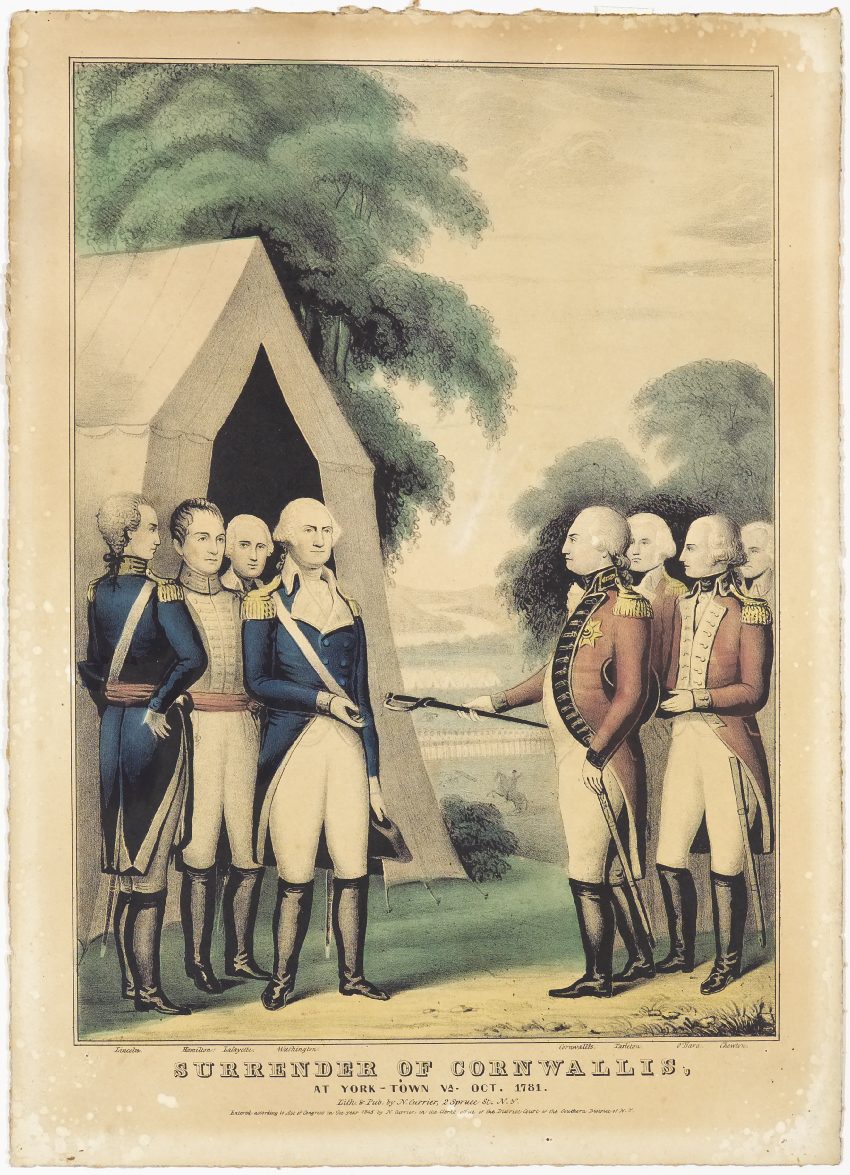
Cornwallis, claiming illness, did not appear. General Charles O'Hara tried to offer his sword to Rochambeau, who pointed to Washington; Washington pointed to his second in command, Benjamin Lincoln. The British had asked for the honors of war, flags flying and a band playing, and Washington refused them because the British had refused those honors to Lincoln's army after the siege of Charleston.6 By the count in the Wikipedia article on the siege, about 8,000 soldiers and 214 artillery pieces were captured.6 Yorktown was the last major land battle. It was not the end of the fighting everywhere, and British troops did not leave Charleston until December 14, 1782, or New York until November 25, 1783.1
The Treaty of Paris, 1783
Provisional articles were signed in Paris on November 30, 1782, and the definitive treaty on September 3, 1783.7 The American delegation in Benjamin West's unfinished painting included John Jay, John Adams, Benjamin Franklin and Henry Laurens.8 The treaty's first article is the one Americans had fought for.
"His Brittanic Majesty acknowledges the said United States ... to be free sovereign and independent states, that he treats with them as such, and for himself, his heirs, and successors, relinquishes all claims to the government, propriety, and territorial rights of the same and every part thereof."
Treaty of Paris, Article 1, September 3, 1783. 7
The treaty set boundaries running to the Mississippi on the west and, in the south, along the thirty-first parallel. It protected American fishing rights off Newfoundland. It also contained the clauses that would cause trouble for years. Article 4 said that "creditors on either side shall meet with no lawful impediment to the recovery of the full value in sterling money of all bona fide debts heretofore contracted." In Article 5, Congress promised to "earnestly recommend" that the state legislatures restore the confiscated property of Loyalists, but Congress could only recommend, since it had no way to make the states comply.7
Article 7 ended the war and ordered the British to withdraw "without causing any destruction, or carrying away any Negroes or other property of the American inhabitants."7 The wording is plain. In a treaty that closed a war fought for liberty, enslaved human beings are counted among the property. Meanwhile the British withdrawal carried Loyalists, including free Black Loyalists, to Nova Scotia and the West Indies, while Native allies of the British and some freed Black people were left to find their own way.1 The brief word "Negroes" in Article 7 is a reminder that the revolution's promises and its practice were in conflict from the start. Module 52, lesson 5, returns to that conflict.
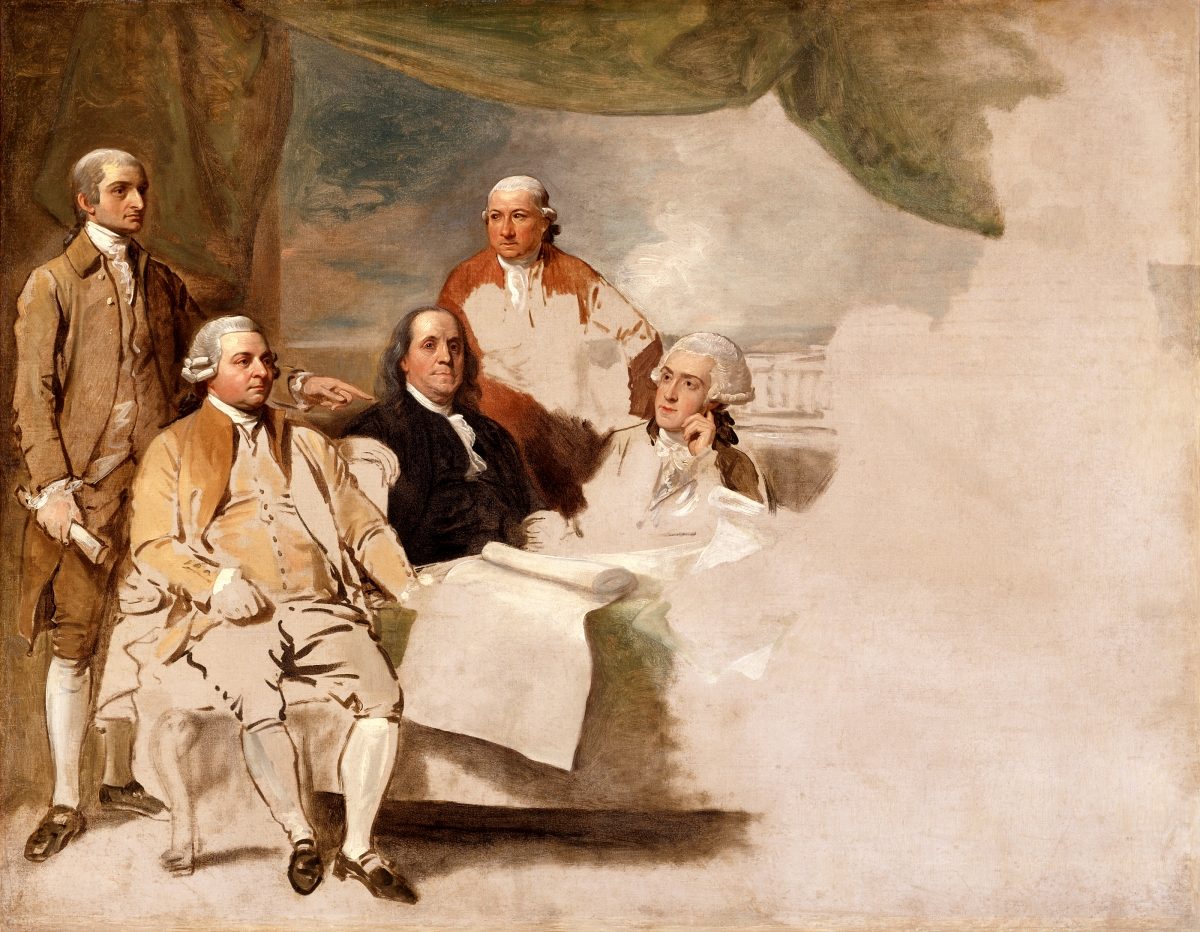
Even the ratification showed the problem ahead. Because too few delegates attended at any one time, the treaty "languished in Congress for several months" for lack of a quorum, and Congress had no power to force members to attend.9
The Articles of Confederation
The same Congress that declared independence set out at once to write a plan of union. It had a model for the job. The Lee Resolution of June 7, 1776, which you met in lesson 3, called for "a plan of confederation." A committee chaired by John Dickinson presented its draft on July 12, 1776. Congress then argued for sixteen months about state sovereignty, the powers to give Congress, whether to have a judiciary, western land claims and voting, and it finished the text on November 15, 1777.9
Virginia ratified first, on December 16, 1777. Twelve states had ratified by February 1779. Maryland held out for two years, refusing to ratify until the states with western claims were ready to give them up to the Union. It ratified on February 2, 1781, and the Articles took effect on March 1.9 In the meantime Congress treated them as its frame of government.
The text starts with its own purpose. The states "hereby severally enter into a firm league of friendship with each other, for their common defense, the security of their liberties, and their mutual and general welfare." Article II is the one that governs everything else.
"Each state retains its sovereignty, freedom, and independence, and every power, jurisdiction, and right, which is not by this Confederation expressly delegated to the United States, in Congress assembled."
Articles of Confederation, Article II. 10
Congress, in that design, was not a government with citizens. It was a meeting of states. It had a single chamber, where "each State shall have one vote," and the state legislatures chose and could recall the delegates.10 The text creates no independent executive, since its "president" is a member of Congress who may serve only one year in three, and it provides no general system of national courts.10 Colonists who had spent a decade resisting the claim of a distant Parliament to rule them "in all cases whatsoever" had built a union that could not do that to them. This was the lesson they took from the 1760s, and it was a reasonable one. The tradition of ordered liberty has always feared concentrated power.11
What Congress could do
The Articles gave Congress real authority in some areas. It had "the sole and exclusive right and power of determining on peace and war," of sending and receiving ambassadors, and of making treaties and alliances. It could regulate the alloy and value of coin, set standards of weights and measures, run the post office, manage relations with Native nations outside any state, appoint the officers of the army and navy and borrow money.10 The Articles also guaranteed that the free inhabitants of each state enjoyed "all privileges and immunities of free citizens in the several States," and that "Full faith and credit shall be given in each of these States to the records, acts, and judicial proceedings of the courts and magistrates of every other State."10 Those two clauses later reappear in the Constitution.
Under this government the United States won the war, signed an alliance and a peace treaty, and, as the next lesson shows, passed the Northwest Ordinance. A fair account of the Articles has to count those successes.
What Congress could not do
The weakness was money and enforcement. Congress could spend, but it could not tax. Expenses were to be "defrayed out of a common treasury, which shall be supplied by the several States," and the key sentence follows: "The taxes for paying that proportion shall be laid and levied by the authority and direction of the legislatures of the several States."10 Congress could send a requisition to the states, and it could not collect. The text gives it no general power to regulate commerce, and the trade power it does name concerns Indians. Its requests for men and money went to the state legislatures. For major decisions, including war, borrowing and the army's size, it needed "unless nine States assent to the same."10
And the Articles were almost impossible to amend. Article XIII says "the Union shall be perpetual; nor shall any alteration at any time hereafter be made in any of them; unless such alteration be agreed to in a Congress of the United States, and be afterwards confirmed by the legislatures of every State."10 A single state could therefore stop any change. That is exactly what happened in November 1782, when the states decisively defeated an amendment that would have let Congress levy an import tariff.12
| Subject | Under the Articles |
|---|---|
| War and peace, treaties | Congress, with nine states needed for war and for treaties |
| Taxes | Laid by the state legislatures; Congress could only request money |
| Regulating trade | No general power |
| Executive and courts | No president; no general federal courts (a court for captures at sea and for state disputes only) |
| Voting | One vote per state, whatever its size |
| Amendment | Congress plus the legislature of every state |
Newburgh, March 1783
The weakness of the Articles produced a crisis in the army. Congress was bitterly divided on finance, the treasury was empty, and Congress could not compel the states to supply money.12 The soldiers had not been paid for some time, and the pensions promised to officers remained unfunded. Some states had passed laws against any lifetime pension.12
On March 10, 1783, an unsigned letter circulated in the army camp at Newburgh, New York. It was later acknowledged to be the work of Major John Armstrong Jr., an aide to General Gates. It called on the army to send Congress an ultimatum, and a notice called a meeting of officers.12 Historians still dispute what was intended. Some nationalists in Congress, including Robert Morris, Gouverneur Morris and Hamilton, wanted the army's anger to push the states toward giving Congress its own revenue. Historian Richard Kohn thinks the group around Gates meant some form of direct action, though not necessarily a coup. Paul David Nelson finds that claim poorly supported.12
The meeting took place on March 15 in the camp's "Temple," and Washington walked in, to everyone's surprise, and asked to speak.12 "By an anonymous summons," he told the officers, "an attempt has been made to convene you together," which he called "how inconsistent with the rules of propriety! how unmilitary! and how subversive of all order and discipline." He did not dismiss the grievance. He pointed out what the anonymous writer was asking: to abandon the country or to turn "our Army against it," and he asked, "Can he be a friend to this Country?"13 He also defended free debate: "if Men are to be precluded from offering their sentiments on a matter, which may involve the most serious and alarming consequences, that can invite the consideration of Mankind; reason is of no use to us" and "the freedom of Speech may be taken away."13 Then he asked the officers to trust the "plighted faith of your Country" and to show "utmost horror and detestation" for any man who "wishes, under any specious pretences, to overturn the liberties of our Country, and who wickedly attempts to open the flood Gates of Civil discord, and deluge our rising Empire in Blood."13
The speech did less than one small act. Washington took out a letter from a member of Congress and fumbled with it. He then took out a pair of reading glasses, which few of the men had seen him wear. According to an account quoted by Wikipedia, he said: "Gentlemen, you will permit me to put on my spectacles, for I have not only grown gray but almost blind in the service of my country."12 Many of the officers were moved to tears, the conspiracy collapsed, and the assembly passed a resolution expressing "unshaken confidence" in Congress.12
Congress then settled. It gave the officers five years' full pay instead of the lifetime half-pay pension, paid in government securities.12 Washington had not solved the problem of a Congress without money. He had kept the army subordinate to Congress. His closing sentence set the standard: the officers would, "by the dignity of your Conduct, afford occasion for Posterity to say, when speaking of the glorious example you have exhibited to man kind, 'had this day been wanting, the World had never seen the last stage of perfection to which human nature is capable of attaining.'"13
Annapolis, December 23, 1783
The army was disbanded in the field in June. Washington ordered a halt to "all acts of hostility" in April 1783, and the last British troops left New York on November 25.1 Then Washington went to Annapolis, Maryland, where Congress was meeting. He arrived on December 19 and wrote to Congress the next day to ask whether he should resign in person or in writing. A committee of Thomas Jefferson, James McHenry and Elbridge Gerry set the ceremony.14 On December 22 Congress gave a dinner in his honor, and a ball followed that night. James Tilton wrote that the diners drank the usual thirteen toasts, "besides one given afterwards by the General," which was "Competent powers to congress for general purposes."15 Washington used his own toast to ask for a stronger Congress.
At noon on December 23, Congress's secretary Charles Thomson led him into the Senate chamber of the Maryland State House. He gave his speech and his commission to the president of Congress, Thomas Mifflin.14 The words were brief.
"Happy in the confirmation of our Independence and Sovereignty, and pleased with the oppertunity afforded the United States of becoming a respectable Nation, I resign with satisfaction the Appointment I accepted with diffidence."
George Washington to Congress, Annapolis, December 23, 1783. 15
He asked only for the "indulgence of retiring from the Service of my Country," and, for his officers, "the favorable notice and patronage of Congress." He closed by "commending the Interests of our dearest Country to the protection of Almighty God," and said, "I here offer my Commission, and take my leave of all the employments of public life."15 The next day he left for Mount Vernon.14
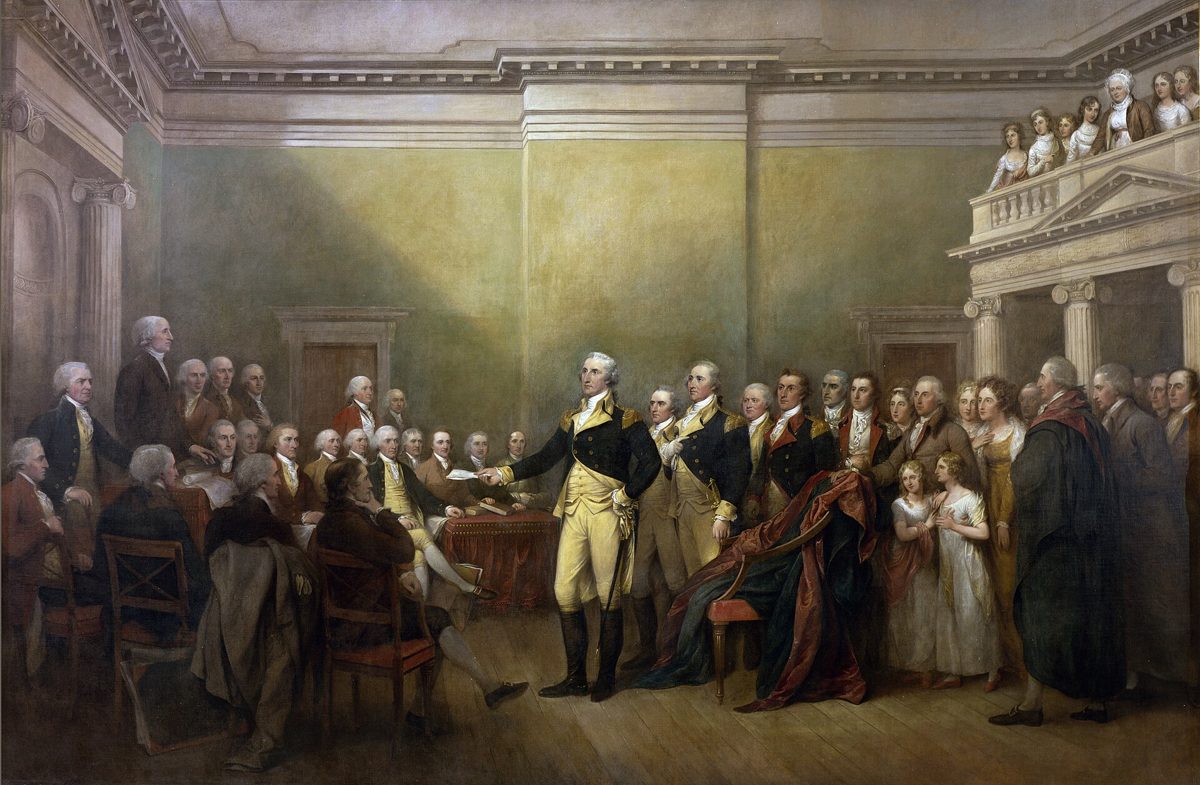
Contemporaries understood what they had seen. Trumbull wrote to his brother that it "excites the astonishment and admiration of this part of the world. 'Tis a Conduct so novel, so inconceivable to People, who, far from giving up powers they possess, are willing to convulse the Empire to acquire more." According to Benjamin West, King George III said in 1797 that the resignation placed Washington "in a light the most distinguished of any man living," and that he "thought him the greatest character of the age."14 Gordon Wood called Washington "the perfect Cincinnatus, the Roman patriot that returned to his farm after his victories in war," and said the resignation was "the greatest act of his life."14
For a course on ordered liberty, the point is direct. A free people has to secure itself against two dangers, a government that oppresses and an army or leader that takes the government. The Declaration spoke to the first. Newburgh and Annapolis answered the second. Power was held under a commission from a lawful authority, and it was returned. That is what "accountable government" means in practice, and it is why the tradition this course follows reads Washington as a man under authority and does not call him a conqueror.
- Mar. 1776 The Continental Army forces the British out of Boston.
- Aug.-Nov. 1776 Defeats at Long Island and Fort Washington.
- Dec. 26, 1776 Washington's victory at Trenton.
- Oct. 17, 1777 Burgoyne surrenders after Saratoga.
- Dec. 1777-June 1778 The army winters at Valley Forge.
- Feb. 6, 1778 Treaties with France.
- May 1780 Charleston falls.
- Mar. 1, 1781 The Articles of Confederation take effect.
- Oct. 19, 1781 Cornwallis surrenders at Yorktown.
- Mar. 15, 1783 Washington's Newburgh Address.
- Sept. 3, 1783 The Treaty of Paris is signed.
- Nov. 25, 1783 The last British troops leave New York City.
- Dec. 23, 1783 Washington resigns his commission at Annapolis.
Learn more
- The Articles of Confederation: short enough to read in one sitting, and plain about what Congress could not do.
- The Treaty of Paris, 1783: ten articles, including the boundaries and the debts.
- Washington's Newburgh Address: the full speech to the officers, March 15, 1783.
- Washington's resignation at Annapolis: the speech, the ceremony and the dinner that followed.
- Newburgh Conspiracy: the surrounding politics, including what historians still dispute.
- Legitimate Authority and Its Limits (module 52): a framework for judging when power is lawful.
Notes
- "American Revolutionary War," Wikipedia, for the dates and outcomes of the Boston, New York, Southern and Yorktown campaigns and the events of 1783. Read it online. ↩
- "Battle of Trenton," Wikipedia: the crossing of the night of December 25-26, 1776, the force of 2,400, and the capture of roughly 800 to 900 Hessians. Read it online. ↩
- "Battles of Saratoga," Wikipedia: the battles of September 19 and October 7, 1777, the surrender on October 17, and the Edmund Morgan quotation. Read it online. ↩
- "Treaty of Alliance (1778)," Wikipedia: the two treaties signed in Paris on February 6, 1778, and the bar on a separate peace. Read it online. ↩
- "Valley Forge," Wikipedia: the encampment of December 19, 1777 to June 19, 1778, an army of about 12,000 people, 1,700 to 2,000 deaths from disease, and Lafayette's recollection. Read it online. ↩
- "Siege of Yorktown," Wikipedia: the dates, the terms of surrender, Washington's refusal of the honors of war, and the count of captured men and guns. Read it online. ↩
- "The Definitive Treaty of Peace 1783," Avalon Project. Spelling as in that text. The page title gives the date as September 30, but the text of the treaty ends "Done at Paris, this third day of September in the year of our Lord, one thousand seven hundred and eighty-three." Read it online. ↩
- "Treaty of Paris (1783)," Wikipedia, on the caption of Benjamin West's unfinished painting, which notes that the British delegation refused to pose. Read it online. ↩
- "Articles of Confederation," Wikipedia: Dickinson's report of July 12, 1776, the final draft of November 15, 1777, Maryland's ratification, and the difficulty of raising a quorum. Read it online. ↩
- "Articles of Confederation: March 1, 1781," Avalon Project, from Documents Illustrative of the Formation of the Union of the American States (Washington: Government Printing Office, 1927). Read it online. ↩
- On the Western tradition of limited government, see module 52, lesson 1. What Ordered Liberty Means. ↩
- "Newburgh Conspiracy," Wikipedia: the anonymous letter of March 10, the meeting of March 15, the spectacles, the settlement of five years' full pay, and the historians' dispute over the officers' aims. Read it online. ↩
- George Washington, Address to the Officers of the Army, March 15, 1783, in the National Constitution Center's Historic Document Library. Spelling and capitalization as in that text. Read it online. ↩
- "George Washington's resignation as commander-in-chief," Wikipedia: the committee of Jefferson, McHenry and Gerry, the ceremony of December 23, Gordon Wood's remark, and the reports of George III and John Trumbull. Read it online. ↩
- George Washington, "Address to Congress on Resigning His Commission," Annapolis, December 23, 1783, from The Writings of George Washington, ed. John C. Fitzpatrick, vol. 27, pp. 284-285, as given by the Maryland State Archives, including James Tilton's letter on the dinner and Washington's toast. Read it online. ↩
Terms in this lesson
- Hessians
- German soldiers hired by Britain from German princes, including the Landgraviate of Hesse-Kassel, and sent to fight in America.
- Articles of Confederation
- The first written constitution of the United States, drafted in 1776-1777 and in force from March 1, 1781 until the Constitution replaced it in 1789.
- Requisition
- A formal request by Congress to the states for money or soldiers. Under the Articles, Congress could ask but could not compel.
- Treaty of Paris (1783)
- The treaty signed on September 3, 1783, in which Great Britain recognized the United States as independent and set its boundaries.
- Newburgh Conspiracy
- A threat of action by Continental Army officers against Congress in March 1783 over back pay, ended by Washington's address on March 15.
- Civilian control of the military
- The principle that elected civil authority commands the armed forces, and not the reverse.
- Commission
- The written grant of authority that Congress gave Washington in 1775 as commander in chief.
Sources
- American Revolutionary War (Wikipedia) checked 2026-10
- Battle of Trenton (Wikipedia) checked 2026-10
- Battles of Saratoga (Wikipedia) checked 2026-10
- Valley Forge (Wikipedia) checked 2026-10
- Treaty of Alliance (1778) (Wikipedia) checked 2026-10
- Siege of Yorktown (Wikipedia) checked 2026-10
- The Definitive Treaty of Peace, 1783 (Avalon Project) checked 2026-10
- Articles of Confederation, March 1, 1781 (Avalon Project) checked 2026-10
- Articles of Confederation (Wikipedia) checked 2026-10
- Newburgh Address, 1783 (National Constitution Center) checked 2026-10
- Newburgh Conspiracy (Wikipedia) checked 2026-10
- Washington's Address to Congress Resigning His Commission (Maryland State Archives) checked 2026-10
- George Washington's resignation as commander-in-chief (Wikipedia) checked 2026-10