Lesson 7 of 9 · about 21 minutes
Ratification: Federalists and Anti-Federalists
You'll be able to
- State what Article VII required and trace the ratification order from Delaware on December 7, 1787 to Rhode Island on May 29, 1790
- Describe four arguments in The Federalist, Nos. 10, 51, 78 and 84, in Publius's own words
- Describe the Anti-Federalist case through Brutus, the Federal Farmer, Centinel, George Mason and Patrick Henry
- Explain how the Massachusetts convention turned recommended amendments into the pattern for the other states
On September 28, 1787, eleven days after the signing in Philadelphia, the Confederation Congress voted to send the Constitution to the states and called for state conventions to consider it.1 The Convention had already told the states how the result would be counted. Article VII reads: "The Ratification of the Conventions of nine States, shall be sufficient for the Establishment of this Constitution between the States so ratifying the Same."2
That sentence changed the rules. The Articles of Confederation said no alteration could be made unless Congress agreed and "the legislatures of every State" confirmed it.3 Article VII asked for nine states, not thirteen, and for conventions instead of legislatures. Edmund Randolph had said on the last day in Philadelphia that "Nine States will fail to ratify the plan and confusion must ensue."4 Nine did not fail. Eleven states had ratified by July 26, 1788, ten months after the Convention ended. North Carolina and Rhode Island held out until the new government was already running.
Two Names for Two Camps
Supporters of the Constitution called themselves Federalists. Their opponents got a label that defined them by what they opposed. The editors at Teaching American History note that The Federalist called the other side "antifederalists," which in their words degraded them "to a position of irrelevance and incoherence," and that some modern scholars hyphenate the name for a similar effect. The editors chose "Antifederalist" to encourage readers to see the opponents' remarks as relevant and coherent.5 This lesson uses Anti-Federalist.
The two camps cut across state and class lines. Washington and Franklin signed the Constitution. Elbridge Gerry and George Mason, both delegates in Philadelphia, would not.4 Patrick Henry, who was appointed a delegate and declined, fought it in Virginia.67 Module 55 has lessons on four of the critics: Mason, Gerry, Luther Martin and Melancton Smith.
The Federalist
Publius
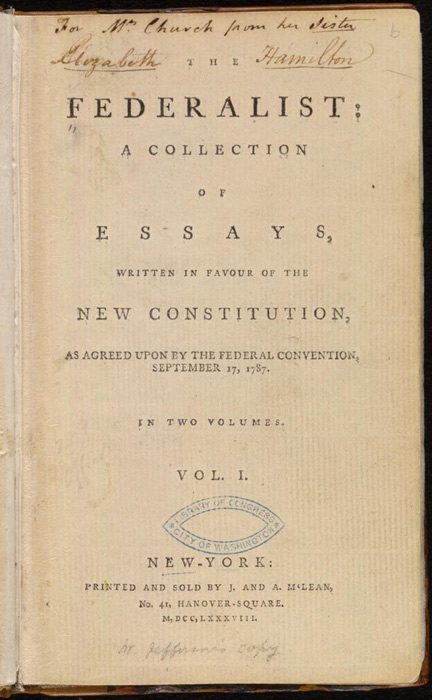
The Library of Congress describes The Federalist as a series of eighty-five essays, written by Alexander Hamilton, James Madison and John Jay under the pen name "Publius," that first appeared anonymously in New York newspapers in 1787 and 1788.8 The first was Hamilton's. Madison's Federalist No. 10 ran in the New York Daily Advertiser on November 22, 1787.9 They were written for New York, a state where opposition was strong, and they were collected in book form in 1788. Madison's life is in Module 55, Lesson 1.
No. 1: Reflection and Choice
Hamilton opened with the stakes. Whether societies of men, he wrote, "are really capable or not of establishing good government from reflection and choice, or whether they are forever destined to depend for their political constitutions on accident and force."10 The line is easy to read past. Hamilton was saying that the thing on the table was a test of whether free people could reason their way into a government. He thought the answer might decide it for everyone else.
No. 10: Faction
Madison's best-known essay starts from a problem. Free people will divide. He defined a faction as "a number of citizens, whether amounting to a majority or a minority of the whole, who are united and actuated by some common impulse of passion, or of interest, adversed to the rights of other citizens, or to the permanent and aggregate interests of the community."11 Madison said there were two ways to cure faction: remove its causes, or control its effects. Removing causes would mean destroying liberty or making everyone think alike, and he rejected both. So the answer was to control the effects. A republic, "a government in which the scheme of representation takes place," would filter the passions of the people through representatives, and a large republic would make it hard for any one faction to become a majority.11 Madison added the warning that when a majority is included in a faction, "the form of popular government, on the other hand, enables it to sacrifice to its ruling passion or interest both the public good and the rights of other citizens."11 That was an answer to the old teaching that free republics must be small. Brutus answered it with Montesquieu, arguing that a free republic over such a vast territory was impracticable.12
No. 51: Ambition Against Ambition
No. 51 is about how to keep the branches of government from swallowing each other. Its answer is to give "those who administer each department the necessary constitutional means and personal motives to resist encroachments of the others." The essay does not pretend that good men will always hold office:
"Ambition must be made to counteract ambition. The interest of the man must be connected with the constitutional rights of the place. It may be a reflection on human nature, that such devices should be necessary to control the abuses of government. But what is government itself, but the greatest of all reflections on human nature? If men were angels, no government would be necessary."
The Federalist No. 51, February 1788. 13
Then the sentence that gives the essay its weight: "you must first enable the government to control the governed; and in the next place oblige it to control itself."13 For anyone who holds that citizens owe both support and scrutiny to legitimate government, those words lay out the balance. A government has to be strong enough to rule and built so that it can be held to account.
No. 78: The Least Dangerous Branch
Hamilton took up the courts in No. 78. The judiciary, he argued, "from the nature of its functions, will always be the least dangerous to the political rights of the Constitution; because it will be least in a capacity to annoy or injure them." The executive holds the sword and the legislature the purse. "The judiciary, on the contrary, has no influence over either the sword or the purse."14 The essay appeared in 1788, before any federal court had sat. Brutus, for one, counted the federal judicial power among the things that could turn a union of states into a consolidated government.12
No. 84: Why No Bill of Rights
The Federalists' weakest point was that the Constitution had no bill of rights, and Hamilton took it head on in No. 84. He argued that bills of rights "are, in their origin, stipulations between kings and their subjects, abridgements of prerogative in favor of privilege, reservations of rights not surrendered to the prince." In a constitution founded on the people, he said, "Here, in strictness, the people surrender nothing; and as they retain every thing they have no need of particular reservations." A list could even be dangerous, because it would give men inclined to usurp a pretext to claim more than was granted: "For why declare that things shall not be done which there is no power to do?"15 It was a serious argument. The Anti-Federalists did not accept it, and the first Congress did not either, as Lesson 8 explains.
The Anti-Federalist Case
The Anti-Federalist writers did not share one plan. They shared a worry about distance. Power that moved far from the people would stop answering to them.
Brutus and the Consolidated Government
Brutus, whom Teaching American History says is generally assumed to be Robert Yates, a New York delegate to the Convention, began his first essay on October 18, 1787 by asking whether the thirteen states should be "reduced to one great republic, governed by one legislature, and under the direction of one executive and judicial," or remain "thirteen confederated republics."12 His answer was that although the plan "does not go to a perfect and entire consolidation, yet it approaches so near to it, that it must, if executed, certainly and infallibly terminate in it."12 The necessary and proper clause, the supremacy clause and the federal courts were the engines he feared.12
Brutus rested the argument on a claim about human nature that Madison would have recognized. "It is a truth confirmed by the unerring experience of ages," he wrote, "that every man, and every body of men, invested with power, are ever disposed to increase it, and to acquire a superiority over every thing that stands in their way."12 Federalist No. 51 starts from the same premise: men are not angels. The two sides drew opposite conclusions. Madison thought clever structure could set one ambition against another inside a single national government. Brutus thought the only safe place for power was close to the people who could watch it, in states small enough for citizens to know their rulers.
The Federal Farmer
An anonymous writer calling himself the Federal Farmer made the same point on October 8. He called the plan "the first important step" toward "one consolidated government of the United States." And he said what that meant: "Instead of being thirteen republics, under a federal head, it is clearly designed to make us one consolidated government."16 The Federal Farmer was no radical. He called his own attachments federal and said he wanted a general system that would protect property and execute the laws.16
Centinel
Centinel, identified by Teaching American History as Samuel Bryan, addressed the freemen of Pennsylvania on October 5. His opening is short: "All the blessings of liberty and the dearest privileges of freemen, are now at stake and dependent on your present conduct."5 Centinel pointed at what Pennsylvania's own bill of rights guaranteed and asked whether the new government would honor it.
Mason's Objections
George Mason wrote out his objections in the weeks after the Convention. The first one has become famous: "There is no Declaration of Rights, and the Laws of the general Government being paramount to the Laws & Constitutions of the several States, the Declarations of Rights in the separate States are no Security."17 Mason's point was about supremacy. State bills of rights meant little if the national government outranked them and had none of its own.
Patrick Henry in Richmond
Patrick Henry opened the Virginia convention's debate on June 4, 1788 by going straight at the first three words:
"What right had they to say, We, the people? My political curiosity, exclusive of my anxious solicitude for the public welfare, leads me to ask, Who authorized them to speak the language of, We, the people, instead of, We, the states?"
Patrick Henry, Virginia Ratifying Convention, June 4, 1788. 7
Henry had noticed a change in wording. The Committee of Detail's draft of August 6 had opened with the names of the thirteen states.18 The final text said "We the People of the United States." Henry wanted to know who had given the delegates that voice. Article VII answered with conventions chosen in each state, and the Federalists argued that this was the people speaking. Henry thought it was a consolidated nation being created in the name of states that had not agreed to vanish.
The two sides agreed on more than their rhetoric suggests. Both feared power that was not accountable. The Federalists thought structure would restrain it: separation of powers, a large republic, ambition set against ambition. The Anti-Federalists thought rights written down and a government close enough to the governed to be watched would do the work. Ordered liberty needs both.
State by State
Delaware went first. The table follows the order in which the states ratified.19
| Order | State | Date | Vote (yes-no) | Note |
|---|---|---|---|---|
| 1 | Delaware | December 7, 1787 | 30-0 | First state; unanimous |
| 2 | Pennsylvania | December 12, 1787 | 46-23 | Convention met November 20 to December 15 |
| 3 | New Jersey | December 18, 1787 | 38-0 | Unanimous |
| 4 | Georgia | December 31, 1787 | 26-0 | Unanimous |
| 5 | Connecticut | January 9, 1788 | 128-40 | Convention met January 3 to 9 |
| 6 | Massachusetts | February 6, 1788 | 187-168 | With nine recommended amendments |
| 7 | Maryland | April 26, 1788 | 63-11 | |
| 8 | South Carolina | May 23, 1788 | 149-73 | |
| 9 | New Hampshire | June 21, 1788 | 57-47 | Ninth state; with twelve recommended amendments |
| 10 | Virginia | June 25, 1788 | 89-79 | With twenty recommended amendments |
| 11 | New York | July 26, 1788 | 30-27 | With thirty-one recommended amendments |
| 12 | North Carolina | November 21, 1789 | 194-77 | First convention voted 83-184 against on August 2, 1788 |
| 13 | Rhode Island | May 29, 1790 | 34-32 | Last of the original thirteen |
Delaware, New Jersey and Georgia voted unanimously. The margins narrowed in Massachusetts (187-168), Virginia (89-79) and New York (30-27), and Rhode Island came in at 34-32.19 The Teaching American History timeline gives the same dates and votes, except for North Carolina's first vote, where it lists 184-84 against and the Wisconsin center lists 83-184.1 The table follows the Wisconsin figures.
Pennsylvania: Fast and Divided
Pennsylvania moved at once. Its state legislature called a convention on September 28, the same day Congress sent the Constitution out. James Wilson gave a speech defending the plan in the State House yard on October 6. Voters elected sixty-nine delegates on November 6, and the convention met on November 20.1 It ratified on December 12 by 46-23. Six days later the losing minority published its "Dissent."1 Centinel had made the argument in October: Pennsylvania's own frame of government already secured its citizens in their "houses, papers and possessions" against searches on warrants issued without oath, and the new national plan said nothing of the kind.5
The Massachusetts Compromise
In Massachusetts the outcome was in real doubt. After three weeks of debate, according to the Wisconsin center, even sanguine Federalists believed ratification was questionable unless some provision was made for amendments.20 They turned to Governor John Hancock, who had been elected president of the convention on January 9 and kept away because of gout, a convenient one, the Wisconsin editors say. He was acceptable to both sides, and he had not taken a public position.20
On January 30 Hancock was carried into the convention wrapped in flannels. On January 31 he read a speech prepared by the Federalist caucus. It proposed that the convention ratify the Constitution without conditions and, at the same time, recommend amendments for the first federal Congress to consider. The convention would instruct the state's delegation in Congress to work for them.20 The Wisconsin editors think it likely that Hancock struck a political deal with the Federalists, explicit or implicit. Rufus King wrote that Hancock would have the support of Bowdoin's friends for governor, and that if Virginia did not unite he would be the only fair candidate for president.20
The plan worked, narrowly. On February 6 the convention ratified 187-168 with nine recommended amendments.191 The trick was that no one had to vote for changes before voting for the Constitution. New Hampshire, Virginia and New York followed the same course, with twelve, twenty and thirty-one recommended amendments.1 A voter who wanted a bill of rights could vote yes knowing his convention had asked for one.
Virginia and New York
New Hampshire's convention met in February and voted 56-51 to adjourn until June 18. When it came back it ratified, 57-47, on June 21, the ninth state.1 That met Article VII's requirement. Four days later Virginia voted. The Virginia convention met in Richmond from June 2 to June 27, and Henry opened the debate with the speech quoted above.719 On June 25 it ratified 89-79 and recommended twenty amendments, including a bill of rights based on the Virginia Declaration of Rights.197 (The Red Hill account gives June 26; the Wisconsin center and Teaching American History give June 25.)1
New York came last of the three. Its convention ran from June 17 to July 26.19 On July 25 it rejected a conditional ratification. The next day it ratified 30-27 and recommended thirty-one amendments.1 In between, on July 2, the Confederation Congress had accepted the ratification of the Constitution.1 The vote in New York was thin, and one of the Anti-Federalist leaders ended on the winning side: Melancton Smith.
North Carolina and Rhode Island
North Carolina's first convention, which met in July and August 1788, voted against ratifying on August 2, by 184 to 83.19 A second convention met in November 1789, after the first Congress had proposed twelve amendments to the states, and ratified 194-77 on November 21.1921 Rhode Island held out longest. It put the Constitution to a vote of the towns on March 24, 1788, where it was overwhelmingly rejected (most Federalists stayed home), and its convention did not ratify until May 29, 1790, by 34-32.119 Rhode Island was also the one state that had sent no delegate to Philadelphia.6
- Sept 28, 1787 Congress calls for state conventions.
- Oct 1787 Federal Farmer, Centinel and Brutus begin publishing.
- Dec 7, 1787 Delaware first, 30-0.
- Feb 6, 1788 Massachusetts ratifies with recommended amendments.
- June 21, 1788 New Hampshire is the ninth state.
- June 25, 1788 Virginia ratifies 89-79.
- July 26, 1788 New York ratifies 30-27.
- Nov 21, 1789 North Carolina ratifies 194-77.
- May 29, 1790 Rhode Island ratifies 34-32.
What the Argument Left Behind
The Constitution was ratified because the Federalists won the votes. A bill of rights followed because the Anti-Federalists made the case that something was missing. Massachusetts, New Hampshire, Virginia and New York each recommended amendments, and North Carolina had voted no.1 The first Congress took those requests up in 1789. That is the subject of Lesson 8.
Learn more
- Ratification at a Glance, University of Wisconsin: state-by-state table, maps and essays from the Documentary History of the Ratification of the Constitution.
- Timeline of the Ratification, Teaching American History: dated entries for every state, with links to the essays and speeches.
- Federalist Papers, Library of Congress: the full text of all eighty-five essays and images of the original newspapers.
- Federalist No. 10: Madison on faction and the extended republic.
- Federalist No. 84: Hamilton on why the Constitution has no bill of rights.
- Brutus I: the Anti-Federalist case against consolidation.
- Patrick Henry, June 4, 1788: the Richmond speech asking who authorized "We, the people."
Notes
- Teaching American History, "Timeline of the Ratification of the Constitution" (entries for September 20 and 28, 1787, and July 2, 1788, and for each state). Read it online. ↩
- The Constitution of the United States, Article VII, transcript, National Archives. Read it online. ↩
- Articles of Confederation (1777), Article XIII, Avalon Project, Yale Law School. Read it online. ↩
- James Madison, Notes of Debates in the Federal Convention of 1787, September 17, 1787, Avalon Project, Yale Law School. Read it online. ↩
- "Centinel 1," Samuel Bryan, October 5, 1787, ed. Gordon Lloyd, Teaching American History. Read it online. ↩
- National Archives, "Meet the Framers of the Constitution." Read it online. ↩
- Patrick Henry, speech to the Virginia Ratifying Convention, June 4, 1788, Patrick Henry's Red Hill. Read it online. ↩
- Library of Congress, "Federalist Papers: Primary Documents in American History," Introduction. Read it online. ↩
- Publius [James Madison], "The Federalist. No. X," New York Daily Advertiser, November 22, 1787, Page 2, Serial and Government Publications Division, Library of Congress, as shown on the Library of Congress guide. Read it online. ↩
- Alexander Hamilton, The Federalist No. 1 (General Introduction), Avalon Project. Read it online. ↩
- James Madison, The Federalist No. 10, Avalon Project. Read it online. ↩
- "Brutus I," October 18, 1787, ed. Gordon Lloyd, Teaching American History. Read it online. ↩
- The Federalist No. 51 (Hamilton or Madison), Avalon Project. Read it online. ↩
- Alexander Hamilton, The Federalist No. 78, Avalon Project. Read it online. ↩
- Alexander Hamilton, The Federalist No. 84, Avalon Project. Read it online. ↩
- "Federal Farmer 1," October 8, 1787, Teaching American History. Read it online. ↩
- George Mason, "Objections to the Constitution of Government formed by the Convention," Teaching American History. Read it online. The American Revolution Institute dates the manuscript between September 16 and October 4, 1787: catalog entry. ↩
- James Madison, Notes of Debates in the Federal Convention of 1787, August 6, 1787 (report of the Committee of Detail), Avalon Project. Read it online. ↩
- Center for the Study of the American Constitution, University of Wisconsin-Madison, "Ratification at a Glance: State-by-State Table of Ratification Information, 1787-1791." Read the table (PDF); page. ↩
- Center for the Study of the American Constitution, "The Role of John Hancock in the Massachusetts Convention." Read it online. ↩
- Joint Resolution of Congress proposing the Bill of Rights, September 25, 1789, transcript, National Archives. Read it online. ↩
Terms in this lesson
- Federalist
- A supporter of the Constitution of 1787 during the ratification debate.
- Anti-Federalist
- An opponent of the Constitution as written. Many wanted a bill of rights and a weaker national government. The spelling varies: Antifederalist, Anti-Federalist.
- Publius
- The pen name Hamilton, Madison and Jay used for the eighty-five essays of The Federalist.
- Faction
- In Federalist No. 10, a group of citizens united by a passion or interest adverse to the rights of other citizens or to the community's permanent interests.
- Recommendatory amendments
- Changes a state convention suggested to the first Congress while ratifying the Constitution without conditions.
- Consolidated government
- The Anti-Federalist term for a single national government that would absorb the states.
- Ratifying convention
- A special assembly of delegates elected in a state to vote on the Constitution, as Article VII directed.
Sources
- Ratification at a Glance (University of Wisconsin CSAC) checked 2026-10
- Timeline of the Ratification of the Constitution (Teaching American History) checked 2026-10
- Federalist Papers introduction (Library of Congress) checked 2026-10
- The Federalist No. 10 (Avalon Project) checked 2026-10
- The Federalist No. 51 (Avalon Project) checked 2026-10
- The Federalist No. 78 (Avalon Project) checked 2026-10
- The Federalist No. 84 (Avalon Project) checked 2026-10
- Brutus I (Teaching American History) checked 2026-10
- Federal Farmer 1 (Teaching American History) checked 2026-10
- Centinel 1 (Teaching American History) checked 2026-10
- George Mason's Objections (Teaching American History) checked 2026-10
- Patrick Henry, June 4, 1788 (Red Hill) checked 2026-10
- The Role of John Hancock in the Massachusetts Convention (CSAC) checked 2026-10