Lesson 10 of 10 · about 22 minutes
From Garden to Republic: Virtue, Faith and Self-Government
You'll be able to
- Describe what Franklin proposed on June 28, 1787, what the delegates answered, and how the day ended
- Quote Washington and Adams on religion, morality and the Constitution, and say what each argued
- Explain Madison's point in Federalist 55 and 57 that republican government presupposes virtue in the governed and the governors
- State Rush's and Tocqueville's reasons for tying republican liberty to religion
- Say what the Constitution forbids on religion, and what the founders asked of citizens instead
Thursday, June 28, 1787. Philadelphia. The delegates had been at it four or five weeks and had little to show for it. Benjamin Franklin stood and told them so. According to Madison's notes he said that the small progress they had made, with "our different sentiments on almost every question, several of the last producing as many noes as ays," was "a melancholy proof of the imperfection of the Human Understanding."1 Then he made a motion that many people now believe was adopted. It was not.
The story of that motion, and of what the founders said about the people who would live under the document the Convention was drafting, is the subject of this lesson. Lesson 1 started in a garden, with a law older than any parliament. This one comes to a republic and to the question the founders kept asking in one form or another: what sort of people can keep one?
Franklin's Motion, June 28, 1787
What he proposed
Franklin reminded the Convention that early in the contest with Britain they had held daily prayer in the Assembly room. "Our prayers, Sir, were heard, & they were graciously answered," he said, and he added that all who had been in the struggle "must have observed frequent instances of a superintending providence in our favor."1 Then came the line that has been quoted ever since.
"I have lived, Sir, a long time, and the longer I live, the more convincing proofs I see of this truth- that God Governs in the affairs of men. And if a sparrow cannot fall to the ground without his notice, is it probable that an empire can rise without his aid?"
Benjamin Franklin, speech in the Federal Convention, June 28, 1787, as recorded by James Madison.1
He quoted Scripture, "except the Lord build the House they labour in vain that build it," and warned that without help the delegates would "succeed in this political building no better, than the Builders of Babel." Then he moved that "prayers imploring the assistance of Heaven, and its blessings on our deliberations, be held in this Assembly every morning," with one or more of the city's clergy asked to officiate.1 Sherman seconded.
What the delegates did with it
They did not pass it. They did not reject it either, which is the part most retellings miss. Hamilton and several others worried that so late in the work the step might "bring on it some disagreeable animadversions," and might lead the public to believe that dissension inside the Convention had prompted it. Franklin and Sherman answered that skipping prayer so far had been an omission and that refusing it now would draw worse comment than adopting it.2
Then Williamson supplied the dry reason. The Convention, he said, "had no funds." Randolph proposed that a sermon be preached on the Fourth of July and that prayers follow every morning thereafter. Franklin seconded that, too. According to Madison, "After several unsuccessful attempts for silently postponing the matter by adjourng. the adjournment was at length carried, without any vote on the motion."3
So the record shows a proposal that was talked around until the hour ran out. It shows delegates worried about appearances and about money. It does not show a vote against prayer, and it does not show a hostile debate over religion. What it does show is Franklin telling a room of the best-informed men in America that they could not build a government on human wisdom alone.
Myth: The Convention voted down prayer
Madison's notes record no vote at all. The motion lapsed when the body adjourned for the day, after Hamilton's worry about appearances and Williamson's remark about funds.3 The same notes do not show that daily prayer was adopted either.
"A Republic, If You Can Keep It"
The Convention signed the Constitution and adjourned on September 17, 1787. The next day James McHenry of Maryland, one of the delegates, wrote in his journal that "a lady asked Dr. Franklin well Doctor what have we got a republic or a monarchy," and that Franklin answered, "A republic replied the Doctor if you can keep it." The lady, McHenry added, was "Mrs. Powel of Philadelphia."45
McHenry missed the middle of the Convention. He was home from June 1 to August 4 because his brother was ill.5 But he was in the room at the end, and he wrote the exchange down the next day. The Founders' Constitution prints a second text, an anecdote headed "18--" that Max Farrand reproduced in his Records, and it gives the same exchange in nearly the same words: "A republic replied the Doctor if you can keep it."4
The conditional clause carries the weight. A republic comes with a condition: it belongs to whoever can keep it. Franklin had sat through a summer of arguing over how to build a government that would be hard to abuse, and he did not say the machinery would hold it. He said the people would have to.
Madison on Virtue in the Governed
The man who built the checks
Madison is remembered as the architect of checks and balances, and rightly. Lesson 7 followed him through Federalist 47, 48 and 51. In Federalist 51 he wrote that "a dependence on the people is, no doubt, the primary control on the government; but experience has taught mankind the necessity of auxiliary precautions."6 Read quickly, that is a man who trusts the structure over the citizen.
Read the next papers and the picture changes. In Federalist 55, answering the fear that the House of Representatives would be too small to be safe, the author turned to a different point.
"As there is a degree of depravity in mankind which requires a certain degree of circumspection and distrust, so there are other qualities in human nature which justify a certain portion of esteem and confidence. Republican government presupposes the existence of these qualities in a higher degree than any other form."
The Federalist No. 55, February 15, 1788.7
He went on: if the dark pictures drawn by "the political jealousy of some among us" were true to life, the conclusion would be "that there is not sufficient virtue among men for self-government; and that nothing less than the chains of despotism can restrain them from destroying and devouring one another."7 The passage cuts both ways. It admits depravity, and it admits that no constitution can run on depravity alone. A republic needs some honesty in the people to work at all.
Two layers of protection
Federalist 57, four days later, states the aim of every constitution with unusual plainness.
"The aim of every political constitution is, or ought to be, first to obtain for rulers men who possess most wisdom to discern, and most virtue to pursue, the common good of the society; and in the next place, to take the most effectual precautions for keeping them virtuous whilst they continue to hold their public trust."
The Federalist No. 57, February 19, 1788.8
Two layers, then. The first is to choose good rulers, which an election does only if the voters can tell good from bad and care which they get. The second is to keep the chosen ones in line, which is where the separated powers, the short terms and the courts come in. The checks Madison designed sit on top of the first layer. They do not replace it. A people that elects the corrupt and the flatterers has handed the mechanism the one thing it cannot supply.
Avalon lists both papers as by Hamilton or Madison, and the usual attribution is to Madison.7 Either way, they are the defenders of the Constitution speaking, and the defenders said in print that the document depended on the character of the people who would use it.
Washington's Farewell Address, 1796
The text
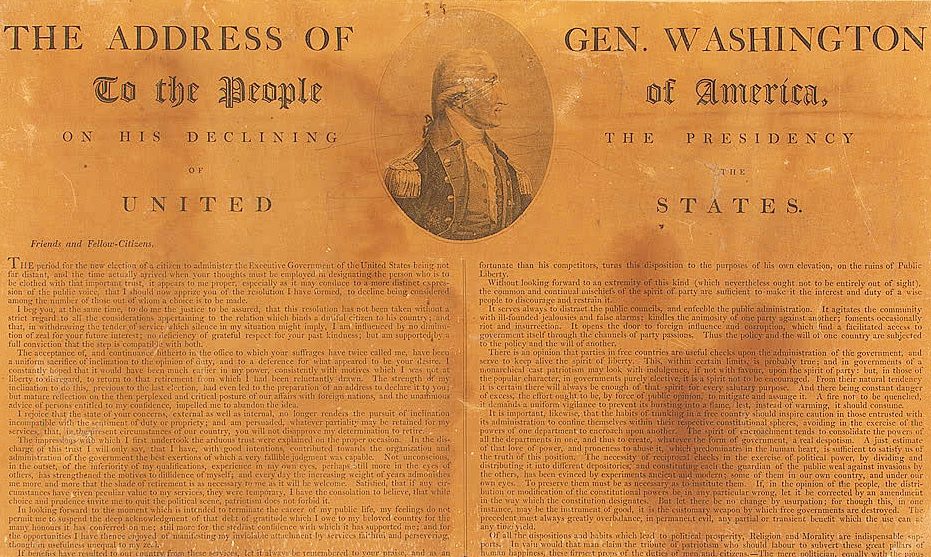
Washington's Farewell Address appeared in a Philadelphia newspaper on September 19, 1796, under the title The Address of Gen. Washington to the People of America on His Declining the Presidency of the United States. Madison had drafted a first version for him in 1792, and Hamilton worked on the final text.9 The passage quoted most often comes near the end.
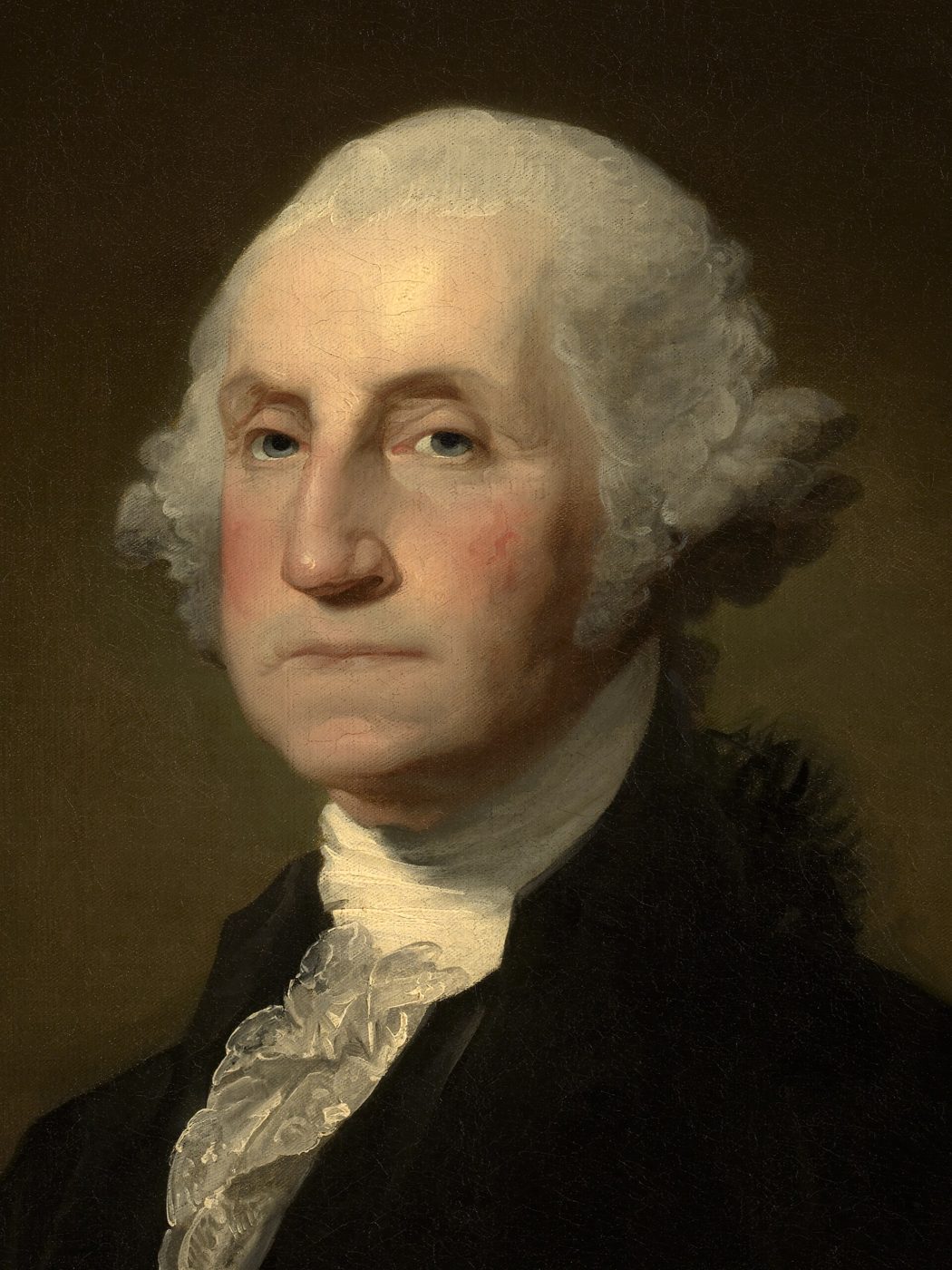
"Of all the dispositions and habits which lead to political prosperity, religion and morality are indispensable supports. In vain would that man claim the tribute of patriotism, who should labor to subvert these great pillars of human happiness, these firmest props of the duties of men and citizens. The mere politician, equally with the pious man, ought to respect and to cherish them."
George Washington, Farewell Address, 1796.10
"The mere politician," a man with no religion of his own, still has reason to defend it, because of what it does for the public. And the argument that follows is practical. "Where is the security for property, for reputation, for life, if the sense of religious obligation desert the oaths which are the instruments of investigation in courts of justice?"10 A court runs on testimony, and testimony runs on a conscience that fears something beyond the judge.
The concession, and the answer to it
Washington knew the objection. Some people are good without being devout. He gave that its due: "Whatever may be conceded to the influence of refined education on minds of peculiar structure, reason and experience both forbid us to expect that national morality can prevail in exclusion of religious principle."10 He allowed that some individuals manage it. He doubted that a whole nation could, and he said both reason and experience stood behind the doubt.
The next paragraph states the claim in political terms.
"It is substantially true that virtue or morality is a necessary spring of popular government. The rule, indeed, extends with more or less force to every species of free government. Who that is a sincere friend to it can look with indifference upon attempts to shake the foundation of the fabric?"
Washington, Farewell Address, 1796.11
A "spring" is where a river starts. Take it away and the channel dries. Washington did not leave the point there. He followed it with a call to "promote then, as an object of primary importance, institutions for the general diffusion of knowledge," since a government that gives force to public opinion needs that opinion to be enlightened.12 Faith, morals and schools go together in his thinking.
The same address warns about party spirit, a "fire not to be quenched" that demands "a uniform vigilance to prevent its bursting into a flame, lest, instead of warming, it should consume."13 That warning comes from the same worry. A people with no inward restraint will be restrained from outside, or not at all.
John Adams to the Militia, 1798
Two years after the Address the second president wrote a short letter that has been cited in many an argument over what the founders meant. On October 11, 1798, from Quincy, Adams answered an address from the officers of the first brigade of the third division of the Massachusetts militia, men who commanded about 2,800 soldiers, he noted. He thanked them, praised their "military Dignity," and then said what worried him.14
"Because We have no Government armed with Power capable of contending with human Passions unbridled by morality and Religion. Avarice, Ambition Revenge or Galantry, would break the strongest Cords of our Constitution as a Whale goes through a Net. Our Constitution was made only for a moral and religious People. It is wholly inadequate to the government of any other"
John Adams to the Massachusetts Militia, October 11, 1798.14
Take the logic apart. The government had no force to match human passion. Avarice, ambition, revenge and "Galantry" would "break the strongest Cords" of the Constitution "as a Whale goes through a Net" unless something other than the government held the people back. That something, Adams said, was morality and religion. The Constitution's authors had designed a government that would not do the work, and they were counting on citizens to do it.
Adams closed the letter on a smaller note that echoes Washington's point about courts. "Oaths, in this Country, are as yet universally considered as Sacred Obligations." He treated the soldiers' oath as "an ample Pledge of your sincerity, and devotion to your Country and its Government."15 The words "as yet" leave room for the habit to fade.
Rush: Education for a Republic
Benjamin Rush turned the argument into a school plan. His essay on education in a republic, dated 1798 in The Founders' Constitution, begins with the observation that independence had created "a new class of duties to every American."16 The duty he stressed most was the teaching of religion.
"The only foundation for a useful education in a republic is to be laid in Religion. Without this there can be no virtue, and without virtue there can be no liberty, and liberty is the object and life of all republican governments."
Benjamin Rush, "Of the Mode of Education Proper in a Republic."16
The chain has three steps, and Rush states them in order. Religion supports virtue. Virtue supports liberty. Liberty is the point of a republic. Pull out the first and the others go slack.
He then did something that surprises readers who expect a narrow sectarian. He wrote that he held "every religion that reveals the attributes of the Deity, or a future state of rewards and punishments" in such regard that he "had rather see the opinions of Confucius or Mahomed inculcated upon our youth, than see them grow up wholly devoid of a system of religious principles."17 A man who thought the New Testament the best foundation said that. For Rush, a young person with no religious principle at all was the worst outcome for a republic.
Having said so, he named the religion he meant to recommend: "that of the New Testament." And he made a claim that will strike modern readers as large: "A Christian cannot fail of being a republican." His reasons are specific. The Old Testament account of the creation of man, he wrote, is "the best refutation that can be given to the divine right of kings, and the strongest argument that can be used in favor of the original and natural equality of all mankind." The Gospel's precepts of humility, self-denial and brotherly kindness are "directly opposed to the pride of monarchy and the pageantry of a court."18
Lesson 1 laid out how Filmer read Genesis as a charter for kings and how Locke and Sidney read the same chapters the other way. Rush stands in their line, reading the book as a charter for equality under God.
Tocqueville's Report
A visitor from France supplied the outside check. Alexis de Tocqueville, writing in Democracy in America (in Henry Reeve's English translation), described religion in the United States as an institution outside the government that the government depended on.19
"Religion in America takes no direct part in the government of society, but it must nevertheless be regarded as the foremost of the political institutions of that country; for if it does not impart a taste for freedom, it facilitates the use of free institutions."
Alexis de Tocqueville, Democracy in America, vol. 1, Reeve translation.19
He also reported what Americans themselves believed. "I do not know whether all the Americans have a sincere faith in their religion, for who can search the human heart? but I am certain that they hold it to be indispensable to the maintenance of republican institutions."19 He claims nothing about the inner lives of his hosts, only about what they thought the republic needed. And elsewhere: "The Americans combine the notions of Christianity and of liberty so intimately in their minds, that it is impossible to make them conceive the one without the other."20
His own conclusion was aimed at men in France who wanted a republic and attacked religious opinions. "Despotism may govern without faith, but liberty cannot."21
Timeline
- June 28, 1787 Franklin moves for daily prayer in the Convention. The day ends in adjournment with no vote.
- Sept. 17, 1787 The Constitution is signed. The next day McHenry records Franklin's reply to Mrs. Powel.
- Feb. 1788 Federalist 55 (February 15) and 57 (February 19) appear in the New York Packet.
- Sept. 19, 1796 Washington's Farewell Address is published in Philadelphia.
- Oct. 11, 1798 Adams writes to the Massachusetts militia.
Five Voices, One Claim
| Speaker | Date | Claim | Source |
|---|---|---|---|
| Franklin | June 28, 1787 | An empire cannot rise "without his aid" | Madison's Notes |
| Madison (usual attribution) | February 1788 | Republican government "presupposes" virtue in the people | Federalist 55, 57 |
| Washington | 1796 | Religion and morality are "indispensable supports" | Farewell Address |
| Adams | October 11, 1798 | The Constitution was "made only for a moral and religious People" | Letter to the militia |
| Rush | dated 1798 | "Without virtue there can be no liberty" | Essay on education |
The five speak across eleven years and from very different places: a delegate in the Convention, a defender of the Constitution in the newspapers, a retiring president, a sitting president and a writer on schools. They agree on one point.
What the Constitution Forbids, and What It Assumes
A reader may take all this as a case for religious establishment. The founders did not mean it so. The Constitution itself says that "no religious Test shall ever be required as a Qualification to any Office or public Trust under the United States."22 Lesson 9 showed how the state declarations treated conscience. The government was to leave belief alone.
That is where Tocqueville's wording matters. Religion "takes no direct part in the government of society." The state does not command belief, and it does not test for it. The claim of Washington, Adams and Rush is about what holds a people together when the state does not, and they believed the answer was faith and the moral habits it teaches. That is a claim about culture, about what families and churches and schools hand on. It makes no demand on the Treasury.
The counter-argument has force. Plenty of unbelievers have been honest and public-spirited, and plenty of believers have been cruel. Washington conceded the first point himself. A republic needs virtue, the objection runs, and virtue has more than one source. A fair answer is that the founders were making an observation about nations, not about individuals. They had read the histories Rush mentions and had lived through a war. They concluded, from "reason and experience" in Washington's phrase, that the habit of restraint was hard to hold across generations without a shared belief that someone above the magistrate was watching. Readers can weigh that. What the sources do not support is the claim that the founders thought the question unimportant.
The Citizen's Part
If the founders are right, the load falls on ordinary people. The Constitution cannot make voters honest. Courts cannot make jurors fear perjury. Franklin's answer to Mrs. Powel put the burden where the founders put it, on "you," the keeper.
Idaho's constitution carries the same idea in its own words. Article I, Section 1 says that "all men are by nature free and equal, and have certain inalienable rights," among them "enjoying and defending life and liberty; acquiring, possessing and protecting property; pursuing happiness and securing safety."23 Article IX, Section 1 states the duty that follows from it: "The stability of a republican form of government depending mainly upon the intelligence of the people, it shall be the duty of the legislature of Idaho, to establish and maintain a general, uniform and thorough system of public, free common schools."24 Washington would have recognized the sentence. It echoes his call to diffuse knowledge, written into a state constitution, with a legislature assigned to carry it out.
For a resident of Idaho the practical lesson is close at hand. A school board election, a county commission seat, a precinct committee, a jury summons, a public meeting where the minutes are read aloud: these are the places where self-government is exercised or neglected. Someone must show up, read the budget, tell the truth under oath, and say no to a friend who is cutting a corner. The founders never claimed the work was pleasant. They claimed it could not be done by anyone else.
Learn more
- Madison's Notes, June 28, 1787: Franklin's speech and the whole day's debate, in Madison's own words.
- Washington's Farewell Address: Read the paragraphs on religion, morality, knowledge and party in context.
- "A Republic, If You Can Keep It" (Library of Congress): How teachers can use McHenry's journal entry, with a discussion of the source.
- Federalist No. 55: Where the Constitution's defender says republican government presupposes virtue.
- Rush on education in a republic: The full essay, including his plan for what the schools should teach.
- Tocqueville, Democracy in America, volume 1: Free full text of the Reeve translation, including the chapters on religion.
- Idaho Constitution, Article IX, Section 1: The state's own statement of why a republic needs schools.
Notes
- James Madison, Notes of Debates in the Federal Convention, Thursday, June 28, 1787, Franklin's speech and the discussion that followed (Avalon Project). Read it online. ↩
- Madison's Notes, June 28, 1787: Hamilton and others feared "disagreeable animadversions" and that the public might think the Convention in disarray; Franklin and Sherman answered that the rejection of the proposal would draw more criticism than its adoption. Read it online. ↩
- Madison's Notes, June 28, 1787: Williamson's remark that "The Convention had no funds"; Randolph's amendment for a sermon on the Fourth of July and prayers thereafter, seconded by Franklin; adjournment "carried, without any vote on the motion." Read it online. ↩
- James McHenry, Anecdote, in Max Farrand, ed., The Records of the Federal Convention of 1787, 3:85, reproduced in The Founders' Constitution, vol. 1, ch. 18, doc. 1 (University of Chicago Press). Read it online. ↩
- "A Republic, If You Can Keep It," Library of Congress, Teaching with the Library of Congress: the entry from McHenry's journal dated September 18, 1787, identifying the lady as Mrs. Powel of Philadelphia and noting McHenry's absence from the Convention from June 1 to August 4. Read it online. ↩
- The Federalist No. 51 (Avalon Project): "A dependence on the people is, no doubt, the primary control on the government; but experience has taught mankind the necessity of auxiliary precautions." Read it online. ↩
- The Federalist No. 55, New York Packet, February 15, 1788, attributed to Hamilton or Madison (Avalon Project); the usual attribution is to Madison. Read it online. ↩
- The Federalist No. 57, New York Packet, February 19, 1788, attributed to Hamilton or Madison (Avalon Project); the usual attribution is to Madison. Read it online. ↩
- "Washington's Farewell Address," Wikipedia: first published as The Address of Gen. Washington to the People of America on His Declining the Presidency of the United States in Claypoole's American Daily Advertiser on September 19, 1796; a first draft was prepared by Madison in 1792 and the final text was worked over with Hamilton. Read it online. ↩
- George Washington, Farewell Address, 1796, paragraph on religion and morality (Avalon Project). Read it online. ↩
- Washington, Farewell Address, 1796, the paragraph beginning "It is substantially true that virtue or morality is a necessary spring of popular government." Read it online. ↩
- Washington, Farewell Address, 1796, on knowledge: "Promote then, as an object of primary importance, institutions for the general diffusion of knowledge." Read it online. ↩
- Washington, Farewell Address, 1796, on the spirit of party: "A fire not to be quenched, it demands a uniform vigilance to prevent its bursting into a flame, lest, instead of warming, it should consume." Read it online. ↩
- John Adams to the Officers of the First Brigade of the Third Division of the Militia of Massachusetts, Quincy, October 11, 1798 (Hillsdale College transcription). The transcription ends the sentence at "any other" without a period. Read it online. ↩
- Adams to the Massachusetts Militia, October 11, 1798: "Oaths, in this Country, are as yet universally considered as Sacred Obligations." Read it online. ↩
- Benjamin Rush, "Of the Mode of Education Proper in a Republic," dated 1798 in The Founders' Constitution, vol. 1, ch. 18, doc. 30, reprinted from Selected Writings of Benjamin Rush, ed. Dagobert D. Runes (New York: Philosophical Library, 1947), 87 to 89, 92, 94 to 96. Read it online. ↩
- Rush, "Of the Mode of Education Proper in a Republic," on Confucius and the New Testament. Read it online. ↩
- Rush, "Of the Mode of Education Proper in a Republic," on the Christian as republican. Read it online. ↩
- Alexis de Tocqueville, Democracy in America, vol. 1, trans. Henry Reeve (Project Gutenberg eBook #815), the chapter on the principal causes that maintain the democratic republic, passage on religion. Read it online. ↩
- Tocqueville, Democracy in America, vol. 1, Reeve translation: "The Americans combine the notions of Christianity and of liberty so intimately in their minds, that it is impossible to make them conceive the one without the other." Read it online. ↩
- Tocqueville, Democracy in America, vol. 1, Reeve translation: "Despotism may govern without faith, but liberty cannot." Read it online. ↩
- U.S. Constitution, Article VI, clause 3 (National Archives transcription). Read it online. ↩
- Idaho Constitution, Article I, Section 1 (Idaho Legislature). Read it online. ↩
- Idaho Constitution, Article IX, Section 1 (Idaho Legislature). Read it online. ↩
Terms in this lesson
- Republic
- A government in which power is held by the people and exercised by elected officers who answer to them and rule under law.
- Civic virtue
- The habits of honesty, self-restraint and public spirit that let citizens govern themselves without a master.
- Farewell Address
- George Washington's 1796 letter to the American people on leaving the presidency, published in a Philadelphia newspaper.
- Religious test
- A requirement that an officeholder profess a belief. Article VI of the Constitution forbids one for any federal office or public trust.
- Oath
- A solemn promise made before God or on a person's honor, on which courts and public office have long depended.
- Auxiliary precautions
- Madison's phrase in Federalist 51 for the checks built into a government because the people's control alone is not enough.
Sources
- Madison's Notes of the Convention, June 28, 1787 (Avalon Project) checked 2026-10
- James McHenry, Anecdote (The Founders' Constitution) checked 2026-10
- "A Republic, If You Can Keep It" (Library of Congress, Teaching with the Library) checked 2026-10
- Federalist No. 55 (Avalon Project) checked 2026-10
- Federalist No. 57 (Avalon Project) checked 2026-10
- Washington's Farewell Address, 1796 (Avalon Project) checked 2026-10
- John Adams to the Massachusetts Militia, October 11, 1798 (Hillsdale College) checked 2026-10
- Benjamin Rush, Of the Mode of Education Proper in a Republic (The Founders' Constitution) checked 2026-10
- Tocqueville, Democracy in America, volume 1, Reeve translation (Project Gutenberg #815) checked 2026-10
- The Constitution of the United States: A Transcription (National Archives) checked 2026-10
- Idaho Constitution, Article IX, Section 1 (Idaho Legislature) checked 2026-10
- Washington's Farewell Address (Wikipedia) checked 2026-10