Lesson 7 of 10 · about 22 minutes
Montesquieu and the Separation of Powers
You'll be able to
- Explain Montesquieu's three powers and why he said liberty is lost when they are joined
- Describe how Madison in Federalist 47 defended the Constitution against the charge that it mixed the powers
- Read Federalist 51 and name the specific checks the Constitution gives each branch
- Explain Montesquieu's teaching that a popular government needs virtue, and the small-republic argument the Anti-Federalists drew from him
- Report accurately what Donald Lutz's 1984 study of citations found, including its limits
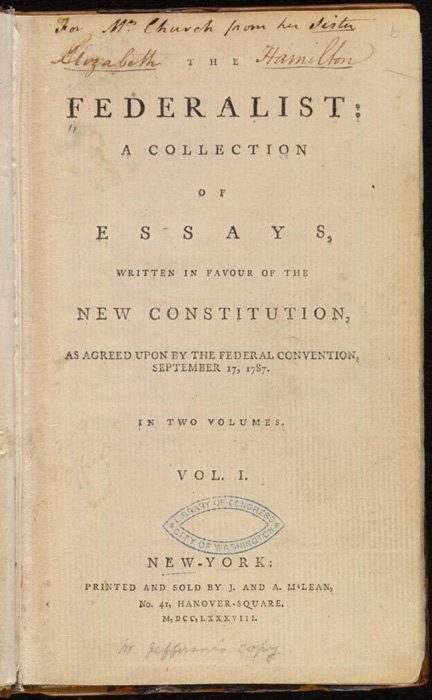
On February 1, 1788, readers of the New York Packet found James Madison writing under the name Publius about a man who had been dead for thirty-three years. The objection to the new Constitution, Madison said, was that it mixed the powers of government. The authority behind the objection was a Frenchman. "The oracle who is always consulted and cited on this subject," Madison wrote, "is the celebrated Montesquieu."12
It is an odd honor. Charles-Louis de Secondat, baron de Montesquieu, was a French nobleman and jurist who never saw America. He wrote about England after a visit and a lot of reading. Yet in the years of the founding, American writers quoted him more than any other European writer on government, and Madison thought it was worth a whole essay to say what he meant. This lesson is about that meaning, about what Madison did with it in Federalist 47 and 51, and about a famous piece of scholarship that tried to put numbers on the founders' reading.
The Baron of La Brede
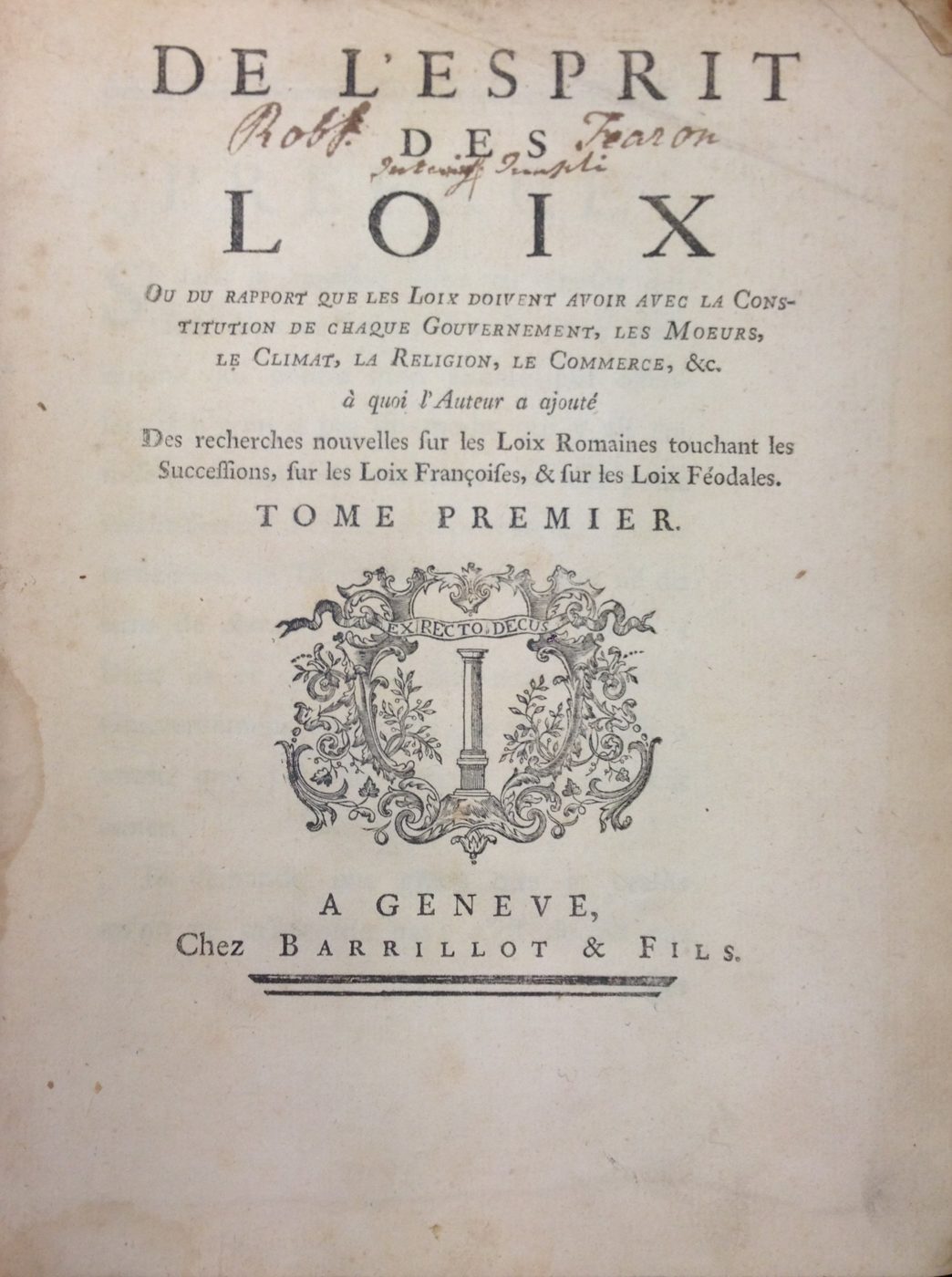
Montesquieu was born on January 18, 1689, at the Chateau de la Brede, south of Bordeaux, and died in Paris on February 10, 1755. He published De l'esprit des lois, The Spirit of Laws, anonymously in 1748. Thomas Nugent's English translation followed in 1750. The Catholic Church put the book on its Index of Prohibited Books in 1751, which did nothing to hurt its sales in Protestant lands.3
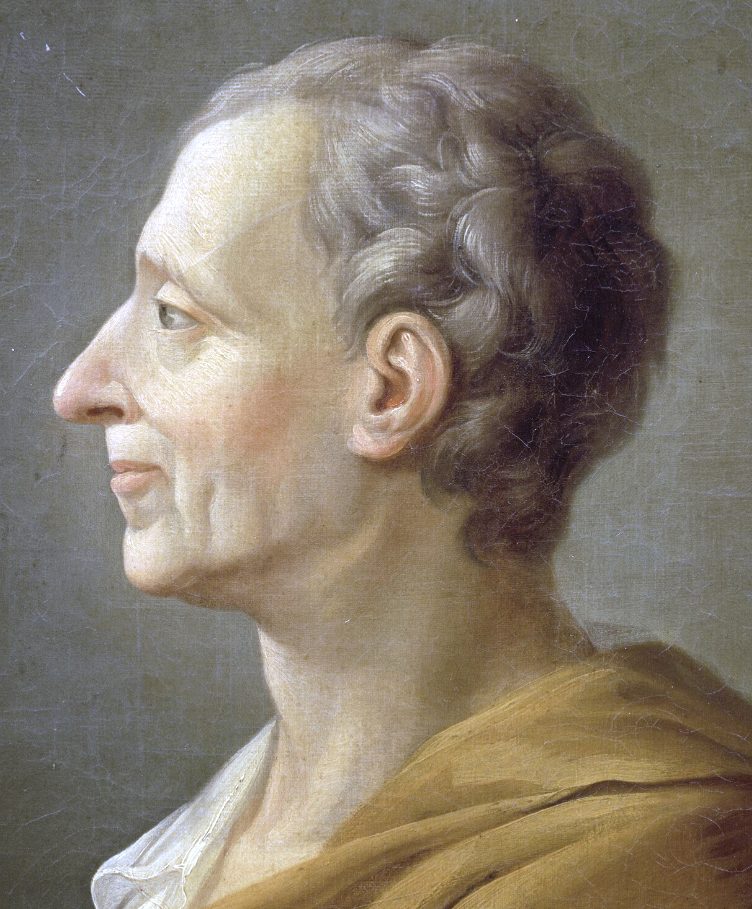
The book is huge, and most of it concerns climate, commerce, religion and the laws of dozens of nations. Americans read it for a few chapters. One was Book 11, chapter 6, "Of the Constitution of England." Another was Book 3 on the principles of the three kinds of government. A third, Book 8, chapter 16, on the size of republics, would turn up in the ratification fight as a weapon against the Constitution itself.
Three Powers and the Loss of Liberty
What Montesquieu wrote
Montesquieu begins Book 11, chapter 6 by counting. In every government there are three sorts of power: the legislative, the executive in matters of war, peace and public safety, and the executive in matters that depend on the civil law, meaning the power of punishing criminals and deciding disputes between individuals. He called the last the judiciary power.4 Then comes his definition of political liberty, which is an odd one. Montesquieu means a state of mind that comes from a certain kind of government, and he means something narrower than a right to do as one likes.
"The political liberty of the subject is a tranquillity of mind arising from the opinion each person has of his safety. In order to have this liberty, it is requisite the government be so constituted as one man need not be afraid of another."
Montesquieu, The Spirit of Laws, 1748, Book 11, chapter 6 (Nugent translation).4
From that, the famous rule follows. If the lawmaker and the law-enforcer are the same person or body, a citizen has reason to fear that tyrannical laws will be carried out in a tyrannical way. If the judge is also the lawmaker, "the life and liberty of the subject would be exposed to arbitrary control; for the judge would be then the legislator." If the judge is also the executive, "the judge might behave with violence and oppression." And if one man or one body, "whether of the nobles or of the people," held all three, "there would be an end of everything."4
Look at that last clause, "whether of the nobles or of the people." Montesquieu did not think the danger belonged to kings. A democratic assembly that makes the laws, runs the offices and judges the cases is as frightening as a sultan. In the Italian republics, he says, where the powers are united, there is less liberty than in the monarchies. The magistrates there "may plunder the state by their general determinations; and as they have likewise the judiciary power in their hands, every private citizen may be ruined by their particular decisions."4
What he did not claim
Montesquieu was careful about England. He did not say the English had perfected liberty. He wrote: "It is not my business to examine whether the English actually enjoy this liberty, or not. It is sufficient for my purpose to observe, that it is established by their laws; and I inquire no further."5 He was describing a model, and the model was what Americans took.
Madison Reads Montesquieu
The charge against the Constitution
The Constitution had been in the newspapers for four months when Madison took up the objection that it ran against the first principles of free government. Its opponents said the new government mixed the three powers. The President had a veto over bills, which was a piece of lawmaking. The Senate shared in appointments and treaties, which was a piece of executive work. Where, the critics asked, was the separation Montesquieu required?
Madison's answer
Madison began by granting the principle. "The accumulation of all powers, legislative, executive, and judiciary, in the same hands, whether of one, a few, or many, and whether hereditary, selfappointed, or elective, may justly be pronounced the very definition of tyranny."6 Then he went back to the text. When Montesquieu said that liberty ends if the legislative and executive powers are united in the same person or body, Madison argued, he did not mean the departments should have no share in each other's business:
"he did not mean that these departments ought to have no PARTIAL AGENCY in, or no CONTROL over, the acts of each other. His meaning, as his own words import, and still more conclusively as illustrated by the example in his eye, can amount to no more than this, that where the WHOLE power of one department is exercised by the same hands which possess the WHOLE power of another department, the fundamental principles of a free constitution are subverted."
James Madison, Federalist No. 47, February 1, 1788.7
That is a reading, and it is a fair one. Madison went to the British Constitution that Montesquieu had in view and found the powers by no means separate there. "The executive magistrate forms an integral part of the legislative authority," he wrote, and he "can put a negative on every law," though he cannot make one by himself.8 What Montesquieu feared was the whole of one power in the hands that held the whole of another. A veto does not make the President a legislature, and a Senate vote on a nomination does not make the Senate an executive.
Madison was arguing for ratification, so his reading of Montesquieu serves his case. It also stays close to what the chapter says. The Americans adopted a model of divided and overlapping powers, and they did so with their eyes open.
What the State Legislatures Had Taught Them
Madison's next essay went further. Federalist 48 argued that writing the boundaries into a constitution does nothing by itself. "Will it be sufficient," he asked, "to mark, with precision, the boundaries of these departments, in the constitution of the government, and to trust to these parchment barriers against the encroaching spirit of power?" Experience, he answered, said no. The early state constitutions had relied on exactly that, and the result was that "the legislative department is everywhere extending the sphere of its activity, and drawing all power into its impetuous vortex."9
The founders of the state republics, Madison observed, had spent their worry on the danger from a hereditary king. They had not looked for it in an elected assembly. To show what that meant in practice, he quoted Jefferson's Notes on the State of Virginia, which had examined Virginia's wartime constitution:
"All the powers of government, legislative, executive, and judiciary, result to the legislative body. The concentrating these in the same hands, is precisely the definition of despotic government. It will be no alleviation, that these powers will be exercised by a plurality of hands, and not by a single one. One hundred and seventy-three despots would surely be as oppressive as one."
Thomas Jefferson, Notes on the State of Virginia, as quoted in Federalist No. 48, February 1, 1788.9
That is Montesquieu's warning in an American voice, and it came from the man who wrote the Declaration. Jefferson went on, in the passage Madison quotes, to say that an "elective despotism" was not the government the colonists had fought for.9 A reader who hears the founders as enemies of democracy should read that sentence twice. They were enemies of unchecked power, and they counted an unchecked majority in an assembly as one more form of it.
Federalist 51 and the Machinery of Checks
A week after Federalist 47, the New York Packet printed Federalist 51, which Avalon attributes to "Hamilton or Madison" and which is usually given to Madison.10 It asks how the lines between the branches are to be kept in practice. Madison answers that the outside provisions have proved inadequate, so the government's inner structure must be contrived so that its parts "by their mutual relations, be the means of keeping each other in their proper places." Each department, he says, should "have a will of its own."11 The line people remember is this one: "Ambition must be made to counteract ambition."12 The essay then goes straight to the reason:
"If men were angels, no government would be necessary. If angels were to govern men, neither external nor internal controls on government would be necessary. In framing a government which is to be administered by men over men, the great difficulty lies in this: you must first enable the government to control the governed; and in the next place oblige it to control itself. A dependence on the people is, no doubt, the primary control on the government; but experience has taught mankind the necessity of auxiliary precautions."
Federalist No. 51, February 8, 1788.13
Notice the order. The primary control is the people. The separated powers are the auxiliary precautions. The ordering is Madison's own.
The Constitution supplies the machinery in plain text. Article I vests "All legislative Powers herein granted" in Congress. Article II vests "The executive Power" in a President. Article III vests "The judicial Power of the United States" in one Supreme Court and such lower courts as Congress creates.14 The table sets out the main checks each branch holds on the others.
| Branch | Check it holds | Where to find it |
|---|---|---|
| Congress over the President | The House holds "the sole Power of Impeachment," and the Senate "the sole Power to try all Impeachments," with two thirds required to convict. No money leaves the Treasury "but in Consequence of Appropriations made by Law." | Art. I, secs. 2, 3 and 9 |
| President over Congress | A bill the President returns with objections dies unless two thirds of each House vote to pass it again. | Art. I, sec. 7 |
| Senate over the President | Judges, ambassadors and other officers are appointed "by and with the Advice and Consent of the Senate." | Art. II, sec. 2 |
| President and Senate over the courts | The President nominates and the Senate confirms the judges, who then hold office "during good Behaviour," and whose pay "shall not be diminished." | Art. II, sec. 2; Art. III, sec. 1 |
Each entry in the table gives one branch a hand in another's work without giving it the whole of that work. That is Madison's partial agency in the flesh. The impeachment power lets the legislature reach the executive, and a two-thirds requirement keeps the weapon from being a casual one. The tenure and salary clauses keep the judges from depending on whichever branch is angry with them this year.
The Virtue a Republic Needs
Montesquieu's machinery was half his teaching. The other half was about people. In Book 3 he asks what makes each kind of government move. A monarchy runs on honor and a despotism on fear. A popular government runs on something harder to produce. "There is no great share of probity necessary to support a monarchical or despotic government," he writes. "The force of laws in one, and the prince's arm in the other, are sufficient to direct and maintain the whole. But in a popular state, one spring more is necessary, namely, virtue."15
The reasoning is easy to follow. In a monarchy the man who commands the execution of the laws "generally thinks himself above them." In a popular government the person entrusted with the laws "is sensible of his being subject to their direction."15 If citizens will not put the common good ahead of their own advantage, there is no master to make them do it, and a free people has no other.
He also described what the loss of that virtue looks like, in words a modern reader could apply to a school board or a city council: "they were free while under the restraint of laws, but they would fain now be free to act against law; and as each citizen is like a slave who has run away from his master, that which was a maxim of equity he calls rigour."16 It is a sharp description of license. The founders drew the same conclusion. Lesson 10 follows it through Washington and Adams.
The Small Republic Argument
Montesquieu also supplied the best case against the Constitution. In Book 8 he wrote that "it is natural for a republic to have only a small territory." In a large one, he said, there are men of large fortunes and little moderation, and trusts too considerable for any single person.17 The Anti-Federalist essayist who signed himself Brutus, probably the New York delegate Robert Yates, opened his campaign against the Constitution on October 18, 1787, by quoting that passage at length and asking whether a country as large as the United States could be governed as one republic.18
This is no small objection, and the Federalists treated it as a serious one. Madison's reply, in Federalist 10 five weeks later, turned Montesquieu on his head. A large republic, he argued, takes in a greater variety of parties and interests, which makes it less likely that a majority will share a common motive to wrong the rest.19 Both sides leaned on the same book. The debate shows how a source can be authoritative without being a script. Each side read Montesquieu for what helped it, and each could point to his words.
Counting What the Founders Cited
What Lutz did
How much did the founders actually read the Frenchman? In 1984 the political scientist Donald Lutz published an article in the American Political Science Review that tried to answer with numbers. He collected political writings by Americans from 1760 to 1805, reviewed about 15,000 items, and built a sample of 916 of them. They contained 3,154 references to 224 individuals. By his estimate the sample covered about one-third of all public political writing longer than 2,000 words.20
The findings are often retold in a garbled form, so the exact figures matter. Counting every source, the Bible came first, at 34 percent of all citations. Among European writers, Montesquieu led at 8.3 percent, Blackstone followed at 7.9, then Locke at 2.9 and Hume at 2.7.21 Lutz's summary line is worth reading in full. The results, he wrote, indicate "that there was no one European writer, or one tradition of writers, that dominated American political thought."22
Myth: Locke was the founders' chief teacher
Locke is the name most people remember, and he does matter, as lesson 6 showed. But in Lutz's count he trails Montesquieu and Blackstone by a wide margin, at 2.9 percent against 8.3 and 7.9. What the count suggests is that a writer's fame today and his weight in the founding generation's pamphlets are different things.21
What the numbers do not say
Lutz was careful about what a citation count shows, and so should anyone who uses it. It measures what writers named in print, not what shaped their thinking. The Bible's 34 percent is a good example. Lutz noted that reprinted sermons made up at least 10 percent of all pamphlets published, and that those sermons supplied almost three-fourths of the biblical citations. Deuteronomy was the most-cited book.23 So the Bible's lead came mostly from the pulpit and the printing of sermons, which were a main way political argument reached the public, and it was not mainly drawn from the secular pamphlets.
His 1787 to 1788 sample, the one on the Constitution itself, tells a different story. Lutz wrote that the debate over adopting the Constitution "was fought out mainly in the context of Montesquieu, Blackstone, the English Whigs, and major writers of the Enlightenment." In that sample the Federalists did not cite the Bible at all, while the Anti-Federalists did so 9 percent of the time.24 The honest conclusion has two parts. The founding generation as a whole drew heavily on Scripture, mostly through preaching. And when it sat down to design institutions, the authorities it named were Montesquieu and the writers of English law.
That fits the rest of this module. The founders took their idea of a law above rulers from natural law and Scripture, their account of rights from Locke and the common lawyers, and their design for dividing power from Montesquieu. A citizen who understands why each idea came from a different shelf is better placed to judge a modern proposal than one who has been told only that "the founders believed" something.
The Principle in Idaho
Montesquieu's rule did not stay in Philadelphia. Idaho's Constitution states it in so many words. Article II, Section 1 reads: "The powers of the government of this state are divided into three distinct departments, the legislative, executive and judicial; and no person or collection of persons charged with the exercise of powers properly belonging to one of these departments shall exercise any powers properly belonging to either of the others, except as in this constitution expressly directed or permitted."25 The text is blunter than anything in the federal document. A county commissioner, a legislator and a state agency head should each be able to name the department he serves and the lines that bind him.
For a citizen holding officials to account, this gives a practical question to ask of any action: which department is doing this, and does the Constitution give that department this power? Most abuse of authority starts when the answer is a shrug.
Timeline
- 1689 Montesquieu is born (January 18) near Bordeaux.
- 1748 The Spirit of Laws appears anonymously.
- 1750 Thomas Nugent publishes the first English translation.
- 1755 Montesquieu dies in Paris (February 10).
- 1787 Brutus I quotes Book 8 against the Constitution (October 18); Federalist 10 answers (November 23).
- 1788 Federalist 47 (February 1) and Federalist 51 (February 8) defend the separation of powers.
- 1984 Donald Lutz publishes his citation study in the American Political Science Review.
Learn more
- Montesquieu, Spirit of Laws, Book 11: Chapter 6 is only a few pages. Read it before you read what anyone says about it.
- Federalist No. 47: Madison on what Montesquieu meant, with the long run of state constitutions he cites in evidence.
- Federalist No. 51: The essay on checks and balances. It is shorter than most people expect.
- Brutus I: The Anti-Federalist case that a republic must stay small, with Montesquieu as the witness.
- The Constitution (National Archives): Check each of the checks in the table against the text.
- Idaho Constitution, Article II, Section 1: Idaho's own statement of the separation of powers.
Notes
- Madison, Federalist No. 47, New York Packet, February 1, 1788 (Avalon Project gives the date and attribution). Read it online. ↩
- Federalist No. 47: "The oracle who is always consulted and cited on this subject is the celebrated Montesquieu." Read it online. ↩
- "Montesquieu," Wikipedia: born January 18, 1689, at Chateau de la Brede near Bordeaux; died February 10, 1755; The Spirit of Law published anonymously in 1748; first English translation by Thomas Nugent, 1750; condemned by the Catholic Church (Index of Prohibited Books) in 1751. Read it online. ↩
- Montesquieu, The Spirit of Laws (1748), Book 11, chapter 6, "Of the Constitution of England," trans. Thomas Nugent. Read it online. ↩
- Montesquieu, The Spirit of Laws, Book 11, chapter 6: "It is not my business to examine whether the English actually enjoy this liberty, or not. It is sufficient for my purpose to observe, that it is established by their laws; and I inquire no further." Read it online. ↩
- Federalist No. 47: "The accumulation of all powers, legislative, executive, and judiciary, in the same hands, whether of one, a few, or many, and whether hereditary, selfappointed, or elective, may justly be pronounced the very definition of tyranny." The Avalon text prints "selfappointed" as one word. Read it online. ↩
- Federalist No. 47, on Montesquieu's meaning: he did not mean that the departments "ought to have no PARTIAL AGENCY in, or no CONTROL over, the acts of each other"; his meaning "can amount to no more than this, that where the WHOLE power of one department is exercised by the same hands which possess the WHOLE power of another department, the fundamental principles of a free constitution are subverted." Capitals as in the Avalon text. Read it online. ↩
- Federalist No. 47, on the British Constitution: "The executive magistrate forms an integral part of the legislative authority," and elsewhere, "The magistrate in whom the whole executive power resides cannot of himself make a law, though he can put a negative on every law." Read it online. ↩
- Madison, Federalist No. 48, New York Packet, February 1, 1788 (Avalon Project), including the passage quoted there from Jefferson, Notes on the State of Virginia (page 195 as cited by Madison). The words "An ELECTIVE DESPOTISM was not the government we fought for" appear in the same quotation. Read it online. ↩
- Federalist No. 51, New York Packet, February 8, 1788, attributed by Avalon to "Hamilton or Madison." Madison is the usual attribution. Read it online. ↩
- Federalist No. 51: "it is evident that each department should have a will of its own." Read it online. ↩
- Federalist No. 51: "Ambition must be made to counteract ambition." Read it online. ↩
- Federalist No. 51: "If men were angels, no government would be necessary. If angels were to govern men, neither external nor internal controls on government would be necessary. In framing a government which is to be administered by men over men, the great difficulty lies in this: you must first enable the government to control the governed; and in the next place oblige it to control itself. A dependence on the people is, no doubt, the primary control on the government; but experience has taught mankind the necessity of auxiliary precautions." Read it online. ↩
- U.S. Constitution, Article I, Sections 1, 2, 3, 7 and 9; Article II, Sections 1 and 2; Article III, Section 1 (National Archives transcript). Read it online. ↩
- Montesquieu, The Spirit of Laws, Book 3, chapter 3, "Of the Principle of Democracy." Read it online. ↩
- Montesquieu, The Spirit of Laws, Book 3, chapter 3, on the loss of virtue: "they were free while under the restraint of laws, but they would fain now be free to act against law." Read it online. ↩
- Montesquieu, The Spirit of Laws, Book 8, chapter 16, "Distinctive Properties of a Republic." Read it online. ↩
- Brutus, Essay I, October 18, 1787, quoting The Spirit of the Laws, Book 8, chapter 16 ("It is natural to a republic to have only a small territory, otherwise it cannot long subsist"). Brutus is generally assumed to be Robert Yates. Read it online. ↩
- Madison, Federalist No. 10, New York Packet, November 23, 1787, on extending the size of the republic so as to take in "a greater variety of parties and interests." Read it online. ↩
- Lutz 1984, p. 191, as quoted in Warren Throckmorton, "Institute on the Constitution Misrepresents Study of Founding Era" (September 24, 2013): about 15,000 items reviewed, a final sample of 916 items containing 3,154 references to 224 individuals; the sample "represents approximately one-third of all public political writings longer than 2,000 words." The article itself is behind a paywall. Read it online. ↩
- Percentages from Lutz's table as reproduced at Old Life Theological Society, "Independence Day After Glow" (July 2013), which lists Montesquieu 8.3, Blackstone 7.9, Locke 2.9 and Hume 2.7 percent of citations; the Bible's 34 percent is reported by Baptist News Global, "No, the U.S. Constitution is not based on the Book of Deuteronomy," from the same article. The author could not open the paywalled article to check the table directly. Old Life. Baptist News Global. ↩
- Donald S. Lutz, "The Relative Influence of European Writers on Late Eighteenth-Century American Political Thought," American Political Science Review 78, no. 1 (March 1984): 189 to 197, abstract: a citation count from 916 items published between 1760 and 1805, used "as a surrogate measure of the relative influence of European writers"; "there was no one European writer, or one tradition of writers, that dominated American political thought." Read the abstract online. ↩
- Lutz 1984, p. 192, as quoted by Throckmorton: reprinted sermons "amounting to at least 10% of all pamphlets published" and "accounted for almost three-fourths of the biblical citations"; Deuteronomy is named as the most-cited book. Read it online. ↩
- Lutz 1984, pp. 194 to 195, as quoted by Throckmorton and Old Life: "The debate surrounding the adoption of the Constitution was fought out mainly in the context of Montesquieu, Blackstone, the English Whigs, and major writers of the Enlightenment." Baptist News Global reports that in the 1787 to 1788 sample the Federalists cited the Bible 0 percent of the time and the Anti-Federalists 9 percent. Old Life. Baptist News Global. ↩
- Idaho Constitution, Article II, Section 1, "Departments of government." Read it online. ↩
Terms in this lesson
- Separation of powers
- The division of government into legislative, executive and judicial parts, each held by different hands.
- Checks and balances
- Powers given to each branch to restrain the others, so that no branch can take over the whole.
- Partial agency
- Madison's phrase for a limited share in another branch's work, such as the President's veto over bills.
- Republic
- A government in which the supreme power rests in the people or in a body chosen by them.
- Civic virtue
- In Montesquieu's sense, the habit of putting the common good ahead of private gain, which he held a popular government cannot do without.
- Citation count
- A tally of how often writers cite an author, used by Donald Lutz as a rough measure of influence.
- Anti-Federalists
- Opponents of the Constitution of 1787, who feared a large national government and wanted amendments.
Sources
- Montesquieu, The Spirit of Laws, Book 11, Nugent translation (constitution.org) checked 2026-10
- Montesquieu, The Spirit of Laws, Book 3 (constitution.org) checked 2026-10
- Montesquieu, The Spirit of Laws, Book 8 (constitution.org) checked 2026-10
- Federalist No. 47 (Avalon Project) checked 2026-10
- Federalist No. 48 (Avalon Project) checked 2026-10
- Federalist No. 51 (Avalon Project) checked 2026-10
- Federalist No. 10 (Avalon Project) checked 2026-10
- Brutus I, October 18, 1787 (Teaching American History) checked 2026-10
- Lutz, The Relative Influence of European Writers on Late Eighteenth-Century American Political Thought, APSR 1984 (abstract) checked 2026-10
- U.S. Constitution, transcript (National Archives) checked 2026-10
- Idaho Constitution, Article II, Section 1 (Idaho Legislature) checked 2026-10
- Montesquieu (Wikipedia) checked 2026-10