Lesson 9 of 10 · about 24 minutes
Rights in the Founding Documents
You'll be able to
- Name the main rights in the Virginia and Pennsylvania declarations of 1776 and the Massachusetts Constitution of 1780
- Quote what the Northwest Ordinance of 1787 said about religion, morality and knowledge and about slavery
- Summarize Madison's June 8, 1789 case for a bill of rights, including the objection he called the most plausible
- Trace the guarantees of the Bill of Rights to English documents and to the state declarations
- Explain what the Ninth and Tenth Amendments say and why they were written
On June 12, 1776, in Williamsburg, the Virginia Convention adopted a list of sixteen articles drafted mostly by George Mason. The vote was unanimous. It came three weeks before Congress adopted the Declaration of Independence in Philadelphia, and in that time it did something the Declaration did not. It turned the principles into rules that a court could apply and a citizen could point to.1
The Declaration says what rights are and where they come from. The documents in this lesson say what a government may not do. Over the next fifteen years, from Williamsburg to the First Congress, the American states and the new nation wrote those limits down in a form that lasted. Lesson 8 followed the argument that rights come from the Creator. This one follows the drafting, and it ends with the amendment that says what to do about rights nobody remembered to list.
Virginia, June 1776
Mason's draft
Mason drafted ten articles in late May 1776. A committee added three more and the full convention revised the whole, with Madison proposing to liberalize the article on religion and Patrick Henry persuading the delegates to drop a clause against bills of attainder.2 Article I, which lesson 8 quoted, states the natural rights. Article II calls magistrates "trustees and servants" of the people. The rest of the document turns to what governments must not do.
The rights of the accused
Articles VIII through XIII read like a checklist of colonial grievances. A man accused of a crime has "a right to demand the cause and nature of his accusation," to confront witnesses, to call evidence in his favor, and "to a speedy trial by an impartial jury of his vicinage, without whose unanimous consent he cannot be found guilty." No man may be compelled to testify against himself. Excessive bail, excessive fines and "cruel and unusual punishments" are forbidden. General warrants, "whereby any officer or messenger may be commanded to search suspected places without evidence of a fact committed," are "grievous and oppressive and ought not to be granted." The press, Article XII says, "is one of the greatest bulwarks of liberty and can never be restrained but by despotic governments."3
The militia article is an odd one to modern ears. Article XIII says that "a well regulated militia, composed of the body of the people, trained to arms, is the proper, natural, and safe defense of a free state," that standing armies in peacetime "should be avoided as dangerous to liberty," and that the military must be "under strict subordination to, and be governed by, the civil power."3 The Boston Massacre was six years behind these men and Lexington one year. They wrote from memory.
Virtue and religion
Two articles at the end deserve more attention than they usually get. Article XV says that "no free government, or the blessings of liberty, can be preserved to any people but by a firm adherence to justice, moderation, temperance, frugality, and virtue and by frequent recurrence to fundamental principles."4 A declaration of rights that stops to state a requirement on the people is unusual, and lesson 10 returns to it. Article XVI deals with religion. Religion, "or the duty which we owe to our Creator and the manner of discharging it, can be directed by reason and conviction, not by force or violence." All men are equally entitled to its free exercise "according to the dictates of conscience," and it is "the mutual duty of all to practice Christian forbearance, love, and charity towards each other."5 The article treats liberty of conscience as a duty to God and as a right against the state.
Pennsylvania, September 1776
Pennsylvania adopted its own constitution on September 28, 1776, with Benjamin Franklin signing as president of the convention. Its Declaration of Rights follows Virginia's closely. Article I says all men are "born equally free and independent, and have certain natural, inherent and inalienable rights," and lists "the enjoying and defending life and liberty, acquiring, possessing and protecting property, and pursuing and obtaining happiness and safety."6 The language is Mason's with small changes.
Where Pennsylvania went further is worth noting. Its Article XII gives "the people" a right "to freedom of speech, and of writing, and publishing their sentiments." Its Article XIII is the first of the documents in this lesson to say plainly that "the people have a right to bear arms for the defence of themselves and the state."7 And Article XIV is a bit like Virginia's XV, with a sharper edge: "a frequent recurrence to fundamental principles, and a firm adherence to justice, moderation, temperance, industry, and frugality are absolutely necessary to preserve the blessings of liberty." Pennsylvania adds that the people "ought therefore to pay particular attention to these points in the choice of officers and representatives."8 It is an instruction to voters. A free people is told to vote for officials who show those habits.
Pennsylvania also shows how unsettled the line between conscience and public religion still was. Article II says that all men have "a natural and unalienable right to worship Almighty God according to the dictates of their own consciences" and that no man may be compelled to support any ministry against his will. But the clause shielding a man from the loss of civil rights for his religion speaks of one who "acknowledges the being of a God."9 And the Frame of Government required each member of the Assembly to declare belief in "one God, the creator and governor of the universe" and to "acknowledge the Scriptures of the Old and New Testament to be given by Divine inspiration," while adding that "no further or other religious test shall ever hereafter be required of any civil officer or magistrate in this State."10 Today's reader may find that a narrow kind of liberty. It is the record of how the first generation drew the line, and it was not drawn in the same place everywhere.
Massachusetts, 1780
The Massachusetts Constitution of 1780 was written by a convention of 1779 and drafted principally by John Adams. The voters approved it on June 15, 1780, and it took effect on October 25.11 It is among the oldest written constitutions still in effect anywhere. Its Preamble states the purpose of the whole enterprise:
"The end of the institution, maintenance, and administration of government, is to secure the existence of the body politic, to protect it, and to furnish the individuals who compose it with the power of enjoying in safety and tranquility their natural rights, and the blessings of life: and whenever these great objects are not obtained, the people have a right to alter the government, and to take measures necessary for their safety, prosperity and happiness."
Constitution of the Commonwealth of Massachusetts, 1780, Preamble.12
Article I of the Declaration of Rights repeats the pattern: "All men are born free and equal, and have certain natural, essential, and unalienable rights," including the rights of "enjoying and defending their lives and liberties," "acquiring, possessing, and protecting property," and "seeking and obtaining their safety and happiness." The state has since replaced this article by amendment.13
Article III shows Adams's approach to religion and virtue. "As the happiness of a people, and the good order and preservation of civil government, essentially depend upon piety, religion and morality," it begins, the people have a right to authorize their legislature to require the towns to support "public Protestant teachers of piety, religion and morality."13 Where Virginia's Article XVI left religion to conscience and persuasion, Massachusetts kept a public, tax-supported, Protestant establishment. The state's own annotated text marks the article as later amended.13 The two states disagreed on the question, and both claimed the same principle of conscience.
One more article ties this lesson to lesson 7. Article XXX of the Declaration of Rights forbids each department of government to exercise the powers of the others, "to the end it may be a government of laws and not of men."14 The phrase "a government of laws and not of men" comes from Adams's constitution, and it puts Montesquieu's separation of powers in a sentence.
The Northwest Ordinance, 1787
While the Constitutional Convention met in Philadelphia, the old Confederation Congress in New York passed a law for the territory north of the Ohio River. The Northwest Ordinance of July 13, 1787, was in effect a bill of rights for the settlers of a region that Congress meant to divide into new states.15 Article 2 guaranteed habeas corpus, jury trial, bail except in capital cases, moderate fines, and "no cruel or unusual punishments," and said that no man could be deprived of liberty or property "but by the judgment of his peers or the law of the land."16 That last phrase echoes Magna Carta's clause 39.17
Two other articles became famous. The first is Article 3, which links education to the founders' account of self-government:
"Religion, morality, and knowledge, being necessary to good government and the happiness of mankind, schools and the means of education shall forever be encouraged."
Northwest Ordinance, July 13, 1787, Article 3.16
The same article promised that "the utmost good faith shall always be observed towards the Indians" and that their lands "shall never be taken from them without their consent." Whether the nation kept that promise is the subject of another module, though a reader should know it was made.16 The second famous article is Article 6: "There shall be neither slavery nor involuntary servitude in the said territory, otherwise than in the punishment of crimes whereof the party shall have been duly convicted." It carried a proviso allowing a fugitive from another state to be "lawfully reclaimed and conveyed to the person claiming his or her labor or service."16 It was a real limit on slavery's spread, and it was also a promise to return people who ran from it. Both halves of the article belong in the record.
Madison and the Bill of Rights, 1789
Why the Constitution lacked one
The Constitution of 1787 had no bill of rights. Its supporters argued that the new government held only the powers listed, so a list of exceptions was needless and might even be dangerous. Several state conventions asked for amendments, and Madison, who had not thought a list essential, changed course. In March 1789, Jefferson wrote him an argument Madison had omitted: a declaration of rights gives "the legal check which it puts into the hands of the judiciary."18
Madison's doubts, October 1788
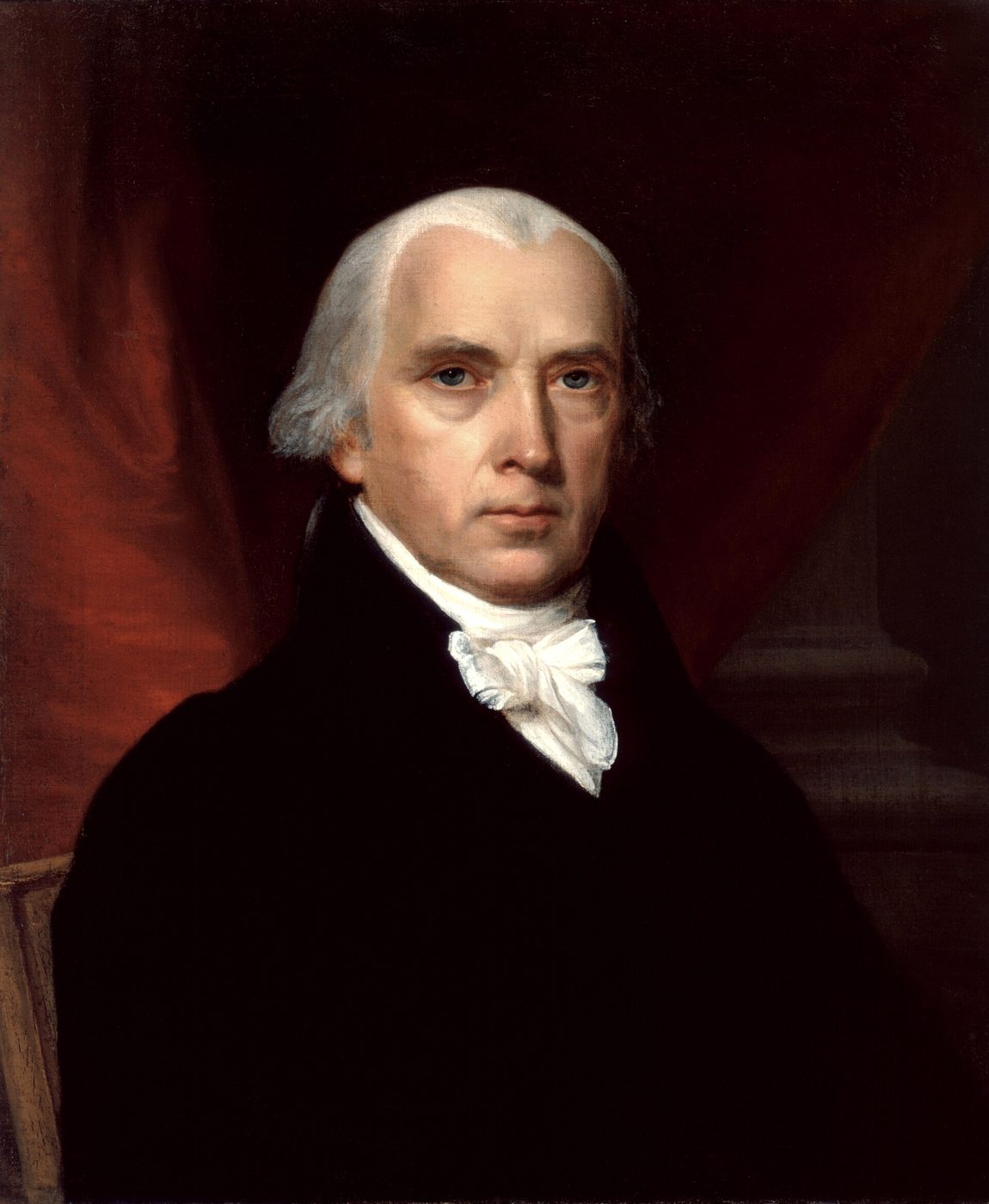
Madison's reluctance was real, and he put it in writing to Jefferson in Paris on October 17, 1788. "My own opinion has always been in favor of a bill of rights," he wrote, "provided it be so framed as not to imply powers not meant to be included in the enumeration." But he added that he had "never thought the omission a material defect," because experience had shown how little a written list could do when it mattered most. "Repeated violations of these parchment barriers have been committed by overbearing majorities in every State." He pointed to Virginia, where he had seen the bill of rights "violated in every instance where it has been opposed to a popular current."19 His conclusion was a rule of thumb for anyone who watches government: "Wherever the real power in a Government lies, there is the danger of oppression."19
Notice what he is worried about. He does not fear the executive. He fears an assembly backed by a loud majority, and he believes a list of rights will help only if people respect it. That is why he later told the House that the amendments would teach the public to expect more of its rulers.
The June 8 speech
On June 8, 1789, in the first House of Representatives, Madison introduced the amendments. He did not claim to love the idea at the start. He said he "never considered this provision so essential to the federal constitution, as to make it improper to ratify it." But he said it was "neither improper nor altogether useless," and he named the purpose plainly: "the great object in view is to limit and qualify the powers of government, by excepting out of the grant of power those cases in which the government ought not to act, or to act only in a particular mode."20
He faced the objection head on. The strongest argument against a bill of rights, he said, was that listing certain rights would imply that the unlisted ones had been handed to the government. "This is one of the most plausible arguments I have ever heard urged against the admission of a bill of rights into this system; but, I conceive, that may be guarded against."20 The guard he proposed became the Ninth Amendment.
Madison also admitted that paper limits are weak. "It may be thought all paper barriers against the power of the community, are too weak to be worthy of attention," he said, and in a government like ours, "the great danger lies rather in the abuse of the community than in the legislative body." But a declaration of rights, he argued, impresses respect on the public, and it will turn the courts into defenders: "independent tribunals of justice will consider themselves in a peculiar manner the guardians of those rights; they will be an impenetrable bulwark against every assumption of power in the legislative or executive."20
His proposals also included a clause on separated powers, that "the legislative department shall never exercise the powers vested in the executive or judicial," and so on.20 That clause is not in the twelve articles Congress sent to the states.21 Massachusetts and Idaho kept the principle in their own constitutions, and the federal Constitution relies on its structure.
From Proposal to Law
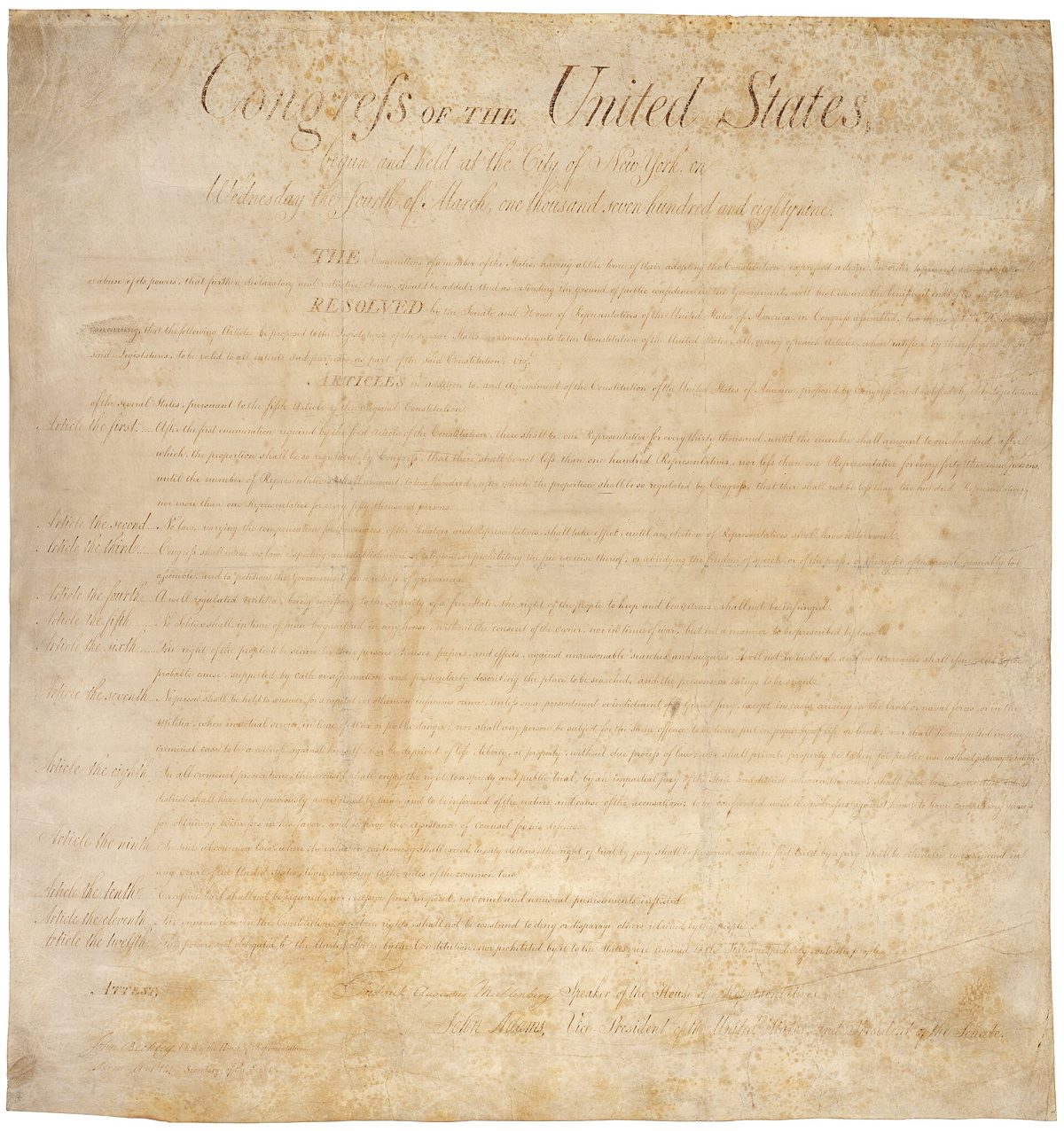
The First Congress proposed twelve amendments on September 25, 1789. Its joint resolution said the state conventions had expressed a desire "in order to prevent misconstruction or abuse" of the new government's powers "that further declaratory and restrictive clauses should be added." Ten of the twelve were ratified by three-fourths of the states on December 15, 1791. One of the two that failed, on congressional pay, was ratified in 1992 as the Twenty-Seventh Amendment.21
The Ninth and Tenth Amendments close the list and explain it. The Ninth: "The enumeration in the Constitution, of certain rights, shall not be construed to deny or disparage others retained by the people." The Tenth: "The powers not delegated to the United States by the Constitution, nor prohibited by it to the States, are reserved to the States respectively, or to the people."21 Read together they say that rights come first and government powers are a short, written exception. Samuel Adams's 1772 line that every natural right "not expressly given up" remains is the idea behind the Ninth.
The Rights and Their Ancestors
| Right | English source | State declaration, 1776 | Federal Bill of Rights |
|---|---|---|---|
| Trial by one's peers | Magna Carta (1215), clause 39: "the lawful judgment of his peers or by the law of the land" | Virginia VIII: "an impartial jury of his vicinage" | Sixth and Seventh Amendments |
| No excessive bail or cruel punishment | English Bill of Rights (1689): "excessive bail ought not to be required, nor excessive fines imposed, nor cruel and unusual punishments inflicted"22 | Virginia IX, repeating the 1689 words | Eighth Amendment |
| Petition | English Bill of Rights: "the right of the subjects to petition the king" | Pennsylvania XVI and Massachusetts XIX23 | First Amendment: "to petition the Government for a redress of grievances" |
| Arms and a militia | English Bill of Rights: "the subjects which are Protestants may have arms for their defence suitable to their conditions and as allowed by law" | Virginia XIII, a militia; Pennsylvania XIII: "the people have a right to bear arms" | Second Amendment |
| No peacetime standing army or quartering | English Bill of Rights: a standing army in peacetime without Parliament's consent "is against law" | Virginia XIII | Third Amendment |
| Freedom from general warrants | (Lesson 4, the writs of assistance) | Virginia X | Fourth Amendment |
| Press and religion | No direct parallel in the 1689 declaration | Virginia XII and XVI; Pennsylvania II and XII | First Amendment |
The table shows two things. Most of the guarantees came straight from the English tradition, sometimes in the very words of 1689, and the colonists claimed them as their inheritance. And a few, including freedom of the press, a wide freedom of conscience and a right of "the people" to bear arms, took a broader form in America than they had in England. The English Bill of Rights allowed arms to Protestants "as allowed by law." Pennsylvania in 1776 spoke of "the people" without a qualifier. The founders did not simply copy their ancestors. They kept what had worked, widened some of it, and wrote it down where the next legislature could not quietly erase it.
What the Documents Ask of Citizens
A reader of these documents in order will notice that the guarantees are only half of what they say. Virginia's XV and Pennsylvania's XIV tell the people they must keep "justice, moderation, temperance, frugality, and virtue" if they want to stay free. Massachusetts in Article III ties public order to piety, religion and morality. The Northwest Ordinance puts "religion, morality, and knowledge" at the head of what a good government needs. And Madison said the real danger lay in "the abuse of the community," meaning majorities.
That is the ordered-liberty case in the founders' own words. Rights are written down so that the government cannot take them. They hold only as long as a people with some discipline keeps choosing officials who respect them. A parchment, Madison knew, enforces nothing. He wanted it anyway, because it teaches, and teaching is how a public learns to expect better of its rulers.
Timeline
- 1689 English Bill of Rights.
- 1776 Virginia Declaration of Rights (June 12). Pennsylvania Constitution and Declaration of Rights (September 28).
- 1780 Massachusetts Constitution approved (June 15) and in effect (October 25).
- 1787 Northwest Ordinance (July 13).
- 1789 Madison introduces amendments (June 8). Congress proposes twelve (September 25).
- 1791 Ten amendments ratified (December 15).
- 1992 The second proposed article, on congressional pay, is ratified as the Twenty-Seventh Amendment.
Learn more
- Virginia Declaration of Rights: Sixteen articles, short enough to read twice in ten minutes.
- Pennsylvania Constitution of 1776: Read the Declaration of Rights and then section 10 of the Frame of Government.
- Massachusetts Constitution: The oldest written constitution in use, with its amendments marked.
- The Northwest Ordinance: Six articles that governed the territory that became five states.
- Madison's June 8, 1789 speech: The best single explanation of why the amendments were written.
- The Bill of Rights (National Archives): The 1789 joint resolution with all twelve proposed articles.
Notes
- Virginia Declaration of Rights, adopted unanimously June 12, 1776, by the Virginia Convention of Delegates, drafted by George Mason (Avalon Project). Read it online. ↩
- "Virginia Declaration of Rights," Wikipedia: Mason drafted ten articles about May 20 to 26, 1776; three more were added in committee; Madison proposed liberalizing the religion article and the convention made further changes; Patrick Henry persuaded the convention to delete a clause on bills of attainder. Read it online. ↩
- Virginia Declaration of Rights, Articles VIII to XIII. Read it online. ↩
- Virginia Declaration of Rights, Article XV. Read it online. ↩
- Virginia Declaration of Rights, Article XVI. Read it online. ↩
- Constitution of Pennsylvania, "Passed in Convention the 28th day of September, 1776," signed by Benjamin Franklin as president, with the Declaration of Rights, Articles I, II, IX to XIV (Avalon Project). Read it online. ↩
- Constitution of Pennsylvania (1776), Declaration of Rights, Articles XII and XIII. Read it online. ↩
- Constitution of Pennsylvania (1776), Declaration of Rights, Article XIV. Read it online. ↩
- Constitution of Pennsylvania (1776), Declaration of Rights, Article II. Read it online. ↩
- Constitution of Pennsylvania (1776), Frame of Government, section 10, oath of members of the House of Representatives. Read it online. ↩
- "Constitution of Massachusetts," Wikipedia: among the oldest functioning written constitutions in the world; created by the Massachusetts Constitutional Convention of 1779, primarily authored by John Adams, approved by voters June 15, 1780, effective October 25, 1780. Read it online. ↩
- Constitution of the Commonwealth of Massachusetts (1780), Preamble. Read it online. ↩
- Constitution of the Commonwealth of Massachusetts (1780), Part the First, Articles I to III. The Legislature's text marks Article I as annulled by Amendments Article CVI and notes later amendments to Articles II and III. Read it online. ↩
- Constitution of the Commonwealth of Massachusetts (1780), Part the First, Article XXX. Read it online. ↩
- "Northwest Ordinance," Wikipedia: passed in New York in 1787 and providing for at least three but not more than five states in the territory. Read it online. ↩
- Northwest Ordinance, July 13, 1787, Articles 1, 2, 3 and 6 (Avalon Project, from Documents Illustrative of the Formation of the Union of the American States). Read it online. ↩
- Magna Carta (1215), clause 39 (Avalon Project translation). Read it online. ↩
- Thomas Jefferson to James Madison, March 15, 1789, on "the legal check which it puts into the hands of the judiciary," The Papers of Thomas Jefferson, vol. 14, pp. 659 to 661, as reprinted in The Founders' Constitution, vol. 1, ch. 14, doc. 49. Read it online. ↩
- James Madison to Thomas Jefferson, October 17, 1788, The Papers of James Madison, vol. 11, pp. 297 to 300, as reprinted in The Founders' Constitution, vol. 1, ch. 14, doc. 47. Read it online. ↩
- James Madison, speech to the House of Representatives, June 8, 1789, The Papers of James Madison, vol. 12, pp. 196 to 209, as reprinted in The Founders' Constitution, vol. 1, ch. 14, doc. 50. Read it online. ↩
- The Bill of Rights, National Archives: the First Congress proposed 12 amendments on September 25, 1789; ten were ratified on December 15, 1791; Article 2 was ratified in 1992 as the 27th Amendment; Article 1 was never ratified. The text of each article is quoted from the Archives' transcription of the joint resolution. Read it online. ↩
- English Bill of Rights (1689), declaration of rights (Avalon Project). Read it online. ↩
- Constitution of Pennsylvania (1776), Declaration of Rights, Article XVI, and Constitution of Massachusetts (1780), Article XIX, on assembling and petitioning. Pennsylvania. Massachusetts. ↩
Terms in this lesson
- Declaration of rights
- A list of rights placed at the front of a constitution, as in Virginia in 1776 and Massachusetts in 1780.
- Northwest Ordinance
- The 1787 act of the Confederation Congress that set up government in the territory north of the Ohio River and guaranteed certain rights there.
- Bill of Rights
- The first ten amendments to the Constitution, ratified on December 15, 1791.
- Ninth Amendment
- The amendment saying that listing certain rights does not deny or disparage others retained by the people.
- Tenth Amendment
- The amendment reserving powers not delegated to the United States to the states or to the people.
- Paper barrier
- Madison's name for a written limit on power that depends on public respect to work.
- Religious test
- A requirement that an officeholder profess certain beliefs.
Sources
- Virginia Declaration of Rights, 1776 (Avalon Project) checked 2026-10
- Constitution of Pennsylvania, 1776 (Avalon Project) checked 2026-10
- Constitution of the Commonwealth of Massachusetts (Massachusetts Legislature) checked 2026-10
- Northwest Ordinance, 1787 (Avalon Project) checked 2026-10
- Madison, speech to the House, June 8, 1789 (The Founders' Constitution) checked 2026-10
- Jefferson to Madison, March 15, 1789 (The Founders' Constitution) checked 2026-10
- The Bill of Rights, transcript (National Archives) checked 2026-10
- English Bill of Rights, 1689 (Avalon Project) checked 2026-10
- Magna Carta, 1215 (Avalon Project) checked 2026-10
- Virginia Declaration of Rights (Wikipedia) checked 2026-10
- Constitution of Massachusetts (Wikipedia) checked 2026-10