Lesson 4 of 10 · about 24 minutes
The Common Law: Custom, Precedent and the Jury
You'll be able to
- Define the common law as law made by custom, precedent and juries rather than by statute alone
- Explain Coke's answer to King James in the Case of Prohibitions and what Dr. Bonham's Case said and did not say
- Describe how the Zenger trial of 1735 and the writs of assistance case of 1761 used the common law against colonial officials
- Connect the common law and the jury to the First Continental Congress's claim of 1774 and to the Fifth, Sixth and Seventh Amendments
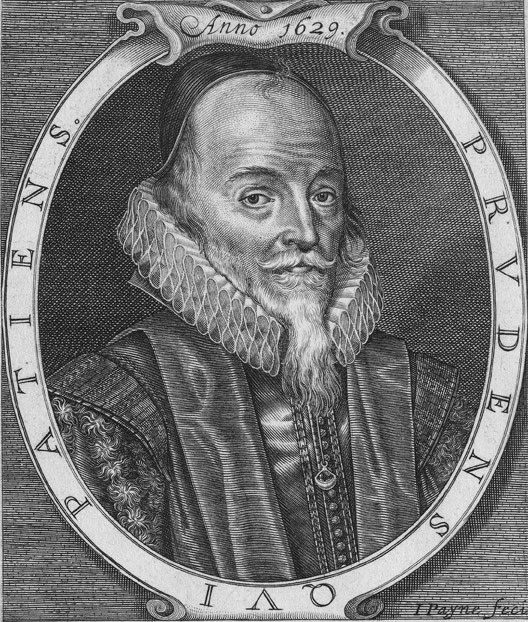
In November 1607, by Coke's own dating, King James I of England summoned his judges to a private meeting and announced that he meant to try cases himself. The Archbishop of Canterbury, Richard Bancroft, backed him. Bancroft told the king that the judges were only his delegates, that he could take any case he liked out of their hands, and that it was "clear in Divinity" that this authority belonged to the king "by the Word of God in the Scripture."1
The Chief Justice of the Court of Common Pleas, Sir Edward Coke, was in the room. He later wrote down what he said, and he said it plainly. The king, he told James, "in his own person cannot adjudge any case." Cases had to be decided in a court of justice, "according to the Law and Custom of England."1 The king was not pleased. According to Coke, James said that he thought the law was founded on reason, and that he and others had reason as well as the judges.
That exchange belongs to this module because of what Coke said next. It opens the history of the English common law as the colonists understood it: a body of law the king could not rewrite by himself, kept by judges and juries who answered to the law first. To see why Coke could say it, and why Americans repeated him for two centuries, we have to see what the common law was.
What the Common Law Is
Most people picture law as statutes: a legislature votes, the governor signs, and a rule appears in a code book. The common law works from another end. It grows out of decided cases and old custom. A judge faces a dispute, asks what the law has already said about similar disputes, and decides. His decision becomes part of what later judges must consider. Over centuries the decisions pile up into rules about contracts, property, wrongs and crimes that no legislature ever sat down and wrote.
William Blackstone, whom lesson 5 takes up in full, described it as the "lex non scripta, the unwritten, or common law," and set it against "the lex scripta, the written, or statute law."2 He explained how an unwritten law stays steady. Judges, he wrote, are "the depositary of the laws; the living oracles." They decide by experience of earlier decisions, and:
"it is an established rule to abide by former precedents, where the same points come again in litigation; as well to keep the scale of justice even and steady, and not liable to waver with every new judge's opinion ... he being sworn to determine, not according to his own private judgment, but according to the known laws and customs of the land; not delegated to pronounce a new law, but to maintain and expound the old one."
William Blackstone, Commentaries on the Laws of England, 1765, Introduction, section 3.3
That is the theory. A judge applies the law he finds, and does not invent it. The practice is more complicated, as every later student of the common law has noted. In 1881 Oliver Wendell Holmes Jr. wrote the line that every law student remembers: "The life of the law has not been logic: it has been experience."4 Holmes meant that the common law bends over time to the "felt necessities of the time" and the moral sense of the community. Blackstone's picture and Holmes's picture are both true. The common law is steady enough to bind a king and flexible enough to meet a new problem.
For Americans the practical gain was large. Property, contracts, wills, damages, and crimes like murder and theft were governed by rules a colonial lawyer could look up in the books, rules that had been worked out in actual disputes. No governor or legislature could change them by decree. Whoever wanted to alter them had to pass a statute, in public, and answer for it.
Where It Came From
The common law took shape in the twelfth century, under Henry II (1154 to 1189). Henry sent royal judges out on circuit through the shires to hear cases in the king's name. The judges compared notes. Local customs gave way to rules that held throughout the kingdom, "common" to the whole realm. About 1188 a treatise on the laws and customs of England, probably written by Henry's chief justiciar, Ranulf de Glanvill, set down the royal courts' procedures in writing.5
A second treatise appeared in the thirteenth century, On the Laws and Customs of England, usually credited to the judge and cleric Henry de Bracton, who lived from about 1210 to about 1268. Bracton wrote a sentence that English lawyers repeated for four centuries. In the modern translation by Samuel Thorne:
"The king must not be under man but under God and under the law, because law makes the king."
Henry de Bracton, On the Laws and Customs of England, about 1250, f. 5b (Thorne translation).6
A fair reader should add what Bracton says next, since it keeps the sentence from meaning more than it does. He adds that no writ runs against the king, so a wronged subject could only petition him to correct his act, and that if the king refused it was "punishment enough for him that he await God's vengeance."6 Bracton's king was under the law morally and in conscience. No court could force him. The long struggle from Bracton to Coke was to turn that moral claim into a legal one, with real remedies.
The Jury
The common law's other great instrument was the jury. In 1166 Henry II's Assize of Clarendon required local men to come before the royal justices and report under oath who in their neighborhood was suspected of murder, robbery and other serious crimes. Those sworn men were the ancestors of the grand jury.7 The trial jury grew up a few decades later, after 1215, when the Fourth Lateran Council forbade clergymen to take part in trial by ordeal, and England needed another way to decide guilt.7 Twelve neighbors, who knew the community and swore an oath, found the facts.
The jury was more than a procedure. It put the people between the individual and the Crown. A prosecutor needed twelve of a man's neighbors to agree. In the seventeenth century the courts tested how far that protection went. In 1670 two Quakers, William Penn and William Mead, were tried at the Old Bailey in London for unlawful assembly. The jury, with Edward Bushel as foreman, refused to convict despite the judge's pressure. The court locked them up without food and fined them. Bushel would not pay, and Chief Justice Sir John Vaughan freed him on a writ of habeas corpus, holding that a jury may not be punished for its verdict.8 Bushel's Case settled that English juries decide as they see fit, and the judges cannot make them convict.
The colonists knew all this by heart. The First Continental Congress claimed it in 1774. The Declaration of Independence charged George III with "depriving us in many cases, of the benefits of Trial by Jury."9 And the Bill of Rights wrote the common-law jury into the Constitution three times. The Fifth Amendment requires a grand jury for serious federal crimes. The Sixth guarantees "an impartial jury of the State and district wherein the crime shall have been committed." The Seventh preserves the right of trial by jury "in suits at common law," and bars any court from reexamining a jury's fact finding "otherwise ... than according to the rules of the common law."10
Coke Against the King
The Case of Prohibitions, 1607
Go back to the scene from the opening. James, a learned man who wrote a book on the divine right of kings, thought that a king might judge. Coke's answer was recorded in his own report of the case, Prohibitions del Roy. When the king said the law was founded on reason and that he had as much reason as the judges, Coke replied that God had indeed endowed His Majesty with great learning, but that His Majesty was not learned in the laws of England. Cases touching a subject's life, inheritance, goods or fortunes:
"are not to be decided by natural Reason, but by the artificial Reason and Judgment of Law."
Sir Edward Coke, Reports, part 12, "Prohibitions del Roy," 1607.11
"Artificial reason" meant reason trained by long study of the cases. Coke added that the law was the "Golden Met-wand and Measure to try the Causes of the Subjects; and which protected his Majesty in Safety and Peace." The king, in a rage according to Coke, said that then he would be under the law, "which was Treason to affirm." Coke answered with Bracton: "quod Rex non debet esse sub homine, sed sub Deo et Lege," that the king ought to be under no man but under God and the law.11
The Archbishop's claim that divine authority belonged to the king gets a pointed answer in the same report. Coke recorded that it "was greatly marvelled that the Archbishop durst inform the King, that such absolute Power and Authority ... belonged to the King by the Word of God."12 It is the same fight lesson 1 described between Filmer and his critics, here in the form of a judge's rebuke.
Dr. Bonham's Case, 1610
Three years later Coke wrote the most famous passage in English constitutional law, and probably the most misunderstood. Thomas Bonham, a physician with a Cambridge degree, had been fined and jailed by the Royal College of Physicians in London for practicing without their license. The College kept half of the fines it imposed. Coke ruled for Bonham on the plain ground that the College could not be a judge in its own cause, since it had a money interest in the verdict: "the censors cannot be judges, ministers, and parties." Then he added a remark that went far beyond the facts:
"And it appears in our books, that in many cases, the common law will controul acts of parliament, and sometimes adjudge them to be utterly void: for when an act of parliament is against common right and reason, or repugnant, or impossible to be performed, the common law will controul it, and adjudge such act to be void."
Sir Edward Coke, Dr. Bonham's Case, 8 Co. Rep. 107a, 118a (Court of Common Pleas, 1610).13
Scholars still argue about what Coke meant. One reading says he was describing how a judge should interpret a statute narrowly when it would otherwise lead to an absurd result. Another says he claimed a power in the courts to strike down laws that violated fundamental principles. Coke's own authorities in the passage did not clearly support the stronger claim, and later critics have said so.14 King James disliked the case. In 1613 Coke was moved from the Common Pleas to the King's Bench, and in 1616 he was suspended from office altogether.14
In England the case did not last. Blackstone, writing 150 years later, rejected the stronger reading and held that no power could control an act of Parliament once it spoke plainly. But in America the sentence had a second life, as lesson 5 will show. Colonial lawyers read it as saying that a government has no authority to pass an unreasonable law. They quoted it in 1761.
John Peter Zenger and the Jury, 1735
In 1732 William Cosby arrived in New York as royal governor. He quarreled with the colony's leading men, removed a chief justice who ruled against him, and went after the one newspaper that spoke for his opponents. In 1733 a German immigrant printer, John Peter Zenger, began publishing the New York Weekly Journal. It attacked Cosby in plain language. Cosby wanted Zenger prosecuted for seditious libel. Two grand juries refused to indict him. So the governor's attorney general filed an "information" directly, and on November 17, 1734, the sheriff arrested Zenger. He spent eight months in jail waiting for trial.15
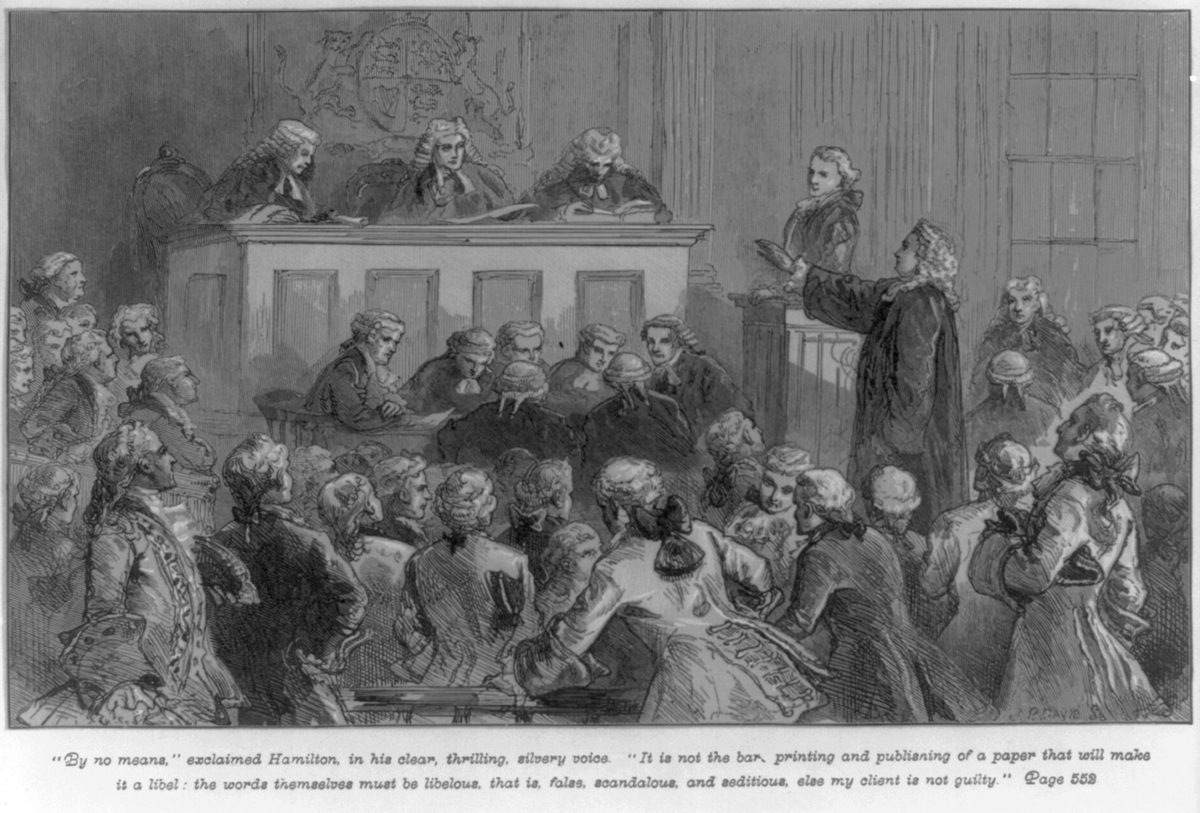
The law as the judges stated it was against him. Seditious libel meant publishing words that tended to disturb the peace by criticizing the government, and under the old rule truth was no defense. The more true a libel, the more provoking it was. The attorney general said as much. Zenger's lawyers were disbarred for objecting to the judges, so his friends brought in Andrew Hamilton, an aging and famous Philadelphia lawyer. The trial opened on August 4, 1735, in New York's City Hall.15
Hamilton admitted at once that Zenger had printed the papers, and he argued that the words were not libelous because they were true. Chief Justice James DeLancey ruled that truth could not be offered as evidence. Hamilton then told the court exactly what he planned to do:
"I know that they have the right beyond all dispute to determine both the law and the fact; and where they do not doubt of the law, they ought to do so. Leaving it to judgment of the court whether the words are libelous or not in effect renders juries useless (to say no worse) in many cases."
Andrew Hamilton, Trial of John Peter Zenger, August 1735, as printed in Zenger's A Brief Narrative (1736).16
He asked the jury to look past the judges and see what was at stake. Power, he said, "may justly be compared to a great river. While kept within its due bounds it is both beautiful and useful. But when it overflows its banks, it is then too impetuous to be stemmed; it bears down all before it, and brings destruction and desolation wherever it comes." He did not preach resistance. He added that "while we pay all due obedience to men in authority we ought at the same time to be upon our guard against power wherever we apprehend that it may affect ourselves or our fellow subjects."16 Obedience and vigilance in one sentence. The best formulation of ordered liberty in the colonial period may be that one.
His closing words were a claim for the whole continent: "It is not the cause of one poor printer, nor of New York alone, which you are now trying ... It is the best cause. It is the cause of liberty." He called it the liberty "of both exposing and opposing arbitrary power (in these parts of the world at least) by speaking and writing truth."16
DeLancey told the jury to leave the question of libel to the court. The jurors went out and came back quickly. The foreman, Thomas Hunt, answered the clerk: "Not guilty." Zenger recorded that there were "three huzzas in the hall" and that the next day he was released.16
The verdict made no law. Under the rules of the time DeLancey was right about the doctrine of seditious libel, and the jury ignored him. What Zenger's trial created was a precedent of the mind. A colonial jury had said no to a royal governor and to hand-picked judges, and had done so in the name of rights that every free man could claim. News of it spread. Americans have remembered it ever since as the beginning of a free press. The jury had acted as the last line of protection, just as the common law's champions had said it would.
James Otis and the Writs of Assistance, 1761
The next great common-law fight in the colonies was over search warrants. A writ of assistance let customs officers search any house, shop or warehouse for smuggled goods, with no named place, no named suspect and no end date. They lapsed six months after the king's death. George II died on October 25, 1760, and when the news reached Boston, officers applied for new writs. In response, sixty-three Boston merchants hired James Otis Jr., a leading Boston lawyer. The case, Paxton's Case, was argued in the Old State House in February 1761 and again in November.17
A 25-year-old John Adams sat in the room taking notes. His abstract of Otis's argument survives in his papers. It records that Otis opened by calling the writ "against the fundamental principles of law," and it records one of the great sentences in colonial law:
"An act against the Constitution is void; an act against natural equity is void; and if an act of Parliament should be made, in the very words of this petition, it would be void."
John Adams, abstract of the argument on writs of assistance, 1761, in Works, vol. 2, Appendix.18
Beside that sentence in Adams's notes stands a reference to "8 Rep. 118," which is Coke's report of Bonham's Case at page 118. Otis was applying Coke. He argued that a law authorizing general search warrants violated the common law's "reason" and that a court should refuse to enforce it.18 The court did not agree, and Chief Justice Thomas Hutchinson, after waiting for word from England, allowed the writs.17
Otis lost his case, and, in a sense, won the next fifteen years. Adams wrote in 1817, fifty-six years afterward, in a letter to William Tudor that began by setting out "the stage and the scenery" before telling the story. Even allowing for an old man's recollection, the effect he described is hard to dismiss. Of Otis he wrote:
"But Otis was a flame of fire! ... American independence was then and there born; the seeds of patriots and heroes were then and there sown."
John Adams to William Tudor, March 29, 1817, in Works, vol. 10.19
Historians treat Adams's memory with some caution, and a good deal of what survives of Otis's speech comes from Adams's notes. The legacy is clear anyway. When the states wrote their own declarations of rights after 1776, several required that warrants name the place to be searched and the person or thing to be seized. The Fourth Amendment says the same thing: no warrants shall issue "but upon probable cause, supported by oath or affirmation, and particularly describing the place to be searched, and the persons or things to be seized."10
The Colonists Claim the Common Law
All this lay behind a short sentence in the Declaration and Resolves of the First Continental Congress in October 1774: "That the respective colonies are entitled to the common law of England, and more especially to the great and inestimable privilege of being tried by their peers of the vicinage, according to the course of that law."20 The delegates were claiming the whole accumulated inheritance: custom, precedent, jury trial, and the rule that officials answer to the law.
They had not invented the claim. It came to them by way of Coke and Blackstone, from the Magna Carta in lesson 3, and from judges and juries in the colonies who had used the common law against royal governors. When independence came, they kept it. State constitutions adopted the common law of England as the law of the new states. The Seventh Amendment names it. A good part of the law that governs Idaho today, in property, contracts and wrongs, is still common law, worked out one case at a time.
What a Citizen Takes From This
| Tool of the common law | What it does | Where it appears in American law |
|---|---|---|
| Custom and precedent | Judges apply settled rules and cannot make them up | State and federal courts follow earlier decisions; Seventh Amendment refers to "the rules of the common law" |
| Grand jury | Citizens decide whether to charge a serious crime | Fifth Amendment |
| Trial jury | Neighbors decide the facts and may refuse to convict | Sixth and Seventh Amendments |
| Habeas corpus | A court can order a jailer to justify a detention | Article I, section 9; Bushel's Case, 1670 |
| Limits on search warrants | Warrants must name the place and the thing | Fourth Amendment; Otis, 1761 |
| Rule that the king is under law | No official, king or governor, stands above the law | Coke, Prohibitions del Roy, 1607; the whole structure of the Constitution |
Timeline
- 1166 Assize of Clarendon: Henry II requires local men to report suspected criminals under oath.
- c. 1188 The treatise attributed to Glanvill records royal court procedure.
- c. 1250 Bracton writes that the king is "under God and under the law."
- 1607 Coke tells James I the king cannot judge cases in his own person.
- 1610 Dr. Bonham's Case: the common law will "controul" an unreasonable act of Parliament.
- 1616 James I suspends Coke from office.
- 1670 Bushel's Case: a jury cannot be punished for its verdict.
- 1735 August 4 and 5: a New York jury acquits John Peter Zenger.
- 1761 James Otis argues against writs of assistance in Boston.
- 1774 The First Continental Congress claims the common law of England.
Law That Binds the Ruler
The common law's deepest lesson is about who is in charge. No monarch wrote it and no assembly passed it. It came from the accumulated judgment of many judges and many juries over centuries, and for that reason it could stand against a king who wanted to rule by will. Coke saw this and paid for it. Hamilton saw it and won. Otis saw it and lost, and inspired the men who finished the argument. Each of them held that the powerful, from a king to a colonial governor to a customs officer, serve under a law that they did not make and cannot rewrite.
The next lesson turns to the man who gathered the whole inheritance into a single book that nearly every American lawyer owned.
Learn more
- Dr. Bonham's Case (The Founders' Constitution): the page that contains Coke's famous passage and his authorities.
- Bracton, On the Laws and Customs of England, Thorne translation, vol. 2, p. 33: the page where the king is placed "under God and under the law."
- The Trial of John Peter Zenger: Trial Record (Famous Trials): the full exchange in court between Hamilton, DeLancey and the attorney general.
- The Trial of John Peter Zenger: An Account: a readable narrative of Cosby, the Popular Party and the trial.
- John Adams, Works, vol. 2 (Internet Archive): Adams's Diary and his abstract of the writs of assistance argument.
- Declaration and Resolves of the First Continental Congress (Avalon Project): resolves 1 to 10 set out the colonists' claim to English rights.
- Holmes, The Common Law (Project Gutenberg): Lecture I is a short, famous statement of how the common law grows.
Notes
- Sir Edward Coke, "Prohibitions del Roy," 12 Co. Rep. 63 (1607), in The Reports of Sir Edward Coke, part 12 (London, 1727 edition, vol. 6 in the Internet Archive scan). Read it online. The passage is also printed in the Constitution Society's Records of Judicial Cases (1606-21) and in the 1658 pamphlet edition at the Online Library of Liberty. Wikipedia gives 1607 and notes that some sources say 1608: "Prohibitions del Roy." ↩
- William Blackstone, Commentaries on the Laws of England, Introduction, section 3. Read it online. ↩
- Blackstone, Commentaries, Introduction, section 3, on abiding by former precedents. Read it online. ↩
- Oliver Wendell Holmes Jr., The Common Law (Boston: Little, Brown, 1881), Lecture I. Read it online. ↩
- "Ranulf de Glanvill," Chief Justiciar of England under Henry II from 1180 and probable author of the Tractatus de legibus et consuetudinibus regni Angliae. Read it online. ↩
- Henry de Bracton, On the Laws and Customs of England, folio 5b, in the Thorne translation, vol. 2, p. 33. Read it online. Bracton lived from about 1210 to about 1268; see "Henry de Bracton." ↩
- "Assize of Clarendon," issued by Henry II in 1166. Read it online. ↩
- "Bushel's Case," 124 Eng. Rep. 1006 (C.P. 1670). Read it online. ↩
- The Declaration of Independence, 4 July 1776, list of grievances. Read it online. ↩
- The Bill of Rights, amendments V, VI and VII. Read it online. ↩
- Coke, 12 Co. Rep. 63, the King's reply and Coke's answer citing Bracton. Read it online. ↩
- Coke, 12 Co. Rep. 63, Coke's account of what he told the King about the judges and the Archbishop's claim. Read it online. ↩
- Dr. Bonham's Case, 8 Co. Rep. 107a, 118a (C.P. 1610), excerpt in The Founders' Constitution, vol. 5, Amendment V, document 1. Read it online. ↩
- "Dr Bonham's Case," on the facts, the College of Physicians Act 1553, Coke's removal from the Common Pleas in 1613 and suspension in 1616, and the scholarly dispute over the meaning of Coke's phrase. Read it online. ↩
- "The Trial of John Peter Zenger: An Account," Famous Trials, on Governor Cosby, the founding of the New York Weekly Journal on 5 November 1733, Zenger's arrest on 17 November 1734, the jury selection of 29 July 1735 and the trial opening on 4 August. Read it online. ↩
- Zenger trial record, from Zenger's A Brief Narrative of the Case and Trial of John Peter Zenger (New York, 1736), as reproduced by Famous Trials. Read it online. ↩
- "Writ of assistance," on the death of George II on 25 October 1760, the challenge by 63 Boston merchants, and the arguments of February and 16 November 1761; see also M. H. Smith, The Writs of Assistance Case (Berkeley: University of California Press, 1978). Read it online. ↩
- John Adams, abstract of the argument in the writs of assistance case, in The Works of John Adams, ed. Charles Francis Adams, vol. 2, Appendix, pp. 521 to 523. Read it online. ↩
- John Adams to William Tudor, Quincy, 29 March 1817, in Works, vol. 10, pp. 244 to 248. Read it online. ↩
- Declaration and Resolves of the First Continental Congress, 14 October 1774, resolve 5. Read it online. ↩
Terms in this lesson
- Common law
- Law that comes from the decisions of judges and from long custom, as distinct from law enacted by a legislature.
- Precedent
- An earlier decision that judges follow when the same question comes up again.
- Grand jury
- A body of citizens that decides whether there is enough evidence to charge someone with a serious crime.
- Petit jury
- The trial jury, a group of citizens who decide the facts in a case and return a verdict.
- Seditious libel
- Under the old law, publishing words that criticized the government or its officers, whether or not the words were true.
- Writ of assistance
- A general search warrant that let customs officers search any place for smuggled goods without naming a place or a person.
- Jury nullification
- A jury's refusal to convict even where the facts fit the charge, because it finds the law or its use unjust.
Sources
- Henry de Bracton, On the Laws and Customs of England, Thorne edition, vol. 2, p. 33 (Harvard Law School Library) checked 2026-10
- Sir Edward Coke, Dr. Bonham's Case, 8 Co. Rep. 107a (The Founders' Constitution) checked 2026-10
- The Trial of John Peter Zenger: Trial Record (Famous Trials) checked 2026-10
- The Trial of John Peter Zenger: An Account (Famous Trials) checked 2026-10
- John Adams, Works, vol. 2, Appendix, abstract of the argument on writs of assistance (Internet Archive) checked 2026-10
- John Adams to William Tudor, March 29, 1817, in Works, vol. 10 (Internet Archive) checked 2026-10
- Declaration and Resolves of the First Continental Congress, 1774 (Avalon Project) checked 2026-10
- William Blackstone, Commentaries, Introduction (Avalon Project) checked 2026-10
- Oliver Wendell Holmes Jr., The Common Law (Project Gutenberg) checked 2026-10
- The Bill of Rights, 1791 (Avalon Project) checked 2026-10