Lesson 11 of 14 · about 60 minutes · Updated October 28, 2026
Finney, Oberlin and Reform: Abolition, Women, Perfectionism and the Legacy
You'll be able to
- Explain how the Lane Seminary walkout of 1834, the Tappans' money and Finney's two conditions led to the Oberlin trustees' votes of 1835, quoting the minutes.
- Describe what Oberlin did and did not do for Black students and for women, with dates and the college's own qualified claims.
- State Finney's position on slavery in his own words from 1835, 1836, 1846 and the Memoirs, and give two historians' readings of it.
- Define Oberlin perfectionism as Mahan and Finney defined it and compare it with Wesley's Christian perfection and with Warfield's critique.
- Summarize the Oberlin-Wellington rescue of 1858, separating documented facts from estimates.
- Compare four readings of Finney's legacy: the method of revival, the reforming evangelical, the democratic reading and the Calvinist critique.
Start here: the short version
In 1835 Charles Finney, pastor of a large New York church, agreed to teach theology in a new colony cut out of the woods of northern Ohio. The school was the Oberlin Collegiate Institute, opened on December 3, 1833, by the home missionary John Jay Shipherd and his colleague Philo P. Stewart. Finney came because most of the students of Lane Seminary in Cincinnati had walked out after its trustees banned their anti-slavery society, because the New York merchant Arthur Tappan promised to pay for their teaching, and because the Oberlin trustees, after what Finney called "a great struggle," met his two conditions: the faculty would control the school's internal affairs and admissions, and Black students would be received on the same terms as white students. Oberlin taught women from its first term and in 1841 gave bachelor of arts degrees to three women, which the college counts as the first in the United States. Its students included Lucy Stone and Antoinette Brown, who in 1853 was ordained pastor of a Congregational church in New York State. Finney preached that slavery was "a great national sin" and "a sin of the church," and his biographers report that his New York church refused communion to slaveholders, but he urged his friend Theodore Weld to make abolition "an appendage of a general revival of religion" rather than a separate crusade. At Oberlin, Finney and the college president Asa Mahan taught that "entire sanctification" was attainable in this life, a doctrine its opponents called Oberlin perfectionism. In 1858 Oberlin townspeople and students rescued a fugitive named John Price at Wellington, and thirty-seven men were indicted. Finney served as president of the college from 1851 to 1865, remained pastor of its First Church until 1872, and died at Oberlin on August 16, 1875. Historians still divide over his legacy: the founder of modern mass revivalism, a reformer who tied conversion to the end of slavery, or, in the view of his Calvinist critics, the man who moved American evangelicalism away from the Reformation's doctrine of grace.
This lesson follows Charles Grandison Finney (1792 to 1875) from the revival campaigns told in lesson 09 to the college town where he spent the second half of his life. His theology (the will, moral government, the atonement and the debate with Charles Hodge) is the subject of lesson 10, and this lesson assumes it. Oberlin and its perfectionism are given in outline in Module 80, lesson 05 and Module 77, lesson 01. What follows goes into the documents: the Lane students' statement of 1834, the minutes of the Oberlin trustees for 1835, Finney's own lectures and letters on slavery, the books of Asa Mahan and Finney on sanctification, the records of the first women and Black students, and the Oberlin-Wellington rescue of 1858. The fairness rule of this module applies throughout. Finney's own words are quoted from his Lectures on Revivals of Religion (1835), his Lectures on Systematic Theology (Oberlin edition, 1846 to 1847), his letters, and his Memoirs, which he wrote from 1867 and which James H. Fairchild edited for publication in 1876.1 Where this lesson quotes the Memoirs, it uses the restored text of Garth Rosell and Richard Dupuis (1989), which prints Finney's manuscript without Fairchild's cuts, as that text is hosted by Gospel Truth Ministries; Fairchild's own conclusion, on Finney's last years, is quoted from the 1876 edition.2
Lane Seminary and the Lane rebels
A seminary for the West
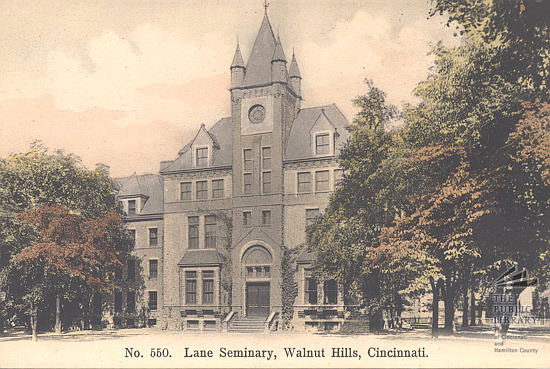
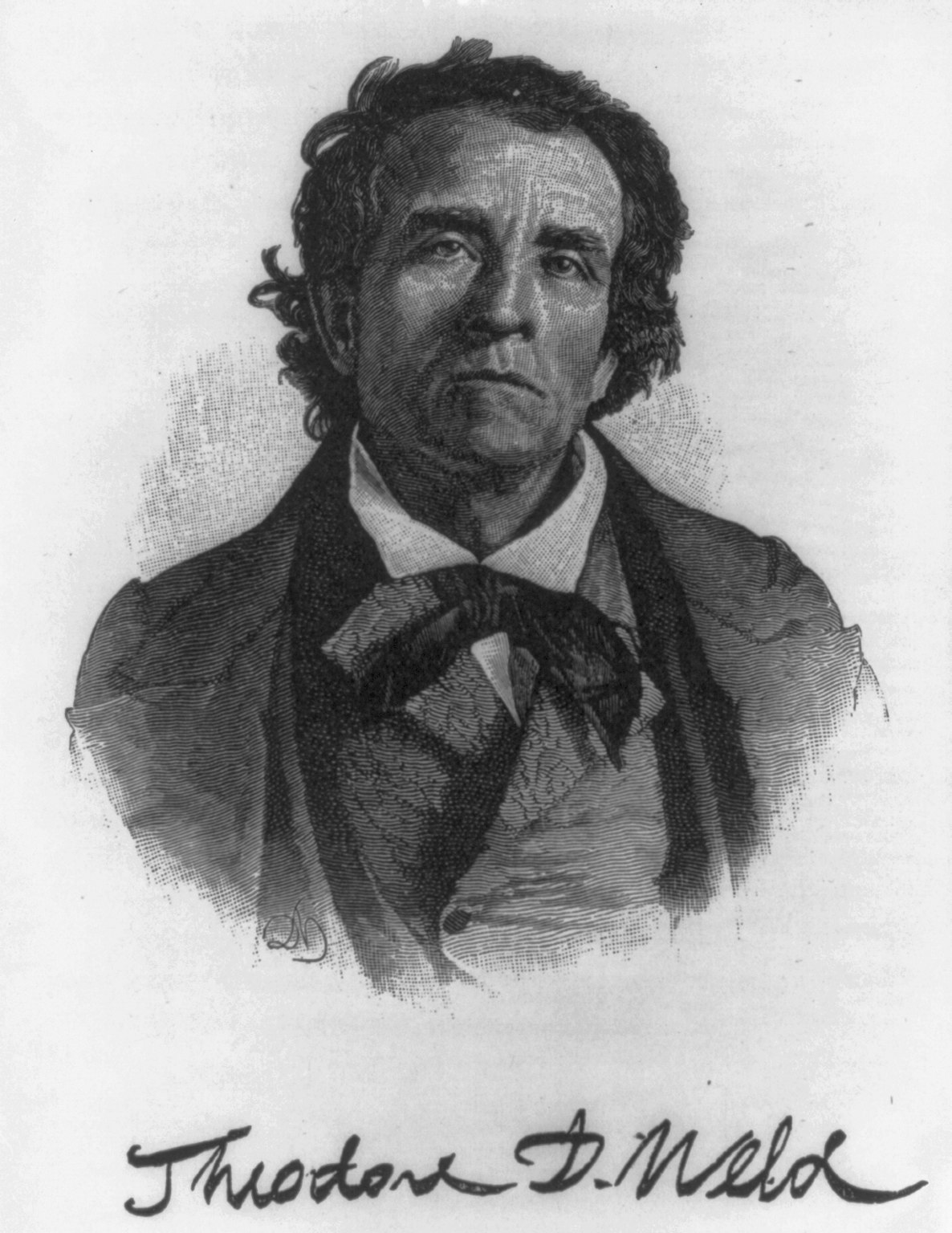
Lane Theological Seminary stood at Walnut Hills, above Cincinnati, and was meant to train Presbyterian ministers for the Mississippi Valley. Lyman Beecher, the Boston pastor who had opposed Finney's new measures at the New Lebanon convention of 1827 (see lesson 09), was its president. Its theological students of 1833 and 1834 were many of them older men, and many were converts of the revivals in western New York. Finney himself wrote of them, "Most, and perhaps nearly all of them, were converts in those great revivals in which I had taken more or less part."2 The most influential of them was Theodore Dwight Weld (1803 to 1895), whom Warfield calls "the young abolitionist agitator" and the students' "idol."3 Weld had been a student at Hamilton College when Finney's Utica revival of 1826 began, and Finney's Memoirs tell how the young man came to Utica opposed to the work and left it converted.4

The debates of 1834
Early in 1834 the students held a series of evening meetings on slavery. Oberlin's account of the Lane debates says that "In February 1834, the theology students attending the Lane Seminary in Cincinnati, Ohio, devoted eighteen evenings to an extended discussion of how best to combat the evils of slavery," and that they "rejected colonization," the plan of the American Colonization Society to settle free Black Americans in Africa, in favor of immediate emancipation.5 The students' own statement, published at the end of the year, describes the process without giving the number of evenings: "With the same spirit of free inquiry, we discussed the question of slavery. We prayed much, heard facts, weighed arguments, kept our temper, and after the most patient pondering, in which we were sustained by the excitement of sympathy, not of anger, we decided that slavery was a sin, and as such, ought to be immediately renounced."6 They formed an anti-slavery society, and they went into the free Black neighborhoods of Cincinnati: "We threw ourselves into the neglected mass of colored population in the city of Cincinnati, and that we might lead it up to the light of the sun, established Sabbath day and evening schools, lyceums, a circulating library, &c."6 At the head of the society was William T. Allan of Huntsville, Alabama, whom Oberlin's table of the Lane men describes as "a slaveholder's son" and as "targeted for explusion by the Executive Committee of the Lane trustees" (the spelling is the table's).7
The trustees' order and the walkout
Cincinnati was a river city whose trade ran south, and the students' work among the Black population alarmed many of its citizens and the seminary's trustees. In 1834 the executive committee of the trustees reported that "no associations or societies among the students ought to be allowed in the Seminary" except those aimed at "improvement in the prescribed course of studies," and the board adopted rules on that basis, giving the committee "power to dismiss any student from the Seminary when they shall think it necessary so to do."6 The students summarized the result in their statement: "We are commanded to discontinue anti-slavery society. We are prohibited from holding meetings among ourselves and from making statements and communications at table, or elsewhere, without permission. A committee of the board of trustees is set over us to exercise censorship, and vested with discretionary power to dismiss any student whenever they may deem it necessary so to do, without consultation with the faculty and without assigning reasons either to them, to the individual dismissed, or to the community."6
The trustees' own principle, as the students quoted it, was that "No seminary of learning, especially no theological one, should stand before the public, as a partizan on any question upon which able men, and pious christians differ."6 The students answered with an argument for free discussion that runs through the rest of the Oberlin story: "We believe free discussion to be the duty of every rational being. It is the acting out of the command 'prove all things.'"6 The reference is to 1 Thessalonians 5:21, "Prove all things; hold fast that which is good" (KJV).8 Most of the class withdrew. Oberlin's own historical timeline puts the number at "an estimated four out of five students."9 Their statement, signed in Cincinnati late in 1834, was printed in William Lloyd Garrison's Liberator on January 10, 1835.6
The withdrawal is usually called the Lane rebellion, and its members the Lane rebels, the name Oberlin's own archives use. B. B. Warfield, the Princeton theologian who wrote the fullest critical history of Oberlin's theology, records that the students, "housed near by, were endeavoring to continue their theological education independently, with only the aid of John Morgan," a tutor who had left with them, and that Asa Mahan, a Presbyterian minister in Cincinnati, "had been the single member of the Board of Trustees who had taken the students' part."3

The founding of Oberlin and Finney's conditions
Shipherd's colony
Oberlin began as a plan for a Christian settlement. In 1832 John Jay Shipherd, a Presbyterian minister at Elyria, Ohio, and Philo P. Stewart, a former missionary whom the college's timeline calls Shipherd's student, planned "a church-centered community that would build and support a school to train preachers and Christian leaders" for the states of the Old Northwest, bought land in Lorain County, and named the colony and the school for John Frederick Oberlin, the Alsatian pastor who had founded schools and built roads in his mountain parish.9 The Oberlin Collegiate Institute opened on December 3, 1833, with 34 students.9 The colonists signed a covenant, and Warfield quotes its pledge on property: "we will hold and manage our estates personally, but pledge as perfect a community of interest as though we held a community of property."3
Women were students from the first term. Philo Stewart wrote that one of the institute's chief objects was "the elevation of the female character, bringing within the reach of the misjudged and neglected sex, all the instructive privileges which hitherto have unreasonably distinguished the leading sex from theirs."10 (The Oberlin transcription prints "misjudge"; the sense requires "misjudged.") In its first years the women studied in a separate Ladies' Course while taking many classes with men.10
The offer to Finney
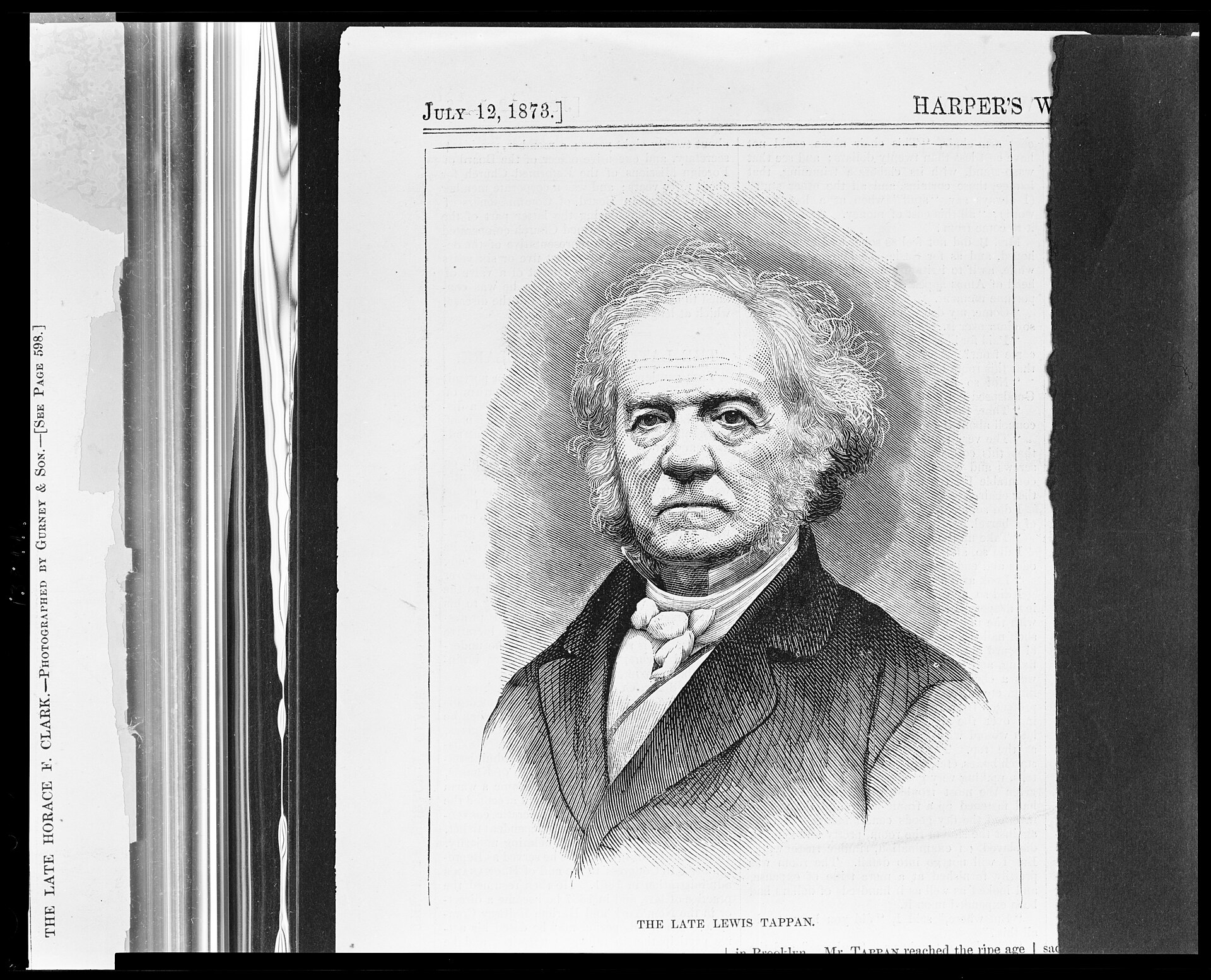
Shipherd had left Oberlin late in 1834 to find money and a president. Warfield tells the story with some irony: Shipherd "found a whole Theological Seminary," with president, professors and pupils, in Cincinnati, and then went east with Mahan to find "money and a Professor of Theology." The office "was offered on the way to Theodore G. [sic] Weld," who "pointed them rather to Charles G. Finney."3 Finney's own account in the Memoirs begins with the Lane walkout and Arthur Tappan's wish to see the students trained: Tappan "made the proposition that if I would come west and take rooms where I could instruct them, and would give them my views in theology and prepare them for the work of preaching throughout the west, he would foot the bills and be at the entire expense of the undertaking." Finney added that "Most, and perhaps nearly all of them, were converts in those great revivals in which I had taken more or less part."2
Finney then set terms. He had heard that the Lane trustees had acted "over the heads" of the faculty, and he told Shipherd that he would not come "unless two propositions were conceded to by the trustees. One was that the trustees should never interfere with the internal regulations of the school, but should leave that entirely to the discretion of the faculty. The other was, that we should be allowed to receive colored people on the same conditions that we did white people, that there should be no discrimination made on account of color; and that this question should be left also entirely to the faculty."2 The Oberlin College Archives' sketch of Finney's life adds a third condition from the negotiations: that "free speech be guaranteed at Oberlin," together with his right to keep preaching in New York.1
Finney also wanted money secured. According to the Memoirs, the New York friends "had a subscription filled that endowed eight professorships," and Arthur Tappan made him a private pledge. Finney quotes Tappan's words as he remembered them: "I do not want you to spread an abolition flag; but carry out your design of receiving colored students upon the same conditions that you do white ones; and see to it that the work be not taken out of the hands of the faculty and spoiled by the trustees, as was the case in Cincinnati." If the agents' collections fell short, Tappan said, "you may draw on me and I will honor your draft to the extent of my income from year to year."211 The pledge was kept from the trustees by agreement, "lest they should fail to make due efforts" to raise money and make the school known.11

What the trustees voted in 1835
The trustees' minutes survive and Oberlin has published a transcription. At Elyria on January 1, 1835, the board unanimously appointed Asa Mahan president, professor of moral and intellectual philosophy and associate professor of theology, and John Morgan professor of mathematics and natural philosophy. On Shipherd's written wish "that students may be received into the Institution irrespective of color," the board declined to act: it did "not feel prepared till they have other and more definite information on the subject to give a pledge respecting the course they will pursue in regard to the education of the people of color: wishing that this Institution should be on the same ground in respect to the admission of students with other similar institutions of our land."12
The question divided the colony. A petition of the colonists asked the board to meet at Oberlin rather than Elyria, because of "a great excitement in their minds in consequence of a resolution of Bro. J.J. Shipherd to be laid before the board, respecting the admissions of people of colour into the Institute." The petitioners wrote, "We feel for our Black brethren" and promised to "lay aside every prejudice and do as we shall be led to believe God would have us do."13 A list dated December 31, 1834, records the students' names in two columns, "In favor" and "Against," on "the practicability of admitting persons of color, to this Institution under existing circumstances."14
The board met at Oberlin on February 9 and 10, 1835. It first resolved "That the question in respect to the admission of students into the Seminary be in all cases left to the decision of the Faculty & to them be committed also the internal management of its concerns," with the proviso that the faculty remain "amenable to the Board." That met Finney's first condition. It then created a professorship of theology and elected "the Rev'd Charles G. Finney of the City of New York" to it, granting him "liberty to be absent 4 or 5 months of each year."12 Finally, after a preamble that spoke of fears that Black students would be "in unsuitable numbers ... introduced into our Schools, and thus in effect forced into the Society of whites," it adopted this resolution:
"Resolved That the Education of the people of color is a matter of great interest and should be encouraged in every proper way and manner & sustained in this Institution."12
The resolution does not say "admit," and Warfield later called it "an ambiguously worded resolution" that passed "by a majority of only one vote."3 Oberlin tradition holds that the chairman, John Keep, broke a tie; the published minutes do not record the vote. In practice the faculty, now in charge of admissions, received Black students, and Oberlin's own timeline describes the decision as making the college "the first institution of higher education in America to admit students without respect to race as a matter of regular policy."9 The careful wording ("as a matter of regular policy") is the college's own and matters for the claims checked below.
Finney himself remembered the meeting this way: "When these conditions were forwarded to Oberlin the trustees were called together, and they had a great struggle to overcome their own prejudices and the prejudices of the community, and pass resolutions complying with the conditions upon which I would come."2
The hard years
Finney arrived in Ohio in 1835, holding a second invitation, from Western Reserve College at Hudson, whose trustees had elected him their professor of theology as soon as they heard of the Oberlin call. At Elyria old acquaintances told him that at Hudson "there was an Old School influence of sufficient power to compel me to fall in with their views and course of action," and he declined Hudson.11 He had asked his New York friends for a great tent, and he described it in the Memoirs: "a circular tent a hundred feet in diameter," with a streamer at the top of the center pole on which "was written in very large characters, 'Holiness to the Lord.'" "When the weather would permit we spread it upon the square every Sabbath, and held public services in it. We held several of our earliest Commencements in it."11 For two or three years he kept both posts: "I spent my summers here and my winters there for two or three years." Then, he wrote, "my health soon became such that I found I must relinquish one of these fields of labor," and "I therefore took my dismissal from my church in New York."11 The Broadway Tabernacle, built for him in 1836, passed to other pastors, and Finney became pastor of Oberlin's First Congregational Church in 1837, a post he held until 1872.1
The financial panic of 1837 ruined the plan. In Finney's words, "the great commercial crash prostrated Brother Tappan, and nearly all the men who had subscribed for the fund for the support of the faculty." The college was left "fifty thousand dollars in debt," and Tappan wrote to Finney "expressing the deepest regret that he was prostrated and wholly unable to fulfil his pledge."11 Ohio politics added pressure. Finney recalled that the state government of the day was "utterly opposed to our enterprise because of its abolition character," that neighboring towns threatened "to come and tear down what buildings we had put up," and that the legislature sought some ground "that would enable them to abrogate our charter."11 Oberlin sent John Keep and William Dawes to Britain, where, as Finney put it, the public "generously responded, and gave us ten thousand pounds Sterling."11 That figure is Finney's recollection three decades later and should be read as his estimate. The family went through hard winters. Finney wrote that one Thanksgiving "found us so poor that I had been obliged to sell my travelling trunk, which I used in my evangelical labors, to supply the place of a cow which I had lost," and that a letter came that day with "a check from Brother Josiah Chapin of Providence, R.I., for two hundred dollars." Chapin, he added, "continued to send me six hundred dollars a year for several years; and on this I managed to live."11
Black students at Oberlin
The first Black students arrived within a year of the trustees' vote. Oberlin's timeline names "James Bradley (spring 1836) and Charles Langston (1835, 1841-44)."9 James Bradley, born in Africa, had been one of the Lane students; Oberlin's table of the Lane men calls him the "First African-American student at Lane and at Oberlin" and records that he became an anti-slavery lecturer.7 Charles Langston's brother, John Mercer Langston, graduated from the collegiate department in 1849, studied theology at Oberlin, read law with Philemon Bliss of Elyria, and in 1854 became, as the college records it, "the first African American lawyer in Ohio."9 Lucy Stanton completed the four-year literary course in 1850, and Mary Jane Patterson graduated with the bachelor of arts in 1862, which Oberlin describes as the first such degree earned by an African American woman in the United States.910 By 1860 the town had about 2,115 residents, of whom the timeline counts 423, or 20 percent, as African American.9
Black students remained a minority in the college, and how large a minority in each decade is a question answered from the college catalogues; Robert Fletcher's History of Oberlin College (1943) and Roland Baumann's documentary history, Constructing Black Education at Oberlin College (2010), treat it in detail.15 Equal admission did not end prejudice among white evangelicals, even among Finney's own supporters. Finney's Memoirs remember the rumor in New York that the Broadway Tabernacle would be "An Amalgamation church," in which Black and white worshipers "were to be compelled to sit together, promiscuously mingled together."2
Oberlin was also a station on the escape routes of fugitives from slavery. Finney wrote: "Several cases occurred in which they were pursued by slaveholders, and the hue and cry was raised, not only in this neighborhood but in the neighboring towns, by their attempting to force the slaves back into slavery." Of one such case he said that several fugitives "had been secreted here; of which, however, at the time I knew nothing until the row occurred."16 The best known of these cases, the Wellington rescue of 1858, is told below.
Women at Oberlin
The collegiate course and the degrees of 1841
For its first four years Oberlin's women studied in the Ladies' Course, which led to a diploma rather than a degree. In 1837, according to the college's women's history collection, "four women, Mary Kellogg, Mary Caroline Rudd, Mary Hosford and Elizabeth Prall, enrolled in the Collegiate Department, and in 1841, all but Kellogg graduated."10 The 175th anniversary timeline says that Caroline Mary Rudd, Elizabeth Prall and Mary Hosford thereby became "the first in the United States to receive the Bachelor of Arts degree."9 Mary Kellogg left for lack of money and later married James Harris Fairchild, a future president of the college.10 Earlier schools for women, such as female seminaries and academies, had granted diplomas and certificates. The claim of 1841 is for the bachelor of arts degree in a course of study meant to match the men's.9
Coeducation at Oberlin was not equality in every respect. Women did not speak at public exercises on the same terms as men, and a Ladies' Board supervised them. Lucy Stone's daughter, Alice Stone Blackwell, in her biography of her mother (1930), described the rule in the rhetoric classes: "The young men had to hold debates as part of their work in rhetoric, and the young women were required to be present, for an hour and a half every week, in order to help form an audience for the boys, but were not allowed to take part."17
Lucy Stone
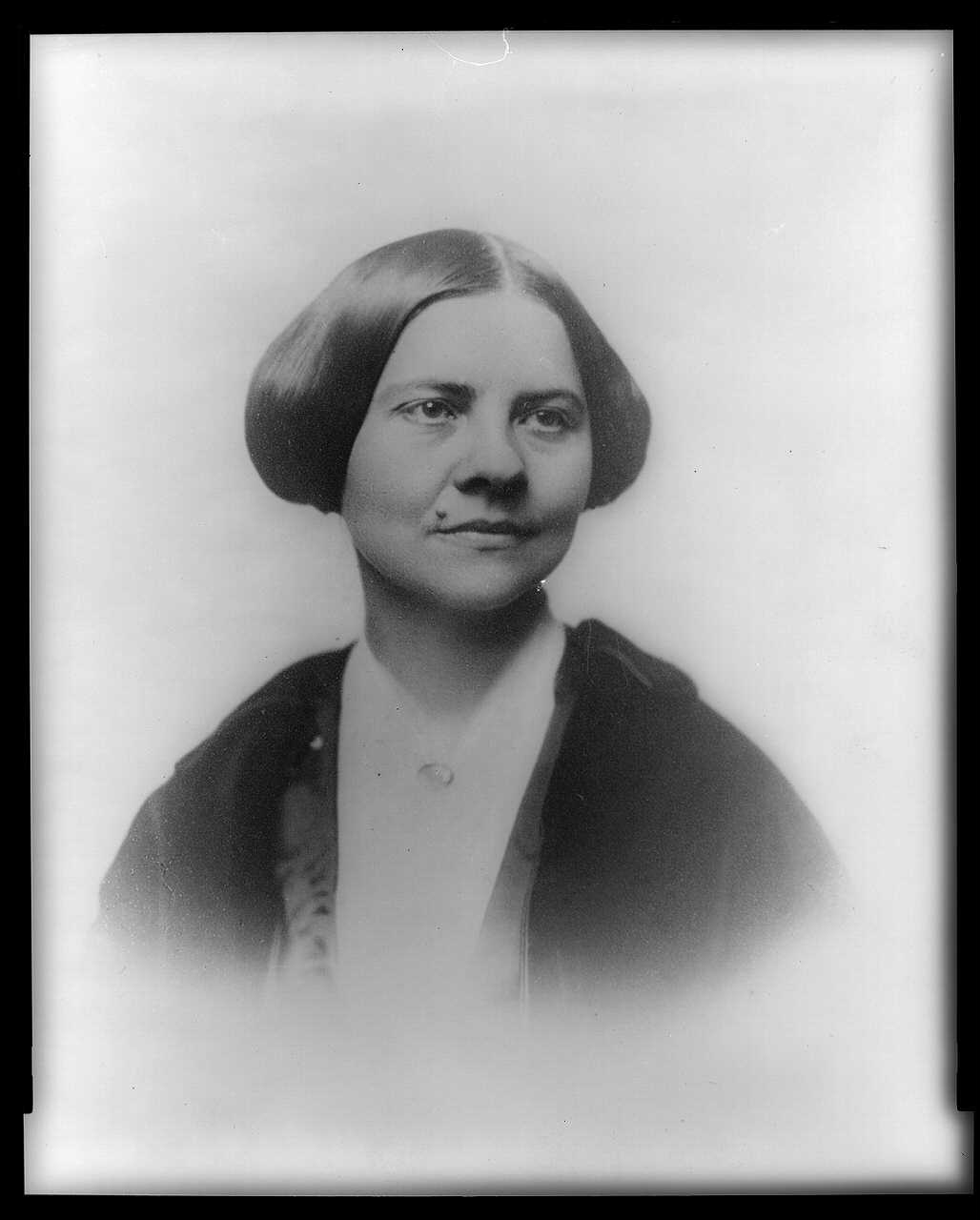
Lucy Stone (1818 to 1893) came from West Brookfield, Massachusetts. Her daughter wrote that "At the low wages then paid to women, it took Lucy nine years to save up money enough to enter college. There was no difficulty as to the choice of an alma mater. There was only one college that admitted women."17 That sentence is a family judgment of 1930 and overstates the matter (female seminaries already existed), but no other college then admitted women to the same collegiate course as men. Stone graduated in 1847.17 With Antoinette Brown she persuaded the rhetoric professor, James A. Thome, to allow a debate between women. Thome, born at Augusta, Kentucky, had been one of the Lane students, and Alice Stone Blackwell describes him as "a Southerner who had freed his slaves."177 In Alice Stone Blackwell's telling, "Tradition says that the debate was exceptionally brilliant," but "the Ladies' Board immediately got busy, St. Paul was invoked, and the college authorities forbade any repetition of the experiment."17 Stone then organized what her daughter called "the first debating society ever formed among college girls," meeting at first "secretly in the woods" and later in the parlor of a Black woman of the town, the mother of one of the pupils Stone taught.17
Stone's views on slavery also set her apart at Oberlin. She was a follower of William Lloyd Garrison, whose wing of the anti-slavery movement denounced the churches that tolerated slavery, encouraged public speaking by women, and refused allegiance to a Constitution that protected slavery. Her daughter wrote that "Oberlin was strongly antislavery, but its abolitionism was strictly orthodox and constitutional," and quoted Stone's letter home: "There is not a single Liberator taken in Oberlin, nor a single Liberator man, woman or child here but me."17 After college she lectured for the American Anti-Slavery Society and for women's rights, helped organize the first national women's rights convention at Worcester in 1850, and, when she married Henry Blackwell in 1855, kept her own name.17

Antoinette Brown
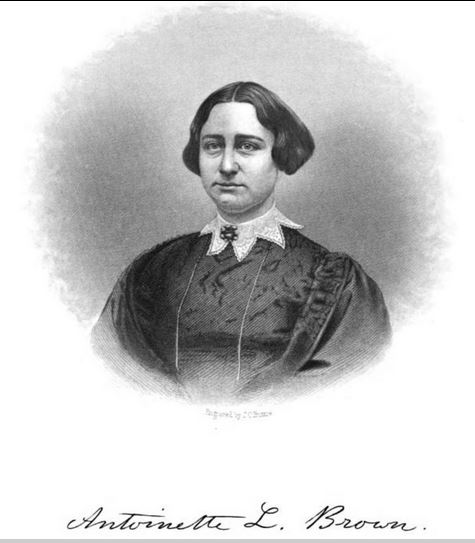
Antoinette Louisa Brown (1825 to 1921) was born at Henrietta, New York, near Rochester. According to the encyclopedia article that Oberlin reprints, she "began to speak publicly in the services of the local Congregational church at age nine."18 She finished Oberlin's literary course in 1847 and then asked to enter the theological department. The Unitarian Universalist biographical dictionary summarizes what followed: "Although Oberlin espoused women's education, College officials at first resisted her application. During the three years that she spent studying theology she was constantly reminded by both faculty and fellow students that the Bible did not approve of women speaking in church. She had to get special permission from her professor to speak in class and from the Theological Literary Society to present essays."19 One of those essays, an exegesis of 1 Corinthians 14:34 ("Let your women keep silence in the churches," KJV), was published in the Oberlin Quarterly Review, where, in the dictionary's words, she argued that Paul "meant only to warn against excesses in public worship." The journal printed it with "a professor's rebuttal, defining women's rights and duties more conservatively."198 She completed the theological course in 1850, but Oberlin did not grant her the degree. The college gave her an honorary master of arts in 1878 and a doctor of divinity in 1908.18
The Congregational church at South Butler, New York, called her as pastor, and on September 15, 1853, she was ordained there. The Oberlin page, quoting the Encyclopedia Americana, says she "became the first ordained woman minister in the United States on her ordination." She was "dismissed in July 1854, evidently by her own wish," later became a Unitarian, in 1856 married Samuel C. Blackwell (whose brother had married Lucy Stone), and preached and wrote for women's rights, temperance and the abolition of slavery until she was past ninety.18 The ordination was performed by a local Congregational church and the ministers it invited, which Congregational polity allowed. It was not an act of Oberlin College.

Finney on women praying and speaking
Finney's record on women's public role is mixed, and it should be stated by what he did and wrote. In his western New York revivals of the 1820s he allowed women to pray aloud in meetings where men were present, one of the new measures that Asahel Nettleton and Lyman Beecher objected to (see lesson 09). In the Lectures on Revivals, in the lecture on measures (Lecture XIV), he defended "Female Prayer Meetings" by recalling the opposition to them: "A minister, now dead, said that when he first attempted to establish these meetings, he had all the clergy around opposed to him. 'Set women to praying? Why, the next thing, I suppose, will be to set them to preaching.' And serious apprehensions were entertained for the safety of Zion, if women should be allowed to get together to pray."20 Finney presented that fear as a mistake that time had answered. He did not, in that lecture, argue that women should preach.
His wives worked beside him. The Oberlin College Archives record that all three of his wives, Lydia Root Andrews (married 1824, died 1847), Elizabeth Ford Atkinson (married 1848, died 1863) and Rebecca Allen Rayl (married 1865), "shared in Finney's revival work, accompanying him on his travels and even developing parallel ministries, as Elizabeth Ford Atkinson did during the two evangelistic trips in England."1 Finney's Memoirs describe how, during one of their later campaigns, "Mrs. Finney established prayer meetings for ladies, which were held in the vestry of the churches. These meetings were largely attended."21
What Finney thought of Antoinette Brown's call to the pulpit is less clear. The Unitarian Universalist dictionary says she needed "special permission from her professor to speak in class" without naming the professor; the sources consulted for this lesson do not say whether it was Finney, and no statement by Finney approving the ordination of women has been found here. The fair summary is that Finney approved and used women's public prayer and organized ministry among women, that Oberlin under his influence educated women for public work, and that the college still kept them from debating in the rhetoric classes and from receiving the theological degree.
Finney and abolition
New York, 1832 to 1835
Finney settled in New York in 1832 as pastor of the Second Free Presbyterian Church, which met in the Chatham Street Chapel, a theater refitted for worship.1 Lewis Tappan, as Finney recalled, leased the old Chatham Street Theatre with other Christian men for the new church, and the Tappan brothers were among the leading abolitionists of New York. Finney described his own position in the Memoirs: "When I first went to New York, I had made up my mind on the subject of the slavery question, and was exceedingly anxious to arouse public attention to the subject. I did not, however, turn aside to make it a hobby, or divert the attention of the people from the work of converting souls. Nevertheless, in my prayers and preaching I so often alluded to slavery and denounced it, that a considerable excitement came to exist among the people."2
In July 1834, while Finney was away on a voyage to the Mediterranean for his health, members of his church and other abolitionists held an anti-slavery meeting on the Fourth of July. Finney wrote: "This had excited a mob; and this was the beginning of that series of mobs that spread in many directions whenever and wherever there was an anti-slavery gathering, and addresses made against the abominable institution of slavery."2 While the Broadway Tabernacle was being built, the rumor spread that it would be an "Amalgamation church." Finney wrote that "somebody set the building on fire. The firemen were in such a state of mind that they refused to put it out, and left the interior and roof to be consumed." The builders completed it anyway.2 Finney also recalled that before his voyage he had "admonished Brother Leavitt," the editor of the New York Evangelist, "to be careful and not go too fast in the discussion of the anti-slavery question, lest he should destroy his paper."2
The 1835 lecture on slavery
Finney's fullest public statement on slavery is in the fifteenth of his Lectures on Revivals of Religion, "Hinderances to Revivals" (the 1835 spelling), delivered in the Chatham Street Chapel in the winter of 1834 to 1835 and printed in 1835. He listed resistance to the temperance reform and wrong ground on "any question involving human rights" among the things that stop a revival, and took slavery as his example.22 The silence of the churches, he argued, was no longer innocent: "Two millions of degraded heathen in our own land stretch their hands, all shackled and bleeding, and send forth to the church of God the agonizing cry for help. And shall the church, in her efforts to reclaim and save the world, deafen her ears to this voice of agony and despair? God forbid."22
Later in the same lecture he said what "right ground" meant. Christians were to avoid "a bad spirit," because "Nothing is more calculated to injure religion, and to injure the slaves themselves, than for Christians to get into an angry controversy on the subject." They were also to avoid neutrality:
"It is a great national sin. It is a sin of the church. The churches by their silence, and by permitting slaveholders to belong to their communion, have been consenting to it. ... The very fact of suffering slaveholders quietly to remain in good standing in their churches, is the strongest and most public expression of their views that it is not sin. For the church, therefore, to pretend to take neutral ground on the subject, is perfectly absurd. The fact is that she is not on neutral ground at all. While she tolerates slaveholders in her communion SHE JUSTIFIES THE PRACTICE."22
He added a third caution, aimed at both sides: "Great care should be taken to avoid a censorious spirit on both sides. It is a subject on which there has been, and probably will be for some time to come, a difference of opinion among Christians, as to the best method of disposing of the question."22 The same lecture tied religion to voting. "Politics are a part of religion in such a country as this," Finney said, "and Christians must do their duty to the country as a part of their duty to God."22
Slaveholders and the Lord's Supper
The lecture states a principle of church discipline: a church that keeps slaveholders in its communion approves slavery. Finney's biographers report that his New York congregations acted on it. Charles Hambrick-Stowe's Charles G. Finney and the Spirit of American Evangelicalism (1996) is among the modern accounts that report Finney's church excluding slaveholders from the Lord's Supper.23 The church minutes that would show the exact wording and date of the rule were not consulted for this lesson, and no copy of such a rule was found in the sources opened here, so the statement rests on the biographers' report and on Finney's published principle. The practice set Finney's churches apart at a time when the national Presbyterian, Methodist and Baptist bodies all still had slaveholding members and ministers.
The letter to Weld, July 1836
By 1836 several Lane and Oberlin men were lecturing for the American Anti-Slavery Society; the Oberlin table of the Lane students records John W. Alvord, Amos Dresser and Huntington Lyman as lecturers for the society and Sereno W. Streeter as its agent from 1836 to 1839.7 On July 21, 1836, Finney wrote to Weld from Oberlin. The manuscript is in the Weld-Grimke Papers at the William L. Clements Library of the University of Michigan, and it was printed by Gilbert Barnes and Dwight Dumond in their edition of Weld's letters (1934; the transcription used here notes that the printed version has errors).24 The letter is the clearest statement of Finney's strategy:
"Br. Weld is it not true, at least do you not fear it is that we are in our present course going fast into a civil war. Will not our present movements in abolition result in that. Shall we not ere long be obliged to take refuge in a Military despotism? ... How can we save our country - & affect the speedy Abolition of slavery. This is my answer. What say you to it? The subject is now before the publick mind. It is upon the conscience of every man, so that now every new convert will be an Abolitionist of course. Now if Abolition can be made an appendage of a general revival of religion all is well."24
Finney feared that "the absorbing abolitionism has drunk up the spirit of some of the most efficient revival men," and predicted that, unless "the publick mind can be engrossed with the subject of salvation & make abolition an appendage just as we made temperance an appendage of the revival in Rochester," the church and the nation would "become embroiled in one common infernal squabble that will roll a wave of blood over the land."24 He offered a plan: "We can now, with you & my Theological class bring enough laborers into the field to under God move the whole land in 2 years." He also gave a number for the earlier revivals: "Then 100000 were converted in one year every one of which was a temperance man."24 That figure is Finney's own claim in a private letter about the revival year of 1830 to 1831, and it is an estimate.
The letter is frank about the abolitionists themselves: "The fact is Dr W. our leading Abolitionists are good men, but there are but few of them wise men. Some of them are reckless. Others are so denunciatory as to kill all prayer about it."24 It is equally frank about Finney's goal, which was "the speedy Abolition of slavery." The disagreement with Weld was over means. Weld kept to his work as an anti-slavery agent and writer. He married Angelina Grimke, and with her and her sister Sarah he compiled American Slavery As It Is: Testimony of a Thousand Witnesses (New York: American Anti-Slavery Society, 1839), a collection of advertisements, court records and testimony drawn largely from southern newspapers.25

The Letters on Revival, 1845 to 1846
Ten years later Finney wrote a series of open letters to ministers in the Oberlin Evangelist. In Letter No. 23 (January 21, 1846), titled "The Pernicious Attitude of the Church on the Reforms of the Age," he blamed the churches for leaving reform to voluntary societies made up partly of Christians and partly of people "who profess no religion," and stated his view of the church's task: "Now the great business of the church is to reform the world," and its work is "to put away every kind of sin. The church of Christ was originally organized to be a body of reformers."26 The letter named the slave as a test: "When we consider the manner in which the movement in behalf of the slave has been treated by ecclesiastical bodies, by missionary associations, by churches and ministers, throughout the land, is it any wonder that the Church is forsaken of the Spirit of God?"26 He also rejected the plea that "moral suasion" alone should be used against slavery and other evils, on the ground that "Moral Government surely is a system of moral suasion," which includes "Law, rewards, and punishments."26
The same letter put the reformers in a hard light as well. Finney's view, stated in 1836 and again here, was that reform belonged inside the church and its revivals. When the church failed, reform passed to societies outside it, and in his judgment both suffered. Historians read this tension in different ways, as the next section shows.
How historians read Finney on slavery
The documents above support two readings, and historians have taken both. One reading stresses Finney's caution. Gilbert Barnes, who first printed the Weld letters, argued in The Antislavery Impulse, 1830 to 1844 (1933) that the revivals of the 1820s and 1830s, carried west by Finney's converts and by Weld's agents, were the chief source of organized abolition in the Old Northwest.27 Read with that thesis, Finney's 1836 letter shows the revivalist holding back from a movement his own converts had started, and writers in this line point to his advice to Joshua Leavitt to go slowly and his sharp words about "reckless" and "denunciatory" abolitionists.
The other reading stresses the content of what Finney taught. Donald Dayton, in Discovering an Evangelical Heritage (1976), drew on Finney and Oberlin to argue that nineteenth century revivalism carried a strong commitment to social reform, which many twentieth century evangelicals forgot.28 Hambrick-Stowe's biography (1996) treats Finney as a consistent opponent of slavery whose strategy was evangelistic: convert the nation, and the converts would end slavery.23 Neither reading needs to deny the other's evidence. Both readings agree on the documented facts. Finney called slavery a sin, made it a matter of church discipline, wanted it ended quickly, and wanted the revival to carry that cause instead of a separate political crusade.
Oberlin perfectionism
The question of 1836
Among the churches, the doctrine that made Oberlin famous was its teaching on holiness. Asa Mahan told how it began in his Scripture Doctrine of Christian Perfection (Boston: D. S. King, 1839). During a revival at Oberlin, "a brother in the ministry arose in one of our meetings and remarked, that there was one question to which he desired that a definite answer might be given." The question was: "When we look to Christ for sanctification, what degree of sanctification may we expect from him? May we look to him to be sanctified wholly, or not?"29 Mahan recalled his reaction: "I do not recollect that I was ever so shocked and confounded at any question before or since. I felt, for the moment, that the work of Christ among us would be marred, and the mass of minds around us rush into Perfectionism."29 The question was left unanswered at the time. "With that question before us, brother Finney and myself came to New York, and spent most of the winter together, in prayer and the study of the Bible."29
Their answer was yes. Mahan wrote: "After looking prayerfully at the testimony of Scripture in respect to the provisions and promises of divine grace, we were constrained to admit, that but one answer to the above question could be given from the Bible; and the greatest wonder with me is, that I have been so long a 'master of Israel, and have never before known these things.'"29 The phrase "master of Israel" is from Jesus's words to Nicodemus in John 3:10. The promise Mahan claimed was 1 Thessalonians 5:23: "And the very God of peace sanctify you wholly; and I pray God your whole spirit and soul and body be preserved blameless unto the coming of our Lord Jesus Christ" (KJV).8 Warfield, writing in 1921, dated the episode to "the summer and autumn of 1836" and said the affirmative answer came only "the ensuing winter."3
Finney's own account in the Memoirs gives a longer prehistory. He had already preached two sermons on Christian perfection in the Broadway Tabernacle, later printed in his Lectures to Professing Christians (1837), and he had studied the Methodist teaching: "I had known considerable of the view of sanctification entertained by our Methodist brethren. But as their view of sanctification seemed to me to relate almost altogether to states of the sensibility, I could not receive their teaching." He had also examined the perfectionists who, as he put it, taught "Christian perfection in the Antinomian sense of the term" at New Haven, Albany and New York, and had read "their periodical entitled, 'The Perfectionist'" (the circle in which John Humphrey Noyes first worked out his views; see lesson 12): "But I could not accept their peculiar views. Yet I was satisfied that the doctrine of sanctification in this life, and entire sanctification in the sense that it was the privilege of Christians to live without known sin, was a doctrine taught in the Bible."11
What Mahan and Finney meant
Both men defined the doctrine carefully, because both knew that the word "perfection" invited misunderstanding. Mahan's first discourse defined perfection in holiness as "a full and perfect discharge of our entire duty, of all existing obligations in respect to God and all other beings. It is perfect obedience to the moral law. It is 'loving the Lord our God with all our heart, and with all our soul, and with all our strength, and our neighbor as ourselves.' It implies the entire absence of all selfishness, and the perpetual presence and all pervading influence of pure and perfect love."29 He stated the disagreement with other Christians as a single question: "Whether we may now, during the progress of the present life, attain to entire perfection in holiness, and whether it is proper for us to indulge the anticipation of making such attainments."29
Finney set out his doctrine in a series of articles on sanctification in the Oberlin Evangelist in 1840 (gathered the same year as Views of Sanctification) and then in the second volume of his Lectures on Systematic Theology (Oberlin: James M. Fitch, 1847).30 Lecture LV defines the terms, and Lecture LVI argues the thesis "That entire sanctification is attainable in this life."31 In Lecture LV Finney first lists what he does not mean. He does not mean a state without temptation: the Christian warfare "certainly did not cease in Christ to the end of life, nor will it with any being in the flesh." Nor does he mean "a state in which no farther progress in holiness is possible," since "The saints will doubtless grow in grace or holiness to all eternity." Nor does he mean that the sanctified soul "will no longer need the continual grace and indwelling spirit of Christ to preserve it from sin."32 His positive definition ties holiness to the moral law: "entire sanctification, as I understand the term, is identical with entire and continued obedience to the law of God."32 He then narrows the question in dispute: "the true question at issue is: Is a state of entire, in the sense of permanent sanctification, attainable in this life."32
This definition depends on Finney's theology of the will (lesson 10). If sin is a voluntary choice and not a condition of nature, and if God never commands what a person cannot do, then full obedience to the law is possible at any moment, and the only question left is whether it can be made permanent. Warfield, the Princeton critic, saw the connection plainly. Summarizing the assumptions behind Finney's Lectures to Professing Christians, he wrote: "All virtue consists in disinterested benevolence; nothing is sinful but voluntary action; we have no obligation beyond our ability."3
Oberlin and the Methodists
The word "perfection" and the promise of a sanctification received by faith sounded Methodist to many listeners, and the Oberlin teachers did not hide the connection in their vocabulary. Warfield quotes Mahan's later autobiography: "The terms by which we designate it ... were those by which it had been presented since the times of Wesley and Fletcher, namely, Christian Perfection, Entire Sanctification, and Full Salvation."3 Warfield himself concluded that the Oberlin men felt their kinship "strongest, of course, with the Methodists, from whom they derived most," while they insisted that the doctrine itself came from Scripture.3 Wesley's teaching and its later history in the Holiness movement are covered in Module 80, lesson 07 and Module 77, lesson 01.
Finney's own statements mark the difference as he saw it. As quoted above, he could not accept the Methodist view because it seemed "to relate almost altogether to states of the sensibility," that is, to feelings.11 His definition ran through the moral law and the will: entire sanctification "is identical with entire and continued obedience to the law of God."32 A Wesleyan reader would answer that Wesley did not make perfection a matter of feeling. His Plain Account of Christian Perfection (1766) summed it up as "Pure love reigning alone in the heart and life," and described it as given to one who had first been "fully convinced of inbred sin."33 The two traditions agreed that a Christian could be delivered from known, willful sin in this life. They disagreed on how sin is defined (a voluntary act only, in Finney; "inbred sin" as well as sinful acts, in Wesley) and on whether entire sanctification is a second, distinct work of grace. The Oberlin doctrine sits between them: Wesleyan in its hope, New School in its account of the will.
The charge of perfectionism
The new doctrine went into print at once. Warfield records that "The Oberlin Evangelist, the first number of which appeared on the first of January, 1839, was established under the editorship of Henry Cowles, for the main purpose of propagating the new doctrine," and that "Wherever Oberlin was heard of, it was Oberlin Perfectionism which was heard of first."3 Finney remembered the reaction in the Memoirs: "Very soon the cry of Antinomian perfectionism was heard, and this charge brought against us. Letters were written, and ecclesiastical bodies were visited, and much pains taken to represent our views here as entirely heretical."11 The word "Antinomian" (against the law) was the sharpest charge that could be made, because the perfectionists around John Humphrey Noyes had drawn from the claim of sinlessness the conclusion that the law no longer bound them (see lesson 12). Finney's definition was the opposite of that: for him perfection was perfect obedience to the law.
The Old School critique went further than the charge of antinomianism. Warfield, writing in 1921, traced Oberlin perfectionism back to Finney's doctrine of the will and found the root in the earlier revivals: "This was a Pelagian revival. That was its peculiarity: and everything else connected with it was merely the expression of this."3 He summarized the premises behind Finney's 1837 lectures to Christians in a single sentence, quoted above: "All virtue consists in disinterested benevolence; nothing is sinful but voluntary action; we have no obligation beyond our ability."3 Finney's own reply to the charge of self-reliance is in the same lecture on sanctification that Warfield criticized. The sanctified, he wrote, would never cease to "need the continual grace and indwelling spirit of Christ to preserve it from sin."32 Whether that statement can be squared with his account of the will is the question argued in lesson 10 and, for the ancient form of the dispute, in Module 79, lesson 06.

The Oberlin-Wellington rescue
The underground railroad at Oberlin
By the 1850s Oberlin was known across the North and the South as a refuge for people escaping slavery. Finney described it in the Memoirs: "This place became one of the points of 'the underground railroad,' as it was called, where escaped slaves on their way to Canada, would take refuge for a day until the way was open for them to proceed."16 The Fugitive Slave Act of 1850 raised the stakes. Under it, as the Oberlin Heritage Center summarizes, "federal marshals received rewards for the arrest and return of alleged fugitive slaves, and anyone caught helping a freedom seeker could be jailed and fined."34 The Oberlin Anti-Slavery Society, formed in 1835 with more than two hundred members, had pledged itself to "the immediate emancipation of the whole colored race within the United States."34
The capture and rescue of John Price
John Price had escaped from slavery in Kentucky and had lived and worked in Oberlin for about two years. On September 13, 1858, according to the Oberlin Heritage Center's account, the slave catchers Anderson Jennings and Richard Mitchell, with a deputy marshal named Jacob Lowe and his assistant Samuel Davis, lured Price out of town with the promise of work, forced him into a carriage, and drove him eight miles south to Wellington to catch the southbound train.34 The Encyclopedia of Cleveland History names Price's owner as John G. Bacon.35 Oberlin's own timeline gives Price's age as eighteen.9
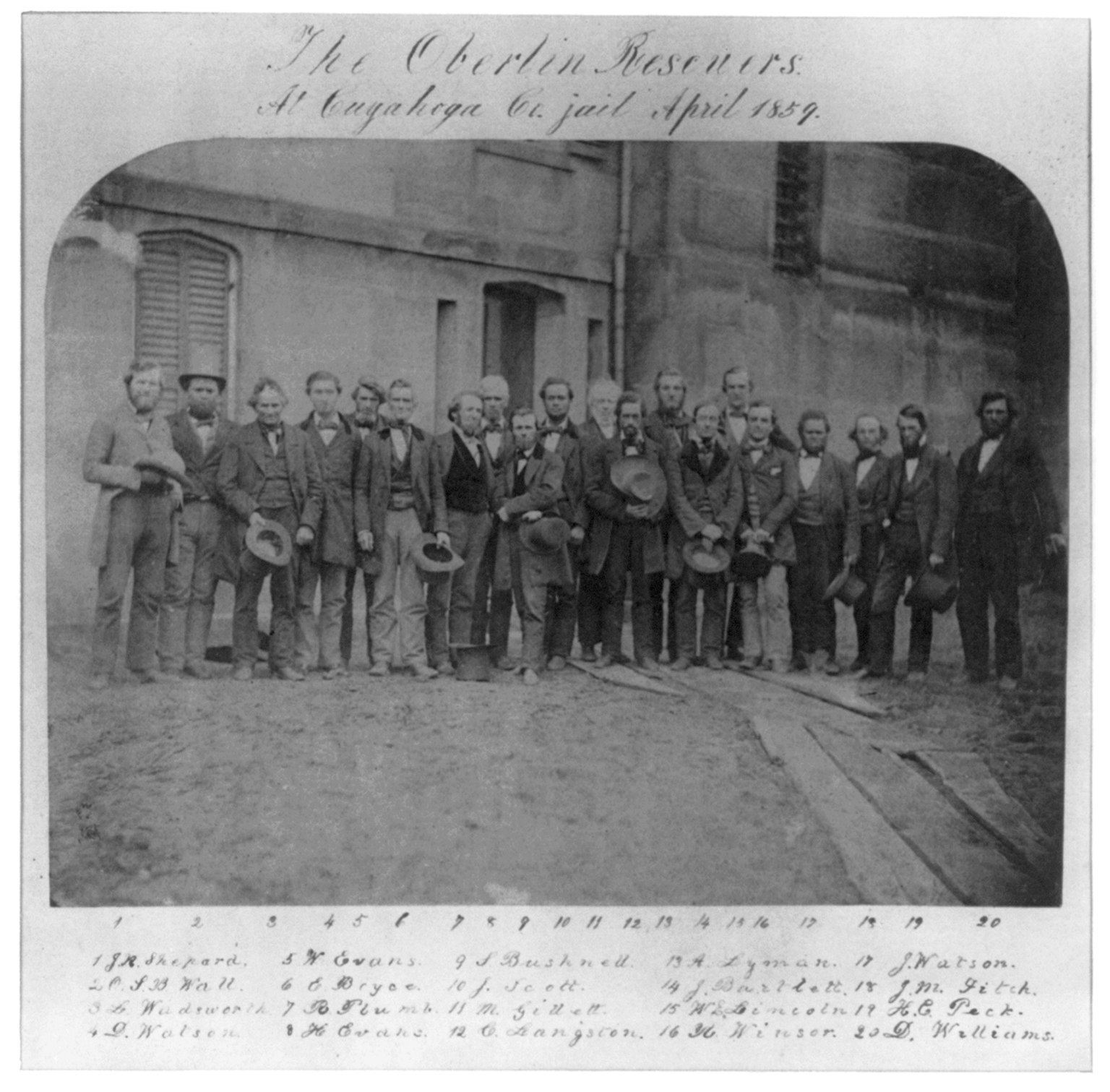
When the news reached Oberlin, townspeople and students went to Wellington by wagon, buggy, horseback and on foot. The size of the crowd that surrounded the Wadsworth hotel is reported differently: "Hundreds" in Oberlin's timeline, "between 200 and 500 men" in the Oberlin Heritage Center's account, and "An estimated 600 citizens" in the Encyclopedia of Cleveland History.93435 All three are estimates, and no count was made at the time. The rescuers forced their way into the hotel and took Price away. He was hidden in Oberlin in the house of James H. Fairchild, then a professor and later president of the college, and then, in the Heritage Center's words, "probably made his way into Canada"; what became of him afterward is not known.3435
The trials in Cleveland
On December 7, 1858, a federal grand jury indicted thirty-seven men of Oberlin and Wellington for violating the Fugitive Slave Act.3534 Oberlin's timeline counts among the rescuers twelve African Americans, thirteen whites, four students and a professor from Oberlin.9 The professor was Henry Peck, who, according to the Heritage Center, was arrested "despite not even going to Wellington that day."34 The first two tried, Simeon Bushnell and Charles Langston, a Black schoolteacher and the brother of John Mercer Langston, were convicted in the spring of 1859, after a trial that opened on April 5.3534 Before sentencing, Langston told the court, as the Heritage Center quotes his speech: "We have all a common humanity, and you all would do that; your manhood would require it, and no matter what the laws might be, you would honor yourself for doing it, while your friends and your children to all generations would honor you for doing it, and every good and honest man would say you had done right!"34 Bushnell wrote, as the Heritage Center quotes him: "They may do their worst, & when I am again out, I will rescue the first slave I get a chance to rescue."34 The other prisoners stayed in jail rather than post bond, printed a paper called The Rescuer from their cells, and were released on July 6, 1859, after the rescuers' friends had the slave catchers charged with kidnapping in Lorain County and both sides agreed to drop their cases.3435
The rescue drew national attention because it set a college town, and the theology of the "higher law," against a federal statute. Three months after the rescuers' release, two Black men of Oberlin, John Copeland and Lewis Sheridan Leary, took part in John Brown's raid on the federal arsenal at Harpers Ferry, Virginia, in October 1859, together with Shields Green, whom Oberlin's timeline also counts among its men. Green had in fact escaped from slavery in South Carolina to Rochester, New York, and went to meet Brown with Frederick Douglass at Chambersburg, Pennsylvania, in 1859; he is not known to have lived in Oberlin. Leary was killed in the raid, and Copeland and Green were hanged on December 16, 1859.946 Finney was president of the college through all of this. The sources opened for this lesson do not record that he took part in the rescue, and his Memoirs, written ten years later, describe the fugitive cases of Oberlin's early years without naming Wellington.16

Finney's last years
President, pastor and professor
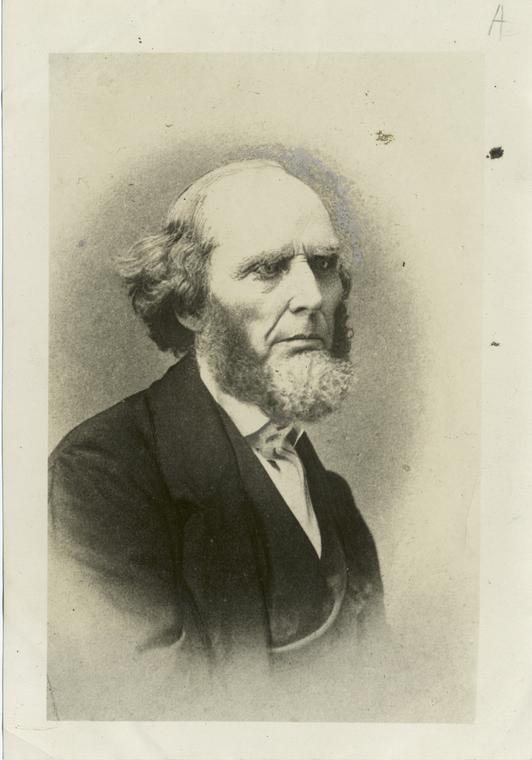
The Oberlin College Archives summarize Finney's offices there: "Professor of Systematic Theology (1835-58) and Professor of Pastoral Theology (1835-75)," pastor of the First Congregational Church "(1837-72)," and a member of the board of trustees "from 1846 until 1851 when he was elected president." The archives date his presidency 1851 to 1865 and say he submitted his resignation from the presidency in 1865. Some other accounts end the presidency in 1866.1 He had left the Presbytery in 1836 and, in the archives' words, "from then on identified himself as a Congregationalist."1 His lectures were printed as Lectures on Systematic Theology (1846 to 1847) and Skeletons of a Course of Theological Lectures (1840), and the Oberlin Evangelist, established in 1839, carried his sermons and letters.1
Finney married three times. Lydia Root Andrews, his wife from 1824, died in 1847, and Finney's Memoirs describe the grief that followed and the rest he found in God.136 He married Elizabeth Ford Atkinson of Rochester in 1848; she died in 1863.36 In 1865 he married Rebecca Allen Rayl, who had been assistant principal of the Ladies' Department at Oberlin. The archives note that all three "shared in Finney's revival work."1
Finney was not always at ease with Oberlin's austerity. The Oberlin Heritage Center records that he never signed the colony's covenant, gave up the strict Graham diet with most of the town, and, in James Fairchild's words, was "passionately fond of music," singing and playing the cello in a community where some thought instrumental music worldly.37
The British campaigns and Boston
The presidency did not end the revival travels. "In the autumn of 1849 my wife and myself embarked for England," Finney wrote, and the couple arrived at Southampton "early in November."38 The archives note that Elizabeth Finney developed a ministry of her own "during the two evangelistic trips in England."1 At home, Finney recorded that in one campaign "Mrs. Finney established prayer meetings for ladies, which were held in the vestry of the churches. These meetings were largely attended."21 The Memoirs then follow him to Hartford, to Western and Rome in New York, and to Boston, in a chapter titled "Revival in Boston in 1856, & 7, & 8," and to a second British campaign, "Labors in England till 1860."39 The Oberlin archives date the two British visits to 1849 to 1850 and 1859 to 1860; the Memoirs give fewer dates, and the exact months differ between accounts.139
The Memoirs and the last sermons
Finney began writing his Memoirs in 1867 and brought the revival narrative down, in his own words, "to this time, the 13th of January, 1868."361 In 1869 he published The Character, Claims, and Practical Workings of Freemasonry, an attack on the order of which, as the archives put it, "he had once been a member."1 Fairchild's conclusion to the 1876 edition describes the last years. Finney "resigned the pastorate in 1872, but still retained his connection with the seminary, and completed his last course of lectures in July 1875, only a few days before his death." On his last day, a Sunday, he walked out with his wife at sunset to hear the music of the evening service; "Upon retiring he was seized with pains which seemed to indicate some affection of the heart; and after a few hours of suffering, as the morning dawned, he died."36 He was eighty-two, two weeks short of his eighty-third birthday, and the date was August 16, 1875.137
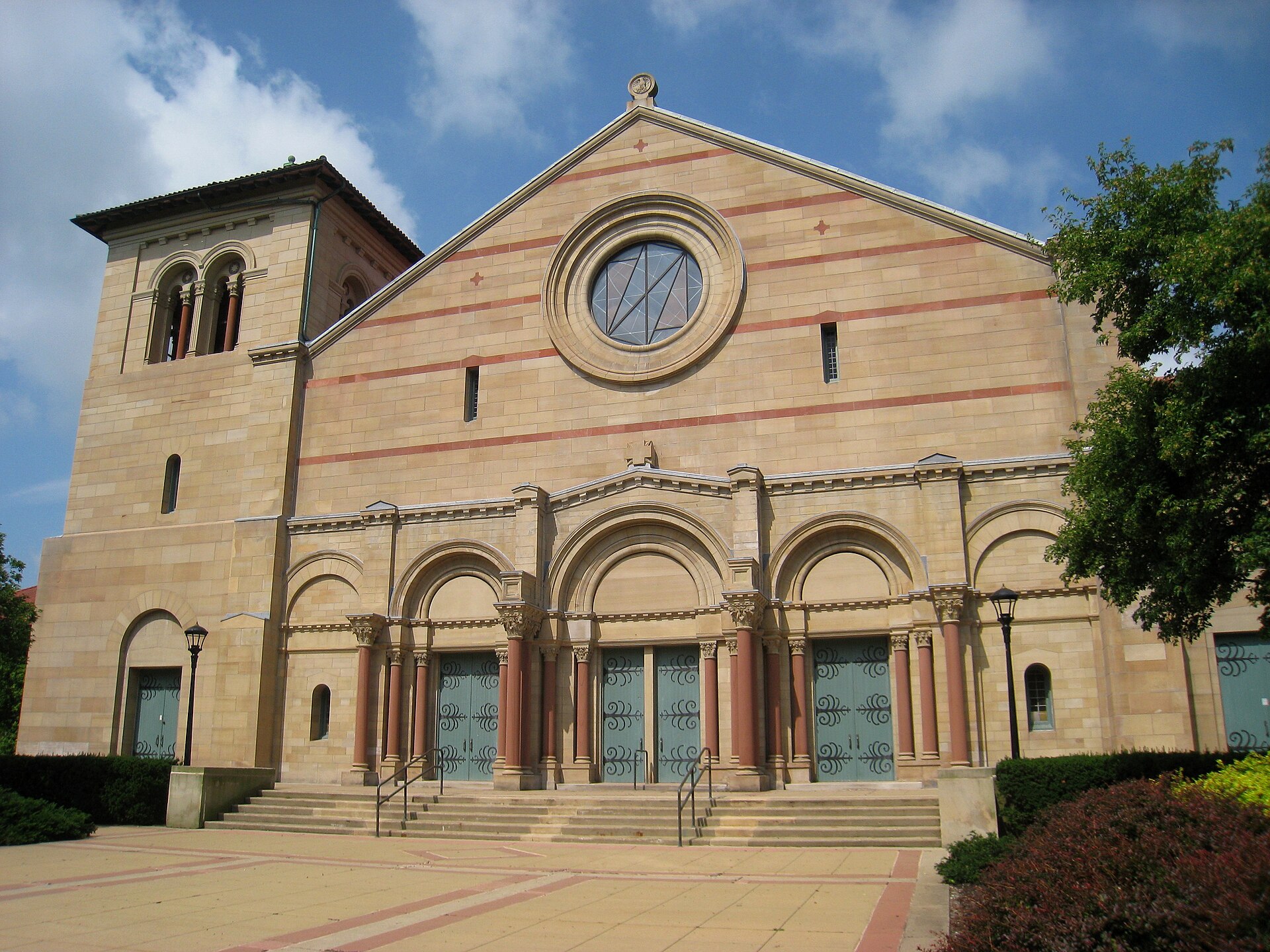

Historians on Finney's legacy
Finney left three things that historians weigh separately: a method of revival, a set of institutions and reform causes, and a theology. Each has its admirers and its critics, and the same historian may praise one and fault another. What follows gives each reading in the words or arguments of those who hold it. The summaries of the modern books are short characterizations of their main arguments, not quotations.
The method of revival
Finney's own Lectures on Revivals (1835) opened with the heading "A REVIVAL OF RELIGION IS NOT A MIRACLE" and taught that revivals come through the right use of means (see lesson 10).40 The book sold widely. The Oberlin Heritage Center reports that in 1835, "shortly after it was published," it "had already sold over 12,000 copies."37 William G. McLoughlin's Modern Revivalism: Charles Grandison Finney to Billy Graham (1959) took the line from Finney through Dwight L. Moody and Billy Sunday to Billy Graham, and treated Finney as the founder of organized, professional mass evangelism in America.41 Iain H. Murray's Revival and Revivalism: The Making and Marring of American Evangelicalism, 1750 to 1858 (1994) accepted the line but reversed the verdict. Murray distinguished revival, a work of God that cannot be produced on demand, from revivalism, the use of planned measures to produce results, and judged that Finney's measures helped turn the first into the second.42 The later history of the altar call and the invitation system is followed in lesson 14.
The reforming evangelical
A second reading begins at Oberlin. Gilbert Barnes's Antislavery Impulse (1933) traced organized abolition in the Old Northwest to the revivals and to Weld's band of Lane and Oberlin agents.27 Donald Dayton's Discovering an Evangelical Heritage (1976) drew on Finney, Oberlin, coeducation and the anti-slavery cause to argue that nineteenth century revivalism had a reforming side that twentieth century evangelicals had largely forgotten.28 Charles Hambrick-Stowe's biography, Charles G. Finney and the Spirit of American Evangelicalism (1996), reads Finney as a pastor and spiritual writer as well as a revivalist, and gives full weight to the Oberlin years.23 On this reading the legacy is the college itself: its Black and women graduates, its rescuers, and the missionaries and teachers it sent out.
The democratic reading
Nathan Hatch's The Democratization of American Christianity (1989) placed the revivals of the early republic in a wider movement in which ordinary people claimed the right to read Scripture for themselves, choose their own preachers and form their own churches. Finney's appeal to the hearer's own judgment fits that picture, although Hatch gave more space to the Methodists, Baptists, the Christian movement and the Latter-day Saints.43 Mark Noll's America's God (2002) described an American synthesis of evangelical Protestant faith, republican political ideals and common sense moral reasoning, and treated Finney's confidence in the hearer's natural ability as one expression of it (on Scottish common sense philosophy, see Liberty module 58, lesson 03).44
The Calvinist critique
The sharpest reading comes from the Reformed side, and it states its case in plain terms. Warfield, as quoted above, called the western revivals "a Pelagian revival."3 Michael Horton, writing in Modern Reformation in 1995, called Finney "the tallest marker in the shift from Reformation orthodoxy, evident in the Great Awakening (under Edwards and Whitefield) to Arminian (indeed, even Pelagian) revivalism, evident from the Second Great Awakening to the present."45 Horton traced to Finney a line of later movements that he regarded as departures, including the church growth movement and what he called "political revivalism."45 Finney's defenders reply in his own words, which affirm the need of "the continual grace and indwelling spirit of Christ," and in the words of the Wesleyan and Holiness traditions, which see in Oberlin a recovery of the New Testament call to holiness (see Module 77, lesson 01).32 The disagreement is theological, and the evidence can only show what each side said.
What the record shows and what it does not
- Documented fact: the Lane students' statement of 1834 and the trustees' order they protested; the Oberlin trustees' resolutions of January 1 and February 10, 1835, including the transfer of admissions to the faculty, Finney's election and the resolution that the education of "the people of color" be "sustained in this Institution"; the degrees of 1841; Antoinette Brown's ordination on September 15, 1853; the indictment of thirty-seven rescuers in December 1858; Finney's death on August 16, 1875.12918351
- Finney's own account: his two conditions, Tappan's private pledge, the trustees' "great struggle," the tent marked "Holiness to the Lord," the debts of 1837 and the ten thousand pounds raised in Britain, all as he remembered them more than thirty years later in the Memoirs.211
- Finney's own estimate: "100000" converted in one year, in the 1836 letter to Weld.24
- Later tradition: that the chairman, John Keep, broke a tie in the February 1835 vote; Warfield says the resolution passed "by a majority of only one vote," but the published minutes do not record the count.312
- Reported but not confirmed here: the rule of Finney's New York church excluding slaveholders from communion, which rests on his biographers.23
- Estimates: the crowd at Wellington ("Hundreds," 200 to 500, about 600, depending on the account).93435
- Scholarly readings: whether Finney's method, his reforms or his theology was his chief legacy, and whether his theology was Pelagian; these are interpretations argued from the same documents.
- Open questions: what Finney thought of Antoinette Brown's ordination; the exact dates of his British campaigns; what became of John Price after he reached Canada.
Claims checked
"Oberlin was the first college in America to admit Black students."
Partly supported. Oberlin's own wording is narrower: the 1835 decision made it "the first institution of higher education in America to admit students without respect to race as a matter of regular policy."9 The trustees' resolution itself did not use the word "admit," and Black students remained a minority of the student body.1215 The claim holds in the college's qualified form, as a standing policy of admission.
"Oberlin gave the first college degrees to women in the United States."
Supported, with a definition. In 1841 Caroline Mary Rudd, Elizabeth Prall and Mary Hosford received the bachelor of arts after the collegiate course, which Oberlin describes as the first such degrees in the United States.910 Female seminaries and academies had awarded diplomas before then, so the claim is about the bachelor of arts degree in the full collegiate course.
"Antoinette Brown was the first woman ordained to the ministry in the United States."
Supported, with a definition. The Encyclopedia Americana article that Oberlin reprints says she "became the first ordained woman minister in the United States on her ordination on Sept. 15, 1853."18 Women had preached in public before 1853 without ordination to a pastorate, so the claim rests on the word "ordained." Oberlin College did not ordain her and did not give her the theological degree.1819
"Finney barred slaveholders from communion."
Partly supported. Finney's 1835 lecture says that a church that keeps slaveholders "in her communion" thereby "JUSTIFIES THE PRACTICE," which states the principle plainly.22 His biographers report that his New York church acted on it.23 The church record of the rule was not found in the sources opened for this lesson.
"Finney cared more about revival than about the slave."
Unresolved. His 1836 letter names "the speedy Abolition of slavery" as the goal and revival as the means; his Memoirs say he "did not, however, turn aside to make it a hobby," but denounced slavery so often that "a considerable excitement came to exist."242 Whether that order of priorities was wise or culpable is a judgment the documents leave to the reader.
"Finney was a Pelagian."
Unresolved (a theological judgment). Warfield said yes ("This was a Pelagian revival"), and Horton calls Finney's revivalism "Arminian (indeed, even Pelagian)."345 Finney denied a sinful nature and defined sin as voluntary action, which is the heart of the charge, but he also wrote that the sanctified soul always needs "the continual grace and indwelling spirit of Christ."32 Whether that is enough to separate him from Pelagius depends on how Pelagianism is defined; see lesson 10 and Module 79, lesson 06.
"Oberlin perfectionism was just Methodist holiness teaching."
Partly supported. Mahan said the terms came from Wesley and Fletcher, and Warfield judged that the Oberlin men "derived most" from the Methodists.3 Finney, however, rejected the Methodist account as too tied to "states of the sensibility" and defined entire sanctification as "entire and continued obedience to the law of God," a definition built on his New School view of the will.1132
"The Oberlin-Wellington rescue set the Civil War in motion."
Unsupported as stated. Oberlin's timeline says that "Years later, the Oberlin-Wellington Rescue would be known as the incident that set the Civil War in motion."9 The rescue and trial drew national attention as one of several fugitive slave cases of the 1850s, and the Heritage Center describes it as catching "the eye of the nation as escalating tensions over slavery raised the prospect of civil war."34 No single event can be shown to have caused the war.
"Finney converted 100,000 people in a single year."
Unsupported as a count. The figure comes from Finney's private letter to Weld: "Then 100000 were converted in one year every one of which was a temperance man."24 It refers to the revival year of 1830 to 1831 across the country, not to Finney's own meetings, and no one counted. It is his estimate.
"Oberlin was the only college that admitted women."
Partly supported. Alice Stone Blackwell wrote of her mother's choice in the 1840s, "There was only one college that admitted women."17 Schools for women such as female seminaries existed, but Oberlin was then unusual, and perhaps alone, in admitting women to the same collegiate course as men.10
Hard questions and answers
If Oberlin was founded by abolitionists, why did its trustees hesitate to admit Black students?
The minutes and petitions show a divided colony. On January 1, 1835, the board declined to give "a pledge" and wished the school to stand "on the same ground ... with other similar institutions of our land."12 The colonists' petition spoke of "a great excitement" over Shipherd's proposal, and the students voted in two columns, "In favor" and "Against."1314 The February resolution spoke of fears that Black students would be "forced into the Society of whites."12 What carried the decision was Finney's refusal to come without it and Tappan's money, which made the Lane students and their professor available. Finney's own memory was of "a great struggle to overcome their own prejudices and the prejudices of the community."2
Was Oberlin's commitment a matter of principle or of the Tappans' money?
Both, and the documents show it. Shipherd asked for equal admission before Finney's terms reached the board, and the Lane students and Finney made it a condition.122 Arthur Tappan told Finney privately to "carry out your design of receiving colored students upon the same conditions that you do white ones," and pledged his income to cover any shortfall.11 When the panic of 1837 ruined Tappan, Oberlin kept the policy, raised money in Britain, and lived through what Finney called a time when the college was "fifty thousand dollars in debt."11
A Wesleyan asks: is Oberlin perfectionism the same as Wesley's Christian perfection?
They share the hope that a Christian may be delivered from willful sin in this life and the terms "Christian Perfection, Entire Sanctification, and Full Salvation," which Mahan traced to Wesley and Fletcher.3 They differ in their account of sin. Wesley spoke of conviction of "inbred sin" before perfect love reigns in the heart.33 Finney held that sin lies only in voluntary action and defined sanctification as "entire and continued obedience to the law of God."32 A Wesleyan may welcome Oberlin's conclusion while questioning its premises.
A Calvinist asks: if Finney's theology was Pelagian, why did it produce Oberlin's reforms?
Finney taught that "The church of Christ was originally organized to be a body of reformers," and that sin is a choice for which every person is accountable.26 That doctrine made slavery, intemperance and prejudice matters of present duty and immediate repentance, which suited immediate abolition. Calvinists answer that reform zeal does not prove a doctrine true, and they point to Calvinist abolitionists such as Samuel Hopkins (see lesson 07) to show that the anti-slavery cause did not depend on Finney's view of the will. Both points can be documented; neither settles the theological question.
Did Finney support women preaching?
The evidence found here shows that he defended women's prayer meetings (and, as lesson 09 records, let women pray in mixed meetings in his New York revivals), that his wives led meetings and ministries of their own, and that Oberlin under his influence gave women the collegiate degree.20110 It does not show him approving the ordination of women. Antoinette Brown studied theology at Oberlin while being told "that the Bible did not approve of women speaking in church," and the college did not grant her the degree.19 Finney's view of her call remains an open question in the sources consulted.
A skeptic asks: did the revivals end slavery?
Not by themselves. Finney's plan in 1836 was to end slavery by converting the nation, and he warned that the alternative was "a wave of blood over the land."24 Slavery ended through a civil war and a constitutional amendment. What the record does show is that the revivals produced many of the abolitionists, including the Lane and Oberlin men who lectured for the American Anti-Slavery Society, and that Oberlin became a refuge on the underground railroad.716 The Second Great Awakening contributed people and arguments to the anti-slavery cause, and also left many churches, North and South, that kept slaveholders in good standing.22
Related lessons: lesson 09 (Finney's conversion and new measures), lesson 10 (his theology and the Old School debate), lesson 12 (the Burned-Over District and Noyes's perfectionists), lesson 13 (Hodge, Taylor and the Presbyterian split), and lesson 14 (the line from Finney to Moody and Graham). For Oberlin and the Congregationalists in outline see Module 80, lesson 05; for the Holiness movement that drew on Oberlin's teaching see Module 77, lesson 01.
Learn more
- Finney, Memoirs, restored text (Gospel Truth Ministries): Finney's own account of New York, Oberlin and his later campaigns, chapter by chapter.
- Electronic Oberlin Group: the Lane Debates documents: The students' statement, the colonists' and students' petitions and the trustees' minutes of 1835.
- Finney to Theodore Weld, July 21, 1836: The clearest statement of Finney's strategy on abolition and revival, in a corrected transcription.
- Warfield, "The Oberlin Perfectionism": The fullest Old School critique, with much documentary detail on Oberlin's early years.
- Oberlin Heritage Center: The Oberlin-Wellington Rescue 1858: A narrative of the rescue and trials with excerpts from the participants.
- Oberlin College timeline, 1833 to 2008: The college's own dates and claims for its firsts.
- Michael Horton, "The Legacy of Charles Finney": A Reformed critique of Finney's influence on later evangelicalism.
Still being checked (16 items)
These points could not be confirmed against a primary source when this lesson was written and fact checked in October 2026. The text above states each one as uncertain.
- The rule of Finney's New York church excluding slaveholders from communion is reported by biographers (Hambrick-Stowe and others) but no church record or exact wording was found; Hambrick-Stowe's book was not opened.
- The summaries of McLoughlin (1959), Murray (1994), Barnes (1933), Dayton (1976), Hambrick-Stowe (1996), Hatch (1989) and Noll (2002) are short characterizations of each book's main argument made without re-reading the books during this task.
- The tradition that John Keep broke a tie in the February 1835 trustees' vote is not in the published minutes; Warfield says the resolution passed by one vote.
- End of Finney's presidency: the Oberlin archives give 1851 to 1865 (resignation submitted 1865); the brief and some accounts give 1866. Not resolved here.
- Dates of the British campaigns: the archives give 1849 to 1850 and 1859 to 1860; the Memoirs give fewer dates. Exact months not confirmed.
- Mahan's quotations were checked against an OCR scan of the 1839 edition; hyphenation and page breaks in the scan were normalized.
- That the gospeltruth.net 'memoirs restored' text follows the Rosell and Dupuis 1989 edition word for word was not compared against the printed book.
- No statement by Finney on Antoinette Brown's ordination was found; whether he was the professor who allowed her to speak in class is not established.
- The claim that Antoinette Brown was the first woman ordained in the United States rests on the Encyclopedia Americana article reprinted by Oberlin; earlier women preached without ordination.
- Wellington crowd sizes (hundreds; 200 to 500; about 600) are estimates from later accounts; no contemporary count was found.
- The Oberlin timeline's statement that Harpers Ferry occurred on 'October 20' conflicts with the usual date (the raid began October 16, 1859); the lesson says only 'October 1859'.
- The image alt texts for the rescuers photograph, Finney Chapel and the c. 1860 Finney portrait were written from the Commons descriptions without viewing the images at full size.
- The Lyman Beecher detail (Boston pastor at the time of the 1827 New Lebanon convention) and the Chatham Street Chapel's earlier use as a theater rest on lesson 09 and Finney's Memoirs, not on a separate source.
- The split of the thirty-seven indicted rescuers into twenty-five from Oberlin and twelve from Wellington, given in the draft, was not found in the sources cited and was removed; the Heritage Center and the Encyclopedia of Cleveland History give only the total.
- Oberlin's timeline counts Shields Green among three 'Oberlin men' at Harpers Ferry; BlackPast places him in Rochester before the raid. The lesson now says he is not known to have lived in Oberlin.
- That Charles Langston the Wellington rescuer was the brother of John Mercer Langston is standard in the histories but is not stated on the Oberlin and Heritage Center pages opened.
Notes
- Oberlin College Archives, Charles Grandison Finney Papers, finding aid, "Biographical Sketch" by Valerie S. Komor (offices, dates, the conditions of 1835, the three marriages, the Oberlin Evangelist, the Memoirs begun in 1867 and edited by James H. Fairchild in 1876) (retrieved Oct. 28, 2026). Read it online. ↩
- Charles G. Finney, Memoirs, restored text from the manuscript of 1867 to 1868, chapter 23, "Labors and Revivals in New York City in 1832 and Onward," as hosted by Gospel Truth Ministries; the critical edition is Garth M. Rosell and Richard A. G. Dupuis, eds., The Memoirs of Charles G. Finney: The Complete Restored Text (Grand Rapids: Academie Books/Zondervan, 1989) (retrieved Oct. 28, 2026). Read it online. ↩
- Benjamin B. Warfield, "The Oberlin Perfectionism," Princeton Theological Review 19 (1921), reprinted in Warfield, Perfectionism, vol. 2 (New York: Oxford University Press, 1931); quoted from the transcription of part 1 at swartzentrover.com (retrieved Oct. 28, 2026). Read it online. ↩
- Finney, Memoirs, restored text, chapter 14, "Revival at Utica, New York" (the conversion of Theodore Weld), Gospel Truth Ministries (retrieved Oct. 28, 2026). Read it online. ↩
- Oberlin College, "The Lane Debates: The Making of Radical Abolition and the Oberlin Commitment to Racial Egalitarianism," online study guide for the reenactment of February 6 and 7, 2004 (Electronic Oberlin Group) (retrieved Oct. 28, 2026). Read it online. ↩
- "Lane Seminary: Defence of the Students," the statement of the withdrawing students, The Liberator 5, no. 2 (January 10, 1835), pp. [5] to 6, transcribed by the Electronic Oberlin Group (retrieved Oct. 28, 2026). Read it online. ↩
- Electronic Oberlin Group, "Lane Rebels Who Came to Oberlin," biographical table based on Robert S. Fletcher, A History of Oberlin College (1943), and the Alumni and Former Student Records, Oberlin College Archives (retrieved Oct. 28, 2026). Read it online. ↩
- The Holy Bible, King James Version (1611): 1 Thessalonians 5:21 and 5:23; John 3:10; 1 Corinthians 14:34 (public domain) (retrieved Oct. 28, 2026). Read it online. ↩
- Oberlin College, "Timeline of Oberlin History," 175th Anniversary of Oberlin College and the City of Oberlin, 1833 to 2008 (entries for 1832, 1833, 1835, 1841, 1843, 1854, 1858, 1859, 1860, 1862 and 1908) (retrieved Oct. 28, 2026). Read it online. ↩
- Electronic Oberlin Group, "Beyond Coeducation: Oberlin College and Women's History" (postings for Women's History Month, 1998), quoting Philo P. Stewart; the transcription prints "misjudge" (retrieved Oct. 28, 2026). Read it online. ↩
- Finney, Memoirs, restored text, chapter 24, "Early Labors in Oberlin" (Tappan's pledge, the Hudson call, the tent, the panic of 1837, the British appeal, the Thanksgiving letter, the origins of the perfection teaching, the charge of "Antinomian perfectionism"), Gospel Truth Ministries (retrieved Oct. 28, 2026). Read it online. ↩
- Select Minutes of the Oberlin College Board of Trustees, January 1, 1835 (Elyria) and February 9 and 10, 1835 (Oberlin), transcribed from Records of the Oberlin College Board of Trustees, Record Group 1, Oberlin College Archives (Electronic Oberlin Group) (retrieved Oct. 28, 2026). Read it online. ↩
- Petition of the Oberlin colonists "To the Hon. Board of Trustees of the O.C. Institute assembled at Elyria," regarding the admission of students of color, late 1834, transcribed by the Electronic Oberlin Group (retrieved Oct. 28, 2026). Read it online. ↩
- List of Oberlin students "In favor" and "Against" the admission of persons of color, dated December 31, 1834, transcribed by the Electronic Oberlin Group (retrieved Oct. 28, 2026). Read it online. ↩
- Robert Samuel Fletcher, A History of Oberlin College from Its Foundation through the Civil War, 2 vols. (Oberlin: Oberlin College, 1943); Roland M. Baumann, Constructing Black Education at Oberlin College: A Documentary History (Athens: Ohio University Press, 2010). Cited for further reading; not quoted (retrieved Oct. 28, 2026). Read it online. ↩
- Finney, Memoirs, restored text, chapter 25, "Matters at Oberlin" (the underground railroad and fugitive cases), Gospel Truth Ministries (retrieved Oct. 28, 2026). Read it online. ↩
- Alice Stone Blackwell, Lucy Stone: Pioneer of Woman's Rights (Boston: Little, Brown, 1930), pp. 42, 48 to 49, 60 to 61, as quoted on the Electronic Oberlin Group's page "Lucy Stone (1818-1893)," which also reprints the Encyclopedia Americana article on Stone (1995) (retrieved Oct. 28, 2026). Read it online. ↩
- Electronic Oberlin Group, "Antoinette Brown Blackwell (1825-1921)," reprinting Paul S. Boyer's article in The Encyclopedia Americana, International Edition, vol. 4 (Danbury, Conn.: Grolier, 1995), pp. 47 to 48 (retrieved Oct. 28, 2026). Read it online. ↩
- "Blackwell, Antoinette Brown," Dictionary of Unitarian and Universalist Biography (Unitarian Universalist History and Heritage Society) (retrieved Oct. 28, 2026). Read it online. ↩
- Charles G. Finney, Lectures on Revivals of Religion, Lecture XIV, "Measures to Promote Revivals," section "Female Prayer Meetings," text of the revised edition (Oberlin, 1868) as hosted by Gospel Truth Ministries; checked also against the 1835 printing (New York: Leavitt, Lord, 1835), Lecture XIV, p. 239 to 240, at the Internet Archive (archive.org/details/lecturesonreviva00finn_1), where the wording is the same (retrieved Oct. 28, 2026). Read it online. ↩
- Finney, Memoirs, restored text, chapter 31, "Labors at Home Again and Elsewhere," Gospel Truth Ministries (retrieved Oct. 28, 2026). Read it online. ↩
- Charles G. Finney, Lectures on Revivals of Religion (New York: Leavitt, Lord and Co.; Boston: Crocker and Brewster, 1835), Lecture XV, "Hinderances to Revivals"; checked against the 1835 printing at the Internet Archive and the revised text (1868) at gospeltruth.net/1868Lect_on_Rev_of_Rel/68revlec15.htm (retrieved Oct. 28, 2026). Read it online. ↩
- Charles E. Hambrick-Stowe, Charles G. Finney and the Spirit of American Evangelicalism (Grand Rapids: Eerdmans, 1996). Cited for its interpretation and for the report that Finney's New York church refused communion to slaveholders; the book was not opened for this lesson (retrieved Oct. 28, 2026). Read it online. ↩
- Charles G. Finney to Theodore Dwight Weld, Oberlin, July 21, 1836, manuscript in the Weld-Grimke Papers, William L. Clements Library, University of Michigan; printed in Gilbert H. Barnes and Dwight L. Dumond, eds., Letters of Theodore Dwight Weld, Angelina Grimke Weld, and Sarah Grimke, 1822-1844 (1934; reprint Gloucester, Mass.: Peter Smith, 1965), pp. 318 to 320; quoted from the corrected transcription at gospeltruth.net (retrieved Oct. 28, 2026). Read it online. ↩
- [Theodore Dwight Weld, with Angelina and Sarah Grimke], American Slavery As It Is: Testimony of a Thousand Witnesses (New York: American Anti-Slavery Society, 1839), Documenting the American South, University of North Carolina (retrieved Oct. 28, 2026). Read it online. ↩
- Charles G. Finney, "Letters on Revival, No. 23: The Pernicious Attitude of the Church on the Reforms of the Age," Oberlin Evangelist, January 21, 1846, as hosted by Gospel Truth Ministries (retrieved Oct. 28, 2026). Read it online. ↩
- Gilbert Hobbs Barnes, The Antislavery Impulse, 1830-1844 (New York: D. Appleton-Century, 1933). Summarized, not quoted (retrieved Oct. 28, 2026). Read it online. ↩
- Donald W. Dayton, Discovering an Evangelical Heritage (New York: Harper and Row, 1976). Summarized, not quoted (retrieved Oct. 28, 2026). Read it online. ↩
- Asa Mahan, Scripture Doctrine of Christian Perfection; with Other Kindred Subjects, Illustrated and Confirmed in a Series of Discourses Designed to Throw Light on the Way of Holiness (Boston: D. S. King, 1839), Internet Archive (the narrative of the 1836 question appears near p. 232; the definitions in the first discourse, pp. 9 to 10) (retrieved Oct. 28, 2026). Read it online. ↩
- Charles G. Finney, "Sanctification, No. 1" and following articles, Oberlin Evangelist, January 1, 1840, and later numbers, as hosted by Gospel Truth Ministries; gathered as Views of Sanctification (Oberlin, 1840) (retrieved Oct. 28, 2026). Read it online. ↩
- Charles G. Finney, Lectures on Systematic Theology, vol. 2 (Oberlin: James M. Fitch, 1847), Lecture LVI, "Sanctification" (the thesis "That entire sanctification is attainable in this life"), as hosted by Gospel Truth Ministries (retrieved Oct. 28, 2026). Read it online. ↩
- Charles G. Finney, Lectures on Systematic Theology, vol. 2 (Oberlin: James M. Fitch, 1847), Lecture LV, "Sanctification" (definitions of entire sanctification), as hosted by Gospel Truth Ministries (retrieved Oct. 28, 2026). Read it online. ↩
- John Wesley, A Plain Account of Christian Perfection (first published 1766, last revised 1777; Thomas Jackson edition), Wesley Center Online, Northwest Nazarene University (retrieved Oct. 28, 2026). Read it online. ↩
- Oberlin Heritage Center, "The Oberlin-Wellington Rescue 1858" (the Oberlin Anti-Slavery Society, the capture of John Price, the trials, the speeches of Charles Langston and the letter of Simeon Bushnell as quoted there) (retrieved Oct. 28, 2026). Read it online. ↩
- "Oberlin-Wellington Rescue," Encyclopedia of Cleveland History, Case Western Reserve University (retrieved Oct. 28, 2026). Read it online. ↩
- Memoirs of Rev. Charles G. Finney, Written by Himself (New York: A. S. Barnes, 1876), pp. 381 to 382 (death of his first wife), pp. 475 to 476 ("the 13th of January, 1868") and the editor's Conclusion by James H. Fairchild, pp. 476 to 477, Internet Archive (retrieved Oct. 28, 2026). Read it online. ↩
- Oberlin Heritage Center, "Charles Finney in Oberlin," by Cesar Palacio (November 2012) (retrieved Oct. 28, 2026). Read it online. ↩
- Finney, Memoirs, restored text, chapter 29, "Visit to England as an Evangelist in 1849," Gospel Truth Ministries (retrieved Oct. 28, 2026). Read it online. ↩
- Finney, Memoirs, restored text, table of chapters (chapters 31 to 34, including "Revival in Boston in 1856, & 7, & 8" and "Labors in England till 1860"), Gospel Truth Ministries (retrieved Oct. 28, 2026). Read it online. ↩
- Charles G. Finney, Lectures on Revivals of Religion (New York: Leavitt, Lord and Co., 1835), Lecture I, "What a Revival of Religion Is," Internet Archive (retrieved Oct. 28, 2026). Read it online. ↩
- William G. McLoughlin Jr., Modern Revivalism: Charles Grandison Finney to Billy Graham (New York: Ronald Press, 1959). Summarized, not quoted (retrieved Oct. 28, 2026). Read it online. ↩
- Iain H. Murray, Revival and Revivalism: The Making and Marring of American Evangelicalism, 1750-1858 (Edinburgh: Banner of Truth Trust, 1994). Summarized, not quoted (retrieved Oct. 28, 2026). Read it online. ↩
- Nathan O. Hatch, The Democratization of American Christianity (New Haven: Yale University Press, 1989). Summarized, not quoted (retrieved Oct. 28, 2026). Read it online. ↩
- Mark A. Noll, America's God: From Jonathan Edwards to Abraham Lincoln (New York: Oxford University Press, 2002). Summarized, not quoted (retrieved Oct. 28, 2026). Read it online. ↩
- Michael S. Horton, "The Legacy of Charles Finney," Modern Reformation, January/February 1995 (retrieved Oct. 28, 2026). Read it online. ↩
- "Shields Green (c. 1830-1859)," BlackPast.org (born enslaved in South Carolina, sheltered by Frederick Douglass in Rochester, met John Brown at Chambersburg in 1859, hanged with John Copeland on December 16, 1859) (retrieved Oct. 28, 2026). Read it online. ↩
Check yourself
1. What two conditions did Finney say he set before agreeing to teach at Oberlin?
In the Memoirs Finney names two propositions: no trustee interference in the school's internal regulations, and admission of colored people on the same conditions as white people, with that question left to the faculty.
2. What did the Oberlin trustees resolve on February 10, 1835, about the education of Black students?
The minutes record this wording. The resolution did not use the word "admit," but admissions had already been placed in the faculty's hands.
3. Which statement about the degrees of 1841 is accurate?
Oberlin's timeline and its women's history pages name these three; Mary Kellogg left for lack of money. Stone and Brown graduated in 1847.
4. In his 1836 letter to Theodore Weld, how did Finney propose to bring about "the speedy Abolition of slavery"?
Finney wrote that if abolition could be made an appendage of a general revival "all is well," as temperance had been in the Rochester revival.
5. How did Finney define entire sanctification in his Lectures on Systematic Theology (1847)?
In Lecture LV he excludes freedom from temptation, an end of growth and independence from grace, and identifies entire sanctification with entire and continued obedience to God's law.
6. Which source estimated the crowd at Wellington at "An estimated 600 citizens"?
The Encyclopedia of Cleveland History gives about 600; the Oberlin Heritage Center gives 200 to 500 and the college timeline says "Hundreds." All are estimates.
7. Who wrote of Finney's western revivals, "This was a Pelagian revival"?
Warfield made the charge in "The Oberlin Perfectionism" (1921), tracing Oberlin's doctrine to Finney's view of the will.
8. Which statement about Antoinette Brown is supported by the sources in this lesson?
The Oberlin page quoting the Encyclopedia Americana gives the ordination date and place and says she was not granted her degree; the college later gave her honorary degrees in 1878 and 1908.
Terms in this lesson
- Lane rebels
- The theological students who withdrew from Lane Seminary, Cincinnati, late in 1834 after its trustees banned their anti-slavery society; many went on to Oberlin.
- Lane debates
- The student discussions of slavery and colonization held at Lane Seminary in February 1834, which Oberlin's account says ran for eighteen evenings.
- Oberlin Collegiate Institute
- The school opened at Oberlin, Ohio, on December 3, 1833; it took the name Oberlin College in 1850.
- Ladies' Course
- Oberlin's course for women in its first years, leading to a diploma; from 1837 women could also enter the collegiate course leading to the bachelor of arts.
- Entire sanctification
- In Finney's definition, "entire and continued obedience to the law of God" attainable in this life; in Wesleyan usage, a state of perfect love received by faith.
- Oberlin perfectionism
- The name, often used by opponents, for the teaching of Mahan, Finney and the Oberlin Evangelist from about 1836 to 1839 that entire sanctification is attainable in this life.
- Oberlin Evangelist
- The semi-monthly paper begun January 1, 1839, under Henry Cowles, which carried Oberlin's teaching on sanctification and Finney's sermons and letters.
- Antinomian perfectionism
- The charge that a claim of sinlessness frees a person from the moral law; leveled against Oberlin, which answered that perfection meant perfect obedience to the law.
- Underground railroad
- The network of people and places that sheltered those escaping slavery on their way north; Finney called Oberlin one of its "points."
- Fugitive Slave Act of 1850
- The federal law that required the return of people who had escaped slavery and penalized those who helped them; the Oberlin-Wellington rescuers were indicted under it.
- Oberlin-Wellington rescue
- The rescue of John Price from slave catchers and federal officers at Wellington, Ohio, on September 13, 1858, which led to the indictment of thirty-seven men.
- Revivalism
- In Iain Murray's usage, the planned use of measures to produce religious awakenings, as distinguished from revival understood as a sovereign work of God.
Sources
- Oberlin College Archives, Charles Grandison Finney Papers, finding aid, "Biographical Sketch" by Valerie S. Komor (offices, dates, the conditions of 1835, the three marriages, the Oberlin Evangelist, the Memoirs begun in (web page, retrieved Oct. 28, 2026) checked 2026-10
- Charles G. Finney, Memoirs, restored text from the manuscript of 1867 to 1868, chapter 23, "Labors and Revivals in New York City in 1832 and Onward," as hosted by Gospel Truth Ministries; the critical edition is Garth M. (written 1867 to 1868) checked 2026-10
- Benjamin B. Warfield, "The Oberlin Perfectionism," Princeton Theological Review 19 (1921), reprinted in Warfield, Perfectionism, vol. 2 (New York: Oxford University Press, 1931); quoted from the transcription of part 1 a (1921) checked 2026-10
- Finney, Memoirs, restored text, chapter 14, "Revival at Utica, New York" (the conversion of Theodore Weld), Gospel Truth Ministries (written 1867 to 1868) checked 2026-10
- Oberlin College, "The Lane Debates: The Making of Radical Abolition and the Oberlin Commitment to Racial Egalitarianism," online study guide for the reenactment of February 6 and 7, 2004 (Electronic Oberlin Group) (2004) checked 2026-10
- "Lane Seminary: Defence of the Students," the statement of the withdrawing students, The Liberator 5, no. 2 (January 10, 1835), pp. [5] to 6, transcribed by the Electronic Oberlin Group (1835) checked 2026-10
- Electronic Oberlin Group, "Lane Rebels Who Came to Oberlin," biographical table based on Robert S. Fletcher, A History of Oberlin College (1943), and the Alumni and Former Student Records, Oberlin College Archives (1943) checked 2026-10
- The Holy Bible, King James Version (1611): 1 Thessalonians 5:21 and 5:23; John 3:10; 1 Corinthians 14:34 (public domain) (1611) checked 2026-10
- Oberlin College, "Timeline of Oberlin History," 175th Anniversary of Oberlin College and the City of Oberlin, 1833 to 2008 (entries for 1832, 1833, 1835, 1841, 1843, 1854, 1858, 1859, 1860, 1862 and 1908) (2008) checked 2026-10
- Electronic Oberlin Group, "Beyond Coeducation: Oberlin College and Women's History" (postings for Women's History Month, 1998), quoting Philo P. Stewart; the transcription prints "misjudge" (1998) checked 2026-10
- Finney, Memoirs, restored text, chapter 24, "Early Labors in Oberlin" (Tappan's pledge, the Hudson call, the tent, the panic of 1837, the British appeal, the Thanksgiving letter, the origins of the perfection teaching, t (written 1867 to 1868) checked 2026-10
- Select Minutes of the Oberlin College Board of Trustees, January 1, 1835 (Elyria) and February 9 and 10, 1835 (Oberlin), transcribed from Records of the Oberlin College Board of Trustees, Record Group 1, Oberlin College (1835) checked 2026-10
- Petition of the Oberlin colonists "To the Hon. Board of Trustees of the O.C. Institute assembled at Elyria," regarding the admission of students of color, late 1834, transcribed by the Electronic Oberlin Group (1834) checked 2026-10
- List of Oberlin students "In favor" and "Against" the admission of persons of color, dated December 31, 1834, transcribed by the Electronic Oberlin Group (1834) checked 2026-10
- Robert Samuel Fletcher, A History of Oberlin College from Its Foundation through the Civil War, 2 vols. (Oberlin: Oberlin College, 1943); Roland M. Baumann, Constructing Black Education at Oberlin College: A Documentary (1943) checked 2026-10
- Finney, Memoirs, restored text, chapter 25, "Matters at Oberlin" (the underground railroad and fugitive cases), Gospel Truth Ministries (written 1867 to 1868) checked 2026-10
- Alice Stone Blackwell, Lucy Stone: Pioneer of Woman's Rights (Boston: Little, Brown, 1930), pp. 42, 48 to 49, 60 to 61, as quoted on the Electronic Oberlin Group's page "Lucy Stone (1818-1893)," which also reprints the E (1930) checked 2026-10
- Electronic Oberlin Group, "Antoinette Brown Blackwell (1825-1921)," reprinting Paul S. Boyer's article in The Encyclopedia Americana, International Edition, vol. 4 (Danbury, Conn.: Grolier, 1995), pp. 47 to 48 (1995) checked 2026-10
- "Blackwell, Antoinette Brown," Dictionary of Unitarian and Universalist Biography (Unitarian Universalist History and Heritage Society) (web page, retrieved Oct. 28, 2026) checked 2026-10
- Charles G. Finney, Lectures on Revivals of Religion, Lecture XIV, "Measures to Promote Revivals," section "Female Prayer Meetings," text of the revised edition (Oberlin, 1868) as hosted by Gospel Truth Ministries; the le (1868) checked 2026-10
- Finney, Memoirs, restored text, chapter 31, "Labors at Home Again and Elsewhere," Gospel Truth Ministries (written 1867 to 1868) checked 2026-10
- Charles G. Finney, Lectures on Revivals of Religion (New York: Leavitt, Lord and Co.; Boston: Crocker and Brewster, 1835), Lecture XV, "Hinderances to Revivals"; checked against the 1835 printing at the Internet Archive (1835) checked 2026-10
- Charles E. Hambrick-Stowe, Charles G. Finney and the Spirit of American Evangelicalism (Grand Rapids: Eerdmans, 1996). Cited for its interpretation and for the report that Finney's New York church refused communion to sl (1996) checked 2026-10
- Charles G. Finney to Theodore Dwight Weld, Oberlin, July 21, 1836, manuscript in the Weld-Grimke Papers, William L. Clements Library, University of Michigan; printed in Gilbert H. Barnes and Dwight L. Dumond, eds., Lette (1836) checked 2026-10
- [Theodore Dwight Weld, with Angelina and Sarah Grimke], American Slavery As It Is: Testimony of a Thousand Witnesses (New York: American Anti-Slavery Society, 1839), Documenting the American South, University of North Ca (1839) checked 2026-10
- Charles G. Finney, "Letters on Revival, No. 23: The Pernicious Attitude of the Church on the Reforms of the Age," Oberlin Evangelist, January 21, 1846, as hosted by Gospel Truth Ministries (1846) checked 2026-10
- Gilbert Hobbs Barnes, The Antislavery Impulse, 1830-1844 (New York: D. Appleton-Century, 1933). Summarized, not quoted (1933) checked 2026-10
- Donald W. Dayton, Discovering an Evangelical Heritage (New York: Harper and Row, 1976). Summarized, not quoted (1976) checked 2026-10
- Asa Mahan, Scripture Doctrine of Christian Perfection; with Other Kindred Subjects, Illustrated and Confirmed in a Series of Discourses Designed to Throw Light on the Way of Holiness (Boston: D. S. King, 1839), Internet (1839) checked 2026-10
- Charles G. Finney, "Sanctification, No. 1" and following articles, Oberlin Evangelist, January 1, 1840, and later numbers, as hosted by Gospel Truth Ministries; gathered as Views of Sanctification (Oberlin, 1840) (1840) checked 2026-10
- Charles G. Finney, Lectures on Systematic Theology, vol. 2 (Oberlin: James M. Fitch, 1847), Lecture LVI, "Sanctification" (the thesis "That entire sanctification is attainable in this life"), as hosted by Gospel Truth Mi (1847) checked 2026-10
- Charles G. Finney, Lectures on Systematic Theology, vol. 2 (Oberlin: James M. Fitch, 1847), Lecture LV, "Sanctification" (definitions of entire sanctification), as hosted by Gospel Truth Ministries (1847) checked 2026-10
- John Wesley, A Plain Account of Christian Perfection (1766; Thomas Jackson edition), Wesley Center Online, Northwest Nazarene University (1766) checked 2026-10
- Oberlin Heritage Center, "The Oberlin-Wellington Rescue 1858" (the Oberlin Anti-Slavery Society, the capture of John Price, the trials, the speeches of Charles Langston and the letter of Simeon Bushnell as quoted there) (web page, retrieved Oct. 28, 2026) checked 2026-10
- "Oberlin-Wellington Rescue," Encyclopedia of Cleveland History, Case Western Reserve University (web page, retrieved Oct. 28, 2026) checked 2026-10
- Memoirs of Rev. Charles G. Finney, Written by Himself (New York: A. S. Barnes, 1876), pp. 381 to 382 (death of his first wife), pp. 475 to 476 ("the 13th of January, 1868") and the editor's Conclusion by James H. Fairchi (1876) checked 2026-10
- Oberlin Heritage Center, "Charles Finney in Oberlin," by Cesar Palacio (November 2012) (web page, retrieved Oct. 28, 2026) checked 2026-10
- Finney, Memoirs, restored text, chapter 29, "Visit to England as an Evangelist in 1849," Gospel Truth Ministries (written 1867 to 1868) checked 2026-10
- Finney, Memoirs, restored text, table of chapters (chapters 31 to 34, including "Revival in Boston in 1856, & 7, & 8" and "Labors in England till 1860"), Gospel Truth Ministries (written 1867 to 1868) checked 2026-10
- William G. McLoughlin Jr., Modern Revivalism: Charles Grandison Finney to Billy Graham (New York: Ronald Press, 1959). Summarized, not quoted (1959) checked 2026-10
- Iain H. Murray, Revival and Revivalism: The Making and Marring of American Evangelicalism, 1750-1858 (Edinburgh: Banner of Truth Trust, 1994). Summarized, not quoted (1994) checked 2026-10
- Nathan O. Hatch, The Democratization of American Christianity (New Haven: Yale University Press, 1989). Summarized, not quoted (1989) checked 2026-10
- Mark A. Noll, America's God: From Jonathan Edwards to Abraham Lincoln (New York: Oxford University Press, 2002). Summarized, not quoted (2002) checked 2026-10
- Michael S. Horton, "The Legacy of Charles Finney," Modern Reformation, January/February 1995 (1995) checked 2026-10