Lesson 4 of 14 · about 45 minutes · Updated October 28, 2026
Gilbert Tennent, Old Lights and New Lights, Old Side and New Side
You'll be able to
- Quote and explain the main arguments of Tennent's The Danger of an Unconverted Ministry (March 8, 1740), including its claim that members may leave an unconverted minister.
- Trace the Presbyterian schism from the synod's rules of 1738 and 1739 through the Protestation of June 1, 1741, the Synod of New York (1745) and the Plan of Union of May 29, 1758.
- State the Old Side and Old Light case in its own words (the Protestation, Chauncy, the Connecticut act of 1742) and the New Side and New Light case in theirs (Tennent, Edwards).
- Describe James Davenport's career, the New London burning of March 6, 1743, and his Retractations of 1744, and say which sources each fact comes from.
- Explain how the quarrel produced lasting institutions: the College of New Jersey, the Separate churches, the Separate Baptists of Sandy Creek and the New Side churches of Virginia under Samuel Davies.
- Rate common claims about Tennent, the Log College, Davenport and the Old Lights against the evidence.
Start here: the short version
The revival of 1739 to 1742 divided the churches that experienced it. In the Middle Colonies the Presbyterian Synod of Philadelphia split in 1741. On one side stood the "New Side," led by Gilbert Tennent (1703 to 1764), his brothers, and the men trained by their father William Tennent at the school near Neshaminy, Pennsylvania, that its critics called "the College" and later writers called the Log College. On the other stood the "Old Side," mostly ministers educated in Scotland, Ireland and New England, who insisted on the synod's rules for examining candidates and for preaching in other ministers' parishes. Gilbert Tennent's sermon The Danger of an Unconverted Ministry, preached at Nottingham, Pennsylvania, on March 8, 1740, compared ministers without a conversion experience to the Pharisees and told church members they might leave such ministers to hear others. The Old Side named that sermon in the Protestation that forced the New Side out of the synod on June 1, 1741. The New Side formed the Synod of New York in 1745, founded the College of New Jersey (later Princeton) in 1746, and grew faster than the Old Side. The two synods reunited on May 29, 1758, on a plan that affirmed the revival as a work of God and condemned censuring other ministers without a trial. In New England the same quarrel produced "Old Lights" such as Charles Chauncy of Boston, "New Lights" such as Jonathan Edwards, and a radical wing around James Davenport, who led a burning of books at New London, Connecticut, on March 6, 1743, and publicly retracted his conduct in 1744. Some radical New Lights left the established churches as "Separates," and some Separates became Baptists, including Shubal Stearns, whose church at Sandy Creek, North Carolina (1755), began the Separate Baptist movement in the South. In Virginia the New Side preacher Samuel Davies gathered Presbyterian congregations under the English Act of Toleration. This lesson sets out the documents of each party in its own words.
Lessons 02 and 03 of this module followed the revival through its two most famous preachers, Jonathan Edwards at Northampton and George Whitefield on his American tours. This lesson follows what happened in the congregations and church courts once the revival had come and gone through a town. Almost every New England and Middle Colony church had to decide what to make of itinerant preachers who came without invitation, of lay "exhorters" who preached without ordination, of crying out and falling in meetings, of members who left their parish minister to hear another man, and of ministers who said that other ministers were unconverted. The answers divided ministers who held the same Westminster Confession and the same Calvinist doctrine of grace. The Presbyterian background (the Westminster standards, presbyteries and synods) is taught in outline in Module 80, lesson 02, and the Congregational churches of New England in Module 80, lesson 05. The colonial church establishments, including the Saybrook Platform of 1708 that Connecticut's legislature used against the revival's itinerants, are described in lesson 01.
The quotations below are taken from the first printings or the standard nineteenth century editions: Tennent's sermon from the second Philadelphia edition printed by Benjamin Franklin in 1740, the Presbyterian synod minutes from the Records of the Presbyterian Church published by the Presbyterian Board of Publication in 1841, Davenport's retractions from the Boston printing of 1744, Chauncy's works from their Boston printings of 1742 and 1743, and the Connecticut statutes and court actions from the Public Records of the Colony of Connecticut edited by Charles Hoadly (1874). Spelling, capitals and italics follow the printed texts, except that the old long s is printed here as s.
The Tennents and the Log College
William Tennent: from Ireland to Neshaminy
William Tennent (1673 to 1746) was an Irish clergyman ordained in the established Church of Ireland, the Anglican church of that kingdom. He emigrated to America with his family and, on September 17, 1718, presented to the Presbyterian Synod of Philadelphia his written reasons for leaving the established church. The synod's minutes record that it was "well satisfied with his credentials" and voted "to admit him as a member of the Synod," and ordered his reasons copied into the synod book.1 His reasons are a short Presbyterian case against episcopacy. He objected to government "by Bishops, Arch-Bishops, Deacons, Arch-Deacons, Canons, Chapters, Chancellors, Vicars, wholly anti-scriptural," to church courts "without a foundation in the word of God," to the claim that "A Diocesan Bishop" could be founded "jure divino" on the letters to Timothy and Titus, to "Pluralities of benefices," and last to "The Churches conniving at the practice of Arminian doctrines."1 The last point matters for this lesson: the Tennents' quarrel with the established churches and with their fellow Presbyterians was never over Calvinist doctrine, which all sides professed. They did believe that formal orthodoxy without converted ministers led toward Arminianism.
After a few years in New York and at Bensalem, Pennsylvania, Tennent accepted a call in 1726 to the Presbyterian congregation at Neshaminy in Bucks County, north of Philadelphia, according to the 1845 history of the school by Archibald Alexander, the first professor of Princeton Theological Seminary.2 There, near his house, he built a log schoolhouse and taught his four sons (Gilbert, William Jr., John and Charles) and other young men Latin, Greek, Hebrew, logic and divinity. All four sons became Presbyterian ministers.2 Alexander, writing a century later, admitted that no contemporary described the building except George Whitefield, and he quoted Whitefield's journal entry of November 1739.2
Whitefield's description of "the College"
Whitefield preached at Neshaminy on November 22, 1739, to a crowd he estimated at "about three thousand people gathered together, in the meeting-house yard," while William Tennent Jr. was preaching to them, and he spent the evening with the old schoolmaster. His journal entry, as Alexander reprinted it, gives the school its name and its size:2
"The place wherein the young men study now, is in contempt called, the college. It is a log house, about twenty foot long, and near as many broad; and to me it seemed to resemble the school of the old prophets; for their habitations were mean ... All that we can say of most of our universities is, they are glorious without. From this despised place, seven or eight worthy ministers of Jesus have lately been sent forth; more are almost ready to be sent, and the foundation is now laying for the instruction of many others."2
The crowd number of three thousand is Whitefield's own estimate, made on the spot without any count, and should be read as an estimate. The phrase "in contempt called, the college" shows that the name began as a sneer by opponents, and the revivalists adopted it. The school's later fame owes a great deal to Alexander's Biographical Sketches of the Founder and Principal Alumni of the Log College (1845), which collected memoirs of Gilbert Tennent, Samuel Blair, Samuel Finley, John Rowland, William Robinson and others.2 Alexander was a partisan of the school's memory, but he was candid about its graduates' faults, as quoted below.
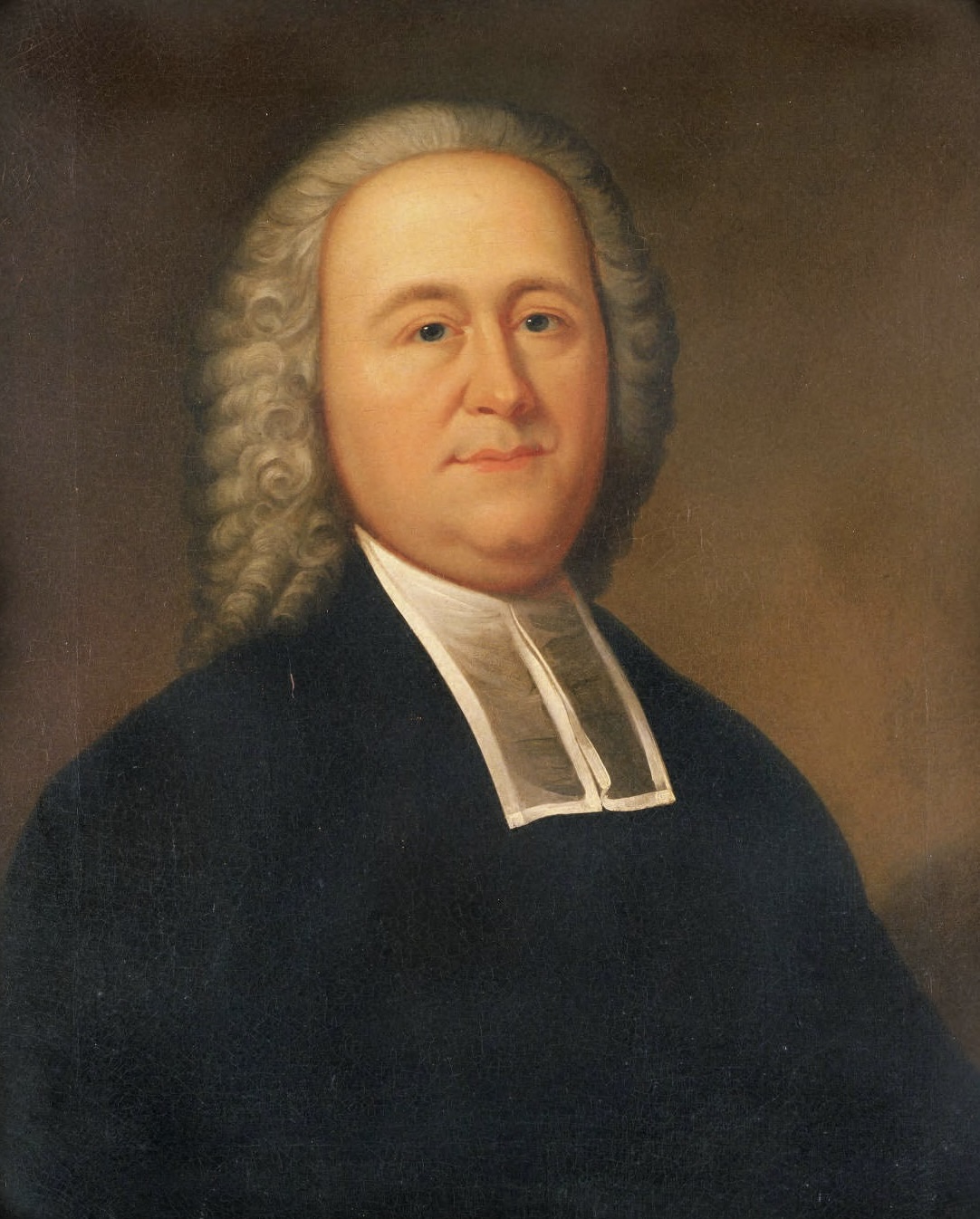

Gilbert Tennent before 1740
Gilbert Tennent was born in County Armagh, Ireland, in 1703 (Alexander gives April 5; other accounts give a different day) and came to America with his father at about fourteen.2 He was educated at home before the log school was built and then helped his father teach. He described a long period of spiritual distress in his teens before he found assurance. In 1726 or 1727 he became pastor of the Presbyterian congregation at New Brunswick, New Jersey, where he served for about sixteen years.2 At New Brunswick he came to know the Dutch Reformed pastor Theodorus Jacobus Frelinghuysen, whose revival preaching in the Raritan Valley in the 1720s is often counted as the beginning of the Awakening in the Middle Colonies. Princeton's own published history of its founding states that "The Great Awakening is said to have begun in New Jersey about 1720" with Frelinghuysen's meetings.3 Milton Coalter's biography, Gilbert Tennent, Son of Thunder (1986), traces Tennent's preaching of conviction and the "terrors of the law" to Frelinghuysen and to Dutch and English Puritan writers on conversion.4
Tennent published sermons in Boston in the 1730s, including A Solemn Warning to the Secure World (1735), whose subtitle promised to display the presumptuous sinner's "Doom."2 His preaching style is described by the Boston minister Thomas Prince, who heard him in the winter of 1740 to 1741 and called it "both terrible and searching," for the preacher "exhibited the dreadful holiness, justice, law-threatnings, truth, power, and majesty of God, and his anger with rebellious, impenitent, and Christless sinners."2
The synod's rules of 1738 and the New Brunswick Presbytery
Before Whitefield arrived, the Synod of Philadelphia had already begun to argue over the Tennents' school. In 1738 the synod created a new Presbytery of New Brunswick out of part of the Presbytery of New York, with bounds "to the northward and eastward of Maidenhead and Hopewell unto Raritan river."5 The Tennents and their allies made up most of it. In the same year, on a proposal from the Presbytery of Lewes, the synod required that a candidate for the ministry who had not studied at "some of the New England, or European colleges, approved by public authority" be examined by a synod committee before any presbytery took him on trials.5 The New Brunswick Presbytery objected, and in 1739 the synod rewrote the act. The revised rule said that any candidate "who has not a diploma, or the usual certificates from an European or New England university, shall be examined by the whole Synod, or its commission," and that the synod's certificate would be received "as equivalent to a diploma." The minutes add: "This we trust will have a happy tendency to prevent unqualified men from creeping in among us." It passed "by a great majority."5
The rule was aimed at the Log College, whose students had no diploma. The New Brunswick Presbytery nevertheless licensed John Rowland, a Log College student, without the synod's examination. In 1739 the synod judged the presbytery's proceedings "very disorderly," admonished it "to avoid such divisive courses for the future," and resolved "not to admit the said Mr. Rowland to be a preacher of the gospel within our bounds ... until he submit to such examinations as were appointed by this Synod for those that have had a private education."5 The synod's majority also passed rules restricting a minister from preaching in another minister's congregation without consent. Alexander, who admired the Log College men, still judged that they acted "in open defiance of an act formed after much discussion and deliberation, in the synod," and that "Gilbert Tennent indulged himself in very unwarrantable language in speaking of men clothed with the same office as himself."2 On the other side he argued that the synod "ought to have recognised and cherished" the school rather than "frowned upon" it.2
Historians have read the conflict in more than one way. Leonard Trinterud, in The Forming of an American Tradition (1949), described the New Side as carrying an English and New England Puritan piety of experience into a synod dominated by Scots and Scots-Irish ministers who stressed strict subscription to the Westminster Confession and church order.6 Marilyn Westerkamp, in Triumph of the Laity (1988), argued that the Scots-Irish laity had their own revival tradition, the outdoor communion seasons of Scotland and Ulster, and that the revival in the Middle Colonies drew on it.7 Elizabeth Nybakken, in "New Light on the Old Side" (Journal of American History, 1982), argued that the Old Side were not opponents of vital religion as their enemies portrayed them, but defenders of an Irish Presbyterian tradition of order and learning.8 These readings disagree in emphasis, and the documents below support parts of each.
The Danger of an Unconverted Ministry (March 8, 1740)
The occasion and the printing
Tennent preached the sermon at Nottingham, Pennsylvania, near the Maryland line, where the Presbyterian congregation was divided and looking for a minister. The title page of the second edition, printed in Philadelphia by Benjamin Franklin in 1740, reads: "THE DANGER OF AN UNCONVERTED MINISTRY, CONSIDER'D IN A SERMON On MARK VI. 34. Preached at NOTTINGHAM, in Pennsylvania, March 8. ANNO 1739, 40. By GILBERT TENNENT, A. M. And Minister of the Gospel in New-Brunswick, New-Jersey."9 The double year "1739, 40" follows the English calendar of the time, in which the legal year began on March 25, so that March 8 fell in 1739 by the legal reckoning and in 1740 by the modern one. Below the title stands Jeremiah 5:30 to 31: "A wonderful and horrible Thing is commited in the Land: The Prophets prophesy falsely, and the Priests bear Rule by their Means, and my People love to have it so."9
The dedication "To the People of Nottingham" says that Tennent wished them "to be directed in the Choice of a Minister." It anticipates the charge that the sermon was too sharp: "If any should object against the Stile, and say, That it is too pointed; I answer, That it is not keener than the Reflections of Christ himself against the old Pharisees. So far as I know my Heart, it is Grief for the Injuries that have been done to the Church of God by natural Ministers, that has extorted such Acrimony from my Pen." It closes with a prayer: "May the LORD scourge Hirelings out of his Temple."9
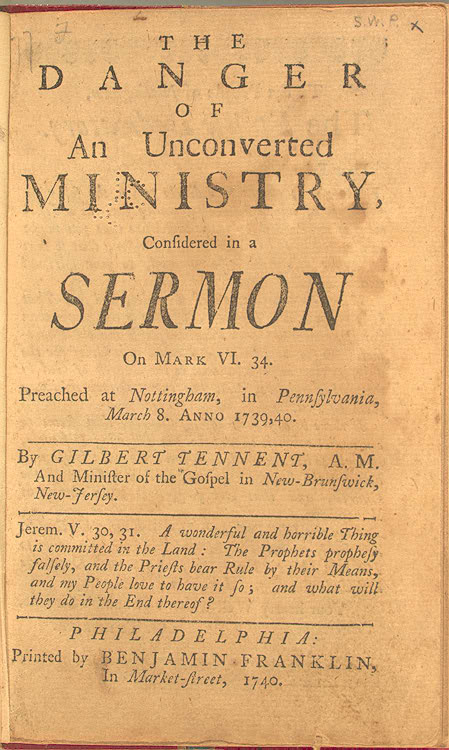

The text and the "Pharisee-Teachers"
The text is Mark 6:34, which the sermon quotes as "And Jesus, when he came out, saw much People, and was moved with Compassion towards them, because they were as Sheep not having a Shepherd."9 Tennent asks why Jesus said the people had no shepherd when they had many teachers, and answers with the phrase that gave the sermon its edge: "Why, had the People then no Teachers? O yes! they had Heaps of Pharisee-Teachers, that came out, no doubt after they had been at the Feet of Gamaliel the usual Time, and according to the Acts, Canons, and Traditions of the Jewish Church. But notwithstanding of the great Crowds of these Orthodox, Letter-learned and regular Pharisees, our Lord laments the unhappy Case of that great Number of People ... who, in the Days of his Flesh, had no better Guides."9 The words "Orthodox, Letter-learned and regular" pointed at his own synod, whose majority stressed orthodox subscription, university learning and regular order.
From the text he draws his proposition: "That the Case of such is much to be pitied, who have no other but Pharisee-Shepherds, or unconverted Teachers." The sermon is laid out in three heads: first, "the Characters of the Old Pharisee-Teachers"; second, why the people who have no better should be pitied; third, how pity should be shown.9 Under the first head he lists "Pride, Policy, Malice, Ignorance, Covetousness, and Bigotry to human Inventions in religious Matters." The Pharisees were "as crafty as Foxes," with "the Cruelty of Wolves"; though some had "a very fair and strict Out-side; yet were they ignorant of the New Birth: Witness Rabbi Nicodemus, who talk'd like a Fool about it." They were made priests if they had "but a little of the Learning then in Fashion, and a fair Outside ... though they had no Experience of the New Birth. O sad!"9
Four reasons the people are to be pitied
The second head gives four numbered reasons, each stated as a heading in the printed text.
"Natural Men have no Call of GOD to the Ministerial Work, under the Gospel-Dispensation." A "natural man," in the Puritan and Reformed vocabulary that Tennent used, is a person not yet born again, after 1 Corinthians 2:14. Tennent argued that the inward call to ministry includes aiming at the glory of God and the good of souls, which an unconverted man cannot do: "No! no! Every Skin of them has an evil Eye; for no Cause can produce Effects above its own Power." He allowed that men might put such ministers into office "through Unfaithfulness, or Mistake," but "GOD sends not such hypocritical Varlets."9
"The Ministry of natural Men is uncomfortable to gracious Souls." Their sermons "are cold and sapless, and as it were freeze between their Lips." They "comfort People, before they convince them; sow before they plow, and are busy in raising a Fabrick, before they lay a Foundation." The best known sentence of the sermon comes here: "They have not the Courage, or Honesty, to thrust the Nail of Terror into sleeping Souls." Instead, he said, they keep "Driving, Driving, to Duty, Duty," as though duties could recommend an unconverted person to God.9
"The Ministry of natural Men, is for the most part unprofitable." Tennent appealed to Scripture, reason and experience, with a run of rhetorical questions: "Is a blind Man fit to be a Guide in a very dangerous Way? Is a dead Man fit to bring others to Life? ... Isn't an unconverted Minister like a Man who would learn others to swim, before he has learn'd it himself, and so is drowned in the Act, and dies like a Fool?" He asked whether the reason conversions had been "so rarely heard of, for a long Time, in the Churches, till of late" was "That the Bulk of her spiritual Guides, were stone-blind, and stone-dead?"9
"The Ministry of natural Men is dangerous, both in respect of the Doctrines, and Practice of Piety." Here Tennent tied his charge to the doctrinal quarrel of his century: "The Doctrines of Original Sin, Justification by Faith alone, and the other Points of Calvinism, are very cross to the Grain of unrenew'd Nature ... Is not the Carnality of the Ministry, one great Cause of the general Spread of Arminianism. Socinianism, Arianism, and Deism, at this Day through the World?"9 He also charged that unconverted ministers dismissed the distress of awakened sinners and "call it Melancholy, or Madness."
The fourth reason also contains a racial figure of speech of its time: unconverted ministers are called "Moral Negroes," however "white in the Mouth" they might be, a proverb Tennent introduced with "as One expresseth is." The phrase is quoted here because it is in the text and because it shows that the language of race was part of the ordinary speech of the revival's preachers. Tennent's own letter to Whitefield about his Boston preaching, quoted below, lists "several negroes" among the converts.2 The revival's relation to slavery and to Black Christians is taken up for Edwards and Whitefield in lessons 02, 03 and 05.
"Private Schools of the Prophets"
Under the third head Tennent proposed a remedy that tied the sermon to the Log College and to the synod's rules: "The most likely Method to stock the Church with a faithful Ministry in the present Situation of Things, the publick Academies being so much corrupted and abused generally, is, To encourage private Schools, or Seminaries of Learning, which are under the Care of skilful and experienced Christians; in which those only should be admitted, who upon strict Examination, have in the Judgment of a reasonable Charity, the plain Evidences of experimental Religion." Young men of piety should be "put to Private Schools of the Prophets." He warned his hearers: "Don't think it much, if the Pharisees should be offended at such a Proposal."9 In the setting of 1740, "private Schools" meant his father's school, and "the Pharisees" who would be offended meant the synod majority that had passed the examination rule.
The right to hear another minister
The sermon's "Improvement" (the application, in Puritan sermon form) made the claim that, more than any insult, threatened the order of the churches. Tennent's fourth inference was this:9
"If the Ministry of natural Men be as it has been represented; Then it is both lawful and expedient to go from them to hear Godly Persons; yea, it's so far from being sinful to do this, that one who lives under a pious Minister of lesser Gifts after having honestly endeavour'd to get Benefit by his Ministry, and yet gets little or none, but doth find real Benefit and more Benefit elsewhere; I say, he may lawfully go, and that frequently, where he gets most Good to his precious Soul, after regular Application to the Pastor where he lives, for his Consent, and proposing the Reasons thereof; when this is done in the Spirit of Love and Meekness, without Contempt of any, as also without rash Anger, or vain Curiosity."9
The passage contains its own conditions: honest effort first, an application to the pastor, and a spirit of love and meekness. Those conditions were often forgotten in the quarrel that followed. Tennent then argued that binding a member to his parish minister was a form of oppression: "To bind Men to a particular Minister, against their Judgment and Inclinations, when they are more edified elsewhere, is carnal with a Witness; a cruel Oppression of tender Consciences, a Compelling of Men to Sin ... It's a Yoke worse than that of Rome itself." He cited the Dutch Reformed theologian Gisbertus Voetius for the claim "That even among the Papists, as to Hearing of Sermons, the People are not deprived of the Liberty of Choice."9 He turned the parish boundary into a jibe: "Faith is said to come by Hearing, Rom. 10. But the Apostle doesn't add, Your Parish-Minister."9
He answered the objection that such a practice would cause "Heats and Contentions" by saying that the gospel itself was "the innocent Occasion only" of divisions, whose "proper Cause" was "that Enmity against GOD, and Holiness, which is in the Hearts of natural Men." The faithful should not seek a false unity, "like the Unity of Ahab's false Prophets; all these four Hundred Daubers were very peaceable and much united ... Ay, they were moderate Men, and had the Majority on their Side."9 He closed with a charge to those living under "the Ministry of dead Men": they should "repair to the Living, where they may be edified. Let who will, oppose it."9
What the sermon did and did not say
Read whole, the sermon is narrower than its reputation in one respect and broader in another. It did not name any minister. It did not deny that an unconverted minister might preach true doctrine, and it admitted that such a minister might sometimes be "Instrumental, in convincing Persons of their lost State," though it called this "very rare, and extraordinary" and "a kind of Chance-medly."9 It allowed a member to leave even "a pious Minister of lesser Gifts." On the other side, it did claim that "the Body of the Clergy, of this Generation" were in the Pharisees' case: "They are blind who see not this to be the Case of the Body of the Clergy, of this Generation."9 That sentence, more than any other, explains why ministers who held the same confession read the sermon as an accusation against them. The Old Side Protestation of 1741 named "Mr. Gilbert Tennent's sermon against unconverted ministers" as an example of "rash judging and condemning all who do not fall in with their measures, both ministers and people, as carnal, graceless, and enemies to the work of God."10
The sermon also raised a question that runs through the whole revival era, and that later returned in the debates over Finney in lesson 09: who can know whether another person is converted? The Westminster tradition taught that the church judges by credible profession and life, and leaves the heart to God. Tennent claimed that a "spiritual Man" may "give a near Guess, who are the Sons of Sceva, by their Manner of Praying, Preaching, and Living."9 The Protestation answered that only God sees the heart and that the New Side taught "that a gracious person can judge of another's gracious state otherwise than by his profession and life."10 Jonathan Edwards, who defended the revival, sided with the Old Side on this point, as shown below.
Tennent in New England, 1740 to 1741
Whitefield, leaving Boston in the autumn of 1740, urged Tennent to follow him through New England. Tennent arrived in Boston on December 13, 1740, and preached there for nearly three months, according to Alexander's summary of the contemporary accounts.2 Thomas Prince wrote that "deep and pungent convictions were wrought in the minds of many hundreds of persons, in that town; and the same effect was produced in several scores, in the neighbouring congregations." He added that his colleague William Cooper "was wont to say, that more came to him in one week, in deep concern, than in the whole twenty-four years of his preceding ministry."2 Another report, quoted with Prince's, said that Cooper had about six hundred different persons visit him "on the concerns of their souls, in three month's time," and that John Webb had "above a thousand."2 These are the ministers' own counts of people who came to them, not counts of conversions, and were published by supporters of the revival.
Tennent's letter to Whitefield on his way home, preserved in John Gillies's Historical Collections and reprinted by Alexander, gives his own estimate: "In the town of Boston, there were many hundreds, if not thousands, as some have judged, under soul-concern. When I left the place, many children were deeply affected about their souls, and several had received consolation. Some aged persons in church-communion, and some open opposers, were convinced. Divers of the young and middle aged were converted, and several negroes."2 The phrase "as some have judged" marks the number as an estimate.
Tennent's visit also made enemies. Charles Chauncy wrote two years later that "Mr. TENNENT went from BOSTON to PISCATAQUA in the Path of Mr. WHITEFIELD; and, in some Places, appeared very forward in tendring his Service to preach, though he knew it was not ( as to Time ) agreeable to the Ministers." On his return he "preach'd in most, if not all the Towns as he past along," and if he had the consent of the pastors, "it was, I am ready to think, by Constraint." Chauncy dated the spread of itinerancy from this tour: "From this Time, the Method of Itinerant Preaching became common."11 Students at Yale College followed Tennent to hear him at Milford, Connecticut, in 1741, and the college fined them; Jonathan Edwards's account of David Brainerd's expulsion from Yale mentions a charge that Brainerd had criticized the rector "for fining the scholars who followed Mr. Tennent to Milford."12
The Presbyterian schism of 1741
The Protestation of June 1, 1741
The Synod of Philadelphia met in Philadelphia at the end of May 1741. On June 1, according to the minutes, "A protestation was brought in by Mr. Cross, read, and signed by several members."10 The text, printed in the Records, was signed by twelve ministers (Robert Cross, John Thomson, Francis Alison, Robert Cathcart, Richard Zanchy, John Elder, John Craig, Samuel Caven, Samuel Thomson, Adam Boyd, James Martin and Robert Jamison) and eight elders.10 It opened by describing "the dreadful divisions, distractions, and convulsions, which all of a sudden have seized this infant church," which had "subsisted for above these thirty years past, in a very great degree of comely order and sweet harmony, until of late."10 It admitted the signers' own share of guilt, naming "that great decay of practical godliness in the life and power of it, and many abounding immoralities" as "the meritorious cause of our present doleful distractions," but it named "our protesting brethren and their adherents" (the New Brunswick men, who had protested the synod's acts the year before) as "the direct and proper cause thereof, by their unwearied, unscriptural, antipresbyterial, uncharitable, divisive practices."10
The Protestation made five protests. The first bound the synod to the Westminster Confession, Catechisms and Directory "as being agreeable to the word of God." The third declared "that all our protesting brethren have at present no right to sit and vote as members of this Synod." The fifth declared that, if the New Brunswick men continued as before, the signers would be "the true Presbyterian Church in this province; and they shall be looked upon as guilty of schism."10 Its list of reasons is the best statement of the Old Side's case in its own words:
- the New Side's "heterodox and anarchical principles," in denying "that Presbyteries have authority to oblige their dissenting members";
- their protest against the synod's act on examining candidates and their licensing of men "in opposition to, and in contempt of said act";
- "irregular irruptions upon the congregations to which they have no immediate relation, without order, concurrence, or allowance of the Presbyteries or ministers";
- "rash judging and condemning all who do not fall in with their measures," with Tennent's sermon named as an example;
- the teaching that the call to the ministry lies in "some invisible motions and workings of the Spirit" rather than in regular ordination, and "that the gospel preached in truth by unconverted ministers, can be of no saving benefit to souls";
- "preaching the terrors of the law in such a manner and dialect as has no precedent in the word of God," so as "to cause them to cry out in a hideous manner, and fall down in convulsion-like fits";
- the teaching "that all true converts are as certain of their gracious state as a person can be of what he knows by his outward senses," and that people "may leave" their own pastors "when they please, and ought to go where they think they get most good."10
The minutes record what followed: the New Brunswick men asked whether they or the protesters were the synod, "They were found to be the minor party, and upon this they withdrew. After this the Synod proceeded to business."10 The remaining synod then required every member "sincerely and heartily" to receive the Westminster Confession and Catechisms, and ordered the Protestation to be defended in print if need be.10 The New Brunswick men did not regard themselves as having left; they regarded themselves as having been cast out by an irregular protest rather than by a trial. That difference of description (schism or exclusion) is the first thing the reunion of 1758 had to settle.
The Protestation's own words show the Old Side's position more exactly than the New Side's label for them. The signers did not deny a "great decay of practical godliness," and they ended their paper with a prayer that "the spirit of life and comfort" would "revive and comfort this poor swooning and fainting church, quicken her to spiritual life."10 Their case was that revival must come within the order of presbytery, the Directory and the confession. In their words, they judged "the strict observation of his laws of government and order, and not the breaking of them, to be one necessary mean and method of this necessary and much to be desired reformation."10
The Synod of New York (1745)
For four years the excluded ministers worked as the Presbytery of New Brunswick, alongside revival men in the New Castle region who organized their own presbytery. The Presbytery of New York, led by Jonathan Dickinson of Elizabethtown, New Jersey, a Yale graduate and a leading Presbyterian writer, had not signed the Protestation and tried for several years to have it withdrawn. When the Synod of Philadelphia refused, Dickinson's presbytery joined the revival men. On September 19, 1745, at Elizabethtown, ministers and elders "convened and formed themselves into a Synod, under the name or title of the Synod of New York."13 The minutes list nine ministers of the Presbytery of New York (among them Dickinson, Aaron Burr and Ebenezer Pemberton), nine of New Brunswick (Gilbert and William Tennent, Richard Treat, William Robinson, Charles Beatty and others) and four of New Castle (Samuel Blair, Samuel Finley, Charles Tennent and John Blair), twenty-two ministers in all, with twelve elders.13
The new synod's first article adopted the Westminster Confession and Catechisms "in such manner as was agreed unto by the Synod of Philadelphia, in the year 1729," that is, under the same Adopting Act the Old Side used. The second provided that every member "shall actively concur or pacifically acquiesce" in the majority's vote or "peaceably withdraw from the body." The third forbade a member to "propagate the scandal" against a brother "until the person objected against is dealt with according to the rules of the gospel, and the known methods of their discipline."13 The third article is a rule against exactly the kind of public judging of which the Old Side had accused the New Brunswick men.
Growth of the New Side and the Old Side's school
Both synods needed ministers and a way to educate them. The Old Side presbyteries of Philadelphia, New Castle and Donegal met on November 16, 1743, and agreed to open a school; in 1744 the Synod of Philadelphia took the school under its care, with Francis Alison as its first master at New London, Pennsylvania. Its plan offered instruction "gratis in the languages, philosophy, and divinity" to all who would come, supported by yearly collections in the congregations.2 The New Side, with the Log College declining as William Tennent aged, looked for a chartered college.
The New Side grew faster. Alexander wrote that its ministers "in a short time ... considerably outnumbered the old synod."2 When the two bodies met to unite in 1758, the roll of the united synod listed forty-two ministers present and fifty-two absent, ninety-four in all, most of them from the New York side.14 The counts usually given in histories (about twenty-some Old Side ministers and about seventy New Side ministers by 1758) are reconstructions from these rolls and should be treated as approximate.
The College of New Jersey (1746)
The New Side's college was chartered in 1746 and became Princeton University. Princeton's own published history of its founding, by Alexander Leitch, sets out the steps. Seven men (Jonathan Dickinson, Aaron Burr, John Pierson and Ebenezer Pemberton, all ministers of the Presbytery of New York, and three laymen, William Smith, Peter Van Brugh Livingston and William Peartree Smith) applied for a charter late in 1745 or early in 1746. Governor Lewis Morris refused. After his death, Acting Governor John Hamilton granted the first charter on October 22, 1746.3 Within months the trustees added five New Side ministers, who were, in Leitch's words, "all graduates of the Log College except Treat, who was one of its close adherents." Dickinson was elected president on April 27, 1747, and the college opened in his parsonage at Elizabethtown in the last week of May 1747. When Dickinson died in October 1747, the students moved to Aaron Burr's parsonage in Newark, and Burr became the second president. Governor Jonathan Belcher issued a second charter on September 14, 1748, which made the governor a trustee ex officio and enlarged the board to twenty-three.3 The college moved to Princeton in 1756.
The founders stated their purpose plainly. Leitch quotes them: "Though our great Intention was to erect a seminary for educating Ministers of the Gospel," they also meant the college to serve those who would fill other public stations. The same account notes that they were "not satisfied with the limited course of instruction given at the Log College."3 The connection between the two schools was therefore one of people and purpose rather than of a single institution. Alexander called the Log College "the germ from which proceeded the flourishing College of New Jersey," and wrote that "Just as the Log College expired, the College of New Jersey sprang into existence."2 Gilbert Tennent became a trustee in 1747 and remained one until his death.
Alexander also recorded a family tradition about the college's origin. He wrote that the widow of a New Brunswick minister told him that, as a girl, she heard Aaron Burr say in her father's house that "if it had not been for the treatment received by Mr. Brainerd at Yale, New Jersey college would never have been erected."2 David Brainerd, a Yale student caught up in the revival, had been expelled in 1742 after he said of a tutor who had just prayed with the students, "He has no more grace than this chair," a remark that a freshman overheard and reported.12 Edwards, who published Brainerd's diary in 1749, called the expulsion "great severity" while declining to judge the college, and he admitted that Brainerd "had the unhappiness to have a tincture of that intemperate, indiscreet zeal, which was at that time too prevalent."12 Burr and Edwards tried in 1743 to have Brainerd restored to his class and failed. Burr's remark is second-hand testimony recorded about a century after it was spoken, and it is rated below in "Claims checked."
The first four presidents of the college all came from the revival party. Dickinson (1747) and Burr (1748 to 1757) were New York Presbytery men; Burr married Esther Edwards, Jonathan Edwards's daughter, in 1752.15 Edwards himself became president in 1758 and died weeks later after a smallpox inoculation (see lesson 05). Samuel Davies, the New Side minister from Virginia whose work is described below, was president from 1759 until his death on February 4, 1761.16 Samuel Finley, a Log College man, followed him. The college's later presidency of John Witherspoon (from 1768) belongs to lesson 07.
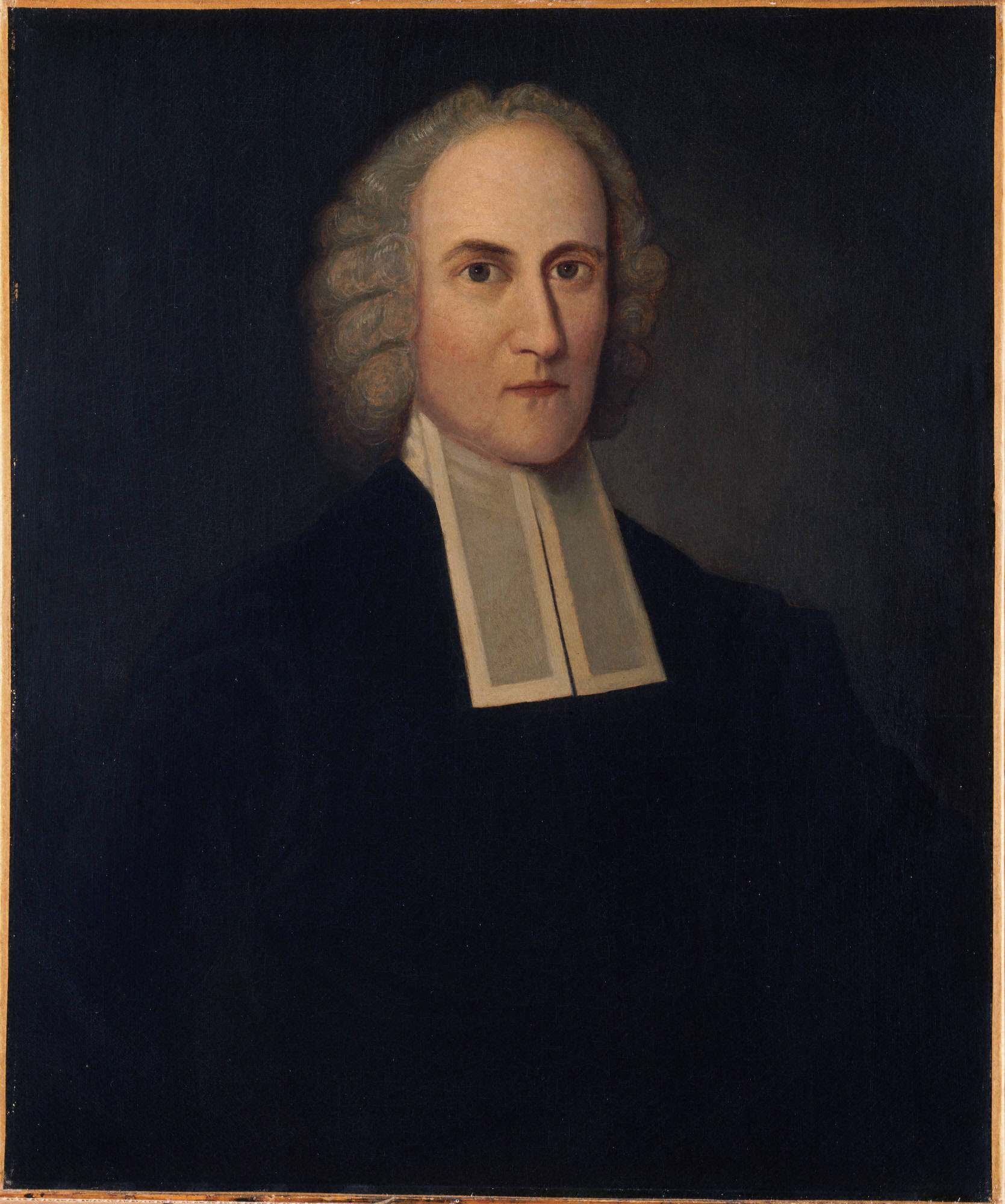

Old Lights and New Lights in New England
The names
In New England the parties were called Old Lights and New Lights. "New Light" was at first a mocking term for those who claimed new spiritual light, and the revival's opponents used it freely. The phrase was older than the revival: the preface to Chauncy's Seasonable Thoughts quotes a seventeenth century New England writer, "Mr. JOHNSON," on the Antinomian controversy of the 1630s, who said there had been "great Talk of NEW-LIGHT; but verily it proved old Darkness." The same book prints a letter on "the extraordinary Conduct of the New-Lights at NEW-LONDON."11 As with "the College," the targets of the name came to use it of themselves. "Old Light" named the revival's opponents. Unlike the Presbyterians, the New England Congregationalists did not divide into two church bodies: their churches were legally established, each town had its own church, and there was no colony-wide synod to split. The quarrel ran inside towns, between ministers and congregations, in the colonial assemblies and in the colleges.
The parties were never two tidy blocs. Historians commonly describe at least three positions: Old Lights who judged the revival to be largely a delusion or a disorder; moderate New Lights (Jonathan Edwards, Thomas Prince, Benjamin Colman, William Cooper, Joseph Sewall, and Gilbert Tennent after 1742) who defended the revival as a work of God while condemning its excesses; and radical or "strict" New Lights who followed James Davenport, encouraged lay exhorting and impressions, and in many towns separated from their parish churches.17 The infographic below arranges the parties and their branches.
James Davenport
James Davenport (1716 to 1757), a Yale graduate and the Presbyterian minister of Southold on Long Island, became the most notorious itinerant of the revival. He preached through Connecticut and Massachusetts in 1741 and 1742, singing in procession through the streets, publicly naming ministers he judged unconverted, and urging their people to leave them. His own later retraction confirms each of these practices.18 In 1742 Connecticut's General Assembly heard a complaint from Stratford about "great disorder" caused "by occasion of one James Davenport and others convening great numbers of people together." Having heard witnesses and watched his behavior during the hearing, the Assembly found that his "behaviour, conduct and doctrines" had "a natural tendency to disturb and destroy the peace and order of this government," but also that he was "under the influences of enthusiastical impressions and impulses, and thereby disturbed in the rational faculties of his mind, and therefore to be pitied and compassionated, and not to be treated as otherwise he might be." It ordered that he "be forthwith transported out of this Colony to Long Island."19 Thomas Kidd's The Great Awakening (2007) reports that a Boston grand jury later in 1742 likewise found him not of sound mind.17
Connecticut's act of May 1742
The same session of the Connecticut Assembly passed "An Act for regulating Abuses and correcting Disorders in Ecclesiastical Affairs." Its preamble recited the Saybrook Platform of 1708, under which, it said, the colony had "enjoyed great peace and quietness, till of late sundry persons have been guilty of disorderly and irregular practices," and complained that ministers had gone "without any lawful call ... into parishes immediately under the care of other ministers," while "sundry persons, some of whom are very illiterate, and have no ecclesiastical character or any authority whatsoever to preach or teach, have taken upon them publickly to teach and exhort the people."19 The act denied the benefit of the laws supporting the ministry (that is, their tax-supported salaries) to any minister who preached in another parish without the express invitation of its settled minister and the major part of its church. It bound any unordained person who preached without such invitation to good behavior in the sum of one hundred pounds, and it ordered that any "foreigner or stranger" from outside the colony who preached without such invitation be "sent (as a vagrant person) ... from constable to constable out of the bounds of this Colony."19
The act was enforced against a future president of the College of New Jersey. In October 1743 the Assembly strengthened the law against those who returned after being expelled, and Hoadly's note to the printed record explains why: "Rev. Samuel Finley, of New Jersey, afterwards president of Princeton College, for preaching in Milford, contrary to the act of May, 1742, had been accordingly sent out of the Colony, but returned again and preached in New Haven."19 The episode shows the Old Light position joined to the power of an established church: in Connecticut the dispute over itinerancy was a matter of colonial law, not only of church discipline. The Baptists' later campaign against such laws is the subject of lesson 06.
The New London burning (March 6, 1743)
The most famous single episode of the radical wing took place at New London, Connecticut, in March 1743. The fullest contemporary account is a letter that Chauncy printed in Seasonable Thoughts, introduced as "a particular Account whereof was soon sent me by an able faithful Friend, and has since been confirmed, and is now generally known and acknowledged to be the Truth."11 It is a hostile account, written by an opponent and published by the revival's chief critic, and its tone should be read with that in mind. According to the letter, "The Separates at NEW-LONDON sent a Boat over to LONG-ISLAND to invite the grand Enthusiast D---T over to Organize their Church, (as they term'd it)." He arrived "on, or about the second Day of March," and "published the Messages which he said, he received from the Spirit in Dreams and otherwise, importing the great Necessity of Mortification and Contempt of the World." He persuaded his followers "that Wigs, Cloaks and Breeches, Hoods, Gowns, Rings, Jewels and Necklaces must be all brought together into one Heap into his Chamber, that they might, by his solemn Decree, be committed to the Flames; together with certain Books of Devotion."11
The letter lists the books. They included works of standard Puritan and Anglican devotion and sermons by New England ministers, among them "BEVERIDGE'S Thoughts on Religion, part of FLAVEL'S Works, one piece of Mr. HENRY'S ... the Whole Duty of Man, one piece of DR. INCREASE MATHER'S, one of Dr. COLMAN'S, one of Dr. SEWALL'S, and Dr. CHAUNCY'S Sermon against Enthusiasm." These, the letter says, "were with much Noise and Outcry burnt on the Town Wharf in the Afternoon of the Sabbath Day, March 6th, just as People were coming from Meeting," and the burners were heard to "sing Hallelujahs and Gloria Patri over the Pile" and to declare that the smoke of the torments of such authors as had died in the same belief "was now ascending in Hell in like Manner, as they saw the Smoak of these Books rise."11 Colman and Sewall were among the revival's leading supporters in Boston, so the books burned were not only the works of Old Lights. More books were burned the next day. The clothing, the letter says, "would certainly have been consumed, but that one of the Fraternity who lov'd the World better than the rest ... came running and diverted them from it for that Time."11 The account calls the clothing pile "a Pile of Men's and Women's Apparel and Ornaments, to which the grand Director added a Pair of Plush Breeches which he wore to Town."11
The letter also reports that "The New-Light Ministers round about are at a loss how to conduct themselves." The burning embarrassed the moderate New Lights more than anything the Old Lights could write. Chauncy named "Messieurs DAVENPORT, and ALLEN" as its leaders; Kidd identifies the second as Timothy Allen, who ran a short-lived school for radical New Light exhorters at New London called the Shepherd's Tent.17
Davenport's Retractions (1744)
Davenport fell ill, and under the counsel of moderate New Light ministers, among them Solomon Williams of Lebanon, Connecticut, he reconsidered. On July 28, 1744, he signed a confession that Williams sent to Thomas Prince in Boston with a covering letter of August 2, asking that it be "forthwith publish'd, and made known in the most open Manner." Williams assured Prince "that the whole of the Paper, and every Interline, was made and written with his own Hand."18 It was printed in Boston in 1744 by S. Kneeland and T. Green as The Reverend Mr. James Davenport's Confession & Retractations.
Davenport did not retract his belief in the revival. He began: "ALTHO' I don't question at all, but there is great Reason to bless God for a glorious and wonderful Work of his Power and Grace in the Edification of his Children, and the Conviction and Conversion of Numbers in New-England, in the neighbouring Governments and several other Parts, within a few Years past." But he was "now fully convinced and persuaded, that several Appendages to this glorious Work are no essential Parts thereof, but of a different and contrary Nature and Tendency," which he had promoted "by a misguided Zeal: being further much influenced in the Affair by the false Spirit."18 He listed five errors:
- "The Method I us'd for a considerable Time, with Respect to some, yea many Ministers in several Parts, in openly exposing such as I fear'd or thought unconverted, in public Prayer or otherwise: herein making my private Judgment ... the Ground of public Actions or Conduct," which he called an offense "against the ninth Commandment" and "against the Laws both of Justice and Charity."
- "my advising and urging to such Separations from those Ministers, whom I treated as above, as I believe may justly be called rash, unwarrantable, and of sad and awful Tendency and Consequence. And here I would ask the Forgiveness of those Ministers, whom I have injured."
- "I confess I have been much led astray by following Impulses or Impressions as a Rule of Conduct, whether they came with or without a Text of Scripture."
- "encouraging private Persons to a ministerial and authoritative Kind or Method of exhorting."
- singing "with others in the Streets in Societies frequently," which had raised needless prejudice.18
He added a paragraph from his letter to "Mr. Barber at Georgia" on "the awful Affair of Books and Cloaths at New-London": "I was to my Shame be it spoken, the Ringleader in that horrid Action; I was, my dear Brother, under the powerful Influence of the false Spirit almost one whole Day together, and Part of several Days." He mentioned that at the same time he "had the long Fever on me and the cankry Humour raging at once," which "Satan and my evil Heart might make some Handle of."18 In a postscript he insisted that he had not reached these conclusions out of "Dulness and Deadness in Religion," and that he had enjoyed "a sweet Calm and Serenity of Soul and Rest in God."18
Davenport's later career was in the New Side Presbyterian church. The minutes of the Synod of New York list him among the ministers of the Presbytery of New York in 1751, and in 1750 that synod sent him to supply the congregation at Cape May and recorded that he had preached in Virginia.14 He died in 1757.
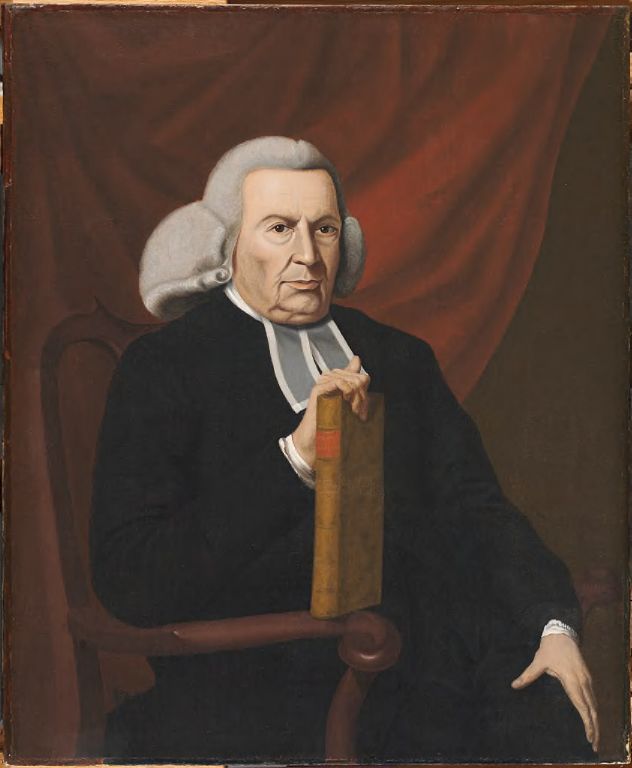

Charles Chauncy and the Old Light case
Charles Chauncy (1705 to 1787) was, from 1727, one of the ministers of the First Church in Boston. He was a great-grandson of Harvard's second president, Charles Chauncy, and he became the revival's most thorough critic. In the summer of 1742, "the Lord's Day after the Commencement," he preached at the Old Brick Meeting-House in Boston a sermon printed as Enthusiasm Described and Caution'd Against, with "a Letter to the Reverend Mr. James Davenport" attached. The title page carried two passages from Luther in Latin, in which Luther said he had made a pact with God not to be sent visions or dreams and would rest on Scripture.20
Chauncy granted that the word enthusiasm "from it's Etymology, carries in it a good meaning, as signifying inspiration from GOD," in which sense the prophets and apostles "might properly be called Enthusiasts." "But the word is more commonly used in a bad sense, as intending an imaginary, not a real inspiration: according to which sense, the Enthusiast is one, who has a conceit of himself as a person favoured with the extraordinary presence of the Deity. He mistakes the workings of his own passions for divine communications, and fancies himself immediately inspired by the SPIRIT of God, when all the while, he is under no other influence than that of an over-heated imagination."20 He gave a medical cause: "The cause of this enthusiasm is a bad temperament of the blood and spirits; 'tis properly a disease, a sort of madness." Among its signs he listed that "it affects their bodies, throws them into convulsions and distortions, into quakings and tremblings," and he recalled seeing as a boy such agitations "in a boisterous female speaker" among the Quakers.20 (The surviving digital copy of this sermon is a poor scan; the wording here was checked against it line by line, with obvious misreadings of the scan corrected.)
Chauncy's long answer to Edwards came in 1743: Seasonable Thoughts on the State of Religion in New-England, a book of more than four hundred pages "in five parts," whose first part claimed to point out "the things of a bad and dangerous tendency, in the late, and present, religious appearance, in the land."11 It was a reply to Edwards's Some Thoughts Concerning the Present Revival of Religion in New-England (1742) and was printed with a long list of subscribers. Its first part catalogued itinerant preaching, lay exhorting, censoriousness, separations, the outcries and faintings in meetings, and the New London burning, quoting letters from ministers across New England. Its central claim is stated in one sentence: "The plain Truth is, an enlightened Mind, and not raised Affections, ought always to be the Guide of those who call themselves Men; and this, in the Affairs of Religion, as well as other Things: And it will be so, where GOD really works on their Hearts, by his SPIRIT."11
That sentence states the Old Light position more exactly than its opponents' summaries of it. Chauncy did not deny that the Spirit works on human hearts; he denied that strong feeling is evidence of that work, and he held that the Spirit works through the understanding. Edwards's Religious Affections (1746), taught in lesson 05, was in part an answer: true religion, Edwards argued, lies very much in the affections, but no degree of feeling and no bodily effect is a certain sign either way. Chauncy's later theology moved away from New England Calvinism; late in life he published a defense of the final salvation of all people, and the First Church he served became Unitarian in the next century. His opponents later cited this as the end of the Old Light road, while his defenders described it as the result of a lifetime of reasoned study. Both are interpretations.
Edwards between the parties
Jonathan Edwards defended the revival in The Distinguishing Marks of a Work of the Spirit of God (1741) and Some Thoughts Concerning the Present Revival (1742), described in lesson 02. He defended it against the Old Lights, but on the question that split the Presbyterians he agreed with the Old Side. In Some Thoughts he wrote: "Censuring others is the worst disease with which this affair has been attended." He explained the temptation: new converts, "forming their idea of a state of grace only by their own experience," found it hard to believe that grace could coexist with the coldness they saw in other professing Christians. "Though censoriousness is very sinful, and is most commonly found in hypocrites and persons of a pharisaical spirit, yet it is not so inconsistent with true godliness as some imagine," he added, citing Job's friends, who were "very positively determining that he was an unconverted man."21 Edwards here used Tennent's own word, "pharisaical," against the habit that Tennent's sermon had encouraged.
Edwards's later dismissal from Northampton (1750) turned on another revival question, whether the Lord's Supper should be open to all baptized members of good life (Solomon Stoddard's practice, described in lesson 01) or limited to those who made a credible profession of saving faith. On that question Edwards took a stricter view than his grandfather and moved toward the Separates' insistence on a converted membership, though he never joined them. That story belongs to lesson 05.
The pastors' convention of May 1743
The ministers of Massachusetts tried to speak as a body in 1743, and could not agree. At their annual convention in Boston on May 25, 1743, the pastors adopted a testimony, signed by Nathanael Eells as moderator "In the Name, and by Order of the Convention," against "several Errors in Doctrine, and Disorders in Practice, that have of late obtained in various Parts of the Land." Chauncy reprinted it in Seasonable Thoughts.11 It judged that "the disorderly Tumults and indecent Behaviours of Persons" were "so far from an Indication of the special Presence of GOD with those Preachers that have industriously excited and countenanced them ... that they are a plain Evidence of the Weakness of human Nature." It advised ministers to guard their churches "against the Intrusions of Itinerants and Exhorters." But it also bore witness "against the impious Spirit of those, that, from hence, take Occasion to reproach the Work of the Divine SPIRIT," and it said that "where there is any special Revival of pure Religion in any Parts of our Land, at this Time, we would give unto GOD all the Glory."11 Even the Old Light convention, then, did not deny that a work of God had taken place. Supporters of the revival answered with their own "Testimony and Advice" at a separate assembly that summer, signed by a larger number of ministers who affirmed the revival while also warning against its errors.17 The two testimonies, one Old Light and one New Light, each conceded part of the other's case.
Separates and Separate Baptists
The Separates, or Strict Congregationalists
Where a parish minister opposed the revival, or where a town's New Lights were a minority, some of them withdrew and formed their own churches. They called themselves Strict Congregationalists, holding that they were keeping the original New England rule of a church of visible saints who could give an account of their conversion, a rule they believed the Half-Way Covenant and Stoddard's open communion had abandoned (see lesson 01). Their opponents called them Separates. C. C. Goen's Revivalism and Separatism in New England, 1740 to 1800 (1962) remains the standard study; Goen traced the Separate churches mainly to eastern Connecticut and southeastern Massachusetts, where Davenport and other itinerants had preached.22
Because the Congregational churches were established by law, separating had legal costs. Separates were still taxed to pay the parish minister they had left. Connecticut's 1742 act applied to their lay preachers, and the colony's toleration law, written for Anglicans, Baptists and Quakers, did not easily cover dissenters who claimed to be the true Congregationalists. Some Separates were jailed for refusing the minister's rate, and some had their goods distrained.22 These experiences pushed many Separates toward a demand that the state stop supporting any church, which is the subject of lesson 06.
From Separates to Baptists
A church of the converted raised the question of infant baptism. If membership required a conversion narrative, many Separates reasoned, baptism should follow conversion too. Over the next decades a large share of the Separate churches became Baptist. The best known of these converts was Isaac Backus of Norwich, Connecticut, who was converted in the revival, became pastor of a Separate church at Middleborough, Massachusetts, accepted believer's baptism in 1751, and organized a Baptist church there in 1756. William McLoughlin's biography, Isaac Backus and the American Pietistic Tradition (1967), follows his path from Separate to Baptist to campaigner for religious liberty.23 Backus's later work belongs to lesson 06; Baptist history in general is in Module 80, lesson 06.
Shubal Stearns and Sandy Creek
The Separate Baptists carried the New Light style to the southern backcountry. Shubal Stearns (1706 to 1771), born in Boston and raised in Connecticut, was a member of the Congregational church at Tolland. According to his entry in the Dictionary of North Carolina Biography (by David T. Morgan), he was stirred by Whitefield's preaching and in 1745 joined other revival supporters in forming a Separate church. In 1751 he renounced infant baptism, was baptized by the New Light Baptist preacher Wait Palmer, and was ordained to the Baptist ministry on May 20, 1751.24 In 1754 he moved south with his family and joined his brother-in-law Daniel Marshall in Virginia, and in November 1755 the group reached Sandy Creek in what was then Guilford County, North Carolina, where they formed the Sandy Creek Baptist Church. The same entry reports that the church grew "from 16 to 606 members in less than fifteen years," and that seven Separate Baptist churches formed the Sandy Creek Association about 1760.24 These are reported church membership counts, not estimates of crowds. From Sandy Creek, Separate Baptist preachers spread through Virginia, the Carolinas and Georgia, and the movement that began in New England's Separate churches became one of the roots of the Baptist majority in the American South.
Samuel Davies and the New Side in Virginia
The New Side also reached Virginia, where the Church of England was established by law. Samuel Davies was born on November 3, 1723, in New Castle County, Delaware. He studied at Samuel Blair's academy at Fagg's Manor in Chester County, Pennsylvania (Blair was a Log College man), was licensed to preach by the New Side Presbytery of New Castle on July 30, 1746, and was ordained on February 19, 1747, for a mission to Hanover County, Virginia.16 Davies did not preach as an itinerant in defiance of the law. He obtained licenses for his meetinghouses under the English Act of Toleration (1689): first for three meetinghouses in Hanover and one in Henrico, and in 1748, over the opposition of some members of the governor's Council and the colony's attorney general, for three more, so that his pastorate covered seven counties. In 1750 the General Court refused to approve an eighth license that a county court had granted. Virginia's authorities appealed to the Bishop of London, and Davies appealed through English dissenters; the bishop never issued a binding ruling.16
Davies preached to enslaved Africans as well as to free Virginians. Encyclopedia Virginia, in its entry by William Bland Whitley, says that he instructed and converted "hundreds" of slaves, many of whom took communion with the rest of the congregation, and that he obtained books for them through his transatlantic connections; the same entry says that Davies was "likely" a slaveholder himself.16 In November 1753 Davies sailed with Gilbert Tennent to raise money in Britain for the College of New Jersey. They arrived in London on December 25, 1753, and spent most of the next year apart, preaching and soliciting in England and Scotland; the only detailed account is Davies's diary, since Tennent kept no journal that has survived.2 After his return Davies became the first moderator of the Presbytery of Hanover, which first met on December 3, 1755, preached and published sermons urging Virginians to join the war against France, and in 1759 accepted the presidency of the College of New Jersey. He died at Princeton on February 4, 1761, aged thirty-seven.16
Tennent's later course: Philadelphia and the Irenicum
In May 1743 a new Presbyterian congregation in Philadelphia, formed largely by people converted or stirred under Whitefield's preaching, called Gilbert Tennent as its pastor, and he moved from New Brunswick to what became the Second Presbyterian Church of Philadelphia. He served there for twenty years.2 Alexander, who regretted the sermon of 1740, wrote that in Philadelphia "The fiery edge of his zeal had worn off," that "he seems to have lived in peace with all men," and that "there is good reason to think" Tennent came to share Alexander's view that "he was mistaken and proceeded on an erroneous principle."2 Alexander's judgment is an interpretation; Tennent's own words from 1749 show how far his view had changed and how far it had not.
In 1749 William Bradford of Philadelphia printed Tennent's Irenicum Ecclesiasticum, or A Humble Impartial Essay upon the Peace of Jerusalem, with "A Prefatory Address to the SYNODS of New-York & Philadelphia." Its motto from Ephesians 4:3 ("Endeavouring to keep the Unity of the Spirit in the Bond of Peace") set its purpose.25 In the prefatory address Tennent wrote that "The Substance of the Points disputed were freely acknowledg'd by the Reverend Brethren upon both Sides of the Question, viz. the nature and necessity of Conversion to GOD ... and the nature and necessity of Church Discipline," so that "the Controversey in my Apprehension, turns entirely upon Circumstantials."25 He granted good motives on both sides: "While some were earnestly contending, for the Credit of the late extraordinary Religious appearances, with design that they might spread far and wide! Others were streneously Contending, for the Order and Government of CHRIST'S Kingdom, least they should Suffer, and be quite unhing'd." And he described the breach in terms that included his own party: "BUT tho' the Things controverted, consider'd calmly and in a true distinct Light, were small; yet the Heat of Debate about them, run very high; this together with evil Surmisings, severe Censurings, and rash Judgings of each other ... encreas'd mutual Prejudices and Suspicions, to a Melancholy Crisis, and so occasioned the unhappy Rupture of the Churches Union."25
The Irenicum did not withdraw the claim that ministers ought to be converted men, and it did not say that the Old Side had been right about the revival. It did call "rash Judgings" a cause of the split, the same charge the Old Side had made in 1741. Coalter's biography connects the change to Tennent's experience in the early 1740s with the Moravians and with the radical New Lights, whose disorders made him a defender of church order against enthusiasm.4
The reunion of 1758
Negotiations dragged through the 1750s. In 1750 the Synod of New York drafted proposals for union. They required every member to receive the Westminster Confession and Catechisms; made it "a censurable misconduct, for any member to charge any of his brethren with errors in doctrine or immorality in conversation, except in a way of private reproof or judicial process"; required candidates to have "a degree or a certificate from the president, and a sufficient number of the tutors or trustees of some college"; and declared the Protestation of 1741 "henceforth void and of none effect." Their eighth article asked that both synods give joint testimony that "a glorious work of God's Spirit was carried on in the late religious appearances, (though we doubt not but there were several follies and extravagancies of people, and artifices of Satan intermixed therewith)."14 The Synod of Philadelphia would not declare the Protestation void, holding that a protest could not be annulled by a later synod, and the parties argued over that point for years.
The two synods met together in Philadelphia and, on May 29, 1758, adopted a plan of union "unanimously," uniting "in one body, under the name of the Synod of New York and Philadelphia." The united synod chose Gilbert Tennent as its moderator.14 The plan's preamble admitted that the old differences had been "agitated many years ago with too great warmth and animosity." Its articles answered each of the disputes of 1738 to 1741:
- Article I received the Westminster Confession and Catechisms "as an orthodox and excellent system of Christian doctrine," and the Directory for worship and government.
- Article II required each member to "actively concur with, or passively submit to" a majority decision, or "peaceably withdraw from our communion, without attempting to make any schism," but only on matters "the body shall judge indispensable in doctrine or Presbyterian government."
- Article III protected the right to protest against a synod's acts, but declared it "irregular and unlawful, to enter a protestation against any member or members, or to protest facts or accusations instead of proving them," which was a description of what had happened in 1741.
- Article IV settled the old dispute by declaring that the Synod of Philadelphia had "never judicially adopted the said protestation, nor do account it a Synodical act, but that it is to be considered as the act of those only who subscribed it."
- Article V made it "a censurable evil, to accuse any member of heterodoxy, insufficiency, or immorality, in a calumniating manner," or for a minister to "officiate in another's congregation, without asking and obtaining his consent," while calling it "unbrotherly" to refuse consent "in ordinary circumstances."
- Article VI required candidates to satisfy the presbytery "as to his learning, and experimental acquaintance with religion," that is, both the Old Side's demand for learning and the New Side's demand for experience.14
Article VIII was the synod's joint statement about the revival. The New York members declared "their adherence to their former sentiments in favour of them, that a blessed work of God's Holy Spirit in the conversion of numbers was then carried on." The united synod then defined a work of God in Westminster terms: since "all mankind are naturally dead in trespasses and sins," an "entire change of heart and life is necessary," and "such a change can be only effected by the powerful operations of the Divine Spirit." Where sinners are convinced of "their lost condition and absolute inability to recover themselves," trust Christ, depend on "his imputed righteousness for their justification," and lead changed lives, "this is to be acknowledged as a gracious work of God, even though it should be attended with unusual bodily commotions or some more exceptionable circumstances." But when people "imagine that they have visions of the human nature of Jesus Christ, or hear voices, or see external lights, or have fainting and convulsion-like fits, and on the account of these judge themselves to be truly converted," the synod judged that "such persons are under a dangerous delusion."14
The reunion therefore did not declare a winner. The New Side got its affirmation of the revival and its requirement of "experimental acquaintance with religion"; the Old Side got its rules against intrusion and public censure, its demand for learning, and the synod's disapproval of visions and fits as grounds of assurance. The united church lasted until the Presbyterian Old School and New School division of 1837 to 1838, which is the subject of lesson 13.
The parties at a glance
The first chart follows the Presbyterian division from the synod's rules of 1738 to the reunion of 1758, with the schools each side founded. The second sets out the New England positions from Old Light to Separate Baptist. The third is a timeline of the events in this lesson.
What the record shows and what it does not
- Documented fact: Tennent preached The Danger of an Unconverted Ministry at Nottingham on March 8, 1740, and Franklin printed a second edition that year. The Synod of Philadelphia passed rules on examining candidates in 1738 and 1739, censured the New Brunswick Presbytery for licensing John Rowland, and on June 1, 1741, received a Protestation signed by twelve ministers and eight elders, after which the New Brunswick men withdrew. The Synod of New York formed on September 19, 1745. The College of New Jersey was chartered on October 22, 1746. The two synods united on May 29, 1758. Connecticut's Assembly passed its act against unauthorized preaching in May 1742 and ordered Davenport removed to Long Island. Davenport signed his Retractations on July 28, 1744.
- Each party's own claim: Tennent claimed that "the Body of the Clergy, of this Generation" were unconverted and that members might leave them. The Old Side claimed that the New Side's "rash judging" and "irregular irruptions" caused the schism. The revival's supporters claimed that hundreds or thousands were converted in Boston in 1740 to 1741; these figures are their own estimates.
- Hostile testimony: The detailed account of the New London burning comes from a letter printed by Chauncy, the revival's chief critic. Its main facts (books burned, clothes gathered) are confirmed by Davenport's own retraction, which calls it "the awful Affair of Books and Cloaths at New-London."
- Later tradition: That the Log College was "the germ" of Princeton is Alexander's 1845 judgment. That Brainerd's expulsion caused the founding of the college rests on Burr's remark as remembered decades later by a woman who heard it as a child.
- Scholarly reading: Whether the schism was mainly about ethnicity and education (Scots-Irish against New England-trained ministers), about church order, or about the nature of conversion is debated (Trinterud, Westerkamp, Nybakken, Coalter).
- Open questions: The exact size of the parties in each year, the number of Separate churches in New England, and how far Tennent's later irenic writings amount to a change of mind are matters of reconstruction and judgment.
Claims checked
"Tennent's Nottingham sermon split the Presbyterian Church." Partly supported.
The Protestation of 1741 names "Mr. Gilbert Tennent's sermon against unconverted ministers" as an instance of the New Side's "rash judging."10 Alexander wrote that it "had much influence in leading to the separation which soon followed."2 But the Protestation lists six other reasons, and the dispute had begun in 1738 with the synod's rule on examining candidates and the licensing of John Rowland in defiance of it.5 The sermon sharpened a quarrel about education, ordination and preaching rights that already existed.
"The Log College was the beginning of Princeton University." Partly supported.
The two institutions were separate: the Log College was William Tennent's private school, and the College of New Jersey was a chartered college founded by ministers of the New York Presbytery and laymen. Princeton's own account says the founders were "not satisfied with the limited course of instruction given at the Log College."3 But the same account records that the trustees added in 1747 were Log College graduates or close adherents, and Gilbert Tennent and Samuel Finley were trustees; Finley became president. The connection is real in people, money and purpose, which is the sense of Alexander's phrase "the germ."2
"Tennent said all ministers who opposed the revival were unconverted." Partly supported.
The sermon names no one, and it allows that converted ministers of "lesser Gifts" exist. It also says that "the Body of the Clergy, of this Generation" resembled the Pharisees, and that it was "lawful and expedient" to leave natural men's ministry.9 It was the general charge, not any accusation against a named man, that the Old Side answered.
"Davenport led a bonfire of books and fine clothes at New London." Supported for the books; partly supported for the clothes.
Books were burned on the town wharf on the afternoon of Sunday, March 6, 1743, according to the letter Chauncy printed, which lists the titles. The same letter says that the clothes were piled up but were not burned because one of the group stopped it.11 Davenport's own retraction confirms "the awful Affair of Books and Cloaths at New-London" and calls himself "the Ringleader in that horrid Action."18
"Davenport was officially declared insane." Partly supported.
The Connecticut Assembly in 1742 found him "under the influences of enthusiastical impressions and impulses, and thereby disturbed in the rational faculties of his mind, and therefore to be pitied," and deported him to Long Island instead of punishing him.19 That is a legislative finding, not a medical one. Kidd reports a similar Boston grand jury finding later in 1742.17 Davenport later blamed a fever and "the false Spirit."18
"The Old Lights and Old Side were opposed to revival as such." Partly supported.
Chauncy treated most of the revival's signs as enthusiasm, and the Connecticut Old Lights used the law against itinerants.19 But the Old Side Protestation lamented "that great decay of practical godliness" and prayed that God would "quicken her to spiritual life," and the Massachusetts pastors' convention of May 1743 gave "unto GOD all the Glory" for any "special Revival of pure Religion."1011 Their objection was to methods and claims, which they judged disorderly or delusive.
"Princeton was founded because Yale expelled David Brainerd." Unresolved.
The only source is Alexander's report of a woman's childhood memory of Aaron Burr's remark.2 The New York Presbytery men had other reasons to found a college: the synod's examination rule, the decline of the Log College, and the need to train ministers for a growing synod.3 The expulsion may have added urgency; the evidence cannot show that it was decisive.
"Tennent later recanted the Nottingham sermon." Partly supported.
Tennent's Irenicum of 1749 called the disputed points "small" and "Circumstantials" and listed "severe Censurings, and rash Judgings of each other" among the causes of the rupture.25 He did not withdraw the claim that a minister must be a converted man, and the reunion plan he helped to adopt kept the requirement of "experimental acquaintance with religion."14 His tone changed; his doctrine of the ministry did not.
"The Southern Separate Baptists grew out of the Great Awakening in New England." Supported.
Shubal Stearns joined a Separate church in Connecticut after hearing Whitefield in 1745, became a Baptist in 1751, and founded the Sandy Creek church in North Carolina in 1755; its membership was reported to grow from sixteen to 606 in less than fifteen years.24
"Patrick Henry learned his oratory from Samuel Davies." Partly supported.
Encyclopedia Virginia states that Henry as a boy went with his mother to hear Davies and was influenced by his speaking style.16 That a boy heard a preacher and admired his style is plausible and widely reported; how much of Henry's later oratory came from Davies cannot be measured.
Hard questions and answers
Can anyone judge whether another person, and especially a minister, is converted?
Tennent held that a spiritual man could "give a near Guess" by a man's praying, preaching and living.9 The Old Side answered that a gracious person cannot judge another's state "otherwise than by his profession and life."10 Edwards, a defender of the revival, called "Censuring others" its "worst disease."21 Davenport, after doing it more than anyone, confessed that he had made his "private Judgment ... the Ground of public Actions," against "the Laws both of Justice and Charity."18 The reunion of 1758 settled the church's answer in rules rather than theory: charges against a minister must be proved by "a regular process."14 Calvinists on both sides agreed that only God knows the elect with certainty; they disagreed about how much a believer's experience could discern in another.
If both sides held the Westminster Confession, was this a doctrinal quarrel at all?
Both synods professed the same confession under the same 1729 Adopting Act.13 Tennent himself wrote in 1749 that "the Controversey ... turns entirely upon Circumstantials."25 But the "circumstantials" touched doctrine: what a call to the ministry is, whether assurance is normally as certain as sense experience, how the law should be preached before the gospel, and whether bodily effects mean anything. The Protestation listed several of these as doctrinal errors.10 A fair answer is that the quarrel was about the application of a shared doctrine of conversion to church order and pastoral practice.
Tennent blamed Arminianism on unconverted ministers. How would an Arminian or Wesleyan answer?
Tennent's charge that "the Carnality of the Ministry" caused "the general Spread of Arminianism. Socinianism, Arianism, and Deism" put Arminians in company they rejected.9 An Arminian would reply that Arminius, the Remonstrants and later John Wesley held the Trinity and the deity of Christ against Socinians and Arians, and that the Wesleyan revival in England, with its stress on the new birth and on assurance, showed that Arminian preaching could produce exactly the converted ministry Tennent wanted. The Arminian and Calvinist positions, and Wesley's quarrel with Whitefield over predestination, are set out in Module 80, lesson 03, and Wesley's teaching on assurance in Module 77, lesson 01. A Calvinist of Tennent's party would answer that the Remonstrant view of grace, whatever its authors intended, weakened the doctrines that humble the sinner.
Tennent called the parish rule "a Yoke worse than that of Rome." How does this look to a Catholic reader?
Tennent's own source, Voetius, conceded "That even among the Papists, as to Hearing of Sermons, the People are not deprived of the Liberty of Choice."9 A Catholic reader would see the argument differently in a second respect: in Catholic teaching the validity of a priest's sacraments does not depend on his personal holiness, a principle the church defended against the Donatists of North Africa, while Tennent argued that a minister's personal conversion bore on whether God would bless his ministry. Tennent did not deny that true doctrine preached by an unconverted man was true. The Protestation accused the New Side of teaching that such preaching "can be of no saving benefit to souls," which the sermon itself does not quite say; it calls such benefit "very rare, and extraordinary."910
Were the outcries and fainting evidence of anything?
Chauncy explained them as "a bad temperament of the blood and spirits," "a disease, a sort of madness."20 The Old Side said they came "from an inferior or worse cause."10 The united synod in 1758 said that a real conversion might be "attended with unusual bodily commotions," but that anyone who judged himself converted on account of "visions," "voices," "external lights" or "fainting and convulsion-like fits" was "under a dangerous delusion."14 That is close to Edwards's position in Religious Affections. A skeptic would accept Chauncy's natural explanation and go further than he did; a believer in the revival would say that natural effects can accompany a supernatural work. None of the parties claimed that the bodily effects alone proved anything, and the evidence of the period cannot settle what caused them in any given person.
What lasted from the quarrel?
Institutions: the College of New Jersey (Princeton), the Synod of New York and Philadelphia and its rules for licensing and intrusion, the Separate churches of New England, and the Separate Baptist churches of the South. Habits: the claim that members may judge their ministers by their spiritual fruit, the expectation of a conversion experience, the itinerant preacher who ignores parish lines, and the argument that the state should not compel support for any church. Each of these returns in later lessons, in the Second Great Awakening's camp meetings (lesson 08), in Finney's new measures and their critics (lesson 09), and in the Old School and New School division of 1837 (lesson 13).
Learn more
- The Danger of an Unconverted Ministry, full text (TCP keyed edition): Read the whole sermon, including the 'Improvement' on hearing other ministers, which is often left out of excerpts.
- Records of the Presbyterian Church (1841): The synod minutes for 1738 to 1758, with the Protestation of 1741 and the Plan of Union of 1758 in full.
- Chauncy, Seasonable Thoughts (1743): The fullest Old Light case, with letters from ministers across New England and the account of the New London burning.
- Archibald Alexander, The Log College (1845): A sympathetic but candid nineteenth century history of William Tennent's school and its graduates.
- Edwards, Some Thoughts Concerning the Present Revival (1742): The moderate New Light defense of the revival, with its warning against 'Censuring others.'
- Module 80, lesson 02: Reformed and Presbyterian: Background on Presbyterian church order and history.
Still being checked (14 items)
These points could not be confirmed against a primary source when this lesson was written and fact checked in October 2026. The text above states each one as uncertain.
- Gilbert Tennent's birth day: Alexander (1845) gives April 5, 1703; other accounts give February 5. The lesson gives only the year.
- The interpretive summaries of Trinterud (1949), Westerkamp (1988), Nybakken (1982), Coalter (1986), Goen (1962), McLoughlin (1967) and Kidd (2007) are from standard accounts of these works; the books themselves were not reopened during this run.
- Kidd's report of a Boston grand jury finding Davenport not of sound mind (1742) and his identification of 'Allen' as Timothy Allen of the Shepherd's Tent were not checked against a primary source.
- Isaac Backus's dates (believer's baptism 1751; Baptist church at Middleborough 1756) are given from the standard account (McLoughlin) and were not checked against Backus's own writings in this run.
- The 'Testimony and Advice' of the pro-revival ministers (summer 1743) is described without its date or number of signers, which were not verified.
- Chauncy's Enthusiasm Described (1742) was read from a poor OCR scan; obvious scan errors were corrected in the quotations (for example 'carries ln it' to 'carries in it'), and minor punctuation in the quoted sentences may differ from the printed page.
- The Gilbert Tennent portrait by Jacob Eichholtz is posthumous (Eichholtz worked in the early nineteenth century); the earlier likeness it was copied from, if any, was not identified. The Wikimedia Commons file page could not be fetched during this run, so caption details follow IMAGES.md.
- IMAGES.md file 04-samuel-davies.jpg is labeled on Commons as a different Samuel Davies (a Welsh Wesleyan minister, 1818 to 1891), so it was not used. 04-log-college-rendering.png is an AI-generated image (DALL-E, 2023) and was not used as a historical illustration.
- Charles Chauncy's descent from Harvard president Charles Chauncy, his late universalist writings and the later Unitarian character of the First Church in Boston are stated from general knowledge and were not footnoted to a primary source.
- The College of New Jersey's move to Princeton in 1756 and Samuel Finley's succession to the presidency are stated without a separate footnote; the Princeton Companion page fetched did not cover them.
- Encyclopedia Virginia says Davies was 'likely' a slaveholder; no primary record of his slaveholding was checked.
- Shubal Stearns's birth year (1706) is not given in the NCpedia entry cited; it follows the usual Baptist histories and was not checked against a primary record.
- The identification of the "Mr. JOHNSON" quoted in the preface of Seasonable Thoughts with Edward Johnson, author of Wonder-Working Providence (1654), was not checked; the text says only that he wrote of the Antinomian controversy.
- That Aaron Burr and Jonathan Edwards tried in 1743 to have Brainerd restored to Yale is stated from the standard biographies; Edwards's Life of Brainerd, as checked, does not give this detail in the passage cited.
Notes
- Records of the Presbyterian Church in the United States of America ... Minutes of the Synod of Philadelphia, from 1717 to 1758 (Philadelphia: Presbyterian Board of Publication, 1841), pp. 51 to 52 (September 17, 1718: admission of William Tennent and his reasons for dissenting from the Church of Ireland) (retrieved Oct. 28, 2026). Read it online. ↩
- Archibald Alexander, Biographical Sketches of the Founder, and Principal Alumni of the Log College: Together with an Account of the Revivals of Religion, under Their Ministry (Princeton: J. T. Robinson, 1845), chapters 1 to 6, including Whitefield's journal for November 22, 1739, Thomas Prince's account and Gilbert Tennent's letter to Whitefield from Gillies's Historical Collections (retrieved Oct. 28, 2026). Read it online. ↩
- Alexander Leitch, "Founding of Princeton, The," in A Princeton Companion (Princeton University Press, 1978), online edition, De Gruyter Brill (Princeton Legacy Library) (retrieved Oct. 28, 2026). Read it online. ↩
- Milton J. Coalter Jr., Gilbert Tennent, Son of Thunder: A Case Study of Continental Pietism's Impact on the First Great Awakening in the Middle Colonies (New York: Greenwood Press, 1986). Cited for interpretation. Read it online. ↩
- Records of the Presbyterian Church (1841), Minutes of the Synod of Philadelphia for 1738 and 1739, pp. 139 to 148 (erection of the Presbytery of New Brunswick; the Lewes proposal; the revised act on examining candidates; the censure for licensing John Rowland) (retrieved Oct. 28, 2026). Read it online. ↩
- Leonard J. Trinterud, The Forming of an American Tradition: A Re-examination of Colonial Presbyterianism (Philadelphia: Westminster Press, 1949). Cited for interpretation. Read it online. ↩
- Marilyn J. Westerkamp, Triumph of the Laity: Scots-Irish Piety and the Great Awakening, 1625 to 1760 (New York: Oxford University Press, 1988). Cited for interpretation. Read it online. ↩
- Elizabeth I. Nybakken, "New Light on the Old Side: Irish Influences on Colonial Presbyterianism," Journal of American History 68, no. 4 (1982). Cited for interpretation. Read it online. ↩
- Gilbert Tennent, The Danger of an Unconverted Ministry, Consider'd in a Sermon on Mark VI. 34. Preached at Nottingham, in Pennsylvania, March 8. Anno 1739, 40. Second edition. Philadelphia: Printed by Benjamin Franklin, 1740 (Evans 4610). Text from the Evans Early American Imprints keyed edition, Text Creation Partnership N03758 (retrieved Oct. 28, 2026). Read it online. ↩
- Records of the Presbyterian Church (1841), Minutes of the Synod of Philadelphia for 1741, pp. 157 to 161, with "A Protestation presented to the Synod, June 1, 1741" and its signatures (retrieved Oct. 28, 2026). Read it online. ↩
- Charles Chauncy, Seasonable Thoughts on the State of Religion in New-England, a Treatise in Five Parts (Boston: Rogers and Fowle, for Samuel Eliot, 1743), Part I, pp. 36 to 42 (itinerancy and Tennent's tour), 220 to 223 (the New London burning), 297 to 301 (the convention of May 25, 1743), 327 ("an enlightened Mind") (retrieved Oct. 28, 2026). Read it online. ↩
- Jonathan Edwards, An Account of the Life of the Late Reverend Mr. David Brainerd (1749), in The Works of Jonathan Edwards, ed. Edward Hickman (London, 1834), vol. 2, Christian Classics Ethereal Library (retrieved Oct. 28, 2026). Read it online. ↩
- Records of the Presbyterian Church (1841), Minutes of the Synod of New York, Elizabethtown, September 19, 1745, p. 233 (retrieved Oct. 28, 2026). Read it online. ↩
- Records of the Presbyterian Church (1841), Minutes of the Synod of New York for 1750 and 1751, pp. 242 to 244 (proposals for union), and the Plan of Union of the Synods of New York and Philadelphia, May 29, 1758, pp. 285 to 288 (retrieved Oct. 28, 2026). Read it online. ↩
- George M. Marsden, Jonathan Edwards: A Life (New Haven: Yale University Press, 2003), on Esther Edwards and Aaron Burr. Cited for the marriage and its date. Read it online. ↩
- William Bland Whitley, "Samuel Davies (1723 to 1761)," Encyclopedia Virginia (Virginia Humanities), from the Dictionary of Virginia Biography (retrieved Oct. 28, 2026). Read it online. ↩
- Thomas S. Kidd, The Great Awakening: The Roots of Evangelical Christianity in Colonial America (New Haven: Yale University Press, 2007). Cited for interpretation and for facts not found in the primary sources consulted. Read it online. ↩
- The Reverend Mr. James Davenport's Confession & Retractations (Boston: S. Kneeland and T. Green, 1744), with Solomon Williams's covering letter of August 2, 1744. Text Creation Partnership N04347 (retrieved Oct. 28, 2026). Read it online. ↩
- Charles J. Hoadly, ed., The Public Records of the Colony of Connecticut, from October, 1735, to October, 1743 (Hartford, 1874), vol. 8, pp. 454 to 457 ("An Act for regulating Abuses and correcting Disorders in Ecclesiastical Affairs," May 1742), 483 to 484 (James Davenport), 569 to 570 with editor's note (October 1743 act and Samuel Finley) (retrieved Oct. 28, 2026). Read it online. ↩
- Charles Chauncy, Enthusiasm Described and Caution'd Against. A Sermon Preach'd at the Old Brick Meeting-House in Boston, the Lord's Day after the Commencement, 1742. With a Letter to the Reverend Mr. James Davenport (Boston: J. Draper, for S. Eliot and J. Blanchard, 1742), pp. 2 to 4. Scanned copy at the Internet Archive; the scan is poor and readings were checked line by line (retrieved Oct. 28, 2026). Read it online. ↩
- Jonathan Edwards, Some Thoughts Concerning the Present Revival of Religion in New-England (Boston, 1742), Part IV, "Censuring others," in The Works of Jonathan Edwards, ed. Edward Hickman (London, 1834), vol. 1 (as "Thoughts on the Revival of Religion in New England"), Christian Classics Ethereal Library (retrieved Oct. 28, 2026). Read it online. ↩
- C. C. Goen, Revivalism and Separatism in New England, 1740 to 1800: Strict Congregationalists and Separate Baptists in the Great Awakening (New Haven: Yale University Press, 1962). Cited for interpretation. Read it online. ↩
- William G. McLoughlin, Isaac Backus and the American Pietistic Tradition (Boston: Little, Brown, 1967). Cited for interpretation and dates of Backus's career. Read it online. ↩
- David T. Morgan, "Stearns, Shubal, Jr.," in Dictionary of North Carolina Biography, ed. William S. Powell (University of North Carolina Press, 1994), on NCpedia (retrieved Oct. 28, 2026). Read it online. ↩
- Gilbert Tennent, Irenicum Ecclesiasticum, or A Humble Impartial Essay upon the Peace of Jerusalem ... Also a Prefatory Address to the Synods of New-York and Philadelphia (Philadelphia: W. Bradford, 1749). Text Creation Partnership N05110 (retrieved Oct. 28, 2026). Read it online. ↩
Check yourself
1. Where and when did Gilbert Tennent preach The Danger of an Unconverted Ministry?
The title page of the 1740 Philadelphia edition says it was preached at Nottingham, in Pennsylvania, on March 8, 1739/40 (1740 in modern reckoning).
2. Which Bible text did Tennent preach on?
The sermon's text is Mark 6:34, Jesus's compassion on people who were 'as Sheep not having a Shepherd.' Jeremiah 5:30 to 31 is the motto on the title page.
3. What did the Synod of Philadelphia's 1739 act require of a candidate who had no college diploma?
The revised act provided that such a candidate 'shall be examined by the whole Synod, or its commission,' and that its certificate would be received 'as equivalent to a diploma.'
4. How many ministers signed the Protestation of June 1, 1741?
The Records print twelve ministers' names (Robert Cross, John Thomson, Francis Alison and others) and eight elders'. Twenty-two is the number of ministers at the founding of the Synod of New York in 1745.
5. What did Connecticut's General Assembly order in 1742 after hearing the complaint against James Davenport?
The Assembly found him 'disturbed in the rational faculties of his mind' and ordered him 'forthwith transported out of this Colony to Long Island.'
6. According to the letter Chauncy printed, what happened at New London on March 6, 1743?
The letter lists the books 'burnt on the Town Wharf' and says the clothes 'would certainly have been consumed' had one of the group not stopped it.
7. Which statement about the Plan of Union of May 29, 1758 is correct?
Article IV says the synod 'never judicially adopted the said protestation' and that it was 'the act of those only who subscribed it.' The plan affirmed the revival, kept the Westminster standards and required both learning and experience.
8. Who founded the Sandy Creek Baptist Church in North Carolina in 1755?
Shubal Stearns, a Connecticut Separate who became a Baptist in 1751, reached Sandy Creek with his family and Daniel Marshall's in November 1755.
Terms in this lesson
- Log College
- The name, first used in contempt, for William Tennent's school in a log house near Neshaminy, Pennsylvania (from about 1726), which trained Gilbert Tennent's brothers, Samuel Blair, Samuel Finley and other New Side ministers.
- Old Side
- The party of the Presbyterian Synod of Philadelphia that excluded the New Brunswick men in 1741; it stressed learned ministers, presbytery authority and rules against preaching in other ministers' congregations without consent.
- New Side
- The revival party of colonial Presbyterians, led by the Tennents and their allies, which formed the Synod of New York in 1745 and founded the College of New Jersey.
- Old Lights
- In New England, ministers and laymen who judged the revival of the 1740s to be largely enthusiasm or disorder, of whom Charles Chauncy was the leading writer.
- New Lights
- In New England, supporters of the revival; the name began as a mocking term for those who claimed new spiritual light. They ranged from moderates such as Edwards to radicals such as Davenport.
- Natural man
- In Reformed and Puritan usage, a person not yet born again (after 1 Corinthians 2:14). Tennent argued that a 'natural man' has no call from God to the ministry.
- Protestation (1741)
- The paper presented to the Synod of Philadelphia on June 1, 1741, by twelve ministers and eight elders, declaring that the New Brunswick men had no right to sit in the synod.
- Itinerancy
- Preaching from place to place, often in other ministers' parishes without their consent; restricted by Connecticut's act of May 1742 and by the Presbyterian synod's rules.
- Exhorter
- A layman without ordination or license who spoke publicly to urge hearers to repent; the Connecticut act of 1742 and the Massachusetts convention of 1743 opposed the practice.
- Enthusiasm
- In eighteenth century usage, a claim to immediate inspiration by the Spirit; Chauncy defined the enthusiast as one who 'mistakes the workings of his own passions for divine communications.'
- Separates (Strict Congregationalists)
- New Light Congregationalists who left their parish churches to form churches of members able to give an account of conversion; many later became Baptists.
- Separate Baptists
- Baptists who came out of the Separate movement, including Shubal Stearns's Sandy Creek church (1755) in North Carolina and its offshoots in the South.
- Plan of Union (1758)
- The articles by which the Synods of New York and Philadelphia reunited on May 29, 1758, affirming the revival and the Westminster standards and forbidding public censure of ministers without trial.
- Act of Toleration (1689)
- The English statute that allowed Protestant dissenters to worship in licensed meetinghouses; Samuel Davies used it to license Presbyterian meetinghouses in Virginia.
Sources
- Gilbert Tennent, The Danger of an Unconverted Ministry (2nd ed., Philadelphia: B. Franklin, 1740), TCP N03758 (1740) checked 2026-10
- Records of the Presbyterian Church in the United States of America (1841) (1841 (minutes 1706 to 1788)) checked 2026-10
- Archibald Alexander, Biographical Sketches of the Founder and Principal Alumni of the Log College (1845) (1845) checked 2026-10
- Charles Chauncy, Seasonable Thoughts on the State of Religion in New-England (1743) (1743) checked 2026-10
- Charles Chauncy, Enthusiasm Described and Caution'd Against (1742) (1742) checked 2026-10
- The Reverend Mr. James Davenport's Confession and Retractations (Boston, 1744), TCP N04347 (1744) checked 2026-10
- Gilbert Tennent, Irenicum Ecclesiasticum (Philadelphia, 1749), TCP N05110 (1749) checked 2026-10
- The Public Records of the Colony of Connecticut, vol. 8, 1735 to 1743 (Hoadly, 1874) (1874 (records 1735 to 1743)) checked 2026-10
- The Works of Jonathan Edwards, ed. Hickman, vol. 1 (Some Thoughts Concerning the Present Revival) (1742; ed. 1834) checked 2026-10
- The Works of Jonathan Edwards, ed. Hickman, vol. 2 (Life of David Brainerd) (1749; ed. 1834) checked 2026-10
- Alexander Leitch, "Founding of Princeton," A Princeton Companion (1978) checked 2026-10
- William Bland Whitley, "Samuel Davies (1723 to 1761)," Encyclopedia Virginia (undated online entry) checked 2026-10
- David T. Morgan, "Stearns, Shubal, Jr.," NCpedia (Dictionary of North Carolina Biography) (1994) checked 2026-10
- Thomas S. Kidd, The Great Awakening (Yale, 2007) (2007) checked 2026-10
- Milton J. Coalter Jr., Gilbert Tennent, Son of Thunder (1986) (1986) checked 2026-10
- Leonard J. Trinterud, The Forming of an American Tradition (1949) (1949) checked 2026-10
- Marilyn J. Westerkamp, Triumph of the Laity (1988) (1988) checked 2026-10
- Elizabeth I. Nybakken, "New Light on the Old Side," Journal of American History (1982) (1982) checked 2026-10
- C. C. Goen, Revivalism and Separatism in New England, 1740 to 1800 (1962) (1962) checked 2026-10
- William G. McLoughlin, Isaac Backus and the American Pietistic Tradition (1967) (1967) checked 2026-10
- George M. Marsden, Jonathan Edwards: A Life (2003) (2003) checked 2026-10