Lesson 2 of 14 · about 60 minutes · Updated November 5, 2026
Thomas Aquinas: His Life, the Dominican Order and the University of Paris
You'll be able to
- Trace the life of Aquinas place by place, from Roccasecca to Fossanova, with the main works of each period.
- Explain what the Order of Preachers was founded for and how Aquinas defended its way of life in the Summa.
- Describe the two Paris controversies (the mendicants and the Averroists) and the condemnations of 1277.
- Separate what sworn witnesses of 1319 reported from what later lives and legends added.
- Rate famous stories about Aquinas by who first told them, when, and how close they were to the event.
- Follow how a suspected teacher of 1277 became a saint in 1323, a Doctor of the Church in 1567 and the model of Aeterni Patris in 1879.
Start here: the short version
Thomas Aquinas was born about 1225 in the family castle of Roccasecca, between Rome and Naples, and died on March 7, 1274, at the Cistercian abbey of Fossanova, on his way to the Second Council of Lyons. In less than fifty years he went from child oblate at the Benedictine abbey of Monte Cassino to student at the emperor's new university in Naples, to Dominican friar (against his family's will, which kept him under guard for a year or more), to pupil of Albert the Great at Paris and Cologne, to master of theology at Paris, and to teacher in the Dominican houses of Orvieto, Rome and Naples. He wrote the Summa contra Gentiles, began the Summa Theologiae at Santa Sabina in Rome, fought two academic battles at Paris (for the friars' right to teach and against a reading of Aristotle that gave all men one intellect), and stopped writing after something happened to him at Mass in Naples around the feast of Saint Nicholas, December 6, 1273. Three years to the day after his death, the bishop of Paris condemned 219 propositions, some of which scholars connect with his teaching. Fifty years later Pope John XXII canonized him (July 18, 1323). This lesson tells that life from the sources, separates what the early witnesses swore to from what later lives added, and rates the famous stories: the straw, the dumb ox, the temptress and the firebrand, the crucifix that spoke.
Lesson 01 set out the world of the universities, the friars and the recovery of Aristotle. This lesson follows one man through that world. The religious life he chose grew out of the older monastic tradition described in Church History, Part A, lesson 07: Monks and the Desert Fathers, and the medieval church around him is outlined in lesson 09: The Medieval Church. How his great book is put together belongs to lesson 03, and its most famous article, on whether God exists, to lesson 04. Here the subject is the life: where he went, what he wrote in each place, who he quarreled with, and how a friar who was under suspicion at Paris in 1277 became, by 1879, the teacher a pope set over every Catholic school.
How his life is known
Aquinas composed, in the 1912 Catholic Encyclopedia's count, "more than sixty works,"1 and almost nothing in them is about himself. The Stanford Encyclopedia of Philosophy entry on him puts it plainly: "Aquinas himself, in his writings, reveals almost nothing about his personal life." The same entry says that his chronology "is fairly well attested," but that "many colorful stories about his life" come from testimony given during his canonization inquiry in 1319, and that "the authenticity of these stories is unknowable."2 A reader therefore needs to know where each story comes from before deciding how much weight it can bear.
The main early sources are these. William of Tocco, a Dominican who had known Aquinas in Naples as a young friar, gathered material for the canonization and wrote a life (the Ystoria sancti Thome de Aquino) in the years around 1318 to 1323. Bernard Gui, the Dominican who is better known for his manual for inquisitors, wrote another life soon after. Peter Calo wrote a third (the 1912 Catholic Encyclopedia dates it 1300; later scholars generally place it after Tocco's life, on which it draws), first printed in 1911 by the Dominican Dominic Prümmer in his Fontes Vitae S. Thomae Aquinatis.1 Tolomeo of Lucca, who had been one of Aquinas's students, included notes on him in his church history. Above all there are the sworn minutes of the canonization inquiry, held at Naples from July 21 to September 18, 1319, where monks, friars, lay nobles and officials answered questions under oath about his life, morals and miracles.3 An English Dominican translated these documents in The Life of Saint Thomas Aquinas: Biographical Documents (1959), and that translation is quoted briefly below.
The two standard modern lives are James A. Weisheipl's Friar Thomas d'Aquino: His Life, Thought, and Works (1974) and Jean-Pierre Torrell's Saint Thomas Aquinas, volume 1: The Person and His Work (French 1993, English 1996, revised since). Torrell's "Brief Catalogue" of the works is the usual reference for dating them, and the dates of the works in this lesson follow the Stanford entry, which relies on it.2 Where the 1912 Catholic Encyclopedia gives older dates, both are shown, since many popular books still repeat the older ones.
Birth at Roccasecca and the family of Aquino
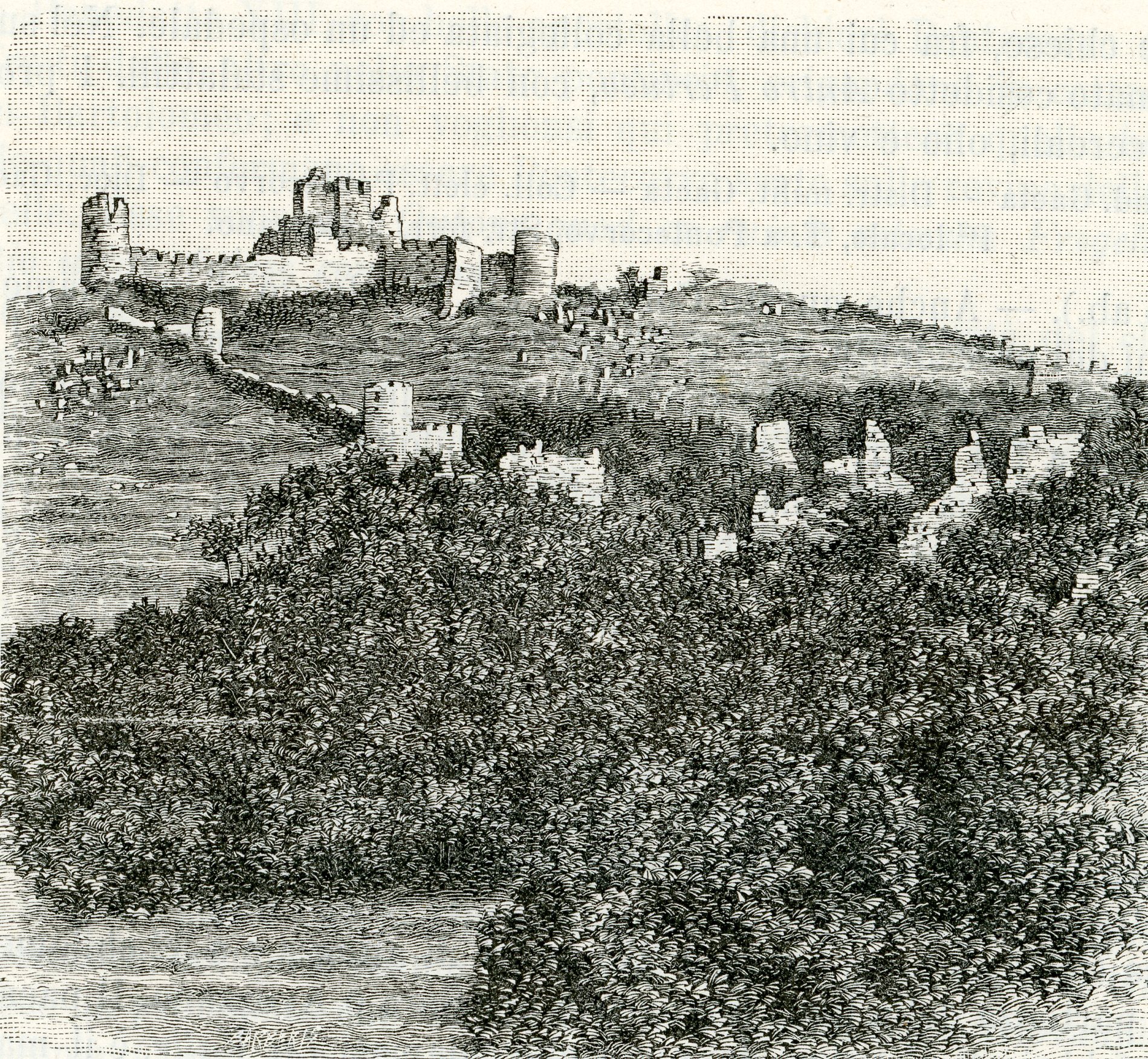
Thomas was the son of Landulf, Count of Aquino, and of Theodora, whom the 1912 Catholic Encyclopedia calls Countess of Teano. The same article says the family "was related to the Emperors Henry VI and Frederick II, and to the Kings of Aragon, Castile, and France."1 The Stanford entry describes him as "the youngest of at least nine children," born "into a wealthy family that presided over a prominent castle in Roccasecca."2 Roccasecca lies about halfway between Rome and Naples, in the Kingdom of Sicily, the southern Italian kingdom then ruled by the emperor Frederick II, and close to the border of the Papal States.

The year of his birth: 1224, 1225 or 1227
Nobody recorded the date. The year has to be worked back from his age at death, and even that was uncertain to the people who knew him. The Catholic Encyclopedia notes that from Tolomeo of Lucca "we learn that at the time of the saint's death there was a doubt about his exact age." It continues: "The end of 1225 is usually assigned as the time of his birth. Father Prümmer, on the authority of Calo, thinks 1227 is the more probable date ... All agree that he died in 1274."1 (The omission is a page reference.) Bartholomew of Capua told the canonization inquiry in 1319 that Thomas died "(according to the usual view) in his forty-eighth year,"3 which would put the birth about 1226 or 1227; Weisheipl and Torrell both settle on about 1224 to 1225, and the Stanford entry says "around the year 1225."2 No early source gives the day of his birth. His feast day in the present Roman calendar, January 28, is not a birthday either: it falls on the anniversary of the day in 1369 when his body was solemnly carried into the Dominican church at Toulouse.1
The hermit's prophecy
The early lives open with a prophecy. Peter Calo, as the Catholic Encyclopedia reports him, says that a hermit told Theodora before the birth: "He will enter the Order of Friars Preachers, and so great will be his learning and sanctity that in his day no one will be found to equal him."1 At the 1319 inquiry William of Tocco repeated the story, saying he had it from Lady Catherine, a niece of Thomas, who had heard it from Theodora herself. In the 1959 English translation the hermit says that "you and your husband will have a mind to make him a monk of Monte Cassino, but God has disposed otherwise, for he shall be a Preaching Friar."3 The story reached the inquiry through three mouths (Theodora, her granddaughter, Tocco) and some seventy years after the birth. It tells a reader more about how the Dominicans of 1319 understood the life than about what was said in a castle in 1225, and it is rated below.
The oblate of Monte Cassino
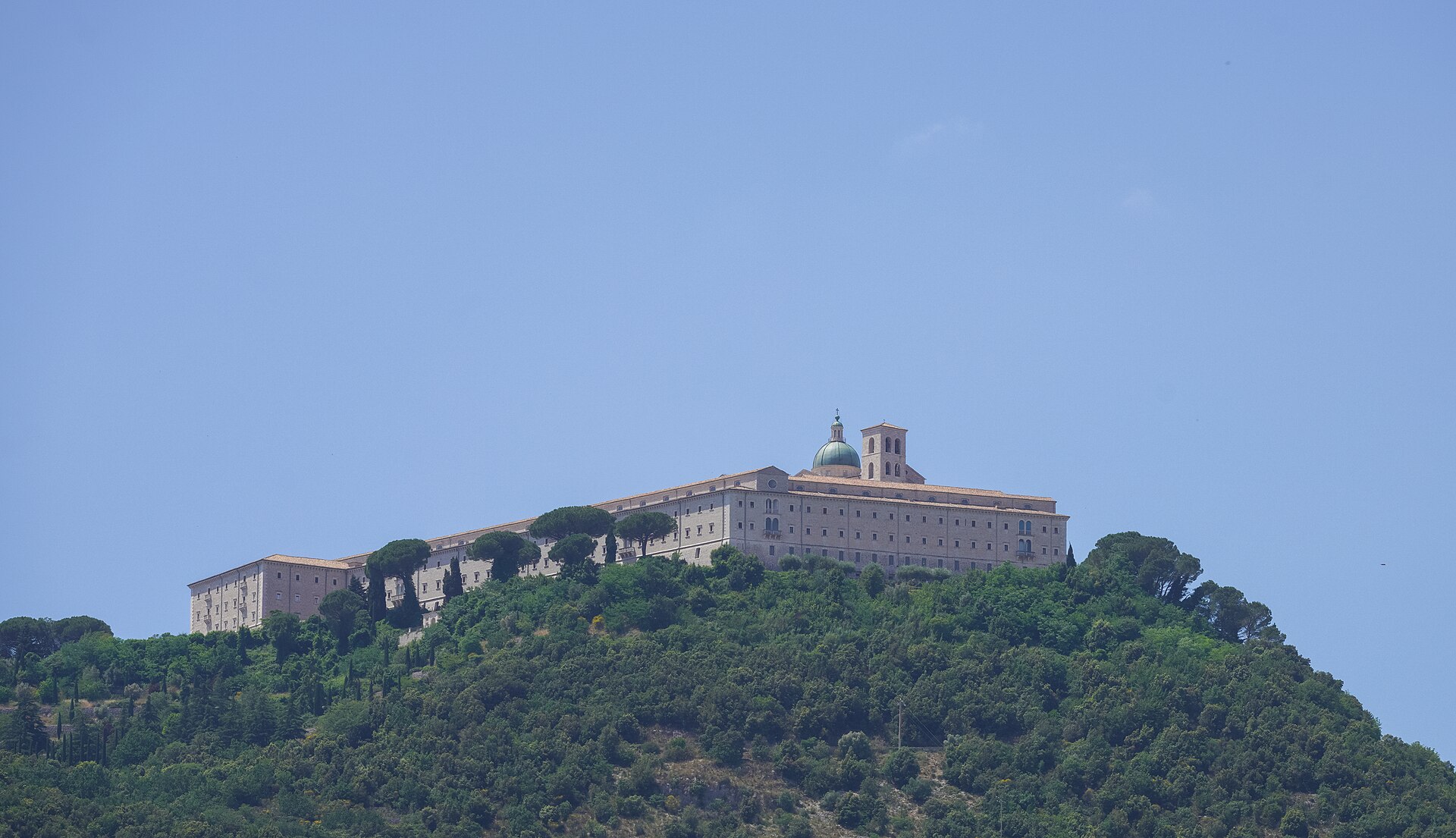
At about five years old, "according to the custom of the times," Thomas was given to the Benedictine abbey of Monte Cassino, the house founded by Saint Benedict in the sixth century, a short journey from Roccasecca. The Catholic Encyclopedia says his teacher "was surprised at hearing the child ask frequently: 'What is God?'"1 A child given to a monastery in this way was called an oblate (from the Latin oblatus, "offered"). Families of the nobility often placed younger sons in this way, and the Stanford entry suggests what the family had in mind: they "had hoped he would play a leading role at the venerable local monastery, Monte Cassino."2 The hermit's line about the parents' "mind to make him a monk of Monte Cassino" fits that hope.

Aquinas later wrote about exactly this practice in the Summa Theologiae, in a question on entering religious life. Asked "Whether children should be received in religion?" (ST II-II, q. 189, a. 5), he distinguished a child's own vow from a child's being offered by parents. On the first he wrote, in the English Dominican Fathers' translation:
"if before reaching the age of puberty a child makes a simple vow, not yet having full use of reason, he is not bound in virtue of the vow; but if he has the use of reason before reaching the age of puberty, he is bound, so far as he is concerned, by his vow; yet this obligation may be removed by his father's authority."4
He put the age of puberty, "as a rule," at "about the age of fourteen" for boys and twelve for girls.4 The article does not mention him, and nothing in the Summa says he had his own boyhood in mind. It is still the man who was offered to Monte Cassino at five writing about the binding force of such offerings.
He did not stay. The Catholic Encyclopedia puts his move to Naples "about the year 1236" and says that Calo reports "the change was made at the instance of the Abbot of Monte Cassino, who wrote to Thomas's father that a boy of such talents should not be left in obscurity."1 Modern biographers usually date the move a few years later and connect it with the war between Frederick II and the papacy, which reached the abbey, a frontier house between the emperor's kingdom and the papal lands, at the end of the 1230s. Either way, he was a student in Naples in his teens.
The University of Naples and the first Aristotle
Naples had a university only because an emperor wanted one. In a general letter issued at Syracuse on June 5, 1224, Frederick II announced a school of all the arts in Naples so that his subjects would not have to study abroad. The Latin text reads in part: "Disponimus autem apud Neapolim amenissimam civitatem doceri artes et cuiuscumque professionis vigere studia ut ieiuni et famelici doctrinarum in ipso regno inveniant unde ipsorum aviditatibus satisfiat, neque compellantur, ad investigandas scientias, peregrinas nationes expetere nec in alienis regionibus mendicare."5 In a plain English rendering made for this lesson: "We arrange that at Naples, a most pleasant city, the arts be taught and the studies of every profession flourish, so that those who fast and hunger for learning may find in the kingdom itself what will satisfy their appetites, and may not be compelled, in order to seek out the sciences, to go to foreign nations or to beg in other lands." The university was the emperor's own school, meant to train the lawyers and officials of his kingdom. Its students were not required to be clerics, and it did not depend on a bishop or a pope for its charter, which set it apart from Paris.
At Naples, the Catholic Encyclopedia says, his teachers were "Pietro Martini and Petrus Hibernus," and the second, Peter of Ireland, "trained him in logic and the natural sciences."1 Logic and natural science at this date meant, above all, the books of Aristotle, which had only recently become available in full in Latin (lesson 01 tells how they arrived and how Paris first restricted lectures on them). Aquinas's lifelong habit of calling Aristotle simply "the Philosopher" goes back to these years of study.
Naples also had a priory of a new kind of religious order. The friars of San Domenico in Naples did not live in a rural abbey behind walls. They lived in the city, begged for their food, studied and preached. A young nobleman in the university saw them every day. The Stanford entry says that "as a teenage student in Naples, he fell under the sway of the Dominicans, a newly founded order of priests devoted to preaching and learning."2 To understand why the family fought his choice, a reader needs to know what that order was.
Dominic and the Order of Preachers
The order Thomas joined was barely a generation old. Its founder, Dominic de Guzman, was, in the Catholic Encyclopedia's words, "born at Calaroga, in Old Castile, c. 1170; died 6 August, 1221."6 He was a canon of the cathedral of Osma in Castile when, in 1203, he traveled through the south of France with his bishop, Diego, on a royal embassy. Passing through Toulouse, the same article says, "they beheld with amazement and sorrow the work of spiritual ruin wrought by the Albigensian heresy," and Dominic "first conceived the idea of founding an order for the purpose of combating heresy and spreading the light of the Gospel by preaching."6 (The Albigensians, or Cathars, taught that the material world was the work of an evil principle; lesson 01 and module 102's lesson on dissenters before the Reformation give the wider story.) He based himself at Prouille, near Fanjeaux, preached through the towns of Languedoc, and gathered companions in Toulouse.
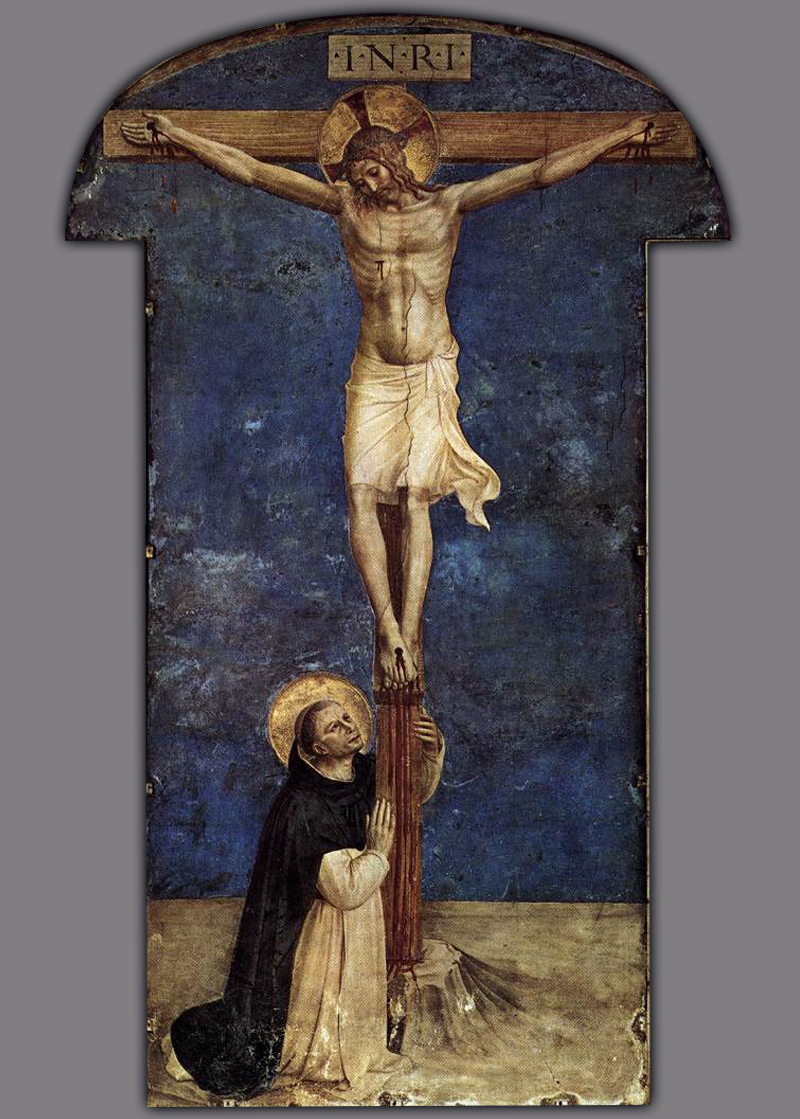

The Fourth Lateran Council of 1215 did not want new rules for religious orders: the 1909 Catholic Encyclopedia speaks of "the wish of the council that there should be no new rules for religious orders" (lesson 01 describes the council).6 Dominic and his brethren therefore "adopted the ancient rule of Saint Augustine," the Catholic Encyclopedia explains, "which, on account of its generality, would easily lend itself to any form they might wish to give it." Dominic went to Pope Honorius III in August 1216, "and on 22 December, 1216, the Bull of confirmation was issued."6 (The bull is usually cited by its opening words, Religiosam vitam, and a second letter of January 1217 calls the brethren preachers; this lesson did not open the papal register to confirm the wording of either.) On August 15, 1217, Dominic gathered his small company at Prouille and sent them out, most of them to the two great university cities. The order took root at Paris, at the house of Saint-Jacques (which is why French Dominicans were long called "Jacobins"), and at Bologna, and in Rome Honorius gave Dominic the ancient basilica of Santa Sabina on the Aventine hill.6 Dominic died at Bologna in 1221.
What the order was for
The Catholic Encyclopedia's article on the order quotes its constitutions: "Our order was instituted principally for preaching and for the salvation of souls." It adds a second line of the same rule: "Our main efforts should be put forth, earnestly and ardently, in doing good to the souls of our fellow-men."7 Everything else in the order's life served that end. The brethren gave up property and lived on alms, like the Franciscans, which is why both orders were called mendicants (beggars). They kept a daily round of prayer in choir, but shortened it so that study would not suffer. And they studied as no religious order had before: every house had its teacher, and above the house schools stood the studia generalia, the order's colleges in the university cities. The same article says that the Paris house obtained "a chair incorporated with the university" in 1229 "and another in 1231," so that "the Preachers were the first religious order that took part in teaching at the University of Paris, and the only one possessing two schools."7 One of those two chairs is the one Aquinas would hold.
Aquinas defended his order's way of life in the Summa Theologiae, in a question on "the different kinds of religious life" (ST II-II, q. 188). Asked "Whether a religious order can be established for preaching or hearing confessions?" he answered:
"Now the good of our neighbor is advanced by things pertaining to the spiritual welfare of the soul rather than by things pertaining to the supplying of bodily needs, in proportion to the excellence of spiritual over corporal things. Hence it was stated above (II-II:32:3) that spiritual works of mercy surpass corporal works of mercy. ... Therefore it is most fitting for a religious order to be established for preaching and similar works pertaining to the salvation of souls."8
In the next article, "Whether a religious order should be established for the purpose of study?" he argued that study helps the contemplative life "directly to contemplate, namely by enlightening the intellect," and indirectly "by removing the obstacles to contemplation, namely the errors which in the contemplation of divine things frequently beset those who are ignorant of the scriptures."9 Then, in article 6, he ranked the orders. The work of the active life, he wrote, is of two kinds:
"one proceeds from the fulness of contemplation, such as teaching and preaching. ... And this work is more excellent than simple contemplation. For even as it is better to enlighten than merely to shine, so is it better to give to others the fruits of one's contemplation than merely to contemplate. ... Accordingly the highest place in religious orders is held by those which are directed to teaching and preaching, which ... are nearest to the episcopal perfection ... The second place belongs to those which are directed to contemplation, and the third to those which are occupied with external actions."10
(The first omission is a citation of Gregory the Great on Psalm 144; the later ones are a quotation of Dionysius and a clause on the bishops.) The middle sentence, in its Latin form contemplari et contemplata aliis tradere ("to contemplate and to hand on to others the things contemplated"), later became a motto of the Dominican order. A Benedictine monk might read this article as a polite demotion of his own way of life to second place. It is at least clear that Aquinas did not think he had left a higher calling for a lower one when he left Monte Cassino for the friars.
On poverty, the issue that would divide the Franciscans for a century (lesson 12), Aquinas took a measured line. Asked "Whether religious perfection is diminished by possessing something in common?" (ST II-II, q. 188, a. 7) he wrote that "perfection consists, essentially, not in poverty, but in following Christ," and that poverty "is like an instrument or exercise for the attainment of perfection."11 A modest common purse that served preaching and study was, on this view, no betrayal of the friars' calling.
The order and the Inquisition
A reader will meet the claim that the Dominicans were "the Inquisition." The record is more specific. Popes from the 1230s on appointed friars, Dominicans and Franciscans alike, as judges delegate to seek out heresy in particular regions, and Dominicans wrote the standard handbooks. The Catholic Encyclopedia's article on the order lists them with some pride: an opinion by Raymond of Pennafort in 1235, a directory for Aragon in 1242, one composed by the inquisitors of Provence about 1244, and "the two classical works of the Middle Ages on inquisitorial law," Bernard Gui's Directorium (it gives 1321; the work is better known as the Practica inquisitionis) and Nicholas Eymerich's Directorium Inquisitorum of 1376.7 Bernard Gui is the same Dominican who wrote one of the early lives of Aquinas.
Aquinas himself addressed the treatment of heretics in the Summa, and his words should be read exactly. In ST II-II, q. 11, a. 3, "Whether heretics ought to be tolerated?" he wrote:
"With regard to heretics two points must be observed: one, on their own side; the other, on the side of the Church. On their own side there is the sin, whereby they deserve not only to be separated from the Church by excommunication, but also to be severed from the world by death. For it is a much graver matter to corrupt the faith which quickens the soul, than to forge money, which supports temporal life. Wherefore if forgers of money and other evil-doers are forthwith condemned to death by the secular authority, much more reason is there for heretics, as soon as they are convicted of heresy, to be not only excommunicated but even put to death.
On the part of the Church, however, there is mercy which looks to the conversion of the wanderer, wherefore she condemns not at once, but 'after the first and second admonition,' as the Apostle directs: after that, if he is yet stubborn, the Church no longer hoping for his conversion, looks to the salvation of others, by excommunicating him and separating him from the Church, and ... delivers him to the secular tribunal to be exterminated thereby from the world by death."12
(The ellipsis replaces one connecting word; the article goes on to quote a Church Father, whose citation is omitted here.) In the article before, he drew a line between two kinds of unbelievers. Those "who have never received the faith, such as the heathens and the Jews," he wrote, "are by no means to be compelled to the faith, in order that they may believe, because to believe depends on the will." Heretics and apostates, who "at some time have accepted the faith, and professed it," were in his view a different case: they "should be submitted even to bodily compulsion, that they may fulfil what they have promised."13 Both halves are his. Modern Catholic teaching has moved on the second point. The Second Vatican Council's declaration on religious freedom, Dignitatis Humanae (December 7, 1965), states: "This Vatican Council declares that the human person has a right to religious freedom. This freedom means that all men are to be immune from coercion on the part of individuals or of social groups and of any human power." It also admits that "in the life of the People of God, as it has made its pilgrim way through the vicissitudes of human history, there has at times appeared a way of acting that was hardly in accord with the spirit of the Gospel or even opposed to it."14 Protestant states of the sixteenth century also put heretics to death, as module 102 records; the question of how Christians came to teach religious freedom is larger than any one writer.
The young friar and his family (1244 to about 1245)
Thomas received the Dominican habit at Naples. The Catholic Encyclopedia gives the date as "some time between 1240 and August, 1243,"1 but Landulf, his father, died in December 1243, and modern biographers place the clothing in April 1244, when he was about nineteen; the Stanford entry says he joined "at the age of nineteen."2 The friar who drew him, according to the same 1912 account, was "John of St. Julian, a noted preacher of the convent of Naples."1
The family reacted at once. "His mother, with mingled feelings of joy and sorrow, hastened to Naples to see her son," the Catholic Encyclopedia says, and the Dominicans, fearing she would take him away, sent him toward Rome and the north. "At the instance of Theodora, Thomas's brothers, who were soldiers under the Emperor Frederick, captured the novice near the town of Aquapendente and confined him in the fortress of San Giovanni at Rocca Secca."1 The sources differ on the place. William of Tocco, testifying in 1319, spoke of "Thomas's imprisonment in the castle of Montesangiovanni,"3 a family castle some distance from Roccasecca; later accounts place him at Roccasecca itself, and he may have been held in both. They differ on the length too: "nearly two years" in the 1912 article,1 "a year" in the Stanford entry.2 Lady Catherine's testimony in 1319 adds homely details: "in prison he studied much and taught his sisters."3 The Catholic Encyclopedia reports that one sister brought him "the Holy Scriptures, Aristotle's Metaphysics, and the 'Sentences' of Peter Lombard," and that when he was released the Dominicans found that "he had made as much progress as if he had been in a studium generale."1
The temptation story: who first told it
The most famous episode of the captivity is the temptation. Its earliest surviving telling is William of Tocco's, both in his life and in his sworn testimony at Naples on August 4, 1319. In the 1959 English translation of the minutes, Tocco said he had heard it at Anagni from Robert of Sezze, a Dominican, who had it from his uncle, "a certain brother Stephen." According to that chain, the brothers "sent a pretty girl to his room to allure him to sin," and Thomas "snatched a log from the fire and indignantly drove her out, and then, with the tip of the log, marked a cross on the wall." He prayed, fell asleep, and saw two angels who "bound his loins, saying: 'In the name of God we bind you with a chastity that will resist every temptation.'" He told no one of it, Tocco said, "until later he revealed it, with many other things, to his socius," his companion Reginald of Piperno.3 The 1912 Catholic Encyclopedia retells the story with the angels saying, "We gird thee with the girdle of perpetual virginity."1
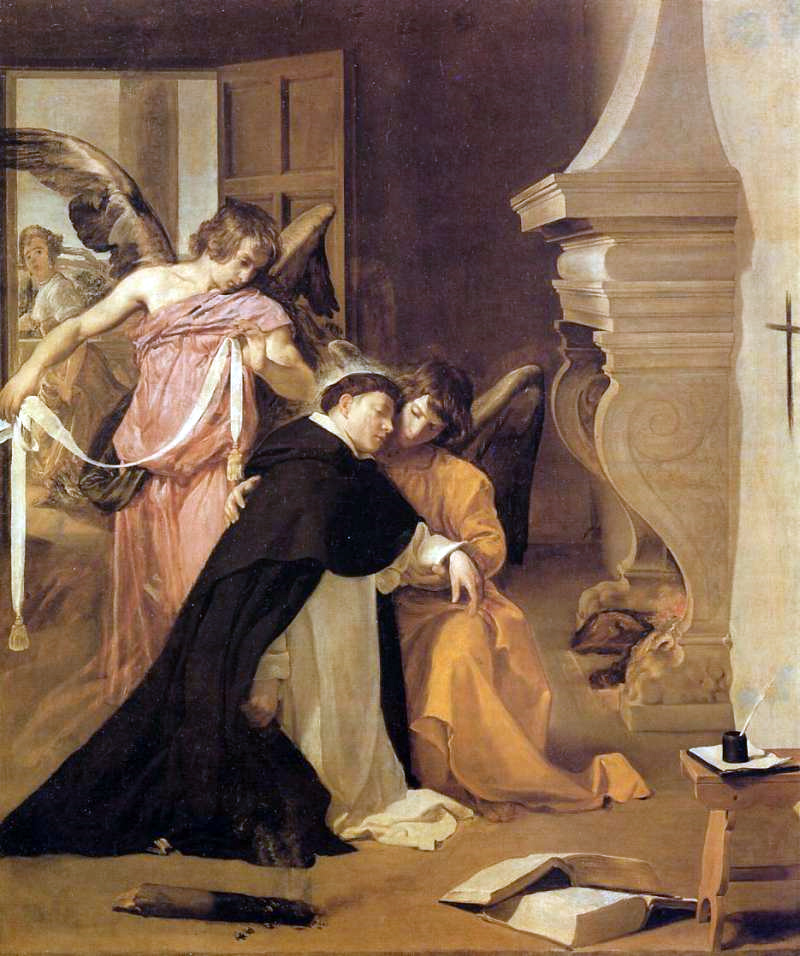

The chain matters for judging the story. Tocco did not see the event; he heard it from a man who heard it from an uncle, about seventy-five years after it is supposed to have happened, and the vision of the angels rests, by Tocco's own account, on what Thomas told Reginald in private. Reginald died long before the inquiry. The story is consistent with what is known (the family did hold him, and his brothers did want him out of the habit), and it is told by a witness under oath who names his sources. It cannot be checked further. The "Claims checked" section rates it accordingly.
What Aquinas later wrote about parents and vocation
In the same question of the Summa on entering religious life, Aquinas asked "Whether one ought to be withdrawn from entering religion through deference to one's parents?" (ST II-II, q. 189, a. 6). His answer has two parts. If parents are "in such need that they cannot fittingly be supported otherwise than by the help of their children, these latter may not lawfully enter religion in despite of their duty to their parents." Otherwise:
"If, however, the parents' necessity be not such as to stand in great need of their children's assistance, the latter may, in despite of the duty they owe their parents, enter religion even against their parents' command, because after the age of puberty every freeman enjoys freedom in things concerning the ordering of his state of life, especially in such as belong to the service of God ..."15
He added in the reply to the first objection that "even those who are in religion can fulfil the commandment of honoring their parents, by praying for them and by revering and assisting them, as becomes religious."15 Once again the article does not name his own case. A noble family that needed no support from its youngest son, a young man past puberty, and a choice "against their parents' command": the article reads like a calm, general statement of the decision he had made at nineteen. Theodora's family was reconciled to the choice. The early sources say he was released (lowered from the castle "in a basket," says the 1912 account), went to Rome, and was sent north to study.1
Albert the Great at Paris and Cologne (1245 to 1252)
The master general of the order, John the Teutonic, took the young friar north. The Catholic Encyclopedia follows "the majority of the saint's biographers" in sending him to Paris and then to Cologne "where he arrived in 1244 or 1245, and was placed under Albertus Magnus, the most renowned professor of the order."1 The modern order of events is simpler: Thomas studied in Paris from about 1245 to 1248, and in 1248 went with Albert to Cologne, where Albert was to found the order's new house of general studies.2
Albert was a generation older. The Stanford Encyclopedia's entry on him says he "was born in Lauingen (Swabia), around 1200," became a Dominican "in 1223," and was sent in the early 1240s to the University of Paris, "where he received his degree of Master of Theology in 1245 and taught until 1248. He was then sent to Cologne to found a new Dominican school (studium generale), accompanied by the young Italian student he had met in 1245 and taught in Paris, Thomas Aquinas." He led the Cologne school until 1254, served as provincial of the German Dominicans, was briefly bishop of Regensburg (1260 to 1262), preached the crusade, and died in Cologne in 1280. "In 1931, Pope Pius XI declared Albert a Saint and a Doctor of the Church."16 Albert was famous in his own century for his works on nature: animals, plants, minerals, the heavens. The Stanford entry quotes the opening of his Physics (1251 to 1252), written because the brethren had been asking him "for now many years, to compose for them a book on physics like this one."16 He was working on that book in the years Thomas was his student. From him Thomas learned the conviction, in the Stanford entry's words, "that the Christian faith could only benefit from a profound engagement with philosophy and science."2
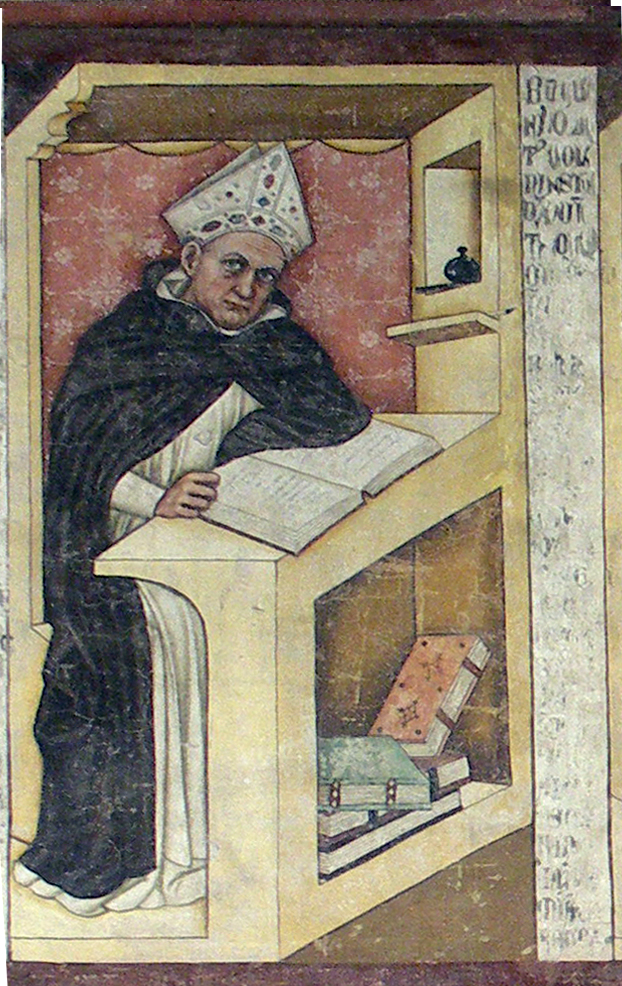

"The dumb ox"
From the Cologne years comes the best-known saying about the young Thomas. The 1912 Catholic Encyclopedia gives it this way: "In the schools Thomas's humility and taciturnity were misinterpreted as signs of dullness, but when Albert had heard his brilliant defence of a difficult thesis, he exclaimed: 'We call this young man a dumb ox, but his bellowing in doctrine will one day resound throughout the world.'"1 The story is told in the early Dominican lives (it is usually traced to William of Tocco's Ystoria). It does not appear in the 1319 inquiry minutes as quoted here, and this lesson did not open Tocco's Latin text to check the wording. It is the kind of story a school tells about its greatest pupil, and the nickname fits what Peter Calo says of his appearance: "of lofty stature and of heavy build, but straight and well proportioned," with a complexion "like the colour of new wheat."1 It is rated below.
At Cologne, "probably in 1250," the 1912 account says, Thomas was ordained priest by the archbishop, Conrad of Hochstaden.1 Dante Alighieri, writing his Paradiso in the years before his death in 1321, placed master and pupil side by side in the heaven of the Sun. Thomas speaks, in Henry Wadsworth Longfellow's translation (1867):
"Of the lambs was I of the holy flock
Which Dominic conducteth by a road
Where well one fattens if he strayeth not.
He who is nearest to me on the right
My brother and master was; and he Albertus
Is of Cologne, I Thomas of Aquinum."17
(Paradiso, canto 10, lines 94 to 99.) In the next canto Dante has Thomas, the Dominican, tell the life of Francis, the founder of the other order of friars, and pair the two founders: "The one was all seraphical in ardour; / The other by his wisdom upon earth / A splendour was of light cherubical."17 Within a generation of their deaths, the two orders and their two greatest teachers were being sung together.
Paris: bachelor of the Sentences and master of theology (1252 to 1259)
In 1252, the Stanford entry says, when Albert "was asked ... to nominate a student to pursue an advanced degree in theology at the University of Paris, he chose Thomas, even though he was still two years younger than the minimum required age."2 At Paris he lectured as a bachelor on Peter Lombard's Sentences, the twelfth-century collection of opinions of the Fathers arranged by topic that every theology student had to explain. His Commentary on the Sentences (1252 to 1256) is a vast work, and the 1912 Catholic Encyclopedia notes that it "furnished the materials and, in great part, the plan for his chief work."1 From the same years come the short treatises On Being and Essence (De ente et essentia) and On the Principles of Nature.2
The mendicant controversy and William of Saint-Amour
His degree was held up by a fight about whether friars belonged in the university at all. The dispute began, the 1912 article explains, when the city guard killed a student and the masters went on strike; "the Dominicans and Franciscans, who had continued to teach in their schools, refused to take the prescribed oath" binding them to strike in future, "and from this there arose a bitter conflict which was at its height when St. Thomas and St. Bonaventure were ready to be presented for their degrees."1 The secular master William of Saint-Amour (secular here means a cleric who was not a member of a religious order) turned the quarrel into an attack on the friars' whole way of life. His book On the Perils of the Last Times (De periculis novissimorum temporum, 1255) presented the begging friars as the false teachers of the last days foretold in 2 Timothy 3, men who "creep into houses," and denied their right to hold university chairs.1 Aquinas answered with Against Those Who Attack the Worship of God and Religion (Contra impugnantes Dei cultum et religionem), a defense of the friars' right to teach, to preach and to live by begging. "The book of William of St-Amour was condemned by Alexander IV at Anagni, 5 October, 1256, and the pope gave orders that the mendicant friars should be admitted to the doctorate."1
The dates of his inception as master differ by source. The 1912 article gives "23 October, 1257," with a tradition that "St. Bonaventure and St. Thomas received the doctorate on the same day."1 The Stanford entry, following the modern chronology, has him hold "the Dominican chair of theology in Paris" from 1256 until 1259.2 The usual modern reading is that he incepted (gave his inaugural lecture) in the spring of 1256, by papal order, and that the secular masters accepted him and Bonaventure into their body only in August 1257. His inaugural lecture took as its text Psalm 103:13 in the Latin numbering, which the 1912 article gives as "Thou waterest the hills from thy upper rooms: the earth shall be filled with the fruit of thy works."118
A master of theology at Paris had three duties, summed up in the university's own words as legere, disputare, praedicare: to lecture on the Bible, to hold disputations, and to preach. In his first regency Aquinas lectured on Isaiah and Matthew among other books, held the disputations collected as On Truth (De veritate, 1256 to 1259, twenty-nine questions and 253 articles), and conducted the free-for-all disputations held in Advent and Lent called quodlibets, at which, the Stanford entry explains, "audience members might propose any topic at all."2 The form of the article in the Summa, with its objections, its sed contra and its respondeo, grew out of these classroom disputations; lesson 03 takes it apart piece by piece.
Italy: Orvieto, Rome and Viterbo (1259 to 1268)
"It was the custom of the Dominican order (as with the Franciscans) to rotate scholars through these positions," the Stanford entry explains, and "in 1259 Aquinas was sent back to Italy, where he spent most of the following decade in several Dominican houses of study, first in Orvieto (in Umbria) and then in Rome."2 On the way he took part in the general chapter of the order at Valenciennes in 1259, where, the 1912 article says, he worked with Albert and Peter of Tarentaise, "afterwards Pope Innocent V," on "a system of studies which is substantially preserved to this day in the studia generalia of the Dominican Order."1
The Summa contra Gentiles
His first great summary of theology belongs to these years. The Summa contra Gentiles (1259 to 1265 in the modern dating) is arranged in four books: God in himself, God as the origin of creatures, God as their end, and God in his revelation.1 The autograph manuscript survives for much of the work, in the Vatican Library (Vat. lat. 9850), though, the Stanford entry warns, "Aquinas's handwriting is notoriously difficult to read, even for experts."2 The 1912 article repeats the old story that he wrote it "at the request of St. Raymond of Pennafort, who desired to have a philosophical exposition and defence of the Christian Faith, to be used against the Jews and Moors in Spain."1 The story is not in the 1319 testimony quoted in this lesson, and modern scholars are divided over whether the book was meant as a missionary handbook at all, since much of it is philosophy written for Christian readers. It is rated below. A witness at the 1319 inquiry remembered a different detail, that a former student told him Thomas "wrote the Summa contra Gentiles on small bits of scribbling paper, since he had no other writing material," as an example of his love of poverty.3 This story is also rated below.
Orvieto and the papal court of Urban IV
At Orvieto (1261 to 1265) Aquinas was lector, the teacher of the friars of the priory, while Pope Urban IV kept his court in the town. For Urban he compiled the Catena aurea (the "golden chain"), a running commentary on the four Gospels made of quotations from the Fathers, and wrote Against the Errors of the Greeks, on the doctrines disputed between Rome and the Byzantine church.1 The 1912 article also credits him, following the Dominican scholar Pierre Mandonnet, with the liturgy for the new feast of Corpus Christi, which Urban established for the whole church, including the hymns Pange lingua (ending with Tantum ergo), Verbum supernum (ending with O salutaris hostia), Sacris solemniis and the sequence Lauda Sion.1 Mandonnet, the article says, held it "established beyond doubt that St. Thomas is the author" of the office; this lesson did not review later scholarship on the question.1
Santa Sabina and the beginning of the Summa Theologiae
In 1265 the Roman province of the order sent him to Rome to open a house of studies at Santa Sabina, the basilica Honorius III had given to Dominic.6 It was a school for ordinary friars of the province, men who would be preachers and confessors, not university masters. The Summa Theologiae was begun there, and its prologue says what it was for. In the English Dominican Fathers' translation, Aquinas wrote that because a teacher of Catholic truth "ought not only to teach the proficient, but also to instruct beginners," "we purpose in this book to treat of whatever belongs to the Christian Religion, in such a way as may tend to the instruction of beginners." He complained that students "have not seldom been hampered by what they have found written by other authors, partly on account of the multiplication of useless questions, articles, and arguments."19 Lesson 03 reads the whole prologue. The Stanford entry paraphrases the same line and adds: "Today, no one thinks of ST as a work for beginners."2
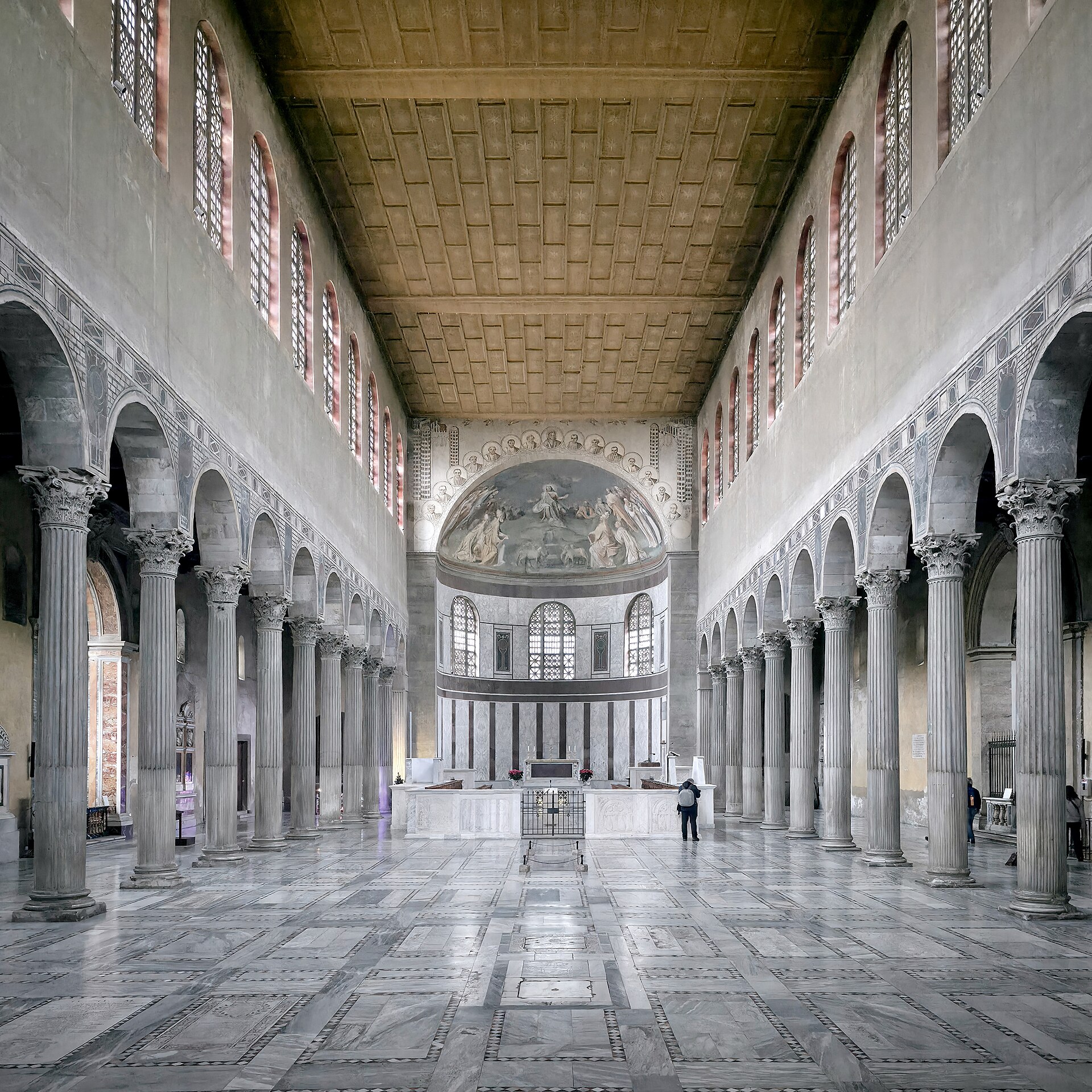

When was it begun? The 1912 article dates the First Part and the first half of the Second Part to Rome, 1265 to 1269.1 The Stanford entry dates the whole work "1267 to 73" in its list of works, "unfinished after 3a 90," and says he "began in Rome and worked on until near the end his life."2 Torrell's catalogue puts the First Part in Rome, about 1265 or 1266 to 1268. The safe statement is that the First Part was written in Italy, in Rome and probably finished at Viterbo, between about 1265 and 1268, and that the rest followed in Paris and Naples.
From the same Roman years come the disputed questions On the Power of God (1265 to 1266) and On the Soul (1266 to 1267), the Compendium of Theology, the unfinished treatise On Kingship, and the first of his commentaries on Aristotle, on the De anima (1267 to 1268).2 In 1265, the 1912 article says, Pope Clement IV appointed him archbishop of Naples, and "with tears he begged to be excused." It adds: "Had this appointment been accepted, most probably the 'Summa theologica' would not have been written."1 In 1267 and 1268 he seems to have been at Viterbo, where Clement IV held his court.
The second Paris regency (1268 to 1272)
"In 1268, Aquinas was asked to return to Paris for an unusual second term as master of theology," the Stanford entry says. "Here he put his now venerable reputation to work in attempting to steer the philosophical conversation away from various extreme positions that were dividing scholars."2 These were the most productive years of his life. He wrote the Second Part of the Summa (both halves, the Prima Secundae and the long Secunda Secundae, which the 1912 article says was "completed in Paris" in 1271), the disputed questions On Evil (1270 to 1271) and On the Virtues (1271 to 1272), the second set of quodlibets, and commentaries on Aristotle's Physics, Ethics, Politics, Posterior Analytics and Metaphysics, besides commentaries on the Gospel of John and the letters of Paul.21 He worked with secretaries; the 1912 article says that "biographers assure us that he could dictate to several scribes at the same time."1
He fought on two fronts at once. On one side were certain masters of the faculty of arts, chief among them Siger of Brabant, who read Aristotle with the help of the great Muslim commentator Ibn Rushd (Averroes, "the Commentator" of the Summa) and taught, as Aristotle's view, positions the faith rejected: that the world is eternal, and that there is one intellect for all mankind. On the other side were theologians, many of them Franciscans in the tradition of Bonaventure, who thought Aquinas himself had gone too far with Aristotle.
On the Unity of the Intellect against the Averroists (1270)
The question of the one intellect sounds remote, but it touched the most personal things. If there is a single intellect for all human beings, then the individual soul that thinks and chooses does not survive death as itself, and there is no one to be rewarded or punished. The 1912 article sums up Aquinas's treatise On the Unity of the Intellect against the Averroists (1270) this way: it "refuted a very dangerous and widespread error, viz., that there was but one soul for all men, a theory which did away with individual liberty and responsibility."1 Aquinas argued the case from Aristotle's own text, claiming that the Averroist reading misread the Philosopher, and he challenged his opponents to answer him openly and in writing.
In 1270 (on December 10, by the usual dating), Bishop Etienne Tempier of Paris condemned a list of propositions taught in the arts faculty, thirteen in the usual count. A course outline of the condemnations prepared by Richard C. Taylor of Marquette University lists among them "One intellect for all," that "God can not make something to become immortal and incorruptible," that "Human actions are not under the control of divine providence," and "the eternity of the human species, scil. no first human being."20 Aquinas was not the target of 1270. He had argued against most of these positions himself.
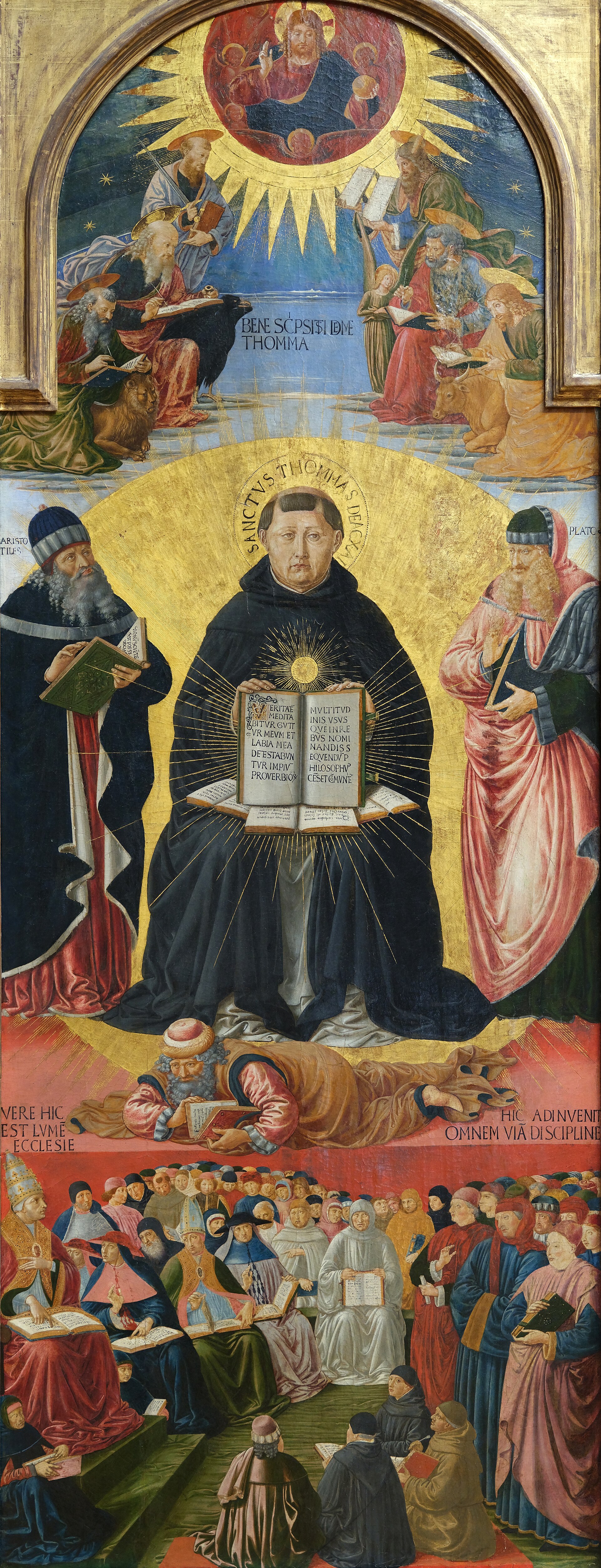

On the Eternity of the World (1271)
On the other front, Aquinas took a position that satisfied neither side fully. Christians held by faith that the world had a beginning. The Averroists said Aristotle had proved it had none. Many theologians, Bonaventure among them, said reason could prove that it had a beginning. Aquinas wrote, in the Stanford entry's description, "a brief treatise arguing for a middle ground on the vexed question of whether the world could be proved to be eternal or created in time."2 He held that neither side could be demonstrated by reason, and that the beginning of the world is known by revelation. He had already said as much in the First Part of the Summa (ST I, q. 46, a. 2), which lesson 04 quotes, because it bears on how to read the Five Ways. To some of his fellow theologians this concession looked dangerous, and it was among the issues that came back after his death.
Naples and December 6, 1273
"When his second four-year term in Paris came to an end he returned to Italy, this time to Naples, in 1272."2 Modern biographers, Weisheipl and Torrell among them, report that the Roman province of the order charged him with founding a new house of studies and that it was placed at Naples, the city where he had studied as a boy, now in the kingdom of Charles of Anjou. There he went on with the Third Part of the Summa, on Christ and the sacraments, and with his commentaries on Aristotle's books on the heavens, on generation and corruption and on meteorology, all left unfinished.2 William of Tocco testified that he had himself seen Thomas "writing on the De generatione et corruptione, which was, he thinks the last of Thomas's philosophical works."3
Then he stopped. The fullest early account is the sworn testimony of Bartholomew of Capua, the chancellor (logothete) of the Kingdom of Sicily, at the 1319 inquiry. In the 1959 English translation, Bartholomew said that "while brother Thomas was saying his Mass one morning, in the chapel of St. Nicholas at Naples, something happened which profoundly affected and altered him. After Mass he refused to write or dictate; indeed he put away his writing materials. He was in the third part of the Summa, at the questions on Penance." When Reginald urged him to go on, Thomas said: "Reginald, I cannot go on." Pressed again, he said: "Reginald, I cannot - because all that I have written seems to me so much straw."3
The testimony goes on. Thomas went to visit his sister, the countess of San Severino, and could scarcely speak to her. She asked Reginald what had happened, and Reginald answered: "He has been like this since about the feast of St. Nicholas - since when he has written nothing at all." Reginald begged him to explain, and Thomas made him promise "that you will never reveal, as long as I live, what I shall tell you." Then he said: "All that I have written seems to me like straw compared with what has now been revealed to me."3
Bartholomew was not there. He explained how he knew: Reginald, "when near to death," told the story to "brother John of Giudice," an old and respected Dominican of Anagni; John repeated it to Bartholomew "when the latter was staying as a guest at the Dominican priory at Anagni, a little while before Pope Boniface was captured" (that is, shortly before September 1303); and Bartholomew told it "as soon as he could, to brother William of Tocco and to other Friar Preachers, and later to Pope Benedict XI."3 The feast of Saint Nicholas is December 6, which is how the date December 6, 1273 entered the biographies. The 1912 Catholic Encyclopedia gives a version in which Thomas says, "I can do no more. Such secrets have been revealed to me that all I have written now appears to be of little value," with the Latin word modica ("of little worth") noted from Prümmer's edition.1 The chart below traces the chain of witnesses.
The words "so much straw" have been read in opposite ways. Some readers take them as a judgment that his theology was worthless. The testimony itself does not say that: the comparison is between what he had written and "what has now been revealed to me," and the same witness tells how Thomas, on his deathbed, submitted his writings to the church. Others read the episode medically, as a stroke or a breakdown from overwork; Reginald, according to Bartholomew, "began to fear that much study might have affected his master's brain."3 The record supports both a spiritual experience reported by those around him and a sudden collapse of his strength. It does not settle which, and the two are not exclusive.
The crucifix that spoke
The 1912 article tells one more Naples story: "at Naples in 1273, after he had completed his treatise on the Eucharist, three of the brethren saw him lifted in ecstasy, and they heard a voice proceeding from the crucifix on the altar, saying 'Thou hast written well of me, Thomas; what reward wilt thou have?' Thomas replied, 'None other than Thyself, Lord.'" It cites Prümmer's edition of the early lives and adds that "similar declarations are said to have been made at Orvieto and at Paris."1 The story belongs to the hagiographical tradition gathered after his death. It is not among the testimonies quoted in this lesson from the 1319 minutes, and the fact that it is told of three different cities is itself a sign of a story that traveled. It is rated below.
The road to Lyons and death at Fossanova (1274)
Pope Gregory X had called a general council to meet at Lyons on May 1, 1274, to seek union with the Greek church and help for the Holy Land, and he summoned Aquinas, "commanding," the 1912 article says, that he bring "his treatise 'Contra errores Graecorum' (Against the Errors of the Greeks)." Bonaventure was summoned too. Aquinas set out in January or February 1274, but "strength failed him; he fell to the ground near Terracina, whence he was conducted to the Castle of Maienza, the home of his niece the Countess Francesca Ceccano."1 (Popular accounts say he struck his head on a branch overhanging the road; that detail comes from a later witness and is not checked here.)
From Maenza he asked to be carried to the Cistercian abbey of Fossanova, a few miles away. Bartholomew of Capua's testimony continues: "on entering the monastery, ill and weak, he clung with his hand to the doorpost, saying: 'Haec requies mea in saeculum saeculi, hic habitabo quoniam elegi eam.'"3 These are the words of Psalm 131:14 in the Latin Bible, which the Douay-Rheims version renders, "This is my rest for ever and ever: here will I dwell, for I have chosen it."21 (Module 103's lesson on the Latin Vulgate tells the history of the Latin Bible he knew.) The monks, a witness said, carried firewood for him themselves, and Thomas would protest, "Who am I that holy men should bring me my fire-wood?"3 At their request, the 1912 article says, "he dictated a brief commentary on the Canticle of Canticles."1
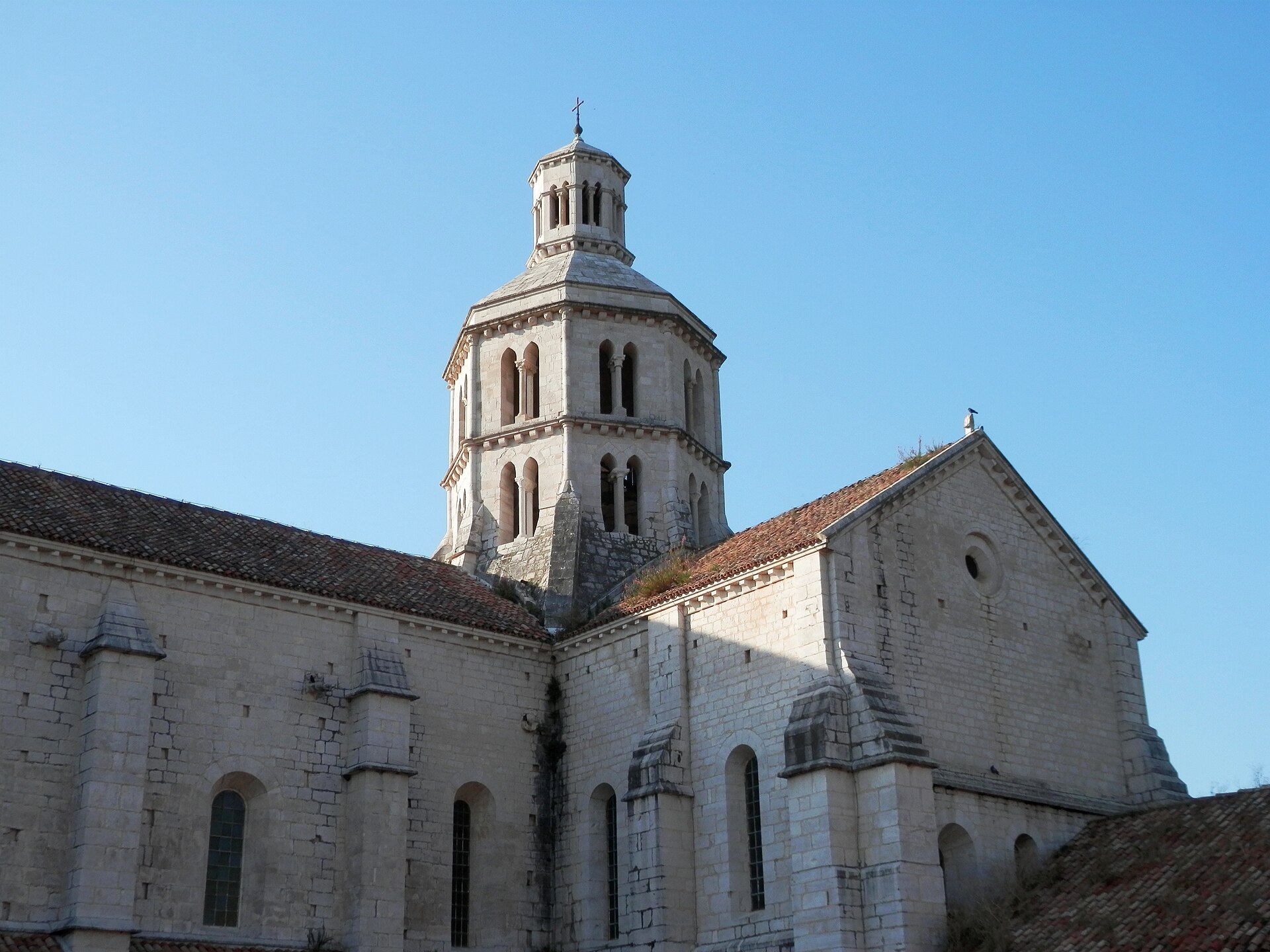

When the viaticum (the last communion) was brought, he made an act of faith that the 1912 article quotes from the early sources:
"I receive Thee, the price of my redemption, for Whose love I have watched, studied, and laboured. Thee have I preached; Thee have I taught. Never have I said anything against Thee: if anything was not well said, that is to be attributed to my ignorance. Neither do I wish to be obstinate in my opinions, but if I have written anything erroneous concerning this sacrament or other matters, I submit all to the judgment and correction of the Holy Roman Church, in whose obedience I now pass from this life."1
"He died on 7 March, 1274."1 He was about forty-nine. Bonaventure died at the council itself, at Lyons, on July 15 of the same year.22 Thomas's body stayed at Fossanova, where, an abbot of the house testified in 1319, it was twice moved to a more honorable place in the church, "seven months after brother Thomas's death, and the second one seven years after the first."3 A grimmer story spread in Italy: that Charles of Anjou had him poisoned. Dante repeated it in the Purgatorio, where Hugh Capet says that Charles "Thrust Thomas back to heaven, for amends" (canto 20, line 69, Longfellow's translation).23 There is no evidence for it; it is rated below.
After his death: from suspicion to Doctor of the Church (1277 to 1879)
The condemnations of 1277: Paris and Oxford
Three years to the day after Aquinas died, the bishop of Paris acted. The Stanford Encyclopedia's entry on the event (by Hans Thijssen) opens: "On March 7, 1277, the Bishop of Paris, Stephen Tempier, prohibited the teaching of 219 philosophical and theological theses that were being discussed and disputed in the faculty of arts under his jurisdiction." Pope John XXI had written to Tempier on January 18, 1277, saying "that he had heard rumors of heresy" and charging him to find out "where and by whom these errors had been disseminated." Anyone teaching or listening to the listed errors was to be excommunicated unless he turned himself in within seven days.24
Was Aquinas among the targets? The 219 articles name no one. The prologue and two manuscript rubrics point to the arts masters Siger of Brabant and Boethius of Dacia, and Tempier complained that the arts masters were "transgressing the limits of their own faculty." But the entry reports a real scholarly disagreement: "John Wippel has argued (against Roland Hissette) that Aquinas' teaching was also implied in Tempier's condemnation and that some of the positions were taken from his writings."24 A second question is whether there was a separate process against Aquinas himself. "According to Robert Wielockx, the inquiry against Thomas Aquinas was never completed," because, on the evidence of a letter by the Franciscan John Pecham, sometime between May 20 and November 25, 1277, while the papacy was vacant, "Tempier received orders from the curia to stop his investigation." The entry adds that Wielockx's thesis "has been generally accepted," but that "recently the historical evidence has been reexamined and his interpretation been questioned by John Wippel and Hans Thijssen."24 The fair summary is that Aquinas's teaching was under suspicion at Paris in 1277, that some of the condemned articles touch positions he held, and that scholars still argue over how far the bishop meant to strike at him.
Eleven days later, on March 18, 1277, the archbishop of Canterbury, Robert Kilwardby, issued what are called the Prohibitions of Oxford: "a list of 30 denounced articles focusing on the subjects of grammar (4), logic (10), and natural philosophy (16)," according to the Stanford entry on Kilwardby, which stresses "the prohibitory rather than condemnatory nature of the list."25 Kilwardby was himself a Dominican, a former provincial of the English Dominicans who had sat with Aquinas at the order's general chapter in Paris in 1269.25 The same entry says that "no proof of connection" between the Paris and Oxford lists "has been presented," but that "already in Kilwardby's time, some of the propositions in naturalibus were interpreted as aimed at the teaching of Thomas Aquinas, namely those propositions related to his doctrine of the unicity of substantial form" (his teaching that a human being has one substantial form, the soul). His order answered. The general chapter at Milan in 1278 "decided to send a commission in order to investigate and punish those who blackened the writings of Thomas Aquinas," and in the same year Pope Nicholas III made Kilwardby a cardinal, which took him from England to Italy.25 The 1912 Catholic Encyclopedia adds that the chapter at Paris in 1279 "pronounced severe penalties against all who dared to speak irreverently of him or of his writings," and that the chapters of 1286, 1287 and 1288 "expressly required the brethren to follow the doctrine of Thomas, who at that time had not been canonized."1
The suspicion did not last. On February 14, 1325, two years after the canonization, Bishop Stephen Bourret of Paris revoked the 1277 condemnation insofar as it touched the teaching of Thomas. The Dominican scholar Marc Millais, writing in New Blackfriars in 2023 and citing the letter's text in the Chartularium Universitatis Parisiensis, quotes its Latin, which annulled "supradictam articulorum condempnationem et excommunicationis sententiam"; in the English of his article, "we totally annul the condemnation of the aforementioned articles and the sentence of excommunication" as far as they concerned Thomas's doctrine.26
The canonization of 1323
The Dominicans of the Kingdom of Naples began collecting testimony in the 1310s. Pope John XXII, at Avignon, appointed commissioners, and the inquiry met at Naples from July 21 to September 18, 1319, with a second inquiry at Fossanova from November 10 to 26, 1321.26 The minutes begin: "These are the minutes of the Enquiry into the life, morals and miracles of brother Thomas of Aquino of worthy memory, a friar of the Order of Preachers and Doctor of Sacred Theology, conducted by the reverend Fathers and Lords, by the grace of GOD, Humbert Archbishop of Naples and Angelo Bishop of Viterbo," deputed "by our holy Father and Lord Pope John XXII."3 Most of the witnesses spoke of his character: "a sweet-tempered man, humble and gentle; free from all worldly ambition; very pure and chaste," in Tocco's words, who "never fussed about his meals or required anything special in food or clothing."3 Many more spoke of healings at his tomb. "Numerous miracles attested his sanctity," the 1912 article says, "and he was canonized by John XXII, 18 July, 1323."1
The relics: Fossanova, Toulouse, Saint-Sernin and back
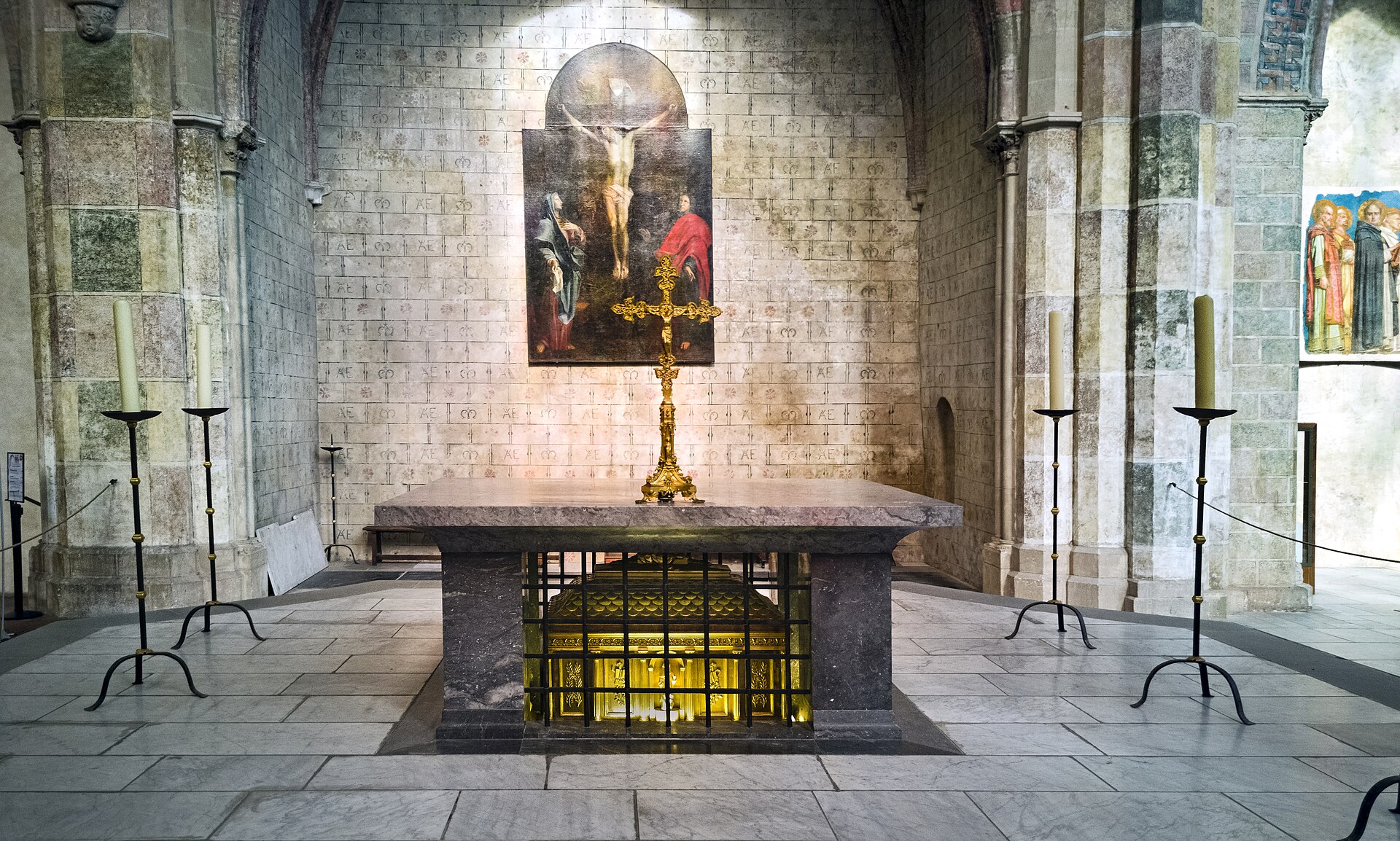
"By order of Urban V the body was given to his Dominican brethren, and was solemnly translated to the Dominican church at Toulouse, 28 January, 1369." The 1912 article goes on: "A magnificent shrine erected in 1628 was destroyed during the French Revolution, and the body was removed to the Church of St. Sernin."1 The Tablet, the London Catholic weekly, reports that the deconsecrated church of the Jacobins "was restored in 1974 and the remains were returned to what is now a museum."27 They rest under the altar of Saint Thomas photographed below.

Doctor of the Church (1567) and Aeterni Patris (1879)
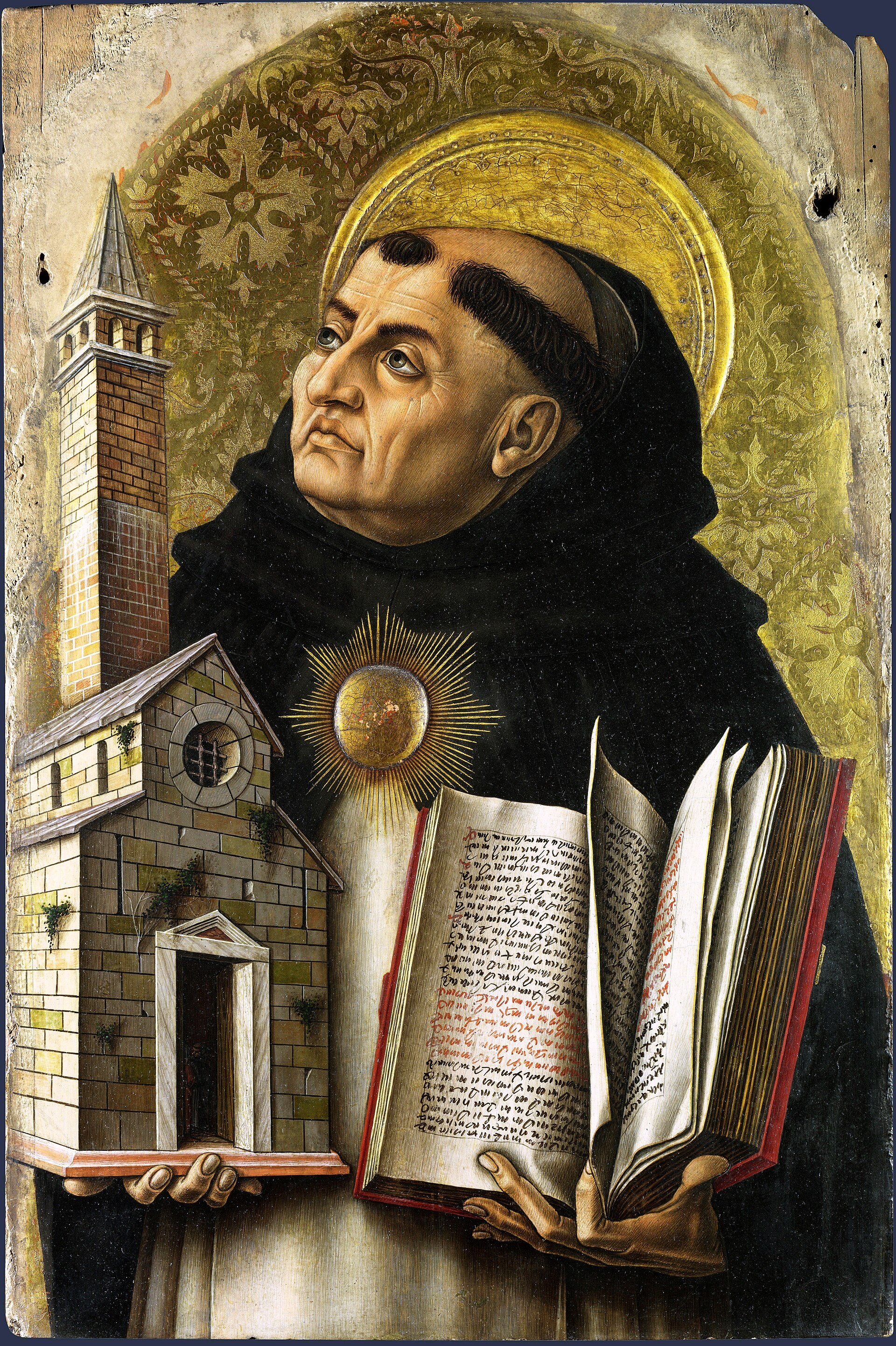
"St. Pius V proclaimed St. Thomas a Doctor of the Universal Church in the year 1567," the 1912 article says.1 Pius V was himself a Dominican, and three years later, in 1570, he had the first collected edition of Aquinas's works printed at Rome, the "Piana."1 Leo XIII, in Aeterni Patris (August 4, 1879), recalled the bull by name: "St. Pius V declares in the bull Mirabilis that heresies, confounded and convicted by the same teaching, were dissipated, and the whole world daily freed from fatal errors."28 Leo then made his own appeal:
"We exhort you, venerable brethren, in all earnestness to restore the golden wisdom of St. Thomas, and to spread it far and wide for the defense and beauty of the Catholic faith, for the good of society, and for the advantage of all the sciences. The wisdom of St. Thomas, We say; for if anything is taken up with too great subtlety by the Scholastic doctors, or too carelessly stated-if there be anything that ill agrees with the discoveries of a later age, or, in a word, improbable in whatever way-it does not enter Our mind to propose that for imitation to Our age."28
(The hyphens stand for dashes in the Vatican's online text.) The qualification in the second sentence is often missed: Leo asked for the "wisdom" of Thomas, not for every opinion of the medieval schools. A year later, by a brief of August 4, 1880, Leo named him patron of Catholic universities, academies, colleges and schools.1 The suspected friar of 1277 had become the church's official teacher. Lesson 07 takes up what Protestant readers, from Luther and Calvin to modern evangelicals, made of him.

What the record shows and what it does not
- Documented fact: his death at Fossanova on March 7, 1274; the Paris condemnation of 219 articles on March 7, 1277 and the Oxford prohibitions of March 18, 1277; the canonization inquiry at Naples (July 21 to September 18, 1319) and at Fossanova (November 10 to 26, 1321); the canonization by John XXII on July 18, 1323; the revocation by Bishop Stephen Bourret of Paris on February 14, 1325; the translation of the body to Toulouse on January 28, 1369; Aeterni Patris, August 4, 1879.2425326128
- His own words: the works themselves, above all the Summa, where he wrote calmly and in general terms about the questions his own life raised: children offered to monasteries, sons who enter religion against their parents, an order founded for preaching and study, and the punishment of heretics.415812
- Sworn early witnesses: the 1319 minutes record what monks, friars, nobles and royal officials said under oath, and many of them say how they knew it. Some were eyewitnesses (a monk of Fossanova who was at Maenza and at the deathbed). Others pass on what they heard at second or third hand (the straw saying, the temptation).3
- Later lives and legend: the lives by William of Tocco, Bernard Gui and Peter Calo, written for or after the canonization, add the hermit's prophecy, the dumb ox, the speaking crucifix and many miracles. The 1912 Catholic Encyclopedia repeats most of them, citing the early lives.1
- Scholarly reading: the dates of his works and of his moves follow Torrell's catalogue as the Stanford Encyclopedia of Philosophy reports it; the year of his birth, the length and place of his captivity and the date of his first mastership are still given differently by different authors.2
- Open questions: what happened to him in December 1273; whether Bishop Tempier opened a separate process against his teaching in 1277 and why it stopped; how far the 1277 articles were aimed at him.24
Claims checked
Popular books, sermons, websites and films repeat many stories about Aquinas. Each claim below is rated by the evidence for the account: who first told it, when, and how close the teller was to the event. A rating says nothing about whether a miracle can happen. It says how good the testimony is that this one did.
"At the end of his life Aquinas said everything he had written was straw"
Rating: Supported, as reported testimony. The saying is in the sworn testimony of Bartholomew of Capua, chancellor of the Kingdom of Sicily, given at Naples on August 8, 1319: "All that I have written seems to me like straw compared with what has now been revealed to me."3 Bartholomew did not hear it himself. By his own account it came to him from John of Giudice, who had it from Reginald of Piperno, Thomas's companion, when Reginald was near death. That is a chain of three tellers and about thirty years between the words and Bartholomew's hearing of them, and some forty-six years to the sworn record. The 1912 Catholic Encyclopedia gives a shorter version from Prümmer's edition of the early lives, with the Latin word modica, "of little value."1 The saying is well attested for a medieval report of private words. The popular gloss that Aquinas rejected or disowned his theology is another matter: the testimony compares his writing "with what has now been revealed to me," and on his deathbed he submitted everything he had written to the judgment of the Roman Church, an act that presumes the writings still mattered.1 That gloss is Unsupported.
"His fellow students called him the dumb ox, and Albert the Great said his bellowing would be heard throughout the world"
Rating: Partly supported. The story is in the early Dominican lives and is repeated in the 1912 Catholic Encyclopedia, which gives Albert's words as "We call this young man a dumb ox, but his bellowing in doctrine will one day resound throughout the world."1 It is not in the sworn testimony of 1319 as reproduced in the 1959 English translation, and the earliest telling is decades after the event. Calo's description of Thomas as "of lofty stature and of heavy build" fits the nickname.1 That a large, quiet student was teased is likely. The exact words given to Albert should be read as the tradition of the order, not a record taken down at Cologne.
"His brothers sent a woman to seduce him and he drove her out with a burning log"
Rating: Partly supported. The family's detention of Thomas is attested by several witnesses and by every early life. The temptation itself rests on William of Tocco's sworn statement of 1319, and Tocco gave his chain of sources: he heard it at Anagni from the Dominican Robert of Sezze, who had it from "his uncle (a certain brother Stephen, a worthy religious)."3 That is three tellers and roughly seventy-five years. The angels and the girdle of chastity rest, in Tocco's account, on what Thomas later told his companion in private. Bartholomew of Capua, the other main witness to the captivity, does not mention the woman: he says Thomas asked his brothers for "a Bible and a breviary" and studied the Bible so deeply "that he understood most of it by the time of his release."3 The deed with the firebrand is possible and is told by a careful witness who names his sources. The vision is reported as Thomas's own private account and cannot be checked.
"A crucifix spoke to Aquinas: 'Thou hast written well of me, Thomas'"
Rating: Unresolved. The 1912 Catholic Encyclopedia tells the story from Prümmer's edition of the early lives and says it happened at Naples in 1273, with "three of the brethren" as witnesses, and adds that "similar declarations are said to have been made at Orvieto and at Paris."1 A story placed in three cities has traveled. It is not among the sworn statements of 1319 quoted in this lesson. The 1319 minutes do contain stories of the same kind told at second hand: William of Tocco testified, on the word of a vicar of the bishop of Nola who had it from Reginald, that while Thomas was commenting on Isaiah he was heard at night speaking with someone, and that he later told Reginald that "God in His mercy had sent the blessed Apostles Peter and Paul to teach him."3 The levitation stories (being "lifted in ecstasy") belong to the same late layer. The testimony for them is thin and secondhand.
"The Summa is unfinished because of a vision"
Rating: Partly supported. That he stopped writing in the Third Part, "at the questions on Penance," after something that happened at Mass in the chapel of Saint Nicholas, is in Bartholomew of Capua's testimony, and the 1912 Catholic Encyclopedia adds that the work had reached "the ninetieth question of the third part."31 What happened is reported only through Thomas's words to Reginald ("what has now been revealed to me") and Reginald's own fear "that much study might have affected his master's brain."3 He died three months later, after a collapse on the road. The record fits a spiritual experience as his companions understood it, a breakdown of his health, or both. It does not decide between them.
"Fresh herrings appeared for him at Maenza"
Rating: Supported, as eyewitness testimony. This is the best-attested miracle story of his life, by the standard this lesson uses. Peter of Montesangiovanni, an old monk of Fossanova, testified on August 1, 1319 that Thomas, ill at Maenza, asked for fresh herrings, that a fishmonger arrived from Terracina with sardines, and that one basket "was found full of fresh herrings." Asked for his authority, the monk said "he himself spent" those four days at Maenza, "was present and saw everything and also ate some of the herrings," and named the others present, all dead by 1319.3 The account is firsthand and sworn, given some forty-five years after the event. Whether the fish were a miracle or a mistake is the kind of question this rating does not settle.
"Charles of Anjou had him poisoned"
Rating: Unsupported. Dante has Hugh Capet say in the Purgatorio that Charles "Thrust Thomas back to heaven, for amends" (canto 20, line 69, Longfellow's translation).23 Dante wrote a generation after the death and was writing a poem with a strong case against the house of France. The sworn witnesses of 1319, several of them officials of Charles's own kingdom, describe an illness, a fall on the road, a stay at Maenza and a slow death at Fossanova, and say nothing of poison.3 No early source supports the rumor.
"A hermit foretold before his birth that he would be a Dominican"
Rating: Unsupported as history; attested as family tradition. Peter Calo tells it, and William of Tocco repeated it in 1319 on the word of Thomas's niece Catherine, who said she had it from Theodora.13 The prophecy was first written down some seventy years after it was supposedly spoken, by members of the order it praises, and through a family that had come to take pride in a son it once tried to keep from that order.
"The Church condemned Aquinas as a heretic in 1277"
Rating: Partly supported. Bishop Tempier's 219 articles of March 7, 1277 name no author. Some of them touch positions Aquinas held, and the scholars John Wippel and Roland Hissette disagree over how many and how deliberately.24 Robert Wielockx argued that a separate inquiry against Aquinas was begun and stopped by order of the curia, a thesis the Stanford entry says "has been generally accepted" but has lately been questioned.24 At Oxford, some of Kilwardby's prohibitions "were interpreted as aimed at the teaching of Thomas Aquinas," those on "his doctrine of the unicity of substantial form."25 The pope never condemned him, his order defended him from 1278 on, and the bishop of Paris revoked the 1277 sentence insofar as it touched him in 1325.25126 "Suspected" fits the record. "Condemned as a heretic" does not.
"He wrote the Summa contra Gentiles on scraps of paper"
Rating: Unresolved. A witness in 1319 said a former student told him Thomas "wrote the Summa contra Gentiles on small bits of scribbling paper, since he had no other writing material."3 The story is secondhand and told as an example of his poverty. Much of the autograph survives in the Vatican Library (Vat. lat. 9850), but this lesson did not examine the manuscript or a description of its leaves, so the story is left open.2
"He wrote the Summa contra Gentiles as a missionary handbook at Raymond of Pennafort's request"
Rating: Unresolved. The 1912 Catholic Encyclopedia states it as fact.1 The story is not in the 1319 testimony quoted here, and modern scholars are divided on the book's purpose, some reading it as an aid to missionaries among Muslims and Jews in Spain and others as a work of Christian wisdom written mainly for Christian readers. This lesson did not open the medieval chronicle in which the Pennafort story first appears.
"Pope John XXII said he worked as many miracles as he wrote articles"
Rating: Unsupported as a saying from the canonization. The Dominican scholar Marc Millais, writing in New Blackfriars in 2023, notes that the phrase Quot articulos scripsit tot miracula fecit is "found in a text of Jean Gerson" and "attributed to the pope," but "cannot be drawn directly from an utterance of John XXII at Thomas's canonisation."26
"The Dominicans were the Inquisition"
Rating: Partly supported. Popes appointed friars of both mendicant orders as inquisitors, and Dominicans wrote the standard handbooks, as the 1911 Catholic Encyclopedia article on the order itself records.7 The Inquisition was a set of papal commissions and tribunals staffed by many kinds of clergy, and the order was founded in 1216 "principally for preaching and for the salvation of souls."7 Aquinas held no inquisitorial office. He did defend, in the Summa, the death penalty for relapsed and obstinate heretics, as quoted above.12
"Thomas Aquinas was born in 1225"
Rating: Partly supported. No document gives the date. The 1912 Catholic Encyclopedia gives "1225 or 1227" and reports that Prümmer, following Calo, preferred 1227; the Stanford Encyclopedia says "around the year 1225"; and Bartholomew of Capua told the inquiry of 1319 that Thomas died "(according to the usual view) in his forty-eighth year," which would put the birth about 1226 or 1227.123 Weisheipl and Torrell prefer 1224 or 1225. "About 1225" is the honest form. No early source gives the day.
Hard questions and answers
If Aquinas himself called his work straw, why should anyone read it?
A skeptic and an evangelical reader can ask this from opposite sides. The testimony answers part of it. The words were a comparison: what he had written seemed straw "compared with what has now been revealed to me."3 Straw is not nothing in that picture. It is what is left when the grain has been threshed. A man who thought his books worthless would hardly have spent his last act of faith submitting them, by name, to the judgment of the church: "if I have written anything erroneous concerning this sacrament or other matters, I submit all to the judgment and correction of the Holy Roman Church."1 His own Summa also said, from its first page, that theology falls short of its object. Its prologue says it was meant to "tend to the instruction of beginners," and he held that the end of human life is a vision of God that no book provides.19 Lesson 06 quotes the article (ST I-II, q. 3, a. 8). Read that way, the straw saying agrees with what the Summa teaches about itself. A reader who thinks the experience of December 1273 was illness, and not revelation, still has the books, which Aquinas wrote over twenty years in full health and which every later reader, Catholic and Protestant, has had to reckon with.
How should a Protestant reader treat a life full of miracles, angels and speaking crucifixes?
The same way a careful Catholic historian does: by asking who told each story, when, and how they knew. The canonization inquiry itself asked those questions. Its notaries recorded, witness by witness, "how he knew it," and the witnesses often answered that they had heard a story from someone who had it from someone else.3 By that test the stories sort themselves. His family's opposition, his studies with Albert, his mastership at Paris, his collapse in December 1273 and his death at Fossanova rest on many independent witnesses. The temptation, the straw saying and the herrings rest on single chains, some firsthand and some not. The speaking crucifix and the hermit rest on the later lives. A Protestant reader does not have to accept a medieval miracle to learn from a medieval theologian, and a Catholic reader does not have to accept every story in a saint's life to honor the saint. The church that canonized him in 1323 did so, as Marc Millais describes it, in a process where the weight was shifting from miracles toward the evidence of virtue and doctrine.26
Aquinas wrote that convicted heretics may be put to death. How do Catholics and Protestants stand to that today?
The text says what it says: heretics who remain obstinate after "the first and second admonition" are to be excommunicated and delivered "to the secular tribunal to be exterminated thereby from the world by death."12 He made a distinction that his own age did not always keep, between those who had never received the faith ("the heathens and the Jews"), who "are by no means to be compelled to the faith," and baptized Christians who had abandoned it.13 The Catholic Church's present teaching is set out in the Second Vatican Council's Dignitatis Humanae (1965), which declares that "the human person has a right to religious freedom" and that "all men are to be immune from coercion," and which admits that "there has at times appeared a way of acting that was hardly in accord with the spirit of the Gospel or even opposed to it."14 Protestant authorities of the 1500s also executed people for heresy, as module 102's lessons record (Martyrs Briefs, lesson 05 covers the medieval dissenters). Neither tradition reads Aquinas's article as current teaching. Both have to explain how they came to their present view.
Did Aquinas put Aristotle above Scripture?
Some Protestant critics have said so, from Luther's attacks on Aristotle in the universities to the twentieth-century charge, made by Francis Schaeffer among others, that Aquinas gave nature and reason an independence they should not have (lesson 07 takes up both, with their own words). The life shows a more mixed picture. He learned Aristotle as a teenager at Naples and called him "the Philosopher" for the rest of his life. He wrote commentaries on most of Aristotle's major works.2 He also spent his second Paris regency fighting masters who read Aristotle as teaching one intellect for all men and an eternal world, and he held that the beginning of the world could be known only by revelation.12 His duties as a master of theology began with lecturing on the Bible, and he defended study in a religious order partly because it removes "the errors which in the contemplation of divine things frequently beset those who are ignorant of the scriptures."9 Whether he gave reason too much room is a theological judgment that lessons 04 and 07 set out from both sides. That he treated Aristotle as an authority above Scripture is not what his own words say.
Were the Dominicans and Franciscans rivals, and were Aquinas and Bonaventure opponents?
They were allies against a common enemy and rivals in theology. At Paris in the 1250s the two orders stood together against William of Saint-Amour, and the 1912 Catholic Encyclopedia reports the tradition that "St. Bonaventure and St. Thomas received the doctorate on the same day."1 Both were summoned to Lyons in 1274, and both died that year.122 On the eternity of the world and on the soul they disagreed. After 1277 some of Aquinas's sharpest critics were Franciscans, among them John Pecham, whose letter is part of the evidence the Stanford entry uses for the 1277 inquiry.24 Dante, writing a generation later, gave the two orders a reconciliation in poetry: in the Paradiso the Dominican Thomas praises Francis, and in the next canto the Franciscan Bonaventure praises Dominic.17 Lessons 12 and 13 tell the Franciscan side.
How did a teacher under suspicion in 1277 become a saint in 1323 and the Church's model teacher in 1879?
Step by step, and largely through his own order. The Dominican general chapter at Milan in 1278 sent a commission "to investigate and punish those who blackened the writings of Thomas Aquinas," and later chapters, the 1912 Catholic Encyclopedia says, "expressly required the brethren to follow the doctrine of Thomas, who at that time had not been canonized."251 The Dominicans of Naples gathered the testimony, the pope at Avignon canonized him in 1323, and the bishop of Paris lifted the 1277 sentence as it touched him in 1325.326 Pius V, a Dominican pope, named him a Doctor of the Church in 1567 and had his works printed in 1570.1 Leo XIII in 1879 then asked the bishops "to restore the golden wisdom of St. Thomas," with the careful proviso that whatever "ill agrees with the discoveries of a later age" was not to be imitated.28 The rise was neither automatic nor uncontested, as the Oxford prohibitions and the critics after 1277 show. Lesson 07 follows what Protestant readers made of him.
Where to go next
Lesson 03 takes apart the book he began at Santa Sabina: its parts, its questions and the five-part article. Lesson 04 reads his most famous article. For the wider world of his century, see lesson 01 and Church History, Part A, lesson 09; for the monastic life he was offered to as a boy, lesson 07 of the same module; and for the Latin Bible he studied in captivity and quoted at Fossanova, The History of the Bible, lesson 04. His teaching on law, which later shaped English and American legal thought, is the subject of lesson 05 and of Principles of Liberty, lesson 02.
Learn more
- The 1319 canonization inquiry in the 1959 English translation (The WM Review): The sworn testimony itself, witness by witness, with each witness's account of how he knew what he said.
- Summa Theologiae, II-II, q. 188 and q. 189 (New Advent): Aquinas on the religious orders, study, preaching, poverty and entering religion, the questions his own life posed.
- Stanford Encyclopedia of Philosophy: Thomas Aquinas: A current scholarly overview with a dated list of the works after Torrell.
- Stanford Encyclopedia of Philosophy: Condemnation of 1277: The best short account of what Tempier condemned and the scholarly dispute over Aquinas.
- Leo XIII, Aeterni Patris (1879): The encyclical that made Aquinas the model for Catholic schools, with its stated limits.
- Catholic Encyclopedia (1912): St. Thomas Aquinas: The older Catholic life, useful for what the early lives say; check its dates against modern scholarship.
Still being checked (16 items)
These points could not be confirmed against a primary source when this lesson was written and fact checked in October 2026. The text above states each one as uncertain.
- The day of Aquinas's birth is unknown; the year is given as 1224, 1225, 1226 or 1227 by different sources. Weisheipl's and Torrell's own books were not opened for this lesson; their positions are reported as commonly cited.
- That January 28 has been his feast in the Roman calendar since the 1969 calendar revision was not checked against the calendar documents; the 1369 translation date is from the 1912 Catholic Encyclopedia.
- The date of his clothing as a Dominican (April 1244 in modern biographies) and of his father Landulf's death (December 1243) come from modern biographies not opened here; Bartholomew of Capua's 1319 testimony instead says his father had him held.
- The place of his detention (Montesangiovanni in Tocco's testimony, Roccasecca in later accounts) and its length (more than a year, a year, or nearly two years) differ by source.
- The 'dumb ox' saying was not checked in William of Tocco's Latin Ystoria; it is quoted from the 1912 Catholic Encyclopedia.
- The wording of the bull Religiosam vitam (December 22, 1216) and of the January 1217 letter was not checked in the papal register.
- The date December 10, 1270 and the count of thirteen propositions for the first Paris condemnation were not confirmed in the Chartularium; the Marquette outline lists the propositions without a count or day.
- The spring 1256 inception and the August 1257 acceptance into the masters' body are the usual modern reading; the 1912 Catholic Encyclopedia gives October 23, 1257.
- The medieval chronicle in which the Raymond of Pennafort story about the Summa contra Gentiles first appears was not opened.
- Whether the autograph of the Summa contra Gentiles is on parchment or paper was not checked.
- The story that he struck his head on a branch on the road to Lyons was not traced to its source.
- That Weisheipl and Torrell place the Naples house of studies as founded by commission of the Roman province (1272) is reported from general knowledge of their books, not from the books opened.
- The identification of the two figures beside Aquinas in Gozzolis Triumph as Aristotle and Plato, and of the figure at his feet as Averroes, is the usual reading and was not checked against the Louvre catalogue.
- The volume and issue number of Millais's New Blackfriars article (2023) were not confirmed; the PDF (re-opened Nov. 5, 2026) gives pages 716 to 725 and the doi but no volume number.
- The modern dating of Peter Calo's life (after Tocco's, rather than the 1300 given by the 1912 Catholic Encyclopedia) is stated from general knowledge of the scholarship, not from a source opened in the check.
- The Tablet article on the 1974 return of the relics to the Jacobins carries no visible date; it refers to 2024 as an upcoming anniversary year (wording confirmed Nov. 5, 2026).
Notes
- Daniel Kennedy, "St. Thomas Aquinas," The Catholic Encyclopedia, vol. 14 (New York: Robert Appleton Company, 1912), New Advent online text. A 1900s Catholic reference; it draws on Dominic Prümmer's Fontes Vitae S. Thomae Aquinatis (Toulouse, 1911), Peter Calo's life and the other early lives (retrieved Nov. 5, 2026). Read it online. ↩
- Robert Pasnau, "Thomas Aquinas," Stanford Encyclopedia of Philosophy, first published Dec. 7, 2022, section 1 (life) and the list of works, whose dates follow Jean-Pierre Torrell's catalogue (retrieved Nov. 5, 2026). Read it online. ↩
- Minutes of the first canonization inquiry into Thomas Aquinas, Naples, July 21 to Sept. 18, 1319: testimony of Peter of Montesangiovanni, monk of Fossanova (Aug. 1, nos. XLIX to L), William of Tocco, prior of Benevento (Aug. 4, nos. LVIII to LXII), and Bartholomew of Capua, chancellor of the Kingdom of Sicily (Aug. 8, from no. LXXVI), in the English translation by an English Dominican, The Life of Saint Thomas Aquinas: Biographical Documents (London: Longmans, Green, 1959), as reproduced in "What did they find at St Thomas Aquinas' canonisation enquiry?" The WM Review, Mar. 7, 2025. Short quotations only (retrieved Nov. 5, 2026). Read it online. ↩
- Thomas Aquinas, Summa Theologiae, II-II, q. 189, a. 5 ("Whether children should be received in religion?"), body of the article, trans. Fathers of the English Dominican Province, 2nd and revised ed. (London: Burns Oates and Washbourne, 1920), New Advent online text (retrieved Nov. 5, 2026). Read it online. ↩
- Frederick II, general letter (generalis litterae) founding the school of Naples, "Datum Siracusie, V Iunii, XII indictionis" (Syracuse, June 5, 1224), Latin text at Latin Wikisource, from the University of Naples's 800anni edition; the English rendering in the lesson was made for this lesson (retrieved Nov. 5, 2026). Read it online. ↩
- John Bonaventure O'Connor, "St. Dominic," The Catholic Encyclopedia, vol. 5 (New York: Robert Appleton Company, 1909), New Advent online text (retrieved Nov. 5, 2026). Read it online. ↩
- Pierre Mandonnet, "Order of Preachers," The Catholic Encyclopedia, vol. 12 (New York: Robert Appleton Company, 1911), New Advent online text, sections on the order's purpose, its schools at Paris and its part in the Inquisition (retrieved Nov. 5, 2026). Read it online. ↩
- Thomas Aquinas, Summa Theologiae, II-II, q. 188, a. 4 ("Whether a religious order can be established for preaching or hearing confessions?"), body of the article; a citation omitted, trans. Fathers of the English Dominican Province, 2nd and revised ed. (London: Burns Oates and Washbourne, 1920), New Advent online text (retrieved Nov. 5, 2026). Read it online. ↩
- Thomas Aquinas, Summa Theologiae, II-II, q. 188, a. 5 ("Whether a religious order should be established for the purpose of study?"), body of the article, trans. Fathers of the English Dominican Province, 2nd and revised ed. (London: Burns Oates and Washbourne, 1920), New Advent online text (retrieved Nov. 5, 2026). Read it online. ↩
- Thomas Aquinas, Summa Theologiae, II-II, q. 188, a. 6 ("Whether a religious order that is devoted to the contemplative life is more excellent than one that is given to the active life?"), body of the article; a citation of Gregory the Great, a quotation of Dionysius and a clause on the bishops omitted, trans. Fathers of the English Dominican Province, 2nd and revised ed. (London: Burns Oates and Washbourne, 1920), New Advent online text (retrieved Nov. 5, 2026). Read it online. ↩
- Thomas Aquinas, Summa Theologiae, II-II, q. 188, a. 7 ("Whether religious perfection is diminished by possessing something in common?"), body of the article, trans. Fathers of the English Dominican Province, 2nd and revised ed. (London: Burns Oates and Washbourne, 1920), New Advent online text (retrieved Nov. 5, 2026). Read it online. ↩
- Thomas Aquinas, Summa Theologiae, II-II, q. 11, a. 3 ("Whether heretics ought to be tolerated?"), body of the article; one connecting word and, after the quotation, a citation of a Church Father omitted (a citation of a Church Father omitted), trans. Fathers of the English Dominican Province, 2nd and revised ed. (London: Burns Oates and Washbourne, 1920), New Advent online text (retrieved Nov. 5, 2026). Read it online. ↩
- Thomas Aquinas, Summa Theologiae, II-II, q. 10, a. 8 ("Whether unbelievers ought to be compelled to the faith?"), body of the article, trans. Fathers of the English Dominican Province, 2nd and revised ed. (London: Burns Oates and Washbourne, 1920), New Advent online text (retrieved Nov. 5, 2026). Read it online. ↩
- Second Vatican Council, Dignitatis Humanae, Declaration on Religious Freedom, Dec. 7, 1965, nos. 2 and 12, Vatican English text (retrieved Nov. 5, 2026). Read it online. ↩
- Thomas Aquinas, Summa Theologiae, II-II, q. 189, a. 6 ("Whether one ought to be withdrawn from entering religion through deference to one's parents?"), body of the article and reply to objection 1, trans. Fathers of the English Dominican Province, 2nd and revised ed. (London: Burns Oates and Washbourne, 1920), New Advent online text (retrieved Nov. 5, 2026). Read it online. ↩
- Bruno Tremblay, "Albert the Great," Stanford Encyclopedia of Philosophy, first published Nov. 30, 2025, section 1 (life) and the opening of Albert's Physics as quoted there (retrieved Nov. 5, 2026). Read it online. ↩
- Dante Alighieri, Paradiso, canto 10, lines 94 to 99, and canto 11, lines 37 to 39 (canto 12 is Bonaventure's praise of Dominic), trans. Henry Wadsworth Longfellow (1867), Project Gutenberg ebook 1003 (retrieved Nov. 5, 2026). Read it online. ↩
- Psalm 103:13 (Psalm 104 in the Hebrew numbering), Douay-Rheims Bible, Challoner revision, drbo.org (retrieved Nov. 5, 2026). Read it online. ↩
- Thomas Aquinas, Summa Theologiae, First Part, Prologue, trans. Fathers of the English Dominican Province (Benziger Brothers edition), Project Gutenberg ebook 17611. The prologue's parenthesis citing 1 Cor. 3:1 to 2 is not quoted (retrieved Nov. 5, 2026). Read it online. ↩
- Richard C. Taylor, "Condemnations of 1210, 1270 & 1277," course outline for Medieval Philosophy, Marquette University, Spring 2017, the 1270 list (retrieved Nov. 5, 2026). Read it online. ↩
- Psalm 131:14 (Psalm 132 in the Hebrew numbering), Douay-Rheims Bible, Challoner revision, drbo.org (retrieved Nov. 5, 2026). Read it online. ↩
- Paschal Robinson, "St. Bonaventure," The Catholic Encyclopedia, vol. 2 (New York: Robert Appleton Company, 1907), New Advent online text, opening lines (died at Lyons, July 15, 1274) (retrieved Nov. 5, 2026). Read it online. ↩
- Dante Alighieri, Purgatorio, canto 20, line 69, trans. Henry Wadsworth Longfellow (1867), Project Gutenberg ebook 1002 (retrieved Nov. 5, 2026). Read it online. ↩
- Hans Thijssen, "Condemnation of 1277," Stanford Encyclopedia of Philosophy, first published Jan. 30, 2003, substantive revision Dec. 18, 2023, sections 1 and 2 (John XXI's letter of Jan. 18, 1277; the targets; Wippel, Hissette and Wielockx on Aquinas) (retrieved Nov. 5, 2026). Read it online. ↩
- José Filipe Silva, "Robert Kilwardby," Stanford Encyclopedia of Philosophy, first published Apr. 17, 2012, substantive revision Dec. 30, 2025, section 1 (life and works: the 1269 chapter, the Prohibitions of Oxford of Mar. 18, 1277, the chapter of Milan, 1278) (retrieved Nov. 5, 2026). Read it online. ↩
- Marc Millais, "Thomas Aquinas and the Interlinking of Sanctity and Doctrine, From One Centenary to Another," trans. Matthew Jarvis, New Blackfriars (2023), pp. 716 to 725, doi 10.1111/nbfr.12872, on the 1319 and 1321 inquiries, the canonization at Avignon on July 18, 1323, the letter of Bishop Stephen Bourret of Feb. 14, 1325 (citing Chartularium Universitatis Parisiensis ii/1, pp. 280 to 281, no. 838) and the saying "Quot articulos scripsit tot miracula fecit" (retrieved Nov. 5, 2026). Read it online. ↩
- "Aquinas relic begins series of anniversaries in Toulouse," The Tablet (London), undated online news item written before the 2024 anniversary (retrieved Nov. 5, 2026). Read it online. ↩
- Leo XIII, Aeterni Patris, encyclical on the restoration of Christian philosophy, Aug. 4, 1879, nos. 20 to 21 (the papal testimonies, including Pius V's bull Mirabilis) and 31, Vatican English text (retrieved Nov. 5, 2026). Read it online. ↩
Check yourself
1. Where was Thomas Aquinas born, and when, as the sources allow?
No document records the day. The 1912 Catholic Encyclopedia gives 1225 or 1227, the Stanford entry about 1225, and a 1319 witness implies 1226 or 1227. January 28 is the date of the 1369 translation of his body to Toulouse.
2. Which pope approved the Order of Preachers, and when?
The 1909 Catholic Encyclopedia article on Dominic gives the bull of confirmation as December 22, 1216, issued by Honorius III.
3. Who is the earliest surviving source for the story that Thomas drove a woman from his room with a burning log?
Tocco told the story under oath at Naples in 1319 and named his chain of sources, about seventy-five years after the event.
4. What did the secular master William of Saint-Amour attack in On the Perils of the Last Times (1255)?
He cast the mendicants as false teachers of the last days; Aquinas answered with Contra impugnantes, and Alexander IV condemned William's book on October 5, 1256.
5. Where was the Summa Theologiae begun?
The First Part was written in Italy, at Rome and probably Viterbo, about 1265 to 1268; the prologue says it was for 'the instruction of beginners.'
6. How did Bartholomew of Capua know the 'straw' saying he reported in 1319?
His testimony names the chain: Thomas to Reginald, Reginald to John of Giudice, John to Bartholomew at Anagni before 1303.
7. What happened on March 7, 1277, three years to the day after Aquinas died?
Tempier acted at Paris on March 7; Kilwardby's Oxford list followed on March 18. Scholars still dispute how far the Paris articles touched Aquinas.
8. Which statement about Aquinas's later honors is correct?
John XXII canonized him at Avignon in 1323; Pius V declared him a Doctor in 1567; Leo XIII's Aeterni Patris (1879) urged the restoration of his 'golden wisdom.'
Terms in this lesson
- Oblate
- A child offered by his parents to a monastery (from Latin oblatus, offered). Thomas was an oblate at Monte Cassino from about age five.
- Order of Preachers
- The Dominican order, founded by Dominic de Guzman and confirmed by Honorius III on December 22, 1216, 'principally for preaching and for the salvation of souls.'
- Mendicant
- A member of a begging order of friars, such as the Dominicans and Franciscans, who lived on alms in the towns rather than on the lands of an abbey.
- Studium generale
- A school open to students from many places; in the Dominican order, the provincial or general colleges such as those at Paris and Cologne.
- Sentences
- Peter Lombard's twelfth-century collection of the opinions of the Fathers arranged by topic, on which every bachelor of theology lectured.
- Master of theology (regent master)
- A doctor of theology holding a chair at the university, whose duties were to lecture on the Bible, dispute and preach.
- Disputed question
- A classroom debate on a set question with arguments on both sides and a master's determination, the model for the articles of the Summa.
- Quodlibet
- A public disputation held in Advent or Lent at which the audience could propose any question at all.
- Averroist
- A name for masters of arts who read Aristotle with the commentaries of Ibn Rushd (Averroes) and taught, as Aristotle's view, positions such as one intellect for all men.
- Socius
- A friar's assigned companion. Reginald of Piperno was Thomas's socius and secretary in his last years.
- Canonization inquiry
- A formal hearing of sworn witnesses on a candidate's life, morals and miracles; for Aquinas, at Naples in 1319 and Fossanova in 1321.
- Condemnation of 1277
- Bishop Stephen Tempier's prohibition, on March 7, 1277, of 219 philosophical and theological theses discussed in the Paris arts faculty.
- Doctor of the Church
- A title given by the pope to a saint whose teaching the Church commends; Pius V gave it to Aquinas in 1567.
Sources
- Thomas Aquinas, Summa Theologiae, II-II, qq. 10, 11, 188, 189 (English Dominican translation, 1920) (1265 to 1273 (translation 1920)) checked 2026-10
- Thomas Aquinas, Summa Theologiae, First Part, Prologue (Project Gutenberg 17611) (about 1265 to 1268) checked 2026-10
- Minutes of the 1319 canonization inquiry, 1959 English translation, reproduced by The WM Review (1319 (translation 1959; web 2025)) checked 2026-10
- Frederick II, general letter founding the school of Naples (Latin Wikisource) (June 5, 1224) checked 2026-10
- Leo XIII, Aeterni Patris (August 4, 1879) checked 2026-10
- Second Vatican Council, Dignitatis Humanae (December 7, 1965) checked 2026-10
- Dante, Paradiso, Longfellow translation (Gutenberg 1003) (about 1320 (translation 1867)) checked 2026-10
- Dante, Purgatorio, Longfellow translation (Gutenberg 1002) (about 1315 (translation 1867)) checked 2026-10
- Douay-Rheims Bible, Psalms 103 and 131 (1609 to 1610 (Challoner revision 1750)) checked 2026-10
- Catholic Encyclopedia: St. Thomas Aquinas (Daniel Kennedy) (1912) checked 2026-10
- Catholic Encyclopedia: St. Dominic (J. B. O'Connor) (1909) checked 2026-10
- Catholic Encyclopedia: Order of Preachers (Pierre Mandonnet) (1911) checked 2026-10
- Catholic Encyclopedia: St. Bonaventure (Paschal Robinson) (1907) checked 2026-10
- Robert Pasnau, Thomas Aquinas, Stanford Encyclopedia of Philosophy (2022) checked 2026-10
- Bruno Tremblay, Albert the Great, Stanford Encyclopedia of Philosophy (2025) checked 2026-10
- Hans Thijssen, Condemnation of 1277, Stanford Encyclopedia of Philosophy (2003, revised 2023) checked 2026-10
- Jose Filipe Silva, Robert Kilwardby, Stanford Encyclopedia of Philosophy (2012, revised 2025) checked 2026-10
- Marc Millais, Thomas Aquinas and the Interlinking of Sanctity and Doctrine, New Blackfriars (2023) checked 2026-10
- Richard C. Taylor, Condemnations of 1210, 1270 and 1277 (Marquette course outline) (2017) checked 2026-10
- The Tablet, Aquinas relic begins series of anniversaries in Toulouse (before 2024) checked 2026-10