Lesson 5 of 14 · about 75 minutes · Updated November 5, 2026
Aquinas on Law: Eternal, Natural, Human and Divine Law
You'll be able to
- Quote and explain Aquinas's definition of law (ST I-II, q. 90, a. 4) and the four kinds of law in q. 91.
- Explain natural law as "the rational creature's participation of the eternal law" and state the first precept and the three natural inclinations of q. 94, a. 2.
- Distinguish laws derived from natural law as conclusions from laws made by determination (q. 95, a. 2), and explain why human law forbids only the graver vices (q. 96, a. 2).
- Say exactly what Aquinas taught about unjust laws (q. 96, a. 4), where "a law that is not just, seems to be no law at all" comes from, and how King used it.
- Explain the moral, ceremonial and judicial precepts of the Old Law and the New Law as "the grace itself of the Holy Ghost" (q. 106, a. 1).
- Compare Aquinas with Luther, Calvin, the Westminster Confession and Barth on natural law, and judge claims of influence on Hooker, Blackstone and the American founding.
Start here: the short version
In nineteen questions of the Summa Theologiae (First Part of the Second Part, questions 90 to 108, ninety-six articles in all), Thomas Aquinas sets out what law is and how many kinds of it there are. He defines law as "an ordinance of reason for the common good, made by him who has care of the community, and promulgated" (ST I-II, q. 90, a. 4). He then names four kinds: the eternal law, which is God's own plan for governing everything; the natural law, which is "the rational creature's participation of the eternal law"; human law, which people make by drawing conclusions from the natural law or by settling details it leaves open; and the divine law revealed in Scripture, in two stages, the Old Law given through Moses and the New Law, which he says is chiefly "the grace itself of the Holy Ghost." The first precept of the natural law, he writes, is that "good is to be done and pursued, and evil is to be avoided." He holds that human law should not try to forbid every vice, that a law contrary to justice "seems to be no law at all" (a line he takes from Augustine), and that the judicial laws of Moses no longer bind. This lesson reads those questions in the English Dominican translation of 1920, shows how Richard Hooker, Hugo Grotius, William Blackstone, Leo XIII and Martin Luther King Jr. used or echoed the theory, sets out what Luther, Calvin, the Westminster Confession and Karl Barth said about natural law, and rates the popular claims about all of it.
The site's Liberty and the Republic family already gives the history of natural law in outline, from the Greek and Roman writers to Aquinas, in Principles of Liberty, lesson 02: Natural Law from Cicero to Aquinas. Readers who want the long view should start there. This lesson goes inside one text: the Treatise on Law itself, article by article, in Aquinas's own words. It also follows the treatise forward to the English jurist William Blackstone, whose Commentaries are treated on their own in Principles of Liberty, lesson 05: William Blackstone, and to the American founding, which lesson 08: The Founders on Natural Rights covers. How a Summa article is built (objections, "On the contrary," "I answer that" and the replies) is explained in lesson 03, and the Five Ways that open the Summa's account of God are in lesson 04. The questions on happiness and the virtues that come before the Treatise on Law are in lesson 06, and the treatise on grace that follows it directly, with the Catholic and Protestant arguments over justification, is in lesson 07.
All Summa quotations below come from the English Dominican Fathers' translation, "literally translated by Fathers of the English Dominican Province," second and revised edition of 1920, in the online text at New Advent, with one page for each question. The online text sometimes leaves a space before a full stop or comma where a word carries a link; those stray spaces are closed up here and nothing else is changed. Where the translation uses a long dash, the quotation stops short of it or the omission is marked. The Latin, where given, is the Leonine text at the Corpus Thomisticum.
Where the Treatise on Law sits in the Summa
The Treatise on Law is not a separate book. It is a block of questions in the middle of the Second Part of the Summa, the part about human beings moving toward God by their own acts. The First Part of the Second Part (the Prima Secundae) begins with the last end of human life, happiness (questions 1 to 5), then treats human acts, the passions, habits, the virtues, vices and sin (questions 6 to 89). Up to that point Aquinas has been dealing with what he calls the intrinsic principles of human acts, the powers and habits inside a person. At question 90 he turns to principles outside the person. The opening lines of question 90 explain the plan:
"We have now to consider the extrinsic principles of acts. Now the extrinsic principle inclining to evil is the devil, of whose temptations we have spoken in the FP, Q[114]. But the extrinsic principle moving to good is God, Who both instructs us by means of His Law, and assists us by His Grace: wherefore in the first place we must speak of law; in the second place, of grace."1
("FP, Q[114]" is the translator's shorthand for the First Part, question 114, on the attacks of the demons.) The Latin is shorter: Principium autem exterius movens ad bonum est Deus, qui et nos instruit per legem, et iuvat per gratiam, "the outward principle moving to good is God, who both instructs us through law and helps us through grace."2 That one sentence explains why law and grace stand side by side in the Summa. Law (questions 90 to 108) tells a person what to do; grace (questions 109 to 114) gives the power to do it and to reach the end law points to. A reader who stops at question 108 has read only half of what Aquinas meant to say about how God moves people to the good. Lesson 07 picks up the other half.
The New Advent outline of the Prima Secundae lists the treatise this way: "GENERAL: The essence (90), various kinds (91), and effects (92) of law. ETERNAL LAW: The eternal law (93). NATURAL LAW: The natural law (94). HUMAN LAW: Human law (95) and its power (96) and mutability (97). OLD LAW: The old law (98) and its precepts (99): moral (100), ceremonial (101) and judicial (104). The causes (102) and duration (103) of the ceremonial precepts. The reason (105) for the judicial precepts. NEW LAW: The law of the Gospel (106) or new law and its comparison with the old (107). What (108) the new law contains."3 Counting the articles question by question on the same pages gives ninety-six articles in nineteen questions.3 More than half of them (fifty-eight of ninety-six) concern the Old Law and the New. Popular summaries of "Aquinas on natural law" usually quote one article, question 94, article 2. The treatise itself spends far more space on the law of Moses than on natural law, a proportion worth keeping in mind.
When was it written? The Prima Secundae is usually dated to Aquinas's second period of teaching at Paris (1268 to 1272). Jean-Pierre Torrell, in Saint Thomas Aquinas, volume 1, The Person and His Work (French 1993, English 1996), and James Weisheipl, in Friar Thomas d'Aquino (1974), both place the Second Part in those Paris years; the exact year for these questions is a matter of scholarly estimate, and the dating here is given as theirs, not as a documented fact.4 Lesson 02 gives the course of his life.
What law is: question 90
Question 90 has four articles, and each one adds a piece to the definition. Article 1 asks "Whether law is something pertaining to reason?" The third objection quotes the Roman jurists, "Whatsoever pleaseth the sovereign, has force of law," the maxim of the Roman jurist Ulpian that Justinian's Digest preserves at the head of its title on the constitutions of the emperors (the translation's reference reads "Lib. i, ff., De Const. Prin. leg. i"). If law is whatever the ruler wills, law belongs to the will, not to reason. Aquinas answers:
"Law is a rule and measure of acts, whereby man is induced to act or is restrained from acting: for 'lex' [law] is derived from 'ligare' [to bind], because it binds one to act. Now the rule and measure of human acts is the reason, which is the first principle of human acts."1
(The translation prints the Latin words in double quotation marks; they are given in single marks here because the sentence sits inside a quotation.) His reply to the jurists' maxim is short and sharp:
"Reason has its power of moving from the will, as stated above (I-II:17:1): for it is due to the fact that one wills the end, that the reason issues its commands as regards things ordained to the end. But in order that the volition of what is commanded may have the nature of law, it needs to be in accord with some rule of reason. And in this sense is to be understood the saying that the will of the sovereign has the force of law; otherwise the sovereign's will would savor of lawlessness rather than of law."1
Aquinas does not reject the Roman maxim. He reinterprets it: the ruler's will makes law only when what the ruler wills is reasonable. A will that departs from reason produces "lawlessness," whatever its legal form. This is the root of everything later in the treatise about unjust laws.
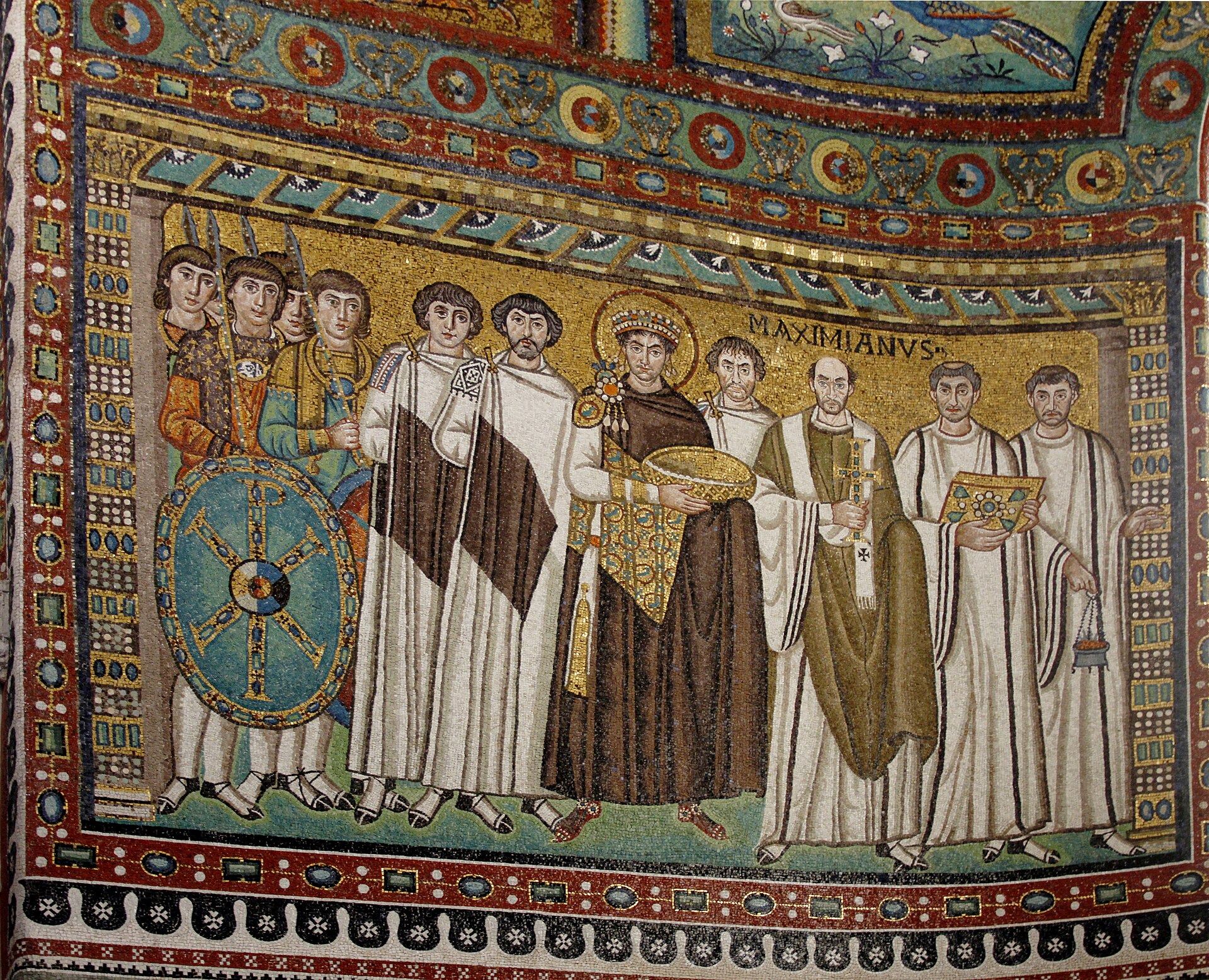

Article 2 asks whether law is always directed to the common good. Aquinas argues that the last end of human life is happiness, that "one man is a part of the perfect community," and so "the law must needs regard properly the relationship to universal happiness." He concludes: "since the law is chiefly ordained to the common good, any other precept in regard to some individual work, must needs be devoid of the nature of a law, save in so far as it regards the common good. Therefore every law is ordained to the common good."1 A command that serves only the private advantage of the one who gives it is, on this account, not properly a law at all.
Article 3 asks "Whether the reason of any man is competent to make laws?" His answer places lawmaking with the community:
"A law, properly speaking, regards first and foremost the order to the common good. Now to order anything to the common good, belongs either to the whole people, or to someone who is the viceregent of the whole people. And therefore the making of a law belongs either to the whole people or to a public personage who has care of the whole people: since in all other matters the directing of anything to the end concerns him to whom the end belongs."1
A private person can advise and urge, Aquinas says in the replies, but cannot make law, because law needs the power to compel, which belongs to the community or its public officer. A father can give commands in his household, but those are not laws in the full sense, since a household is not a "perfect community."
Article 4 asks whether promulgation is essential to law. A rule binds only when it is applied to those it rules, and it is applied by being made known. Then Aquinas gathers the four articles into the definition that has been quoted ever since:
"Thus from the four preceding articles, the definition of law may be gathered; and it is nothing else than an ordinance of reason for the common good, made by him who has care of the community, and promulgated."1
The Latin reads quaedam rationis ordinatio ad bonum commune, ab eo qui curam communitatis habet, promulgata.2 Each phrase answers one article: reason (article 1), the common good (article 2), the one who has care of the community (article 3), promulgation (article 4). The first objection to article 4 raises an obvious problem: the natural law is never published by anyone, so how can promulgation be essential? The reply: "The natural law is promulgated by the very fact that God instilled it into man's mind so as to be known by him naturally."1 The definition is meant to cover every kind of law, from God's eternal plan down to a city ordinance, and Aquinas tests it against each kind in the questions that follow.
The four kinds of law: question 91
Question 91 has six articles: whether there is an eternal law, a natural law, a human law and a divine law, whether the divine law is one or several, and whether there is a "law of sin." The first five give the scheme that the rest of the treatise fills in.
Eternal law
The objections to article 1 say there cannot be an eternal law, because there was no one from eternity to receive it. Aquinas answers from God's government of the world:
"a law is nothing else but a dictate of practical reason emanating from the ruler who governs a perfect community. Now it is evident, granted that the world is ruled by Divine Providence, as was stated in I:22:1 and I:22:2, that the whole community of the universe is governed by Divine Reason. Wherefore the very Idea of the government of things in God the Ruler of the universe, has the nature of a law. And since the Divine Reason's conception of things is not subject to time but is eternal, according to Proverbs 8:23, therefore it is that this kind of law must be called eternal."5
The authority he sets in the "On the contrary" is Augustine's dialogue On Free Choice of the Will (De Libero Arbitrio), book 1, chapter 6: "That Law which is the Supreme Reason cannot be understood to be otherwise than unchangeable and eternal."5 Augustine's little book is quoted again and again in the Treatise on Law, in questions 91, 93, 95, 96 and 97. The idea of an eternal law did not begin with Aquinas; he took it from Augustine and gave it a place in a system.
Natural law
Article 2 asks "Whether there is in us a natural law?" The "On the contrary" is a gloss on Romans 2:14, a verse that runs through the whole Christian tradition on this subject. Aquinas read it in the Latin Vulgate (translated about 382 to 405 at the request of Pope Damasus; the history of that Bible is in The History of the Bible, lesson 04), and the English Dominican translation quotes the verse as "When the Gentiles, who have not the law, do by nature those things that are of the law." The gloss comments: "Although they have no written law, yet they have the natural law, whereby each one knows, and is conscious of, what is good and what is evil."5 The answer is the most quoted definition in the treatise:
"Wherefore, since all things subject to Divine providence are ruled and measured by the eternal law, as was stated above (Article 1); it is evident that all things partake somewhat of the eternal law, in so far as, namely, from its being imprinted on them, they derive their respective inclinations to their proper acts and ends. Now among all others, the rational creature is subject to Divine providence in the most excellent way, in so far as it partakes of a share of providence, by being provident both for itself and for others. Wherefore it has a share of the Eternal Reason, whereby it has a natural inclination to its proper act and end: and this participation of the eternal law in the rational creature is called the natural law."5
He then reads Psalm 4 (Psalm 4:7 in the Vulgate and Douay-Rheims numbering, 4:6 in the King James Version and most English Bibles today; the translation's reference "Psalm 4:6" in this article belongs to the verse before it, "Offer up the sacrifice of justice"): "The light of Thy countenance, O Lord, is signed upon us," and comments that "the light of natural reason, whereby we discern what is good and what is evil, which is the function of the natural law, is nothing else than an imprint on us of the Divine light. It is therefore evident that the natural law is nothing else than the rational creature's participation of the eternal law."5 The Latin of that last sentence, participatio legis aeternae in rationali creatura lex naturalis dicitur, is the phrase scholars mean when they speak of natural law as "participation."2
Two points in this article are easy to miss. First, every creature shares in the eternal law: a stone falls and a plant grows by inclinations God placed in them. Only a rational creature shares in it "in an intellectual and rational manner," and so only in a rational creature is the sharing "properly called a law"; in animals it is law only "by way of similitude," as the reply to the third objection puts it.5 Second, natural law is not a code written somewhere outside the mind. It is the mind itself, seeing what is good and inclined toward it, because God made it so. That is why Aquinas can say in question 90 that it is "promulgated" simply by being instilled.
Human law
Article 3 asks whether there is a human law at all, since the natural law might seem enough. Aquinas compares practical reasoning with the sciences. Just as the sciences draw conclusions from first principles that everyone knows, "so too it is from the precepts of the natural law, as from general and indemonstrable principles, that the human reason needs to proceed to the more particular determination of certain matters. These particular determinations, devised by human reason, are called human laws, provided the other essential conditions of law be observed."5 He quotes Cicero ("Tully") for the same order: "justice has its source in nature; thence certain things came into custom by reason of their utility; afterwards these things which emanated from nature and were approved by custom, were sanctioned by fear and reverence for the law."5 The reply to the third objection adds a caution that shapes the whole treatment of human law: practical matters are "singular and contingent," and so "human laws cannot have that inerrancy that belongs to the demonstrated conclusions of sciences."5
Divine law, and why it is needed
Article 4 asks "Whether there was any need for a Divine law?" Natural law and human law might seem to cover everything. Aquinas gives four reasons why they do not, and the four are worth reading in full, because they explain how a theologian who trusts reason as much as Aquinas does can still insist on revelation:
"Besides the natural and the human law it was necessary for the directing of human conduct to have a Divine law. And this for four reasons. First, because it is by law that man is directed how to perform his proper acts in view of his last end. And indeed if man were ordained to no other end than that which is proportionate to his natural faculty, there would be no need for man to have any further direction of the part of his reason, besides the natural law and human law which is derived from it. But since man is ordained to an end of eternal happiness which is inproportionate to man's natural faculty, as stated above (I-II:5:5), therefore it was necessary that, besides the natural and the human law, man should be directed to his end by a law given by God.
"Secondly, because, on account of the uncertainty of human judgment, especially on contingent and particular matters, different people form different judgments on human acts; whence also different and contrary laws result. In order, therefore, that man may know without any doubt what he ought to do and what he ought to avoid, it was necessary for man to be directed in his proper acts by a law given by God, for it is certain that such a law cannot err.
"Thirdly, because man can make laws in those matters of which he is competent to judge. But man is not competent to judge of interior movements, that are hidden, but only of exterior acts which appear: and yet for the perfection of virtue it is necessary for man to conduct himself aright in both kinds of acts. Consequently human law could not sufficiently curb and direct interior acts; and it was necessary for this purpose that a Divine law should supervene.
"Fourthly, because, as Augustine says (De Lib. Arb. i, 5,6), human law cannot punish or forbid all evil deeds: since while aiming at doing away with all evils, it would do away with many good things, and would hinder the advance of the common good, which is necessary for human intercourse. In order, therefore, that no evil might remain unforbidden and unpunished, it was necessary for the Divine law to supervene, whereby all sins are forbidden."5
("Inproportionate" and "of the part of his reason" are the translation's own words.) The four reasons are, in short: a supernatural end, the uncertainty of human judgment, the hidden interior life, and the limits of human punishment. The first is the deepest. Natural law is fitted to human nature; the end God offers, the vision of God described in question 3 (see lesson 06), lies beyond what nature can reach. A law fitted to nature cannot direct a person to an end above nature. The fourth reason looks ahead to question 96: because human law must leave many sins alone, someone else must forbid them.
Article 5 then divides the divine law into two. The "On the contrary" is Hebrews 7:12, "The priesthood being translated, it is necessary that a translation also be made of the law." Aquinas explains the difference as that between a boy and a man, "perfect and imperfect in the same species," and gives three ways the New Law surpasses the Old: the Old Law was directed to "a sensible and earthly good," the New to "an intelligible and heavenly good"; the New Law "directs our internal acts"; and where the Old Law induced obedience "by the fear of punishment," the New does so "by love, which is poured into our hearts by the grace of Christ, bestowed in the New Law, but foreshadowed in the Old." He quotes a saying from Peter Lombard's Sentences: "the Old Law restrains the hand, but the New Law controls the mind."5 The reply to the first objection gives the image that governs the whole later discussion: "As the father of a family issues different commands to the children and to the adults, so also the one King, God, in His one kingdom, gave one law to men, while they were yet imperfect, and another more perfect law, when, by the preceding law, they had been led to a greater capacity for Divine things."5
Article 6, the last in question 91, asks whether there is a "law of sin," the "fomes" (tinder) of concupiscence that Paul calls "another law in my members" (Romans 7:23). Aquinas allows the name only in a borrowed sense: the disordered pull of the passions has "the nature of law" only as a penalty God justly allows, not as a rule of reason.5 It is a reminder that Aquinas was not naive about human nature. The same treatise that trusts reason to know the first precepts also speaks of a pull in the members that fights against them.
What law does: question 92
Question 92 has only two articles. The first asks "Whether an effect of law is to make men good?" The "On the contrary" is Aristotle: "the intention of every lawgiver is to make good citizens." Aquinas agrees, with a qualification that matters for the rest of the treatise:
"it is evident that the proper effect of law is to lead its subjects to their proper virtue: and since virtue is 'that which makes its subject good,' it follows that the proper effect of law is to make those to whom it is given, good, either simply or in some particular respect. For if the intention of the lawgiver is fixed on true good, which is the common good regulated according to Divine justice, it follows that the effect of the law is to make men good simply. If, however, the intention of the lawgiver is fixed on that which is not simply good, but useful or pleasurable to himself, or in opposition to Divine justice; then the law does not make men good simply, but in respect to that particular government. In this way good is found even in things that are bad of themselves: thus a man is called a good robber, because he works in a way that is adapted to his end."6
The "good robber" is a dry joke with a serious point. A law serving a tyrant's pleasure can make people "good" at serving the tyrant, as a robber can be good at robbing. That is goodness in a respect, not goodness simply. The second article lists the acts of law, following a Roman definition: to command, to forbid, to permit and to punish.6
The eternal law: question 93
Question 93 has six articles on the eternal law. Article 1 gives the definition. Aquinas uses the image of a craftsman. Just as a builder has in mind the plan of the house before building it, "so too in every governor there must pre-exist the type of the order of those things that are to be done by those who are subject to his government." God is the maker of all things and governs every movement of every creature; so "the type of Divine Wisdom, as moving all things to their due end, bears the character of law. Accordingly the eternal law is nothing else than the type of Divine Wisdom, as directing all actions and movements."7 "Type" here translates the Latin ratio: the plan, pattern or reason of a thing in the mind of its maker.
Article 2 asks whether the eternal law is known to all. The answer turns on an analogy with the sun, which a person can know by its rays without looking at it:
"So then no one can know the eternal law, as it is in itself, except the blessed who see God in His Essence. But every rational creature knows it in its reflection, greater or less. For every knowledge of truth is a kind of reflection and participation of the eternal law, which is the unchangeable truth, as Augustine says (De Vera Relig. xxxi). Now all men know the truth to a certain extent, at least as to the common principles of the natural law: and as to the others, they partake of the knowledge of truth, some more, some less; and in this respect are more or less cognizant of the eternal law."7
"Some more, some less" is Aquinas's own concession that moral knowledge is unequal among people. It returns in question 94, where he explains how whole peoples have come to approve of things the natural law forbids.
Article 3 asks "Whether every law is derived from the eternal law?" The second objection quotes Isaiah 10:1, "Woe to them that make wicked laws," and argues that a wicked law cannot come from God's plan. Aquinas first states the general rule: "all laws, in so far as they partake of right reason, are derived from the eternal law." He quotes Augustine again: "in temporal law there is nothing just and lawful, but what man has drawn from the eternal law." Then he answers the objection with one of the most important sentences in the treatise:
"Human law has the nature of law in so far as it partakes of right reason; and it is clear that, in this respect, it is derived from the eternal law. But in so far as it deviates from reason, it is called an unjust law, and has the nature, not of law but of violence. Nevertheless even an unjust law, in so far as it retains some appearance of law, though being framed by one who is in power, is derived from the eternal law; since all power is from the Lord God, according to Romans 13:1."7
The sentence has two halves, and both are needed. An unjust law is, in its injustice, "violence," not law. Yet in so far as it is issued by someone who holds power, it keeps "some appearance of law," and that power comes from God. The same tension appears in question 96, article 4, where Aquinas says unjust laws do not bind in conscience but may still be obeyed to avoid scandal or disturbance. The remaining articles of question 93 ask whether necessary and eternal things, natural contingent things and all human affairs are subject to the eternal law. Article 6 answers that the good are subject to it as knowing and loving it, and the wicked are still subject to it, imperfectly, as suffering what it ordains.7
The natural law: question 94
Question 94 is the shortest road into Aquinas's moral thought, and it is the question nearly every later writer on natural law has read. It has six articles: whether the natural law is a habit, whether it contains one precept or several, whether all acts of virtue belong to it, whether it is the same in all men, whether it can be changed, and whether it can be abolished from the heart of man.8
Article 1 settles a technical point. The natural law is not, properly speaking, a habit, because a habit is that by which a person acts, while a law is something reason lays down, as a proposition is. A person can be said to "have" the natural law habitually only in the sense that its precepts sit in the mind even when nobody is thinking about them, as a geometer keeps the axioms in mind while asleep.8
The first precept: article 2
Article 2 asks whether the natural law contains several precepts or only one. Aquinas begins with a comparison he takes from the logic of the sciences. In speculative reasoning the first thing the mind grasps is "being," and the first principle built on it is "that 'the same thing cannot be affirmed and denied at the same time.'" Practical reasoning, the reasoning that leads to action, has its own first object and its own first principle:
"Now as 'being' is the first thing that falls under the apprehension simply, so 'good' is the first thing that falls under the apprehension of the practical reason, which is directed to action: since every agent acts for an end under the aspect of good. Consequently the first principle of practical reason is one founded on the notion of good, viz. that 'good is that which all things seek after.' Hence this is the first precept of law, that 'good is to be done and pursued, and evil is to be avoided.' All other precepts of the natural law are based upon this: so that whatever the practical reason naturally apprehends as man's good (or evil) belongs to the precepts of the natural law as something to be done or avoided."8
(The translation's double quotation marks inside the passage are given here as single marks.) The Latin of the first precept is bonum est faciendum et prosequendum, et malum vitandum.9 On its own the first precept says very little: nobody argues that evil is to be pursued. Its work is to set the frame. Every other precept is a way of saying what, concretely, the good is. To find that out, Aquinas turns to the natural inclinations, because "all those things to which man has a natural inclination, are naturally apprehended by reason as being good, and consequently as objects of pursuit, and their contraries as evil, and objects of avoidance. Wherefore according to the order of natural inclinations, is the order of the precepts of the natural law."8 He names three levels:
"Because in man there is first of all an inclination to good in accordance with the nature which he has in common with all substances: inasmuch as every substance seeks the preservation of its own being, according to its nature: and by reason of this inclination, whatever is a means of preserving human life, and of warding off its obstacles, belongs to the natural law. Secondly, there is in man an inclination to things that pertain to him more specially, according to that nature which he has in common with other animals: and in virtue of this inclination, those things are said to belong to the natural law, 'which nature has taught to all animals' [Pandect. Just. I, tit. i], such as sexual intercourse, education of offspring and so forth. Thirdly, there is in man an inclination to good, according to the nature of his reason, which nature is proper to him: thus man has a natural inclination to know the truth about God, and to live in society: and in this respect, whatever pertains to this inclination belongs to the natural law; for instance, to shun ignorance, to avoid offending those among whom one has to live, and other such things regarding the above inclination."8
The bracketed reference is the translator's: the phrase "which nature has taught to all animals" is the Roman jurist Ulpian's definition of natural law at the start of Justinian's Digest. Aquinas takes a Roman lawyer's definition and fits it into a larger scheme, in which the inclinations a human being shares with stones and animals are ruled, in a human being, by reason. The reply to the second objection says so outright: the inclinations of every part of human nature belong to the natural law "in so far as they are ruled by reason," so that "the precepts of the natural law are many in themselves, but are based on one common foundation."8
Article 3 then asks whether all acts of virtue are commanded by the natural law. The answer has two parts. Considered as virtuous, yes: "there is in every man a natural inclination to act according to reason: and this is to act according to virtue." Considered in their particular kinds, no, because "many things are done virtuously, to which nature does not incline at first; but which, through the inquiry of reason, have been found by men to be conducive to well-living."8 The natural law gives the direction; reason, experience and law work out much of the detail.
Is it the same for everyone? Article 4
Article 4 asks whether the natural law is the same in all men, and the answer is more careful than popular summaries suggest. Speculative reasoning deals with necessary things, so its conclusions hold without exception. Practical reasoning deals with contingent things, and "although there is necessity in the general principles, the more we descend to matters of detail, the more frequently we encounter defects." Aquinas gives an example that has been discussed ever since:
"Thus it is right and true for all to act according to reason: and from this principle it follows as a proper conclusion, that goods entrusted to another should be restored to their owner. Now this is true for the majority of cases: but it may happen in a particular case that it would be injurious, and therefore unreasonable, to restore goods held in trust; for instance, if they are claimed for the purpose of fighting against one's country."8
His conclusion has two parts. As to general principles, the natural law "is the same for all, both as to rectitude and as to knowledge." As to the detailed conclusions, it is the same "in the majority of cases," but "in some few cases it may fail," both because circumstances change what is right and because "in some the reason is perverted by passion, or evil habit, or an evil disposition of nature; thus formerly, theft, although it is expressly contrary to the natural law, was not considered wrong among the Germans, as Julius Caesar relates (De Bello Gall. vi)."8 The "On the contrary" of the article is a definition from Isidore of Seville: "The natural law is common to all nations." The first objection cites Gratian's Decretum, the twelfth-century textbook of church law, which said that the natural law is "contained in the Law and the Gospel"; Aquinas answers that the sentence means not that everything in Scripture is natural law, "since they contain many things that are above nature," but "that whatever belongs to the natural law is fully contained in them."8
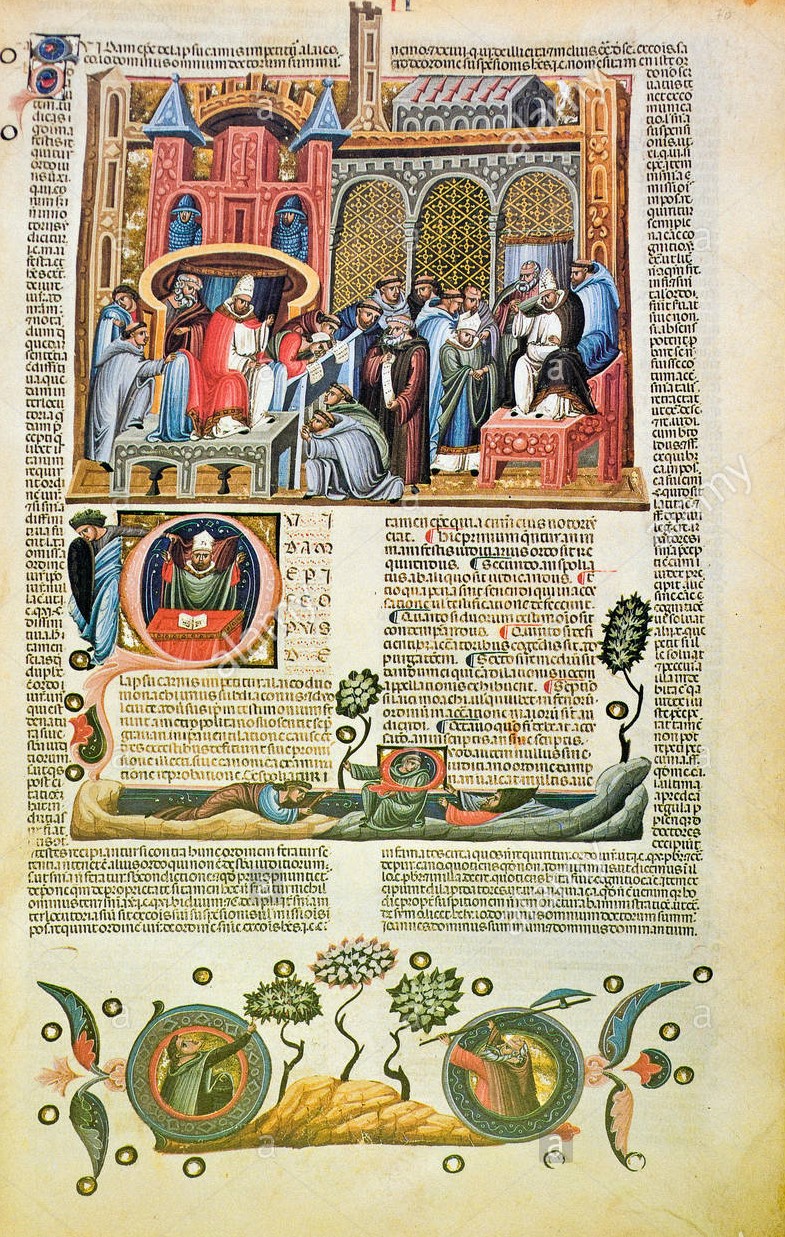

Can it change or be blotted out? Articles 5 and 6
Article 5 asks whether the natural law can be changed. Aquinas distinguishes change "by way of addition," which is no problem at all, since "many things for the benefit of human life have been added over and above the natural law, both by the Divine law and by human laws," from change "by way of subtraction." In the second sense, "the natural law is altogether unchangeable in its first principles: but in its secondary principles, which, as we have said (Article 4), are certain detailed proximate conclusions drawn from the first principles, the natural law is not changed so that what it prescribes be not right in most cases. But it may be changed in some particular cases of rare occurrence, through some special causes hindering the observance of such precepts."8
The objections of article 5 raise the hard cases from the Old Testament: God's command to Abraham to sacrifice Isaac (Genesis 22:2), the Israelites taking the vessels of the Egyptians (Exodus 12:35), and the command to Hosea to take "a wife of fornications" (Hosea 1:2). Aquinas's reply is that God, as the author of life and the owner of all things, does no injustice in these commands: "by the command of God, death can be inflicted on any man, guilty or innocent, without any injustice whatever," and "whatever is taken by the command of God, to Whom all things belong, is not taken against the will of its owner, whereas it is in this that theft consists."8 The precept is not suspended; the act, so commanded, is not the kind of act the precept forbids. Readers have argued over this reply for centuries, and it is one place where Aquinas's natural law depends openly on his account of God.
The reply to the third objection deals with private property and slavery. Isidore had said that "the possession of all things in common, and universal freedom" belong to natural law. Aquinas answers that they belong to it only in the sense that "nature did not bring in the contrary," as nakedness belongs to it because nature gave no clothes: "the distinction of possessions and slavery were not brought in by nature, but devised by human reason for the benefit of human life."8 The sentence is quoted here exactly. It treats slavery, as the society of his day knew it, as a human arrangement and not as a precept of nature. It does not condemn it.
Article 6 asks whether the law of nature can be abolished from the human heart. The "On the contrary" is Augustine's Confessions, book 2: "Thy law is written in the hearts of men, which iniquity itself effaces not." The answer:
"As to those general principles, the natural law, in the abstract, can nowise be blotted out from men's hearts. But it is blotted out in the case of a particular action, in so far as reason is hindered from applying the general principle to a particular point of practice, on account of concupiscence or some other passion, as stated above (I-II:77:2). But as to the other, i.e. the secondary precepts, the natural law can be blotted out from the human heart, either by evil persuasions, just as in speculative matters errors occur in respect of necessary conclusions; or by vicious customs and corrupt habits, as among some men, theft, and even unnatural vices, as the Apostle states (Romans 1), were not esteemed sinful."8
The reply to the third objection adds that some legislators "have framed certain enactments which are unjust" against the secondary precepts.8 Put together, articles 4 to 6 describe a natural law that everyone knows at the level of first principles, that most people know at the level of near conclusions, and that whole societies can lose at the level of detail through passion, bad teaching and bad custom. That is why, in question 91, article 4, Aquinas said a divine law was needed "on account of the uncertainty of human judgment."5 Natural law and revelation, on his account, are not rivals: revelation restates and secures what reason can know but often fails to see.
Human law: questions 95 to 97
Three questions (fourteen articles) treat the laws that people make: why they are needed (question 95), what they can and cannot do (question 96) and when they should change (question 97).
Why human laws are needed: question 95
Article 1 asks whether it was useful for laws to be framed by men at all. The objections say that persuasion is better than force and that a wise judge is better than a written rule. Aquinas answers from human nature. A person "has a natural aptitude for virtue; but the perfection of virtue must be acquired by man by means of some kind of training." For young people of good disposition, "paternal training suffices, which is by admonitions." But "since some are found to be depraved, and prone to vice, and not easily amenable to words, it was necessary for such to be restrained from evil by force and fear, in order that, at least, they might desist from evil-doing, and leave others in peace, and that they themselves, by being habituated in this way, might be brought to do willingly what hitherto they did from fear, and thus become virtuous. Now this kind of training, which compels through fear of punishment, is the discipline of laws."10 Law, on this account, is a teacher as well as a guard. It keeps the peace now and, over time, forms habits.
Article 2 asks whether every human law is derived from the natural law, and this is where the Augustine line enters the treatise for the first time:
"As Augustine says (De Lib. Arb. i, 5) 'that which is not just seems to be no law at all': wherefore the force of a law depends on the extent of its justice. Now in human affairs a thing is said to be just, from being right, according to the rule of reason. But the first rule of reason is the law of nature, as is clear from what has been stated above (I-II:91:2 ad 2). Consequently every human law has just so much of the nature of law, as it is derived from the law of nature. But if in any point it deflects from the law of nature, it is no longer a law but a perversion of law."10
He then names the two ways a human law can be derived from the natural law, the distinction that makes his theory usable by actual lawmakers:
"But it must be noted that something may be derived from the natural law in two ways: first, as a conclusion from premises, secondly, by way of determination of certain generalities. The first way is like to that by which, in sciences, demonstrated conclusions are drawn from the principles: while the second mode is likened to that whereby, in the arts, general forms are particularized as to details: thus the craftsman needs to determine the general form of a house to some particular shape. Some things are therefore derived from the general principles of the natural law, by way of conclusions; e.g. that 'one must not kill' may be derived as a conclusion from the principle that 'one should do harm to no man': while some are derived therefrom by way of determination; e.g. the law of nature has it that the evil-doer should be punished; but that he be punished in this or that way, is a determination of the law of nature."10
Laws of the first kind "have some force from the natural law also"; laws of the second kind "have no other force than that of human law."10 A law against murder repeats what nature already commands. A law that sets the speed limit, the age of majority or the penalty for theft settles something nature leaves open, and it binds because a lawful authority has settled it. This is why, in the reply to the third objection, the same natural law can stand behind "the diversity of positive laws among various people."10 Natural law, read this way, does not hand lawmakers a ready-made code. It sets limits and goals and leaves a great deal to prudence.
Should the law forbid every vice? Question 96, article 2
Question 96 has six articles on the power of human law. Article 2 asks "Whether it belongs to the human law to repress all vices?" The objections argue that law aims at virtue and that all vices are against nature, so law should forbid all of them. The "On the contrary" is again Augustine's On Free Choice of the Will: "It seems to me that the law which is written for the governing of the people rightly permits these things, and that Divine providence punishes them." Aquinas answers:
"Now human law is framed for a number of human beings, the majority of whom are not perfect in virtue. Wherefore human laws do not forbid all vices, from which the virtuous abstain, but only the more grievous vices, from which it is possible for the majority to abstain; and chiefly those that are to the hurt of others, without the prohibition of which human society could not be maintained: thus human law prohibits murder, theft and such like."11
The reply to the second objection gives the reason in a homely image: "The purpose of human law is to lead men to virtue, not suddenly, but gradually. Wherefore it does not lay upon the multitude of imperfect men the burdens of those who are already virtuous, viz. that they should abstain from all evil. Otherwise these imperfect ones, being unable to bear such precepts, would break out into yet greater evils: thus it is written (Proverbs 30:33): 'He that violently bloweth his nose, bringeth out blood.'"11 The reply to the third objection draws the line between the two laws: "The natural law is a participation in us of the eternal law: while human law falls short of the eternal law... Wherefore, too, human law does not prohibit everything that is forbidden by the natural law."11 Aquinas, in short, did not think the civil law should try to make people saints. He did think it should restrain the grave harms without which a common life is impossible. The same article does not settle which vices are grave enough; that is left to the prudence of lawmakers, and later readers have drawn the line in very different places.
Do unjust laws bind? Question 96, article 4
Article 4 asks "Whether human law binds a man in conscience?" The "On the contrary" is 1 Peter 2:19: "This is thankworthy, if for conscience . . . a man endure sorrows, suffering wrongfully." Aquinas begins with just laws: "If they be just, they have the power of binding in conscience, from the eternal law whence they are derived." A law is just from its end (ordered to the common good), from its author (within the lawgiver's power) and from its form (burdens laid "according to an equality of proportion"). Then he turns to unjust laws, of which there are two kinds. The first kind is contrary to the human good, by failing in end, author or form. The translation sets the three cases off with long dashes, which are left out here and marked by ellipses:
"On the other hand laws may be unjust in two ways: first, by being contrary to human good, through being opposed to the things mentioned above... either in respect of the end, as when an authority imposes on his subjects burdensome laws, conducive, not to the common good, but rather to his own cupidity or vainglory... or in respect of the author, as when a man makes a law that goes beyond the power committed to him... or in respect of the form, as when burdens are imposed unequally on the community, although with a view to the common good. The like are acts of violence rather than laws; because, as Augustine says (De Lib. Arb. i, 5), 'a law that is not just, seems to be no law at all.' Wherefore such laws do not bind in conscience, except perhaps in order to avoid scandal or disturbance, for which cause a man should even yield his right, according to Matthew 5:40-41: 'If a man . . . take away thy coat, let go thy cloak also unto him; and whosoever will force thee one mile, go with him other two.'
"Secondly, laws may be unjust through being opposed to the Divine good: such are the laws of tyrants inducing to idolatry, or to anything else contrary to the Divine law: and laws of this kind must nowise be observed, because, as stated in Acts 5:29, 'we ought to obey God rather than man.'"11
The two kinds are treated differently, and the difference is often lost. A law that is unjust because it burdens people unfairly or serves the ruler's greed does not bind in conscience, but a person may still obey it, and sometimes should, "in order to avoid scandal or disturbance." A law that commands something against God, such as idolatry, "must nowise be observed." The reply to the first objection keeps Paul's teaching in Romans 13 in force for laws "within its scope": "he that resisteth the power... resisteth the ordinance of God."11 Aquinas is no friend of casual disobedience. His article frees the conscience from unjust laws without telling anyone to break them, except where obedience would itself be a sin.
Change in law: question 97
Question 97 has four articles on whether human law should be changed, whether it should always be changed when something better turns up, whether custom can have the force of law, and whether rulers can dispense from law. Article 1 quotes Augustine once more: "A temporal law, however just, may be justly changed in course of time."12 Article 2 warns against changing laws lightly:
"human law is rightly changed, in so far as such change is conducive to the common weal. But, to a certain extent, the mere change of law is of itself prejudicial to the common good: because custom avails much for the observance of laws, seeing that what is done contrary to general custom, even in slight matters, is looked upon as grave. Consequently, when a law is changed, the binding power of the law is diminished, in so far as custom is abolished. Wherefore human law should never be changed, unless, in some way or other, the common weal be compensated according to the extent of the harm done in this respect."12
Such compensation can come, he says, from "some very great and every evident benefit conferred by the new enactment" (the translation's wording) or from urgency, when "the existing law is clearly unjust, or its observance extremely harmful." The reply to the first objection quotes Aristotle's Politics: "laws derive very great force from custom."12 Article 3 then allows that custom itself can obtain the force of law, since a people's repeated actions express its reason and will as a written decree does. Taken together, questions 95 to 97 describe human law as a work of practical wisdom: rooted in the natural law, limited in what it can demand, binding only when just, and slow to change because people learn to obey by habit.
"An unjust law is no law at all": whose words, and what they mean
The Latin tag lex iniusta non est lex, "an unjust law is not a law," is often credited to Aquinas. The Summa itself shows where it comes from. In both places where the line appears in the Treatise on Law (q. 95, a. 2 and q. 96, a. 4), Aquinas introduces it with "as Augustine says (De Lib. Arb. i, 5)," and in both places the English Dominican translation renders it with the word "seems": "that which is not just seems to be no law at all"; "a law that is not just, seems to be no law at all."1011 The source is Augustine's dialogue On Free Choice of the Will, book 1, chapter 5, written in the late 380s and 390s, in which Augustine and his friend Evodius discuss whether a law that permits killing in self-defense is just. The short Latin tag, in that exact form, is not in the Summa.
What does Aquinas mean by it? Three things are clear from the articles already quoted. First, an unjust law fails as law: it "has the nature, not of law but of violence" (q. 93, a. 3) and is "a perversion of law" (q. 95, a. 2).710 Second, it still keeps "some appearance of law" because it is issued by someone who holds power, and power is from God (q. 93, a. 3, ad 2).7 Third, the practical consequence is graded: a merely unfair law may be obeyed to avoid scandal or disturbance, while a law commanding sin must not be obeyed (q. 96, a. 4).11 The tag is a claim about what makes a command a law in the full sense. It is not, in the Summa, a general license to disregard any law a person dislikes.
The Old Law: questions 98 to 105
The longest part of the treatise, eight questions and forty-six articles, is about the law of Moses. Modern readers who come to the Treatise on Law for natural law often skip it. Aquinas did not regard it as a digression. For him the Old Law was the divine law in its first stage, and how it relates to natural law and to the Gospel is the test of his whole scheme.
Good, but imperfect: question 98
Question 98, article 1, asks whether the Old Law was good. The answer begins: "Without any doubt, the Old Law was good. For just as a doctrine is shown to be good by the fact that it accords with right reason, so is a law proved to be good if it accords with reason. Now the Old Law was in accordance with reason. Because it repressed concupiscence which is in conflict with reason, as evidenced by the commandment, 'Thou shalt not covet thy neighbor's goods' (Exodus 20:17)." Then comes the qualification. Human law aims at "the temporal tranquillity of the state"; divine law aims at "everlasting happiness," which needs more than the prohibition of sin. It needs grace, "whereby 'charity' which fulfilleth the law... 'is spread abroad in our hearts' (Romans 5:5)," and "the Old Law could not confer this grace, for this was reserved to Christ."13 His verdict, with Hebrews 7:19: "the Old Law was good indeed, but imperfect."13
Moral, ceremonial and judicial precepts: questions 99 to 105
Question 99 sorts the precepts of the Old Law into three kinds, and questions 100 to 105 take each in turn: the moral precepts (question 100, twelve articles, mostly on the Ten Commandments), the ceremonial precepts of worship, sacrifice and purity (questions 101 to 103) and the judicial precepts that governed Israel as a people (questions 104 and 105).3 The threefold division was not new with Aquinas, but his use of it shaped Christian teaching for centuries, Protestant as well as Catholic.
On the moral precepts, question 100, article 1, ties the Old Law directly back to natural law: "it follows, of necessity, that all the moral precepts belong to the law of nature; but not all in the same way." Some things "the natural reason of every man, of its own accord and at once, judges to be done or not to be done: e.g. 'Honor thy father and thy mother,' and 'Thou shalt not kill, Thou shalt not steal': and these belong to the law of nature absolutely." Others, such as "Rise up before the hoary head, and honor the person of the aged man," are seen by the wise after careful thought and must be taught to others. Still others need "Divine instruction, whereby we are taught about the things of God."14 The Ten Commandments, on this reading, are mostly the natural law written down.
The ceremonial precepts are another matter. They were figures, instituted "chiefly for the purpose of foreshadowing the mysteries of Christ to come," and with Christ's coming they ceased. Question 104, article 3, states the contrast between ceremonial and judicial precepts in words that need to be quoted exactly, because they concern the Jewish people and Aquinas's view of Jewish practice after Christ:
"The judicial precepts did not bind for ever, but were annulled by the coming of Christ: yet not in the same way as the ceremonial precepts. For the ceremonial precepts were annulled so far as to be not only 'dead,' but also deadly to those who observe them since the coming of Christ, especially since the promulgation of the Gospel. On the other hand, the judicial precepts are dead indeed, because they have no binding force: but they are not deadly. For if a sovereign were to order these judicial precepts to be observed in his kingdom, he would not sin: unless perchance they were observed, or ordered to be observed, as though they derived their binding force through being institutions of the Old Law: for it would be a deadly sin to intend to observe them thus."15
The words "dead" and "deadly" come from a long patristic argument over Galatians and over whether the apostles kept the ceremonies of the law of Moses; Aquinas treats it at length in question 103, articles 3 and 4, where he argues that "just as it would be a mortal sin now for anyone, in making a profession of faith, to say that Christ is yet to be born... so too it would be a mortal sin now to observe those ceremonies which the fathers of old fulfilled with devotion and fidelity."16 The claim is theological: that to keep the ceremonies after the Gospel, as still binding, is to deny that Christ has come. It is a claim about the meaning of the rites for Christians and for converts; the Treatise on Law does not here discuss how Christian rulers should treat Jews who kept them, which Aquinas takes up elsewhere (for example ST II-II, q. 10, aa. 11 and 12). Lesson 07 and the module's review lesson set his teaching beside later Catholic and Protestant teaching.
The judicial precepts, Aquinas says in the same article, "were not instituted that they might be figures, but that they might shape the state of that people who were directed to Christ. Consequently, when the state of that people changed with the coming of Christ, the judicial precepts lost their binding force." A Christian ruler may copy them freely as good laws, but not as binding because Moses gave them. The reply to the second objection adds a remark of Aristotle's that shows how far Aquinas was from imagining one fixed code for all peoples: "democracy, which is government by the people, demands different laws from those of oligarchy, which is government by the rich."15
The best form of government: question 105, article 1
Question 105, article 1, asks whether the Old Law gave fitting precepts about rulers, and in answering it Aquinas states his judgment of the best constitution:
"Accordingly, the best form of government is in a state or kingdom, where one is given the power to preside over all; while under him are others having governing powers: and yet a government of this kind is shared by all, both because all are eligible to govern, and because the rules are chosen by all. For this is the best form of polity, being partly kingdom, since there is one at the head of all; partly aristocracy, in so far as a number of persons are set in authority; partly democracy, i.e. government by the people, in so far as the rulers can be chosen from the people, and the people have the right to choose their rulers."17
("The rules are chosen by all" is the translation's wording; the sense is "the rulers.") He finds this mixed constitution in Israel under Moses, with Moses at the head, seventy-two elders "chosen" in virtue beneath him, and the elders drawn from the whole people.17 The article is a reminder that the man who wrote about the eternal law also thought hard, with Aristotle's Politics open beside him, about elections and shared rule. It is one reason later writers on constitutional government, Catholic and Protestant, kept reading the Treatise on Law.
The New Law: questions 106 to 108
The treatise ends with three questions on "the law of the Gospel," and here law and grace meet. Question 106, article 1, asks whether the New Law is a written law, and the answer is the sentence most often quoted from this part of the Summa:
"'Each thing appears to be that which preponderates in it,' as the Philosopher states (Ethic. ix, 8). Now that which is preponderant in the law of the New Testament, and whereon all its efficacy is based, is the grace of the Holy Ghost, which is given through faith in Christ. Consequently the New Law is chiefly the grace itself of the Holy Ghost, which is given to those who believe in Christ."18
He supports it from Paul ("the law of faith," Romans 3:27; "The law of the spirit of life, in Christ Jesus, hath delivered me from the law of sin and of death," Romans 8:2) and from Augustine's On the Spirit and the Letter: "What else are the Divine laws written by God Himself on our hearts, but the very presence of His Holy Spirit?" The written Gospel, its teachings and commands, belongs to the New Law only "secondarily": "the New Law is in the first place a law that is inscribed on our hearts, but that secondarily it is a written law."18
Article 2 then asks whether the New Law justifies, and draws the consequence. As to its chief element, the inward grace, "the New Law justifies." As to the secondary element, the written commands, it does not: "the letter denotes any writing external to man, even that of the moral precepts such as are contained in the Gospel. Wherefore the letter, even of the Gospel would kill, unless there were the inward presence of the healing grace of faith."18 Readers who know the Reformation arguments will notice how close this sentence comes to language Luther and Calvin used about the law that kills (2 Corinthians 3:6). Lesson 07 takes up where Aquinas and the Reformers still part company: on what grace does in the soul, on merit and on the place of works.
Question 107 compares the New Law with the Old (four articles). Question 108 asks what the New Law contains; an objection in its first article repeats the saying from Peter Lombard's Sentences, here in the form "the Old Law restrains the hand, whereas the New Law curbs the will."19 The question closes with the evangelical counsels. Article 4 explains the difference between a commandment and a counsel: "a commandment implies obligation, whereas a counsel is left to the option of the one to whom it is given. Consequently in the New Law, which is the law of liberty, counsels are added to the commandments, and not in the Old Law, which is the law of bondage." The three counsels answer the three temptations of 1 John 2:16: "riches are renounced by poverty; carnal pleasures by perpetual chastity; and the pride of life by the bondage of obedience."19 The Treatise on Law thus ends with the vows of the religious life that Aquinas himself had taken as a Dominican friar (see lesson 02) and that Francis of Assisi had made the center of his Rule (see lesson 12).
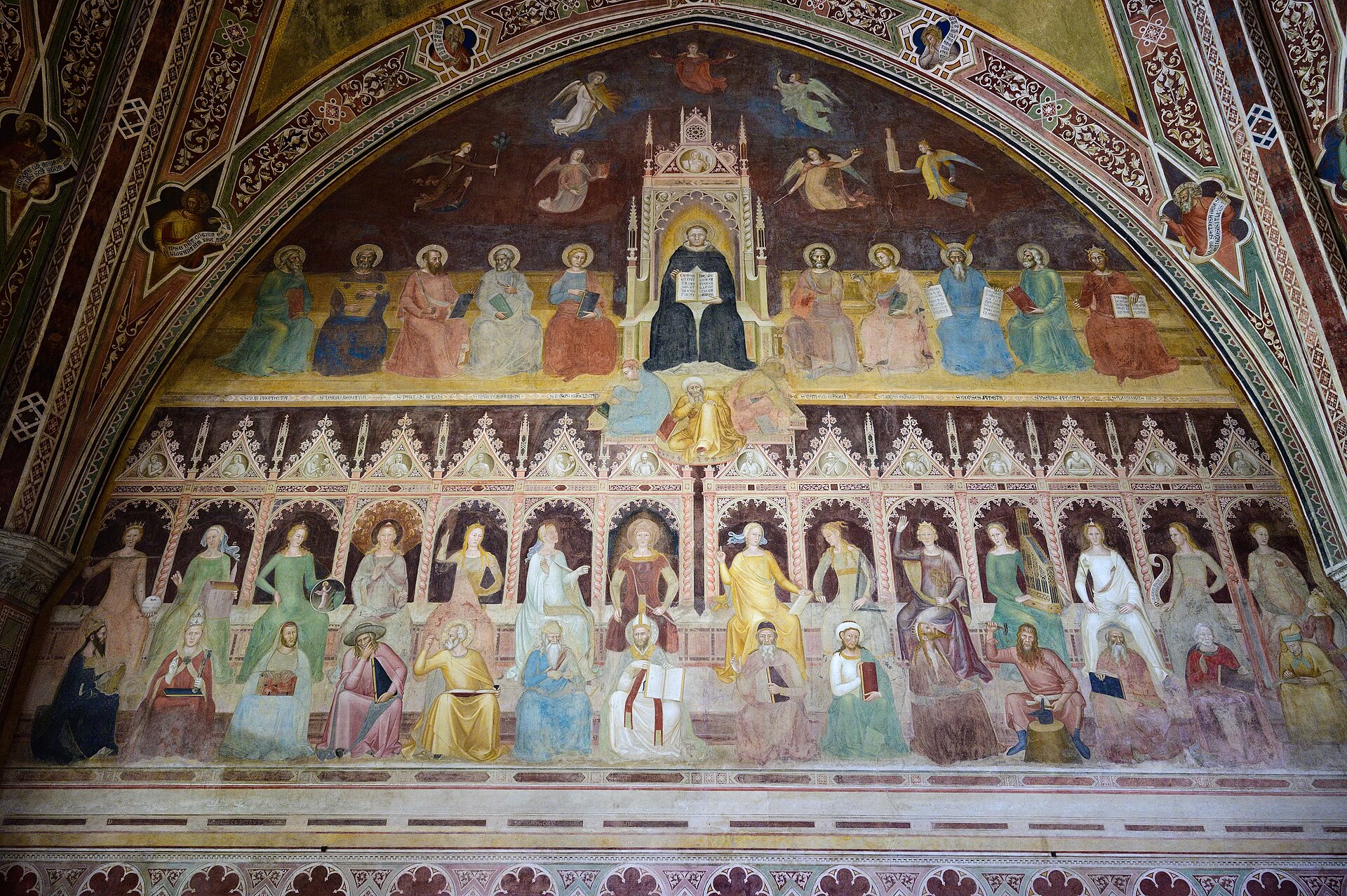

How later writers used the treatise
The Treatise on Law was read far outside Dominican schools. The writers below used or echoed it in different ways, and in most cases the line of influence is a matter of scholarly argument, not of a citation the writer gave. Each is quoted here in his own words, and the claim of influence is stated only as far as the evidence goes.
Richard Hooker (1594)
Richard Hooker (1553 or 1554 to 1600), a priest of the Church of England, published the first books of Of the Laws of Ecclesiastical Polity in 1594 to defend the Elizabethan church against Puritan critics who held that Scripture alone must govern church order. Book I is a full theory of law in the Thomist pattern: a "Law eternal" in God, the law that governs nature, the law of reason that binds human beings, human positive law and the law revealed in Scripture. Hooker's "Law eternal" is "that order which God before all ages hath set down with himself, for himself to do all things by."20 Book I closes with a sentence that has been quoted as often as anything in English prose on the subject:
"Of Law there can be no less acknowledged, than that her seat is the bosom of God, her voice the harmony of the world: all things in heaven and earth do her homage, the very least as feeling her care, and the greatest as not exempted from her power."20
Hooker's debt to Aquinas in the order and many details of Book I is widely recognized by historians of political thought; it shows that a Protestant churchman at the end of the sixteenth century could take over the four-part scheme of the Summa while rejecting the papacy that Aquinas defended. John Locke later quoted Hooker repeatedly in his Second Treatise of Government (1689), which is one road by which this way of thinking reached English and American readers.
Hugo Grotius (1625)
The Dutch jurist Hugo Grotius (1583 to 1645) published On the Law of War and Peace (De Iure Belli ac Pacis) in 1625. He was a Protestant layman, a Remonstrant (Arminian) in the disputes of the Dutch Reformed Church, and he built his law of nations on natural law. In William Whewell's abridged translation (Cambridge, 1853), Grotius writes that "though the power of God be immense, there are some things to which it does not extend," and goes on: "Thus God himself cannot make twice two not be four; and in like manner, he cannot make that which is intrinsically bad, not be bad."21 (The scanned text reads "intrinsically" with damaged type; it is corrected here.) Aquinas had made a related point in his own terms: the natural law flows from the eternal law, which is God's wisdom, not from an arbitrary decree, and so its first principles cannot change (q. 93, a. 1; q. 94, a. 5).78 Grotius is also known for a sentence in his Prolegomena saying that natural law would have some force even if one granted, what cannot be granted without the utmost wickedness, that there is no God. That sentence, often called the etiamsi daremus ("even if we should grant"), is attributed to him here from the standard secondary literature; it did not appear in a readable form in the scan opened for this lesson.
William Blackstone (1765)
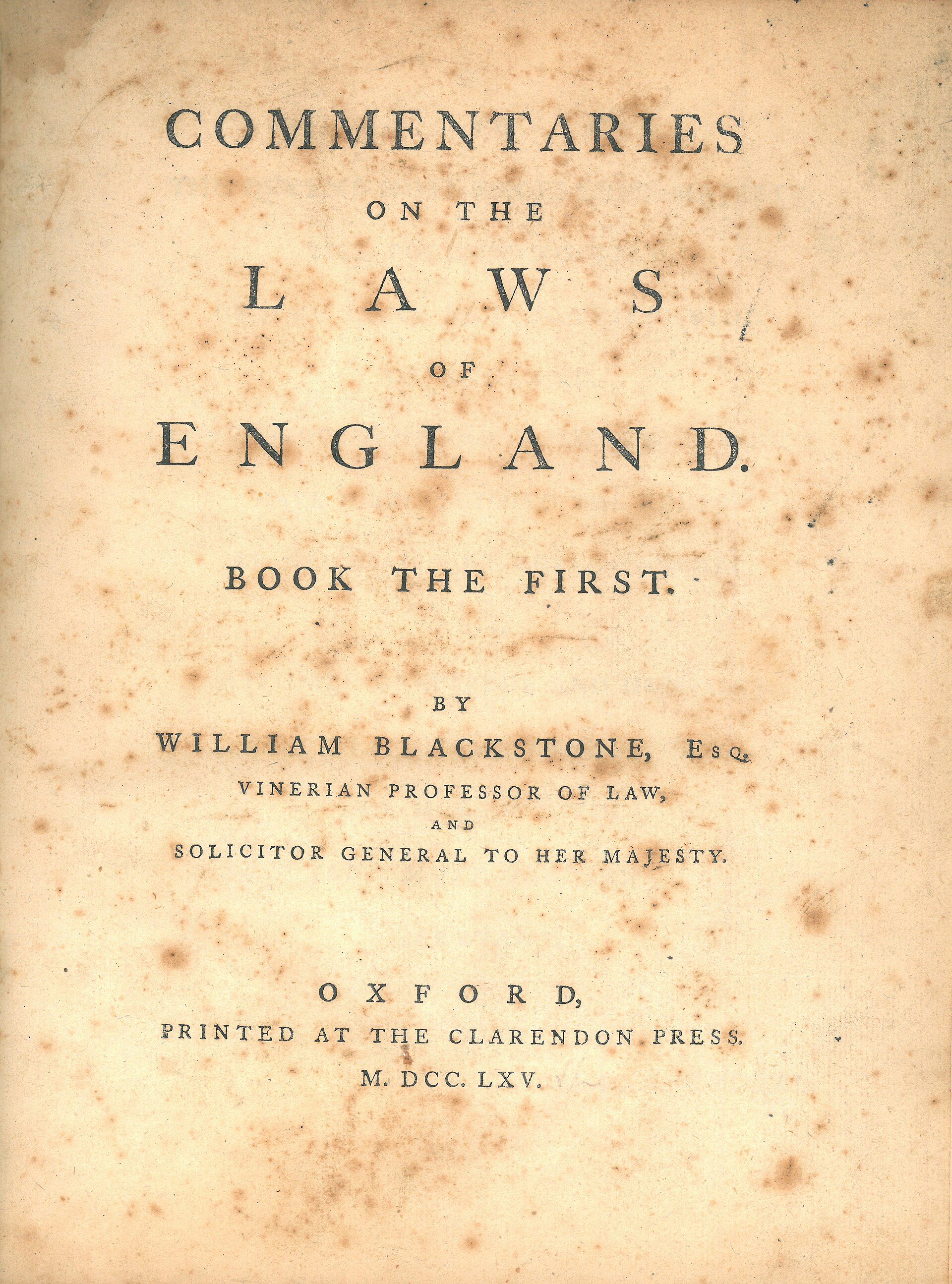
William Blackstone (1723 to 1780), the Oxford lecturer whose Commentaries on the Laws of England (four volumes, 1765 to 1769) became the standard law book in Britain and the American colonies, opened his work with a section "Of the Nature of Laws in General" (Introduction, section 2). The site's Principles of Liberty, lesson 05 treats Blackstone on his own. His account of the law of nature runs in a line familiar from the Treatise on Law. "This will of his maker is called the law of nature," he writes, and God "has laid down only such laws as were founded in those relations of justice, that existed in the nature of things antecedent to any positive precept. These are the eternal, immutable laws of good and evil, to which the creator himself in all his dispensations conforms; and which he has enabled human reason to discover."22 Then the sentence that American lawyers quoted for a century:
"This law of nature, being co-eval with mankind and dictated by God himself, is of course superior in obligation to any other. It is binding over all the globe, in all countries, and at all times: no human laws are of any validity, if contrary to this; and such of them as are valid derive all their force, and all their authority, mediately or immediately, from this original."22
(The 1765 text is printed with the long s, as in "fuperior"; the spelling is modernized here and nothing else is changed.) Blackstone does not cite Aquinas in this passage. The resemblance to q. 95, a. 2 ("every human law has just so much of the nature of law, as it is derived from the law of nature") is plain, but Blackstone wrote within an English tradition that had passed through Hooker, Grotius, Samuel Pufendorf and Locke, and the resemblance is best described as a shared inheritance, not a direct borrowing.

The Declaration of Independence (1776)
The Declaration of Independence speaks in its first sentence of "the separate and equal station to which the Laws of Nature and of Nature's God entitle them," and in its second of truths held "to be self-evident."23 The vocabulary of natural law and self-evident truths is the vocabulary of the Treatise on Law (q. 94, a. 2 calls the first precepts "self-evident principles"). That does not show that Thomas Jefferson drew on Aquinas, and no document shows that he did. In a letter to Henry Lee of May 8, 1825, Jefferson said the Declaration's authority rested on "the harmonizing sentiments of the day, whether expressed in conversation, in letters, printed essays, or in the elementary books of public right, as Aristotle, Cicero, Locke, Sidney, &c."24 Aquinas is not on his list. Some Catholic and some Protestant writers argue that the medieval idea reached the founders indirectly, through Hooker, Locke, Blackstone and the Protestant natural-law writers; others answer that the founders' natural law was an Enlightenment theory of rights quite different from Aquinas's law of virtue and the common good. Both are interpretations. The documented fact is only the shared language. Principles of Liberty, lesson 08 follows the founders' own sources.
Leo XIII (1879 and 1888)
Pope Leo XIII's encyclical Aeterni Patris (1879) urged Catholic schools to restore the study of Aquinas (see lesson 02). Nine years later, in Libertas (June 20, 1888), on the nature of human liberty, he restated the Treatise on Law almost word for word. Natural law, he wrote, "is written and engraved in the mind of every man; and this is nothing but our reason, commanding us to do right and forbidding sin," and "the law of nature is the same thing as the eternal law, implanted in rational creatures, and inclining them to their right action and end; and can be nothing else but the eternal reason of God, the Creator and Ruler of all the world" (section 8).25 Libertas also quotes Aquinas by name on God's permission of evil, as the model for a human law that tolerates evils it does not approve, which is the teaching of q. 96, a. 2.25 Modern Catholic teaching on natural law, through the Catechism of the Catholic Church, stands in this line.
Martin Luther King Jr. (1963)
The most famous modern use of the Treatise on Law came from a Baptist minister in an Alabama jail. Martin Luther King Jr.'s "Letter from Birmingham Jail," dated April 16, 1963, answered a public statement by eight Alabama clergymen, printed in the Birmingham News, that criticized the civil rights demonstrations in the city. King wrote it in the city jail after his arrest on Good Friday of that year.26 The letter is under copyright, and its argument is summarized here, not quoted at length. King explained why he urged people to obey some laws and to break others. He said he agreed with Augustine that an unjust law is no law at all, and, putting the point in what he called the terms of St. Thomas Aquinas, he described an unjust law as a human law not rooted in eternal law and natural law. He went on to state a test of his own: any law that degrades human personality is unjust.26
King's use matches the Summa in two ways: the definition of an unjust law by its departure from the eternal and natural law (q. 93, a. 3; q. 95, a. 2), and the refusal to treat that judgment as a license for lawlessness (q. 96, a. 4).71011 His test of degrading human personality is his own wording, not a phrase from Aquinas.
Protestant views of natural law
It is sometimes said that the Reformation threw out natural law along with scholastic theology. The Reformers' own words do not bear that out. What they disputed was how much fallen reason can know and do, and what natural law can achieve before God. Lesson 07 sets out Luther's attack on Aristotle and scholastic theology in 1517; the texts below concern natural law itself.
Martin Luther
In a sermon of 1525 published as "How Christians Should Regard Moses," Luther argued against preachers who wanted to impose the law of Moses on Christian society. In the English translation by Martin H. Bertram in Luther's Works, volume 35, edited by E. Theodore Bachmann (1960), he says bluntly that "Moses is dead. His rule ended when Christ came." Yet the commandments that Moses shares with all peoples still bind, he says, because "they have been implanted in me by nature, and Moses agrees exactly with nature."27 (The translation is under copyright; only short phrases are quoted.) The argument is close to Aquinas's in q. 100, a. 1 and q. 104, a. 3: the moral precepts of the Old Law are natural law written down, the ceremonial and judicial precepts no longer bind as the law of Moses. The difference lies elsewhere. For Luther the law, natural or written, can command and accuse but cannot make a sinner righteous before God; righteousness comes by faith alone. Aquinas also says that the law cannot justify and that only the grace of the Holy Ghost does (q. 98, a. 1; q. 106, a. 2), but he describes that grace as working an inward change by which a person fulfills the law out of love.1318 Where the two finally part is the subject of lesson 07. For Luther's life, see Church History, Part A, lesson 11.
John Calvin
John Calvin's Institutes of the Christian Religion (final Latin edition 1559), in Henry Beveridge's translation (1845), discusses natural law in Book II, chapter 2, on the powers left to fallen human beings. He grants a great deal: "Nothing, indeed is more common, than for man to be sufficiently instructed in a right course of conduct by natural law, of which the Apostle here speaks." Then he states its purpose in a sentence that marks his difference from Aquinas:
"The end of the natural law, therefore, is to render man inexcusable, and may be not improperly defined... the judgment of conscience distinguishing sufficiently between just and unjust, and by convicting men on their own testimony depriving them of all pretext for ignorance."28
(The ellipsis marks a long dash in the translation, II.2.22.) For Calvin, as for Aquinas, the text is Romans 2:14 and 15. Aquinas reads it chiefly as a sign of the human share in God's wisdom; Calvin reads it chiefly as the ground of human guilt. In Book IV, chapter 20, on civil government, Calvin's teaching on human law comes close to the Treatise on Law. Every law has an "enactment" and an "equity on which the enactment is founded," and "as it is evident that the law of God which we call moral, is nothing else than the testimony of natural law, and of that conscience which God has engraven on the minds of men, the whole of this equity of which we now speak is prescribed in it. Hence it alone ought to be the aim, the rule, and the end of all laws" (IV.20.16).29 Nations may therefore make laws that "differ from the Jewish law," provided they aim at this equity, which is Aquinas's argument about the judicial precepts in different words.
The Westminster Confession (1646)
The Westminster Confession of Faith, written by the Westminster Assembly in the 1640s and still the doctrinal standard of many Presbyterian churches, keeps the threefold division of the Old Law in chapter 19, "Of the Law of God." The moral law "was delivered by God upon Mount Sinai, in ten commandments"; the ceremonial laws, given to Israel "as a church under age," "are now abrogated, under the New Testament"; and the judicial laws "expired together with the state of that people, not obliging any other now, further than the general equity thereof may require."30 Set beside q. 104, a. 3 ("the judicial precepts are dead indeed, because they have no binding force"), the agreement is striking. The Confession does not cite Aquinas, and the division had been common property of Christian teachers for centuries; the comparison shows a shared framework, not a borrowing.15
Karl Barth (1934)
The sharpest Protestant rejection came in the twentieth century. In 1934 the Swiss Reformed theologian Emil Brunner published "Nature and Grace," arguing that the image of God in fallen humans leaves a "point of contact" (Anknüpfungspunkt) for the Gospel and appealing to the "ordinances" of creation. Karl Barth answered the same year with a pamphlet titled simply "Nein!" ("No!"). As Trevor Hart summarizes the exchange in the Tyndale Bulletin (1993), Barth rejected any natural theology, any capacity in fallen humans to receive revelation, and any point of contact beyond the bare fact that a human being is a human being; he feared that Brunner's position led toward "a natural religion, a natural law." Hart and others place the debate in the year of the Barmen Declaration, when the Confessing Church was resisting the "German Christians," who joined the church to National Socialist ideology.31 Barth's "No" shaped much Protestant theology for a generation. Later Reformed writers, for example Stephen Grabill in Rediscovering the Natural Law in Reformed Theological Ethics (2006), have argued that Calvin, Luther, Hooker, the Westminster divines and the Protestant scholastics held to natural law, and that the modern Protestant suspicion of it owes more to Barth than to the Reformers. The Schaeffer critique of Aquinas on nature and grace (1968) is another strand of evangelical criticism; it is set out in Ideas and Values since the Enlightenment, lesson 01 and in lesson 07 here.
What the record shows and what it does not
- Documented fact: the Treatise on Law is ST I-II, qq. 90 to 108, nineteen questions and ninety-six articles, fifty-eight of them on the Old Law and the New (counted from the question pages of the English Dominican translation). It was written in the Second Part of the Summa, which Torrell and Weisheipl date to Aquinas's second Paris regency (1268 to 1272).
- Aquinas's own words: the definition of law (q. 90, a. 4); natural law as "the rational creature's participation of the eternal law" (q. 91, a. 2); the first precept, "good is to be done and pursued, and evil is to be avoided" (q. 94, a. 2); human law forbids "only the more grievous vices" (q. 96, a. 2); unjust laws "do not bind in conscience, except perhaps in order to avoid scandal or disturbance," while laws against the divine good "must nowise be observed" (q. 96, a. 4); the New Law is "chiefly the grace itself of the Holy Ghost" (q. 106, a. 1).
- Borrowed words: "a law that is not just, seems to be no law at all" is Augustine's, cited by Aquinas from On Free Choice of the Will I.5; the eternal law comes from the same book; the first-precept analogy comes from Aristotle; the definition "which nature has taught to all animals" is the Roman jurist Ulpian's in Justinian's Digest.
- Later use, documented: Hooker (1594), Grotius (1625), Blackstone (1765), Leo XIII (1888) and King (1963) wrote in this tradition; Leo XIII and King name Aquinas.
- Scholarly reading, not documented fact: how much Hooker, Grotius, Blackstone and the American founders took from Aquinas directly, as distinct from a shared tradition. Jefferson's own list of sources (1825) does not include him.
- Open questions: the exact year these questions were written; whether Aquinas's reply on Abraham and Hosea (q. 94, a. 5, ad 2) makes the natural law depend on God's will after all; whether his natural law can be stated without his theology.
Claims checked
"Aquinas coined the saying 'an unjust law is no law at all.'"
Refuted. Both times the line appears in the Treatise on Law, Aquinas attributes it to Augustine, On Free Choice of the Will, book 1, chapter 5 (q. 95, a. 2; q. 96, a. 4), and the English Dominican translation renders it with "seems": "a law that is not just, seems to be no law at all."1011 Aquinas made the idea part of a system and drew out its consequences. King's letter, correctly, credits the saying to Augustine and the definition of an unjust law to Aquinas.26
"Aquinas taught that any unjust law may be disobeyed."
Partly supported. He taught that unjust laws "do not bind in conscience." But for laws unjust by unfair burdens or excess of power he added "except perhaps in order to avoid scandal or disturbance, for which cause a man should even yield his right." Only laws against the divine good, such as a command to idolatry, "must nowise be observed."11
"Aquinas invented natural law."
Refuted. The treatise itself cites the sources he worked from: Paul (Romans 2:14), Augustine, Cicero ("Tully"), Isidore of Seville, Gratian's Decretum, the Roman jurists in Justinian's Digest and Aristotle.58 His contribution was the ordered account of eternal, natural, human and divine law and their relations. The long history is in Principles of Liberty, lesson 02.
"Aquinas wanted the state to outlaw every sin."
Refuted as a reading of the Treatise on Law. Question 96, article 2, says human law forbids "only the more grievous vices, from which it is possible for the majority to abstain; and chiefly those that are to the hurt of others."11 A fair account must add that Aquinas counted heresy among the gravest crimes and, in ST II-II, q. 11, a. 3, held that convicted and obstinate heretics could be handed to the secular power for death (quoted in the hard questions below).32 His restraint about vice and his severity about heresy stand side by side in the Summa.
"For Aquinas, everyone knows the natural law equally well."
Refuted. First principles are "the same for all, both as to rectitude and as to knowledge," but the secondary precepts can be unknown through passion, "evil persuasions" or "vicious customs," and whole peoples have approved what the natural law forbids, as he says of theft among the ancient Germans (q. 94, aa. 4 and 6).8
"Aquinas taught that Christian nations must govern by the law of Moses."
Refuted. He wrote that the judicial precepts "are dead indeed, because they have no binding force," though a ruler may copy them as good laws, not as binding because Moses gave them (q. 104, a. 3).15 The Westminster Confession says much the same of the "judicial laws."30
"Jefferson drew 'the Laws of Nature and of Nature's God' from Aquinas."
Unsupported. The phrase is in the Declaration, and the idea of a law of nature from God is in the Summa, but no document shows Jefferson reading Aquinas for it. His 1825 list of sources names "Aristotle, Cicero, Locke, Sidney, &c."2324 An indirect line through Hooker, Locke and Blackstone is argued by some historians and doubted by others: Unresolved as a question of influence.
"Martin Luther King Jr. cited Aquinas in the Letter from Birmingham Jail."
Supported. The letter, dated April 16, 1963, defines an unjust law in what it calls the terms of St. Thomas Aquinas, as a human law not rooted in eternal law and natural law, and credits the saying about an unjust law to Augustine (paraphrased here; the text is under copyright).26
"The Reformers rejected natural law."
Refuted for Luther and Calvin; supported for Barth. Luther held that the moral commandments bind because "they have been implanted in me by nature"; Calvin called the moral law "the testimony of natural law" and made its equity "the aim, the rule, and the end of all laws."2729 They differed from Aquinas on what fallen reason can achieve before God. Karl Barth's "Nein!" of 1934 did reject natural theology and, by extension, natural law as a basis for Christian ethics.31
"Aquinas's natural law works without God."
Refuted as a reading of Aquinas. His definition makes natural law a "participation of the eternal law," which is "the type of Divine Wisdom" (q. 91, a. 2; q. 93, a. 1).57 Reason knows its first precepts without first proving God, which is why people of every faith and none can know them, but for Aquinas their binding force comes from the eternal law. The view that natural law would hold even if there were no God is associated with Grotius, who himself called that supposition wicked.
Hard questions and answers
If an unjust law is "no law," who decides which laws are unjust?
Aquinas gives tests, not a tribunal. A law is unjust if it fails in end (serving the ruler's "cupidity or vainglory" instead of the common good), in author (beyond the power committed to the lawgiver), in form (burdens laid unequally), or if it commands what the divine law forbids (q. 96, a. 4).11 Each person must judge in conscience, but the article puts heavy weights on the side of obedience: Romans 13 binds for laws within their scope, a person "should even yield his right" to avoid scandal or disturbance, and laws should not be changed lightly because custom gives law its force (q. 97, a. 2).12 The clear cases are the ones at the extremes: a command to commit idolatry or murder. Most of political life lies between them, and there Aquinas leaves the work to prudence. Aquinas does not set out a method of civil resistance; King's letter, written in defense of a nonviolent campaign, is one modern attempt to supply one.
How can the same Summa that limits human law approve death for heretics?
The text is plain and should be read as it stands. In ST II-II, q. 11, a. 3, Aquinas writes that heretics deserve "not only to be separated from the Church by excommunication, but also to be severed from the world by death. For it is a much graver matter to corrupt the faith which quickens the soul, than to forge money, which supports temporal life. Wherefore if forgers of money and other evil-doers are forthwith condemned to death by the secular authority, much more reason is there for heretics, as soon as they are convicted of heresy, to be not only excommunicated but even put to death." He adds that the Church, out of mercy, first admonishes twice, and only then "delivers him to the secular tribunal to be exterminated thereby from the world by death."32 Within his own scheme the argument runs: human law must forbid the grave harms "to the hurt of others"; corrupting the faith of others is, for him, the gravest harm. The premise that heresy is a public harm to be punished by the state was shared by most Christian rulers, Catholic and Protestant, into the sixteenth and seventeenth centuries; the Second Vatican Council's declaration Dignitatis Humanae (December 7, 1965) taught that every person "has a right to religious freedom," meaning that "all men are to be immune from coercion on the part of individuals or of social groups and of any human power."33 Readers who accept Aquinas's theory of law have had to argue that this application of it rests on premises about the confessional state that the theory itself does not require.
A Reformed reader asks: if human nature is fallen, how can natural reason know the law at all?
Aquinas and Calvin answer more alike than the question supposes. Aquinas holds that the first principles cannot be blotted out, but that the secondary precepts "can be blotted out from the human heart" by evil persuasions and corrupt customs (q. 94, a. 6), and that divine law is needed "on account of the uncertainty of human judgment" (q. 91, a. 4).58 Calvin grants that "Nothing, indeed is more common, than for man to be sufficiently instructed in a right course of conduct by natural law," but says that its end is "to render man inexcusable."28 Both affirm that reason knows enough to be accountable. They differ on how far that knowledge leads toward God and whether it can be a starting point for theology, which is exactly the point Barth pressed against Brunner in 1934.
A Lutheran asks: is it not a confusion to call the Gospel a "New Law"?
The question goes to the center of the Reformation debate. Aquinas uses "law" for the Gospel because of Paul's own phrases, "the law of faith" (Romans 3:27) and "the law of the spirit of life" (Romans 8:2), and he defines the New Law as "chiefly the grace itself of the Holy Ghost," adding that its written commands, "even of the Gospel," would kill without inward grace (q. 106, aa. 1 and 2).18 Luther's distinction of law and Gospel uses "law" for whatever commands and accuses, and "Gospel" for the promise received by faith. The two vocabularies do not map onto each other one to one. On Aquinas's terms, the New Law's chief element is not a set of commands at all; on Luther's, calling grace a "law" risks turning the promise back into a demand. Lesson 07 sets their teaching on justification side by side, with the 1999 Joint Declaration.
A skeptic asks: is natural law simply Christian morality dressed up as reason?
Aquinas claims the reverse: that the first precepts are known by reason to all people, and that Christian revelation restates them. His evidence is partly scriptural (Romans 2:14, the Gentiles who "do by nature those things that are of the law") and partly argued from the structure of practical reasoning (q. 94, a. 2).58 He freely names pagan sources (Aristotle, Cicero, the Roman jurists) for the same principles. Critics answer that his list of "natural inclinations" already carries his theology, especially the inclination "to know the truth about God," and that his conclusions on marriage, property and religion reflect thirteenth-century Christian society. Modern defenders such as John Finnis (Natural Law and Natural Rights, 1980) have tried to restate the theory from the basic goods of human life without starting from theology. Whether they succeed is an open philosophical question; the Summa itself never claims that natural law can be fully understood apart from the eternal law.
An Orthodox or Catholic reader asks: does the natural law change with history, since Aquinas accepted slavery?
Aquinas's own terms allow an answer. He says that "the distinction of possessions and slavery were not brought in by nature, but devised by human reason for the benefit of human life," and that the natural law changes only "by way of addition" in such matters (q. 94, a. 5, ad 3).8 He also says that secondary precepts can be lost or obscured by "vicious customs" (q. 94, a. 6).8 The Second Vatican Council's Gaudium et Spes (1965), section 27, lists "slavery" among the things that insult human dignity34; on Aquinas's own scheme, that would be a case of reason seeing more clearly a secondary precept that custom had obscured, not a change in the natural law itself. Whether that reading is faithful to him or an improvement on him is a judgment the reader must make from the texts.
Learn more
- Principles of Liberty, lesson 02: Natural Law from Cicero to Aquinas: The long history of natural law before the Summa.
- Principles of Liberty, lesson 05: William Blackstone: Blackstone's Commentaries on their own.
- The Summa's Treatise on Law at New Advent: Read q. 90, q. 91, q. 94 and q. 96 in full, in that order, before the rest.
- Calvin, Institutes IV.20 (Beveridge): The Reformed account of civil government and law to set beside q. 95 to 97.
- Lesson 07: Faith, Grace and Works: The treatise on grace that follows the Treatise on Law directly.
Still being checked (11 items)
These points could not be confirmed against a primary source when this lesson was written and fact checked in October 2026. The text above states each one as uncertain.
- The year the Treatise on Law was written is given only as Torrell's and Weisheipl's dating of the Prima Secundae to 1268 to 1272; their exact pages were not opened.
- The date range for Augustine's On Free Choice of the Will (late 380s to 390s) and its setting (Augustine and Evodius discussing killing in self-defense in book 1, chapter 5) are from standard references; Augustine's Latin was not opened (augustinus.it failed to load).
- Hooker's debt to Aquinas in Book I and Locke's repeated quotation of Hooker in the Second Treatise are stated from the secondary literature; Locke's text was not opened for this lesson.
- Grotius's dates, his Remonstrant affiliation and the etiamsi daremus sentence of the Prolegomena (section 11) are from standard references; the Whewell scan did not give a readable copy of that sentence.
- King's letter was read only in the Online Library of Liberty excerpt (the Augustine, Aquinas and 'degrades human personality' points confirmed there); the April 16, 1963 date, the Good Friday arrest and the clergymen's statement rest on Harper's and standard accounts, not the full text.
- Luther's 1525 sermon was read only in the nlnrac.org excerpt of Luther's Works vol. 35 (pp. 161 to 169 and 171 to 172 there); the quoted phrases were confirmed in that excerpt.
- Stephen Grabill's Rediscovering the Natural Law in Reformed Theological Ethics (2006) is named from general knowledge; the book was not opened.
- John Finnis's Natural Law and Natural Rights (1980) is named from general knowledge; the book was not opened.
- Aquinas's treatment of Jewish rites and children (ST II-II, q. 10, aa. 11 and 12) is cited by question number only; those articles were not opened for this lesson.
- The Torrell link points to the publisher's site, not the book page.
- The nlnrac.org excerpt of Luther's 1525 sermon (Luther's Works vol. 35) used for note 27 returned 404 on the live link check of Nov. 5, 2026; the printed volume was not opened.
Notes
- Thomas Aquinas, Summa Theologiae, First Part of the Second Part (I-II), q. 90, prologue and aa. 1 to 4 (on a. 1, obj. 3, the translation's reference "Lib. i, ff., De Const. Prin. leg. i" is to Justinian's Digest, book 1, the title on the constitutions of the emperors), in The Summa Theologica of St. Thomas Aquinas, literally translated by Fathers of the English Dominican Province, second and revised edition (London: Burns Oates and Washbourne, 1920), online edition at New Advent (retrieved Nov. 5, 2026). The prologue of q. 90 is not printed on the New Advent page; it is quoted from the same 1920 translation as given by the Christian Classics Ethereal Library, https://www.ccel.org/ccel/aquinas/summa.FS_Q90.html, and checked against isidore.co, https://isidore.co/aquinas/summa/FS/FS090.html (retrieved Nov. 5, 2026). Read it online. ↩
- Thomas Aquinas, Summa Theologiae I-II, qq. 90 to 92 (prologue of q. 90; q. 90, a. 4; q. 91, a. 2), Latin, Leonine text (Rome, 1892) as edited by Enrique Alarcon, Corpus Thomisticum, University of Navarra (retrieved Nov. 5, 2026). The English of the q. 90 prologue in the text is a literal rendering made for this lesson. Read it online. ↩
- New Advent, outline of the Summa Theologiae, First Part of the Second Part ("GENERAL: The essence (90)..."), and the question pages for I-II, qq. 90 to 108, where the articles of each question were counted for this lesson (19 questions, 96 articles) (retrieved Nov. 5, 2026). Read it online. ↩
- On the dating of the Prima Secundae to the second Paris regency (1268 to 1272): Jean-Pierre Torrell, Saint Thomas Aquinas, vol. 1, The Person and His Work, trans. Robert Royal (Washington, D.C.: Catholic University of America Press, 1996; French ed. 1993), chapter on the second Paris regency and the catalogue of works; James A. Weisheipl, Friar Thomas d'Aquino: His Life, Thought, and Works (Garden City, N.Y.: Doubleday, 1974), chapter 6 and the catalogue of works. Cited as secondary scholarship; page numbers not checked for this lesson. Read it online. ↩
- Thomas Aquinas, Summa Theologiae, First Part of the Second Part (I-II), q. 91, aa. 1 to 6, in The Summa Theologica of St. Thomas Aquinas, literally translated by Fathers of the English Dominican Province, second and revised edition (London: Burns Oates and Washbourne, 1920), online edition at New Advent (retrieved Nov. 5, 2026). Read it online. ↩
- Thomas Aquinas, Summa Theologiae, First Part of the Second Part (I-II), q. 92, aa. 1 and 2, in The Summa Theologica of St. Thomas Aquinas, literally translated by Fathers of the English Dominican Province, second and revised edition (London: Burns Oates and Washbourne, 1920), online edition at New Advent (retrieved Nov. 5, 2026). Read it online. ↩
- Thomas Aquinas, Summa Theologiae, First Part of the Second Part (I-II), q. 93, aa. 1 to 6, in The Summa Theologica of St. Thomas Aquinas, literally translated by Fathers of the English Dominican Province, second and revised edition (London: Burns Oates and Washbourne, 1920), online edition at New Advent (retrieved Nov. 5, 2026). Read it online. ↩
- Thomas Aquinas, Summa Theologiae, First Part of the Second Part (I-II), q. 94, aa. 1 to 6, in The Summa Theologica of St. Thomas Aquinas, literally translated by Fathers of the English Dominican Province, second and revised edition (London: Burns Oates and Washbourne, 1920), online edition at New Advent (retrieved Nov. 5, 2026). Read it online. ↩
- Thomas Aquinas, Summa Theologiae I-II, q. 94, a. 2, Latin, Leonine text, Corpus Thomisticum (retrieved Nov. 5, 2026). Read it online. ↩
- Thomas Aquinas, Summa Theologiae, First Part of the Second Part (I-II), q. 95, aa. 1 and 2, in The Summa Theologica of St. Thomas Aquinas, literally translated by Fathers of the English Dominican Province, second and revised edition (London: Burns Oates and Washbourne, 1920), online edition at New Advent (retrieved Nov. 5, 2026). Read it online. ↩
- Thomas Aquinas, Summa Theologiae, First Part of the Second Part (I-II), q. 96, aa. 2 and 4 (in a. 4 the translation's long dashes are replaced by ellipses), in The Summa Theologica of St. Thomas Aquinas, literally translated by Fathers of the English Dominican Province, second and revised edition (London: Burns Oates and Washbourne, 1920), online edition at New Advent (retrieved Nov. 5, 2026). Read it online. ↩
- Thomas Aquinas, Summa Theologiae, First Part of the Second Part (I-II), q. 97, aa. 1 to 3, in The Summa Theologica of St. Thomas Aquinas, literally translated by Fathers of the English Dominican Province, second and revised edition (London: Burns Oates and Washbourne, 1920), online edition at New Advent (retrieved Nov. 5, 2026). Read it online. ↩
- Thomas Aquinas, Summa Theologiae, First Part of the Second Part (I-II), q. 98, a. 1 (the passage quoted ends before the sentence beginning with a connective the site does not use), in The Summa Theologica of St. Thomas Aquinas, literally translated by Fathers of the English Dominican Province, second and revised edition (London: Burns Oates and Washbourne, 1920), online edition at New Advent (retrieved Nov. 5, 2026). Read it online. ↩
- Thomas Aquinas, Summa Theologiae, First Part of the Second Part (I-II), q. 100, a. 1, in The Summa Theologica of St. Thomas Aquinas, literally translated by Fathers of the English Dominican Province, second and revised edition (London: Burns Oates and Washbourne, 1920), online edition at New Advent (retrieved Nov. 5, 2026). Read it online. ↩
- Thomas Aquinas, Summa Theologiae, First Part of the Second Part (I-II), q. 104, a. 3, with the replies, in The Summa Theologica of St. Thomas Aquinas, literally translated by Fathers of the English Dominican Province, second and revised edition (London: Burns Oates and Washbourne, 1920), online edition at New Advent (retrieved Nov. 5, 2026). Read it online. ↩
- Thomas Aquinas, Summa Theologiae, First Part of the Second Part (I-II), q. 103, aa. 3 and 4 (quoted from a. 4), in The Summa Theologica of St. Thomas Aquinas, literally translated by Fathers of the English Dominican Province, second and revised edition (London: Burns Oates and Washbourne, 1920), online edition at New Advent (retrieved Nov. 5, 2026). Read it online. ↩
- Thomas Aquinas, Summa Theologiae, First Part of the Second Part (I-II), q. 105, a. 1, in The Summa Theologica of St. Thomas Aquinas, literally translated by Fathers of the English Dominican Province, second and revised edition (London: Burns Oates and Washbourne, 1920), online edition at New Advent (retrieved Nov. 5, 2026). Read it online. ↩
- Thomas Aquinas, Summa Theologiae, First Part of the Second Part (I-II), q. 106, aa. 1 and 2, in The Summa Theologica of St. Thomas Aquinas, literally translated by Fathers of the English Dominican Province, second and revised edition (London: Burns Oates and Washbourne, 1920), online edition at New Advent (retrieved Nov. 5, 2026). Read it online. ↩
- Thomas Aquinas, Summa Theologiae, First Part of the Second Part (I-II), q. 108, a. 1, obj. 3 (citing Peter Lombard, Sentences III, d. 40) and a. 4; compare q. 91, a. 5, in The Summa Theologica of St. Thomas Aquinas, literally translated by Fathers of the English Dominican Province, second and revised edition (London: Burns Oates and Washbourne, 1920), online edition at New Advent (retrieved Nov. 5, 2026). Read it online. ↩
- Richard Hooker, Of the Laws of Ecclesiastical Polity, Book I, chapter 2, section 6 (the definition of "Law eternal," at the end of the chapter; chapter 3 opens with the same term) and chapter 16, section 8 ("Of Law there can be no less acknowledged..."), in The Works of That Learned and Judicious Divine, Mr. Richard Hooker, vol. 1, scanned copy from the University of Toronto, Internet Archive (retrieved Nov. 5, 2026). Full text checked in the Internet Archive OCR of the same scan. Read it online. ↩
- Hugo Grotius, On the Rights of War and Peace: An Abridged Translation, by William Whewell (Cambridge: University Press, 1853), Book I, chapter 1, Internet Archive full text (retrieved Nov. 5, 2026). The scan's OCR is damaged at this passage; the word "intrinsically" is restored. Read it online. ↩
- William Blackstone, Commentaries on the Laws of England, Book 1 (Oxford: Clarendon Press, 1765), Introduction, section 2, "Of the Nature of Laws in General," transcription at the Avalon Project, Yale Law School (retrieved Nov. 5, 2026). Long s modernized. Read it online. ↩
- The Declaration of Independence (July 4, 1776), transcription, U.S. National Archives (retrieved Nov. 5, 2026). Read it online. ↩
- Thomas Jefferson to Henry Lee, May 8, 1825, as given at Teaching American History (from Founders Online, National Archives) (retrieved Nov. 5, 2026). Read it online. ↩
- Leo XIII, Libertas, encyclical on the nature of human liberty (June 20, 1888), sections 8 and 33, vatican.va (retrieved Nov. 5, 2026). Read it online. ↩
- Martin Luther King Jr., "Letter from Birmingham Jail" (April 16, 1963), text as excerpted at the Online Library of Liberty, Liberty Fund, "The Reading Room" (Jan. 16, 2023) (retrieved Nov. 5, 2026); date, place of writing and the clergymen's statement as given by Harper's Magazine, "King: Letter from a Birmingham Jail" (2008), citing The Essential Writings and Speeches of Martin Luther King Jr., p. 289 (retrieved Nov. 5, 2026). The letter is under copyright and is paraphrased. Read it online. ↩
- Martin Luther, "How Christians Should Regard Moses" (1525), trans. Martin H. Bertram, in Luther's Works, vol. 35, Word and Sacrament I, ed. E. Theodore Bachmann (Philadelphia: Fortress Press, 1960), pp. 161 to 174 (the excerpt gives pp. 161 to 169 and 171 to 172), as excerpted at the Natural Law, Natural Rights, and American Constitutionalism site (nlnrac.org) (retrieved Nov. 5, 2026; the page at nlnrac.org/node/253 returned 404 when the live links were rechecked the same day, so no link is given). Copyrighted translation: short phrases only. ↩
- John Calvin, Institutes of the Christian Religion, trans. Henry Beveridge (Edinburgh, 1845), Book II, chapter 2, section 22, Christian Classics Ethereal Library (retrieved Nov. 5, 2026). The ellipsis marks a long dash in the translation. Read it online. ↩
- John Calvin, Institutes of the Christian Religion, trans. Henry Beveridge (1845), Book IV, chapter 20, section 16, Christian Classics Ethereal Library (retrieved Nov. 5, 2026). Read it online. ↩
- Westminster Confession of Faith (1646), chapter 19, "Of the Law of God," sections 2 to 4, text as given by the Bible Presbyterian Church General Synod (retrieved Nov. 5, 2026). Read it online. ↩
- Trevor Hart, "A Capacity for Ambiguity? The Barth-Brunner Debate Revisited," Tyndale Bulletin 44.2 (1993): 289 to 305, on Emil Brunner, "Nature and Grace" (1934), and Karl Barth, "Nein! Answer to Emil Brunner" (1934) (retrieved Nov. 5, 2026). Read it online. ↩
- Thomas Aquinas, Summa Theologiae, Second Part of the Second Part (II-II), q. 11, a. 3, "Whether heretics ought to be tolerated?" English Dominican translation (1920), New Advent (retrieved Nov. 5, 2026). The second passage is quoted from the sentence after a connective the site does not use; the authority Aquinas cites next (a citation of a Church Father omitted) is not quoted. Read it online. ↩
- Second Vatican Council, Dignitatis Humanae, Declaration on Religious Freedom (December 7, 1965), section 2, vatican.va (retrieved Nov. 5, 2026). Read it online. ↩
- Second Vatican Council, Gaudium et Spes, Pastoral Constitution on the Church in the Modern World (December 7, 1965), section 27, vatican.va (retrieved Nov. 5, 2026). Read it online. ↩
Check yourself
1. How does Aquinas define law in ST I-II, q. 90, a. 4?
Article 4 gathers the four preceding articles into this definition: reason, the common good, the one who has care of the community, promulgation.
2. What does Aquinas call "the rational creature's participation of the eternal law"?
ST I-II, q. 91, a. 2: "the natural law is nothing else than the rational creature's participation of the eternal law."
3. What is the first precept of the natural law in q. 94, a. 2?
Aquinas founds the first precept of practical reason on the notion of good, as the principle of non-contradiction is founded on being.
4. Whose words are "a law that is not just, seems to be no law at all," as the Summa cites them?
Both q. 95, a. 2 and q. 96, a. 4 introduce the line with "as Augustine says (De Lib. Arb. i, 5)."
5. According to q. 96, a. 2, which vices should human law forbid?
Human law is framed for people mostly "not perfect in virtue," so it forbids "only the more grievous vices, from which it is possible for the majority to abstain."
6. What does Aquinas say about laws that are unjust because they burden people unequally or serve the ruler's greed?
Q. 96, a. 4. Only laws against the divine good, such as commands to idolatry, "must nowise be observed."
7. What does Aquinas say of the judicial precepts of the Old Law after Christ (q. 104, a. 3)?
He contrasts them with the ceremonial precepts, which are "not only dead, but also deadly" if kept as binding after the Gospel.
8. Which writer listed "Aristotle, Cicero, Locke, Sidney, &c." as the sources of the Declaration's sentiments?
Jefferson to Henry Lee, May 8, 1825. Aquinas is not on the list, so a direct borrowing from him is unsupported.
Terms in this lesson
- Treatise on Law
- The block of questions on law in the Summa Theologiae, I-II, qq. 90 to 108: nineteen questions and ninety-six articles.
- Eternal law
- "The type of Divine Wisdom, as directing all actions and movements" (q. 93, a. 1): God's plan for governing all things, the source of every other law.
- Natural law
- "The rational creature's participation of the eternal law" (q. 91, a. 2): the share in God's wisdom by which human reason knows what is good and is inclined to it.
- First precept
- "Good is to be done and pursued, and evil is to be avoided" (q. 94, a. 2), on which all other precepts of the natural law are based.
- Secondary precepts
- Detailed conclusions drawn closely from the first principles; they hold in most cases and can be blotted out of the heart by bad persuasion and custom (q. 94, aa. 4 to 6).
- Human (positive) law
- Law made by a community or its ruler, derived from natural law either as a conclusion or as a determination of details (q. 95, a. 2).
- Determination (determinatio)
- The settling of a detail the natural law leaves open, such as the particular penalty for a crime; it binds by human authority (q. 95, a. 2).
- Divine law
- Law given by God in revelation, needed for four reasons (q. 91, a. 4); in two stages, the Old Law and the New Law.
- Moral, ceremonial and judicial precepts
- The three kinds of precept in the Old Law: moral precepts belong to natural law; ceremonial precepts of worship ceased with Christ; judicial precepts for Israel's government lost their binding force (qq. 99 to 105).
- New Law
- The law of the Gospel, "chiefly the grace itself of the Holy Ghost, which is given to those who believe in Christ" (q. 106, a. 1), and only secondarily a written law.
- Lex iniusta non est lex
- "An unjust law is not a law": a later Latin tag for Augustine's line, which the Summa cites as "a law that is not just, seems to be no law at all."
- Evangelical counsels
- Poverty, chastity and obedience, advised but not commanded by the New Law, "the law of liberty" (q. 108, a. 4).
- Point of contact (Anknupfungspunkt)
- Emil Brunner's term (1934) for a capacity in fallen humans to which the Gospel can appeal; Karl Barth rejected it in "Nein!"
Sources
- Summa Theologiae, I-II, qq. 90 to 108 (English Dominican translation, 1920) (1268 to 1272 (translation 1920)) checked 2026-10
- Summa Theologiae, Latin Leonine text, I-II qq. 90 to 97 (Corpus Thomisticum) (Leonine edition 1892) checked 2026-10
- Summa Theologiae, II-II, q. 11 (English Dominican translation) (about 1271 to 1272 (translation 1920)) checked 2026-10
- Richard Hooker, Works, vol. 1 (Laws of Ecclesiastical Polity) (1594 (this edition 19th century)) checked 2026-10
- Hugo Grotius, On the Rights of War and Peace, abridged trans. William Whewell (1625 (translation 1853)) checked 2026-10
- William Blackstone, Commentaries, Introduction, section 2 (Avalon Project) (1765) checked 2026-10
- Declaration of Independence, transcription (1776-07-04) checked 2026-10
- Thomas Jefferson to Henry Lee (1825-05-08) checked 2026-10
- Leo XIII, Libertas (1888-06-20) checked 2026-10
- Martin Luther King Jr., Letter from Birmingham Jail (excerpt, Online Library of Liberty) (1963-04-16) checked 2026-10
- Harper's Magazine, King: Letter from a Birmingham Jail (2008) checked 2026-10
- Martin Luther, How Christians Should Regard Moses (excerpt, LW 35) (1525 (translation 1960)) checked 2026-10
- John Calvin, Institutes II.2 (Beveridge) (1559 (translation 1845)) checked 2026-10
- John Calvin, Institutes IV.20 (Beveridge) (1559 (translation 1845)) checked 2026-10
- Westminster Confession of Faith, chapter 19 (1646) checked 2026-10
- Trevor Hart, The Barth-Brunner Debate Revisited, Tyndale Bulletin 44.2 (1993) checked 2026-10
- Second Vatican Council, Dignitatis Humanae (1965-12-07) checked 2026-10
- Second Vatican Council, Gaudium et Spes (1965-12-07) checked 2026-10
- Jean-Pierre Torrell, Saint Thomas Aquinas, vol. 1: The Person and His Work (1996 (French 1993)) checked 2026-10