Lesson 3 of 14 · about 50 minutes · Updated November 5, 2026
How the Summa Theologiae Is Built: Questions, Objections, "On the Contrary" and "I Answer That"
You'll be able to
- Describe the three parts of the Summa, the two halves of the Second Part and the Supplement, with their subjects and question ranges
- Name and recognize the five parts of an article: the question, the objections, the sed contra, the body (respondeo) and the replies
- Read a complete article, such as ST I, q. 1, a. 1 or a. 10, and say which sentences give Aquinas's own position
- Identify the authorities the Summa cites by title (the Philosopher, the Commentator, Rabbi Moses, Damascene, Dionysius) and how Aquinas ranks their weight
- Look up any citation such as ST I-II, q. 94, a. 2, ad 1 in the English and Latin texts online
- Test popular claims about the Summa against the text
Start here: the short version
The Summa Theologiae of Thomas Aquinas is a very large book built out of very small, identical units. Its Prologue says it was written to "tend to the instruction of beginners" in theology. Aquinas planned it in three parts: God and the things that come from God (the First Part), the movement of the rational creature back toward God (the Second Part, divided into two halves called the Prima Secundae and the Secunda Secundae), and Christ, who as man is "our way to God" (the Third Part). He stopped writing in December 1273, partway through question 90 of the Third Part, and a Supplement of 99 questions was later gathered from his earlier commentary on Peter Lombard's Sentences, probably by his companion Reginald of Piperno. A count made for this lesson from the 1920 English Dominican translation finds 512 questions and 2,669 articles in the three parts Aquinas wrote himself, with 8,843 objections. Every article follows the same five steps: a question beginning "Whether...", a set of objections, a short "On the contrary" (sed contra), the body beginning "I answer that" (respondeo), and a reply to each objection. This lesson lays out the plan of the whole work, takes two articles apart line by line (ST I, q. 1, a. 1 and ST I, q. 1, a. 10), names the authorities Aquinas quotes and counts how often he quotes them, and shows how to find any citation in English or Latin. The famous claims about the book (its numbers, the Supplement, the Council of Trent, the angels on a pin) are checked at the end.
Lesson 02 told the story of Aquinas's life, from Roccasecca to Fossanova. This lesson leaves the man and opens the book. Lesson 04 reads the most famous single article in it, the Five Ways of ST I, q. 2, a. 3, and lessons 05, 06 and 07 read the treatises on law, happiness and the virtues, and grace. None of those lessons can be followed well without knowing how an article of the Summa works, where a given question sits in the whole plan, and how to check a citation against the text. That is the work of this lesson. Readers who want the medieval church in outline first can begin with Church History, Part A, lesson 09: The Medieval Church, and lesson 01 of this module sets out the world of the universities and the friars in which the Summa was written.
All English quotations from the Summa in this lesson come from the translation "literally translated by Fathers of the English Dominican Province," second and revised edition, 1920, as given online at New Advent, which prints that edition's title and approval on every page.1 The Latin comes from the Corpus Thomisticum, which reproduces the Leonine text of the Summa (its page for the First Part gives the source as the Leonine text "Romae 1888 editum," published at Rome in 1888).2 Each citation below gives the part, question and article in the standard form (for example ST I, q. 1, a. 10) and links the page for that question.
What kind of book the Summa is
A summa in the medieval schools was a summary, an ordered presentation of a whole field of learning. Teachers of theology in the twelfth and thirteenth centuries had a standard textbook already: the four books of Sentences compiled by Peter Lombard in the middle of the twelfth century, a collection of passages from Scripture and the Church Fathers arranged by topic. Every young theologian at Paris lectured on the Sentences before becoming a master, and Aquinas did the same. In the chronology of his works drawn up by the Dominican historian Jean-Pierre Torrell, Aquinas's commentary on the Sentences belongs to his "first period of teaching in Paris as bachelor of the Sentences," from 1252 to 1256.3 That commentary matters for this lesson in a surprising way: the Supplement that now finishes the Summa was cut out of it after his death, as shown below.
Aquinas had also written one large systematic work before the Summa Theologiae: the Summa contra Gentiles, which Torrell's chronology places at Naples (with a question mark) from 1259 and then at Orvieto, finished between 1261 and 1265.3 That book is written as continuous chapters of argument. The Summa Theologiae is different in form. It takes the shape of a long series of debates, each one set out in miniature with the case against, the case for, the teacher's answer and the replies. To see why he chose that shape, the place to start is his own short preface.
The Prologue: "the instruction of beginners"
The whole Summa opens with a single paragraph of purpose, which the English Dominican translation renders as follows:
"Because the doctor of Catholic truth ought not only to teach the proficient, but also to instruct beginners (according to the Apostle: As unto little ones in Christ, I gave you milk to drink, not meat, 1 Corinthians 3:1-2), we purpose in this book to treat of whatever belongs to the Christian religion, in such a way as may tend to the instruction of beginners. We have considered that students in this doctrine have not seldom been hampered by what they have found written by other authors, partly on account of the multiplication of useless questions, articles, and arguments, partly also because those things that are needful for them to know are not taught according to the order of the subject matter, but according as the plan of the book might require, or the occasion of the argument offer, partly, too, because frequent repetition brought weariness and confusion to the minds of readers.
"Endeavouring to avoid these and other like faults, we shall try, by God's help, to set forth whatever is included in this sacred doctrine as briefly and clearly as the matter itself may allow."1
The Latin opens with the words "Quia Catholicae veritatis doctor non solum provectos debet instruere, sed ad eum pertinet etiam incipientes erudire," and the key phrase about the aim of the book is "secundum quod congruit ad eruditionem incipientium," "as befits the instruction of beginners."2 (The translation prints a dash before the Scripture reference; it is given here as a comma, following this site's style.)
The Prologue names three faults Aquinas wanted to avoid in the books students were using. The first was the "multiplication of useless questions, articles, and arguments." The second was a bad order: things were taught "according as the plan of the book might require, or the occasion of the argument offer," that is, in the order of the text being commented on or of the debates that happened to arise, and not in "the order of the subject matter" (in the Latin, secundum ordinem disciplinae). The third was "frequent repetition." The remedy he promised was brevity, clarity and an order that follows the subject itself. Whether a modern reader faced with 2,669 articles finds the result brief is another matter, and it is taken up in the hard questions at the end of this lesson. What the Prologue does show, in his own words, is that he meant the book as a teaching tool with a deliberate order, and that the order is part of the teaching.
Who were the "beginners"? The Prologue does not say. The 1912 Catholic Encyclopedia article on Aquinas, by the Dominican Daniel Kennedy, wrote that "the author himself modestly considered it simply a manual of Christian doctrine for the use of students."4 Later scholars have tried to be more exact. The Dominican historian Leonard Boyle, in a short lecture published in 1982 as The Setting of the Summa theologiae of Saint Thomas, connected the beginning of the work with Aquinas's assignment to set up a house of studies for Dominican friars at Santa Sabina in Rome in 1265, and argued that the "beginners" were ordinary Dominican students, friars who would spend their lives preaching and hearing confessions, rather than university masters.5 Boyle's reading is widely cited, though it remains a scholarly interpretation of the setting; the text itself only says "beginners." (The summary of Boyle's argument here is drawn from the way later scholarship reports it; see the unverified list for this lesson.)
When and where it was written
The Summa was written over about eight years in three cities, and the dates are still argued over in detail. Torrell's chronology, as summarized in a teaching guide by the Marquette University scholar Richard Taylor, places the First Part at Rome, where Aquinas was "regent-master" from 1265 to 1268; the Second Part during his "second regency in Paris" from 1268 to 1272; and the Third Part, "qq. 1-90," at Naples from 1272 to December 1273.3 The 1912 Catholic Encyclopedia gave a slightly different account: "Eight years were given to the composition of this work, which was begun at Rome, where the First Part and the First of the Second were written (1265-69). The Second of the Second, begun in Rome, was completed in Paris (1271). In 1272 St. Thomas went to Naples, where the Third Part was written, down to the ninetieth question of the tract On Penance."4 The two accounts agree on the beginning in Rome, the end in Naples and the length of about eight years. They differ on where the first half of the Second Part was written, and modern scholarship (Torrell is the standard reference) places most of the Second Part in Paris.
The writing ended suddenly. The Catholic Encyclopedia reports that on December 6, 1273, after "an unusually long ecstasy during Mass," Aquinas laid aside his pen, and that when Reginald of Piperno urged him to continue he answered, in that article's translation, "I can do no more. Such secrets have been revealed to me that all I have written now appears to be of little value." It adds: "The 'Summa theologica' had been completed only as far as the ninetieth question of the third part (De partibus poenitentiae)."4 The better known form of this saying, that all he had written seemed "like straw," comes from the testimony of Bartholomew of Capua at the canonization inquiry held at Naples in 1319, reporting what Reginald had told him. That testimony and its wording are discussed in lesson 02; the claim that the Summa is unfinished "because of a vision" is rated in the Claims checked section below.
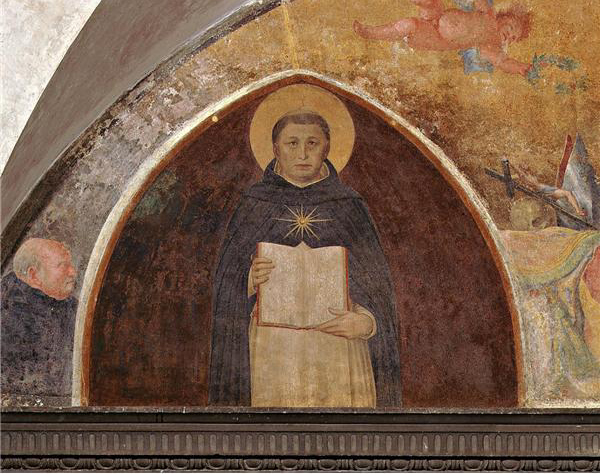

The plan of the whole work
Aquinas states the plan of the entire Summa at the start of its second question, just before he asks whether God exists. The English Dominican translation reads:
"Because the chief aim of sacred doctrine is to teach the knowledge of God, not only as He is in Himself, but also as He is the beginning of things and their last end, and especially of rational creatures, as is clear from what has been already said, therefore, in our endeavor to expound this science, we shall treat: (1) Of God; (2) Of the rational creature's advance towards God; (3) Of Christ, Who as man, is our way to God."6
Those three headings are the three parts of the book. The same paragraph then divides the first heading: "In treating of God there will be a threefold division, for we shall consider: (1) Whatever concerns the Divine Essence; (2) Whatever concerns the distinctions of Persons; (3) Whatever concerns the procession of creatures from Him."6 This habit of announcing the divisions before beginning them runs through the whole work. Almost every question opens with a short paragraph that says what is to be considered and lists the articles to come ("Concerning the first, there are three points of inquiry"), so a reader can always see where the present question sits.
Many modern readers describe the plan as a circle: everything comes forth from God (the First Part) and the rational creature returns to God (the Second Part) through Christ (the Third Part). The French Dominican Marie-Dominique Chenu set out this reading in the language of "going out and return" (exitus and reditus) in his 1950 introduction to the study of Aquinas, and it has been repeated in many guides since.7 The words exitus and reditus are Chenu's summary. Aquinas's own words are the three headings quoted above, and some scholars have questioned how well the circle fits the place of Christ at the end of the book. Readers can test the reading against the prologues quoted in this section.
The First Part (Prima Pars): 119 questions
The First Part treats God and creation. In the outline printed by New Advent from the question titles, it runs as follows: sacred doctrine itself (question 1); the one God, his existence, attributes and operations (questions 2 to 26); the Trinity (27 to 43); creation (44 to 49); the angels (50 to 64); the work of the six days (65 to 74); man, body and soul (75 to 102); and the government of creatures, or divine providence at work in the world (103 to 119).8 The question on the existence of God, with the Five Ways, is question 2, very near the start; it is the subject of lesson 04. The questions on the soul and its powers (75 to 89) are among the most read in modern philosophy departments.
The Second Part in two halves: the Prima Secundae and the Secunda Secundae
The Second Part is the longest part of the Summa, and Aquinas divided it into two halves. They are called the "First Part of the Second Part" (Prima Secundae, abbreviated I-II) and the "Second Part of the Second Part" (Secunda Secundae, abbreviated II-II). The first half opens with a sentence that ties the moral part of the book to the doctrine of creation:
"Since, as Damascene states (De Fide Orthod. ii. 12), man is said to be made to God's image, in so far as the image implies an intelligent being endowed with free-will and self-movement: now that we have treated of the exemplar, i.e., God, and of those things which came forth from the power of God in accordance with His will; it remains for us to treat of His image, i.e., man, inasmuch as he too is the principle of his actions, as having free-will and control of his actions."9
"Damascene" is John of Damascus, the eighth century Greek theologian, whose Exposition of the Orthodox Faith Aquinas read in Latin. The Prima Secundae (114 questions) then treats morals in general: the last end and happiness (questions 1 to 5), human acts (6 to 21), the passions (22 to 48), habits and virtues, with the gifts, beatitudes and fruits of the Holy Spirit (49 to 70), vice and sin (71 to 89), law (90 to 108) and grace (109 to 114).9 Lesson 05 reads the treatise on law, lesson 06 the treatise on happiness and the virtues, and lesson 07 the treatise on grace.
The Secunda Secundae (189 questions) treats morals in particular. Its prologue explains the method, and the explanation shows how carefully the whole book was planned to avoid repeating itself:
"As to the first, we must observe that if we were to treat of each virtue, gift, vice, and precept separately, we should have to say the same thing over and over again. For if one wished to treat adequately of this precept: Thou shalt not commit adultery, one would have to inquire about adultery which is a sin, the knowledge of which depends on one's knowledge of the opposite virtue. The shorter and quicker way, therefore, will be if we include the consideration of each virtue, together with its corresponding gift, opposite vice, and affirmative and negative precepts, in the same treatise." ... "Accordingly we may reduce the whole of moral matters to the consideration of the virtues, which themselves may be reduced to seven in number. Three of these are theological, and of these we must treat first, while the other four are the cardinal virtues, of which we shall treat afterwards."10
So the Secunda Secundae is built on seven virtues. Faith (questions 1 to 16), hope (17 to 22) and charity (23 to 46) come first; then prudence (47 to 56), justice with all the virtues attached to it, including religion, piety, obedience and truthfulness (57 to 122), fortitude (123 to 140) and temperance (141 to 170). Each treatise gathers the virtue, its gift of the Holy Spirit, the vices opposed to it and the commandments that concern it. The last section (171 to 189) treats things that belong only to some people: prophecy and the other graces "freely given," the active and contemplative lives, and the states of life such as bishops and members of religious orders.10
The Third Part (Tertia Pars): 90 questions
The Third Part opens with a prologue that names its subject and its three intended sections:
"Forasmuch as our Saviour the Lord Jesus Christ, in order to 'save His people from their sins' (Matthew 1:21), as the angel announced, showed unto us in His own Person the way of truth, whereby we may attain to the bliss of eternal life by rising again, it is necessary, in order to complete the work of theology, that after considering the last end of human life, and the virtues and vices, there should follow the consideration of the Saviour of all, and of the benefits bestowed by Him on the human race.
"Concerning this we must consider (1) the Saviour Himself; (2) the sacraments by which we attain to our salvation; (3) the end of immortal life to which we attain by the resurrection."11
Aquinas finished the first section and most of the second. The Incarnation fills questions 1 to 26 and the life of Christ, from his conception to his ascension and his power as judge, questions 27 to 59. The sacraments begin at question 60: the sacraments in general (60 to 65), baptism (66 to 71), confirmation (72), the Eucharist (73 to 83) and penance (84 to 90).11 Question 90, "Of the parts of Penance, in general," announces four articles, and its opening paragraph promises a further treatment of each part of penance "in particular." That further treatment was never written by him.12 The third planned section, on "the end of immortal life," was never begun. The sacraments of extreme unction, holy orders and matrimony, which would have followed penance, are also missing from the part he wrote.
The Supplement: 99 questions compiled after his death
Printed editions of the Summa almost always continue past question 90 with a "Supplement to the Third Part" (Supplementum Tertiae Partis). The Christian Classics Ethereal Library edition heads it "Supplement to the Third Part of the Summa Theologica of St. Thomas Aquinas gathered from his Commentary on Book IV of the Sentences (Questions 1-99)."13 The New Advent edition adds an editor's note: "St. Thomas never completed his treatise on Penance. The remainder of the Summa Theologiae, known as the Supplement, was compiled probably by his companion and friend Fra Rainaldo da Piperno, and was gathered from St. Thomas's commentary on the Fourth Book of the Sentences of Peter Lombard."11 (Rainaldo da Piperno is the Italian form of Reginald of Piperno.)
The 1912 Catholic Encyclopedia gives the history of the attribution with more care. The Supplement, it says, was "drawn from other writings of St. Thomas, attributed by some to Peter of Auvergne, by others to Henry of Gorkum. These attributions are rejected by the editors of the Leonine edition (XI, pp. viii, xiv, xviii). Mandonnet (op. cit., 153) inclines to the very probable opinion that it was compiled by Father Reginald de Piperno, the saint's faithful companion and secretary."4 Pierre Mandonnet was a Dominican historian of the early twentieth century. The compiler is therefore not known for certain; Reginald is the most likely candidate in the judgment of the scholars named, and the encyclopedia itself calls it a "very probable opinion." The Supplement covers the rest of penance (contrition, confession, satisfaction, the keys, excommunication and indulgences: questions 1 to 28), extreme unction (29 to 33), holy orders (34 to 40), matrimony (41 to 68) and the last things, from the state of souls after death to the resurrection, the judgment and the state of the blessed (69 to 99). Two short appendices on the souls of those who die with original sin only and on purgatory follow.14
One point matters for anyone who quotes it. The Supplement's words are Aquinas's, but they come from a work he wrote as a young bachelor between 1252 and 1256, about twenty years before the Third Part.3 On some questions his thinking developed in the meantime. Careful scholars therefore cite the Supplement as the commentary on the Sentences that it is, or mark it "Suppl." and note its origin, instead of treating it as the mature voice of the Summa.
Counting the Summa: questions, articles and objections
Books and websites give different totals for the size of the Summa. The figure most often repeated, 512 questions and about 2,669 articles, covers the three parts Aquinas wrote himself. The 1912 Catholic Encyclopedia gave larger numbers: "The entire 'Summa' contains 38 Treatises, 612 Questions, subdivided into 3120 articles, in which about 10,000 objections are proposed and answered."4 The difference comes almost entirely from whether the Supplement is counted.
To settle the matter for this lesson, every question page of the New Advent edition (one web page per question, 611 pages in all) was downloaded on October 28, 2026, and the numbered articles and objections on each page were counted by a short script.15 The results:
| Part | Questions | Articles | Written |
|---|---|---|---|
| First Part (I) | 119 | 584 | by Aquinas |
| First Part of the Second Part (I-II) | 114 | 619 | by Aquinas |
| Second Part of the Second Part (II-II) | 189 | 917 | by Aquinas |
| Third Part (III), to q. 90 | 90 | 549 | by Aquinas |
| Total written by Aquinas | 512 | 2,669 | |
| Supplement | 99 | 446 | compiled after 1274 from his commentary on the Sentences |
| Total with the Supplement | 611 | 3,115 | (plus two short appendices) |
The count confirms the commonly cited figure of 512 questions and 2,669 articles for the parts Aquinas wrote. With the Supplement the totals rise to 611 questions and 3,115 articles; the two appendices (New Advent lists questions on the souls of those who die with original sin only and on purgatory, and "two additional articles on purgatory"), which some editions may count as further questions or articles, probably account for the small remaining gap between this count and the encyclopedia's 612 and 3,120. In the three parts Aquinas wrote, the same count found 8,843 numbered objections, an average of about 3.3 objections to an article (a second count of the same pages, reading the objection labels slightly differently, found 8,828, so the total is firm to within a few dozen).15 The Supplement adds about 1,660 more. The encyclopedia's "about 10,000 objections" is a fair round figure for the whole printed work, which comes to about 10,500.
The count also shows how uneven the questions are. The most common size is four articles (199 of the 512 questions), followed by six articles (70 questions), eight (67) and two (65). Six questions have only one article. The longest question is ST II-II, q. 83, on prayer, with 17 articles; ST I, q. 14, on God's knowledge, and ST II-II, q. 47, on prudence, have 16 each.15 In the three parts he wrote, the single article with the most objections is ST I-II, q. 102, a. 3, "Whether a suitable cause can be assigned for the ceremonies which pertained to sacrifices?", which states 14 objections before answering them all.16
The five parts of an article
The basic unit of the Summa is the article. A question (for example ST I, q. 1, "The nature and extent of sacred doctrine") is a group of related articles, and each article asks one yes-or-no question and settles it. The 1912 Catholic Encyclopedia quoted an older description of the form: "The whole Summa is arranged on a uniform plan. Every subject is introduced as a question, and divided into articles. . . . Each article has also a uniform disposition of parts." It went on: the objections "are generally three or four in number, but sometimes extend to seven or more. The conclusion adopted is then introduced by the words, Respondeo dicendum. At the end of the thesis expounded the objections are answered, under the forms, ad primum, ad secundum, etc."4 The count above bears that out: about 3.3 objections to an article on average, with a few articles running past ten.
Each article has five parts. The Latin formulas below are taken from the Leonine text of ST I, q. 1, a. 1 in the Corpus Thomisticum, and the English from the 1920 translation of the same article.17
Part one: the question, "Whether..."
The article's title is a question beginning with "Whether" (Latin utrum): "Whether, besides philosophy, any further doctrine is required?" The question is put so that it can be answered yes or no. Many titles state the opposite of what Aquinas will conclude, and many state the same thing; the title alone does not reveal his answer. The list of article titles at the head of each question works as a table of contents for that question.
Part two: the objections
The article proper begins with the formula "Ad primum sic proceditur. Videtur quod..." ("We proceed thus to the first article. It seems that..."). The English Dominican translation shortens this to "Objection 1. It seems that..." What follows is a set of arguments for the answer Aquinas will reject. Each later objection begins "Praeterea," which the translation renders "Further." The objections are stated at full strength, often from Scripture, from Aristotle or from a Church Father, and a reader who stops after them will come away with the opposite of what Aquinas taught. This is the single most common mistake made by people who quote the Summa from a search engine: the sentence they quote is an objection, which Aquinas sets out in order to answer it.
Part three: "On the contrary" (sed contra)
Next comes a single short argument introduced by "Sed contra est quod..." ("On the contrary..."). The sed contra usually cites one authority, a verse of Scripture or a line of a respected writer, that points the other way. It shows that the question is a real one with weighty considerations on both sides. The sed contra is not always Aquinas's own reasoning, and on occasion his answer qualifies it. In the count made for this lesson, 2,644 of the 2,669 articles of the first three parts carry the words "On the contrary" in the English text.15
Part four: "I answer that" (respondeo)
The body of the article, often called the corpus ("body") or the respondeo, begins "Respondeo dicendum quod..." ("I answer that..."). Here Aquinas gives his own answer and his reasons. This is the part that states his teaching, and a careful citation names it ("ST I, q. 1, a. 1, corpus" or "c."). The body often begins by drawing a distinction, because many questions turn out to have a sense in which the answer is yes and another in which it is no.
Part five: the replies to the objections
Finally, each objection receives its own reply, introduced by "Ad primum ergo dicendum quod..." ("Reply to Objection 1"), "Ad secundum..." and so on. The replies do not simply say that the objection was wrong. Often they grant what is true in it and show where it goes too far. Much of Aquinas's most precise teaching sits in these replies, and they are cited with "ad" and the number: "ST I-II, q. 94, a. 2, ad 1" means the reply to the first objection of that article.
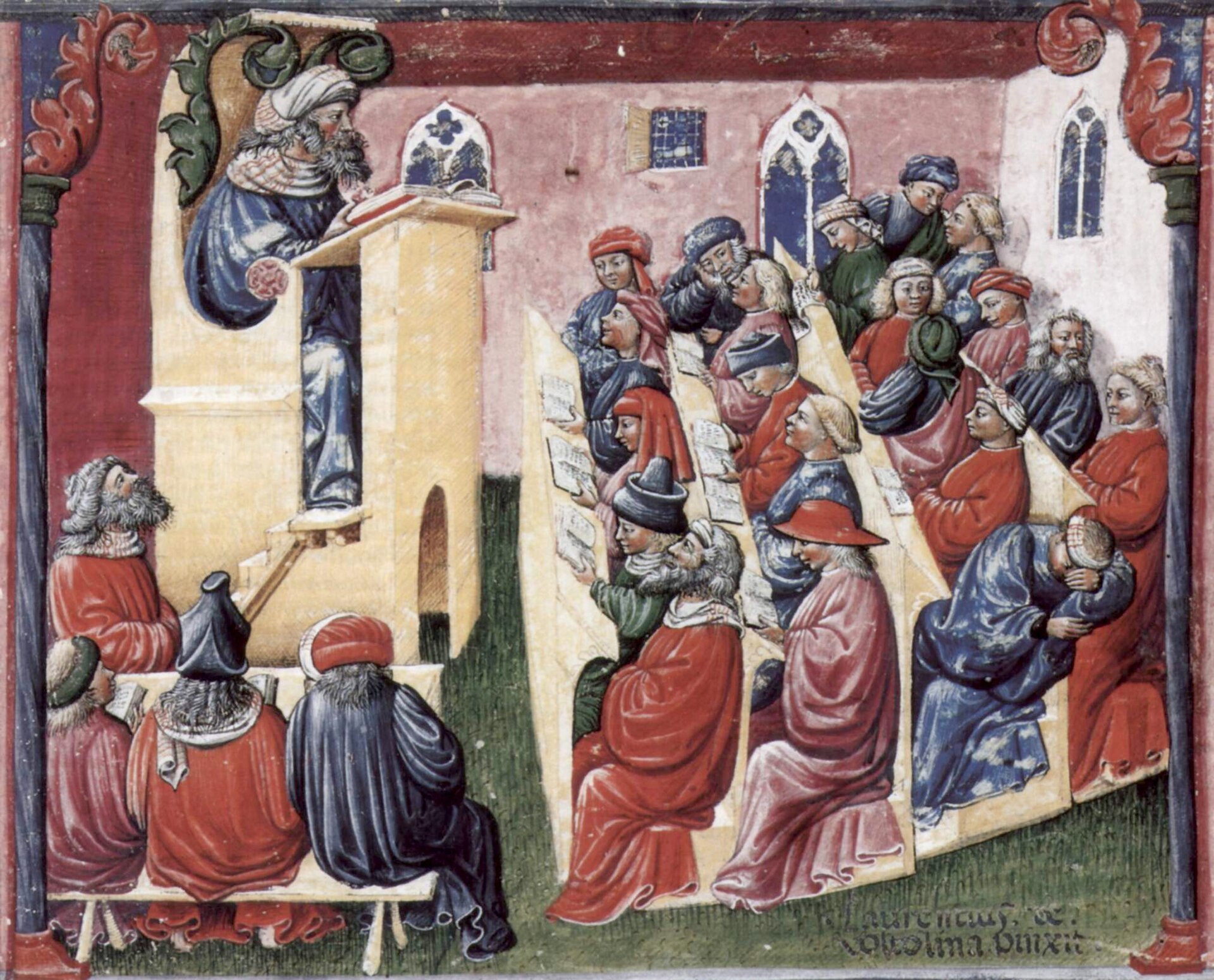
Where the form came from: the disputation
The article copies, in writing, a teaching exercise of the medieval university: the disputed question (quaestio disputata). In a formal disputation a master put a question, students and other masters argued on both sides, a bachelor answered, and on a later day the master gave his "determination," his settled answer, and replied to the arguments against it. Aquinas held such disputations throughout his career. Torrell's chronology lists the Disputed Questions on Truth (De veritate) from his first Paris regency (1256 to 1259), the Disputed Questions on the Power of God (De potentia) from his Roman years (1265 to 1268), and the open "quodlibetal" disputations, in which anyone could raise any question, at Paris in both regencies.3 Those disputed questions are longer than the articles of the Summa, sometimes with twenty or more objections. In the Summa Aquinas kept the shape of the disputation and cut it down for beginners, which is how the Prologue's complaint about "the multiplication of useless questions, articles, and arguments" turned into a book with an average of three objections to an article.

A worked example: ST I, q. 1, a. 1
The first article of the whole Summa asks why theology is needed at all, if philosophy can already reason about God. It is short, it uses every part of the form, and it states a principle the rest of the book depends on. Here it is entire, in the 1920 English Dominican translation as given by New Advent, with each part labelled.18 (New Advent prints the modern book name "Sirach" where the older printed text, as reproduced by the Christian Classics Ethereal Library from the Benziger Brothers edition of 1947, has "Ecclus.," and it prints one dash, given here as a comma.)
[1. The question] "Article 1. Whether, besides philosophy, any further doctrine is required?"
[2. The objections]
"Objection 1. It seems that, besides philosophical science, we have no need of any further knowledge. For man should not seek to know what is above reason: 'Seek not the things that are too high for thee' (Sirach 3:22). But whatever is not above reason is fully treated of in philosophical science. Therefore any other knowledge besides philosophical science is superfluous.
"Objection 2. Further, knowledge can be concerned only with being, for nothing can be known, save what is true; and all that is, is true. But everything that is, is treated of in philosophical science, even God Himself; so that there is a part of philosophy called theology, or the divine science, as Aristotle has proved (Metaph. vi). Therefore, besides philosophical science, there is no need of any further knowledge."
[3. On the contrary]
"On the contrary, It is written (2 Timothy 3:16): 'All Scripture, inspired of God is profitable to teach, to reprove, to correct, to instruct in justice.' Now Scripture, inspired of God, is no part of philosophical science, which has been built up by human reason. Therefore it is useful that besides philosophical science, there should be other knowledge, i.e. inspired of God."
[4. I answer that]
"I answer that, It was necessary for man's salvation that there should be a knowledge revealed by God besides philosophical science built up by human reason. Firstly, indeed, because man is directed to God, as to an end that surpasses the grasp of his reason: 'The eye hath not seen, O God, besides Thee, what things Thou hast prepared for them that wait for Thee' (Isaiah 64:4). But the end must first be known by men who are to direct their thoughts and actions to the end. Hence it was necessary for the salvation of man that certain truths which exceed human reason should be made known to him by divine revelation. Even as regards those truths about God which human reason could have discovered, it was necessary that man should be taught by a divine revelation; because the truth about God such as reason could discover, would only be known by a few, and that after a long time, and with the admixture of many errors. Whereas man's whole salvation, which is in God, depends upon the knowledge of this truth. Therefore, in order that the salvation of men might be brought about more fitly and more surely, it was necessary that they should be taught divine truths by divine revelation. It was therefore necessary that besides philosophical science built up by reason, there should be a sacred science learned through revelation."
[5. The replies]
"Reply to Objection 1. Although those things which are beyond man's knowledge may not be sought for by man through his reason, nevertheless, once they are revealed by God, they must be accepted by faith. Hence the sacred text continues, 'For many things are shown to thee above the understanding of man' (Sirach 3:25). And in this, the sacred science consists.
"Reply to Objection 2. Sciences are differentiated according to the various means through which knowledge is obtained. For the astronomer and the physicist both may prove the same conclusion: that the earth, for instance, is round: the astronomer by means of mathematics (i.e. abstracting from matter), but the physicist by means of matter itself. Hence there is no reason why those things which may be learned from philosophical science, so far as they can be known by natural reason, may not also be taught us by another science so far as they fall within revelation. Hence theology included in sacred doctrine differs in kind from that theology which is part of philosophy."
What the example shows
Several features of the method stand out in this one short article.
The objections are real arguments. The first uses a verse of Scripture (the Latin Bible's text of Ecclesiasticus, or Sirach, 3:22) to argue that people should not reach beyond reason. The second uses Aristotle's Metaphysics, which names a part of philosophy "theology." A reader who quoted Objection 2 as "Aquinas says philosophy already covers God" would have the article backwards.
The sed contra is a single authority, 2 Timothy 3:16, pointing the other way. It establishes that Scripture exists and is useful, and that it is not a product of human reasoning. It does not by itself explain why revelation was necessary; that is left to the body.
The body draws a distinction between two kinds of truth about God. Some truths "exceed human reason" (Aquinas's later examples include the Trinity and the Incarnation), and these could only be known by revelation. Others "human reason could have discovered" (such as the existence of God, which question 2 argues can be demonstrated), yet even these needed to be revealed, because reason alone reaches them only for "a few, and that after a long time, and with the admixture of many errors." That three-part phrase is one of the most quoted lines in the Summa, and the 1912 Catholic Encyclopedia singles it out in its summary of the work.4 It is also the ground for the order of the whole book: reason has real work to do in theology, and revelation is needed both above reason and alongside it.
The replies grant something to each objection. The first reply accepts that people should not try to reach by reason what is above reason, and then adds that once such things are revealed "they must be accepted by faith." It even quotes the next verses of the same chapter of Sirach that the objection had used (Sirach 3:25), so Scripture answers Scripture. The second reply accepts that philosophy has a "theology" of its own and shows that two sciences can reach the same conclusion by different means, the way an astronomer and a physicist (a student of nature, in medieval language) can each show that the earth is round. The reply assumes, as educated people of the thirteenth century commonly did, that the earth is a sphere. Its point is that sacred doctrine and philosophical theology differ "in kind" because they know by different lights.
A second example: the senses of Scripture (ST I, q. 1, a. 10)
The last article of the first question asks "Whether in Holy Scripture a word may have several senses?"18 It is worth reading closely because it shows how Aquinas read the Bible he cited on every page, and because Catholic and Protestant readers have both drawn on it. The objections run as follows:
"Objection 1. It seems that in Holy Writ a word cannot have several senses, historical or literal, allegorical, tropological or moral, and anagogical. For many different senses in one text produce confusion and deception and destroy all force of argument. Hence no argument, but only fallacies, can be deduced from a multiplicity of propositions. But Holy Writ ought to be able to state the truth without any fallacy. Therefore in it there cannot be several senses to a word.
"Objection 2. Further, Augustine says (De util. cred. iii) that 'the Old Testament has a fourfold division as to history, etiology, analogy and allegory.' Now these four seem altogether different from the four divisions mentioned in the first objection. Therefore it does not seem fitting to explain the same word of Holy Writ according to the four different senses mentioned above.
"Objection 3. Further, besides these senses, there is the parabolical, which is not one of these four."
The sed contra cites Pope Gregory the Great's Morals on Job: "Holy Writ by the manner of its speech transcends every science, because in one and the same sentence, while it describes a fact, it reveals a mystery."18 The body of the article then sets out the four senses:
"I answer that, The author of Holy Writ is God, in whose power it is to signify His meaning, not by words only (as man also can do), but also by things themselves. So, whereas in every other science things are signified by words, this science has the property, that the things signified by the words have themselves also a signification. Therefore that first signification whereby words signify things belongs to the first sense, the historical or literal. That signification whereby things signified by words have themselves also a signification is called the spiritual sense, which is based on the literal, and presupposes it. Now this spiritual sense has a threefold division. For as the Apostle says (Hebrews 10:1) the Old Law is a figure of the New Law, and Dionysius says (Coel. Hier. i) 'the New Law itself is a figure of future glory.' Again, in the New Law, whatever our Head has done is a type of what we ought to do. Therefore, so far as the things of the Old Law signify the things of the New Law, there is the allegorical sense; so far as the things done in Christ, or so far as the things which signify Christ, are types of what we ought to do, there is the moral sense. But so far as they signify what relates to eternal glory, there is the anagogical sense. Since the literal sense is that which the author intends, and since the author of Holy Writ is God, Who by one act comprehends all things by His intellect, it is not unfitting, as Augustine says (Confess. xii), if, even according to the literal sense, one word in Holy Writ should have several senses."
The Latin opens with the sentence on which the whole article rests: "Respondeo dicendum quod auctor sacrae Scripturae est Deus," "I answer that the author of Holy Scripture is God."17 The first reply then limits what the spiritual senses can do in an argument:
"Reply to Objection 1. The multiplicity of these senses does not produce equivocation or any other kind of multiplicity, seeing that these senses are not multiplied because one word signifies several things, but because the things signified by the words can be themselves types of other things. Thus in Holy Writ no confusion results, for all the senses are founded on one, the literal, from which alone can any argument be drawn, and not from those intended in allegory, as Augustine says (Epis. 48). Nevertheless, nothing of Holy Scripture perishes on account of this, since nothing necessary to faith is contained under the spiritual sense which is not elsewhere put forward by the Scripture in its literal sense."
The remaining replies place Augustine's fourfold list (history, etiology, analogy, allegory) under the literal sense, with allegory standing for all three spiritual senses, note that Hugh of St. Victor counted only three senses, and explain that the "parabolical" sense, figurative speech such as "God's arm," belongs to the literal sense: "When Scripture speaks of God's arm, the literal sense is not that God has such a member, but only what is signified by this member, namely operative power. Hence it is plain that nothing false can ever underlie the literal sense of Holy Writ."18 (The translation sets off "the literal" and the three terms of the second reply with dashes; they are given here with commas.)
How Protestant and Catholic readers use this article
The Reformers and their heirs are often described as rejecting the medieval four senses in favour of the literal sense. The Westminster Confession of Faith (1646), the standard of Presbyterian churches, puts its rule this way: "The infallible rule of interpretation of Scripture is the Scripture itself: and therefore, when there is a question about the true and full sense of any Scripture (which is not manifold, but one), it must be searched and known by other places that speak more clearly."19 The phrase "not manifold, but one" stands against any doctrine of several senses in a single text. Readers of Aquinas on both sides have pointed out that his own article already limits the spiritual senses sharply: arguments can be drawn only from the literal sense, and "nothing necessary to faith is contained under the spiritual sense which is not elsewhere put forward by the Scripture in its literal sense." The difference between the two positions is real, since Aquinas holds that the things described in Scripture can themselves signify further things and Westminster holds that each text has one sense. The common ground is also real, since both make the plain sense of the text the place where argument about doctrine has to happen. Lesson 07 takes up the larger questions of authority and grace on which Catholics and Protestants differ.
His authorities: who Aquinas quotes and how much weight each carries
A first-time reader of the Summa meets a crowd of names: the Apostle, Augustine, Dionysius, Damascene, the Philosopher, the Commentator, Rabbi Moses. Aquinas tells the reader how much weight each kind of authority carries, in the second reply of ST I, q. 1, a. 8:
"This doctrine is especially based upon arguments from authority, inasmuch as its principles are obtained by revelation: thus we ought to believe on the authority of those to whom the revelation has been made. Nor does this take away from the dignity of this doctrine, for although the argument from authority based on human reason is the weakest, yet the argument from authority based on divine revelation is the strongest. But sacred doctrine makes use even of human reason, not, indeed, to prove faith (for thereby the merit of faith would come to an end), but to make clear other things that are put forward in this doctrine. Since therefore grace does not destroy nature but perfects it, natural reason should minister to faith as the natural bent of the will ministers to charity. ... Hence sacred doctrine makes use also of the authority of philosophers in those questions in which they were able to know the truth by natural reason, as Paul quotes a saying of Aratus: 'As some also of your own poets said: For we are also His offspring' (Acts 17:28). Nevertheless, sacred doctrine makes use of these authorities as extrinsic and probable arguments; but properly uses the authority of the canonical Scriptures as an incontrovertible proof, and the authority of the doctors of the Church as one that may properly be used, yet merely as probable. For our faith rests upon the revelation made to the apostles and prophets who wrote the canonical books, and not on the revelations (if any such there are) made to other doctors."18
(The omission marked by the ellipsis is one sentence quoting 2 Corinthians 10:5.) This passage gives a ranking. Canonical Scripture is "an incontrovertible proof." The doctors of the Church, the Fathers and later teachers, may "properly be used, yet merely as probable." The philosophers are "extrinsic and probable arguments," useful where they reached the truth "by natural reason." The same reply contains the line "grace does not destroy nature but perfects it" (Latin: "gratia non tollat naturam, sed perficiat"),17 often quoted as a summary of Aquinas's whole approach to reason and faith. The sentence that follows the quoted passage in the article cites a letter of Augustine to the same effect, that only the canonical books are to be believed without error and other writers read with judgment.
A count of the authorities
How often does Aquinas actually call on each authority? For this lesson the English text of every article in the three parts he wrote (2,669 articles) was searched for the names and titles below, and the number of articles in which each appears was counted.15 The count measures articles that name the authority anywhere (in an objection, the sed contra, the body or a reply), so it shows how often each one enters the discussion, whether Aquinas agrees with it or answers it. It is a name search: "Gregory" includes more than one Gregory, and quotations of Scripture by book and verse, which appear in most articles, are not counted.
Several points stand out. Augustine is named in more than half of all the articles, which fits the usual description of Aquinas as an Augustinian theologian who used Aristotle. Aristotle, almost always called simply "the Philosopher," comes second. Paul, "the Apostle," comes third, and that figure covers only the places where Paul is named by title; the many verses of his letters cited by book and chapter are on top of it. The Greek Fathers (Dionysius, Damascene, Chrysostom) appear often, and the Arabic and Jewish philosophers rarely, though their influence on particular questions is large.
Scripture and the Fathers
Scripture is cited in almost every article, by book, chapter and verse in the modern editions. Aquinas read it in the Latin Vulgate (translated about 382 to 405 at the request of Pope Damasus), and the printed 1920 translation gave his references in the Vulgate's names and numbers, the ones the Douay-Rheims Bible (the English version of the Vulgate) also uses. Online editions differ here. In ST I, q. 2, a. 1, the sed contra cites "The fool said in his heart, There is no God." The Christian Classics Ethereal Library text, which keeps the old references, gives it as "Ps. 52:1," the Vulgate and Douay-Rheims number; the New Advent text gives it as "Psalm 53:2," a modern numbering that counts the psalm's heading as verse 1 (the King James Version has Psalm 53:1).20 Module 103 explains the Vulgate and its history (The History of the Bible, lesson 04). Among the Fathers, Augustine dominates, followed by Gregory the Great, Ambrose and the Greek writers. "Damascene" is John of Damascus, whose Exposition of the Orthodox Faith provided the Greek tradition in a single handbook.
"The Philosopher": Aristotle
Aquinas calls Aristotle "the Philosopher" because in the thirteenth century schools he was the philosopher, the teacher whose works defined logic, natural science, ethics and metaphysics. The third article of the first question shows the usual form: "according to the Philosopher (Poster. i) 'that science is one which treats only of one class of subjects.'"18 The abbreviation names the work, here the Posterior Analytics, book one. Aristotle appears in objections as often as in answers, and Aquinas can turn him either way. Lesson 04 shows how the first of the Five Ways rests on Aristotle's Physics and Metaphysics, and lesson 06 sets the treatise on happiness beside Aristotle's Nicomachean Ethics.
Dionysius and Boethius
"Dionysius" is the writer who presented himself as Dionysius the Areopagite, the Athenian converted by Paul (Acts 17:34), and whose works on the divine names and the heavenly and church hierarchies were read in the Middle Ages as apostolic. Modern scholars date them to about 500 and call their author Pseudo-Dionysius. Aquinas cites him in ST I, q. 1, a. 9 for the principle that "We cannot be enlightened by the divine rays except they be hidden within the covering of many sacred veils."18 Boethius, the Roman statesman executed about 524, author of The Consolation of Philosophy and of short theological treatises, appears in the treatise on law: "as Boethius says (De Hebdom.), certain axioms or propositions are universally self-evident to all," such as "Every whole is greater than its part."21
Avicenna, Averroes and Maimonides
Three non-Christian philosophers appear by name or title. Avicenna (Ibn Sina, died 1037), the Persian Muslim philosopher, is named in 25 articles. In ST I, q. 11, a. 1 Aquinas sets out a view about the "one" that is the principle of number and says: "Avicenna, however, on the contrary, considering that 'one' which is the principle of number, added a reality to the substance of 'being'..." before giving his own position.22 Averroes (Ibn Rushd, died 1198), the Andalusian Muslim philosopher whose commentaries on Aristotle were standard in Paris, is usually called "the Commentator." An objection in ST I, q. 19, a. 3 reads: "as the Commentator [Averroes] says in Phys. ii" (the bracket is the translators').23 Aquinas also disagrees with him openly. In ST I, q. 76, a. 4, on the forms of the elements in a mixed body, he reports that "Averroes maintained that the forms of elements, by reason of their imperfection, are a medium between accidental and substantial forms," and answers: "But this is even still more impossible."24
Moses Maimonides (died 1204), the Jewish philosopher of Cordoba and Cairo whose Guide for the Perplexed circulated in Latin, appears as "Rabbi Moses." In ST I, q. 13, a. 2, on the names of God, Aquinas reports the view that names like "living" express only what God is not, "and this was taught by Rabbi Moses," and then rejects it along with a second view: "Both of these opinions, however, seem to be untrue for three reasons."25 The pattern is the same for all three: Aquinas reads them with respect, quotes them by name or title, and disagrees where he thinks they are wrong. He also argued against the Latin followers of Averroes at Paris in a separate work, On the Unity of the Intellect, discussed in lesson 02.
How to look up a citation
Every reference to the Summa in a book, a sermon or a website should lead back to one exact place in the text, and the standard form of citation is built to do that. Take the reference "ST I-II, q. 94, a. 2, ad 1," one of the most quoted places in the treatise on law. It has five pieces, and each one narrows the search.
| Piece | Meaning | Other forms in print |
|---|---|---|
| ST | Summa Theologiae (older English books say Summa Theologica) | S.T., Sum. theol., STh |
| I-II | the part: I (First Part), I-II (First Part of the Second Part), II-II (Second Part of the Second Part), III (Third Part), Suppl. (Supplement) | Ia, Ia-IIae, IIa-IIae, IIIa; 1a, 1a2ae, 2a2ae, 3a; Prima Secundae |
| q. 94 | the question, numbered from 1 within each part | Q. 94, qu. 94 |
| a. 2 | the article, numbered from 1 within each question | art. 2 |
| ad 1 | the reply to the first objection | ad 1um, ad primum; "c." or "corp." for the body, "s.c." for the sed contra, "arg. 1" or "obj. 1" for the first objection |
The pieces never change their order: part, question, article, place in the article. A citation that gives only "Summa, q. 94" is incomplete, because there are four questions numbered 94 (in the First Part, in each half of the Second Part and in the Supplement; the Third Part ends at question 90). A citation that gives the article but no place in it is acceptable for a short article and too loose for a long one, and a citation of an objection without any warning that it is an objection is a misquotation in all but name.
Finding it in English
The New Advent edition gives one web page to each question, and its page addresses follow a simple code. The first digit is the part (1 for the First Part, 2 for the Prima Secundae, 3 for the Secunda Secundae, 4 for the Third Part, 5 for the Supplement) and the next three digits are the question number. So ST I, q. 1 is newadvent.org/summa/1001.htm, ST I, q. 2 is 1002.htm, and ST I-II, q. 94 is 2094.htm. Each article on the page carries an anchor, so "2094.htm#article2" opens the page at article 2.21 Within the text, New Advent prints its own cross-references in a short form: an objection in ST I-II, q. 94, a. 2 refers back to "I-II:92:2," meaning ST I-II, q. 92, a. 2.21 The count of 611 question pages made for this lesson relied on this numbering: every page from 1001 to 1119, 2001 to 2114, 3001 to 3189, 4001 to 4090 and 5001 to 5099 exists, and the next number in each series does not.15
Here is the place the example citation points to. Article 2 asks "Whether the natural law contains several precepts, or only one?" Its first objection argues: "It would seem that the natural law contains, not several precepts, but one only. For law is a kind of precept, as stated above (I-II:92:2). If therefore there were many precepts of the natural law, it would follow that there are also many natural laws." After the body of the article, which lists the precepts that follow from the natural inclinations of human beings, comes the reply the citation names:
"Reply to Objection 1. All these precepts of the law of nature have the character of one natural law, inasmuch as they flow from one first precept."21
That single sentence answers the worry of the objection without denying its premise: there is one natural law because there is one first precept, and there are many precepts because many things follow from it. The body of this article, with its first precept "good is to be done and pursued, and evil is to be avoided," is read in lesson 05.
Finding it in Latin
The Corpus Thomisticum uses the same order with Latin labels. Its page for ST I-II, q. 94 is corpusthomisticum.org/sth2094.html (the page names follow the same code as New Advent's: sth1001.html is ST I, q. 1), and every paragraph is labelled with its exact place: "Iª q. 1 pr." for the opening paragraph of a question, "arg. 1" for an objection, "s. c." for the sed contra, "co." for the body and "ad 1" for a reply.17 The reply quoted above appears there as "Iª-IIae q. 94 a. 2 ad 1," and reads: "Ad primum ergo dicendum quod omnia ista praecepta legis naturae, inquantum referuntur ad unum primum praeceptum, habent rationem unius legis naturalis."26 A reader with a little Latin can check any English quotation in a minute this way, and can see what the 1920 translators did: here "inquantum referuntur ad unum primum praeceptum" (literally "inasmuch as they are referred to one first precept") became "inasmuch as they flow from one first precept."
A checklist for checking a quotation
Anyone who meets a quotation attributed to Aquinas can test it in four steps, using only the free texts named in this lesson.
- Find the place. If the quotation has no part, question and article, search the New Advent or Corpus Thomisticum text for a distinctive phrase. Many lines circulated online under his name do not appear anywhere in the Summa.
- Find the part of the article. Note whether the words stand in an objection, the sed contra, the body or a reply. Words in an objection are the view Aquinas answers. Words in the sed contra are an authority he cites, usually though not always on the side he takes.
- Read the reply. If the words are in an objection, read the matching reply before saying what Aquinas thought. If they are in a reply, read the objection it answers, because a reply often grants part of the objection.
- Check the Supplement and the edition. If the citation is to the Supplement, remember that its text comes from the early commentary on the Sentences. If wording differs between two English versions, compare the Latin.
The Latin text and the printed editions
Aquinas wrote in Latin, and for nearly two centuries the Summa circulated in handwritten copies made for Dominican houses, universities and monasteries. Copyists often made the parts as separate volumes, and the copy shown below contains the First Part only. This fifteenth century copy of the First Part, now in the University Library of Basel (shelfmark A I 14), came from the library of Johannes de Lapide, a Carthusian monk in Basel, according to the description that accompanies its digitized images.
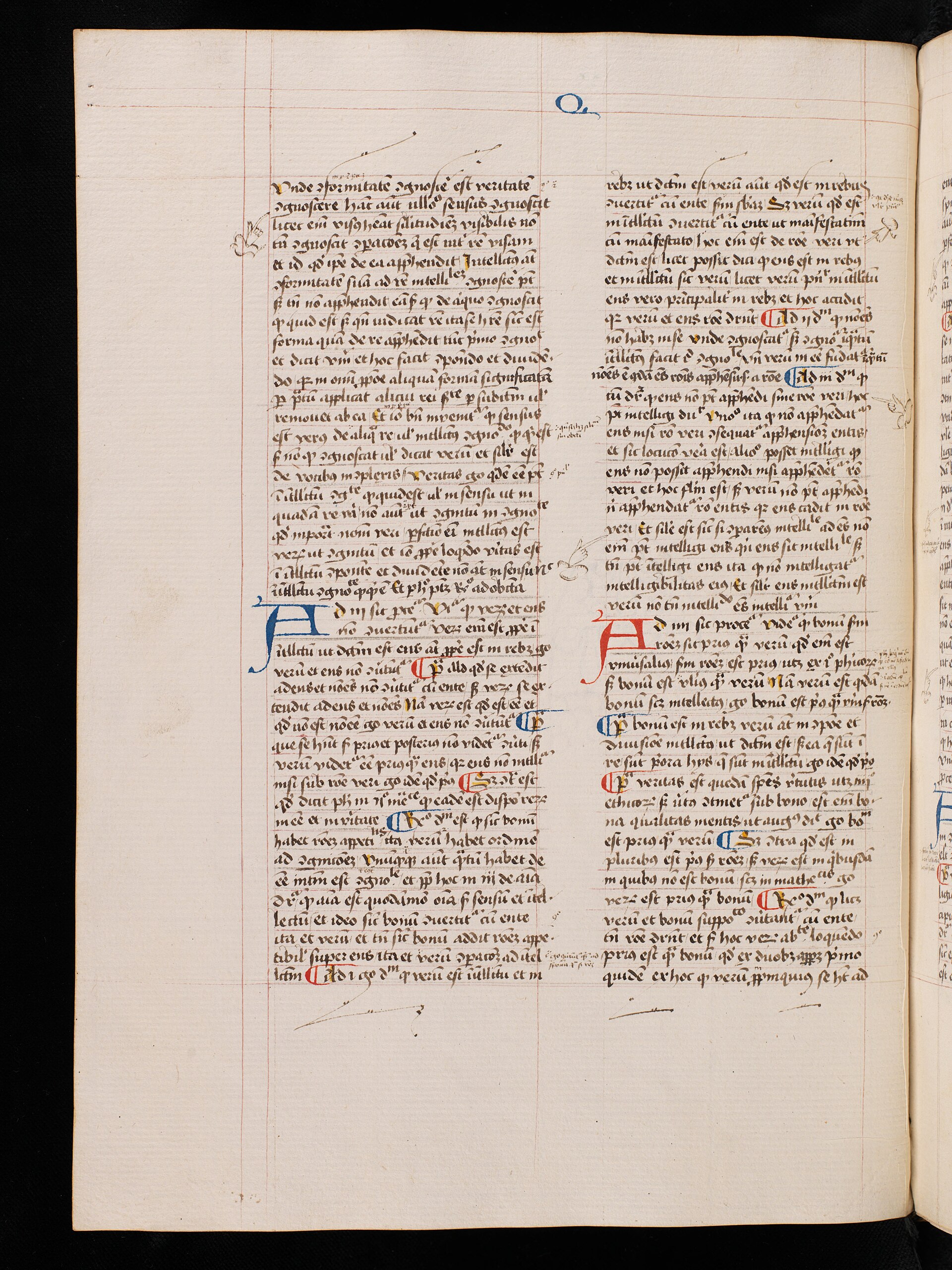

Printing came early. The 1912 Catholic Encyclopedia reports: "Peter Schöffer, a printer of Mainz, published the 'Secunda Secundae' in 1467. This is the first known printed copy of any work of St. Thomas. The first complete edition of the 'Summa' was printed at Basle, in 1485." The same article lists the collected editions of all his works, beginning "Rome, 1570," and explains that "The Roman edition of 1570, called 'the Piana', because edited by order of St. Pius V, was the standard for many years." It ends the list with "Rome, 1882 (the Leonine)."4 The Leonine edition takes its name from Pope Leo XIII, whose encyclical Aeterni Patris (August 4, 1879) urged bishops "to restore the golden wisdom of St. Thomas, and to spread it far and wide for the defense and beauty of the Catholic faith, for the good of society, and for the advantage of all the sciences."27 Its volumes of the Summa are the critical Latin text that modern scholars cite, and the Corpus Thomisticum states that its text of the First Part is the Leonine text published at Rome in 1888.2

The English translation quoted in this lesson was made by Dominican friars of the English province and first published in many volumes in the early twentieth century; the text online is that of the "Second and Revised Edition, 1920," as New Advent's pages state, and the Christian Classics Ethereal Library text is taken from the Benziger Brothers edition of 1947, which also names the translators as "Fathers of the English Dominican Province."112 The translation is close to the Latin and somewhat old-fashioned ("Holy Writ," "Whereas"). Later translations, among them the Latin and English Blackfriars edition begun in the 1960s, are under copyright, and this module quotes only the 1920 translation.
What the record shows and what it does not
- Documented in the text itself: the Prologue's stated aim, "the instruction of beginners"; the three-part plan announced at the start of ST I, q. 2; the five-part form of every article; the stop in ST III, q. 90, whose opening paragraph promises a treatment of each part of penance "in particular" that Aquinas never wrote.1612
- Counted for this lesson: 512 questions and 2,669 articles in the three parts Aquinas wrote, with 8,843 objections; 611 questions and 3,115 articles with the Supplement; the number of articles naming each authority. These are counts of the New Advent English text, downloaded October 28, 2026, and could differ by a few units in an edition that numbers the appendices differently.15
- Aquinas's own words on method: Scripture is "an incontrovertible proof," the doctors of the Church "merely as probable," the philosophers "extrinsic and probable arguments"; "grace does not destroy nature but perfects it" (ST I, q. 1, a. 8, ad 2).18
- Reported by early witnesses: that he stopped writing on or about December 6, 1273 after an experience at Mass, and said that what he had written seemed of little worth (the 1912 Catholic Encyclopedia summarizes this; the fuller testimony, given at the canonization inquiry of 1319, is discussed in lesson 02).4
- Editorial judgment, not certain: that Reginald of Piperno compiled the Supplement. The 1912 Catholic Encyclopedia calls it "the very probable opinion" of Mandonnet; New Advent says "compiled probably" by him.411
- Scholarly reading: the "going out and return" (exitus and reditus) shape of the whole work (Chenu); the identification of the "beginners" with ordinary Dominican students at Santa Sabina (Boyle). Both are interpretations of a text that says less.57
- Later tradition, without an early source cited: that the Council of Trent placed the Summa on the altar beside the Bible, which rests in the record checked for this lesson on Leo XIII's encyclical of 1879.27
- Open questions: the exact dates and places of each part (Torrell and the 1912 encyclopedia differ on the Prima Secundae); why Aquinas stopped writing; who compiled the Supplement and when.
Claims checked
"The Summa has 512 questions and 2,669 articles."
Rating: Supported, for the three parts Aquinas wrote. A count of every question page of the New Advent edition made for this lesson found 119, 114, 189 and 90 questions in the First Part, Prima Secundae, Secunda Secundae and Third Part, 512 in all, with 584, 619, 917 and 549 articles, 2,669 in all.15 Larger totals in older books include the Supplement: the 1912 Catholic Encyclopedia's "612 Questions, subdivided into 3120 articles" is close to this lesson's count of 611 questions and 3,115 articles with the Supplement, the small gap coming from the appendices.4 A claim that the Summa has "about 3,000 articles" is therefore true of the printed book and false of the part Aquinas himself wrote; a careful writer says which is meant.
"Aquinas answered about 10,000 objections."
Rating: Partly supported. The 1912 Catholic Encyclopedia gave "about 10,000 objections" for the whole printed work.4 The count made for this lesson found 8,843 numbered objections in the three parts Aquinas wrote (a second count found 8,828), and a count of the Supplement's 99 question pages found about 1,660 more, some 10,500 in all.15 The round figure is a fair one for the whole printed work. For the Summa as Aquinas himself wrote it, about 8,800 is the accurate number.
"The Summa is unfinished because of a vision."
Rating: Partly supported. That the work breaks off in ST III, q. 90 is a fact of the text.12 That Aquinas stopped writing after an experience during Mass on December 6, 1273 rests on the report of his companion Reginald of Piperno, passed on by Bartholomew of Capua in testimony at the canonization inquiry at Naples in 1319, more than forty-five years after the event; the 1912 Catholic Encyclopedia summarizes it as "an unusually long ecstasy during Mass."4 Whether that experience was a vision, an illness or both is a judgment the sources do not settle. Some modern biographers have proposed a physical cause, such as a stroke or a collapse from overwork, alongside or in place of a mystical one (see the unverified list). Aquinas died about three months later, on March 7, 1274, at Fossanova, which would have ended the work in any case.4 Lesson 02 gives the testimony and the "straw" saying.
"The Supplement was written by Aquinas."
Rating: Partly supported. The words of the Supplement are his, taken from his commentary on Book IV of the Sentences, which belongs to his first Paris period, 1252 to 1256; the arrangement into questions and articles under the title of the Summa was made by someone else after his death.313 Its teaching on the sacraments of marriage and holy orders and on the last things therefore represents the young Aquinas, adapted by an editor, and not the plan he was carrying out in 1273.
"Reginald of Piperno compiled the Supplement."
Rating: Unresolved, though it is the most widely accepted view. The 1912 Catholic Encyclopedia records earlier attributions to Peter of Auvergne and Henry of Gorkum, notes that the Leonine editors rejected them, and calls Reginald's authorship Mandonnet's "very probable opinion."4 No document from the time naming the compiler was found in the sources checked for this lesson.
"At the Council of Trent the Summa lay on the altar beside the Bible."
Rating: Unresolved. Leo XIII wrote in Aeterni Patris (1879), paragraph 22, that "the chief and special glory of Thomas, one which he has shared with none of the Catholic Doctors, is that the Fathers of Trent made it part of the order of conclave to lay upon the altar, together with sacred Scripture and the decrees of the supreme Pontiffs, the Summa of Thomas Aquinas, whence to seek counsel, reason, and inspiration."27 The 1912 Catholic Encyclopedia repeats the sentence.4 The encyclical gives no source from the council's own records for it, and none was found for this lesson. What Trent's decree on justification actually teaches, and how it compares with the Summa, is a separate question, taken up in lesson 07.
"Aquinas debated how many angels can dance on the head of a pin."
Rating: Refuted as a description of the Summa. No article asks it. The nearest is ST I, q. 52, a. 3, "Whether several angels can be at the same time in the same place?", which answers no: "There are not two angels in the same place. The reason of this is because it is impossible for two complete causes to be the causes immediately of one and the same thing."28 The question belongs to a larger treatment of how a being without a body can be said to be in a place at all, a question about causes and presence. The pin and the dancing come from later writers mocking scholastic debate; the earliest form of the jibe was not traced for this lesson.
"The Summa is built more on Aristotle than on Scripture and the Fathers."
Rating: Unsupported as a matter of how often each is used. In the name count made for this lesson, Augustine is named in 1,416 articles, "the Philosopher" in 969, and Aristotle by name in 123 (only about 47 of those 123 articles do not also say "the Philosopher"); Scripture is quoted by book and verse in most articles and was not counted at all.15 Aquinas's own rule in ST I, q. 1, a. 8, ad 2 ranks the philosophers below Scripture and the doctors of the Church.18 How deeply Aristotle's concepts shape the arguments is a different question, on which Catholic and Protestant scholars disagree; a count of names cannot settle it.
"Aquinas taught that woman is 'misbegotten.'"
Rating: Partly supported, and a good test of the method in this lesson. The words are in ST I, q. 92, a. 1, in a reply, so they are Aquinas's own and not an objection's: "As regards the individual nature, woman is defective and misbegotten," a view he draws from Aristotle's biology and supports with Aristotle's On the Generation of Animals. The same reply continues: "On the other hand, as regards human nature in general, woman is not misbegotten, but is included in nature's intention as directed to the work of generation. Now the general intention of nature depends on God, Who is the universal Author of nature. Therefore, in producing nature, God formed not only the male but also the female."29 A quotation that gives only the first sentence leaves out the distinction the reply is built on; a defense that leaves out the first sentence leaves out what he did say. Both halves are in the text.
"The Summa was written for advanced scholars."
Rating: Refuted as a statement of Aquinas's purpose. The Prologue says the book is meant to "tend to the instruction of beginners," and complains that existing books hampered students with "useless questions, articles, and arguments."1 What Aquinas meant by a beginner, a student who already knew Latin, logic and the rudiments of theology, is very different from a modern beginner, and that is the sense in which the book is hard going today.
"Aquinas said that grace does not destroy nature but perfects it."
Rating: Supported. The sentence is in ST I, q. 1, a. 8, ad 2: "Since therefore grace does not destroy nature but perfects it, natural reason should minister to faith as the natural bent of the will ministers to charity." The Latin reads "Cum enim gratia non tollat naturam, sed perficiat."1718 It is often quoted without its setting, which is a statement about the use of reason within theology.
Hard questions and answers
A Reformed or Lutheran reader asks: if Aquinas calls Scripture the only "incontrovertible proof," does he hold a version of "Scripture alone"?
Not in the Reformation sense, and the Summa itself shows why. ST I, q. 1, a. 8, ad 2 does rank the canonical Scriptures as "an incontrovertible proof" and the doctors of the Church as "merely as probable," and it says "our faith rests upon the revelation made to the apostles and prophets who wrote the canonical books."18 In the treatise on faith, however, Aquinas writes that "the formal object of faith is the First Truth, as manifested in Holy Writ and the teaching of the Church, which proceeds from the First Truth," and that whoever does not adhere "as to an infallible and Divine rule, to the teaching of the Church" lacks the habit of faith (ST II-II, q. 5, a. 3).30 For Aquinas, then, the individual Fathers are probable authorities, while the Church's teaching is the rule through which Scripture's truth is received. The Westminster Confession, by contrast, makes "the Scripture itself" the "infallible rule of interpretation of Scripture."19 Both sides can quote ST I, q. 1, a. 8 accurately, and both should read II-II, q. 5, a. 3 beside it.
A skeptic asks: is the article form a rigged debate, since Aquinas chooses the objections and always wins?
He does choose them, and he always gives his own answer, so the form is a teaching device and not a neutral transcript of a debate. Three things count against calling it rigged. First, the objections are usually real arguments from authorities his readers respected (Scripture, Augustine, Aristotle), as the two articles of ST I, q. 1 quoted above show. Second, the replies often concede part of an objection, which a staged debate would not need to do. Third, the form came from the university disputation, in which a master had to answer arguments raised by others in public.3 A fair criticism remains: the objections are stated in Aquinas's own summary, so a reader who wants the strongest form of a view he rejects (Averroes on the intellect, for example, or Maimonides on the divine names) has to read that writer directly.
A reader asks: why does a work of Christian theology quote Muslim and Jewish philosophers by name?
Aquinas gives the reason himself: "sacred doctrine makes use also of the authority of philosophers in those questions in which they were able to know the truth by natural reason," as Paul quoted the pagan poet Aratus in Acts 17:28.18 On that principle a philosopher's religion did not disqualify his arguments on questions reason can reach. Avicenna, Averroes ("the Commentator") and Maimonides ("Rabbi Moses") appear in only a few dozen articles, but in each case they are quoted with their argument and answered on its merits, as the examples from ST I, q. 11, a. 1, q. 13, a. 2 and q. 76, a. 4 show.222425
A student asks: how can a work of 2,669 articles be "for beginners"?
The Prologue's complaint was about disorder and repetition, not length: it promised to set things out "according to the order of the subject matter" and "as briefly and clearly as the matter itself may allow."1 The prologue of the Secunda Secundae shows the same concern in practice, gathering each virtue with its gift, vice and precepts so as not to "say the same thing over and over again."10 Measured against the disputed questions, which can run to twenty or more objections, the Summa's average of about 3.3 objections to an article is brief.15 A beginner was never expected to read it straight through in a term. Lesson 14 gives a reading plan for the Summa, and the treatises read in lessons 04 to 07 make a natural first course.
A Catholic reader asks: may the Supplement be quoted as the teaching of the Summa?
It may be quoted as Aquinas, since its words are his, but it should be marked as the Supplement and dated to his commentary on the Sentences of 1252 to 1256.313 New Advent's editor's note says plainly that "St. Thomas never completed his treatise on Penance."11 Where the Third Part and the Supplement treat the same subject, the Third Part is the later and more deliberate text. The difference matters most for the sacraments he never reached (extreme unction, holy orders, matrimony) and for the last things, where the Supplement is the only "Summa" text there is.
A first-time reader asks: does the "On the contrary" always give Aquinas's own position?
Usually it points toward the answer he gives, but it is a cited authority, not his reasoning, and sometimes the body qualifies it. In ST I, q. 1, a. 1 the sed contra from 2 Timothy 3:16 shows that Scripture exists and is useful; the body supplies the actual argument for why revelation was necessary, including truths reason could reach.18 A small number of articles lack a sed contra entirely: in the count for this lesson, 25 of the 2,669 articles in the English text do not contain the words "On the contrary" (whether each of these lacks a sed contra or the translation words it differently was not checked one by one).15 The safe rule is the one this lesson has followed throughout: cite the body ("c.") for Aquinas's position and the reply ("ad") for his answer to a particular argument.
Learn more
- Summa Theologiae at New Advent: The 1920 English text, one page per question; the easiest way to follow any citation in this module.
- Summa Theologiae, Latin text, Corpus Thomisticum: The Leonine Latin, with every paragraph labelled by part, question, article and place.
- ST I, q. 1 (New Advent): The ten articles on sacred doctrine: the best single place to start reading the Summa.
- Richard C. Taylor, Dating Works of Aquinas: A dated list of Aquinas's works after Torrell, with a second chronology for comparison.
- Basel manuscript A I 14 at e-codices: Page through a fifteenth century handwritten copy of the First Part.
- Leo XIII, Aeterni Patris: The 1879 encyclical behind the modern revival of Aquinas and the Leonine edition.
Still being checked (10 items)
These points could not be confirmed against a primary source when this lesson was written and fact checked in October 2026. The text above states each one as uncertain.
- Leonard Boyle's argument that the "beginners" were ordinary Dominican students at Santa Sabina is reported as later scholarship summarizes it; his 1982 lecture was not opened.
- Chenu's exitus and reditus reading of the plan is reported as commonly summarized; his 1950 book was not opened.
- The details of Bartholomew of Capua's 1319 testimony (reporting Reginald of Piperno) come from the module brief and lesson 02, not from the 1959 English translation of the biographical documents, which was not opened for this lesson.
- That some modern biographers attribute the end of writing in December 1273 to a stroke or physical collapse is stated from general knowledge of the literature; no biography was opened to confirm who argues it.
- The story that the Summa lay on the altar at the Council of Trent was traced only to Leo XIII's Aeterni Patris (1879) and the 1912 Catholic Encyclopedia; no source from the council's records was found.
- The earliest form of the "angels on the head of a pin" jibe was not traced.
- The article and objection counts are counts of the New Advent web pages; they were not checked against a printed Leonine volume. The cause of the small gap with the 1912 Catholic Encyclopedia's totals (612 questions, 3,120 articles) is inferred, not proved.
- Whether each of the 25 articles without the words "On the contrary" truly lacks a sed contra, or the translation words it differently, was not checked one by one.
- The Blackfriars Latin and English edition is mentioned only as begun in the 1960s; its volume count and dates were not checked.
- The Voltolina miniature is captioned without a date because the Commons page gives none for the artwork.
Notes
- Thomas Aquinas, Summa Theologiae, trans. Fathers of the English Dominican Province, second and revised edition, 1920, New Advent online edition, Prologue ("the instruction of beginners"), on the Summa index page, which also prints the edition's title page (retrieved Nov. 5, 2026). Read it online. ↩
- Thomas Aquinas, Summa Theologiae, Latin text (Leonine edition), Corpus Thomisticum, ed. Enrique Alarcon, Prologue ("Summa theologiae, pr."); the page for ST I, q. 1 gives its source as the Leonine text "Romae 1888 editum" (retrieved Nov. 5, 2026). Read it online. ↩
- Richard C. Taylor, "Dating Works," course page for Thomas Aquinas, Fall 2014 (The Nature and Attainment of Happiness), Marquette University, giving the chronology of Jean-Pierre Torrell, Saint Thomas Aquinas, vol. 1, The Person and His Work (Washington, D.C.: Catholic University of America Press, 2005), 327 to 329: Sentences commentary 1252 to 1256; Summa contra Gentiles 1259 to 1265; De veritate 1256 to 1259; De potentia and the Prima Pars at Rome 1265 to 1268; Secunda Pars in Paris 1268 to 1272; Tertia Pars, qq. 1 to 90, Naples 1272 to December 1273 (retrieved Nov. 5, 2026). Read it online. ↩
- Daniel Kennedy, "St. Thomas Aquinas," The Catholic Encyclopedia, vol. 14 (New York: Robert Appleton Company, 1912), sections on his life, the Summa theologica and the editions of his works; a 1900s Catholic reference, public domain (retrieved Nov. 5, 2026). Read it online. ↩
- Leonard E. Boyle, The Setting of the Summa theologiae of Saint Thomas, Etienne Gilson Series 5 (Toronto: Pontifical Institute of Mediaeval Studies, 1982). The book was not opened for this lesson; its argument is reported as later scholarship summarizes it. ↩
- Thomas Aquinas, Summa Theologica, trans. Fathers of the English Dominican Province (Benziger Bros. edition, 1947), Christian Classics Ethereal Library, First Part, Question 2, prologue (the plan of the whole work) (retrieved Nov. 5, 2026). Read it online. ↩
- Marie-Dominique Chenu, Introduction a l'etude de saint Thomas d'Aquin (Montreal and Paris, 1950); English translation, Toward Understanding Saint Thomas (Chicago: Regnery, 1964), on the plan of the Summa as exitus and reditus. Not opened for this lesson; reported as commonly summarized. ↩
- Thomas Aquinas, Summa Theologiae, trans. Fathers of the English Dominican Province, second and revised edition, 1920, New Advent online edition, First Part, outline of questions 1 to 119 (retrieved Nov. 5, 2026). Read it online. ↩
- Thomas Aquinas, Summa Theologiae, trans. Fathers of the English Dominican Province, second and revised edition, 1920, New Advent online edition, First Part of the Second Part, prologue and outline of questions 1 to 114 (retrieved Nov. 5, 2026). Read it online. ↩
- Thomas Aquinas, Summa Theologiae, trans. Fathers of the English Dominican Province, second and revised edition, 1920, New Advent online edition, Second Part of the Second Part, prologue and outline of questions 1 to 189 (retrieved Nov. 5, 2026). Read it online. ↩
- Thomas Aquinas, Summa Theologiae, trans. Fathers of the English Dominican Province, second and revised edition, 1920, New Advent online edition, Third Part, prologue, outline of questions 1 to 90 and editor's note on the Supplement (retrieved Nov. 5, 2026). Read it online. ↩
- Thomas Aquinas, Summa Theologica, trans. Fathers of the English Dominican Province (Benziger Bros. edition, 1947), Christian Classics Ethereal Library, Third Part, Question 90, opening paragraph ("We must now consider the parts of Penance: (1) in general. (2) each one in particular"); New Advent's page for the same question is https://www.newadvent.org/summa/4090.htm (retrieved Nov. 5, 2026). Read it online. ↩
- Thomas Aquinas, Summa Theologica, trans. Fathers of the English Dominican Province (Benziger Bros. edition, 1947), Christian Classics Ethereal Library, Supplement, heading ("Supplement (XP): to the Third Part of the Summa Theologica of St. Thomas Aquinas gathered from his Commentary on Book IV of the Sentences (Questions 1-99)") (retrieved Nov. 5, 2026). Read it online. ↩
- Thomas Aquinas, Summa Theologiae, trans. Fathers of the English Dominican Province, second and revised edition, 1920, New Advent online edition, Supplement to the Third Part, editor's note, outline of questions 1 to 99 and the two appendices (retrieved Nov. 5, 2026). Read it online. ↩
- Count made for this lesson: all 611 question pages of the New Advent edition (1001 to 1119, 2001 to 2114, 3001 to 3189, 4001 to 4090, 5001 to 5099) were downloaded on October 28, 2026, and a script counted the numbered articles on each page, the numbered objections and the articles containing "On the contrary" in parts I to III, and the articles whose English text names each authority (a name search: "Gregory" covers more than one Gregory; Scripture cited by book is not counted). Totals: parts I to III, 512 questions, 2,669 articles, 8,843 objections, 2,644 articles with "On the contrary"; Supplement, 99 questions, 446 articles. Rechecked from the saved pages Nov. 5, 2026. An independent recount by the fact checker (all 611 pages downloaded again Nov. 5, 2026) confirmed 512 questions, 2,669 articles, 2,644 articles with "On the contrary", the distribution of article counts and the authority counts; it found 8,828 objections in parts I to III (the difference from 8,843 is a matter of how labels are read) and 1,664 objections in the Supplement. Read it online. ↩
- Thomas Aquinas, Summa Theologiae, trans. Fathers of the English Dominican Province, second and revised edition, 1920, New Advent online edition, ST I-II, q. 102, a. 3 (fourteen objections) (retrieved Nov. 5, 2026). Read it online. ↩
- Thomas Aquinas, Summa Theologiae, Latin text (Leonine edition), Corpus Thomisticum, ed. Enrique Alarcon, ST I, q. 1 (Latin of aa. 1, 8 and 10, with the paragraph labels arg., s. c., co. and ad) (retrieved Nov. 5, 2026). Read it online. ↩
- Thomas Aquinas, Summa Theologiae, trans. Fathers of the English Dominican Province, second and revised edition, 1920, New Advent online edition, ST I, q. 1, aa. 1 to 10 (aa. 1 and 10 quoted entire; a. 3, a. 8, ad 2 and a. 9 quoted in part) (retrieved Nov. 5, 2026). Read it online. ↩
- Westminster Confession of Faith (1646), chapter 1, section 9, as published by the Orthodox Presbyterian Church (retrieved Nov. 5, 2026). Read it online. ↩
- Thomas Aquinas, Summa Theologiae, trans. Fathers of the English Dominican Province, second and revised edition, 1920, New Advent online edition, ST I, q. 2, a. 1, sed contra ("Psalm 53:2"); compare the Christian Classics Ethereal Library text of the same article, which gives "Ps. 52:1", https://www.ccel.org/ccel/aquinas/summa.FP_Q2_A1.html (retrieved Nov. 5, 2026). Read it online. ↩
- Thomas Aquinas, Summa Theologiae, trans. Fathers of the English Dominican Province, second and revised edition, 1920, New Advent online edition, ST I-II, q. 94, a. 2, body and replies (Boethius, De Hebdomadibus; the cross-reference "I-II:92:2"; Reply to Objection 1) (retrieved Nov. 5, 2026). Read it online. ↩
- Thomas Aquinas, Summa Theologiae, trans. Fathers of the English Dominican Province, second and revised edition, 1920, New Advent online edition, ST I, q. 11, a. 1 (Avicenna) (retrieved Nov. 5, 2026). Read it online. ↩
- Thomas Aquinas, Summa Theologiae, trans. Fathers of the English Dominican Province, second and revised edition, 1920, New Advent online edition, ST I, q. 19, a. 3, objection 5 ("the Commentator [Averroes]") (retrieved Nov. 5, 2026). Read it online. ↩
- Thomas Aquinas, Summa Theologiae, trans. Fathers of the English Dominican Province, second and revised edition, 1920, New Advent online edition, ST I, q. 76, a. 4 (Averroes on the forms of the elements) (retrieved Nov. 5, 2026). Read it online. ↩
- Thomas Aquinas, Summa Theologiae, trans. Fathers of the English Dominican Province, second and revised edition, 1920, New Advent online edition, ST I, q. 13, a. 2 ("Rabbi Moses") (retrieved Nov. 5, 2026). Read it online. ↩
- Thomas Aquinas, Summa Theologiae, Latin text (Leonine edition), Corpus Thomisticum, ed. Enrique Alarcon, ST I-II, q. 94, a. 2, ad 1 ("Ia-IIae q. 94 a. 2 ad 1") (retrieved Nov. 5, 2026). Read it online. ↩
- Leo XIII, Aeterni Patris, encyclical on the restoration of Christian philosophy, August 4, 1879, English text, paragraphs 22 and 31, vatican.va (retrieved Nov. 5, 2026). Read it online. ↩
- Thomas Aquinas, Summa Theologiae, trans. Fathers of the English Dominican Province, second and revised edition, 1920, New Advent online edition, ST I, q. 52, a. 3 ("Whether several angels can be at the same time in the same place?") (retrieved Nov. 5, 2026). Read it online. ↩
- Thomas Aquinas, Summa Theologiae, trans. Fathers of the English Dominican Province, second and revised edition, 1920, New Advent online edition, ST I, q. 92, a. 1, Reply to Objection 1 (retrieved Nov. 5, 2026). Read it online. ↩
- Thomas Aquinas, Summa Theologiae, trans. Fathers of the English Dominican Province, second and revised edition, 1920, New Advent online edition, ST II-II, q. 5, a. 3, body (retrieved Nov. 5, 2026). Read it online. ↩
Check yourself
1. In what words does the Prologue of the Summa state the book's purpose?
The Prologue says it will treat "whatever belongs to the Christian religion, in such a way as may tend to the instruction of beginners." The Summa contra Gentiles and the Sentences commentary are other works.
2. Where does the part Aquinas himself wrote break off?
He stopped in December 1273 in ST III, q. 90. The Supplement was compiled after his death from his commentary on the Sentences.
3. According to the count made for this lesson, how many questions and articles are in the three parts Aquinas wrote?
512 questions and 2,669 articles in parts I to III. With the Supplement the count is 611 and 3,115; the 1912 Catholic Encyclopedia gave 612 and 3,120 for the whole printed work.
4. Which part of an article states Aquinas's own answer and his reasons?
The objections state the case he will answer; the sed contra cites an authority; the body (corpus, respondeo) gives his answer.
5. What does the citation "ST I-II, q. 94, a. 2, ad 1" point to?
I-II is the Prima Secundae, q. 94 the question, a. 2 the article, and "ad 1" the reply to Objection 1.
6. In ST I, q. 1, a. 8, ad 2, how does Aquinas rank the authority of the doctors of the Church?
Scripture is "an incontrovertible proof"; the doctors "merely as probable"; the philosophers "extrinsic and probable arguments."
7. Whom does the Summa call "the Commentator"?
Averroes (Ibn Rushd), the commentator on Aristotle. Maimonides is "Rabbi Moses," Aristotle "the Philosopher," and Peter Lombard "the Master."
8. According to ST I, q. 1, a. 10, from which sense of Scripture alone can an argument be drawn?
Reply to Objection 1: all the senses are founded on the literal, "from which alone can any argument be drawn."
Terms in this lesson
- Summa
- A medieval term for an ordered summary of a whole field of learning. The Summa Theologiae is Aquinas's ordered presentation of theology for beginners.
- Prima Pars, Prima Secundae, Secunda Secundae, Tertia Pars
- The First Part (I), the First Part of the Second Part (I-II), the Second Part of the Second Part (II-II) and the Third Part (III) of the Summa.
- Supplement (Supplementum)
- Ninety-nine questions added after Aquinas's death to finish the Third Part, gathered from his commentary on Book IV of Peter Lombard's Sentences, probably by Reginald of Piperno.
- Question (quaestio)
- A group of related articles on one subject, numbered within each part, cited as "q."
- Article (articulus)
- The basic unit of the Summa: one yes-or-no question beginning "Whether" and settled in five steps. Cited as "a."
- Objection (videtur quod)
- An argument for the answer Aquinas will reject, set out at the start of an article. Cited as "arg." or "obj."
- Sed contra ("On the contrary")
- A short counter-argument, usually a single authority, that shows the question has weight on the other side. Cited as "s.c."
- Respondeo ("I answer that")
- The body (corpus) of an article, where Aquinas gives his own answer and reasons. Cited as "c."
- Reply (ad primum, ad secundum)
- Aquinas's answer to each objection, often granting part of it. Cited as "ad 1," "ad 2."
- Disputed question (quaestio disputata)
- A formal university debate on a set question, with arguments on both sides and a master's determination; the model for the article form.
- The Philosopher, the Commentator, Rabbi Moses
- The Summa's titles for Aristotle, Averroes (Ibn Rushd) and Moses Maimonides.
- Leonine edition
- The critical Latin edition of Aquinas's works begun under Pope Leo XIII; its text of the First Part was published at Rome in 1888 and is reproduced by the Corpus Thomisticum.
- Four senses of Scripture
- The literal or historical sense and the three spiritual senses (allegorical, moral or tropological, anagogical), as ST I, q. 1, a. 10 sets them out.
Sources
- Summa Theologiae, English Dominican translation, 2nd rev. ed. 1920 (New Advent online edition, all 611 question pages) (1920) checked 2026-10
- Summa Theologica, English Dominican translation, Benziger Bros. 1947 (Christian Classics Ethereal Library) (1947) checked 2026-10
- Summa Theologiae, Latin Leonine text (Corpus Thomisticum) (1888 (Leonine text of the First Part)) checked 2026-10
- Daniel Kennedy, "St. Thomas Aquinas," Catholic Encyclopedia, vol. 14 (1912) (1912) checked 2026-10
- Leo XIII, Aeterni Patris (1879) (1879-08-04) checked 2026-10
- Westminster Confession of Faith (1646), Orthodox Presbyterian Church text (1646) checked 2026-10
- Richard C. Taylor, Dating Works of Aquinas (Marquette course page, after Torrell) (2014) checked 2026-10
- Jean-Pierre Torrell, Saint Thomas Aquinas, vol. 1, The Person and His Work (1993 French; 1996 and 2005 English) (1996) checked 2026-10
- Leonard E. Boyle, The Setting of the Summa theologiae of Saint Thomas (1982) (1982) checked 2026-10
- Marie-Dominique Chenu, Introduction a l'etude de saint Thomas d'Aquin (1950) (1950) checked 2026-10
- Basel, Universitatsbibliothek, A I 14, Summa theologiae (prima pars), digitized at e-codices (15th century) checked 2026-10