Lesson 11 of 14 · about 60 minutes · Updated November 5, 2026
Reading Catherine of Siena: The Dialogue, Selected Passages and Her Use of Scripture
You'll be able to
- Explain how the Dialogue was made, what it was called, when it was first printed and how Gardner's six treatises differ from Thorold's four.
- Describe the Bridge and its three steps (Feet, Side, Mouth) and connect them to the three states and the three powers of the soul, with chapter references.
- Quote and place her teaching on self-knowledge, tears, vocal and mental prayer, obedience and the reverence owed to bad priests.
- Read her letters to Gregory XI, the King of France, John Hawkwood and Raymond of Capua (on Niccolo di Toldo) in context, separating her own account from later report.
- List the Scripture texts in the passages quoted and show where her Latin Bible shaped her reading (John 12:32).
- State fairly, in their own words, how Protestant historians and Catholic teaching (Paul VI, the Catechism, Benedict XVI) have read her.
Start here: the short version
Catherine of Siena (1347 to 1380) left three kinds of writing: one book, the Dialogue, which her disciples took down in Siena in 1377 and 1378 while she spoke; nearly 400 letters (the count differs from edition to edition), most of them dictated to secretaries; and 26 short prayers that her followers wrote down as she prayed aloud in her last years. This lesson reads all three closely, in the public domain English of Algar Thorold (the Dialogue), Vida D. Scudder (the letters, 1905) and Edmund Gardner (the prayers, 1907). It follows the book's great picture of Christ as a Bridge from earth to heaven with three stairs (the pierced Feet, the open Side, the Mouth), the "cell of self-knowledge," the five kinds of tears, the move from spoken to inward prayer, and obedience as the key of heaven. It then reads her letters to Pope Gregory XI (whom she called "sweet Christ on earth"), to the English soldier of fortune John Hawkwood and to her confessor about Niccolo di Toldo, the young man she walked with to his execution. It lists the Scripture texts the quoted passages use, and it sets out, in their own words, how Protestant writers and Catholic teaching have each read her. Lesson 10 tells her life and her part in papal politics; this lesson stays with the texts.
Lesson 10 follows Catherine Benincasa from the dyer's house in Siena to Avignon, Rome and her death. Module 79 gives the Avignon papacy and the Western Schism in outline (Church History, Part A, lesson 10: Reform Before Luther). This lesson reads what she said. The aim is to let a reader hear her voice in the oldest English translations that are free for anyone to open, to show how each text was made and handed down, and to mark plainly where a statement comes from her own words, where it comes from her disciples, and where it comes from later writers. The Bible she heard and quoted was the Latin Vulgate (translated about 382 to 405 at the request of Pope Damasus), and module 103 explains that Bible (The History of the Bible, lesson 04).

The book and how it was made
Dictated in Siena, 1377 to 1378
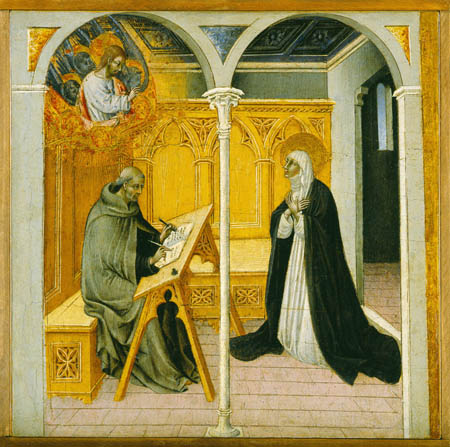
The Dialogue is a conversation between "the soul" and God the Father. The soul is Catherine, though she speaks of herself in the third person ("a handmaid of God," "that soul") and the Father answers her at length. The earliest account of how it was written comes from Raymond of Capua, the Dominican friar who was her confessor from 1374 and who wrote her life (the Legenda Major) after her death. Gardner translates the passage: "When the peace had been announced, she returned to her own home, and set herself with fresh diligence to the composition of a certain book, which, inspired by the supreme Spirit, she dictated in her vernacular. She had besought her secretaries (who were wont to write the letters which she despatched in all directions) attentively to observe everything when, according to her custom, she was rapt out of her corporeal senses, and carefully to write down whatever she then dictated."1 The "peace" was the peace between Florence and the papacy, concluded in the summer of 1378 under the new pope, Urban VI. Gardner dates the completion of the book to "the late summer and early autumn of 1378," in "the brief interval between her leaving Florence and her going to Rome."1 Scudder's chronology agrees: after the peace, "Catherine returns to Siena, where she devotes herself to composing her 'Dialogue.'"2
The book did not begin in 1378. Gardner shows that its core is a vision Catherine had "after receiving Holy Communion on a feast of the Blessed Virgin, in the autumn of the previous year," which she had already described "in a more partial form" in a long letter to Raymond (Letter 272 in Tommaseo's numbering).1 The opening pages of the Dialogue say the same thing in their own way: the soul "desired the arrival of the morning (for the morrow was a feast of Mary) in order to hear Mass."3
Catherine herself spoke of the book plainly. In her last letter to Raymond, written in Rome in 1380, she asked him and three other friars to take charge of it: "I beg you that you and Brother Bartolomeo and Brother Tommaso and the Master should gather together in your hands the book, and any writing of mine that you might find, and do with them what you see will be most to the honour of God: you and Misser Tommaso too, things in which I found some recreation."4 Gardner gives the Italian, il Libro e ogni scrittura la quale trovaste di me, and remarks that while her friends describe her dictating it "rapt," "it is not clear that she herself would have made any claims of supernatural authority for it."1 That is Gardner's reading. The disciples' reading is on the title page of the old editions: Thorold's English is headed "The Dialogue of the Seraphic Virgin Catherine of Siena, dictated by her, while in a state of ecstasy, to her secretaries."5
What the book was called
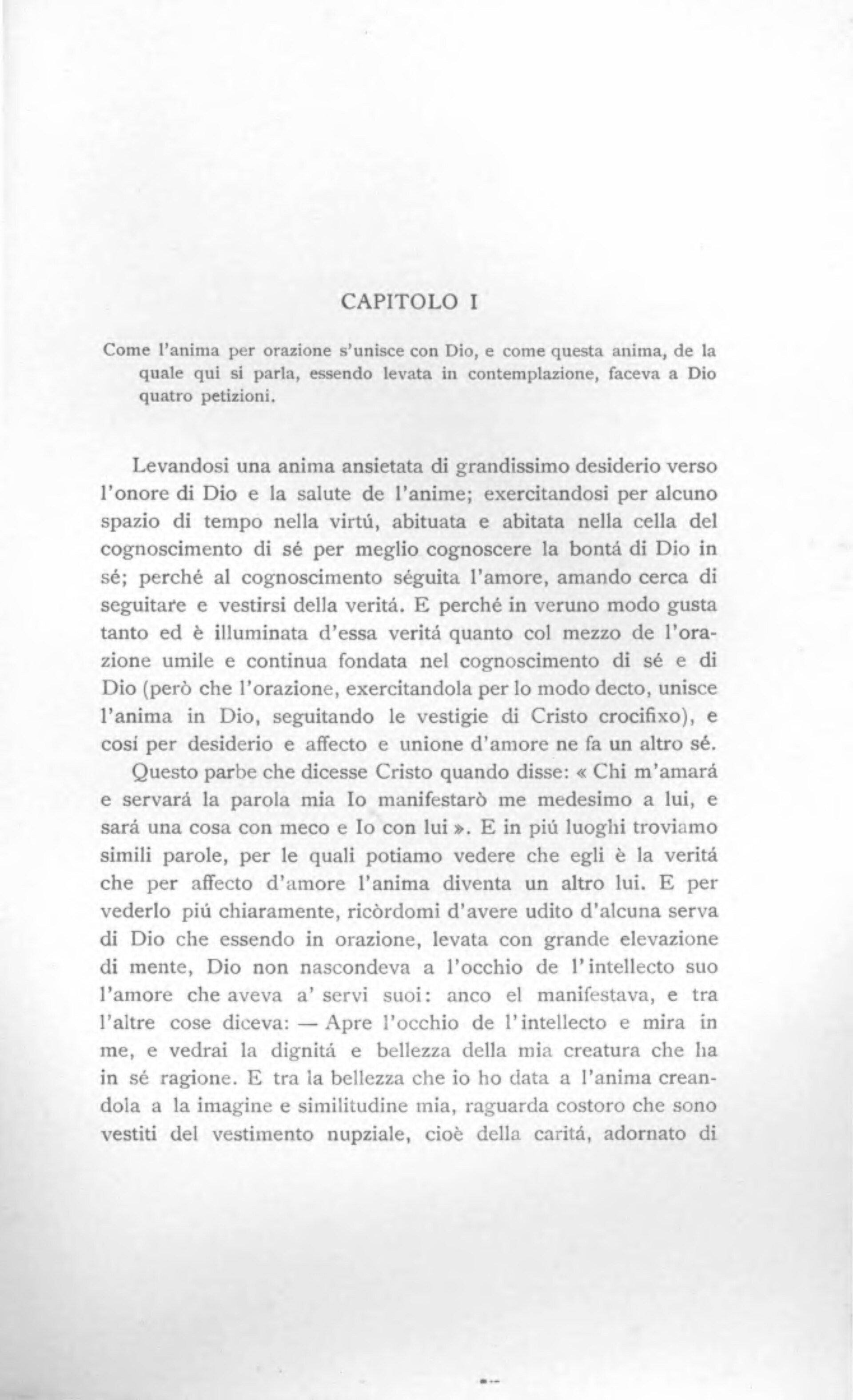
Catherine called it simply "the book." Her followers and printers gave it several names. Gardner lists them: the Dialogo, the Trattato della Divina Provvidenza (Treatise of Divine Providence) and the Libro della Divina Dottrina (Book of Divine Doctrine).1 A fifteenth century manuscript now in the Vatican (Cod. Barb. Lat. 4063) is headed only Il libro facto per divina revelacione de la venerabile et admirabile vergine beata Katherina da Siena ("the book made by divine revelation of the venerable and admirable virgin blessed Katherina of Siena," translated for this lesson).1 All three names are still in use. Modern Italian editions often print Il Dialogo della Divina Provvidenza; the 1912 Italian edition reproduced below used Libro della divina dottrina.

First printings and translations
The book circulated in manuscript for nearly a century before it was printed. Gardner gives the printing history: "Catherine's great literary work, the Dialogo, was published at Bologna in 1472, at Naples in 1478, and at Venice in 1494. A number of editions were printed at Venice in the course of the sixteenth century."6 His bibliography names the Bologna printer as Baldassare Azzoguidi.6 Two Latin translations were made by her own circle: one by the Sienese notary Ser Cristofano di Gano Guidini, which stayed in manuscript, and one by Raymond, "printed at Brescia in 1496, and at Cologne in 1553 and 1601." The first English version was made from Raymond's Latin: "An English rendering of Fra Raimondo's Latin version, entitled 'The Orcharde of Syon' by Brother Dane James, was printed by Wynkyn de Worde in 1519." Girolamo Gigli reprinted the Italian text in 1707 as the fourth volume of his collected works of Catherine.6
Algar Thorold, an English Catholic layman, published a full English translation in London in 1896 and a "new and abridged edition" in 1907. Gardner, writing in 1907, judged that the Dialogo "was well translated by Mr. Algar Thorold (London, 1896)," but that the new abridged edition "omits the greater part of the terrible Trattato delle Lagrime."6 The free text most readers meet today, at the Christian Classics Ethereal Library, is the 1907 abridgment, first published in London in 1907 by Kegan Paul, Trench, Trubner and Co., with Thorold's introduction dated "Viareggio, September 1906."5 Thorold says he followed "the text of Gigli" and aimed "to translate as literally as possible."5 That is the translation quoted in this lesson.
One error on that title page needs flagging. It says the book was "completed in the year of our Lord 1370." The year cannot be right: Catherine met Raymond only in 1374, the vision behind the book came in the autumn of 1377, and Raymond and Gardner both place the dictation in 1378.1 The date is a misprint or a slip in the source the printer followed, and it is rated in "Claims checked" below.
How the book is arranged
The full Italian text runs to 167 chapters. Gardner divides it into six treatises: "an Introduction (cap. 1 to cap. 8), the Trattato della Discrezione (cap. 9 to cap. 64), the Trattato dell'Orazione (cap. 65 to cap. 86), the Trattato delle Lagrime (cap. 87 to cap. 134), the Trattato della Divina Provvidenza (cap. 135 to cap. 153), and the Trattato dell'Obbedienza (cap. 154 to cap. 167)." He calls this arrangement "a compromise between that of the manuscripts and early editions of the Italian text and that given by Fra Raimondo in his Latin version."7 Thorold's abridged edition uses four headings instead: "A Treatise of Divine Providence," "A Treatise of Discretion," "A Treatise of Prayer" and "A Treatise of Obedience."5 His "Treatise of Divine Providence" is only the eight opening chapters that Gardner calls the Introduction, his "Treatise of Prayer" takes in the teaching on tears, and the long providence section that Gardner places at chapters 135 to 153 is mostly left out. The 1907 edition prints the chapter headings without numbers.
Because of this, the passages below are cited by Thorold's treatise and by the order of the chapter headings within it, counted in the Christian Classics Ethereal Library text (for example "Discretion, section 10"), with the chapter heading quoted so that a reader can find the same place in any edition. Thorold's digitized text marks breaks with double hyphens; in the quotations below these are printed as commas or colons to keep to this site's style, and no words are changed.
The four petitions
The book opens with a soul praying, and its whole plan comes from what she asks. Thorold's first chapter states it: "So, that soul, wishing to know and follow the truth more manfully, and lifting her desires first for herself, for she considered that a soul could not be of use, whether in doctrine, example, or prayer, to her neighbor, if she did not first profit herself, that is, if she did not acquire virtue in herself, addressed four requests to the Supreme and Eternal Father. The first was for herself; the second for the reformation of the Holy Church; the third a general prayer for the whole world, and in particular for the peace of Christians who rebel, with much lewdness and persecution, against the Holy Church; in the fourth and last, she besought the Divine Providence to provide for things in general, and in particular, for a certain case with which she was concerned."8
The "Christians who rebel" were, in 1377 and 1378, above all the Florentines and their allies in the War of the Eight Saints against the papacy, which lesson 10 describes. The "certain case" is never named. When the Father sums up the book at the end, the order of the second and third requests is reversed: "The second request you made of Me was that I should do mercy to the world. In the third you prayed for the mystical body of the holy Church."9 Readers who check the two lists will see the difference; it is one sign that the book was spoken and gathered, not drafted and revised.
The same opening chapter gives the image that controls everything after it, the soul made one with God by love: the Father says of those who love Him, "they are another Myself, inasmuch as they have lost and denied their own will, and are clothed with Mine, are united to Mine, are conformed to Mine."8 The second chapter adds a picture that later readers often quote: in prayer "the soul is then in God, and God in the soul, as the fish is in the sea, and the sea in the fish."3
The cell of self-knowledge
Catherine's first word of advice, to herself and to everyone she wrote to, is to stay in what she calls the cell of self-knowledge. The book's first sentence uses the phrase: the soul "begins by exercising herself, for a certain space of time, in the ordinary virtues, remaining in the cell of self-knowledge, in order to know better the goodness of God towards her. This she does because knowledge must precede love, and only when she has attained love, can she strive to follow and to clothe herself with the truth."8
Self-knowledge in her sense has two sides. A person sees her own nothingness and sin, and in the same look sees God's goodness. The Father explains: "I reply that this is the way, if you will arrive at a perfect knowledge and enjoyment of Me, the Eternal Truth, that you should never go outside the knowledge of yourself, and, by humbling yourself in the valley of humility, you will know Me and yourself, from which knowledge you will draw all that is necessary." And again: "In self-knowledge, then, you will humble yourself, seeing that, in yourself, you do not even exist; for your very being, as you will learn, is derived from Me, since I have loved both you and others before you were in existence."10 Self-knowledge without the second half would lead to despair, and the book warns against exactly that (see the section on prayer below). The final summary of the whole book closes on the same note: "Beware that you never leave the cell of self-knowledge, but in this cell preserve and spend the treasure which I have given you, which is a doctrine of truth founded upon the living stone, sweet Christ Jesus."9
She used the image with everyone, popes included. Her first surviving letter to Gregory XI begins with a wish "to see you a fruitful tree, full of sweet and mellow fruits, and planted in fruitful earth, for if it were out of the earth the tree would dry up and bear no fruit, that is, in the earth of true knowledge of yourself. For the soul that knows itself humbles itself, because it sees nothing to be proud of."11 The "cell" is not a room in a convent. Catherine lived as a laywoman of the Dominican third order in her father's house, and the cell she meant was one a person carries everywhere.
Christ the Bridge
The best known image in the Dialogue is the Bridge. It fills the first part of the Treatise of Discretion (Thorold's Discretion, sections 7 to 13) and returns at the end of the book. Benedict XVI, in a 2010 address, described it as Catherine's picture of Christ "as a bridge flung between Heaven and earth."12 The passages below are given at length, because the image is built up step by step and loses its sense when it is cut into phrases.
The road was broken
The Father begins with the Fall. Thorold's chapter is headed "How the road to Heaven being broken through the disobedience of Adam, God made of His Son a Bridge by which man could pass":
"Wherefore I have told you that I have made a Bridge of My Word, of My only-begotten Son, and this is the truth. I wish that you, My children, should know that the road was broken by the sin and disobedience of Adam, in such a way, that no one could arrive at Eternal Life. Wherefore men did not render Me glory in the way in which they ought to have, as they did not participate in that Good for which I had created them, and My truth was not fulfilled. This truth is that I have created man to My own image and similitude, in order that he might have Eternal Life, and might partake of Me, and taste My supreme and eternal sweetness and goodness. But, after sin had closed Heaven and bolted the doors of mercy, the soul of man produced thorns and prickly brambles, and My creature found in himself rebellion against himself."
"... Every one was drowned in the flood, because no one, with his own justice alone, could arrive at Eternal Life. And so, wishing to remedy your great evils, I have given you the Bridge of My Son, in order that, passing across the flood, you may not be drowned, which flood is the tempestuous sea of this dark life."13
Two things stand out. The remedy is a person, the Son, and not a program. And human effort alone is ruled out from the start: "no one, with his own justice alone, could arrive at Eternal Life."
From heaven to earth
The next chapter explains why the Bridge had to be both divine and human:
"I also wish you to look at the Bridge of My only-begotten Son, and see the greatness thereof, for it reaches from Heaven to earth, that is, that the earth of your humanity is joined to the greatness of the Deity thereby. I say then that this Bridge reaches from Heaven to earth, and constitutes the union which I have made with man.
"This was necessary, in order to reform the road which was broken, as I said to you, in order that man should pass through the bitterness of the world, and arrive at life; but the Bridge could not be made of earth sufficiently large to span the flood and give you Eternal Life, because the earth of human nature was not sufficient to satisfy for guilt, to remove the stain of Adam's sin. ... It was, therefore, necessary to join human nature with the height of My nature, the Eternal Deity, so that it might be sufficient to satisfy for the whole human race, so that human nature should sustain the punishment, and that the Divine nature, united with the human, should make acceptable the sacrifice of My only Son, offered to Me to take death from you and to give you life.
"So the height of the Divinity, humbled to the earth, and joined with your humanity, made the Bridge and reformed the road. Why was this done? In order that man might come to his true happiness with the angels. And observe, that it is not enough, in order that you should have life, that My Son should have made you this Bridge, unless you walk thereon."14
This is the medieval doctrine of satisfaction, close to what Anselm of Canterbury had set out in Why God Became Man (about 1098): only a man ought to make satisfaction for human sin, and only God could make one great enough, so the one who makes it must be both. Catherine puts the doctrine into a picture a Sienese wool-dyer's daughter could carry home. The last sentence, "it is not enough ... unless you walk thereon," states the theme of the rest of the book.
Catherine's answer to this teaching is one of her most quoted outbursts: "Oh, inestimable Charity, sweet above all sweetness! Who would not be inflamed by such great love? What heart can help breaking at such tenderness? It seems, oh, Abyss of Charity, as if you were mad with love of Your creature, as if You could not live without him, and yet You are our God who have no heed of us ... What moves You to do us such mercy through pure love, and on account of no debt that You owed us, or need that You had of us? We are rather Your guilty and malignant debtors. Wherefore, if I understand aright, Oh, Supreme and Eternal Truth, I am the thief and You have been punished for me."15 The phrase "mad with love" returns in her final prayer, and the line "I am the thief and You have been punished for me" is as plain a statement of a substitute bearing punishment as any in medieval writing.
The three steps
Then the Father gives the Bridge its stairs. Thorold's heading reads: "How this Bridge has three steps, which signify the three states of the soul; and how, being lifted on high, yet it is not separated from the earth; and how these words are to be understood: 'If I am lifted up from the earth, I will draw all things unto Me.'"
"Now learn that this Bridge, My only-begotten Son, has three steps, of which two were made with the wood of the most Holy Cross, and the third still retains the great bitterness He tasted, when He was given gall and vinegar to drink. In these three steps you will recognize three states of the soul, which I will explain to you below. The feet of the soul, signifying her affection, are the first step, for the feet carry the body as the affection carries the soul. Wherefore these pierced Feet are steps by which you can arrive at His Side, Which manifests to you the secret of His Heart, because the soul, rising on the steps of her affection, commences to taste the love of His Heart, gazing into that open Heart of My Son, with the eye of the intellect, and finds It consumed with ineffable love. I say consumed, because He does not love you for His own profit, because you can be of no profit to Him, He being one and the same thing with Me. Then the soul is filled with love, seeing herself so much loved. Having passed the second step, the soul reaches out to the third, that is, to the Mouth, where she finds peace from the terrible war she has been waging with her sin. On the first step, then, lifting her feet from the affections of the earth, the soul strips herself of vice; on the second she fills herself with love and virtue; and on the third she tastes peace."16
The three steps are parts of the crucified body: the nailed Feet, the pierced Side and the Mouth that tasted gall. Climbing the Bridge means coming closer to the crucified Christ, from the Feet to the Heart to the Mouth, where the soul "finds peace from the terrible war she has been waging with her sin." The same chapter explains "lifted up": "Do you know when it was lifted on high? When My Son was lifted up on the wood of the most Holy Cross, the Divine nature remaining joined to the lowliness of the earth of your humanity."16
"I will draw all things to Me"
The text Catherine builds this chapter on is John 12:32, and she quotes it in Latin: "'Si exaltatus fuero a terra omnia traham ad me ipsum,' that is, 'If I am lifted on high I will draw all things to Me.'"16 The Latin Vulgate reads Et ego, si exaltatus fuero a terra, omnia traham ad meipsum, which the Douay-Rheims renders "And I, if I be lifted up from the earth, will draw all things to myself."17 The King James Version, translated from the Greek, has "And I, if I be lifted up from the earth, will draw all men unto me."18 The difference matters for her reading. Because her Bible said omnia, "all things," she draws two meanings out of the verse. "Firstly, that, when the heart of man is drawn by the affection of love, as I have said, it is drawn together with all the powers of his soul, that is, with the Memory, the Intellect, and the Will." "Secondly, everything has been created for the service of man, ... See, then, that man being drawn, everything else is drawn with him, because everything else has been made for him."16 The second reading depends on the Latin "all things."
Stones, mortar and the hostelry
The Bridge is not bare. The next chapter walls it, roofs it and puts an inn on it:
"This Bridge is built of stones, so that, if the rain come, it may not impede the traveler. Do you know what these stones are? They are the stones of true and sincere virtues. These stones were not built into the walls before the Passion of My Son, and therefore even those who attempted to walk by the road of virtue were prevented from arriving at their journey's end ... He, who was Himself the Bridge, moistened the mortar for its building with His Blood. That is, His Blood was united with the mortar of divinity, and with the fortitude, and the fire of love; and, by My power, these stones of the virtues were built into a wall, upon Him as the foundation, for there is no virtue which has not been proved in Him, and from Him all virtues have their life. ... How was Heaven opened? With the key of His Blood; so you see that the Bridge is walled and roofed with Mercy. His also is the Hostelry in the Garden of the Holy Church, which keeps and ministers the Bread of Life, and gives to drink of the Blood, so that My creatures, journeying on their pilgrimage, may not, through weariness, faint by the way."19
At the far end is a door, and the door is Christ: "The pilgrim, having passed the Bridge, arrives at the door which is part of the Bridge, at which all must enter, wherefore He says: 'I am the Way, the Truth, and the Life, he who follows Me does not walk in darkness, but in light.'"19 Catherine joins two verses from memory here, John 14:6 ("I am the way, and the truth, and the life," in the Douay-Rheims20) and John 8:12 ("he that followeth me, walketh not in darkness"21), as she often does.
Those who refuse the Bridge go under it: "But he, who walks not on this road, goes under the Bridge, in the river where there are no stones, only water, and since there are no supports in the water, no one can travel that way without drowning ... for creatures are like water that continually runs past, and man also passes continually like the river, although it seems to him that he stands still and the creatures that he loves pass by, and yet he is passing himself continually to the end of his journey, death!"19 The danger she names is not created things themselves but "disordinate love" for them, loving creatures in a way that keeps a person "far from Me."
The Bridge after the Ascension
An objection follows: Christ has ascended, so where is the Bridge now? The answer is that His teaching remains. "Thus, though the bodily presence of My Son left you, His doctrine remained, and the virtue of the stones founded upon this doctrine, which is the way made for you by this Bridge. For first, He practiced this doctrine and made the road by His actions, giving you His doctrine by example rather than by words." That teaching is "confirmed by the Apostles, declared by the blood of the martyrs, ... confessed by the confessors, narrated in all its love by the Evangelists, all of whom stand as witnesses to confess the Truth," and "is found in the mystical body of the Holy Church." "It is, indeed, the truth that His doctrine is true, and has remained like a lifeboat to draw the soul out of the tempestuous sea and to conduct her to the port of salvation."22 (One phrase about the doctors of the Church is left out at the ellipsis.) For Catherine the Bridge, the teaching of Christ and the Church that keeps it are one road.
The Treatise of Obedience adds the sentence that most clearly states her view of grace and human response. Speaking of the "key of obedience" that Christ repaired with His blood, the Father says: "So that each man has in his own person that very same key which the Word had, and if a man does not ... in the light of faith, and with the hand of love the gate of heaven by means of this key, he never will enter there, in spite of its having been opened by the Word; for though I created you without yourselves, I will not save you without yourselves."23
The three stairs and the three powers
Memory, intellect and will
Later in the Treatise of Discretion the three steps receive a second meaning: they are the three powers of the soul, memory, intellect and will, which the Western tradition after Augustine saw as the image of the Trinity in man. Catherine asks the Father to explain "the figure of three steps," and He begins with the root of all evil: "You know that every evil is founded in self-love, and that self-love is a cloud that takes away the light of reason, which reason holds in itself the light of faith, and one is not lost without the other. The soul I created in My image and similitude, giving her memory, intellect, and will."24 Then comes a sentence that sums up her psychology: "The soul cannot live without love, but always wants to love something, because she is made of love, and, by love, I created her."24 The Reformed historian David S. Schaff quoted the same sentence in 1910 as an example of her wisdom.25
The chapter explains how sin works on the three powers together: "This love so dazzles the eye of the intellect that it can discern and see nothing but such glittering objects. It is the very brightness of the things that causes the intellect to perceive them and the affection to love them; for had worldly things no such brightness there would be no sin, for man, by his nature, cannot desire anything but good, and vice, appearing to him thus, under color of the soul's good, causes him to sin."24 The idea that every sin is a false good, chosen because it looks like a real one, is the teaching of Augustine and of Aquinas (lesson 06 reads Aquinas on the will and the good). Catherine was a Dominican tertiary, her confessors were Dominican friars, and she had heard this teaching preached; in Letter 272, as Gardner translates it, she even says that she learned to write in the presence of "the glorious evangelist John and Thomas of Aquino."26
The three powers must be gathered together, and the text Catherine uses for this is Matthew 18:20: "When there are two or three or more gathered together in My name, there am I in the midst of them."24 (The Douay-Rheims has "For where there are two or three gathered together in my name, there am I in the midst of them."27) She reads the "two" as the two great commandments, love of God and of neighbor, and the "three" as the three powers: "These two cannot be gathered together in My Name, without three, that is without the congregation of the powers of the soul, the memory, the intellect, and the will; the memory to retain the remembrance of My benefits and My goodness, the intellect to gaze into the ineffable love, which I have shown you by means of My only-begotten Son, ... and the will to love and desire Me, who am your End."28 The person alone in self-love, she says, is "solitary," and "the number one is excluded."28 Evelyn Underhill quoted this teaching in Mysticism (1911) as an instance of the mystics' insistence on "wholeness of experience."29
"Whosoever thirsts"
The condition for climbing is thirst. Catherine joins John 7:37 to the Bridge: "'Whosoever thirsts, let him come to Me and drink, for I am the Fountain of the Water of Life.' He did not say 'Go to the Father and drink,' but He said 'Come to Me.' He spoke thus, because in Me, the Father, there can be no pain, but in My Son there can be pain. And you, while you are pilgrims and wayfarers in this mortal life, cannot be without pain, because the earth, through sin, brought forth thorns."30 The Douay-Rheims reads "If any man thirst, let him come to me, and drink."31 The words "for I am the Fountain of the Water of Life" are not in the verse. They are her gloss, drawn perhaps from the next verse ("rivers of living water"31) and from the Samaritan woman in John 4, and they show how freely she joins texts.
The image of a full vessel follows: "You know that an empty thing, when touched, resounds, but not so when it is full. So memory, being filled with the light of the intellect, and the affection with love, on being moved by the tribulations or delights of the world, will not resound with disordinate merriment or with impatience, because they are full of Me, who am every good."28
From servile fear to love
The three steps are, finally, three stages of the Christian life. Many, Catherine sees, "began to mount, feeling themselves pricked by servile fear, that is, fearing their own personal pain," others reached the second state, "but few she saw who arrived at the greatest perfection."32 The Father explains: "They have arisen with servile fear from the vomit of mortal sin, but, if they do not arise with love of virtue, servile fear alone is not sufficient to give eternal life. But love with holy fear is sufficient, because the law is founded in love and holy fear. The old law was the law of fear, that was given by Me to Moses, by which law they who committed sin suffered the penalty of it. The new law is the law of love, given by the Word of My only-begotten Son, and is founded in love alone. The new law does not break the old law, but rather fulfills it, as said My Truth, 'I come not to destroy the law, but to fulfill it.'"32 The text is Matthew 5:17, "I am not come to destroy, but to fulfil" in the Douay-Rheims.33 The same chapter adds that "while man lives is his time for mercy, but when he is dead comes the time of justice."32
The summary at the end of the book ties the three meanings together: "I also showed you, to give you further light concerning My truth, how this Bridge is built on three steps; that is, on the three powers of the soul. These three steps I also represented to you, as you know, under figures of your body, the feet, the side, and the mouth, by which I also figured three states of soul, the imperfect state, the perfect state, and the most perfect state, in which the soul arrives at the excellence of unitive love."9 In the Treatise of Prayer the same three states appear as servant, friend and son: the soul moves from imperfect love to love that is "friendly and filial," as Thorold's heading for the next chapter puts it.34
Tears
Catherine asks next about tears, because she sees "that the soul passes through these states with tears." The Father answers with a list of five kinds and a sixth that has no water in it:
"These are the tears of damnation. The former are those of fear, and belong to men who abandon sin from fear of punishment, and weep for fear. The third are the tears of those who, having abandoned sin, are beginning to serve and taste Me, and weep for very sweetness; but since their love is imperfect, so also is their weeping, as I have told you. The fourth are the tears of those who have arrived at the perfect love of their neighbor, loving Me without any regard whatsoever for themselves. These weep and their weeping is perfect. The fifth are joined to the fourth and are tears of sweetness let fall with great peace, as I will explain to you. I will tell you also of the tears of fire, without bodily tears of the eyes, which satisfy those who often would desire to weep and cannot."35
So the five are: the tears of the wicked, which "engender death"; tears of fear; tears of imperfect love; tears of perfect love of neighbor; and tears of sweetness in union with God; and beyond these the "tears of fire," a weeping of desire for those who cannot weep. "I wish you to know that every tear proceeds from the heart," the next chapter begins.36 Tears here are not mere feeling. They follow the same ladder as the Bridge, from fear to love, and the best of them are wept for other people. This is the treatise Gardner called "terrible," and as he noted, Thorold's 1907 edition gives only part of it.6
Prayer
The Treatise of Prayer begins with the warning that saying many words is not the same as praying. "But do not think that the soul receives such ardor and nourishment from prayer, if she pray only vocally, as do many souls whose prayers are rather words than love. Such as these give heed to nothing except to completing Psalms and saying many paternosters." Vocal prayer is not to be dropped: "She should nevertheless continue in vocal prayer, while she is yet imperfect, so as not to fall into idleness. But she should not say her vocal prayers without joining them to mental prayer, that is to say, that while she is reciting, she should endeavor to ... her mind in My love, with the consideration of her own defects and of the Blood of My only-begotten Son, wherein she finds the breadth of My charity and the remission of her sins."37
The same chapter explains why self-knowledge must always be joined to the memory of mercy. "I do not wish the soul to consider her sins, either in general or in particular, without also remembering the Blood and the broadness of My mercy, for fear that otherwise she should be brought to confusion." It then recalls a moment when the devil tried to persuade Catherine that "your life had been deluded," and gives her answer: "I confess to my Creator that my life has indeed been passed in darkness, but I will hide myself in the wounds of Christ crucified, and bathe myself in His Blood and so shall my iniquities be consumed, and with desire will I rejoice in my Creator."37 Readers from every tradition have found in that sentence a confession of trust in Christ's blood rather than in one's own record.
The chapter also places the Eucharist on the Bridge. The soul is nourished by "the food of the Sacrament [which is placed in the tavern of the mystical body of the Holy Church] that is to say, the food of the Body and Blood of My Son, wholly God and wholly man, administered to you by the hand of My vicar, who holds the key of the Blood. This is that tavern, which I mentioned to you, standing on the Bridge, to provide food and comfort for the travelers and the pilgrims."37 Catherine distinguishes receiving "sacramentally," at communion, from receiving "virtually," "both by desire of communion, and by contemplation of the Blood of Christ crucified."37 The pope as the one "who holds the key of the Blood" is the root of her later words to Gregory and Urban.
Obedience, the key of heaven
The last treatise makes obedience the key that opens heaven. "The whole of your faith is founded upon obedience, for by it you prove your fidelity," the Father says. "I have already told you that this word is the key which opens heaven, which key My Son placed in the hands of His vicar. This vicar placed it in the hands of everyone who receives holy baptism, promising therein to renounce the world and all its pomps and delights, and to obey."23 The key was ruined by sin and repaired by Christ, who had "come and taken this key of obedience in His hands and purified it in the fire of divine love, having drawn it out of the mud, and cleansed it with His blood, and straightened it with the knife of justice, and hammered your iniquities into shape on the anvil of His own body."23 The way back is the sacrament of penance: "you must leave mortal sin by a holy confession, contrition of heart, satisfaction, and purpose of amendment."23
The summary of the whole book sets Adam's disobedience against Christ's obedience in the manner of Romans 5:19: "that in the obedience of the only-begotten Word, My Son, you have life, and as from that first old man you contracted the infection of death, so all of you who will take the key of obedience have contracted the infection of the life of the new Man, sweet Jesus, of whom I made a Bridge, the road to Heaven being broken."9
Good priests and bad
The Treatise of Prayer contains some of the sharpest pages Catherine wrote about the clergy of her day, together with a firm rule about how lay people must treat them. The Father says that the dignity of the priesthood "belongs to good and bad alike," and forbids the faithful to set themselves up as judges: "You should love them therefore by reason of the virtue and dignity of the Sacrament, and by reason of that very virtue and dignity you should hate the defects of those who live miserably in sin, but not on that account appoint yourselves their judges, which I forbid, because they are My Christs, and you ought to love and reverence the authority which I have given them."38 She gives a homely picture: "You know well that if a filthy and badly dressed person brought you a great treasure from which you obtained life, you would not hate the bearer, however ragged and filthy he might be, through love of the treasure and of the lord who sent it to you."38 The duty she lays on lay people is prayer and tears for bad priests, not rebellion against them: "you should pray for them, and not judge them, leaving their judgment to Me."38
The same view runs through her letters. She could call corrupt legates "incarnate demons" in a letter to the pope, and in the same breath refuse to justify the cities that rebelled against him.39 This double stance, hard words about the clergy joined to strict obedience to the papal office, is what later Protestant and Catholic readers both noticed, and drew different lessons from, as the sections below show.
The closing prayer of the Dialogue
The book ends with Catherine's thanksgiving, which Gardner corrected from the Vatican manuscript and placed at chapter 167.26 It is the passage most often printed from the Dialogue. Thorold's text reads, in part:
"Having known the truth through Your clemency, I have found Your charity, and the love of my neighbor. What has constrained me? Not my virtues, but only Your charity. ... I confess and do not deny that You loved me before I existed, and that Your love for me is ineffable, as if You were mad with love for Your creature. Oh, eternal Trinity! oh Godhead! which Godhead gave value to the Blood of Your Son, You, oh eternal Trinity, are a deep Sea, into which the deeper I enter the more I find, and the more I find the more I seek; the soul cannot be satiated in Your abyss, for she continually hungers after You, the eternal Trinity, desiring to see You with light in Your light. As the hart desires the spring of living water, so my soul desires to leave the prison of this dark body and see You in truth. ... Oh! Abyss, oh! Eternal Godhead, oh! Sea Profound! what more could You give me than Yourself; You are the fire which ever burns without being consumed; You consume in Your heat all the soul's self-love; You are the fire which takes away all cold ..."
"... Clothe me, clothe me with You, oh! Eternal Truth, that I may run my mortal course with true obedience and the light of holy faith, with which light I feel that my soul is about to become inebriated afresh."40
"Desiring to see You with light in Your light" echoes Psalm 35:10 in the Vulgate numbering (Psalm 36:9 in the KJV), "in thy light we shall see light" in the Douay-Rheims,41 and "As the hart desires the spring of living water" is Psalm 41:2 in the Vulgate numbering (Psalm 42:1 in the KJV), "As the hart panteth after the fountains of water" in the Douay-Rheims.42 "What has constrained me? Not my virtues, but only Your charity" recalls 2 Corinthians 5:14, "the charity of Christ presseth us" in the Douay-Rheims43 and "the love of Christ constraineth us" in the KJV.44 The words "with light in Your light" and "the more I find the more I seek" are the ones Catholic writers quote most often from the whole book.
The prayers
Besides the book and the letters, Gardner counted "a certain number of prayers, twenty-six in all," that her disciples preserved, most of them spoken in Rome in 1378 to 1380. "One, the shortest, is said to be the first thing that she wrote with her own hand":
"O holy Spirit, come into my heart; by Thy power draw it to Thee, its God, and grant me love with fear. Guard me, Christ, from every evil thought; warm me and reinflame me with Thy most sweet love, so that every pain may seem light to me. My holy Father and my sweet Master, help me now in all my ministry. Christ Love, Christ Love, Amen."45
"The others are mystical outpourings, which were taken down at the time by the Saint's disciples." Gardner notes how many of them are prayers for Urban VI, "that grim and ruthless man whom she called her 'sweet Christ on earth,'" asking God "to temper his 'virile heart' with holy humility," and that in one prayer of 1380 she prays even for the schismatics she had called "incarnate demons," asking God "to punish their sins upon her own body."45 The last prayer in the series, spoken when she came round after a seizure in early 1380, offers her life for the Church:
"O eternal God, O divine Craftsman, who hast made and formed the vessel of the body of Thy creature of the dust of the ground! O most sweet Love, Thou hast formed it of so vile a thing, and hast put therein so great a treasure as is the soul, which bears the image of Thee, eternal God. Thou, good Craftsman, my sweet Love, Thou art the potter who dost mar and make again; Thou dost shatter and mend this vessel, as pleases Thy goodness. To Thee, eternal Father, I, wretched woman, offer anew my life for Thy sweet Spouse ... if only I may see the reformation of this sweet Spouse, Thy holy Church. ... I have sinned, Lord, be merciful unto me."45
The potter who mars and makes again is Jeremiah 18:4, and "I have sinned, Lord, be merciful unto me" is the cry of the publican in Luke 18:13 joined to Psalm 50 (51 in the KJV). Barduccio Canigiani, one of her secretaries, wrote to a nun in Florence that in her last hours she repeated "I have sinned! Oh Lord, have mercy on me!" "more than sixty times," and that her last words were "Father, into Your Hands I commend my soul and my spirit" (Luke 23:46), after she had said: "You, oh Lord, call me, and I come to You, not through my merits, but through Your mercy alone, which I ask of You, in virtue of Your Blood!"46
The letters
How many letters, and how they survive
No letter in Catherine's own hand survives. Gardner states it flatly: "Not a single word written by Catherine's own hand has been preserved." Of the letters that exist, "with six exceptions, we possess only copies; and even these six originals were evidently written at the Saint's dictation by one of her secretaries."26 Her early letters were written for her by women companions, Alessa, Cecca and Giovanna Pazzi; in her years of public work she had three regular secretaries, the young Sienese nobles Neri di Landoccio Pagliaresi, Stefano Maconi and Francesco Malavolti, and from 1378 the Florentine Barduccio Canigiani.26 Francesco Malavolti later described her dictating three letters at once, "one to Pope Gregory, another to Bernabo Visconti, the third to a certain great nobleman," turning from one secretary to the next "as though absorbed in thought."26
The letters were copied by her disciples into collections soon after her death and later printed. Gardner gives the editions: Aldo Manuzio's Venice edition of 1500, "regarded as the editio princeps," contained "ostensibly 368 letters, but, in reality, allowing for repetitions, 350"; Girolamo Gigli's edition (Siena, 1713, and Lucca, 1721) "brought up to 373" and remained "the standard one" in 1907; Niccolo Tommaseo's four-volume edition (Florence, 1860) was "practically a reprint of Gigli."6 Gardner warned that copyists had cut passages "of merely temporary interest," so that "even in the editions of Gigli and Tommaseo, the text is still sadly corrupt and too often mutilated."6 David S. Schaff wrote in 1910 that "Nearly four hundred of her letters are extant."25 Jane Tylus, reviewing Suzanne Noffke's complete English translation (2000 to 2008), still speaks of "almost 400 letters."64 The figure of about 380 given in many reference books could not be checked against a critical edition (it is listed as unverified in the notes).
Scudder's 1905 selection, the one quoted here, translates a little over sixty of them. Its table of contents, counted for this lesson, lists 65 separately headed letters, and the chart below sorts them by the kind of person addressed. The proportions are those of Scudder's choice, not of the whole collection, but they show the range Scudder described: "She wrote to prisoners and outcasts; to great nobles and plain business men; to physicians, lawyers, soldiers of fortune; to kings and queens and cardinals and popes; to recluses pursuing the Beatific Vision, and to men and women of the world plunged in the lusts of the flesh and governed by the pride of life."47
The opening formula
Almost every letter opens the same way, and Scudder kept the formula: "In the Name of Jesus Christ crucified and of sweet Mary," followed by a greeting such as "I Catherine, servant and slave of the servants of Jesus Christ, write to you in His precious Blood: with desire to see you ..." (the words of her letter to the King of France48) and then the wish that sets the theme of the letter. To Gregory XI the greeting ran: "I Catherine your poor unworthy daughter, servant and slave of the servants of Christ, write to you in His precious Blood; with desire to see you a good shepherd."39 The title "servant of the servants" echoes the papal title servus servorum Dei. The phrase "in His precious Blood" appears 58 times in Scudder's volume, counted for this lesson in the Project Gutenberg text (introductions and notes included), most of them in these openings. Scudder named "holy desire" as the key to the whole correspondence: "'I, Catherine, write to you, with desire': so open all her letters. Holy Desire! It is not only the watchword of her teaching: it is also the true key to her personality."47 Most letters end "Sweet Jesus, Jesus Love."
"Sweet Christ on earth"
Catherine's name for the pope, dolce Cristo in terra, "sweet Christ on earth," is her best known phrase after the Bridge. Scudder found it already in a letter of about 1372 to Gerard du Puy, a relative of Gregory XI and papal legate in Tuscany: "I believe that our sweet Christ on earth should do away entirely with two things which ravage the Bride of Christ. The first is the over-great tenderness and care for relatives, which ought to be entirely mortified. The other is that over-great good nature which is founded on too great mercy."11 In the same letter she named the three vices she saw among the prelates, "impurity, avarice, and swollen pride," and asked that cardinals not be chosen "through flatteries or moneys or simony," adding: "let him not prefer a gentleman to a tradesman, for virtue is the thing that makes a man gentle."11
The phrase was not flattery. In her letters it comes with demands. To Gregory she wrote: "I tell you, sweet Christ on earth, on behalf of Christ in Heaven, that if you do thus, without any strife or tempest, they will all come, grieving for the wrong they have done, and will put their heads in your bosom."39 She used it of Urban VI to the end. To Paul VI, proclaiming her a Doctor of the Church in 1970, the phrase summed up her loyalty: the homily quotes "il dolce Cristo in terra" and says that for her "la Chiesa è per lei autentica madre, a cui è doveroso sottomettersi, prestare riverenza ed assistenza" ("the Church is for her a true mother, to whom it is a duty to submit, to give reverence and help," translated for this lesson).49
Letters to Gregory XI
Scudder dates the first surviving letter to Gregory to 1375, before Catherine had met him.11 It is a sermon on self-love addressed to a pope, and it does not spare him. A prelate who loves himself, she writes, "sees his subjects commit faults and sins, and pretends not to see them and fails to correct them; or if he does correct them, he does it with such coldness and lukewarmness that he does not accomplish anything, but plasters vice over ... I say that this is the very worst cruelty which can be shown. If a wound when necessary is not cauterized or cut out with steel, but simply covered with ointment, not only does it fail to heal, but it infects everything, and many a time death follows from it."11 Then the turn to encouragement: "O 'Babbo' mine, sweet Christ on earth, follow that sweet Gregory (the Great)! For all will be possible to you as to him; for he was not of other flesh than you; and that God is now who was then: we lack nothing save virtue, and hunger for the salvation of souls."11 "Babbo" is Tuscan for "daddy"; Scudder left it in Italian because "Daddy" "would sound so strange in English ears."39
The second letter, written as Florence and its allies rose against papal rule, asks the pope to win the rebels by mercy, and puts the blame for the revolt on his own officials: "it seemed to them that they could not do otherwise on account of the many sufferings and unjust and iniquitous things that they endured from bad shepherds and governors. For, breathing the stench of the life of many rulers whom you know yourself to be incarnate demons, they fell into the worst of fears." She offers herself in their place: "But if you will wreak vengeance and justice, take them upon me, poor wretch, and give me any pain and torment that may please you, even to death."39
The third letter gives her whole program in three points: reform the clergy, return to Rome, raise the crusade. Its most quoted sentence is the one popular books often misquote: "Be manly in my sight, and not timorous. Answer God, who calls you to hold and possess the seat of the glorious Shepherd St. Peter, whose vicar you have been."50 The words "manly" and "manfully" are hers, not the translator's: Scudder notes, introducing a letter to a nun of Pisa, that "'Virile,' 'virilmente'" are "among her especial words."51 The same letter has the line: "I tell you, Come, come, come, and do not wait for time, since time does not wait for you."50 It ties the return to the crusade: "And raise the standard of the holy Cross; for as we were freed by the Cross, so Paul says, thus raising this standard, which seems to me the refreshment of Christians, we shall be freed, we from our wars and divisions and many sins, the infidel people from their infidelity."50 (Scudder's dashes are printed here as commas.) And it pictures the reform as weeding a garden: "Do you uproot in the garden of Holy Church the malodorous flowers, full of impurity and avarice, swollen with pride: that is, the bad priests and rulers who poison and rot that garden. ... Plant in this garden fragrant flowers, priests and rulers who are true servants of Jesus Christ, and care for nothing but the honour of God and the salvation of souls, and are fathers of the poor."50 She saw God's hand even in the Church's losses: "it seems that He is permitting dignities and luxuries to be taken away from His Bride, as if He would show that Holy Church should return to her first condition, poor, humble, and meek as she was in that holy time when men took note of nothing but the honour of God and the salvation of souls."50
How much these letters moved Gregory is a question for lesson 10. Schaff summed up the older scholarship in 1910: her appeals "confirmed Gregory in his decision to return to Rome, a decision he had already formed before Catherine's visit," citing the French historian Mirot, who was "quite sure Catherine had no influence in bringing Gregory to his original decision. So also Pastor and Gardner."52
The letter to the King of France
Kings received the same teaching as popes. Scudder judged that Catherine's letters "to great personages whom she did not know are, as would be expected, less searching and fresh than the many written with a more personal inspiration," and wrote that this one, to Charles V of France, "was evidently written during her stay at Avignon."48 It opens with Christ as the Way, quoting John 14:6 in Latin, "Ego sum Via, Veritas et Vita," and calling Him "the sweet Master who has taught us the doctrine, ascending the pulpit of the most holy Cross." It then gives the king three counsels. The first is "to despise the world and yourself and all its joys, possessing your kingdom as a thing lent to you, and not your own." The second is justice: "do not connive at your officials doing injustice for money, and denying right to the poor: but be to the poor a father, a distributer of what God has given you." The third is love toward "your neighbour, with whom you have for so long a time been at war," his "brother monarch," as Scudder puts it.48 Scudder sums up the tone of the letter with one of its lines: "So you will fulfil the will of God and me."48 The plain address of a dyer's daughter to a king is the same voice that told a pope to "be manly."
The letter to John Hawkwood
Sir John Hawkwood was an English captain of mercenaries in Italy, in Scudder's words a "reckless free-lance, selling his sword with light-hearted zeal to the highest bidder."47 Her table of public events records that Gregory XI took "the English free-lance" into papal pay in 1372.2 Catherine's letter to him, carried by Raymond of Capua, survives with an old heading that Scudder translates: it is "one of credentials, certifying that he may put faith in all things said to him by Fra Raimondo of Capua. Wherefore the said Fra Raimondo went to the said Messer John, and the other captains, to induce them to go over and fight against the infidels should it happen that others should go. And before leaving he had from them and from Messer John a promise on the sacrament that they would go, and they signed it with their hands and sealed it with their seals."53 The letter itself reads, in the central part:
"Now my soul desires that you should change your way of life, and take the pay and the cross of Christ crucified, you and all your followers and companions; so that you may be Christ's company, to march against the infidel dogs who possess our Holy Place, where rested the Sweet Primal Truth and bore death and pains for us. I beg you, then, gently in Christ Jesus, that since God and also our Holy Father have ordered a crusade against the infidels, and you take such pleasure in war and fighting, you should not make war against Christians any more, for this is a wrong to God; but go against the infidels! For it is a great cruelty that we who are Christians, and members bound in the Body of Holy Church, should persecute one another."53
The words "infidel dogs" are in the letter, and they are given here as she said them. The context is the crusade that Gregory XI was then proposing against the Ottoman Turks and for the recovery of the Holy Land, a plan Catherine pressed on the pope in several letters; it never took place. Her purpose in this letter was to turn the mercenaries' violence away from the towns of Italy, where companies like Hawkwood's were burning and ransoming at will. Introducing the third letter to Gregory, Scudder quotes Catherine writing to him of her hope that "the Infidel," once converted, "might reach great perfection," so that "the fragrance of their virtue might help us to drive away the sins and vice, the pride and impurity, which abound to-day among the Christian people"; Scudder called it "a strange dream, and hopeless; but it was the dream of a saint."50 Both sides of her thinking are in the record: the language of holy war of her age, and a hope that the "infidel" would become a brother in the faith. Scudder adds that the old account says Hawkwood "vowed himself to the Crusade," and that he "protested against the massacre of Cesena,"53 the slaughter that Scudder's chronology lays to Count Robert of Geneva, the papal commander who had summoned Hawkwood to his aid.2

The letter about Niccolo di Toldo
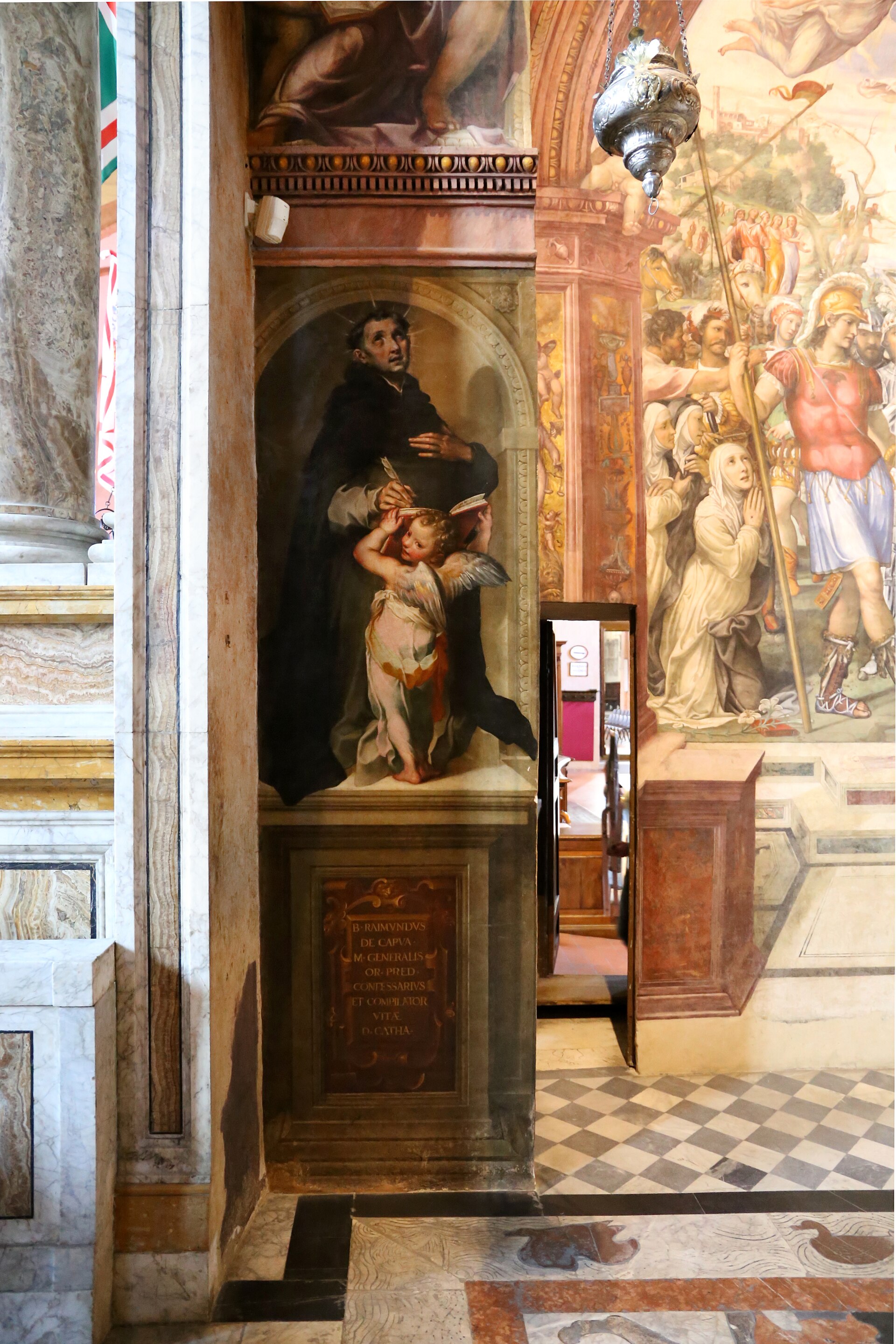
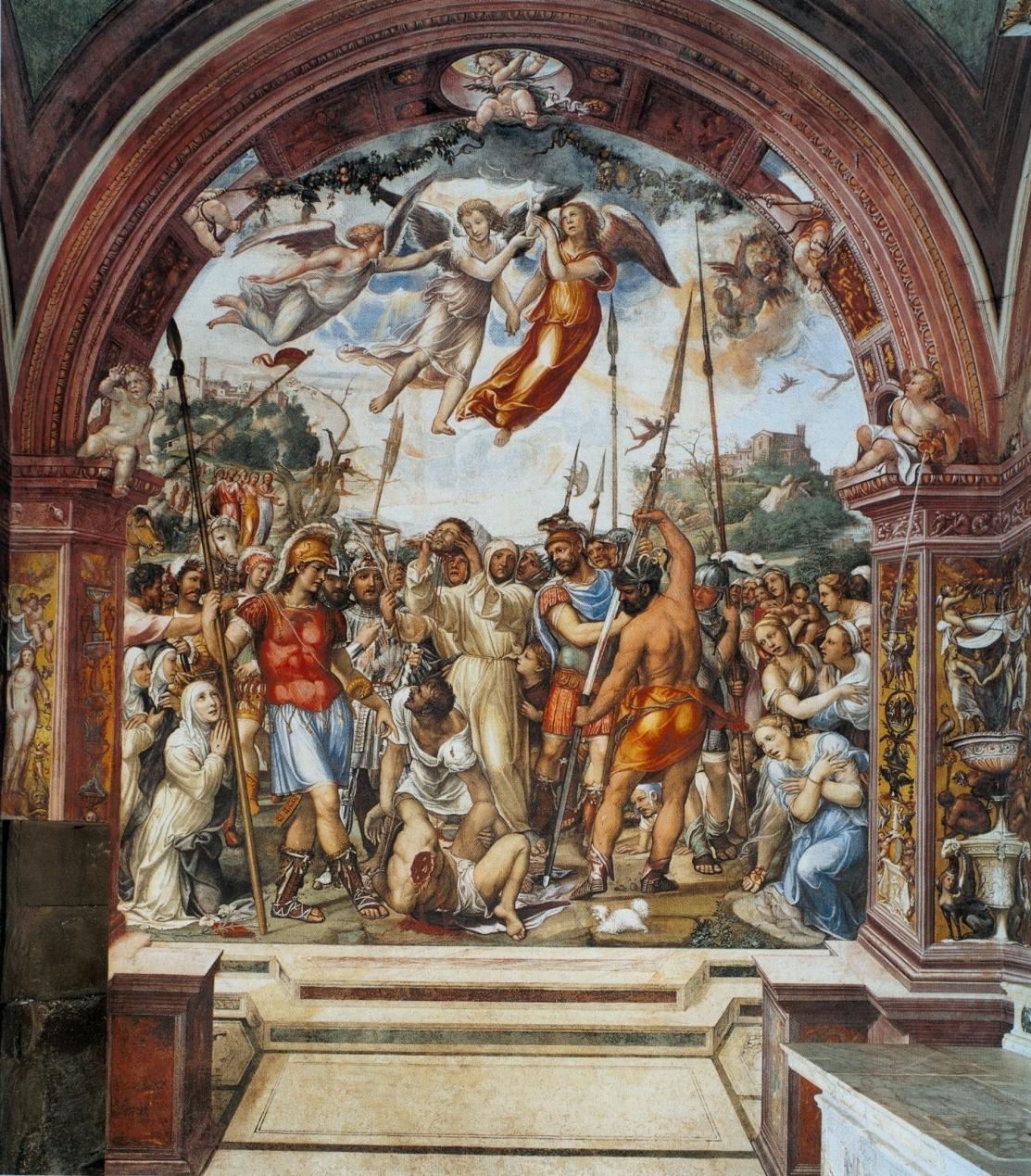
The most famous of all Catherine's letters is the one she wrote to Raymond of Capua after the beheading of a young man in Siena. Modern writers call him Niccolo di Toldo; Scudder's English calls him Niccolo Tuldo. Scudder gives what was known of the case: "A young gentleman from Perugia, Niccolo Tuldo by name, had been condemned to death for speaking critically of the Sienese Government. It does not appear that he was a serious political conspirator, but simply a young man whose aristocratic sympathies led him thoughtlessly to the use of haughty or bitter speech."54 The letter itself is the only first-hand account of what Catherine did. Scudder warns that most translators had dropped "the opening and closing paragraphs, with their amazing, confused, and to our modern taste almost shocking metaphors," and printed it whole.54 The central part follows, in her translation, without cuts:
"Up, up, sweetest my father! and let us sleep no more! For I hear such news that I wish no more bed of repose or worldly state. I have just received a Head in my hands, which was to me of such sweetness as heart cannot think, nor tongue say, nor eye see, nor the ears hear. The will of God went on through the other mysteries wrought before; of which I do not tell, for it would be too long. I went to visit him whom you know: whence he received such comfort and consolation that he confessed, and prepared himself very well. And he made me promise by the love of God that when the time of the sentence should come, I would be with him. So I promised, and did. Then in the morning, before the bell rang, I went to him: and he received great consolation. I led him to hear Mass, and he received the Holy Communion, which he had never before received. His will was accorded and submitted to the will of God; and only one fear was left, that of not being strong at the moment. But the measureless and glowing goodness of God deceived him, creating in him such affection and love in the desire of God that he did not know how to abide without Him, and said: 'Stay with me, and do not abandon me. So it shall not be otherwise than well with me. And I die content.' And he held his head upon my breast. ...
"I waited for him then at the place of justice; and waited there with constant prayer, in the presence of Mary and of Catherine, Virgin and martyr. But before I attained, I prostrated me, and stretched my neck upon the block; but my desire did not come there, for I had too full consciousness of myself. Then up! I prayed, I constrained her, I cried 'Mary!' for I wished this grace, that at the moment of death she should give him a light and a peace in his heart, and then I should see him reach his goal. ...
"Then he came, like a gentle lamb; and seeing me, he began to smile, and wanted me to make the sign of the Cross. When he had received the sign, I said: 'Down! To the Bridal, sweetest my brother! For soon shalt thou be in the enduring life.' He prostrated him with great gentleness, and I stretched out his neck; and bowed me down, and recalled to him the Blood of the Lamb. His lips said naught save Jesus! and, Catherine! And so saying, I received his head in my hands, closing my eyes in the Divine Goodness, and saying, 'I will!'"54
Then she describes what she saw in prayer: Christ "stood wounded, and received the blood," and "received his soul, which He put into the open treasure-house of His Side, full of mercy; the primal Truth showing that by grace and mercy alone He received it, and not for any other work."54 The letter ends: "When he was at rest, my soul rested in peace and in quiet, in so great fragrance of blood that I could not bear to remove the blood which had fallen on me from him."54
Readers must take this letter carefully. Its outward facts (the visit in prison, his confession, his first communion, her promise, her waiting at the scaffold, his last words, the head in her hands) are told by the one person who was there and wrote within days. Its vision of the soul entering Christ's side is her account of what she saw in prayer, and a reader may weigh that as a report of an inner experience. Its language of blood and marriage ("To the Bridal") is the language of the whole Dialogue, where the Blood is the price of redemption and union with Christ is a wedding. The words "by grace and mercy alone He received it, and not for any other work" describe a man who had, by her account, done nothing in his life to deserve heaven and received it at the last hour. The letter was the subject of a fresco by Sodoma in Catherine's chapel in the church of San Domenico in Siena in 1526.

Did Catherine write or dictate?
Both. Raymond reported that she learned to read in her years of seclusion, having "originally got the alphabet from a companion of hers," and then, finding it slow, prayed and "was miraculously instructed"; Gardner adds that she seems to have studied nothing beyond "the Psalms and the offices of the Church."55 Writing came much later. In Letter 272 to Raymond, in the autumn of 1377, she wrote (in Gardner's translation): "This letter, and another that I sent you, I have written with my own hand on the Isola della Rocca, with many sighs and abundance of tears ... He had given me and prepared me to receive the faculty of writing; in order that, descending from the height, I might have somewhat wherewith to relieve my heart, that it might not burst ... In a wondrous way, He set it for me in my mind, even as the master does to the child when he gives him the copy."26 Tommaso Caffarini, a Dominican of her circle, reported that her first letter in her own hand was to Stefano Maconi and ended: "Know, my dearest son, that this is the first letter that I have ever written"; on Maconi's word he added that she "afterwards often wrote her own letters, as also certain pages of the Dialogo."26 Scudder's short version, "She learned to write only three years before her death, and even after this time was in the habit of dictating her correspondence, sometimes two or three letters at a time,"56 agrees with this, and Benedict XVI said in 2010 that she "learned to read with difficulty and learned to write in adulthood."12 The claim that she learned "miraculously" is her own and her disciples'. The fact that she could write by 1377 and still dictated most of her work rests on her own letter and on several witnesses.
Her use of Scripture
Catherine had no school training in theology, yet her pages are full of the Bible. She knew it as she heard it in the Latin liturgy, in sermons and in the Psalms she prayed, and she quotes it the way a preacher does, from memory, joining verses and adding her own glosses. Schaff observed in 1910 that the letters show "some acquaintance with the New Testament from which she quotes the greater precepts," and that "One of her most frequent expressions is the blood of Christ."25 The table lists the Scripture texts used in the passages quoted in this lesson, in the order they appear. References follow the KJV numbering, with the Vulgate and Douay-Rheims numbering of the Psalms in brackets.
| Passage in this lesson | Scripture used | How she uses it |
|---|---|---|
| Dialogue, opening chapter (union by love) | John 14:21, 23 | "he shall be one thing with Me and I with him": love makes the soul "another Himself" |
| Providence, section 3 (finite works) | 1 Corinthians 13:1 to 3 | works without love "would be worth nothing" |
| The Bridge (Discretion, sections 7 to 11) | Genesis 3 (the Fall); John 12:32; John 14:6; John 8:12 | the broken road, the lifted Christ who draws "all things," Christ the Way and the Light |
| The Bridge after the Ascension (section 13) | Acts 1:11; John 16:28; John 14:18 | Christ returns by the Holy Spirit and by His teaching |
| The three powers (sections 31, 34) | Matthew 18:20; Matthew 22:37 to 40 | "two or three gathered": the two commandments and the three powers |
| Thirst (section 33) | John 7:37 (with John 7:38 and John 4:14) | "Whosoever thirsts, let him come to Me and drink" |
| Servile fear and love (section 36) | Matthew 5:17 | the law of fear fulfilled by the law of love |
| Obedience (Obedience, sections 2 and 10) | Matthew 16:19 (the keys); Romans 5:12 to 19 | the key of obedience; Adam's disobedience and Christ's obedience |
| Closing prayer (section 11) | Psalm 36:9 [35:10]; Psalm 42:1 [41:2]; 2 Corinthians 5:14 | "light in Your light," the hart and the spring, love that constrains |
| Prayer of 1380 | Jeremiah 18:4; Genesis 2:7; Luke 18:13 | God the potter; the body of dust; "I have sinned, Lord, be merciful" |
| Letters to Gregory XI | Paul on the Cross ("so Paul says": no verse is named; compare Galatians 6:14 and Colossians 2:14 to 15) | "as we were freed by the Cross," so the crusade under "the standard of the holy Cross" will free Christians from their wars |
| Letter to the King of France | John 14:6 (in Latin, "Ego sum Via, Veritas et Vita"); Luke 23:34; Matthew 22:37 to 39 | Christ the Way, "ascending the pulpit of the most holy Cross"; "Father, forgive"; love of God and neighbor as the cure for war |
| Letter on Niccolo di Toldo | John 19:34 (the pierced side); Revelation 19:7 to 9 (the marriage of the Lamb); 1 Corinthians 2:9 | the open side of Christ, "To the Bridal," "nor eye see, nor the ears hear" |
| Her death (Barduccio's letter) | Luke 23:46 | "Father, into Your Hands I commend my soul" |
Three things stand out from the list. Most of her texts come from the Gospel of John and from Paul, the parts of the New Testament on which the medieval and the Reformation preachers alike most often drew. Her Bible was the Latin one, and at least once (John 12:32, "all things") the Latin wording shapes her teaching. And her favorite theme is not a single verse at all but the blood of Christ, which she uses as a summary of the whole Gospel. In Thorold's abridged Dialogue the word "Blood" or "blood" appears 155 times and "Bridge" 79 times, counted for this lesson in the Christian Classics Ethereal Library text.
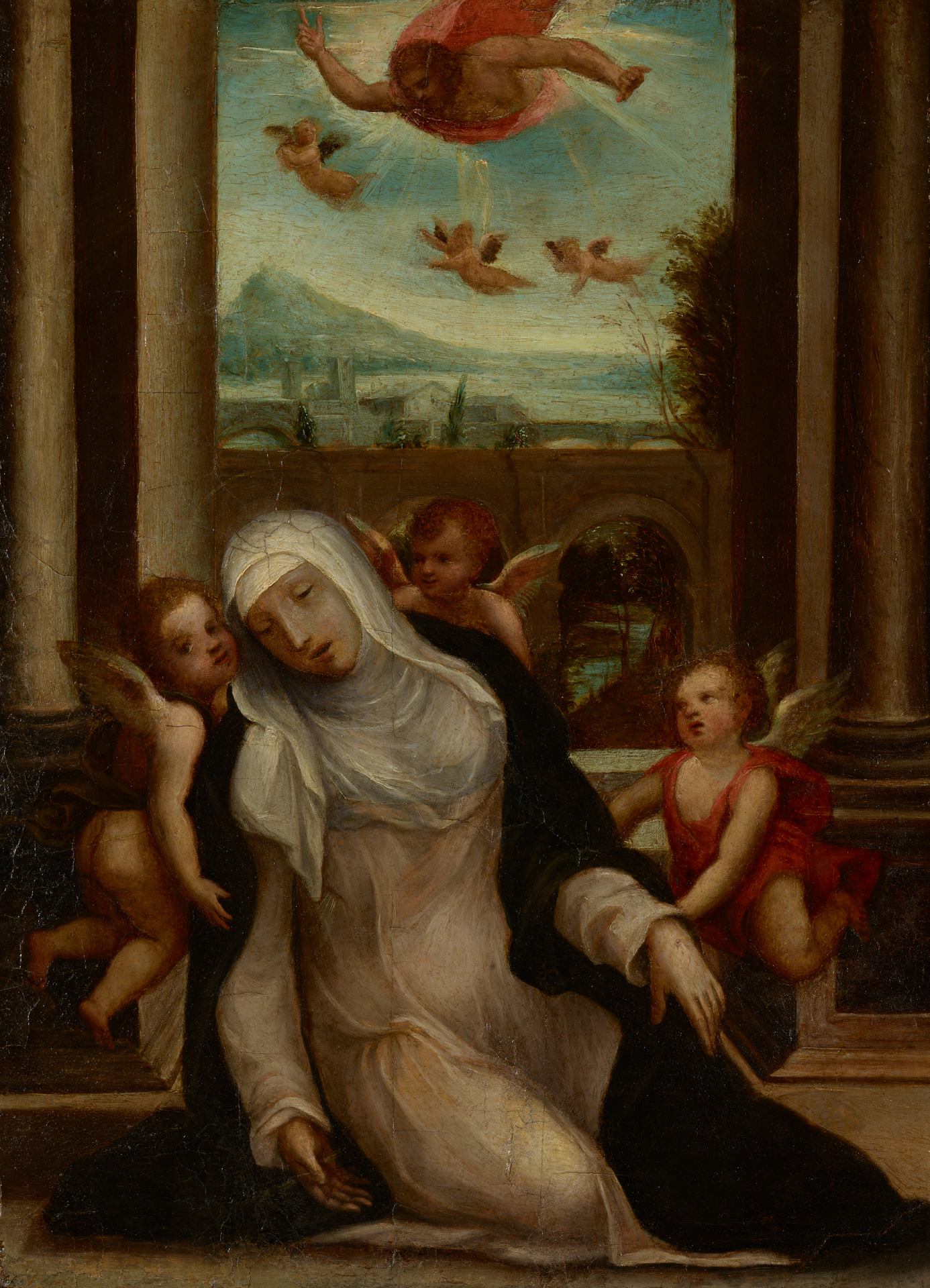

How Protestant readers have read her
A "witness to the truth"
The first Protestant use of Catherine was as a witness against the corruption of the late medieval Church. David S. Schaff, writing the medieval volume of his father Philip Schaff's History of the Christian Church (1910), recorded it: "The stress Catherine laid upon the pope's responsibility to God and her passionate reproof of an unworthy and hireling ministry, inclined some to give her a place among the heralds of the Protestant Reformation. Flacius Illyricus included her in the list of his witnesses for the truth, Catalogus testium veritatis."25 Matthias Flacius Illyricus was a Lutheran theologian, and his Catalogus gathered medieval voices that had protested against abuses in the Church, to show that the Reformation's complaints were old ones.
Schaff himself, a Presbyterian scholar, admired her and set limits to the claim. He praised her teaching on discretion in penance and wrote: "Monastic as Catherine was, yet no evangelical guide-book could write more truly than she did in most particulars." He judged the letters "a valuable manual of religious devotion, especially to those who are on their guard against being carried away by the underlying quietistic tone." And he concluded: "But Catherine, admirable as these sentiments were, moved within the limits of the mediaeval Church. She placed piety back of penitential exercises in love and prayer and patience, but she never passed beyond the ascetic and conventual conception of the Christian life into the open air of liberty through faith."25
Two English-language readers
Two English-language writers of the early twentieth century did much to make Catherine known to readers of English. Vida D. Scudder, an American scholar, translated the letters in 1905 and wrote of them with open admiration: "Catherine Benincasa was probably the most remarkable woman of the fourteenth century, and her letters are the precious personal record of her inner as of her outer life."56 She also wrote that Catherine shared, with Savonarola and with Luther, "the dream ... of thorough Church-reform."57 The English writer Evelyn Underhill, in Mysticism (first published 1911; quoted here from the twelfth edition of 1930), used Catherine as a leading example of the mystic who turns to public action, naming her with Bernard of Clairvaux and Joan of Arc as "the supreme examples" of "immensely virile souls whose participation in the Absolute Life has seemed to force on them a national destiny." She read the dictation of the Dialogue psychologically: it "may mean no more than the absorbed state of recollection in which the creative faculty works most freely."29
Where Protestant readers part company
The texts in this lesson show plainly the points at which a Lutheran, Reformed or evangelical reader stops. Catherine calls the pope "sweet Christ on earth" and says Christ placed the key of heaven "in the hands of His vicar."23 She speaks of satisfaction for sins, of the "infinite merit" of suffering joined to love, and of offering her own pains for the sins of others: "their every pain, whether spiritual or corporeal, from wherever it may come, receives infinite merit, and satisfies for a guilt which deserved an infinite penalty."58 She teaches the sacrament of penance as the way back to grace ("a holy confession, contrition of heart, satisfaction, and purpose of amendment"23) and calls on Mary at Niccolo's execution. Each of these is what the Lutheran Augsburg Confession (1530) and Calvin's Institutes argued against, as lesson 07 sets out in their own words.
The same texts also contain sentences that Protestant readers have found close to their own faith: "no one, with his own justice alone, could arrive at Eternal Life";13 "I am the thief and You have been punished for me";15 "Not my virtues, but only Your charity";40 "I will hide myself in the wounds of Christ crucified, and bathe myself in His Blood";37 and her last words as Barduccio heard them, "not through my merits, but through Your mercy alone."46 Catholic readers answer that these lines are not in tension with the rest: in Catholic teaching all merit is itself the gift of grace, a point Aquinas makes in the passages lesson 07 reads. The two readings rest on the same words, and a fair reader can see why each side finds itself in them.
How Catholic teaching uses her
Pius II canonized Catherine in 1461, and Paul VI proclaimed her a Doctor of the Church in 1970, with Teresa of Avila the first women given that title; lesson 10 gives the dates and documents. The vatican.va text of Paul VI's homily is headed "Domenica, 3 ottobre 1970" and speaks of "proclamare Dottore della Chiesa la umile e sapiente vergine domenicana, Caterina da Siena" ("proclaiming as Doctor of the Church the humble and wise Dominican virgin, Catherine of Siena," translated for this lesson).49 The pope was frank that her title did not rest on school learning: "né possiamo pretendere dalla non colta vergine di Fontebranda le alte speculazioni" ("nor can we expect from the unschooled virgin of Fontebranda the lofty speculations" of the theologians). What struck him most was "la sapienza infusa," infused wisdom, "dovuta ad un carisma di sapienza dello Spirito Santo, un carisma mistico" ("due to a charism of wisdom from the Holy Spirit, a mystical charism").49 He also named the Blood as her theme: "Questo Sangue del Salvatore, la Santa lo vede fluire continuamente nel Sacrificio della Messa e nei Sacramenti" ("This Blood of the Savior the Saint sees flowing continually in the Sacrifice of the Mass and in the Sacraments").49
The Catechism of the Catholic Church (1992, English 1994) quotes the Dialogue at paragraphs 313, 356 and 1937. Paragraph 313, on providence, gives her words to "those who are scandalized and rebel against what happens to them": "Everything comes from love, all is ordained for the salvation of man, God does nothing without this goal in mind."59 Paragraph 356, on the dignity of the human person, quotes her prayer: "You are taken with love for her; for by love indeed you created her, by love you have given her a being capable of tasting your eternal Good."60 It is the same thought as the Thorold sentence quoted above, "by love, I created her." Paragraph 1937, on the differences of gifts among people, quotes the passage on the virtues given "diversely": "I distribute the virtues quite diversely; I do not give all of them to each person, but some to one, some to others.... I have willed that one should need another and that all should be my ministers in distributing the graces and gifts they have received from me."61 Thorold renders the same passage: "I could easily have created men possessed of all that they should need both for body and soul, but I wish that one should have need of the other, and that they should be My ministers to administer the graces and the gifts that they have received from Me."62 Benedict XVI devoted a general audience to her on November 24, 2010.12
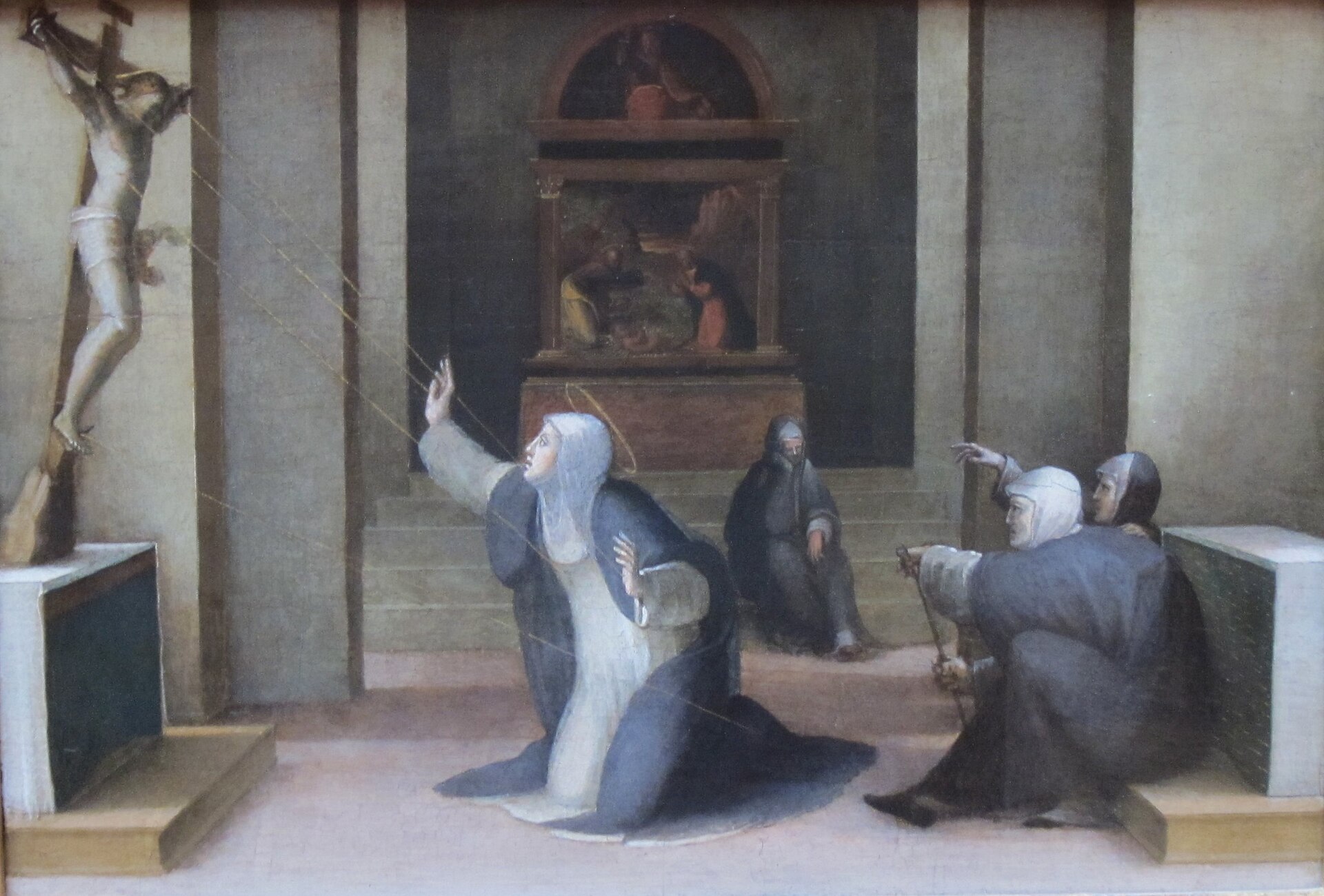

What the record shows and what it does not
- Documented fact: the Dialogue was taken down by her secretaries in Siena and completed in 1378 (Raymond, quoted by Gardner); it was printed at Bologna in 1472; nearly 400 letters survive (373 in Gigli's edition; the count differs by edition), almost all as copies, and none in her own hand; 26 prayers were preserved by her disciples.
- Her own words: the Bridge with its three steps, the cell of self-knowledge, the five tears, obedience as the key, "sweet Christ on earth," "Be manly in my sight," the letter on Niccolo di Toldo and her account in Letter 272 of learning to write.
- What her disciples report: that she dictated the book "rapt" in ecstasy (Raymond); that she dictated three letters at once (Francesco Malavolti); her last words (Barduccio Canigiani).
- Later additions and legend: the title page date of 1370 in Thorold's edition; popular claims that she "could not write" or that she alone brought the papacy back to Rome.
- Scholarly reading: Gardner's six-treatise division; Schaff's judgment that she stayed "within the limits of the mediaeval Church"; Underhill's psychological reading of the dictation; Paul VI's "infused wisdom."
- Open questions: how far the secretaries shaped the wording of the book; which "particular case" the fourth petition meant; the exact modern count of the letters.
Claims checked
"The Dialogue was completed in 1370"
Refuted. The title page of Thorold's 1907 edition says "completed in the year of our Lord 1370."5 Raymond's account, Catherine's own Letter 272 (autumn 1377) describing the vision that became the book, and Gardner's dating to the late summer and autumn of 1378 all rule that year out.1 The figure is a printing or copying error.
"Catherine could not read or write"
Refuted as stated. Raymond reports that she learned to read in her years of seclusion, and her own Letter 272 (1377) says she wrote that letter "with my own hand"; Caffarini reports a first autograph letter to Stefano Maconi.5526 It is true that she learned to write only about three years before her death, that she dictated almost everything, and that no page in her hand survives.56
"She dictated the whole Dialogue in ecstasy, as God's words"
Unresolved. Raymond says she dictated "when, according to her custom, she was rapt out of her corporeal senses," and the old title page repeats it.1 Catherine herself, in her last letter, called it "the book" and grouped it with writings "in which I found some recreation."4 Whether a reader takes the disciples' description as a report of ecstasy or, with Underhill, as deep recollection, the historical record shows a spoken text taken down by others.29
"She told Gregory XI, 'Be a man'"
Partly supported. The wording in Scudder's translation is "Be manly in my sight, and not timorous."50 Schaff paraphrases her as calling on him to "play the man."25 The sense is hers; the short form "Be a man" is a later paraphrase.
"She called the pope 'sweet Christ on earth'"
Supported. The phrase appears in her letters to and about Gregory XI and Urban VI and in a letter of about 1372 to Gerard du Puy.1139
"Catherine single-handedly brought the pope back to Rome"
Unsupported. Her letters urged the return, and she went to Avignon in 1376. But Schaff, following Mirot and with Pastor and Gardner, held that Gregory had already decided to return before her visit.52 Lesson 10 sets out the evidence.
"She caught the head of a condemned man in her hands"
Supported, by her own account. Her letter to Raymond says: "I received his head in my hands."54 The reason for his sentence (critical speech against the Sienese government) comes from Scudder's introduction, not from the letter.
"Her letter made Hawkwood vow to go on crusade"
Partly supported. The old heading of the letter says Raymond obtained from Hawkwood and his captains "a promise on the sacrament that they would go," signed and sealed.53 No crusade took place, and Hawkwood went on fighting in Italy.
"Early Protestants claimed her as a forerunner"
Supported. Flacius Illyricus listed her among his "witnesses for the truth."25 Schaff, a Protestant historian, also judged that she stayed within the medieval Church's limits.
"Paul VI made her a Doctor of the Church on October 4, 1970"
Supported, with a note on the date. October 4, 1970 is the date usually given. The vatican.va text of the homily is headed "Domenica, 3 ottobre 1970," but October 3, 1970 was a Saturday and October 4 the Sunday, so the heading appears to contain a slip; the page's web address carries the same date (19701003).49 The Christian Classics Ethereal Library note at the head of Thorold's text gives October 4, 1970.63
Hard questions and answers
If the secretaries wrote it down, how much of the Dialogue is Catherine's?
The evidence is that the words are hers as spoken and the arrangement partly theirs. Raymond says the secretaries wrote "whatever she then dictated."1 The book's repetitions, its sudden changes of image (which Thorold admits he sometimes smoothed: "she introduces a metaphor and forgets it"5) and the reversal of the second and third petitions between the first and last chapters all point to a spoken text. The chapter divisions differ between manuscripts, Raymond's Latin and the printed editions, which is why Gardner calls his own division "a compromise."7 A careful reader treats the ideas as hers and the chapter order as the work of her circle.
Does the Bridge teach salvation by works? (a Lutheran or Reformed question)
Catherine would not have used the terms of the sixteenth century debate. In her picture, the Bridge itself, the stones of virtue and the mortar of the Blood are all Christ's; "no one, with his own justice alone, could arrive at Eternal Life."13 Yet she insists that a person must walk: "it is not enough ... unless you walk thereon," and God "will not save you without yourselves."1423 She also teaches the satisfying value of suffering joined to love and the sacrament of penance.58 A Lutheran reader will find there the medieval doctrine that the Reformation rejected; a Catholic reader will find the doctrine Trent later defined, that grace is first and human cooperation is itself a gift. Lesson 07 sets the two positions side by side.
Why did she demand obedience to priests and popes she herself called corrupt?
Because she separated the office from the person. The Dialogue says the priest's dignity "belongs to good and bad alike," that bad priests are like ragged messengers bringing a treasure, and that lay people must "pray for them, and not judge them."38 She used the hardest words for the sins of the clergy and refused to justify rebellion against the pope. A reader may judge that position consistent or not, but it is the position she took in the book and the letters alike.
How should a modern reader take her calls for a crusade?
As part of the record, quoted whole. She called Muslims "infidel dogs" in the letter to Hawkwood and urged Gregory to raise "the standard of the holy Cross."5350 She also hoped that "the infidel" would be converted and would renew the Church by "the fragrance of their virtue."50 Her purposes, as her letters state them, were to stop Christians killing Christians in Italy and to win the conversion of non-Christians; the means she proposed was the holy war of her age. Lesson 12 reads the earlier and quite different meeting of Francis with the Sultan in 1219.
Was she a mystic or a politician?
Her texts do not allow a choice. The same pages that describe the Bridge and the Trinity as "a deep Sea" ask the pope to appoint better cardinals and to send letters to Lucca and Pisa.11 Scudder wrote that "the task is impossible without the vision," and Underhill named her among the mystics whose inner life "seemed to force on them a national destiny."4729 Paul VI spoke of her wisdom as a gift of the Spirit.49 All three, an American translator, an English student of mysticism and a pope, read her contemplation and her public work as one thing.
Which translation should a reader use today?
For the Dialogue, Thorold's abridged text is free and reliable for what it contains, but it is incomplete (much of the teaching on tears and the later providence chapters is missing) and it is not numbered. Thorold's full 1896 edition, Raymond's Latin and the modern critical translations by Suzanne Noffke (1980 and later) give the whole. For the letters, Scudder's selection is free and lively; Gardner warned in 1907 that the printed Italian texts were "sadly corrupt," and later critical work has gone beyond them.6 The reading plan in lesson 14 suggests where to begin.
The next lesson turns to Francis of Assisi, born more than 160 years before Catherine: Lesson 12: Francis of Assisi: His Life, the Rule and the Canticle of the Creatures. For the Dominican order to which Catherine belonged as a lay member, see lesson 02, and for the monastic background of her "cell," Church History, Part A, lesson 07.
Learn more
- The Dialogue of Saint Catherine of Siena (Thorold), CCEL: Read the Bridge chapters (Discretion, sections 7 to 13) and the closing prayer (Obedience, section 11) whole.
- Scudder, Saint Catherine of Siena as Seen in Her Letters (Project Gutenberg): The three letters to Gregory XI, the letter to Hawkwood and the letter on Niccolo Tuldo, each with Scudder's short introduction.
- Gardner, Saint Catherine of Siena (1907), Internet Archive: The chapter on her literary work describes the book, the letters and the prayers and gives the printing history.
- Benedict XVI on Catherine of Siena (2010): A short modern papal reading of her life and teaching.
- Lesson 10: Catherine of Siena: Her Life, Her Letters and the Return of the Papacy to Rome: Her life, the Avignon mission and the Schism, which this lesson does not retell.
Still being checked (7 items)
These points could not be confirmed against a primary source when this lesson was written and fact checked in October 2026. The text above states each one as uncertain.
- The modern total of surviving letters was not checked against a critical edition: Gardner (1907) gives 373 in Gigli's edition, Schaff (1910) "nearly four hundred" and Tylus (2010) "almost 400"; the figure of about 380 often given could not be confirmed.
- Gardner's page numbers are read from the running heads of an OCR scan and may be off by one page.
- The Vatican homily page is headed "Domenica, 3 ottobre 1970" (and its address carries 19701003), while October 4, 1970 (a Sunday) is the date usually given; the slip in the heading is inferred from the calendar, not from a Vatican correction.
- Thorold's full 1896 edition was not opened; the lesson quotes only the 1907 abridged edition and relies on Gardner for the 1896 date.
- Anselm's Why God Became Man is dated about 1098 from general reference, not from a text opened for this lesson.
- The Scripture list covers only the passages quoted in the lesson and the chapters they come from; it is not a count for the whole Dialogue or all the letters.
- Catherine's Italian phrase "dolce Cristo in terra" is quoted from Paul VI's homily; the Italian of her letters was not opened.
Notes
- Edmund G. Gardner, Saint Catherine of Siena: A Study in the Religion, Literature and History of the Fourteenth Century in Italy (London: J. M. Dent and Co.; New York: E. P. Dutton and Co., 1907), ch. 16, "Catherine's Literary Work,", pp. 351 to 354, quoting Raymond of Capua, Legenda Major III.i.2 (section 332), and the Vatican manuscript Cod. Barb. Lat. 4063, Internet Archive scan (University of Toronto copy) (retrieved Nov. 5, 2026). Read it online. ↩
- Vida D. Scudder, trans. and ed., Saint Catherine of Siena as Seen in Her Letters (1905), "Chief Events in the Life of Saint Catherine" and "Brief Table of Contemporary Public Events" (entries for 1372, 1376 and 1378), Project Gutenberg eBook #7403, from the 1905 edition (retrieved Nov. 5, 2026). Read it online. ↩
- Catherine of Siena, The Dialogue of the Seraphic Virgin Catherine of Siena, trans. Algar Thorold, new and abridged edition (London: Kegan Paul, Trench, Trubner and Co., 1907), A Treatise of Divine Providence, section 2 (the chapter beginning "How the desire of this soul grew"), Christian Classics Ethereal Library text (retrieved Nov. 5, 2026). Read it online. ↩
- Vida D. Scudder, trans. and ed., Saint Catherine of Siena as Seen in Her Letters (1905), the last letter, "To Master Raimondo of Capua, of the Order of the Preachers" (Rome, 1380), Project Gutenberg eBook #7403, from the 1905 edition (retrieved Nov. 5, 2026). Read it online. ↩
- Catherine of Siena, The Dialogue of the Seraphic Virgin Catherine of Siena, trans. Algar Thorold, new and abridged edition (London: Kegan Paul, Trench, Trubner and Co., 1907), title page and Thorold's Introduction (dated "Viareggio, September 1906"), Christian Classics Ethereal Library text (retrieved Nov. 5, 2026). Read it online. ↩
- Edmund G. Gardner, Saint Catherine of Siena: A Study in the Religion, Literature and History of the Fourteenth Century in Italy (London: J. M. Dent and Co.; New York: E. P. Dutton and Co., 1907), Preface and bibliographical note, pp. xii to xv, Internet Archive scan (University of Toronto copy) (retrieved Nov. 5, 2026). Read it online. ↩
- Edmund G. Gardner, Saint Catherine of Siena: A Study in the Religion, Literature and History of the Fourteenth Century in Italy (London: J. M. Dent and Co.; New York: E. P. Dutton and Co., 1907), ch. 16, p. 353 and note 2, Internet Archive scan (University of Toronto copy) (retrieved Nov. 5, 2026). Read it online. ↩
- Catherine of Siena, The Dialogue of the Seraphic Virgin Catherine of Siena, trans. Algar Thorold, new and abridged edition (London: Kegan Paul, Trench, Trubner and Co., 1907), A Treatise of Divine Providence, section 1 (the opening chapter), Christian Classics Ethereal Library text (retrieved Nov. 5, 2026). Read it online. ↩
- Catherine of Siena, The Dialogue of the Seraphic Virgin Catherine of Siena, trans. Algar Thorold, new and abridged edition (London: Kegan Paul, Trench, Trubner and Co., 1907), A Treatise of Obedience, section 10 ("This is a brief repetition of the entire book"), Christian Classics Ethereal Library text (retrieved Nov. 5, 2026). Read it online. ↩
- Catherine of Siena, The Dialogue of the Seraphic Virgin Catherine of Siena, trans. Algar Thorold, new and abridged edition (London: Kegan Paul, Trench, Trubner and Co., 1907), A Treatise of Divine Providence, section 4 (the chapter beginning "How desire and contrition of heart satisfies"), Christian Classics Ethereal Library text (retrieved Nov. 5, 2026). Read it online. ↩
- Vida D. Scudder, trans. and ed., Saint Catherine of Siena as Seen in Her Letters (1905), the first letter "To Gregory XI," with Scudder's introduction quoting the letter of 1372 to Gerard du Puy, Project Gutenberg eBook #7403, from the 1905 edition (retrieved Nov. 5, 2026). Read it online. ↩
- Benedict XVI, General Audience on Saint Catherine of Siena, November 24, 2010, English text at vatican.va (retrieved Nov. 5, 2026). Read it online. ↩
- Catherine of Siena, The Dialogue of the Seraphic Virgin Catherine of Siena, trans. Algar Thorold, new and abridged edition (London: Kegan Paul, Trench, Trubner and Co., 1907), A Treatise of Discretion, section 7 (the chapter beginning "How the road to Heaven being broken"), Christian Classics Ethereal Library text (retrieved Nov. 5, 2026). Read it online. ↩
- Catherine of Siena, The Dialogue of the Seraphic Virgin Catherine of Siena, trans. Algar Thorold, new and abridged edition (London: Kegan Paul, Trench, Trubner and Co., 1907), A Treatise of Discretion, section 8 (the chapter beginning "How God induces the soul to look at the greatness of this Bridge"), Christian Classics Ethereal Library text (retrieved Nov. 5, 2026). Read it online. ↩
- Catherine of Siena, The Dialogue of the Seraphic Virgin Catherine of Siena, trans. Algar Thorold, new and abridged edition (London: Kegan Paul, Trench, Trubner and Co., 1907), A Treatise of Discretion, section 9 (the chapter beginning "How this soul prays God to show her those who cross"), Christian Classics Ethereal Library text (retrieved Nov. 5, 2026). Read it online. ↩
- Catherine of Siena, The Dialogue of the Seraphic Virgin Catherine of Siena, trans. Algar Thorold, new and abridged edition (London: Kegan Paul, Trench, Trubner and Co., 1907), A Treatise of Discretion, section 10 (the chapter beginning "How this Bridge has three steps"), Christian Classics Ethereal Library text (retrieved Nov. 5, 2026). Read it online. ↩
- The Holy Bible, Douay-Rheims version (Challoner revision), John 12:32, at drbo.org (retrieved Nov. 5, 2026). Read it online. ↩
- The Holy Bible, King James Version (1611), John 12:32, text at bible-api.com (retrieved Nov. 5, 2026). Read it online. ↩
- Catherine of Siena, The Dialogue of the Seraphic Virgin Catherine of Siena, trans. Algar Thorold, new and abridged edition (London: Kegan Paul, Trench, Trubner and Co., 1907), A Treatise of Discretion, section 11 (the chapter beginning "How this Bridge is built of stones"), Christian Classics Ethereal Library text (retrieved Nov. 5, 2026). Read it online. ↩
- The Holy Bible, Douay-Rheims version (Challoner revision), John 14:6, at drbo.org (retrieved Nov. 5, 2026). Read it online. ↩
- The Holy Bible, Douay-Rheims version (Challoner revision), John 8:12, at drbo.org (retrieved Nov. 5, 2026). Read it online. ↩
- Catherine of Siena, The Dialogue of the Seraphic Virgin Catherine of Siena, trans. Algar Thorold, new and abridged edition (London: Kegan Paul, Trench, Trubner and Co., 1907), A Treatise of Discretion, section 13 (the chapter beginning "How this Bridge, having reached to Heaven on the day of the Ascension"), Christian Classics Ethereal Library text (retrieved Nov. 5, 2026). Read it online. ↩
- Catherine of Siena, The Dialogue of the Seraphic Virgin Catherine of Siena, trans. Algar Thorold, new and abridged edition (London: Kegan Paul, Trench, Trubner and Co., 1907), A Treatise of Obedience, section 2 (the chapter beginning "How obedience is the key with which Heaven is opened"); where the translation has a word this site does not use, an ellipsis marks the omission, Christian Classics Ethereal Library text (retrieved Nov. 5, 2026). Read it online. ↩
- Catherine of Siena, The Dialogue of the Seraphic Virgin Catherine of Siena, trans. Algar Thorold, new and abridged edition (London: Kegan Paul, Trench, Trubner and Co., 1907), A Treatise of Discretion, section 31 (the chapter beginning "How the three steps figured in the Bridge"), Christian Classics Ethereal Library text (retrieved Nov. 5, 2026). Read it online. ↩
- David S. Schaff, History of the Christian Church, vol. 6, The Middle Ages, A.D. 1294 to 1517 (New York: Charles Scribner's Sons, 1910), ch. 3, section 21, "Catherine of Siena, the Saint," Christian Classics Ethereal Library text (retrieved Nov. 5, 2026). Read it online. ↩
- Edmund G. Gardner, Saint Catherine of Siena: A Study in the Religion, Literature and History of the Fourteenth Century in Italy (London: J. M. Dent and Co.; New York: E. P. Dutton and Co., 1907), ch. 16, pp. 368 to 371, translating Letter 272 (Tommaseo numbering) and the testimony of Francesco Malavolti and Tommaso Caffarini, with the note on the Vatican manuscript text of cap. 167, Internet Archive scan (University of Toronto copy) (retrieved Nov. 5, 2026). Read it online. ↩
- The Holy Bible, Douay-Rheims version (Challoner revision), Matthew 18:20, at drbo.org (retrieved Nov. 5, 2026). Read it online. ↩
- Catherine of Siena, The Dialogue of the Seraphic Virgin Catherine of Siena, trans. Algar Thorold, new and abridged edition (London: Kegan Paul, Trench, Trubner and Co., 1907), A Treatise of Discretion, section 34 (the chapter beginning "The general method by which every rational creature"), Christian Classics Ethereal Library text (retrieved Nov. 5, 2026). Read it online. ↩
- Evelyn Underhill, Mysticism: A Study in the Nature and Development of Man's Spiritual Consciousness (London: Methuen, 1911; twelfth edition, 1930), Part One (quoting the Dialogue on the three steps and the three powers) and Part Two (on "immensely virile souls" and on the dictation of the Dialogue), Christian Classics Ethereal Library text of the twelfth edition (retrieved Nov. 5, 2026). Read it online. ↩
- Catherine of Siena, The Dialogue of the Seraphic Virgin Catherine of Siena, trans. Algar Thorold, new and abridged edition (London: Kegan Paul, Trench, Trubner and Co., 1907), A Treatise of Discretion, section 33 ("An exposition on Christ's words: Whosoever thirsts, let him come to Me and drink"), Christian Classics Ethereal Library text (retrieved Nov. 5, 2026). Read it online. ↩
- The Holy Bible, Douay-Rheims version (Challoner revision), John 7:37 to 38, at drbo.org (retrieved Nov. 5, 2026). Read it online. ↩
- Catherine of Siena, The Dialogue of the Seraphic Virgin Catherine of Siena, trans. Algar Thorold, new and abridged edition (London: Kegan Paul, Trench, Trubner and Co., 1907), A Treatise of Discretion, sections 35 and 36 (the chapter beginning "How servile fear is not sufficient"), Christian Classics Ethereal Library text (retrieved Nov. 5, 2026). Read it online. ↩
- The Holy Bible, Douay-Rheims version (Challoner revision), Matthew 5:17, at drbo.org (retrieved Nov. 5, 2026). Read it online. ↩
- Catherine of Siena, The Dialogue of the Seraphic Virgin Catherine of Siena, trans. Algar Thorold, new and abridged edition (London: Kegan Paul, Trench, Trubner and Co., 1907), A Treatise of Prayer, section 3 (heading: "Of the method by which the soul separates herself from imperfect love, and attains to perfect love, friendly and filial"), Christian Classics Ethereal Library text (retrieved Nov. 5, 2026). Read it online. ↩
- Catherine of Siena, The Dialogue of the Seraphic Virgin Catherine of Siena, trans. Algar Thorold, new and abridged edition (London: Kegan Paul, Trench, Trubner and Co., 1907), A Treatise of Prayer, section 13 ("How there are five kinds of tears"), Christian Classics Ethereal Library text (retrieved Nov. 5, 2026). Read it online. ↩
- Catherine of Siena, The Dialogue of the Seraphic Virgin Catherine of Siena, trans. Algar Thorold, new and abridged edition (London: Kegan Paul, Trench, Trubner and Co., 1907), A Treatise of Prayer, section 14 (the chapter beginning "Of the difference of these tears"), Christian Classics Ethereal Library text (retrieved Nov. 5, 2026). Read it online. ↩
- Catherine of Siena, The Dialogue of the Seraphic Virgin Catherine of Siena, trans. Algar Thorold, new and abridged edition (London: Kegan Paul, Trench, Trubner and Co., 1907), A Treatise of Prayer, section 2 (the chapter beginning "Here, touching something concerning the Sacrament of the Body of Christ"); where the translation has a word this site does not use, an ellipsis marks the omission, Christian Classics Ethereal Library text (retrieved Nov. 5, 2026). Read it online. ↩
- Catherine of Siena, The Dialogue of the Seraphic Virgin Catherine of Siena, trans. Algar Thorold, new and abridged edition (London: Kegan Paul, Trench, Trubner and Co., 1907), A Treatise of Prayer, section 29 ("A brief repetition of the preceding chapter; and of the reverence which should be paid to priests, whether they are good or bad"), Christian Classics Ethereal Library text (retrieved Nov. 5, 2026). Read it online. ↩
- Vida D. Scudder, trans. and ed., Saint Catherine of Siena as Seen in Her Letters (1905), the second letter "To Gregory XI," with Scudder's introduction (on "Babbo"), Project Gutenberg eBook #7403, from the 1905 edition (retrieved Nov. 5, 2026). Read it online. ↩
- Catherine of Siena, The Dialogue of the Seraphic Virgin Catherine of Siena, trans. Algar Thorold, new and abridged edition (London: Kegan Paul, Trench, Trubner and Co., 1907), A Treatise of Obedience, section 11 (the closing prayer), Christian Classics Ethereal Library text (retrieved Nov. 5, 2026). Read it online. ↩
- The Holy Bible, Douay-Rheims version (Challoner revision), Psalm 35:10 (Psalm 36:9 in the KJV numbering), at drbo.org (retrieved Nov. 5, 2026). Read it online. ↩
- The Holy Bible, Douay-Rheims version (Challoner revision), Psalm 41:2 (Psalm 42:1 in the KJV numbering), at drbo.org (retrieved Nov. 5, 2026). Read it online. ↩
- The Holy Bible, Douay-Rheims version (Challoner revision), 2 Corinthians 5:14, at drbo.org (retrieved Nov. 5, 2026). Read it online. ↩
- The Holy Bible, King James Version (1611), 2 Corinthians 5:14, text at bible-api.com (retrieved Nov. 5, 2026). Read it online. ↩
- Edmund G. Gardner, Saint Catherine of Siena: A Study in the Religion, Literature and History of the Fourteenth Century in Italy (London: J. M. Dent and Co.; New York: E. P. Dutton and Co., 1907), ch. 16, pp. 382 to 384, on the twenty-six prayers and translating the first and the last of them, Internet Archive scan (University of Toronto copy) (retrieved Nov. 5, 2026). Read it online. ↩
- Catherine of Siena, The Dialogue of the Seraphic Virgin Catherine of Siena, trans. Algar Thorold, new and abridged edition (London: Kegan Paul, Trench, Trubner and Co., 1907), appendix: "Letter of Ser Barduccio di Piero Canigiani, containing the Transit of the Seraphic Virgin, Saint Catherine of Siena," to Sister Catherine Petriboni, Christian Classics Ethereal Library text (retrieved Nov. 5, 2026). Read it online. ↩
- Vida D. Scudder, trans. and ed., Saint Catherine of Siena as Seen in Her Letters (1905), Scudder's Introduction, "St. Catherine of Siena as Seen in Her Letters", Project Gutenberg eBook #7403, from the 1905 edition (retrieved Nov. 5, 2026). Read it online. ↩
- Vida D. Scudder, trans. and ed., Saint Catherine of Siena as Seen in Her Letters (1905), the letter "To the King of France," with Scudder's introduction, Project Gutenberg eBook #7403, from the 1905 edition (retrieved Nov. 5, 2026). Read it online. ↩
- Paul VI, homily for the proclamation of Saint Catherine of Siena as Doctor of the Church, Italian text at vatican.va, headed "Domenica, 3 ottobre 1970"; English renderings of the Italian are made for this lesson (retrieved Nov. 5, 2026). Read it online. ↩
- Vida D. Scudder, trans. and ed., Saint Catherine of Siena as Seen in Her Letters (1905), the third letter "To Gregory XI," with Scudder's introduction quoting another letter to Gregory on the conversion of "the Infidel"; Scudder's dashes are printed as commas, Project Gutenberg eBook #7403, from the 1905 edition (retrieved Nov. 5, 2026). Read it online. ↩
- Vida D. Scudder, trans. and ed., Saint Catherine of Siena as Seen in Her Letters (1905), Scudder's introduction to the letter "To Sister Bartolomea della Seta, Nun in the Convent of Santo Stefano at Pisa", Project Gutenberg eBook #7403, from the 1905 edition (retrieved Nov. 5, 2026). Read it online. ↩
- David S. Schaff, History of the Christian Church, vol. 6 (1910), ch. 1, section 11, "The Re-establishment of the Papacy in Rome. 1377," text and note 243 (citing Leon Mirot, La politique pontificale et le retour du Saint-Siege a Rome, Paris, 1899, p. 101), Christian Classics Ethereal Library text (retrieved Nov. 5, 2026). Read it online. ↩
- Vida D. Scudder, trans. and ed., Saint Catherine of Siena as Seen in Her Letters (1905), the letter "To Messer John, the Soldier of Fortune and Head of the Company that Came in the Time of Famine," with its old heading and Scudder's introduction, Project Gutenberg eBook #7403, from the 1905 edition (retrieved Nov. 5, 2026). Read it online. ↩
- Vida D. Scudder, trans. and ed., Saint Catherine of Siena as Seen in Her Letters (1905), the letter "To Brother Raimondo of Capua, of the Order of the Preachers" on the death of Niccolo Tuldo, with Scudder's introduction, Project Gutenberg eBook #7403, from the 1905 edition (retrieved Nov. 5, 2026). Read it online. ↩
- Edmund G. Gardner, Saint Catherine of Siena: A Study in the Religion, Literature and History of the Fourteenth Century in Italy (London: J. M. Dent and Co.; New York: E. P. Dutton and Co., 1907), ch. 1, p. 21, summarizing Raymond of Capua's Legenda Major on her learning to read, Internet Archive scan (University of Toronto copy) (retrieved Nov. 5, 2026). Read it online. ↩
- Vida D. Scudder, trans. and ed., Saint Catherine of Siena as Seen in Her Letters (1905), Scudder's Introduction, opening pages, Project Gutenberg eBook #7403, from the 1905 edition (retrieved Nov. 5, 2026). Read it online. ↩
- Vida D. Scudder, trans. and ed., Saint Catherine of Siena as Seen in Her Letters (1905), Scudder's Introduction, on Catherine's program of Church reform, Project Gutenberg eBook #7403, from the 1905 edition (retrieved Nov. 5, 2026). Read it online. ↩
- Catherine of Siena, The Dialogue of the Seraphic Virgin Catherine of Siena, trans. Algar Thorold, new and abridged edition (London: Kegan Paul, Trench, Trubner and Co., 1907), A Treatise of Divine Providence, section 3 (the chapter beginning "How finite works are not sufficient"), Christian Classics Ethereal Library text (retrieved Nov. 5, 2026). Read it online. ↩
- Catechism of the Catholic Church, 2nd ed. (Libreria Editrice Vaticana), paragraph 313 and note 181 (citing the Dialogue, "On Divine Providence"), English text at vatican.va (retrieved Nov. 5, 2026). Read it online. ↩
- Catechism of the Catholic Church, paragraph 356 and note 221 (citing the Dialogue, "On Divine Providence"), English text at vatican.va (retrieved Nov. 5, 2026). Read it online. ↩
- Catechism of the Catholic Church, paragraph 1937 and note 43 (citing the Dialogue I, 7), English text at vatican.va (retrieved Nov. 5, 2026). Read it online. ↩
- Catherine of Siena, The Dialogue of the Seraphic Virgin Catherine of Siena, trans. Algar Thorold, new and abridged edition (London: Kegan Paul, Trench, Trubner and Co., 1907), A Treatise of Divine Providence, section 7 (the chapter beginning "How virtues are accomplished by means of our neighbor"), Christian Classics Ethereal Library text (retrieved Nov. 5, 2026). Read it online. ↩
- Christian Classics Ethereal Library, catalog description of Dialog of Catherine of Siena (Thorold translation) (retrieved Nov. 5, 2026). Read it online. ↩
- Jane Tylus, review of The Letters of Catherine of Siena, trans. Suzanne Noffke, O.P., 4 vols. (Tempe: Arizona Center for Medieval and Renaissance Studies, 2000 to 2008), Catholic Historical Review 96, no. 4 (2010), pp. 796 to 797 ("the first complete modern edition in any language that places Catherine's almost 400 letters in chronological order"). Project MUSE (retrieved Nov. 5, 2026). Read it online. ↩
Check yourself
1. According to Raymond of Capua as Gardner translates him, how was the Dialogue written?
Raymond says she asked her secretaries to "write down whatever she then dictated" when she was rapt; Gardner dates the completion to the late summer and early autumn of 1378.
2. What are the three steps of the Bridge in the Dialogue?
Discretion, section 10: the Feet (affection lifted from the earth), the Side (the secret of His Heart) and the Mouth (peace).
3. Why does Catherine draw two meanings from John 12:32?
She quotes "omnia traham ad me ipsum": all things are drawn, both the powers of the soul and the creatures made for man.
4. Which counsel does the Dialogue give lay people about bad priests?
Prayer, section 29: the priest is like a ragged messenger bringing a treasure; judgment belongs to God.
5. In Scudder's translation, what did Catherine write to Gregory XI about returning to Rome?
The third letter to Gregory: "Be manly in my sight, and not timorous." "Be a man" is a later shortening.
6. What does the old heading of the letter to John Hawkwood say Raymond obtained from him?
The heading says Hawkwood and his captains promised "on the sacrament that they would go," and signed and sealed it. No crusade took place.
7. How many letters does Scudder's 1905 selection contain, as counted from its table of contents?
Scudder's table of contents lists 65 letters; nearly 400 survive in all (Gardner and Schaff: "nearly four hundred"; Tylus in 2010: "almost 400"). 26 is the number of prayers, 167 the chapters of the full Dialogue.
8. Which line from the closing prayer of the Dialogue echoes Psalm 35:10 (Vulgate numbering)?
Psalm 35:10 in the Douay-Rheims: "in thy light we shall see light" (Psalm 36:9 in the KJV).
Terms in this lesson
- Dialogue (Libro della Divina Dottrina)
- Catherine's one book, a conversation between the soul and God the Father, taken down by her secretaries in Siena in 1377 and 1378; also called the Treatise of Divine Providence.
- The Bridge
- Her image of Christ, joining earth and heaven over the river of this life after Adam's sin broke the road; walled with the virtues and set in the mortar of His Blood.
- Three steps
- The pierced Feet, open Side and Mouth of the crucified Christ: the imperfect, perfect and most perfect (unitive) states of the soul, and its three powers.
- Cell of self-knowledge
- The inward "cell" in which a person knows both her own nothingness and God's goodness; Catherine urged everyone, popes included, never to leave it.
- Three powers of the soul
- Memory, intellect and will, which must be "gathered together" in God's name for the soul to climb the Bridge.
- Five kinds of tears
- Tears of the damned, of fear, of imperfect love, of perfect love of neighbor and of sweetness, with the "tears of fire" of those who cannot weep (Prayer, section 13).
- Vocal and mental prayer
- Prayer said in words and prayer of the mind and heart; the Dialogue keeps the first for beginners but insists that it be joined to the second.
- Key of obedience
- The key that opens heaven, repaired by Christ with His blood and given to every baptized person (Obedience, section 2).
- Sweet Christ on earth (dolce Cristo in terra)
- Catherine's name for the pope, used of Gregory XI and Urban VI, often joined to sharp demands for reform.
- Mantellate
- Women of the Dominican third order who wore the black mantle and lived in their own homes; Catherine was one of them.
- Babbo
- Tuscan for "daddy," Catherine's pet name for Gregory XI in her letters, left in Italian by Scudder.
- Legenda Major
- The life of Catherine written by Raymond of Capua, her confessor, after her death; the earliest account of how the Dialogue was dictated.
- Doctor of the Church
- A title given by the pope to saints whose teaching the Church holds to be of special value; Paul VI gave it to Catherine in 1970.
Sources
- Catherine of Siena, The Dialogue, trans. Algar Thorold (abridged edition, 1907), CCEL text (1907) checked 2026-10
- Vida D. Scudder, Saint Catherine of Siena as Seen in Her Letters (1905), Project Gutenberg #7403 (1905) checked 2026-10
- Edmund G. Gardner, Saint Catherine of Siena (1907), Internet Archive (1907) checked 2026-10
- David S. Schaff, History of the Christian Church, vol. 6 (1910), CCEL (1910) checked 2026-10
- Evelyn Underhill, Mysticism (1911; 12th ed. 1930), CCEL (1911) checked 2026-10
- Paul VI, homily proclaiming Catherine of Siena Doctor of the Church (October 1970), vatican.va (1970-10-04) checked 2026-10
- Benedict XVI, General Audience on Catherine of Siena, November 24, 2010, vatican.va (2010-11-24) checked 2026-10
- Catechism of the Catholic Church, paragraph 313 (1992/1997) checked 2026-10
- Catechism of the Catholic Church, paragraph 356 (1992/1997) checked 2026-10
- Catechism of the Catholic Church, paragraph 1937 (1992/1997) checked 2026-10
- Douay-Rheims Bible (Challoner), drbo.org: John 7, 8, 12, 14; Matthew 5, 18; Psalms 35, 41; 2 Corinthians 5 (1582 to 1610; Challoner revision 1749 to 1752) checked 2026-10
- King James Version, John 12:32 and 2 Corinthians 5:14, bible-api.com (1611) checked 2026-10