Lesson 12 of 14 · about 75 minutes · Updated November 5, 2026
Francis of Assisi: His Life, the Rule and the Canticle of the Creatures
You'll be able to
- Place the main events of Francis's life in order, with the dates the sources support and the dates they dispute.
- Separate what Francis wrote, what the earliest witnesses report and what later lives added, using the leper, the crucifix and the sultan as test cases.
- Read the Rule of 1223 chapter by chapter and compare it with the longer Rule of 1221.
- Read the Canticle of the Creatures as a whole and explain its structure and the translation problem of the word per.
- Explain what the Testament commands and why Gregory IX ruled in 1230 that it did not bind the friars.
- Trace the quarrel over poverty from Quo elongati (1230) through Exiit qui seminat (1279) to John XXII's rulings of 1322 and 1323.
Start here: the short version
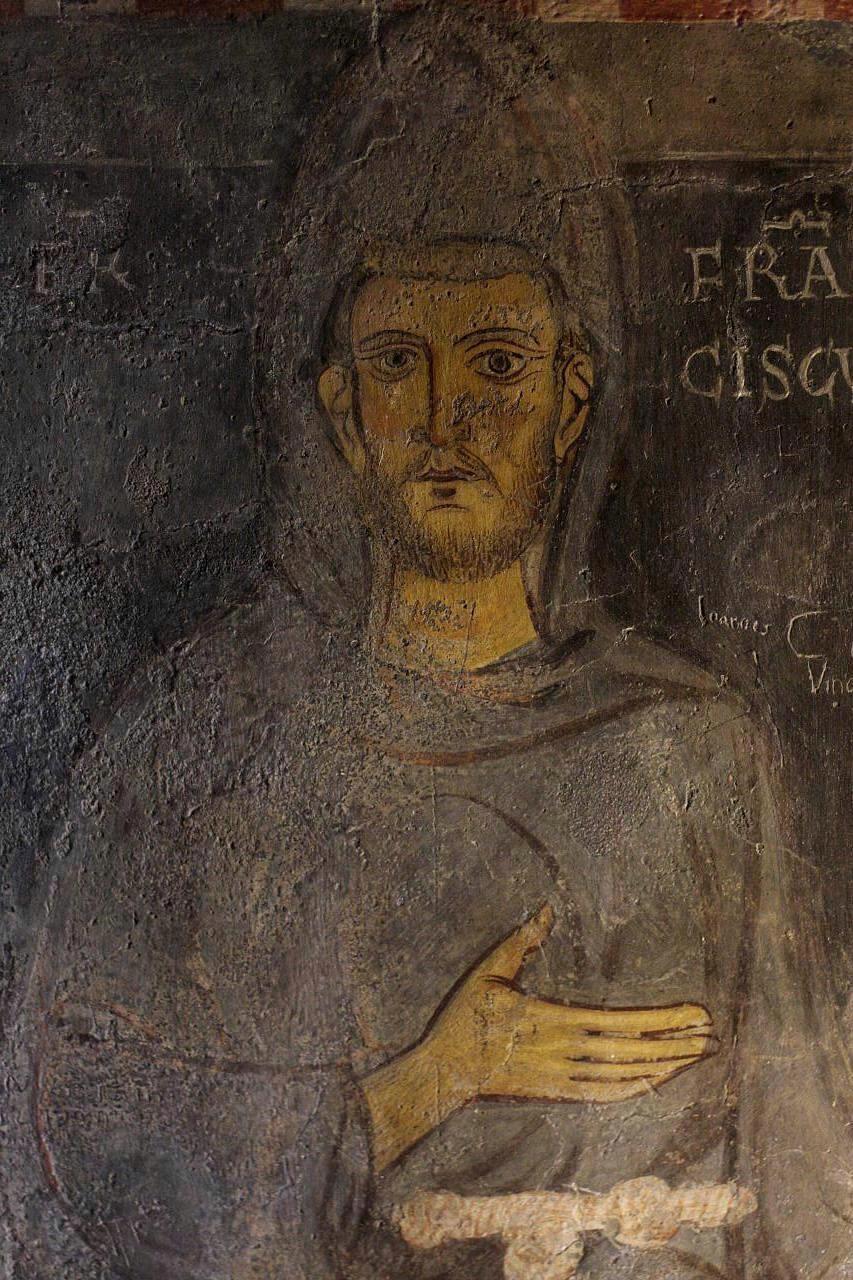
Francis of Assisi was born in 1181 or 1182 to a rich cloth merchant of Assisi, Pietro di Bernardone, and was baptized Giovanni; his father renamed him Francesco. After a youth of spending and soldiering, a year as a prisoner of war in Perugia and a long illness, he turned about 1205 to 1206 to prayer, to the lepers he had once avoided, and to the repair of ruined churches near Assisi. Before the bishop of Assisi he gave back even his clothes to his father. In 1208 a Gospel reading on how Christ sent out his disciples with nothing became his program, and when eleven men had joined him, Pope Innocent III approved their way of life by word of mouth in 1209 or 1210. Clare of Assisi followed in 1212. Francis went to the crusader camp at Damietta in Egypt in 1219 and crossed the lines to preach to the Sultan, an event recorded in 1220 by a bishop who was there. His Rule was rewritten and approved by Pope Honorius III on November 29, 1223. He received, as his first biographer reports, the marks of Christ's wounds at La Verna in 1224, sang the Canticle of the Creatures at San Damiano in 1225, dictated his Testament in 1226 and died at the Portiuncula on the evening of October 3, 1226. Gregory IX canonized him on July 16, 1228. This lesson reads his life from his own writings (in Paschal Robinson's 1906 translation) and from the earliest records, quotes the Rule of 1223, the Canticle and the Testament at length, and follows the quarrel over poverty that his Rule left behind. Lesson 13 takes up the later lives, the Little Flowers and the famous legends.
Francis is the oldest of the four figures in this module and the only one who left no book of theology. What he left is short: two Rules for his brothers, a Testament, a handful of letters, some prayers and praises, a few lines for Clare and her sisters, and one song in the Umbrian dialect of Italian. Those writings, a small number of papal documents, a letter written by a crusading bishop in 1220 and the first life written by Thomas of Celano within three years of Francis's death are the closest witnesses to the man. Everything else, including most of the stories people know best, comes later. Lesson 01 placed Francis in the world of Innocent III, the Fourth Lateran Council and the new orders of friars. Module 79 gives the older monastic tradition the friars both drew on and departed from (Church History, Part A, lesson 07: Monks and the Desert Fathers) and the medieval church in outline (lesson 09). This lesson stays close to the documents.
How this lesson uses the sources
The sources for Francis fall into layers, and the order matters for every claim that follows. The first layer is what Francis himself wrote or dictated. Paschal Robinson, a Franciscan of the American province, published the first critical English translation of these writings in 1906, working from the Quaracchi Latin edition of 1904 and from the oldest manuscripts, above all codex 338 of the communal library at Assisi, a parchment collection of eleven of his works whose age critics dispute but which, Robinson wrote, "dates at least from the beginning of the fourteenth century."1 Robinson's translation is in the public domain and is the version quoted throughout this lesson, with his page numbers.
The second layer is the documents of the Church that touched Francis while he lived or soon after: the papal bull Solet annuere that approved the Rule in 1223, the canonization in 1228, and Gregory IX's bull Quo elongati of 1230 on how far the friars were bound by Francis's Testament. The third layer is outsiders who saw him, the most valuable being Jacques de Vitry, a preacher and bishop of Acre who met the early friars in Italy in 1216 and was in the crusader camp in Egypt when Francis came there in 1219.2
The fourth layer is the lives. Thomas of Celano, a friar who had joined the order about 1215 and was present at the canonization on July 16, 1228, wrote his First Life between that date and February 1229 at the command of Gregory IX. He wrote a Second Life between 1244 and 1247 at the request of the minister general Crescentius of Jesi, drawing on recollections the friars had been asked to send in.3 The two lives are cited here by the paragraph numbers of A. G. Ferrers Howell's English translation of 1908 (1 Cel and 2 Cel). Bonaventure of Bagnoregio wrote the Major Life (Legenda Maior) between 1260 and 1263, and it became the order's official life.4 Later still come the Legend of the Three Companions, the Mirror of Perfection, the Assisi Compilation and the Little Flowers, whose dates and reliability are the subject of what scholars call the "Franciscan question." Lesson 13 sets out that question in full.
Modern historians have weighed these layers differently. Paul Sabatier's Life of St. Francis of Assisi (1894) made Francis famous to Protestant and secular readers and argued that the Church had bent his ideal into an ordinary religious order.5 John Moorman, an Anglican bishop, wrote The Sources for the Life of S. Francis of Assisi (1940) and A History of the Franciscan Order from Its Origins to the Year 1517 (1968).6 Augustine Thompson, a Dominican, built Francis of Assisi: A New Biography (2012) on the writings and the earliest documents and set the hagiographical portraits to one side in a separate section.7 Andre Vauchez's Francis of Assisi: The Life and Afterlife of a Medieval Saint (French 2009, English 2012) treats both the historical Francis and the many Francises later centuries made.8 The 1909 article on Francis in the Catholic Encyclopedia, which Robinson himself wrote, gives a clear older Catholic summary of the dates and is used here beside the primary texts.9

A timeline of Francis's life
The chart below sets out the dates used in this lesson. Where the sources disagree (the year of Innocent III's approval, the year of the Canticle, the date of the bull Cum inter nonnullos), the text below discusses the disagreement and the timeline gives the most commonly cited date.
Birth, family and youth in Assisi (1181 or 1182 to 1205)
Assisi in the late 1100s was a hill town of Umbria on the slope of Monte Subasio, looking west across the Spoleto valley toward Perugia, its larger rival. Francis was born there in 1181 or 1182; the exact year is not recorded. His father, Pietro di Bernardone, was a wealthy cloth merchant who traded in France, and his mother is named Pica in the later tradition. He was baptized Giovanni (John), and his father, according to the early tradition summarized by Robinson, changed the boy's name to Francesco, "the Frenchman," perhaps out of fondness for the country where he did his business. The story that he was born in a stable, in imitation of Christ, first appears in the fifteenth century.9
Thomas of Celano opens the First Life with a hard portrait of the young man. Parents in Assisi, he says, raised their children in vanity, and Francis was no exception: "almost until the twenty-fifth year of his age he miserably squandered and wasted his time." He describes him as the leader of the young men of the town in "frolics, freaks, sallies of wit and idle talk, songs, and soft and flowing attire, for he was very rich. He was not miserly but prodigal, not a hoarder of money but a squanderer of his substance, a shrewd trader but a most ostentatious spender; a man, however, very kindly in his dealings, very easy and affable."10 Modern historians, Thompson among them, read this opening with care, because the life of a saint commonly set a dark "before" against a bright "after," and Celano's own Second Life, written nearly twenty years later, gives a gentler picture of the youth.7 What both lives agree on is that he was the son of money, that he worked in his father's trade, and that he was popular.
War with Perugia and captivity
Assisi and Perugia fought repeatedly in these years. The First Life does not mention Francis's part in the fighting. The Second Life does: "once when there was a bloody battle between the citizens of Perugia and those of Assisi, Francis with several others was taken, and being put in chains with the rest endured the horrors of imprisonment." Celano adds that while the other prisoners grieved, Francis laughed at his chains and told them, "I shall yet be worshipped as a Saint all the world over," and that he made peace between the other captives and a proud knight whom they all shunned.11 The battle is usually dated to 1202 and his release to 1203; Robinson's 1909 summary says he was "held captive for more than a year in Perugia" and fell ill with a fever there.9 The prophecy in prison is the kind of detail a writer of the 1240s, looking back on a canonized saint, would value, and it rests on Celano's report alone.
Back in Assisi he was ill again for a long time. Celano says that when he first walked out of the house, leaning on a stick, nothing that had once pleased him pleased him any longer, but that the change was not yet thorough. When a noble of Assisi prepared to ride south to Apulia to win "money or honour," Francis agreed to go with him. A dream of a house full of "saddles, shields, lances and other accoutrements" seemed to promise success, but he turned back; in the First Life he simply "refused to go to Apulia."10 Robinson's summary dates the turning back at Spoleto to 1205 and connects the expedition with the campaign of Walter of Brienne in southern Italy.9 Celano then describes months of struggle: prayers in a cave outside the town while a friend waited outside, talk in riddles of "a great and precious treasure," and a promise to the young men who teased him about marriage that he would marry "a nobler and fairer bride than you ever saw." Celano explains the bride as "the true Religion which he took unto him."10
Conversion (about 1205 to 1208)
The lepers, in Francis's own words
Francis himself named the turning point. The opening of his Testament, dictated in 1226 shortly before his death, does not mention a vision, a voice or a crucifix. It mentions lepers:
The Lord gave to me, Brother Francis, thus to begin to do penance; for when I was in sin it seemed to me very bitter to see lepers, and the Lord Himself led me amongst them and I showed mercy to them. And when I left them, that which had seemed to me bitter was changed for me into sweetness of body and soul. And afterwards I remained a little and I left the world.
That is Robinson's translation of the Assisi manuscript.12 Robinson notes that some manuscripts read "I made a sojourn with them" (feci moram cum illis) where his text reads "I showed mercy to them" (feci misericordiam cum illis), and that Francis "on the eve of his death, casting a backward glance over the ways by which he had been led, dwells on this incident."12 Lepers in Umbria lived outside the towns in their own houses under church care, and contact with them was both feared and regulated. The First Life quotes these lines of the Testament and adds that Francis served the lepers "washing all foulness from them and even wiping away the matter from the ulcers," that in his vain days the sight of their houses "about two miles off" made him hold his nose, and that "one day, while still in the habit of the world, he met a leper, and, having become stronger than himself, went near and kissed him."13
The Second Life, written twenty years after Francis's death, tells the meeting again and adds a new detail. Francis dismounted, gave the leper money and a kiss, and remounted, and then "as he looked round this way and that, though the country was free and open on all sides and there were no obstacles, he could not see that leper at all."14 The vanishing leper, read by later tradition as Christ himself, is absent from the Testament and from the First Life. Placed side by side, the three texts show the growth of a story: Francis's own plain sentence, a first life that adds service and a kiss, and a second life that adds a miracle.
San Damiano and the crucifix
The First Life brings Francis next to San Damiano, an old church below the walls of Assisi "threatening soon to fall from excessive age." After selling cloth and his horse at Foligno, he offered the money to the poor priest there and asked to stay with him. The priest let him stay but "would not take the money for fear of Francis' parents," and Francis threw it on a window sill "heeding it as little as dust."15 In the First Life nothing speaks to him at San Damiano.
The Second Life adds the scene that has made San Damiano famous. Francis went in to pray and "fell down before the crucifix in devout supplication," and then:
straightway (a thing unheard of for ages) the painted image of Christ crucified moved its lips and addressed him, calling him by name: "Francis," it said, "go repair My house, which as thou seest is wholly falling into ruin." Francis, trembling and in no small amazement, became well-nigh deranged by this address. He prepared to obey and was wholly intent on fulfilling the commandment.
Celano adds that although the words "referred to that Church which Christ acquired by His own Blood," Francis took them first as an order to rebuild stone churches.14 (Howell's translation sets the parenthesis off with dashes, given here in parentheses.) The report that it spoke comes from Celano's second book, written in the 1240s from the memories the friars had gathered; Francis's own writings do not mention it.

Before the bishop of Assisi
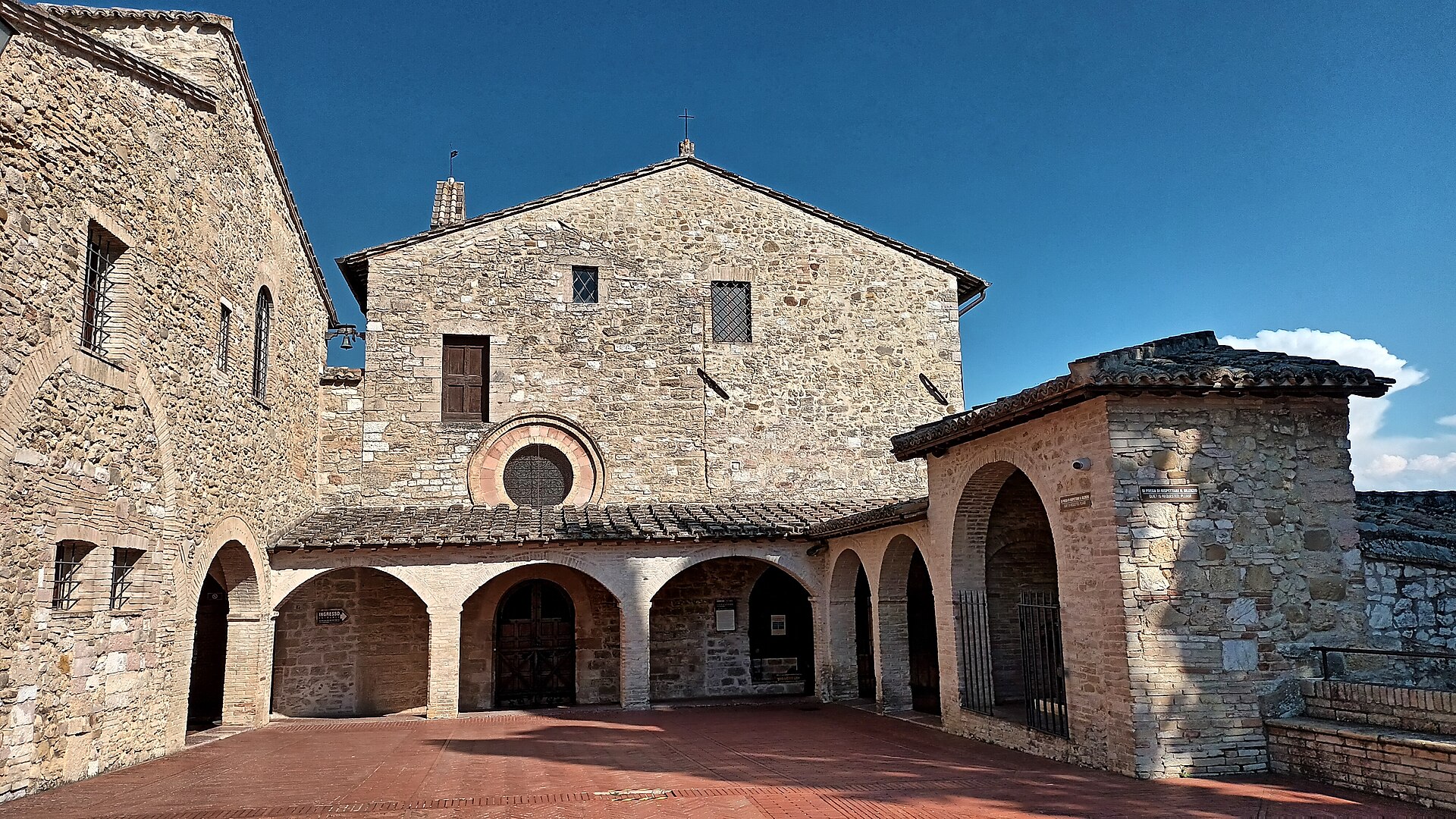
Pietro di Bernardone did not accept his son's change. The First Life says that Francis hid for a month in a pit in the house where he was staying, then walked openly into the town, where people "pelted him with mire and stones" as a madman; his father dragged him home, beat him and chained him in a dark place, and his mother released him while the father was away on business. When the father found the money from Foligno and still could not bring his son back, "he brought his son before the bishop of the city, so that by a formal renunciation of all his property in the bishop's presence he might give up all he had."15 Celano's account of the scene is short and vivid:
When brought before the bishop, Francis would brook no delay nor hesitation in anything: nay, without waiting to be spoken to and without speaking he immediately put off and cast aside all his garments and gave them back to his father. ... he did not even keep his drawers but stripped himself stark naked before all the bystanders. But the bishop, observing his disposition, and greatly wondering at his fervour and stedfastness, arose forthwith, gathered him into his arms and covered him with the mantle which he himself was wearing.
The bishop was Guido of Assisi, who appears again in 1209 or 1210 helping Francis in Rome.15 In the First Life Francis says nothing at all. In the Second Life he speaks: "Henceforth I may freely say 'our Father who art in heaven,' not any more 'father Pietro di Bernardone,' to whom lo! I not only restore the money but give up all my clothes. Naked therefore will I go to the Lord."16 Robinson's 1909 summary records that Francis's father had first summoned him before the city consuls, and that Francis answered that as a man now in God's service he was under the bishop's jurisdiction, not the commune's.9 The scene had a legal side. A son who renounced his inheritance before a bishop put himself under church law and freed his father from responsibility for him, and the bishop's mantle was also a sign of that protection.
Soon after, singing praises in French on the road in a wood, Francis met robbers who asked who he was. "I am a herald of the great King," he answered, and they threw him into a ditch of snow.13 He worked in a monastery kitchen for a few days and got a tunic from a friend at Gubbio.
Rebuilding the churches
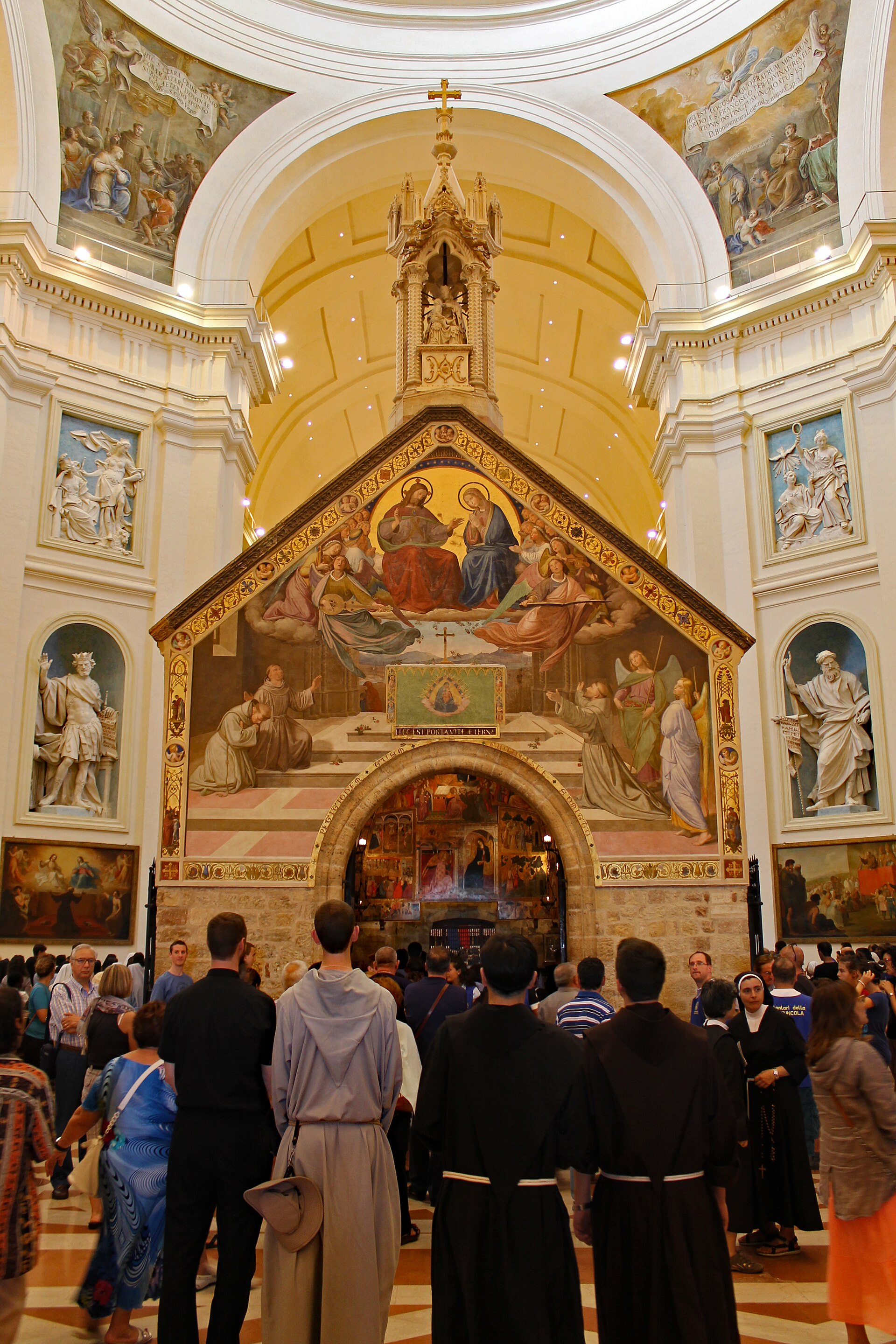
Celano says the first work Francis undertook "was to build a house for God: but he did not try to build it anew, rather did he repair the old and restore the ancient." He repaired San Damiano, then another dilapidated church near the city, then a third, the little church of Saint Mary called the Portiuncula, "the little portion," in the plain below Assisi, which belonged to the Benedictines of Monte Subasio and had been abandoned.17 Robinson identifies the second church as Saint Peter's, at some distance from the city.9 At this stage, Celano says, Francis "went about wearing a kind of hermit's dress, girded with a leather girdle, carrying a staff in his hand and having shoes on his feet."18 He begged stones in the streets of Assisi and carried them himself.
The Gospel at the Portiuncula
The decisive text for Francis's way of life was not a rule written by someone else but a Gospel reading. Celano places it at the Portiuncula when the repair of the little church was finished, "in the third year from his conversion." One day the Gospel of how Christ sent out his disciples was read at Mass. Afterward Francis asked the priest to explain it, and
when the priest had set forth to him all things in order, S. Francis hearing that Christ's disciples ought not to possess gold, silver, or money, not to carry on their way scrip, wallet, bread or staff, not to have shoes, or two tunics, but to preach the Kingdom of God, and repentance, straightway he cried, exulting in the spirit of God: "This is what I wish, this is what I am seeking, this I long with all my inmost heart to do."
He took off his shoes, put down his staff, kept one tunic, exchanged his leather belt for a cord, and made a rough tunic in the shape of a cross.18 The passage he heard is the sending of the Twelve (Matthew 10:7 to 10 and Luke 9:1 to 6). In the Douay-Rheims, the English version of the Latin Bible he heard, Matthew 10:9 to 10 reads: "Do not possess gold, nor silver, nor money in your purses: Nor scrip for your journey, nor two coats, nor shoes, nor a staff."19 Robinson's summary dates the morning to 1208, "probably 24 February," the feast of Saint Matthias.9 Later accounts add that when the first companions joined him, Francis opened the Gospel book three times at the church of Saint Nicholas in Assisi and found each time a text about leaving all things, and said, "This shall be our rule of life."9

The first brothers and Innocent III (1208 to 1210)
Others soon came. Robinson's summary names Bernard of Quintavalle, "a magnate of the town," as the first, followed by Peter Catani (Peter of Cattaneo), a canon of the cathedral, and Giles, later famous for his "good words"; by the time there were eleven or twelve of them, Francis wrote down a form of life.9 Francis's own account in the Testament is brief and makes a strong claim:
And when the Lord gave me some brothers, no one showed me what I ought to do, but the Most High Himself revealed to me that I should live according to the form of the holy Gospel. And I caused it to be written in few words and simply, and the Lord Pope confirmed it for me. And those who came to take this life upon themselves gave to the poor all that they might have and they were content with one tunic, patched within and without, by those who wished, with a cord and breeches, and we wished for no more.12
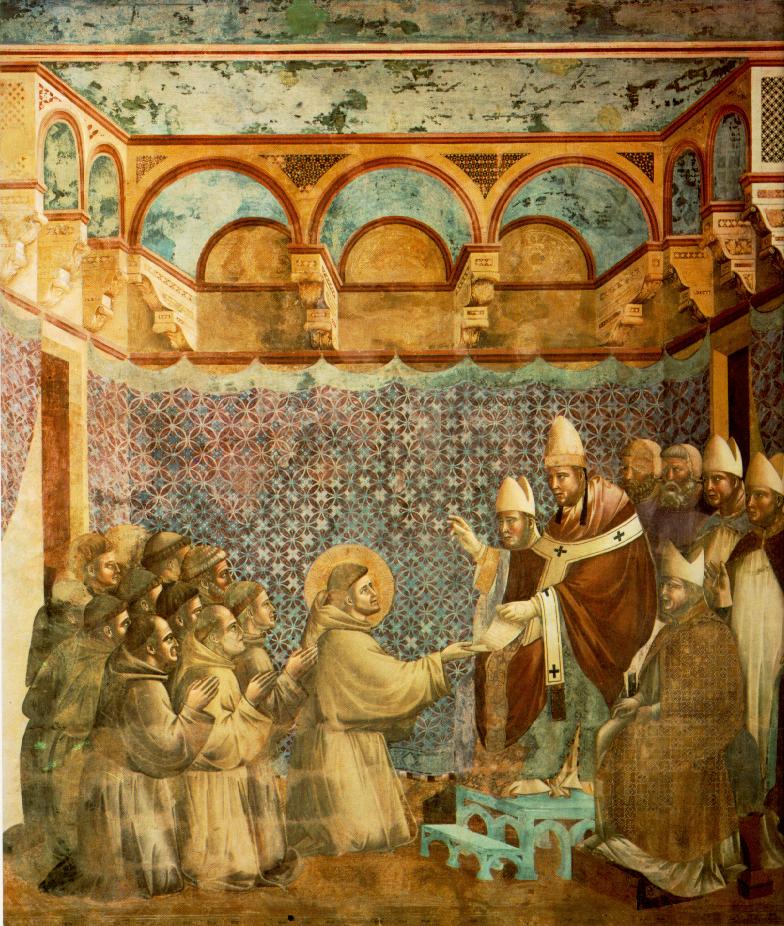
Celano gives the same picture from outside: "Blessed Francis, seeing that the Lord God was daily increasing the number [of the brethren] ... wrote down simply and in few words for himself and for his brethren both present and future a pattern and rule of life, using chiefly the language of the holy Gospel, after whose perfection alone he yearned." He went with all the brothers to Rome to ask Pope Innocent III to confirm it. Bishop Guido of Assisi was in Rome and was at first "annoyed at their coming," fearing they meant to leave his diocese, but helped them when he understood; a cardinal, John of Saint Paul, bishop of Sabina, examined Francis, tried to steer him toward an existing form of religious life, and then took his case to the pope.20 Innocent, Celano writes, examined the matter, granted the request, blessed them and said:
Go, and the Lord be with you, brethren, and as He shall deign to inspire you, preach repentance to all. And when the Lord Almighty shall multiply you in number and in grace, ye shall report it to me with joy, and I will grant you more than this and shall with more confidence entrust greater things to you.20
Celano adds a dream of Francis's own: he saw himself growing tall enough to bend down the top of a great tree, which Celano reads as the pope bowing "so graciously to his will and petition."20 Bonaventure, writing in the 1260s, gives the dream to the pope instead: Innocent "saw, as he recounted, the Lateran Basilica about to fall, when a little poor man, of mean stature and humble aspect, propped it with his own back."4 That is the scene Giotto's workshop later painted in the Upper Church at Assisi. It does not appear in Celano's First Life.
Three points about this approval are firm. First, it was oral. The heading of the longer Rule in Robinson's manuscripts reads "First Rule of the Friars Minor, which St. Francis made and which Pope Innocent III confirmed without a Bull."21 Second, the text Innocent heard is lost. Robinson writes that "the first Rule in its original form was very short and simple," and that the version of twenty-three chapters that survives is that first Rule "in the form it had assumed in the course of twelve years, as a consequence of many changes and additions."22 Third, the year is disputed. Robinson held that the approval took place on April 23, 1209, "the date given by the Bollandists and the Seraphic Breviary," while Sabatier, following the seventeenth-century Franciscan annalist Luke Wadding, put it in the summer of 1210.22 Modern writers usually give "1209 or 1210."

The name "Friars Minor"
Celano says the brotherhood took the name "Lesser Brethren," fratres minores, from words written in the Rule, "And be they lesser," and reports Francis saying, "I will that this brotherhood be called the Order of Lesser Brethren." Celano explains the name as humility: "truly they were 'lesser,' for, being subject to all, they ever sought for lowly dwellings."20 The word also had a social meaning in Assisi, where the maiores were the leading families and the minores the common townspeople, and Robinson's 1909 summary gives both explanations.9 The brothers lived first in a deserted hut at Rivo Torto in the plain below Assisi until, in the story Robinson repeats, a peasant drove his donkey in on them; about 1211 the Benedictines of Monte Subasio gave them the use of the Portiuncula, which became "the cradle of the Franciscan Order."9 The brothers went out two by two, worked for their food or begged, preached repentance and peace in the open air, and slept in haylofts or church porches. In the Testament Francis remembered: "We clerics said the Office like other clerics; the laics said the Paternoster, and we remained in the churches willingly enough. And we were simple and subject to all."12
Francis himself was never a priest. Robinson's summary records that the first brothers received the clerical tonsure in Rome and that Francis was "ordained deacon later on."9 His reverence for priests is one of the most insistent themes of his writings, and it is quoted below from the Testament.
Clare and the Poor Ladies (1212)
In 1212 Clare (Chiara), a young noblewoman of Assisi, left her family's house by night after Palm Sunday and came to the Portiuncula, where Francis cut her hair and received her into a life of poverty. Robinson's summary says she was then eighteen. She lived for a short time with Benedictine nuns and then at San Damiano, where her sister Agnes and other women joined her; the house became the first monastery of the Poor Ladies, later called the Poor Clares.9 Celano, writing while Clare was still alive, calls San Damiano the place "wherein the glorious Religion and most excellent Order of Poor Ladies and holy virgins took its happy beginning some six years after blessed Francis' conversion," and Clare "a stone precious and strong above all the others of the pile."17
Only two short texts of Francis to Clare and her sisters survive, preserved because Clare quoted them in the sixth chapter of her own Rule, which Innocent IV confirmed on August 9, 1253, two days before her death. Robinson notes that the original bull was lost for centuries and found in 1893 "wrapped within an old mantle of Saint Clare."23 The first text is Francis's promise of care:
Since, by divine inspiration, you have made yourselves daughters and handmaids of the Most High Sovereign King, the Heavenly Father, and have espoused yourselves to the Holy Ghost, choosing to live according to the perfection of the holy Gospel, I will, and I promise to have always, by myself and my brothers, a diligent care and special solicitude for you, as for them.23
The second, which Clare says he wrote "shortly before his death," is his last wish: "I, little brother Francis, wish to follow the life and poverty of Jesus Christ our Most High Lord and of His Most Holy Mother and to persevere therein until the end. And I beseech you all, my ladies, and counsel you, to live always in this most holy life and poverty."23 Robinson also corrects an old error: Francis did not write a separate Rule for the Poor Ladies. Cardinal Ugolino, the future Gregory IX, wrote one for them about 1219, and Clare later recast it on the model of Francis's Rule of 1223.23
The places of Francis's life
Almost all of Francis's life was lived within a few days' walk of Assisi. The diagram below places the sites named in the earliest sources. The left panel shows central Italy in a simplified projection from approximate latitude and longitude; the right panel enlarges the plain below Assisi, where San Damiano, the Portiuncula and Rivo Torto lie within about four kilometers of one another; the strip at the bottom shows the voyage of 1219.
Missions, chapters and the growth of the order (1212 to 1219)
Francis tried twice to reach the Muslim world before he succeeded. Robinson's summary records that in the autumn of 1212 he sailed for Syria but was shipwrecked on the coast of Slavonia across the Adriatic and had to return to Ancona, and that in 1214 he set out for Morocco but fell ill in Spain and turned back (the journey, it adds, probably took place in the winter of 1214 to 1215). In 1213 Count Orlando of Chiusi gave him the mountain of La Verna in the Tuscan Apennines as a place of prayer.9 Celano says that "in the sixth year of his conversion, burning with the utmost desire for holy martyrdom, he determined to pass over to the regions of Syria to preach the Christian faith, and repentance to the Saracens and the other unbelievers," and that on the second attempt, when he "had already reached Spain," an illness recalled him. Celano adds that this delay was God being "mindful of me and of many," since some men of learning joined the order when Francis came back; Celano was probably one of them.24
The brotherhood grew fast. Jacques de Vitry, writing about 1216 to 1217 after meeting the friars in Italy, described them as men who "meet once a year ... and then with the help of good men adopt and promulgate holy institutions approved by the Pope."22 These yearly chapters at the Portiuncula added to the Rule. The general chapter of May 1217 divided the order into provinces and sent friars beyond the Alps; Cardinal Ugolino of Ostia, the future Gregory IX, became protector of the order about this time.9 Robinson notes that Honorius III, on September 22, 1220, forbade friars to leave the order after profession, and that this rule was then written into the second chapter of the Rule.22
Damietta and the Sultan (1219 to 1220)
In 1219 Francis went to Egypt during the Fifth Crusade. A crusader army had landed at Damietta in the Nile delta in May 1218 and besieged it; the sultan of Egypt was al-Malik al-Kamil; the crusaders took the city by storm on November 5, 1219.25 Robinson's summary says that Francis sailed from Ancona in June 1219 with eleven companions, went by way of Acre, and was present at the siege and taking of Damietta.9
The earliest record: Jacques de Vitry, 1220
The oldest account of Francis's meeting with the sultan is not Franciscan. Jacques de Vitry, by then bishop of Acre, was with the crusaders, and he ended a letter written in February or March 1220 (letter VI in R. B. C. Huygens's critical edition of his letters) with news about friends who had joined the Friars Minor. He was not uncritical: he wrote that the order "seems very dangerous to us, because it sends out two by two throughout the world, not only formed religious, but also immature young men who should first be tested." Then he wrote, in Latin:
Magister vero illorum, qui ordinem illum instituit, cum venisset in exercitum nostrum, zelo fidei accensus ad exercitum hostium nostrorum pertransire, non timuit et cum aliquot diebus Sarracenis verbum dei predicasset, modicum profecit. Soldanus autem, rex Egypti, ab eo secreto petiit ut pro se domino supplicaret quatinus religioni, que magis deo placeret, divinitus inspiratus adhereret.
In John Tolan's English translation: "The head of these brothers, who also founded the Order, came into our camp. He was so inflamed with zeal for the faith that he did not fear to cross the lines to the army of our enemy. For several days he preached the Word of God to the Saracens and made little progress. The Sultan, king of Egypt, privately asked him to pray to the Lord for him, so that he might be inspired by God to adhere to that religion which most pleased God."2 The letter goes on to report, with some dismay, that members of Jacques's own household had joined the friars.
A few years later Jacques expanded the story in the section on the Friars Minor in his Historia Occidentalis (written in the 1220s). There he calls Francis "a simple and unlettered man, beloved of God and men" (virum simplicem et illiteratum, dilectum Deo et hominibus), says that the Saracens seized him on the road and that he told them, "I am a Christian. Take me to your master" (Ego christianus sum. Ducite me ad dominum vestrum). He writes that when the sultan, whom he calls "that cruel beast" (bestia crudelis), saw him, he became gentle and listened very attentively (attendissime) for several days as Francis preached the faith of Christ to him and his men, then, fearing that some of his soldiers would be converted and go over to the Christian army, had him escorted back "with all reverence and security," saying at the end: "Ora pro me, ut deus legem illam et fidem que magis sibi placet mihi dignetur revelare," "Pray for me, that God may deign to reveal to me the law and the faith which is more pleasing to Him."26 The language about the sultan is Jacques's, a crusading bishop's, and is quoted as he wrote it.
Celano (1228) and Bonaventure (1260s)
Celano's First Life (1228 to 1229) tells the visit in one paragraph. "In the thirteenth year of his conversion," Francis went "to the regions of Syria," and "did not fear to present himself to the sight of the Soldan of the Saracens." Before he reached the sultan he "had been seized by the [Soldan's] associates, insulted and beaten." The sultan received him "most honourably," offered him gifts, and "was deeply stirred by his words and heard him very willingly. But in all this the Lord did not fulfil S. Francis' desire, reserving for him the privilege of an unparalleled favour."24 The "desire" in Celano's account is martyrdom, and the "unparalleled favour" is the stigmata that came five years later.
Bonaventure's Major Life (chapter 9) adds the scene most often painted. In his account Francis offered to enter a great fire with the sultan's priests, or, when the sultan said none of his priests would do so, to enter it alone if the sultan would promise to become a Christian should he come out unharmed; the sultan declined "for that he feared a revolt of his people," and offered gifts, which Francis refused.4 No fire was lit in Bonaventure's own story. The challenge itself first appears in his life, written some forty years after the event.
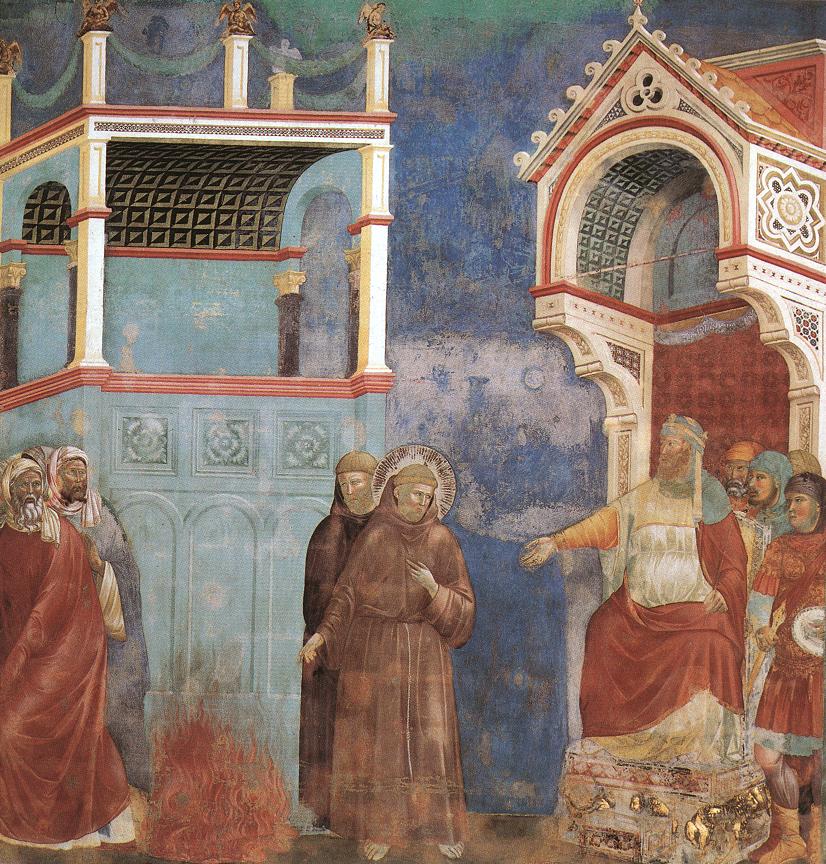

What Francis wrote about going among the Saracens
The best guide to what Francis intended is the chapter he wrote for friars who went to Muslim lands. It stands as chapter 16 of the longer Rule; it is often connected with his experience in Egypt, though the date at which it was written into the Rule is not recorded. It is quoted here at length in Robinson's translation so that readers can judge it themselves:
The Lord says: "Behold, I send you as sheep in the midst of wolves. Be ye therefore wise as serpents and simple as doves." Wherefore, whoever of the brothers may wish, by divine inspiration, to go among the Saracens and other infidels, let them go with the permission of their minister and servant. But let the minister give them leave and not refuse them, if he sees they are fit to be sent; he will be held to render an account to the Lord if in this or in other things he acts indiscreetly. The brothers, however, who go may conduct themselves in two ways spiritually among them. One way is not to make disputes or contentions; but let them be "subject to every human creature for God's sake," yet confessing themselves to be Christians. The other way is that when they see it is pleasing to God, they announce the Word of God, that they may believe in Almighty God, Father, and Son, and Holy Ghost, the Creator of all, our Lord the Redeemer and Saviour the Son, and that they should be baptized and be made Christians, because, "unless a man be born again of water and the Holy Ghost, he cannot enter into the kingdom of God."21
The chapter continues with a long chain of Gospel texts on persecution and martyrdom: the brothers "have relinquished their bodies to our Lord Jesus Christ; and for love of Him they ought to expose themselves to enemies both visible and invisible," and "if however they should persecute you in one city, flee to another."21 The two "ways" are both in the text. The first is a life of quiet presence, "subject to every human creature," without disputes; the second is open preaching that calls for faith in the Trinity and baptism. Readers who see Francis as a man of interfaith dialogue and readers who see him as a missionary seeking converts or martyrdom can each find their reading here, and the text holds both. The Rule of 1223 kept only a short version of this chapter, quoted below.
From the Rule of 1221 to the Rule of 1223
Francis came back to Italy in the summer of 1220, landing at Venice, to find the brotherhood troubled. Robinson's summary lists the problems: the two vicars he had left in charge had added new fasts; Cardinal Ugolino had given the Poor Ladies a written rule close to the Benedictine one; one of the first companions, John of Capella, had gathered lepers of both sexes into a new order; and a rumor had spread that Francis was dead.9 The order was growing beyond the size of a band of companions. The same summary records that at Bologna Francis refused to enter a house that people called "the House of the Friars" and ordered the brothers out of it until Ugolino declared it his own property.9 At a chapter at the Portiuncula, in 1220 or 1221, Francis gave up the leadership of the order to Peter Catani, who died within a year and was succeeded as vicar by Brother Elias of Cortona, who held the office until Francis's death.9 In the Testament Francis wrote of himself afterward: "I wish to obey the minister general of this brotherhood strictly and the guardian whom it may please him to give me. And I wish to be so captive in his hands that I cannot go or act beyond his obedience and his will because he is my master."12
The Rule of 1221 (the "First Rule")
The long Rule of twenty-three chapters that survives is called the Rule of 1221 or, because no papal bull approved it, the Regula non bullata. Scholars disagree about what it is. Karl Muller and Paul Sabatier treated it as a new rule written in 1221, which made the Rule of 1223 the third; David Burr's introduction to his translation of the 1223 Rule on the Internet Medieval Sourcebook follows that count and calls the 1223 Rule "the third produced by Francis."27 Robinson argued that it is the Rule Innocent approved, swollen by twelve years of additions made at the chapters, and pointed out that the thirteenth-century writers "speak only of the changes and accretions which the first Rule suffered between 1209 and 1223."22 Jordan of Giano, a friar who wrote a chronicle of the order, says that Francis asked Brother Caesar of Speyer, "learned in the Scriptures," to "embellish with evangelical language the Rule which he himself had put together in simple words," which explains the long chains of Gospel quotations in the text.22
The Rule of 1221 reads more like an exhortation than a legal code. It opens with obedience to "our Lord Pope Innocent and to his successors" and states its program in the Gospel's own words: "The Rule and life of these brothers is this: namely, to live in obedience and chastity, and without property, and to follow the doctrine and footsteps of our Lord Jesus Christ, who says: 'If thou wilt be perfect, go sell what thou hast, and give to the poor, and thou shalt have treasure in heaven, and come, follow Me.'"21 Its chapter 17, on preachers, contains the sentence closest to the famous saying about preaching wrongly attributed to Francis (lesson 13 rates that saying):
Let none of the brothers preach contrary to the form and institution of the holy Roman Church, and unless this has been conceded to him by his minister. But let the minister take care that he does not grant this leave indiscreetly to anyone. Nevertheless, let all the brothers preach by their works.21
The same chapter asks all the brothers, "preachers, prayers, or laborers, both clerics and laics," not to "glory ... nor inwardly exalt themselves on account of good words and works, nor indeed for any good which God may sometimes say or do and operate in them or by them."21 Preaching by works is placed beside preaching in words, under the Church's license, and not in place of it.
Fonte Colombo and the bull Solet annuere
In 1223 Francis went to the hermitage of Fonte Colombo near Rieti and wrote a shorter Rule. Bonaventure's account, quoted by Robinson, says that Francis, "desiring to bring into a shorter form the Rule handed down in which the words of the Gospel were scattered somewhat diffusely," had a Rule written and gave it to his vicar, "who, after a few days had elapsed, declared that he had carelessly lost it," so that Francis wrote it again and "by Pope Honorius obtained its confirmation" on November 29, 1223.22 The vicar was Elias. Robinson's summary adds that some precepts were changed at Cardinal Ugolino's urging and that the twenty-three chapters became twelve.9 Honorius III approved it in the bull Solet annuere, which, as Robinson notes, made no distinction between the two texts: "We confirm," Honorius wrote, "the Rule of your Order approved by Pope Innocent, our predecessor, of happy memory."22 Robinson translated the Rule "according to the text of the original Bull which is preserved at the Sacro Convento in Assisi."28 It is called the Regula bullata, the Rule with a bull, and Franciscan friars of the First Order still profess it.
Sabatier read the change from the first Rule to the second as a defeat. Robinson quotes him in French: the Rules of 1210 and 1223 "had hardly anything in common but the name"; "that of 1210 alone is truly Franciscan. That of 1223 is indirectly the work of the Church." Robinson answered that "the second Rule is shorter, more precise, and more orderly; but essentially and in substance it is clearly and truly the same as the first Rule," and that "the very wording of the second Rule already exists in great part in the first one."22 Both judgments can be tested against the texts that follow.
Reading the Rule of 1223
The Rule of 1223 has twelve short chapters. The passages below are given in Robinson's translation with his chapter titles, so that the Rule can be read in its own words.28
Chapter 1: the Gospel, obedience, poverty, chastity
In the Name of the Lord begins the life of the Minor Brothers. The Rule and life of the Minor Brothers is this, namely, to observe the holy Gospel of our Lord Jesus Christ, by living in obedience, without property and in chastity. Brother Francis promises obedience and reverence to the Lord Pope Honorius and to his successors canonically elected and to the Roman Church. And let the other brothers be bound to obey Brother Francis and his successors.
The first sentence defines the whole life as observing "the holy Gospel," and the three vows of the older religious orders follow as the means. The second binds the founder himself to the pope. Both parts of that chapter mattered later: the Gospel standard gave every reformer of the order a text to appeal to, and the obedience clause kept those appeals inside the Church.
Chapter 2: receiving brothers
Candidates were to be sent to the provincial ministers, examined "regarding the Catholic faith and the Sacraments of the Church," and then told "the word of the holy Gospel, that they go and sell all their goods and strive to distribute them to the poor. If they should not be able to do this, their good will suffices." The ministers were not to take any interest in the newcomers' property: "the brothers and their ministers must take care not to be solicitous about their temporal affairs, that they may freely do with their affairs whatsoever the Lord may inspire them." After a year of probation they were received "to obedience" and might not leave, "because, according to the holy Gospel: 'No man putting his hand to the plough and looking back is fit for the kingdom of God.'" The chapter ends with a warning that Francis repeated in several writings: "I admonish and exhort them not to despise or judge men whom they see clothed in fine and showy garments using dainty meats and drinks, but rather let each one judge and despise himself."28
Chapters 3 to 5: prayer, the road, money and work
Clerics were to say the Divine Office of the Roman Church; lay brothers, who could not read the Latin psalter, were to say set numbers of the Lord's Prayer, "twenty-four Paternosters for Matins; five for Lauds," and so on. The fasts were from All Saints to Christmas and in Lent, and on Fridays; "in time of manifest necessity the brothers shall not be bound to corporal fasting." Chapter 3 then gives the friar's manner on the road:
I indeed counsel, warn, and exhort my brothers in the Lord Jesus Christ that when they go through the world they be not litigious nor contend in words, nor judge others; but that they be gentle, peaceful, and modest, meek and humble, speaking honestly to all as is fitting. And they must not ride on horseback unless compelled by manifest necessity or infirmity. Into whatsoever house they may enter let them first say: Peace be to this house! And, according to the holy Gospel, it is lawful to eat of all foods which are set before them.
Chapter 4 is the strictest sentence in the Rule: "I strictly enjoin on all the brothers that in no wise they receive coins or money, either themselves or through an interposed person." Only for the sick and for clothing might the ministers "take watchful care through spiritual friends." Chapter 5 orders work: brothers "to whom the Lord has given the grace of working" should "labor faithfully and devoutly, so that in banishing idleness, the enemy of the soul, they do not extinguish the spirit of holy prayer and devotion," and may receive for their labor "the things needful for the body ... with the exception of coins or money."28
Chapter 6: "the most sublime poverty"
The brothers shall appropriate nothing to themselves, neither a house nor place nor anything. And as pilgrims and strangers in this world, serving the Lord in poverty and humility, let them go confidently in quest of alms, nor ought they to be ashamed, because the Lord made Himself poor for us in this world. This, my dearest brothers, is the height of the most sublime poverty which has made you heirs and kings of the kingdom of heaven: poor in goods, but exalted in virtue. Let that be your portion, for it leads to the land of the living; cleaving to it unreservedly, my best beloved brothers, for the Name of our Lord Jesus Christ, never desire to possess anything else under heaven.
The chapter turns at once to the care the brothers owe one another: "if a mother nourishes and loves her carnal son, how much more earnestly ought one to love and nourish his spiritual brother! And if any of them should fall into illness, the other brothers must serve him as they would wish to be served themselves."28 The opening words, "appropriate nothing to themselves, neither a house nor place nor anything," are the sentence over which the order's great quarrel was fought for the next hundred years: did the friars own nothing at all, even in common, and if so, who owned the houses and books they used?
Chapters 7 to 9: penance, the minister general, preachers
Ministers who imposed penance were to do so "with mercy," and "must beware lest they be angry or troubled on account of the sins of others, because anger and trouble impede charity in themselves and in others." The brothers were bound to obey a minister general, elected by the provincial ministers and custodes at the Whitsun (Pentecost) chapter, and could replace him if he proved "not sufficient for the service and the common welfare of the brothers." Preachers needed the bishop's consent and the minister general's examination, and Francis asked that their words "be fire-tried and pure for the utility and edification of the people, announcing to them vices and virtues, punishment and glory, with brevity of speech because the Lord made His word short upon earth."28
Chapter 10: ministers as servants
Those brothers who are ministers and servants of the other brothers, shall visit and admonish their brothers, and shall humbly and charitably correct them, not commanding them anything against their souls and our Rule. The brothers however who are subject must remember that, for God, they have renounced their own will. Wherefore I order them strictly to obey their ministers in all things which they have promised the Lord to observe and are not against their souls and our Rule. And wheresoever there are brothers who see and know that they are not able to observe the rule spiritually, they ought to and can recur to their ministers. And let the ministers receive them charitably and kindly and show so great familiarity toward them that they may speak and act with them as masters with their servants, for thus it ought to be, since the ministers are the servants of all the brothers.
The chapter continues with the line most often quoted on Francis and learning: "Let not those who are ignorant of letters care to learn letters, but let them consider that, beyond all, they should desire to possess the spirit of the Lord and His holy operation, to pray always to Him with a pure heart and to have humility, patience in persecution and in infirmity and to love those who persecute, reprove, and accuse us."28 The sentence speaks to those who could not read; it does not forbid study to those who could, and the Testament, quoted below, tells the brothers to "honor and venerate all theologians."
Chapters 11 and 12: women, Saracens and the cardinal protector
Chapter 11 forbids "suspicious intimacy, or conferences with women" and entry into nuns' monasteries without special permission from the Apostolic See. Chapter 12 shortens the long missionary chapter of 1221 to a rule of permission:
Let all of the brothers who by divine inspiration desire to go amongst the Saracens or other infidels, ask leave therefor from their provincial ministers. But the ministers must give permission to go to none except to those whom they see are fitted to be sent. ... I enjoin on the ministers, by obedience, that they ask of the Lord Pope one of the Cardinals of the holy Roman Church to be governor, protector, and corrector of this brotherhood, so that being always subject and submissive at the feet of the same holy Church, grounded in the Catholic faith, we may observe poverty and humility and the holy Gospel of our Lord Jesus Christ, which we have firmly promised.28
The Rule ends where it began, with "the holy Gospel of our Lord Jesus Christ." In 1221 the ministers were told to let fit brothers go to the Saracens "and not refuse them"; in 1223 they "must give permission to go to none except to those whom they see are fitted." The chart below sets out these and other differences.
Greccio, La Verna and the last years (1223 to 1226)
A month after the Rule was approved, Francis kept Christmas at Greccio, a hill village near Rieti. Celano dates it "on the birthday of our Lord Jesus Christ in the third year before the day of his glorious decease," and has Francis tell a friend named John: "I would make memorial of that Child who was born in Bethlehem," with a manger, hay, an ox and an ass.29 Lesson 13 reads the full account and rates the claim that Greccio was "the first nativity scene."
In August 1224 Francis went up La Verna with a few companions for a forty days' fast before the feast of Saint Michael. Celano's First Life, written four years later, gives the first narrative of what happened there. "Two years before he gave back his soul to Heaven," Celano writes, Francis
saw in a vision of God a man like a seraph having six wings, standing over him with hands outstretched and feet joined together, fixed to a cross. Two wings were raised above his head, two were spread out for flight, and two veiled the whole body. ... And while he continued without any clear perception of its meaning, and the strangeness of the vision was perplexing his heart, marks of nails began to appear in his hands and feet, such as he had seen a little while before in the Man crucified who had stood over him.30
Celano goes on to describe the marks: the heads of the nails in the palms and the tops of the feet, "certain small pieces of flesh ... like the ends of nails bent and driven back," and a wound in the right side that "often shed forth blood, so that his tunic and drawers were many times sprinkled with the sacred blood." He says that few saw the side wound while Francis lived, naming Brother Elias as one who did.30 Robinson's summary dates the vision on or about the feast of the Exaltation of the Cross, September 14, 1224, and points to the short note in the hand of Brother Leo, who was with Francis, on the parchment of the blessing Francis wrote for him, still kept at Assisi.9 This lesson reports what the sources say. Lesson 13 sets the stigmata accounts side by side (Elias's letter announcing the death, Leo's note, Celano and Bonaventure) and rates each by its distance from the event.
Francis's health failed in his last two years. Robinson's summary describes an eye disease that left him almost blind, a painful and unsuccessful treatment at Rieti, a winter at Siena for further treatment, a stay at Cortona in the spring of 1226, and the return to Assisi in July 1226 under guard, because Assisi feared that Perugia would seize the dying man and keep his relics.9 In these months he composed the Canticle and dictated the Testament.
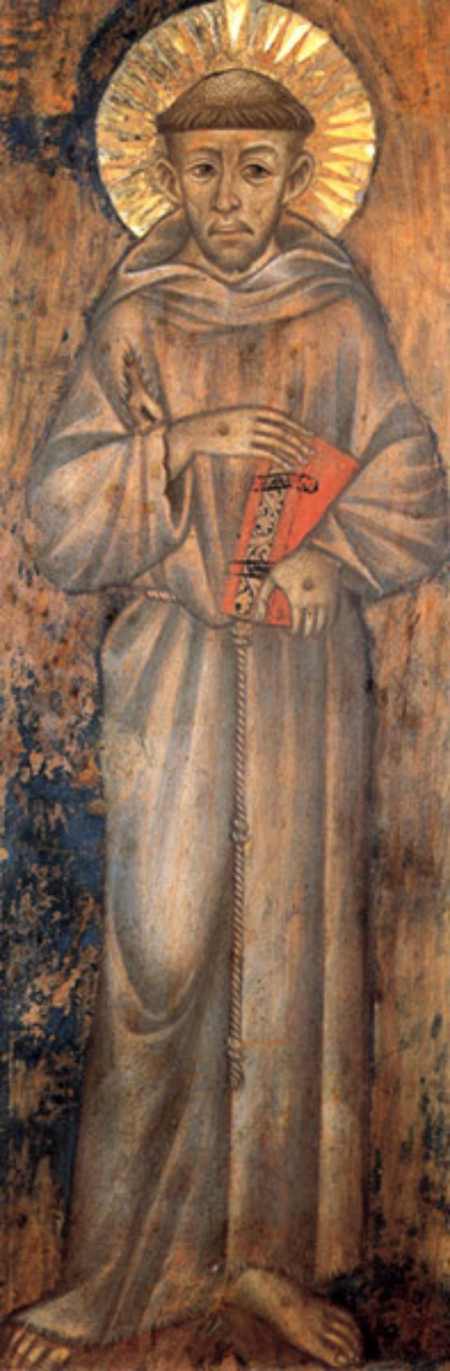

The Canticle of the Creatures (1225 to 1226)
The Canticle is the only one of Francis's songs "in the vernacular" (cantica in vulgari) that is known to survive, and it is the one text of his in Italian rather than Latin. Robinson writes that it "appears to have been composed toward the close of the year 1225 in a poor little hut near the Monastery of San Damiano, whither St. Francis had retired on account of his infirmities"; the 1909 summary dates it to September 1225.31 Its heading in the Assisi manuscript 338 (folio 33) says that Francis made it "while he was ill at St. Damian's." Robinson adds that, "if we may believe the tradition which finds formal expression in the Speculum Perfectionis, two strophes were subsequently added by the Saint to the original composition, the eighth strophe upon the occasion of a feud between the Bishop and the magistrates of Assisi, and the ninth one when the Saint recognized the approach of death."31 The Mirror of Perfection is a later compilation (lesson 13 discusses its date), so the story of the two additions is a tradition, while the text itself is in the early manuscript.
Robinson explained that he tried "to render literally into English the naif rhythm of the original Italian, which necessarily disappears in any formal rhymed translation." His translation of the Assisi text follows entire, laid out in his lines:31
Here begin the Praises of the Creatures which the Blessed Francis made to the praise and honor of God while he was ill at St. Damian's:
Most high, omnipotent, good Lord,
Praise, glory and honor and benediction all, are Thine.
To Thee alone do they belong, most High,
And there is no man fit to mention Thee.Praise be to Thee, my Lord, with all Thy creatures,
Especially to my worshipful brother sun,
The which lights up the day, and through him dost Thou brightness give;
And beautiful is he and radiant with splendor great;
Of Thee, most High, signification gives.Praised be my Lord, for sister moon and for the stars,
In heaven Thou hast formed them clear and precious and fair.Praised be my Lord for brother wind
And for the air and clouds and fair and every kind of weather,
By the which Thou givest to Thy creatures nourishment.Praised be my Lord for sister water,
The which is greatly helpful and humble and precious and pure.Praised be my Lord for brother fire,
By the which Thou lightest up the dark.
And fair is he and gay and mighty and strong.Praised be my Lord for our sister, mother earth,
The which sustains and keeps us
And brings forth diverse fruits with grass and flowers bright.Praised be my Lord for those who for Thy love forgive
And weakness bear and tribulation.
Blessed those who shall in peace endure,
For by Thee, most High, shall they be crowned.Praised be my Lord for our sister, the bodily death,
From the which no living man can flee.
Woe to them who die in mortal sin;
Blessed those who shall find themselves in Thy most holy will,
For the second death shall do them no ill.Praise ye and bless ye my Lord, and give Him thanks,
And be subject unto Him with great humility.
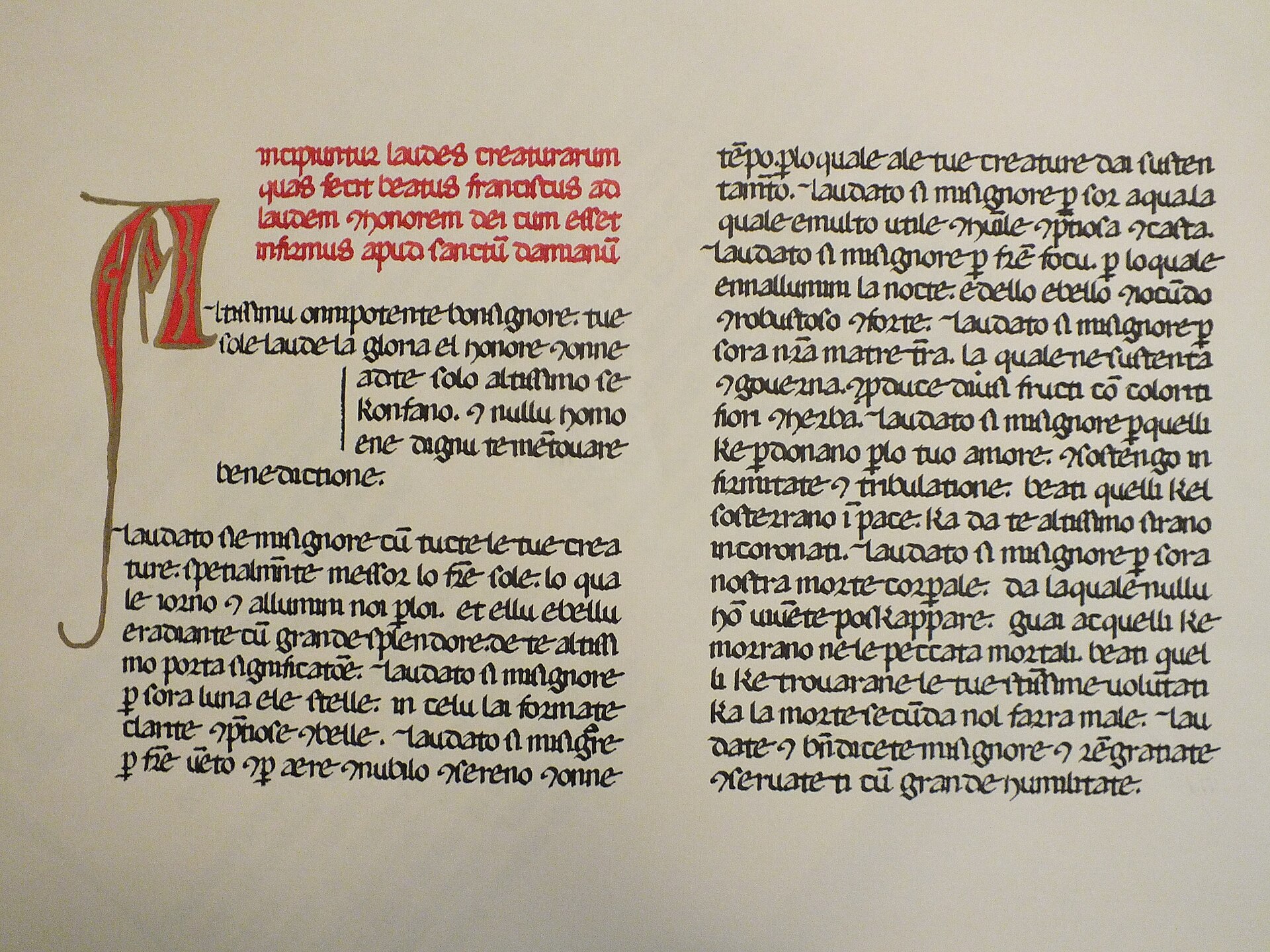

How the Canticle is built
The poem moves from God, whom "there is no man fit to mention," to the creatures through which he may be praised. The heavenly lights come first (sun, moon and stars), then the four elements of medieval natural philosophy (air with wind and weather, water, fire, earth), each with its own adjectives: the sun "beautiful ... and radiant with splendor great," water "helpful and humble and precious and pure," fire "fair ... and gay and mighty and strong," the earth a "sister, mother" who "sustains and keeps us." The creatures alternate as "brother" and "sister" in a pattern that follows the grammatical gender of their Italian names (frate sole, sora luna, frate vento, sora acqua, frate focu, sora nostra matre terra). Then the poem turns to human beings, and only to two kinds: those who forgive and bear suffering in peace, and those who meet "our sister, the bodily death." The warning "Woe to them who die in mortal sin" and the promise that "the second death shall do them no ill" (Revelation 2:11 and 20:6) keep the song inside the faith of the Church. It ends with a call to praise and to "be subject unto Him with great humility."
The repeated Italian word per ("Laudato si', mi' Signore, per sora luna") is the main problem for translators. It can mean "for" (praise God for the creature), "by" or "through" (let God be praised by or through the creature), and translators choose differently; Robinson's "with all Thy creatures" in the first line and "for" in the rest is one choice among several. The opening words Laudato si' gave their name to Pope Francis's encyclical on the care of creation, signed on May 24, 2015. The encyclical calls Francis "the patron saint of all who study and work in the area of ecology," and its own translation of the Canticle takes per as "through": "Praised be you, my Lord, through Sister Water, who is very useful and humble and precious and chaste."32
The Testament (1226)
The Testament is Francis's last word to his brothers and the most personal of his writings. The 1909 summary says it is believed to have been dictated at the hermitage of the Celle at Cortona in April 1226, "during an interval of improvement," and records that Francis himself described it as a "reminder, a warning, and an exhortation."9 Robinson translated it from the Assisi manuscript 338, where it follows the Rule of 1223 (folios 16 to 18), and compared it with other early copies.1 Its opening lines, on the lepers, were quoted above. It goes on from conversion to the faith that carried him afterward:
And the Lord gave me so much faith in churches that I would simply pray and say thus: "We adore Thee Lord Jesus Christ here and in all Thy churches which are in the whole world, and we bless Thee because by Thy holy cross Thou hast redeemed the world." After that the Lord gave me, and gives me, so much faith in priests who live according to the form of the holy Roman Church, on account of their order, that if they should persecute me, I would have recourse to them. And if I had as much wisdom as Solomon had, and if I should find poor priests of this world, I would not preach against their will in the parishes in which they live. And I desire to fear, love, and honor them and all others as my masters; and I do not wish to consider sin in them, for in them I see the Son of God and they are my masters. And I do this because in this world, I see nothing corporally of the most high Son of God Himself except His most holy Body and Blood, which they receive and they alone administer to others.12
Robinson explains "order" in this passage as "sacerdotal character" and "priests of the world" as secular priests, the parish clergy who were not members of a religious order.12 Francis would not preach in a parish against the will of its priest, even a poor and ignorant one, and he gave as his reason the Eucharist. He then asked that the sacrament be "honored and revered above all things," that the names and written words of God found "in unseemly places" be gathered up and put in a fitting place, and that the brothers "honor and venerate all theologians and those who minister to us the most holy Divine Words as those who minister to us spirit and life."12
The middle of the Testament recalls the early brotherhood (the passage on the Gospel form of life and the one tunic, quoted above) and then turns to work and to the houses of the order:
And I worked with my hands and I wish to work and I wish firmly that all the other brothers should work at some labor which is compatible with honesty. Let those who know not [how to work] learn, not through desire to receive the price of labor but for the sake of example and to repel idleness. And when the price of labor is not given to us, let us have recourse to the table of the Lord, begging alms from door to door. The Lord revealed to me this salutation, that we should say: "The Lord give thee peace." Let the brothers take care not to receive on any account churches, poor dwelling-places, and all other things that are constructed for them, unless they are as is becoming the holy poverty which we have promised in the Rule, always dwelling there as strangers and pilgrims. I strictly enjoin by obedience on all the brothers that, wherever they may be, they should not dare, either themselves or by means of some interposed person, to ask any letter in the Roman curia either for a church or for any other place, nor under pretext of preaching, nor on account of their bodily persecution; but, wherever they are not received let them flee to another land to do penance, with the blessing of God.12
Two parts of this paragraph went straight to the heart of the later quarrel. One is the ban on accepting buildings that did not fit "holy poverty." The other is the ban on asking the papal court for "any letter," that is, for papal privileges. By 1226 the order was already receiving such letters, and its later history depended on them.
The Testament also contains a passage that readers who know Francis only from the Canticle may not expect. After asking that the Office be said "according to the Rule," he wrote:
And those who may be found not performing the office according to the Rule and wishing to change it in some way, or who are not Catholics, let all the brothers wherever they may be, if they find one of these, be bound by obedience to present him to the custos who is nearest to the place where they have found him. And the custos shall be strictly bound, by obedience, to guard him strongly day and night as a prisoner so that he cannot be snatched from his hands until he shall personally place him in the hands of his minister. And the minister shall be firmly bound by obedience to send him by such brothers as shall watch him day and night like a prisoner until they shall present him to the Lord of Ostia, who is master, protector, and corrector of this brotherhood.12
The "Lord of Ostia" was Cardinal Ugolino, then bishop of Ostia and protector of the order, who became Pope Gregory IX the next year.12 The measure applies to friars, members of the brotherhood who had departed from the prescribed Office or from the Catholic faith; it hands them over to the order's own superiors and finally to its cardinal protector. It is quoted here in full so that readers can weigh it beside the gentler passages.
The Testament closes with the sentences that made it a legal problem for the next century:
And let not the brothers say: This is another Rule; for this is a remembrance, a warning, and an exhortation and my Testament which I, little Brother Francis, make for you, my blessed brothers, in order that we may observe in a more Catholic way the Rule which we have promised to the Lord. And let the minister general and all the other ministers and custodes be bound by obedience not to add to these words or to take from them. And let them always have this writing with them beside the Rule. And in all the Chapters they hold, when they read the Rule let them read these words also. And I strictly enjoin on all my brothers, clerics and laics, by obedience, not to put glosses on the Rule or on these words saying: Thus they ought to be understood; but as the Lord has given me to speak and to write the Rule and these words simply and purely, so shall you understand them simply and purely and with holy operation observe them until the end.12
Robinson notes that some copies, the Assisi manuscript among them, read "without gloss" where his text reads "purely."12 Francis insisted that the Testament was "not another Rule" and also commanded, "by obedience," that it be read with the Rule and never glossed. Whether a dying founder who had resigned the government of his order could bind it in this way was the first question his friends put to the pope four years later.
Death at the Portiuncula (October 3, 1226)
Brought under guard to the bishop's palace in Assisi in July 1226, Francis asked in the early autumn to be carried down to the Portiuncula, the place where the brotherhood had begun, so that he might die there.9 Celano's First Life describes the last days. Knowing that death was near, Francis asked two brothers to sing "with a loud voice praises to the Lord concerning death which was near, or rather life which was so close at hand," and himself "broke into that Psalm of David, 'I cried unto the Lord with my voice, with my voice unto the Lord I made supplication'" (Psalm 141 in the Douay-Rheims numbering, 142 in the King James Version). To a brother who begged a blessing for the friars he answered: "See, my son, God is calling me, I remit all the offences and faults of my brethren as well absent as present, and so far as I may, I absolve them: do thou proclaim this to them and bless them all for me."33
Celano continues:
Finally he ordered the codex of the Gospels to be brought and asked to have the passage from the Gospel according to John read to him beginning at the words "Six days (sic) before the Passover, Jesus, knowing that His hour was come, that He should pass out of this world unto the Father". ... Then, for that he was about to become dust and ashes, he bade that he should be laid on sack-cloth and sprinkled with ashes. All the brethren (whose father and leader he was) came together, and, as they stood reverently by and awaited his blessed departure and happy consummation, his most holy soul was released from the flesh and absorbed into the abyss of light, and his body fell asleep in the Lord.33
The "(sic)" is Howell's: in the Douay-Rheims, John 13:1 reads "Before the festival day of the pasch, Jesus knowing that his hour was come, that he should pass out of this world to the Father," and the "six days" come from John 12:1.19 Celano adds that an unnamed brother "of no small fame" saw Francis's soul rise to heaven "as it were a star having in some sort the bigness of the moon," and that the brothers and the people of Assisi who came to see the body were amazed to find on it the marks of the wounds.33
The date needs a word of explanation. Celano gives it as "the 1226th year of our Lord's Incarnation, in the fourteenth Indiction, on Sunday the fourth day of October."34 Francis died after sunset on Saturday, October 3, and by the medieval custom of counting the liturgical day from the evening before, that evening already belonged to Sunday, October 4. Howell's table of dates gives "3rd to 4th October," the modern lives say he died on the evening of October 3, and the Church keeps his feast on October 4.34 Celano reckons that he died "in the twentieth year of his conversion."35
Canonization and the basilica (1228 to 1230)
On October 4 the body was carried in procession up to the town, with a halt at San Damiano so that Clare and her sisters could see it, and was laid for the time being in the church of San Giorgio, where Francis had received his first schooling from its priests and where Clare had heard him preach.9 Less than two years later his friend Ugolino, now Gregory IX, came to Assisi and declared him a saint. The third part of Celano's First Life describes the ceremony, the pope's sermon and the reading of the miracles, and ends with the date: "These things were done in the city of Assisi on 16th July, in the second year of the pontificate of Pope Gregory IX," which Howell gives as 1228.35 Celano was there. He wrote the First Life at the pope's command between that day and February 1229.3
On the day after the canonization, the 1909 summary records, the pope laid the first stone of the great double church of San Francesco on the western edge of the town. That summary dates the transfer of the body to May 25, 1230, and says that Brother Elias had it moved in secret and buried far below the high altar of the lower church, where it lay hidden until it was found on December 12, 1818, after a search lasting fifty-two nights.9 Michael Bihl's article on the Friars Minor in the same encyclopedia gives the date as May 22, 1230, "three days before the appointed time," and says that Elias, "possibly fearing some disturbance," took possession of the body "with the assistance of the civic authorities" and that Gregory IX censured and punished him for it in a bull of June 16, 1230.36 The order commemorates the translation on May 25. Bihl calls the building "the magnificent church (or rather double church) of S. Francesco." For friars who had heard the Testament read, a church on that scale raised at once the question of what the Rule allowed.
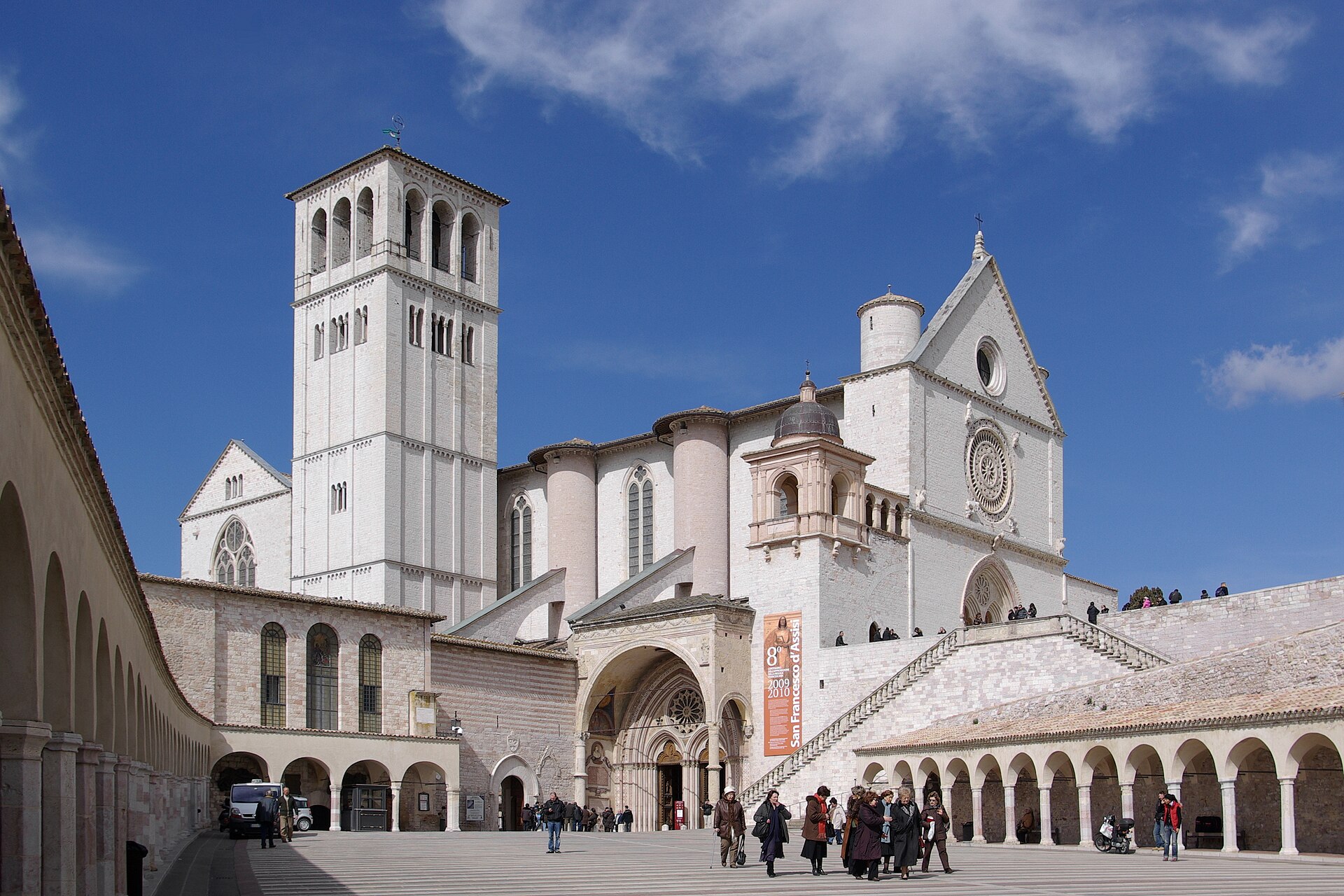

Quo elongati and the quarrel over poverty (1230 to 1323)
The bull Quo elongati (1230)
At the general chapter of 1230 the friars sent a delegation, with the minister general, to Gregory IX with questions about the Rule and the Testament. Gregory answered in the bull Quo elongati, dated at Anagni on September 28, 1230.36 The bull is quoted here in the modern English translation published by the Capuchin friars of Australia on their CapDox site, quoted short.37 Gregory reminds the friars of his own part in the Rule: "Although we held a lower rank, we stood by him during his composition of the aforementioned Rule and obtained its confirmation from the Apostolic See." He grants that Francis "had a singular purpose in writing the Testament," and then decides the first question:
To alleviate any apprehension in your hearts, we unequivocally state that you are not obligated to follow the Testament. Without the unanimous consent of the brothers, particularly the ministers, Francis could not establish a binding rule that applies to all. ... he could not bind his successor because an equal lacks authority over another equal.37
The reasoning is legal. The Rule bound the friars because they had professed it and the pope had confirmed it; the Testament was the private command of a man who, at his death, held no office that could bind his successors. The bull went on to the Rule itself. The friars were bound to the Gospel counsels that the Rule states as precepts and prohibitions, and to the rest "in the same manner as other Christians." On money, Gregory allowed the friars to point a donor to an agent (in the Latin, a nuntius) who would hold and pay out alms on the donor's behalf, so that the brothers themselves never received coins. On property, he answered the sentence of chapter 6, "The brothers shall appropriate nothing to themselves," by ruling out ownership by individuals or by the order as a body while allowing the use of "equipment, books, and other movable property," and by stating that places and houses remained the property of those to whom they belonged.37
Readers have judged the bull in opposite ways. To the friars who wanted to preach, study and build, it made the Rule workable for a large order spread across Europe. To those who held to the Testament, it set aside the founder's last command four years after his death, and it was written by the cardinal who had been his friend and who had shaped the Rule of 1223. The bull itself claims both loyalties at once: Gregory says he knows Francis's intention "more fully" because of their "longstanding friendship."37
Elias, the Spirituals and the Community
Bihl's history traces the conflict that followed. Elias became minister general in 1232; complaints about his government, led by the Paris masters of theology and the German and English provinces, brought his deposition at the chapter of Rome in 1239 with Gregory IX's approval, and he later sided with the emperor Frederick II and was excommunicated.36 Under his successors the friars grew further apart on how strictly the Rule should be kept. Bonaventure, elected minister general in 1257, tried to hold the order together with revised constitutions promulgated at the chapter of Narbonne in 1260 and with his new Major Life, which the chapter of Pisa approved in 1263 "as the standard biography of the saint to the exclusion of all others" (lesson 13 takes up what happened to the earlier lives).4 Bihl records that the Spirituals "accused Bonaventure of laxity," while he denounced abuses in his own letters.36
Nicholas III's bull Exiit qui seminat (August 14, 1279) gave the order's arrangement its classic form. It confirmed that the friars renounced all property in common as well as individually and vested the ownership of everything given to them in the Holy See, unless the donor kept the title himself; the friars kept only its use.36 The party that Bihl calls "Spirituals or Zelanti," in which Peter John Olivi was the leading thinker, held that the vow also bound the friars to a "poor use" (usus pauper) of the things they did not own. The majority, which Bihl calls "the Community," held that the Rule as the popes had explained it was enough. Clement V tried to settle the strife at the Council of Vienne in the decree Exivi de Paradiso (May 5, 1312, in Bihl's dating), which kept the renunciation of property, required "simple use" where the Rule prescribed it, and left questions of habit, storehouses and cellars to the superiors.36 It did not end the quarrel. The Spirituals of Provence and Tuscany, Bihl writes, "were not yet placated," and John XXII "interdicted and suppressed their peculiar notions" in the constitution Quorumdam exigit (October 7, 1317).36
John XXII and the poverty of Christ (1322 to 1323)
In 1321, Bihl continues, the Dominican inquisitor John of Belna objected to the statement that Christ and the apostles possessed property "neither in common nor individually," and the quarrel "degenerated into a fierce scholastic disputation between the Franciscans and the Dominicans," with the pope inclining to the Dominican view. The minister general of the Franciscans at the time was Michael of Cesena, elected in 1316. John XXII acted first in the constitution Ad conditorem canonum (December 8, 1322), which, in Bihl's words, "renounced the title of the Church to all the possessions of the friars Minor, and restored the ownership to the order," undoing the arrangement of 1279.36 He then issued Cum inter nonnullos (also spelled Quum inter nonnullos), given at Avignon "two days before the Ides of November" in the seventh year of his pontificate, that is, November 12, 1323. In the translation published by the Franciscan Archive, which its translator released to the public domain, the bull's first ruling reads:
We, desiring to put an end to this contest, after [having taken] the counsel of our brothers [the cardinals] by this perpetual edict do declare that a pertinacious assertion of this kind, when sacred scriptures, which assert in very many places that they had not a few things, expressly contradict it, and when it supposes openly that the same sacred scripture, through which certainly the articles of orthodox faith are proven in regards to the aforesaid things, contains the ferment of falsehood, and consequently, as much as regards these things, emptying all faith in them, it renders the Catholic Faith doubtful and uncertain, taking away its demonstration, is respectively to be censured erroneous and heretical.38
The "assertion of this kind" is the one named in the bull's opening words: "to affirm pertinaciously, that Our Redeemer and Lord Jesus Christ and His Apostles did not have anything individually, nor even in common." A second ruling declared it heretical to hold that Christ and the apostles had no right to use, sell or give away the things Scripture says they had.38 The word "pertinaciously" limits the condemnation to those who hold the view stubbornly against the Church's judgment, and the bull says nothing about the friars' own vow. It did, however, reject the reading of Christ's poverty on which the Spirituals, and many in the Community, had built their defense of the Franciscan life. Michael of Cesena broke with the pope and was deposed; Bihl writes that he was "supported with conspicuous learning by some of the leading members of the order and encouraged by the German emperor Louis IV (the Bavarian)," and judges that the long strife "gave great and irresistible impulse to laxity in the order." His followers, called Michaelites, were disavowed by a general chapter at Paris, and the order as a whole remained with the pope.36
The divisions lasted. In the following two centuries the reform movement of the "Observants" grew beside the "Conventuals," and at a general chapter summoned by Leo X to meet at Rome at Pentecost, May 31, 1517, the Observants were declared "an independent order, the true Order of St. Francis," and "separated ... completely from the Conventuals." The Capuchin reform, which Bihl names among "the reforms afoot" in the years after 1528, followed.36 All of them profess the Rule of 1223. The sentence of chapter 6, "The brothers shall appropriate nothing to themselves, neither a house nor place nor anything," is the shared text, and the century of argument after 1226 was over how to keep it.
What the record shows and what it does not
- Documented fact: the papal approval of the Rule in Solet annuere (November 29, 1223), with the original bull kept at the Sacro Convento in Assisi; the canonization at Assisi on July 16, 1228; the bull Quo elongati (September 28, 1230); John XXII's Ad conditorem canonum (1322) and Cum inter nonnullos (1323). The death on the evening of October 3, 1226 is given by Celano within three years of the event.
- Francis's own words: the Rule of 1223, the longer Rule of 1221, the Testament, the Canticle of the Creatures and the two texts preserved in Clare's Rule, in Robinson's 1906 translation from the oldest manuscripts. They show his conversion among the lepers, his claim that "the Most High Himself" showed him the Gospel form of life, his obedience to the pope and reverence for priests and the Eucharist, his rule against money and property, his two "ways" of living among Muslims, and his wish that the Rule be kept "without gloss."
- The earliest outside witness: Jacques de Vitry, in a letter of early 1220, reports that Francis crossed the lines at Damietta, preached to the Saracens for several days, "made little progress," and was asked by the sultan to pray for him.
- What the earliest life reports: Celano's First Life (1228 to 1229) gives the youth in Assisi, the bishop's mantle, the Gospel at the Portiuncula, the oral approval by Innocent III, the visit to the sultan, Greccio, the seraph vision and the marks of the wounds, and the death scene.
- Later additions: the speaking crucifix and the vanishing leper first appear in Celano's Second Life (1244 to 1247); Innocent III's dream of a little man holding up the Lateran and the challenge of the fire before the sultan come in Bonaventure's life (1260 to 1263); the birth in a stable is a fifteenth-century legend.
- Scholarly reading: whether the Rule of 1223 kept or changed the first ideal (Sabatier against Robinson); how far the lives shape Francis to the pattern of saints' lives (Thompson); what Francis intended at Damietta. Lesson 13 sets out the debate over the sources.
- Open questions: the year of Innocent III's approval (1209 or 1210); the exact year of the Canticle and of the two strophes said to be added; the date at which the chapter on the Saracens entered the Rule of 1221.
Claims checked
The claims below are common in popular lives, sermons, websites and films about Francis. Each is rated by the evidence for it: Supported, Partly supported, Unsupported, Refuted or Unresolved. Stories that belong to the later legends (the wolf of Gubbio, the sermon to the birds, perfect joy, the first nativity scene, the stigmata accounts compared) are rated in lesson 13.
"Francis was born in a stable, like Christ."
Refuted. No early source says so. Robinson's 1909 article states that "the legend that he was born in a stable dates from the fifteenth century only, and appears to have originated in the desire of certain writers to make his life resemble that of Christ."9 Celano, writing within three years of his death, describes a rich merchant's son raised in his parents' house.10
"Francis was a priest."
Refuted. The Testament speaks of priests as others, men in whom "I see the Son of God," and of himself as one of the brothers.12 Robinson's summary records that the first brothers received the tonsure in Rome and that Francis was "ordained deacon later on."9 No early source records his ordination as a priest.
"Francis's own writings tell how the crucifix of San Damiano spoke to him."
Refuted as a claim about his writings. The Testament names the lepers as the beginning of his conversion and does not mention San Damiano's crucifix.12 The First Life brings Francis to San Damiano without any voice.15 The speaking crucifix first appears in the Second Life, written from the friars' collected memories some twenty years after his death.14 Whether the event happened is a question this rating does not decide; the report is late and comes from one writer.
"Innocent III approved the Franciscan Rule by a papal bull in 1209."
Refuted. The approval was given by word of mouth. The heading of the longer Rule in the manuscripts calls it the Rule "which Pope Innocent III confirmed without a Bull," and the first written papal approval of a Franciscan Rule is Honorius III's Solet annuere of 1223.21 The year, 1209 or 1210, is Unresolved: Robinson preferred April 23, 1209, and Sabatier the summer of 1210.22
"Innocent III dreamed that Francis held up the falling Lateran Basilica."
Unsupported by the earliest sources. Celano's First Life gives a dream to Francis (the tall tree bending down), and Bonaventure, writing in the 1260s, gives the dream of the Lateran to the pope, "as he recounted."204 Bonaventure says the pope told of the dream himself, but no earlier witness records it, and a report that first appears in writing about half a century after the event cannot be checked.
"Francis converted the Sultan of Egypt" (or "the sultan was secretly baptized").
Refuted. The witness on the spot, Jacques de Vitry, wrote in 1220 that Francis preached for several days and "made little progress," and that the sultan asked him to pray that he might be inspired to adhere to the religion "which most pleased God."2 Celano, the order's own first biographer, says that the sultan heard him "very willingly" but that "the Lord did not fulfil S. Francis' desire."24 Robinson's 1909 summary says that Francis's preaching "seems to have effected little" beyond a promise of kinder treatment for Christian captives.9 No early source reports a conversion or a baptism.
"Francis went to Egypt as a peacemaker to stop the Crusade."
Partly supported. Celano's Second Life reports that at Damietta Francis, believing the Lord had shown him that the Christians "will not prosper," warned the army against a battle on a certain day, "urging them not to fight, and announcing disaster if they did," and that the army ignored him.39 The same passage says he and his companions had come "in their ardour for martyrdom," and Jacques de Vitry says he crossed the lines "inflamed with zeal for the faith" to preach.392 The sources show a warning against one battle and a mission to preach Christ to the sultan. None of them reports that he opposed the crusade as such or went to negotiate a peace.
"Francis offered to walk through fire to prove his faith before the sultan."
Unresolved. The offer appears first in Bonaventure's Major Life (chapter 9), written some forty years after the visit, and the sultan declines in that account, so no fire is lit.4 Jacques de Vitry (1220) and Celano (1228 to 1229) say nothing of it.224
"The Rule of 1223 was forced on Francis by the Church and betrayed his ideal."
Unresolved. This is Sabatier's view: the Rule of 1210 "alone is truly Franciscan," and that of 1223 "is indirectly the work of the Church."22 In its favor, Robinson's own summary records that some precepts were changed at Cardinal Ugolino's urging.9 Against it, the Rule of 1223 opens in Francis's voice, binds the brothers to "observe the holy Gospel," keeps the ban on money "either themselves or through an interposed person," and much of its wording already stands in the longer Rule; Robinson called the two "essentially and in substance ... the same," and the Testament tells the friars to keep "the Rule which we have promised to the Lord."2812 The texts allow both readings, and historians still divide.
"Francis forbade his friars to study and despised books."
Partly supported. The Rule of 1223 tells those "who are ignorant of letters" not to "care to learn letters," and to seek "the spirit of the Lord" instead.28 The same writings tell the brothers to "honor and venerate all theologians," to gather up God's written words found in unseemly places, and let the clerics keep the Office.12 The Rule of 1223 also requires that preachers be examined by the minister general, and Robinson's 1909 summary records that Francis refused to enter the friars' house at Bologna in 1220, in part because a studium (house of study) had been set up there.9 His writings warn against learning sought for pride and against the unlettered seeking letters; they do not forbid study to those already learned.
"The Testament was binding on Francis's friars."
Refuted as a matter of church law since 1230. Francis commanded "by obedience" that the Testament be read with the Rule and never glossed.12 Gregory IX ruled in Quo elongati that the friars "are not obligated to follow the Testament," because Francis could not bind his successors.37 Many friars, the Spirituals above all, continued to treat it as Francis's true intention.
"Pope John XXII condemned Franciscan poverty as heresy."
Partly supported. Cum inter nonnullos (1323) condemned as "erroneous and heretical" the pertinacious assertion that Christ and the apostles "did not have anything individually, nor even in common."38 It did not condemn the friars' vow or their way of life. In Ad conditorem canonum (1322) John XXII had already given the friars' goods back to the order, ending papal ownership; Bihl calls this "a harsh provision for an order which had laboured so untiringly in the interests of the Church."36
"The stigmata were invented generations after Francis died."
Refuted as to the date of the report. Celano's First Life, written in 1228 and 1229, less than five years after La Verna, describes the vision of the seraph and the marks in hands, feet and side, and names Brother Elias among those who saw the side wound.30 Brother Leo, who was with Francis on La Verna, left a short note about the event on the parchment of the blessing Francis wrote for him, still kept at Assisi.9 What the marks were is a separate question; lesson 13 compares the accounts.
"Francis wrote the Peace Prayer" and "Francis said, 'Preach the Gospel at all times; if necessary use words.'"
Unsupported. Neither text is in Robinson's 1906 collection of the writings, which predates the first known printing of the Peace Prayer, and neither is in Celano. The closest authentic sentence to the second saying is chapter 17 of the Rule of 1221, which keeps preaching in words under the minister's license and adds: "Nevertheless, let all the brothers preach by their works."21 Lesson 13 traces both sayings.
Hard questions and answers
Was Francis a Gospel radical whom the Church tamed, a kind of Protestant before the Reformation?
Sabatier's Life (1894) made something like this case, and it drew many Protestant readers to Francis.5 His own writings support part of it: he says that "no one showed me what I ought to do, but the Most High Himself revealed to me that I should live according to the form of the holy Gospel," and he measures the whole Rule by "the holy Gospel of our Lord Jesus Christ."1228 The same writings bind him and his brothers in obedience "to the Lord Pope Honorius and to his successors," ask for a cardinal "to be governor, protector, and corrector" so that the friars stay "grounded in the Catholic faith," and rest his reverence for priests on the Eucharist, "His most holy Body and Blood, which they receive and they alone administer to others."2812 A reader can admire his return to the Gospel text, as many Protestants have, while recognizing that he placed that return inside the Roman Church and its sacraments and asked for no reform of its doctrine.
Gregory IX was Francis's friend and protector. How could he set aside the Testament only four years after Francis died?
Gregory's own answer, in Quo elongati, is legal: a Rule binds because it is professed and confirmed by the Apostolic See, and a founder without office cannot bind his successors, "because an equal lacks authority over another equal."37 He also claims to know Francis's mind better than the friars do, from the years when he "stood by him" during the writing of the Rule.37 The order he had protected had grown into a large body of friars, with houses, preaching and studies in many countries, and the Testament's bans on papal letters and on buildings unfit for "holy poverty" could not be kept by it as it then was.12 Those who regretted the bull could point to Francis's plain command that the Testament be read with the Rule "until the end." Both readings rest on documents, and the dispute that followed shows that both had many defenders inside the order.
Was Francis's visit to the sultan an act of interreligious dialogue or a mission to convert him?
The texts name both, and the answer depends on which is weighted. Jacques de Vitry and Celano agree that Francis went to preach Christ, and Celano says he hoped for martyrdom; the sultan, in Jacques's report, asked for prayer that he might hold to the religion "which most pleased God."224 The chapter of the Rule of 1221 on the Saracens gives two ways of life among Muslims: living "subject to every human creature for God's sake" without disputes, and, "when they see it is pleasing to God," preaching the Trinity and baptism.21 Benedict XVI, in a general audience of January 27, 2010, read the episode as a model: Francis "travelled the path of dialogue effectively" and "was given a benevolent welcome and a cordial reception by the Muslim Sultan."40 That is a modern reading of the event; the medieval sources describe a preacher who was received with courtesy and who did not convert his hearer.
How does the man of the Canticle fit with the Testament's order to hold erring friars "as a prisoner"?
Both are in his own dictated words. The Testament orders that friars who will not say the Office according to the Rule, "or who are not Catholics," be held "day and night as a prisoner" and handed up to the cardinal protector.12 The measure is internal discipline: it concerns members of his own order, it gives them to their superiors and to the Church, and it imposes no penalty of its own. It reflects a man for whom obedience and the Catholic faith were the condition of the brotherhood's existence, the same man who wrote that ministers should correct "humbly and charitably" and must not be "angry or troubled on account of the sins of others."28 Readers who know Francis from later images of gentleness alone meet in the Testament a founder who was also a lawgiver.
What can a skeptic accept about the stigmata, and what can a believer claim?
The documents establish that within five years of September 1224 the order's first biographer described the vision of a seraph and marks on Francis's hands, feet and side, named a witness to the side wound, and reported that many saw the marks on the body after his death; Brother Leo's note on his autograph blessing gives a still earlier witness.30339 A skeptic can accept that the report is early and that companions said they saw the marks. Whether the marks came from God, from Francis's own devotion, from illness or from some other cause, the documents do not settle; they record what the witnesses believed. A believer can claim an early and consistent tradition, which the Church honors with a feast on September 17.9 Lesson 13 sets the accounts side by side.
Did Francis mean that his friars should own nothing at all, even as a community?
The Rule of 1223 says the brothers "shall appropriate nothing to themselves, neither a house nor place nor anything," and forbids them to receive money "either themselves or through an interposed person."28 The Testament tells them to live in churches and houses "as strangers and pilgrims."12 Read plainly, the texts exclude ownership by the order as a body as well as by individuals, and that is how the popes from Gregory IX to Nicholas III read them, placing ownership with donors or with the Holy See.3736 John XXII's decision of 1322 to return ownership to the order, and his ruling in 1323 that Christ and the apostles had owned things, ended that arrangement in law.38 Francis's own words do not settle the technical question of "use" against "ownership" that later lawyers and theologians argued, because he never wrote in those terms.
For the older monastic background that the friars both drew on and changed, see Church History, Part A, lesson 07; for the medieval church in outline, lesson 09 of the same module. Lesson 13 of this module turns to the lives and legends, and lesson 14 places Francis beside Aquinas, the Frankfurt author and Catherine of Siena.
Learn more
- Robinson, The Writings of Saint Francis of Assisi (1906): All of Francis's writings in a careful public domain translation, with notes on the manuscripts.
- Celano's First and Second Lives (Howell, 1908): The earliest life, written within three years of his death, and the second life built from the friars' memories.
- The Rule of 1223 (Internet Medieval Sourcebook): A short modern translation of the Rule to read beside Robinson's.
- Quum inter nonnullos (Franciscan Archive): John XXII's ruling of 1323 on the poverty of Christ in a public domain translation.
- Church History, Part A, lesson 07: Monks and the Desert Fathers: The monastic tradition that the friars drew on and departed from.
- Lesson 13: Francis in the Early Lives and the Little Flowers: The sources, the Franciscan question and the famous legends rated.
Still being checked (10 items)
These points could not be confirmed against a primary source when this lesson was written and fact checked in October 2026. The text above states each one as uncertain.
- The editor of the critical edition of Jacques de Vitry's letters (R. B. C. Huygens) is named in the lesson from standard reference; the page opened for the Latin cites only 'the critical edition, letter VI' and does not name him. The English of the letter is John Tolan's as labeled on that page; Tolan's book itself was not opened.
- The Historia Occidentalis quotations are from the Latin and an unattributed English rendering on the same page; the chapter number (32) and the 1220s date were not checked in the critical edition.
- Publication details for Moorman (1940, 1968), Thompson (2012) and Vauchez (2009, 2012) are given from standard bibliography; these books were not opened, and the lesson only names their approach.
- The Bonaventure text was read in a saved copy of Salter's translation (an ebook edition stating 'c.1902'); the online URL of that copy was not recorded, and the 1904 Dent edition was not opened.
- The Subiaco fresco's date (1224 or 1228) comes from the Wikimedia Commons file title and was not verified independently.
- The year of Innocent III's oral approval (1209 or 1210) and the exact year of the Canticle and its added strophes remain disputed in the sources.
- The date of the translation of the body is given as May 25, 1230 in the Catholic Encyclopedia article on Francis and May 22, 1230 in Bihl's article on the Friars Minor; both are reported.
- Bihl's article dates Exivi de Paradiso to May 5, 1312; this date was not checked against the conciliar text.
- The view that the Spirituals held a doctrine of 'poor use' (usus pauper) binding under the vow is stated from standard histories; Bihl's article uses the term in describing Exivi de Paradiso but was the only source opened.
- The Testament passages were checked word for word in one OCR copy of Robinson (archive.org writingsofsaintf00fran_1); two other archive.org copies (cu31924029364787, writingsofsaintf00fran_0) lack OCR text for the Testament pages, so the second check of those passages rests on Celano's quotation of the opening lines (1 Cel 17) only. The Rules, the Canticle and the writings to Clare were matched in two copies.
Notes
- Paschal Robinson, trans., The Writings of Saint Francis of Assisi (Philadelphia: Dolphin Press, 1906), Introduction, pp. xix to xx (the Assisi codex 338, its contents and date), Internet Archive scan of the Princeton Theological Seminary copy (retrieved Nov. 5, 2026). Read it online. ↩
- Jacques de Vitry, letter VI (February or March 1220), Latin text and English translation by John V. Tolan (Saint Francis and the Sultan, 2009, ch. 1) as reproduced on Dick Wursten, "Jacques de Vitry over Franciscus en de sultan," which cites the critical edition of the letters (brief VI). The page was opened for the Latin and the translation (retrieved Nov. 5, 2026). Jacques's meeting with the friars in 1216 and his presence at Damietta: Robinson, Writings, pp. 27 to 28; Catholic Encyclopedia, "St. Francis of Assisi" (1909). Read it online. ↩
- Thomas of Celano, The Lives of S. Francis of Assisi, trans. A. G. Ferrers Howell (London: Methuen, 1908), Translator's Introduction, pp. vi to vii (Celano's entry into the order, his presence at the canonization of July 16, 1228, the First Life written between that date and February 1229 at the command of Gregory IX, the Second Life written between 1244 and 1247 for the minister general Crescentius of Jesi); Catholic Encyclopedia, "St. Francis of Assisi" (1909), on Celano joining the order after Francis returned from Spain. Read it online. ↩
- Bonaventure, The Life of Saint Francis (Legenda Maior), trans. E. Gurney Salter (London: J. M. Dent, 1904), ch. 3 (the dream of the Lateran) and ch. 9 (the sultan and the offer of the fire), text of the Salter translation saved on Jeff Pierson's PC from an ebook edition; dates: Paschal Robinson, "St. Bonaventure," The Catholic Encyclopedia, vol. 2 (New York: Robert Appleton, 1907) (the chapter of Narbonne, 1260; the chapter of Pisa, 1263, approving the life "as the standard biography of the saint to the exclusion of all others"); Catholic Encyclopedia, "St. Francis of Assisi" (1909): "appeared about 1263" (retrieved Nov. 5, 2026). Read it online. ↩
- Paul Sabatier, Life of St. Francis of Assisi, trans. Louise Seymour Houghton (New York: Scribner, 1894), Project Gutenberg ebook 18787 (retrieved Nov. 5, 2026). Sabatier's judgment of the two Rules as quoted in Robinson, Writings, pp. 29 to 30 (from Vie de S. Francois, p. 289). Read it online. ↩
- John R. H. Moorman, The Sources for the Life of S. Francis of Assisi (Manchester: Manchester University Press, 1940); A History of the Franciscan Order from Its Origins to the Year 1517 (Oxford: Clarendon Press, 1968). Cited by title; not opened for this lesson. ↩
- Augustine Thompson, O.P., Francis of Assisi: A New Biography (Ithaca: Cornell University Press, 2012), part 1 (the life from the writings and early documents) and part 2 (the sources and the hagiographic portraits). Cited for the author's method; not quoted. ↩
- Andre Vauchez, Francis of Assisi: The Life and Afterlife of a Medieval Saint, trans. Michael F. Cusato (New Haven: Yale University Press, 2012; French ed. Francois d'Assise, Paris: Fayard, 2009). Cited by title; not quoted. ↩
- Paschal Robinson, "St. Francis of Assisi," The Catholic Encyclopedia, vol. 6 (New York: Robert Appleton Company, 1909), New Advent online text, a 1900s Catholic reference used beside the primary texts (retrieved Nov. 5, 2026). Read it online. ↩
- Thomas of Celano, The Lives of S. Francis of Assisi, trans. A. G. Ferrers Howell (London: Methuen, 1908), First Life, 1 Cel 1 to 7 (pp. 3 to 9): the youth, the Apulian expedition and the dream of arms, the cave and the "bride." Read it online. ↩
- Thomas of Celano, The Lives of S. Francis of Assisi, trans. A. G. Ferrers Howell (London: Methuen, 1908), Second Life, 2 Cel 4 (pp. 146 to 147): the battle with Perugia and the imprisonment. Read it online. ↩
- Paschal Robinson, trans., The Writings of Saint Francis of Assisi (Philadelphia: Dolphin Press, 1906), "The Testament of the Holy Father St. Francis," pp. 79 to 86, with Robinson's notes on the manuscripts and variant readings (feci misericordiam and feci moram; "purely" and "without gloss") (retrieved Nov. 5, 2026). Read it online. ↩
- Thomas of Celano, The Lives of S. Francis of Assisi, trans. A. G. Ferrers Howell (London: Methuen, 1908), First Life, 1 Cel 16 to 17 (pp. 16 to 17): the robbers and the "herald of the great King"; the lepers. Read it online. ↩
- Thomas of Celano, The Lives of S. Francis of Assisi, trans. A. G. Ferrers Howell (London: Methuen, 1908), Second Life, 2 Cel 9 to 11 (pp. 152 to 155): the leper who vanished, the crucifix at San Damiano, and Celano's comment that the words referred to the Church. Read it online. ↩
- Thomas of Celano, The Lives of S. Francis of Assisi, trans. A. G. Ferrers Howell (London: Methuen, 1908), First Life, 1 Cel 8 to 15 (pp. 9 to 15): Foligno, San Damiano, the father's anger and the renunciation before the bishop. Read it online. ↩
- Thomas of Celano, The Lives of S. Francis of Assisi, trans. A. G. Ferrers Howell (London: Methuen, 1908), Second Life, 2 Cel 12 (pp. 155 to 156): Francis's words before the bishop. Read it online. ↩
- Thomas of Celano, The Lives of S. Francis of Assisi, trans. A. G. Ferrers Howell (London: Methuen, 1908), First Life, 1 Cel 18 to 21 (pp. 18 to 21): the repair of San Damiano, the second church and the Portiuncula; Clare and the Poor Ladies. Read it online. ↩
- Thomas of Celano, The Lives of S. Francis of Assisi, trans. A. G. Ferrers Howell (London: Methuen, 1908), First Life, 1 Cel 21 to 22 (pp. 21 to 22): the hermit's dress and the Gospel heard at the Portiuncula. Read it online. ↩
- The Holy Bible, Douay-Rheims version (Challoner revision), Matthew 10:9 to 10 and John 13:1, at drbo.org (retrieved Nov. 5, 2026). Read it online. ↩
- Thomas of Celano, The Lives of S. Francis of Assisi, trans. A. G. Ferrers Howell (London: Methuen, 1908), First Life, 1 Cel 32 to 38 (pp. 31 to 37): the first Rule, the journey to Rome, Bishop Guido and Cardinal John of Saint Paul, Innocent III's words, the dream of the tree, and the name "Lesser Brethren." Read it online. ↩
- Paschal Robinson, trans., The Writings of Saint Francis of Assisi (Philadelphia: Dolphin Press, 1906), "First Rule of the Friars Minor," pp. 31 to 63: heading ("confirmed without a Bull"), ch. 1, ch. 16 (those who go among the Saracens) and ch. 17 (preachers). Read it online. ↩
- Paschal Robinson, trans., The Writings of Saint Francis of Assisi (Philadelphia: Dolphin Press, 1906), introduction to the Rules, pp. 25 to 31: the date of Innocent III's approval, the growth of the first Rule, Jacques de Vitry on the yearly chapters, Honorius III's decree of September 22, 1220, Jordan of Giano on Caesar of Speyer, Bonaventure on the lost Rule, Sabatier's judgment and Robinson's reply, and the words of Solet annuere. Read it online. ↩
- Paschal Robinson, trans., The Writings of Saint Francis of Assisi (Philadelphia: Dolphin Press, 1906), "Writings to St. Clare and her sisters," pp. 76 to 78: the form of life and the last wish preserved in ch. 6 of Clare's Rule; the bull of Innocent IV found in 1893; Ugolino's rule for the Poor Ladies. Read it online. ↩
- Thomas of Celano, The Lives of S. Francis of Assisi, trans. A. G. Ferrers Howell (London: Methuen, 1908), First Life, 1 Cel 55 to 57 (pp. 53 to 56): the attempts on Syria and Morocco and the visit to the sultan. Read it online. ↩
- Louis Brehier, "Crusades," The Catholic Encyclopedia, vol. 4 (New York: Robert Appleton Company, 1908), section on the Fifth Crusade: "The crusaders accordingly landed at Damietta in May, 1218" and "took the city by storm, 5 November, 1219" (retrieved Nov. 5, 2026). Read it online. ↩
- Jacques de Vitry, Historia Occidentalis, ch. 32 (on the Friars Minor), postscript on Francis and the sultan, Latin text from the critical edition (pp. 161 to 162) as reproduced, with an English rendering, on Dick Wursten, "Jacques de Vitry over Franciscus en de sultan" (retrieved Nov. 5, 2026). Read it online. ↩
- "Medieval Sourcebook: St. Francis of Assisi: The Rule of 1223," trans. David Burr, with Burr's introduction, Internet Medieval Sourcebook, Fordham University (retrieved Nov. 5, 2026). Read it online. ↩
- Paschal Robinson, trans., The Writings of Saint Francis of Assisi (Philadelphia: Dolphin Press, 1906), "Second Rule of the Friars Minor" (the Rule of 1223), pp. 64 to 74, translated "according to the text of the original Bull which is preserved at the Sacro Convento in Assisi," chs. 1 to 12. Read it online. ↩
- Thomas of Celano, The Lives of S. Francis of Assisi, trans. A. G. Ferrers Howell (London: Methuen, 1908), First Life, 1 Cel 84 (pp. 82 to 83): Greccio. Read it online. ↩
- Thomas of Celano, The Lives of S. Francis of Assisi, trans. A. G. Ferrers Howell (London: Methuen, 1908), First Life, 1 Cel 94 to 95 (pp. 91 to 93): the vision of the seraph and the description of the stigmata. Read it online. ↩
- Paschal Robinson, trans., The Writings of Saint Francis of Assisi (Philadelphia: Dolphin Press, 1906), "The Canticle of the Sun," pp. 146 to 153, with Robinson's introduction (composition near San Damiano at the close of 1225; the tradition of the added strophes in the Speculum Perfectionis; his method of translation) and the text from the Assisi manuscript 338, fol. 33. For the 1909 dating (September 1225), Catholic Encyclopedia, "St. Francis of Assisi." Read it online. ↩
- Pope Francis, encyclical letter Laudato si' (May 24, 2015), paras. 1, 10 and 87, vatican.va (retrieved Nov. 5, 2026). Read it online. ↩
- Thomas of Celano, The Lives of S. Francis of Assisi, trans. A. G. Ferrers Howell (London: Methuen, 1908), First Life, 1 Cel 108 to 113 (pp. 107 to 112): the last days, the psalm, the absolution of the brethren, the reading of John 13, the death, the vision of the soul and the marks seen on the body. Read it online. ↩
- Thomas of Celano, The Lives of S. Francis of Assisi, trans. A. G. Ferrers Howell (London: Methuen, 1908), First Life, 1 Cel 88 (pp. 85 to 86): the date of death; and "Principal Dates in S. Francis' Life," p. xxiii ("1226, 3rd to 4th October. Death of S. Francis"). The feast of October 4: Catholic Encyclopedia, "St. Francis of Assisi" (1909). Read it online. ↩
- Thomas of Celano, The Lives of S. Francis of Assisi, trans. A. G. Ferrers Howell (London: Methuen, 1908), First Life, 1 Cel 119 and 126 (pp. 120 and 128 to 129): "the twentieth year of his conversion" and the canonization at Assisi on July 16, 1228. Read it online. ↩
- Michael Bihl, "Order of Friars Minor," The Catholic Encyclopedia, vol. 6 (New York: Robert Appleton Company, 1909), part I, General History of the Order, First Period (1209 to 1517), New Advent online text (retrieved Nov. 5, 2026). (The online text prints "John XXIII" for the pope of Quorumdam exigit in 1317, a slip for John XXII.) Read it online. ↩
- Gregory IX, bull Quo elongati, given at Anagni, September 28, 1230, English translation published by the Capuchin Friars of Australia (CapDox), paras. 2 to 6; short quotations only (retrieved Nov. 5, 2026). Read it online. ↩
- John XXII, bull Cum inter nonnullos (Quum inter nonnullos), given at Avignon, November 12, 1323, English translation by the Franciscan Archive from Extravagantes Ioannis XXII, tit. 14, cap. 5, released by its translator to the public domain, paras. 1 and 2 (retrieved Nov. 5, 2026). Read it online. ↩
- Thomas of Celano, The Lives of S. Francis of Assisi, trans. A. G. Ferrers Howell (London: Methuen, 1908), Second Life, 2 Cel 30 (pp. 173 to 174): Francis's warning to the army before a battle at Damietta. Read it online. ↩
- Benedict XVI, General Audience, January 27, 2010 (on Saint Francis of Assisi), vatican.va (retrieved Nov. 5, 2026). Read it online. ↩
Check yourself
1. What does Francis's Testament name as the beginning of his conversion?
The Testament opens: 'when I was in sin it seemed to me very bitter to see lepers, and the Lord Himself led me amongst them and I showed mercy to them.' The speaking crucifix first appears in Celano's Second Life.
2. How did Innocent III approve the first form of life of the brothers in 1209 or 1210?
The manuscripts head the longer Rule as the one 'which Pope Innocent III confirmed without a Bull.' Solet annuere is Honorius III's bull of 1223.
3. Who wrote the earliest surviving account of Francis's meeting with the sultan, and when?
Jacques de Vitry, then bishop of Acre, wrote in February or March 1220 that Francis preached to the Saracens for several days and 'made little progress.'
4. Which pope approved the Rule of 1223, and on what date?
Honorius III confirmed the Rule of twelve chapters in the bull Solet annuere on November 29, 1223.
5. According to chapter 6 of the Rule of 1223, what may the brothers appropriate to themselves?
Chapter 6 begins: 'The brothers shall appropriate nothing to themselves, neither a house nor place nor anything.'
6. What did Gregory IX rule about the Testament in Quo elongati (1230)?
Gregory ruled that the friars were not obligated to follow the Testament, because Francis 'could not bind his successor.'
7. Why does Celano give Francis's death as Sunday, October 4, when modern lives say the evening of October 3?
He died on the evening of Saturday, October 3; by the custom of counting the liturgical day from the evening before, it was already Sunday, October 4, which is his feast.
8. What did John XXII's Cum inter nonnullos (1323) condemn as heretical?
The bull condemned the stubborn assertion that Christ and the apostles 'did not have anything individually, nor even in common,' and the denial that they had the right to use what Scripture says they had.
Terms in this lesson
- Friars Minor
- The 'lesser brothers' (fratres minores), the name Francis gave his brotherhood; Celano explains it as humility, and in Assisi the minores were also the common townspeople.
- Portiuncula
- The little church of Saint Mary of the Angels below Assisi, repaired by Francis about 1208; the center of the early brotherhood and the place of his death.
- San Damiano
- The old church below Assisi that Francis repaired about 1206 to 1208; from 1212 the house of Clare and the Poor Ladies, and the place where the Canticle was composed.
- Regula non bullata
- The longer Rule of twenty-three chapters, called the Rule of 1221, which no papal bull approved; Robinson held it to be Innocent III's Rule grown by additions.
- Regula bullata
- The Rule of twelve chapters approved by Honorius III in the bull Solet annuere on November 29, 1223, still professed by Franciscan friars.
- Solet annuere
- Honorius III's bull of November 29, 1223 confirming the Rule; the original is kept at the Sacro Convento in Assisi.
- Testament
- Francis's last exhortation to his brothers, dictated in 1226, which he said was 'not another Rule' and which he ordered read with the Rule and never glossed.
- Canticle of the Creatures
- Francis's song in the Umbrian dialect of Italian, composed near San Damiano in 1225, with the strophe on 'sister bodily death' traditionally added in 1226; also called the Canticle of Brother Sun.
- Quo elongati
- Gregory IX's bull of September 28, 1230 ruling that the Testament did not bind the friars and explaining the Rule on money and property.
- Spirituals
- The friars, also called Zelanti, who held to a strict reading of the Rule and the Testament against the majority Community; Peter John Olivi was their leading thinker.
- Exiit qui seminat
- Nicholas III's bull of August 14, 1279 that vested ownership of the friars' goods in the Holy See and left the friars only their use.
- Cum inter nonnullos
- John XXII's bull of November 12, 1323 declaring heretical the pertinacious assertion that Christ and the apostles had nothing individually or in common.
- Jacques de Vitry
- Preacher, bishop of Acre and later cardinal, who met the friars in 1216 and wrote in 1220 the earliest account of Francis before the sultan.
- Thomas of Celano
- Friar and Francis's first biographer, author of the First Life (1228 to 1229) and the Second Life (1244 to 1247).
Sources
- Paschal Robinson, The Writings of Saint Francis of Assisi (1906) (1906) checked 2026-10
- Thomas of Celano, The Lives of S. Francis of Assisi, trans. A. G. Ferrers Howell (1908) (1908) checked 2026-10
- Bonaventure, The Life of Saint Francis, trans. E. Gurney Salter (1904) (1260 to 1263; trans. 1904) checked 2026-10
- St. Francis of Assisi: The Rule of 1223, trans. David Burr (Internet Medieval Sourcebook) (1223) checked 2026-10
- Jacques de Vitry on Francis and the sultan (Latin texts and translations), Dick Wursten (1220 and 1220s) checked 2026-10
- Gregory IX, Quo elongati (1230), CapDox English translation (1230-09-28) checked 2026-10
- John XXII, Quum inter nonnullos (1323), Franciscan Archive translation (1323-11-12) checked 2026-10
- Catholic Encyclopedia: St. Francis of Assisi (Paschal Robinson, 1909) (1909) checked 2026-10
- Catholic Encyclopedia: Order of Friars Minor (Michael Bihl, 1909) (1909) checked 2026-10
- Catholic Encyclopedia: St. Bonaventure (Paschal Robinson, 1907) (1907) checked 2026-10
- Catholic Encyclopedia: Crusades (Louis Brehier, 1908) (1908) checked 2026-10
- Douay-Rheims Bible, Matthew 10 (1582 to 1610; Challoner revision 1749 to 1752) checked 2026-10
- Pope Francis, Laudato si' (2015) (2015-05-24) checked 2026-10
- Benedict XVI, General Audience on Saint Francis of Assisi (2010) (2010-01-27) checked 2026-10
- Paul Sabatier, Life of St. Francis of Assisi, trans. Louise Seymour Houghton (1894) (1894) checked 2026-10
- Augustine Thompson, Francis of Assisi: A New Biography (2012) (2012) checked 2026-10
- Andre Vauchez, Francis of Assisi: The Life and Afterlife of a Medieval Saint (2012) (2009 French; 2012 English) checked 2026-10
- John R. H. Moorman, The Sources for the Life of S. Francis of Assisi (1940); A History of the Franciscan Order (1968) (1940; 1968) checked 2026-10