Lesson 8 of 14 · about 65 minutes · Updated November 5, 2026
The Theologia Germanica: The Unknown Frankfurt Author, Luther's Two Editions and Winkworth's Translation
You'll be able to
- State what the medieval prologue says about the author and what it leaves unknown.
- Explain how the 1497 Bronnbach manuscript, printed by Franz Pfeiffer in 1851, differs from Luther's 1516 and 1518 printings.
- Quote Luther's 1518 preface accurately and date it correctly.
- Trace the book's later readers: radical reformers, Castellio, Calvin, the Roman Index, Arndt, Spener and the Pietists.
- Tell which German text each English translation follows (Winkworth, Hoffman, Blamires) and choose a text for a given purpose.
- Rate common claims about the book by the evidence behind them.
Start here: the short version
The Theologia Germanica ("German Theology") is a short German treatise on the spiritual life, written by an unknown priest of the Teutonic Order at Frankfurt, most likely in the second half of the 1300s. Its own prologue names no author: it says only that God spoke the book "by the mouth of a wise, understanding, faithful, righteous man, His friend, who aforetime was of the Teutonic order, a Priest and a Warden in the house of the Teutonic order in Frankfort." The book would probably have stayed in a few convent libraries if Martin Luther had not found a copy. He printed part of it at Wittenberg in December 1516, the first book he ever published, and a fuller text in 1518 under the title Eyn deutsch Theologia, with a preface saying that next to the Bible and St. Augustine no book had taught him more "of what God, and Christ, and man and all things are." From there the little book went in several directions at once: to Lutheran devotion, to Anabaptist and spiritualist readers such as Hans Denck and Sebastian Castellio, to a sharp warning from John Calvin, to the Roman Index of Forbidden Books, to Johann Arndt and the Pietists, and in 1854 to English readers in Susanna Winkworth's translation. A manuscript copied in 1497, found in the 1840s and printed by Franz Pfeiffer in 1851, showed that the prologue was medieval and that Luther's text was incomplete. This lesson tells that history from the documents. Lesson 09 reads the book itself chapter by chapter.
Lesson 01 placed the "Frankfurt book" among the four medieval sources of this module and quoted part of Luther's 1518 preface. This lesson goes behind that preface. It asks five plain questions of the record. Who wrote the book, and what does the book itself say about him? When was it written, and on what evidence? What exactly did Luther print in 1516 and 1518, and what did he say about it? What happened to the book after Luther, among Lutherans, radicals, Reformed Protestants, Catholic authorities and Pietists? And how did it reach English readers, in which translations, made from which text? Each answer rests on a document that can be opened today: the 1497 manuscript as Pfeiffer printed it, Luther's prefaces and letters, the printed editions catalogued by Pfeiffer and later bibliographers, and Winkworth's English volume with its prefaces by Charles Kingsley and Chevalier Bunsen. The story of Luther's own life is told in module 79 (Church History, Part A, lesson 11: Luther and the Reformation), and the later Pietist readers of the book appear in module 77 (Church History, Part C, lesson 01: Holiness and Pietism). This lesson does not retell those stories.
A book without a title or a name
Most famous books carry their author's name. This one carries a deliberate silence. Luther, writing the preface to his first printing in 1516, said that the little book had been found "an titell vnd namen," that is, without title and without name. Pfeiffer, who quoted that phrase in the preface to his 1851 edition, printed it as Luther wrote it: "dan dißmall ist das büchleyn an titell vnd namen funden" ("for this time the little book has been found without title and name").1 Every title the book has carried since then was given to it by someone else. "Theologia Germanica," the Latin name under which English readers know it, comes from the Latin translation of 1557 and from the scholarly habit of Latinizing German titles; "Theologia Deutsch" or "Theologia Teutsch" comes from the early reprints of Luther's 1518 edition; and the plainest name of all, "Der Franckforter" ("the Frankfurter"), comes from the 1497 manuscript, where the treatise is introduced with the words "Hie hebet sich an der Franckforter" ("Here begins the Frankfurter").2
The author's silence about himself was not unusual among the circle he belonged to. Pfeiffer pointed out that the Strasbourg writers of the same movement, Nicholas of Basel and Rulman Merswin and even John Tauler, took anxious care not to be named as the authors of the writings they put into circulation during their lifetimes. He quoted a saying attributed to Tauler that the true Friends of God are those who so hide themselves from all creatures that no one can speak of them, either good or ill. Pfeiffer drew the conclusion that the Frankfurt author's name had been concealed on purpose and that it would be "lost labor" to try to recover it without some new source.1 Susanna Winkworth, the English translator, gave the same explanation in 1854: "It was the practice of the 'Friends of God' to conceal their names as much as possible when they wrote, lest a desire for fame should mingle with their endeavours to be useful."3
The prologue: the only evidence about the author
Everything known about the author comes from a short prologue (in German "Vorrede") that stands in front of the text in the 1497 manuscript and also stood in front of the copy Luther printed in 1518. In the German of the manuscript, as Pfeiffer printed it in 1851, it begins:
"Die vorrede uber den Franckforter. Dis buchlin hat der almechtig ewig got uß gesprochen durch einen wisen, vorstanden, warhaftigen, gerechten menschen sinen frunt, der da vor ziten gewest ist ein dutscher herre, ein priester und ein custos in der dutschen herren hus zu Franckfurt..."2
Winkworth's English version, printed in black-letter type on its own page in the 1874 Macmillan edition, reads in full:
"This little Book hath the Almighty and Eternal God spoken by the mouth of a wise, understanding, faithful, righteous man, His friend, who aforetime was of the Teutonic order, a Priest and a Warden in the house of the Teutonic order in Frankfort: and it giveth much precious insight into divine truth, and especially teacheth how and whereby we may discern the true and upright Friends of God from those unrighteous and false free-thinkers, who are most hurtful to the Holy Church."4
Four facts can be drawn from these lines, and only four. First, the writer of the prologue was not the author: he speaks of the author in the third person and in the past tense ("who aforetime was"), which suggests the author had died or left his office by the time the prologue was written. Second, the author was a "dutscher herre," a member of the Teutonic Order (the Order of the Brothers of the German House of St. Mary in Jerusalem, founded during the Crusades, which by the 1300s held houses, called commanderies, across the German lands). Third, he was a priest, and he held the office of "custos" (Winkworth's "Warden"), an officer of the house, in the order's house at Frankfurt. Fourth, the prologue presents the book as a guide for telling the "true and upright Friends of God" from the "false free spirits" (the German is "valschen frien geiste"), whom it calls harmful to the Church. That last phrase points to a known controversy of the 1300s, discussed below.
Pfeiffer added two details from his own reading. The Frankfurt meant is Frankfurt am Main, not Frankfurt an der Oder, as some had guessed; and the house of the Teutonic Order there stood across the river Main in the suburb of Sachsenhausen.1 He also tried, without success, to find the custos in the records. He wrote to the Frankfurt historian Johann Friedrich Böhmer, who replied that he could not name a single custos of the Frankfurt house of the Teutonic Order, that he had used the house's archive years earlier with this very question in mind and found nothing, and that a new search held little hope. A search of the large copy-book of the commandery in the state archive also turned up nothing.1


Was the prologue written by Luther?
Before 1850 many scholars thought the prologue was Luther's own work, a note he had written from some tradition he had heard. If that were so, it would be a sixteenth-century guess, and the book could be assigned to anyone. Winkworth reported this older view: "Till the discovery of the Wurtzburg Manuscript, it was supposed that this Preface was from Luther's hand, who merely embodied in it the tradition which he had received from some source unknown to us; and hence, some, disregarding its authority, have ascribed the Theologia Germanica to Tauler." The manuscript ended the argument. Because the prologue stands in a manuscript copied in 1497, when Luther was thirteen or fourteen years old, it is older than Luther and came to him with the text. As Winkworth put it, "the antiquity of the Preface is now proved."3 Pfeiffer made the same point in German: the prologue stands "schon in der Hs. selbst" ("already in the manuscript itself"), contrary to the newer claims that it came from Luther, and it therefore has much higher value.1
One small matter of wording deserves care. Charles Kingsley, in his 1854 preface to Winkworth's translation, called the author "a knight of the Teutonic order."5 The prologue does not say "knight." It says "dutscher herre" (a member of the order) and then "priester" and "custos." The Teutonic Order had knight-brothers and priest-brothers, and this man is named as a priest. The sixth volume of Philip Schaff's History of the Christian Church (1910, written by his son David S. Schaff) gives Luther's own description of the author as "a Frankfurt priest, a Teutonic knight."6 The word "knight" in English accounts therefore goes back at least to Luther's description as Schaff reports it, but the medieval prologue itself calls him a priest.
The 1497 manuscript and Franz Pfeiffer's edition of 1851
For more than three hundred years every printed copy of the book descended from Luther's 1518 edition. Pfeiffer stated this plainly in 1851: all the editions he could trace "leiten ... ihren Ursprung aus dem Wittenberger Drucke vom J. 1518 her" ("derive their origin from the Wittenberg printing of the year 1518"), most of them not directly but through earlier reprints, and some only through whatever reprint had come just before. He added that the text and language had suffered the "chance and arbitrary changes" one would expect from that kind of copying.1 No one knew whether Luther's text was complete, and no one had seen the book in its medieval form.
That changed with a manuscript found in the library of the Princes of Löwenstein-Wertheim-Freudenberg at Bronnbach, a former Cistercian abbey near Wertheim, where the Tauber flows into the Main. Pfeiffer's preface describes it in detail. It was written on paper at the end of the fifteenth century and has 154 leaves in quarto. It holds five texts: a poem on the Virgin Mary, a treatise on the suffering of Christ, an allegory called "Der geistliche Cremer" (the spiritual merchant) with a colophon dated 1494, the "History" of Tauler (a story of a preacher's conversion that was printed at Basel in 1522), and, on leaves 85 to 153, the treatise introduced as "der Franckforter." Pfeiffer gives the date of the copy plainly: the manuscript is "erst im Jahre 1497 geschrieben" ("written only in the year 1497").1 The manuscript was first reported by Dr. Reuss, professor and university librarian at Würzburg, in the Zeitschrift für deutsches Alterthum, volume 3, page 437, where Pfeiffer read the notice and recognized "at first glance" the little book he had long hoped to find. With Reuss's help and the permission of the archivist Franz von Jagemann at Wertheim, Pfeiffer was allowed to study the manuscript and print it.1
English writers usually call it "the Würzburg manuscript," after the city of the librarian who announced it. Winkworth wrote that "about 1850, a manuscript of it was discovered at Wurtzburg, by Professor Reuss, the librarian of the University there."3 Pfeiffer's own account shows that the manuscript was kept at Bronnbach, not at Würzburg, and that Reuss's notice had appeared "some years" before 1851, so Winkworth's "about 1850" is too late for the discovery. Volume 3 of the Zeitschrift für deutsches Alterthum is usually dated 1843, which agrees with the date of 1843 given in some modern reference works; that year was not checked against the journal itself for this lesson.
What Pfeiffer did with the text
Pfeiffer's edition was printed at Stuttgart in 1851 in a small run. A printed note on the back of its title page reads "Gedruckt in 256 Exemplaren, wovon 6 auf Velin- und 250 auf Schreibpapier" ("printed in 256 copies, of which 6 on vellum paper and 250 on writing paper"), and Pfeiffer dated his preface "Stuttgart, im Merz 1851" (Stuttgart, in March 1851).1 Pfeiffer explained his method in four points. He simplified the "all too luxuriant forest of letters" of the late fifteenth-century spelling, while keeping the Middle German dialect of the manuscript, which he judged to suit Frankfurt. He found the scribe careful and only rarely needed to correct him from Luther's edition. He reported that the manuscript is "vollständiger" (more complete) than the printed editions, especially in the first third and toward the end. And he noted that its division into chapters differs in part from Luther's, so he kept the manuscript's chapters and gave Luther's numbering in brackets where they differ.1
Pfeiffer also gave his own judgment of the book's place in church history, and it is worth hearing because it is a Catholic-friendly reading of a book Protestants had claimed. Some writers, he noted, had counted the author among the "forerunners of the Reformation," citing Carl Ullmann's Reformatoren vor der Reformation (second edition, Hamburg, 1841 to 1842). Pfeiffer thought this wrong: since the book, by common admission, contains nothing reforming or contrary to Catholic teaching, the mere chance that Luther first printed it and was deeply moved by it could not give it that character, or else St. Augustine, whose works shaped Luther most of all, would have to be counted a forerunner of the Reformation too.1 Schaff, writing from the Protestant side in 1910, took the opposite view and noted that Ullmann "place[d] its author in the list of the Reformers before the Reformation."6 Both readings are set out in the "Hard questions" section below.
Later editions built on Pfeiffer's. Schaff lists a "best German ed., Stuttgart, 1858," a third edition of Pfeiffer "unchanged," and a Gütersloh edition of 1875 "containing Luther's Preface of 1518 and the Preface of Joh. Arndt."6 A critical edition based on all the surviving manuscripts, by Wolfgang von Hinten, appeared in 1982 under the title Der Franckforter ("Theologia Deutsch"): Kritische Textausgabe; it is the text behind David Blamires's English translation, The Book of the Perfect Life (2003). Those two modern works were not opened for this lesson, and their details are reported here from reference works.7
When was the book written?
The book carries no date. Three kinds of evidence fix the window in which it could have been written. The latest possible date is 1497, the year the Bronnbach copy was made (and the text must be older than its copy). The earliest possible date comes from a name inside the book: chapter 13 opens with a quotation from John Tauler, the Dominican preacher of Strasbourg. In Winkworth's translation it reads: "Tauler saith: 'There be some men at the present time, who take leave of types and symbols too soon, before they have drawn out all the truth and instruction contained therein.'"8 Tauler was born about 1300 and died at Strasbourg in 1361, according to Schaff, so a writer who could cite him by name as a known teacher was writing in Tauler's later years or after his death.9 The third kind of evidence is the book's vocabulary and its controversy with the "free spirits," which belong to the religious world of the 1300s.
Within that window scholars have offered different dates:
- About 1350. Winkworth (1854): "The book before us was probably written somewhere about 1350, since it refers to Tauler as already well known."3
- The end of the 1300s. Pfeiffer (1851) argued that traces of the Friends of God do not reach beyond the fourteenth century, so the book's origin "may be placed with fair certainty at the close of this century" (his German: "in den Schluß dieses Jahrhunderts").1 He explained away apparently later words in the manuscript, such as "liebe" and "liebhaben," as the 1497 scribe's modern spellings for the older "minne" and "minnen."
- Toward the end of the fourteenth century. William Ralph Inge, the Anglican scholar of mysticism, wrote in Light, Life, and Love: Selections from the German Mystics of the Middle Ages (second edition, 1919) that the book "was written towards the end of the fourteenth century by one of the Gottesfreunde."10
- "Of a little later date" than Tauler. Schaff (volume 7) described it as "of a little later date" than Tauler's sermons, from "a priest and custos of the Deutsch-Herrn Haus of Frankfort."11
Modern reference works commonly say "the later fourteenth century."7 A range of about 1350 to 1400 covers every view above, and nothing in the evidence opened for this lesson allows a narrower date.
The Friends of God and the German mystics
The prologue calls the author God's "friend" and says the book teaches how to know "the true and upright Friends of God." In the 1300s "Friends of God" (German Gottesfreunde) was the name used by and for circles of devout priests, religious and lay people, especially along the Rhine. Schaff summarized them this way: "in the fourteenth century it came to be a designation for coteries of pietists scattered along the Rhine, from Basel to Strassburg and to the Netherlands, laymen and priests who felt spiritual longings the usual church services did not satisfy. They did not constitute an organized sect." He added that "their practices did not involve a breach with the Church and its ordinances," that they "had no sympathy with heresy, and antagonized the Brethren of the Free Spirit," and that the German Theology "at the outset marks the difference between the Friends of God and the false, free spirits."12 The name came from the words of Christ in John 15:15, which Winkworth quoted from the King James Version: "Henceforth I call you not servants; for the servant knoweth not what his lord doeth; but I have called you friends." (Schaff's printed reference to "John 16:15" for this verse is a misprint.)3
Winkworth, whose notes name August Neander's church history and a life of Tauler (Carl Schmidt's Johannes Tauler von Strassburg, Hamburg, 1841, which her note misprints as "Schmitz's") as her main authorities,3 described the movement in 1854 as a society kept quiet "lest through misconception of their principles, they might fall under suspicion of heresy," whose associations "extended along the Rhine provinces from Basle to Cologne, and eastwards through Swabia, Bavaria, and Franconia." She listed their "distinguishing doctrines" as "self-renunciation,--the complete giving-up of self-will to the will of God;--the continuous activity of the Spirit of God in all believers, and the intimate union possible between God and man;--the worthlessness of all religion based upon fear or the hope of reward;--and the essential equality of the laity and clergy, though, for the sake of order and discipline, the organization of the Church was necessary."3 (The doubled hyphens are Winkworth's printed punctuation as it appears in the digital text.) Her picture of a secret "Association" with members and leaders is fuller than Schaff's, who stressed that the Friends of God were not an organized body and that "much mystery surrounds them."12
Eckhart, Tauler and Suso
The Frankfurt author wrote in the wake of three Dominican friars whose German sermons and books shaped the Friends of God. Their dates, as Schaff gives them, frame the book's world:
- Meister Eckhart (1260 to 1327 in Schaff's dates), a Dominican theologian and preacher who taught at Paris, preached at Strasbourg, was prior at Frankfurt in 1320 and then went to Cologne, as Schaff reports. Accused of heresy by the archbishop of Cologne, he appealed to the pope and died before the case ended. "In a bull dated March 27, 1329, John XXII. announced that of the 26 articles charged against Eckart, 15 were heretical and the remaining 11 had the savor of heresy. Two other articles, not cited in the indictment, were also pronounced heretical."13 (The bull thus condemned 28 articles in all.) Schaff also notes that "in spite of the condemnation passed upon his writings by the pope, his memory was regarded with veneration by the succeeding generation of mystics."
- John Tauler (about 1300 to 1361), a Dominican preacher of Strasbourg, whom the Frankfurt author quotes by name. Schaff writes that he and Suso, "without denying any of the teachings or sacraments of the Church, ... made prominent immediate union with Christ."9 Luther read Tauler's sermons in 1516, as his letters show (below).
- Henry Suso (about 1295 to 1366), a Dominican of Constance and later Ulm, author of devotional books and an autobiography, who "died, Jan. 25, 1366" and "was beatified by Gregory XVI., 1831."9
Chapter 8 of the Theologia Germanica also shows the author's learning in the older Christian mystical tradition. It cites "St. Dionysius" (the writer known today as Pseudo-Dionysius, a Greek author of about 500 who wrote under the name of Paul's convert in Acts 17:34) and then "a master" who commented on him: "it behoveth you to know that a master hath said on this passage of St. Dionysius, that it is possible, and may happen to a man often, till he become so accustomed to it, as to be able to look into eternity whenever he will."14 The book does not name this "master." Readers have often guessed Eckhart, whom the German mystics called "Meister," but the text leaves the question open.
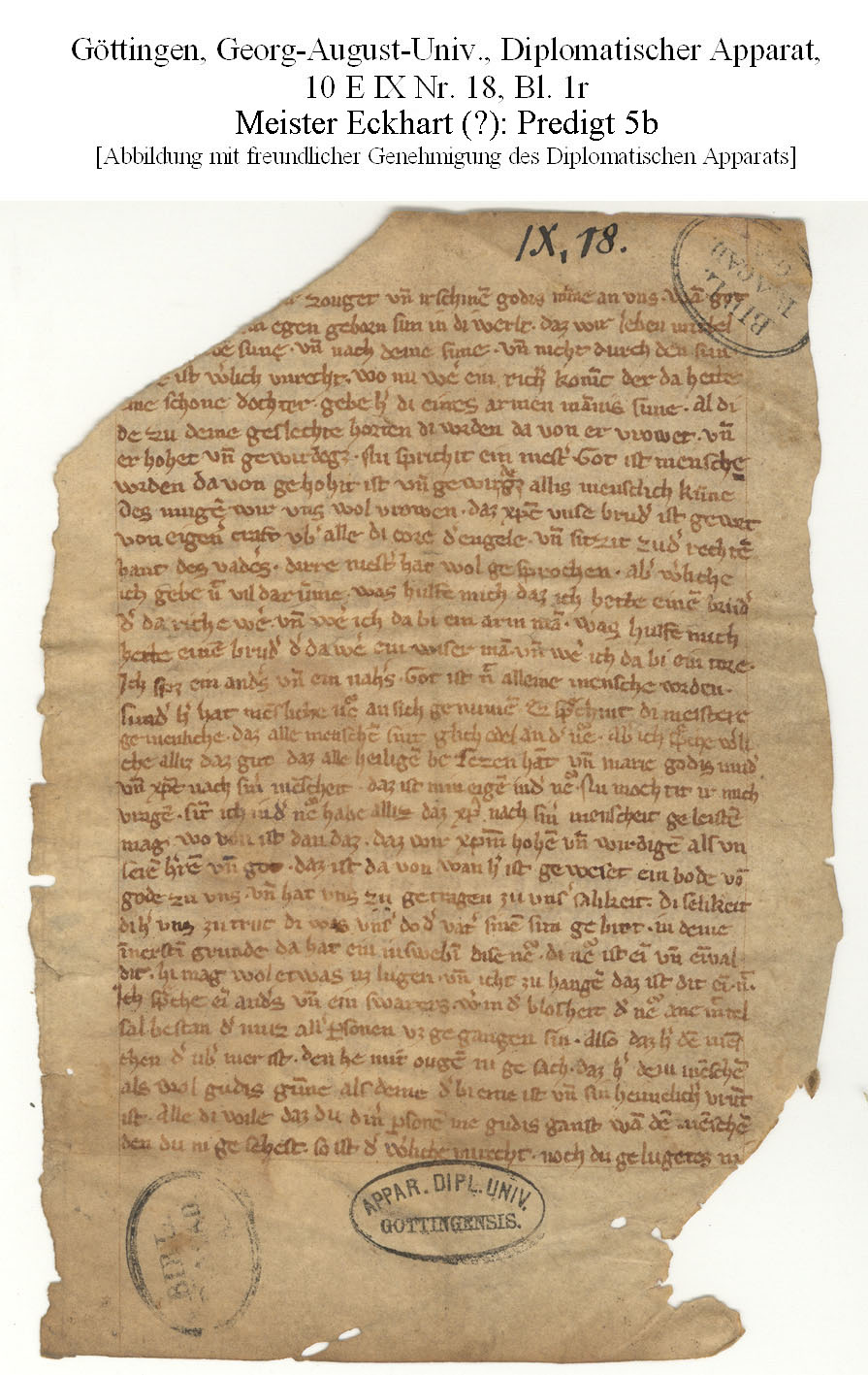

The "free spirits" the book was written against
The prologue says the book teaches how to tell the Friends of God from the "false free spirits," and the book returns to them several times. Chapter 25 describes a man who, after real spiritual effort, is tempted to think "that he no longer needeth Scripture, nor teaching, nor this nor that." Out of this pride, the author says, grows a "false, lawless freedom," and such a spirit "giveth no heed to the admonitions, order, laws and precepts of the holy Christian Church, nor to the Sacraments, but mocketh at them and at all men who walk according to these ordinances and hold them in reverence."15 In chapter 39 the author names a party who mock the "enlightened" for keeping outward order, "the others (that is, the Free Spirits)," and Winkworth added a note: "This is evidently an allusion to the 'Brethren of the Free Spirit,' mentioned in the Historical Introduction."16
Who were these "free spirits"? Winkworth's introduction described the Beghards or "Brothers and Sisters of the Free Spirit" as people who "appear to have been a kind of antinomian pantheists, teaching that the Spirit is bound by no law, and annihilating the distinction between the Creator and the creature," and she reported that in 1317 "the Bishop of Ochsenstein" (so her text names him) complained that Alsace was "filled with these Beghards."3 That description comes from their opponents, as almost all medieval descriptions of the "Free Spirit" do, and modern historians debate how far an organized "Free Spirit" movement existed at all. For this lesson the point is narrower and secure: the Frankfurt author placed himself on the side of Church order, Scripture and the sacraments, against people he believed had claimed a freedom above them. A book later read by Anabaptists and spiritualists who left the medieval Church was written by a priest who warned against contempt for the Church's sacraments. Readers of every tradition will want to keep both facts in view.
The world the author lived in
Winkworth set the book against the troubles of fourteenth-century Germany, and the main events she named can be checked in other sources. Pope John XXII and the Emperor Louis IV (Louis of Bavaria) were at war for years, and an interdict was laid on the Emperor's lands in 1324; in towns that sided with the Emperor, priests who obeyed the Pope stopped public worship or were expelled. Winkworth wrote that the Friends of God "carefully observed all the precepts of the Church, and carried their obedience so far that many of their number were among the priests who were banished for obeying the Pope, when the Emperor ordered them to disregard the Interdict."3 Schaff confirms that Strasbourg lay "under the interdict fulminated against it in 1329" and that Suso and the Dominicans of Constance were banished "for supporting the pope against Lewis the Bavarian."9 Then came the Black Death of 1348 to 1351. Winkworth wrote that in Strasbourg the plague "carried off 16,000 victims" and that Tauler worked among the sick; and she did not hide the darkest part of those years: "some thought to do God service, by wreaking vengeance on the people which had slain the Lord, and thousands of wretched Jews perished in the flames kindled by frantic terror."3 Her figure for Strasbourg's dead is a nineteenth-century number taken from older German historians, not a count from the time. The Black Death across Europe is covered in lesson 01.
The Teutonic Order itself belongs to this picture. The order began at Acre in the Holy Land, "its cradle in Palestine" from 1190, as the old Catholic Encyclopedia puts it, and from 1309 its headquarters stood at Marienburg in Prussia, "the centre of its temporal domination as a military principality," while its houses in the rest of Germany were grouped into bailiwicks.17 The Frankfurt house at Sachsenhausen was one of these German houses.1 The author was thus a priest inside a military religious order born in the Crusades, living in the city where, under the Golden Bull of 1356, the prince-electors were to gather "at Frankfort on the Main" to elect the king of the Romans.18 Nothing in his book discusses the order's wars or its politics. Its subject is the soul's turning from self-will to God.
Luther finds the book, 1516
In 1516 Martin Luther was an Augustinian friar teaching theology at the University of Wittenberg. His letters from that year show him reading the German mystics with excitement. In a letter to his fellow friar John Lang at Erfurt, dated to about October 1516, he wrote: "Therefore, take care, as your Tauler commands, to persevere, keeping yourself apart and yet accessible to all men." The editor of the standard English collection of Luther's letters, Preserved Smith (1913), noted that this is "the first allusion to Tauler" in Luther's correspondence and that it suggests Lang had introduced him to the preacher.19
Two months later, on December 14, 1516, Luther wrote to his friend George Spalatin, chaplain and secretary to the Elector Frederick of Saxony:
"If you delight in reading pure, sound theology, like that of the earliest age, and in German, read the sermons of John Tauler, the Dominican, of which I send you, as it were, the quintessence. I have never read either in Latin or in our own tongue theology more wholesome or more agreeable to the gospel. Taste and see, therefore, how sweet is the Lord, as you have first tasted and seen how bitter is everything in us."20
Smith's note on this letter explains the "quintessence": it "is the German Theology, a tract by one of Tauler's school, which Luther perhaps attributed to Tauler, and which he first edited in this year. His preface, Weimar, i. 153."20 The letter is the earliest record of Luther handing the book to a reader. It also shows how he understood it at first: as Tauler's kind of theology, in German, and "agreeable to the gospel."
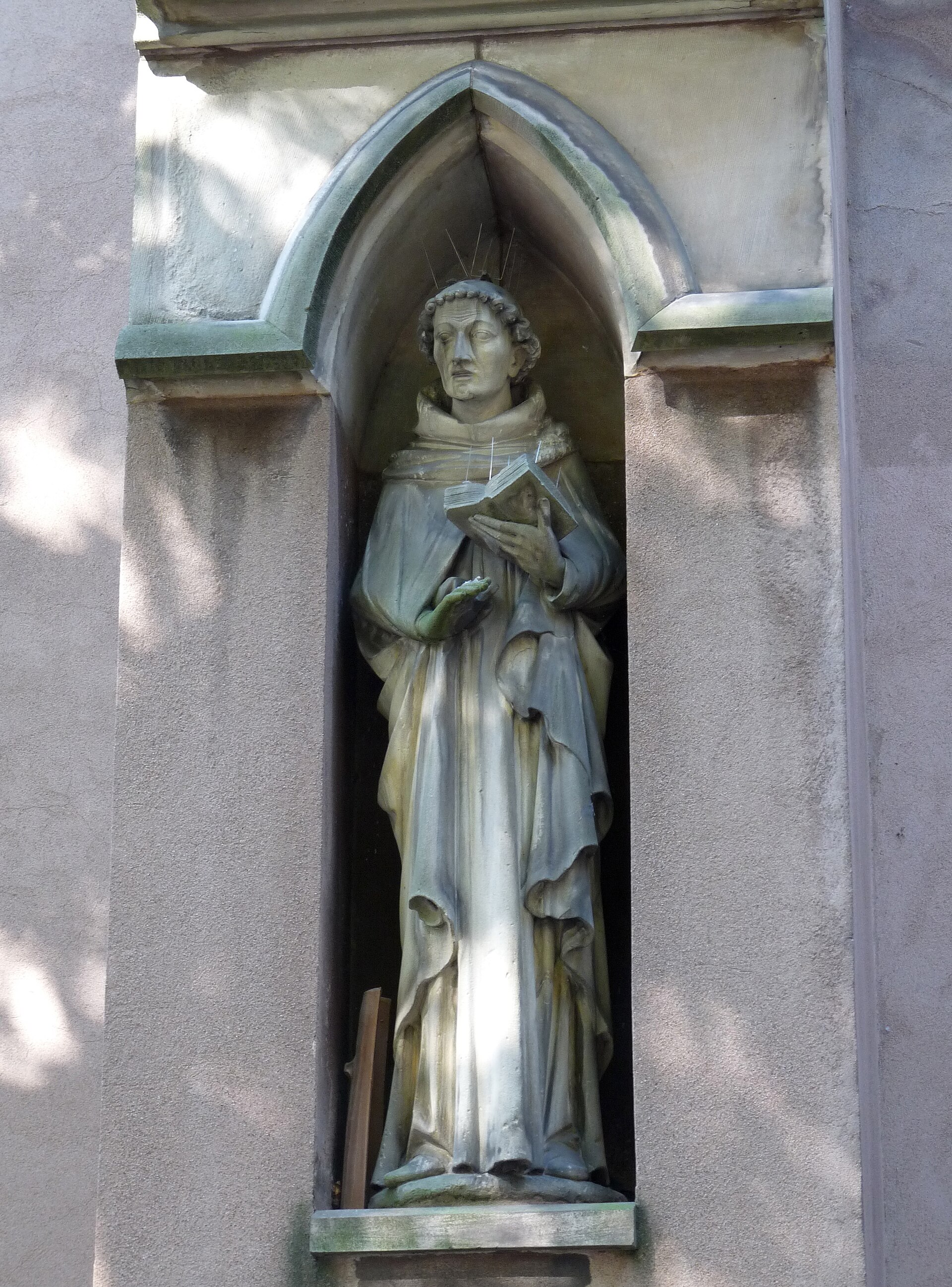

The partial printing of December 1516
The book Luther sent Spalatin was a thin quarto just off the Wittenberg press. Its title began Eyn geystlich edles Buchleynn ("A spiritually noble little book"), and the full title spoke of "the right distinction and understanding of what the old and the new man are." The Gruber Collection of the Lutheran School of Theology at Chicago, which holds a copy, catalogues it as printed at Wittenberg by Johann Rhau-Grünenberg in December 1516, with Luther's preface in the Weimar edition of his works, volume 1, pages 152 to 153, and calls it "Luther's first published writing."21 Pfeiffer gave the date as December 4, 1516, and said the little edition held only part of the book, "ungefähr ein Viertheil des Ganzen" ("about a quarter of the whole"), namely chapters 7 to 26 of the complete edition. He had not seen this rare first printing himself; he knew it from a Leipzig reprint of 1518 by Wolfgang Stöckel, with the title Eyn geystlich edels Buchleynn, and from collected editions of Luther's German writings (Eisleben, 1564, and the Altenburg edition of 1661).1
Luther's short 1516 preface was not repeated in his later edition, and only two phrases from it are quoted in the sources opened for this lesson. Pfeiffer quoted Luther's statement that the book had been found "an titell vnd namen" (without title and name), and his judgment that "die matery fast nach der art des erleuchten doctors Tauleri ist" ("the matter is very much after the manner of the enlightened doctor Tauler"). Pfeiffer agreed with that judgment of the style while rejecting Tauler as the author.1 The Gruber Collection's note summarizes the preface this way: "In the preface Luther stated that only God knew who the author was, but he was certain that the person belonged to the school of mystics led by John Tauler."21 The full German text is printed in the Weimar edition (volume 1, pages 152 to 153), and an English translation is in Bengt Hoffman's 1980 translation of the book; neither was opened for this lesson, so the preface is not quoted at length here.
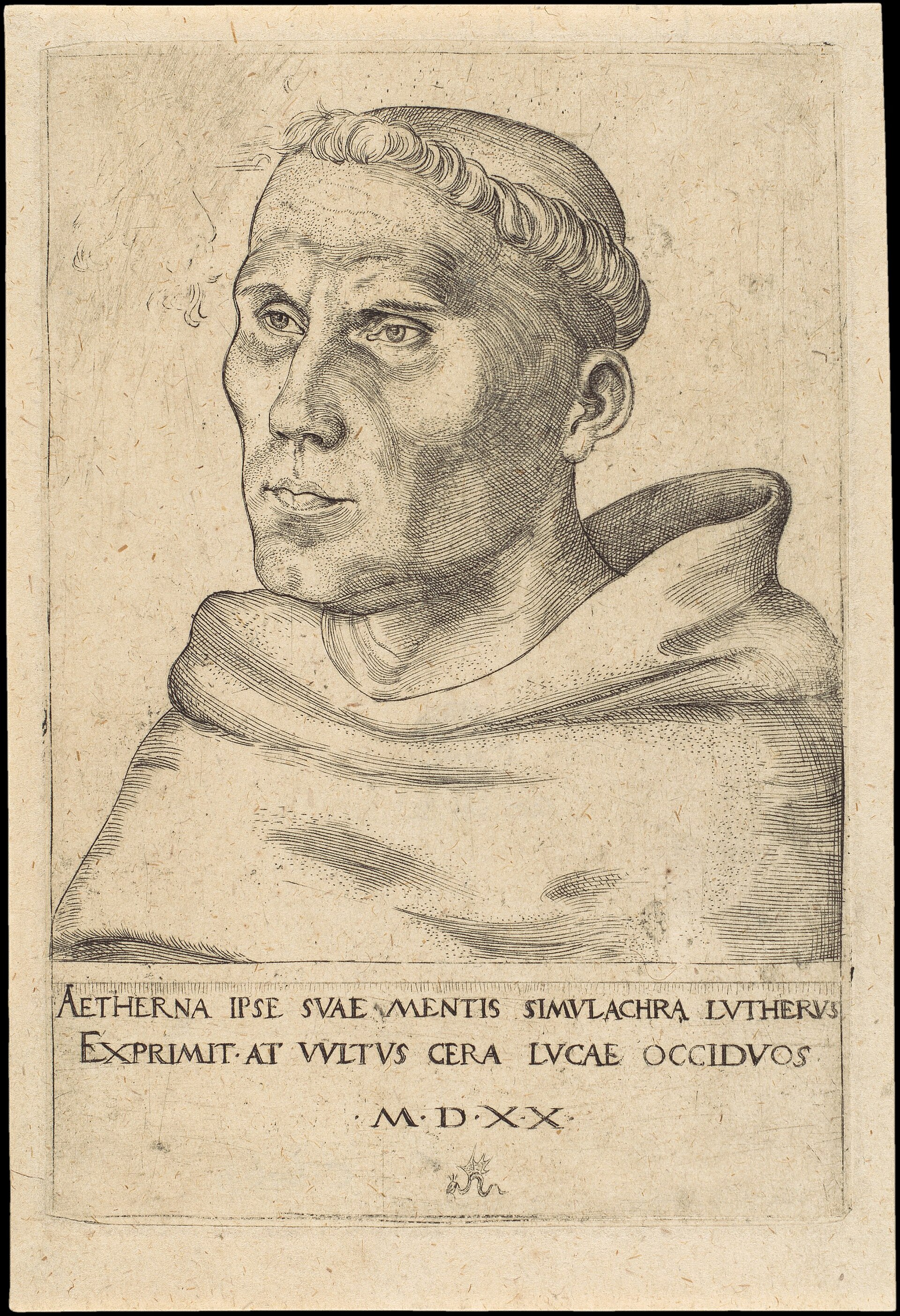

Luther's full edition of 1518
In 1518 Luther obtained a fuller copy of the book and printed it entire. The Pitts Theology Library at Emory University, which holds a copy, gives its title as Eyn deutsch Theologia: das ist Eyn edles Buchleyn, von rechtem vorstand, was Adam vnd Christus sey, vnd wie Adam yn vns sterben, vnd Christus ersteen sall, printed by Johann Rhau-Grünenberg at Wittenberg in 1518, and describes it as the "first printing of Luther's second publication of the 'Theologia Deutsch.'"22 Schaff translated the title: "A German theology, that is, a right noble little book about the right comprehension of what Adam and Christ are, and how Adam is to die in us and Christ is to arise."6 The Gruber Collection dates the Wittenberg printing to June 1518 and adds: "When it was republished in Augsburg in September it was called Theologia Deutsch, and this became its popular title."23 Pfeiffer's list agrees, giving an Augsburg reprint by Silvan Otmar dated September 23, 1518, under the title Theologia Teütsch.1
Two things about Luther's title are worth noticing. First, the title is Luther's, not the author's. The medieval manuscript calls the book only "der Franckforter." Second, the German phrase "Eyn deutsch Theologia" meant something modest: "a German theology," a little book of theology written in German. Pfeiffer observed that Luther's wording "evidently means nothing more than a German book of theological content," and that the later title "the German Theology" sounded "much too proud and presumptuous," a complaint the French translator Pierre Poiret had already made around 1700.1
The 1518 preface: "next to the Bible and St. Augustine"
The preface Luther wrote for the 1518 edition was reprinted in most later editions, and Winkworth translated it in full at the head of her Historical Introduction. It is short enough to read entire, and it is the single most quoted statement about the book. Its center is this passage:
"This I say because I will have every one warned who readeth this little book, that he should not take offence, to his own hurt, at its bad German, or its crabbed and uncouth words. For this noble book, though it be poor and rude in words, is so much the richer and more precious in knowledge and divine wisdom. And I will say, though it be boasting of myself and 'I speak as a fool,' that next to the Bible and St. Augustine, no book hath ever come into my hands, whence I have learnt, or would wish to learn more of what God, and Christ, and man and all things are."3
Luther then turned the book against his opponents in the universities. In Winkworth's translation he continued that he now saw "the truth of what certain of the learned have said in scorn of us theologians of Wittemberg, that we would be thought to put forward new things, as though there had never been men elsewhere and before our time," and he answered: "Let as many as will, read this little book, and then say whether Theology is a new or an old thing among us; for this book is not new." He complained that "for a long time past such things have not been treated of in our universities; nay, it has gone so far, that the Holy Word of God is not only laid on the shelf, but is almost mouldered away with dust and moths." And he closed with a line that later readers would quote both in praise and in blame: "I thank God, that I have heard and found my God in the German tongue, as neither I nor they have yet found Him in the Latin, Greek, or Hebrew tongue. God grant that this book may be spread abroad, then we shall find that the German theologians are without doubt the best theologians." He signed it "Dr. MARTIN LUTHER, AUGUSTINIAN of Wittemberg."3
Three features of this preface matter for the history of the book. First, its date and setting: Luther wrote it in 1518, the year after the Ninety-five Theses, when he was under attack and was defending his teaching at Wittenberg and before the general chapter of the Augustinians at Heidelberg in April 1518.24 He used the medieval book as evidence that his theology was "not new." Second, its comparison: the Bible first, Augustine second, this book third. Luther did not place it above Scripture. Third, its appeal to German. The preface praised "the German tongue" against "the Latin, Greek, or Hebrew," a line that became part of the book's reputation as a German national treasure in the nineteenth century, as Bunsen's letter to Winkworth shows (below).
What Luther took from the book
Luther's own letters show what he thought he had in common with Tauler and the "German Theology." On March 31, 1518, he wrote to his superior John Staupitz: "Truly I have followed the theology of Tauler and of that book which you recently gave to Christian Doring to print; I teach that men should trust in nothing save in Jesus Christ only, not in their own prayers, or merits, or works, for we are not saved by our own exertions, but by the mercy of God."24 Readers sometimes take "that book" in this letter to be the Theologia Germanica, but Smith's note identifies it as Staupitz's own book, Von der Liebe Gottes (On the Love of God). The letter shows that Luther linked his teaching on trust in Christ alone to "the theology of Tauler," a theology he had just found again in the Frankfurt book.
How deep that link went is a question historians answer differently. Schaff (volume 7) judged that the mystical tradition Luther met through Staupitz, Augustine, Bernard and Tauler "deepened and spiritualized his piety and left permanent traces on his theology," but that "mysticism alone could not satisfy him, especially after the Reformation began in earnest. It was too passive and sentimental and shrunk from conflict."11 The catalogue note of the Gruber Collection quotes the editors of the American edition of Luther's Works (volume 31, page 74): "Luther rejected the mystic conception of love as essentially 'the sweetness' of the loved one and stressed the active love which suffers and labors for the loved one."23 Lesson 09 reads the passages on self-will, the old and new man and the cross that Luther and his readers found in the text. For Luther's life in these years, see module 79, lesson 11.
How many editions? Counting a popular book
The Theologia Germanica spread quickly once Luther's name was on it, but the numbers given for its editions vary widely, and the variation itself teaches something about how such counts are made. Each count below is quoted from its source, with its date and its scope:
- Pfeiffer, 1851: his list of earlier editions and translations, "not without some trouble brought together," traced "nicht weniger als 55 Ausgaben" ("no fewer than 55 editions"), and he was sure a careful search of the larger German libraries "could easily raise the number to a full 60."1
- Winkworth, 1854: "No fewer than seventeen editions of the work appeared during the lifetime of Luther. Up to the present day, it has continued to be a favourite handbook of devotion in Germany, where it has passed through certainly as many as sixty Editions."3 (Her sixty agrees with Pfeiffer's estimate; her seventeen during Luther's lifetime, that is, from 1516 to 1546, was not checked against a bibliography for this lesson.)
- Schaff, 1910, citing Cohrs: "Cohrs in Herzog, XIX. 626, mentions 28 editions as having appeared in High German previous to 1742." This counts only High German printings before 1742.6
- The Gruber Collection catalogue (recent): "More than 170 printed editions of this work have been identified."23
- Bernard McGinn's history of German mysticism (2005), as reported in a reference work: about two hundred editions from the sixteenth to the twentieth century. McGinn's book was not opened for this lesson.7
The standard modern list is Georg Baring's Bibliographie der Ausgaben der "Theologia Deutsch" (1516 bis 1961), published in 1963, which the Pitts Theology Library cites as "Baring ... 3 II" for Luther's 1518 printing.22 The counts differ because they measure different things: one language or all languages, only original printings or reprints too, up to 1742 or up to the twentieth century, and because nineteenth-century scholars could only list what they had seen or found in older catalogues. A reader who meets a number for this book should always ask which of these it is.
Pfeiffer's 1851 list itself gives a picture of the early spread. After Luther's Wittenberg printings he lists reprints at Leipzig (1518, 1519, 1520), Augsburg (1518, 1520, 1526), Strasbourg (1519, 1520), Basel (1523), Nuremberg (1526), a printing of 1528 without place, and later printings at Frankfurt am Main (1546) and Königsberg (1558).1 The book traveled through the great printing towns of the early Reformation in its first decade in print.
Radical reformers and spiritualists
Luther printed the book to show that his theology was old. Within ten years, other readers were using it in ways Luther came to oppose. The book's language about giving up self-will, about the inner man taught by God, and about outward commandments being "needful for those men who know nothing better" (chapter 39)16 appealed to reformers who put the inner word of the Spirit ahead of outward church order.
- Ludwig Hätzer and Hans Denck (1528). An online encyclopedia article reports, citing Bernard McGinn, that in 1528 Ludwig Hätzer republished the book with "Propositions" by the Anabaptist teacher Hans Denck, who had died in 1527.7 Pfeiffer's list does include a printing of 1528 "ohne Ort" (without place of printing), a copy of which he located in the public library at Stuttgart, but his list does not say who edited it.1 The attribution of the 1528 edition to Hätzer and Denck is therefore reported here from secondary sources.
- Sebastian Franck and Caspar Schwenckfeld. The same reference work reports that Sebastian Franck, the spiritualist historian, made a Latin paraphrase of the Hätzer text near the end of his life (1541 to 1542).7 Pfeiffer listed a printing of 1541 without place that he says appeared under Caspar Schwenckfeld's name and was repeated in the first volume of Schwenckfeld's writings in 1564.1 (Pfeiffer's German here was read from an uncorrected scan, and the reading should be checked against the printed page.)
- Sebastian Castellio (1557 and 1558). The humanist Sebastian Castellio, who had left Geneva after a quarrel with Calvin and who, in Schaff's words, "wrote several anonymous or pseudonymous booklets against Calvin, and against the persecution of heretics" after the burning of Michael Servetus at Geneva on October 27, 1553, translated the book into Latin.25 Pfeiffer lists the first edition as Theologia germanica ... ex lingua germ. translata a Joan. Theophilo (Basel: Oporinus, 1557). "Joannes Theophilus" was a pen name: Pfeiffer identified the translator as Castellio, who died at Basel on December 29, 1563, and listed reprints of the Latin at Antwerp (1558), Lyon (1580 and 1655) and Leipzig (1730), and a French version, Théologie germanique, printed at Antwerp in 1558, "likewise translated by Seb. Castellio."1 Castellio's Latin made the book available to readers all over Europe who could not read German. It is the source of the Latin title by which English speakers still know it.
- Valentin Weigel (1571). The Lutheran pastor and mystical writer Valentin Weigel of Zschopau wrote a Short Account and Introduction to the German Theology in 1571, according to the same reference work; his writings were printed only after his death.7
Steven Ozment's Mysticism and Dissent: Religious Ideology and Social Protest in the Sixteenth Century (Yale University Press, 1973) traced how sixteenth-century dissenters, including Denck, Franck, Castellio and Weigel, used medieval mystical writings such as this one to argue for the authority of the inner word and the freedom of conscience. Ozment's book was not opened for this lesson, and his argument is stated here only in outline and attributed to him.
Calvin's warning, 1559
John Calvin did not share Luther's praise. The reformer of Geneva knew the book in Castellio's Latin and French, and Castellio was his bitter opponent. The episode usually cited is a letter of 1559 that Calvin wrote to the French Reformed congregation at Frankfurt am Main, where some members were reading the book. Ferdinand Cohrs, in his article on the book in the New Schaff-Herzog Encyclopedia (1911), dates the warning to 1559 and connects it with the use the Anabaptist Hans Denck had made of the book.37 An online encyclopedia article on the book, used here only to locate the source, quotes Bengt Hoffman's introduction to his 1980 translation (page 26) as giving Calvin's words in English: the book was "conceived by Satan's cunning" and "contains a hidden poison which can poison the church."7 Calvin's letter in its original French is printed in the nineteenth-century edition of his works (the Calvini Opera in the Corpus Reformatorum), but that volume could not be opened for this lesson, so the wording above is given only as Hoffman's English as reported, and the claim is rated in "Claims checked" below.
Even without the exact wording, the reason for Calvin's alarm can be seen from the timing. In 1557 and 1558 the man who had opposed Calvin over Servetus put the book into Latin and French. Calvin's warning to a French-speaking Reformed congregation two years later was a warning against a book that had come to them through his opponent's hands. Calvin's own teaching on union with Christ and on sanctification is found in the Institutes (Beveridge's translation of 1845, book 3); lesson 07 sets out his teaching on justification beside Aquinas, Trent and the Lutheran confessions.
The Roman Index of Forbidden Books
The book's popularity among Protestants of every kind drew Catholic suspicion, and in the early seventeenth century it was placed on the Roman Index of Forbidden Books. The printed Index itself gives the date. The Index of Benedict XIV (Rome, 1758) and the Index of Gregory XVI (1841) both carry the entry "Theologia Germanica; libellus aureus, quomodo sit exuendus vetus homo, induendusque novus, ex Germanico translatus, studio Joannis Theophili," with a second form of the same title, "Theologia Mystica a pio quodam Ordinis Dominorum Teutonicorum Sacerdote, ducentis circiter ab hinc annis Germanice conscripta, & a Joanne Theophilo in Latinum translata," and the date of the prohibiting decree: "Decr. 16. Martii 1621" (decree of March 16, 1621).36 Both titles name the Latin version of "Joannes Theophilus," that is, Castellio's translation. The Index thus agrees with Schaff (1910): "In 1621 the Catholic Church placed the Theologia Germanica on the Index."6 An online encyclopedia article gives 1612, under Pope Paul V, and adds that the book remained on the Index "into the second half of the twentieth century," without citing the Index.7 Neither statement is borne out by the editions of the Index opened for this lesson: they give the decree of 1621, and no entry for the book was found in the text of the revised Index issued under Leo XIII in 1900.36
Schaff also reported Catholic opinion of the book in his own day, and he was careful to say it was divided: "Stöckl and other Catholics, though not all, are bitter against the Theologia and charge it with pantheism."6 The other side of Catholic opinion is represented by Pfeiffer's 1851 judgment, quoted above, that the book contains nothing contrary to Catholic teaching. Lesson 09 sets out the passages (on becoming "deified," on God as the being of all things) that the charge of pantheism rests on, so that readers can judge them in context.
Johann Arndt, Philipp Jakob Spener and the Pietists
Within Lutheranism the book found its most faithful readers among those who wanted a warmer, more inward faith than the controversies of the late 1500s seemed to offer. Johann Arndt (1555 to 1621), the Lutheran pastor whose True Christianity became one of the most read devotional books in Germany, edited the Theologia Deutsch with a preface of his own. Pfeiffer's list includes printings with "Arndts Vorrede" (Arndt's preface) at Lüneburg in 1628, 1642 and 1652, bound with Staupitz's little book on the love of God, and a Magdeburg edition of 1605 reprinted at Erlangen in 1827 "after the edition of Arndt."1 Reference works citing McGinn date Arndt's first edition to 1597 and say his version "had over sixty later printings"; those figures were not checked against a bibliography for this lesson.7 Pfeiffer also quoted Arndt's own description of the book's style as "der grobe deutsche Bauernrock und die alte grobe deutsche Sprache" ("the coarse German peasant's coat and the old coarse German language"), an echo of Luther's warning about its "bad German."1
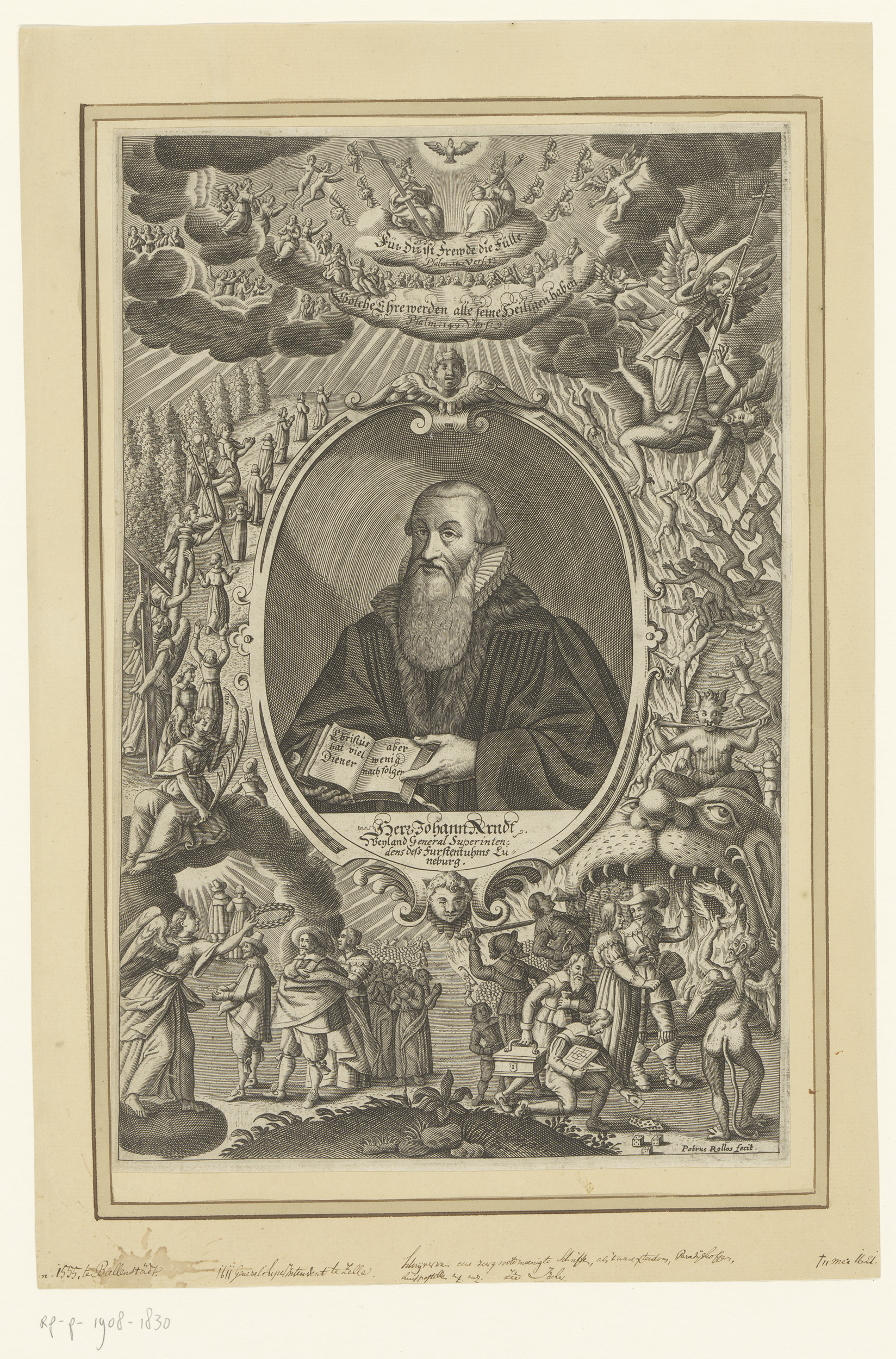

Philipp Jakob Spener (1635 to 1705), the Frankfurt pastor usually counted as the father of Lutheran Pietism, kept the book in print by attaching it to editions of Tauler's sermons. Pfeiffer listed it as an appendix to "Phil. Jac. Speners Ausgaben der Taulerischen Predigten" (Spener's editions of Tauler's sermons) printed at Frankfurt by Johann Haase in 1681, at Nuremberg in 1688, at Frankfurt in 1692 and 1703, and at Halle by the Orphanage press of the Pietists in 1703, 1705 and 1720.1 The book thus returned to the city where it had been written, printed by a Lutheran pastor of Frankfurt more than three hundred years after a priest of the Teutonic house across the river had composed it. Module 77 tells the story of Spener and the Pietists (Church History, Part C, lesson 01).
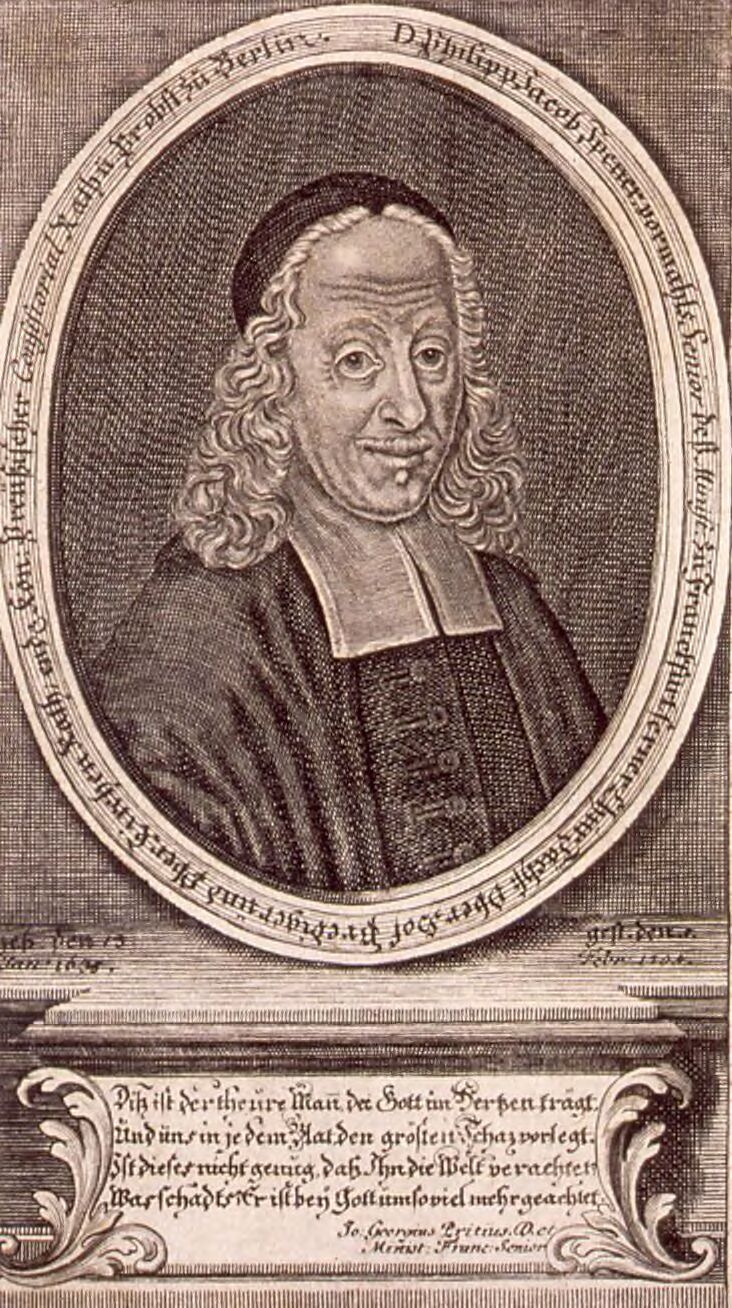

A French Protestant mystic carried the book further still. Pierre Poiret (1646 to 1719), born at Metz, who died at Rijnsburg near Leiden, published a French translation at Frankfurt in 1675 and a new one at Amsterdam in 1700 under the title La théologie réelle, vulgairement ditte la théologie germanique ("The real theology, commonly called the German theology"). Pfeiffer, who gives these details, also listed a Flemish translation printed at Antwerp in 1590.1 By 1700 the book existed in German, Latin, French and Flemish, in Lutheran, Reformed-mystical and Anabaptist-spiritualist editions, while standing on the Roman Index.
Susanna Winkworth's English translation, 1854
Most English readers have met the book in the translation that Susanna Winkworth (1820 to 1884) published in 1854; she signed its introduction at Manchester. Earlier English versions existed (below), but hers was the first made from the medieval manuscript text. Her volume was published in London by Longman, Brown, Green and Longmans in 1854 (lxxiii and 205 pages).26 Its title page announced the text as "edited by Dr. Pfeiffer from the only complete manuscript yet known." Winkworth chose the manuscript text over Luther's because, as she wrote, "upon careful comparison, it seemed to the translator indisputably superior to the best modern editions based upon Luther's," and she marked the passages missing from Luther's edition by printing them "between brackets." In a few places she corrected Pfeiffer from Luther where the manuscript appeared to contain errors "of the transcriber's pen."3 Her English is deliberately archaic ("saith," "hath," "teacheth"), in the style of the King James Bible, and that choice shaped how English readers have heard the book ever since.
The volume came with three pieces of front matter, each with its own point of view:
- Charles Kingsley's Preface (dated "Torquay, Lent, 1854"). Kingsley, the Church of England clergyman and novelist, commended the book "to those who wish to be really justified by faith, by being made just persons by faith; and who cannot satisfy either their consciences or reasons by fancying that God looks on them as right, when they know themselves to be wrong, or that the God of truth will stoop to fictions (miscalled forensic) which would be considered false and unjust in any human court of law." He defended its orthodoxy to two audiences at once: "to 'evangelical' Christians Martin Luther's own words ought to be sufficient warrant," while others "must recollect, that the Author of this book was a knight of the Teutonic order; one who considered himself, and was considered, as far as we know, by his contemporaries, an orthodox member of the Latin Church." He also admitted reservations: "Not that I agree with all which is to be found in this book," naming the word "vergottet," "deified or made divine," as the one that "most startles me."5
- Winkworth's Historical Introduction (dated "Manchester, February 1854"), with Luther's 1518 preface in English, a long account of fourteenth-century Germany and the Friends of God drawn from Neander and Schmidt, and the evidence for the author and date discussed above.3
- A letter from Chevalier Bunsen (Christian Karl Josias von Bunsen, the Prussian diplomat and scholar, who wrote that the proofs reached him as he was leaving Carlton Terrace in London for a few days by the sea), dated "77 Marina, St. Leonard's-on-Sea, 11th May 1854." Bunsen wrote that "with Luther, I rank this short treatise next to the Bible, but, unlike him, should place it before rather than after St. Augustine," and summed up the book's teaching "in plain Teutonic" in four lines: "Sin is selfishness: Godliness is unselfishness: A godly life is the steadfast working out of inward freeness from self: To become thus Godlike is the bringing back of man's first nature." He added that the book had been "now for almost forty years an unspeakable comfort to me."27
Bunsen's letter also made the boldest claim in the volume about the Friends of God: "By teaching that man is justified by faith, and by faith alone, they prepared the popular intellectual element of the Reformation."27 That claim is tested in "Claims checked" below.
The American edition, the Golden Treasury Series and the text online
Winkworth's translation crossed the Atlantic within a year. An American edition was printed and published at Andover, Massachusetts, by Warren F. Draper, with John P. Jewett and Company of Boston, and its copyright was entered "in the year 1855." Its title page adds "an Introduction by Professor Calvin E. Stowe, D. D." The copy opened for this lesson, now at Cornell University Library, is a printing dated 1857 (MDCCCLVII), and Schaff's bibliography gives "Andover, 1856," so the American edition was reprinted more than once in its first years.286 Stowe's short introduction, headed "To the Reader," presented the book to American readers in Luther's name: "For the evangelical Christian this little work needs no other recommendation than that which is given by Martin Luther, in his brief, terse, and characteristic preface to it as originally published by him." He wrote that the book "sets forth the essential principle of the gospel in its naked simplicity, just as it is, and just as it proves itself most acceptable to every soul which feels its need of salvation and finds that salvation in Christ alone."28 (The scanned text of the Andover copy prints the long s of the old type; the words are given here in modern letters.) Schaff quoted the same sentence of Stowe in his own account of the book.6
In Britain, Macmillan reissued the translation in 1874 as a volume of its Golden Treasury Series, printed at the Chiswick Press, with Kingsley's preface, Bunsen's letter and the black-letter prologue.294 The online text at the Christian Classics Ethereal Library, which is the copy most readers now open, states that the book was "First published as a volume of the Golden Treasury Series in 1874. New Edition 1893," that it was "Reprinted 1901, 1907," and that the text was scanned from the 1893 Golden Treasury edition with the introductory material from the 1907 reprint.29 That online text does not include the medieval prologue. Readers who want the prologue in Winkworth's words must use a scan of the 1854 or 1874 printing, where it stands on its own page, headed "A Preface," just before chapter 1.4 The records opened for this lesson do not say that Winkworth revised her translation for the 1874 or 1893 printings. On present evidence, 1874 marks the first Golden Treasury printing of the 1854 translation, not a second, revised translation.
English versions before Winkworth
Winkworth's was the first English version made from the medieval manuscript text, but it was not the first English version. The historian of mysticism Rufus M. Jones, in Spiritual Reformers in the 16th and 17th Centuries (1914), described two earlier English renderings, both made from Castellio's Latin. The preacher and translator John Everard made a version called "The Golden Book of German Divinitie," which Jones says was "rendered into English in 1628 from the Latin edition of 'John Theophilus,' who is Sebastian Castellio"; Jones knew it from a Cambridge manuscript. In 1648 an English edition was printed under the name of Giles Randall, "the translation being made from the Latin of 'John Theophilus,' that is, Sebastian Castellio," and called "a Little Golden Manuall briefly discovering the mysteries, sublimity, perfection and simplicity of Christianity in Belief and Practice." Jones thought "it seems likely that there was an earlier edition of the Theologia than this of 1648," because a contemporary critic quoted chapters and pages that do not match it, and he warned that, of the translations bearing Randall's name, "it is far from certain that he actually made the translations." He also judged that Randall's printed text and Everard's manuscript "probably did not come from the same" hand.30
Castellio's Latin itself circulated among English readers. The microfilm collection Early English Books, 1475 to 1640, now digitized at the Internet Archive, includes a Latin Theologia Germanica dated 1632 that opens with the translator's preface, "In hunc libellum praefatio interpretis."31 English readers of the 1600s therefore met the book through Castellio, the translator Calvin distrusted, and in a text that descended from Luther's 1518 edition, while English readers after 1854 met it through Pfeiffer's manuscript text.
Translations after Winkworth
Two later English translations have replaced Winkworth for many students. Bengt Hoffman's The Theologia Germanica of Martin Luther, with translation, introduction and commentary, was published by the Paulist Press in New York in 1980, and the Gruber Collection's catalogue sends readers to it.23 As its title signals, and as reference works report, it translates the text as Luther printed it in 1518, not the manuscript text Pfeiffer printed.7 David Blamires's The Book of the Perfect Life (2003) is reported to translate von Hinten's 1982 critical text, which is built on all the surviving manuscripts.7 A further edition by J. Bernhart was published by Pantheon Books in New York in 1949; that book was not opened for this lesson, and its relation to Winkworth's translation is not stated here.32 A reader comparing passages across these English versions should first ask which German text each one translates: Luther's 1518 edition (Hoffman, and the older German reprints), Pfeiffer's 1497 manuscript (Winkworth), or von Hinten's critical text (Blamires).
What the record shows and what it does not
- Documented fact. A copy of the treatise, made in 1497, survives in a manuscript of 154 leaves from the Löwenstein-Wertheim library at Bronnbach, and Franz Pfeiffer printed it in 1851.1 Luther printed part of the book at Wittenberg in December 1516 and the whole in 1518, and both printings survive in library collections today.2122 Winkworth's translation was published in London in 1854.26
- The book's own words. The prologue, older than Luther, calls the author a member of the Teutonic Order, "a Priest and a Warden in the house of the Teutonic order in Frankfort," and says the book teaches how to tell "the true and upright Friends of God" from the "false free-thinkers."4 Chapter 13 quotes Tauler by name.8
- Luther's own words. His 1518 preface ranks the book "next to the Bible and St. Augustine," and his letters of 1516 and 1518 link it to Tauler and to his own teaching on trust in Christ.32024
- Editors' and translators' judgments. Pfeiffer read the book as Catholic and denied that it was a "forerunner of the Reformation"; Kingsley, Bunsen and Stowe read it as a witness for evangelical faith; Schaff called it "evangelical."1527286 These are readings, not facts about the author.
- Reported, not opened for this lesson. The English wording of Calvin's 1559 warning (and the year of the letter), the year 1612 that some accounts give for the Roman Index, the Hätzer and Denck edition of 1528, and the count of about two hundred editions all rest on secondary reports.7
- Open questions. The author's name, the exact date of writing (somewhere between Tauler's fame and 1497, most likely about 1350 to 1400) remain unsettled. The year of the Index listing is settled by the printed Index, which cites a decree of March 16, 1621.36
Claims checked
Popular histories, devotional reprints, sermons and websites repeat a number of statements about this book. Each is rated below by the evidence opened for this lesson: Supported, Partly supported, Unsupported, Refuted or Unresolved.
"Martin Luther wrote the Theologia Germanica."
Rating: Refuted. Luther presented himself as the book's finder and editor. His 1516 preface said the book had been found "an titell vnd namen" (without title and name), and the Gruber Collection's summary of that preface says he stated that "only God knew who the author was."121 The prologue naming a priest of the Teutonic Order stands in a manuscript copied in 1497, before Luther was a student, so it cannot be Luther's invention.13 Luther's 1518 preface calls the book "not new" and uses it as evidence that his theology was old, which would make no sense if he had written it himself.3
"John Tauler wrote it."
Rating: Refuted. This was a real opinion before 1851. Smith notes that Luther "perhaps attributed" the book to Tauler, and Philip Schaff wrote in volume 7 that Luther "ascribed" it to Tauler.2011 What Luther wrote in 1516, as Pfeiffer quotes it, is narrower: the matter is "after the manner of the enlightened doctor Tauler."1 Two facts settle the authorship question. Chapter 13 begins "Tauler saith," quoting him as another teacher, and the 1497 prologue names a Frankfurt priest of the Teutonic Order, while Tauler was a Dominican of Strasbourg.849 Pfeiffer concluded, "Auch an Tauler ist nicht zu denken" ("Tauler too is out of the question"), and Winkworth agreed that the reference to Tauler rules him out.13
"The author's name has been discovered."
Rating: Unresolved. No name has been proved. Pfeiffer dismissed as a "Fabel" (fable), "long since given up," an older story begun in Johann Wolf's Lectiones memorabiles and repeated by the church historian Schröckh that gave the author a personal name, and he judged that the name had been hidden on purpose.1 Böhmer, the Frankfurt historian, could not name any custos of the Frankfurt house.1 A modern scholarly hypothesis is recorded in the University of California's catalogue entry for its 1854 copy: "Author hypothetically identified as Johannes de Francfordia," citing the Lexikon für Theologie und Kirche, second edition, volume 10, column 62.26 That reference work was not opened for this lesson. The catalogue's own word, "hypothetically," is the right measure of the claim.
"The author was a Teutonic Knight."
Rating: Partly supported. He belonged to the Teutonic Order, which was a military order with knight-brothers, and Schaff reports that Luther called him "a Teutonic knight"; Kingsley repeated the word in 1854.6517 The prologue itself, the only medieval evidence, calls him "ein dutscher herre, ein priester und ein custos": a member of the order, a priest, and the warden of its Frankfurt house.2 "Priest of the Teutonic Order" is the accurate description.
"In 1516 Luther wrote that, next to the Bible and Augustine, no book had taught him more."
Rating: Partly supported. The words are Luther's, but they come from the preface to the full edition of 1518, which Winkworth translated.3 The 1516 preface was short and was not reprinted in Luther's later editions.1 The mix-up is old. Pfeiffer noted that the Eisleben edition of Luther's German works (1564) and the Altenburg edition (1661) printed the 1518 preface "irriger Weise" (by mistake) with the date 1516.1 Modern summaries still blend the two prefaces: Roland Bainton's Here I Stand, as quoted in the Gruber Collection's catalogue under the 1516 printing, says Luther published the book in 1516 "under the title of A German Theology, declaring in the preface that he had learned from it more than any writing save the Bible and the works of St. Augustine."21 The front page of the online Christian Classics Ethereal Library text likewise says the book "was discovered and published in 1516 by Martin Luther, who said of it" the words of the 1518 preface.29 The title Eyn deutsch Theologia belongs to 1518 as well; the 1516 printing was titled Eyn geystlich edles Buchleynn.2122
"The manuscript was discovered at Würzburg in 1850."
Rating: Partly supported. Winkworth wrote that it was discovered "about 1850" at "Wurtzburg" by Professor Reuss, and Schaff wrote that it was "found in 1850."36 Pfeiffer, who handled it, says it was kept in the princely library at Bronnbach near Wertheim, and that Reuss, the university librarian of Würzburg, had announced it "vor einigen Jahren" (some years before) in volume 3 of the Zeitschrift für deutsches Alterthum.1 The name "Würzburg manuscript" comes from the man who reported it, and the discovery was earlier than 1850. The year 1843, often given, was not checked against the journal for this lesson.
"Calvin called the Theologia Germanica poison."
Rating: Partly supported. That Calvin warned a Reformed congregation against the book in 1559 is widely reported, and the English words "conceived by Satan's cunning" and "a hidden poison which can poison the church" are given as Bengt Hoffman's rendering of Calvin's letter.7 Calvin's French original, printed in the nineteenth-century edition of his works, was not opened for this lesson, so the exact wording, the date and the addressees remain unchecked here. The fact that the book had just been put into Latin and French by Castellio, Calvin's opponent, is documented from Pfeiffer's list and Schaff's account of Castellio.125
"The Theologia Germanica was condemned by Rome."
Rating: Supported (listed on the Index by a decree of 1621). The Index of Benedict XIV (1758) and of Gregory XVI (1841) lists the Latin "Theologia Germanica" of "Joannes Theophilus" (Castellio) under "Decr. 16. Martii 1621."36 Schaff likewise states, "In 1621 the Catholic Church placed the Theologia Germanica on the Index," and calls it "the evangelical text-book" in a list of works the papacy restricted.6 Another account gives 1612, under Paul V, without citing the Index;7 no Index opened for this lesson supports that year, and no entry for the book was found in the revised Index of 1900.36 The listing was a prohibition of a book, not a condemnation of particular propositions drawn from it. Before the Reformation the record points the other way: Kingsley wrote in 1854 that "during the hundred and seventy years which elapsed between the writing of this book and the Reformation, it incurred no ecclesiastical censure whatsoever," and nothing found for this lesson contradicts him.5 Pfeiffer, writing in 1851, judged that the book contains nothing "mit der katholischen Lehre im Widerspruch" (contrary to Catholic teaching).1 The listing, when it came, followed the book's Protestant fame.
"The book teaches justification by faith alone."
Rating: Unsupported as a description of the book's own words. Bunsen wrote in 1854 that the Friends of God taught "that man is justified by faith, and by faith alone," and Stowe called the book the gospel "in its naked simplicity."2728 In Winkworth's translation of the fifty-four chapters the word "faith" occurs only four times (once in chapter 2, once in chapter 16 and twice in chapter 48), and the phrase "faith alone" never occurs. The nearest passage, in chapter 16, says that "when a man entereth into the obedience of the faith, all is healed, and blotted out and forgiven."33 The book's own language is about obedience, the death of self-will and union with God. Whether that teaching agrees with Luther's doctrine of justification is a judgment on which Pfeiffer and Ullmann disagreed (above). Lesson 09 reads the passages, and lesson 07 sets out the Lutheran, Reformed and Catholic doctrines of justification in their own documents.
"The book never mentions Mary, good works or the sacraments."
Rating: Partly supported. Schaff wrote that "in all its fifty-four chapters no reference is made to Mary or to the justifying nature of good works or the merit of sacramental observances."6 In Winkworth's translation Mary is named once, in chapter 26, only as Christ's mother ("from the time that He was born of Mary, until His death on the cross"), and the book contains no prayer to her.34 The book does mention the sacraments: chapter 25 condemns the false free spirit who "giveth no heed to the admonitions, order, laws and precepts of the holy Christian Church, nor to the Sacraments, but mocketh at them."15 Schaff's sentence is accurate if read narrowly (no teaching that works or sacraments earn merit) and misleading if read as saying the book is silent about the Church's sacraments.
"The book has gone through about two hundred editions."
Rating: Partly supported. Counts range from 28 (High German printings before 1742) to "more than 170" and about two hundred, depending on what is counted.6237 Pfeiffer traced 55 by 1851.1 The standard bibliography is Georg Baring's of 1963.2235 A number without its scope, as the chart above shows, says little.
"Winkworth's 1854 translation was the first in English."
Rating: Refuted. Rufus M. Jones described a manuscript English version by John Everard made in 1628 and a printed English edition of 1648 under the name of Giles Randall, both from Castellio's Latin.30 Winkworth's was the first English translation of the medieval manuscript text and the one that made the book widely known in English.3
"The book was written against an organized sect called the Brethren of the Free Spirit."
Rating: Partly supported. The prologue and chapters 25 and 39 do set the book against "false free" spirits, and Winkworth's note on chapter 39 calls this "evidently an allusion to the 'Brethren of the Free Spirit.'"41516 Schaff, too, says the Friends of God "antagonized the Brethren of the Free Spirit."12 The descriptions of the Free Spirit in these sources come from its opponents, and the book itself never names a sect, an organization or a leader. How organized the "Free Spirit" was is a question this lesson leaves open.
Hard questions and answers
A Catholic reader asks: is this a Catholic book that Protestants borrowed, or a forerunner of the Reformation?
The evidence about the book's origin is all on one side: a priest of a religious order, under obedience to the Church, wrote it, and the prologue says it was meant to defend "the Holy Church" against those who despised it.4 The book itself warns against contempt for the Church's order and sacraments (chapter 25).15 Kingsley found no censure of it before the Reformation, and Pfeiffer, its first modern editor, argued that it contains nothing contrary to Catholic teaching and that Luther's admiration could no more make it a Reformation book than his admiration for Augustine made Augustine a Reformer.51 The case for calling it a forerunner rests on what readers found in it, not on its author's intent: Ullmann counted its author among the "Reformers before the Reformation," Schaff praised its "evangelical teachings," and the Roman Index later listed it.6 Both descriptions are true of different things. As a fourteenth-century text, it belongs to the Catholic mystical writing of the Rhineland. As a printed book after 1516, it became part of Protestant history, and its later Catholic listing was a judgment on its Protestant use as much as on its words.
A Lutheran reader asks: did Luther learn justification by faith from this book?
Luther himself linked them. On March 31, 1518, he wrote to Staupitz that he had "followed the theology of Tauler" and taught "that men should trust in nothing save in Jesus Christ only, not in their own prayers, or merits, or works."24 His 1518 preface ranked the book after the Bible and Augustine, which places Augustine, not this book, closer to the center of his theology on his own account.3 Several limits on the claim are visible in the record. The book's own words do not include "faith alone" (see "Claims checked"). The editors of the American edition of Luther's Works, as the Gruber Collection quotes them, note that Luther "rejected the mystic conception of love as essentially 'the sweetness' of the loved one."23 And Schaff judged that mysticism "deepened and spiritualized his piety and left permanent traces on his theology," but that "mysticism alone could not satisfy him."11 A fair answer is that the book confirmed and gave language to Luther's attack on self-will and on trust in one's own works in 1516 to 1518, at the time of his lectures and disputations; it did not supply his later doctrine of justification in the form the Augsburg Confession states it. Luther's life in these years is told in module 79, lesson 11.
A Reformed reader asks: why would Calvin warn against a book Luther praised?
Three things can be said from the documents, and one cannot. First, the Calvin of 1559 met the book in a different form and through different hands: Castellio, who had written against Calvin and against the persecution of heretics, had just published it in Latin (1557) and French (1558).251 Second, by then the book was being read by spiritualist and Anabaptist teachers, including the circle of Hans Denck, who put the inner word ahead of outward church order (as reported).7 Third, the book does contain lines such readers could use, such as the statement in chapter 39 that the commandments and laws of men are "needful for those men who know nothing better."16 What cannot be said from the sources opened here is exactly which teachings Calvin objected to, because his letter was not opened. The answer should therefore stay with the circumstances and wait on Calvin's own text for the reasons.
A skeptical reader asks: why trust a prologue written by someone who never names himself?
Because it is old, independent of Luther and consistent with the book. The prologue stands in a manuscript copied in 1497, and it was also in the copy Luther printed in 1518, so two lines of transmission carry it.13 Its writer speaks of the author in the past tense and does not claim to be him.4 Its details fit what the book shows: a writer who quotes Tauler, who knows the controversy with the "free spirits," and who writes in a Middle German dialect that Pfeiffer judged right for Frankfurt.81 What the prologue cannot do is identify the man. Böhmer found no custos in the records, so the prologue remains the only evidence, uncorroborated by any other document but contradicted by none.1
An Anabaptist or evangelical reader asks: why did reformers who left the Church love a book that defends the sacraments?
Because the book holds two things together that its readers often pulled apart. It defends outward order against those who mock it (chapter 25), and it also says that the inner man taught by God needs no outward commandment, while outward laws are for those "who know nothing better" (chapter 39).1516 Readers who stressed the inner word, such as the 1528 editors associated with Hans Denck and later Castellio and Weigel, found the second theme; Lutheran Pietists such as Arndt and Spener, who stayed inside a state church, read the book as devotion within the Church's life.71 Steven Ozment's Mysticism and Dissent (1973) studied this use of medieval mysticism by sixteenth-century dissenters; it is named here as the place to read the argument in full and was not opened for this lesson.
A new reader asks: which text of the book should I read?
That depends on the question being asked. For the book as its medieval author wrote it, the best text is the manuscript tradition: Pfeiffer's 1497 text in Winkworth's English (free online, with Luther's preface, Kingsley and Bunsen), or Blamires's translation of the modern critical text.37 Winkworth printed between brackets the passages that Luther's edition lacks, so her translation also shows what Luther's readers did not have.3 For the book as Luther, Arndt, Spener and the Pietists knew it, the right text is Luther's 1518 edition, which Hoffman translated.237 For the prologue, use a scan of the 1854 or 1874 printing, because the common online text omits it.429 Lesson 09 reads the book in Winkworth's translation, chapter by chapter, and lesson 14 places it in a reading plan beside the Summa, Catherine of Siena and the Little Flowers.
Learn more
- Theologia Germanica in Winkworth's translation (Christian Classics Ethereal Library): The full text read in lesson 09, with Luther's preface, Kingsley's preface and Bunsen's letter.
- The 1854 first edition, with the black-letter prologue (Internet Archive): The only easy way to read the medieval prologue in Winkworth's English.
- Pfeiffer's 1851 edition of the 1497 manuscript (Internet Archive): The German text behind Winkworth, with Pfeiffer's preface and list of 55 earlier editions.
- Luther's letters of 1516 and 1518 in Preserved Smith's translation: Letters 20, 23 and 54 show how Luther connected Tauler, the German Theology and his own teaching.
- Schaff, History of the Christian Church, vol. 6, section 36: A Protestant historian's account from 1910, with its bibliography of editions.
- Gruber Collection records for Luther's 1516 and 1518 printings: Library descriptions of surviving copies of the two Wittenberg printings.
Still being checked (10 items)
These points could not be confirmed against a primary source when this lesson was written and fact checked in October 2026. The text above states each one as uncertain.
- Calvin's 1559 letter to the French congregation at Frankfurt was not opened in French or Latin; the English words "conceived by Satan's cunning" and "a hidden poison" are Hoffman's rendering as reported by Wikipedia. The year 1559 rests on Cohrs (1911); the letter itself was not opened.
- The year 1612 for the Index, given by Wikipedia under Paul V, is not supported by the printed Index (1758, 1841), which cites a decree of March 16, 1621; whether any earlier prohibition of 1612 existed was not found. The claim that the book stayed on the Index into the later twentieth century was not confirmed: no entry was found in the text of the 1900 Leonine Index.
- The 1528 edition by Ludwig Hatzer with Hans Denck's propositions, Sebastian Franck's Latin paraphrase (1541 to 1542), Valentin Weigel's 1571 study, Arndt's first edition of 1597 and its sixty later printings, and McGinn's count of about two hundred editions are reported from Wikipedia citing McGinn (2005); McGinn was not opened.
- The year of Reuss's notice of the manuscript (Zeitschrift fur deutsches Alterthum, vol. 3, p. 437), commonly given as 1843, was not checked against the journal.
- Winkworth's figure of seventeen editions in Luther's lifetime was not checked against a bibliography (Baring 1963 was not opened).
- Von Hinten's 1982 critical edition, Blamires's 2003 translation and Hoffman's 1980 translation were not opened; their descriptions are reported.
- The work-package brief mentions an English translation by "Bernhard, 1856"; no such edition was found. The nearest match is the edition by J. Bernhart (New York: Pantheon, 1949), which was not opened.
- The identification of the author as Johannes de Francfordia is recorded only as a hypothesis in a library catalogue note citing the Lexikon fur Theologie und Kirche (2nd ed., vol. 10, col. 62), which was not opened.
- Pfeiffer's entry on the 1541 printing under Schwenckfeld's name was read from an uncorrected OCR scan.
- Steven Ozment's Mysticism and Dissent (1973) was not opened; it is named only as further reading.
Notes
- Franz Pfeiffer, ed., Theologia deutsch: Die leret gar manchen lieblichen underscheit gotlicher warheit und seit gar hohe und gar schone ding von einem volkomen leben (Stuttgart, 1851; printed in 256 copies), Vorwort (preface, dated Stuttgart, March 1851), pages iii to ix: the Bronnbach manuscript and its contents, the list of earlier editions and translations (Originalausgaben, Nachdrucke, Neuere Ausgaben, Ubersetzungen), the count of 55 editions, the editorial method, the author, the prologue, the date, the title, and the judgment on Ullmann. English renderings of Pfeiffer's German in this lesson are translations made for the lesson. Google Books scan at the Internet Archive (retrieved Nov. 5, 2026). Read it online. ↩
- Pfeiffer, ed., Theologia deutsch (1851), page 1: the heading "Hie hebet sich an der Franckforter" and "Die vorrede uber den Franckforter," the prologue as it stands in the 1497 manuscript. Internet Archive scan (retrieved Nov. 5, 2026). Read it online. ↩
- Susanna Winkworth, "Historical Introduction" (dated Manchester, February 1854), including her translation of Luther's preface to the 1518 edition, in Theologia Germanica, edited by Dr. Pfeiffer, translated by Susanna Winkworth (London: Longman, Brown, Green and Longmans, 1854). Text read at the Christian Classics Ethereal Library, from the Golden Treasury Series edition (London: Macmillan, new edition 1893; introductory matter from the 1907 reprint) (retrieved Nov. 5, 2026). Read it online. ↩
- "A Preface" (the medieval prologue, printed in black-letter type before chapter 1), in Theologia Germanica, translated by Susanna Winkworth (London: Longman, Brown, Green and Longmans, 1854), University of California Libraries copy at the Internet Archive; the same page appears in the Golden Treasury edition (London: Macmillan, 1874), University of Toronto copy at the Internet Archive (theologigermanic00theouoft) (retrieved Nov. 5, 2026). Read it online. ↩
- Charles Kingsley, Preface (signed "Torquay, Lent, 1854"), in Theologia Germanica, translated by Susanna Winkworth (London, 1854). Text read at the Christian Classics Ethereal Library (retrieved Nov. 5, 2026). Read it online. ↩
- Philip Schaff, History of the Christian Church, vol. 6, The Middle Ages, from Boniface VIII, 1294, to the Protestant Reformation, 1517, by David S. Schaff (New York: Charles Scribner's Sons, 1910), section 36, "The German Theology," with notes 526 to 529, and the closing survey of the papacy ("The evangelical text-book, the Theologia Germanica has been put on the index"). Christian Classics Ethereal Library (retrieved Nov. 5, 2026). Read it online. ↩
- Reported, not opened for this lesson: Bengt Hoffman, trans., The Theologia Germanica of Martin Luther, Classics of Western Spirituality (New York: Paulist Press, 1980), Introduction, p. 26 (the English wording of Calvin's warning); Bernard McGinn, The Harvest of Mysticism in Medieval Germany (New York: Crossroad, 2005), pp. 392 to 404 (date of writing, about two hundred editions, the 1528 Hatzer and Denck edition, Franck, Weigel, Arndt's edition of 1597); Wolfgang von Hinten, Der Franckforter ("Theologia Deutsch"): Kritische Textausgabe (1982); David Blamires, trans., Theologia Deutsch, Theologia Germanica: The Book of the Perfect Life (Walnut Creek: AltaMira Press, 2003). These works and the year 1612 for the Index (which the printed Index does not support; see note 36) are reported from the Wikipedia article "Theologia Germanica," which was used only to locate them and is not relied on as a source; every statement resting on this note is marked in the text as reported (retrieved Nov. 5, 2026). Read it online. ↩
- Theologia Germanica, trans. Winkworth, chapter 13, "How a Man may cast aside Images too soon." Christian Classics Ethereal Library (retrieved Nov. 5, 2026). Read it online. ↩
- Schaff, History of the Christian Church, vol. 6, by David S. Schaff (1910), section 30, "John Tauler of Strassburg," and section 31, "Henry Suso." Christian Classics Ethereal Library (retrieved Nov. 5, 2026). Read it online. ↩
- William Ralph Inge, Light, Life, and Love: Selections from the German Mystics of the Middle Ages, second edition (London, 1919), Introduction, section 8, "Theologia Germanica." Project Gutenberg eBook 4664 (retrieved Nov. 5, 2026). Read it online. ↩
- Philip Schaff, History of the Christian Church, vol. 7, Modern Christianity: The German Reformation (New York: Charles Scribner's Sons), section 28, "Luther and Mysticism. The Theologia Germanica." Christian Classics Ethereal Library (retrieved Nov. 5, 2026). Read it online. ↩
- Schaff, History of the Christian Church, vol. 6, by David S. Schaff (1910), section 32, "The Friends of God." Christian Classics Ethereal Library (retrieved Nov. 5, 2026). Read it online. ↩
- Schaff, History of the Christian Church, vol. 6, by David S. Schaff (1910), section 29, "Meister Eckart" (dates 1260 to 1327; prior at Frankfurt, 1320; the bull of March 27, 1329). Christian Classics Ethereal Library (retrieved Nov. 5, 2026). Read it online. ↩
- Theologia Germanica, trans. Winkworth, chapter 8, "How the Soul of Man, while it is yet in the Body, may obtain a Foretaste of eternal Blessedness." Christian Classics Ethereal Library (retrieved Nov. 5, 2026). Read it online. ↩
- Theologia Germanica, trans. Winkworth, chapter 25, "Of two evil Fruits that do spring up from the Seed of the Evil Spirit, and are two Sisters who love to dwell together." Christian Classics Ethereal Library (retrieved Nov. 5, 2026). Read it online. ↩
- Theologia Germanica, trans. Winkworth, chapter 39, "How God will have Order, Custom, Measure, and the like in the Creature, seeing that He cannot have them without the Creature," etc., with Winkworth's note 44 on the Free Spirits. Christian Classics Ethereal Library (retrieved Nov. 5, 2026). Read it online. ↩
- "Teutonic Order," The Catholic Encyclopedia, vol. 14 (New York: Robert Appleton Company, 1912), a Catholic reference work of the early 1900s, at New Advent (retrieved Nov. 5, 2026). Read it online. ↩
- The Golden Bull of the Emperor Charles IV (1356), chapter 1, English translation at the Avalon Project, Yale Law School (retrieved Nov. 5, 2026). Read it online. ↩
- Preserved Smith, ed. and trans., Luther's Correspondence and Other Contemporary Letters, vol. 1, 1507 to 1521 (Philadelphia: Lutheran Publication Society, 1913), letter 20, Luther to John Lang at Erfurt (middle of October 1516), with Smith's note on "the first allusion to Tauler." Internet Archive (retrieved Nov. 5, 2026). Read it online. ↩
- Smith, Luther's Correspondence, vol. 1 (1913), letter 23, Luther to George Spalatin, Wittenberg, December 14, 1516, with Smith's note identifying the "quintessence" as the German Theology ("His preface, Weimar, i. 153"). Internet Archive (retrieved Nov. 5, 2026). Read it online. ↩
- The Gruber Collection, Lutheran School of Theology at Chicago, "Luther's Works: 1516," Gruber 173, Eyn geystlich edles Buchleynn (Wittenberg: Johann Rhau-Grunenberg, December 1516; WA 1.152 to 153), annotation by Ralph W. Klein, quoting Roland H. Bainton, Here I Stand (1955), p. 102 (retrieved Nov. 5, 2026). Read it online. ↩
- Pitts Theology Library, Emory University, digital collections record for Eyn deutsch Theologia: das ist Eyn edles Buchleyn, von rechtem vorstand, was Adam vnd Christus sey (Wittenberg: Johann Rhau-Grunenberg, 1518), call number 1518 FRAN, citing Baring, Bibliographie der Ausgaben der "Theologia Deutsch", 3 II (retrieved Nov. 5, 2026). Read it online. ↩
- The Gruber Collection, Lutheran School of Theology at Chicago, "Luther's Works: 1518," Gruber 174, Eyn deutsch Theologia (Wittenberg: Johann Grunenberg, June 1518; WA 1.375 to 379; Luther's Works 31:71 to 76), with the quotation from Luther's Works 31:74, the count of "more than 170 printed editions," and the reference to Bengt Hoffman's translation (New York: Paulist Press, 1980) (retrieved Nov. 5, 2026). Read it online. ↩
- Smith, Luther's Correspondence, vol. 1 (1913), letter 54, Luther to John Staupitz, Wittenberg, March 31, 1518, with note 2 ("Namely, Staupitz's own book, 'Von der Liebe Gottes'"), and the editor's headnote to letter 55 (Coburg, April 15, 1518) on Luther's journey to the general chapter of the Augustinians at Heidelberg. Internet Archive (retrieved Nov. 5, 2026). Read it online. ↩
- Philip Schaff, History of the Christian Church, vol. 8, Modern Christianity: The Swiss Reformation (New York: Charles Scribner's Sons), section 126, "Calvin and Castellio," and section 155, "Execution of Servetus. Oct. 27, 1553." Christian Classics Ethereal Library (retrieved Nov. 5, 2026). Read it online. ↩
- Library record and scan of Theologia Germanica: which setteth forth many fair lineaments of divine truth, translated by Susanna Winkworth (London: Longman, Brown, Green and Longmans, 1854), "lxxiii, 205 p.," University of California Libraries copy, with the catalogue notes "Winkworth, Susanna, 1820-1884" and "Author hypothetically identified as Johannes de Francfordia. Cf. Lexicon fur Theologie und Kirche. 2d ed., v. 10, column 62." Internet Archive (retrieved Nov. 5, 2026). Read it online. ↩
- Chevalier Bunsen, "Letter from Chevalier Bunsen to the Translator" (77 Marina, St. Leonard's-on-Sea, 11th May 1854), in Theologia Germanica, trans. Winkworth (London, 1854). Christian Classics Ethereal Library (retrieved Nov. 5, 2026). Read it online. ↩
- Theologia Germanica, translated by Susanna Winkworth, with Kingsley's preface, Bunsen's letter "and an Introduction by Professor Calvin E. Stowe, D. D." (Andover: W. F. Draper; Boston: John P. Jewett and Co., 1857; copyright entered 1855), title page, copyright page and Stowe's "To the Reader," pages v to vii. Cornell University Library copy at the Internet Archive (retrieved Nov. 5, 2026). Read it online. ↩
- Front matter of the Christian Classics Ethereal Library text of Theologia Germanica ("First published as a volume of the Golden Treasury Series in 1874. New Edition 1893. Reprinted 1901, 1907," with its scanning note and its opening summary of Luther's praise), and the title page of the Golden Treasury edition (London: Macmillan and Co., 1874; Chiswick Press), University of Toronto copy at the Internet Archive (theologigermanic00theouoft) (retrieved Nov. 5, 2026). Read it online. ↩
- Rufus M. Jones, Spiritual Reformers in the 16th and 17th Centuries (London: Macmillan, 1914), chapter 13, "Early English Interpreters of Spiritual Religion: John Everard, Giles Randall, and Others," text at Bible Hub (retrieved Nov. 5, 2026). Read it online. ↩
- Internet Archive record "Theologia Germanica. 1632," Early English Books, 1475 to 1640, microfilm collection, a Latin text opening with "In hunc libellum praefatio interpretis" (retrieved Nov. 5, 2026). Read it online. ↩
- Internet Archive record for Theologia Germanica, J. Bernhart (New York: Pantheon Books, 1949), a lending copy that was not opened for this lesson (retrieved Nov. 5, 2026). Read it online. ↩
- Theologia Germanica, trans. Winkworth, chapter 16, "Telleth us what is the old Man, and what is the new Man"; the count of the word "faith" was made in the Christian Classics Ethereal Library text of chapters 1 to 54 for this lesson (retrieved Nov. 5, 2026). Read it online. ↩
- Theologia Germanica, trans. Winkworth, chapter 26, "Touching Poorness of Spirit and true Humility and whereby we may discern the true and lawful free Men whom the Truth hath made free." Christian Classics Ethereal Library (retrieved Nov. 5, 2026). Read it online. ↩
- Georg Baring, Bibliographie der Ausgaben der "Theologia Deutsch" (1516 bis 1961) (1963), Internet Archive record; the book was not opened for this lesson (retrieved Nov. 5, 2026). Read it online. ↩
- Index librorum prohibitorum sanctissimi domini nostri Benedicti XIV pontificis maximi iussu recognitus, atque editus (Rome, 1758), and Index librorum prohibitorum sanctissimi domini nostri Gregorii XVI pontificis maximi jussu editus (1841), entry "Theologia Germanica; libellus aureus ... studio Joannis Theophili" with "Idem aliter: Theologia Mystica a pio quodam Ordinis Dominorum Teutonicorum Sacerdote ... a Joanne Theophilo in Latinum translata," "Decr. 16. Martii 1621"; checked against the Index librorum prohibitorum issued under Leo XIII (Rome, 1900), in whose text no entry for the book was found. Internet Archive scans bub_gb_52UMjNpdCBAC (1758), bub_gb_u1FXyUxkutYC (1841) and indexlibrorumpr00roma (1900) (retrieved Nov. 5, 2026). Read it online. ↩
- Ferdinand Cohrs, "Theologia Germanica," in The New Schaff-Herzog Encyclopedia of Religious Knowledge, ed. Samuel Macauley Jackson, vol. XI (New York and London: Funk and Wagnalls, 1911), p. 339 ("the same on account of which Calvin warned the Frankfort church in 1559"; "The work was placed on the Index in 1621"); scanned text at the Internet Archive (retrieved Nov. 5, 2026). Read it online. ↩
Check yourself
1. According to the medieval prologue, who was the author of the Theologia Germanica?
The prologue, already present in the 1497 manuscript, names no author but describes him as a member of the Teutonic Order, a priest and a warden in its Frankfurt house.
2. Why does the 1497 manuscript prove that the prologue is older than Luther?
Pfeiffer showed the prologue stands in the manuscript itself, copied in 1497, so it came to Luther with the text instead of from his pen.
3. Which evidence rules out Tauler as the author?
A writer who quotes Tauler by name as an authority is not Tauler, and the prologue names a Teutonic Order priest, not a Dominican.
4. In which preface did Luther write that next to the Bible and St. Augustine no book had taught him more?
The words are in the 1518 preface, which Winkworth translated. Some old collected editions misprinted that preface with the date 1516, and the mistake still circulates.
5. What did Luther mean by the title Eyn deutsch Theologia?
Pfeiffer judged that the phrase means simply a German book of theology; later readers made it the proud-sounding "the German Theology."
6. Who translated the book into Latin in 1557 under the pen name Joannes Theophilus?
Pfeiffer identifies Castellio as the translator of the Latin (Basel, 1557) and of the French (Antwerp, 1558). The English versions of the 1600s were made from this Latin.
7. Which German text does Susanna Winkworth's 1854 translation follow?
Winkworth chose the manuscript text Pfeiffer printed, judging it superior to the editions based on Luther's, and marked the passages missing from Luther's edition with brackets.
8. What is the best-supported statement about the book and the Roman Index?
The Index of 1758 and 1841 lists the Latin Theologia Germanica of "Joannes Theophilus" (Castellio) under a decree of March 16, 1621, as Schaff also says; the year 1612 given by one modern account is not supported by the Index. Kingsley found no censure before the Reformation.
Terms in this lesson
- Theologia Germanica (Theologia Deutsch)
- The anonymous German treatise on the spiritual life printed by Luther in 1516 and 1518; the Latin name comes from Castellio's translation and later usage.
- Der Franckforter
- "The Frankfurter," the name under which the 1497 manuscript introduces the treatise.
- Prologue (Vorrede)
- The short medieval preface, written by someone other than the author, that describes him as a priest and custos of the Teutonic Order's house at Frankfurt.
- Custos
- An officer of a religious house; Winkworth translates the word as "Warden."
- Teutonic Order
- A military religious order founded at Acre during the Crusades, with knight-brothers and priest-brothers and houses across the German lands; its Frankfurt house stood at Sachsenhausen.
- Friends of God (Gottesfreunde)
- Circles of devout clergy and lay people along the Rhine in the 1300s, linked with Tauler and Suso, who stressed self-renunciation and union with God within the Church.
- Free Spirits
- The name the prologue and the book give to people who claimed a freedom above Scripture, Church order and the sacraments; known almost entirely from their opponents' descriptions.
- Bronnbach (Wurzburg) manuscript
- The paper manuscript copied in 1497, kept at Bronnbach near Wertheim and announced by Professor Reuss of Wurzburg, that Franz Pfeiffer printed in 1851.
- Eyn deutsch Theologia
- Luther's title for his full edition of 1518, meaning "a German theology"; his partial edition of 1516 was titled Eyn geystlich edles Buchleynn.
- Index of Forbidden Books
- The Roman list of books Catholics were forbidden to read; the Theologia Germanica, in Castellio's Latin, was placed on it by a decree of March 16, 1621.
- Golden Treasury Series
- Macmillan's series in which Winkworth's translation was reissued in 1874 and in a new edition of 1893; the common online text comes from this edition.
- Critical edition
- An edition that compares all surviving manuscripts to recover the earliest text; for this book, Wolfgang von Hinten's of 1982.
Sources
- Theologia deutsch, ed. Franz Pfeiffer (Stuttgart, 1851) (1851) checked 2026-10
- Theologia Germanica, trans. Susanna Winkworth (London: Longman, 1854), scan (1854) checked 2026-10
- Theologia Germanica, trans. Winkworth, Golden Treasury Series (London: Macmillan, 1874), scan (1874) checked 2026-10
- Theologia Germanica, trans. Winkworth, with Stowe's introduction (Andover: Draper, 1857 printing) (1855 to 1857) checked 2026-10
- Theologia Germanica, trans. Winkworth, Christian Classics Ethereal Library text (Golden Treasury, 1893) (1854 (1893 edition)) checked 2026-10
- Luther's Correspondence and Other Contemporary Letters, vol. 1, ed. Preserved Smith (1913) (1913) checked 2026-10
- Gruber Collection: Luther's Works, 1516 (Gruber 173) (1516) checked 2026-10
- Gruber Collection: Luther's Works, 1518 (Gruber 174) (1518) checked 2026-10
- Pitts Theology Library record: Eyn deutsch Theologia (Wittenberg, 1518) (1518) checked 2026-10
- Schaff, History of the Christian Church, vol. 6 (D. S. Schaff, 1910), sections 29 to 32 and 36 (1910) checked 2026-10
- Schaff, History of the Christian Church, vol. 7, section 28 (1888 to 1910) checked 2026-10
- Schaff, History of the Christian Church, vol. 8, sections 126 and 155 (1892 to 1910) checked 2026-10
- W. R. Inge, Light, Life, and Love (2nd ed., 1919) (1919) checked 2026-10
- Rufus M. Jones, Spiritual Reformers in the 16th and 17th Centuries (1914), chapter 13 (1914) checked 2026-10
- Catholic Encyclopedia (1912), "Teutonic Order" (1912) checked 2026-10
- The Golden Bull of 1356 (Avalon Project) (1356) checked 2026-10
- Theologia Germanica, Latin, 1632 (Early English Books microfilm, Internet Archive) (1632) checked 2026-10
- Baring, Bibliographie der Ausgaben der "Theologia Deutsch" (1963), record (1963) checked 2026-10
- Theologia Germanica, ed. J. Bernhart (Pantheon, 1949), record (1949) checked 2026-10
- Wikipedia, "Theologia Germanica" (used only to locate Hoffman, McGinn, von Hinten and Blamires) (2026) checked 2026-10
- Index librorum prohibitorum of Benedict XIV (Rome, 1758), entry "Theologia Germanica" (1758) checked 2026-10