Lesson 14 of 14 · about 55 minutes · Updated November 5, 2026
Review and Reading Guide: How to Read These Texts, Timeline and Terms
You'll be able to
- Place Francis, Aquinas, Catherine of Siena, the Frankfurt author, Luther and the later church documents on one timeline and say which dates are uncertain and why.
- Compare the four texts by date, language, kind of writing, audience, first printing and the English translation quoted in this module.
- Follow a reading plan for each text, starting with the passages that show how the book works, and look up a Summa citation such as ST I-II, q. 114, a. 3.
- State, in the words of Trent, the Augsburg Confession, the Smalcald Articles, the Formula of Concord, Calvin and the Joint Declaration, where Catholic and Protestant readers agree and disagree.
- Rate common claims about the four sources (the straw, the Peace Prayer, the Index, Catherine and the papacy) by the evidence for them.
Start here: the short version
This last lesson gathers the module into one place. It sets out a timeline from the birth of Francis of Assisi (1181 or 1182) to the Lutheran and Catholic Joint Declaration on justification (1999), a who-is-who of everyone the module names, a chart comparing the four texts, and a reading plan for each: which questions of the Summa Theologiae to read first, which chapters of the Theologia Germanica, which parts of Catherine of Siena's Dialogue and letters, and which of Francis's own writings to read before the later lives and the Little Flowers. It then sets out, each in its own words, where Catholic and Protestant readers agree and disagree about these texts (grace, merit, the saints, the papacy, mysticism, Scripture and tradition), what Luther, Calvin, Wesley and modern writers on both sides said about them, a recap of the terms, and a list of the primary texts to read first with links. Every quotation comes from a public domain translation or an official text that was opened for this lesson, and the popular claims that circulate about these four sources are rated at the end.
The module has read four medieval sources in their own words. Lesson 01 set out the world they came from. Lessons 02 to 07 read Thomas Aquinas and the Summa Theologiae. Lessons 08 and 09 read the anonymous Theologia Germanica that Martin Luther printed. Lessons 10 and 11 read Catherine of Siena, and lessons 12 and 13 read Francis of Assisi and the stories told about him. This lesson does not repeat those lessons. It puts their results side by side so that a reader can see the whole, find a person or a date quickly, and go back to the texts themselves with a plan.
A review can drift into summary without evidence. To keep that from happening, the main claims below are tied again to the primary texts, quoted afresh from the translations the module uses: the Summa in the translation of the Fathers of the English Dominican Province (second and revised edition, 1920), the Theologia Germanica in Susanna Winkworth's translation (1854), Catherine's Dialogue in Algar Thorold's translation and her letters in Vida D. Scudder's selection (1905), and Francis in Paschal Robinson's Writings of Saint Francis of Assisi (1906); lesson 13 reads the Little Flowers in Thomas Okey's translation (Everyman, 1910).
The module in brief: four texts, four kinds of writing
The four sources are very different kinds of book, and much confusion about them comes from reading one kind as if it were another. The Summa is a school book of arguments. The Theologia Germanica is a short treatise of spiritual counsel. Catherine's Dialogue is a book of prayer written as a conversation with God, and her letters are public and private correspondence. Francis left a Rule, a Testament, a song and some letters and admonitions; nearly everything else people know about him comes from lives and story collections written by others after his death.
Aquinas and the Summa (lessons 02 to 07)
Thomas Aquinas, a Dominican friar born about 1225 at Roccasecca in the Kingdom of Naples, taught at Paris, Naples, Orvieto and Rome and died at the Cistercian abbey of Fossanova on March 7, 1274.1 The 1900s Catholic Encyclopedia gives his birth as "1225 or 1227", a reminder that even the basic dates of medieval lives are reconstructions; the modern biographers James Weisheipl (Friar Thomas d'Aquino, 1974) and Jean-Pierre Torrell (Saint Thomas Aquinas, vol. 1, 1993 French, 1996 English) prefer 1224 or 1225, and lesson 02 weighs the evidence, so "about 1225" is the honest form. He began the Summa Theologiae at Rome about 1265 and stopped writing on December 6, 1273, leaving the Third Part unfinished. He was canonized by John XXII on July 18, 1323, and Pius V named him a Doctor of the Church in 1567.1
He said whom the book was for. The Prologue opens: "Because the doctor of Catholic truth ought not only to teach the proficient, but also to instruct beginners (according to the Apostle: As unto little ones in Christ, I gave you milk to drink, not meat, 1 Corinthians 3:1-2), we purpose in this book to treat of whatever belongs to the Christian religion, in such a way as may tend to the instruction of beginners."2 (In the online edition the Scripture reference is set off with a dash; it is given here with a comma.) Lesson 03 showed how that instruction is organized: three Parts, the Second divided in two, each made of questions, each question made of articles, and each article built from objections, a contrary authority ("On the contrary"), Aquinas's own answer ("I answer that") and replies to the objections.
The other Aquinas lessons read the parts of the Summa that later readers argue about most. Lesson 04 read the Five Ways of ST I, q. 2, a. 3, which begin: "The existence of God can be proved in five ways."3 Lesson 05 read the Treatise on Law, which defines law as "an ordinance of reason for the common good, made by him who has care of the community, and promulgated" (ST I-II, q. 90, a. 4).4 Lesson 06 read the questions on happiness and the virtues, where Aquinas concludes that "Final and perfect happiness can consist in nothing else than the vision of the Divine Essence" (ST I-II, q. 3, a. 8).5 Lesson 07 read the treatise on grace and set it beside the Council of Trent, the Augsburg Confession, Calvin and the Joint Declaration.
The Theologia Germanica (lessons 08 and 09)
The Theologia Germanica is a German treatise of the later 1300s by an author whose name is unknown. Winkworth, writing in 1854, reports what its old preface says about him: the writer "was of the Teutonic order, a priest and a warden in the house of the Teutonic order in Frankfort."6 Luther printed part of it in 1516 and a fuller text in 1518. Winkworth also reports that "about 1850, a manuscript of it was discovered at Wurtzburg, by Professor Reuss, the librarian of the University there, which has since been published verbatim by Professor Pfeiffer of Prague. This Manuscript dates from 1497."6 Her translation follows that manuscript. Luther's own judgment of the book, in his preface to the 1518 edition as she translates it, is the most quoted sentence about it: "next to the Bible and St. Augustine, no book hath ever come into my hands, whence I have learnt, or would wish to learn more of what God, and Christ, and man and all things are."6
Catherine of Siena (lessons 10 and 11)
Catherine Benincasa was born in Siena on March 25, 1347 and died in Rome on April 29, 1380 (Scudder's 1905 chronology gives April 30).78 She took "the habit of the Dominican Tertiaries" in her sixteenth year (in Siena these women were called the Mantellate), gathered a circle of disciples, wrote or dictated hundreds of letters, went to Avignon in June 1376 on behalf of Florence, and urged Pope Gregory XI to return to Rome, which he entered on January 17, 1377.7 When the Western Schism began in 1378 she supported Urban VI and moved to Rome, where she died. Her book, called by her followers the Book of Divine Doctrine and in English the Dialogue, opens with a soul praying "in the cell of self-knowledge, in order to know better the goodness of God towards her."9 She was canonized by Pius II in 1461 and proclaimed a Doctor of the Church by Paul VI on Sunday, October 4, 1970.710
Francis of Assisi (lessons 12 and 13)
Francis was born at Assisi "in 1181 or 1182" (the Catholic Encyclopedia adds that "the exact year is uncertain"), and died there on October 3, 1226.11 Honorius III approved the Rule of 1223 on November 29, 1223, and Gregory IX canonized Francis on July 16, 1228.11 The Rule begins, in Robinson's translation: "The Rule and life of the Minor Brothers is this, namely, to observe the holy Gospel of our Lord Jesus Christ, by living in obedience, without property and in chastity."12 Lesson 13 sorted the many stories about him by how close their earliest source stands to his life, from Thomas of Celano's First Life (1228 to 1229) to the Little Flowers of the later 1300s and the "Peace Prayer" first printed in 1912.13
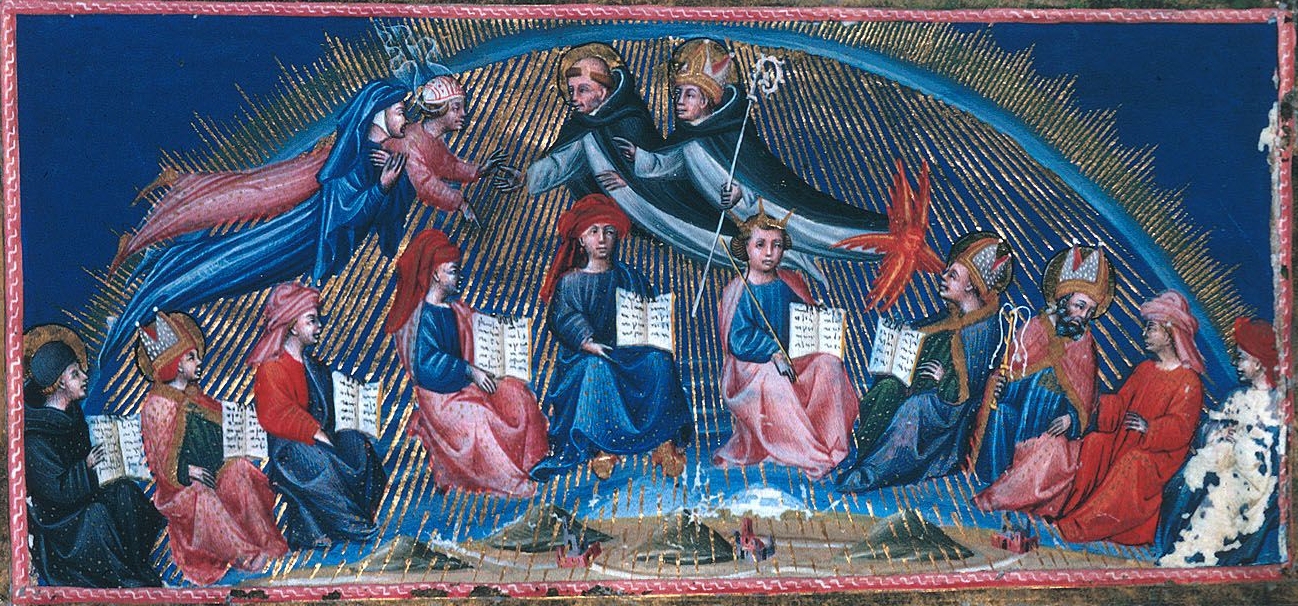

A full timeline, 1181 to 1999
The four sources are spread over more than a century and a half, and their readers over eight centuries. The timeline below places each writer's life, the church events that shaped them, the printing of the texts, the translations this module quotes and the later Catholic and Protestant acts that concern them. Francis lived first (died 1226), Aquinas next (died 1274), then Catherine (died 1380), with the Frankfurt priest writing in the same generation as Catherine, about the middle or later 1300s. Luther's two editions of the Theologia Germanica (1516 and 1518) fall on either side of the Ninety-five Theses.
A few dates on the timeline carry an "about" or an "or" because the sources disagree or the event was not recorded on the day. Francis's birth year is uncertain between 1181 and 1182; his first approval by Innocent III is dated 1209 or 1210; Aquinas's birth is usually given as 1225, and the Catholic Encyclopedia allows 1227; the date when the Summa was begun rests on the scholars' reconstruction of his teaching at Santa Sabina in Rome.1 The Theologia Germanica carries no date at all: Winkworth places its author among the Friends of God of the 1300s, and modern scholars usually say about 1350 to 1400 (lesson 08 gives who argues what).6
The later rows record acts of the Catholic Church and of Lutheran bodies that bear on the four writers. Paul VI's homily of October 4, 1970 proclaimed Catherine a Doctor of the Church.10 Benedict XVI recalled in 2010 that she was also "Co-Patroness of the City of Rome, at the wish of Bl. Pius IX, and of Patroness of Italy, in accordance with the decision of Venerable Pius XII" (the punctuation of the dashes in the Vatican text is given here with commas).14 In 2011 he recalled the proclamation of Francis "as Patron of ecology by my beloved Predecessor, John Paul II, in 1979" and that "it was Pope Pius XII who declared him" patron of Italy "in 1939."15 John Paul II named Catherine, with Bridget of Sweden and Teresa Benedicta of the Cross, a co-patroness of Europe in the apostolic letter Spes aedificandi, "Given in Rome, at Saint Peter's, on the first day of October in the year 1999."16 On October 31 of the same year the Lutheran World Federation and the Catholic Church signed the Joint Declaration on the Doctrine of Justification, which concerns the questions argued over the Summa's treatise on grace.17 John Paul II told the crowd at the Angelus that day: "In Augsburg, Germany, a very important event is taking place at this moment."18
The four texts compared
The chart below sets the four texts side by side by date, language, kind of writing, intended readers, first printing and the English translation the module quotes. Two of the four were written in Latin for trained readers; two were written or dictated in the spoken languages of their authors' regions, German and Tuscan Italian, for people who did not read Latin. That difference explains much of their later history. The Summa stayed in the schools until it was translated in the twentieth century, while the Theologia Germanica, Catherine's letters and the stories about Francis passed into the devotional reading of lay people within a few generations.
The printing history has its own uncertainties. Bridwell Library at Southern Methodist University, describing its copy of Peter Schoeffer's Mainz edition of the Second Part of the Second Part of the Summa (March 6, 1467), calls it "the second edition" and says "The first edition was printed by Johann Mentelin (c. 1410-1478) at Strasbourg, not after 1463" (Bridwell owns that edition too).19 (Bridwell writes the range with a dash; it is given here with a hyphen.) For Catherine's Dialogue, the Incunabula Short Title Catalogue records a Libro della divina dottrina printed at Naples by Werner Raptor on April 28, 1478, with variant issues signed by other printers.20 Some references give an earlier printing at Bologna in 1472. The Bologna incunable records found for this lesson belong to a different saint, Catherine of Bologna (her Sette armi spirituali, about 1475),21 so the 1472 date is left unverified, and the chart gives the Naples edition as the earliest found. Luther's two editions of the Theologia Germanica are dated by his own prefaces (lesson 08).6
What each text is for
A reader gets the most from each text by asking what its author meant it to do. The Summa means to teach, so every article states a question, weighs reasons on both sides and gives a ruling with reasons; a reader who takes one sentence of an objection as Aquinas's own view has misread it. The Theologia Germanica means to move the reader to give up self-will, so it repeats itself, as spiritual counsel does, and its strong sayings ("nothing burneth in hell but self-will") are meant to wake the reader rather than to define doctrine. Catherine's Dialogue is a prayer in which God is the speaker of most of the text: it was dictated as the record of what she understood God to say to her, and her followers received it that way. Francis's Rule is a law for a religious order, approved by a pope; his Testament is a last instruction to his brothers; the Canticle is a song for singing. The Little Flowers is a book of edifying stories collected more than a century after his death.
Who is who in the module
The table lists everyone the module names, grouped by the part of the story they belong to, with the lesson where each is discussed most fully. Dates are as given in those lessons and their sources; "about" marks a date that is reconstructed.
| Person | Dates | Who they were | Lesson |
|---|---|---|---|
| The four sources and those closest to them | |||
| Francis of Assisi (Giovanni di Pietro di Bernardone) | 1181 or 1182 to 1226 | Founder of the Friars Minor; author of the Rule of 1223, the Testament and the Canticle of the Creatures | 12, 13 |
| Clare of Assisi | about 1193 to 1253 | Follower of Francis from 1212; founder of the Poor Clares | 12 |
| Brother Leo | died 1271 | Companion and secretary of Francis; his notes on the parchment Francis gave him (the Assisi chartula) are an early witness to the stigmata | 13 |
| Brother Elias of Cortona | died 1253 | Vicar and later minister general; the letter on Francis's death that bears his name announced the stigmata | 13 |
| Thomas Aquinas | about 1225 to 1274 | Dominican friar, master at Paris, author of the Summa Theologiae and the Summa contra Gentiles | 02 to 07 |
| Reginald of Piperno | died about 1290 | Aquinas's companion and secretary; credited with compiling the Supplement to the Summa | 02, 03 |
| Albert the Great | about 1200 to 1280 | Dominican teacher of Aquinas at Paris and Cologne | 02 |
| Dominic de Guzman | about 1170 to 1221 | Founder of the Order of Preachers, approved by Honorius III on December 22, 1216 | 02 |
| The Frankfurt author ("Der Frankfurter") | wrote about 1350 to 1400 | Anonymous priest and warden of the Teutonic Order's house at Frankfurt, author of the Theologia Germanica | 08, 09 |
| Meister Eckhart, John Tauler, Henry Suso | Eckhart about 1260 to 1328; Tauler about 1300 to 1361; Suso about 1295 to 1366 | German Dominican preachers and mystics; the book names Tauler and was long credited to him | 01, 08 |
| Catherine of Siena (Caterina Benincasa) | 1347 to 1380 | Dominican tertiary, author of the Dialogue and about 380 letters, adviser to popes | 10, 11 |
| Raymond of Capua | about 1330 to 1399 | Dominican, her confessor from 1374, author of the Legenda Major (her life), later master general | 10, 11 |
| Niccolo di Toldo (Tuldo) | executed 1375 | Young man from Perugia executed at Siena, whom Catherine accompanied to his death | 11 |
| John Hawkwood | died 1394 | English mercenary captain to whom Catherine wrote urging a crusade | 11 |
| William Flete | died after 1380 | English Augustinian hermit at Lecceto, one of Catherine's circle | 10 |
| Popes and councils | |||
| Innocent III | pope 1198 to 1216 | Received Francis in 1209 or 1210; called the Fourth Lateran Council (1215) | 01, 12 |
| Honorius III | pope 1216 to 1227 | Approved the Dominicans (1216) and the Rule of 1223 (bull Solet annuere) | 02, 12 |
| Gregory IX (Ugolino) | pope 1227 to 1241 | Protector of the friars; canonized Francis (1228); bull Quo elongati (1230) | 12 |
| John XXII | pope 1316 to 1334 | Canonized Aquinas (1323); ruled against the Spiritual Franciscans on poverty (1323) | 02, 12 |
| Gregory XI | pope 1370 to 1378 | Returned from Avignon to Rome (1377) after Catherine's letters | 10 |
| Urban VI and Clement VII | elected 1378 | Rival popes at the start of the Western Schism; Catherine backed Urban | 10 |
| Pius II | pope 1458 to 1464 | Canonized Catherine (1461) | 10 |
| Pius V | pope 1566 to 1572 | Named Aquinas a Doctor of the Church (1567) | 02 |
| Leo XIII | pope 1878 to 1903 | Encyclical Aeterni Patris (1879) on the study of Aquinas | 02, 07 |
| Pius XII, Paul VI, John Paul II, Benedict XVI | 1939 to 2013 | Pius XII named Francis patron of Italy (1939) and Catherine patroness of Italy; Paul VI named Catherine a Doctor (1970); John Paul II named Francis patron of ecology (1979) and Catherine co-patroness of Europe (1999); Benedict XVI spoke on both | 10, 12 |
| Etienne Tempier | bishop of Paris 1268 to 1279 | Issued the condemnation of 219 propositions, March 7, 1277 | 02 |
| Biographers and early sources | |||
| Thomas of Celano | about 1190 to about 1260 | Franciscan, author of the First Life (1228 to 1229) and Second Life (1246 to 1247) of Francis | 13 |
| Bonaventure | 1217 or 1221 to 1274 | Minister general of the Franciscans; author of the Legenda Major (1260 to 1263) | 13 |
| Jacques de Vitry | about 1170 to 1240 | Bishop of Acre; his letter of 1220 is the earliest record of Francis at Damietta | 12, 13 |
| Ugolino of Montegiorgio (attributed) | 1300s | Credited with the Actus beati Francisci, the Latin source of the Little Flowers | 13 |
| William of Tocco, Bartholomew of Capua | early 1300s | Tocco, biographer of Aquinas and promoter of his cause; Bartholomew, chancellor of Sicily; both testified at the canonization inquiry of 1319 | 02 |
| Reformers and later readers | |||
| Martin Luther | 1483 to 1546 | Printed the Theologia Germanica (1516, 1518); wrote against scholastic theology (1517) | 07, 08 |
| Philip Melanchthon | 1497 to 1560 | Author of the Augsburg Confession (1530) | 07 |
| John Calvin | 1509 to 1564 | Reformer at Geneva; answered the medieval teaching on merit and justification in the Institutes; warned the French church at Frankfurt against the Theologia Germanica (1559) | 07, 08 |
| Sebastian Castellio | 1515 to 1563 | Translated the Theologia Germanica into Latin (1557) | 08 |
| Johann Arndt and Philipp Jakob Spener | 1555 to 1621; 1635 to 1705 | Lutheran devotional writers who reprinted and commended the book | 08 |
| John Wesley | 1703 to 1791 | Anglican clergyman and leader of the Methodist revival; read the mystics, warned against them in 1736, later published extracts of Catholic lives | 01, 14 |
| William Law | 1686 to 1761 | Anglican devotional writer who introduced Wesley to the Theologia Germanica (Olson) | 01, 14 |
| Hans Denck; Ludwig Hatzer; Valentin Weigel | 1500s | Anabaptist and spiritualist readers and editors of the Theologia Germanica | 08 |
| Richard Hooker | 1554 to 1600 | Anglican writer on law who drew on Aquinas | 05, 07 |
| Translators, editors and modern scholars | |||
| Susanna Winkworth | 1820 to 1884 | English translator of the Theologia Germanica (1854) | 08 |
| Charles Kingsley and Christian Charles Josias Bunsen | 1854 | Wrote the preface and the letter printed with Winkworth's translation | 08 |
| Franz Pfeiffer | 1815 to 1868 | Published the Wurzburg manuscript (1851) | 08 |
| Algar Thorold; Vida D. Scudder | 1896; 1905 | English translators of Catherine's Dialogue and of her letters | 10, 11 |
| Paschal Robinson; Thomas Okey | 1906; 1910 | Translators of Francis's writings and (Okey, in the Everyman edition) of the Little Flowers | 12, 13 |
| Paul Sabatier | 1858 to 1928 | French Protestant historian, Life of St. Francis (1894) | 13 |
| James Weisheipl; Jean-Pierre Torrell; Brian Davies; Ralph McInerny; Etienne Gilson | 1900s | Modern Catholic historians and philosophers of Aquinas | 02 to 07 |
| Norman Geisler; Arvin Vos; Francis Schaeffer | 1900s | Evangelical readers of Aquinas, appreciative (Geisler, Vos) and critical (Schaeffer) | 07, 14 |
| Steven Ozment; Bengt Hoffman; Wolfgang von Hinten | 1900s | Historian of the German mystics; translator (1980); critical editor (1982) of the Theologia Germanica | 08 |
| Edmund Gardner; Suzanne Noffke; F. Thomas Luongo | 1907; 1980s to 2000s; 2006 | Historians and translator of Catherine | 10, 11 |
| John Moorman; Augustine Thompson; Andre Vauchez | 1900s to 2012 | Historians of Francis and the early Franciscans | 12, 13 |
| Others the lessons name | |||
| Aristotle ("the Philosopher") | 384 to 322 BC | Greek philosopher whose works, recovered in Latin, shaped the Summa | 01, 03, 04, 06 |
| Augustine of Hippo | 354 to 430 | Bishop and theologian, the Church Father the Summa quotes most and whom Luther ranked next to the Bible | 03, 07, 08 |
| Pseudo-Dionysius; Boethius | about 500; about 480 to 524 | Late ancient Christian writers among Aquinas's authorities | 03 |
| Avicenna; Averroes ("the Commentator"); Maimonides ("Rabbi Moses") | 980 to 1037; 1126 to 1198; 1138 to 1204 | Muslim and Jewish philosophers whom Aquinas cites | 03 |
| Anselm of Canterbury | 1033 to 1109 | Author of the argument for God that Aquinas rejects in ST I, q. 2, a. 1 | 04 |
| David Hume; Immanuel Kant | 1711 to 1776; 1724 to 1804 | Philosophers whose objections to arguments like the Five Ways lesson 04 sets out | 04 |
| Hugo Grotius; William Blackstone | 1583 to 1645; 1723 to 1780 | Writers on natural law after Aquinas | 05 |
| Karl Barth | 1886 to 1968 | Swiss Reformed theologian who rejected natural theology | 05 |
| Pietro di Bernardone; Bishop Guido of Assisi | about 1206 | Francis's father, a cloth merchant, and the bishop before whom Francis renounced his inheritance | 12 |
| Sultan al-Kamil | sultan of Egypt 1218 to 1238 | Received Francis at Damietta in 1219 | 12 |
| Bridget of Sweden | 1303 to 1373 | Visionary who also urged the popes back to Rome; co-patroness of Europe with Catherine (1999) | 10, 14 |
| Esther Bouquerel; Christian Renoux | 1855 to 1923; modern | Founder of the Ligue de la Sainte-Messe, whose La Clochette printed the Peace Prayer in 1912; the historian who traced it | 13, 14 |
| Michael Allen; Mark K. Olson; David Steinmetz | modern | Historians quoted in this lesson on Luther and Wesley | 14 |
Some dates in the table (for Reginald, Leo, Elias, Celano and the German mystics) are those commonly given in modern references and are reconstructions; the lessons that discuss each person give the evidence. The count of about 380 letters of Catherine is the usual modern figure discussed in lesson 10.
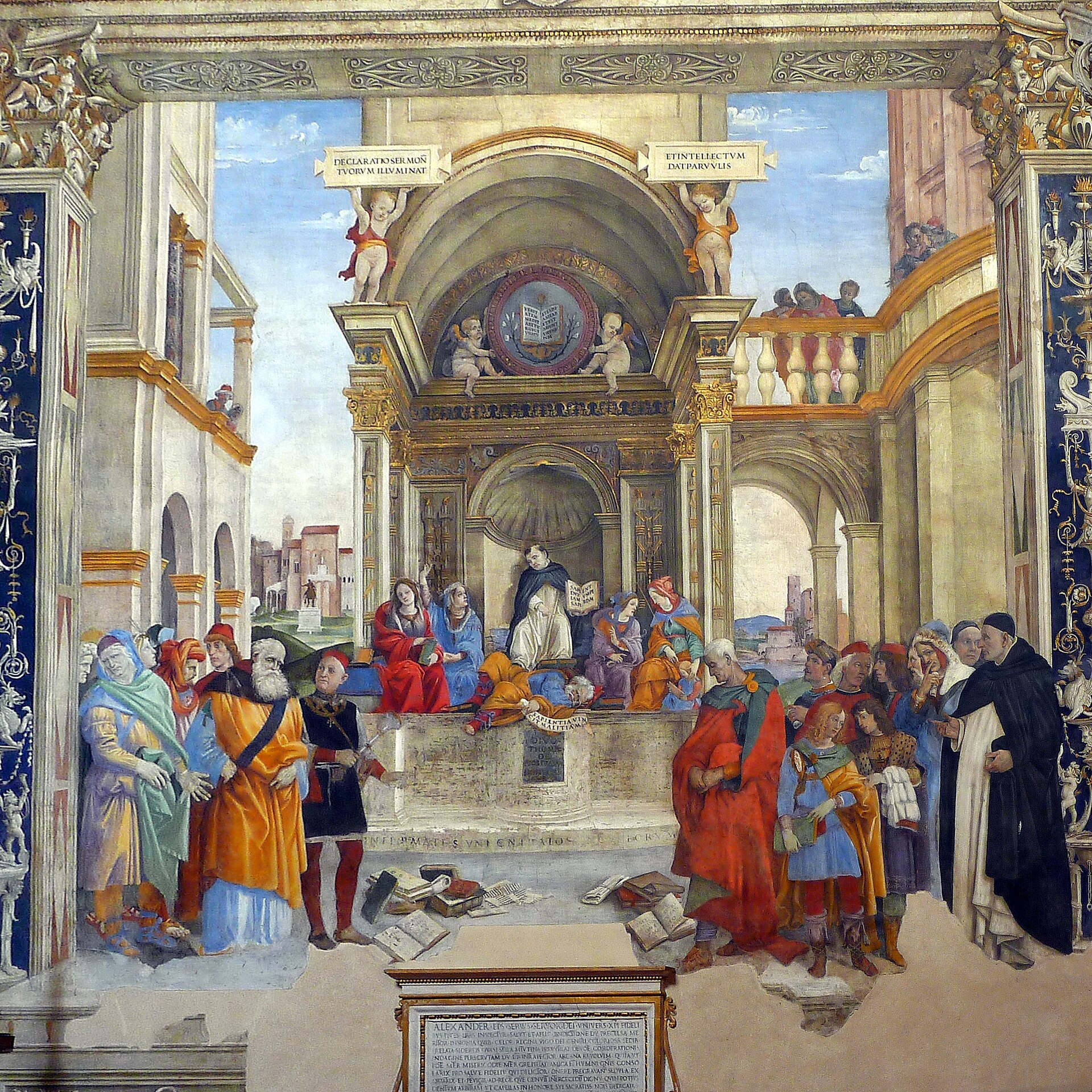

How to read each text: four reading plans
Each of the four sources can be read in a few evenings if a reader knows where to begin. The plans below start with the passages that teach a reader how the book works and then move to the passages that later readers argued about most. Every passage named is in the public domain translation used in this module and is linked to a free online text. The ladder chart after the four plans puts all of them in one suggested order.
A reading plan for the Summa Theologiae
The Summa has 512 questions in the commonly cited count (lesson 03 gives the source and the article totals), and nobody needs to read it straight through. Aquinas himself said that students had been "hampered" by books that followed no order, and he promised to set out his matter "briefly and clearly."2 The online text at New Advent gives one page to each question, numbered by part: pages beginning with 1 are the First Part, 2 the First Part of the Second Part, 3 the Second Part of the Second Part and 4 the Third Part.
- The Prologue and the first question. Read the Prologue (two paragraphs) and ST I, q. 1 (newadvent.org/summa/1001.htm), on what "sacred doctrine" is. Article 1 asks whether any doctrine beyond philosophy is needed, and lesson 03 reads it part by part as the worked example of how an article is built. Article 8 states how Aquinas weighs his authorities, and article 10 sets out the senses of Scripture.
- Whether God exists. ST I, q. 2, three articles (1002.htm), with lesson 04. Then ST I, q. 46, a. 2 (1046.htm), where Aquinas says that the world's beginning in time is held by faith and cannot be demonstrated, which keeps a reader from mistaking the Five Ways for an argument about a first moment in time.
- Happiness. ST I-II, qq. 1 to 5 (2001.htm to 2005.htm), with lesson 06. Question 2 goes through wealth, honors, fame, power, bodily goods and pleasure one article at a time, and question 3, article 8 gives the answer.
- Law. ST I-II, q. 90 (the definition of law), q. 91 (the kinds of law), q. 94 (the natural law) and q. 96, a. 4 (unjust laws) (2090.htm, 2091.htm, 2094.htm, 2096.htm), with lesson 05.
- Grace, justification and merit. ST I-II, q. 109 (the need for grace), q. 113 (justification) and q. 114 (merit) (2109.htm, 2113.htm, 2114.htm), with lesson 07. These are the questions Catholic and Protestant readers argue over most, so they are best read in full, replies included.
- Faith and charity. ST II-II, q. 1 (the object of faith), q. 4 (faith as a virtue, including a. 3 on faith "formed" by charity) and q. 23 (charity as friendship with God) (3001.htm, 3004.htm, 3023.htm).
- Christ. ST III, q. 1, on whether it was fitting for God to become incarnate (4001.htm), the opening of the Part that Aquinas never finished.
Three habits make the reading easier. First, read the "I answer that" before the objections, and then go back to the objections and the replies: the objections state views Aquinas means to answer, and a sentence from an objection is not his teaching. Second, keep track of the "On the contrary": it usually gives one authority, often a verse of Scripture, against the objections, and it is not yet the argument. Third, follow the cross-references. When the text says "as stated above (I-II:5:5)," it is pointing to the First Part of the Second Part, question 5, article 5, and the answer to the present article often depends on it. Lesson 03 explains the citation form (for example ST I-II, q. 94, a. 2, ad 1, meaning the reply to the first objection).
A reader should also know how Aquinas ranks his sources, because it answers a common question about him. In ST I, q. 1, a. 8 he writes that sacred doctrine uses the philosophers' authorities "as extrinsic and probable arguments; but properly uses the authority of the canonical Scriptures as an incontrovertible proof, and the authority of the doctors of the Church as one that may properly be used, yet merely as probable. For our faith rests upon the revelation made to the apostles and prophets who wrote the canonical books, and not on the revelations (if any such there are) made to other doctors."22 Readers on every side quote that sentence: Protestants for its ranking of Scripture above the doctors, Catholics as the order of authorities within a church that also receives tradition (the Council of Trent's decree on that point is quoted below).
A reading plan for the Theologia Germanica
Winkworth's translation has 54 short chapters, most of them a page or two long, and the whole book can be read in an afternoon.23 The chapter titles, which Winkworth translates from the old headings, tell a reader what each chapter argues. A first reading in this order shows the shape of the book:
- Chapter 1, "Of that which is perfect and that which is in part," which opens with 1 Corinthians 13:10: "When that which is perfect is come, then that which is in part shall be done away."24 The rest of the book depends on this contrast between God, the Perfect, and creatures, the things "in part."
- Chapters 2 to 4, on sin as the creature's turning from the true Good to itself, Adam's fall, and claiming any good thing as one's own.
- Chapter 14, "Of three Stages by which a Man is led upwards till he attaineth true Perfection": "Thus there are three stages: first, the purification; secondly, the enlightening; thirdly, the union. The purification concerneth those who are beginning or repenting, and is brought to pass in a threefold wise; by contrition and sorrow for sin, by full confession, by hearty amendment."25 The three stages are the older medieval scheme of the spiritual life, and the "full confession" is a reminder that the book was written by a priest of the medieval Church.
- Chapter 16, on the old man and the new man: "The old man is Adam and disobedience, the Self, the Me, and so forth. But the new man is Christ and true obedience, a giving up and denying oneself of all temporal things, and seeking the honour of God alone in all things."26
- Chapters 18 to 20 and 31, on the life of Christ as "the noblest and best Life," which the book says must be practised "until Death" and never cast off.
- Chapter 34, on forswearing self-will, with the book's most quoted sentence: "the farther off is he from God, the true Good, for nothing burneth in hell but self-will."27 Chapters 49 to 51 return to self-will as the "one Tree forbidden" in paradise.
- Chapters 40 to 43, on the false light and the true light, which lesson 09 sets out in a two-column chart.
- Chapters 52 to 54, which end the book with Christ's sayings "No Man cometh unto the Father, but by Me" and "No Man can come unto Me, except the Father, which hath sent Me, draw him" (the headings of chapters 52 and 53), and with entering eternal life "by the right Door, to wit, by Christ."
Read Luther's 1518 preface and Winkworth's historical introduction before or after the text (both are on the same CCEL site), and lesson 08 for the book's history. Readers should notice that the book's language about the soul's "union" with God and about becoming "a Partaker of the Divine Nature" (the phrase of 2 Peter 1:4, which the headings of chapters 35 and 41 use) is the language that later readers both loved and suspected, and lesson 09 gives the passages and the charges in full.
A reading plan for Catherine of Siena
The Dialogue in Thorold's translation is long (several hundred pages) and is arranged in treatises: a short opening, then the treatises of Divine Providence, Discretion, Prayer and Obedience in his arrangement (lesson 11 gives the details). A reader who has only a week should read:
- The opening chapters, where "a soul" in "the cell of self-knowledge" addresses four requests to God. Thorold's text lists them: "The first was for herself; the second for the reformation of the Holy Church; the third a general prayer for the whole world, and in particular for the peace of Christians who rebel, with much lewdness and persecution, against the Holy Church," and the fourth, as lesson 11 sets out, for God's providence.9 Near the end of the book God reminds her: "you made four petitions of Me with anxious desire, or rather I caused you to make them in order to increase the fire of My love in your soul."28
- The Bridge. The section headed "How the road to Heaven being broken through the disobedience of Adam, God made of His Son a Bridge by which man could pass" and the sections that follow it. God says: "Wherefore I have told you that I have made a Bridge of My Word, of My only-begotten Son, and this is the truth. I wish that you, My children, should know that the road was broken by the sin and disobedience of Adam."29 Earlier God tells her to "look at the Bridge of My only-begotten Son, and see the greatness thereof, for it reaches from Heaven to earth, that is, that the earth of your humanity is joined to the greatness of the Deity thereby."29 Lesson 11 draws the Bridge and its three stairs.
- The sections on tears and on prayer, which teach the stages of the soul's growth in the Dialogue's own terms.
- The treatise on obedience, near the end, which God calls the answer to her desire "concerning obedience."28
Then read a handful of letters in Scudder's selection (1905). Three show her range. To Gregory XI at Avignon she wrote: "Up, father, like a man! For I tell you that you have no need to fear. You ought to come; come, then. Come gently, without any fear."8 To the English mercenary captain John Hawkwood, whose company was then fighting in Italy, she wrote a letter of credentials for Raymond of Capua, her messenger to him and the other captains, urging them toward the crusade, so that "you shall show that you are a manly and true knight."8 And her letter to Raymond of Capua about the execution of Niccolo di Toldo (lesson 11) shows her at a scaffold rather than a court. Scudder's notes also quote her letter to Gerard du Puy, "a relative of the Pope and Papal Legate in Tuscany": "I believe that our sweet Christ on earth should do away entirely with two things which ravage the Bride of Christ. The first is the over-great tenderness and care for relatives."8 "Christ on earth" is her usual name for the pope, and readers should hear it beside her plain demands that the pope reform the clergy.
A reading plan for Francis of Assisi
Francis's own writings fill one small book, and they should come first, before any life of him. In Robinson's Writings of Saint Francis of Assisi (1906):
- The Testament (1226), which begins: "The Lord gave to me, Brother Francis, thus to begin to do penance; for when I was in sin it seemed to me very bitter to see lepers, and the Lord Himself led me amongst them and I showed mercy to them. And when I left them, that which had seemed to me bitter was changed for me into sweetness of body and soul."30 It is his own account of his conversion, written at the end of his life.
- The Rule of 1223, twelve short chapters, beginning "The Rule and life of the Minor Brothers is this, namely, to observe the holy Gospel of our Lord Jesus Christ, by living in obedience, without property and in chastity."12 Then the longer Rule of 1221, which has more of his own voice.
- The Canticle of the Creatures, which Robinson translates literally "to render... the naif rhythm of the original Italian": "Most high, omnipotent, good Lord, Praise, glory and honor and benediction all, are Thine."31
- The Admonitions and the Letters, including the letter to all the faithful.
Then read Thomas of Celano's First Life (1228 to 1229, in Howell's translation of 1908), the nearest full life, and only after it Bonaventure's Legenda Major (1260 to 1263) and the Little Flowers of the later 1300s, as lesson 13 sets them out. In the Little Flowers, chapter 8 (perfect joy), chapter 16 (the sermon to the birds) and chapter 21 (the wolf of Gubbio) are the famous ones; lesson 13 sets each beside its earliest source.
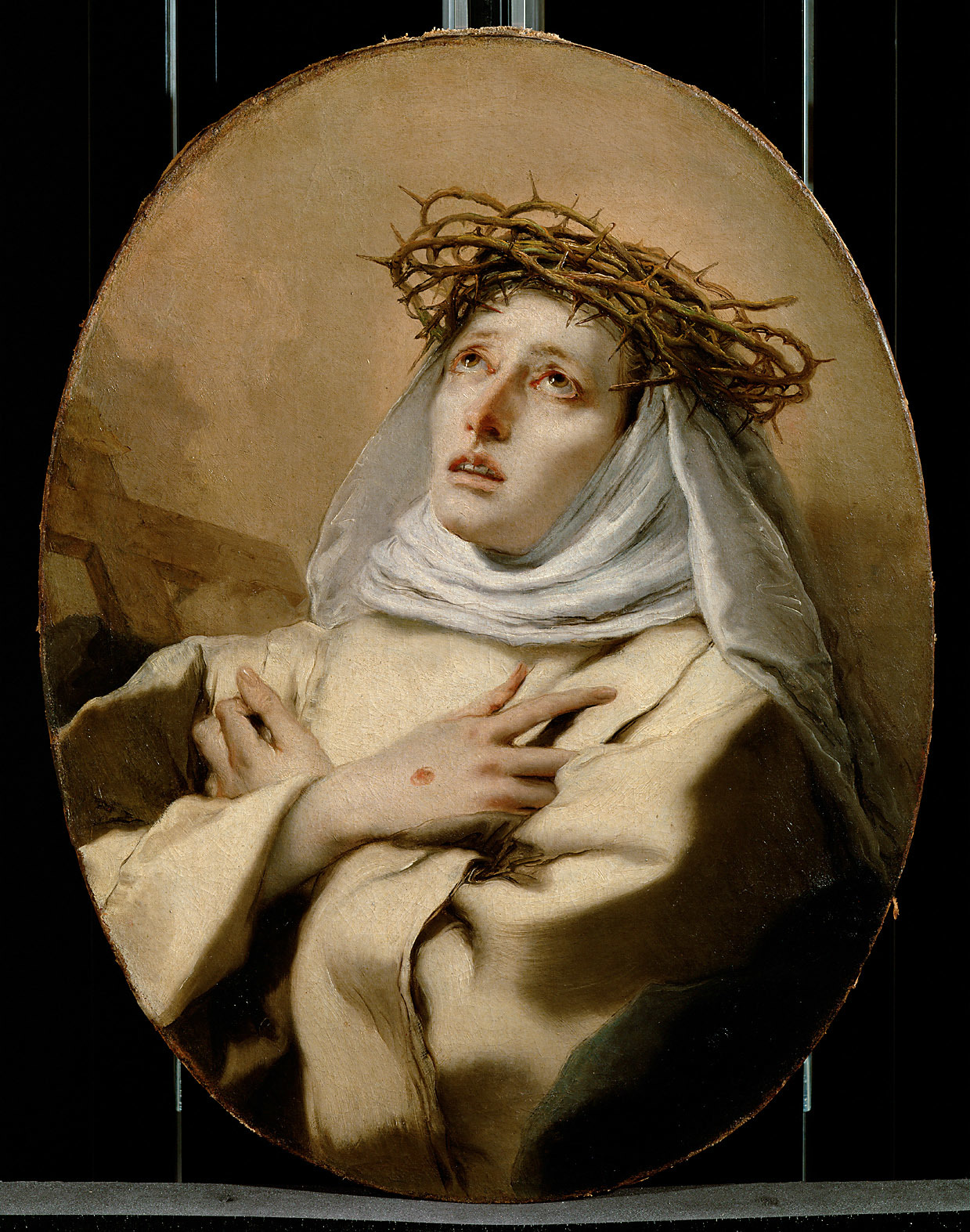

Reading across the divide: Protestant and Catholic readers
Catholic and Protestant readers come to these four books from different starting points, and both have long read them. The questions below are the ones each side usually brings, answered from what the texts and the churches' own documents say.
How a Protestant reader can read these works
A Protestant reader has precedent. Luther printed the Theologia Germanica twice and praised it beside the Bible and Augustine.6 Calvin argued with Aquinas's teaching on merit and justification in the Institutes and so read him closely enough to answer him. Wesley read the mystics for years and published extracts of Catholic lives (below). Reformed and Anglican writers such as Richard Hooker used Aquinas on law (lesson 05). The habit these readers shared was to separate what they could receive from what they could not, and to say which was which.
Four practices help. First, read each author for what he or she says before reading what later controversy made of it: the Summa's teaching on grace begins with the claim that "without grace man cannot merit everlasting life,"32 a sentence no Protestant confession disputes, and the disagreement comes at the next step, over what grace does in the person and how works done in grace stand before God. Second, notice what the medieval authors assume that the Reformation later questioned: purgatory, prayers to the saints, the sacrament of penance (the "full confession" of the Theologia Germanica, chapter 1425) and the pope as "Christ on earth" in Catherine's letters.8 Those are part of the texts, and reading them honestly means reading them as written. Third, use the Reformers' own tests: Luther praised the Theologia Germanica for teaching "what God, and Christ, and man and all things are,"6 and the same test can be put to Catherine's Bridge or Francis's Testament. Fourth, give the lives of the saints the same historical scrutiny that Protestant historians such as Paul Sabatier gave the Franciscan sources (lesson 13): the saint's own writings first, the earliest lives next, the legends last.
Evangelical writers of the late 1900s divided over Aquinas. Norman Geisler, in Thomas Aquinas: An Evangelical Appraisal (1991), argued that evangelicals could accept much of his philosophy and his arguments for God while rejecting his teaching on the sacraments and on justification, and Arvin Vos (Aquinas, Calvin, and Contemporary Protestant Thought, 1985) argued that Protestant critics had often misread him. Francis Schaeffer, in Escape from Reason (1968), argued the reverse case: that Aquinas had given "nature" (reason, the created world) an independence from "grace" that later thinkers took further, until nature swallowed up grace. Schaeffer's critique and its later reception are set out in Liberty and the Republic, module 58, lesson 01. These three books were not reopened for this lesson, and their arguments are given here in summary.
How a Catholic reader reads them
For a Catholic reader the four sources are not equal in standing. Aquinas is a Doctor of the Church (1567), and Leo XIII's encyclical Aeterni Patris (August 4, 1879) told the bishops: "We exhort you, venerable brethren, in all earnestness to restore the golden wisdom of St. Thomas, and to spread it far and wide for the defense and beauty of the Catholic faith, for the good of society, and for the advantage of all the sciences."33 Leo added a limit in the next sentence: "The wisdom of St. Thomas, We say; for if anything is taken up with too great subtlety" by the scholastic doctors, or held with too little care, it is not to be held up for imitation.33 Catherine is also a Doctor of the Church (1970), and Paul VI's homily of Sunday, October 4, 1970 opens with the "júbilo espiritual" (spiritual joy) of proclaiming "Doutora da Igreja a humilde e sábia virgem dominicana Catarina de Sena" (a Doctor of the Church the humble and wise Dominican virgin Catherine of Siena), in the Vatican's Portuguese text.10 Francis is a canonized saint and the founder of an order that still lives under the Rule of 1223. The Theologia Germanica, by contrast, is an anonymous book that was placed on the Roman Index in the 1600s (the year is disputed; lesson 08), and Catholic readers have usually met it through the German mystical tradition that it shares with Tauler.
A Catholic reader reads the canonized texts within the Church's teaching and not as private revelation binding on faith. The Summa itself draws that line when it says that faith "rests upon the revelation made to the apostles and prophets who wrote the canonical books, and not on the revelations (if any such there are) made to other doctors."22 Catherine's Dialogue and Francis's stigmata are, in Catholic teaching, matters of devotion and of the saints' lives, and a Catholic historian may weigh the sources for them as freely as anyone else. The modern Catholic biographers in this module (Weisheipl and Torrell on Aquinas, Vauchez and Augustine Thompson on Francis, Luongo on Catherine) do exactly that.
What Luther, Calvin, Wesley and later readers said
Luther
Luther's judgments on these four writers point in two directions. On the Theologia Germanica he was warm: in the 1518 preface, as Winkworth translates it, he wrote that "next to the Bible and St. Augustine, no book hath ever come into my hands, whence I have learnt, or would wish to learn more of what God, and Christ, and man and all things are."6 On scholastic theology he was severe. In the Disputation against Scholastic Theology (September 4, 1517), in Harold Grimm's translation in Luther's Works, volume 31, as quoted by Michael Allen (Themelios, 2019), he wrote that "it is an error to say that no man can become a theologian without Aristotle" (thesis 43) and that "briefly, the whole Aristotle is to theology as darkness is to light" (thesis 50).34 Allen adds, citing the Reformation historian David Steinmetz, that Luther "consistently reads Gregory of Rimini as the one scholastic theologian avoiding the error of Thomas, Scotus, and Ockham."34 The theses name Aristotle and the late medieval schoolmen more than Aquinas himself, and lesson 07 sets out what Luther said about Thomas by name.
Calvin
Calvin answered the medieval teaching on justification in book 3 of the Institutes. In Beveridge's translation (1845) he defines the Reformed position: "a man will be justified by faith when, excluded from the righteousness of works, he by faith lays hold of the righteousness of Christ, and clothed in it appears in the sight of God not as a sinner, but as righteous. Thus we simply interpret justification, as the acceptance with which God receives us into his favor as if we were righteous" (III.11.2).35 On the Theologia Germanica, Calvin's warning to the French congregation at Frankfurt in 1559 is known in English chiefly through Bengt Hoffman's 1980 introduction, as lesson 08 explains; the original letter was not opened for this module.
Wesley
John Wesley read the mystics closely and then drew back. The Methodist historian Mark K. Olson writes that Wesley "was introduced to the Theologia Germanica by William Law, when the two met for the first time in the summer of 1732," and that "by 1736 the Theologia Germanica and other mystical works began to fall out of favor with Wesley."36 Wesley's own letter to his brother Samuel, dated "SAVANNAH, November 23, 1736," says: "I think the rock on which I had the nearest made shipwreck of the faith was the writings of the Mystics;" and goes on to define the mystics as all, and only, those who slight any of the means of grace.37 Wesley did not stop publishing Catholic devotional lives. Catalogue records show An Extract of the Life of Monsieur de Renty, a Late Nobleman of France, "Published by John Wesley, M.A." (in a London printing of 1778), and An Extract of the Life of Madam Guion "By John Wesley, M. A" (London, 1776), both printed in London by R. Hawes and sold at the Foundry in Moorfields and at Wesley's preaching-houses.38 His pattern was to abridge, keeping what he judged to teach holiness and cutting what he judged unsound. Lesson 01 describes his reading of the mystics more fully.
Modern Catholic writers and the popes
Modern popes have written on all four figures except the Frankfurt author. Leo XIII's Aeterni Patris (1879) set Aquinas at the center of Catholic study.33 Paul VI proclaimed Catherine a Doctor in 1970.10 John Paul II named Francis patron of ecology in 1979 and Catherine a co-patroness of Europe in 1999.1516 Benedict XVI spoke of both saints. In his general audience of November 24, 2010 he said of Catherine that Paul VI "declared her a Doctor of the Church, a title that was added to those of Co-Patroness of the City of Rome, at the wish of Bl. Pius IX, and of Patroness of Italy, in accordance with the decision of Venerable Pius XII."14 Speaking on November 28, 2011, he said of Francis that "it was Pope Pius XII who declared him such in 1939, when he described him as 'the most Italian of saints and the saintliest of Italians.'"15 Catholic scholars of the 1900s, Etienne Gilson, Ralph McInerny and Brian Davies among them, wrote on Aquinas as a philosopher, while the Dominican historians Weisheipl and Torrell rebuilt his life and the order of his works from the documents (lesson 02).
Modern Protestant writers
Protestants did much of the work that brought these texts to English readers. Susanna Winkworth translated the Theologia Germanica in 1854 with a preface by the Anglican clergyman Charles Kingsley and a letter dated May 11, 1854 from Chevalier Bunsen, the Prussian scholar and diplomat then living in England, who wrote: "with Luther, I rank this short treatise next to the Bible, but, unlike him, should place it before rather than after St. Augustine."39 Paul Sabatier, a French Protestant pastor, wrote the 1894 life of Francis that opened the modern "Franciscan question" (lesson 13). Vida D. Scudder, who chose and translated the letters of Catherine in 1905, introduced her as a woman "keenly and humanly interested in life on this earth."8 Among theologians, Geisler and Vos argued for reading Aquinas with appreciation and Schaeffer for reading him with suspicion, as set out above.
Where the traditions agree and where they disagree
The four texts were written before the Reformation, and so they do not take sides in it. Later readers did. The six subjects below are the ones on which Catholic and Protestant readers of these texts most often part company, and on most of them they also share more than polemic on either side admits. Each position is given in the words of the documents that each church itself treats as its standard: for the Catholic Church, the Council of Trent (Waterworth's translation of 1848) and later papal documents; for Lutherans, the Augsburg Confession (1530), the Smalcald Articles (1537) and the Formula of Concord (1577) in the Triglot translation at bookofconcord.org; for the Reformed, Calvin's Institutes; and for both Catholics and Lutherans, the Joint Declaration of 1999. The chart summarizes; the paragraphs give the words.
| Subject | What the texts of this module say | Shared ground | Where the traditions part |
|---|---|---|---|
| Grace | Aquinas: without grace no one can merit eternal life (ST I-II, q. 109, a. 5) | Salvation begins with God's grace, not human strength (Trent, Augsburg IV, Joint Declaration 15) | Whether justifying grace is a quality God gives within the soul (Aquinas, Trent) or God's favor and Christ's righteousness reckoned to the believer (Augsburg IV, Calvin) |
| Merit | Aquinas: works done in grace merit eternal life "condignly" because of the Holy Spirit (q. 114, a. 3) | No one merits the first grace; good works follow faith | Trent teaches that the works of the justified are truly their merits; Augsburg IV and Calvin deny that merit has any part in justification |
| The saints | Catherine and Francis as examples; the lives as devotion | The memory of the saints may be set before believers as examples (Augsburg XXI; Trent XXV) | Trent: it is "good and useful" to invoke the saints; Augsburg XXI and the Smalcald Articles: Scripture does not teach their invocation |
| The papacy | Catherine: the pope is "Christ on earth" and must reform the Church | The Church of the 1300s needed reform of its clergy (Catherine; the Reformers) | Catholic teaching on the pope's office; the Smalcald Articles deny that the pope is head of Christendom by divine right |
| Mysticism | The Theologia Germanica's purification, enlightening and union; Catherine's Bridge | Union with God in love as the goal of the Christian life | Divided within each tradition as much as between them (Luther's praise, Calvin's and Wesley's warnings) |
| Scripture and tradition | Aquinas: Scripture is "incontrovertible proof," the doctors "merely as probable" (ST I, q. 1, a. 8) | Scripture is the supreme written authority, read in the Church | Trent receives written books and unwritten traditions "with an equal affection of piety"; the Formula of Concord makes Scripture "alone" the rule |
On grace
Aquinas's treatise on grace begins from the need for it. In ST I-II, q. 109, a. 5 he writes that "man, by his natural endowments, cannot produce meritorious works proportionate to everlasting life; and for this a higher force is needed, viz. the force of grace. And thus without grace man cannot merit everlasting life."32 The Augsburg Confession, Article IV, teaches "that men cannot be justified before God by their own strength, merits, or works, but are freely justified for Christ's sake, through faith."40 In 1999 the Lutheran World Federation and the Catholic Church said together: "By grace alone, in faith in Christ's saving work and not because of any merit on our part, we are accepted by God and receive the Holy Spirit, who renews our hearts while equipping and calling us to good works" (paragraph 15).17 The same document recorded that the sixteenth-century condemnations "are still valid today and thus have a church-dividing effect" (paragraph 1) and concluded that, in so far as they concern justification, the Lutheran teaching it presents "does not fall under the condemnations from the Council of Trent" (paragraph 41).17 Both statements belong to a fair account. The Joint Declaration did not settle the other subjects below, and not every Lutheran or Reformed body accepted it (lesson 07 gives the responses).
On merit
Merit is where the texts part most clearly. Aquinas distinguishes two ways of looking at a good work. Considered as it comes from free will alone, "there can be no condignity because of the very great inequality" between man and God. "If, however, we speak of a meritorious work, inasmuch as it proceeds from the grace of the Holy Ghost moving us to life everlasting, it is meritorious of life everlasting condignly. For thus the value of its merit depends upon the power of the Holy Ghost" (ST I-II, q. 114, a. 3).41 The Council of Trent taught in 1547 that "life eternal is to be proposed to those working well unto the end, and hoping in God, both as a grace mercifully promised to the sons of God through Jesus Christ, and as a reward" (Session VI, chapter 16), and condemned anyone who says "that the good works of one that is justified are in such manner the gifts of God, as that they are not also the good merits of him that is justified" (canon 32).42 Calvin answered that a man is justified "when, excluded from the righteousness of works, he by faith lays hold of the righteousness of Christ" (Institutes III.11.2).35 A Protestant reader of Aquinas should notice that his merit is the Holy Spirit's work in the person and not a claim made by unaided nature; a Catholic reader of Calvin should notice that Calvin's objection is to any part for works in the sinner's acceptance before God, not to good works themselves.
On the saints
Catherine and Francis are saints in the Catholic calendar, and a reader meets in their lives the medieval practice of praying to the saints. The Council of Trent, in its twenty-fifth session (December 1563), told bishops to teach "that the saints, who reign together with Christ, offer up their own prayers to God for men; that it is good and useful suppliantly to invoke them, and to have recourse to their prayers, aid, (and) help for obtaining benefits from God, through His Son, Jesus Christ our Lord, who is our alone Redeemer and Saviour."43 The Augsburg Confession, Article XXI, teaches "that the memory of saints may be set before us, that we may follow their faith and good works, according to our calling," and adds: "But the Scripture teaches not the invocation of saints or to ask help of saints, since it sets before us the one Christ as the Mediator, Propitiation, High Priest, and Intercessor."44 The two texts agree that the saints' faith and works are examples and that Christ is the one Redeemer; they disagree over prayer to the saints. A Protestant reader can read Francis's Testament or Catherine's letters as the Augsburg Confession reads the saints, as examples of faith and good works.
On the papacy
Catherine is the module's witness on the papacy, and she is a witness both sides quote. Writing to the papal legate Gerard du Puy, she called the pope "our sweet Christ on earth" and said in the same passage that he should do away with "the over-great tenderness and care for relatives" that ravaged the Church.8 She urged Gregory XI to return to Rome and supported Urban VI in the schism (lesson 10). The Smalcald Articles, written by Luther in 1537, state "that the Pope is not, according to divine law or according to the Word of God the head of all Christendom (for this [name] belongs to One only, whose name is Jesus Christ), but is only the bishop and pastor of the Church at Rome," and go on to call him "the very Antichrist."45 Those words are part of the Lutheran Confessions and are quoted here because they are the Lutheran position as Luther framed it; modern Lutheran and Catholic dialogues have discussed the papacy since (lesson 07 and Church History, Part B, lesson 01). Catherine and Luther shared a conviction that the clergy of their day needed reform. They disagreed about whether the papal office itself was of God, and Catherine never doubted that it was.
On mysticism
The Theologia Germanica and Catherine's Dialogue both teach that the soul can come to union with God in love in this life. The Theologia Germanica sets out "three stages: first, the purification; secondly, the enlightening; thirdly, the union."25 Catherine's Dialogue speaks of the soul that "unites herself with God by the affection of love" and of those who "are another Myself, inasmuch as they have lost and denied their own will, and are clothed with Mine."9 The lines of division on this subject do not run between Catholic and Protestant. Luther praised the Theologia Germanica, Calvin warned against it and Wesley learned from it and then called the mystics the rock on which his faith had nearly been wrecked.637 Within the Catholic Church, the writings of Meister Eckhart, who belonged to the same German school, were censured by Pope John XXII in 1329 (lesson 08), while Catherine was named a Doctor. Every tradition has had both admirers and critics of mystical writing, and the critics on each side have usually raised the same worry: that talk of union with God might blur the difference between the Creator and the creature, or make the outward means of grace seem unnecessary.
On Scripture and tradition
Aquinas, as quoted above, calls the canonical Scriptures "incontrovertible proof" and the doctors of the Church a "merely probable" authority.22 The Council of Trent, in its fourth session (April 8, 1546), said that the truth and discipline of the Gospel "are contained in the written books, and the unwritten traditions which, received by the Apostles from the mouth of Christ himself, or from the Apostles themselves, the Holy Ghost dictating, have come down even unto us," and that the council receives them "with an equal affection of piety, and reverence."46 The Lutheran Formula of Concord (1577) teaches "that the sole rule and standard according to which all dogmas together with [all] teachers should be estimated and judged are the prophetic and apostolic Scriptures of the Old and of the New Testament alone."47 Aquinas wrote three centuries before either text, and both sides have claimed his sentence. What the sentence shows is that a medieval doctor of the schools placed Scripture at the head of his authorities and treated the Fathers as weighty but fallible; it does not say how he would have answered the sixteenth-century question, which was not yet asked in that form. The Bible these writers used was the Latin Vulgate (translated about 382 to 405 at the request of Pope Damasus), which The History of the Bible, lesson 04, describes.
The module's terms in one place
The terms below are used across the fourteen lessons. Each is defined as the module uses it, with the lesson where it is explained in full.
Terms for reading the Summa
- Summa
- A "summary" or ordered whole of a subject; the Summa Theologiae is Aquinas's summary of theology for beginners (lesson 03).
- Question and article
- The Summa's units: each question (for example q. 2, on whether God exists) is divided into articles, each a single yes-or-no inquiry beginning "Whether..." (lesson 03).
- Objections, "On the contrary," "I answer that," replies
- The five parts of an article: arguments against Aquinas's view, a contrary authority (sed contra), his own answer (respondeo) and the replies to each objection ("ad 1," "ad 2") (lesson 03).
- Scholasticism
- The method of the medieval schools: questions argued by reason from authorities, objections and distinctions. Luther's Disputation of 1517 was directed "against scholastic theology" (lesson 07).
- The Philosopher, the Commentator, Rabbi Moses
- Aquinas's names for Aristotle, Averroes and Maimonides (lesson 03).
- The Five Ways
- The five arguments of ST I, q. 2, a. 3, from motion, efficient cause, possibility and necessity, gradation and governance (lesson 04).
- Eternal, natural, human and divine law
- The four kinds of law in ST I-II, qq. 90 to 108; natural law is "the rational creature's participation of the eternal law" (ST I-II, q. 91, a. 2; lesson 05).48
- Beatitude
- Happiness in its final sense, which Aquinas places in the vision of the divine essence (ST I-II, q. 3, a. 8; lesson 06).
- Operating and cooperating grace
- Aquinas's distinction in ST I-II, q. 111 between grace by which God moves the soul and grace by which the soul, moved, also acts (lesson 07).
- Condign and congruous merit
- Merit in strict justice and merit by fitness. Aquinas holds that a work, as it comes from the Holy Spirit's grace, merits eternal life condignly (ST I-II, q. 114, a. 3; lesson 07).
Terms for reading the Theologia Germanica
- The Frankfurter
- The unknown author, a priest and warden (custos) of the Teutonic Order's house at Frankfurt, named only by the book's old preface (lesson 08).
- Friends of God (Gottesfreunde)
- The circles of German clergy and lay people in the 1300s, linked with Tauler and Suso, among whom Winkworth placed the book (lesson 08).
- That which is perfect and that which is in part
- The book's opening contrast, from 1 Corinthians 13:10, between God and creatures (chapter 1; lesson 09).
- Self-will, "I, Me and Mine"
- The book's name for sin: the creature's claiming of itself and its goods as its own (chapters 2 to 4, 34, 49 to 51; lesson 09).
- Purification, enlightening, union
- The three stages of the spiritual life in chapter 14 (lesson 09).
- True light and false light
- The book's test for telling genuine holiness from spiritual pride and "false, lawless Freedom" (chapters 25, 40 to 43; lesson 09).
Terms for reading Catherine
- Mantellate
- The Dominican tertiaries of Siena, laywomen who wore the order's habit and mantle while living at home; Catherine took the habit in her sixteenth year (lesson 10).
- The cell of self-knowledge
- The Dialogue's image for the soul's knowledge of itself and of God's goodness, where prayer begins (lesson 11).
- The Bridge
- The Dialogue's central image: Christ as the bridge from earth to heaven over the river of the world, with three stairs (lesson 11).
- "Christ on earth"
- Catherine's name for the pope in her letters (lesson 11).
- Avignon papacy and Western Schism
- The popes' residence at Avignon (1309 to 1377) and the division of the papacy between rival claimants from 1378 to 1417 (lessons 01 and 10).
Terms for reading Francis
- Friars Minor
- The "lesser brothers," Francis's order; its Rule of 1223 is the Regula bullata, approved by papal bull, and the longer Rule of 1221 is the Regula non bullata (lesson 12).
- Testament
- Francis's last instruction to his brothers (1226), the main source for his own account of his conversion (lesson 12).
- Canticle of the Creatures
- His Umbrian Italian song of praise "with all Thy creatures," composed 1225, with the verse on Sister Death added before his death in 1226 (lesson 12).
- The Franciscan question
- The scholarly debate, opened by Sabatier in 1894, over which early lives and collections preserve the most reliable record of Francis (lesson 13).
- Actus and Fioretti
- The Latin Actus beati Francisci et sociorum eius (about 1327 to 1340) and its Italian reworking, the Little Flowers of the later 1300s (lesson 13).
- Stigmata
- The wounds of Christ's passion, which Brother Elias, Brother Leo, Celano and Bonaventure report that Francis bore from La Verna in 1224, and which Raymond of Capua reports that Catherine received invisibly at Pisa in 1375 (lessons 10 and 13).
Terms for the later debates
- Justification
- God's making or declaring the sinner righteous; the subject of Trent's Session VI (1547), the Augsburg Confession, Article IV, and the Joint Declaration of 1999 (lesson 07).
- Doctor of the Church
- A title the popes give to saints whose teaching the Catholic Church commends; Aquinas (1567) and Catherine (1970) hold it (lessons 02 and 10).
- Index of Forbidden Books
- The Roman list of books Catholics were forbidden to read without permission, on which the Theologia Germanica was placed in the 1600s; the list ceased to bind in 1966 (lesson 08).
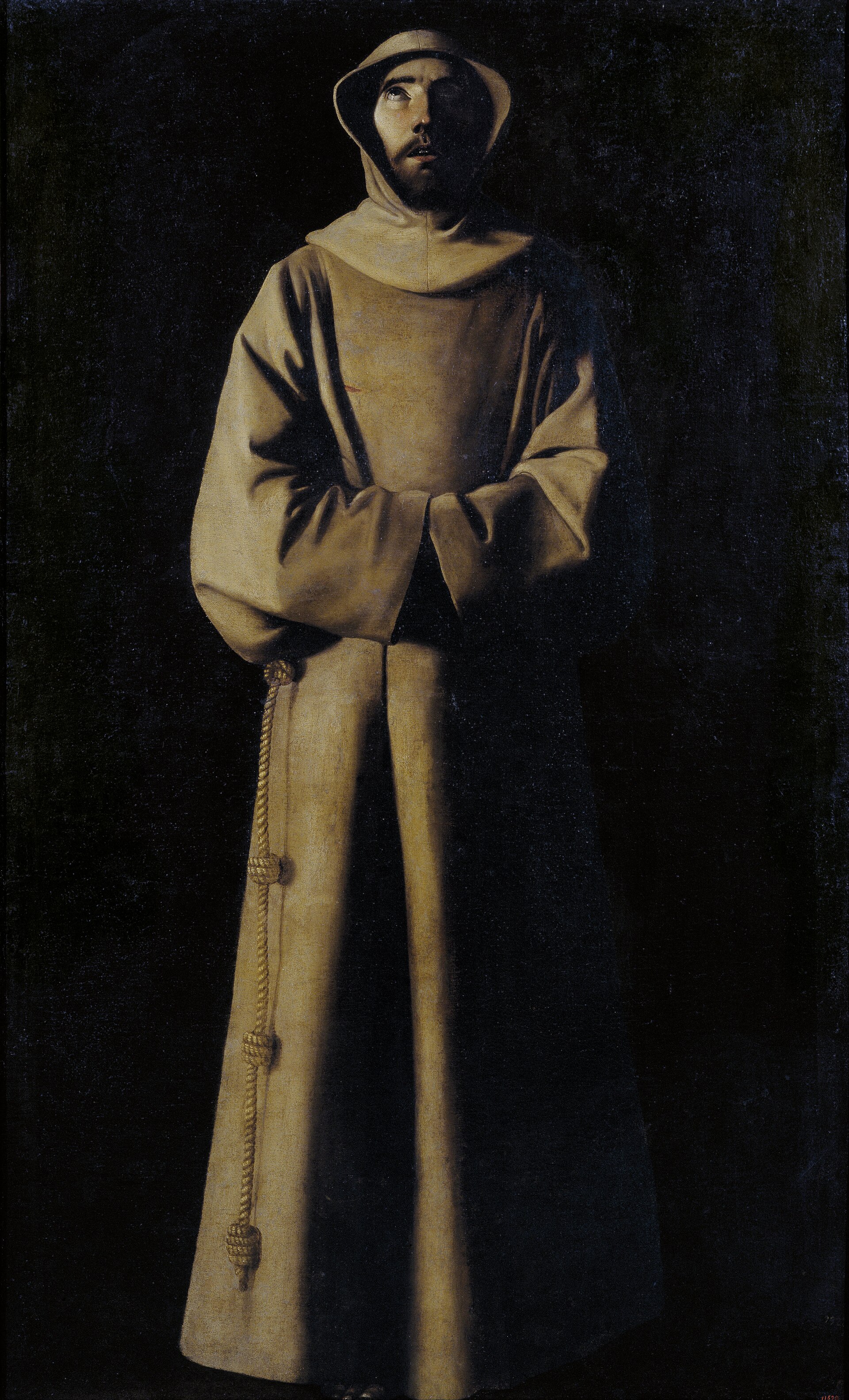

The primary texts to read first
All of the texts below are free online in the public domain translations this module quotes. They are listed in the order of the reading ladder above.
- Thomas Aquinas, Summa Theologiae, translated by the Fathers of the English Dominican Province, second and revised edition (1920): newadvent.org/summa, one page for each question. The Latin Leonine text is at corpusthomisticum.org.
- Francis of Assisi, The Writings of Saint Francis of Assisi, translated by Paschal Robinson (Philadelphia, 1906): the Rules, the Testament, the Canticle, the Admonitions and the Letters, at archive.org.
- Theologia Germanica, translated by Susanna Winkworth (1854), with Luther's preface, Kingsley's preface and Bunsen's letter: ccel.org/ccel/anonymous/theologia.
- Catherine of Siena, The Dialogue, translated by Algar Thorold: ccel.org/ccel/catherine/dialog.
- Catherine of Siena, Saint Catherine of Siena as Seen in Her Letters, translated and edited by Vida D. Scudder (1905): gutenberg.org/ebooks/7403.
- Thomas of Celano, the First and Second Lives, translated by A. G. Ferrers Howell (1908), and Bonaventure's Life, translated by E. Gurney Salter, as lesson 13 lists them, on archive.org; and the Little Flowers in Thomas Okey's translation (Everyman, 1910).
- The church documents: the Council of Trent in Waterworth's translation (1848) at the Hanover Historical Texts Project; the Augsburg Confession and the other Lutheran Confessions at bookofconcord.org; Calvin's Institutes in Beveridge's translation at ccel.org; Aeterni Patris at vatican.va; and the Joint Declaration on the Doctrine of Justification (1999), reprinted at EWTN.
What the record shows and what it does not
- Documented fact: the dates of the popes' acts (the Rule of 1223, the canonizations of 1228, 1323 and 1461, Aquinas named a Doctor in 1567, Aeterni Patris in 1879, Catherine named a Doctor in 1970 and co-patroness of Europe in 1999); Gregory XI's entry into Rome on January 17, 1377; the decrees of Trent with their session dates; the Augsburg Confession (1530); Luther's editions of 1516 and 1518; the Joint Declaration signed at Augsburg on October 31, 1999.
- The authors' own words: the Summa, the Theologia Germanica, the Dialogue and the letters, and Francis's Rule, Testament and Canticle, all quoted here from public domain translations. These show what each author taught, not what later readers made of them.
- What the earliest lives report: Celano on Francis (from 1228), the 1319 canonization testimony on Aquinas (lesson 02), Raymond of Capua on Catherine (lesson 10). These are close to the events but written by admirers for a purpose, usually a canonization.
- Later legend: the Little Flowers (more than a century after Francis), the "Peace Prayer" (first printed 1912), the story behind Zurbaran's standing Francis.
- Scholarly reading: the date of the Theologia Germanica (about 1350 to 1400), Aquinas's birth year (about 1225), Catherine's political weight at Avignon, and how far Aquinas and the Reformers really differ, are judgments that modern scholars make and argue over.
- Open questions: Calvin's exact French words about it, the first printing of Catherine's Dialogue and of the Little Flowers, and the identity of the Frankfurt author.
Claims checked
The claims below circulate in sermons, popular histories, devotional books and websites. Each is rated by the evidence for it: Supported, Partly supported, Unsupported, Refuted or Unresolved. For miracle stories and visions the rating is of the evidence for the report (who first told it, when and how close to the event), not a ruling on whether a miracle happened. The lesson that examines each claim in full is named.
| Claim | Rating | Evidence |
|---|---|---|
| "At the end of his life Aquinas said all he had written was straw." | Supported, as reported testimony | Bartholomew of Capua testified in 1319 to the saying, at third hand, from Reginald of Piperno through John of Giudice, some forty-five years after the event (lesson 02). The 1912 Catholic Encyclopedia gives the reply to Reginald as "all I have written now appears to be of little value."1 |
| "Albert the Great said the 'dumb ox' would bellow so loud the world would hear." | Partly supported | The story is in the early Dominican lives and the Catholic Encyclopedia gives it ("his bellowing in doctrine will one day resound throughout the world"); it is not in the sworn 1319 testimony as quoted in lesson 02.1 |
| "The Summa is unfinished because of a vision." | Partly supported | He stopped writing on December 6, 1273 after an experience at Mass, and the work had reached "the ninetieth question of the third part"; what he saw is known only from his words to Reginald.1 He died three months later (lesson 02). |
| "Aquinas taught that heretics should be put to death." | Supported | ST II-II, q. 11, a. 3: obstinate heretics "deserve not only to be separated from the Church by excommunication, but also to be severed from the world by death," after "the first and second admonition."49 The article compares heresy to forging money, which "the secular authority" punishes with death, and says that the Church, after excommunicating the obstinate heretic, "delivers him to the secular tribunal." |
| "Luther hated Aquinas." | Partly supported | Luther's 1517 theses attack Aristotle's place in theology ("the whole Aristotle is to theology as darkness is to light") and he read Thomas as one of the scholastics in error.34 He also printed and praised a medieval mystical book (1516, 1518), and his quarrel was with a method and a teaching on grace more than with a person (lesson 07). |
| "Luther wrote the Theologia Germanica" or "Tauler wrote it." | Refuted (both) | The old preface names "a priest and a warden in the house of the Teutonic order in Frankfort," and the Wurzburg manuscript "dates from 1497."6 The Methodist historian Mark K. Olson writes that Luther "believed" Tauler had written it;36 the book itself quotes him (chapter 13 opens "Tauler saith"), and Winkworth notes that it "refers to Tauler as already well known";236 Tauler was a Dominican of Strasbourg, not a priest of the Teutonic Order (lesson 08). |
| "The Theologia Germanica was condemned by Rome." | Supported | Castellio's Latin version is listed in the printed Roman Index of Benedict XIV (1758) and of Gregory XVI (1841) under a decree of March 16, 1621, as Schaff (1910) also gives; the 1612 date found in some modern references is not supported by any Index opened (lesson 08). |
| "Calvin called the Theologia Germanica poison." | Partly supported | His 1559 letter to the French church at Frankfurt is quoted in English, through Bengt Hoffman (1980), as saying the book "contains a hidden poison." The French original was not opened for this module (lesson 08). |
| "Catherine single-handedly brought the pope back to Rome." | Partly supported | She went to Avignon in June 1376 and urged Gregory XI to return; he entered Rome on January 17, 1377.7 Scudder's chronology records that in 1372 "Gregory, in full consistory, announces his intention of returning to Rome," years before her visit.8 She was one strong voice among the pressures on him (lesson 10). |
| "Catherine could not read or write." | Partly supported | She dictated most of her letters and the Dialogue. The Catholic Encyclopedia (Gardner, 1908) says that in 1377 "she miraculously learned to write, though she still seems to have chiefly relied upon her secretaries."7 Lesson 10 gives Raymond's account and the scholars' views. |
| "Francis wrote the Peace Prayer ('Lord, make me an instrument of your peace')." | Refuted | Jack Wintz, OFM, reporting the research of Christian Renoux, writes that it first appeared "in France in 1912 in a small spiritual magazine called La Clochette," and that "no serious scholar today, Franciscan or otherwise, would place the Peace Prayer among the authentic writings of St. Francis."13 |
| "Francis said, 'Preach the Gospel at all times; if necessary use words.'" | Unsupported | The saying is not in his writings or the early lives (lesson 13). The nearest text is the Rule of 1221, chapter 17: "Nevertheless, let all the brothers preach by their works."50 The same chapter regulates preaching with words. |
| "Francis preached to the birds." | Supported as early report | Thomas of Celano's First Life (1228 to 1229) tells it within three years of his death; the Little Flowers retells it later (lesson 13). |
| "Francis tamed the wolf of Gubbio." | Unresolved | The earliest written source is the Actus (about 1327 to 1340), a century after his death, followed by the Little Flowers, chapter 21; the early lives do not tell it (lesson 13). |
| "Francis made the first nativity scene, at Greccio." | Partly supported | Celano's First Life (1 Cel 84 to 86), written within six years, describes the Christmas of 1223 at Greccio, and lesson 13 quotes it. That it was the first such scene anywhere is a later claim the early sources do not make (lessons 12 and 13). |
| "Francis converted the Sultan." | Refuted | Jacques de Vitry, who was in the crusader camp in 1219, wrote in 1220 that Francis made little progress; Celano says the Lord did not fulfil his desire; no early source reports a conversion (lesson 12). |
| "Wesley rejected the mystics." | Partly supported | In 1736 he called "the writings of the Mystics" the rock on which he had nearly made shipwreck of the faith,37 but he later published extracts of the lives of de Renty and Madame Guyon.38 |
| "The Joint Declaration of 1999 ended the Reformation's quarrel." | Partly supported | It declared a "consensus in basic truths" on justification and said the Lutheran teaching it presents "does not fall under the condemnations from the Council of Trent" (paragraph 41), but it treated justification only, and saints, papacy and the sacraments remain matters of disagreement.17 |
Hard questions and answers
Can a Reformed or Lutheran Christian treat Aquinas as a teacher without accepting Trent?
Protestants have done so since the Reformation. Aquinas wrote three hundred years before Trent, and the Council's decree on justification is not a quotation of the Summa; on several points (for example his statement that "without grace man cannot merit everlasting life") the Augsburg Confession says the same.3240 On merit, however, ST I-II, q. 114, a. 3 and Trent's canon 32 stand together against Calvin and the Augsburg Confession.4142 An honest Protestant reading takes Aquinas as a teacher on God, law, virtue and the method of argument, and as an opponent on merit and the sacraments, and says which is which. Hooker, Turretin and Geisler are examples of that kind of reading (lesson 07).
Did Luther read his own theology into the Theologia Germanica?
Partly. The book teaches purification, enlightening and union, and it assumes "full confession" as part of repentance (chapter 14), which is medieval Catholic practice.25 It says little about justification by faith in Luther's later sense. What Luther took from it was its attack on self-will and its insistence that the creature must claim nothing good as its own (chapters 2 to 4, 34), which fit his attack on human merit. His preface praised what it taught about "what God, and Christ, and man and all things are,"6 which is a claim about its teaching on God and the self, not a claim that it taught his doctrine of justification. Later Anabaptist and spiritualist readers drew other lessons from it, as lesson 08 shows.
Catherine called popes "Christ on earth" and urged a crusade. How should a modern reader weigh that?
By reading the letters whole. In the same passage in which she calls the pope "our sweet Christ on earth," writing to the papal legate Gerard du Puy, she says the pope should do away with "the over-great tenderness and care for relatives" that ravaged the Church, and her letters to Gregory XI press him to reform the clergy.8 Her call for a crusade was the policy of the popes she wrote to, and in urging it on the mercenary John Hawkwood she sought, in Scudder's words, "to sanctify the military life of his affections" (lesson 11).8 A reader need not share her view of the papacy or of crusade to see that she was asking the most powerful men of her day to change their conduct, and that the record of her letters is in her own words.
How much of the Francis that people know is legend?
A good deal of the popular picture comes from later sources. The Peace Prayer is from 1912,13 the wolf of Gubbio first appears about a century after his death, and the saying about preaching without words is not in the early sources (lesson 13). What remains when the legends are set aside is still large: his own Rule ("to observe the holy Gospel of our Lord Jesus Christ, by living in obedience, without property and in chastity"),12 the Testament's account of the lepers,30 the Canticle, the sermon to the birds and the crib at Greccio as Celano told them within a few years, and the stigmata as Elias, Leo and Celano reported them. Reading Francis's writings first is the surest way to know him.
Do these four texts teach the same faith?
They share the faith of the medieval Western Church: the Creeds, the sacraments, the Latin Bible, the authority of the pope and the hope of the vision of God. They differ in kind and in emphasis. Aquinas argues and distinguishes; the Theologia Germanica exhorts the reader to give up self-will; Catherine prays and commands in God's voice and her own; Francis gives a rule of life and a song. The common center is the call to love God above all things and to follow Christ, which each states in its own way: the "vision of the Divine Essence" in the Summa,5 the "new man" who "is Christ and true obedience" in the Theologia Germanica,26 the Bridge in Catherine,29 and the Gospel lived "without property" in Francis.12
Why should a reader today spend time on four medieval texts?
Because the arguments they started or carried are still alive. Aquinas's definitions of law and of the virtues are still taught (lessons 05 and 06); the questions about grace and merit he set out were the ones Trent, Augsburg, Calvin and the Joint Declaration answered; the Theologia Germanica shaped Luther, the Pietists and many English readers; Catherine is a Doctor of the Church whose letters show a laywoman addressing popes; and Francis is the most widely known saint of the Middle Ages, whose own writings are short enough to read in an evening. Reading them in their own words, with the sources checked, lets a reader take part in those arguments with the evidence in hand.
Learn more
- Summa Theologiae (New Advent): The full 1920 English Dominican translation, one page per question; start with the Prologue and ST I, q. 1.
- Corpus Thomisticum: The Latin Leonine text of the Summa and Aquinas's other works, for checking a translation.
- Theologia Germanica (CCEL): Winkworth's translation with Luther's preface, Kingsley's preface and Bunsen's letter; 54 short chapters.
- The Dialogue of Saint Catherine of Siena (CCEL): Thorold's translation; read the opening and the Bridge first.
- Saint Catherine of Siena as Seen in Her Letters (Gutenberg): Scudder's selection, with a chronology of her life and of the papal events.
- The Writings of Saint Francis of Assisi (Internet Archive): Robinson's 1906 translation of the Rules, the Testament, the Canticle, the Admonitions and the Letters.
- Joint Declaration on the Doctrine of Justification: The 1999 Lutheran-Catholic text; read paragraphs 1, 15 and 40 to 41.
- Liberty and the Republic, module 58, lesson 01: Francis Schaeffer: Schaeffer's critique of Aquinas on nature and grace in context.
- Church History, Part A, lesson 10: Reform before Luther: The Avignon papacy and the Western Schism in outline, the setting of Catherine's letters.
Still being checked (10 items)
These points could not be confirmed against a primary source when this lesson was written and fact checked in October 2026. The text above states each one as uncertain.
- The first printing of Catherine's Dialogue: the ISTC Naples edition of April 28, 1478 is the earliest found; the Bologna 1472 printing given in some references was not confirmed, and the Bologna incunables found belong to Catherine of Bologna.
- The first printing of the Little Flowers (Fioretti) was not verified for this lesson.
- Calvin's 1559 letter to the French church at Frankfurt is known here only through Bengt Hoffman's English as reported in lesson 08; the French original was not opened.
- The books of Norman Geisler (1991), Arvin Vos (1985) and Francis Schaeffer (1968) were not reopened for this lesson; their arguments are given in summary.
- Life dates in the who-is-who table for Leo, Elias, Celano, Reginald of Piperno, the German mystics, Bonaventure (1217 or 1221) and Susanna Winkworth (1820 to 1884) are those commonly given in modern references and were not each checked against a primary source.
- The Wesley extract of the life of de Renty is cited from a 1778 printing; the date of its first edition was not verified.
- Thorold's chapter numbers for the Bridge passage are not given because the CCEL text opened has section titles without numbers.
- Pius XII's naming of Catherine as patroness of Italy is attested here by Benedict XVI's 2010 audience, which does not give the year; 1939 is from the module brief and lesson 10.
- The second printed copy of Thorold's Dialogue was not located on Project Gutenberg (ebook numbers 1878 and 1932 are other books); the Dialogue quotations were checked against the CCEL text only.
- The MPDL catalogue record for Wesley's extract of the life of de Renty (EB000464720) could not be opened on Nov. 5, 2026 (access refused); the Madam Guion record (EB000508541) was confirmed.
Notes
- Daniel Kennedy, "St. Thomas Aquinas," in The Catholic Encyclopedia, vol. 14 (New York: Robert Appleton Company, 1912), New Advent: birth "1225 or 1227," death at Fossa Nuova "7 March, 1274," canonization "18 July, 1323," Pius V's proclamation of 1567, the Summa "begun at Rome" (1265 to 1269), December 6, 1273 and the reply to Reginald, and Albert's "dumb ox" saying. Cited as a 1900s Catholic reference beside the primary sources (retrieved Nov. 5, 2026). Read it online. ↩
- Thomas Aquinas, Summa Theologiae, "literally translated by Fathers of the English Dominican Province," second and revised edition (London: Burns Oates and Washbourne, 1920), New Advent online edition, Prologue to the whole work (retrieved Nov. 5, 2026). Read it online. ↩
- Thomas Aquinas, Summa Theologiae, "literally translated by Fathers of the English Dominican Province," second and revised edition (London: Burns Oates and Washbourne, 1920), New Advent online edition, ST I, q. 2, a. 3 (retrieved Nov. 5, 2026). Read it online. ↩
- Thomas Aquinas, Summa Theologiae, "literally translated by Fathers of the English Dominican Province," second and revised edition (London: Burns Oates and Washbourne, 1920), New Advent online edition, ST I-II, q. 90, a. 4 (retrieved Nov. 5, 2026). Read it online. ↩
- Thomas Aquinas, Summa Theologiae, "literally translated by Fathers of the English Dominican Province," second and revised edition (London: Burns Oates and Washbourne, 1920), New Advent online edition, ST I-II, q. 3, a. 8 (retrieved Nov. 5, 2026). Read it online. ↩
- Susanna Winkworth, Historical Introduction, in Theologia Germanica, translated by Susanna Winkworth (London: Longman, 1854), Christian Classics Ethereal Library, theologia.iii, including her translation of Luther's preface to the edition of 1518 and her account of the Wurzburg manuscript of 1497 and Pfeiffer's edition (retrieved Nov. 5, 2026). Read it online. ↩
- Edmund Gardner, "St. Catherine of Siena," in The Catholic Encyclopedia, vol. 3 (New York: Robert Appleton Company, 1908), New Advent: born "25 March, 1347," died "29 April, 1380," the Dominican habit, Avignon in "June, 1376," Gregory XI in Rome "17 January, 1377," "nearly four hundred letters," and her learning to write in 1377 (retrieved Nov. 5, 2026). Read it online. ↩
- Vida D. Scudder, ed. and trans., Saint Catherine of Siena as Seen in Her Letters (London: Dent; New York: Dutton, 1905), Project Gutenberg eBook 7403 ("Letters of Catherine Benincasa"): the chronology (death "April 30th"; Gregory XI's announcement in consistory, 1372), the introduction, the letter to Gerard du Puy quoted in the notes, the letter "To Gregory XI" from Avignon, and the letter "To Messer John the Soldier of Fortune" (John Hawkwood) (retrieved Nov. 5, 2026). Read it online. ↩
- Catherine of Siena, The Dialogue of Saint Catherine of Siena, translated by Algar Thorold (first published 1896), Christian Classics Ethereal Library plain text edition, the opening sections ("A Treatise of Divine Providence"): the soul "in the cell of self-knowledge," the four requests, and the soul's union with God by love (retrieved Nov. 5, 2026). Read it online. ↩
- Paul VI, homily for the proclamation of Saint Catherine of Siena as Doctor of the Church, "Domingo, 4 de Outubro de 1970" (the Vatican page is headed 3 October), Portuguese text, vatican.va (retrieved Nov. 5, 2026). Read it online. ↩
- Paschal Robinson, "St. Francis of Assisi," in The Catholic Encyclopedia, vol. 6 (New York: Robert Appleton Company, 1909), New Advent: born "1181 or 1182," "the exact year is uncertain," died "3 October, 1226," the Rule approved "29 November, 1223," canonized "16 July, 1228" (retrieved Nov. 5, 2026). Read it online. ↩
- Paschal Robinson, trans., The Writings of Saint Francis of Assisi (Philadelphia: Dolphin Press, 1906), Internet Archive text, "Second Rule of the Friars Minor" (the Rule of 1223), chapter 1 (retrieved Nov. 5, 2026). Read it online. ↩
- Jack Wintz, OFM, "A Look at the Peace Prayer of St. Francis," St. Anthony Messenger, Franciscan Media, September 23, 2020, reporting the research of Christian Renoux (retrieved Nov. 5, 2026). Read it online. ↩
- Benedict XVI, General Audience on Saint Catherine of Siena, November 24, 2010, vatican.va. The Vatican text sets the two asides off with dashes; they are given here with commas (retrieved Nov. 5, 2026). Read it online. ↩
- Benedict XVI, Address of November 28, 2011 (on Saint Francis as patron of ecology and of Italy), vatican.va (retrieved Nov. 5, 2026). Read it online. ↩
- John Paul II, Apostolic Letter issued motu proprio Spes aedificandi proclaiming Saint Bridget of Sweden, Saint Catherine of Siena and Saint Teresa Benedicta of the Cross co-patronesses of Europe, October 1, 1999, vatican.va (retrieved Nov. 5, 2026). Read it online. ↩
- Lutheran World Federation and the Catholic Church, Joint Declaration on the Doctrine of Justification (1999), paragraphs 1, 15, 40 and 41, reprinted by EWTN (retrieved Nov. 5, 2026). Read it online. ↩
- John Paul II, Angelus address, October 31, 1999 ("In Augsburg, Germany, a very important event is taking place at this moment"), vatican.va (retrieved Nov. 5, 2026). Read it online. ↩
- Bridwell Library, Southern Methodist University, exhibition entry "Aquinas 1467" (Thomas Aquinas, Summa theologiae, Secunda secundae, Mainz: Peter Schoeffer, 6 March 1467) (retrieved Nov. 5, 2026). Read it online. ↩
- Incunabula Short Title Catalogue (ISTC), record ic00283000: Catharina Senensis, Libro della divina dottrina, [Naples]: Werner Raptor, 28 Apr. 1478, with variant issues (retrieved Nov. 5, 2026). Read it online. ↩
- Incunabula Short Title Catalogue (ISTC), record ic00279000: Catharina Bononiensis (Catherine of Bologna), Le sette armi spirituali, [Bologna: Balthasar Azoguidus, about 1475]; compare Gesamtkatalog der Wiegendrucke GW 06220 (retrieved Nov. 5, 2026). Read it online. ↩
- Thomas Aquinas, Summa Theologiae, "literally translated by Fathers of the English Dominican Province," second and revised edition (London: Burns Oates and Washbourne, 1920), New Advent online edition, ST I, q. 1, a. 8, reply to objection 2 (retrieved Nov. 5, 2026). Read it online. ↩
- Theologia Germanica, translated by Susanna Winkworth (London: Longman, 1854), Christian Classics Ethereal Library, chapters 1 to 54 (the chapter titles as translated by Winkworth; chapter 13 opens "Tauler saith") (retrieved Nov. 5, 2026). Read it online. ↩
- Theologia Germanica, translated by Susanna Winkworth (London: Longman, 1854), Christian Classics Ethereal Library, chapter 1 (retrieved Nov. 5, 2026). Read it online. ↩
- Theologia Germanica, translated by Susanna Winkworth (London: Longman, 1854), Christian Classics Ethereal Library, chapter 14 (retrieved Nov. 5, 2026). Read it online. ↩
- Theologia Germanica, translated by Susanna Winkworth (London: Longman, 1854), Christian Classics Ethereal Library, chapter 16 (retrieved Nov. 5, 2026). Read it online. ↩
- Theologia Germanica, translated by Susanna Winkworth (London: Longman, 1854), Christian Classics Ethereal Library, chapter 34 (retrieved Nov. 5, 2026). Read it online. ↩
- Catherine of Siena, The Dialogue of Saint Catherine of Siena, translated by Algar Thorold (first published 1896), Christian Classics Ethereal Library plain text edition, the closing section of the Treatise of Obedience ("you made four petitions of Me") (retrieved Nov. 5, 2026). Read it online. ↩
- Catherine of Siena, The Dialogue of Saint Catherine of Siena, translated by Algar Thorold (first published 1896), Christian Classics Ethereal Library plain text edition, A Treatise of Discretion, the section "How the road to Heaven being broken through the disobedience of Adam, God made of His Son a Bridge by which man could pass" and the section before it (retrieved Nov. 5, 2026). Read it online. ↩
- Paschal Robinson, trans., The Writings of Saint Francis of Assisi (Philadelphia: Dolphin Press, 1906), Internet Archive text, the Testament of Saint Francis (1226) (retrieved Nov. 5, 2026). Read it online. ↩
- Paschal Robinson, trans., The Writings of Saint Francis of Assisi (Philadelphia: Dolphin Press, 1906), Internet Archive text, "The Praises of the Creatures" (the Canticle of Brother Sun) and Robinson's note on his literal rendering (retrieved Nov. 5, 2026). Read it online. ↩
- Thomas Aquinas, Summa Theologiae, "literally translated by Fathers of the English Dominican Province," second and revised edition (London: Burns Oates and Washbourne, 1920), New Advent online edition, ST I-II, q. 109, a. 5 (retrieved Nov. 5, 2026). Read it online. ↩
- Leo XIII, encyclical Aeterni Patris, On the Restoration of Christian Philosophy, August 4, 1879, paragraph 31, vatican.va (retrieved Nov. 5, 2026). Read it online. ↩
- Michael Allen, "Disputation for Scholastic Theology: Engaging Luther's 97 Theses," Themelios 44, no. 1 (2019), The Gospel Coalition, quoting Luther, "Disputation against Scholastic Theology, 1517," trans. Harold J. Grimm, Luther's Works, vol. 31 (Philadelphia: Fortress, 1957), 3 to 16 (WA 1:221 to 228), theses 43 and 50, and citing David Steinmetz, "Luther among the Anti-Thomists" (retrieved Nov. 5, 2026). Read it online. ↩
- John Calvin, Institutes of the Christian Religion, translated by Henry Beveridge (Edinburgh: Calvin Translation Society, 1845), book 3, chapter 11, section 2, Christian Classics Ethereal Library (retrieved Nov. 5, 2026). Read it online. ↩
- Mark K. Olson, "Luther & Wesley on The Theologia Germanica," Society of Evangelical Arminians, posted August 6, 2025 (from Olson's own website) (retrieved Nov. 5, 2026). Read it online. ↩
- John Wesley to his brother Samuel Wesley, "SAVANNAH, November 23, 1736," in The Letters of John Wesley, 1736, Wesley Center Online, Northwest Nazarene University (retrieved Nov. 5, 2026). Read it online. ↩
- Max Planck Digital Library eBooks catalogue records: An extract of the Life of Madam Guion. By John Wesley, M. A (London: R. Hawes, 1776), record EB000508541, and An extract of the life of Monsieur de Renty, a late nobleman of France. Published by John Wesley, M.A (London: R. Hawes, 1778 printing), record EB000464720 (retrieved Nov. 5, 2026). Read it online. ↩
- Christian Charles Josias Bunsen, "Letter from Chevalier Bunsen to the Translator," St. Leonard's-on-Sea, May 11, 1854, in Theologia Germanica, translated by Susanna Winkworth (London: Longman, 1854), Christian Classics Ethereal Library, theologia.iv (retrieved Nov. 5, 2026). Read it online. ↩
- The Augsburg Confession (1530), Article IV, Of Justification, Triglot Concordia translation (1921) at BookOfConcord.org (retrieved Nov. 5, 2026). Read it online. ↩
- Thomas Aquinas, Summa Theologiae, "literally translated by Fathers of the English Dominican Province," second and revised edition (London: Burns Oates and Washbourne, 1920), New Advent online edition, ST I-II, q. 114, a. 3 (retrieved Nov. 5, 2026). Read it online. ↩
- J. Waterworth, trans., The Canons and Decrees of the Sacred and Oecumenical Council of Trent (London: Dolman, 1848), Hanover Historical Texts Project, Session VI (January 13, 1547), Decree on Justification, chapter 16 and canons 9 and 32 (retrieved Nov. 5, 2026). Read it online. ↩
- J. Waterworth, trans., The Canons and Decrees of the Sacred and Oecumenical Council of Trent (London: Dolman, 1848), Hanover Historical Texts Project, Session XXV (December 3 and 4, 1563), decree on the invocation, veneration and relics of saints and on sacred images (retrieved Nov. 5, 2026). Read it online. ↩
- The Augsburg Confession (1530), Article XXI, Of the Worship of the Saints, Triglot Concordia translation (1921) at BookOfConcord.org (retrieved Nov. 5, 2026). Read it online. ↩
- Martin Luther, The Smalcald Articles (1537), Part II, Article IV, Of the Papacy, Triglot Concordia translation (1921) at BookOfConcord.org (retrieved Nov. 5, 2026). Read it online. ↩
- J. Waterworth, trans., The Canons and Decrees of the Sacred and Oecumenical Council of Trent (London: Dolman, 1848), Hanover Historical Texts Project, Session IV (April 8, 1546), Decree concerning the Canonical Scriptures (retrieved Nov. 5, 2026). Read it online. ↩
- The Formula of Concord (1577), Epitome, the opening section on the rule and norm of doctrine, paragraph 1, Triglot Concordia translation (1921) at BookOfConcord.org (retrieved Nov. 5, 2026). Read it online. ↩
- Thomas Aquinas, Summa Theologiae, "literally translated by Fathers of the English Dominican Province," second and revised edition (London: Burns Oates and Washbourne, 1920), New Advent online edition, ST I-II, q. 91, a. 2 (retrieved Nov. 5, 2026). Read it online. ↩
- Thomas Aquinas, Summa Theologiae, "literally translated by Fathers of the English Dominican Province," second and revised edition (London: Burns Oates and Washbourne, 1920), New Advent online edition, ST II-II, q. 11, a. 3, the body of the article ("I answer that"), checked against the Latin at corpusthomisticum.org (the quotation stops before a citation of a Church Father) (retrieved Nov. 5, 2026). Read it online. ↩
- Paschal Robinson, trans., The Writings of Saint Francis of Assisi (Philadelphia: Dolphin Press, 1906), Internet Archive text, "First Rule of the Friars Minor" (the Rule of 1221), chapter 17, Of Preachers (retrieved Nov. 5, 2026). Read it online. ↩
Check yourself
1. Which of the four sources was written first?
Francis's Rule was approved in 1223 and his Testament dates from 1226; Aquinas began the Summa about 1265, Catherine dictated the Dialogue in 1377 to 1378, and the Theologia Germanica is usually dated about 1350 to 1400.
2. In ST I, q. 1, a. 8, how does Aquinas rank the authority of the doctors of the Church?
He says sacred doctrine uses the canonical Scriptures "as an incontrovertible proof, and the authority of the doctors of the Church as one that may properly be used, yet merely as probable."
3. What are the three stages of the spiritual life in chapter 14 of the Theologia Germanica?
Winkworth's translation: "Thus there are three stages: first, the purification; secondly, the enlightening; thirdly, the union."
4. What is the earliest dated printing of Catherine's Dialogue found for this lesson?
The ISTC records a Libro della divina dottrina printed at Naples by Werner Raptor on April 28, 1478; the Bologna 1472 date could not be verified.
5. Where did the Peace Prayer ("Lord, make me an instrument of your peace") first appear?
Jack Wintz, reporting Christian Renoux's research, writes that it first appeared in France in 1912 in La Clochette; it is not among Francis's writings.
6. What does the Augsburg Confession, Article XXI, say about the saints?
Article XXI: "the memory of saints may be set before us, that we may follow their faith and good works," but "the Scripture teaches not the invocation of saints."
7. According to ST I-II, q. 114, a. 3, in what way is a good work meritorious of eternal life condignly?
Aquinas: as it springs from free will there is no condignity, but "inasmuch as it proceeds from the grace of the Holy Ghost moving us to life everlasting, it is meritorious of life everlasting condignly."
8. What did Wesley write about the mystics in his letter of November 23, 1736?
Wesley to his brother Samuel: "I think the rock on which I had the nearest made shipwreck of the faith was the writings of the Mystics." He later still published extracts of Catholic lives such as Madame Guyon's (1776).
Terms in this lesson
- Article (of the Summa)
- One yes-or-no inquiry beginning "Whether...", built from objections, "On the contrary," "I answer that" and the replies.
- Condign merit
- Merit in strict justice. Aquinas holds that a work, as it proceeds from the Holy Spirit's grace, merits eternal life condignly (ST I-II, q. 114, a. 3).
- Justification
- God's making or declaring the sinner righteous; the subject of Trent's Session VI (1547), the Augsburg Confession, Article IV, and the Joint Declaration of 1999.
- The Frankfurter
- The unknown author of the Theologia Germanica, described by its old preface as a priest and warden of the Teutonic Order's house at Frankfurt.
- Self-will
- The Theologia Germanica's name for sin, the creature's claiming of itself and its goods as its own: "nothing burneth in hell but self-will" (chapter 34).
- Purification, enlightening, union
- The three stages of the spiritual life in chapter 14 of the Theologia Germanica.
- The Bridge
- The central image of Catherine's Dialogue: Christ as the bridge from earth to heaven, made because the road was broken by Adam's disobedience.
- "Christ on earth"
- Catherine of Siena's usual name for the pope in her letters.
- Regula bullata
- Francis's Rule of 1223, approved by Honorius III's bull of November 29, 1223.
- Franciscan question
- The scholarly debate, opened by Paul Sabatier in 1894, over which early lives and collections give the most reliable record of Francis.
- Invocation of saints
- Asking the saints for their prayers; Trent called it "good and useful," while the Augsburg Confession, Article XXI, says Scripture does not teach it.
- Sole rule and standard
- The Formula of Concord's description of the Scriptures as the norm by which all teachers and teachings are judged.
- Doctor of the Church
- A title the popes give to saints whose teaching the Catholic Church commends; Aquinas received it in 1567 and Catherine in 1970.
Sources
- Summa Theologiae, English Dominican translation (2nd ed., 1920), New Advent (1920) checked 2026-10
- Theologia Germanica, trans. Susanna Winkworth (1854), CCEL (1854) checked 2026-10
- The Dialogue of Saint Catherine of Siena, trans. Algar Thorold, CCEL (1896) checked 2026-10
- Vida D. Scudder, Saint Catherine of Siena as Seen in Her Letters (1905), Project Gutenberg (1905) checked 2026-10
- Paschal Robinson, The Writings of Saint Francis of Assisi (1906), Internet Archive (1906) checked 2026-10
- Catholic Encyclopedia: St. Thomas Aquinas (Kennedy, 1912) (1912) checked 2026-10
- Catholic Encyclopedia: St. Catherine of Siena (Gardner, 1908) (1908) checked 2026-10
- Catholic Encyclopedia: St. Francis of Assisi (Robinson, 1909) (1909) checked 2026-10
- Council of Trent, Sessions IV, VI and XXV, trans. Waterworth (1848), Hanover Historical Texts Project (1546 to 1563) checked 2026-10
- Augsburg Confession, Articles IV and XXI, BookOfConcord.org (1530) checked 2026-10
- Smalcald Articles, Part II, Article IV, BookOfConcord.org (1537) checked 2026-10
- Formula of Concord, Epitome, Rule and Norm, BookOfConcord.org (1577) checked 2026-10
- Calvin, Institutes III.11, trans. Beveridge (1845), CCEL (1559 (Latin); 1845 (English)) checked 2026-10
- Leo XIII, Aeterni Patris (1879), vatican.va (1879-08-04) checked 2026-10
- Paul VI, homily proclaiming Catherine of Siena a Doctor of the Church (Portuguese), vatican.va (1970-10-04) checked 2026-10
- John Paul II, Spes aedificandi (1999), vatican.va (1999-10-01) checked 2026-10
- John Paul II, Angelus, October 31, 1999, vatican.va (1999-10-31) checked 2026-10
- Benedict XVI, General Audience on Catherine of Siena, November 24, 2010 (2010-11-24) checked 2026-10
- Benedict XVI, Address of November 28, 2011 on Saint Francis (2011-11-28) checked 2026-10
- Joint Declaration on the Doctrine of Justification (1999), EWTN reprint (1999) checked 2026-10
- Bridwell Library, Aquinas 1467 (Schoeffer, Mainz) (1467) checked 2026-10
- ISTC ic00283000, Catharina Senensis, Libro della divina dottrina, Naples 1478 (1478) checked 2026-10
- ISTC ic00279000, Catharina Bononiensis, Le sette armi spirituali (about 1475) checked 2026-10
- Michael Allen, Disputation for Scholastic Theology, Themelios 44.1 (2019) checked 2026-10
- Mark K. Olson, Luther and Wesley on the Theologia Germanica (2025-08-06) checked 2026-10
- John Wesley, Letters of 1736, Wesley Center Online (1736-11-23) checked 2026-10
- MPDL catalogue: An extract of the Life of Madam Guion (1776) (1776) checked 2026-10
- MPDL catalogue: An extract of the life of Monsieur de Renty (1778 printing) (1778) checked 2026-10
- Jack Wintz, A Look at the Peace Prayer of St. Francis, Franciscan Media (2020-09-23) checked 2026-10