Lesson 13 of 14 · about 55 minutes · Updated November 5, 2026
Francis in the Early Lives and the Little Flowers: Legend and Record
You'll be able to
- Put the main sources for Francis in order by date, author and purpose, from Leo's chartula and Celano's First Life to the Actus and the Fioretti.
- Explain what scholars mean by "the Franciscan question" and why Sabatier's 1894 Life started it.
- Quote and compare the earliest and later versions of the sermon to the birds, perfect joy, Greccio and the stigmata.
- Explain what the General Chapter of 1266 ordered and why it matters for the survival of the sources.
- Rate popular claims about Francis (the wolf of Gubbio, the first nativity scene, the Sultan's conversion, the Peace Prayer, "if necessary use words") by the date of their earliest source.
- Read the Little Flowers as fourteenth-century memory without either dismissing it or treating it as a chronicle.
Start here: the short version
Almost everything people "know" about Francis of Assisi comes from lives and story collections written after his death in 1226, by men who had their own purposes. Thomas of Celano wrote the First Life in 1228 and 1229 at the bidding of Pope Gregory IX, and a Second Life between 1244 and 1247 from material sent in by Francis's old companions. Bonaventure wrote the official Major Life between 1260 and 1263, and in 1266 a General Chapter of the friars ordered the older lives destroyed. A century after Francis died, friars in the March of Ancona gathered the Latin Acts of Blessed Francis and His Companions, which became the Italian Fioretti, the Little Flowers. Sorting these texts by date, author and purpose is what scholars since Paul Sabatier's Life of St. Francis (1894) call "the Franciscan question." This lesson reads the famous stories in their earliest surviving forms: the sermon to the birds, the wolf of Gubbio, perfect joy, the Christmas manger at Greccio, the stigmata, the meeting with the Sultan, and two sayings Francis is credited with but never wrote, the Peace Prayer and "Preach the Gospel at all times." Each story is placed on a scale of how close its first written source stands to the event, and each popular claim is rated at the end.
Lesson 12 told Francis's life from his own writings and the best documents: the Rule of 1223, the Testament, the Canticle of the Creatures and the papal bulls. This lesson turns to the other half of the record, the lives and legends. Monasticism and the friars in outline are in Church History, Part A, lesson 07; the Latin Bible the friars read, the Latin Vulgate (translated about 382 to 405 at the request of Pope Damasus), is covered in The History of the Bible, lesson 04. All quotations below come from public domain English translations opened for this lesson: A. G. Ferrers Howell's translation of Celano's two Lives (Methuen, 1908), Thomas Okey's translation of the Little Flowers and E. Gurney Salter's translation of Bonaventure's Life in the Everyman volume (Dent, 1910), Sebastian Evans's translation of the Mirror of Perfection (1899), Paschal Robinson's Writings of Saint Francis of Assisi (1906), and Louise Seymour Houghton's translation of Sabatier (1894).
What "the Franciscan question" is
Francis left a small body of writings: two Rules, a Testament, letters, admonitions, prayers and the Canticle. They tell what he wanted his brothers to be. They say little about the stories that made him famous. For those, readers depend on lives written after 1226. The lives disagree on details, copy one another, and were written while the Order was arguing bitterly over poverty, buildings, books and the authority of the Rule. Some were written for the papacy, some for the Order's leaders, some by the stricter friars later called the Spirituals, who believed the Order had betrayed its founder. A modern reader who wants to know what Francis actually did has to ask of each story: who first told it, when, and why.
The question became sharp in 1894, when the French scholar Paul Sabatier published his Vie de Saint Francois d'Assise. Thomas Okey, writing the introduction to the 1910 Everyman edition of the Little Flowers, put it plainly: "Since the appearance of Paul Sabatier's Vie de Saint Francois d'Assise in 1894, the starting-point of the neo-Franciscan movement, scholars have disputed with much unfranciscan acrimony concerning the relative value of existing documentary authorities: the main outlines, however, of the life of the founder of the Franciscan order are clear enough."1 Sabatier argued that the official lives, above all Bonaventure's, had smoothed away the Francis of poverty and freedom, and that the truest picture lay in writings that came from Francis's closest companions, especially Brother Leo. He then went looking for those writings, and he published a Latin text he believed was the oldest life of all, the Mirror of Perfection, which Sebastian Evans put into English in 1899 as "the oldest Life of the Blessed Francis of Assisi."2 The century of argument that followed over which texts came first, which copied which, and which preserve the companions' memories is what historians mean by the Franciscan question.3
Later historians named in this module have answered it in different ways. John Moorman surveyed the documents in The Sources for the Life of S. Francis of Assisi (1940). Rosalind Brooke edited the companions' material in Scripta Leonis, Rufini et Angeli Sociorum S. Francisci (1970). Augustine Thompson, in Francis of Assisi: A New Biography (2012), built his narrative mainly on Francis's own writings and the earliest documents and set his arguments about the sources in a separate second part of the book. Andre Vauchez, in Francis of Assisi: The Life and Afterlife of a Medieval Saint (French 2009, English 2012), gave long chapters to how the memory of Francis was shaped by the Order and the Church after his death.4 None of them accepts every story; none of them throws the legends away. All of them start, as this lesson does, by putting the sources in order.
The early sources in order
Francis's own writings and Leo's chartula
The first layer is what Francis himself wrote or dictated. Two pieces survive in his own hand. One is a small parchment sheet kept in the Sacro Convento at Assisi, the "chartula," with the Praises of God on one side and a blessing for Brother Leo on the other. Leo added notes in red to authenticate it. Paschal Robinson translated Leo's third note in 1906: "Blessed Francis two years before his death kept a Lent in the place of Mount La Verna in honor of the Blessed Virgin Mary, the Mother of the Lord, and of the blessed Michael the Archangel, from the feast of the Assumption of the holy Virgin Mary until the September feast of St. Michael. And the hand of the Lord was laid upon him; after the vision and speech of the Seraph and the impression of the Stigmata of Christ in his body he made and wrote with his own hand the Praises written on the other side of the sheet, giving thanks to the Lord for the benefits conferred on him."5 The blessing on the other side, Robinson explained, is the biblical blessing of Numbers 6:24 to 26, dictated to Leo, and "at the bottom St. Francis himself wrote the personal blessing," adding what the seventeenth-century annalist Luke Wadding described as a "large and mysterious thau," the T-shaped cross that Celano and Bonaventure both say Francis used as his signature. Leo's first note reads, "Blessed Francis wrote with his own hand this blessing for me, Brother Leo."5 This scrap of parchment matters for this lesson because it is the one witness to La Verna that comes from Francis's own hand and his companion's notes.
The letter of Brother Elias (1226)
When Francis died on the evening of October 3, 1226, Brother Elias of Cortona was at the head of the Order. Elias sent a circular letter to the friars announcing the death. Lawrence S. Cunningham, writing in Christian History in 1994, summarized it: "Elias said that those who were with Francis at his death inspected the wounds, which Elias called, for the first time, stigmata," and he quoted Elias calling the marks "unheard of in our time."6 The word comes from Paul: "From henceforth let no man trouble me: for I bear in my body the marks of the Lord Jesus" (Galatians 6:17, KJV), where the Greek has ta stigmata; Cunningham observed that "Elias was simply using Paul's vocabulary to describe the bodily marks of Francis."76 The letter is the earliest public report of the wounds. Some modern scholars have questioned whether the surviving text is exactly what Elias wrote; their studies were not opened for this lesson, so the letter is treated here as an early witness whose wording carries less weight than Leo's note and Celano's description.
Thomas of Celano, the First Life (1228 to 1229)
Thomas came from Celano in the Abruzzi and, according to the Catholic Encyclopedia's article on him (1912), probably joined the friars in 1215, went with Caesar of Speyer on the mission to Germany in 1221, and returned to Italy before September 1223.8 Howell summarized the dates: Thomas "was certainly present at the canonization of S. Francis on 16th July, 1228, between which date and February, 1229, he wrote the First Life of S. Francis by commission of Pope Gregory IX."9 Gregory IX was Cardinal Hugolino (Okey's "Hugolin"), whom Francis had asked the pope in 1220 to appoint "protector and corrector of the Order."1 Celano's preface states his method: "it has been my endeavour, at the bidding of the lord and glorious Pope Gregory, to set forth to the best of my ability (though with unskilled words) at least those things that I have heard from blessed Francis' own mouth or have understood from faithful and approved witnesses, since the memory of none can retain all that he did and taught."10
Celano was a gifted Latin stylist (he is the likeliest author of the sequence Dies irae, Howell judged), and he wrote a saint's life to support a canonization that had just happened.9 His Francis is a model of holiness, and Elias appears in a warm light. He was also honest about his limits. Howell noted that Celano "was in all probability absent from Italy during the closing years of the Saint's life," and that at the point where he describes Francis's last two years Celano writes prout potuimus recte scire, "as we have been able to learn rightly," which "seems to amount to a disclaimer of personal knowledge."9 The First Life is the oldest full narrative, written two to three years after the death, by a man who had met Francis and had the testimony of brothers who lived with him. That is as close as the lives come.
Julian of Speyer and the liturgy
Soon after the canonization the friars needed readings for the new feast. Julian of Speyer, a German friar who had been choirmaster at the French royal court, wrote the Office of St. Francis, and Sabatier also listed a Life of Francis by him. Sabatier wrote that "It was doubtless about 1230 that Brother Julian, the Teuton, who had been chapel-master at the court of the King of France, was commissioned to put the finishing touches to the Office of St. Francis," and judged that such a work "would contain nothing original."3 Julian's work witnesses how fast Celano's account became the standard one; it is not an independent source.
The call of 1244 and the Three Companions (1246)
By the 1240s the friars who had known Francis were growing old. The General Chapter held at Genoa in 1244 asked that "All the Brothers who had anything to tell about Francis's life" should "commit it to writing and send it to the minister Crescentius de Jesi," as Sabatier put it.3 One answer came from Greccio, from three of the earliest brothers, Leo, Rufino and Angelo, whose writings Rosalind Brooke later edited under their three names.11 Sabatier gave the date: the life known as the Legend of the Three Companions "was finished on August 11, 1246, in a little convent in the vale of Rieti, which appears often in the course of this history, that of Greccio."3 Whether the text that now goes under that name is the one the three companions sent is one of the hardest parts of the Franciscan question. Howell reported that the German scholar Walter Goetz had "very seriously shaken the position of those who maintain that Celano made use of the Legenda for his Second Life" and thought it more likely that the Legend as we have it "is to a great extent compiled from Celano's two 'Lives.'"9 Scholars still argue over how much of the surviving Legend goes back to 1246.
Thomas of Celano, the Second Life (1244 to 1247)
Crescentius then commissioned Celano to write again. Howell dated the Second Life "between 1244 and 1247."9 Its preface speaks for a group: "It was the pleasure of the entire holy assembly of the late Chapter-General, and of you, most reverend father (not without a dispensation of the Divine Counsel) to enjoin on our insignificance, for the comfort of those living, and as a memorial for those to come, to write of the deeds and also of the words of our glorious father Francis, for that through long experience of them they were better known to us than to the rest by reason of our constant association with him and the mutual intimacy between us."12 Howell argued that in this book the companions are almost the authors "and Thomas as the editor who cast their material into a literary form, adding somewhat of his own," and that Celano uses "I" for himself and "we" for the companions.9 The Second Life is a supplement to the First, full of sayings and small scenes. It is also sterner: it is written for an Order that had grown large, and Howell, following Goetz, read it as showing "how deeply in the meantime the ideal had decayed."9 Elias, who had been deposed in 1239 and had joined the excommunicated Emperor Frederick II, appears in a harder light.1
The Treatise on the Miracles
A third work, a collection of miracles, was "probably composed after 1255," Howell wrote, and "is perhaps also the work of Thomas of Celano: but it cannot be assigned to him with absolute certainty."9 A fourteenth-century chronicle says Celano wrote a "second treatise" at the bidding of John of Parma, minister general from 1247 to 1257.9 Its stories are mostly healings and rescues after Francis's death, the kind of evidence a medieval canonization inquiry gathered.
The Assisi Compilation and the Mirror of Perfection
Two collections preserve much of the companions' material outside Celano's polished Latin. One is the Mirror of Perfection (Speculum Perfectionis). Sabatier printed a manuscript text whose closing line, as Evans translated it, reads: "Done in the most holy place of S. Mary of the Little Portion, and completed this fifth of the Ides of May in the year of Our Lord 1228."2 A note in Evans's edition explains that the writer dated by "the Pisan style, which is nine months and seven days in advance of our own," so Sabatier dated the work to May 11, 1227, only seven months after Francis died. Evans's 1899 translation carried that claim on its title page, calling the Mirror "the oldest Life of the Blessed Francis of Assisi by his beloved disciple Brother Leo," and his preface states that the Mirror "was finished on May 11, 1227."2 The same text gives the year of Francis's death as 1227, which fits Pisan reckoning.2
Most later scholars read the date differently. Okey, citing the German historian Heinrich Boehmer, called the Mirror "a compilation, edited by one of the Spirituali of the Porziuncula, and based chiefly on documents and memoirs left by Friar Leo, and completed about 1318."1 Howell agreed that in its present form it is "possibly of as late a date as 1318," though it contains "a great deal of 'old valuable material derived from the Saint's trusted companions, or from Brother Leo alone,'" quoting Goetz.9 The usual modern reading is that 1318 is the right year and that the compiler used older notes. So the Mirror is both late and early: a compilation of the 1300s that carries memories from the 1220s, shaped by the Spirituals' quarrel with the Order's leaders.
The other collection is the material preserved in a manuscript now at Perugia, usually called the Assisi Compilation (Compilatio Assisiensis), once called the Legenda antiqua. Its stories overlap with the Mirror and the Second Life, and many scholars think it preserves the companions' texts of 1246 in an older form than the Mirror does. Rosalind Brooke's Scripta Leonis (1970) edited and translated that material.11 Both collections use the phrase that marks them, as in the Mirror: "We that were with the Blessed Francis and have written these things do bear witness."13
Bonaventure's Major Life (1260 to 1263)
By the 1250s the Order had too many lives of its founder and too many quarrels about what he had meant. Bonaventure of Bagnoregio, a theologian of the University of Paris, was elected minister general in 1257 (his first circular letter to the provincials is dated April 23 of that year).14 Sabatier set out what followed: "The first chapter held under the presidence of Bonaventura, in the extended decisions of which we find everywhere tokens of his influence, assembled at Narbonne in 1260. He was then commissioned to compose a new life of St. Francis."14 The reason, Sabatier wrote, was practical as well as political: "The number of legends had greatly increased," and the brothers going out on mission could neither choose among them nor carry them all, so the new author "must do the work of compiler and peacemaker."14 Okey added that Bonaventure "went to Assisi for the purpose of consulting documents and to interrogate the surviving companions of St. Francis," and that he "softened certain matters with a view to pacification."1
The result, the Legenda Maior, is arranged by virtues rather than strictly by years: chapters on Francis's conversion, his founding of the Order, his austerity, his prayer, his love of poverty, his love for the creatures, his preaching and miracles, the stigmata and his death. Bonaventure presented it in 1263. "Three years after, in 1263, he brought his completed work to the chapter-general convoked under his presidence at Pisa. It was there solemnly approved," Sabatier wrote; a shorter Legenda Minor for reading in choir was approved with it.14 All quotations of Bonaventure in this lesson come from E. Gurney Salter's translation as printed in the Everyman volume of 1910, cited by chapter and section.15
Readers have judged the book very differently. Sabatier was sharp: "His book is a true sheaf, or rather it is a millstone under which the indefatigable author has pressed, somewhat at hazard, the sheaves of his predecessors," and after reading it "we have a very vague impression of St. Francis."14 He added at once, "God forbid that I should say or think that St. Bonaventura was not worthy to write a life of St. Francis, but the circumstances controlled his work."14 Okey, also writing as an admirer of the companions' tradition, called Bonaventure's Life "the Vita et Miracula of a conventional hagiographer."1 Those are judgments by men who preferred the companions' stories. Read on its own terms, the Major Life is a theologian's portrait: Francis as the man conformed to Christ and the model friar for an Order that now taught in the universities. Its prologue presents Francis "under the similitude of the Angel ascending from the sunrising and bearing the seal of the Living God," the angel of the sixth seal in Revelation 7:2.15 It is also the version that most later art follows, including the fresco cycle of the Legend of St. Francis in the Upper Church at Assisi, three of whose scenes appear in this lesson and lesson 12.

The decree of 1266
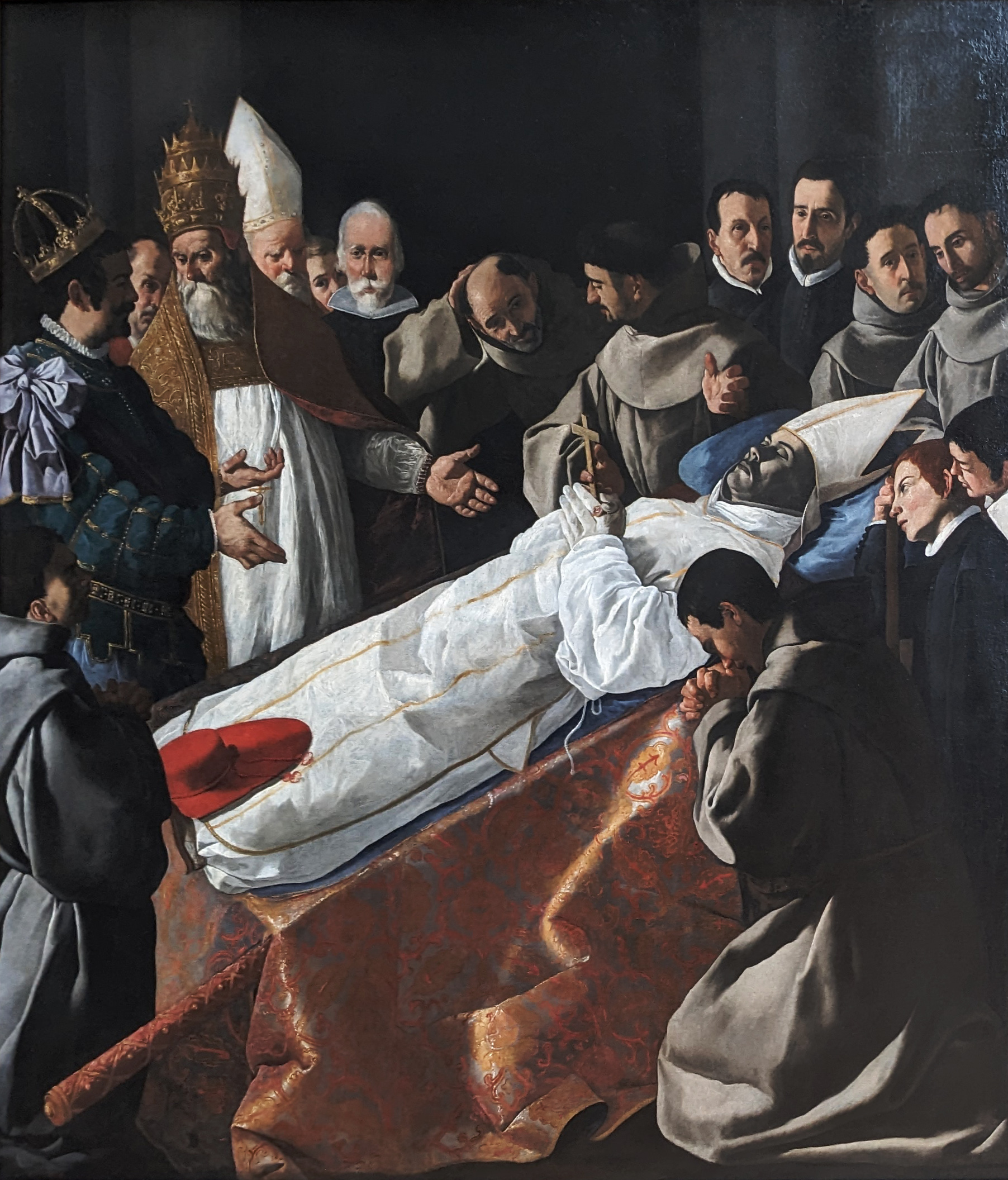
The next General Chapter, held at Paris in 1266 with Bonaventure presiding, went further. Sabatier quoted the decree from the text that Father Rinaldi had found and printed in the preface to his edition of Celano: "Item praecipit Generale capitulum per obedientiam quod omnes legendae de B. Francisco olim factae deleantur et ubi inveniri poterant extra ordinem ipsas fratres studeant amovere, cum illa legenda quae facta est per Generalem sit compilata prout ipse habuit ab ore illorum qui cum B. Francisco quasi semper fuerunt et cuncta certitudinaliter sciverint et probata ibi sint posita diligenter."16 Sabatier's translator rendered it: "Item, the Chapter-general ordains on obedience that all the legends of the Blessed Francis formerly made shall be destroyed. The Brothers who shall find any without the Order must try to make away with them since the legend made by the General is compiled from accounts of three who almost always accompanied the Blessed Francis; all that they could certainly know and all that is proven has been carefully inserted therein."16 (The Latin says "those who were almost always with Blessed Francis"; the English "three" is the translator's.) Okey summarized the same order: "the whole of the existing Lives in the friaries of the Order should be destroyed, and the friars were instructed to remove from circulation any that they might find outside."1
The decree did not succeed. Celano's two Lives survived in a small number of manuscripts and were printed again by modern editors, among them Edouard d'Alencon (Rome, 1906), whose edition the Catholic Encyclopedia called "the best critical edition of the works of Thomas of Celano"; the companions' material survived in later compilations.8 But the decree helps explain why a reader in 1300 who wanted to know Francis usually met him through Bonaventure, and why the older lives had to be recovered by later scholars. Sabatier believed the decree caused lasting loss; he wrote that one early life by Giovanni di Ceperano "disappeared, no doubt in consequence of the decision of the chapter of 1266."3 The decree also explains the suspicion with which the Spirituals regarded the official Life, and the energy with which they kept their own stories.
The Actus and the Little Flowers
The Little Flowers (Fioretti di San Francesco) are an Italian book of the 1300s made from a Latin collection, the Actus beati Francisci et sociorum eius, "The Deeds of Blessed Francis and His Companions." Paschal Robinson, writing the Catholic Encyclopedia's article in 1909, described the Fioretti as "a classic collection of popular legends about the life of St. Francis of Assisi and his early companions as they appeared to the Italian people at the beginning of the fourteenth century."17 He reported that "modern critics generally believe" that the Actus "represents an approximation to the text now lost of the original 'Floretum', of which the 'Fioretti' is a translation."17
Two parts of the book have different histories. "The first half of the collection is, no doubt, merely a new form given to traditions that go back to the early days of the order," Robinson wrote; "the other is believed to be substantially the work of a certain Fra Ugolino da Monte Giorgio of the noble family of Brunforte, who, at the time of his death in 1348, was provincial of the Friars Minor in the March."17 He was blunt about the distance: "Living as he did a century after the death of St. Francis, Ugolino was dependent on hearsay for much of his information; part of it he is said to have learned from Fra Giacomo da Massa who had been well known and esteemed by the companions of the saint, and who had lived on terms of intimacy with Fra Leone."17 Robinson dated the Latin chapters "before 1328"; Okey, writing a year later, said the Latin original was "compiled some time after 1322."171 Modern editors usually place the Actus between about 1327 and 1340, which overlaps both estimates.
The Italian translator is unknown. Robinson: "the name of the fourteenth-century Franciscan friar who translated into Italian fifty-three of the seventy-six chapters found in the 'Actus B. Francisci' and in translating immortalized them as the 'Fioretti', remains unknown."17 The five "Considerations on the Holy Stigmata," and the lives and sayings of Brother Juniper and Brother Giles, which fill nearly half of the printed book, "form no part of the original collection and were probably added by later compilers." The earliest known manuscript of the Italian, in Berlin, "is dated 1390; the work was first printed at Vicenza in 1476."17 This lesson quotes the Little Flowers in Thomas Okey's translation, Everyman's Library, first issued in September 1910 (the copy opened is the August 1912 reprint), cited by chapter.18
Okey, who loved the book, was frank about how it was made: "Many of the stories of the Fioretti are, doubtless, but memories of memories; ensamples, fused and transfigured in their fervent imaginations, which the second and third generations of Spirituali would tell as they went by the way or gathered together in their refectories."1 He noticed that the stories shift from past to present tense, which suggested to him that "we have here the realistic form in which the friars recited some of these stories in their sermons to the people," and he summed it up in a German phrase: "Dichtung and Wahrheit are inextricably interwoven," poetry and truth woven together.1 He also warned of the Spirituals' slant: "The reader of the Mirror of Perfection, and of the Little Flowers, will not fail to perceive the anti-Elian and pro-Spirituali bias of their compilers; and this impression will probably do less than justice to Elias' memory."1

Sabatier and the modern question
Sabatier's book of 1894 began with a long "Critical Study of the Sources," and it is still a useful map, even where later scholars have redrawn it. He took the companions' material as the most valuable, Celano's First Life as early but official, the Second Life as a reworking ordered because "Thomas of Celano's first legend had become impossible. The prominence there given to Elias was almost a scandal."3 He read Bonaventure as the work of the Order's "Moderates," steering between the strict party and the lax.14 And he believed that a text Brother Leo finished in 1227 lay behind the Mirror of Perfection. That last claim did not survive; the rest of his framework set the terms of the argument for a century. Howell's own introduction (1908) shows the debate already moving: he weighed Goetz against Sabatier and leaned toward Goetz on the Three Companions and the Mirror.9 For a reader, the useful result is a habit: ask of every story which of these books first tells it.
Reading the famous stories source by source
The method in this part is simple. For each famous story, find the earliest text that tells it, note how far that text stands from the event, and then watch what later texts add. A story first told by Celano two or three years after Francis died, on the word of brothers who were there, is a different kind of evidence from a story first told a hundred years later in the March of Ancona. Neither kind of source rules on whether a miracle happened. They show who said what, and when.
The sermon to the birds
Earliest text: Celano, First Life 58 (1228 to 1229). Celano placed the scene during the years when "many joined themselves to the brethren," near Bevagna in the valley of Spoleto, where "a very great number of birds of different sorts were gathered together, viz., doves, rooks and those other birds that are called in the vulgar tongue monade." Francis "left his companions in the way and ran eagerly toward the birds," greeted them, and, "not a little surprised that the birds did not fly away (as they are wont to do)," begged them to hear the word of God.19 Celano gave the sermon in a few lines:
"My brother birds, much ought ye to praise your Creator, and ever to love Him who has given you feathers for clothing, wings for flight, and all that ye had need of. God has made you noble among His creatures, for He has given you a habitation in the purity of the air, and, whereas ye neither sow nor reap, He Himself doth still protect and govern you without any care of your own."19
Then comes the detail that matters most for the historian: "On this (as he himself and the brethren who had been with him used to say) those little birds rejoicing in wondrous fashion, after their nature, began to stretch out their necks, to spread their wings, to open their beaks and to gaze on him. And then he went to and fro amidst them, touching their heads and bodies with his tunic." Afterward Francis "began to charge himself with negligence for not having preached to the birds before," and "from that day he diligently exhorted all winged creatures, all beasts, all reptiles and even creatures insensible, to praise and love the Creator."19 Celano names his informants as Francis himself and the brothers with him. In the next section (59) he adds a second bird story, the swallows at Alviano, whom Francis asked to be quiet: "My sisters, the swallows, it is now time for me to speak too, because you have been saying enough all this time."19
Bonaventure, Major Life XII.3 (1260 to 1263). Bonaventure kept Celano's words almost exactly ("My brothers the birds, much ought ye to praise your Creator, Who hath clothed you with feathers and given you wings to fly, and hath made over unto you the pure air, and careth for you without your taking thought for yourselves"), but he moved the story into a new frame.20 In his chapter on preaching, Francis first doubts whether to give himself to prayer or to preaching, sends to Brother Silvester and to Clare for counsel, and when both answer that "it was the divine will that the herald of Christ should go forth to preach," he sets out at once; the birds at Bevagna come on that journey.20 The sermon has become a sign that confirms a vocation.
The Little Flowers, chapter 16 (fourteenth century). The Fioretti keep Bonaventure's frame (Silvester and Clare), add the swallows of "a city called Saburniano," where Francis "bethought him of the third Order," and place the birds "between Cannara and Bevagna." The sermon is now three times as long and addressed to "my little sisters the birds": they are reminded that God "did preserve the seed of you in the ark of Noe," gave them "the rivers and the fountains for your drink," "the mountains and the valleys for your refuge," and they are warned, "beware, little sisters mine, of the sin of ingratitude." The book names new witnesses: "according as Friar Masseo and Friar James of Massa thereafter related." At the end the birds "divided themselves into four parts after the form of the cross St. Francis had made over them," flying east, west, south and north, which the book reads as a figure of the friars' preaching "throughout the whole world."21 James of Massa was the friar from whom, Robinson reported, Ugolino is said to have learned much of his material.17
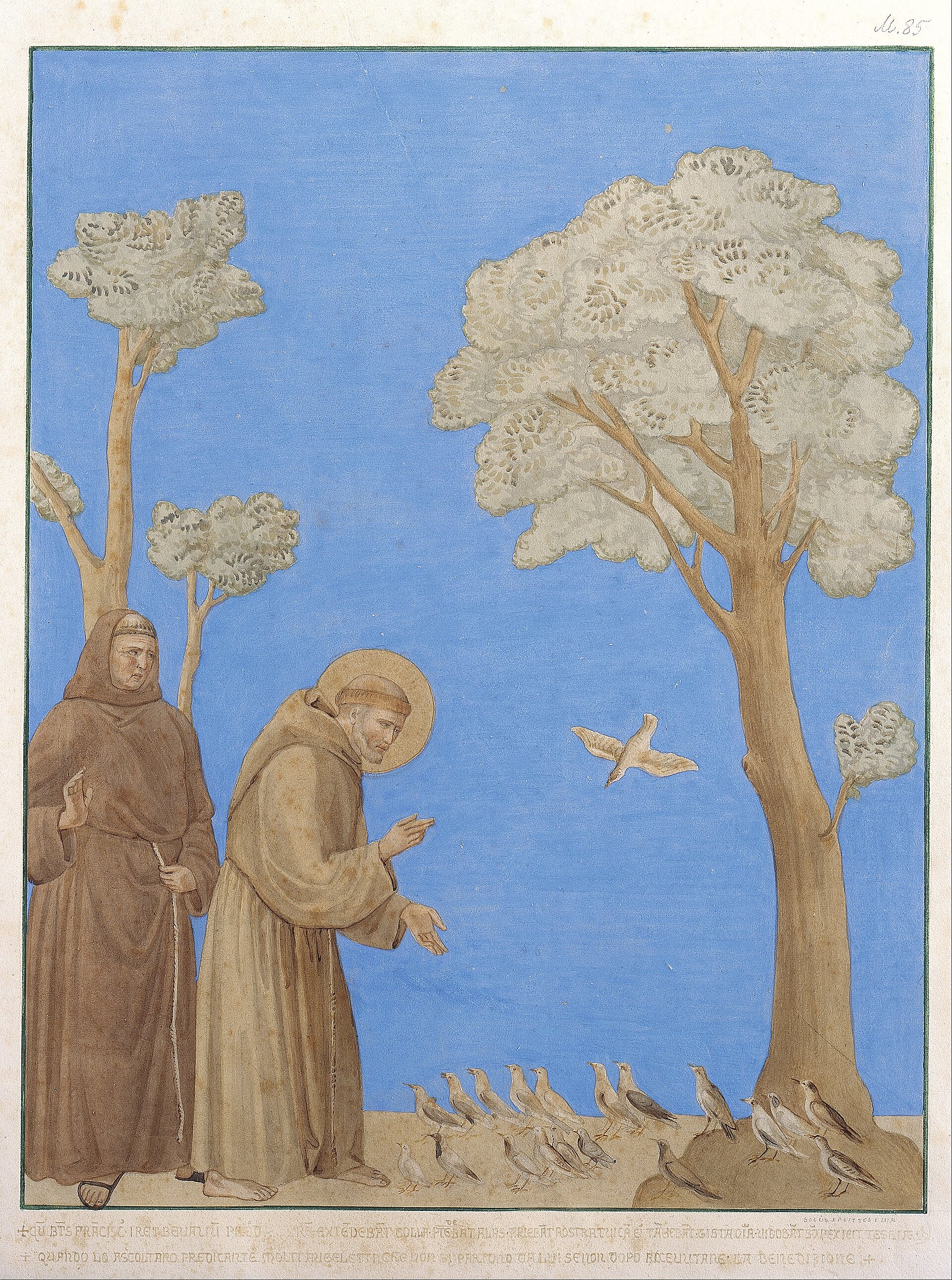

So the core of the story (a crowd of birds near Bevagna, a short sermon on God's care, the birds staying while Francis walked among them) is in the oldest life, two or three years after his death, and Celano attributes it to Francis's own telling and his companions'. What the birds did is the part a reader will weigh according to his own view of the miraculous; that Francis preached to birds and spoke of it afterward is about as well attested as anything in the lives. The frame of Silvester and Clare first appears thirty-odd years later in Bonaventure, and the long sermon, the ark of Noah, the cross-shaped departure and the named witnesses Masseo and James of Massa first appear in the fourteenth-century collection.
The wolf of Gubbio
Earliest text: the Actus and the Little Flowers, chapter 21 (about 100 years after Francis's death). No life written in the thirteenth century tells this story. In Okey's translation, "a huge wolf, terrible and fierce, appeared in the neighbourhood" of Gubbio and "not only devoured animals but men also," until "for fear of this wolf no man durst leave the city walls." Francis went out, and when the wolf "leapt towards St. Francis with gaping jaws," he made the sign of the cross and said, "Come hither, friar wolf; I command thee in the name of Christ that thou do hurt neither to me nor to any man."22 The heart of the chapter is a peace treaty, spelled out like a legal agreement:
"Friar wolf, thou workest much evil in these parts, and hast wrought grievous ill, destroying and slaying God's creatures without His leave; and not only hast thou slain and devoured the beasts of the field, but thou hast dared to destroy and slay men made in the image of God; wherefore thou art worthy of the gallows as a most wicked thief and murderer: all folk cry out and murmur against thee, and all this city is at enmity with thee. But, friar wolf, fain would I make peace with them and thee, so that thou injure them no more; and they shall forgive thee all thy past offences, and neither man nor dog shall pursue thee more."22
Francis promises the wolf "a continual sustenance from the men of this city," because "well I ween that thou hast wrought all this evil to satisfy thy hunger." The wolf "lifted up his right paw and gently laid it in the hand of St. Francis," the pledge is repeated before the whole town in the market place, and Francis stands as "a bondsman for him." In the sermon to the townspeople, the wolf becomes a lesson: "how much more to be feared were the jaws of hell, since that for fear of the mouth of a small beast such multitudes went in fear and trembling." The chapter ends: "And the said wolf lived two years in Gubbio, and was wont to enter like a tame creature into the houses from door to door," until "after two years, friar wolf died of old age."22
Earlier parallels. Bonaventure, a lifetime earlier, tells a different wolf story set not at Gubbio but at Greccio: "an herd of ravening wolves was devouring not beasts alone, but men also, and every year a hailstorm laid waste their corn and vineyards." Francis promised that the plague would leave if the people would "first make true confession, then bring forth fruits worthy of repentance," and warned that if they turned back "the plague will be renewed."23 That story is about a town's repentance, with no tame wolf and no treaty. The Gubbio chapter may be a later, sharper form of the same kind of preaching story, or a separate local tradition; no thirteenth-century text settles it.
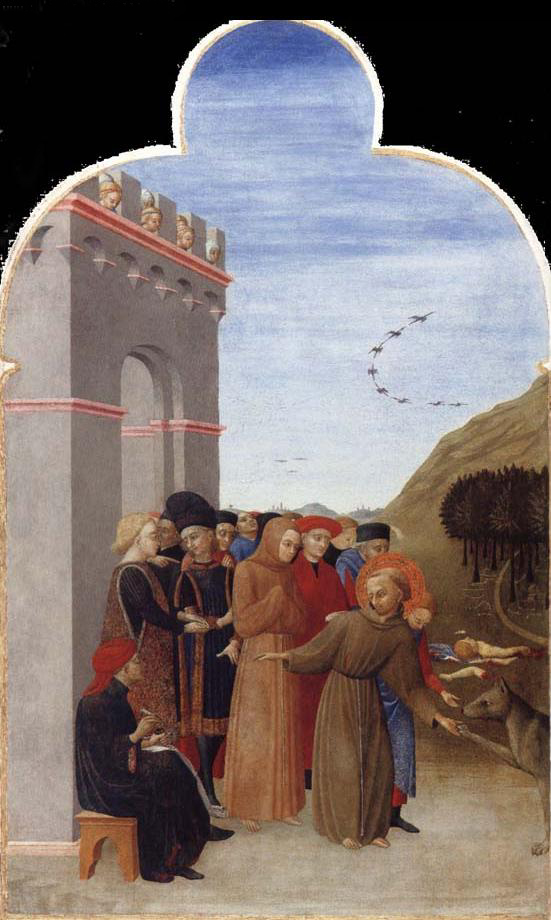

Readings. Okey, translating the chapter, offered a natural explanation without insisting on it: "The once savage brigand Fra Lupo of La Verna, or, perhaps, a cruel feudal oppressor wreaking havoc and desolation among a peaceful community, may easily have been developed into the fierce wolf of Gubbio."1 The Fioretti itself presents it as "the most holy miracle that St. Francis wrought," and many Catholic readers since have taken it in that sense. A third reading, common in modern Franciscan preaching, treats the treaty as the point: the town's violence and the wolf's hunger are both answered by a pact in which each side gives something. All three readings depend on a text written about a century after the event, and none can be checked against an earlier witness.
Perfect joy
The Dictate on True and Perfect Joy. A short Latin text survives in fourteenth-century manuscripts in which Francis dictates to Brother Leo what true joy is. It is not among the writings Robinson printed in 1906. The research of the Franciscan scholar Benvenuto Bughetti supports its attribution to Francis, and Kajetan Esser, the modern critical editor of Francis's writings, placed it among his dictated writings. The incident cannot be dated with certainty.24 In the English translation of Francis of Assisi: Early Documents (vol. 1, 1999), Francis lists what would not be true joy: if a messenger came to say "that all the Masters of Paris have entered the Order," or that prelates and kings had entered, or that his brothers had converted the unbelievers, or that he himself healed the sick and worked many miracles. After each comes the refrain, "Write: this isn't true joy!" and then: "I tell you true joy doesn't consist in any of these things."24 True joy is this: he returns to the Portiuncula on a freezing winter night, muddy and wounded by icicles, and the brother at the gate refuses to let him in and turns him away; and Francis keeps his patience and does not become upset. "If I had patience and did not become upset, true joy, as well as true virtue and the salvation of my soul" would be there.24
The Little Flowers, chapter 8. The Fioretti tell a longer and more literary version. "One winter's day, as St. Francis was going from Perugia with Friar Leo to St. Mary of the Angels, suffering sorely from the bitter cold," he calls out to Leo again and again over "two good miles." Perfect joy is not found if the friars "gave sight to the blind, made the crooked straight, cast out devils," or "raised to life those who have lain four days in the grave"; not if they "knew all tongues and all the sciences and all the Scriptures"; not if a friar "spake with the tongue of angels and knew the courses of the stars and the virtues of herbs"; not if he could "convert all the infidels to the faith of Christ."25 Then Francis tells Leo where it is:
"When we are come to St. Mary of the Angels, wet through with rain, frozen with cold, and foul with mire and tormented with hunger; and when we knock at the door, the doorkeeper cometh in a rage and saith, 'Who are ye?' and we say, 'We are two of your friars,' and he answers, 'Ye tell not true; ye are rather two knaves that go deceiving the world and stealing the alms of the poor; begone!' and he openeth not to us, and maketh us stay outside hungry and cold all night in the rain and snow; then if we endure patiently such cruelty, such abuse, and such insolent dismissal without complaint or murmuring, and believe humbly and charitably that that doorkeeper truly knows us, and that God maketh him to rail against us; O Friar Leo, write, there is perfect joy."25
The Fioretti go on to a second knock, a blow on the cheek, and a third knock answered with "a big knotted stick," and end with a conclusion built on Paul: "Above all the grace and the gifts of the Holy Spirit that Christ giveth to His beloved is that of overcoming self, and for love of Him willingly to bear pain and bufferings and revilings and discomfort," because in God's other gifts, the text says, we may not glory, "seeing they are not ours, but of God," while "in the cross of tribulation and of affliction we may glory, because this is ours." The chapter closes with Galatians 6:14: "I will not glory save in the cross of our Lord Jesus Christ."25
Comparing them. The two texts agree on the scene (a winter night, the Portiuncula, a brother at the gate who refuses his own founder) and on the teaching (joy lies in patient suffering, not in success). They differ in what counts as success. The Dictate speaks of things that were real temptations for the Order in Francis's lifetime and just after: the Masters of Paris joining the friars, prelates and kings entering, mass conversions. The Fioretti replace these with the miracles of the Gospels and the learning of the schools, and add the beating and the Pauline conclusion. The Dictate is shorter, plainer, and closer to Francis's own way of writing in the Admonitions; the Fioretti chapter reads like the same memory reworked for preaching.
The Christmas manger at Greccio
Earliest text: Celano, First Life 84 to 86 (1228 to 1229). Celano dated the event "in the third year before the day of his glorious decease," that is, Christmas 1223, and set it at "the fortress called Greccio."26 He began with Francis's purpose. "His chief intention, his principal desire and supreme purpose was in and through all things to observe the holy Gospel," and "chiefly did the humility of the Incarnation and the charity of the Passion so occupy his memory that he would scarce ponder over anything else."26 About fifteen days before Christmas Francis sent for a man of Greccio named John and told him what to prepare:
"If thou wilt that we celebrate the present festival of the Lord at Greccio, make haste to go before and diligently prepare what I tell thee. For I would make memorial of that Child who was born in Bethlehem, and in some sort behold with bodily eyes His infant hardships; how He lay in a manger on the hay, with the ox and the ass standing by."26
Celano described the night: "The manger had been made ready, the hay was brought, the ox and the ass were led in. There Simplicity was honoured, Poverty exalted, Humility commended; and of Greccio there was made as it were a new Bethlehem." "The solemnities of Mass were celebrated over the manger." Francis, who "was a Levite," that is, a deacon, "chanted the holy Gospel" and preached "concerning the birth of the poor King and the little town of Bethlehem," saying the word "Bethlehem" "in the manner of a sheep bleating."26 Then: "a vision of wondrous efficacy was seen by a certain man; for in the manger he saw a little child lying lifeless, to whom the Saint of God seemed to draw near and (as it were) to rouse the child from the lethargy of sleep." Celano at once explained it as a parable: "the child Jesus had been given over to forgetfulness in the hearts of many in whom, by the working of His Grace, He was raised up again through His servant Francis." He added that hay from the manger later healed animals and helped women in labor, and that an altar and church were built over the place.26
Bonaventure, Major Life X.7. Bonaventure added two things. First, permission: "That this might not seem an innovation, he sought and obtained licence from the Supreme Pontiff, and then made ready a manger, and bade hay, together with an ox and an ass, be brought unto the spot." Second, he named the man who saw the vision: "A certain knight, valorous and true, Messer John of Greccio, who for the love of Christ had left the secular army," declared "that he beheld a little Child right fair to see sleeping in that manger, Who seemed to be awakened from sleep when the blessed Father Francis embraced Him in both arms." He argued for the vision's credibility from "the holiness of him that beheld it" and "the miracles that followed it."27
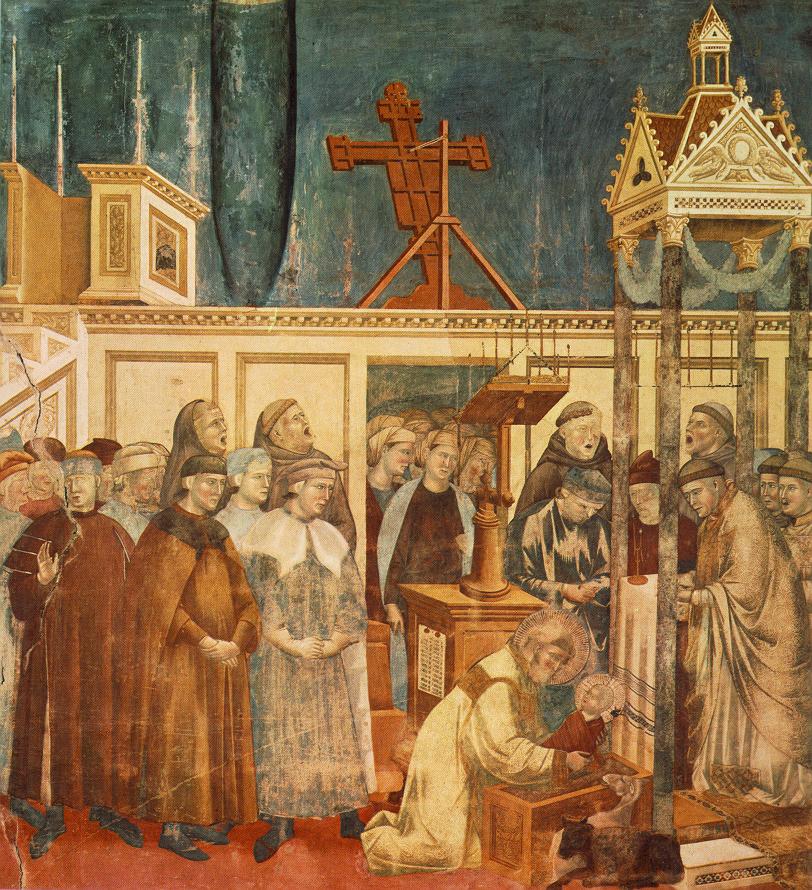

What the earliest account contains and what it does not. Celano's Greccio has a manger with hay, a live ox and ass, crowds with torches, a Mass celebrated over the manger, a sermon, and a vision seen by one man. It has no statues or painted figures, no one playing Mary or Joseph, and no infant laid in the manger except in the vision. It is a Christmas Mass with a manger as its altar setting. The claim that Francis "made the first nativity scene" is therefore partly right: Greccio is the most famous early staging of the Bethlehem scene and did much to make Christmas cribs popular, but it was not a set of figures, and Celano presents it as a way of keeping the feast, not as a new invention. Bonaventure's line that Francis asked papal permission "that this might not seem an innovation" shows that by the 1260s the friars felt a need to defend it. (Lesson 12 places Greccio in the last years of Francis's life.)

The stigmata at La Verna
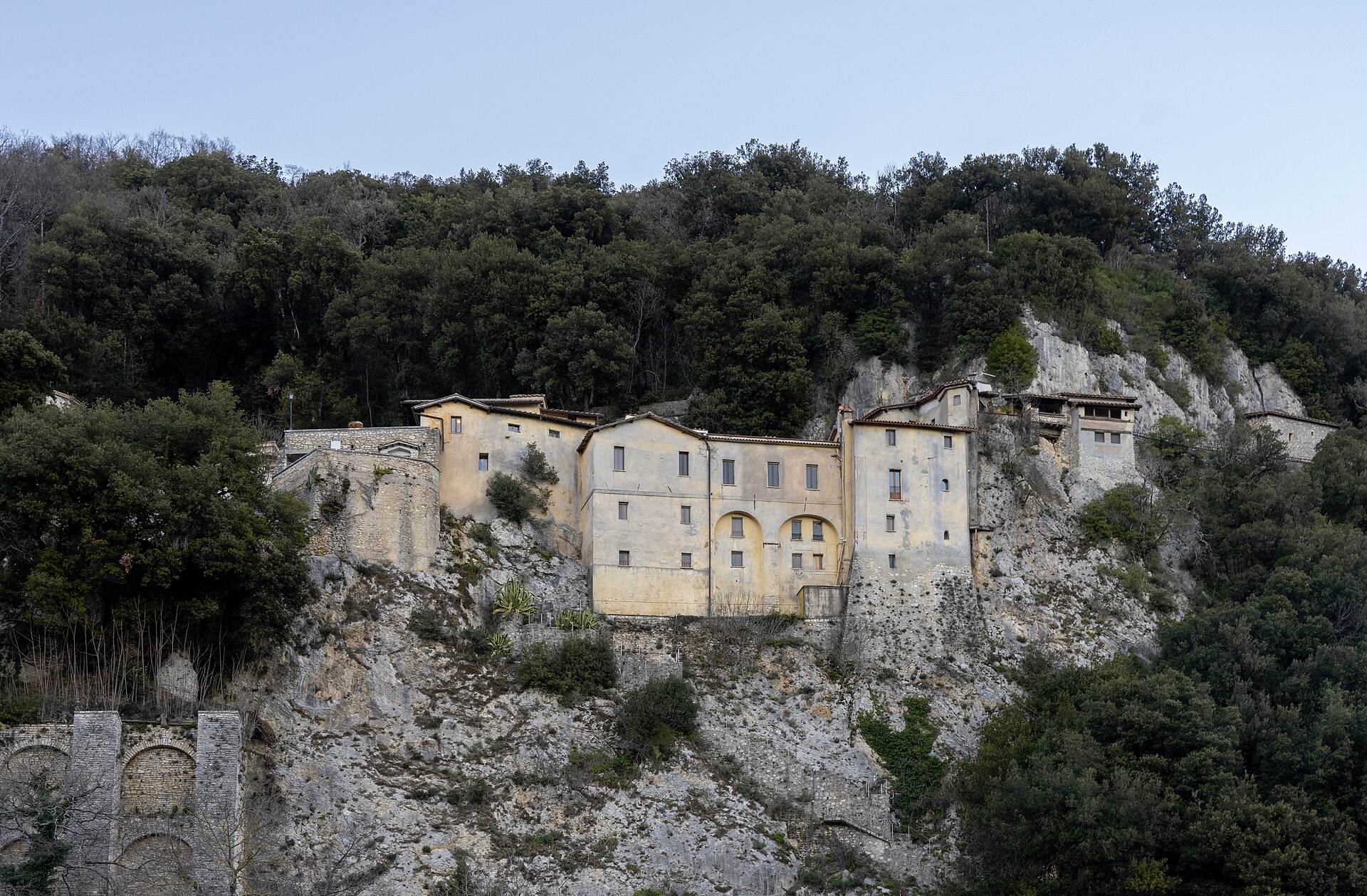
The stigmata have the closest witnesses of any of the famous stories, and the accounts also change most visibly over time. They can be read in five layers.
1. Leo's note on the chartula (written after September 1224). Leo's red note, quoted above, says that at La Verna, in a Lent kept from the Assumption (August 15) to St. Michael's day (September 29), "after the vision and speech of the Seraph and the impression of the Stigmata of Christ in his body," Francis wrote the Praises of God on the sheet.5 The note is undated, but it is in the hand of the companion who was with Francis on the mountain, on a sheet Francis wrote. It names the vision, the seraph, the speech and the wounds, and gives no further details.
2. Elias's letter (October 1226). Announcing the death, Elias reported, as Cunningham summarized him, that "those who were with Francis at his death inspected the wounds," and he called them stigmata, "unheard of in our time."6 This is the first public announcement, made by the head of the Order within days of the death.
3. Celano, First Life 94 to 95 (1228 to 1229). Celano gave the first full narrative. "While he dwelt in the hermitage which, from the place in which it is situate, is called Alverna, two years before he gave back his soul to Heaven, he saw in a vision of God a man like a seraph having six wings, standing over him with hands outstretched and feet joined together, fixed to a cross. Two wings were raised above his head, two were spread out for flight, and two veiled the whole body."28 Francis was glad at the seraph's "benign and gracious look" but afraid at "the crucifixion, and the bitterness of the seraph's suffering," and while he puzzled over it, "marks of nails began to appear in his hands and feet, such as he had seen a little while before in the Man crucified who had stood over him."28 Celano's description of the wounds is physical and exact:
"His hands and feet seemed pierced in the midst by nails, the heads of the nails appearing in the inner part of the hands and in the upper part of the feet, and their points over against them. Now those marks were round in the inner side of the hands and elongated on the outer side, and certain small pieces of flesh were seen like the ends of nails bent and driven back, projecting from the rest of the flesh. So also the marks of nails were imprinted in his feet, and raised above the rest of the flesh."28
Of the side Celano wrote that "his right side, as it had been pierced by a lance, was overlaid with a scar, and often shed forth blood, so that his tunic and drawers were many times sprinkled with the sacred blood."28
Celano then names two witnesses who saw or touched the side wound during Francis's life: "happy was Elias who was found worthy to see it somehow while the Saint was living; and not less happy Rufino who touched it with his own hands." He adds that Francis "concealed the stigmata most diligently from strangers," so that "even the brethren at his side and his most devoted followers were for a long time unaware of them."28 Celano does not give a day, and he describes the figure as "a man like a seraph," not as Christ.
4. Bonaventure, Major Life XIII.3 (1260 to 1263). Bonaventure dated the vision "on a certain morning about the Feast of the Exaltation of Holy Cross," that is, about September 14, 1224, and changed its theology. The seraph comes "flaming and resplendent, coming down from the heights of heaven," and "there appeared betwixt the wings the Figure of a Man crucified." Francis "rejoiced at the gracious aspect wherewith he saw Christ, under the guise of the Seraph, regard him."29 Bonaventure also explained the vision's meaning: Francis "was to be wholly transformed into the likeness of Christ Crucified, not by martyrdom of body, but by enkindling of heart."29 The figure Celano called a man like a seraph is now Christ in the form of a seraph.
5. The Considerations on the Holy Stigmata (fourteenth century, printed with the Fioretti). The Third Consideration keeps Bonaventure's date ("the feast of the Most Holy Cross in the month of September drawing nigh") and his explanation, then adds wonders. "The whole mount of La Verna seemed to flame forth with dazzling splendour"; shepherds "saw the mountain aflame"; "certain muleteers that were going to Romagna, arose up at the brightness of this light which shone through the windows of the inns of that country, and thinking the sun had risen, saddled and loaded their beasts."30 It also gives words that, it says, Christ spoke to Francis in the vision and Francis revealed only after his death: "I have given thee the stigmas that are the marks of my Passion, in order that thou be My standard-bearer."30 Sabatier listed the travelers at the inns, from this Consideration, among the many later embellishments, and complained that some critics judged the stigmata only through Bonaventure's "deplorable arguments"; had they "read simply Thomas of Celano's first Life," he thought, they "would have arrived at very different conclusions."3
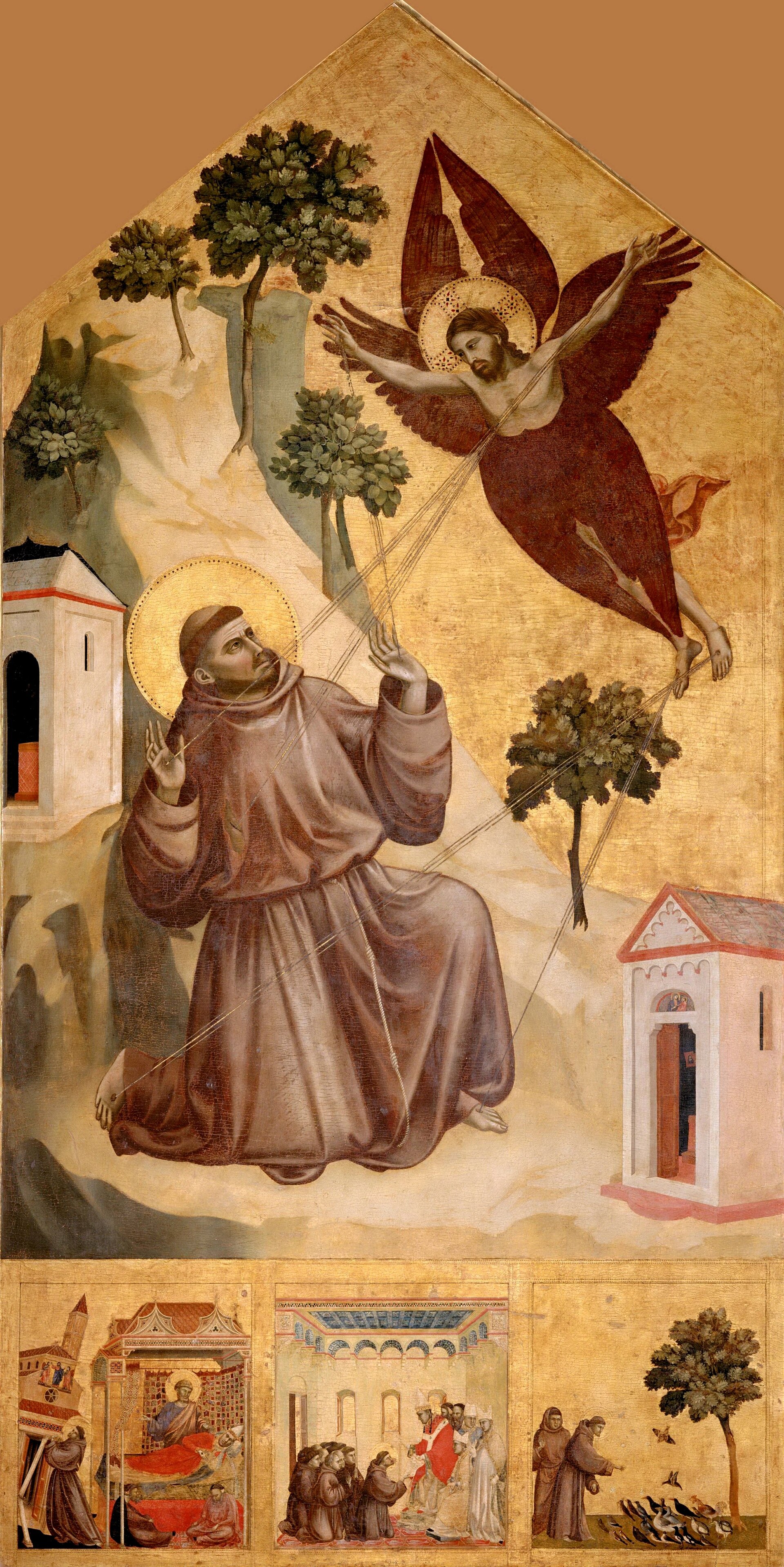

What historians make of it. The stigmata are not a late legend. They are reported by Leo, by Elias within days of the death, and by Celano within three years, and Celano names men who saw and touched the wounds. Cunningham judged that "Francis had the stigmata: that seems defensible given the historical evidence," and noted that "Francis was the first to claim to have received such 'stigmata.'"6 He also recorded that "in his own day, there were doubters," and that the papal document of canonization of 1228 "makes no mention of it."6 On how to explain them, the sources part company with modern readers. Cunningham reported that "Scholars of the stigmata, even Catholic believers like the late Herbert Thurston, S.J., almost unanimously agree that such phenomena are best explained as bodily reactions to intense ecstatic and psychological experiences."6 Many Catholic readers hold them to be a supernatural gift, as Bonaventure did; some skeptical writers have suggested self-infliction, which none of the early sources hints at. This lesson rates the report, not the cause: the wounds are as well attested as anything in the record of Francis's last two years.

The Sultan, from Celano to the Little Flowers
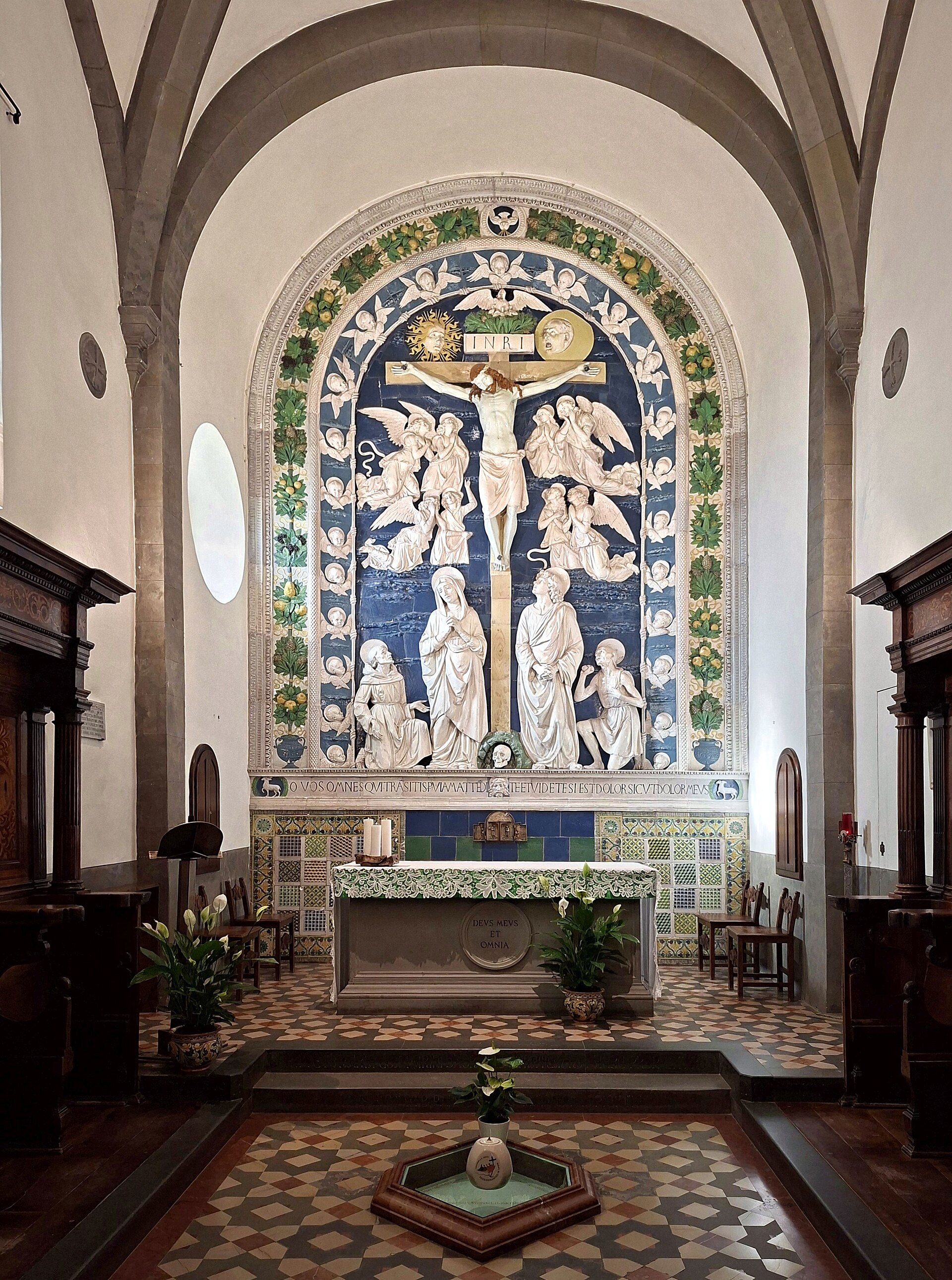
Lesson 12 reads the earliest account of Francis's crossing to the camp of Sultan al-Kamil at Damietta in 1219, the letter Jacques de Vitry wrote in 1220, and Celano's and Bonaventure's versions. Here the point is how the story grew. Celano (First Life 57) has Francis seized, "insulted and beaten," then "most honourably received by the Soldan," who offered gifts, "was deeply stirred by his words and heard him very willingly." Celano ends with a plain admission: "But in all this the Lord did not fulfil S. Francis' desire," which was martyrdom.31 Nobody in Celano is converted.
The Little Flowers, chapter 24, a century later, has the heading "How St. Francis converted the Soldan of Babylon to the true faith." Francis comes with "twelve of his holiest companions," preaches so that "for his faith's sake he even would have entered the fire," and is given leave to preach anywhere. The sultan says, "Friar Francis, fain would I convert me to the faith of Christ, but I fear to do so now, for if this people heard thereof they would surely slay thee and me and all thy companions." Francis promises to send two friars after his own death; years later, when the sultan falls sick, two friars arrive, "and when he had received instruction from those friars in the faith of Christ and holy baptism, he, being born again in Christ, died of that sickness."32 The same chapter adds a temptation scene at an inn that has no earlier witness. The thirteenth-century sources say the sultan listened and sent Francis back safely; the deathbed baptism appears first in this fourteenth-century collection. The historian John Tolan, whose translation of Jacques de Vitry is used in lesson 12, traced how the meeting was retold over the centuries in Saint Francis and the Sultan: The Curious History of a Christian-Muslim Encounter (2009).
The Peace Prayer
The prayer that begins "Lord, make me an instrument of your peace" is the best-known text credited to Francis, and it is not his. Christian Renoux of the University of Orleans, who traced its history, found that it first appeared "in 1912 in a small spiritual magazine called" La Clochette, the bulletin of the Ligue de la Sainte-Messe founded by Father Esther Bouquerel (1855 to 1923), in issue no. 12, December 1912, page 285, under the title "Belle prière à faire pendant la messe" ("A beautiful prayer to say during the Mass"). It "was published anonymously," and "the identity of the author remains a mystery."33 According to Renoux, "The prayer was sent in French to Pope Benedict XV in 1915 by the French Marquis Stanislas de La Rochethulon," it appeared in Italian in L'Osservatore Romano in 1916, and "Around 1920, the prayer was printed by a French Franciscan priest on the back of an image of St. Francis," titled "Prière pour la paix," "without being attributed to the saint." It was first attributed to Francis "in 1927 by a French Protestant Movement," Les Chevaliers du Prince de la Paix, and "The first translation in English that we know of appeared in 1936 in Living Courageously," by Kirby Page, who "clearly attributed the text to St. Francis of Assisi."33 No medieval manuscript contains it, and it is in none of the writings Robinson collected or any of the lives read in this lesson. Its spirit is often called Franciscan, and many Franciscans pray it gladly; its author is unknown and wrote about seven centuries after Francis.
"Preach the Gospel at all times; if necessary use words"
This saying appears on posters, in sermons and in books on evangelism, always credited to Francis. It is not in his writings or in the early lives. Glenn Stanton, checking it for The Gospel Coalition in 2012, wrote, "It doesn't show up in any of his writings," and "None of his disciples, early or later biographers have these words coming from his mouth."34 No one has shown who first said it. The nearest genuine text is in the Rule of 1221, chapter 17, "Of Preachers," in Robinson's translation: "Let none of the brothers preach contrary to the form and institution of the holy Roman Church, and unless this has been conceded to him by his minister. ... Nevertheless, let all the brothers preach by their works."35 (Stanton cites the same passage, numbering the chapter differently.) The approved Rule of 1223, chapter 9, adds that the brothers' words should be "fire-tried and pure," announcing "vices and virtues, punishment and glory, with brevity of speech."36 Celano's Francis preached constantly, in towns and to birds. The genuine teaching is that a friar's life should preach as well as his words; the popular saying turns that into permission to do without words, which neither Rule says.
Francis, animals and nature in the sources
Francis's love of creatures is not a modern addition. Celano's First Life (80 to 81), written within three years of his death, says that "he called all creatures by the name of brother," that "when he came upon a great quantity of flowers he would preach to them and invite them to praise the Lord, just as if they had been gifted with reason," and that "cornfields and vineyards, stones, woods, and all the beauties of the field, fountains of waters, all the verdure of gardens, earth and fire, air and wind would he with sincerest purity exhort to the love and willing service of God."37 Celano gives the reason in theological terms: in the beauty of flowers Francis "turned forthwith the eye of consideration to the beauty of that Flower which, brightly coming forth in springtime from the root of Jesse," that is, Christ.37 The creatures matter because they point to the Creator.
Bonaventure's chapter on Francis's love for the creatures (Major Life VIII) gathers many animal stories: a lamb he gave to the Roman lady Jacoba di Settesoli, a leveret at Greccio that kept jumping back into his lap, a waterfowl and a fish on the lake of Rieti, birds in the Venetian marshes that fell silent at his request while the friars said the Hours, and a cicada at the Portiuncula: "Sing, my sister cicada, and praise the Lord thy Creator with thy glad lay."38 The companions' material in the Mirror of Perfection adds his special love for the crested lark ("Sister lark hath a hood like the Religious") and his wish that the Emperor make a law for Christmas Day: "that none snare nor kill our Sisters the larks," that the lords of towns have grain thrown on the roads for the birds, and that "whosoever hath an ox and an ass be bound on that night to provide them provender the best that may be."13 The Mirror also reports that larks circled singing over the house on the evening before he died.13
The Canticle of Brother Sun (read in full in lesson 12) is Francis's own statement of the same faith. On November 29, 1979, Pope John Paul II, in the apostolic letter Inter Sanctos, proclaimed Francis the heavenly patron of those who promote ecology ("Sanctum Franciscum Assisiensem oecologiae cultorum Patronum caelestem renuntiamus"), citing the Canticle.39 The modern picture of Francis as a nature lover is built on real early texts. What the early texts add, and the modern picture sometimes drops, is that every one of these scenes ends in praise of God and a call to repentance, as the wolf's sermon in the Little Flowers ends.
What the record shows and what it does not
- Documented fact: Celano wrote the First Life between July 1228 and February 1229 at the order of Gregory IX, and the Second Life between 1244 and 1247 for the minister general Crescentius.9 Bonaventure was commissioned at Narbonne in 1260 and his Life was approved at Pisa in 1263; the chapter at Paris in 1266 ordered the older lives destroyed.16 The earliest dated manuscript of the Italian Fioretti is of 1390, and the book was first printed at Vicenza in 1476.17
- Francis's own words and his companion's hand: the chartula with the Praises and the blessing, and Leo's note naming the seraph and the stigmata;5 the Rule of 1221, chapter 17, "let all the brothers preach by their works."35 The Dictate on True and Perfect Joy is accepted by Esser as dictated by Francis but survives only in fourteenth-century copies.24
- What the earliest lives report: the sermon to the birds near Bevagna, on the word of Francis and his companions; the Christmas at Greccio in 1223 with a manger, hay, an ox and an ass and Mass over the manger; the vision of a crucified seraph and wounds in hands, feet and side, seen by Elias and touched by Rufino; a meeting with the sultan in which no one was converted.19262831
- Later additions: the papal licence for Greccio and the naming of John as the seer, and the seraph as Christ himself (Bonaventure, 1260s);2729 the wolf of Gubbio, the sultan's deathbed baptism, the long sermon to the birds and the muleteers at the inns (Actus, Fioretti and the Considerations, fourteenth century).223230
- Modern inventions: the Peace Prayer (first printed 1912, attributed to Francis from 1927) and "if necessary use words" (no medieval source).3334
- Scholarly reading: since Sabatier (1894), scholars sort the sources by date, author and party; they disagree on how much of the companions' collections goes back to 1246 and on how far Bonaventure reshaped Francis.39
- Open questions: the exact relation of the Legend of the Three Companions, the Assisi Compilation and the Mirror of Perfection to the companions' writings of 1246; the date of the Actus within the decades after 1322; how the stigmata are to be explained.
Claims checked
Each claim below appears in popular books, sermons, films or websites. The rating judges the claim as stated against the earliest evidence, not whether any miracle occurred.
| Claim | Rating | Evidence |
|---|---|---|
| "Francis wrote the Peace Prayer (Lord, make me an instrument of your peace)." | Refuted | First printed anonymously in La Clochette, December 1912; first attributed to Francis in 1927; in no medieval manuscript, none of his writings and none of the early lives.33 |
| "Francis said, Preach the Gospel at all times; if necessary use words." | Unsupported | Not in his writings or any early biography; the nearest text is the Rule of 1221, chapter 17, "let all the brothers preach by their works," which assumes preaching with words as well.3435 |
| "Francis preached to the birds." | Supported (as a report) | Celano, First Life 58, written 1228 to 1229, citing Francis himself and the brothers with him. The longer sermon and the cross-shaped flight are fourteenth-century additions.1921 |
| "Francis tamed the wolf of Gubbio." | Unresolved | The story first appears in the Actus and the Fioretti, chapter 21, about a century after his death; no thirteenth-century source mentions it. Bonaventure has a different story of wolves at Greccio ended by the people's repentance. Okey suggested a human "wolf" behind the tale.22231 |
| "Francis made the first nativity scene at Greccio." | Partly supported | Celano records a manger, hay, a live ox and ass and a Mass over the manger at Christmas 1223. There were no figures of Mary, Joseph or the Child; the Child appears only in one man's vision. Greccio did much to popularize the crib, but "first" and "nativity scene" in the modern sense go beyond the source.26 |
| "Francis received the stigmata on September 14, 1224." | Partly supported | The wounds are reported by Leo, by Elias in 1226 and by Celano in 1228 to 1229, who gives no day. The date about the Feast of the Holy Cross comes from Bonaventure in the 1260s; Leo's note places the vision within the Lent of August 15 to September 29, 1224.52829 |
| "Francis was the first person known to bear the stigmata." | Supported | Cunningham: "Francis was the first to claim to have received such 'stigmata.'" No earlier case is reported in the sources read here.6 |
| "Francis converted the Sultan." | Refuted | Jacques de Vitry (1220) and Celano (1228 to 1229) report that the sultan listened and sent him back; Celano says "the Lord did not fulfil S. Francis' desire." The conversion and baptism first appear in the Fioretti, chapter 24.3132 |
| "Perfect joy is a genuine teaching of Francis." | Partly supported | The Dictate on True and Perfect Joy is accepted as dictated by Francis by Esser and Bughetti, though it survives only in fourteenth-century manuscripts; the familiar Fioretti chapter 8 is a later, expanded version.2425 |
| "Bonaventure had all the earlier lives burned." | Partly supported | The Paris chapter of 1266, under his presidency, ordered all older legends "destroyed" (deleantur) and removed from outside the Order. Burning is not stated, and the order failed: Celano's lives survived.168 |
| "The Mirror of Perfection is the oldest life, finished by Brother Leo in 1227." | Refuted (as to the date) | Sabatier's dating, printed on Evans's 1899 title page, rested on reading the manuscript's 1228 in the Pisan style. Okey (after Boehmer) and Howell date the compilation about 1318, while granting it contains older material from Leo.219 |
| "The Little Flowers were written by Francis's companions." | Unsupported | The Latin Actus was compiled about a century after his death; its later chapters are credited to Ugolino of Montegiorgio, who died in 1348 and "was dependent on hearsay," partly through James of Massa. The Italian translator is unknown.17 |
| "Francis was a nature lover in the modern sense." | Partly supported | Celano reports that "he called all creatures by the name of brother" and preached to flowers and fields, and in 1979 John Paul II named him patron of ecology. In every early account, the creatures are called to praise God; the theology is the point of the stories.3739 |
Hard questions and answers
If the lives were written to make a saint, can any of them be trusted?
A skeptic's question, and a fair one. Every life had a purpose: Celano's First Life supported a canonization the pope had just proclaimed, Bonaventure's Life was meant to end the Order's quarrels, and the Spirituals' collections argued their side. But purpose does not cancel evidence. Celano wrote within three years, named his informants, admitted when he had not been present ("as we have been able to learn rightly," Howell translated), and recorded failures, such as the sultan's refusal to convert.931 Where several independent kinds of witness agree (Leo's note, Elias's letter and Celano on the stigmata; Celano and Jacques de Vitry on the sultan), the historian has good ground. Where a story first appears a century later in one partisan collection, the historian has a story about how Francis was remembered, which is also history.
Why should a Protestant reader care about these legends at all?
Several reasons come from the texts themselves. Francis's genuine writings and the earliest life are full of Scripture, and Celano says Francis wished "in and through all things to observe the holy Gospel."26 Protestant writers have admired that, and Okey called Sabatier's book of 1894 "the starting-point of the neo-Franciscan movement."1 The Franciscan question is also a lesson in source criticism that applies to any tradition, including the lives of Reformers, which also grew legends. And the two most quoted "Francis" sayings in modern Protestant preaching, the Peace Prayer and "if necessary use words," are exactly the ones the evidence rejects.3334
Does the Catholic Church require belief in the wolf of Gubbio or the stigmata?
No source opened for this lesson makes either a matter of faith. Gregory IX canonized Francis in 1228 in a document that, Cunningham noted, "makes no mention" of the stigmata.6 The Catholic Encyclopedia's own article on the Fioretti (1909) called them "popular legends" and said Ugolino depended "on hearsay."17 Catholic readers are free to weigh these stories as the historian does, and many Franciscan scholars have led the work of sorting them.
Was Bonaventure's decree of 1266 a cover-up?
The decree itself gives its reason: the new Life was "compiled from accounts" of those "who almost always accompanied the Blessed Francis," and "all that is proven has been carefully inserted therein."16 To the chapter, one approved Life meant one story for a divided Order and fewer arguments drawn from competing texts. To Sabatier, it meant "disastrous results for the primitive Franciscan documents."16 Both are true in part. The decree did not remove the facts most damaging to anyone (the companions' complaints survived in other collections), but it did make Bonaventure's Francis the standard one for centuries. Readers of any party can judge it by asking what Bonaventure left out; the answer, from Celano's Second Life and the Mirror, is mostly the sharpest sayings on poverty and buildings and the criticism of the Order's leaders.
If the Peace Prayer is not by Francis, should it still be prayed?
That is a question for each reader's church, not for the historian. The historical point is narrower: it should not be printed as Francis's words. Renoux showed that a French Franciscan printed it on the back of an image of the saint around 1920 "without being attributed to the saint," and that the attribution came later, in 1927.33 An honest heading would be "a prayer in the spirit of St. Francis, author unknown, 1912." Readers who want Francis's own words of peace can pray the blessing he wrote for Leo, the greeting "The Lord give thee peace" that he says in his Testament the Lord revealed to him, or the Canticle (lesson 12).40
What is the best way to read the Little Flowers today?
As Okey suggested, as "memories of memories," told by friars of the second and third generation, with poetry and truth woven together.1 Read it beside Celano: when a Fioretti chapter has an older parallel (the birds, perfect joy, the sultan, the stigmata), compare the two and notice what was added; when it has none (the wolf of Gubbio, much of the March of Ancona material), read it as the fourteenth century's picture of Francis. Lesson 14 of this module gives a reading plan. The book's value does not depend on every story being factual, and its readers have long known that. Robinson's verdict of 1909 still holds: the legends "bear precious witness to the vitality and enthusiasm with which the memory of the life and teaching of the Poverello was preserved."17
Related lessons: 12 Francis of Assisi: His Life, the Rule and the Canticle; 14 Review and Reading Guide; 10 Catherine of Siena, whose life by her confessor raises the same questions of witness and legend; Church History, Part A, lesson 07 on monasticism; and Martyrs Briefs, lesson 04, Constantine to the Middle Ages.
Learn more
- Celano's Lives in Howell's translation (1908): The oldest lives, with Howell's clear introduction to the Franciscan question as it stood in 1908.
- The Little Flowers, Bonaventure's Life and the Mirror of Perfection (Everyman, 1910): All three later sources in one volume, with Okey's frank introduction on how the Fioretti grew.
- Sabatier, Life of St. Francis of Assisi (Gutenberg): The book that started the modern debate; read the "Critical Study of the Sources" at the end.
- Christian Renoux on the Peace Prayer: The documented history of the prayer from 1912.
- Robinson, The Writings of Saint Francis of Assisi (1906): Francis's own words, to set beside the legends.
Still being checked (8 items)
These points could not be confirmed against a primary source when this lesson was written and fact checked in October 2026. The text above states each one as uncertain.
- The text of Brother Elias's circular letter of 1226 was not opened; it is reported from Lawrence S. Cunningham's 1994 summary, and the modern debate over its authenticity is mentioned without the studies themselves having been read.
- The dating of the Actus to about 1327 to 1340 is the usual modern estimate; the sources opened give "before 1328" (Robinson, 1909) and "some time after 1322" (Okey, 1910).
- The description of the Assisi Compilation (a manuscript now at Perugia, once called the Legenda antiqua) and the claim that many scholars think it preserves the companions' 1246 texts in an older form than the Mirror were not checked against Brooke's edition, which is in copyright and was seen only as a catalog record.
- The descriptions of the contents of Moorman (1940), Thompson (2012) and Vauchez (2012) rest on the books' titles and general knowledge; only their bibliographic records were opened.
- The Dictate on True and Perfect Joy is quoted in short phrases from the Early Documents translation as printed by Pace e Bene; the Latin text and the manuscripts were not opened.
- John Tolan's Saint Francis and the Sultan (2009) is named but was not opened for this lesson.
- Bonaventure chapter-section numbers (VIII.7 to 11, X.7, XII.3, XIII.3) follow the section numbers printed in the Everyman text; the chapter numbers for VIII were inferred from the sequence of sections.
- The date of Christian Renoux's online article is not shown on the page opened.
Notes
- Thomas Okey, Introduction, in The "Little Flowers," Life and "Mirror" of St. Francis, Everyman's Library (London: J. M. Dent and Sons; New York: E. P. Dutton; first issued September 1910, reprinted August 1912), pp. vii to xxi, archive.org copy (retrieved Nov. 5, 2026). Read it online. ↩
- The Mirror of Perfection, Being the Oldest Life of the Blessed Francis of Assisi by His Beloved Disciple Brother Leo, trans. Sebastian Evans from the Latin text published by Paul Sabatier (Boston: L. C. Page, 1899): title page, Preface p. ix ('finished on May 11, 1227'), the closing colophon p. 224, the death notice dated 1227, and the printer's note on 'the Pisan style,' archive.org copy (retrieved Nov. 5, 2026). Read it online. ↩
- Paul Sabatier, Life of St. Francis of Assisi, trans. Louise Seymour Houghton (first English edition New York: Scribner, 1894; the text opened is the London: Hodder and Stoughton printing of 1919, Project Gutenberg ebook 18787), "A Critical Study of the Sources," sections on the Legend of the Three Companions, the Second Life and the Life by Brother Julian, with the notes to the chapter on the stigmata (retrieved Nov. 5, 2026). Read it online. ↩
- John R. H. Moorman, The Sources for the Life of S. Francis of Assisi (Manchester: Manchester University Press, 1940); Rosalind B. Brooke, ed. and trans., Scripta Leonis, Rufini et Angeli Sociorum S. Francisci (Oxford: Clarendon Press, 1970); Augustine Thompson, Francis of Assisi: A New Biography (Ithaca: Cornell University Press, 2012); Andre Vauchez, Francis of Assisi: The Life and Afterlife of a Medieval Saint (New Haven: Yale University Press, 2012; French edition 2009). Bibliographic records checked at archive.org (retrieved Nov. 5, 2026); the books themselves are in copyright and are described, not quoted. Read it online. ↩
- Paschal Robinson, trans., The Writings of Saint Francis of Assisi (Philadelphia: Dolphin Press, 1906), "The Praises of God and the Blessing of Brother Leo," introduction and notes, pp. 145 to 148 (Leo's three notes on the chartula; the 'large and mysterious thau'), archive.org copy (retrieved Nov. 5, 2026). Read it online. ↩
- Lawrence S. Cunningham, "The Strange Stigmata," Christian History, Issue 42 (1994), Christian History Institute (retrieved Nov. 5, 2026). Read it online. ↩
- Galatians 6:17 and 6:14, King James Version (public domain), Bible Gateway (retrieved Nov. 5, 2026). Read it online. ↩
- Ferdinand Heckmann, "Thomas of Celano," The Catholic Encyclopedia, vol. 14 (New York: Robert Appleton, 1912), New Advent (retrieved Nov. 5, 2026). Read it online. ↩
- A. G. Ferrers Howell, Introduction, in Thomas of Celano, The Lives of S. Francis of Assisi, trans. A. G. Ferrers Howell (London: Methuen, 1908), pp. vii to xiii (dates of the First and Second Lives, Celano's absence from Italy and the phrase prout potuimus recte scire, Goetz on the Three Companions and the Mirror of Perfection, the Treatise on the Miracles, the Dies irae), archive.org copy (Cornell University Library) (retrieved Nov. 5, 2026). Read it online. ↩
- Thomas of Celano, First Life, Preface, in Thomas of Celano, The Lives of S. Francis of Assisi, trans. A. G. Ferrers Howell (London: Methuen, 1908), p. 1 (retrieved Nov. 5, 2026). Read it online. ↩
- Rosalind B. Brooke, ed. and trans., Scripta Leonis, Rufini et Angeli Sociorum S. Francisci: The Writings of Leo, Rufino and Angelo, Companions of St. Francis (Oxford: Clarendon Press, 1970), bibliographic record at archive.org (retrieved Nov. 5, 2026). Read it online. ↩
- Thomas of Celano, Second Life, Preface (II, 1), in Thomas of Celano, The Lives of S. Francis of Assisi, trans. A. G. Ferrers Howell (London: Methuen, 1908) (retrieved Nov. 5, 2026). Read it online. ↩
- The Mirror of Perfection, trans. Sebastian Evans (Boston: L. C. Page, 1899), chapters 113 and 114 (the larks; the law for Christmas), pp. 203 to 206, archive.org copy (retrieved Nov. 5, 2026). Read it online. ↩
- Paul Sabatier, Life of St. Francis of Assisi, trans. Louise Seymour Houghton (first English edition New York: Scribner, 1894; the text opened is the London: Hodder and Stoughton printing of 1919, Project Gutenberg ebook 18787), "A Critical Study of the Sources," IX, "Legend of St. Bonaventura," and its notes 75 to 78 (retrieved Nov. 5, 2026). Read it online. ↩
- Bonaventure, The Life of St. Francis, trans. E. Gurney Salter, in The "Little Flowers," Life and "Mirror" of St. Francis, Everyman's Library (London: J. M. Dent and Sons; New York: E. P. Dutton; first issued September 1910, reprinted August 1912), Prologue 1, pp. 303 to 304, archive.org copy (retrieved Nov. 5, 2026). Read it online. ↩
- Paul Sabatier, Life of St. Francis of Assisi, trans. Louise Seymour Houghton (first English edition New York: Scribner, 1894; the text opened is the London: Hodder and Stoughton printing of 1919, Project Gutenberg ebook 18787), "A Critical Study of the Sources," IX, "Legend of St. Bonaventura," the decree of the General Chapter of Paris (1266) in English, and note 79 giving the Latin as published by Father Rinaldi in the preface to his edition of Celano, Seraphici viri Francisci vitae duae, p. xi (retrieved Nov. 5, 2026). Read it online. ↩
- Paschal Robinson, "Fioretti di San Francesco d'Assisi," The Catholic Encyclopedia, vol. 6 (New York: Robert Appleton, 1909), New Advent (retrieved Nov. 5, 2026). Cited as a 1900s Catholic reference. Read it online. ↩
- The Little Flowers of St. Francis, trans. Thomas Okey, in The "Little Flowers," Life and "Mirror" of St. Francis, Everyman's Library (London: J. M. Dent and Sons; New York: E. P. Dutton; first issued September 1910, reprinted August 1912), pp. 1 to 180 (translator named in the volume's contents), archive.org copy (retrieved Nov. 5, 2026). Read it online. ↩
- Thomas of Celano, First Life 58 to 59, in Thomas of Celano, The Lives of S. Francis of Assisi, trans. A. G. Ferrers Howell (London: Methuen, 1908), pp. 57 to 59 (retrieved Nov. 5, 2026). Read it online. ↩
- Bonaventure, Life of St. Francis XII.2 to 3, trans. E. Gurney Salter, in The "Little Flowers," Life and "Mirror" of St. Francis, Everyman's Library (London: J. M. Dent and Sons; New York: E. P. Dutton; first issued September 1910, reprinted August 1912), pp. 377 to 378 (retrieved Nov. 5, 2026). Read it online. ↩
- The Little Flowers of St. Francis, chapter 16, trans. Thomas Okey, in The "Little Flowers," Life and "Mirror" of St. Francis, Everyman's Library (London: J. M. Dent and Sons; New York: E. P. Dutton; first issued September 1910, reprinted August 1912), pp. 28 to 31 (retrieved Nov. 5, 2026). Read it online. ↩
- The Little Flowers of St. Francis, chapter 21, trans. Thomas Okey, in The "Little Flowers," Life and "Mirror" of St. Francis, Everyman's Library (London: J. M. Dent and Sons; New York: E. P. Dutton; first issued September 1910, reprinted August 1912), pp. 38 to 41 (retrieved Nov. 5, 2026). Read it online. ↩
- Bonaventure, Life of St. Francis VIII.11, trans. E. Gurney Salter, in The "Little Flowers," Life and "Mirror" of St. Francis, Everyman's Library (London: J. M. Dent and Sons; New York: E. P. Dutton; first issued September 1910, reprinted August 1912) (retrieved Nov. 5, 2026). Read it online. ↩
- "True and Perfect Joy" (a dictated writing of Francis), as printed by Pace e Bene from Francis of Assisi: Early Documents, vol. 1, The Saint, ed. Regis J. Armstrong, J. A. Wayne Hellmann and William J. Short (New York: New City Press, 1999), p. 166, with the page's note on the fourteenth-century manuscript tradition, Kajetan Esser and Benvenuto Bughetti (retrieved Nov. 5, 2026); the same text is excerpted by the Secular Franciscan Order USA, "Perfect Joy" (PDF). Copyright translation: quoted briefly. Read it online. ↩
- The Little Flowers of St. Francis, chapter 8, trans. Thomas Okey, in The "Little Flowers," Life and "Mirror" of St. Francis, Everyman's Library (London: J. M. Dent and Sons; New York: E. P. Dutton; first issued September 1910, reprinted August 1912), pp. 15 to 17 (retrieved Nov. 5, 2026). Read it online. ↩
- Thomas of Celano, First Life 84 to 87, in Thomas of Celano, The Lives of S. Francis of Assisi, trans. A. G. Ferrers Howell (London: Methuen, 1908), pp. 82 to 85 (retrieved Nov. 5, 2026). Read it online. ↩
- Bonaventure, Life of St. Francis X.7, trans. E. Gurney Salter, in The "Little Flowers," Life and "Mirror" of St. Francis, Everyman's Library (London: J. M. Dent and Sons; New York: E. P. Dutton; first issued September 1910, reprinted August 1912), pp. 368 to 369 (retrieved Nov. 5, 2026). Read it online. ↩
- Thomas of Celano, First Life 94 to 95, in Thomas of Celano, The Lives of S. Francis of Assisi, trans. A. G. Ferrers Howell (London: Methuen, 1908), pp. 92 to 94 (retrieved Nov. 5, 2026). Read it online. ↩
- Bonaventure, Life of St. Francis XIII.3, trans. E. Gurney Salter, in The "Little Flowers," Life and "Mirror" of St. Francis, Everyman's Library (London: J. M. Dent and Sons; New York: E. P. Dutton; first issued September 1910, reprinted August 1912) (retrieved Nov. 5, 2026). Read it online. ↩
- "Of the Most Holy Stigmas," the Third Consideration, in The Little Flowers of St. Francis, trans. Thomas Okey, in The "Little Flowers," Life and "Mirror" of St. Francis, Everyman's Library (London: J. M. Dent and Sons; New York: E. P. Dutton; first issued September 1910, reprinted August 1912), pp. 111 to 117 (retrieved Nov. 5, 2026). Read it online. ↩
- Thomas of Celano, First Life 57, in Thomas of Celano, The Lives of S. Francis of Assisi, trans. A. G. Ferrers Howell (London: Methuen, 1908), pp. 56 to 57 (retrieved Nov. 5, 2026). Read it online. ↩
- The Little Flowers of St. Francis, chapter 24, trans. Thomas Okey, in The "Little Flowers," Life and "Mirror" of St. Francis, Everyman's Library (London: J. M. Dent and Sons; New York: E. P. Dutton; first issued September 1910, reprinted August 1912), pp. 42 to 44 (retrieved Nov. 5, 2026). Read it online. ↩
- Christian Renoux, "The Origin of the Peace Prayer of St. Francis," Franciscan Archive, citing La Clochette, no. 12 (December 1912), p. 285 (retrieved Nov. 5, 2026). Read it online. ↩
- Glenn T. Stanton, "FactChecker: Misquoting Francis of Assisi," The Gospel Coalition, July 10, 2012 (retrieved Nov. 5, 2026). Read it online. ↩
- Rule of 1221 (First Rule), chapter 17, "Of Preachers," in Paschal Robinson, trans., The Writings of Saint Francis of Assisi (Philadelphia: Dolphin Press, 1906), pp. 50 to 51 (retrieved Nov. 5, 2026). Read it online. ↩
- Rule of 1223 (Second Rule), chapter 9, "Of Preachers," in Paschal Robinson, trans., The Writings of Saint Francis of Assisi (Philadelphia: Dolphin Press, 1906), p. 71 (retrieved Nov. 5, 2026). Read it online. ↩
- Thomas of Celano, First Life 80 to 81, in Thomas of Celano, The Lives of S. Francis of Assisi, trans. A. G. Ferrers Howell (London: Methuen, 1908), pp. 78 to 79 (retrieved Nov. 5, 2026). Read it online. ↩
- Bonaventure, Life of St. Francis VIII.7 to 9, trans. E. Gurney Salter, in The "Little Flowers," Life and "Mirror" of St. Francis, Everyman's Library (London: J. M. Dent and Sons; New York: E. P. Dutton; first issued September 1910, reprinted August 1912), pp. 354 to 356 (retrieved Nov. 5, 2026). Read it online. ↩
- John Paul II, apostolic letter Inter Sanctos (November 29, 1979), proclaiming St. Francis of Assisi heavenly patron of those who promote ecology, Latin text, vatican.va (retrieved Nov. 5, 2026). Read it online. ↩
- The Testament of St. Francis, in Paschal Robinson, trans., The Writings of Saint Francis of Assisi (Philadelphia: Dolphin Press, 1906), pp. 83 to 84 (retrieved Nov. 5, 2026). Read it online. ↩
Check yourself
1. Which is the oldest full life of Francis, written at the command of Pope Gregory IX?
Howell dates Celano's First Life between the canonization of July 16, 1228 and February 1229, written by commission of Gregory IX.
2. What did the General Chapter of Paris order in 1266?
The decree, quoted by Sabatier from Rinaldi's text, ordered that "all the legends of the Blessed Francis formerly made shall be destroyed" (deleantur).
3. Where does the story of the wolf of Gubbio first appear?
No thirteenth-century source tells the Gubbio story; it is chapter 21 of the Fioretti, from the Latin Actus. Bonaventure has a different story of wolves at Greccio.
4. According to Celano, who told the story of the sermon to the birds?
Celano writes "(as he himself and the brethren who had been with him used to say)."
5. What did Celano's account of Greccio (1223) include?
Celano: "The manger had been made ready, the hay was brought, the ox and the ass were led in," and "The solemnities of Mass were celebrated over the manger." The papal licence is Bonaventure's addition.
6. When and where was the Peace Prayer ("Lord, make me an instrument of your peace") first printed?
Christian Renoux traced it to La Clochette, no. 12, December 1912, p. 285; it was first attributed to Francis in 1927.
7. Which detail of the stigmata story first appears in Bonaventure rather than in Celano?
Celano describes "a man like a seraph" and gives no day; Bonaventure dates it about the Feast of the Exaltation of Holy Cross and says Francis saw "Christ, under the guise of the Seraph."
8. What is the closest genuine text to the saying "Preach the Gospel at all times; if necessary use words"?
Robinson's translation of the Rule of 1221, chapter 17, says "Nevertheless, let all the brothers preach by their works"; the popular saying itself has no medieval source.
Terms in this lesson
- Franciscan question
- The scholarly debate, opened by Paul Sabatier's Life of St. Francis (1894), over the dates, authors, relations and reliability of the early sources for Francis.
- Chartula
- The small parchment at Assisi with the Praises of God and the Blessing of Brother Leo in Francis's own hand, with Leo's notes dating it to La Verna in 1224.
- First Life (Vita prima)
- Thomas of Celano's life of Francis, written 1228 to 1229 at the command of Gregory IX; the oldest full narrative (cited 1 Cel).
- Second Life (Vita secunda)
- Celano's second work (1244 to 1247), written for the minister general Crescentius from material the companions sent in after the chapter of 1244 (cited 2 Cel).
- Legend of the Three Companions
- A life connected with Leo, Rufino and Angelo and a letter from Greccio of August 11, 1246; how much of the surviving text goes back to 1246 is disputed.
- Mirror of Perfection (Speculum Perfectionis)
- A collection of the companions' stories, dated by Sabatier to 1227 and by most later scholars to about 1318, containing older material from Leo.
- Assisi Compilation
- A collection of companions' material preserved in a manuscript now at Perugia, once called the Legenda antiqua; it overlaps the Mirror and the Second Life.
- Legenda Maior (Major Life)
- Bonaventure's official life of Francis, commissioned at Narbonne in 1260 and approved at Pisa in 1263; a shorter Legenda Minor was made for choir.
- Decree of 1266
- The order of the General Chapter of Paris that all earlier legends of Francis be destroyed and removed, leaving Bonaventure's Life as the standard.
- Actus beati Francisci et sociorum eius
- The fourteenth-century Latin collection of stories about Francis and his companions, partly credited to Ugolino of Montegiorgio, from which the Fioretti were translated.
- Fioretti (Little Flowers)
- The Italian translation of 53 chapters of the Actus, with the Considerations on the Stigmata and other pieces added later; earliest dated manuscript 1390, first printed 1476.
- Spirituals (Spirituali)
- Friars who insisted on strict poverty and saw the Order's leaders as unfaithful to Francis; their outlook shapes the Mirror and the Fioretti.
- Stigmata
- Wounds like Christ's in hands, feet and side; the word comes from Galatians 6:17 and was first applied to Francis's wounds in Elias's letter of 1226.
- Dictate on True and Perfect Joy
- A short text in which Francis dictates to Leo that true joy lies in patient suffering; it survives in fourteenth-century manuscripts and is the older form of Fioretti chapter 8.
Sources
- Thomas of Celano, The Lives of S. Francis of Assisi, trans. A. G. Ferrers Howell (Methuen, 1908) (1908) checked 2026-10
- The "Little Flowers," Life and "Mirror" of St. Francis (Everyman's Library; Okey, Salter, Steele translations; 1910, reprint 1912) (1910) checked 2026-10
- The Mirror of Perfection, trans. Sebastian Evans (L. C. Page, 1899) (1899) checked 2026-10
- Paschal Robinson, The Writings of Saint Francis of Assisi (1906) (1906) checked 2026-10
- Paul Sabatier, Life of St. Francis of Assisi, trans. Louise Seymour Houghton (Project Gutenberg 18787) (1894) checked 2026-10
- Paschal Robinson, "Fioretti di San Francesco d'Assisi," Catholic Encyclopedia (1909) (1909) checked 2026-10
- Ferdinand Heckmann, "Thomas of Celano," Catholic Encyclopedia (1912) (1912) checked 2026-10
- Lawrence S. Cunningham, "The Strange Stigmata," Christian History 42 (1994) (1994) checked 2026-10
- Christian Renoux, "The Origin of the Peace Prayer of St. Francis" (2001?) checked 2026-10
- Glenn T. Stanton, "FactChecker: Misquoting Francis of Assisi," The Gospel Coalition (2012-07-10) checked 2026-10
- "True and Perfect Joy," from Francis of Assisi: Early Documents, vol. 1 (Pace e Bene page) (1999) checked 2026-10
- Secular Franciscan Order USA, "Perfect Joy" (PDF) (undated) checked 2026-10
- John Paul II, Inter Sanctos (November 29, 1979) (1979-11-29) checked 2026-10
- Galatians 6, King James Version (Bible Gateway) (1611) checked 2026-10
- John R. H. Moorman, The Sources for the Life of S. Francis of Assisi (1940), archive.org record (1940) checked 2026-10
- Rosalind B. Brooke, Scripta Leonis, Rufini et Angeli (1970), archive.org record (1970) checked 2026-10
- Augustine Thompson, Francis of Assisi: A New Biography (2012), archive.org record (2012) checked 2026-10
- Andre Vauchez, Francis of Assisi: The Life and Afterlife of a Medieval Saint (2012), archive.org record (2012) checked 2026-10