Lesson 10 of 14 · about 55 minutes · Updated November 5, 2026
Catherine of Siena: Her Life, Her Letters and the Return of the Papacy to Rome
You'll be able to
- Name the main sources for Catherine's life (Raymond's Legenda, the Processus, Caffarini's works and her letters) and say what kind of evidence each is.
- Trace her life from Fontebranda in 1347 to her death in Rome on April 29, 1380, with the papal events of the same years.
- Explain what the Mantellate were and why Catherine was a laywoman, not a nun.
- Quote her letters to Gregory XI accurately, including the 'Be manly' passages, and explain their context.
- Weigh the evidence for and against the claim that she brought the papacy back from Avignon by herself.
- Separate documented fact, her own words, Raymond's reports and later legend in the accounts of the mystical marriage, the stigmata and her learning to read and write.
Start here: the short version
Catherine Benincasa was born in Siena on March 25, 1347, the daughter of a wool dyer, and died in Rome on Sunday, April 29, 1380, aged thirty-three. She never entered a convent. She lived at home as one of the Mantellate, the laywomen of the Dominican third order, spent three years in near silence in her own room, and then came out into the city to nurse the sick, gather a circle of disciples and write (or rather dictate) letters to everyone from a tailor's wife to the pope. In 1376 the city of Florence, at war with the papacy, sent her to Avignon. The peace mission failed, but she pressed Gregory XI to go back to Rome, and on September 13, 1376 he left Avignon. He entered Rome on January 17, 1377. When the cardinals split the Church in 1378 by electing a second pope, she took the side of Urban VI and spent her last eighteen months in Rome writing to kings, queens, cities and cardinals on his behalf. Almost everything known about her inner life comes from her own letters and from the life written by her confessor, Raymond of Capua, between 1384 and 1395. This lesson tells her life from those sources, quotes her letters on the papacy in Vida Scudder's 1905 translation, keeps what her confessor reports (the mystical marriage, the stigmata, the miracles) clearly marked as his report, and rates the popular claims about her, including the claim that she brought the pope back to Rome by herself.
Lesson 01 set out the world Catherine was born into: the Black Death, the Avignon papacy and the Western Schism. Module 79 gives the Avignon years and the Schism in outline (Church History, Part A, lesson 10: Reform Before Luther), and that outline is not repeated here. This lesson follows one woman through those events, from the dyer's house near the fountain of Fontebranda to the papal palace at Avignon and the deathbed in Rome. The next lesson, lesson 11, reads her book, the Dialogue, and her spiritual teaching closely. This one is about her life, her letters as historical documents, and her part in the politics of the Church.
Where the story comes from
Catherine is one of the best documented laywomen of the Middle Ages, but almost all the documents come from people who loved her. Edmund Gardner, whose Saint Catherine of Siena (1907) is still the fullest life in English that is now in the public domain, named five principal sources: "the Vita or Legenda (known as the Legenda prolixa, or, in Italian, Leggenda maggiore); the Processus; the Supplementum; the Legenda abbreviata (Leggenda minore, in Italian); and Catherine's own Letters."1
Raymond of Capua and the Legenda Major
The first and longest source is the life written by Raymond of Capua (Raimondo delle Vigne), the Dominican friar who became her confessor in 1374 and was master general of the Dominicans when he wrote. Gardner gives the dates: "In 1384, four years after the Saint's death, Fra Raimondo delle Vigne of Capua, who had been her third confessor and chief director, and was then master-general of the Dominicans, began his admirable history of her," and "This was finished in 1395."1 Raymond wrote in Latin. He drew on what Catherine told him in confession and conversation, on the notes of her first confessor, Tommaso della Fonte, on her mother Lapa, and on her companions. He says so repeatedly. At the end of his first chapter he writes: "The above account I have obtained either from Catharine herself, from her mother, or from some religious and seculars who were neighbors, friends or relatives of Jacomo."2
A reader needs to know what kind of book this is. Raymond was writing the life of a woman he believed to be a saint, to support her cause for canonization, and he was writing it about events in which he had sometimes been a participant. He reports visions, miracles and prophecies, and he reports them as true. He also gives names, places and dates that can be checked against her letters and against the chronicles of Siena and Florence, and in those matters he is usually right. Historians therefore treat him as an eyewitness for what he saw, as a faithful reporter of what Catherine told him she experienced, and as a believer whose interpretation is his own. This lesson follows that rule. Where Raymond reports a vision, the lesson says "Raymond reports."
The English text quoted here is Life of Saint Catharine of Sienna, by the Blessed Raymond of Capua, Her Confessor, translated by the Ladies of the Sacred Heart (Mother Regis Hamilton) and published in New York by P. J. Kenedy; the Internet Archive record dates the copy to 1862. It was translated not from Raymond's Latin but from the French version of Etienne Cartier, and it includes Cartier's appendix of testimonies by her disciples and the bull of canonization.2 Gardner warned in 1907 that "Raimondo's complete work has never been translated into English," so the 1862 English, made through French, is a faithful but not a word-for-word witness to the Latin. Chapter numbers below are those of the 1862 English edition.1
The Processus and the other witnesses
The second source is the Processus, a set of sworn testimonies gathered at Venice between 1411 and 1413, after the Bishop of Castello was told that Dominicans there were keeping an annual feast for a woman the Church had not yet canonized. Gardner calls it "a collection of testimonies and letters by Catherine's surviving followers, and others who had come under her influence, edited (so to speak) by Fra Tommaso Caffarini between 1411 and 1413."1 Several of these depositions, by Bartolomeo Dominici, Tommaso Caffarini, Stefano Maconi and others, are printed in translation in the appendix to the 1862 English Raymond. Caffarini also wrote the Supplementum and the shorter Italian life, the Leggenda minore.
The fifth source, and the one that comes straight from Catherine, is her letters. Gardner wrote that "Nearly four hundred of Catherine's letters have been preserved to us."3 Jane Tylus, reviewing Suzanne Noffke's four-volume English translation (2000 to 2008), describes it as the first complete modern edition "that places Catherine's almost 400 letters in chronological order," and notes that fewer than one in ten letters is dated or can be dated from its contents.4 The exact count differs from edition to edition (letters have been added, split and rejected over the centuries), which is why careful writers say "nearly 400." The figure of "about 380" that appears in many reference books could not be checked here against Noffke's own numbering, and is given only as a round number. This lesson quotes the selection translated by Vida D. Scudder in Saint Catherine of Siena as Seen in Her Letters (1905), which is in the public domain. Noffke's modern translation is under copyright and is not quoted here.
Birth and family in Fontebranda
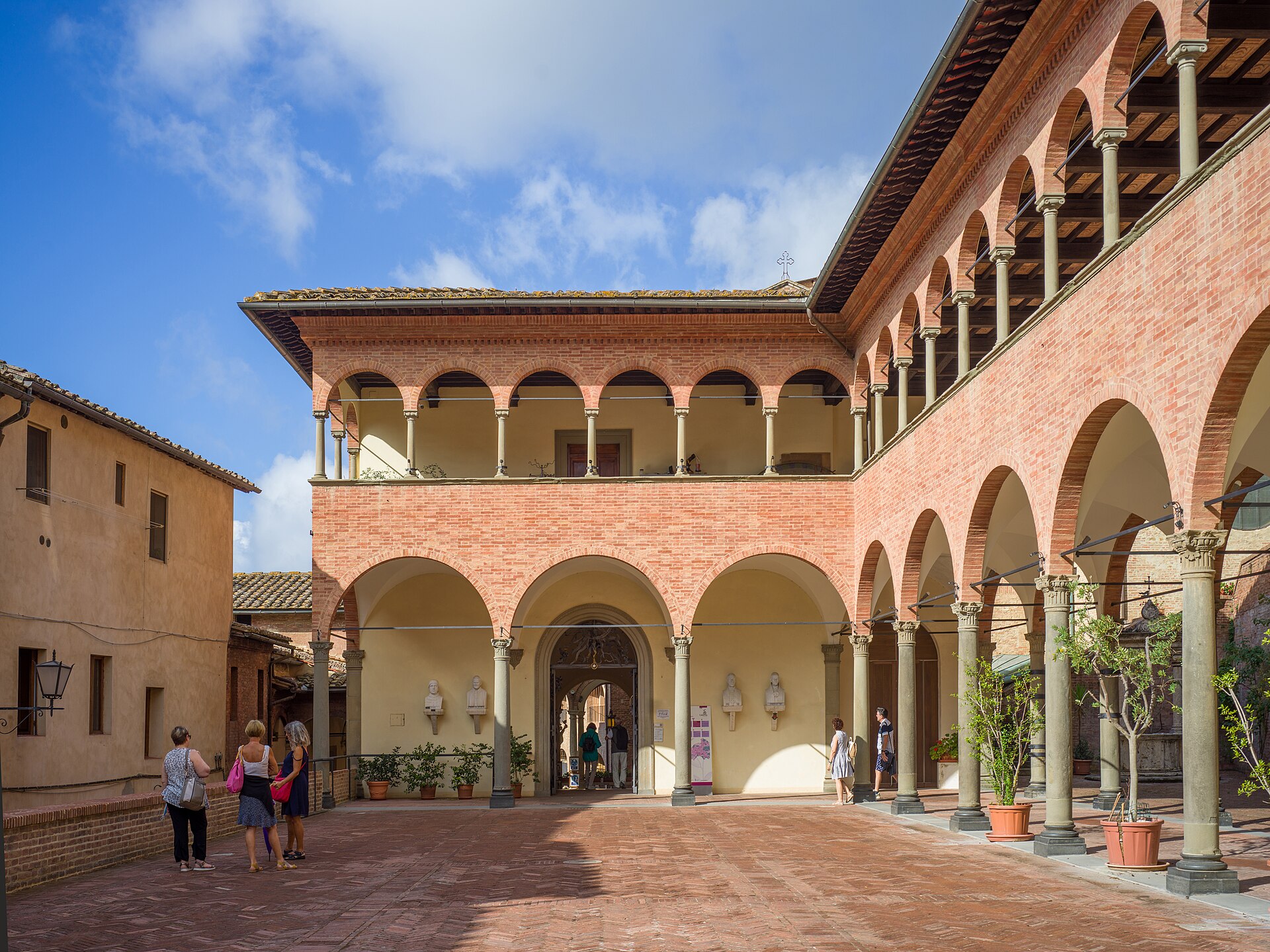
Scudder's chronology, drawn from Raymond and the Sienese records, opens: "1347. On March 25th, Catherine, and a twin-sister who dies at once, are born in the Strada dell' Oca, near the fountain of Fontebranda, Siena. She is the youngest of the twenty-five children of Jacopo Benincasa, a dyer, and Lapa, his wife."5 March 25 is the feast of the Annunciation, and in 1347 it fell on Palm Sunday. The Strada dell'Oca ("Goose Street") runs down the hill below the great brick church of San Domenico toward the Fontebranda gate, in the district of the dyers and tanners. Gardner, who walked it, wrote that "All that part of Siena is still redolent with the aroma of the dyers' and tanners' labours."6 The family belonged to the Dodicini, the party of the lesser merchants who governed Siena in the 1350s and 1360s.
The twenty-third or twenty-fourth of twenty-five
Popular books say that Catherine was the youngest of twenty-five children, or the twenty-fifth. Scudder's chronology says "youngest," and the Italian Leggenda minore also makes her Lapa's youngest child.6 Raymond, the source closest to the family, says otherwise. The 1862 English, which abridges here, tells the twin birth this way:
"Lapa became the mother of two delicate daughters at a birth; [1347] but the weakness of their bodies was not destined to impair the energy of their souls. The mother not being able to nourish both, found herself obliged to confide one of them to the care of a stranger. God willed that the infant she herself retained, should be her whom he had chosen for his spouse; and when the infants received baptism, the mother's choice was called Catharine, and the other Jane. Jane soon bore to Heaven the name and grace that she received in baptism; she lived but a few days ... it was the only one out of the twenty-five children, with which God had blessed her, to whom she had been able to give this maternal attention."2
Gardner, translating directly from Raymond's Latin (Legenda I.ii.1, section 26 in the Bollandist edition), adds the sentence the English version leaves out: "After Lapa had brought forth Catherine, she gave birth to another girl, who was called Giovanna, to renew the memory of the departed sister of Catherine; and this was the last, after she had given birth to twenty-five children."6 On Raymond's account, then, the twins were the twenty-third and twenty-fourth children, and a second Giovanna (Nanna) was the twenty-fifth. Gardner found the burial of that younger sister in the death register of San Domenico: "Nanna filia Jacobi Tinctoris sepulta est die xviii Aprilis, 1363" ("Nanna, daughter of Jacopo the dyer, was buried on April 18, 1363").6 Whether Catherine is called the twenty-third or the twenty-fourth depends only on whether she or her twin is counted first. Raymond does not say. What can be said is that Raymond, who knew Lapa personally, did not make Catherine the youngest.
Gardner names five brothers (Benincasa, Bartolommeo, Sandro, Niccolo and Stefano) and five older sisters (Niccoluccia, Maddalena, Bonaventura, Lisa and Nera).6 Many of the twenty-five died young, as children did in the plague years. Of her father, Raymond records Lapa's testimony that "he was so mild and moderate in his words that he never gave way to anger," and tells how, when a fellow citizen cheated him, Jacomo would not allow the man to be spoken against: "let him alone, dear, let him alone, and God will bless you."2 Of Lapa, still living when he wrote, Raymond says she was "an octogenarian, and is so simple that even would she, she could not invent anything false."2 Lapa outlived her daughter. The notes appended to the 1862 English edition say that when Catherine's head was carried to Siena in 1385, "every eye was intent upon the aged Lapa, who had seen more than 80 revolving suns, and who walked in procession beside the head of her daughter."2 Raymond names her as the source of the childhood stories.

Childhood, the vow and the struggle at home
Raymond says that the neighbours loved the child so much "that they did not call her Catharine, but Euphrosyne, which signifies joy, satisfaction."2 Scudder's chronology summarizes the next stories as Raymond tells them: "When six years old she beholds the vision of Christ, arrayed in priestly robes, above the Church of St. Dominic. She is inspired by a longing to imitate the life of the Fathers of the desert, and begins to practise many penances. At the age of seven she makes the vow of virginity."5 The vow, in the 1862 English of Raymond, ends with the words: "I promise thy Son, and I promise thee, never to accept any other spouse and to preserve myself to the best of my ability pure and unspotted."7 The only witness to a vow made by a seven-year-old alone in prayer is the woman herself, years later, telling her confessor. That is what Raymond's account is: her own memory of her childhood as she gave it to him in the 1370s.
The record of the family quarrel that followed is firmer, because several people saw it. When Catherine was about twelve, her mother and sisters began to prepare her for marriage. Scudder summarizes: "Her ascetic practices meet with sharp opposition at home. She is urged to array herself beautifully and to marry, is denied a private chamber, and forced to perform the menial work of the household, etc. In time, however, her perseverance wins the consent of her father and family to her desires."5 Raymond tells that she cut off her hair to make herself unmarriageable, and that her sister Bonaventura, whom she loved best, persuaded her for a time to dress and adorn herself as a girl of marriageable age, a lapse that Catherine afterwards counted one of the great sins of her life. Bonaventura died in childbirth in 1362. Gardner, from the Sienese records, notes that the second Giovanna died the next year.6 The deaths of the two sisters and the opposition of the family form the setting of her decision.
The Mantellate: a laywoman in a habit
Catherine wanted the habit of the Sisters of Penance of Saint Dominic, the women of Siena who were called the Mantellate from the black cloak (mantello) they wore over a white dress. They were not nuns. They took no solemn vows, kept no enclosure, and lived in their own houses under a rule and under the direction of the Dominican friars. Raymond records that when Lapa went to ask for the habit on her daughter's behalf, "The sisters replied that it was not their custom to give their habits to young maidens, but to widows of mature age, who had consecrated themselves to God; that they kept no enclosure (or cloister,) but that each sister must be capable of governing herself at home."8 They gave way after Catherine fell ill with a disfiguring fever, and she received the habit, probably late in 1363 or in 1364, when she was sixteen or seventeen (Scudder's chronology gives "1363-1364").5
Raymond's own chapter on the origin of the order says plainly what its rule was and was not: "This Rule is not absolutely a religious Rule, because it does not require the three Vows, which are the foundation of every Religious Order."9 Calling Catherine "a nun," as many popular books and holy cards do, is therefore inaccurate. She was a laywoman in a religious habit, a "tertiary" of the third order of Saint Dominic. That status explains a great deal about her later life: she could travel, receive visitors of both sexes in her own house, gather disciples, and go on embassies for the city of Florence, none of which an enclosed nun of the 1370s could have done. It also explains why her freedom drew suspicion.
Three years in the cell, and learning to read
For about three years, 1364 to 1367, Catherine lived as a recluse in a small room of the crowded family house. Scudder's chronology: "She leads in her own room at home the life of a religious recluse, speaking only to her Confessor. She is absorbed in mystical experiences and religious meditation. During this time she learns to read."5 Raymond's account of the reading is the source of the later claim that she was taught "miraculously":
"Since I have mentioned the recitation of the Psalms, I must inform my readers that Catharine knew how to read without having learned from any one. She narrated to me herself, that having resolved to learn to read so as to recite the Hours and follow the Offices, she had studied the alphabet with one of her companions. But after having uselessly consumed several weeks in this labor, the thought came to her to obtain from heaven the grace to lose no more time. ... Before the end of her prayer, our Lord taught her so well, that when rising from her knees, she knew how to read every kind of manuscript, as rapidly and as perfectly as the most highly educated persons. What astonished me the most was, that she read easily but without being able to spell her words, when she was asked to do so; she scarcely knew her letters!"10
Two things in this passage can be separated. The first is the observation, which Raymond makes as a witness: as an adult she read the Psalms and the canonical hours from the office books fluently, as a whole-word reader, but could not spell out the letters. Those books were in Latin, a language she did not understand, so what she read aloud with ease she could not translate. The second is the explanation, which comes from Catherine herself: she had prayed and the gift had been given. Gardner, who accepted Raymond's account of what she could do, summarized it carefully: "When he knew her, she could read any writing, rapidly and with ease, though unlike other people and as if she knew the meaning of the words without being able to spell out the syllables."11 Reading and writing were taught separately in the 1300s, and many people who could read could not write. Catherine's writing came ten years later, as the section on 1377 below shows. She never learned Latin. Raymond, who served as her interpreter with Gregory XI, says flatly that "she did not understand Latin, and the Sovereign Pontiff did not speak Italian."12
The mystical marriage, 1367
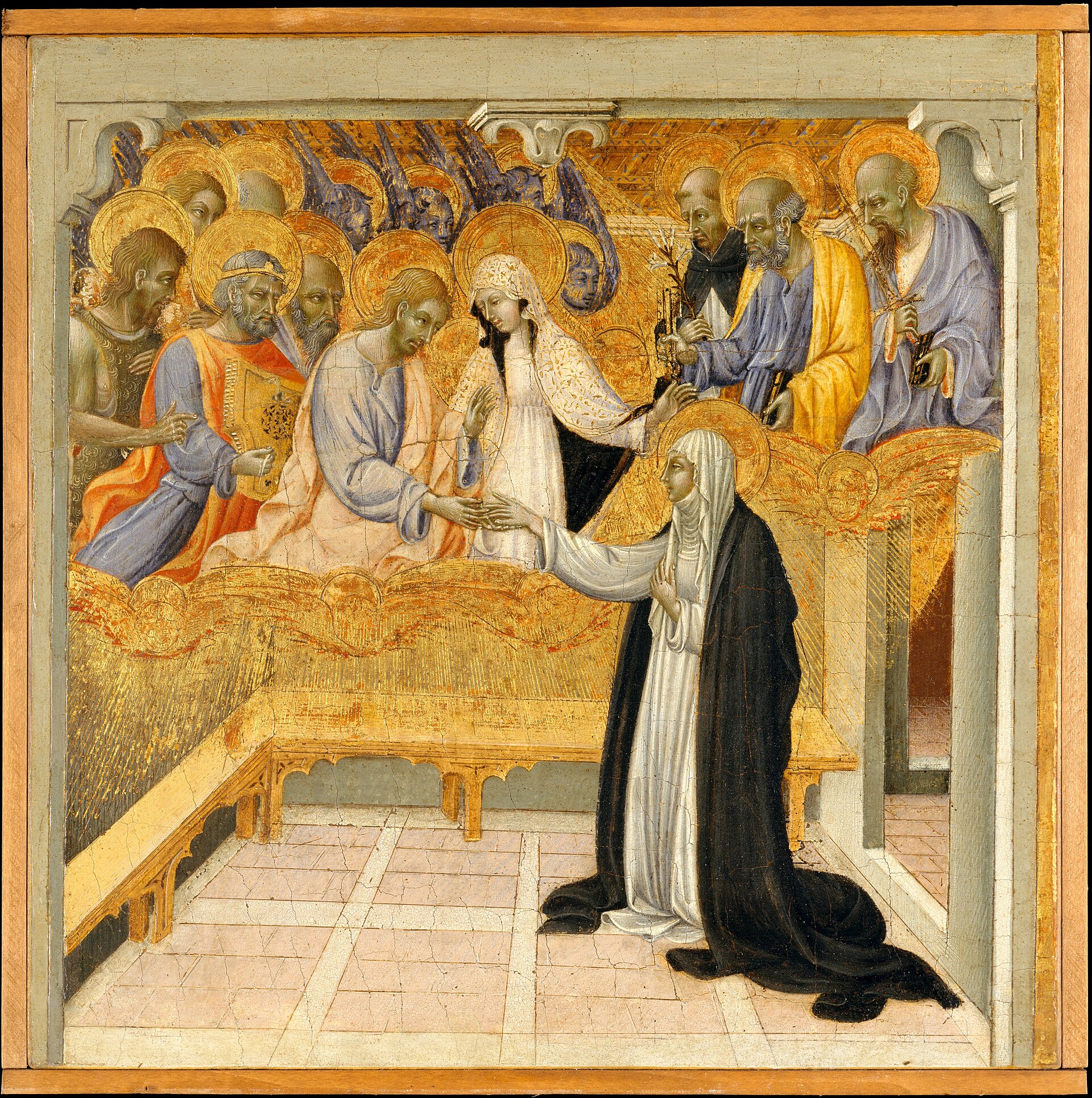
The three years of seclusion ended, by Catherine's own account, with what Raymond calls her espousals to Christ. Scudder dates it: "The period closes with her espousals to Christ, on the last day of Carnival, 1367."5 (The last day of Carnival is Shrove Tuesday, the day before Ash Wednesday; in 1367 that fell in early March. Catherine was then nineteen, or twenty by the Sienese reckoning; John Paul II in 1999 wrote that "Catherine was twenty years old when Christ showed his special love for her through the mystical symbol of a wedding ring.")13 Raymond's account, in the 1862 English, is the earliest full telling:
"One day, at the approach of the holy season of Lent, when Christians celebrate the Carnival, or a foolish adieu to the viands which the Church is on the eve of prohibiting, Catharine withdrew into her cell there to enjoy her Spouse more intimately by fasting and prayer: she reiterated her petition with more fervor than ever, and our Lord answered her: 'Because thou hast shunned the vanities of the world and forbidden pleasure, and hast fixed on me alone all the desires of thy heart, I intend, whilst thy family are rejoicing in profane feasts and festivals, to celebrate the wedding which is to unite me to thy soul. I am going, according to my promise to espouse thee in Faith.'"14
Raymond goes on to say that the Virgin Mary, Saint John the Evangelist, Saint Paul, Saint Dominic and the prophet David with his harp appeared, that Mary took Catherine's right hand and presented it to her Son, and that Christ placed on her finger "a golden ring, set with four precious stones, in the centre of which blazed a magnificent diamond," saying, "I thy Creator and Redeemer, espouse thee in Faith and thou shalt preserve it pure, until we celebrate together in Heaven the eternal nuptials of the Lamb."14 Raymond is careful about what anyone else could see: "The vision disappeared, and the ring remained on the finger of Catharine. She saw it, but it was invisible to others! She acknowledged to me, while blushes mantled her cheek, that it never left her."14 In other words, no one except Catherine ever claimed to see the ring. The whole account rests on what she told Raymond. Raymond himself read the vision as a sign of mission rather than of private privilege: "Catharine, although a woman, was to be an apostle in the world and convert many souls; she received a sensible sign of grace in order to accomplish with more courage the divine work that was entrusted to her."14
The mystical marriage became one of the most painted scenes of her life. Painters often confused it with the older legend of the mystical marriage of Saint Catherine of Alexandria, the virgin martyr whom Raymond mentions in the same chapter ("There was already one Catharine, queen and martyr, who, after baptism, espoused our Lord").14 In the Sienese pictures, Catherine of Siena wears the white dress and black mantle of the Mantellate, which is how to tell the two apart.

From the cell to the city, 1367 to 1374
After 1367 Catherine came back into the life of the household and the street. Scudder's chronology: "In obedience to the commands of God, and impelled by her love of men, she returns gradually to family and social life. From this time dates her special devotion to the Blessed Sacrament. She joyfully devotes herself to household labours, and to a life of ministration to the sick and needy. In 1368 her father dies, and the Revolution puts an end to the prosperity of the Benincasa family, which is now broken up."5 The "Revolution" was the overthrow of the Dodicini government in Siena in 1368, which cost the family its political protection. Scudder adds that in 1370 Catherine "dies mystically and returns to life, having received the command to go abroad into the world to save souls."5 That too is her own report, given to her confessors.
She nursed the sick in the city hospitals, including the great hospital of Santa Maria della Scala opposite the cathedral and the house of the Misericordia, gave away the family's food and clothing (to her brothers' annoyance), and took on the care of particular patients whom others would not touch. Raymond tells several such stories, among them a widow called Cecca with a cancerous breast whom Catherine nursed though the woman slandered her, and the Mantellata Palmerina who hated her. Raymond's point is moral, but his details (names, illnesses, hospitals) are the kind his first readers in Siena could have checked.
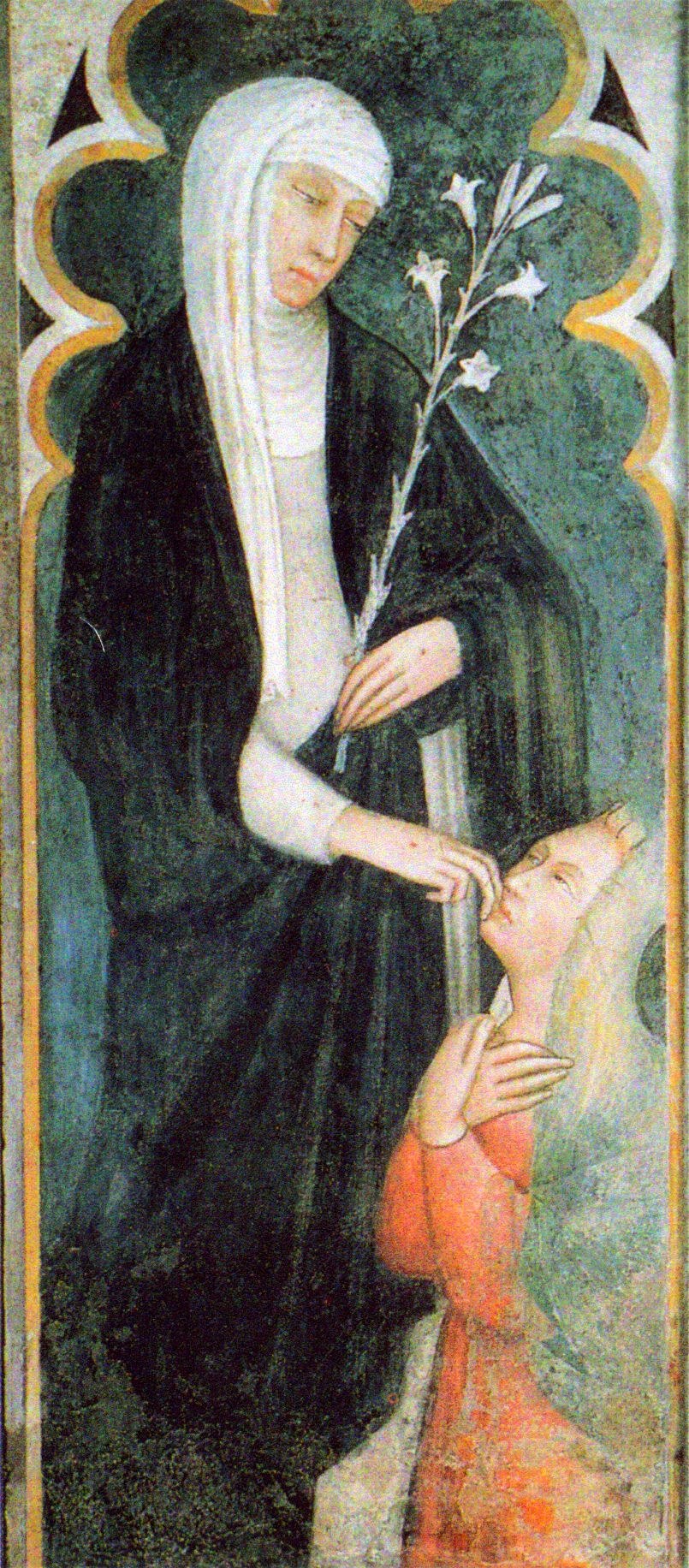
By about 1370 a group of disciples had begun to gather around her: women of the Mantellate such as Alessa dei Saracini and Cecca, Dominican friars such as Bartolomeo Dominici and Tommaso Caffarini, and young laymen of good Sienese families. Scudder's chronology for 1370 to 1374 summarizes the double effect: "Her reputation and influence increase. A group of disciples gathers around her. Her correspondence gradually becomes extensive, and she becomes known as a peacemaker. At the same time, her ecstasies and unusual mode of life excite criticism and suspicion."5 Among those she drew into her circle, Gardner names the Sienese painter and city magistrate Andrea di Vanni, though he adds that "There is no reason for supposing that he actually became one of Catherine's spiritual family." It is to Vanni that the earliest known portrait of her is attributed, still in the Cappella delle Volte of San Domenico, which Gardner called "that strange, unearthly, almost uncouth, but immeasurably touching and appealing portrait of Catherine from his hand."15

Florence, 1374: the plague and Raymond of Capua
The suspicion came to a head in 1374. The master general of the Dominicans, Elias of Toulouse, summoned Catherine to the general chapter of the order at Florence in May. An anonymous Florentine who met her there left the earliest description of her by someone outside her circle, quoted by Gardner: "There came to Florence, in the month of May, 1374, when the chapter of the Friars Preachers was held, at the command of the Master of the order, one wearing the habit of the sisters of penance of St. Dominic, who was called Caterina di Jacomo di Benincasa of Siena, who was of the age of twenty-seven years, and whom we deemed to be a great servant of God. And with her she had three other women, dressed in her habit, who went in her company."16 No record of the chapter's verdict survives. Scudder's chronology says only that she went "perhaps summoned thither to answer charges made against her by certain in the Order."5 The practical outcome is known: the order gave her a new director, Raymond of Capua, a learned friar of noble family who had been prior of the Dominican house of Santa Maria sopra Minerva in Rome. Gardner calls him the man "whom, in her last letter, she was to call 'father and son given me by that sweet Mother Mary.'"16
That summer the plague returned to Tuscany. The Florentine chronicler Marchionne di Coppo Stefani, as Gardner reports him, wrote that Florence suffered less than any other town in Tuscany and "that elsewhere a third of the population died."16 Catherine went back to Siena and nursed the sick. Raymond's own memory of that summer, written about seventeen years later, is one of the most vivid passages in his book, because he was a participant:
"The following fact I can particularly attest. Seventeen years ago, that is 1373 or 1374, religious obedience summoned me to Sienna, where I exercised in the Convent of my Order, the functions of Lector. I was serving God in a lukewarm manner, when the plague declared itself, and raged as it had done in many places during our time, but never so fearfully as in Sienna. The contagion attacked men and persons of all ages; one day, two or even three days at most, sufficed to make one the victim of its empoisoned breath. In consequence terror reigned everywhere."17
Raymond goes on to tell how the rector of the house of the Misericordia, Father Matthew, was carried in from a sickbed "like a corpse," and how the doctor, whom Raymond names as Senso and says was still living, told him the case was hopeless. Catherine came into the room and said, in Raymond's English, "Get up Father Matthew, arise, this is not the moment to repose indolently in your bed," and, Raymond reports, the fever and the marks of the plague disappeared.17 He then tells of his own illness. Having resolved "not to avoid any pestiferous patient whatever," he woke one night with pain in the groin, "my hand discovered to me the fatal swelling," and he dragged himself to her house, where she prayed over him and he recovered.17 These are miracle stories, told by a man who believed he owed her his life, and they cannot be tested now. They also record ordinary facts that can be: the plague of 1374 in Siena, the work of the Misericordia, a young friar staying among the sick when others fled, and a laywoman of twenty-seven going from house to house.
The famiglia: her disciples and secretaries
By the mid 1370s Catherine's followers called themselves her famiglia, her family, and called her mamma. Scudder uses that word when she describes the company that went with her to Rome in 1378: "a large group of disciples, her 'Famiglia,' who live together, subsisting on alms."5 Modern writers sometimes call the group her bella brigata ("fair company"). It included Dominican friars, Augustinian hermits, a Carthusian or two, Mantellate, and young Sienese laymen of good family who served as her secretaries. Gardner names the three regular secretaries of her political years, "Neri di Landoccio Pagliaresi, Stefano di Corrado Maconi, and Francesco di Messer Vanni Malavolti," joined in 1378 by the young Florentine Barduccio di Piero Canigiani, who "never left her until the end."18 Stefano Maconi later became prior general of the Carthusians, and Neri di Landoccio a hermit. Their testimonies, written after her death, are among the main sources for her life.
Francesco Malavolti left a description of how she worked, which Gardner paraphrases: "We see her dictating simultaneously to these three young men, three letters: one to Pope Gregory, another to Bernabo Visconti, the third to a certain great nobleman whose name Francesco does not remember. She dictates now to one, now to another; at times with her face covered by her hands or veil, as though absorbed in thought, at others with clasped hands and head raised up to Heaven."18 Malavolti's story goes on to a small wonder (the three scribes all took down the same sentence, and it proved to fit all three letters), which is the kind of detail a devoted disciple would remember. The picture of dictation itself agrees with everything else that is known of her letters.
Pisa, 1375: the crusade and the stigmata
In 1375 the papacy's government of central Italy was collapsing. Scudder's table of public events gives the year in one line: "Eighty Italian cities join a League, headed by Florence, against the Pope, with the watchword, 'Fling off the foreign yoke.'"19 Catherine went to Pisa at the invitation of its ruler, Pietro Gambacorta. Scudder's chronology states her purpose: "Her object is to prevent Pisa and Lucca from joining the League of Tuscan cities against the Pope. She meets the Ambassador from the Queen of Cyprus, and zealously undertakes to further the cause of a Crusade."5
The call for a crusade
The crusade was not a side interest. In 1373, according to Scudder's table, "A Crusade publicly proclaimed by the Pope."19 Catherine took it up with all her energy and urged it in letter after letter to Gregory XI, to the queen of Naples, to Pisa and Lucca, and to the English mercenary captain John Hawkwood, whom she begged to take "the pay and the cross of Christ crucified" and turn his company from war on Christians to war "against the infidel dogs who possess our Holy Place."20 The phrase is hers, in Scudder's translation, and it should be read as she wrote it: she wanted the Holy Land taken back by force from its Muslim rulers. Raymond explained her reasoning as she put it to the pope, with Raymond himself translating:
"Holy Father, there is no better means for re-establishing peace among Christians, than the undertaking of a Crusade. All the turbulent soldiers who now entertain division among the faithful, will go cheerfully and combat in the holy cause; very few will refuse to serve God in the profession which pleases them, and it will be a means for expiating their offences: the fire will be thus extinguished for want of fuel. ... and besides, many Saracens might be converted."21
Raymond recorded this exchange because, after her death, critics said she had prophesied a crusade that never came. He answered: "I never heard Catharine indicate in any manner whatsoever that a Crusade would certainly take place; I always found her on the contrary very reserved concerning it, never determining an epoch, but resigning the whole to divine Providence."21 Scudder's judgment, a century ago, was that the crusade "was the one aim of her life in which she wholly failed."22 The plan has two sides that a modern reader can hold together without softening either. Catherine wanted to end the wars between Christian cities and the plundering of Italy by mercenary companies. Her remedy was to send those soldiers to fight Muslims in the eastern Mediterranean, and she spoke of those Muslims, in the language of her time, as "infidels" to be conquered or converted. Lesson 11 reads the central part of the Hawkwood letter, with its old heading.
The stigmata at Santa Cristina
At Pisa, on Sunday, April 1, 1375 (the date in Scudder's chronology; April 1 was in fact a Sunday that year), Catherine received what Raymond calls the stigmata, the wounds of Christ.5 Raymond was present, and his account is the primary one:
"She received hospitality at the house of an inhabitant, near the little Church of St. Christina. On Sunday I celebrated Mass there, and gave her the holy Communion. She remained afterwards a long time in ecstasy, according to her custom ... when on a sudden we saw her body that was prostrate on the ground, rise a little, kneel, and extend its hands and arms. Her countenance was inflamed; she remained a long time motionless and with her eyes closed. Then, as though she had received a deathly wound, we saw her suddenly fall, and resume a few moments after the use of her senses. She sent for me and said to me in a low tone: 'Father, I announce to you that, by the mercy of our Lord Jesus Christ, I bear his sacred stigmata in my body.'"23
Asked what had happened, she told him, in Raymond's English: "I saw my crucified Saviour who descended upon me with a great light ... Then from the five openings of the sacred wounds of our Lord, I saw directed upon me bloody rays which struck my hands, my feet and my heart. I understood the mystery, and cried out: Ah! Lord my God, I entreat thee, that these cicatrixes may not appear exteriorly on my body." She said the rays turned to light as she prayed, and that she felt "at these five places, and especially in my heart, a pain so violent, that without a new miracle, it appears to me impossible to live in this state."23
The record therefore separates into three layers. What Raymond and the others saw was a woman in ecstasy who rose to her knees, stretched out her arms and collapsed. What Catherine told them was that she had received the wounds of Christ, and that at her request they were not visible. What later art and devotion added were visible wounds: Sienese painters of the 1400s often painted her with them, and that caused a long quarrel with the Franciscans, who held that Francis of Assisi alone had received visible stigmata (lesson 12 tells Francis's story). Scudder's chronology states the point exactly: "the marks, at her request, remain invisible."5 Some of Catherine's disciples later testified that the marks became visible on her body after death; that testimony belongs to the canonization process, not to anything Raymond says he saw at Pisa.
Also at Pisa, Raymond records that when news came of the revolt of Perugia against the pope, Catherine told him the troubles of the laity were "mere milk and honey" compared with what would follow, when "the ecclesiastics will offer the spectacle of a grievous scandal to the whole church; they will ravage and divide it as though they were heretics." Raymond says he did not understand the words until the Schism of 1378.21 It is a prophecy recorded after the fact by the man who heard it, which is how a reader should weigh it.
Florence against the pope, 1375 to 1376
The war that drew Catherine into the high politics of the Church began as a quarrel over grain and mercenaries. Scudder's table of public events for 1374 records that the papal legate in Bologna, William of Noellet, "refuses to allow corn to be imported into Tuscany from the Papal States," that John Hawkwood's company, "probably at his instigation, ravages the country, and even threatens the city of Florence," and that Florence, "enraged, rebels against the Pope, and appoints from the ranks of the Ghibellines a new body of Magistrates, known as the Eight of War."19 The Florentines later called the members of that board the Eight Saints, and the conflict is known as the War of the Eight Saints (1375 to 1378). In 1376, by the same table, Florence stirred Bologna to revolt, "The Papal Nuncio is flayed alive in the streets of Florence. The city is placed under an Interdict," and the pope sent Robert of Geneva into Italy with an army of mercenaries, who carried out "the hideous massacre of Cesena."19 An interdict suspended the public celebration of the sacraments in the city.
Catherine was loyal to the pope and sympathetic to the Tuscans at the same time, and her letters of 1375 and 1376 try to hold both. She wrote to Gregory XI that the rebellion was a punishment the clergy had brought on themselves, and urged him to win the cities back by mercy rather than arms. In a letter Scudder places in this period she lays out what Scudder calls "her threefold policy: reform of the Church, return to Rome, the initiation of a Crusade."22 The reform she wanted was specific. She asked the pope to remove bad pastors, in her favourite image of the Church as a garden:
"Do you uproot in the garden of Holy Church the malodorous flowers, full of impurity and avarice, swollen with pride: that is, the bad priests and rulers who poison and rot that garden. Ah me, you our Governor, do you use your power to pluck out those flowers! Throw them away, that they may have no rule! Insist that they study to rule themselves in holy and good life. Plant in this garden fragrant flowers, priests and rulers who are true servants of Jesus Christ, and care for nothing but the honour of God and the salvation of souls, and are fathers of the poor."24
The same letter contains the words most often quoted from her correspondence with the pope. Popular books give them as "Be manly!" or "Be a man!" Scudder's 1905 translation reads:
"I tell you, father in Christ Jesus, come swiftly like a gentle lamb. Respond to the Holy Spirit who calls you. I tell you, Come, come, come, and do not wait for time, since time does not wait for you. ... On behalf of Christ crucified I tell it you: refuse to believe the counsels of the devil, who would hinder your holy and good resolution. Be manly in my sight, and not timorous. Answer God, who calls you to hold and possess the seat of the glorious Shepherd St. Peter, whose vicar you have been."24
The letter goes on to tie the return to Rome to the crusade ("raise the standard of the holy Cross") and to peace with the rebel cities: "I tell you that the fierce wolves will put their heads in your bosom like gentle lambs, and will ask mercy from you, father."24 It closes by commending to the pope the bearer, "Fra Raimondo," whom she had sent ahead of her to Avignon. The tone of these letters needs to be read as a fourteenth-century reader would have heard it. Catherine always calls herself the pope's "poor unworthy little daughter," asks his pardon for her "ignorance" and begs his blessing, and in the same paragraph tells him what God requires of him. Scudder, introducing a later letter to Urban VI, called it "the same amazing combination of candour and reverence."25 A modern reader can see both the deference and the pressure.
Avignon, June to September 1376
In the spring of 1376 the Florentine government asked Catherine to go to the pope on its behalf. Scudder's chronology: "In May, at the request of the Florentines, she goes to Florence. Sent as their representative to Avignon, she reaches that city on June 18th. Gregory entrusts her with the negotiations for peace. The Florentine ambassadors, however, delay their coming, and when they come refuse to ratify her powers."5 The official envoys of Florence, when they finally arrived, disowned her. Gardner's summary of what happened next is exact: "Disavowed by the Eight, she was still in Avignon as the ambassador of Christ, to bid the Pope return to Rome and reform the Church."26 The peace mission, which was the errand Florence had given her, failed. The papacy and Florence did not make peace until July 1378, after Gregory's death, under his successor.19
Raymond as interpreter
Her conversations with Gregory went through Raymond, because Catherine spoke only Tuscan and the French pope did not speak Italian. Raymond was present and gives one exchange in the first person:
"I frequently served as interpreter between Gregory XI. and Catharine; she did not understand Latin, and the Sovereign Pontiff did not speak Italian. In one of these interviews, Catharine asked why she found in the court of Rome, in which all the virtues ought to bloom, nothing but the contagion of disgraceful vices. ... 'I must declare, to the glory of Almighty God, that I have perceived more distinctly the infections of the sins that are committed in the Court of Rome, while yet in my native city, than those even who committed them, and are still daily committing them.' The Pope remained silent; I could not overcome my surprise, and shall never forget the tone of authority, with which Catharine spoke to that great Pontiff."12
("The court of Rome" means the papal court, wherever it sat; in 1376 it sat at Avignon.) Raymond and the canonization witnesses also tell a story that Gardner relates from the Legenda (II.iv.7) and the Processus. Gregory asked her for God's will about his return. She protested that "It is not meet that a wretched little woman should give advice to the Sovereign Pontiff," and when he ordered her to answer on her obedience, she said: "Who knoweth this better than your Holiness, who vowed to God that you would do this thing?" The story continues that Gregory "was overwhelmed with amazement, for, as he said, no living man save himself knew that he had made this vow."26 Gardner explains the vow in a note: "Gregory during the conclave had made a vow that, if elected Pope, he would return to Rome."26 The account comes from her own circle and was written down after her death. It also shows something the letters confirm: the return was Gregory's own intention long before Catherine met him.
The forged letter and the "timorous child"
Opposition came from the French cardinals, from the pope's family and from the court. Gardner notes the scrutiny Catherine herself faced: "three prelates of the Curia came to Catherine, and made a prolonged attempt to ensnare her in her speech," hoping to convict her of false pretences or heresy, and failed.26 Then the pope received an anonymous letter, apparently from a holy man, warning him that he would be poisoned in Rome. Catherine's reply, written in Avignon, is the source of the second famous line:
"I think he wants to treat you as the mother treats the child when she wants to wean him: she puts something bitter on her bosom, that he may taste the bitterness before the milk, so that he may abandon the sweet through fear of the bitter ... And I beg of you, on behalf of Christ crucified, that you be not a timorous child, but manly. Open your mouth, and swallow down the bitter for the sweet."27
She told him she believed the letter was a forgery that came "from very near, and from the servants of the devil," meaning from the papal court itself. Scudder adds that whether that guess was right "we do not" know.27 The two lines, "Be manly in my sight, and not timorous" and "be not a timorous child, but manly," are therefore genuine, from two different letters, and both are about courage in carrying out a decision Gregory had already announced.
September 13, 1376
Gregory left suddenly. Gardner, from the Avignon sources, describes the day: "On September 13, 1376, Gregory came out of the papal palace of Avignon, to return to the seat of the Apostles. A mournful crowd in silence watched the departure." At the palace door, his aged father, Count Guillaume de Beaufort, "threw himself at his feet," pleading with him not to go.26 Catherine left Avignon the same day. Gardner: "She had left Avignon on the day of his departure, September 13, and thence travelled by land, for which the Pope and the Duke of Anjou had provided her with the requisite means."26 Paul VI's apostolic letter of 1970 gives the same date in Latin: "Decedentem autem Avenione Gregorium die tertio decimo Septembris, anno MCCCLXXVI, Catharina secuta est usque Genuam" ("When Gregory left Avignon on September 13, 1376, Catherine followed him as far as Genoa").28

Genoa, Pisa and the pope's entry into Rome
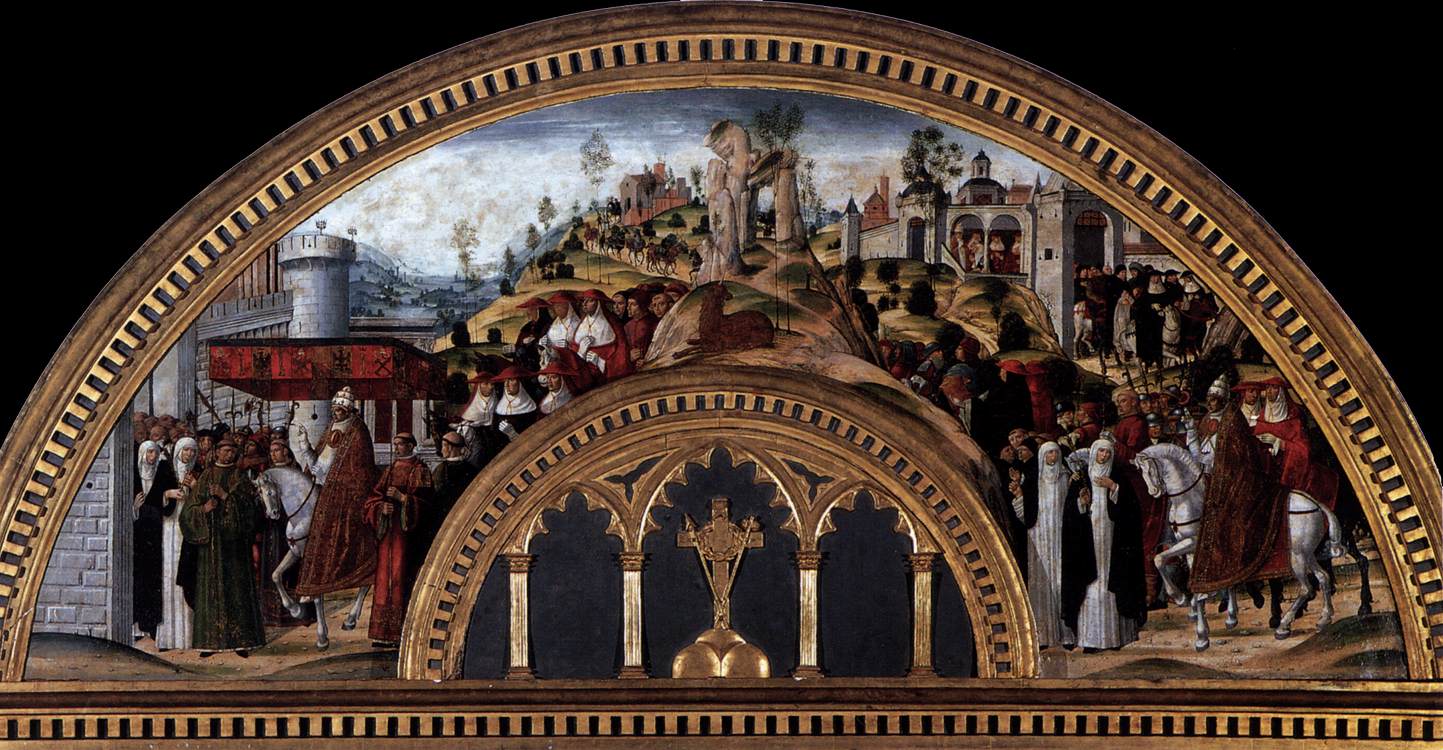
The pope went by sea and the voyage was slow and stormy. Gardner records that the papal galleys, after "encountering terrible weather at sea," reached Genoa on October 18, "And here Catherine and her company were awaiting the Pope's coming."26 Catherine's party was held at Genoa for about a month, in the house of Orietta Scotta, by illness among her companions. Scudder's introduction to a letter Catherine wrote from there to her mother explains the setting: "Her mission being ended, Catherine set forth on her homeward journey on the same day as the Pope, though by a different route. But her progress was interrupted at Genoa, where, owing to illness among her companions, she was detained for a month in the house of Madonna Orietta Scotta."27 Lapa had been complaining of her daughter's long absence. Catherine's letter to her opens: "With desire have I desired to see you a true mother, not only of my body but of my soul."27 Catherine went on to Pisa, where, Gardner notes, her mother met her, and, in the words of Scudder's chronology, "she reaches Siena in December or January."265
Gregory landed at Corneto on December 5, kept Christmas there, and came up the Tiber to San Paolo fuori le Mura on January 16. Gardner: "The next day, January 17, 1377, Gregory made his triumphal entry into the Eternal City." He quotes the Bishop of Sinigaglia: "Verily, I never thought in this world to see such glory with my own eyes."26 After almost seventy years at Avignon (from 1309), the papal court was again in Rome. Module 79 gives the background of the Avignon years in outline (Church History, Part A, lesson 10).
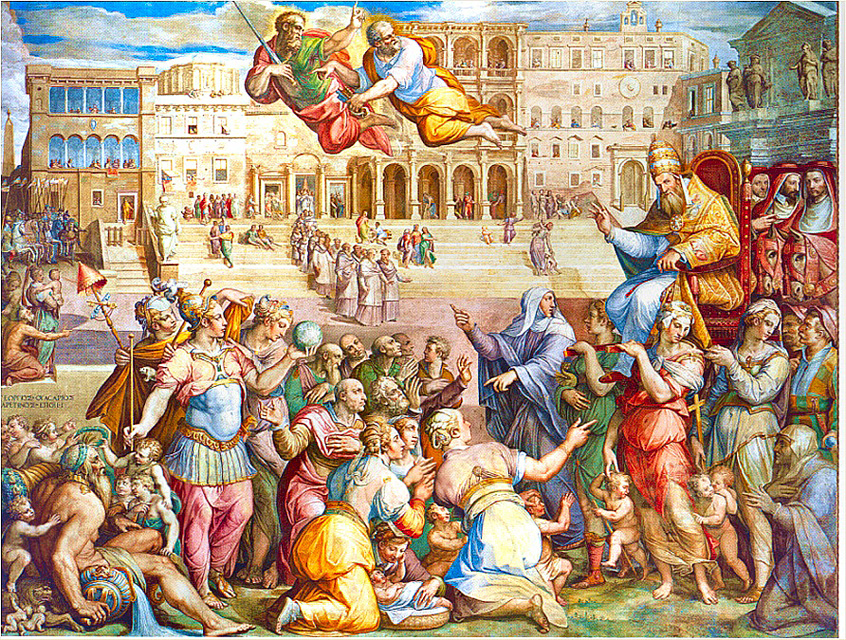

Rocca d'Orcia, 1377: peacemaking and learning to write
Back in Siena, Catherine spent 1377 in the country districts. Scudder's chronology: "Catherine converts the castle of Belcaro, conveyed to her by its owner, into a monastery. She visits the Salimbeni in their feudal castle at Rocca D'Orcia, for the purpose of healing their family feuds. While here she learns miraculously to write."5 The Salimbeni were the most powerful noble clan of the Sienese countryside, at war with their own kinsmen and with the city. Gardner places the castle "on an eminence above the Orcia, some twenty-three miles from Siena on the way to Rome, between Montepulciano and Montalcino," and says that "For more than four months Catherine remained in these parts, making Rocca d'Orcia her headquarters."26 Her work there was the same work she did in the city: reconciling families in blood feud, hearing the confessions brought to her friars, and preaching informally to the peasants who came to see her.
"Written with my own hand"
Her own words on learning to write come at the end of a long letter to Raymond of Capua, the letter that, Gardner notes, "reads almost like a first sketch of the Dialogo." Gardner translates:
"This letter, and another that I sent you, I have written with my own hand on the Isola della Rocca, with many sighs and abundance of tears, so that the eye, though seeing, saw not; but I was full of wonder at myself and at the goodness of God ... He had given me and prepared me to receive the faculty of writing; in order that, descending from the height, I might have somewhat wherewith to relieve my heart, that it might not burst ... In a wondrous way, He set it for me in my mind, even as the master does to the child when he gives him the copy. Thus, as soon as you had left me, with the glorious evangelist John and Thomas of Aquino, I began to learn in my sleep. Forgive me for writing too much, for my hands and my tongue are in tune with my heart."18
Gardner dates the letter to "the autumn of 1377" and adds the testimony of Tommaso Caffarini, on the authority of Stefano Maconi, that she had already written a short letter to Stefano with her own hand, ending, "Know, my dearest son, that this is the first letter that I have ever written," and that "she afterwards often wrote her own letters, as also certain pages of the Dialogo." He then states the limit of the evidence: "at the present day, with six exceptions, we possess only copies."18 Two facts can be held together. Catherine was able to write by late 1377, at about thirty, and her own account of how she learned is that it was given to her in sleep, with Saint John and Thomas Aquinas as her teachers (Thomas is the subject of lessons 02 to 07 of this module). And most of her letters, before and after 1377, were dictated to secretaries. Paul VI, in the 1970 letter making her a Doctor of the Church, summed it up by saying that although she was of the common people and had not attended school, she "vix scriberet aut legeret" ("could scarcely write or read").28
The Dialogue itself was composed in 1377 and 1378, partly at Rocca d'Orcia and mostly in Siena after her return from Florence in 1378, when, in Scudder's words, "she devotes herself to composing her 'Dialogue.'"5 Her disciples called it simply her Book. It is the subject of the next lesson, lesson 11, which reads it closely in Algar Thorold's 1896 translation.
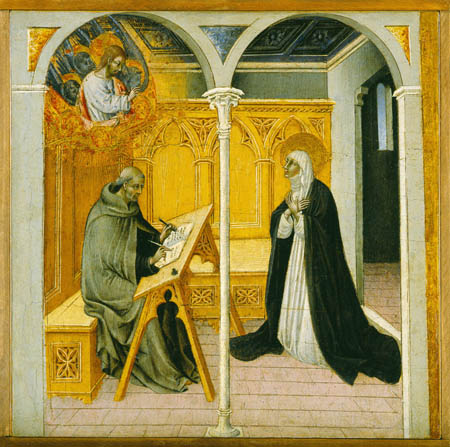

Florence, 1378: the last embassy and the tumult
Peace between Florence and the papacy was still not made. Early in 1378 Gregory sent Catherine to Florence again. Gardner records Raymond's account of how it was arranged: the pope said to Raymond, "It has been written to me that, if Catherine of Siena goes to Florence, I shall have peace," and, when Raymond offered to go himself, replied: "I do not wish you to go, because they would maltreat you; but I do not believe that they will harm Catherine, for she is a woman and they hold her in reverence."29 Scudder's chronology summarizes the stay: Gregory "sends her, however, to Florence, where she stays in a house built for her by Niccolo Soderini, at the foot of the hill of St. George. She succeeds in causing the Interdict to be respected, but almost loses her life in a popular tumult, and keenly regrets not having won the crown of martyrdom."5
Gregory died in Rome on March 27, 1378, while the Florentine negotiations were still going on.30 In June the city's factions turned on each other, in the rising Gardner calls the "Tumulto degli Ammoniti." A band of armed rioters, "probably at the instigation of the more embittered victims of the Parte Guelfa," in Gardner's words, came straight from sacking the houses of the Canigiani (the family of her young secretary Barduccio) to the little house on the hill of San Giorgio where she was staying. Gardner, from the testimony of her companions, tells what followed:
"Soon the men broke in, brandishing their weapons, and shouting: 'Where is Catherine?' She went to meet them, and, with radiant countenance, falling on her knees before their leader, said: 'I am Catherine; do to me whatever God will permit, but I charge you, in the name of the Almighty, to hurt none of these who are with me.' The ruffian hesitated, and then bade her go away. 'Why should I fly,' she answered, 'when I have found what I desired? I offer myself a living sacrifice to my eternal Bridegroom. If you are sent to kill me, act boldly; I shall not move from here; but harm none of my companions.' At this the whole band went away in confusion."29
Her own letter to Raymond about the day survives, and Gardner quotes it: "My desire was not fulfilled of giving my life for the truth and for the sweet Spouse of Christ. But the eternal Bridegroom played a great trick upon me."29 Peace between Florence and the papacy was signed in July 1378, and the interdict was lifted.19 Catherine went home to Siena to finish her book.
The Western Schism, 1378
Gardner notes that "For the first time for seventy-four years, a new Pope was elected in the Vatican." He gives the scene from the depositions of the cardinals and their servants: early on the morning of "Thursday, April 8," Romans broke into the bell tower of St. Peter's and rang the bells, the bell of the Capitol answered, and crowds outside shouted for "a Roman or an Italian."30 That day the cardinals elected Bartolomeo Prignano, archbishop of Bari, a Neapolitan whom Gardner describes, at the time of Catherine's visit to Avignon, as "assistant to the Vice-Chancellor of the Holy See."26 He took the name Urban VI. Within weeks his harshness toward the cardinals turned them against him. Scudder's table of events: "In June, the Cardinals begin to circulate rumours challenging the validity of the election, and on September 20th they formally announce that the election was invalid, having been forced on them by fear, and appoint as Pope the Cardinal Robert of Geneva, who takes the name of Clement VII."19 Robert of Geneva was the same commander whose mercenaries had carried out the massacre of Cesena. Clement went back to Avignon. The Western Church now had two popes, each with his own college of cardinals, and Europe divided between them: Scudder notes that "England remains faithful to Urban," while France recognized Clement.19 The Schism lasted until the Council of Constance in 1417 (module 79, lesson 10, and module 102, lesson 05, tell how it ended).
Catherine took Urban's side from the first and never wavered. The question of who was the true pope was argued by canonists until the Schism ended. Catherine's case was the one Urban's supporters made: the cardinals had elected him in due form, had crowned him, had asked him for favours, and had notified the world, and only later claimed fear. She wrote to the three Italian cardinals who had joined the French:
"If I turn to the election ordained by your lips, we knew that you chose him canonically and not through fear. We have already said that he whom you presented to the people through fear was Messer di Santo Pietro. What proves to me the regular election with which you chose Messer Bartolommeo, Archbishop of Bari, who to-day is made in truth Pope Urban VI.? In the solemnity with which his coronation was observed, this truth is clear to us."25
("Messer di Santo Pietro" is the elderly Roman cardinal Francesco Tebaldeschi, whom the cardinals had briefly presented to the crowd as their choice to calm it.) In the same letter she reminds them what they had been meant to be: "you were flowers planted to breathe forth the fragrance of virtue in that garden; you were placed as masts to strengthen this ship, and the Vicar of Christ on earth."25
Rome, 1378 to 1380
Urban, who had met Catherine at Avignon, summoned her to Rome. Gardner: "Catherine reached Rome on November 28, 1378, the first Sunday in Advent," with a large company of men and women of her famiglia; Raymond, then prior of the Minerva, met them.31 She spent the remaining seventeen months writing on his behalf. Scudder's chronology lists the recipients: "She writes on his behalf to the Kings of France and Hungary, to Queen Giovanna of Naples, to the magistrates of Italian cities, to the Italian cardinals who have joined the Schism, and to others."5 At Urban's request, "though probably by her own suggestion," as Scudder puts it, she also wrote to hermits she knew, among them the English Augustinian Brother William of England at Lecceto near Siena, summoning them to Rome to stand around the pope.25
She did not flatter Urban. Scudder's introduction to one of her letters to him notes that "Urban's arbitrary and headstrong nature resented any interference," and that Catherine, "true to her constant principles in the interpretation of character, ... insists on putting the best possible construction on his actions," while she "can rebuke pungently enough."25 Her first letter to the new pope, written from Florence before the Schism, already gave him political advice in one line that Scudder singles out: "Receive from a sick man what he can give you."25 Urban sent Raymond to the King of France. Scudder: "He proceeded to the port of Genoa, planning thence to set sail for France. But the galleys of the antipope sought to debar the passage; and Raimondo ... allowed himself to give up the expedition." Catherine's reply began, "Oh my naughty father."25 He never saw her again.
Her last months were spent in a rented house near the Minerva, in what is now the Via di Santa Chiara. Gardner: "This was the house near the Minerva, in the present Via S. Chiara, where her cell is now venerated as a chapel, and it was here that her last mysterious illness came upon her."31 Raymond reports from her companions that in the early weeks of 1380 she still walked each morning from her house past the Minerva and the Campo de' Fiori to St. Peter's to pray at the tomb of the apostle: "this course was capable of fatiguing any one in good health."32 Scudder's chronology: "In vision at St. Peter's, on Sexagesima Sunday, the burden of the Ship of the Church descends upon her shoulders."5 Gardner dates her "last agony" from "January 30, the Monday after Sexagesima Sunday," and writes that to those who stood by her it "seemed a new, unheard-of spiritual martyrdom."33
Death in Rome, April 29, 1380
Raymond was in Genoa when she died, and says so. His account in Part III of the Legenda rests on the testimony of those present, whom he names in the chapter that opens Part III. He gives the day twice. The first time: "Some days before she was called to Heaven, she found herself unable to rise; finally, on Sunday April 29, 1380, on the festival of St. Peter, martyr of the Order of Preaching Friars, about the hour of Tierce, she yielded her beautiful soul to its loving Spouse and Redeemer." The second, after giving her last instructions to her followers, among them a message for Raymond himself:
"Seeing that the moment of her exit had arrived, she said: 'Lord, into thy hands I commend my spirit;' Domine, in manus tuas commendo spiritum meum. And as she had so long desired, that devout soul was freed from its captivity and united in an indissoluble, eternal union, to the Spouse whom she had so ardently loved, in the year of our Lord, 1380, on Sunday, the 29th of April, at the hour of Tierce. I was at that instant in Genes [Genoa]."32
Her last words in Raymond's report are those of Christ on the cross (Luke 23:46; in the Douay-Rheims, "Father, into thy hands I commend my spirit"). Tierce is the third hour of the day, about nine in the morning. Gardner agrees on the date: "The end came on April 29, the Sunday before the Ascension, after prolonged and continual suffering."33 April 29, 1380 was indeed a Sunday, and Paul VI's apostolic letter of 1970 gives the same date, "die undetricesimo mensis Aprilis, anno MCCCLXXX."28 Scudder's chronology alone says "on April 30th she dies."5 The difference probably reflects her feast day: a brief of Urban VIII in 1630, as the 1862 English edition notes, moved the feast to April 30 because "the Church celebrates the Feast of St. Peter, Martyr" on the 29th, the day of her death.34 She was thirty-three years old. Her followers saw meaning in the age, which was traditionally that of Christ at his death; the age itself follows simply from her birth in March 1347.
Stefano Maconi, according to the notes of the 1862 English edition, "carried her corpse on his shoulders to the church of the Minerva, guarded it piously, so long as it was exposed, and buried it."2 Her body still lies in Santa Maria sopra Minerva in Rome. Paul VI's letter of 1970 says that she "rests" in Rome, "in templo Sanctae Mariae supra Minervam, ubi resurrectionem iustorum praestolatur" ("in the church of Saint Mary above Minerva, where she awaits the resurrection of the just").28
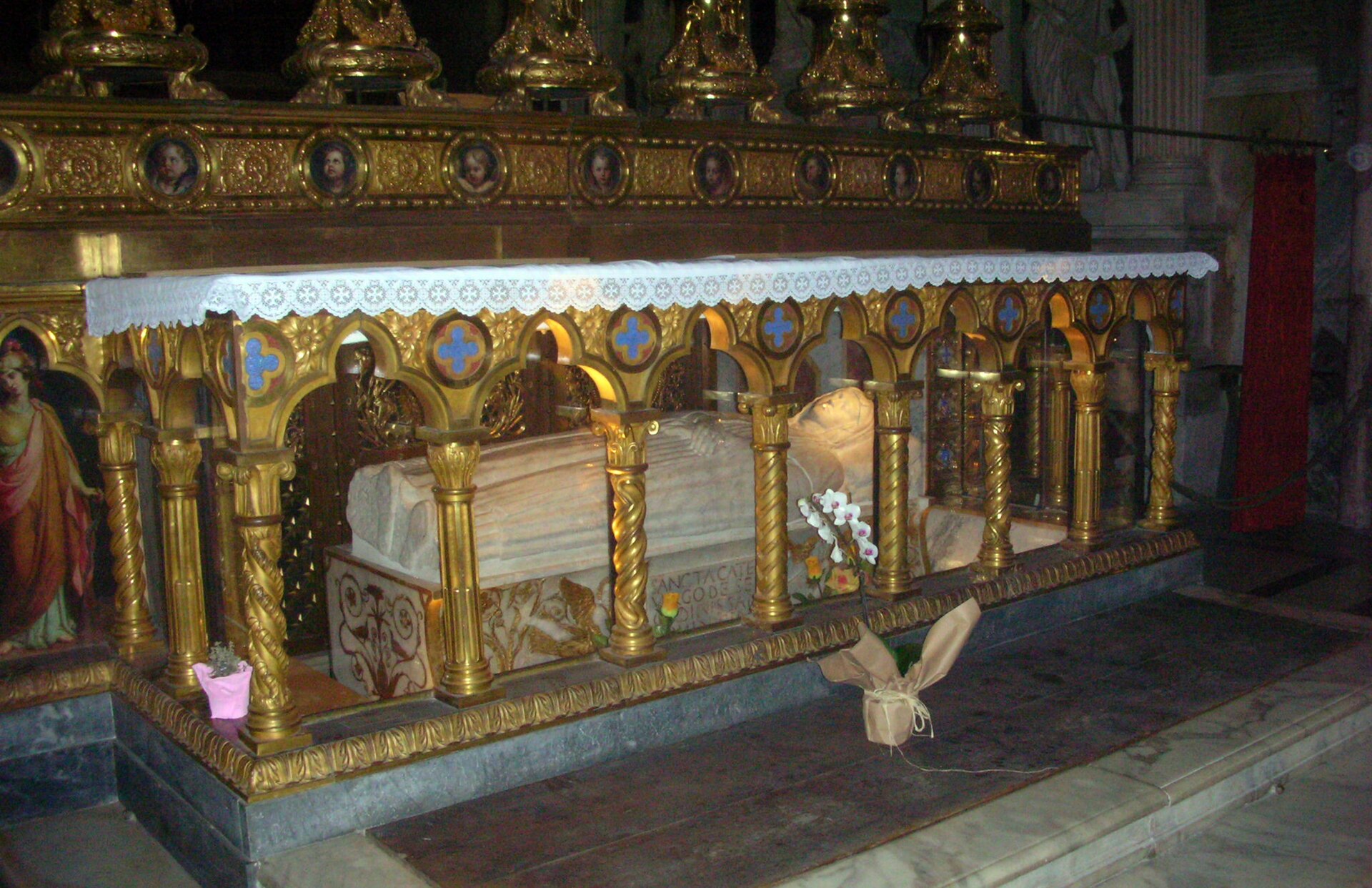

After her death: relics, cult and honors
Her followers began to honour her at once. In 1385, according to the notes of the 1862 English edition, her head was carried from Rome to Siena in procession, "amid a concourse of people and clergy, who carried lighted torches and made the air resound with pious canticles," with the aged Lapa walking beside it.2 It is kept in a reliquary in the Chapel of Saint Catherine in San Domenico, Siena, the church above the Benincasa house where she had prayed as a girl. The same notes, by the French editor Etienne Cartier, describe the reliquary on the altar, "the keys of which are in the hands of the Gonfalonier of the city, and of the Prior of the Convent."2 Her body remained in Rome. Smaller relics were divided among her followers. The 1862 notes report that when her body lay in the Minerva one finger of her hand stayed straight while the others were bent, until a kinswoman detached it, and that "This was intended to indicate the finger that received the nuptial ring of the Spouse."2 That is devotion recorded by her circle, and it is reported here as theirs.
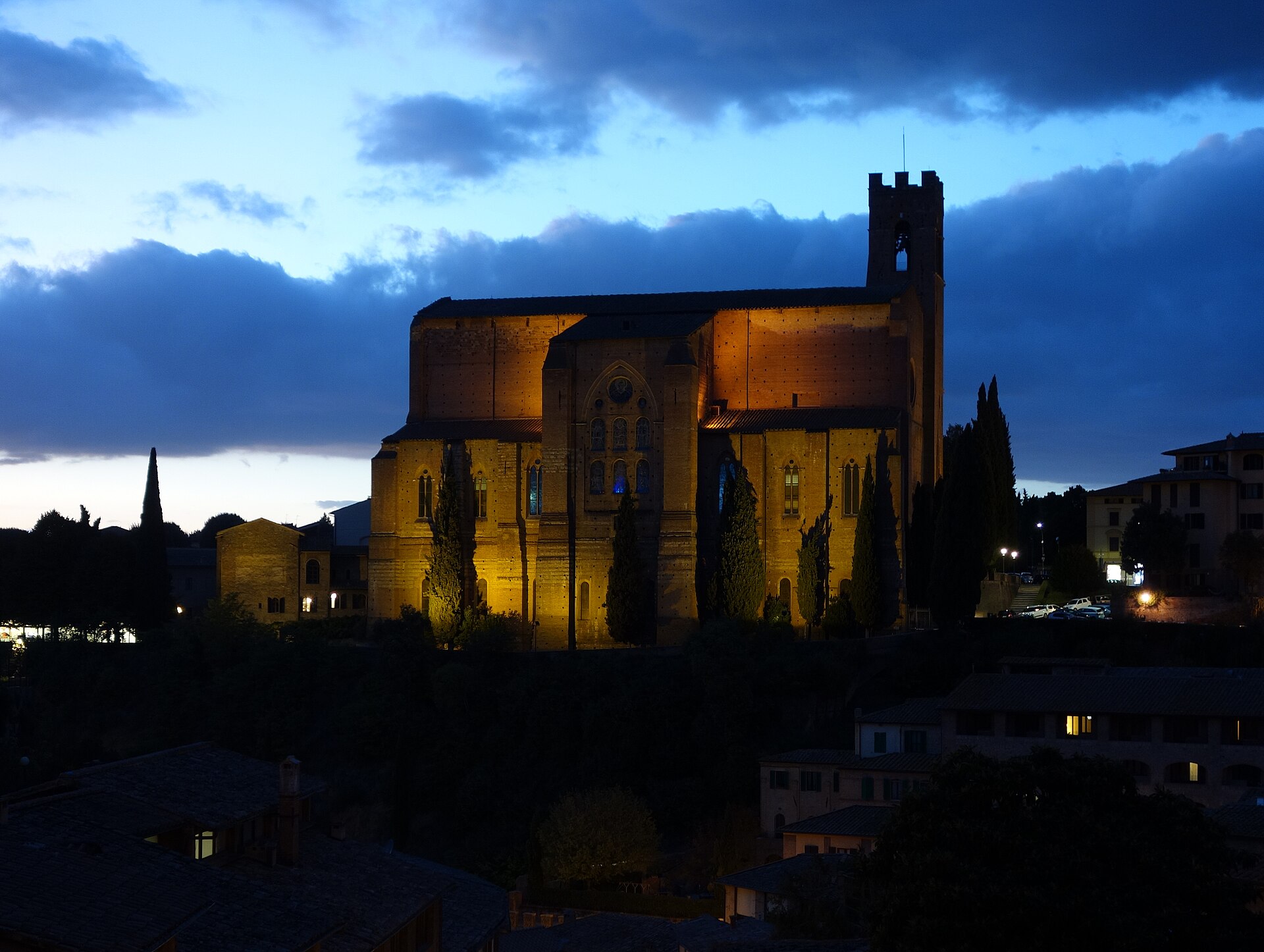

The Processus of 1411 to 1413 was gathered because Dominicans in Venice were already keeping her feast without papal permission.1 She was canonized in 1461 by Pius II. The 1862 English edition prints his bull in translation; its decree reads: "we declare, on the opinion of our Brethren, that Catharine of Sienna, virgin of illustrious and ineffaceable memory ... " and the bull is dated "at Rome, at St. Peter's," in the third year of his pontificate (1461; the digitized copy reads "1641, the 19th of June," which is either a misprint or a scanning error for the year, since Pius II reigned 1458 to 1464).34 The editor of the 1862 edition notes that the bull "recalls" the most extraordinary facts of Raymond's life: the canonization was built on Raymond's book.34 Paul VI's letter of 1970 adds that Urban VIII in the 1600s approved her stigmata "sua auctoritate" (by his own authority), and that Pius IX placed the see of Peter under her protection.28
The modern honours came in three steps:
- 1939, patroness of Italy. On June 18, 1939, Pius XII, by an apostolic brief, proclaimed Francis of Assisi and Catherine of Siena the principal patrons of Italy ("Patroni Primari d'Italia").35 Francis is the subject of lessons 12 and 13.
- 1970, Doctor of the Church. Paul VI declared Teresa of Avila a Doctor of the Church on September 27, 1970, and Catherine a week later. The Vatican's homily page for Catherine's proclamation is headed "Domenica, 3 ottobre 1970" ("Sunday, October 3, 1970"), but October 3, 1970 was a Saturday; the Sunday was October 4, the date of the apostolic letter Mirabilis in Ecclesia Deo, "die quarto mensis Octobris" (October 4), so the ceremony fell on Sunday, October 4, 1970, and the "3" on the homily page is a slip.3628 The formula, in Latin, was: "Sanctam Catharinam, Virginem Senensem, Ecclesiae universalis Doctorem declaramus" ("we declare Saint Catherine, Virgin of Siena, a Doctor of the universal Church").28 The letter records that the Congregation of Rites had first been asked, in December 1966, whether the title of Doctor could be given to "three holy women" at all, and answered yes.28 Teresa and Catherine were the first two women to receive it, Teresa by one week the first.
- 1999, co-patroness of Europe. On October 1, 1999, John Paul II, in the apostolic letter Spes aedificandi, named Bridget of Sweden, Catherine of Siena and Teresa Benedicta of the Cross (Edith Stein) co-patronesses of Europe, beside Benedict, Cyril and Methodius. Of Catherine he wrote that she was "the force behind the Pope's return to his own See at the tomb of the Prince of the Apostles."13
What historians have made of her politics
Every account of Catherine has to decide how much she changed events. The official Catholic documents give her a large role. John Paul II's phrase, "the force behind the Pope's return," is one. Paul VI's 1970 letter goes further in one direction and less far in another: it says there is no doubt that Gregory's return should be credited more to her holiness than to her human prudence, because, by divine instinct alone, she knew of the pope's secret vow to return ("neque est prorsus dubitandum quin Gregorii XI reditus sit magis sanctitati quam humanae Catharinae prudentiae tribuendus").28 That is a theological judgment about the source of her influence, and it is stated as such.
The historians quoted in this lesson are more cautious about her effect and more interested in her methods. Edmund Gardner, a scholar of Dante and of Italian history, wrote his 1907 book as "a study in Italian history centred in the work and personality of one of the most wonderful women that have ever lived," and called her "the successor of Dante in the literature and religious thought of Italy."1 His narrative of 1376 shows the return as something Gregory had long intended, announced and prepared, which Catherine helped him carry out against his family and his cardinals. The record supports him: Scudder's table records that on April 22, 1372, four years before Catherine reached Avignon, "Gregory, in full consistory, announces his intention of returning to Rome."19 In July 1376, while Catherine was still in Avignon, Gardner notes from a dispatch of July 17 to Lodovico Gonzaga of Mantua that "a number of the papal officials had already started."26 Bridget of Sweden had urged the popes to return before her, as Spes aedificandi itself says when it describes Catherine as completing "a spiritual work already initiated by Bridget."13
Vida Scudder judged Catherine's political sense highly in particular cases: "She was capable, as she showed during the Schism, of detailed political sagacity: but she never lost the womanly conviction that moral generalizations would convict men of sin and point them to the path of holiness."22 She also thought the crusade "the one aim of her life in which she wholly failed."22 F. Thomas Luongo, in The Saintly Politics of Catherine of Siena (Cornell University Press, 2006), reads her letters together with the archives of Siena and Florence. As the publisher's description summarizes his argument, the political situation of the Church in Italy, together with a culture that valued women's spirituality and prophetic speech, opened a public role to her, and her letters must be read as political acts in that setting.37 On her literacy, Jane Tylus's Reclaiming Catherine of Siena: Literacy, Literature, and the Signs of Others (University of Chicago Press, 2009) argues, in the publisher's words, that she should be recognized as "one of the major figures at the birth of the Italian literary canon," and studies how speech and writing work together in letters that were mostly dictated.38 (Both modern books are named here for further reading; this lesson quotes only from the public domain sources.)
A fair summary can stay close to what the documents allow. Catherine did not create the plan to return to Rome. She did not make the peace with Florence, which was made by Urban VI in July 1378. She did press Gregory, in person and in writing, at the moment when his family, his cardinals and his own fears held him back, and her letters and Raymond's account show that he listened to her. After 1378 she was one of the most active writers in Italy on Urban's side, and, by Scudder's account, helped reconcile the city of Rome to him when it revolted.19 Whether any of this changed the outcome is a question historians answer differently; that she tried, and how, is plain in her own words.
What the record shows and what it does not
- Documented fact. Her birth in Siena in 1347 to Jacomo Benincasa, a dyer, and Lapa; the habit of the Mantellate about 1363 to 1364; the Dominican chapter at Florence in May 1374 (described by an outside witness); her stay at Pisa in 1375; her arrival at Avignon on June 18, 1376 and departure on September 13, the day Gregory XI left; Gregory's entry into Rome on January 17, 1377; the Florentine tumult of June 1378; her arrival in Rome on November 28, 1378; her death in Rome on Sunday, April 29, 1380; burial at Santa Maria sopra Minerva; canonization by Pius II in 1461; the honours of 1939, 1970 and 1999.52628
- Her own words. Nearly 400 letters, almost all dictated and known from copies, among them the letters to Gregory XI ("Be manly in my sight, and not timorous"; "be not a timorous child, but manly"), to Urban VI, to the Italian cardinals and to Hawkwood; her own account of learning to write at Rocca d'Orcia in 1377; and the Dialogue (lesson 11).32418
- What the earliest life reports from her or from witnesses. Raymond of Capua (writing 1384 to 1395) reports the childhood vision and vow, the miraculous gift of reading, the mystical marriage with an invisible ring, the stigmata at Pisa made invisible at her request, the healings in the plague of 1374 (including his own), and her prophecy of the Schism. For each, he says whether he saw it or was told it, and most rest on what Catherine herself told him.2
- Later additions. Visible wounds of the stigmata in paintings of the 1400s and after; the age of thirty-three treated as a sign; the claim that she was a nun; the claim that she alone brought the papacy home.
- Scholarly reading. Gardner (1907) and Scudder (1905) treat her as a real political actor whose main goal, the return of the pope, coincided with Gregory's own plan; Luongo (2006) reads her sanctity and her politics together; Tylus (2009) reads her as an author at the start of Italian literature.1223738
- Open questions. How much weight her pleading carried in Gregory's final decision; the exact number of authentic letters; how many letters she wrote with her own hand; how far her secretaries shaped her wording.
Claims checked
"Catherine single-handedly brought the pope back to Rome." Partly supported.
She urged Gregory XI in person and in letters, and her own circle and two modern popes credit her with a decisive part (John Paul II: "the force behind the Pope's return").13 But Gregory had announced his intention to return in consistory on April 22, 1372, four years before she reached Avignon, had vowed it at his election according to the story her own circle told, and had papal officials already on the road in July 1376.1926 Bridget of Sweden had pressed the same demand earlier.13 "Helped persuade a hesitant pope to carry out a plan he already held" fits the evidence; "single-handedly" does not.
"Catherine could not read or write." Partly supported.
As a young woman she could not read; by Raymond's account she learned in her late teens, read the office books easily, and "scarcely knew her letters" if asked to spell.10 She dictated almost all of her letters. But her own letter to Raymond says that from the autumn of 1377 she wrote with her own hand, and Caffarini reports a first letter to Stefano Maconi in her hand and later pages of the Dialogue.18 Paul VI's phrase is accurate: she "could scarcely write or read."28 She never knew Latin.12
"Catherine was a Dominican nun." Refuted.
She was a member of the Mantellate, the Sisters of Penance of Saint Dominic, laywomen who lived at home. Raymond says their rule "is not absolutely a religious Rule, because it does not require the three Vows."9 "Dominican tertiary" or "laywoman of the Dominican third order" is correct.
"She was the youngest (the twenty-fifth) of twenty-five children." Unsupported.
Scudder's chronology and the Italian Leggenda minore say youngest.56 Raymond, who knew her mother, says that after the twins Lapa had one more daughter, Giovanna, "and this was the last, after she had given birth to twenty-five children," which makes Catherine the twenty-third or twenty-fourth.6 The earliest and closest source contradicts the popular version.
"She told the pope, 'Be a man!'" Supported, with the exact wording.
In Scudder's translation of the letter from before the Avignon journey: "Be manly in my sight, and not timorous." In the Avignon letter about the forged warning: "be not a timorous child, but manly. Open your mouth, and swallow down the bitter for the sweet."2427 Both concern the return to Rome. "Be a man" is a loose modern paraphrase.
"Catherine bore the visible stigmata like Francis." Unsupported by the earliest account.
Raymond, who was present at Pisa on April 1, 1375, saw her rise in ecstasy and collapse, and then heard her say she had received the wounds, which at her prayer were not visible; she felt the pain.23 Scudder: "the marks, at her request, remain invisible."5 Visible wounds appear in later art and in later testimony; the Church's approval of her stigmata came under Urban VIII in the 1600s.28 This rating concerns the evidence for visible marks during her life, not whether she had the experience she described.
"Christ gave her a ring that she wore for the rest of her life." Rests on her own report (Unresolved as history).
The only source is Catherine, as told to Raymond, who wrote that the ring "was invisible to others" and that she told him "it never left her."14 No witness ever claimed to see it. The account is early, first-hand from her, and unverifiable by anyone else.
"She cured Raymond of the plague in 1374." Rests on the patient's own testimony (Unresolved as history).
Raymond tells it as the man who was sick: he found "the fatal swelling," went to her, and recovered after her prayer.17 It is a first-person account written years later by a devoted disciple; it shows what he believed happened, and that both of them worked among the plague sick, but cannot be tested now.
"Catherine was the first woman named a Doctor of the Church." Partly supported.
Teresa of Avila was declared a Doctor on September 27, 1970, and Catherine a week later (on Sunday, October 4, 1970, the date of the apostolic letter; the homily page's heading "Domenica, 3 ottobre" cannot be right, since October 3 was a Saturday).3628 They were the first two women; Teresa was first by a week.
"She preached a crusade against the Muslims." Supported.
Her letters urged Gregory XI, Hawkwood and others to take the cross against "the infidel dogs who possess our Holy Place," and Raymond records her telling the pope a crusade was the best way to end wars among Christians, adding that "many Saracens might be converted."2021 No crusade came of it; Scudder called it "the one aim of her life in which she wholly failed."22
"She called the pope 'sweet Christ on earth.'" Supported.
The phrase appears in her letters to and about Gregory XI in Scudder's translation, for example "O 'Babbo' mine, sweet Christ on earth, follow that sweet Gregory (the Great)!"24 Lesson 11 discusses what she meant by it.
Hard questions and answers
A Reformed or Lutheran reader asks: why should a Protestant take seriously a woman whose life is full of visions and who called the pope "Christ on earth"?
Because her letters are among the plainest medieval witnesses to the corruption of the church of her day, written by someone who loved it. She asked the pope to "uproot in the garden of Holy Church the malodorous flowers, full of impurity and avarice," and told him to his face, through Raymond, that she smelled the sins of the papal court from Siena.2412 A Protestant reader will disagree with her view of the papacy and will weigh her visions as Raymond's reports of her experience. The same reader can still learn from her how a layperson without office or Latin pressed the leaders of the church toward reform in the name of the blood of Christ, a century and a half before Luther. Module 79 places her among the reform movements before the Reformation (lesson 10).
A Catholic reader asks: if the Church canonized her on Raymond's evidence, is it disrespectful to label his miracles "his report"?
No. Raymond himself separates what he saw from what he was told: at Pisa he writes "we saw her body ... rise a little, kneel," and then gives her words about the wounds; of the ring he writes that "it was invisible to others."2314 Labelling each layer follows his own method. The Church's judgment on her holiness, stated by Pius II and Paul VI, is a different kind of judgment from a historian's rating of the evidence for a particular event, and this lesson reports both without ruling on the miracles.
A skeptic asks: aren't the fasting, the ecstasies and the visions better explained as illness?
That reading is possible, and Gardner, writing in 1907, already acknowledged that "many" would regard her trances "simply as a form of catalepsy," while holding that this did not exhaust them.11 The sources cannot settle a diagnosis made six centuries later. They do show that the same woman who fasted and fell into ecstasy also nursed plague victims, ran a large household of disciples, negotiated between cities and wrote clear, practical letters to rulers. Any explanation has to account for both.
A careful reader asks: Urban VI was violent and erratic. Why did she support him to the end?
Because she believed his election had been valid, and her argument to the cardinals was legal as well as spiritual: they had elected him in due form, crowned him and obeyed him, and only later claimed they had acted "through fear."25 She did not defend his temper. Scudder notes that her letters to him "rebuke pungently enough," and that she urged him to temper justice with mercy.25 Her loyalty was to the office she believed he held, not to his character.
A reader asks: how should her call for a crusade and her language about Muslims be judged?
By reading it whole and in its time. She called Muslims "infidel dogs" and wanted the Holy Land taken by war; her stated aims were to stop Christian cities from fighting each other, to send the mercenary companies that ravaged Italy out of it, and, in Raymond's report of her words, that "many Saracens might be converted."2021 Francis of Assisi, a century and a half earlier, went to the Sultan in person during a crusade (lesson 12). The texts should be quoted as they are, neither softened nor used to dismiss everything else she wrote.
A historian asks: in the end, what did she actually change?
Less than her admirers say and more than a laywoman of her station could have been expected to. She failed at the two errands she was given (peace for Florence in 1376 and the crusade). She helped a hesitant pope carry out the return he had planned. She was a leading voice for Urban in the first two years of the Schism. Her lasting effect was through her writings: the letters and the Dialogue, copied and spread by her disciples, and the basis on which Paul VI declared her a Doctor of the Church in 1970.28 Lesson 11 turns to those writings.
Learn more
- Scudder, Saint Catherine of Siena as Seen in Her Letters (Project Gutenberg): The public domain selection of her letters quoted in this lesson, with a chronology and table of public events.
- Gardner, Saint Catherine of Siena (1907, Internet Archive): The fullest public domain English life, built on Raymond, the Processus, the letters and the Italian archives.
- Raymond of Capua, Life of Saint Catharine of Sienna (1862, Internet Archive): Her confessor's life in a nineteenth-century English version made through French, with the canonization bull and disciples' testimonies.
- Paul VI, Mirabilis in Ecclesia Deo (1970): The Latin letter declaring her a Doctor of the Church, with an official summary of her life.
- Church History, Part A, lesson 10: Reform Before Luther: The Avignon papacy and the Western Schism in outline.
- Lesson 11: Reading Catherine of Siena: The Dialogue, her prayers and her letters read closely.
Still being checked (6 items)
These points could not be confirmed against a primary source when this lesson was written and fact checked in October 2026. The text above states each one as uncertain.
- The exact number of surviving letters: Gardner (1907) says 'nearly four hundred' and Tylus (2010) 'almost 400'; the figure of about 380 often given could not be checked against Noffke's numbering.
- The exact day of the canonization bull of Pius II: the digitized 1862 English text reads '1641, the 19th of June' (the year is evidently a misprint or scan error for 1461); modern reference works commonly give June 29, 1461; neither day was confirmed from the Latin bull.
- Scudder's chronology gives her death as April 30, 1380; Raymond, Gardner and Paul VI give April 29. The lesson follows April 29 and suggests the April 30 feast (moved by Urban VIII in 1630) as the likely source of the difference; that explanation is an inference.
- The age at which she made her childhood vow (about seven) and the dates of the vision and espousals come only from Raymond's report of what Catherine told him.
- Luongo's argument is summarized from the publisher's description, not from the book itself; Tylus's 2009 book likewise from the publisher's description.
- The Andrea Vanni fresco's date (about 1400) and attribution are as given on Wikimedia Commons; the Vasari attribution of the return scene is as given in the Commons file name and was not checked against a museum record.
Notes
- Edmund G. Gardner, Saint Catherine of Siena: A Study in the Religion, Literature and History of the Fourteenth Century in Italy (London: J. M. Dent; New York: E. P. Dutton, 1907), Preface, pp. vii to x (the five principal sources; Raymond's Legenda begun 1384 and finished 1395; the Processus of 1411 to 1413; "Raimondo's complete work has never been translated into English"; the book as "a study in Italian history" and Catherine as "the successor of Dante"). Internet Archive (retrieved Nov. 5, 2026). Read it online. ↩
- Raymond of Capua, Life of Saint Catharine of Sienna, by the Blessed Raymond of Capua, Her Confessor, translated from the French of Etienne Cartier by the Ladies of the Sacred Heart (Mother Regis Hamilton) (New York: P. J. Kenedy, 1862), Part I, chs. 1 and 2 (her parents; Lapa's testimony; the twins; "Euphrosyne"); and the editor's notes in the appendix to the deposition of Stefano Maconi and in "Recollections of St. Catharine in Italy" (Maconi carries her body to the Minerva; the translation of her head to Siena in 1385; the finger relic; the reliquary in San Domenico). Internet Archive scan of the 1862 edition (retrieved Nov. 5, 2026). Read it online. ↩
- Edmund G. Gardner, Saint Catherine of Siena: A Study in the Religion, Literature and History of the Fourteenth Century in Italy (London: J. M. Dent; New York: E. P. Dutton, 1907), ch. XVI, "Catherine's Literary Work" ("Nearly four hundred of Catherine's letters have been preserved to us"). Internet Archive (retrieved Nov. 5, 2026). Read it online. ↩
- Jane Tylus, review of The Letters of Catherine of Siena, trans. Suzanne Noffke, O.P., 4 vols. (Tempe: Arizona Center for Medieval and Renaissance Studies, Medieval and Renaissance Texts and Studies, 2000 to 2008), Catholic Historical Review 96, no. 4 (2010), pp. 796 to 797 (quoted: "the first complete modern edition in any language that places Catherine's almost 400 letters in chronological order"; "fewer than 10 percent of Catherine's letters are identified by date or internal historical evidence"). Project MUSE excerpt (retrieved Nov. 5, 2026). Read it online. ↩
- Vida D. Scudder, trans. and ed., Saint Catherine of Siena as Seen in Her Letters (London: J. M. Dent; New York: E. P. Dutton, 1905), Project Gutenberg eBook 7403 (Letters of Catherine Benincasa), "Chief Events in the Life of St. Catherine" (chronology, 1347 to 1380). Project Gutenberg (retrieved Nov. 5, 2026). Read it online. ↩
- Edmund G. Gardner, Saint Catherine of Siena: A Study in the Religion, Literature and History of the Fourteenth Century in Italy (London: J. M. Dent; New York: E. P. Dutton, 1907), ch. I, "Catherine's Hidden Life" (the Strada dell'Oca and Fontebranda; the Dodicini; the family; Raymond, Legenda I.ii.1, section 26, on the twenty-five children; the note that the Leggenda minore makes her the youngest; the burial entry for Nanna, April 18, 1363). Internet Archive (retrieved Nov. 5, 2026). Read it online. ↩
- Raymond of Capua, Life of Saint Catharine of Sienna, by the Blessed Raymond of Capua, Her Confessor, translated from the French of Etienne Cartier by the Ladies of the Sacred Heart (Mother Regis Hamilton) (New York: P. J. Kenedy, 1862), Part I, ch. 3, "Of Catharine's Vow of Virginity." Internet Archive (retrieved Nov. 5, 2026). Read it online. ↩
- Raymond of Capua, Life of Saint Catharine of Sienna, by the Blessed Raymond of Capua, Her Confessor, translated from the French of Etienne Cartier by the Ladies of the Sacred Heart (Mother Regis Hamilton) (New York: P. J. Kenedy, 1862), Part I, ch. 6 (the reply of the Sisters of Penance to Lapa; the clothing with the habit). Internet Archive (retrieved Nov. 5, 2026). Read it online. ↩
- Raymond of Capua, Life of Saint Catharine of Sienna, by the Blessed Raymond of Capua, Her Confessor, translated from the French of Etienne Cartier by the Ladies of the Sacred Heart (Mother Regis Hamilton) (New York: P. J. Kenedy, 1862), Part I, ch. 7, "Of the Origin and Establishment of the Sisters of Penance of St. Dominic, and of Their Mode of Life." Internet Archive (retrieved Nov. 5, 2026). Read it online. ↩
- Raymond of Capua, Life of Saint Catharine of Sienna, by the Blessed Raymond of Capua, Her Confessor, translated from the French of Etienne Cartier by the Ladies of the Sacred Heart (Mother Regis Hamilton) (New York: P. J. Kenedy, 1862), Part I, ch. 10 (her learning to read; pp. 73 to 74 of the 1862 edition). Internet Archive (retrieved Nov. 5, 2026). Read it online. ↩
- Edmund G. Gardner, Saint Catherine of Siena: A Study in the Religion, Literature and History of the Fourteenth Century in Italy (London: J. M. Dent; New York: E. P. Dutton, 1907), ch. I, "Catherine's Hidden Life" (her reading: "she could read any writing, rapidly and with ease"; on her ecstasies, that "many" will regard them "simply as a form of catalepsy"). Internet Archive (retrieved Nov. 5, 2026). Read it online. ↩
- Raymond of Capua, Life of Saint Catharine of Sienna, by the Blessed Raymond of Capua, Her Confessor, translated from the French of Etienne Cartier by the Ladies of the Sacred Heart (Mother Regis Hamilton) (New York: P. J. Kenedy, 1862), Part II, ch. 3, on her service to the sick (Raymond as interpreter between Gregory XI and Catherine; "she did not understand Latin"; her words on the vices of the papal court; pp. 100 to 101 of the 1862 edition). Internet Archive (retrieved Nov. 5, 2026). Read it online. ↩
- John Paul II, Apostolic Letter issued motu proprio Spes aedificandi, proclaiming Saint Bridget of Sweden, Saint Catherine of Siena and Saint Teresa Benedicta of the Cross Co-Patronesses of Europe, October 1, 1999, sections 6 and 9. Vatican website, English text (retrieved Nov. 5, 2026). Read it online. ↩
- Raymond of Capua, Life of Saint Catharine of Sienna, by the Blessed Raymond of Capua, Her Confessor, translated from the French of Etienne Cartier by the Ladies of the Sacred Heart (Mother Regis Hamilton) (New York: P. J. Kenedy, 1862), Part I, ch. 11, "Of Her Marriage with Our Lord, and of the Miraculous Ring that She Received." Internet Archive (retrieved Nov. 5, 2026). Read it online. ↩
- Edmund G. Gardner, Saint Catherine of Siena: A Study in the Religion, Literature and History of the Fourteenth Century in Italy (London: J. M. Dent; New York: E. P. Dutton, 1907), ch. V, "The Spiritual Fellowship" (Andrea di Vanni; the portrait in the Cappella delle Volte). Internet Archive (retrieved Nov. 5, 2026). Read it online. ↩
- Edmund G. Gardner, Saint Catherine of Siena: A Study in the Religion, Literature and History of the Fourteenth Century in Italy (London: J. M. Dent; New York: E. P. Dutton, 1907), ch. VI, "From the Cell to the World" (the anonymous Florentine's description of May 1374; Raymond of Capua; Marchionne di Coppo Stefani on the plague mortality). Internet Archive (retrieved Nov. 5, 2026). Read it online. ↩
- Raymond of Capua, Life of Saint Catharine of Sienna, by the Blessed Raymond of Capua, Her Confessor, translated from the French of Etienne Cartier by the Ladies of the Sacred Heart (Mother Regis Hamilton) (New York: P. J. Kenedy, 1862), Part II, ch. 7, "Of Some Miracles Obtained by Catharine for the Life or Health of the Neighbor" (the plague in Siena; Father Matthew; Doctor Senso; Raymond's own illness). Internet Archive (retrieved Nov. 5, 2026). Read it online. ↩
- Edmund G. Gardner, Saint Catherine of Siena: A Study in the Religion, Literature and History of the Fourteenth Century in Italy (London: J. M. Dent; New York: E. P. Dutton, 1907), ch. XVI, "Catherine's Literary Work" (her secretaries; Francesco Malavolti on her dictating three letters at once; her letter to Raymond on writing "with my own hand" at the Rocca in the autumn of 1377, Letter 272 in Gardner's numbering; Caffarini on her first letter to Stefano Maconi; "with six exceptions, we possess only copies"). Internet Archive (retrieved Nov. 5, 2026). Read it online. ↩
- Vida D. Scudder, trans. and ed., Saint Catherine of Siena as Seen in Her Letters (London: J. M. Dent; New York: E. P. Dutton, 1905), Project Gutenberg eBook 7403 (Letters of Catherine Benincasa), "Brief Table of Contemporary Public Events," 1368 to 1380. Project Gutenberg (retrieved Nov. 5, 2026). Read it online. ↩
- Vida D. Scudder, trans. and ed., Saint Catherine of Siena as Seen in Her Letters (London: J. M. Dent; New York: E. P. Dutton, 1905), Project Gutenberg eBook 7403 (Letters of Catherine Benincasa), letter "To Messer John the Soldier of Fortune and Head of the Company that Came in the Time of Famine" (John Hawkwood). Project Gutenberg (retrieved Nov. 5, 2026). Read it online. ↩
- Raymond of Capua, Life of Saint Catharine of Sienna, by the Blessed Raymond of Capua, Her Confessor, translated from the French of Etienne Cartier by the Ladies of the Sacred Heart (Mother Regis Hamilton) (New York: P. J. Kenedy, 1862), Part II, ch. 9, "Of St. Catherine's Gift of Prophecy" (her prophecy of the Schism at Pisa; her words to Gregory XI on the crusade; Raymond's answer to critics; pp. 209 to 213 of the 1862 edition). Internet Archive (retrieved Nov. 5, 2026). Read it online. ↩
- Vida D. Scudder, trans. and ed., Saint Catherine of Siena as Seen in Her Letters (London: J. M. Dent; New York: E. P. Dutton, 1905), Project Gutenberg eBook 7403 (Letters of Catherine Benincasa), Scudder's introductions to the third letter "To Gregory XI" ("her threefold policy"; the crusade "the one aim of her life in which she wholly failed") and to the letter "To the Anziani and Consuls and Gonfalonieri of Bologna" ("detailed political sagacity"). Project Gutenberg (retrieved Nov. 5, 2026). Read it online. ↩
- Raymond of Capua, Life of Saint Catharine of Sienna, by the Blessed Raymond of Capua, Her Confessor, translated from the French of Etienne Cartier by the Ladies of the Sacred Heart (Mother Regis Hamilton) (New York: P. J. Kenedy, 1862), Part II, ch. 5, "Of Catharine's Wonderful Ecstasies and of the Great Revelations Which She Received from God" (the stigmata at Pisa, in the church of Santa Cristina). Internet Archive (retrieved Nov. 5, 2026). Read it online. ↩
- Vida D. Scudder, trans. and ed., Saint Catherine of Siena as Seen in Her Letters (London: J. M. Dent; New York: E. P. Dutton, 1905), Project Gutenberg eBook 7403 (Letters of Catherine Benincasa), the letters "To Gregory XI" written before the journey to Avignon (the first, with "sweet Christ on earth" and "Babbo"; the third, with the garden of Holy Church, "Come, come, come" and "Be manly in my sight, and not timorous"). Project Gutenberg (retrieved Nov. 5, 2026). Read it online. ↩
- Vida D. Scudder, trans. and ed., Saint Catherine of Siena as Seen in Her Letters (London: J. M. Dent; New York: E. P. Dutton, 1905), Project Gutenberg eBook 7403 (Letters of Catherine Benincasa), the letters "To Urban VI" and Scudder's introductions to them ("Receive from a sick man what he can give you"; "the same amazing combination of candour and reverence"), "To Three Italian Cardinals," "To Certain Holy Hermits Who Had Been Invited to Rome by the Pope," "To Brother William of England and Brother Antonio of Nizza at Lecceto," and "To Brother Raimondo of the Preaching Order When He Was in Genoa." Project Gutenberg (retrieved Nov. 5, 2026). Read it online. ↩
- Edmund G. Gardner, Saint Catherine of Siena: A Study in the Religion, Literature and History of the Fourteenth Century in Italy (London: J. M. Dent; New York: E. P. Dutton, 1907), ch. IX, "From the Babylon of the West", and ch. X, "The Angel of Peace" (Avignon, 1376: the Florentine envoys; Raymond as interpreter; the story of Gregory's vow from Raymond, Legenda II.iv.7, and the Processus; Bartolomeo Prignano as assistant to the Vice-Chancellor; the dispatch of July 17 to Lodovico Gonzaga; the departure of September 13, 1376; Genoa, October 18; Corneto, December 5; Rome, January 17, 1377; Rocca d'Orcia). Internet Archive (retrieved Nov. 5, 2026). Read it online. ↩
- Vida D. Scudder, trans. and ed., Saint Catherine of Siena as Seen in Her Letters (London: J. M. Dent; New York: E. P. Dutton, 1905), Project Gutenberg eBook 7403 (Letters of Catherine Benincasa), the letter "To Gregory XI" written at Avignon, the later letter "To Gregory XI" on the forged warning ("be not a timorous child, but manly"), and the letter "To Monna Lapa Her Mother Before She Returned from Avignon," with Scudder's introductions. Project Gutenberg (retrieved Nov. 5, 2026). Read it online. ↩
- Paul VI, Apostolic Letter Mirabilis in Ecclesia Deo, declaring Saint Catherine of Siena a Doctor of the Church, dated October 4, 1970, Acta Apostolicae Sedis 63 (1971), pp. 674 to 682, sections 2 and 3 (Latin text; translations in this lesson are the lesson's own). Vatican website (retrieved Nov. 5, 2026). Read it online. ↩
- Edmund G. Gardner, Saint Catherine of Siena: A Study in the Religion, Literature and History of the Fourteenth Century in Italy (London: J. M. Dent; New York: E. P. Dutton, 1907), ch. XI, "Catherine's Last Embassy to Florence" (Gregory's words to Raymond; the Tumulto degli Ammoniti of June 1378; the rioters at San Giorgio; her letter to Raymond). Internet Archive (retrieved Nov. 5, 2026). Read it online. ↩
- Edmund G. Gardner, Saint Catherine of Siena: A Study in the Religion, Literature and History of the Fourteenth Century in Italy (London: J. M. Dent; New York: E. P. Dutton, 1907), ch. XII, "The Beginning of the Schism" (Gregory XI's death, March 27, 1378; the conclave and the election of April 8, 1378). Internet Archive (retrieved Nov. 5, 2026). Read it online. ↩
- Edmund G. Gardner, Saint Catherine of Siena: A Study in the Religion, Literature and History of the Fourteenth Century in Italy (London: J. M. Dent; New York: E. P. Dutton, 1907), ch. XIII, "From Siena to Rome" (arrival in Rome, November 28, 1378) and ch. XV, "The Passage from the World" (the house near the Minerva in the Via S. Chiara). Internet Archive (retrieved Nov. 5, 2026). Read it online. ↩
- Raymond of Capua, Life of Saint Catharine of Sienna, by the Blessed Raymond of Capua, Her Confessor, translated from the French of Etienne Cartier by the Ladies of the Sacred Heart (Mother Regis Hamilton) (New York: P. J. Kenedy, 1862), Part III, ch. 2 (her last months; her daily walk to St. Peter's; "on Sunday April 29, 1380") and ch. 4, "Of the Death of St. Catharine" (her last words; "I was at that instant in Genes"). Internet Archive (retrieved Nov. 5, 2026). Read it online. ↩
- Edmund G. Gardner, Saint Catherine of Siena: A Study in the Religion, Literature and History of the Fourteenth Century in Italy (London: J. M. Dent; New York: E. P. Dutton, 1907), ch. XV, "The Passage from the World" (her last agony from January 30, 1380; her death on April 29, "the Sunday before the Ascension"). Internet Archive (retrieved Nov. 5, 2026). Read it online. ↩
- Raymond of Capua, Life of Saint Catharine of Sienna, by the Blessed Raymond of Capua, Her Confessor, translated from the French of Etienne Cartier by the Ladies of the Sacred Heart (Mother Regis Hamilton) (New York: P. J. Kenedy, 1862), appendix: "Bull of Pius II for the Canonization of Saint Catharine of Sienna," with the editor's note on the brief of Urban VIII (February 16, 1630) moving her feast to April 30; and Cartier's Preface to the French edition (the bull of Pius II "recalls" Raymond's facts). The digitized copy prints the bull's year as "1641, the 19th of June." Internet Archive (retrieved Nov. 5, 2026). Read it online. ↩
- Pius XII, Apostolic Brief proclaiming Saint Francis of Assisi and Saint Catherine of Siena principal patrons of Italy ("Patroni Primari d'Italia"), June 18, 1939. Vatican website, Italian text (retrieved Nov. 5, 2026). Read it online. ↩
- Paul VI, homilies for the proclamation of Saint Teresa of Avila as Doctor of the Church (page dated September 27, 1970: https://www.vatican.va/content/paul-vi/it/homilies/1970/documents/hf_p-vi_hom_19700927.html) and of Saint Catherine of Siena as Doctor of the Church (page headed "Domenica, 3 ottobre 1970"; October 3, 1970 was a Saturday, and the Sunday, October 4, is the date of Mirabilis in Ecclesia Deo). Vatican website, Italian texts (retrieved Nov. 5, 2026). Read it online. ↩
- F. Thomas Luongo, The Saintly Politics of Catherine of Siena (Ithaca: Cornell University Press, 2006); argument as summarized in the publisher's description in the Santa Clara University library catalogue record (retrieved Nov. 5, 2026). Read it online. ↩
- Jane Tylus, Reclaiming Catherine of Siena: Literacy, Literature, and the Signs of Others (Chicago: University of Chicago Press, 2009); publisher's description (retrieved Nov. 5, 2026). Read it online. ↩
Check yourself
1. What was Catherine's religious status?
Raymond says the Mantellate kept no enclosure and that their rule 'is not absolutely a religious Rule, because it does not require the three Vows.'
2. According to Raymond of Capua, what was Catherine's place among Lapa's twenty-five children?
Raymond (Legenda I.ii.1, as Gardner translates it) says that after Catherine Lapa bore another girl, Giovanna, 'and this was the last.'
3. When did Catherine arrive at Avignon, and what errand had Florence given her?
Scudder's chronology: sent as the Florentines' representative, 'she reaches that city on June 18th.' The Florentine envoys later disowned her and the peace mission failed.
4. Which wording is in Scudder's translation of Catherine's letter to Gregory XI?
The letter urges him: 'Be manly in my sight, and not timorous. Answer God, who calls you to hold and possess the seat of the glorious Shepherd St. Peter.'
5. What does the record show about Gregory XI's plan to return to Rome?
Scudder's table of public events records the 1372 announcement; Gardner notes officials already on the road in July 1376. Catherine helped a hesitant pope carry out his plan.
6. What did Raymond report about the stigmata Catherine received at Pisa on April 1, 1375?
Raymond saw her ecstasy and heard her account; she prayed that the 'cicatrixes may not appear exteriorly.' Scudder: 'the marks, at her request, remain invisible.'
7. How did Catherine, by her own account, learn to write?
Her letter to Raymond, in Gardner's translation, says she wrote it 'with my own hand' at the Rocca, having begun 'to learn in my sleep.' Most of her letters were still dictated.
8. Which statement about her honors after death is correct?
Pius II canonized her in 1461; Paul VI's Mirabilis in Ecclesia Deo (dated October 4, 1970) declared her a Doctor, a week after Teresa of Avila. Pius XII named her patroness of Italy in 1939; John Paul II co-patroness of Europe in 1999.
Terms in this lesson
- Mantellate
- The Sisters of Penance of Saint Dominic in Siena, laywomen of the Dominican third order who wore a white dress and black mantle and lived in their own homes. Catherine received their habit about 1363 to 1364.
- Tertiary
- A member of a religious 'third order,' a layperson who follows a rule under the direction of an order of friars without taking solemn vows or living in enclosure.
- Legenda Major
- The long Latin life of Catherine by Raymond of Capua, written 1384 to 1395, the main source for her inner life and the basis of her canonization. 'Legenda' means a text to be read, not a legend.
- Processus
- The sworn testimonies about Catherine collected at Venice in 1411 to 1413 and edited by Tommaso Caffarini, after Dominicans there were found keeping her feast.
- Famiglia
- Catherine's 'family' of disciples (friars, Mantellate and young laymen) who called her 'mamma'; sometimes called her 'bella brigata.'
- Mystical marriage
- Catherine's espousals to Christ in 1367 as she described them to Raymond, with a ring visible only to her. Reported in this lesson as her account.
- Stigmata
- The wounds of Christ's crucifixion. Raymond reports that Catherine received them at Pisa on April 1, 1375, but that at her request they remained invisible.
- Avignon papacy
- The period from 1309 to 1377 when the popes resided at Avignon in Provence. Gregory XI left on September 13, 1376 and entered Rome on January 17, 1377.
- War of the Eight Saints
- The war of Florence and its allied cities against the papal government in Italy, 1375 to 1378, named for the Florentine board of eight that directed it. Florence was placed under interdict in 1376; peace came in July 1378.
- Interdict
- A church penalty suspending the public celebration of the sacraments in a place. Florence was under interdict during the war with Gregory XI.
- Western Schism
- The division of the Western Church from 1378 to 1417 between rival popes, beginning when the cardinals who had elected Urban VI on April 8, 1378 elected Clement VII on September 20, 1378.
- Doctor of the Church
- A title the Catholic Church gives to saints whose teaching it judges of special value to the whole Church. Paul VI gave it to Teresa of Avila and Catherine of Siena in 1970, the first women so named.
- Rocca d'Orcia
- The castle of the Salimbeni family in the Val d'Orcia south of Siena, where Catherine spent several months in 1377 making peace between feuding families and, by her account, learned to write.
Sources
- Raymond of Capua, Life of Saint Catharine of Sienna (English translation via the French of E. Cartier, New York: P. J. Kenedy, 1862) (1384 to 1395 (Latin); 1862 (English)) checked 2026-10
- Vida D. Scudder, Saint Catherine of Siena as Seen in Her Letters (1905), Project Gutenberg 7403 (1905) checked 2026-10
- Edmund G. Gardner, Saint Catherine of Siena (1907) (1907) checked 2026-10
- Paul VI, Mirabilis in Ecclesia Deo (Apostolic Letter declaring Catherine of Siena a Doctor of the Church) (1970-10-04) checked 2026-10
- Paul VI, homily for the proclamation of Catherine of Siena as Doctor of the Church (1970-10-03) checked 2026-10
- Paul VI, homily for the proclamation of Teresa of Avila as Doctor of the Church (1970-09-27) checked 2026-10
- John Paul II, Spes aedificandi (Co-Patronesses of Europe) (1999-10-01) checked 2026-10
- Pius XII, Apostolic Brief: Patroni Primari d'Italia (Francis of Assisi and Catherine of Siena) (1939-06-18) checked 2026-10
- Jane Tylus, review of The Letters of Catherine of Siena, trans. Suzanne Noffke, Catholic Historical Review 96.4 (2010) checked 2026-10
- F. Thomas Luongo, The Saintly Politics of Catherine of Siena (Cornell University Press, 2006), library record (2006) checked 2026-10
- Jane Tylus, Reclaiming Catherine of Siena: Literacy, Literature, and the Signs of Others (University of Chicago Press, 2009) (2009) checked 2026-10