Lesson 20 of 22 · about 45 minutes
Using a Lexicon and Reading Aids
You'll be able to
- Explain why BDB is arranged by root and find a word in it by working back to the root first
- Work a weak form such as וַיֵּלֶךְ or וַיִּתֵּן back to its root step by step, restoring the missing letter
- Say what a Strong's number is, use it to find a word, and name three of its limits
- Read an Open Scriptures morphology code such as HVqp3ms or HC/Vqw3ms letter by letter
- Use free tools (Open Scriptures data, Sefaria, STEP Bible, tanach.us) and reader's editions as checks, not crutches
- Recognize a ketiv and qere and read the qere aloud
Sooner or later you will meet a Hebrew word this course never taught you. Probably in the first verse you read on your own. The skill that matters then is getting from the form on the page, say וַיִּתֵּן, to the right entry in a dictionary, נָתַן "give", and then to the right sense of that entry. In Greek you mostly strip endings and an augment. In Hebrew you strip prefixes and endings too, and then you often have to put back a root letter that has vanished. This lesson teaches that skill, by hand first. The online tools come second. They are excellent, and they make lazy readers out of people who never learned to work without them. (Lesson 20 of Intro to Classical Greek makes the same argument for Greek.)
Everything in lessons 1 to 19 goes into this. You need the prefixes from lesson 7, the suffixes from lesson 9, the idea of the root from lesson 10, the stem markers from lesson 15 and, above all, the weak verbs from lesson 16.
Which dictionary
A dictionary of an ancient language is called a lexicon. For classical Hebrew in English, a handful of works matter. Here they are, with what you can and cannot get for free.
| Name people use | What it is | Date | Arranged | Free? |
|---|---|---|---|---|
| BDB | Francis Brown, S. R. Driver and Charles A. Briggs, A Hebrew and English Lexicon of the Old Testament, with an appendix containing the Aramaic. Built on the work of Wilhelm Gesenius. | 1906 (Oxford, Clarendon Press); many reprints with the same page numbers | By root | Yes. Public domain; scans on the Internet Archive, a digital outline from Open Scriptures, and the full text on Sefaria. |
| Strong's | The Hebrew and Chaldee dictionary at the back of James Strong's Exhaustive Concordance (1890). Short glosses keyed to numbers 1 to 8674. | 1890 | Alphabetical, numbered | Yes. Public domain and built into most free tools. |
| Davidson's Analytical Lexicon | Benjamin Davidson, The Analytical Hebrew and Chaldee Lexicon. Lists every inflected form that occurs, in alphabetical order, with its parsing and root. | 1848 | Alphabetical by form | Yes. Public domain; scans on the Internet Archive. |
| HALOT | Ludwig Koehler and Walter Baumgartner, The Hebrew and Aramaic Lexicon of the Old Testament, English edition under M. E. J. Richardson (Brill) | 1994 to 2000, five volumes; later a two-volume study edition | Alphabetical | No. A modern work under copyright, sold in print and in software. |
| DCH | The Dictionary of Classical Hebrew, edited by David J. A. Clines. Includes the Dead Sea Scrolls, Ben Sira and inscriptions as well as the Hebrew Bible. | 1993 to 2011, eight volumes | Alphabetical | No. Under copyright. |
This course describes HALOT and DCH but does not quote them: they are modern, copyrighted works, and you would need a library or a purchase to use them. Most serious readers end up owning one of them. For learning to read, BDB is enough, it is free, and its arrangement by root teaches you Hebrew while you look things up. Its English is old (it says "Gn" for Genesis and "ψ" for Psalms, and its etymologies from Akkadian and Arabic are sometimes out of date), but its sense divisions and its lists of passages are still the place most work begins.
How BDB is built
BDB follows the order of the alphabet, but the alphabet of roots, not of words. Under each root you find the verb (if there is one), then the nouns, adjectives and names made from that root. Roots are written without vowel points, and this lesson writes them that way too: ה-ל-ך, written הלך. When a verb is attested in the Qal, BDB names it by the Qal perfect third masculine singular, pointed: הָלַךְ "he went" (Gesenius, section 30, on stems and roots).
A real entry heading
Here is how the entry for "go" begins in the Open Scriptures digital edition of BDB, which records the printed page as 229. The digital file gives the heading and an outline of the senses; the printed book fills in every sense with passages, nine pages of them.
הָלַךְ 1546 vb. go, come, walk
Qal Impf. usually (629 t.) as if from ילך
- הָלַךְ: the headword, the Qal perfect 3ms.
- 1546: the number of times the entry counts the verb in the Hebrew Bible.
- vb.: verb. Nouns are "n.m." or "n.f." (noun masculine, noun feminine), "n.pr.m." is a man's name, "adj." an adjective.
- go, come, walk: the basic English senses.
- Qal Impf. usually (629 t.) as if from ילך: "in the Qal the imperfect is usually formed (629 times) as if the root were ילך." That single line will save you when you meet וַיֵּלֶךְ below. Gesenius treats the same fact under the verbs that begin with yod (Gesenius, section 69).
After the Qal, this entry runs through the other stems the verb uses: Pi. (Piel), Hithp. (Hithpael), Hiph. (Hiphil). BDB's usual order is Qal, Niph., Pi., Pu., Hiph., Hoph., Hithp., and it skips any stem the verb does not use; a minority of entries, this one among them, put Hithp. before Hiph. Inside each stem, senses are numbered with Roman numerals, Arabic numerals and letters. For הָלַךְ the Qal is split into I. literal uses (of persons, of animals, of things) and II. figurative uses (pass away, die; live; of moral and religious life). The Hiphil means "lead, bring, carry".
Then come the derived words, still under the same root. After the verb הָלַךְ BDB lists הֵלֶךְ "traveller", הֲלִיכָה "a going, way", מַהֲלָךְ "walk, journey" and תַּהֲלוּכָה "procession". Notice the last two: they begin with מ and ת, but you find them under ה, because those letters are not part of the root. They are noun prefixes (Gesenius, section 85).
Square brackets, Roman numerals and "v."
| What you see | What it means | Example from BDB |
|---|---|---|
| Square brackets around the headword | The headword itself does not occur in that exact form; BDB writes the form for convenience. | [זמר] vb. only Pi. make music in praise of God (page 274). There is no Qal, so the root is bracketed. |
| I., II. before a root | Two or more different roots that happen to have the same letters (homonyms). They get separate entries. | I. רָעָה "pasture, tend, graze" (page 944); II. [רָעָה] "associate with". |
| v. (Latin vide, "see") | A cross-reference: this form is listed somewhere else. | רֹעִי v. רָעָה (page 945); מִזְמוֹר v. I. זמר (page 561). |
| A number after the headword | How often the word occurs. | נָתַן 2007 vb. give, put, set (page 678). |
| Abbreviated book names | Gn Ex Lv Nu Dt; Ru; ψ (Psalms); Pr; Ec; Is; Jon; Mi. Then chapter and verse. | Ct 6:11 is Canticles (Song of Songs) 6:11. |
Look at the cross-reference for רֹעִי. It sits in the ר section right after the verb, because BDB's editors knew learners would meet רֹעִי "my shepherd" in Psalm 23:1 and wonder what it was. On the same page there is a trap: רְעִי, with shewa instead of holem, is a different word, a noun meaning "pasture" that occurs once (1 Kings 5:3). One vowel separates them. That is why you always copy a form with every vowel before you look it up.
The page numbers in this lesson come from the Open Scriptures digital BDB, which records the page of the 1906 printing where each entry starts. Most later reprints keep those page numbers, which is why scholars cite "BDB 229" for הָלַךְ.
From the page to the root
The form on the page is almost never the headword. Here is a method, in the order that usually works. It is the Hebrew version of the method lesson 20 of the Greek course gives.
- Copy the form with all its points. Dagesh, shewa and the exact vowels are clues. Leave the cantillation marks aside.
- Take off what is attached in front. The conjunction וְ or וּ; the article הַ (with a dagesh after it); the prepositions בְּ, כְּ, לְ and מִן (often just מִ with a dagesh in the next letter); the question marker הֲ; the relative שֶׁ. The wayyiqtol וַ with a dagesh in the next letter goes too (lesson 12).
- Take off what is attached behind. Pronominal suffixes such as ךָ, וֹ, נִי, הֶם; plural and feminine endings ִים, וֹת, ָה; verb endings such as תִּי, תָּ, וּ, נוּ.
- Read the stem and conjugation markers, then set them aside. Imperfect prefixes א ת י נ; Niphal נִ or a dagesh in the first root letter; Piel and Pual dagesh in the middle letter; Hiphil הִ, יַ and a hireq-yod before the last letter; Hithpael הִתְ; participle מְ; noun prefixes מ and ת (lesson 15).
- Count the letters that are left. Three: look them up. Two: a root letter has gone missing, and the vowels tell you which one (next section).
- Find the root in BDB. If you cannot find it, try the other candidates, and look for a cross-reference entry under the form itself.
- Find the stem inside the entry, then the sense that fits the sentence. Check the passages BDB cites under that sense. If one is your verse, you are done.
Restoring a missing root letter
Lesson 16 taught the weak verbs from the root out. Here is the same knowledge turned around, as clues you see in a form and what they point to.
| What you see | Example | Suspect | Root |
|---|---|---|---|
| Dagesh forte in the first letter after an imperfect prefix with hireq | יִתֵּן | I-nun: the נ has assimilated (Gesenius, section 66) | נתן give |
| The same, with ק after hireq: לקח behaves like a I-nun verb | יִקַּח | the ל has assimilated | לקח take |
| Tsere under the imperfect prefix, only two letters after it | יֵשֵׁב | I-yod (originally I-waw), or הלך (Gesenius, section 69) | ישׁב sit, dwell |
| Qamets under the prefix, a long vowel between two letters | יָקוּם | hollow (II-waw or II-yod) (Gesenius, section 72) | קום arise |
| Ending ֶה in the imperfect, וֹת in the infinitive, or no third letter at all after a wayyiqtol | יִבְנֶה | III-he (Gesenius, section 75) | בנה build |
| Holem under the imperfect prefix with an א that is not pronounced | יֹאמַר | I-aleph | אמר say |
| Holem-waw at the start of a Hiphil or Niphal | לְהוֹשִׁיב | I-waw: the original waw shows up again | ישׁב (Hiphil, "seat", 1 Samuel 2:8) |
Every form in the second column occurs in the books this course quotes: יִתֵּן in Genesis 43:14, יִקַּח in Exodus 21:10, יֵשֵׁב in Numbers 35:28, יָקוּם in Exodus 21:19, יִבְנֶה in Deuteronomy 25:9, יֹאמַר in Genesis 31:8 and לְהוֹשִׁיב in 1 Samuel 2:8.
Example: five forms worked back to BDB
- וַיֵּלֶךְ (Ruth 1:1). Prefix וַ with dagesh in the next letter: wayyiqtol. יֵ: third masculine singular. Left: ל and ך. Two letters, tsere under the prefix: either a I-yod root ילך or הלך. Try ילך in BDB: there is no verb there, and the entry for "go" sits under הָלַךְ on page 229, whose heading says the Qal imperfect is formed "as if from ילך". Qal, sense I.1, of persons. "And he went." [va-YE-lekh]
- וַיִּתֵּן (Jonah 1:3). וַ + dagesh: wayyiqtol. יִ: 3ms. Left: ת and ן, with a dagesh forte in ת. The dagesh stands for a נ that assimilated: נתן. BDB page 678: נָתַן 2007 vb. give, put, set. Qal sense 1, give. In Jonah 1:3 the object is שְׂכָרָהּ "its fare": "and he paid its fare." [va-yi-TEN]
- יַרְבִּיצֵנִי (Psalm 23:2). Suffix נִי: "me" on a verb. Prefix יַ with patah and a hireq-yod before the last letter: Hiphil imperfect 3ms. Left: ר ב צ, three letters. BDB, under ר: רָבַץ vb. stretch oneself out, lie down. The Hiphil is causative: "make lie down." "He makes me lie down." [yar-bi-TSE-ni]
- עֲשׂוֹת (Micah 6:8). No prefix. Ending וֹת after two root letters: the infinitive construct of a III-he verb. Root עשׂה, "do, make". "To do (justice)." [a-SOT]
- רֹעִי (Psalm 23:1). Suffix ִי "my". Holem after the first letter: a Qal active participle, רֹעֶה "one who tends", with the final ה dropped before the suffix. Root I. רעה, page 944, "pasture, tend, graze". BDB even prints a cross-reference for this exact form on page 945. "My shepherd." [ro-I]
Strong's numbers
In 1890 James Strong published an exhaustive concordance of the English King James Version. At the back he added a short Hebrew and Aramaic ("Chaldee") dictionary and gave every headword a number, from 1 (אָב, father) to 8674. The concordance let a reader with no Hebrew find every place an English word stood for a given Hebrew word. The numbers outlived the book. Today almost every free tool tags each Hebrew word with a Strong's number, and so does the Open Scriptures data this course uses: in its tags for Genesis 1:1, בָּרָא carries 1254 a (Strong's 1254 with a letter added, explained below) and אֱלֹהִים carries 430.
A Strong's number is a handy address. Type H1254 into a search box and you get every verse with that verb, whatever its form. That is its real value: it gets you from a form to a list of passages, and to the BDB entry, quickly.
The limits
- The glosses are short and old. Strong gives a line or two, often shaped by how the King James Version translated the word. A number is not a meaning. Read the lexicon entry and the context.
- One verb, two numbers. Strong split some verbs by the shape of the form. The verb "go" has 1980 (הָלַךְ) and 3212 (יָלַךְ). In this course's readings, וַיֵּלֶךְ in Ruth 1:1 is tagged 3212, while הֹלֵךְ in Ecclesiastes 1:4 is tagged 1980. BDB treats both as one verb. A search on one number finds only half the verb.
- Different words, one number. Homonyms that BDB separates (I. and II.) can share a number. The Open Scriptures project adds letters to split some of them: טוֹב is tagged 2896 a in Genesis 1:4 (the adjective "good") and 2896 b in Psalm 23:6 (the noun "a good thing, goodness").
- The numbers do not parse. 3212 tells you nothing about whether the form is an imperative or a wayyiqtol. You still have to read the form, or read a morphology code.
- Hebrew and Aramaic are mixed. Aramaic words from Daniel and Ezra sit in the same number series as the Hebrew ones, and names are numbered separately from the common nouns they come from.
Use the numbers to find, never to define.
The free tools
All of these were checked in October 2026. Websites change; if a description here does not match what you see, trust the site's own help pages.
| Tool | What it does | Best for |
|---|---|---|
| Open Scriptures Hebrew Bible (morphhb) | The Westminster Leningrad Codex as XML, with every word tagged by lemma (an extended Strong's number) and a morphology code. The text is public domain; the tags are under a Creative Commons Attribution license. This course checked its quoted verses against these files. | Checking a parse; counting forms; building your own word lists. |
| Open Scriptures HebrewLexicon | BDB and Strong's in digital form, linked to each other. The BDB file gives each entry's heading, its outline of senses and the page of the 1906 printing. | Finding the BDB page for a root, then reading the full entry in a scan. |
| BDB on the Internet Archive | A full page scan of the printed BDB. | The complete entries with every passage. |
| Sefaria | A free library of Jewish texts with the Tanakh in Hebrew and English. Its reference shelf includes BDB, Jastrow (for later Hebrew and Aramaic) and Klein (word origins). Select a word in the Hebrew text to see dictionary entries alongside it. | Reading a passage with traditional commentaries and a dictionary in one window. |
| STEP Bible | Free study software from Tyndale House, Cambridge, online or downloaded for use offline. Shows the Hebrew with lexicon entries and grammar for each word, and interlinear displays. | Quick word study and parsing on a phone or laptop. |
| tanach.us (UXLC) | The Unicode/XML Leningrad Codex: a continuation of the Westminster Leningrad Codex, begun in 2016 by Christopher V. Kimball from WLC version 4.20 and corrected against the codex photographs, with notes on every change. Public domain. | The most carefully checked digital text of the Leningrad Codex; checking a doubtful letter or vowel. |
Two older free books belong on this list too. Davidson's Analytical Hebrew and Chaldee Lexicon (1848) lists every form that occurs in alphabetical order, so you can look up וַיֵּלֶךְ as it stands and be told its parsing and root. Generations of students have used it to check their own work. And Gesenius' Hebrew Grammar, which this course cites by section, has a full set of paradigms at the back.
Reading morphology codes
The Open Scriptures tags are compact. Each word gets a code like HVqp3ms. Learn to read them and every free tool that uses them opens up. The first letter is the language: H for Hebrew, A for Aramaic. Then comes the part of speech and its details. When a word has prefixes or suffixes, each piece gets its own code, separated by a slash, in the order the pieces are written: HC/Vqw3ms is a conjunction plus a verb.
| Letter | Part of speech | Details that follow |
|---|---|---|
| V | verb | stem, conjugation, then person, gender, number (or gender, number, state for participles) |
| N | noun | type (c common, p proper name, g gentilic), gender, number, state |
| A | adjective | type (a adjective, c cardinal number, o ordinal, g gentilic), gender, number, state |
| P | pronoun | type (p personal, d demonstrative, i interrogative, r relative), person, gender, number |
| R | preposition | Rd: preposition with the article fused in, as in בָּאָרֶץ |
| C | conjunction | |
| D | adverb | |
| T | particle | Td article, To object marker אֵת, Tn negative, Ti interrogative, Tr relative, Ta affirmation, Tj interjection, Tm demonstrative, Te exhortation |
| S | suffix | Sp pronominal (with person, gender, number), Sd directional ָה, Sh paragogic he, Sn paragogic nun |
| Verb stem letters | Conjugation letters | Person, gender, number, state |
|---|---|---|
| q Qal; N Niphal; p Piel; P Pual; t Hithpael; h Hiphil; H Hophal; also o Polel, O Polal, r Hithpolel and other rare stems | p perfect; q sequential perfect (weqatal); i imperfect; w sequential imperfect (wayyiqtol); h cohortative; j jussive; v imperative; r active participle; s passive participle; a infinitive absolute; c infinitive construct | 1, 2, 3; m masculine, f feminine, c common (verbs), b both (nouns); s singular, p plural, d dual; a absolute, c construct, d determined |
Upper and lower case matter: p is Piel and P is Pual; h is Hiphil and H is Hophal. Here is בָּרָא from Genesis 1:1, code HVqp3ms: H Hebrew, V verb, q Qal, p perfect, 3 third person, m masculine, s singular. "He created."
The Open Scriptures tags for a real verse
Here is Jonah 1:3, then what the Open Scriptures data give for it, word by word: each word, its lemma (Strong's number with any prefix letters), and its morphology code. The right-hand column decodes each code.
וַיָּקָם יוֹנָה לִבְרֹחַ תַּרְשִׁישָׁה מִלִּפְנֵי יְהוָה וַיֵּרֶד יָפוֹ וַיִּמְצָא אָנִיָּה בָּאָה תַרְשִׁישׁ וַיִּתֵּן שְׂכָרָהּ וַיֵּרֶד בָּהּ לָבוֹא עִמָּהֶם תַּרְשִׁישָׁה מִלִּפְנֵי יְהוָה׃
Jonah 1:3, Westminster Leningrad Codex
| Word | Lemma | Code | Decoded |
|---|---|---|---|
| וַיָּקָם | c/6965 b | HC/Vqw3ms | conjunction + Qal wayyiqtol 3ms of קום: "and he arose" |
| יוֹנָה | 3124 | HNp | proper noun: Jonah |
| לִבְרֹחַ | l/1272 | HR/Vqc | preposition לְ + Qal infinitive construct of ברח: "to flee" |
| תַּרְשִׁישָׁה | 8659 | HNp/Sd | proper noun + directional he: "toward Tarshish" |
| מִלִּפְנֵי | m/l/6440 | HR/R/Ncbpc | preposition מִן + preposition לְ + noun, plural construct: "from before" |
| וַיֵּרֶד | c/3381 | HC/Vqw3ms | conjunction + Qal wayyiqtol 3ms of ירד: "and he went down" |
| וַיִּמְצָא | c/4672 | HC/Vqw3ms | conjunction + Qal wayyiqtol 3ms of מצא: "and he found" |
| אָנִיָּה | 591 | HNcfsa | common noun, feminine singular absolute: "a ship" |
| בָּאָה | 935 | HVqrfsa | Qal active participle, feminine singular absolute, of בוא: "going (to)" |
| וַיִּתֵּן | c/5414 | HC/Vqw3ms | conjunction + Qal wayyiqtol 3ms of נתן: "and he gave, paid" |
| שְׂכָרָהּ | 7939 | HNcmsc/Sp3fs | noun, masculine singular construct + suffix 3fs: "its fare" (her fare, the ship's) |
| בָּהּ | b | HR/Sp3fs | preposition בְּ + suffix 3fs: "into it" |
| לָבוֹא | l/935 | HR/Vqc | preposition + Qal infinitive construct of בוא: "to go" |
| עִמָּהֶם | 5973 a | HR/Sp3mp | preposition עִם + suffix 3mp: "with them" |
Notes on the output. The lemma column uses letters for prefixes: c for the conjunction, l for לְ, b for בְּ, m for מִן, d for the article, k for כְּ. A bare letter with no number, like b on בָּהּ, means the word is only a preposition plus a suffix. The added letter after a number (6965 b, 5973 a) is the Open Scriptures way of splitting a Strong's number that covers more than one word. In Ruth 1:1 you will see 1035+ on בֵּית; the plus marks a word that belongs to a name of more than one word, בֵּית לֶחֶם Bethlehem.
Three words in Jonah 1:3 are wayyiqtols of weak verbs, and the codes do not tell you which letter is weak. וַיָּקָם is hollow, וַיֵּרֶד is I-yod, וַיִּתֵּן is I-nun. Notice the vowels. In וַיָּקָם the stress moves back to the prefix, as it does in many short wayyiqtols, and the last vowel, a qamets in a closed unstressed syllable, is qamets hatuf: [va-YA-kom]. Likewise וַיֵּרֶד [va-YE-red], with segol where the plain imperfect יֵרֵד has tsere.
Reader's editions and interlinears
Two kinds of printed help sit between you and a lexicon.
A reader's edition prints the Hebrew text with footnotes that gloss the less common words and parse the hard verbs. A Reader's Hebrew Bible (Zondervan, 2008), edited by A. Philip Brown II and Bryan W. Smith, glosses the words that occur 100 times or fewer. The German Bible Society and Hendrickson publish a reader's edition of the standard scholarly text, Biblia Hebraica Stuttgartensia, with a similar apparatus. The idea is good: the frequent words you should know by heart, and the footnotes keep your eye on the Hebrew line instead of on a dictionary. Use one once you know the few hundred most common words.
An interlinear prints an English word under each Hebrew word. It is useful for one thing, checking which Hebrew word stands behind a translation. It is harmful for learning, because your eye goes to the English line every time and the Hebrew becomes decoration. The glosses also follow Hebrew word order, which makes poor English, and one gloss per word hides the range of senses a lexicon shows you.
| Aid | Use it to | Do not use it to |
|---|---|---|
| Lexicon (BDB) | Learn the range of a word's senses and choose the right one | Look up words you have already looked up five times; learn those |
| Parsing guide or analytical lexicon | Check your own parse after you have tried | Parse for you before you try |
| Reader's edition | Keep reading without stopping for rare words | Skip learning the common ones |
| Interlinear | Find which Hebrew word lies behind an English translation | Read. Cover the English line if you must have one open. |
| Morphology codes in software | Confirm a parse, find every form of a verb | Replace knowing the paradigms |
The Masoretic notes: ketiv and qere
The Masoretes were Jewish scholars of the seventh to tenth centuries AD who added the vowel points and accents to the consonantal text and guarded it with notes, which together are called the Masorah. In the Leningrad Codex the small notes in the side margins (the Masorah parva) count words and flag unusual spellings, and the larger notes at the top and bottom of the page (the Masorah magna) give lists. The photograph below shows both.
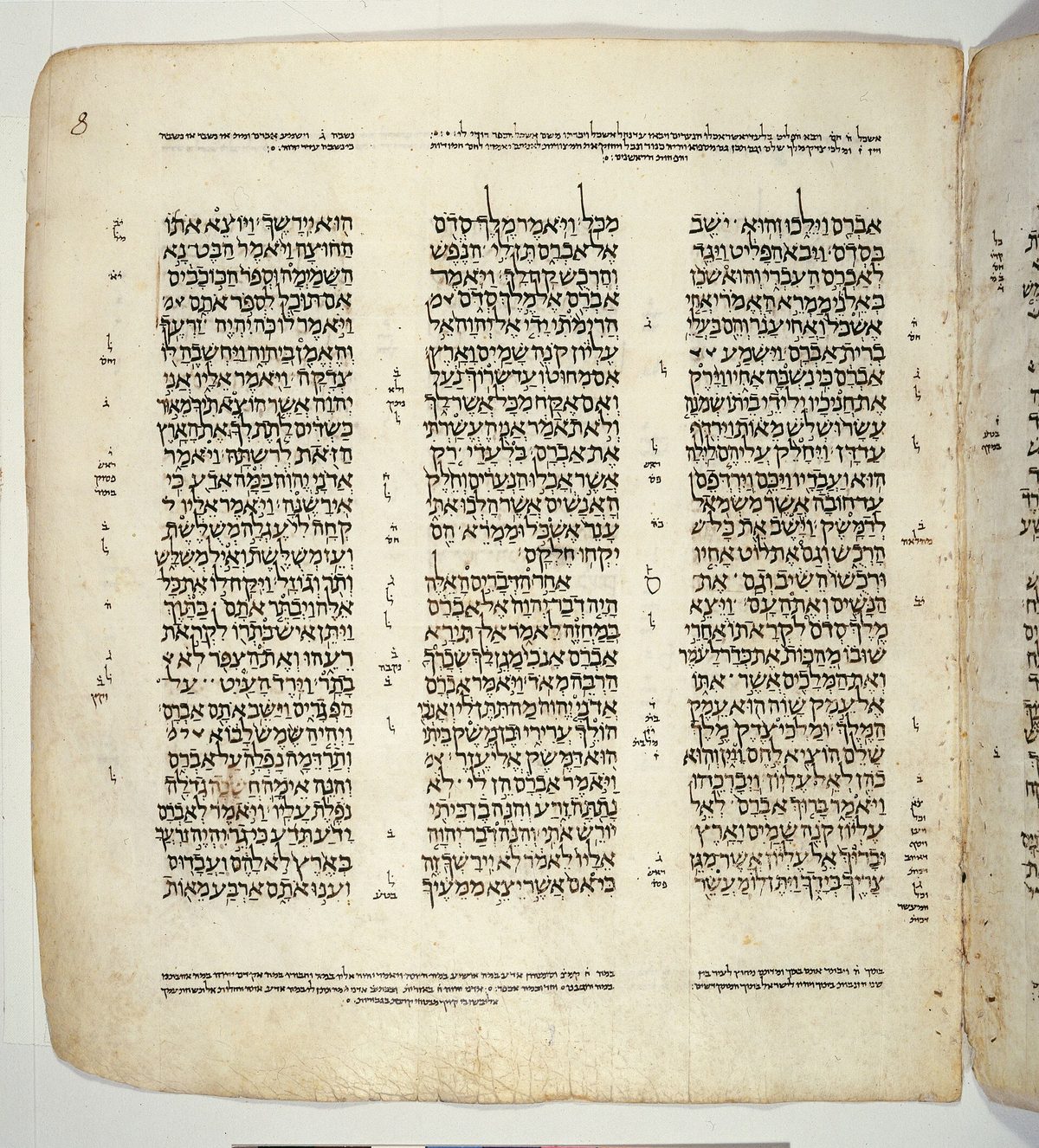
The Leningrad Codex was copied in Cairo in 1008 or 1009 AD and is now in the National Library of Russia in Saint Petersburg. It is the oldest complete manuscript of the Hebrew Bible, and the standard scholarly editions and the Westminster and UXLC digital texts all follow it.
The most important notes for a reader are the ketiv and qere (Aramaic: "written" and "read"). The Masoretes would not change a consonant of the text they received. Where they held that a word should be read differently from how it was written, they left the written consonants (ketiv) in the line and put the reading (qere) in the margin. Printed editions mark the word with a small circle and give the qere in a note. The ketiv in the line usually carries the vowels of the qere, which can make it look like nonsense until you see the note (Gesenius, section 17). Counts differ with the manuscript and the method of counting, from roughly 850 to more than 1,500.
Example: Psalm 100:3
דְּעוּ כִּי־יְהוָה הוּא אֱלֹהִים הוּא־עָשָׂנוּ ולא אֲנַחְנוּ עַמּוֹ וְצֹאן מַרְעִיתוֹ׃
Psalm 100:3, Westminster Leningrad Codex
The unpointed word ולא in the middle is the ketiv, written as the Open Scriptures data give it, without points. Read as וְלֹא it means "and not": "he made us, and not we (ourselves)". The qere is וְלוֹ "and to him", that is, "and his": "he made us, and we are his." The two words sound the same, lo, and differ only in the final letter. Read the qere aloud: [ve-LO a-NAKH-nu a-MO ve-TSON mar-i-TO], "and his we are, his people and the flock of his pasture."
Example: a word read but not written, Ruth 3:5
וַתֹּאמֶר אֵלֶיהָ כֹּל אֲשֶׁר־תֹּאמְרִי אֶעֱשֶׂה׃
Ruth 3:5, Westminster Leningrad Codex
Here the qere adds a word that is not in the line at all: אֵלַי "to me", read after תֹּאמְרִי. The written text says "All that you say I will do"; the reading is "All that you say to me I will do." Manuscripts show this with vowels and no consonants, an empty space with points in it.
Readings that are never written: the perpetual qere
A few words are so common that the Masoretes did not note them each time. You simply know. These are called perpetual qere.
- יְהוָה: the divine name. As lessons 2 and 3 explained, by long Jewish practice it is read Adonai [a-do-NAI], "my Lord", and the vowels written with it point to that reading.
- הִוא: in the five books of Moses the pronoun "she" is usually written הוא, the same consonants as "he", and pointed with hireq: הִוא (Genesis 3:12). Read it הִיא [hi]. Outside the Pentateuch it is written הִיא, as in Ruth 1:3.
- יְרוּשָׁלִַם: Jerusalem is usually written without a yod before the final mem, but the Masoretes put a hireq there as well as the patah or qamets under the lamed, so that it is read Yerushalayim [ye-ru-sha-LA-yim] (Psalm 79:1). The two vowels under one letter look odd; the hireq stands for the yod that is read but not written.
Printed editions mark every ketiv and qere with a note, and so do tanach.us and the Open Scriptures data. When you read such a verse, read the qere aloud, and when you quote it, say so in your notes.
Practice
- Under which root would you look each word up in BDB? (a) וַיִּשְׁמְרוּ (b) הַמֶּלֶךְ (c) מִזְמוֹר (d) לָבוֹא
- Work back to the root, step by step: וַיֵּשְׁבוּ (Ruth 1:4).
- Work back to the root: וַיִּקְרָא (Genesis 1:5).
- Work back to the root: וַיַּבְדֵּל (Genesis 1:4). Which stem is it?
- Work back to the root: וַיָּמָת (Ruth 1:3). How is it pronounced?
- Decode these codes: (a) HVqp3fs (b) HVNw3fs (c) HVpi3ms/Sp1cs (d) HR/Vqc (e) HTd/Ncmpa
- A BDB entry begins [זמר] vb. only Pi. What do the brackets tell you, and what does "only Pi." tell you?
- Name three limits of Strong's numbers.
- Why are וַיֵּלֶךְ (Ruth 1:1) and הֹלֵךְ (Ecclesiastes 1:4) under different Strong's numbers but the same BDB entry?
- In Psalm 100:3, what is the ketiv, what is the qere, and how do the two readings differ in meaning?
- You see הִוא in Genesis 3:12. How do you read it, and why?
- Which free tool would you use (a) to see the full printed BDB entry with all its passages, (b) to check a doubtful vowel in the Leningrad Codex text, (c) to read a passage with a dictionary and traditional commentaries side by side?
Answers
- (a) שׁמר: וַ + יִ...וּ is a wayyiqtol 3mp. (b) מלך: הַ is the article, with dagesh in מ. (c) זמר: מ is a noun prefix; BDB puts the word in the ז section and gives a cross-reference under מ. (d) בוא: לְ plus the infinitive construct of a hollow verb.
- וַ + dagesh: wayyiqtol. יֵ...וּ: 3mp. Left: שׁ and ב. Tsere under the prefix and only two letters: a I-yod root. ישׁב, "sit, dwell": "and they lived (there)."
- וַ + יִ: wayyiqtol 3ms. Left: ק ר א. Three letters, a III-aleph root: קרא, "call". "And he called."
- וַ + יַּ with patah, and tsere before the last letter: Hiphil wayyiqtol 3ms (the short form of יַבְדִּיל). Root בדל, "separate"; Hiphil "divide, separate". The code is HC/Vhw3ms.
- וַ + יָּ with qamets, two letters left, מ and ת: a hollow root, מות "die". The stress is on the prefix and the last vowel is qamets hatuf: [va-YA-mot], "and he died."
- (a) Qal perfect 3fs. (b) Niphal wayyiqtol 3fs (וַתִּשָּׁאֵר, Ruth 1:3). (c) Piel imperfect 3ms with suffix 1cs, "me" (יְנַהֲלֵנִי, Psalm 23:2). (d) preposition + Qal infinitive construct. (e) article + common noun, masculine plural absolute (הַשָּׁמַיִם).
- The brackets mean the form written there does not occur; it is the root, given for convenience. "Only Pi." means the verb occurs only in the Piel stem.
- Any three: the glosses are short and shaped by the King James Version; one verb can have two numbers (1980 and 3212); homonyms can share one number; the numbers do not parse a form; the number is not a meaning.
- Strong numbered by the shape of the form, so forms that look like they come from ילך got 3212 and the others 1980. BDB lists both under הָלַךְ and notes that the imperfect is made as if from ילך.
- Ketiv ולא, read וְלֹא "and not": "he made us, and not we ourselves." Qere וְלוֹ "and his": "he made us, and we are his."
- As הִיא [hi], "she". In the Pentateuch "she" is usually written with the consonants of "he" and pointed with hireq; this is a perpetual qere.
- (a) The BDB scan on the Internet Archive (find the page with the Open Scriptures digital BDB first). (b) tanach.us, the UXLC. (c) Sefaria.
Writing drill
Copy. Start a word notebook if you have not already. On its first page copy these three entries the way BDB arranges them, root first, in print and then in cursive:
- הלך: הָלַךְ vb. go, walk; impf. יֵלֵךְ; מַהֲלָךְ n.m. walk, journey.
- נתן: נָתַן vb. give, put, set; impf. יִתֵּן.
- רעה: רָעָה vb. pasture, tend; ptc. רֹעֶה shepherd; with suffix רֹעִי my shepherd.
Compose. Take five words from Genesis 12:1 and 12:4 in the Reading below that you would have to look up. For each, write a notebook entry in the BDB style: the root, the headword with its part of speech, the meaning that fits this verse, and the parse of the form in the verse. Then write one Hebrew sentence of your own using two of them.
Model answer
- ארץ: אֶרֶץ n.f. land, earth. מֵאַרְצְךָ: מִן + construct + suffix 2ms, "from your land".
- ילד: מוֹלֶדֶת n.f. kindred, birthplace (BDB puts it under ילד, "bear, beget"). וּמִמּוֹלַדְתְּךָ: וּ + מִן + construct + suffix 2ms, "and from your kindred".
- ראה: רָאָה vb. see; Hiphil "show". אַרְאֶךָּ: Hiphil imperfect 1cs + suffix 2ms, "I will show you".
- דבר: דִּבֶּר vb. (Piel) speak. דִּבֶּר: Piel perfect 3ms, "he had spoken".
- יצא: יָצָא vb. go out. בְּצֵאתוֹ: בְּ + Qal infinitive construct + suffix 3ms, "when he went out".
Sentence: הָלַךְ הָאִישׁ מֵאַרְצוֹ [ha-LAKH ha-ISH me-ar-TSO] "The man went from his land."
Speaking drill
Read aloud. Say each form, then its root, then its meaning, three times through. This is how you fix a weak form in memory.
- וַיֵּלֶךְ, הלך, "and he went". [va-YE-lekh, he-lamed-khaf]
- וַיִּתֵּן, נתן, "and he gave". [va-yi-TEN, nun-tav-nun]
- וַיָּקָם, קום, "and he arose". [va-YA-kom, kuf-vav-mem]
- וַיֵּרֶד, ירד, "and he went down". [va-YE-red, yod-resh-dalet]
- רֹעִי, רעה, "my shepherd". [ro-I, resh-ayin-he]
Question and answer. Answer aloud in Hebrew. The model answers use the course's modern pronunciation.
- מָה הַשֹּׁרֶשׁ שֶׁל וַיֵּלֶךְ? [MA ha-SHO-resh shel va-YE-lekh] "What is the root of vayyelekh?" Answer: הָלַךְ. [ha-LAKH] (שֹׁרֶשׁ, "root", is the ordinary Hebrew grammatical term, and the word for the root of a plant.)
- מָה הַשֹּׁרֶשׁ שֶׁל וַיִּתֵּן? [MA ha-SHO-resh shel va-yi-TEN] Answer: נָתַן. [na-TAN]
- מִי הָלַךְ? [MI ha-LAKH] "Who went?" (about Genesis 12:4) Answer: אַבְרָם הָלַךְ. [av-RAM ha-LAKH] "Abram went."
- מִי הָלַךְ אִתּוֹ? [MI ha-LAKH i-TO] "Who went with him?" Answer: לוֹט הָלַךְ אִתּוֹ. [LOT ha-LAKH i-TO] "Lot went with him."
Reading
The call of Abram. Use this passage to practice the lookup method: try each unfamiliar word by hand, write down the root you think it has, and only then check the word help. Notice that לֶךְ and וַיֵּלֶךְ both come from the verb you looked up above. In verse 1 the divine name is read Adonai [a-do-NAI]; English translations traditionally print it "the LORD".
וַיֹּאמֶר יְהוָה אֶל־אַבְרָם לֶךְ־לְךָ מֵאַרְצְךָ וּמִמּוֹלַדְתְּךָ וּמִבֵּית אָבִיךָ אֶל־הָאָרֶץ אֲשֶׁר אַרְאֶךָּ׃
Genesis 12:1, Westminster Leningrad Codex
וַיֵּלֶךְ אַבְרָם כַּאֲשֶׁר דִּבֶּר אֵלָיו יְהוָה וַיֵּלֶךְ אִתּוֹ לוֹט וְאַבְרָם בֶּן־חָמֵשׁ שָׁנִים וְשִׁבְעִים שָׁנָה בְּצֵאתוֹ מֵחָרָן׃
Genesis 12:4, Westminster Leningrad Codex
[va-YO-mer a-do-NAI el av-RAM: lekh le-KHA me-ar-tse-KHA u-mi-mo-lad-te-KHA u-mi-BEIT a-VI-kha el ha-A-rets a-SHER ar-E-ka.]
[va-YE-lekh av-RAM ka-a-SHER di-BER e-LAV a-do-NAI, va-YE-lekh i-TO LOT, ve-av-RAM ben kha-MESH sha-NIM ve-shiv-IM sha-NA be-tse-TO me-kha-RAN.]
Word help
- וַיֹּאמֶר [va-YO-mer]: and he said. Wayyiqtol 3ms of אמר; the א is silent and the prefix takes holem.
- אַבְרָם [av-RAM]: Abram (in Genesis 17 he becomes אַבְרָהָם).
- לֶךְ־לְךָ [lekh le-KHA]: go! Qal imperative 2ms of הלך (formed like a I-yod verb, lesson 16), with לְךָ "for yourself", a dative that sharpens the command: "go off", "get yourself going".
- מֵאַרְצְךָ [me-ar-tse-KHA]: from your land. מִן becomes מֵ before the guttural א; אֶרֶץ in construct with the suffix "your".
- וּמִמּוֹלַדְתְּךָ [u-mi-mo-lad-te-KHA]: and from your kindred. Root ילד "bear, beget"; מוֹלֶדֶת is a noun with the prefix מ, and the וֹ is the original waw of the root. BDB lists it under ילד.
- וּמִבֵּית אָבִיךָ [u-mi-BEIT a-VI-kha]: and from your father's house. בֵּית is the construct of בַּיִת; אָבִיךָ is אָב with the suffix 2ms (Strong's number 1).
- אֲשֶׁר אַרְאֶךָּ [a-SHER ar-E-ka]: that I will show you. Hiphil imperfect 1cs of ראה "see" with the suffix "you"; the Hiphil of "see" is "show". The final ה of the root has dropped before the suffix.
- כַּאֲשֶׁר [ka-a-SHER]: just as.
- דִּבֶּר אֵלָיו [di-BER e-LAV]: he had spoken to him. Piel perfect 3ms of דבר; אֶל with the suffix 3ms.
- אִתּוֹ [i-TO]: with him. The preposition אֵת "with" (not the object marker) with the suffix 3ms.
- לוֹט [LOT]: Lot, Abram's nephew.
- בֶּן־חָמֵשׁ שָׁנִים וְשִׁבְעִים שָׁנָה [ben kha-MESH sha-NIM ve-shiv-IM sha-NA]: seventy-five years old, literally "a son of five years and seventy year(s)". Lesson 17 explained this way of giving age.
- בְּצֵאתוֹ [be-tse-TO]: when he went out. בְּ + Qal infinitive construct of יצא (a I-yod root that has lost its yod, as in שֶׁבֶת from ישׁב) + suffix 3ms.
- מֵחָרָן [me-kha-RAN]: from Haran.
Notes. Count the weak verbs: וַיֹּאמֶר (I-aleph), לֶךְ and וַיֵּלֶךְ (הלך), אַרְאֶךָּ (III-he), בְּצֵאתוֹ (I-yod and III-aleph). Only דִּבֶּר is strong. That is normal: the commonest verbs in Hebrew are weak, which is why lesson 16 matters so much for looking things up. Verse 4 echoes verse 1 on purpose. God says לֶךְ "go", and the narrator answers וַיֵּלֶךְ "and he went", with no word of reply from Abram.
Translation
"The LORD said to Abram, 'Go from your land, from your kindred and from your father's house, to the land that I will show you.'"
"So Abram went, as the LORD had told him, and Lot went with him. Abram was seventy-five years old when he left Haran."
Checklist
- I can explain why BDB is arranged by root and use its cross-references, brackets and Roman numerals.
- I can work a weak form back to its root and say which letter was missing and how I knew.
- I can use a Strong's number to find passages and can name three of its limits.
- I can read an Open Scriptures morphology code, including the prefix and suffix codes after a slash.
- I know what HALOT and DCH are, and which free tools I will use.
- I can spot a ketiv and qere and read the qere aloud, including the perpetual qere of the divine name and of הִוא.
Updated October 28, 2026.
Check yourself
1. Why can you not simply look up וַיִּתֵּן under the letter ו in BDB?
BDB lists words under their roots. וַ is the conjunction of the wayyiqtol, יִ is the third person prefix, and the dagesh in ת stands for a nun that has assimilated. The root is נתן, 'give', on page 678.
2. In the Open Scriptures code HC/Vqw3ms, what does the w mean?
In the verb code the letter after the stem is the conjugation: p perfect, q sequential perfect, i imperfect, w sequential imperfect (the wayyiqtol), v imperative, r active participle, c infinitive construct, a infinitive absolute.
3. Ruth 1:1 has וַיֵּלֶךְ and Ecclesiastes 1:4 has הֹלֵךְ. What do Strong's numbers do with these two forms of the same verb?
Strong split this verb into two numbers, 1980 (הָלַךְ) and 3212 (יָלַךְ), by the shape of the form. BDB puts both under הָלַךְ and notes that the imperfect is usually made 'as if from ילך'. This is one reason a Strong's number is a finding aid, not a definition.
4. Psalm 100:3 has the written text ולא with a qere וְלוֹ. What do you read aloud?
The ketiv (what is written) stays in the consonantal text. The qere (what is read) is the reading the Masoretic notes direct. Here the qere gives 'he made us, and we are his'. The ketiv would mean 'and not we ourselves' (Gesenius, section 17).
5. Which is true of HALOT?
HALOT is the English edition of Koehler and Baumgartner's lexicon, published by Brill in five volumes from 1994 to 2000. It is under copyright and sold, not free. It lists words alphabetically, while BDB groups them under roots.
6. BDB has an entry that reads רֹעִי v. רָעָה. What is it?
The abbreviation v. is Latin vide, 'see'. BDB inserts short cross-reference entries for forms whose root is hard to find. רֹעִי in Psalm 23:1 is the Qal participle of I. רָעָה, 'pasture, tend', with the suffix 'my'.
Terms in this lesson
- Root
- The consonants, usually three, that carry a word's basic meaning, such as ה-ל-ך 'go' or נ-ת-ן 'give'. BDB is arranged by roots.
- BDB
- Brown, Driver and Briggs, A Hebrew and English Lexicon of the Old Testament (1906). The standard older English lexicon, now in the public domain.
- Strong's number
- A number from 1 to 8674 that James Strong gave each Hebrew and Aramaic headword in his concordance of 1890. Many free tools tag words with these numbers.
- Morphology code
- A short string that parses a word, such as HVqp3ms: Hebrew, verb, Qal, perfect, third person, masculine, singular.
- Weak letter
- A root letter that can drop out, assimilate or change in some forms: נ, י, ו, ה, א and the doubled letter of a geminate root.
- Ketiv and qere
- Aramaic for 'written' and 'read'. Where the Masoretes judged that the written consonants should be read differently, they left the ketiv in the text and noted the qere in the margin.
- Interlinear
- An edition that prints an English gloss under each Hebrew word in Hebrew word order.
- Reader's edition
- A Hebrew text with glosses or parsings in footnotes for less common words, meant to keep you reading the Hebrew page.
Sources
- Brown, Driver and Briggs, A Hebrew and English Lexicon of the Old Testament (1906), Internet Archive scan checked 2026-10
- Open Scriptures HebrewLexicon (digitized BDB and Strong; BDB entry headings and page numbers quoted from BrownDriverBriggs.xml) checked 2026-10
- Open Scriptures Hebrew Bible (WLC with lemma and morphology; text public domain, morphology CC BY 4.0) checked 2026-10
- Open Scriptures Hebrew Bible, Hebrew morphology codes checked 2026-10
- Unicode/XML Leningrad Codex (UXLC), tanach.us checked 2026-10
- Sefaria Help Center, An Overview of Reference Tools on Sefaria (BDB, Jastrow, Klein) checked 2026-10
- Gesenius' Hebrew Grammar (Kautzsch and Cowley, 1910), section 17 on qere and ketiv, sections 66, 69 and 72 on weak verbs checked 2026-10
- Wikimedia Commons, Leningrad Codex folio 8a (public domain) checked 2026-10
