Lesson 4 of 22 · about 45 minutes
Syllables, Stress and Reading Aloud
You'll be able to
- Divide any pointed Hebrew word into syllables and say whether each is open or closed
- Place the stress: on the last syllable in most words, on the next to last in segolates, dual nouns and some verb and suffix forms
- Read furtive patah correctly, before the final guttural
- Explain what the maqaf, the pause and the sof pasuq do to words in a verse
- Read Genesis 1:1 to 5 aloud fluently, with correct stress
You can now name every letter and every vowel sign. This lesson puts them together into words you can say aloud with confidence. The two skills are dividing a word into syllables and knowing which syllable to stress. Hebrew gives you firm rules for both, and once you have them you can read any pointed text aloud, even words you have never seen. At the end of the lesson you will read the opening verses of Genesis, one syllable at a time.
Syllables matter for more than reading. Many of the vowel changes in Hebrew grammar happen because a syllable opens or closes, or because the stress moves. When later lessons say "the vowel reduces because it is now two syllables from the stress," this lesson is where that idea starts.
The basic rules
Gesenius (section 26) sets out the shape of a Hebrew syllable. Four rules carry most of the weight:
- Every syllable starts with a consonant. Hebrew has no syllables that begin with a vowel. (There is one exception: the word "and" written וּ, which is the vowel u standing alone, as in וּבֵין [u-VEN] "and between.") Even a word that looks as if it starts with a vowel, like אֱלֹהִים or עַיִן, starts with a consonant, א or ע, which modern speakers have softened to almost nothing.
- Every syllable has exactly one full vowel. Count the full vowels and you have counted the syllables. Shewa and the hateph vowels do not count as full vowels.
- A syllable is open or closed. An open syllable ends in its vowel: consonant + vowel, like דָּ in דָּבָר. A closed syllable ends in a consonant: consonant + vowel + consonant, like בָר in the same word.
- A consonant with vocal shewa or a hateph vowel leans on the next syllable. It is not a full syllable of its own. Grammarians call it a half-syllable. In בְּנֵי [be-NE] the בְּ is said quickly and hangs onto the stressed נֵי.
How shewa and dagesh divide a word
Lesson 2 taught you to tell vocal shewa from silent shewa. Now you can see why it matters. A silent shewa closes a syllable; a vocal shewa begins one.
- מִשְׁפָּט: silent shewa after the short hireq, so the syllables are מִשְׁ | פָּט, [mish-PAT].
- יִשְׁמְרוּ: two shewas; the first is silent and closes יִשְׁ, the second is vocal and leans on the last syllable: יִשְׁ | מְרוּ, [yish-me-RU].
A letter with dagesh forte is doubled, and the two halves belong to different syllables. The first half closes the syllable before it, and the second half opens the next one.
- אִשָּׁה "woman": ish | sha, [ish-SHA]. Modern Israelis do not double the sound, so they say [i-SHA], but the first syllable is still closed in the grammar.
- שַׁבָּת "Sabbath": shab | bat, [sha-BAT] in modern speech.
A quiet letter, such as the א in בָּרָא or רֹאשׁ, does not close a syllable, because it is not pronounced. And a vowel letter, such as the ו in טוֹב or the י in מִי, is part of the vowel, not a consonant.
A recipe for dividing any word
- Find every full vowel. Each one is the center of a syllable.
- Give each vowel the consonant written just before it (the one it is written under or after). That consonant starts the syllable.
- A consonant with vocal shewa or hateph goes with the following syllable.
- A consonant with silent shewa, or with no vowel at all at the end of the word, closes the syllable before it.
- A doubled letter (dagesh forte) is split between two syllables.
- Vowel letters and quiet letters belong to the vowel before them.
Example
אֱלֹהִים "God": full vowels holem and hireq-yod, so two full syllables, plus a half-syllable for the hateph segol: אֱ | לֹ | הִים. The first full syllable is open (lo), the last is closed (him). Said [e-lo-HIM].
חָכְמָה "wisdom": full vowels qamets and qamets, with a silent shewa between: חָכְ | מָה. The first syllable is closed and unstressed, so its qamets is qamets hatuf, o: [khokh-MA]. The final ה is a silent vowel letter, so the last syllable is open.
מִדְבָּר "wilderness": מִדְ | בָּר, both closed, [mid-BAR].
Syllables and vowel length
The syllable type explains the vowels you find in it (Gesenius, sections 26 and 27). These are tendencies, not laws, but they are strong:
- An open syllable that is not stressed usually has a long vowel: the qamets of דָּ in דָּבָר.
- A closed syllable that is not stressed usually has a short vowel: the hireq of מִשְׁ, the patah of הַשׁ in הַשָּׁמַיִם. That is why a qamets in a closed unstressed syllable must be the short qamets hatuf.
- A stressed syllable can have either a long or a short vowel.
- A vowel two or more syllables before the stress, in an open syllable, often reduces to shewa when a word grows: דָּבָר "word" but דְּבָרָיו [de-va-RAV] "his words" (Proverbs 30:6), with shewa under ד. Later lessons on nouns use this constantly.
Stress: milra and mil'el
The Jewish grammatical tradition has two Aramaic words for the two possible stress positions:
- Milra ("from below"): stress on the last syllable. This is the normal pattern. דָּבָר [da-VAR], שָׁלוֹם [sha-LOM], אֱלֹהִים [e-lo-HIM], תּוֹרָה [to-RA].
- Mil'el ("from above"): stress on the next to last syllable. Several large groups of words do this.
Hebrew stress is never earlier than the next to last syllable in a word (Gesenius, section 29). So for any word you only have two choices, and the default is the last syllable. Learn the mil'el groups and you will be right nearly every time.
The mil'el groups
| Group | Examples | Say |
|---|---|---|
| Segolates: nouns of two syllables with a helping vowel (usually segol) in the second | מֶלֶךְ king, אֶרֶץ land, סֵפֶר book, בֹּקֶר morning, חֹשֶׁךְ darkness, נַעַר youth, עֶרֶב evening | [ME-lekh], [E-rets], [SE-fer], [BO-ker], [KHO-shekh], [NA-ar], [E-rev] |
| Words ending in -ayim: the dual ending and the words "water" and "heavens" | מַיִם water, שָׁמַיִם heavens, עֵינַיִם eyes, אָזְנַיִם ears | [MA-yim], [sha-MA-yim], [e-NA-yim], [oz-NA-yim] |
| Some verb forms: the "I" and masculine singular "you" forms of the perfect, and some forms with "and" in front (lessons 11 and 12) | יָדַעְתָּ you knew; וַיֹּאמֶר and he said; וַיֵּרֶד and he went down | [ya-DA-ta], [va-YO-mer], [va-YE-red] |
| Some words with pronoun endings, where the stress stays on the syllable before the ending | אֵלֶיךָ to you; יְנַהֲלֵנִי he leads me | [e-LE-kha], [ye-na-ha-LE-ni] |
| Words with the ending ָה that is not stressed, such as "night" | לָיְלָה night | [LA-ye-la], modern [LAI-la] |
The segolates deserve special attention, because there are hundreds of them and they are among the commonest nouns in the language. Their two vowels are often both segol, which is how they got their name, but the first can also be tsere, holem or patah, and with a guttural the second becomes patah: נַעַר, לֶחֶם. They are stressed on the first syllable because the second vowel was added later, to break up a cluster of two consonants at the end of the word: an older form like malk became מֶלֶךְ. Lesson 6 returns to them.
Stress can change meaning
Sometimes two words have the same letters and the same vowels and differ only in stress. The accents in the Leningrad Codex mark the difference, and this course's guides show it in capitals:
| Word | Stress | Meaning | Where |
|---|---|---|---|
| בָּנוּ | [ba-NU] | they built | Genesis 11:5, "the tower that the sons of man had built" |
| בָּנוּ | [BA-nu] | in us, through us | Numbers 12:2, "has he not spoken through us also?" |
וַיֵּרֶד יְהוָה לִרְאֹת אֶת־הָעִיר וְאֶת־הַמִּגְדָּל אֲשֶׁר בָּנוּ בְּנֵי הָאָדָם׃
Genesis 11:5, Westminster Leningrad Codex
[va-YE-red a-do-NAI lir-OT et-ha-IR ve-et-ha-mig-DAL a-SHER ba-NU be-NE ha-a-DAM] "And the LORD came down to see the city and the tower that the sons of man had built."
Moving stress: nesiga
When a word stressed on its last syllable stands just before a word stressed on its first syllable, two stresses would fall side by side. Hebrew avoids that, and the first word pulls its stress back one syllable (Gesenius, section 29). Genesis 1:5 has a clear case: קָרָא "he called" is normally [ka-RA], but before לָיְלָה [LA-ye-la] the accent sits on its first syllable: [KA-ra LA-ye-la]. You do not need to apply this rule yourself as a beginner, but it explains some guides you will see in this course.
Furtive patah
A guttural at the end of a word after a vowel other than a gets a little a-glide in front of it. The Masoretes wrote this glide as a patah under the guttural, but it is said before the guttural, not after (Gesenius, section 22). It is called furtive patah ("stolen" patah), and it occurs with final ח, ע and הּ (with mappiq):
- רוּחַ [RU-akh] wind, breath, spirit: not ru-kha.
- רָקִיעַ [ra-KI-a] firmament, expanse (Genesis 1:6).
- גָּבֹהַּ [ga-VO-ah] high, tall (1 Samuel 9:2).
The furtive patah does not take the stress and does not count as a full syllable. The stress stays where it would be without it: [RU-akh], [ra-KI-a]. The reason is the one lesson 3 gave: gutturals are made deep in the throat, and the mouth opens toward a as the tongue moves back to make them.
Maqaf: words that travel together
The maqaf ־ is a raised hyphen that ties two or more words into one unit for reading (Gesenius, section 16). The words in the unit share one main stress, which falls on the last word. The words before the maqaf lose their stress, and their vowels often shorten as a result.
| Alone | With maqaf | What changed |
|---|---|---|
| אֵת [ET] (Genesis 1:1), the object marker | אֶת־הָאוֹר [et-ha-OR] (Genesis 1:4) | tsere shortens to segol |
| כֹּל [KOL] all | כָּל־לֵב [kol-LEV] all the heart, a whole heart | holem shortens to qamets hatuf |
| עַל [AL] on, over | עַל־פְּנֵי [al-pe-NE] over the face of (Genesis 1:2) | stress moves to the second word |
| כִּי [KI] that, because | כִּי־טוֹב [ki-TOV] that it was good (Genesis 1:4) | stress moves to the second word |
Short words such as prepositions, the object marker and "all" are the usual ones to take a maqaf. When you read aloud, say the maqaf group as if it were one word.
Pause
The accents divide each verse into halves and smaller parts. The two strongest breaks are the athnah, which marks the middle of the verse, and the silluq, on the last word before the sof pasuq. A word at one of these breaks is "in pause." Pausal words often lengthen their stressed vowel or, in some forms, move their stress (Gesenius, section 29).
Genesis 1 shows the pattern clearly with the word for water:
| Form | Where | Why |
|---|---|---|
| הַמַּיִם [ha-MA-yim] | Genesis 1:7, in the middle of a phrase | ordinary form, patah |
| הַמָּיִם [ha-MA-yim] | Genesis 1:2, last word of the verse; Genesis 1:6 at the athnah | pausal form, the patah lengthened to qamets |
| מַיִם and לָמָיִם | Genesis 1:6, "between water and water," with the second in pause at the end of the verse | ordinary, then pausal |
In modern pronunciation patah and qamets sound the same, so you will not hear the difference. You will see it, and it will keep you from thinking you have found a new word. The same thing happens with אֶרֶץ "land," which in pause becomes אָרֶץ with qamets.
Sof pasuq and paragraph marks
The sof pasuq ׃ ("end of verse"), two diamonds like a colon, closes every verse in the Leningrad Codex. It always follows the word with the silluq. It is not a full stop in the English sense: sometimes a sentence runs on into the next verse, and sometimes a verse holds several sentences. But it is always a place to breathe.
The manuscripts also divide the text into paragraphs. An "open" paragraph, marked in printed Bibles with the letter פ, starts on a new line; a "closed" paragraph, marked with ס, leaves a space within the line. The texts in this course show verses one at a time and leave those marks out.
Reading Genesis 1:1 to 2 syllable by syllable
Now put everything together. Here is the first verse of the Hebrew Bible, followed by a syllable chart and a word-by-word breakdown. Read the chart from right to left, as you would read the verse.
בְּרֵאשִׁית בָּרָא אֱלֹהִים אֵת הַשָּׁמַיִם וְאֵת הָאָרֶץ׃
Genesis 1:1, Westminster Leningrad Codex
| Word | Syllables | Notes | Say |
|---|---|---|---|
| בְּרֵאשִׁית | be | re | SHIT | בְּ has dagesh lene (start of the verse) and vocal shewa (first letter). The א is quiet, so רֵא is open. שִׁית is closed by ת. | [be-re-SHIT] |
| בָּרָא | ba | RA | Dagesh lene in בּ: the word before ends in a consonant. Two open syllables; final א quiet. | [ba-RA] |
| אֱלֹהִים | e | lo | HIM | Hateph segol under the guttural א. | [e-lo-HIM] |
| אֵת | ET | The sign of the definite object, untranslated (lesson 7). One closed syllable. | [ET] |
| הַשָּׁמַיִם | hash | sha | MA | yim | The article הַ doubles the שׁ (dagesh forte). An -ayim word, stressed on the next to last syllable. | [ha-sha-MA-yim]; classical [hash-sha-MA-yim] |
| וְאֵת | ve | ET | "And" plus the object marker. | [ve-ET] |
| הָאָרֶץ | ha | A | rets | The article before א cannot double it, so its vowel is qamets instead of patah. A segolate, stressed on the next to last syllable. Sof pasuq follows. | [ha-A-rets] |
Now read the whole verse at speaking pace, letting the half-syllables be quick and light:
[be-re-SHIT ba-RA e-lo-HIM ET ha-sha-MA-yim ve-ET ha-A-rets]
Then the second verse, which is longer and has two maqaf groups and a furtive patah:
וְהָאָרֶץ הָיְתָה תֹהוּ וָבֹהוּ וְחֹשֶׁךְ עַל־פְּנֵי תְהוֹם וְרוּחַ אֱלֹהִים מְרַחֶפֶת עַל־פְּנֵי הַמָּיִם׃
Genesis 1:2, Westminster Leningrad Codex
| Word | Syllables | Notes | Say |
|---|---|---|---|
| וְהָאָרֶץ | ve | ha | A | rets | "And" + the article + segolate. Stress on the next to last. | [ve-ha-A-rets] |
| הָיְתָה | ha | ye | TA | By the Tiberian rule, the shewa after the long qamets is vocal. Modern Israelis say [hay-TA]. The final ה is silent. | [ha-ye-TA] |
| תֹהוּ | TO | hu | Stressed on the first syllable. No dagesh in ת because the word before ends in a vowel. | [TO-hu] |
| וָבֹהוּ | va | VO | hu | "And" takes qamets here, before a stressed syllable (lesson 7). Soft ב after a vowel. | [va-VO-hu] |
| וְחֹשֶׁךְ | ve | KHO | shekh | A segolate with holem. Final kaf with silent shewa. | [ve-KHO-shekh] |
| עַל־פְּנֵי | al | pe | NE | Maqaf group: one stress, on the last word. Dagesh lene in פּ after the closed syllable עַל. | [al-pe-NE] |
| תְהוֹם | te | HOM | No dagesh in ת: the word before ends in a vowel. | [te-HOM] |
| וְרוּחַ | ve | RU (akh) | Furtive patah: the a-glide comes before the final ח and is not stressed. | [ve-RU-akh] |
| אֱלֹהִים | e | lo | HIM | As in verse 1. | [e-lo-HIM] |
| מְרַחֶפֶת | me | ra | KHE | fet | A participle, "hovering." The stress is on the next to last syllable. Soft פ after a vowel; final ת. | [me-ra-KHE-fet] |
| עַל־פְּנֵי | al | pe | NE | As before. | [al-pe-NE] |
| הַמָּיִם | ham | MA | yim | The article doubles מ. Pausal form with qamets, last word of the verse. | [ha-MA-yim]; classical [ham-MA-yim] |
The whole verse, at speaking pace:
[ve-ha-A-rets ha-ye-TA TO-hu va-VO-hu ve-KHO-shekh al-pe-NE te-HOM ve-RU-akh e-lo-HIM me-ra-KHE-fet al-pe-NE ha-MA-yim]
Translation of verses 1 and 2: "In the beginning God created the heavens and the earth. And the earth was formless and empty, and darkness was over the face of the deep, and the spirit (or wind) of God was hovering over the face of the waters."
Translators debate the first words. בְּרֵאשִׁית has no article, so some render verse 1 as a time clause: "When God began to create the heavens and the earth, the earth was formless..." Both readings have good support. רוּחַ means both "wind" and "spirit," and the phrase can be read either way. You will be able to weigh these questions yourself after the grammar lessons.
Practice
- Divide into syllables and label each open or closed: דָּבָר, מִשְׁפָּט, שָׁלוֹם, מִזְמוֹר.
- How many syllables are in יִשְׂרָאֵל? Say it.
- Where does the doubled letter split in אִשָּׁה and in הַמָּיִם?
- Mark the stress (milra or mil'el): סֵפֶר, תּוֹרָה, עֵינַיִם, אֱמֶת, בֹּקֶר, טוֹב.
- Read with furtive patah: רוּחַ, רָקִיעַ, גָּבֹהַּ. Where is the stress?
- Why is the qamets in כָּל־לֵב said o?
- What happens to אֵת when it is joined to the next word by maqaf?
- Genesis 1:2 ends with הַמָּיִם, Genesis 1:7 has הַמַּיִם. Explain the difference.
- How does stress tell בָּנוּ "they built" from בָּנוּ "in us"?
- In Genesis 1:1, which two words are stressed on the next to last syllable, and why?
- What is the mark ׃ and where does it go?
Answers
- דָּ open | בָר closed [da-VAR]. מִשְׁ closed | פָּט closed [mish-PAT]. שָׁ open | לוֹם closed [sha-LOM]. מִזְ closed | מוֹר closed [miz-MOR].
- Three: יִשְׂ | רָ | אֵל, [yis-ra-EL].
- ish | sha; ham | MA | yim. The first half of the doubled letter closes the first syllable.
- [SE-fer] mil'el (segolate); [to-RA] milra; [e-NA-yim] mil'el (-ayim); [e-MET] milra; [BO-ker] mil'el (segolate); [TOV] one syllable.
- [RU-akh], [ra-KI-a], [ga-VO-ah]. The stress is on the syllable before the furtive patah.
- The maqaf takes away its stress, so כָּל is a closed unstressed syllable, and qamets there is qamets hatuf, o.
- It loses its stress and its tsere shortens to segol: אֶת־, as in אֶת־הָאוֹר.
- The word in Genesis 1:2 is the last word of the verse, in pause, so its stressed vowel is lengthened to qamets. In Genesis 1:7 it stands mid-phrase and keeps patah.
- "They built" is stressed on the last syllable, [ba-NU] (Genesis 11:5); "in us" on the first, [BA-nu] (Numbers 12:2). The letters and vowels are the same.
- הַשָּׁמַיִם, an -ayim word, and הָאָרֶץ, a segolate.
- The sof pasuq, "end of verse." It follows the last word of every verse.
Writing drill
Copy. Copy Genesis 1:1 three times with all its vowel points. The first time, copy it whole. The second time, leave a small gap between syllables and draw a dot over each stressed syllable. The third time, write it whole again from memory and check it.
בְּרֵאשִׁית בָּרָא אֱלֹהִים אֵת הַשָּׁמַיִם וְאֵת הָאָרֶץ׃
Compose. Make your own syllable chart for the words וְחֹשֶׁךְ, תְהוֹם and מְרַחֶפֶת: write each syllable in its own box, label it open, closed or half, and mark the stress. Then write a guide in square brackets for each word.
Model answer
וְחֹשֶׁךְ: וְ half | חֹ open, stressed | שֶׁךְ closed. [ve-KHO-shekh].
תְהוֹם: תְ half | הוֹם closed, stressed. [te-HOM].
מְרַחֶפֶת: מְ half | רַ open | חֶ open, stressed | פֶת closed. [me-ra-KHE-fet].
Speaking drill
Read aloud. Read these stress pairs, exaggerating the stress at first, then at normal speed:
- דָּבָר [da-VAR] and מֶלֶךְ [ME-lekh]
- שָׁלוֹם [sha-LOM] and מַיִם [MA-yim]
- אֱלֹהִים [e-lo-HIM] and שָׁמַיִם [sha-MA-yim]
- עַל־פְּנֵי [al-pe-NE] and כִּי־טוֹב [ki-TOV]
Then read Genesis 1:1 and 1:2 aloud three times, the first time syllable by syllable, the second time word by word, and the third time at speaking pace without stopping.
Answer aloud. Ask about each word with מַה־זֶּה [ma-ZE] "What is this?" and answer in English with the number of syllables and the stressed one.
- (אֶרֶץ) מַה־זֶּה Answer: two syllables, E-rets, stress on the first.
- (תּוֹרָה) מַה־זֶּה Answer: two syllables, to-RA, stress on the last.
- (רָקִיעַ) מַה־זֶּה Answer: two syllables plus a furtive patah, ra-KI-a, stress on KI.
Reading
Read on into the story of the first day. These three verses use only marks and patterns from lessons 1 to 4. Read each verse syllable by syllable first, then at speaking pace with the guide.
וַיֹּאמֶר אֱלֹהִים יְהִי אוֹר וַיְהִי־אוֹר׃
Genesis 1:3, Westminster Leningrad Codex
[va-YO-mer e-lo-HIM ye-HI OR vay-hi-OR]
וַיַּרְא אֱלֹהִים אֶת־הָאוֹר כִּי־טוֹב וַיַּבְדֵּל אֱלֹהִים בֵּין הָאוֹר וּבֵין הַחֹשֶׁךְ׃
Genesis 1:4, Westminster Leningrad Codex
[va-YAR e-lo-HIM et-ha-OR ki-TOV va-yav-DEL e-lo-HIM BEN ha-OR u-VEN ha-KHO-shekh]
וַיִּקְרָא אֱלֹהִים לָאוֹר יוֹם וְלַחֹשֶׁךְ קָרָא לָיְלָה וַיְהִי־עֶרֶב וַיְהִי־בֹקֶר יוֹם אֶחָד׃
Genesis 1:5, Westminster Leningrad Codex
[va-yik-RA e-lo-HIM la-OR YOM ve-la-KHO-shekh KA-ra LA-ye-la vay-hi-E-rev vay-hi-VO-ker YOM e-KHAD]
Word help: וַיֹּאמֶר and he said; יְהִי let there be; אוֹר light; וַיְהִי and there was, said [vay-HI] in this course, as Israelis say it (classically the י has lost a doubling dot, so its shewa counts as vocal, va-ye-HI; Gesenius, section 20); וַיַּרְא and he saw (the final א is quiet); אֶת־ the object marker, joined by maqaf; כִּי־טוֹב that it was good; וַיַּבְדֵּל and he separated; בֵּין between (Israelis say [BEIN]); וּבֵין and between, with "and" as the vowel u; וַיִּקְרָא and he called; לָאוֹר to the light; יוֹם day; וְלַחֹשֶׁךְ and to the darkness; קָרָא he called (stress pulled back before לָיְלָה); לָיְלָה night (modern [LAI-la]); עֶרֶב evening; בֹקֶר morning (no dagesh in ב, because וַיְהִי־ before it ends in a vowel); אֶחָד one.
Look for the patterns: three segolates (חֹשֶׁךְ, עֶרֶב, בֹקֶר), all stressed on the first syllable; five maqaf groups; and the verb forms beginning וַיּ or וַיַּ, "and he...," which carry the story forward. Lesson 12 explains them.
Translation
"And God said, 'Let there be light,' and there was light.
And God saw the light, that it was good, and God separated between the light and the darkness.
And God called the light Day, and the darkness he called Night. And there was evening and there was morning, one day."
Notice "one day," not "the first day": Hebrew uses the plain number "one" here, and the ordinals "second," "third" and so on for the days that follow. Lesson 17 explains Hebrew numbers.
Updated October 28, 2026.
Check yourself
1. How many syllables does מִשְׁפָּט (justice) have, and what kind are they?
There are two full vowels, hireq and qamets, so two syllables. The shewa under שׁ is silent and closes the first one: mish-PAT. Both end in a consonant, so both are closed (Gesenius, section 26).
2. Where is the stress in מֶלֶךְ (king)?
מֶלֶךְ is a segolate noun, one of a large group with two segols (or similar vowels) that are stressed on the next to last syllable. Most other Hebrew words are stressed on the last syllable.
3. In רוּחַ (wind, spirit), when is the patah said?
This is a furtive patah. Under a final ח, ע or הּ after a vowel other than a, the patah slips in before the guttural (Gesenius, section 22). The stress stays on the syllable before.
4. What does a maqaf (the raised hyphen in עַל־פְּנֵי) do?
Words joined by maqaf are read as one stress unit. The first word loses its own stress, and its vowel may shorten: כֹּל becomes כָּל־ said kol (Gesenius, section 16).
5. Genesis 11:5 has בָּנוּ stressed on the last syllable, ba-NU. Numbers 12:2 has בָּנוּ stressed on the first, BA-nu. What is the difference?
The consonants and vowels are identical; only the stress, shown by the accents, tells the verb 'they built' from the preposition with a suffix, 'in us.'
6. Why does Genesis 1:2 end with הַמָּיִם, with qamets, when the same word elsewhere is הַמַּיִם, with patah?
Words at a major break in the verse, especially the last word, take pausal forms, often with a lengthened stressed vowel (Gesenius, section 29). Genesis 1:7 has the ordinary form הַמַּיִם.
Terms in this lesson
- Open syllable
- A syllable that ends in a vowel, such as דָּ in דָּבָר. Unstressed open syllables tend to have long vowels.
- Closed syllable
- A syllable that ends in a consonant, such as מִשְׁ in מִשְׁפָּט. Unstressed closed syllables tend to have short vowels.
- Milra
- Aramaic for 'from below': stress on the last syllable of a word, the usual Hebrew pattern.
- Mil'el
- Aramaic for 'from above': stress on the next to last syllable, as in segolates like מֶלֶךְ [ME-lekh].
- Segolate
- A noun of two syllables stressed on the first, usually with segol in the second, such as מֶלֶךְ king, סֵפֶר book, בֹּקֶר morning, נַעַר youth.
- Furtive patah
- A patah under a final ח, ע or הּ that is said before the guttural, as a glide: רוּחַ [RU-akh].
- Maqaf
- The raised hyphen ־ that joins words into a single stress unit.
- Pause
- The position of a word at a major break in a verse, especially the last word. Words in pause often lengthen or change their stressed vowel.
Sources
- Gesenius' Hebrew Grammar, ed. Kautzsch, trans. Cowley (1910), section 26 (syllables), section 29 (the tone and pause), section 22 (furtive patah), section 16 (maqqef and metheg) checked 2026-10
- Westminster Leningrad Codex (UXLC): Genesis 1:1 to 7, Genesis 11:5, Numbers 12:2 checked 2026-10
- Open Scriptures Hebrew Bible (WLC with morphology and accents), used to check every form and stress checked 2026-10
- Sefaria: Genesis 1, Hebrew with English checked 2026-10
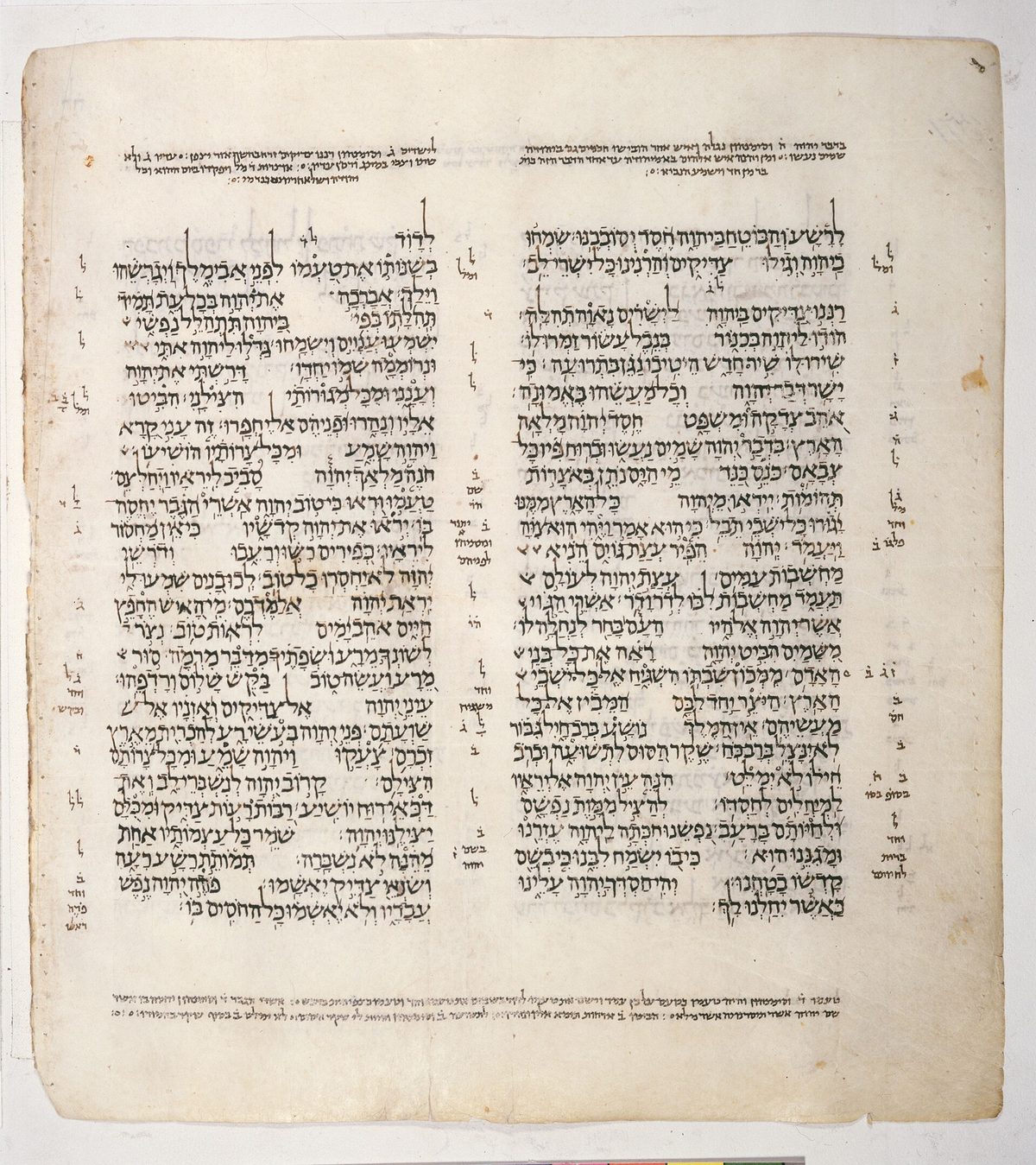
- Wikimedia Commons: Leningrad Codex Folio 371b.jpg (Psalms 32 to 34; public domain, scan by USC Dornsife) checked 2026-10
