Lesson 6 of 22 · about 50 minutes
Nouns: Gender, Number and the Construct State
You'll be able to
- Tell the gender of a noun from its ending, and know the common feminine nouns with no ending (אֶרֶץ, עִיר, יָד, נֶפֶשׁ)
- Form and recognize the plural in ים- and וֹת- and the dual in ַיִם-, including plurals that do not match the gender
- Learn the irregular plurals of אִישׁ, אִשָּׁה, בַּיִת, בֵּן, בַּת, אָב, יוֹם and עִיר
- Recognize segolate nouns (מֶלֶךְ, סֵפֶר, נַעַר) and their plurals
- Form the construct state with its vowel changes and endings (דְּבַר, תּוֹרַת, דִּבְרֵי, עֵינֵי) and read construct chains
- Decide whether a construct chain is definite or indefinite
English nouns are simple: add -s for the plural, and say "of" when one noun belongs to another. Hebrew nouns carry more information in their shape. Every noun is masculine or feminine. It can be singular, plural or dual. And it has two "states": the ordinary form, and a bound form used before another noun to mean "of." That bound form, the construct state, is the single most important idea in this lesson. You will meet it in nearly every verse you read.
The good news: Hebrew nouns have no case endings. Unlike Greek or Latin, a Hebrew noun looks the same whether it is the subject, the object or after a preposition. (If you took Intro to Classical Greek, you can forget about five cases for a while.) What changes is the ending for number and the vowels when the noun is bound to another.
Gender: masculine and feminine
Hebrew has two genders (Gesenius, section 122). Masculine is the default: a noun with no special ending is usually masculine. Feminine nouns usually end in one of two ways (Gesenius, section 80):
- ָה- (qamets + he), stressed: תּוֹרָה [to-RA] instruction, law; שָׁנָה [sha-NA] year; אֲדָמָה [a-da-MA] ground; נַעֲרָה [na-a-RA] young woman.
- ת-, often in an unstressed syllable: בַּת [BAT] daughter; בְּרִית [be-RIT] covenant; דֶּלֶת [DE-let] door.
Where the meaning has a natural sex, the gender follows it, and often the feminine is a different word or the masculine plus an ending:
| Masculine | Say it | Feminine | Say it | Meaning |
|---|---|---|---|---|
| אָב | [AV] | אֵם | [EM] | father / mother |
| בֵּן | [BEN] | בַּת | [BAT] | son / daughter |
| אִישׁ | [ISH] | אִשָּׁה | [i-SHA] | man, husband / woman, wife |
| נַעַר | [NA-ar] | נַעֲרָה | [na-a-RA] | young man / young woman |
| אָח | [AKH] | אָחוֹת | [a-KHOT] | brother / sister (dictionary form; in this course's books with endings, as אֲחֹתִי "my sister," Genesis 12:13) |
| עֶבֶד | [E-ved] | אָמָה | [a-MA] | servant / maidservant |
The man naming the woman in Genesis 2:23 plays on אִישׁ and אִשָּׁה: לְזֹאת יִקָּרֵא אִשָּׁה כִּי מֵאִישׁ לֻקֳחָה־זֹּאת, "this one shall be called Woman, for from Man this one was taken." The two words sound related, and the verse uses that.
Feminine nouns with no ending
Some feminine nouns show nothing on the outside. You learn their gender from the words that agree with them (adjectives and verbs, lessons 8 and 11). The most common groups:
- Lands, cities and places: אֶרֶץ [E-rets] land, earth; עִיר [IR] city. In Genesis 1:2, וְהָאָרֶץ הָיְתָה תֹהוּ וָבֹהוּ, the verb הָיְתָה "was" is feminine because אֶרֶץ is.
- Paired parts of the body: יָד [YAD] hand; עַיִן [A-yin] eye; רֶגֶל [RE-gel] foot; אֹזֶן [O-zen] ear.
- Some others: אֶבֶן [E-ven] stone; נֶפֶשׁ [NE-fesh] life, soul, self (mostly feminine); רוּחַ [RU-ach] wind, spirit (mostly feminine). In Genesis 1:2 וְרוּחַ אֱלֹהִים מְרַחֶפֶת, the participle "hovering" is feminine to match רוּחַ.
Dictionaries tell you the gender. BDB marks each noun "n.m." or "n.f."; some nouns are marked both, because the texts use them both ways.
Number: singular, plural and dual
The two plural endings
The usual masculine plural ending is ִים- [-IM], stressed. The usual feminine plural ending is וֹת- [-OT], also stressed, and it replaces the feminine ָה- (Gesenius, section 87):
| Singular | Plural | Say it | Meaning | Plural found in |
|---|---|---|---|---|
| סוּס | סוּסִים | [su-SIM] | horses | Deuteronomy 17:16 |
| עֵץ | עֵצִים | [e-TSIM] | trees; pieces of wood | Numbers 15:32 |
| דָּבָר | דְּבָרִים | [de-va-RIM] | words, things | Exodus 4:10 |
| תּוֹרָה | תּוֹרֹת | [to-ROT] | instructions, laws | Isaiah 24:5 (written תוֹרֹת there, with no dagesh after a vowel) |
| נַעֲרָה | נְעָרוֹת | [ne-a-ROT] | young women | 1 Samuel 9:11 |
Two spelling notes. First, וֹת- is often written without the waw, as ֹת-, with the same sound: תּוֹרֹת above, or תּוֹלְדֹת and תּוֹלְדוֹת "generations" (Genesis 5:1, 2:4). This "defective" spelling is common in the WLC. Second, ִים- can also be written defectively, as in הַתַּנִּינִם "the sea monsters" (Genesis 1:21).
Vowel reduction in the plural
Look again at דָּבָר [da-VAR] and דְּבָרִים [de-va-RIM]. The ending pulls the stress one syllable to the right (in Hebrew writing, to the left). The qamets two syllables before the new stress, no longer near the stress, shrinks to a shewa. This is vowel reduction, and it is the reason Hebrew nouns change their vowels when you add endings. The rule of thumb: a qamets or tsere in an open syllable two places before the stress reduces; a long vowel written with a vowel letter (וֹ, וּ, ִי, ֵי) does not. That is why סוּס keeps its u in סוּסִים and תּוֹרָה keeps its o in תּוֹרֹת.
Plurals that do not match the gender
The ending does not decide the gender. Some masculine nouns take וֹת- and some feminine nouns take ִים-, and they keep their own gender in the plural:
| Singular | Gender | Plural | Say it | Found in |
|---|---|---|---|---|
| אָב | masculine | אָבוֹת | [a-VOT] | Exodus 34:7 |
| שֵׁם | masculine | שֵׁמוֹת | [she-MOT] | Genesis 2:20 |
| מָקוֹם | masculine | מְקֹמוֹת (construct) | [me-ko-MOT] | Psalm 103:22 |
| שָׁנָה | feminine | שָׁנִים | [sha-NIM] | Genesis 5:6 |
| אִשָּׁה | feminine | נָשִׁים | [na-SHIM] | Genesis 4:19 |
| עִיר | feminine | עָרִים | [a-RIM] | Numbers 32:24 |
| אֶבֶן | feminine | אֲבָנִים | [a-va-NIM] | Genesis 31:46 |
Genesis 1:16 shows why this matters. מָאוֹר "light, lamp" is masculine but makes its plural in ֹת-, so "the great lights" is הַמְּאֹרֹת הַגְּדֹלִים: a noun ending in -ot followed by an adjective ending in -im. The adjective follows the gender, not the look of the ending (lesson 8).
The dual: things that come in pairs
Hebrew has a third number, the dual, with the ending ַיִם- [-A-yim], stressed on the patah (Gesenius, section 88). It is used for:
- Paired body parts: יָדַיִם [ya-DA-yim] hands, עֵינַיִם [ei-NA-yim] eyes, רַגְלַיִם [rag-LA-yim] feet, אָזְנַיִם [oz-NA-yim] ears (the qamets here is qamets hatuf, said o), כְּנָפַיִם [ke-na-FA-yim] wings.
- Two of a unit of time or measure: יוֹמַיִם [yo-MA-yim] two days (Exodus 21:21: אִם־יוֹם אוֹ יוֹמַיִם, "if a day or two days"); שְׁנָתַיִם [she-na-TA-yim] two years (Genesis 45:6).
- Pairs of things: דְּלָתַיִם [de-la-TA-yim] double doors (Deuteronomy 3:5).
Notice that a feminine noun in ָה- brings back its old t before the dual: שָׁנָה, שְׁנָתַיִם. The same t returns in the construct, as you will see below.
Three warnings about the dual:
- For body parts, the dual is the ordinary plural. "Hands" is יָדַיִם even if many people's hands are meant. The plural forms of some of these words exist but mean something else: יָדוֹת means "portions, shares" (חָמֵשׁ יָדוֹת, "five portions," Genesis 43:34), and רְגָלִים means "times, occasions" (שָׁלֹשׁ רְגָלִים, "three times," Exodus 23:14).
- Only nouns have a dual. Adjectives and verbs that go with a dual noun are plural.
- מַיִם [MA-yim] water and שָׁמַיִם [sha-MA-yim] sky, heavens look dual but are plurals of a special kind (Gesenius, section 88). They are always treated as plural: "the waters," "the heavens."
Plurals that mean one thing
Some Hebrew nouns are plural in form but singular in sense. פָּנִים [pa-NIM] face is always plural. חַיִּים [kha-YIM] life is plural: עֵץ הַחַיִּים "the tree of life" (Genesis 2:9). And אֱלֹהִים [e-lo-HIM], when it means the God of Israel, is plural in form but takes a singular verb: בָּרָא אֱלֹהִים, "God created" (Genesis 1:1), with בָּרָא singular. Gesenius calls this the plural of majesty, or of rank (Gesenius, section 124). The same word can mean "gods" with plural agreement when other gods are meant.
Collective nouns
Some singular nouns name a group: צֹאן [TSON] sheep and goats, a flock; עוֹף [OF] birds, flying creatures; בְּהֵמָה [be-he-MA] cattle, animals. Genesis 1:20 says וְעוֹף יְעוֹפֵף עַל־הָאָרֶץ, "and let birds fly above the earth," with a singular noun and a singular verb.
Irregular nouns
A small group of very common nouns forms its plural or construct in unexpected ways (Gesenius, section 96). They are worth learning as a list, because they turn up everywhere. All forms below are in the WLC; the verse given is one place to find each.
| Meaning | Singular | Singular construct | Plural | Plural construct |
|---|---|---|---|---|
| father | אָב | אֲבִי | אָבוֹת | אֲבוֹת |
| Gen 44:19 | Gen 4:20 | Exod 34:7 | Exod 6:25 | |
| brother | אָח | אֲחִי | אַחִים | אֲחֵי |
| Gen 24:29 | Gen 10:21 | Gen 13:8 | Gen 24:27 | |
| man | אִישׁ | אִישׁ | אֲנָשִׁים | אַנְשֵׁי |
| Gen 2:24 | Gen 9:5 | Gen 12:20 | Gen 6:4 | |
| woman | אִשָּׁה | אֵשֶׁת | נָשִׁים | נְשֵׁי |
| Gen 2:23 | Gen 11:29 | Gen 4:19 | Gen 4:23 | |
| house | בַּיִת | בֵּית | בָּתִּים | בָּתֵּי |
| Exod 12:30 | Gen 12:15 | Exod 1:21 | Exod 8:17 | |
| son | בֵּן | בֶּן | בָּנִים | בְּנֵי |
| Gen 4:25 | Gen 5:32 | Gen 5:4 | Gen 6:4 | |
| daughter | בַּת | בַּת | בָּנוֹת | בְּנוֹת |
| Gen 30:21 | Gen 11:29 | Gen 30:13 | Gen 6:2 | |
| day | יוֹם | יוֹם | יָמִים | יְמֵי |
| Gen 1:5 | Gen 2:4 (in בְּיוֹם) | Gen 4:3 | Gen 3:14 | |
| city | עִיר | עִיר | עָרִים | עָרֵי |
| Gen 4:17 | Gen 24:10 | Num 32:24 | Gen 19:29 |
Say them: אָב, אֲבִי, אָבוֹת, אֲבוֹת [AV, a-VI, a-VOT, a-VOT]; אָח, אֲחִי, אַחִים, אֲחֵי [AKH, a-KHI, a-KHIM, a-KHEI]; אִישׁ, אֲנָשִׁים, אַנְשֵׁי [ISH, a-na-SHIM, an-SHEI]; אִשָּׁה, אֵשֶׁת, נָשִׁים, נְשֵׁי [i-SHA, E-shet, na-SHIM, ne-SHEI]; בַּיִת, בֵּית, בָּתִּים, בָּתֵּי [BA-yit, BEIT, ba-TIM, ba-TEI]; בֵּן, בֶּן, בָּנִים, בְּנֵי [BEN, ben, ba-NIM, be-NEI]; בַּת, בָּנוֹת, בְּנוֹת [BAT, ba-NOT, be-NOT]; יוֹם, יָמִים, יְמֵי [YOM, ya-MIM, ye-MEI]; עִיר, עָרִים, עָרֵי [IR, a-RIM, a-REI].
Some notes:
- אִישׁ and אִשָּׁה form their plurals from other bases. נָשִׁים has a masculine-looking ending but is feminine.
- בֶּן in the construct is usually joined by maqaf: בֶּן־נָחוֹר "son of Nahor" (Genesis 29:5).
- The qamets in בָּתִּים is unusual: a long vowel before a doubled consonant, which the normal rules do not predict. Grammars treat בַּיִת as its own case (Gesenius, section 96). Say [ba-TIM].
- אָב and אָח add ִי- in the construct: אֲבִי־מִלְכָּה "the father of Milcah" (Genesis 11:29). This i is an old ending that survived in these short words.
Segolate nouns
Many of the commonest Hebrew nouns are stressed on the first syllable and have a segol (sometimes a patah) in the second: מֶלֶךְ [ME-lekh] king, סֵפֶר [SE-fer] book, document, עֶבֶד [E-ved] servant, אֶרֶץ [E-rets] land, נַעַר [NA-ar] young man, אֹהֶל [O-hel] tent, בֹּקֶר [BO-ker] morning. They are called segolates. Lesson 4 noted that they break the usual rule of final stress.
The reason is history. These words go back to bases with one vowel and two consonants at the end: something like malk, sipr, qudš. Hebrew does not like a word to end in two consonants, so a helping vowel slipped in between them, usually a segol, and the original vowel changed to fit: malk became מֶלֶךְ, sipr became סֵפֶר, qudš became קֹדֶשׁ (Gesenius, section 93). When a guttural is involved, the helping vowel is patah: נַעַר.
Why this matters: when the noun takes endings, the old base can reappear. The plural is regular in its own way, following the pattern קְטָלִים, but the plural construct and the forms with pronoun endings go back to the old one-vowel base.
| Meaning | Singular | Plural | Plural construct | Base shows in |
|---|---|---|---|---|
| king | מֶלֶךְ | מְלָכִים | מַלְכֵי | מַלְכִּי my king (Psalm 2:6) |
| Gen 36:31 | Gen 14:9 | Gen 17:16 | ||
| servant | עֶבֶד | עֲבָדִים | עַבְדֵי | עַבְדְּךָ your servant (Genesis 43:28) |
| Gen 9:26 | Gen 9:25 | Gen 21:25 | ||
| young man | נַעַר | נְעָרִים | נַעֲרֵי | לְנַעֲרוֹ to his young man (Ruth 2:5) |
| Gen 37:2 | 1 Sam 25:5 | Exod 24:5 | ||
| book | סֵפֶר | סְפָרִים | ||
| Deut 17:18 | Eccl 12:12 | not in this course's books | ||
| tent | אֹהֶל | אֹהָלִים | אָהֳלֵי | |
| Gen 4:20 | Gen 25:27 | Num 16:26 | ||
| stone (f.) | אֶבֶן | אֲבָנִים | אַבְנֵי | |
| Exod 17:12 | Gen 31:46 | Exod 25:7 | ||
| life, soul (f.) | נֶפֶשׁ | נְפָשׁוֹת | נַפְשׁוֹת | נַפְשִׁי my soul (Genesis 12:13) |
| Gen 1:20 | Prov 14:25 | Gen 36:6 |
Say them: [ME-lekh, me-la-KHIM, mal-KHEI, mal-KI]; [E-ved, a-va-DIM, av-DEI]; [NA-ar, ne-a-RIM, na-a-REI]; [SE-fer, se-fa-RIM]; [O-hel, o-ha-LIM, o-ho-LEI]; [E-ven, a-va-NIM, av-NEI]; [NE-fesh, ne-fa-SHOT, naf-SHOT]. In אָהֳלֵי the first vowel is a qamets hatuf, said o.
Segolates also have pause forms with qamets or tsere in the first syllable: אָרֶץ beside אֶרֶץ, נָפֶשׁ beside נֶפֶשׁ, עָבֶד beside עֶבֶד. The meaning does not change. אֶרֶץ also takes qamets after the article, wherever it stands: הָאָרֶץ in Genesis 1:1 and 1:2 alike (Gesenius, section 35). Without the article, at a pause, it is אָרֶץ, as at the end of Exodus 15:12.
The construct state (smikhut)
English says "the word of the LORD." Hebrew says דְּבַר יְהוָה [de-VAR a-do-NAI]: two nouns side by side, with no word for "of." The relationship is shown by changing the first noun into its construct form. The second noun stays in its ordinary absolute form (Gesenius, section 89). Modern grammar calls the pair a סְמִיכוּת [smi-KHUT], "a leaning": the first noun leans on the second.
אַחַר הַדְּבָרִים הָאֵלֶּה הָיָה דְבַר־יְהוָה אֶל־אַבְרָם
Genesis 15:1 (first part), Westminster Leningrad Codex
"After these things the word of the LORD came to Abram." The construct דְבַר is joined to יְהוָה by a maqaf. (The beginning letter ד has no dagesh here because the word before ends in a vowel; lesson 2 covered this.)
The construct noun and the following noun are said as one unit, with the main stress on the second noun. Because the construct noun loses its own main stress, its vowels can reduce. That is the source of all the changes below.
How the construct changes the first noun
| Type | Absolute | Construct | Example in a verse |
|---|---|---|---|
| Long vowels reduce | דָּבָר | דְּבַר | דְבַר־יְהוָה the word of the LORD (Gen 15:1) |
| Long vowels reduce | מָקוֹם | מְקוֹם | מְקוֹם (Gen 12:6) the place of |
| Feminine ָה- becomes ַת- | תּוֹרָה | תּוֹרַת | תּוֹרַת (Exod 13:9) the law of |
| Feminine ָה- becomes ַת- | שָׁנָה | שְׁנַת | שְׁנַת (Gen 41:50) the year of |
| Feminine ָה- becomes ַת- | חַיָּה | חַיַּת | חַיַּת הָאָרֶץ the animals of the earth (Gen 1:25) |
| Masculine plural ִים- becomes ֵי- | דְּבָרִים | דִּבְרֵי | דִּבְרֵי רִבְקָה the words of Rebekah (Gen 24:30) |
| Masculine plural ִים- becomes ֵי- | בָּנִים | בְּנֵי | בְנֵי־הָאֱלֹהִים the sons of God (Gen 6:2) |
| Dual ַיִם- becomes ֵי- | עֵינַיִם | עֵינֵי | עֵינֵי שְׁנֵיהֶם the eyes of both of them (Gen 3:7) |
| Dual ַיִם- becomes ֵי- | יָדַיִם | יְדֵי | עַל־יְדֵי אֲחֹתוֹ on his sister's hands (Gen 24:30) |
| Feminine plural keeps וֹת- | בָּנוֹת | בְּנוֹת | בְּנוֹת הָאָדָם the daughters of man (Gen 6:2) |
| Diphthong contracts | בַּיִת | בֵּית | בֵּית פַּרְעֹה Pharaoh's house (Gen 12:15) |
| Diphthong contracts | עַיִן | עֵין | עֵין (Gen 16:7) the spring of |
| Final ֶה- becomes ֵה- | שָׂדֶה | שְׂדֵה | שְׂדֵה (Gen 14:7) the field of |
| Segolates: usually no change | מֶלֶךְ | מֶלֶךְ | מֶלֶךְ־סְדֹם the king of Sodom (Gen 14:17) |
| Words with unchangeable vowels: no change | סוּס | סוּס | סוּס (Exod 14:9) the horse(s) of |
Say the pairs: [da-VAR, de-VAR]; [ma-KOM, me-KOM]; [to-RA, to-RAT]; [sha-NA, she-NAT]; [kha-YA, kha-YAT]; [de-va-RIM, div-REI]; [ba-NIM, be-NEI]; [ei-NA-yim, ei-NEI]; [ya-DA-yim, ye-DEI]; [ba-NOT, be-NOT]; [BA-yit, BEIT]; [A-yin, EIN]; [sa-DE, se-DE].
Look at דִּבְרֵי. From דְּבָרִים, the ending changes to ֵי-, and the stress moves even further from the qamets, so it too reduces. Two shewas cannot stand together at the start of a word, so the first becomes hireq: דִּבְרֵי [div-REI]. Segolate plurals do the same and show their old base: מַלְכֵי, עַבְדֵי.
Many construct nouns are joined to the next word with a maqaf, especially short ones: בֶּן־, בַּת־, בֵּית־, אֵשֶׁת־. But the maqaf is optional, and plenty of construct nouns stand without it, as in בֵּית פַּרְעֹה.
A verse full of construct forms
Genesis 11:29 names the wives of Abram and his brother Nahor. Count the construct forms:
וַיִּקַּח אַבְרָם וְנָחוֹר לָהֶם נָשִׁים שֵׁם אֵשֶׁת־אַבְרָם שָׂרָי וְשֵׁם אֵשֶׁת־נָחוֹר מִלְכָּה בַּת־הָרָן אֲבִי־מִלְכָּה וַאֲבִי יִסְכָּה׃
Genesis 11:29, Westminster Leningrad Codex
"And Abram and Nahor took wives for themselves. The name of Abram's wife was Sarai, and the name of Nahor's wife was Milcah, the daughter of Haran, the father of Milcah and the father of Iscah."
- נָשִׁים: absolute plural, "wives."
- שֵׁם אֵשֶׁת־אַבְרָם: a chain of three, "the name of the wife of Abram." שֵׁם and אֵשֶׁת are construct; אַבְרָם is the absolute.
- בַּת־הָרָן: "daughter of Haran."
- אֲבִי־מִלְכָּה וַאֲבִי יִסְכָּה: "father of Milcah and father of Iscah." Each construct noun gets its own following noun. Hebrew repeats the construct rather than saying "the father of Milcah and Iscah."
Construct chains
A chain can be longer than two. Every noun except the last is in the construct state. Pharaoh's polite question to Jacob in Genesis 47:8 has a chain of three, and Jacob's answer has one of four:
וַיֹּאמֶר פַּרְעֹה אֶל־יַעֲקֹב כַּמָּה יְמֵי שְׁנֵי חַיֶּיךָ׃
Genesis 47:8, Westminster Leningrad Codex
"And Pharaoh said to Jacob, 'How many are the days of the years of your life?'" Jacob answers in the next verse, and near its end says that his years have not reached יְמֵי שְׁנֵי חַיֵּי אֲבֹתַי, "the days of the years of the life of my fathers."
Read the chain from right to left: יְמֵי "the days of," שְׁנֵי "the years of," חַיֵּי "the life of," אֲבֹתַי "my fathers." Each of the first three is a masculine plural construct in ֵי-: יָמִים, יְמֵי; שָׁנִים, שְׁנֵי; חַיִּים, חַיֵּי. (שְׁנֵי here is "years of," the construct of שָׁנִים. Do not confuse it with שְׁנֵי "two of," which looks the same; context decides. Some electronic tagging of this verse mixes the two up.) The last word, אֲבֹתַי, is אָבוֹת "fathers" with the ending "my" (lesson 9).
A three-noun chain with a person at the end appears in Genesis 14:12, where Lot is בֶּן־אֲחִי אַבְרָם, "the son of the brother of Abram," that is, Abram's nephew.
What the construct can mean
"Of" in English covers many relationships, and so does the construct (Gesenius, section 128). A few common ones:
| Relationship | Hebrew | Meaning | Verse |
|---|---|---|---|
| Possession | בֵּית פַּרְעֹה | Pharaoh's house | Genesis 12:15 |
| Family relation | בַּת־בְּתוּאֵל | the daughter of Bethuel | Genesis 24:24 |
| Ruler of a place | מֶלֶךְ שָׁלֵם | the king of Salem | Genesis 14:18 |
| Material or contents | עֶדְרֵי־צֹאן | flocks of sheep | Genesis 29:2 |
| Quality (like an adjective) | אִישׁ מִלְחָמָה | a man of war, a warrior | Exodus 15:3 |
| Part of a whole | רֹאשׁ הָהָר | the top of the mountain | Exodus 19:20 |
| Place | שְׂדֵי מוֹאָב | the fields (country) of Moab | Ruth 1:2 |
| Superlative | עֶבֶד עֲבָדִים | a servant of servants, the lowest slave | Genesis 9:25 |
The construct of quality is very common where English would use an adjective. אִישׁ מִלְחָמָה is "a warrior"; Rachel in Genesis 29:17 is יְפַת־תֹּאַר וִיפַת מַרְאֶה, "beautiful of form and beautiful of appearance," with the adjective יָפָה itself in the construct.
Definiteness in a chain
This is the rule that surprises English speakers most (Gesenius, section 127):
- A construct noun never takes the article. You will never see הַ on the first noun of a chain.
- The whole chain is definite if the last noun is definite, and indefinite if the last noun is indefinite. The last noun is definite if it has the article, is a proper name, or has a pronoun ending.
| Hebrew | Last noun | Meaning | Verse |
|---|---|---|---|
| עֵץ הַגָּן | has the article | the trees of the garden | Genesis 3:8 |
| חַיַּת הָאָרֶץ | has the article | the animals of the earth | Genesis 1:25 |
| דְבַר־יְהוָה | proper name | the word of the LORD | Genesis 15:1 |
| בֵּית פַּרְעֹה | proper name | the house of Pharaoh | Genesis 12:15 |
| יְמֵי שְׁנֵי חַיֶּיךָ | pronoun ending | the days of the years of your life | Genesis 47:8 |
| אִישׁ מִלְחָמָה | indefinite | a man of war | Exodus 15:3 |
| עֶדְרֵי־צֹאן | indefinite | flocks of sheep | Genesis 29:2 |
| עֵץ פְּרִי | indefinite | fruit trees, trees of fruit | Genesis 1:11 |
So "the tree of the garden" and "the garden's tree" are both עֵץ הַגָּן. If you want "a tree of the garden," indefinite first noun with a definite second noun, Hebrew uses a different construction with the preposition לְ (lesson 7).
Genesis 3:8 uses עֵץ in the singular as a collective: בְּתוֹךְ עֵץ הַגָּן, "among the trees of the garden." Context, not form, says "trees."
Where does the adjective go?
Nothing comes between the construct noun and the noun after it. An adjective that describes the first noun has to wait until after the whole chain, and it agrees with the noun it describes. Genesis 43:27 has אֲבִיכֶם הַזָּקֵן, "your father, the old one," with the adjective after the noun-plus-suffix. Lesson 8 shows how to tell which noun an adjective after a chain belongs to.
A page of the Leningrad Codex
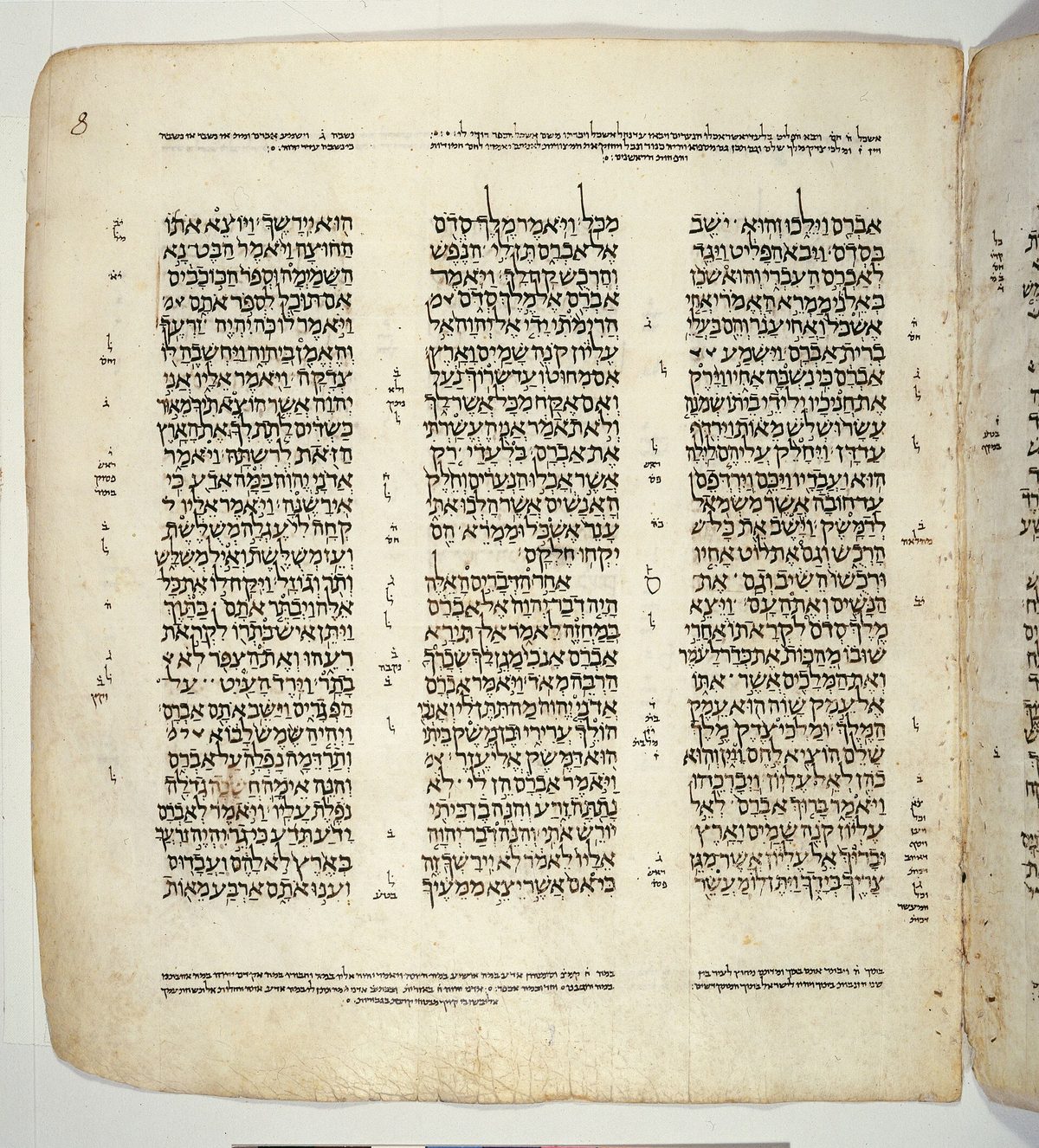
This page holds the story of Abram rescuing Lot and meeting Melchizedek, and it is thick with construct forms. On it you can find בֶּן־אֲחִי אַבְרָם "the son of Abram's brother" (14:12), מֶלֶךְ־סְדֹם "the king of Sodom" and עֵמֶק הַמֶּלֶךְ "the King's Valley" (14:17), מֶלֶךְ שָׁלֵם "the king of Salem" (14:18), and at the top of chapter 15, דְבַר־יְהוָה. The scribe also wrote the small vowel points and accent marks you have been learning, plus tiny notes in the margins (the Masorah) that count and check unusual spellings.
Putting it together
Example
Parse each phrase: say which noun is construct, which is absolute, whether the phrase is definite, and translate.
- בְּנֵי יִשְׂרָאֵל [be-NEI yis-ra-EL]: בְּנֵי construct plural of בֵּן; יִשְׂרָאֵל proper name, absolute; definite: "the sons of Israel," often "the Israelites."
- אֵשֶׁת־נָחוֹר: construct of אִשָּׁה; definite: "Nahor's wife" (Genesis 11:29).
- עֵינֵי שְׁנֵיהֶם: עֵינֵי dual construct of עַיִן; "the eyes of the two of them" (Genesis 3:7).
- תוֹלְדוֹת הַשָּׁמַיִם וְהָאָרֶץ: תּוֹלְדוֹת feminine plural construct; two definite nouns joined by "and" both depend on it; "the generations (origins) of the heavens and the earth" (Genesis 2:4).
Practice
- Give the gender of each, and say how you know: תּוֹרָה, מֶלֶךְ, עִיר, בְּרִית, יָד.
- Give the plural: סוּס, דָּבָר, אָב, שָׁנָה, אִישׁ.
- Which of these are dual: יָדַיִם, מַיִם, יוֹמַיִם, יָמִים, רַגְלַיִם?
- Give the singular of these segolate plurals: מְלָכִים, עֲבָדִים, סְפָרִים.
- Give the construct form: תּוֹרָה, בַּיִת, דְּבָרִים, עֵינַיִם, אִשָּׁה.
- Translate: בֵּית לֶחֶם (word for word, then as a name).
- Translate and say whether definite: עֵץ פְּרִי; עֵץ הַגָּן; דִּבְרֵי רִבְקָה.
- What is wrong with הַבֵּית הַמֶּלֶךְ for "the king's house"? Correct it.
- Translate the chain בֶּן־אֲחִי אַבְרָם (Genesis 14:12).
- Why is the verb in וְהָאָרֶץ הָיְתָה feminine?
- What does רְגָלִים mean in Exodus 23:14, and how is it different from רַגְלַיִם?
- Name two plural nouns that take a singular meaning, and give the meaning.
Answers
- תּוֹרָה feminine (ending ָה-); מֶלֶךְ masculine (no ending, male); עִיר feminine (cities are feminine, no ending); בְּרִית feminine (ending ת-); יָד feminine (paired body part).
- סוּסִים, דְּבָרִים, אָבוֹת, שָׁנִים, אֲנָשִׁים.
- יָדַיִם, יוֹמַיִם, רַגְלַיִם. מַיִם only looks dual; יָמִים is plural.
- מֶלֶךְ, עֶבֶד, סֵפֶר.
- תּוֹרַת, בֵּית, דִּבְרֵי, עֵינֵי, אֵשֶׁת.
- "House of bread"; Bethlehem.
- "Fruit trees" (indefinite); "the trees (or the tree) of the garden" (definite); "the words of Rebekah" (definite, proper name).
- A construct noun cannot take the article, and בַּיִת must be in the construct. Correct: בֵּית הַמֶּלֶךְ.
- "The son of the brother of Abram," Abram's nephew.
- Because אֶרֶץ is feminine, even without a feminine ending.
- "Times, occasions" (three times a year). רַגְלַיִם is the dual, "feet."
- Any two of: פָּנִים face; חַיִּים life; אֱלֹהִים God (with a singular verb); מַיִם water; שָׁמַיִם heavens.
Writing drill
Copy. Copy these pairs, absolute then construct, twice each in print and once in cursive. Point every vowel.
דָּבָר / דְּבַר · תּוֹרָה / תּוֹרַת · בַּיִת / בֵּית · דְּבָרִים / דִּבְרֵי · עֵינַיִם / עֵינֵי · בָּנוֹת / בְּנוֹת · אִשָּׁה / אֵשֶׁת
Cursive line (unpointed): דבר תורת בית דברי עיני בנות אשת
Compose. Write six construct phrases about your own family and home, using only the nouns in this lesson and names. For example: "the house of my father" (use אָבִי "my father," Genesis 22:7), "the daughter of Dana," "the name of the city." Then make one chain of three nouns.
Model answer
בֵּית אָבִי · בַּת־דָּנָה · שֵׁם הָעִיר · אֵשֶׁת־דָּוִד · בְּנֵי הָעִיר · סֵפֶר הַנַּעַר
שֵׁם אֵשֶׁת־דָּוִד
Translation: my father's house; Dana's daughter; the name of the city; David's wife; the people (sons) of the city; the young man's book. Chain: the name of David's wife (built on Genesis 11:29, שֵׁם אֵשֶׁת־אַבְרָם).
Note: בֵּית אָבִי is a real phrase in the texts: Abraham says God took him מִבֵּית אָבִי, "from my father's house" (Genesis 24:7). The article goes only on the last noun: שֵׁם הָעִיר, never הַשֵּׁם הָעִיר.
Speaking drill
Read aloud. Say each pair, putting the main stress on the second word of each construct phrase: the first word leans on it.
- דְּבַר יְהוָה [de-VAR a-do-NAI]
- בֵּית לֶחֶם [beit LE-khem]
- בֶּן־נָחוֹר [ben-na-KHOR]
- בְּנוֹת הָאָדָם [be-NOT ha-a-DAM]
- עֵץ הַחַיִּים [ETS ha-kha-YIM]
- יְמֵי שְׁנֵי חַיֶּיךָ [ye-MEI she-NEI kha-YE-kha]
Question and answer. Answer each question with a construct phrase. Sample answers follow.
- בַּת־מִי אַתְּ? "Whose daughter are you?" (Genesis 24:23). Sample: בַּת־דָּוִד אָנֹכִי. "I am David's daughter."
- בֶּן־מִי אַתָּה? "Whose son are you?" (built on the same pattern). Sample: בֶּן־יוֹסֵף אָנֹכִי.
- מָה שֵׁם הָעִיר? Sample: בֵּית לֶחֶם.
- מֵאַיִן אַתָּה? Sample: מֵאֶרֶץ כְּנַעַן. "From the land of Canaan." (בְּאֶרֶץ כְּנָעַן "in the land of Canaan" is in Genesis 42:13.)
Reading
The opening of the book of Ruth. These are real verses from the Westminster Leningrad Codex. They are full of construct forms; find them all before you read the translation. Two verb forms are new (they come in lessons 12 and 14), so they are glossed.
וַיְהִי בִּימֵי שְׁפֹט הַשֹּׁפְטִים וַיְהִי רָעָב בָּאָרֶץ וַיֵּלֶךְ אִישׁ מִבֵּית לֶחֶם יְהוּדָה לָגוּר בִּשְׂדֵי מוֹאָב הוּא וְאִשְׁתּוֹ וּשְׁנֵי בָנָיו׃
Ruth 1:1, Westminster Leningrad Codex
וְשֵׁם הָאִישׁ אֱלִימֶלֶךְ וְשֵׁם אִשְׁתּוֹ נָעֳמִי וְשֵׁם שְׁנֵי־בָנָיו מַחְלוֹן וְכִלְיוֹן אֶפְרָתִים מִבֵּית לֶחֶם יְהוּדָה וַיָּבֹאוּ שְׂדֵי־מוֹאָב וַיִּהְיוּ־שָׁם׃
Ruth 1:2, Westminster Leningrad Codex
Word help:
- וַיְהִי [vai-HI] and it happened, and there was
- בִּימֵי [bi-MEI] in the days of (בְּ "in" + יְמֵי; lesson 7 explains the spelling)
- שְׁפֹט הַשֹּׁפְטִים the judging of the judges, that is, when the judges judged (שְׁפֹט is an infinitive, lesson 14, used here like a construct noun)
- רָעָב [ra-AV] famine
- וַיֵּלֶךְ [va-YE-lekh] and (he) went
- לָגוּר [la-GUR] to live as a foreigner, to sojourn
- בִּשְׂדֵי in the fields (country) of; שְׂדֵי is the plural construct of שָׂדֶה
- אִשְׁתּוֹ [ish-TO] his wife (אֵשֶׁת + "his"); בָנָיו [va-NAV] his sons
- שְׁנֵי here: "the two of" (construct of the number two, lesson 17)
- אֶפְרָתִים Ephrathites, a clan of Bethlehem
- וַיָּבֹאוּ and they came; וַיִּהְיוּ־שָׁם and they were there, they stayed there
Translation
And it happened in the days when the judges judged, that there was a famine in the land, and a man went from Bethlehem in Judah to live as a foreigner in the country of Moab, he and his wife and his two sons.
And the name of the man was Elimelech, and the name of his wife was Naomi, and the names of his two sons were Mahlon and Chilion, Ephrathites from Bethlehem in Judah. And they came to the country of Moab and stayed there.
Construct forms: יְמֵי, שְׁפֹט, בֵּית (twice), שְׂדֵי (twice), שְׁנֵי (twice), שֵׁם (three times). Notice בֵּית לֶחֶם יְהוּדָה, "Bethlehem of Judah": a place name followed by the region, to tell it apart from another Bethlehem. And וְשֵׁם הָאִישׁ אֱלִימֶלֶךְ has no verb "was": a noun clause, the same as שֵׁם אֵשֶׁת־אַבְרָם שָׂרָי in Genesis 11:29.
Updated October 28, 2026.
Check yourself
1. Which of these nouns is feminine even though it has no feminine ending?
אֶרֶץ 'land, earth' is feminine by usage, like עִיר 'city' and the paired body parts יָד, עַיִן, רֶגֶל. מֶלֶךְ, יוֹם and דָּבָר are masculine.
2. What is the construct form of תּוֹרָה, as in 'the law of the LORD'?
Feminine nouns in ָה- change the ending to ַת- in the construct: תּוֹרָה becomes תּוֹרַת (Exodus 13:9). The holem waw in the first syllable is unchangeable, so it does not reduce.
3. What makes the chain יְמֵי שְׁנֵי חַיֶּיךָ (Genesis 47:8) definite, 'the days of the years of your life'?
A chain is definite when its last noun is definite: with the article, as a proper name, or with a pronoun ending. חַיֶּיךָ has the ending ךָ 'your,' so the whole chain is definite. A construct noun such as יְמֵי never takes the article.
4. Why does the construct noun in בֵּית לֶחֶם never take the article?
A construct noun never takes the article. The whole chain is definite or indefinite according to its last noun (Gesenius, section 127). בֵּית לֶחֶם is a place name, so it is definite as a name.
5. Which form is a dual?
עֵינַיִם 'eyes, two eyes' has the dual ending ַיִם-. יָמִים and שָׁנִים are plurals in ים-, and אָבוֹת is a plural in וֹת-.
6. מֶלֶךְ is a segolate noun. What is its plural?
Segolates take the plural pattern קְטָלִים: מְלָכִים (Genesis 14:9), סְפָרִים, נְעָרִים. Their plural construct goes back to the old one-vowel base: מַלְכֵי (Genesis 17:16).
Terms in this lesson
- Gender
- Every Hebrew noun is masculine or feminine. Most feminine nouns end in ָה- or ת-, but some (אֶרֶץ, עִיר, יָד) are feminine with no ending.
- Dual
- A third number, beside singular and plural, used mainly for things that come in pairs and for 'two' of some units: יָדַיִם hands, שְׁנָתַיִם two years. Ending ַיִם-.
- Absolute state
- The ordinary dictionary form of a noun, standing on its own: דָּבָר word, תּוֹרָה law.
- Construct state (smikhut)
- The form a noun takes when it is bound to a following noun to mean 'X of Y': דְּבַר יְהוָה 'the word of the LORD.' Hebrew סְמִיכוּת, 'leaning.'
- Construct chain
- Two or more nouns in a row, all but the last in the construct state: יְמֵי שְׁנֵי חַיֵּי אֲבֹתַי 'the days of the years of the life of my fathers.'
- Segolate noun
- A noun stressed on its first syllable with a helping vowel (usually segol) in the second: מֶלֶךְ, סֵפֶר, נַעַר, אֹהֶל. It comes from an old base with one vowel, such as malk.
- Vowel reduction
- When stress moves toward the end of a word, a long vowel two syllables or more before the new stress often shrinks to shewa: דָּבָר, דְּבָרִים, דְּבַר.
- Collective noun
- A singular noun that means a group: צֹאן flock, sheep; עוֹף birds, flying things (Genesis 1:20).
Sources
- Gesenius' Hebrew Grammar, ed. Kautzsch and Cowley (1910): sections 80 (feminine), 87 (plural), 88 (dual), 89 (construct), 93 (segolates), 96 (irregular nouns), 122 (gender), 127 (definiteness of the construct) checked 2026-10
- Brown, Driver and Briggs, Hebrew and English Lexicon (1906) checked 2026-10
- Open Scriptures Hebrew Bible (WLC with lemmas and morphology), the source of the attested forms in this lesson checked 2026-10
- Westminster Leningrad Codex / UXLC text checked 2026-10
- Leningrad Codex, folio 8a (Genesis 14:12 to 15:13), Wikimedia Commons checked 2026-10
- Sefaria, Ruth 1 (Hebrew with translation) checked 2026-10
- Open Scriptures HebrewLexicon (BDB and Strong digitized) checked 2026-10
