Lesson 14 of 22 · about 45 minutes
Participles and Infinitives
You'll be able to
- Form the Qal active participle קֹטֵל, קֹטֶלֶת, קֹטְלִים, קֹטְלוֹת and the passive participle קָטוּל, קְטוּלָה, קְטוּלִים, קְטוּלוֹת, and recognize them in שָׁמַר, יָשַׁב, בָּרַךְ, אָרַר and כָּתַב
- Use the participle for ongoing action, as an adjective or relative clause, as a noun (keeper, judge, shepherd), and after הִנֵּה
- Form the infinitive construct קְטֹל, with לְ (לִקְטֹל) and with suffixes (שָׁמְרוֹ), and read it as to, as a verbal noun and in time clauses with בְּ and כְּ
- Recognize the infinitive absolute קָטוֹל and translate it before a finite verb (surely, indeed), after a verb (keep on), and as a command
- Read Genesis 2:15 to 17, where all four kinds of infinitive use appear in three verses
The perfect, the imperfect and the volitives (lessons 11 to 13) are finite verbs: each has a person built into it, I or you or they. Hebrew also has four verb forms with no person at all. Two of them are verbal adjectives, the participles. Two are verbal nouns, the infinitives. Between them they do a great deal of work: they describe what is going on right now, name people by what they do, express purpose, tell you when something happened, and add emphasis.
| Form | Qal of קָטַל | Guide | Rough English | Tag in the lookup tool |
|---|---|---|---|---|
| Active participle | קֹטֵל | [ko-TEL] | killing, one who kills, killer | Vqr |
| Passive participle | קָטוּל | [ka-TUL] | killed | Vqs |
| Infinitive construct | קְטֹל | [ke-TOL] | to kill, killing | Vqc |
| Infinitive absolute | קָטוֹל | [ka-TOL] | killing (as such); surely | Vqa |
Look hard at the last three. קָטוּל has shureq, וּ. קָטוֹל has holem, וֹ, and is often written without the ו, as קָטֹל. And the infinitive construct קְטֹל is spelled exactly like the masculine singular imperative of lesson 13. The forms follow Gesenius' Paradigm B; the real examples below come from the books this course loads, with the morphology code the lookup tool gives each one.
The active participle: קֹטֵל
The Qal active participle has holem after the first root letter and tsere after the second. It inflects like an adjective (lesson 8), for gender and number, not for person (Gesenius, section 50).
| Masculine | Guide | Feminine | Guide | |
|---|---|---|---|---|
| Singular | קֹטֵל | [ko-TEL] | קֹטֶלֶת | [ko-TE-let] |
| Plural | קֹטְלִים | [ko-te-LIM] | קֹטְלוֹת | [ko-te-LOT] |
The feminine singular usually takes the segolate ending ֶת with the stress before it: קֹטֶלֶת. A less common feminine in ָה (קֹטְלָה) also occurs: אֹכְלָה [o-khe-LA] "consuming" (Deuteronomy 4:24). When a vowel ending is added, the tsere reduces to vocal shewa: קֹטְלִים. The holem stays, and may be written full (קוֹטֵל): Psalms 121:4 spells שׁוֹמֵר with ו, while Genesis 4:9 has שֹׁמֵר without it.
Here is the paradigm in real words:
| Form | Guide | Meaning | Where (tag) |
|---|---|---|---|
| שֹׁמֵר | [sho-MER] | keeping, keeper | Genesis 4:9 (Vqrmsa) |
| יֹשֵׁב | [yo-SHEV] | sitting, living (somewhere) | Genesis 14:12, 18:1 (Vqrmsa) |
| הַהֹלֶכֶת | [ha-ho-LE-khet] | the (gift) that is going | Genesis 32:21 (Vqrfsa) |
| שֹׁמְרִים | [sho-me-RIM] | keeping (m. pl.) | Numbers 3:38 (Vqrmpa) |
| יֹשְׁבִים | [yo-she-VIM] | sitting, staying (m. pl.) | 1 Samuel 13:16 (Vqrmpa) |
| יֹשְׁבוֹת | [yo-she-VOT] | living (f. pl.) | 1 Samuel 27:8 (Vqrfpa) |
| יֹצְאוֹת | [yo-tse-OT] | going out (f. pl.) | 1 Samuel 9:11 (Vqrfpa) |
The participle also has a construct form and takes suffixes, like any adjective used as a noun: שֹׁמְרֵי [sho-me-RE] "keepers of" (Numbers 3:28), שֹׁמְרֶךָ [sho-me-RE-kha] "your keeper" (Psalms 121:3 and 5).
What weak letters do to it
You will study weak verbs in lesson 16, but three participle shapes are so common that it pays to know them now.
- Third root letter ח or ע: a furtive patah slips in under the last letter: שֹׁמֵעַ [sho-ME-a] "hearing" (1 Samuel 3:9), יוֹדֵעַ [yo-DE-a] "knowing" (Psalms 1:6), שֹׁלֵחַ [sho-LE-ach] "sending" (Exodus 23:20). The feminine becomes בֹּרַחַת [bo-RA-khat] "fleeing" (Genesis 16:8), with patah in place of segol.
- III-he verbs end in ֶה: עֹשֶׂה [o-SE] "doing, making," רֹעֶה [ro-E] "shepherding, shepherd," תֹעֶה [to-E] "wandering."
- Hollow verbs like בּוֹא "come" have a participle that looks like the perfect: בָּא [BA] is "he came" or "coming." In Ruth 2:4 the tool tags it as a participle (Vqrmsa), and the הִנֵּה in front of it points the same way.
What the participle does
1. Ongoing action, with no verb "to be"
A participle can be the predicate of a clause, with the subject before it and no word for "is" or "was" (lesson 8 showed the same thing with adjectives). The action is in progress. The participle itself has no tense; the time comes from the context. In a story set in the past it means "was doing"; in speech it usually means "is doing"; and it can point to the near future (Gesenius, section 116).
וַיֵּרָא אֵלָיו יְהוָה בְּאֵלֹנֵי מַמְרֵא וְהוּא יֹשֵׁב פֶּתַח־הָאֹהֶל כְּחֹם הַיּוֹם׃
Genesis 18:1, Westminster Leningrad Codex
"The LORD appeared to him by the oaks of Mamre, while he was sitting at the entrance of the tent in the heat of the day." The narrative verb is the waw-consecutive וַיֵּרָא (Niphal of רָאָה, "appeared"). Then the narrator stops the clock with a וְ + subject + participle clause: וְהוּא יֹשֵׁב [ve-HU yo-SHEV] "and he (was) sitting." This pattern, a noun or pronoun followed by a participle, is the standard way to paint the scene in which the main action happens. Genesis 14:12 and 13 do the same thing twice: וְהוּא יֹשֵׁב בִּסְדֹם "he was living in Sodom," and וְהוּא שֹׁכֵן בְּאֵלֹנֵי מַמְרֵא "he was dwelling by the oaks of Mamre."
In speech, the same construction is present tense. Hagar, asked where she is going, answers מִפְּנֵי שָׂרַי גְּבִרְתִּי אָנֹכִי בֹּרַחַת "I am fleeing from my mistress Sarai" (Genesis 16:8). Joseph, asked what he is looking for, says אֶת־אַחַי אָנֹכִי מְבַקֵּשׁ "I am looking for my brothers" (Genesis 37:16; מְבַקֵּשׁ is a Piel participle, lesson 15).
A participle is negated with אֵין "there is not," usually with a suffix for the subject: וְאִם־אֵינְךָ מֵשִׁיב "and if you are not returning (her)" (Genesis 20:7; מֵשִׁיב is a Hiphil participle).
2. As an adjective or relative clause
With the article, a participle after a noun works like an English relative clause: בַּמִּנְחָה הַהֹלֶכֶת לְפָנָי [ba-min-KHA ha-ho-LE-khet le-fa-NAI] "with the gift that is going ahead of me" (Genesis 32:21). Literally "the gift, the going one." The participle agrees with מִנְחָה: feminine singular, with the article.
3. As a noun
Many everyday words for people are simply participles: the one who judges is a judge, the one who shepherds a shepherd.
- שֹׁפֵט [sho-FET] "judge" (Psalms 50:6)
- רֹעֶה [ro-E] "shepherd" (Genesis 37:2, Joseph "was shepherding," and 48:15, "the God who has shepherded me")
- אֹיֵב [o-YEV] "enemy," literally "one who is hostile" (1 Samuel 18:29); אֹיְבֶיךָ "your enemies" in Numbers 10:35 (lesson 13).
- אֹהֵב [o-HEV] "lover, friend," literally "one who loves" (Psalms 34:13 has it as "loving").
- עֹשֵׂה שָׁמַיִם וָאָרֶץ [o-SE sha-MA-yim va-A-rets] "maker of heaven and earth" (Psalms 115:15), with the participle in the construct state.
Cain's answer in Genesis 4:9 hovers between verb and noun: הֲשֹׁמֵר אָחִי אָנֹכִי [ha-sho-MER a-KHI a-no-KHI]. The ה at the front is the question marker הֲ. Word for word: "Keeping my brother, am I?" English has long rendered it "Am I my brother's keeper?" Both readings are fair, and the Hebrew does not force a choice.
4. With הִנֵּה
The particle הִנֵּה [hi-NE] "look! here is!" (וְהִנֵּה [ve-hi-NE] in a story) points at a scene, and very often what it points at is a participle. In narrative it shifts the reader into a character's eyes: "and there it was." Jacob's dream is the famous example:
וַיַּחֲלֹם וְהִנֵּה סֻלָּם מֻצָּב אַרְצָה וְרֹאשׁוֹ מַגִּיעַ הַשָּׁמָיְמָה וְהִנֵּה מַלְאֲכֵי אֱלֹהִים עֹלִים וְיֹרְדִים בּוֹ׃
Genesis 28:12, Westminster Leningrad Codex
"He dreamed, and there was a ladder set up on the ground, its top reaching to the heavens, and there were angels of God going up and coming down on it." Three participles in one verse: מֻצָּב "set up" (Hophal, tagged HVHsmsa), מַגִּיעַ "reaching" (Hiphil), and the Qal pair עֹלִים וְיֹרְדִים [o-LIM ve-yo-re-DIM] "going up and coming down." Notice the directional ending ָה twice: אַרְצָה "to the ground," הַשָּׁמָיְמָה "to the heavens."
More scenes framed with הִנֵּה and a participle:
- וַיִּמְצָאֵהוּ אִישׁ וְהִנֵּה תֹעֶה בַּשָּׂדֶה "A man found him, and there he was, wandering in the field" (Genesis 37:15).
- וְהִנֵּה עֹמֵד עַל־הַגְּמַלִּים "and there he was, standing by the camels" (Genesis 24:30).
- וְהִנֵּה רִבְקָה יֹצֵאת "and there was Rebekah, coming out" (Genesis 24:15). יֹצֵאת is the feminine of a III-aleph verb: the א is quiet and the ending is just ת.
- וְהִנֵּה־בֹעַז בָּא מִבֵּית לֶחֶם "and just then Boaz came from Bethlehem" (Ruth 2:4).
In speech, הִנֵּה with a participle often announces something about to happen, what Gesenius calls a future close at hand (Gesenius, section 116):
- הִנֵּה אָנֹכִי עֹשֶׂה דָבָר בְּיִשְׂרָאֵל [hi-NE a-no-KHI o-SE da-VAR be-yis-ra-EL] "I am about to do a thing in Israel" (1 Samuel 3:11), God to the boy Samuel.
- הִנֵּה אָנֹכִי שֹׁלֵחַ מַלְאָךְ לְפָנֶיךָ "I am going to send a messenger ahead of you" (Exodus 23:20).
The passive participle: קָטוּל
Only the Qal has this passive participle with an inner vowel change. The other stems make their participles with a מ prefix, active and passive alike (lesson 15). The pattern is qamets plus shureq (Gesenius, section 50).
| Masculine | Guide | Feminine | Guide | |
|---|---|---|---|---|
| Singular | קָטוּל | [ka-TUL] | קְטוּלָה | [ke-tu-LA] |
| Plural | קְטוּלִים | [ke-tu-LIM] | קְטוּלוֹת | [ke-tu-LOT] |
When the ending takes the stress, the qamets, now two syllables before it, reduces to shewa. Two verbs give you the whole set from real texts:
| Form | Guide | Meaning | Where (tag) |
|---|---|---|---|
| בָּרוּךְ | [ba-RUKH] | blessed (m. sg.) | Ruth 2:20 |
| בְּרוּכָה | [be-ru-KHA] | blessed (f. sg.) | Ruth 3:10 (Vqsfsa) |
| בְּרוּכִים | [be-ru-KHIM] | blessed (m. pl.) | Psalms 115:15 (Vqsmpa) |
| אָרוּר | [a-RUR] | cursed (m. sg.) | Genesis 3:14 |
| אֲרוּרִים | [a-ru-RIM] | cursed (m. pl.) | Psalms 119:21 (Vqsmpa) |
| כָּתוּב | [ka-TUV] | written | Psalms 40:8 (Vqsmsa) |
| הַכְּתוּבִים | [ha-ke-tu-VIM] | the written (words) | Deuteronomy 28:58 (Vqsmpa) |
| שָׁמוּר | [sha-MUR] | kept, set aside | 1 Samuel 9:24 (Vqsmsa) |
Two of these have quirks you can now explain. In אֲרוּרִים the reduced vowel under א is a hateph patah, because a guttural cannot carry a simple vocal shewa (lesson 2). And בָּרַךְ "bless" is normally a Piel verb; its passive participle בָּרוּךְ is the one common Qal form of the root, used in blessings: בָּרוּךְ הוּא לַיהוָה "May he be blessed by the LORD" (Ruth 2:20), בְּרוּכָה אַתְּ לַיהוָה בִּתִּי "May you be blessed by the LORD, my daughter" (Ruth 3:10). Notice there is no verb "be" in either: the passive participle is the predicate, just as an active one was above.
The infinitive construct: קְטֹל
The infinitive construct is a verbal noun. In the Qal strong verb it has the same shape as the masculine singular imperative: קְטֹל [ke-TOL] (Gesenius, section 45). It is called "construct" because, like a noun in the construct state, it can be bound to what follows, including a subject or object (Gesenius, sections 114 and 115). It does most of its work with a preposition in front.
With לְ: to kill, in order to kill
With לְ the infinitive expresses purpose, or completes another verb: "to kill." Because the ק has shewa, the preposition takes hireq and the next letter is closed off: לִקְטֹל [lik-TOL]. The ב, כ or פ that follows keeps or loses its dagesh by the usual rules. Real examples:
- לִשְׁמֹר אֶת־דֶּרֶךְ עֵץ הַחַיִּים [lish-MOR et-DE-rekh ets ha-kha-YIM] "to guard the way to the tree of life" (Genesis 3:24). The tool lists 27 cases of לִשְׁמֹר in the loaded books.
- לִרְאוֹת טוֹב [lir-OT TOV] "to see good" (Psalms 34:13). III-he verbs end the infinitive construct in וֹת.
- לֵאמֹר [le-MOR] "saying," literally "to say." This infinitive of אָמַר introduces direct speech hundreds of times, like a spoken colon. The א has gone quiet and the preposition took tsere.
- לִשְׁאֹב מָיִם [lish-OV MA-yim] "to draw water" (1 Samuel 9:11).
With suffixes: his keeping, to keep him
Lesson 9's suffixes attach to the infinitive construct. The first syllable then usually has qamets hatuf, read o: קָטְלוֹ [kot-LO]. Whether the suffix is the subject ("his killing," that is, when he killed) or the object ("to kill him") depends on the verb and the context.
| Form | Guide | Suffix is | Meaning | Where |
|---|---|---|---|---|
| לְשָׁמְרוֹ | [le-shom-RO] | object | to watch him | 1 Samuel 19:11 |
| וּלְשָׁמְרָהּ | [u-le-shom-RAH] | object | and to keep it (the garden) | Genesis 2:15 |
| לִשְׁמָרְךָ | [lish-mor-KHA] | object | to guard you | Exodus 23:20 |
| בְּשָׁמְרָם | [be-shom-RAM] | object | in keeping them | Psalms 19:12 |
| כְשָׁמְעוֹ | [khe-shom-O] | subject | as he heard, when he heard | Genesis 39:15 |
| אֲכָלְךָ | [a-khol-KHA] | subject | your eating | Genesis 2:17 |
The table shows the two shapes Gesenius gives for the infinitive with a suffix. Most forms are of the qamets-hatuf type, קָטְלוֹ (לְשָׁמְרוֹ, בְּשָׁמְרָם). Before ךָ there is also a second type with shewa under the first root letter and qamets hatuf under the second, קְטָלְךָ: that is לִשְׁמָרְךָ. In אֲכָלְךָ the first letter is the guttural א, so its reduced vowel is a hateph patah; the ָ under כ is qamets hatuf.
With בְּ and כְּ: time clauses
The most frequent job of the infinitive construct in stories is to say when something happened. בְּ plus infinitive means "when, while"; כְּ plus infinitive means "when, as soon as" (Gesenius, section 114). The clause often follows וַיְהִי "and it happened," which English can usually leave out.
| Hebrew | Guide | Literal | English | Where |
|---|---|---|---|---|
| וַיְהִי בִּהְיוֹתָם בַּשָּׂדֶה | [va-ye-HI bih-yo-TAM ba-sa-DE] | and it was, in their being in the field | and when they were in the field | Genesis 4:8 |
| וַיְהִי בִּנְסֹעַ הָאָרֹן | [va-ye-HI bin-SO-a ha-a-RON] | and it was, in the ark's setting out | whenever the ark set out | Numbers 10:35 |
| וַיְהִי כְשָׁמְעוֹ | [va-ye-HI khe-shom-O] | and it was, as his hearing | as soon as he heard | Genesis 39:15 |
| וַיְהִי כִשְׁמֹעַ אֲדֹנָיו | [va-ye-HI khish-MO-a a-do-NAV] | and it was, as his master's hearing | when his master heard | Genesis 39:19 |
| וַיְהִי כִּרְאֹת אֶת־הַנֶּזֶם | [va-ye-HI kir-OT et-ha-NE-zem] | and it was, as seeing the nose-ring | when he saw the nose-ring | Genesis 24:30 |
Notice how the subject is shown: by a suffix (בִּהְיוֹתָם "their being," כְשָׁמְעוֹ "his hearing") or by a noun right after the infinitive (בִּנְסֹעַ הָאָרֹן "the ark's setting out," כִשְׁמֹעַ אֲדֹנָיו "his master's hearing"). The object, if any, follows with אֶת as with any verb: כִּרְאֹת אֶת־הַנֶּזֶם.
בְּיוֹם with the infinitive
A common idiom puts בְּיוֹם "in the day of" in front of the infinitive: "in the day of making" means "when ... made." Genesis 2:4 has בְּיוֹם עֲשׂוֹת יְהוָה אֱלֹהִים אֶרֶץ וְשָׁמָיִם [be-YOM a-SOT a-do-NAI e-lo-HIM E-rets ve-sha-MA-yim] "when the LORD God made earth and heaven." The subject יְהוָה אֱלֹהִים follows the infinitive, the objects follow the subject.
אֵלֶּה תוֹלְדוֹת הַשָּׁמַיִם וְהָאָרֶץ בְּהִבָּרְאָם בְּיוֹם עֲשׂוֹת יְהוָה אֱלֹהִים אֶרֶץ וְשָׁמָיִם׃
Genesis 2:4, Westminster Leningrad Codex
"These are the generations of the heavens and the earth when they were created, in the day the LORD God made earth and heaven." There are two infinitives here: בְּהִבָּרְאָם "in their being created" (Niphal of בָּרָא with suffix, lesson 15), and עֲשׂוֹת, the Qal infinitive construct of עָשָׂה. Many printed Hebrew Bibles write the ה of בְּהִבָּרְאָם small, following a scribal tradition; the plain text from the lookup tool does not show letter sizes.
The same idiom drives the warning in Eden: בְּיוֹם אֲכָלְךָ מִמֶּנּוּ "in the day of your eating from it," that is, "when you eat from it" (Genesis 2:17). You will read the whole verse below.
Negating an infinitive: לְבִלְתִּי
The infinitive construct is not negated with לֹא. It takes לְבִלְתִּי [le-vil-TI] "so as not to":
- אֲשֶׁר צִוִּיתִיךָ לְבִלְתִּי אֲכָל־מִמֶּנּוּ "which I commanded you not to eat from" (Genesis 3:11). Before maqaf the holem of אֱכֹל shortens to qamets hatuf: אֲכָל [a-khol].
- לְבִלְתִּי־לֶכֶת אַחֲרֵי הַבַּחוּרִים "not going after the young men" (Ruth 3:10). לֶכֶת is the infinitive construct of הָלַךְ, which drops its first letter like a I-yod verb (lesson 16).
The infinitive absolute: קָטוֹל
The infinitive absolute stands alone. It takes no prepositions and no suffixes, which is why it is called "absolute," loosed from other words. Its Qal form is קָטוֹל, often written defectively קָטֹל (Gesenius, section 113). It has three main jobs.
1. Before a finite verb: emphasis
Put the infinitive absolute in front of a finite verb from the same root, and the verb is strengthened. The sense depends on context: certainty ("surely"), insistence ("indeed"), completeness ("freely"), or, in a question, disbelief ("do you really mean ...?"). English has no matching construction, so translators reach for an adverb.
| Hebrew | Guide | Literal | English | Where |
|---|---|---|---|---|
| מוֹת תָּמוּת | [MOT ta-MUT] | dying you will die | you shall surely die | Genesis 2:17 |
| אָכֹל תֹּאכֵל | [a-KHOL to-KHEL] | eating you may eat | you may freely eat | Genesis 2:16 |
| שָׁמֹר תִּשְׁמְרוּן | [sha-MOR tish-me-RUN] | keeping you keep | if you carefully keep | Deuteronomy 11:22 |
| שָׁאוֹל שָׁאַל | [sha-OL sha-AL] | asking he asked | he questioned closely | Genesis 43:7 |
| הֲמָלֹךְ תִּמְלֹךְ עָלֵינוּ | [ha-ma-LOKH tim-LOKH a-LE-nu] | reigning will you reign over us? | do you really mean to be king over us? | Genesis 37:8 |
Genesis 37:8 is a perfect pair. Joseph's brothers, furious at his dream, ask הֲמָלֹךְ תִּמְלֹךְ עָלֵינוּ אִם־מָשׁוֹל תִּמְשֹׁל בָּנוּ "Will you really reign over us? Will you really rule us?" Two infinitives absolute, one spelled defectively (מָלֹךְ) and one fully (מָשׁוֹל). The construction drips with sarcasm. Deuteronomy 11:22 is useful because its verb is our strong model verb שָׁמַר; the ending וּן on תִּשְׁמְרוּן is an older, fuller form of וּ (lesson 12).
In מוֹת תָּמוּת the root is the hollow verb מוּת "die," so the infinitive absolute is מוֹת and the imperfect is תָּמוּת. You will meet hollow verbs in lesson 16; the construction is the same. Genesis 20:7, which you read in lesson 13, repeats the phrase: דַּע כִּי־מוֹת תָּמוּת "know that you shall surely die."
2. After a verb: keep on, more and more
An infinitive absolute after the main verb, often paired with a second one, describes continuing or gradual action. The verb הָלַךְ "go" is the usual first member, in the sense "going on."
- וַיָּשֻׁבוּ הַמַּיִם מֵעַל הָאָרֶץ הָלוֹךְ וָשׁוֹב [ha-LOKH va-SHOV] "The waters went back from the earth, going and returning," that is, "receded steadily" (Genesis 8:3).
- וְהַמַּיִם הָיוּ הָלוֹךְ וְחָסוֹר [ha-LOKH ve-kha-SOR] "and the waters kept on decreasing" (Genesis 8:5).
- וַיִּסַּע אַבְרָם הָלוֹךְ וְנָסוֹעַ הַנֶּגְבָּה [ha-LOKH ve-na-SO-a ha-NEG-ba] "Abram journeyed on, going on and on toward the Negev" (Genesis 12:9).
3. Alone: as a command
An infinitive absolute can stand at the head of a sentence as an emphatic command. The two versions of the Ten Commandments open the sabbath law this way, with different verbs:
זָכוֹר אֶת־יוֹם הַשַּׁבָּת לְקַדְּשׁוֹ׃
Exodus 20:8, Westminster Leningrad Codex
שָׁמוֹר אֶת־יוֹם הַשַׁבָּת לְקַדְּשׁוֹ כַּאֲשֶׁר צִוְּךָ יְהוָה אֱלֹהֶיךָ׃
Deuteronomy 5:12, Westminster Leningrad Codex
"Remember the sabbath day, to keep it holy." "Keep the sabbath day, to keep it holy, as the LORD your God commanded you." [za-KHOR et-YOM ha-sha-BAT le-kad-de-SHO], [sha-MOR et-YOM ha-sha-BAT le-kad-de-SHO]. Each verse has one infinitive absolute (זָכוֹר, שָׁמוֹר) and one infinitive construct with לְ and a suffix (לְקַדְּשׁוֹ, Piel, "to make it holy"). Note that the codex at Deuteronomy 5:12 writes הַשַׁבָּת without the dagesh in ש that Exodus 20:8 has; the plain text keeps the codex as it is.
Example: sorting look-alikes in one verse
Deuteronomy 11:22 begins כִּי אִם־שָׁמֹר תִּשְׁמְרוּן אֶת־כָּל־הַמִּצְוָה הַזֹּאת "For if you carefully keep all this commandment." Take it apart:
- כִּי אִם [ki IM]: "for if."
- שָׁמֹר [sha-MOR]: qamets under the first letter, holem after the second, no prefix, no ending. Not the participle (that would be שֹׁמֵר), not the passive participle (שָׁמוּר, with shureq). This is the infinitive absolute, defectively written. The tool tags it HVqa.
- תִּשְׁמְרוּן [tish-me-RUN]: imperfect 2 m. pl., "you keep," with the fuller ending וּן.
- Same root twice, infinitive absolute first: emphasis. "If you really do keep."
- אֶת־כָּל־הַמִּצְוָה הַזֹּאת: "all this commandment," object.
Practice
- Give the four forms of the Qal active participle of שָׁמַר (m. sg., f. sg., m. pl., f. pl.).
- Give the four forms of the Qal passive participle of כָּתַב.
- Identify each form: (a) שֹׁמֵר (b) שָׁמוּר (c) שָׁמוֹר (d) לִשְׁמֹר (e) שְׁמֹר (two answers).
- Translate: וְהוּא יֹשֵׁב בִּסְדֹם. (Genesis 14:12)
- Translate: הִנֵּה אָנֹכִי עֹשֶׂה דָבָר בְּיִשְׂרָאֵל. (1 Samuel 3:11) What does הִנֵּה with the participle add?
- Translate: בָּרוּךְ הוּא לַיהוָה. (Ruth 2:20)
- Translate: וַיְהִי בִּהְיוֹתָם בַּשָּׂדֶה. (Genesis 4:8)
- What is the subject of the infinitive in וַיְהִי כִשְׁמֹעַ אֲדֹנָיו (Genesis 39:19), and how is it shown?
- Translate אָכֹל תֹּאכֵל and explain the construction.
- Translate הָלוֹךְ וְנָסוֹעַ in Genesis 12:9.
- Write in Hebrew: "to guard the garden" and "not to eat."
- Why does Exodus 20:8 begin with זָכוֹר and not with the imperative זְכֹר? Name the form and its use.
Answers
- שֹׁמֵר, שֹׁמֶרֶת, שֹׁמְרִים, שֹׁמְרוֹת [sho-MER, sho-ME-ret, sho-me-RIM, sho-me-ROT].
- כָּתוּב, כְּתוּבָה, כְּתוּבִים, כְּתוּבוֹת [ka-TUV, ke-tu-VA, ke-tu-VIM, ke-tu-VOT].
- (a) active participle m. sg., "keeping, keeper." (b) passive participle m. sg., "kept." (c) infinitive absolute. (d) infinitive construct with לְ, "to keep." (e) imperative m. sg. "keep!" or infinitive construct "keeping."
- "He was living in Sodom." Pronoun plus participle: ongoing action, past from the story.
- "I am about to do a thing in Israel." הִנֵּה with the participle announces something close at hand.
- "May he be blessed by the LORD." Passive participle as predicate, no verb "be."
- "And when they were in the field." בְּ + infinitive construct of הָיָה with the suffix "their."
- אֲדֹנָיו "his master," the noun right after the infinitive. "When his master heard."
- "You may freely eat." Infinitive absolute before a finite verb of the same root, for emphasis or completeness.
- "Going on and journeying," that is, "journeying on by stages." Infinitives absolute after the main verb for continuing action.
- לִשְׁמֹר אֶת־הַגָּן [lish-MOR et-ha-GAN]; לְבִלְתִּי אֱכֹל [le-vil-TI e-KHOL] (Genesis 3:11 has the maqaf form לְבִלְתִּי אֲכָל־).
- זָכוֹר is the infinitive absolute, used alone as an emphatic command. Hebrew can give orders this way as well as with the imperative.
Writing drill
Copy. In print and then in cursive, copy the line קֹטֵל, קָטוּל, קְטֹל, קָטוֹל four times, saying the name of each form as you write it. Then copy the four participle forms קֹטֵל, קֹטֶלֶת, קֹטְלִים, קֹטְלוֹת, and under each write the matching form of יָשַׁב (יֹשֵׁב, יֹשֶׁבֶת, יֹשְׁבִים, יֹשְׁבוֹת). Copy מוֹת תָּמוּת and בְּיוֹם אֲכָלְךָ with every point.
Compose. Write five lines: (1) a pronoun plus participle sentence saying someone is sitting in the house; (2) a הִנֵּה sentence with a participle; (3) a passive participle blessing; (4) a time clause with וַיְהִי and כְּ plus an infinitive; (5) an emphatic statement with an infinitive absolute before the verb.
Model answer
- וְהִיא יֹשֶׁבֶת בַּבַּיִת. [ve-HI yo-SHE-vet ba-BA-yit] "And she was sitting in the house."
- וְהִנֵּה הָאִישׁ הֹלֵךְ בַּשָּׂדֶה. [ve-hi-NE ha-ISH ho-LEKH ba-sa-DE] "And there was the man, walking in the field."
- בָּרוּךְ אַתָּה לַיהוָה. [ba-RUKH a-TA la-do-NAI] "May you be blessed by the LORD."
- וַיְהִי כִשְׁמֹעַ הַמֶּלֶךְ ... [va-ye-HI khish-MO-a ha-ME-lekh] "And when the king heard ..."
- שָׁמוֹר אֶשְׁמֹר אֶת־הַדָּבָר. [sha-MOR esh-MOR et-ha-da-VAR] "I will surely keep the word."
Speaking drill
Read aloud. Say each line three times. The vowel change from holem-tsere to qamets-shureq to shewa-holem to qamets-holem is what separates the forms, so make each vowel clear.
- קֹטֵל, קָטוּל, קְטֹל, קָטוֹל [ko-TEL, ka-TUL, ke-TOL, ka-TOL]
- שֹׁמֵר, שָׁמוּר, שְׁמֹר, שָׁמוֹר [sho-MER, sha-MUR, she-MOR, sha-MOR]
- מַלְאֲכֵי אֱלֹהִים עֹלִים וְיֹרְדִים בּוֹ [mal-a-KHE e-lo-HIM o-LIM ve-yo-re-DIM BO]
- בְּיוֹם אֲכָלְךָ מִמֶּנּוּ מוֹת תָּמוּת [be-YOM a-khol-KHA mi-ME-nu MOT ta-MUT]
Question and answer. Answer each question with a pronoun and a participle, as Hagar and Joseph do in Genesis.
- מָה אַתָּה מְבַקֵּשׁ? [MA a-TA me-va-KESH] "What are you looking for?" Answer: אֶת־אַחַי אָנֹכִי מְבַקֵּשׁ. [et-a-KHAI a-no-KHI me-va-KESH] "I am looking for my brothers." (Genesis 37:16)
- אָנָה אַתְּ הֹלֶכֶת? [A-na AT ho-LE-khet] "Where are you going?" (to a woman) Answer: אָנֹכִי הֹלֶכֶת הַשָּׂדֶה. [a-no-KHI ho-LE-khet ha-sa-DE] "I am going to the field."
- אֵיפֹה הֵם רֹעִים? [e-FO HEM ro-IM] "Where are they pasturing (the flock)?" (Genesis 37:16) Answer: הֵם רֹעִים בַּשָּׂדֶה. [HEM ro-IM ba-sa-DE] "They are pasturing in the field."
- הֲשֹׁמֵר אָחִיךָ אַתָּה? [ha-sho-MER a-KHI-kha a-TA] "Are you your brother's keeper?" Answer: שֹׁמֵר אָחִי אָנֹכִי. [sho-MER a-KHI a-no-KHI] "I am my brother's keeper."
Reading
Genesis 2:15 to 17. The man is placed in the garden, given a task and given a command. In three verses you will find an infinitive construct with suffixes, an infinitive construct with לְ introducing speech, two infinitives absolute before verbs, and an infinitive construct in a time phrase. Text from the Westminster Leningrad Codex; translation this course's own.
וַיִּקַּח יְהוָה אֱלֹהִים אֶת־הָאָדָם וַיַּנִּחֵהוּ בְגַן־עֵדֶן לְעָבְדָהּ וּלְשָׁמְרָהּ׃
Genesis 2:15, Westminster Leningrad Codex
וַיְצַו יְהוָה אֱלֹהִים עַל־הָאָדָם לֵאמֹר מִכֹּל עֵץ־הַגָּן אָכֹל תֹּאכֵל׃
Genesis 2:16, Westminster Leningrad Codex
וּמֵעֵץ הַדַּעַת טוֹב וָרָע לֹא תֹאכַל מִמֶּנּוּ כִּי בְּיוֹם אֲכָלְךָ מִמֶּנּוּ מוֹת תָּמוּת׃
Genesis 2:17, Westminster Leningrad Codex
Word help
- וַיִּקַּח [va-yi-KAKH]: "and he took," waw-consecutive of לָקַח (lesson 16 explains the doubled ק).
- וַיַּנִּחֵהוּ [va-ya-ni-KHE-hu]: "and he put him," Hiphil of נוּחַ with the suffix "him."
- בְגַן־עֵדֶן [ve-gan-E-den]: "in the garden of Eden."
- לְעָבְדָהּ [le-ov-DAH]: "to work it," infinitive construct of עָבַד with לְ and the feminine suffix "her, it," which refers back to the garden (the database marks גַּן as a noun that can take either gender).
- וּלְשָׁמְרָהּ [u-le-shom-RAH]: "and to keep it," same pattern from שָׁמַר.
- וַיְצַו [va-ye-TSAV]: "and he commanded," Piel waw-consecutive of צָוָה, shortened.
- עַל־הָאָדָם [al-ha-a-DAM]: "the man" (literally "upon the man"; צִוָּה takes עַל).
- לֵאמֹר [le-MOR]: "saying," introducing the words of the command.
- מִכֹּל עֵץ־הַגָּן [mi-KOL ets-ha-GAN]: "from every tree of the garden."
- אָכֹל תֹּאכֵל [a-KHOL to-KHEL]: "you may freely eat," infinitive absolute plus imperfect.
- וּמֵעֵץ הַדַּעַת טוֹב וָרָע [u-me-ETS ha-DA-at TOV va-RA]: "but from the tree of the knowledge of good and evil."
- לֹא תֹאכַל מִמֶּנּוּ [lo to-KHAL mi-ME-nu]: "you shall not eat from it," a לֹא prohibition (lesson 13). Inside the verse the imperfect of אָכַל has patah, תֹאכַל; at the pause that ends verse 16 it has tsere, תֹּאכֵל (Gesenius, section 68).
- כִּי בְּיוֹם אֲכָלְךָ מִמֶּנּוּ [ki be-YOM a-khol-KHA mi-ME-nu]: "for in the day you eat from it."
- מוֹת תָּמוּת [MOT ta-MUT]: "you shall surely die."
Notes. The two commands mirror each other. Verse 16 grants with an infinitive absolute: אָכֹל תֹּאכֵל, "eat, by all means." Verse 17 forbids with לֹא and the imperfect, then backs the ban with a second infinitive absolute, מוֹת תָּמוּת. And the task of verse 15 is given in two infinitives construct, לְעָבְדָהּ וּלְשָׁמְרָהּ, "to work it and to keep it." The verb שָׁמַר, which you have used as a model all through this course, appears here in its first job in the Hebrew Bible: keeping a garden.
Translation
15 "The LORD God took the man and put him in the garden of Eden to work it and to keep it.
16 And the LORD God commanded the man, saying, 'From every tree of the garden you may freely eat;
17 but from the tree of the knowledge of good and evil you shall not eat, for in the day that you eat from it you shall surely die.'"
Checklist
- I can form the Qal active participle in four forms and read it as ongoing action, as an adjective and as a noun.
- I can form the Qal passive participle and translate בָּרוּךְ, אָרוּר and כָּתוּב.
- I can read הִנֵּה with a participle as "there he was" in a story or "I am about to" in speech.
- I can use the infinitive construct with לְ, with suffixes, and with בְּ or כְּ in a time clause.
- I can negate an infinitive construct with לְבִלְתִּי.
- I can translate an infinitive absolute before a verb, after a verb and as a command.
Updated October 28, 2026.
Check yourself
1. What is יֹשֵׁב in וְהוּא יֹשֵׁב פֶּתַח־הָאֹהֶל (Genesis 18:1)?
The holem after the first root letter and tsere after the second (קֹטֵל pattern) mark the Qal active participle. With the pronoun הוּא as subject it describes ongoing action: 'while he was sitting at the tent door.'
2. Which form is the Qal passive participle?
שָׁמוּר with shureq is the passive participle, 'kept, guarded' (1 Samuel 9:24). שֹׁמֵר is the active participle, שְׁמֹר is the imperative or infinitive construct, and שָׁמוֹר with holem is the infinitive absolute (Deuteronomy 5:12).
3. How is מוֹת תָּמוּת in Genesis 2:17 best translated?
An infinitive absolute before a finite verb of the same root strengthens it: certainty, emphasis. 'You shall surely die' (Gesenius, section 113).
4. In וַיְהִי כְשָׁמְעוֹ (Genesis 39:15), what does כְּ plus the infinitive construct with suffix mean?
כְּ with the infinitive construct is a time clause, 'when, as soon as.' The suffix וֹ is the subject: 'his hearing.' So: 'and as soon as he heard ...'
5. What is the usual way to negate an infinitive construct of purpose?
לְבִלְתִּי negates the infinitive construct: לְבִלְתִּי אֲכָל־מִמֶּנּוּ 'not to eat from it' (Genesis 3:11). אֵין negates the participle.
6. Exodus 20:8 begins the sabbath command with זָכוֹר. What is this form doing?
זָכוֹר is the Qal infinitive absolute (קָטוֹל pattern). Alone at the head of a command it serves as an emphatic imperative. Deuteronomy 5:12 has שָׁמוֹר, 'keep,' in the same place.
Terms in this lesson
- Participle
- A verbal adjective: a verb form that can describe a noun, act as a noun, or serve as the predicate of a clause. Qal active קֹטֵל, passive קָטוּל.
- Active participle
- The participle for the doer: שֹׁמֵר, keeping, the one who keeps, keeper. It shows ongoing or characteristic action and takes its time from context.
- Passive participle
- The Qal participle for the one acted on: בָּרוּךְ, blessed; כָּתוּב, written. Formed with qamets and shureq.
- Infinitive construct
- A verbal noun, קְטֹל: it takes prepositions (לִקְטֹל, to kill; בְּשָׁמְרָם, in keeping them) and pronoun suffixes for its subject or object.
- Infinitive absolute
- A second verbal noun, קָטוֹל, that stands alone: before a verb for emphasis (מוֹת תָּמוּת), after a verb for continued action, or as a command (זָכוֹר).
- Temporal clause
- A clause of time. Hebrew often builds one from בְּ or כְּ plus an infinitive construct, frequently after וַיְהִי: וַיְהִי בִּהְיוֹתָם בַּשָּׂדֶה, and when they were in the field.
- הִנֵּה
- Look, here is, there was: a particle that points at a scene. With a participle it gives a vivid picture (there they were, going up) or announces what is about to happen.
Sources
- Gesenius' Hebrew Grammar (Kautzsch and Cowley, 1910), sections 45, 50, 113 to 116 and Paradigm B checked 2026-10
- Brown, Driver and Briggs, Hebrew and English Lexicon (1906): entries שָׁמַר, בָּרַךְ, הִנֵּה, בִּלְתִּי checked 2026-10
- Open Scriptures Hebrew Bible (WLC with morphology): the Vqr, Vqs, Vqc and Vqa tags quoted here checked 2026-10
- Westminster Leningrad Codex / UXLC checked 2026-10
- Sefaria, Genesis 2 (Hebrew text and translations) checked 2026-10
- Sefaria, Genesis 28:12 (Jacob's ladder) checked 2026-10
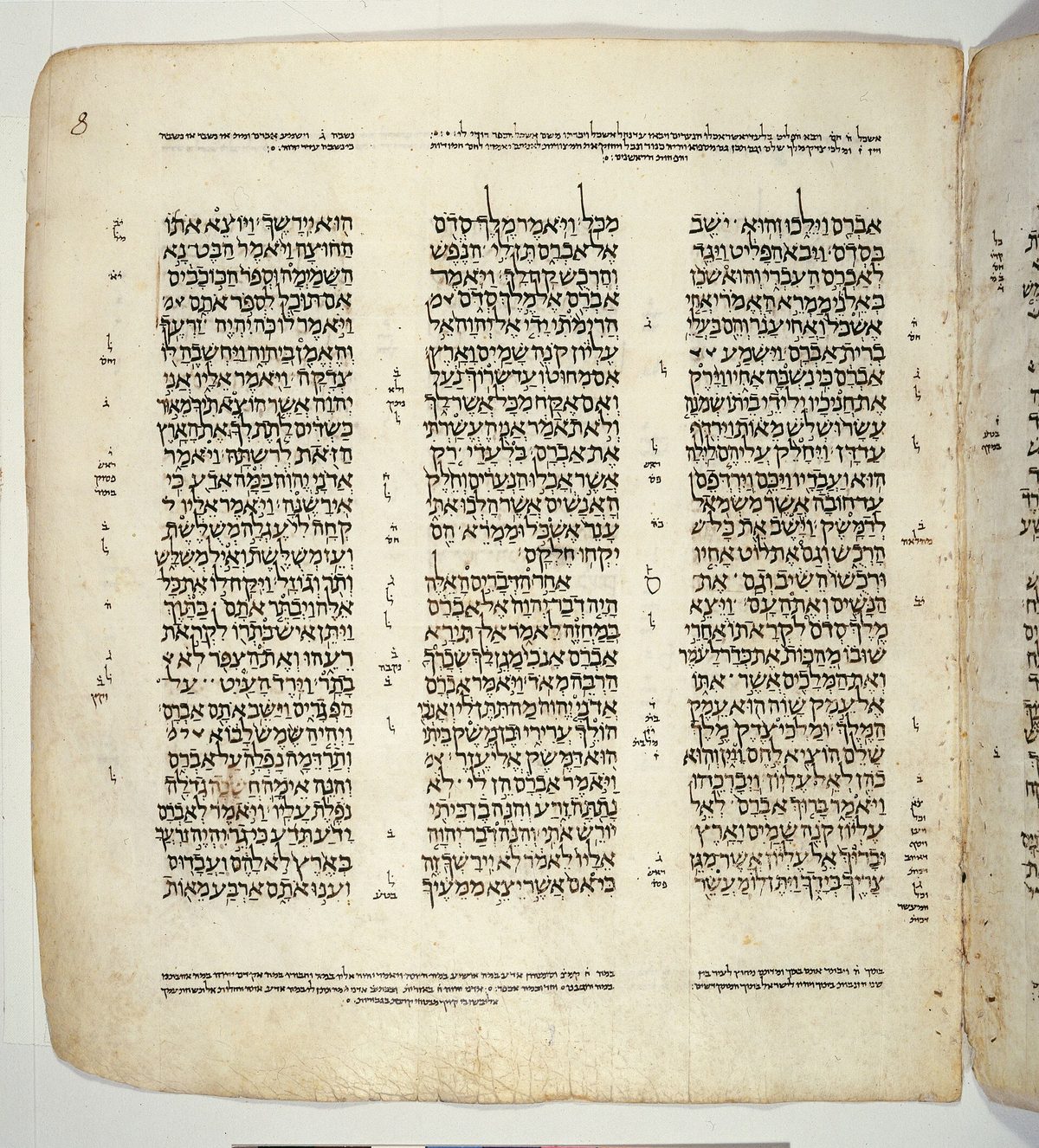
- Wikimedia Commons, Leningrad Codex folio 8a (Genesis 14:12 to 15:13) checked 2026-10
