Lesson 1 of 22 · about 45 minutes
The Alphabet and Handwriting
You'll be able to
- Name, say and write all 22 Hebrew letters in order, reading from right to left
- Use the five final forms ך ם ן ף ץ at the end of a word and the ordinary forms everywhere else
- Tell apart the letters that look alike: ב and כ, ד and ר, ה ח and ת, ו ז and ן, ס and ם, ע and צ, ג and נ
- Write the print letters with clean strokes and recognize the modern cursive hand
- Explain how the square script replaced the older paleo-Hebrew script, with three inscriptions as evidence
- Spell your own name in Hebrew letters and give the number value of any letter
Hebrew has 22 letters. They are all consonants. There are no capital letters, there is no difference between print in a book and print on a sign, and five letters change shape at the end of a word. Hebrew runs from right to left, so a Hebrew book opens from what an English reader would call the back. By the end of this lesson you will be able to read every letter in this line, the first verse of Genesis, which is printed here without its vowel points so you see only the letters:
בראשית ברא אלהים את השמים ואת הארץ׃
Genesis 1:1, consonants only (Westminster Leningrad Codex with the vowel points removed)
Start at the right edge. The first letter is ב (bet), then ר (resh), א (alef), שׁ (shin), י (yod) and ת (tav): בראשית, the word for "in the beginning." The mark ׃ at the end of the line is the sof pasuq, the "end of verse" sign. You will meet the vowels that make these letters into syllables in lesson 2. For now the job is the letters themselves.
A word about the kind of Hebrew this course teaches. "Classical Hebrew" here means the Hebrew of the Hebrew Bible (the Tanakh): Genesis, Ruth, Jonah, the Psalms and the rest. Every real verse in this course is quoted from the Westminster Leningrad Codex, a careful digital text of the Leningrad Codex, the oldest complete manuscript of the Hebrew Bible, finished in 1008 AD. The course speaks Hebrew aloud with modern Israeli pronunciation, because that is the Hebrew you can hear and use today, and it gives notes on the older sounds along the way. Lesson 3 explains that choice.
The 22 letters
Read the table from top to bottom: that is alphabetical order. The "Say the name" column gives the letter's name in the bracket guide this course uses. Capitals in a guide mark the stressed syllable. The "Sound" column is the modern Israeli sound the course uses. The "Tiberian" column gives the sound in the classical reading tradition of the Masoretes of Tiberias, around 900 AD, which the vowel points were designed to record. Every example word is spelled exactly as it appears in the Leningrad Codex.
| Letter | Name | Say the name | Sound (this course) | Tiberian, about 900 AD | Example word |
|---|---|---|---|---|---|
| א | אָלֶף alef | [A-lef] | silent, or a light catch in the throat | glottal stop, the catch in "uh-oh" | אָב [AV] father |
| ב | בֵּית bet | [BET] | b with a dot inside (בּ), v without (ב) | b and v, the same as today | בַּיִת [BA-yit] house |
| ג | גִּימֶל gimel | [GI-mel] | g as in "go" | g with a dot; a soft throaty gh without | גָּמָל [ga-MAL] camel |
| ד | דָּלֶת dalet | [DA-let] | d | d with a dot; th as in "this" without | דָּבָר [da-VAR] word, thing |
| ה | הֵא he | [HE] | h (often silent at the end of a word) | h | הַר [HAR] mountain |
| ו | וָו vav | [VAV] | v; also a sign for the vowels o and u | w, as in "wet" | וְאֵת [ve-ET], with the prefix וְ "and" (Genesis 1:1) |
| ז | זַיִן zayin | [ZA-yin] | z | z | זָהָב [za-HAV] gold |
| ח | חֵית het | [KHET] | kh, as in Scottish "loch" or German "Bach" | a strong h pressed from the throat | חֹשֶׁךְ [KHO-shekh] darkness |
| ט | טֵית tet | [TET] | t | an "emphatic" t, made with the tongue root drawn back | טוֹב [TOV] good |
| י | יוֹד yod | [YOD] (Israelis say [YUD]) | y as in "yes"; also a sign for the vowels i and e | y | יוֹם [YOM] day |
| כ ך | כַּף kaf | [KAF] | k with a dot (כּ), kh without (כ) | k and kh | כֹּהֵן [ko-HEN] priest |
| ל | לָמֶד lamed | [LA-med] | l | l | לֶחֶם [LE-khem] bread |
| מ ם | מֵם mem | [MEM] | m | m | מַיִם [MA-yim] water |
| נ ן | נוּן nun | [NUN] | n | n | נֶפֶשׁ [NE-fesh] life, soul, person |
| ס | סָמֶךְ samekh | [SA-mekh] | s | s | סֵפֶר [SE-fer] book, scroll |
| ע | עַיִן ayin | [A-yin] | silent, or a light catch in the throat | a voiced sound squeezed in the throat, as in Arabic | עַיִן [A-yin] eye, spring of water |
| פ ף | פֵּא pe | [PE] | p with a dot (פּ), f without (פ) | p and f | פֶּה [PE] mouth |
| צ ץ | צָדִי tsadi | [TSA-di] | ts, as in "cats" | an emphatic s | צֶדֶק [TSE-dek] righteousness, justice |
| ק | קוֹף qof | [KOF] | k | a k made farther back, emphatic | קוֹל [KOL] voice, sound |
| ר | רֵישׁ resh | [RESH] | r, said in the back of the mouth as in French | r (the Tiberian r had two varieties) | רוּחַ [RU-akh] wind, breath, spirit |
| שׁ שׂ | שִׁין shin, שִׂין sin | [SHIN], [SIN] | sh with the dot on the right (שׁ), s with the dot on the left (שׂ) | sh and s; the older sin was probably a different sound again (lesson 3) | שָׁלוֹם [sha-LOM] peace; שָׂדֶה [sa-DE] field |
| ת | תָּו tav | [TAV] | t | t with a dot; th as in "thin" without | תּוֹרָה [to-RA] teaching, instruction, law |
A few names have more than one spelling. Many older grammars spell צָדֵי (tsade) where Israeli schools say צָדִי (tsadi). The name of פ is spelled both פֵּא and פֵּה. English books write the names many ways: aleph or alef, beth or bet, cheth or het, teth or tet, kaph or kaf, qoph or qof or kof, tav or taw. They all name the same letters. Use whichever spelling your other books use. Every teacher will understand you (Gesenius, section 5).
Notice that the shin and the sin are one letter with two sounds. The dot over the right arm makes shin (sh), and the dot over the left arm makes sin (s). In the alphabet they count as one letter, the 21st, which is why the total is 22 and not 23. In unpointed text there is no dot at all, and you have to know the word.
Letters as sound groups
Grammars sort the letters into a few families, and you will hear these names constantly (Gesenius, section 6).
- Gutturals, the throat letters: א ה ח ע. The letter ר shares some of their habits. Gutturals cannot be doubled and they prefer a-vowels near them, which explains many small spelling changes later in the course.
- Begadkefat letters: ב ג ד כ פ ת. The name is a memory word made by putting vowels between the six letters. In classical Hebrew each had a hard sound and a soft sound. Modern Hebrew keeps the difference only for three of them: ב (b, v), כ (k, kh) and פ (p, f).
- Vowel letters: א ה ו י. Long before anyone invented vowel points, scribes used these four letters to hint at vowels. ו can stand for o or u, י for i or e, and ה at the end of a word for a or e. Lesson 2 calls them by their Latin name, matres lectionis, "mothers of reading."
- Sibilants, the hissing letters: ז ס צ שׂ שׁ.
The five final forms
Five letters have a second shape used only at the end of a word: כ מ נ פ צ become ך ם ן ף ץ (Gesenius, section 5). Everywhere else in the word, including the very first letter, the ordinary form is used. Jewish tradition remembers the five with a made-up word, מנצפ״ך (written without vowels; the mark ״ shows it is an abbreviation), and English teachers often say "kamnefatz" from the order כ מ נ פ צ.
| Ordinary | Final | How the final differs | Example at the end of a word |
|---|---|---|---|
| כ | ך | The base is gone. The right side drops straight down below the line. | מֶלֶךְ [ME-lekh] king |
| מ | ם | Closed into a square box, sitting on the line. It does not drop. | אָדָם [a-DAM] human being, Adam |
| נ | ן | No base. A long straight stroke drops below the line. | בֵּן [BEN] son |
| פ | ף | No base. The right side drops below the line, keeping the little hook inside. | אַף [AF] also, even; nose, anger |
| צ | ץ | No flat base. The main stroke drops straight down below the line. | אֶרֶץ [E-rets] land, earth |
Two small details save a lot of confusion later. First, final kaf almost always carries a small mark inside it, two dots one above the other: ךְ, as in מֶלֶךְ. That mark is a silent shewa (lesson 2). It is there only to keep you from mistaking ך for ן. Sometimes final kaf carries a vowel instead, written inside it in the same spot: ךָ. Second, final mem ם and samekh ס are both closed shapes. The look-alike section below shows how to keep them apart.
Final forms do not change the sound. ך is still kh, ם is still m, ן is still n, ף is still f, ץ is still ts. Final kaf and final pe are almost always soft (kh and f). A handful of verb forms in the Leningrad Codex end in a final letter with the hardening dot inside, such as וַיֵּבְךְּ [va-YEVK] "and he wept" (Genesis 27:38) and תּוֹסְףְּ [TOSP] "add" (Proverbs 30:6). They are rare enough that you can learn them when you meet them.
Right to left
Everything in Hebrew writing runs from right to left: the letters in a word, the words in a line, the columns on a page of a manuscript, and the pages of a book. Your eye starts at the right margin. When you copy, your pen starts at the right edge of the paper and moves left.
Numbers written with digits are the one exception in modern Hebrew. A modern Israeli newspaper writes "2026" left to right, in the middle of a right-to-left line. Classical texts have no digits. They use letters for numbers, as you will see below.
Hebrew has no capital letters. A proper name like דָּוִד [da-VID] (David) is spelled with the same letters as any other word. Nothing marks the beginning of a sentence either. The Leningrad Codex marks the end of each verse with the sof pasuq ׃, and the vowel and accent marks (lessons 2 and 4) show how the words group together.
Letters that look alike
Square script is elegant and compact, and that makes some letters close cousins. Almost every beginner's misreading comes from one of the groups below. Learn the one feature that tells each group apart, and look for that feature every time.
| Group | What to look for | A word where it matters |
|---|---|---|
| ב כ | ב has square corners and its base line runs a little past the upright on the right, like a small heel. כ is rounded, with no heel. | בֵּן son, but כֵּן so, thus |
| ד ר | ד has a roof that overhangs its leg, making a sharp corner that sticks out to the right. ר turns a smooth, rounded corner. | דָּבָר word: the first letter is ד, the last is ר |
| ה ח ת | ה has a gap between its roof and its short left leg. ח has no gap: both legs touch the roof. ת is like ח, but its left leg ends in a small foot that points left. | הַר mountain; חֹשֶׁךְ darkness; תּוֹרָה teaching |
| ו ז ן | ו is a straight stroke with a small hook at the top, ending on the base line. ז has a head that sits across the top like a small crossbar. ן (final nun) has no hook to speak of and drops well below the base line. | זָהָב gold; בֵּן son |
| ס ם | ס is round at the bottom, often with the top bar overhanging on the left. ם is a box with square corners on all four sides. ם only ever appears at the end of a word. | סֵפֶר book; אָדָם human being |
| ע צ | ע is two arms that meet and run down to the left in a slanted tail. צ sits on a flat base line, with a small arm on the upper right. | עַיִן eye; צֶדֶק righteousness |
| ג נ | ג is one stroke with a little foot kicking out to the left at the bottom. נ is a narrow letter with a flat base that runs to the left along the line. | גָּמָל camel; נֶפֶשׁ life |
Three more pairs catch people now and then. י and ו differ only in length: י is half height, ו reaches the base line. כ and ך differ in whether the letter drops below the line. And ה and ק differ in the left leg: in ה it is short and stays inside the line, in ק it drops below.
Handwriting: the print letters
Write the letters by hand from day one. Students who only type or click learn to recognize letters slowly and keep mixing up the look-alikes. Use lined paper and leave room for vowel points under and over each letter. Work from right to left across the page.
The square letters were built for pens held at an angle, so their horizontal strokes are thick and their vertical strokes thin. You do not need to copy that. A simple block print, with clear corners where corners belong and clear curves where curves belong, is what most classes teach. The guide below gives one sensible stroke order. Most strokes go from top to bottom and from right to left, which keeps the pen moving the way the line moves.
| Letter | How to write it (print) | Keep it distinct from |
|---|---|---|
| א | Three strokes. A long slanting stroke from top left to bottom right. Then a short arm at the upper right coming down to touch the middle of the slant. Then a short leg at the lower left. | No close look-alike |
| ב | A top bar from left to right, a straight stroke down, then a base back to the left. Let the base start a little to the right of the upright, so the bottom right corner has a small heel. | כ |
| ג | A short stroke straight down from the top line, then a small foot kicking out to the left at the bottom. | נ |
| ד | A top bar from left to right. Then, a little in from the right end of the bar, a straight leg down. The bar sticks out past the leg. | ר |
| ה | Write a ד. Then add a short separate left leg that starts below the roof and stops at the base line. | ח, ת, ק |
| ו | A small hook at the top, then straight down to the base line. | ז, ן, י |
| ז | A short head stroke across the top, then a straight stroke down from its middle. | ו, ן |
| ח | A roof, the right leg down, then the left leg down from the roof. Both legs touch the roof, like a doorway. | ה, ת |
| ט | Start at the top left with a small curl turning inward, come down the left side, round the bottom, go up the right side and bend over the top toward the left. | מ |
| י | A small comma-shaped stroke hanging from the top line. Half height only. | ו |
| כ | A top bar, a curve down the right side, and a base back to the left. Round the corners. | ב |
| ל | Start above the top line with a short upright stroke, then go across to the right along the top line, then down and curve to the left at the bottom. It is the only letter that rises. | No close look-alike |
| מ | A short slanting stroke on the left. Then a roof, the right side down, and a base going left, leaving a small opening at the bottom left. | ט, ם |
| נ | A small tick at the top, a short stroke down, and a flat base to the left. Narrow. | ג, כ |
| ס | A top bar from left to right, then round down the right side, across the bottom and up the left side to close. Round at the bottom. | ם |
| ע | A short left arm from the top left, slanting down to the right. Then a longer right arm from the top right, slanting down to the left to meet it and running on into a tail at the bottom left. | צ |
| פ | Write a כ, then add a small hook hanging down inside from the top left of the roof. | כ |
| צ | A small arm at the upper right. Then a stroke from the top left slanting down to the right, turning into a flat base that runs to the left. | ע |
| ק | A roof with its right side curving down to the base line. Then a separate left leg that starts below the roof and drops below the base line. | ה |
| ר | One stroke: across the top and round a smooth corner straight down. | ד |
| ש | Three arms rising from a flat or rounded base: draw the right arm and the base, then the middle arm, then the left arm. Add the dot over the right arm for shin, over the left arm for sin. | ע (in a hurry) |
| ת | A roof and a right leg, then a left leg that ends in a small foot pointing left. | ח, ה |
| ך | A top bar and the right side straight down well below the base line. | ן, ר |
| ם | A closed box: roof, right side, base, left side. Square corners. | ס |
| ן | A small top tick, then one long stroke straight down below the base line. | ו, ך |
| ף | Like ך, with the small hook of פ hanging inside the roof. | ך |
| ץ | The small upper right arm, then the main stroke dropping straight down below the base line. | ע |
Three habits make print Hebrew easy to read. Keep the tops of the letters on one line, because Hebrew readers expect a straight top edge. Make descenders clearly long, so ן never shrinks into ו and ך never shrinks into ר. And leave a little space between letters, because in Hebrew the vowel points go under and between them.
Modern cursive
Classical texts are printed in the square script, and every page of Hebrew Scripture you read in this course will be in square letters. Israelis, though, do not write square letters by hand in daily life. They use a cursive hand, the everyday handwriting taught in Israeli schools, for notes, letters, shopping lists and the board in a classroom. If you ever take a Hebrew class, visit Israel, or read a handwritten letter, you will need to read it. Many students also find cursive faster to write once they learn it.
Modern cursive grew out of the handwriting of European Jewish communities over the last few centuries. It is a modern hand. Ancient scribes never wrote it, and no classical text was composed in it. The shapes below are shown in a handwriting-style font (Gveret Levin). Real handwriting varies from person to person, as English handwriting does. Copy the shapes you see, and use the "print" column to check which letter you are writing.
| Cursive | Name | Note | |
|---|---|---|---|
| א | א | alef | Looks rather like a rounded "IC" written as one shape. |
| ב | ב | bet | Keep the little tail at the bottom right; it tells ב from כ in cursive too. |
| ג | ג | gimel | |
| ד | ד | dalet | Very different from print. Learn it as a new shape. |
| ה | ה | he | The left stroke stays separate, as in print. |
| ו | ו | vav | A plain straight stroke, clearly longer than cursive yod. |
| ז | ז | zayin | |
| ח | ח | het | Looks like a handwritten English n. |
| ט | ט | tet | |
| י | י | yod | A small tick, like an apostrophe. Keep it small. |
| כ | כ | kaf | Rounded, no tail. |
| ך | ך | final kaf | Drops below the line, as in print. |
| ל | ל | lamed | Still the one letter that rises above the others. |
| מ | מ | mem | |
| ם | ם | final mem | A closed shape, but drawn differently from samekh. |
| נ | נ | nun | |
| ן | ן | final nun | A long stroke below the line. |
| ס | ס | samekh | Close to a round English O. |
| ע | ע | ayin | |
| פ | פ | pe | |
| ף | ף | final pe | Drops below the line. |
| צ | צ | tsadi | Many people's cursive צ looks like the numeral 3. |
| ץ | ץ | final tsadi | Drops below the line. |
| ק | ק | qof | Drops below the line, as in print. |
| ר | ר | resh | |
| ש | ש | shin, sin | The dot goes over the right or left side, as in print. |
| ת | ת | tav | Like cursive ח with a left leg that curls out to the left. Keep that curl clear. |
Here is a short line in both hands, so you can see the difference in a real word. Both say שָׁלוֹם [sha-LOM], "peace," the everyday greeting you will learn in lesson 5. Handwritten Hebrew is almost always written without vowel points, so the cursive line leaves them off.
שָׁלוֹם שלום
In this course you may do the copy work in either hand. Print is better for reading the Hebrew Bible, because it trains your eye on the shapes you will see on the page. Cursive is better if you plan to write a lot. Many students learn print first and add cursive after a few weeks.
Where the letters came from
The letters you have just learned are not the letters that David or Isaiah used. The square script is the second Hebrew alphabet. The first one, which scholars call the paleo-Hebrew script (or old Hebrew script), was a local form of the alphabet shared with the Phoenicians and other neighbors in the Levant. It was used in Israel and Judah through the time of the kings.
Both alphabets keep the same 22 letters in the same order and with the same names, because both go back to the same Semitic alphabet. Greek borrowed that alphabet too: Greek alpha, beta and gamma come from the same letter names as alef, bet and gimel. If you have taken Intro to Classical Greek, you have already met the cousins of these letters.
The Gezer calendar
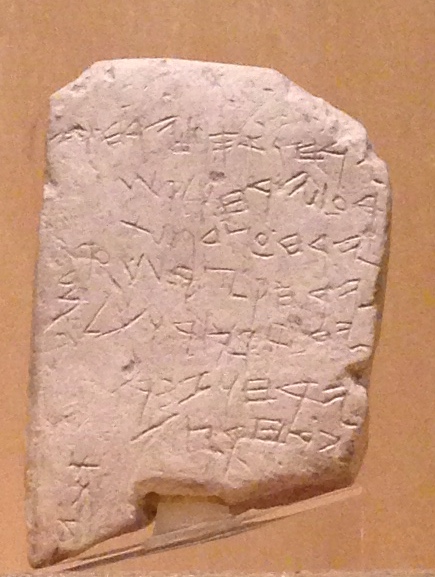
The Gezer calendar is a small soft limestone tablet, about the size of a hand, found at the city of Gezer in 1908 and dated to the 10th century BC. It lists the months of the farming year by their work: months of harvest, of sowing, of late planting, of cutting flax, of barley harvest, and so on. It may be a schoolboy's writing exercise. Its script is an early form of the alphabet, very close to Phoenician. Scholars still argue about whether its language should be called Hebrew, Phoenician, or simply early Canaanite, so treat it as a witness to the alphabet of the land at the time of Solomon, not as certain Hebrew.
The Mesha stele
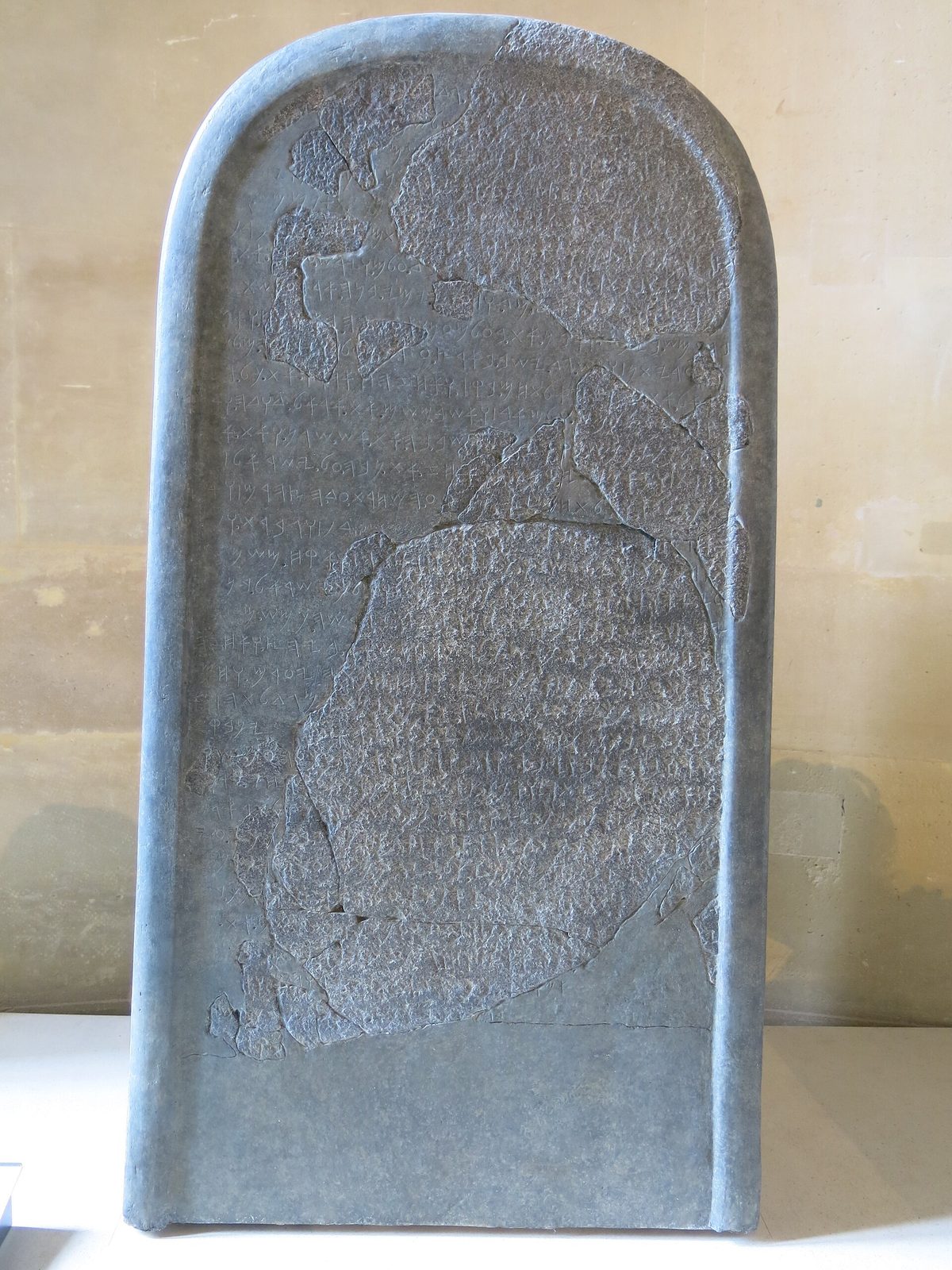
The Mesha stele is a black basalt monument set up around 840 BC by Mesha, king of Moab, the country east of the Dead Sea. It was found at Dhiban in Jordan in 1868 and broken soon after. A paper impression made before it was broken preserved most of the text, and the pieces were reassembled in the Louvre in Paris. Its language is Moabite, a close neighbor of Hebrew, and its script is almost the same as paleo-Hebrew. It mentions Omri, king of Israel, and the God of Israel by the name written with the same four letters as in Hebrew Scripture. A reader of Hebrew can make out many of its words.
The Siloam inscription
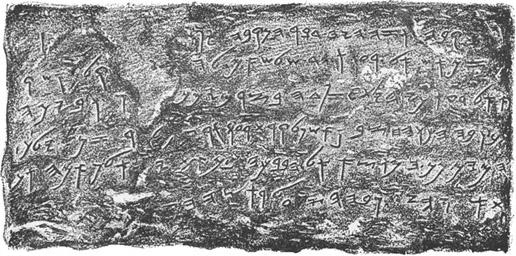
The Siloam inscription was carved on the wall of a water tunnel cut through the rock under Jerusalem to bring water from the Gihon spring to the pool of Siloam. It was found in 1880. Most scholars connect the tunnel with King Hezekiah, around 700 BC. The six lines tell how two teams of diggers, starting from opposite ends, heard each other's voices through the rock and broke through to meet "pick against pick." This one is Hebrew beyond any doubt, in the paleo-Hebrew script, with small dots between the words. It is the kind of writing the prophet Isaiah, Hezekiah's contemporary, would have known.
The square script
After the Babylonians conquered Judah in 586 BC, the Persian empire that followed them used Aramaic as its language of government, written in the Aramaic form of the alphabet. Jewish scribes took over that Aramaic script for Hebrew as well, and over the following centuries it developed into the Jewish square script. The Talmud calls it the "Assyrian" script, כְּתָב אַשּׁוּרִי [ke-TAV a-shu-RI], because it came from the lands of the old Assyrian empire, and it connects the change with Ezra's time (Babylonian Talmud, Sanhedrin 21b to 22a). The old script is called there the Hebrew script, כְּתָב עִבְרִי [ke-TAV iv-RI].
The Dead Sea Scrolls, copied between about 250 BC and 70 AD, show the change nearly complete. Almost all of them are in square script. A few books were still copied in paleo-Hebrew, and some scrolls written in square letters write the divine name in the old letters as a mark of reverence. Coins struck by Jewish rebels against Rome still used paleo-Hebrew letters as a national symbol. The Samaritans, who split from the Jewish community in antiquity, still write their Torah today in a script descended from paleo-Hebrew.
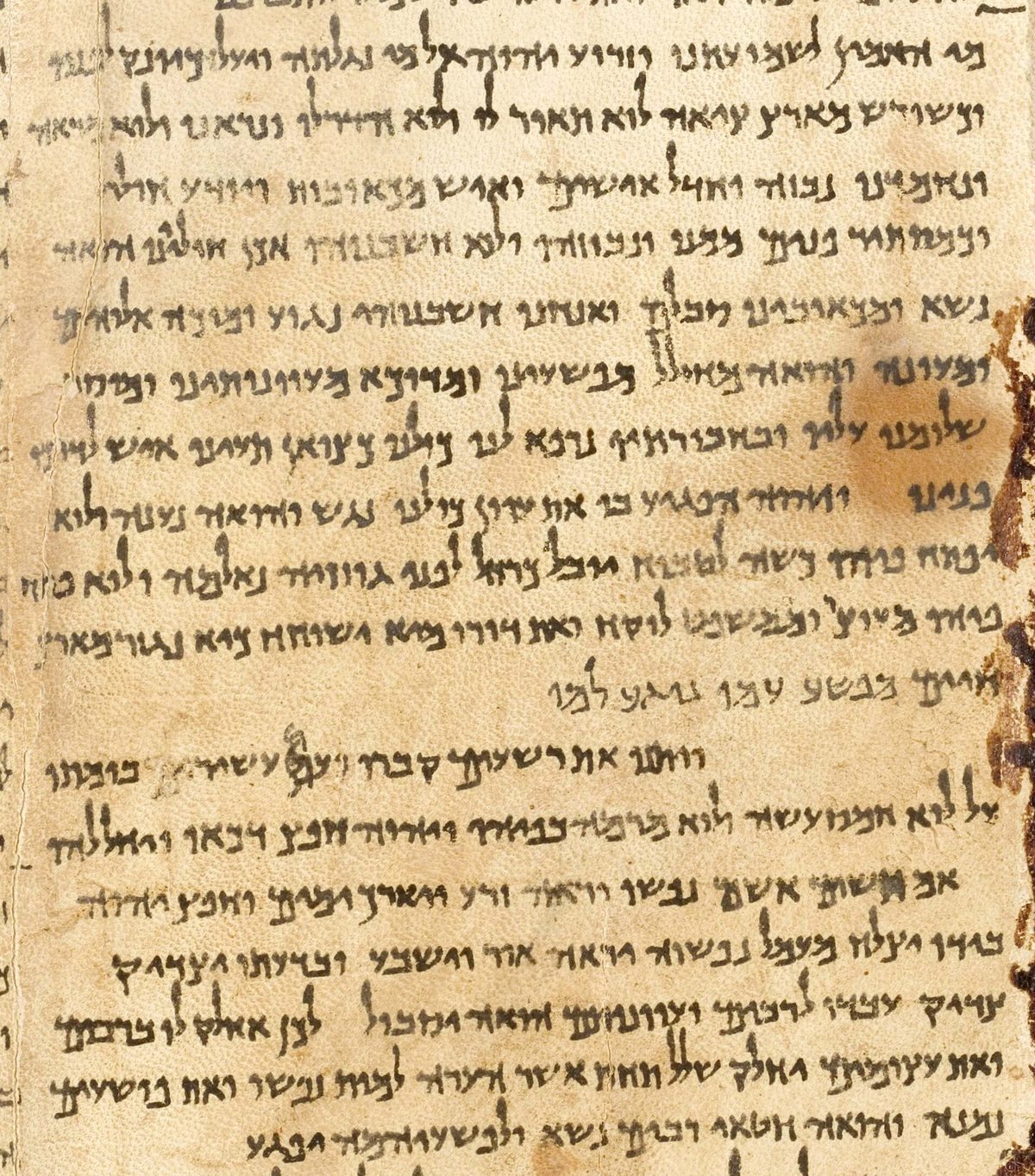
Look closely at the Isaiah scroll and you can recognize many letters from this lesson. The shapes are a little looser than modern print, and there are no vowel points at all: they had not been invented yet. Final forms are already in use, though not as strictly as in later manuscripts. By the time of the great medieval codices, such as the Leningrad Codex of 1008 AD, the square letters look almost exactly like the letters in a printed Bible today.
Letters as numbers
Classical Hebrew had no separate signs for numbers in its books. When a number is written with signs instead of spelled out as words, each letter has a value (Gesenius, section 5). The first nine letters count the ones, the next nine the tens, and the last four the hundreds.
| Ones | Tens | Hundreds |
|---|---|---|
| א 1, ב 2, ג 3, ד 4, ה 5, ו 6, ז 7, ח 8, ט 9 | י 10, כ 20, ל 30, מ 40, נ 50, ס 60, ע 70, פ 80, צ 90 | ק 100, ר 200, ש 300, ת 400 |
Letters are added together, largest first: יא is 11 (10 + 1), כג is 23. Two numbers break the pattern. Fifteen is written טו (9 + 6), not יה, and sixteen is טז (9 + 7), not יו, because יה and יו spell short forms of the divine name. Modern Hebrew marks a number written in letters with a geresh ׳ after a single letter or a gershayim ״ before the last letter: ה׳ is 5, ט״ו is 15. Jewish calendars use the system for years: the Hebrew year that began in September 2026 is 5787, written תשפ״ז (400 + 300 + 80 + 7, with the thousands left out). Psalm 119 is divided into 22 sections, one for each letter, and you will see the letters used as section headings in many printed Bibles. Lesson 17 teaches numbers properly, spelled out as words, which is how most numbers in the Hebrew Bible are actually written.
Writing your own name in Hebrew
Many English names come from Hebrew already, and their Hebrew spelling is in the text. Look for your name, or a family member's, in this list. All of these are spelled as in the Leningrad Codex.
| Hebrew | Say it | English | Where it appears |
|---|---|---|---|
| דָּוִד | [da-VID] | David | Ruth 4:22 and often in 1 Samuel |
| שָׂרָה | [sa-RA] | Sarah | Genesis 17:15 |
| רוּת | [RUT] | Ruth | Ruth 1:4 |
| יוֹנָה | [yo-NA] | Jonah (also the word for "dove") | Jonah 1:1 |
| חַנָּה | [kha-NA] | Hannah, the source of Ann, Anna and Anne | 1 Samuel 1:2 |
| שְׁמוּאֵל | [she-mu-EL] | Samuel | 1 Samuel 1:20 |
| מִיכָאֵל | [mi-kha-EL] | Michael | Numbers 13:13 |
| רָחֵל | [ra-KHEL] | Rachel | Genesis 29:6 |
| יִצְחָק | [yits-KHAK] | Isaac | Genesis 17:19 |
| דָּן | [DAN] | Dan | Genesis 30:6 |
Notice how far some English forms have traveled. Hannah begins with ח, a kh sound, which English dropped. Isaac, which in Hebrew begins with י and has a ts sound in the middle, reached English by way of Greek and Latin, which had no letter for either sound.
For other names, modern Israelis follow a few conventions. They write foreign names without vowel points and use the vowel letters ו and י (and sometimes א) to show vowels. Some of the habits:
- English t is often written with ט, English k with ק and English s with ס, when the name is foreign: Tom is טום, Ken is קן, Lisa is ליסה.
- Sounds Hebrew lacks are marked with a geresh ׳ after a letter: ג׳ for j (Jeff is ג׳ף), ז׳ for the zh sound in "measure," צ׳ for ch as in "church" (Charlie is צ׳רלי).
- English w is usually written ו, often doubled as וו at the start of a word: William is וויליאם.
- A final a sound is usually written with ה: Dana is דנה, Linda is לינדה.
Example
Dana, with vowel points added the classical way: דָּנָה [DA-na]. Every sound has a Hebrew letter. The ה at the end is silent and only shows the final vowel.
Ben: בֶּן [BEN], with final nun. (The Hebrew word for "son" is בֵּן, with a different vowel, so the English name and the Hebrew word are close cousins.)
Tom: modern spelling טום, without vowel points. With points, טוֹם [TOM].
Jeff: ג׳ף. The geresh after ג makes it j, and the name ends in final pe, which says f.
Do not worry about the vowel points yet. Lesson 2 will show you how to add them. For now, spell your name with consonants, using ו and י where you hear o, u, i or e, and ה at the end for a final a.
Practice
- Write the 22 letters in order from memory, from right to left across the page. Then add the five final forms at the end.
- Name each letter: ט, ק, צ, ע, ס, ז, ח.
- Which letter in each pair is the one with the sharp corner or heel? (a) ד or ר (b) ב or כ.
- Which of these letters drop below the base line: ק, ה, ן, ו, ך, ם, ץ, ל?
- Write the final form of each letter: כ, מ, נ, פ, צ.
- Find the mistake: a student wrote the word for "king" as מלכ and the word for "son" as בנ. What is wrong?
- Read these words letter by letter, naming each letter from right to left: שָׁלוֹם, אֶרֶץ, חֹשֶׁךְ, תּוֹרָה.
- Give the number value of each: ג, י, כ, ק, ת. Then work out טו and כא.
- Which letter has two sounds told apart by a dot over the right or left arm? Give a word for each sound.
- Which three inscriptions in this lesson are in the older script, and which is the latest of the three?
- In the unpointed line of Genesis 1:1 at the top of this lesson, find the final mem and the final tsadi. Which words do they end?
- Spell the names Dan and Ruth in Hebrew letters.
Answers
- א ב ג ד ה ו ז ח ט י כ ל מ נ ס ע פ צ ק ר ש ת, then ך ם ן ף ץ.
- tet, qof, tsadi, ayin, samekh, zayin, het.
- (a) ד has the sharp corner that sticks out. (b) ב has the heel at the bottom right.
- ק, ן, ך and ץ drop below. ה, ו and ם stay on the line, and ל rises above it.
- ך, ם, ן, ף, ץ.
- Both words end in a letter that needs its final form: מלך (מֶלֶךְ), בן (בֵּן).
- שׁ shin, ל lamed, ו vav, ם final mem. א alef, ר resh, ץ final tsadi. ח het, שׁ shin, ך final kaf. ת tav, ו vav, ר resh, ה he.
- 3, 10, 20, 100, 400. טו is 15 (9 + 6). כא is 21 (20 + 1).
- ש: shin, as in שָׁלוֹם [sha-LOM]; sin, as in שָׂדֶה [sa-DE].
- The Gezer calendar (10th century BC), the Mesha stele (about 840 BC, Moabite) and the Siloam inscription (about 700 BC). The Siloam inscription is the latest.
- Final mem ends אלהים and השמים. Final tsadi ends הארץ.
- דָּן (Genesis 30:6) and רוּת (Ruth 1:4).
Writing drill
Copy. Copy each line by hand three times, from right to left, saying each letter's name as you write it. Use print first. If you want to learn cursive, copy the lines a fourth time using the cursive table.
א ב ג ד ה ו ז ח ט י כ
ל מ נ ס ע פ צ ק ר ש ת
ך ם ן ף ץ
Then copy these look-alike rows, slowly, making the telling feature clear each time:
ב כ ב כ ד ר ד ר ה ח ת ו ז ן ס ם ע צ ג נ
Finally copy these words twice each, with their vowel points: שָׁלוֹם, דָּבָר, מֶלֶךְ, אֶרֶץ, תּוֹרָה, רוּחַ.
Compose. Write your own first name in Hebrew letters. Then write the names of three people you know. Finally join the names with the Hebrew word for "and," which is the single letter ו attached to the front of the next word, so "David and Ruth" is דָּוִד וְרוּת.
Model answer
דָּנָה וְדָוִד וְשָׂרָה
"Dana and David and Sarah." Notice that the second name lost the dot in its first letter when ו was attached: וְדָוִד. In the Leningrad Codex a begadkefat letter takes the dot only at the start of a word or after a closed syllable, and once the prefix is attached the ד is no longer at the start. Lesson 2 explains this rule. Without vowel points the line is simply דנה ודוד ושרה, and that is how an Israeli would write it by hand.
Speaking drill
Read aloud. Say the alphabet in order, slowly, twice: [A-lef], [BET], [GI-mel], [DA-let], [HE], [VAV], [ZA-yin], [KHET], [TET], [YOD], [KAF], [LA-med], [MEM], [NUN], [SA-mekh], [A-yin], [PE], [TSA-di], [KOF], [RESH], [SHIN], [TAV]. Then say the names a third time, as fast as you can without blurring them.
Now read these words aloud with the guides: שָׁלוֹם [sha-LOM], טוֹב [TOV], יוֹם [YOM], מֶלֶךְ [ME-lekh], אֶרֶץ [E-rets], רוּחַ [RU-akh].
Answer aloud. Here is your first Hebrew question: מַה־זֶּה [ma-ZE] "What is this?", exactly as Isaac asks it in Genesis 27:20. Point at a letter on this page, ask the question, and answer with the letter's name. (מָה is "what" and זֶה is "this." Joined by the maqaf, מָה shortens to מַה and the ז takes a doubling dot, the doubling dot that lesson 2 explains. Lesson 5 uses both words again.)
- (pointing at ש) מַה־זֶּה Answer: שִׁין [SHIN].
- (pointing at ר) מַה־זֶּה Answer: רֵישׁ [RESH].
- (pointing at ד) מַה־זֶּה Answer: דָּלֶת [DA-let].
- (pointing at ם) מַה־זֶּה Answer: מֵם [MEM], final mem.
Reading
Some poems in the Hebrew Bible are acrostics: each verse begins with the next letter of the alphabet. The best known is the poem about the "woman of valor" at the end of Proverbs, Proverbs 31:10 to 31. Here are the opening words of its 22 verses, exactly as printed in the Leningrad Codex. Read down the first column and you are reading the alphabet.
| Letter | Opening word | Verse | Meaning |
|---|---|---|---|
| א | אֵשֶׁת־חַיִל | 31:10 | a woman of valor |
| ב | בָּטַח | 31:11 | (it) trusts |
| ג | גְּמָלַתְהוּ | 31:12 | she does him (good) |
| ד | דָּרְשָׁה | 31:13 | she seeks |
| ה | הָיְתָה | 31:14 | she is (like) |
| ו | וַתָּקָם | 31:15 | and she rises |
| ז | זָמְמָה | 31:16 | she considers |
| ח | חָגְרָה | 31:17 | she girds |
| ט | טָעֲמָה | 31:18 | she tastes, perceives |
| י | יָדֶיהָ | 31:19 | her hands |
| כ | כַּפָּהּ | 31:20 | her palm |
| ל | לֹא־תִירָא | 31:21 | she does not fear |
| מ | מַרְבַדִּים | 31:22 | coverings |
| נ | נוֹדָע | 31:23 | known |
| ס | סָדִין | 31:24 | a linen garment |
| ע | עֹז־וְהָדָר | 31:25 | strength and dignity |
| פ | פִּיהָ | 31:26 | her mouth |
| צ | צוֹפִיָּה | 31:27 | watching over |
| ק | קָמוּ | 31:28 | they rise |
| ר | רַבּוֹת | 31:29 | many |
| ש | שֶׁקֶר | 31:30 | false, deceptive |
| ת | תְּנוּ־לָהּ | 31:31 | give her |
The little horizontal line joining two words, as in אֵשֶׁת־חַיִל, is the maqaf, a hyphen that makes two words one unit for reading aloud (lesson 4). The dot inside the ה at the end of כַּפָּהּ and תְּנוּ־לָהּ is a mappiq, which makes a final ה say h (lesson 2).
Now read the first verse in full. You do not need to know the vowels yet: find each letter, name it, and use the guide to say the verse.
אֵשֶׁת־חַיִל מִי יִמְצָא וְרָחֹק מִפְּנִינִים מִכְרָהּ׃
Proverbs 31:10, Westminster Leningrad Codex
[e-shet-KHA-yil MI yim-TSA ve-ra-KHOK mi-pe-ni-NIM mikh-RAH]
Word help: אֵשֶׁת woman of, wife of (a form of אִשָּׁה woman); חַיִל strength, ability, worth; מִי who?; יִמְצָא will find; וְרָחֹק and far; מִפְּנִינִים beyond corals (the prefix מִ here means "more than"; the gem is coral or pearl, and translations differ); מִכְרָהּ her price, her value.
Translation
"A woman of valor, who can find? Her worth is far beyond corals."
Older English versions say "a virtuous woman" and "rubies." The word חַיִל means strength or capability: in other places it describes an army or a man's wealth. The poem praises a capable, hard-working wife who runs a household and a business.
For the acrostic list: a woman of valor; it trusts; she does him good; she seeks; she is like; and she rises; she considers; she girds; she perceives; her hands; her palm; she does not fear; coverings; known; a linen garment; strength and dignity; her mouth; watching over; they rise; many; false; give her.
Updated October 28, 2026.
Check yourself
1. Which of these letters has a small corner that sticks out past its upright stroke at the top right?
ד (dalet) has a roof that overhangs its leg, making a small corner. ר (resh) has a smooth rounded corner. Readers who mix them up turn דָּבָר (word) into nonsense.
2. Which five letters have a special form used only at the end of a word?
Kaf, mem, nun, pe and tsadi have final forms: ך ם ן ף ץ (Gesenius, section 5). Jewish tradition remembers them with the made-up word מנצפ״ך.
3. What sound does צ stand for in the pronunciation this course uses?
צ (tsadi) is said ts in modern Israeli Hebrew, as in צֶדֶק [TSE-dek], righteousness. In the classical Tiberian reading it was an emphatic s, a sound lesson 3 explains.
4. The Siloam inscription, cut in a water tunnel in Jerusalem around 700 BC, is written in which script?
Before the Babylonian exile, Hebrew was written in the paleo-Hebrew script. The square script, taken over from Aramaic, came into Jewish use after the exile.
5. What number does the letter י stand for?
The first nine letters count 1 to 9, the next nine count the tens (י is 10, כ is 20 and so on), and ק ר ש ת count 100 to 400. Lesson 17 covers numbers fully.
6. A student writes the word for 'eye' as עין, but her ע looks like a צ. What feature should she check?
צ sits on a flat base line. ע is two arms that meet and run down to the left in a tail. Keep the base of צ flat and the bottom of ע slanted and the two never blur.
Terms in this lesson
- Square script
- The Hebrew letter shapes used in printed Bibles and modern books, called כְּתָב מְרֻבָּע (square script) or, in the Talmud, the 'Assyrian' script. It grew out of the Aramaic alphabet.
- Paleo-Hebrew script
- The older Hebrew alphabet, close to Phoenician, used in Israel and Judah before the Babylonian exile. It appears on the Gezer calendar and the Siloam inscription.
- Final form
- The shape that five letters (כ מ נ פ צ) take at the end of a word: ך ם ן ף ץ. Four of the five drop below the line.
- Consonantal script
- A writing system whose letters stand for consonants, with vowels left for the reader to supply. Hebrew was written this way for centuries before vowel points were added (lesson 2).
- Guttural letters
- The throat letters א ה ח ע, and in some rules ר. They follow special rules in grammar because they cannot be doubled and like a-vowels (Gesenius, section 22).
- Cursive
- The joined-up everyday handwriting used in Israel today. Classical texts are printed in square script; cursive is for notes, letters and the board in class.
- Geresh
- A small mark ׳ written after a letter. In modern Hebrew it shows a foreign sound, such as ג׳ for j, and it also marks a letter used as a number.
Sources
- Gesenius' Hebrew Grammar, ed. Kautzsch, trans. Cowley (1910), section 5: the alphabet, final letters, number values; section 6: pronunciation and grouping of the consonants checked 2026-10
- Westminster Leningrad Codex (UXLC): Genesis 1 and Proverbs 31 texts checked 2026-10
- Open Scriptures Hebrew Bible (WLC with morphology), used to check every example word in this lesson checked 2026-10
- Unicode Standard, Hebrew block chart (U+0590 to U+05FF) checked 2026-10
- Babylonian Talmud, Sanhedrin 21b to 22a: the change of script and the name 'Assyrian' (Sefaria) checked 2026-10
- Wikimedia Commons: Siloam Inscription.jpg (public domain) checked 2026-10
- Wikimedia Commons: Gezer calendar close up.jpg (photo oncenawhile, CC BY-SA 3.0) checked 2026-10
- Wikimedia Commons: Mesha stele (Louvre, AO 5066).jpg (photo Tangopaso, public domain) checked 2026-10


