Lesson 16 of 19 · about 30 minutes
Modern Mercantilism: State and Capital Fused, 2008 to 2026
You'll be able to
- Describe what Pierson means by modern mercantilism and why the course treats it as a working term
- Trace the documented steps from TARP and the Federal Reserve's balance sheet to the 2025 government equity stakes
- State the strongest case for industrial policy and the strongest case against it, each in the words of its own advocates
- Apply the mercantile test to specific deals: who gets the money, who pays, who bears the loss
- Separate what the record shows about Natural Asset Companies and the BLM Public Lands Rule from what was alleged
Start here: the short version
In 1651 Parliament told merchants which ships could carry the empire's goods, then split every forfeited cargo with whoever seized it. The state and its favored traders shared the profits. Between 2008 and 2026 the United States built a new version of that partnership. It rescued banks with a $700 billion authorization, grew the Federal Reserve's balance sheet to nearly $9 trillion, wrote $50 billion in chip grants and hundreds of billions in energy tax credits into law, and then, in 2025, took ownership stakes in Intel, MP Materials, Lithium Americas and U.S. Steel. Presidents of both parties built pieces of it. Pierson calls the pattern modern mercantilism. The test is the one module 51 applies to the old system: who gets the money, who pays, and who bears the loss.
Challenge
If the 2008 rescue looks to you like prudence and the 2025 Intel stake looks like socialism, or the other way around, check whether the line you are drawing follows the policy or the party. Both put public money behind chosen firms. Free-market readers should sit with Granite City, where a federal official used a share of stock to keep running a plant its owner wanted to idle. Industrial-policy readers should sit with energy credits that firms built plants on, repealed or cut short three years later, and with the Fed's deferred asset, about $232.7 billion that the Treasury will not receive until the Fed earns it back, piled up without a vote. Rand Paul and Elizabeth Warren objected to the Intel stake from opposite ends and hit the same spot: the public carries the risk and has little say in the terms. Either program can be defended on this record. Neither gets a private rulebook.
Pierson writes that authoritarianism "is not confined to government. It can be exercised through courts, agencies, corporations, media, activist groups, and digital platforms wherever power is used without accountability and justice is replaced with control."1 The sentence fits the period because its institutions are hybrids. A chip company that is 9.9 percent federally owned, a steel company whose plant closings need a federal officer's consent, and a central bank that bought corporate bond funds managed by the same firm it hired to run the purchases do not fit neatly into "public" or "private." Judge an institution by what it does, and judge the last eighteen years the same way.
"Modern mercantilism" is Pierson's working term. He used the phrase "what I call modern mercantilism" in October 2026 and has not yet published a written definition.2 The course uses it in this sense: the old mercantile partnership of state power and favored private capital (charters, monopolies, protected trades) carried into the present through subsidies, government equity stakes, protected and guaranteed finance, tariffs used as industrial steering, and the concentration of ownership in a few large asset managers that sit close to the state. Economists who study these programs mostly call them "industrial policy" or "state capitalism." Those terms are also used below, attributed to the people who use them.
The 1651 pattern
The Navigation Act passed by the Commonwealth Parliament in October 1651 provided that after December 1, 1651, no goods "of the Growth, Production or Manufacture of Asia, Africa or America" could be brought into England or its territories except in ships that belonged "onely to the People of this Commonwealth, or the Plantations thereof," with masters and mariners mostly English. The penalty was forfeiture of the cargo and the ship, "the one moyety to the use of the Commonwealth, and the other moyety to the use and behoof of any person or persons who shall seize the said Goods."3 Read that last clause twice. The state split the seized property with the private informer. Enforcement itself was a shared business.
Lesson 3 traced the chartered companies that carried this system across the Atlantic. Module 51 traced its theory. Adam Smith, writing in 1776, gave the verdict that every later critic of state and capital partnerships has borrowed from:
"Consumption is the sole end and purpose of all production; and the interest of the producer ought to be attended to, only so far as it may be necessary for promoting that of the consumer. The maxim is so perfectly self-evident, that it would be absurd to attempt to prove it. But in the mercantile system, the interest of the consumer is almost constantly sacrificed to that of the producer."
Smith then asked who designed the system. "It cannot be very difficult to determine who have been the contrivers of this whole mercantile system; not the consumers, we may believe, whose interest has been entirely neglected; but the producers, whose interest has been so carefully attended to; and among this latter class, our merchants and manufacturers have been by far the principal architects."4 He also priced it. Of the American colonial system he wrote that "the home consumers have been burdened with the whole expense of maintaining and defending that empire," and that "in the two last wars, more than two hundred millions have been spent" for that purpose.4


Hold the pattern in mind. The state grants a privilege (a trade monopoly, a protected market, a charter). A favored set of private owners collects the upside. The public carries the cost through higher prices, taxes or war debt. The 2008 to 2026 record can be read against each part.
| Feature | 1651 to 1776 | 2008 to 2026 |
|---|---|---|
| Legal instrument | Act of Parliament, royal charter | Statute (EESA, CHIPS, IRA), emergency proclamation, contract, national security agreement |
| Privilege granted | Exclusive carrying trade, colonial market | Grants, tax credits, price floors, guaranteed purchases, tariff protection |
| State's share | Half of forfeitures, customs revenue | Equity stakes, warrants, a golden share, tariff revenue |
| Who paid | Home consumers, colonists, taxpayers funding wars | Taxpayers, importers and buyers of tariffed goods, holders of dollars |
| Who answered to whom | Board of Trade and Privy Council to the Crown | Agencies to the President, some deals to no single body |
2008: the rescue becomes the template
TARP and the bailout statute
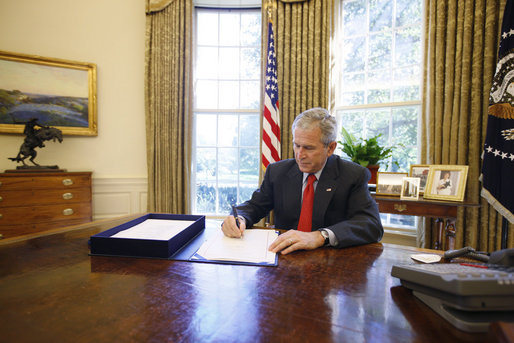
On October 3, 2008, President George W. Bush signed the Emergency Economic Stabilization Act, Division A of Public Law 110-343. It authorized the Treasury Secretary to purchase "troubled assets" and capped the program at $700,000,000,000 outstanding at any one time.5 The Troubled Asset Relief Program was supposed to buy bad mortgage securities. Within weeks Treasury used it to buy preferred stock in banks instead, and later to rescue AIG, General Motors and Chrysler. The Dodd-Frank Act of July 21, 2010, cut the authorization to $475 billion. By August 2014, the Congressional Research Service reported, Treasury had disbursed about $424.78 billion, and the Congressional Budget Office's estimates of TARP's total cost had fallen to roughly $21 billion to $27 billion, because most banks repaid. AIG's portion alone produced a recognized $13.5 billion loss.6

Defenders of TARP point to that low final cost. The program stopped a run on the banking system and the taxpayers got most of the money back. Opponents point to who was saved. Shareholders and bondholders of the largest banks kept firms that markets were prepared to close, and the lesson every large firm learned was that size would be rescued. Both readings rest on the same numbers.
Fannie Mae and Freddie Mac
Two weeks before TARP, the government took control of the two companies that stand behind most American mortgages. The Federal Housing Finance Agency states that "Fannie Mae and Freddie Mac were placed into conservatorships upon the consent of each board of directors on September 6, 2008," and that Treasury support began under Senior Preferred Stock Purchase Agreements signed the next day.7 Eighteen years later they are still there. "Fannie Mae and Freddie Mac continue to operate under conservatorship, as they have since 2008," the agency says, and the conservator "has ultimate authority over all operations of the Enterprises."7 Talk of a public offering has come and gone since 2025, and in May 2026 Bloomberg Government reported a Mizuho analyst putting the chance that Fannie Mae leaves conservatorship by 2028 at 30 percent, and Freddie Mac at 20 percent.8 A status declared temporary in 2008 is now eighteen years old. A rescue became a structure, and the structure became a habit.
The Federal Reserve's balance sheet
The largest single instrument of the period was the Federal Reserve's balance sheet. The Fed's weekly H.4.1 data, republished by the St. Louis Fed as the FRED series WALCL, show total assets of about $891 billion in late December 2007. By the last week of 2008 they had passed $2.24 trillion. After three rounds of quantitative easing they reached about $4.50 trillion at the end of 2014. The Fed shrank them to about $3.76 trillion by August 2019, then bought on a scale never seen before in the pandemic: $7.17 trillion by June 10, 2020, and a peak of $8.97 trillion on April 13, 2022. On October 21, 2026, the figure stood at about $6.75 trillion.9
The balance sheet is where the mercantile test gets hard. When the Fed holds trillions in bonds that pay less than the interest it pays banks on their reserves, it loses money. It does not send a bill to Congress. It stops sending profits to the Treasury and books a "deferred asset," the amount it must earn back before remittances resume. FRED's series on earnings remittances due to the Treasury turned negative in the week of September 7, 2022. The deferred asset reached about $245.9 billion on January 28, 2026, and stood at about $232.7 billion on October 21, 2026.10 That is money the Treasury would otherwise have received. The loss lands on the public through the federal budget, years later, without a vote.

March 2020: the asset manager inside the central bank
The pandemic produced the clearest single example of state and private capital working as one machine. On March 24, 2020, the Federal Reserve Bank of New York announced that it "retained BlackRock Financial Markets Advisory as a third-party vendor" to carry out its purchases of agency commercial mortgage-backed securities, and that "BlackRock was selected on a short-term basis to serve as an investment manager."11 The New York Fed also "retained BlackRock Financial Markets Advisory as a third-party vendor to serve as the investment manager" for the Secondary Market Corporate Credit Facility, which bought corporate bonds and exchange-traded bond funds.52 When the Fed disclosed its first ETF purchases on May 29, 2020, its own transaction file showed about $1.58 billion bought from May 12 through May 18, worth about $1.31 billion at May 19 prices. The largest position was BlackRock's iShares investment-grade corporate bond fund (LQD, about $326 million), followed by two Vanguard corporate bond funds (intermediate-term VCIT and short-term VCSH, about $228 million and $226 million) and BlackRock's iShares high-yield fund (HYG, about $101 million).12
Nothing in the record reviewed here shows that BlackRock broke a rule. The New York Fed published the investment management agreement and quarterly reports on vendor costs.52 The point the record does support is structural. In a crisis the central bank needed operating capacity it did not have, and the firm with that capacity was also one of the largest owners of the assets being bought. Those who call it a scandal have no broken rule to point to. Those who call it routine have to explain why the manager running the purchases also ran the largest fund being bought.
The Big Three and concentrated ownership
Lucian Bebchuk and Scott Hirst of Harvard and Boston University published the standard numbers in 2019. The combined average stake of BlackRock, Vanguard and State Street Global Advisors in S&P 500 companies rose from 5.2 percent in 1998 to 20.5 percent in 2017. Their shares made up about 25 percent of the shares voted in director elections at S&P 500 companies in 2018, and over the prior decade more than 80 percent of all assets flowing into investment funds had gone to those three firms. Their projection was that the Big Three could cast around 40 percent of votes at S&P 500 companies within two decades.13
The firms have kept growing. BlackRock reported assets under management of $15.5 trillion at September 30, 2026.14 Vanguard reported USD $13.3 trillion in global assets as of July 30, 2026, the latest figure it had published by October 2026.15 State Street reported $6.3 trillion in assets under management at September 30, 2026, along with $59.2 trillion in assets under custody or administration.16 Added together, the three manage roughly $35.1 trillion, though the dates differ by two months and the figures include assets outside the United States.
Index ownership is passive in the sense that the funds buy every company in an index. It is active in the sense that the managers vote the shares. Bebchuk and Hirst's concern was that three firms, owning a fifth of nearly every large company, would have reasons to stay quiet with management and stay close to regulators. That is a claim about incentives. Whether it describes their behavior is disputed, and the firms have answered by letting some fund investors choose how their shares are voted. The outline Pierson was handed went further and named these firms, J.P. Morgan and the Federal Reserve as a single controlling apparatus. The record reviewed here does not show that. It shows large firms with deep ties to the state, hired by it in emergencies, and owning shares in the companies the state now subsidizes.
2022: subsidy by statute
The CHIPS Act of 2022 became law as Division A of Public Law 117-167 on August 9, 2022. It created the CHIPS for America Fund in the Treasury and appropriated $24 billion to it for fiscal year 2022 alone, of which $19 billion was for the manufacturing incentive program. It added section 48D to the Internal Revenue Code, an "advanced manufacturing investment credit" equal to 25 percent of qualified investment in a semiconductor plant.17 Across all years the statute gave the Commerce Department $50 billion, of which, the National Institute of Standards and Technology says, "the CHIPS Program Office is dedicating $39 billion to provide incentives" and the research office is investing $11 billion.18
One week later, on August 16, 2022, the Inflation Reduction Act became Public Law 117-169.19 In the Congressional Budget Office's score, as summarized by the Committee for a Responsible Federal Budget on September 7, 2022, its energy and climate provisions cost $391 billion over 2022 to 2031, most of it as tax credits for wind, solar, batteries, electric vehicles and domestic manufacturing.20 Much of that was repealed or cut short three years later. The reconciliation law signed July 4, 2025, Public Law 119-21, ended the clean vehicle credits after September 30, 2025, and, as the Peter G. Peterson Foundation summarized it, required wind and solar projects either to begin construction by July 4, 2026, or to be placed in service by December 31, 2027, to keep their credits. The Foundation put the savings from the energy credit changes at $496 billion over 2025 to 2034.21
That reversal cuts against the program's own promise. Firms that built plants on the 2022 credits made bets on a political promise, and some of those promises lasted three years. The incentive in such a system is to invest in lobbying as well as in plants.
2025: the state takes equity
The new feature of 2025 was ownership. Earlier programs gave grants, loans and tax credits and walked away. In 2025 the federal government began to keep shares.
Intel
Intel announced the deal on August 22, 2025. "The U.S. government will make an $8.9 billion investment in Intel common stock," the company said, buying "433.3 million primary shares of Intel common stock at a price of $20.47 per share, equivalent to a 9.9 percent stake." The money came from "$5.7 billion in remaining unpaid CHIPS Act grants and $3.2 billion awarded to the company as part of the Secure Enclave program." With $2.2 billion in grants already received, the government's total investment reached $11.1 billion. The stake was described as passive, with "no Board representation or other governance or information rights," and the government agreed to vote with the board with limited exceptions. It also received a five-year warrant for another 5 percent at $20 per share, exercisable only if Intel stopped owning at least 51 percent of its foundry business. The clawback and profit-sharing terms on the earlier grants were eliminated.22
The closing came on August 27, 2025. Intel's Form 8-K reports that it issued 274,583,000 shares to the Department of Commerce, placed 158,740,000 more in escrow to be released as Secure Enclave funds are paid, and received "the full amount of the accelerated disbursements" of $5.695 billion.23 Intel's stock then rose sharply. On April 24, 2026, Bloomberg reported that the government's stake had "increased fourfold to hit a value of about $36 billion," a paper return of almost $27 billion.24 A paper gain is unrealized until shares are sold.
Intel's chief executive, Lip-Bu Tan, said that "Intel is deeply committed to ensuring the world's most advanced technologies are American made."22 The objections came from both parties. Senator Rand Paul of Kentucky posted, before the deal was announced, "If socialism is government owning the means of production, wouldn't the government owning part of Intel be a step toward socialism? Terrible idea." Representative Thomas Massie wrote, "Our government should not have ownership in private companies."25 Senator Elizabeth Warren, the ranking Democrat on the Banking Committee, wrote to Commerce Secretary Howard Lutnick on September 4, 2025, that "the President is handing billions of dollars of taxpayer money to Intel and asking for nothing in return."26
MP Materials
Six weeks earlier the Defense Department had made a deeper bet on what is widely reported as the only active rare earth mine in the United States, at Mountain Pass, California. MP Materials announced on July 10, 2025, that the department would buy $400 million of a new convertible preferred stock and receive a warrant, both at $30.03 per common share, together equal to about 15 percent of the company on an as-converted basis and making the department its largest shareholder. The government also committed to a 10-year price floor of $110 per kilogram for the company's NdPr (neodymium-praseodymium) products, agreed that for ten years after a new magnet plant is built "100% of the magnets" from it would be purchased by defense and commercial customers, and lent the company $150 million. JPMorgan Chase and Goldman Sachs committed $1 billion in financing for the new plant, called the 10X Facility, with commissioning expected in 2028. Chief executive James Litinsky called it "a decisive action by the Trump administration to accelerate American supply chain independence."27


Set that deal beside the 1651 Act. The state sets a price floor, which is a guaranteed minimum income for one producer. It guarantees the buyers. It takes an ownership share. Two of the largest private banks finance the expansion with the government's commitments behind them. The national security reason, dependence on Chinese rare earth magnets, is real and widely accepted. The structure is still the oldest one in this course.
U.S. Steel and the golden share
The U.S. Steel case began as a merger review. President Biden blocked Nippon Steel's purchase on January 3, 2025. President Trump reopened the review and on June 13, 2025, issued an order under section 721 of the Defense Production Act allowing the deal if the parties signed a national security agreement with the government.28 The companies said the agreement required about $11 billion in new investment by 2028 and gave the government a "golden share." The President's own description was blunt: "We have a golden share, which I control."29 The deal closed June 18, 2025. According to S&P Global's reading of the filings, the share is one share of Class G Preferred stock, and the President's November 2025 letter confirms that designation.31 While President Trump is in office his written consent, or his designee's, is required for actions such as changing the company's name, moving its headquarters or reducing capital investment, and at other times the consent rights pass to the Treasury and Commerce Departments.30
On November 20, 2025, the President wrote to U.S. Steel's general counsel: "I, President Donald J. Trump, hold the Class G Preferred Stock (Golden Share) in U.S. Steel." He designated the Under Secretary of Commerce for International Trade, William Kimmitt, to exercise the share's consent powers and exercised his "exclusive right as the holder of the Golden Share to appoint and elect one director."31 The share had already been used. In September 2025 the White House said "the administration did intervene to block U.S. Steel's decision to idle the Granite City Works plant" in Illinois, where about 800 people work, with Lutnick delivering the message.32
Lithium Americas and the sovereign wealth fund idea
On October 7, 2025, Lithium Americas announced it had finalized amendments to a $2.23 billion Energy Department loan for its Thacker Pass project in Nevada. In exchange for deferring $184 million of scheduled payments, the department received warrants for a 5 percent equity stake in the company and a 5 percent economic stake in the Thacker Pass joint venture with General Motors, each exercisable at $0.01 per share or unit.33 Earlier, on February 3, 2025, Executive Order 14196 had directed the Treasury and Commerce Secretaries to develop a plan for "a sovereign wealth fund" to "maximize the stewardship of our national wealth for the sole benefit of American citizens."34 The order asked for a plan and named no funding source. The equity stakes that followed were made agency by agency, each under its own authority.
| Company | Date | Agency | What the government got | What the company got |
|---|---|---|---|---|
| MP Materials | July 10, 2025 | Defense | About 15% (preferred plus warrant), largest shareholder | $400M equity, $150M loan, $110/kg price floor for 10 years, guaranteed magnet buyers |
| U.S. Steel | June 18, 2025 | President, then Treasury and Commerce | One Class G golden share, consent rights, one director | Approval of the Nippon Steel merger |
| Intel | Aug. 22 to 27, 2025 | Commerce | 9.9% (433.3M shares at $20.47), warrant for 5% more | $8.9B in already-awarded grants paid as equity, clawbacks removed |
| Lithium Americas | Oct. 2025 | Energy | Warrants for 5% of company and 5% of project at $0.01 | $184M payment deferral on $2.23B loan |
Tariffs as steering, and the Supreme Court's answer
The 1651 Act steered trade by law. The 2025 tariffs steered it by emergency proclamation. President Trump invoked the International Emergency Economic Powers Act of 1977 to impose a 25 percent duty on most Canadian and Mexican imports and 10 percent on most Chinese imports, tied to drug trafficking, and then a "reciprocal" duty of at least 10 percent "on all imports from all trading partners," with higher rates for dozens of countries.35
On February 20, 2026, in Learning Resources, Inc. v. Trump, consolidated with Trump v. V.O.S. Selections, the Supreme Court held 6 to 3: "we hold that IEEPA does not authorize the President to impose tariffs." Chief Justice Roberts wrote that the Constitution gives Congress the power "To lay and collect Taxes, Duties, Imposts and Excises," and that the Framers "did not vest any part of the taxing power in the Executive Branch." Justices Thomas, Alito and Kavanaugh dissented.35 Lesson 17 reads the opinion closely. What came after matters more here.
The same day, the President signed Proclamation 11012, a temporary 10 percent import surcharge under section 122 of the Trade Act of 1974, which permits such a surcharge for up to 150 days.36 It ran from February 24 to July 24, 2026. On May 7, 2026, a divided panel of the Court of International Trade held in Oregon v. United States that the proclamation exceeded the President's authority, with relief limited to three plaintiffs, and the Federal Circuit stayed that judgment on June 11, 2026, pending appeal.37 Refunds of the IEEPA tariffs began under Court of International Trade supervision. The Cato Institute put the IEEPA duties collected at about $166 billion before interest, and a Customs and Border Protection filing reported $100 billion in refunds paid by July 31, 2026.3839 On October 8, 2026, the Court of International Trade certified a class of importers with outstanding refund claims.37 Tariffs under other statutes, including section 232 national security tariffs on steel and aluminum, were outside the IEEPA case and remain.
The mercantile test applied to tariffs is simple and old. The tariff money is paid by domestic importers. The Court said so: unlike IEEPA's other powers, "tariffs operate directly on domestic importers to raise revenue for the Treasury."35 Importers pass some of it to their customers. Protected domestic producers gain pricing room. The refunds now go to importers of record, who may or may not have passed the cost along. Justice Kavanaugh's dissent made that point: some importers "may have already passed on costs to consumers or others."35
Natural Asset Companies and the Public Lands Rule
The outline Pierson was handed treated two 2023 to 2024 proposals as one plan to put federal land into private financial hands. The record shows two separate proposals, a public fight that linked them, and the withdrawal or rescission of both.
The NYSE proposal
On September 27, 2023, the New York Stock Exchange filed a proposed rule change, File No. SR-NYSE-2023-09, to add listing standards for "Natural Asset Companies." Under the proposal, a NAC would be "a corporation whose primary purpose is to actively manage, maintain, restore (as applicable), and grow the value of natural assets," such as the clean water, flood protection and productive soil that land provides. The filing named Intrinsic Exchange Group, a private company founded in 2017, as the developer of the concept.40 The SEC published it on October 4, 2023, extended its review, and on December 21, 2023, instituted proceedings to decide whether to disapprove it. On January 17, 2024, the Exchange withdrew the proposal.41
Opposition was led from the West. In January 2024, 25 Republican state attorneys general, led by Sean Reyes of Utah and Kris Kobach of Kansas, wrote to the SEC that the proposal "is part of an interlocking scheme designed to facilitate another agency's violation of the law," meaning the BLM's pending rule.42 BLM's principal deputy director, Nada Wolff Culver, told a House subcommittee that the BLM rule would let the agency "issue leases for restoration or mitigation activities," and that entities "could apply for those leases, but they would not be guaranteed to be issued." The Salt Lake Tribune reported that she said the rule had nothing to do with NACs.43 Neither document reviewed for this lesson shows a formal link between the two proposals. The attorneys general argued the NYSE proposal "functions in unison with the BLM rule," and the BLM denied any connection.43
The BLM rule and its rescission
The Bureau of Land Management published the final rule widely called the Public Lands Rule on May 9, 2024, at 89 Fed. Reg. 40308. It applied land health standards to all BLM lands, revised the rules for areas of critical environmental concern, and let third parties obtain restoration and mitigation leases on public land under the Federal Land Policy and Management Act.44 The agency proposed rescinding it on September 11, 2025, and received 138,161 comments, 129,029 of them form letters.45 The final rescission was published May 12, 2026, at 91 Fed. Reg. 25787, and took effect June 11, 2026. It removed all of 43 CFR part 6100 and restored the 1983 rules for areas of critical environmental concern. Its central reasoning: "It is not appropriate, or logical, to treat conservation as a 'use' under FLPMA." The leasing provisions, the BLM wrote, "go beyond what the BLM may legally grant under FLPMA, which only allows the BLM to grant third parties authorization to 'use, occup[y], and develop[]' the public lands."46
For Idaho readers, whose state is mostly federal land (lesson 14 gives the figures), this was the closest the period came to the territorial questions in lessons 7 and 14. The rescission returned the federal estate to its multiple-use rules. It did not change who owns the land.
The strongest case for industrial policy
Defenders of industrial policy say it is as American as Alexander Hamilton, and they have a document to prove it. Hamilton's Report on Manufactures of December 5, 1791, argued that "Not only the wealth; but the independence and security of a Country, appear to be materially connected with the prosperity of manufactures," and called pecuniary bounties "one of the most efficacious means of encouraging manufactures."47
The modern version was stated most fully by Jake Sullivan, President Biden's national security adviser, at the Brookings Institution on April 27, 2023. "America's industrial base had been hollowed out," he said. The policy of the prior decades rested on "one assumption at the heart of all of this policy, that markets always allocate capital productively and efficiently, no matter what our competitors did." In its place he proposed "a modern American industrial strategy" that "identifies specific sectors that are foundational to economic growth, strategic from a national security perspective, and where private industry on its own isn't poised to make the investments needed to secure our national ambitions." He insisted: "This is about crowding-in private investment, not replacing it. It's about making long-term investments in sectors vital to our national well-being, not picking winners and losers."48
The Trump administration's version kept the goal and changed the terms. Commerce Secretary Howard Lutnick put it on CNBC in August 2025: "We should get an equity stake for our money," and "If we're going to give you the money, we want a piece of the action for the American taxpayer."53 Intel's fourfold paper gain is their best evidence. The national security case is shared across both administrations. The International Energy Agency puts China's share of sintered permanent magnet production at 94 percent in 2024,55 and Commerce Secretary Gina Raimondo told a House hearing on May 8, 2024, that "the United States buys 92 per cent of its leading edge chips from TSMC in Taiwan."56 A country that cannot make its own magnets or chips cannot build its own weapons. On that view the question is how to do industrial policy, and pretending markets will solve a problem that a rival state created is the real risk.
The strongest case against
The case against begins with Smith and was restated in 2025 by free-market economists. Ryan Bourne of the Cato Institute wrote on August 27, 2025, about the Intel and U.S. Steel deals: "Once taxpayers' money is on the line, political meddling follows." Companies, he argued, begin to compete for the President's favor in place of customers': "Free markets are thus giving way to court politics."49 Granite City is his best evidence. A federal official used a share of stock to keep a plant running that the owner wanted to idle. Whether that was wise for those 800 workers, it was a political decision about a private business.
Then accountability. The Intel stake converted grants that Congress appropriated under conditions into shares, and the clawback and profit-sharing provisions on the earlier grants were removed in the deal.22 Congress never voted on owning 9.9 percent of Intel. The MP price floor and offtake guarantee commit the Defense Department for a decade. Senator Warren's objection and Senator Paul's came from opposite directions and landed on the same point: the public bears the risk and has little say in the terms.
And reversibility. The 2022 energy credits lasted three years. The IEEPA tariffs lasted about a year before the Court struck them down, and the refunds are still being paid. A policy that changes with each election invites firms to invest in access to whoever holds power. That is the oldest charge against mercantilism, and Smith made it about "merchants and manufacturers."
The mercantile test
| Program | Who gets the money | Who pays | Who bears the loss |
|---|---|---|---|
| TARP (2008) | Bank shareholders and creditors, AIG counterparties, auto firms | Taxpayers fronted about $425B | Taxpayers for the net cost (CBO roughly $21B to $27B); AIG portion $13.5B |
| Fannie and Freddie (2008 to now) | Mortgage bond holders, home buyers through lower rates | Treasury under the stock purchase agreements | Taxpayers if losses return; private shareholders were largely wiped out in 2008 |
| Fed balance sheet | Holders of bonds and stocks whose prices rose; borrowers | Savers through low rates; holders of dollars | Treasury through lost remittances (deferred asset about $233B in Oct. 2026) |
| CHIPS and IRA (2022) | Chip makers, energy developers, investors in both | Taxpayers through grants and credits | Firms that built on credits later repealed; taxpayers if plants fail |
| Intel stake (2025) | Intel, which kept the grants with fewer strings | Taxpayers ($11.1B) | Taxpayers on the downside; so far a paper gain |
| MP Materials (2025) | MP shareholders, lenders | Defense budget | Defense budget if NdPr prices stay below $110/kg |
| IEEPA tariffs (2025) | Treasury (temporarily), protected domestic producers | Importers and their customers | Treasury through refunds; consumers who paid passed-on costs and will not see a refund |
In almost every row the upside is concentrated and the downside is spread across taxpayers or consumers. And in almost every row the decision was made by an agency or the President, with Congress supplying a general authority years earlier or none at all. The 1651 Act at least passed Parliament.
Through Pierson's Framework
Pierson's test for an institution is whether it answers to the people and whether it is judged by what it does. The Acacia essay supplies the image for this period. "Biologists discovered that some species of acacia secrete a special nectar that affects the digestive enzymes of their ant defenders," he writes. "In essence, the tree makes itself the only viable food source." And: "In human systems, institutional defenders may appear voluntary but are, in reality, functionally dependent."50 A firm whose plant runs on a federal price floor, or whose biggest shareholder is the Pentagon, is in that position. So is a financial system that expects the Fed to buy in every crisis. The dependence may begin in sincerity, as Pierson says of institutions generally: "somewhere along the line, the mission is replaced by the machinery, and survival becomes the goal."50
Name versus function is the second test. Several 2025 deals carried names that did not match what they did. A "passive" stake that the government votes with management, a "national security agreement" that sets a company's headquarters, a "temporary" conservatorship now eighteen years old, an "emergency" statute used to set the country's tariff schedule. The Court used the same method on the tariffs, asking what the duties did. Its answer was that they raised revenue, which is taxing, which belongs to Congress.
Ordered liberty, as Pierson frames it, carries two duties: hold government accountable, and support legitimate government. Both apply here. Supporting legitimate government means taking the security case seriously, because a republic that cannot make its own weapons is less free. Holding it accountable means asking who voted for each deal, who can unwind it, and who carries the loss. The Anti-Federalist appendix states the danger plainly: "Institutions, once corrupt, do not collapse. They adapt. They learn how to appear lawful while suppressing dissent. They entrench policies behind procedure."51 Modern mercantilism has not been shown to be corrupt. It has been shown to be durable across both parties, with some of its biggest steps (the 2025 equity stakes, the growth of the Fed balance sheet) taken without a vote of Congress, which is the condition in which Pierson says corruption grows.
Hard Questions and Answers
Every major country runs industrial policy. Isn't "modern mercantilism" just a scare word for it?
Partly, yes. Japan, South Korea, Germany and China all use subsidies, state banks and protected sectors, and the United States did so under Hamilton, Lincoln and Eisenhower. Pierson's term earns its place only because it names a specific feature: the joining of state power with a favored set of private owners, which industrial policy can have or avoid. A program of open, competitive grants voted by Congress with clawbacks is industrial policy with fewer mercantile features. A price floor for one firm plus a guaranteed buyer plus a government stake has more. The label is a tool for asking that question, deal by deal. Used without the record in hand, it is just an insult.
The Intel stake is up almost $27 billion on paper. Taxpayers are winning. What exactly is the objection?
It answers the fear that the stake would lose money, at least so far. Bloomberg reported a paper gain of almost $27 billion by April 2026.24 It does not answer the accountability objection. Congress appropriated grants with conditions, and the conditions were traded for shares without a vote. A stake that rises also creates a new incentive: the government now gains when Intel's stock rises, and it regulates, buys from and sets trade policy for Intel's competitors. Smith's warning was about that conflict of interest, and a profit does not remove it.
The 2008 rescue kept the country out of a depression. Isn't lumping it in with golden shares and price floors a cheap shot?
Defenders have numbers on their side. Alan Blinder, a former Fed vice chairman, and Mark Zandi of Moody's Analytics estimated in 2015 that without the combined fiscal and financial responses, real GDP would have fallen close to 14 percent from peak to trough and more than 17 million jobs would have been lost.54 TARP's final cost was small compared with its size,6 and anyone still calling it a pure giveaway has to argue with that. The rescue may well have been right. It also set a template. The firms saved were the largest. Fannie and Freddie never left conservatorship. The Fed's tools, used again in 2020 on a larger scale and with a private asset manager running the purchases, became standing expectations. An emergency can be justified and still leave behind an institution that later defends itself on habit.
Westerners were sure Natural Asset Companies were a plan to sell off public land. Were they wrong?
About a sale and a single plan, yes. The documents reviewed here do not show either. The NYSE filing proposed listing standards for companies that would own or hold rights to natural assets, and it was withdrawn on January 17, 2024, before the SEC acted.41 The BLM rule authorized restoration and mitigation leases, which are not sales, and BLM officials said leases would not be guaranteed.43 The attorneys general argued the two worked "in unison," and that concern was reasonable to raise: a listed company holding long-term federal leases would have created a new private claim on public land. The record supports the concern. It does not support the claim of a single coordinated plan, and both proposals are now gone.
Three firms made up about a quarter of the shares voted in S&P 500 director elections, and one of them ran the Fed's 2020 buying. Isn't that control?
No document reviewed here shows control. It shows concentration: an average 20.5 percent combined stake in S&P 500 companies by 2017 and about $35.1 trillion under management among the three at 2026 reporting dates (Vanguard's figure is as of July 30, BlackRock's and State Street's as of September 30).1314 It shows the New York Fed hiring BlackRock in March 2020.11 Those facts justify scrutiny of how the firms vote and how the Fed hires. They fall short of proof of a single directing power. Index funds hold what the index holds, and their investors can move money elsewhere. Bebchuk and Hirst's argument is about incentives to stay passive, which is nearly the opposite of a claim of active control. And defenders who answer that the funds are merely passive are conceding the point Bebchuk and Hirst actually made.
The Supreme Court struck down the IEEPA tariffs. Doesn't that prove the system works and the alarm is overblown?
On that statute, yes, and lesson 17 treats the ruling as one of the clearest examples of the Court enforcing Congress's taxing power. But the President imposed a section 122 surcharge the same day, and other tariff statutes remain in force.36 The refunds go to importers of record and do not reach the consumers who paid higher prices. And none of the 2025 equity stakes was before the Court. A check that stops one instrument while the pattern runs on through others is a partial correction. Calling it more flatters the system.
Learn more
- Learning Resources, Inc. v. Trump (2026): the full IEEPA tariff opinion, concurrences and dissents.
- Intel's announcement of the U.S. government investment: the company's own statement of terms, August 22, 2025.
- MP Materials and the Department of Defense: the price floor, offtake and equity terms.
- The President's Golden Share letter to U.S. Steel: the Federal Register text.
- FRED: Federal Reserve total assets: weekly data from 2002 to the present.
- BLM's 2026 rescission of the Public Lands Rule: the final rule and its reasoning.
- The NYSE Natural Asset Company proposal: SEC Release 34-98665, the original filing.
- Jake Sullivan at Brookings, April 2023: the fullest official case for modern industrial strategy.
- Ryan Bourne, Cato Institute, August 2025: the case against state equity stakes.
- Module 51: Mercantilism: the original system and the mercantile test.
Notes
- Jeff A. Pierson, Ordered Liberty Reclaimed: A Foundation for Liberty. Read it online. ↩
- Pierson used the phrase "what I call modern mercantilism" in course planning for this module, October 22, 2026. He has not published a written definition. The definition in this lesson is the course's working definition, built from his usage and his writing on institutionalism. ↩
- "October 1651: An Act for increase of Shipping," in C. H. Firth and R. S. Rait, eds., Acts and Ordinances of the Interregnum, 1642-1660 (London, 1911), pp. 559-562. Read it online. ↩
- Adam Smith, An Inquiry into the Nature and Causes of the Wealth of Nations (1776), Book IV, Chapter 8, "Conclusion of the Mercantile System." Project Gutenberg edition. Read it online. ↩
- Emergency Economic Stabilization Act of 2008, Division A of Pub. L. 110-343, 122 Stat. 3765 (Oct. 3, 2008), sec. 115 (limit of $700,000,000,000 outstanding at any one time). Read it online. ↩
- Congressional Research Service, Troubled Asset Relief Program (TARP): Implementation and Status, R41427 (Aug. 21, 2014): authorization reduced to $475 billion by Dodd-Frank (July 21, 2010); $424.78 billion disbursed as of Aug. 15, 2014; CBO cost estimates of $21 billion to $27 billion; $13.5 billion recognized loss on TARP's AIG assistance. Read it online. ↩
- Federal Housing Finance Agency, "Conservatorship." Read it online. ↩
- Bloomberg Government, "Fannie, Freddie's Latest Bull Says Traders Underpricing IPO Odds," May 8, 2026. Read it online. ↩
- Board of Governors of the Federal Reserve System, Assets: Total Assets: Wednesday Level (WALCL), retrieved from FRED, Federal Reserve Bank of St. Louis, October 22, 2026. Values used: Dec. 26, 2007, $890,662 million; Dec. 31, 2008, $2,239,457 million; Dec. 31, 2014, $4,497,660 million; Aug. 28, 2019, $3,759,946 million; June 10, 2020, $7,168,936 million; Apr. 13, 2022, $8,965,487 million; Dec. 31, 2025, $6,640,618 million; Oct. 21, 2026, $6,753,604 million. Read it online. ↩
- Board of Governors of the Federal Reserve System, Liabilities and Capital: Earnings Remittances Due to the U.S. Treasury: Wednesday Level (RESPPLLOPNWW), retrieved from FRED, October 22, 2026. Negative values represent the deferred asset: -$245,927 million on Jan. 28, 2026; -$232,672 million on Oct. 21, 2026; first negative reading Sept. 7, 2022. Read it online. ↩
- Federal Reserve Bank of New York, "FAQ: Agency Commercial Mortgage-Backed Securities," March 24, 2020. Read it online. ↩
- Board of Governors of the Federal Reserve System, Secondary Market Corporate Credit Facility, transaction-specific disclosures released May 29, 2020 (Trade Level and ETF Summary sheets; trades May 12 to 18, market value as of May 19, 2020). Read it online. Press account: Bloomberg, "Fed Reveals ETFs It Purchased in Emergency Lending Program," May 29, 2020, via BNN Bloomberg (that URL now redirects to the BNN home page). Read it online. ↩
- Lucian Bebchuk and Scott Hirst, "The Specter of the Giant Three," Harvard Law School Forum on Corporate Governance, May 21, 2019; published in Boston University Law Review 99 (2019): 721. Read it online. ↩
- BlackRock, Inc., Form 8-K, Exhibit 99.2, third quarter 2026 results, October 14, 2026. Read it online. ↩
- Vanguard Investments Canada, press release, September 24, 2026 (corporate boilerplate: "Vanguard manages USD $13.3 trillion (CAD $18.4 trillion) in global assets ... (as of July 30, 2026)"). The same figure and date appear in Vanguard Canada's distribution release of October 8, 2026. An earlier release of July 29, 2026 gave USD $12.8 trillion as of April 30, 2026. Read it online. ↩
- State Street Corporation, "State Street 3Q26 Results and Metrics" earnings fact sheet, October 2026. Read it online. ↩
- CHIPS Act of 2022, Division A of Pub. L. 117-167, 136 Stat. 1366 (Aug. 9, 2022), sec. 102 (CHIPS for America Fund; $24,000,000,000 for fiscal year 2022, of which $19,000,000,000 for section 9902) and sec. 107 (26 U.S.C. 48D, 25 percent credit). Read it online. ↩
- National Institute of Standards and Technology, "CHIPS for America." Read it online. ↩
- Inflation Reduction Act of 2022, Pub. L. 117-169, 136 Stat. 1818 (Aug. 16, 2022). Read it online. ↩
- Committee for a Responsible Federal Budget, "CBO Scores IRA with $238 Billion of Deficit Reduction," September 7, 2022, summarizing CBO publication 58455. Read it online. ↩
- Pub. L. 119-21, 139 Stat. 72 (July 4, 2025) (text); Peter G. Peterson Foundation, "Energy Tax Policy under the OBBBA." Read it online. ↩
- Intel Corporation, Form 8-K, Exhibit 99.1, "Intel and Trump Administration Reach Historic Agreement," August 22, 2025. Read it online. ↩
- Intel Corporation, Form 8-K, event date August 27, 2025 (closing under the Purchase Agreement). Read it online. ↩
- Yazhou Sun and Amy Thomson, "US Government Stake in Intel Has Jumped 300% to $36 Billion," Bloomberg News, April 24, 2026. Read it online. ↩
- Spectrum News 1, "Paul, Massie oppose Intel deal," August 25, 2025 (quoting posts on X by Sen. Rand Paul and Rep. Thomas Massie). Read it online. ↩
- U.S. Senate Committee on Banking, Housing, and Urban Affairs (Minority), "Warren Presses Commerce Secretary on Trump's Deal to Give the U.S. 10% Stake in Intel," September 4, 2025. Read it online. ↩
- MP Materials Corp., "MP Materials Announces Transformational Public-Private Partnership with the Department of Defense to Accelerate U.S. Rare Earth Magnet Independence," July 10, 2025; see also Form 8-K filed with the SEC. Read it online. ↩
- Order of June 13, 2025, "Regarding the Proposed Acquisition of United States Steel Corporation by Nippon Steel Corporation," 90 Fed. Reg. 26185 (June 20, 2025). Read it online. ↩
- Associated Press, "Trump clears path for Nippon Steel investment in US Steel, so long as it fits the government's terms," June 14, 2025, via Fortune. Read it online. ↩
- S&P Global Commodity Insights, "In rare deal for US, government owns a piece of US Steel," June 26, 2025; U.S. Steel Form 8-K, June 25, 2025 (merger completed June 18, 2025). Read it online. ↩
- Letter of November 20, 2025, from the President to U.S. Steel Senior Vice President, General Counsel and Secretary Scot Duncan, 90 Fed. Reg. 54223 (Nov. 25, 2025). Read it online. ↩
- Marc Levy, Associated Press, "The White House says it blocked US Steel's decision to stop processing steel at Granite City plant," September 22, 2025. Read it online. ↩
- Lithium Americas Corp., "Lithium Americas Finalizes DOE Loan Amendments and Provides ATM Update," October 7, 2025 (Business Wire; also posted at lithiumamericas.com). Read it online. ↩
- Executive Order 14196, "A Plan for Establishing a United States Sovereign Wealth Fund," 90 Fed. Reg. 9181 (Feb. 10, 2025). Read it online. ↩
- Learning Resources, Inc. v. Trump, 607 U.S. 229 (2026) (Nos. 24-1287 and 25-250, decided Feb. 20, 2026), syllabus, opinion of the Court, and Kavanaugh, J., dissenting. Read it online. ↩
- Proclamation 11012, "Imposing a Temporary Import Surcharge To Address Fundamental International Payments Problems," 91 Fed. Reg. 9339 (signed Feb. 20, 2026). Read it online. ↩
- Troutman Pepper Locke, "Getting Duties Back: Where Recovery Stands Under IEEPA, Section 122, and Section 301 Forced Labor Tariffs," October 12, 2026 (describing Oregon v. United States, Slip Op. 26-47 (Ct. Int'l Trade May 7, 2026), the Federal Circuit stay of June 11, 2026, and Freestyle World, Inc. v. CBP, Slip Op. 26-123 (Oct. 8, 2026)). Law firm summary; court documents not independently reviewed. Read it online. ↩
- Scott Lincicome, Alfredo Carrillo Obregon and Chad Smitson, "IEEPA Tariff Refunds Update: Good Progress, but Still a Ways to Go," Cato Institute, July 9, 2026. Read it online. ↩
- Phil Neuffer, "CBP has paid $100B in IEEPA tariff refunds," Supply Chain Dive, August 7, 2026 (reporting a CBP filing with the Court of International Trade). Read it online. ↩
- Securities and Exchange Commission, Release No. 34-98665, File No. SR-NYSE-2023-09, Notice of Filing of Proposed Rule Change to Adopt Listing Standards for Natural Asset Companies (Sept. 29, 2023), 88 Fed. Reg. 68811 (Oct. 4, 2023). Read it online. ↩
- Securities and Exchange Commission, Release No. 34-99355, File No. SR-NYSE-2023-09, Notice of Withdrawal (Jan. 17, 2024). Read it online. ↩
- E&E News, "GOP AGs denounce trading 'natural asset companies' on stock exchange," January 11, 2024. Read it online. ↩
- Anastasia Hufham, "Utah Republicans shut down a free-market solution to climate change. Here's why," Salt Lake Tribune, March 29, 2024 (quoting BLM Principal Deputy Director Nada Wolff Culver at a House Subcommittee on Federal Lands hearing, and the attorneys general's letter: "It functions in unison with the BLM rule"). Read it online. ↩
- Bureau of Land Management, final rule (the Public Lands Rule), 89 Fed. Reg. 40308 (May 9, 2024), 43 CFR parts 1600 and 6100, RIN 1004-AE92. Read it online. ↩
- Bureau of Land Management, proposed rule to rescind the 2024 Public Lands Rule, 90 Fed. Reg. 43990 (Sept. 11, 2025); comment totals reported in the final rule, 91 Fed. Reg. 25787. Read it online. ↩
- Bureau of Land Management, final rule rescinding the 2024 Public Lands Rule, 91 Fed. Reg. 25787 (May 12, 2026), effective June 11, 2026, RIN 1004-AF03 (public inspection copy). Read it online. ↩
- Alexander Hamilton, "Final Version of the Report on the Subject of Manufactures," December 5, 1791, Founders Online, National Archives. Read it online. ↩
- "The Biden Administration's International Economic Agenda: A Conversation with National Security Advisor Jake Sullivan," Brookings Institution, April 27, 2023, transcript. Read it online. ↩
- Ryan Bourne, "Trump's Cronyism Is Quietly Unravelling American Capitalism," Cato Institute (originally in The Times), August 27, 2025. Read it online. ↩
- Jeff A. Pierson, "The Acacia Illusion: How Institutionalism Mimics Nature's Most Subtle Manipulation," in The Ordered Liberty Papers (2025). Read it online. ↩
- Jeff A. Pierson, "The Anti-Federalist Warning: Institutional Power and the Fragility of Liberty," appendix to Ordered Liberty Reclaimed. Read it online. ↩
- Federal Reserve Bank of New York, "Secondary Market Corporate Credit Facility" (facility agreements and vendor information). Read it online. ↩
- Lutnick remarks on CNBC, as reported in "US wants equity stake in Intel for cash grants given under Biden," Al Jazeera, August 19, 2025. Read it online. ↩
- Alan S. Blinder and Mark Zandi, "The Financial Crisis: Lessons for the Next One," Center on Budget and Policy Priorities, October 15, 2015. The figures are model estimates of a counterfactual, not observed outcomes. Read it online. ↩
- International Energy Agency, Rare Earth Elements (2026), executive summary: China "accounted for around 50% of the production of sintered permanent magnets" in 2005, and "its share expanded significantly to reach 94% in 2024." Read it online. ↩
- Reuters, "US official says Chinese seizure of TSMC in Taiwan would be 'absolutely devastating'," Washington, May 8, 2024, via Malay Mail (May 9, 2024). The British spelling "per cent" is the wire copy's. Read it online. ↩
Terms in this lesson
- Modern mercantilism
- Pierson's working term for the old partnership of state power and favored private capital carried into the present through subsidies, government equity stakes, guaranteed finance, tariffs used to steer industry, and ownership concentrated in a few large asset managers close to the state.
- Conservatorship
- A legal status in which a regulator takes control of a firm's operations. Fannie Mae and Freddie Mac entered conservatorship under the Federal Housing Finance Agency on September 6, 2008, and remain in it.
- Quantitative easing
- Large-scale purchases of Treasury and mortgage-backed securities by the Federal Reserve, paid for with newly created bank reserves. It is the main reason the Fed's balance sheet grew from under $1 trillion in 2007 to nearly $9 trillion in 2022.
- Deferred asset
- The accounting entry the Federal Reserve books when its expenses exceed its income. Instead of sending profits to the Treasury, it records what it must earn back before remittances resume.
- A single share of special stock that gives its holder veto or consent rights over named corporate decisions. The United States holds one Class G Preferred share in U.S. Steel.
- IEEPA
- The International Emergency Economic Powers Act of 1977. The Supreme Court held on February 20, 2026, that it does not authorize the President to impose tariffs.
- Natural Asset Company (NAC)
- A proposed kind of listed corporation whose main purpose would be to manage and grow the value of natural assets such as land and water. The NYSE proposed listing standards in September 2023 and withdrew them on January 17, 2024.
- Mercantile test
- The three questions from module 51 applied to any state and capital partnership: who gets the money, who pays, and who bears the loss.
Sources
- Emergency Economic Stabilization Act of 2008, Pub. L. 110-343 checked 2026-10
- FRED: Federal Reserve Total Assets (WALCL) checked 2026-10
- Intel Form 8-K Exhibit 99.1, U.S. government investment, August 22, 2025 checked 2026-10
- MP Materials press release, Department of Defense partnership, July 10, 2025 checked 2026-10
- Presidential letter on the U.S. Steel Golden Share, 90 FR 54223 checked 2026-10
- Learning Resources, Inc. v. Trump, 607 U.S. 229 (2026) checked 2026-10
- SEC Release 34-99355, NYSE withdrawal of Natural Asset Company listing standards checked 2026-10
- BLM final rule rescinding the 2024 Public Lands Rule, 91 FR 25787 checked 2026-10
- Adam Smith, Wealth of Nations, Book IV, Chapter 8 checked 2026-10
- Jake Sullivan remarks at Brookings, April 27, 2023 (transcript) checked 2026-10
- Al Jazeera, US wants equity stake in Intel for cash grants given under Biden (Lutnick on CNBC), August 19, 2025 checked 2026-10
- Alan S. Blinder and Mark Zandi, The Financial Crisis: Lessons for the Next One, CBPP, October 15, 2015 checked 2026-10
- Federal Reserve Board, SMCCF transaction-specific disclosures, May 29, 2020 checked 2026-10
- International Energy Agency, Rare Earth Elements (2026), executive summary checked 2026-10
- Reuters via Malay Mail, Raimondo on TSMC and leading edge chips, May 8, 2024 checked 2026-10