Lesson 1 of 19 · about 40 minutes
What Institutionalism Is
You'll be able to
- State Pierson's definition of institutionalism and the course's operational definition, and distinguish institutionalism from an institution, institutional loyalty and earned trust
- Explain how institutionalism corrupts the duty to support legitimate government, and how reflexive anti-institutionalism corrupts the duty of accountability
- Describe the mechanisms of goal displacement, infusion with value, oligarchy, bureaucratic self-preservation, capture, distributional coalitions, groupthink, normalization of deviance and system justification, with the scholar behind each
- State accurately what the acacia studies found and what the analogy does and does not capture
- Use observable markers to tell earned trust from institutionalism in an institution's record
- Place the module's seven eras and lessons on a timeline from the 1606 Virginia charter to 2026
Start here: the short version
When the board that investigated the loss of the shuttle Columbia announced its report on August 26, 2003, it put NASA's organizational culture on the same footing as the piece of foam that struck the orbiter. Culture was a cause of the accident. Capable, sincere people had come to defend their own routines against the evidence. That is the ground Pierson's word covers. Institutionalism, in his sense, is the habit of defending an institution's survival, authority and reputation as ends in themselves, whether or not it still does the job it exists to do, and of treating criticism of it as an attack on order itself. Officials have the habit. So do members, loyal supporters and the general public. Social scientists have mapped its working parts for more than a century: rules that turn into goals, organizations prized for their own sake, leaders who dig in, budgets and careers that need the institution to go on, regulators who drift toward the industries they regulate, and groups that stop hearing bad news. Pierson's acacia tree and its ant guards picture one of those parts, engineered dependence, and no more. Institutionalism corrupts a real duty, the duty to support legitimate government. Its mirror image, reflexive hostility to every institution, corrupts the other duty, holding government to account. This module traces where the institutions now defended this way came from, starting with a royal charter in 1606.
Challenge
Two readers arrive comfortable. One trusts the institutions he grew up with and hears criticism of them as an attack on order. The other assumes every agency serves itself and every official is a careerist. The record in this lesson is bad news for both. Vaughan's NASA managers and the officials Merton described were capable, conscientious people, and they still drifted into defending routines against evidence. The trusting reader loses the comfort that good people make a sound institution. The hostile reader loses the villain he wanted, because the drift needed no villain and can be checked by outside review and voice. Pierson names two duties: support legitimate government, and hold it to account. Whoever performs only the duty that suits his mood is practicing one of the two corruptions defined below.
An institution can be a court, a company, a bank, a board, a church, a school, a newspaper, an army or a regulatory agency. Most begin with a stated purpose and a grant of authority written down somewhere. Over time the purpose can drift while the grant stays on the books, and the people inside can start treating survival as the purpose. Nobody has to plan it. Ordinary incentives, ordinary loyalties and ordinary habits of mind do the work, which is why the drift is so common and so hard to see from the inside.
A working definition
Pierson's words
Pierson's fullest statement comes in an essay titled "The Acacia Illusion: How Institutionalism Mimics Nature's Most Subtle Manipulation," collected in The Ordered Liberty Papers (2025). Institutionalism, he writes, is "a political, educational, and cultural mindset that defends and preserves institutions not based on performance or morality," and he locates its real basis "on habit, identity, and survival instinct."1 He then sharpens the point:
"Institutionalism is not merely a belief in the value of institutions. It is the reflexive defense of them. Institutionalism is not loyalty to principle; it's loyalty to process. It assumes continuity equals virtue, structure guarantees truth, and outside critique is a threat by default."1
He ends the passage with the slogan of that mindset, "Trust the system," and says the trust is claimed because the system "once did" earn it, whether or not it "earns trust daily."1 The contrast is between trust earned once and trust earned again every day. An institution earned trust at some point, perhaps at its founding, perhaps in a crisis it handled well. Institutionalism keeps drawing on that old account long after the deposits stopped. Pierson's summary image is a shell, "hollow but armored."1
He does not cast the people inside institutions as villains. "The tragedy is that this dynamic often begins in sincerity," he writes. "Career bureaucrats, tenure-bound professors, and lifelong public officials may enter public life with high ideals and principle, but somewhere along the line, the mission is replaced by the machinery, and survival becomes the goal." And he says plainly that institutions are worth having: "Institutions can and should be valuable, but only when they are rooted in principle, responsive to conscience, and open to reform. When survival becomes the end, rather than a byproduct of service, then manipulation replaces meaning."1
The definition in operational terms
Pierson's phrase "the mission is replaced by the machinery" is vivid. It also has to be checkable against a record, or it is only a mood. The course works from this definition, built from his essay and from the scholarship below.
Institutionalism (working definition)
The habit, found in members, officials, supporters and the public, of defending an institution's continuation, authority and reputation as ends in themselves, apart from whether it is doing the job it exists for, and of treating criticism of the institution as an attack on order itself.
Each part of that sentence does work. "Habit" means the defense is reflexive, offered before the facts are in. "Members, officials, supporters and the public" means the habit is not confined to insiders: a citizen who has never worked for an agency can still defend it out of identity. "Continuation, authority and reputation" names the three things usually defended: that the body keeps existing, that its decisions keep binding, and that its name stays clean. "As ends in themselves" is the core: the defense does not run through results. And "an attack on order itself" names the move that turns criticism of one body into disloyalty to the whole system, so that a question about a particular agency's record is heard as a threat to government in general.
The definition leaves room for the opposite case. An institution that publishes its record, welcomes audit and fixes what audits find can be defended as hard as anyone likes. That defense is no vice. The trouble starts when the defense no longer needs the record.
Institution, loyalty, trust and institutionalism
The word has close neighbors. Most arguments about institutions go wrong by blurring them.
An institution. The economist Douglass North gave a much-cited definition in 1990: "Institutions are the rules of the game in a society or, more formally, are the humanly devised constraints that shape human interaction."2 In his 1993 Nobel lecture he separated those rules from the bodies that operate under them: "If institutions are the rules of the game, organizations and their entrepreneurs are the players."3 Ordinary speech blurs the two. "The Supreme Court" names both an organization of nine justices and staff, and a set of rules about appeals, precedent and judicial review. This module uses both senses. Institutionalism can attach to an organization (defend the agency) or to a rule (defend the procedure), and it often attaches to both at once.
Institutional loyalty. Loyalty to an institution is ordinary and often admirable. A soldier loyal to a regiment, a member loyal to a congregation, a citizen loyal to the Constitution: each stays and works through bad seasons instead of walking away at the first disappointment. The economist Albert Hirschman, in Exit, Voice, and Loyalty (1970), argued that loyalty of this kind does real work. It keeps the most quality-conscious members from leaving first, and they stay "in the hope or, rather, reasoned expectation that improvement or reform can be achieved 'from within.'" His summary: "As a rule, then, loyalty holds exit at bay and activates voice."4 Loyalty, in his account, expects that the institution can be moved back on course. So it is a reason to speak up.
Trust earned by performance. Trust is a judgment about the future based on the past. A depositor trusts a bank that has paid out on demand for decades. A patient trusts a hospital with a good record. Earned trust is provisional, renewed by results, and lost by failure. Pierson's phrase for it is trust that "earns trust daily."1
Institutionalism. The fourth thing borrows the vocabulary of the other three. It speaks of loyalty and trust, but its defense of the institution does not depend on whether the institution performs. Hirschman saw this edge of his own concept. The devices organizations build to promote loyalty, he wrote, "are often meant to repress voice alongside exit," because managers' "short-run interest is to entrench themselves and to enhance their freedom to act as they wish, unmolested as far as possible by either desertions or complaints of members."4 At that point loyalty has stopped activating voice and started gagging it. That is institutionalism.
The two duties of ordered liberty
Pierson's guiding principle, which he calls ordered liberty, is liberty that carries a shared duty to hold government accountable and also a duty to support legitimate government, whoever wins elections.5 His Ordered Liberty Reclaimed puts the balance this way: "This document is not a defense of government nor a license for revolt. It is a call to restore the moral balance that defines legitimate civic life. Ordered Liberty insists on mutual restraint: individuals must act with discipline and responsibility, and governments and institutions must operate under law, truth, and justice."6
Read against that principle, institutionalism has a precise address. It corrupts the second duty. Supporting legitimate government is a real obligation, and institutionalism quietly drops the word "legitimate," so that support is owed to whatever exists, whatever it does. The corruption of the first duty is its mirror image: reflexive anti-institutionalism, the habit of treating every institution as guilty, every official as corrupt and every rule as illegitimate, again regardless of the record. Both corruptions make the same mistake. They swap judgment for a fixed attitude, and each one feels like civic virtue to the person holding it. Pierson's own phrasing rules out both. Liberty is restored, he writes, "Not through expanded government, and not through chaos," and his acacia essay ends: "We don't need to burn down the forest. But we do need to stop calling parasites partners."61
How it works: the mechanisms
Pierson names the condition. Sociologists, economists and psychologists have spent more than a century describing how it comes about. None of the scholars below used his word, and several wrote in defense of the institutions they studied. That makes their findings harder to wave away, and they remain the best account of the working parts.
Goal displacement: Merton, 1940
The sociologist Robert K. Merton published "Bureaucratic Structure and Personality" in the journal Social Forces in 1940 and reprinted it in Social Theory and Social Structure (1949). He began from Max Weber's picture of bureaucracy as precise, reliable and efficient, and then asked what that same structure fails to do. A bureaucracy needs officials to follow rules reliably, so it trains strong attachment to the rules. Merton described what happens next: "Adherence to the rules, originally conceived as a means, becomes transformed into an end-in-itself; there occurs the familiar process of displacement of goals whereby 'an instrumental value becomes a terminal value.'"7 When conformity to rules "interferes with the achievement of the purposes of the organization," he wrote, "we have the familiar phenomenon of the technicism or red tape of the official."7
Merton borrowed the phrase "trained incapacity" from the economist Thorstein Veblen: "Trained incapacity refers to that state of affairs in which one's abilities function as inadequacies or blind spots. Actions based upon training and skills which have been successfully applied in the past may result in inappropriate responses under changed conditions."7 His example was a real ruling, and it is almost comic. Bernt Balchen, the Norwegian-born pilot of Admiral Richard Byrd's flight over the South Pole, was denied citizenship papers because the expedition took him out of the country, and the Bureau of Naturalization would not treat Byrd's base at Little America as American soil.7 Nobody in that story was corrupt. Everyone followed the rules. That was the problem.
Merton also saw the step from rule-worship to institutional self-defense. Officials who share a career ladder develop "the sense of a common destiny for all those who work together," and that esprit de corps "often leads the personnel to defend their entrenched interests rather than to assist their clientele and elected higher officials."7 He added a point that matters for Pierson's claim about identity: resistance to change is not only a matter of vested interest. Officials "affectively identify themselves with their way of life," and through that attachment "there develop prerogatives involving attitudes of moral legitimacy which are established as values in their own right, and are no longer viewed as merely technical means for expediting administration."7 That last sentence is very nearly a technical description of what Pierson calls institutionalism.
Infusion with value: Selznick, 1957
Philip Selznick, a sociologist who had studied the Tennessee Valley Authority, gave the classic account of how an organization becomes an institution. In Leadership in Administration (1957), in a sentence the sociologist W. Richard Scott later quoted near the start of his 1987 survey of institutional theory, he wrote: "In what is perhaps its most significant meaning, 'to institutionalize' is to infuse with value beyond the technical requirements of the task at hand."8 Scott also quoted the passage in which Selznick set two kinds of body side by side. Organizations "are technical instruments, designed as means to definite goals. They are judged on engineering premises; they are expendable. Institutions, whether conceived as groups or practices, may be partly engineered, but they have also a 'natural' dimension. They are products of interaction and adaptation; they become the receptacles of group idealism; they are less readily expendable."8
Selznick thought infusion with value was often good. A university, a church or a court that people care about can hold to its purposes under pressure. A purely technical organization cannot. The same process explains how institutionalism becomes possible. Once a body is valued "beyond the technical requirements of the task," its defenders can keep valuing it after it stops performing the task. Selznick's insight and Pierson's warning describe the same transformation from opposite sides.
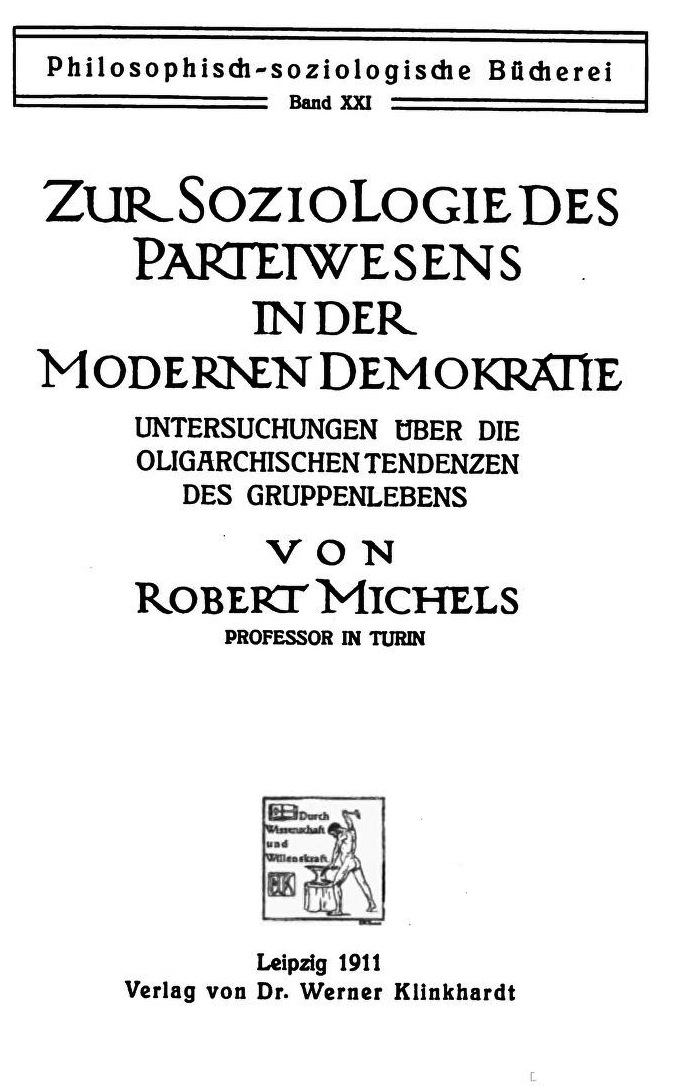
Oligarchy: Michels, 1911
Robert Michels, a German-born sociologist, studied the parties and trade unions that claimed to be the most democratic organizations in Europe, above all the German Social Democratic Party. His book appeared in German in 1911 and in English, translated by Eden and Cedar Paul, in 1915. He found that even organizations founded to empower their members ended up governed by a permanent leadership with interests of its own. He compressed the finding into a law: "It is organization which gives birth to the dominion of the elected over the electors, of the mandataries over the mandators, of the delegates over the delegators. Who says organization, says oligarchy."9
Michels described the shift from means to end in words that anticipate Pierson. "The party is created as a means to secure an end. Having, however, become an end in itself, endowed with aims and interests of its own, it undergoes detachment, from the teleological point of view, from the class which it represents." And: "The interests of the body of employees are always conservative."9 In the 1915 edition's chapter on party life in wartime, he described parties whose "preservation has gradually become the supreme objective," so that "the party is no longer regarded as a means for the attainment of an end, but gradually becomes an end-in-itself."9 The cost he recorded was concrete. Such a party, he wrote, could not hold to its principles once a state bent on war threatened it with "the dissolution of its branches, the sequestration of its funds."9

Rationalized authority and the "iron cage": Weber
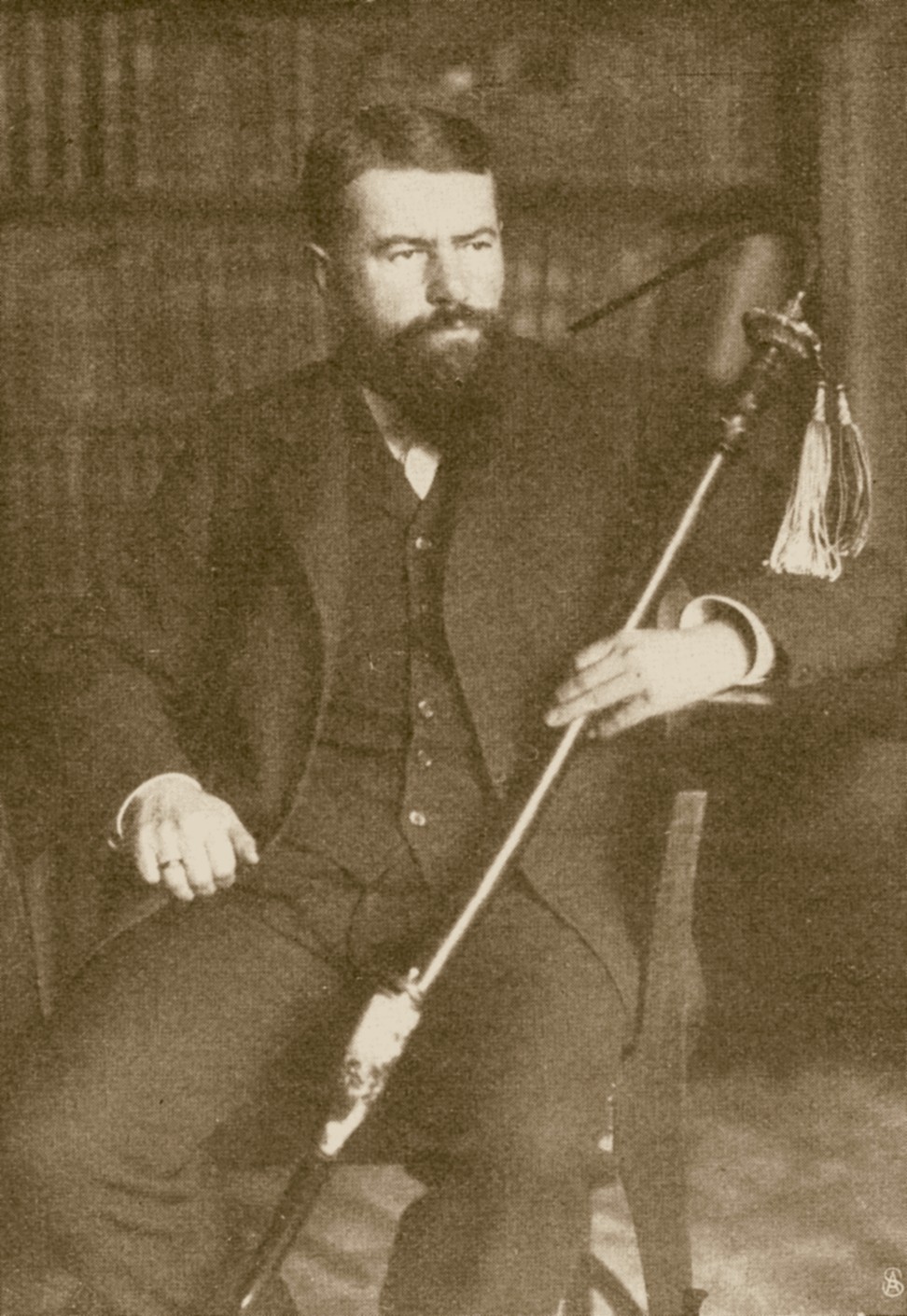
Max Weber, the German sociologist who died in 1920, wrote the founding analysis of modern bureaucracy. He admired its precision and feared its permanence. In the essay on bureaucracy translated by H. H. Gerth and C. Wright Mills (1946), he wrote: "Once it is fully established, bureaucracy is among those social structures which are the hardest to destroy."10 He also identified the instrument bureaucracies use to protect themselves from outside control: "The concept of the 'official secret' is the specific invention of bureaucracy, and nothing is so fanatically defended by the bureaucracy as this attitude." Facing a parliament, he wrote, the bureaucracy "out of a sure power instinct, fights every attempt of the parliament to gain knowledge by means of its own experts or from interest groups."10
The phrase most associated with Weber needs a note on translation. At the end of The Protestant Ethic and the Spirit of Capitalism (German, 1904 and 1905), he described the modern economic order as something people are now born into and cannot step out of. The Puritan writer Richard Baxter had said that care for worldly goods should sit on the believer like a light cloak that could be thrown off at any moment. In Talcott Parsons's 1930 English translation Weber's next sentence reads: "But fate decreed that the cloak should become an iron cage."11 Weber's German is "stahlhartes Gehäuse," more literally a casing or shell "hard as steel." The sociologist Peter Baehr has argued that Parsons's "iron cage" changed the image: a cage confines people but leaves their powers intact, while a shell suggests that modern capitalism has made a new kind of human being.11 Either way, the passage concerns the whole rationalized economic order and no single agency. The passage gives a picture of how structures built for a purpose can harden into conditions nobody chose.

Self-preservation and conservatism: Downs, 1964 and 1967
The economist Anthony Downs set out a theory of bureaus in a paper for the RAND Corporation dated November 1964 and expanded it into Inside Bureaucracy (1967). He started from the assumption that "bureaucratic officials, like all other agents in society, are motivated by their own self interests at least part of the time." Among the official types he described were "conservers," who "seek to maximize their own security and convenience."12 His hypotheses about the life of a bureau read like a summary of this lesson: "Bureaus have predictable life-cycles, except that once established, they rarely (within A given historical era) die," and as they age they tend to "shift their goals from performing their functions well to maintaining their organizational structures."12 The 1967 book stated a set of "laws," among them a Law of Increasing Conservatism: "All organizations tend to become more conservative as they get older, unless they experience periods of very rapid growth or internal turnover." Downs added that the principle "is especially applicable to bureaus because they are relatively insulated from competition."13
Budget maximizing: Niskanen, 1971
William Niskanen had worked in the 1960s as an analyst at the U.S. Department of Defense before he wrote Bureaucracy and Representative Government (1971). The book is remembered for its model of the "budget-maximizing bureaucrat," which one standard reference summarizes as an account of how government policy is guided, and distorted, "by the incentives of government agencies and bureaucrats to increase their budgets and authority rather than serve the general public interest."14 In the model, as the political scientist David Weimer summarized it, the head of a bureau seeks to maximize the budget granted by its sponsor, the legislature, and has an incentive to hide information about the true costs of the bureau's output that might undercut the next budget request. Weimer judged the empirical record of tests of the model to be mixed.14 Its contribution here is narrow: it identifies a reason an institution's leaders might defend its size and survival even when its output does not justify either.
Regulatory capture: Stigler, 1971
George Stigler, a University of Chicago economist, argued in "The Theory of Economic Regulation" (1971) that regulation often serves the regulated. His central thesis was "that, as a rule, regulation is acquired by the industry and is designed and operated primarily for its benefit."15 The idea came to be called regulatory capture, though Stigler did not use that phrase in the article.15 Capture bears on institutionalism because a captured agency acquires a constituency outside itself, the regulated industry, with every reason to defend the agency's continuation and authority. Defense then comes from two directions at once. Later scholars have argued that Stigler's "as a rule" overstated business power, since industries often lose regulatory fights.15 The mechanism is real, and its strength varies case by case, so the historical record has to settle each instance.
Distributional coalitions: Olson, 1982
The economist Mancur Olson extended the argument from single agencies to whole societies. In The Rise and Decline of Nations (1982) he described the organized groups that build up in stable societies and that are "overwhelmingly oriented to struggles over the distribution of income and wealth rather than to the production of additional output"; he called them "distributional coalitions."16 Among his implications: such groups "make decisions more slowly than the individuals and firms of which they are comprised," and they "slow down a society's capacity to adopt new technologies and to reallocate resources in response to changing conditions, and thereby reduce the rate of economic growth."16 Each coalition has a stake in the institutions that serve it. A society thick with such groups is a society in which almost every institution has organized defenders, whatever its performance.
Groupthink: Janis, 1972
The psychologist Irving Janis studied decisions such as the Bay of Pigs invasion of 1961 and the escalation of the Vietnam War. In Victims of Groupthink (1972) he wrote: "I use the term 'groupthink' as a quick and easy way to refer to a mode of thinking that people engage in when they are deeply involved in a cohesive in-group, when the members' strivings for unanimity override their motivation to realistically appraise alternative courses of action."17 Among his eight symptoms were "collective efforts to rationalize in order to discount warnings," "an unquestioned belief in the group's inherent morality," "direct pressure on any member who expresses strong arguments against any of the group's stereotypes, illusions, or commitments, making clear that this type of dissent is contrary to what is expected of all loyal members," and "the emergence of self-appointed mindguards," members "who protect the group from adverse information."17 Groupthink is a small-group phenomenon, and Janis applied it to the small circles of officials and advisers who made foreign-policy decisions under four presidents. It supplies the face-to-face mechanism by which an institution's leaders come to hear criticism as disloyalty.
Normalization of deviance: Vaughan, 1996
The sociologist Diane Vaughan spent years reconstructing the decision to launch the space shuttle Challenger on January 28, 1986. Her book, The Challenger Launch Decision (1996), argued that the launch was a mistake born of organizational culture, with no individual misconduct needed to explain it. In the words of her publisher's summary, she traced "an incremental descent into poor judgment," showing how NASA insiders, "when repeatedly faced with evidence that something was wrong," "normalized the deviance so that it became acceptable to them."18 Each small acceptance of an anomaly became the baseline for the next. The enlarged edition of her book notes that a similar decision-making process brought down the shuttle Columbia in 2003.18 In announcing its report on August 26, 2003, the Columbia Accident Investigation Board stated that "physical and organizational causes played an equal role in the Columbia accident - that the NASA organizational culture had as much to do with the accident as the foam that struck the Orbiter on ascent," and that "the agency does not have a strong safety culture."19 The mechanism the two shuttle losses share is gradual: a sincere institution, staffed by capable people, comes to defend its own routines against the evidence.


System justification and status quo bias
Psychological research helps explain why institutionalism reaches past insiders into the general public. In 1994 John Jost and Mahzarin Banaji proposed the idea of "system-justification," which "refers to psychological processes contributing to the preservation of existing social arrangements even at the expense of personal and group interest."20 They offered it to explain why people take part in justifying the arrangements they live under, including arrangements that disadvantage them, as when disadvantaged groups share negative stereotypes of themselves. In 1988 the economists William Samuelson and Richard Zeckhauser reported experiments and field data showing that "individuals disproportionately stick with the status quo," including in choices of health plans and retirement programs.21 Neither study was about government institutions in particular. Together they explain why a citizen with no stake in an agency may still bristle when it is criticized: the mind leans toward defending what exists.
A popular formulation: Pournelle's "Iron Law"
The science fiction writer and columnist Jerry Pournelle stated an informal rule on his website on April 3, 2006, and called it Pournelle's Iron Law of Bureaucracy. It holds "that in any bureaucratic organization there will be two kinds of people: those who work to further the actual goals of the organization, and those who work for the organization itself," and that "in all cases, the second type of person will always gain control of the organization, and will always write the rules under which the organization functions."22 Pournelle offered it as an observation from experience, and his own illustration was a contested one about teachers and union representatives. It is a slogan with no study behind it, and "always" claims more than any scholar above would sign. People repeat it because it squeezes Michels and Downs into two sentences. It should be cited as Pournelle's own formulation, never as a finding.
The cycle, drawn from the scholarship
Put together, these mechanisms describe a sequence that many institutions pass through. It is a tendency, observed often enough to be named, and many institutions interrupt it. The diagram below is the course's synthesis of the scholars above.
The academic sense of "institutionalism"
Anyone who searches the word will find that it already belongs to two academic traditions, and neither means what Pierson means.
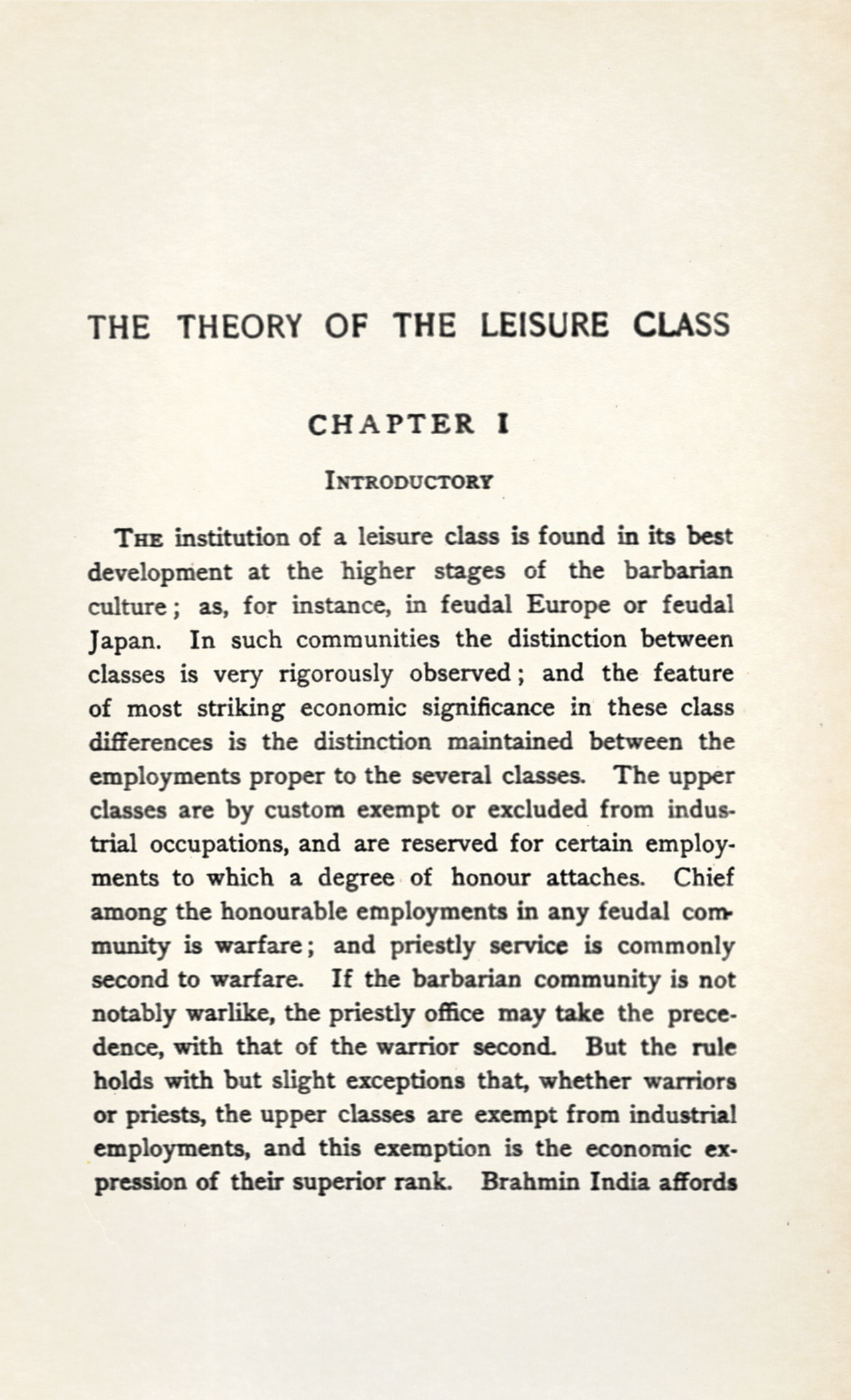
In economics, "institutionalism" names a school that began in the United States around 1900. Thorstein Veblen, its founding figure, wrote in The Theory of the Leisure Class (1899) that "The institutions are, in substance, prevalent habits of thought with respect to particular relations and particular functions of the individual and of the community." He also wrote that institutions "are products of the past process, are adapted to past circumstances, and are therefore never in full accord with the requirements of the present."23 John R. Commons, the University of Wisconsin economist, wrote in 1931: "we may define an institution as collective action in control, liberation and expansion of individual action."24 This older school is now called the old institutional economics.
The new institutional economics is associated above all with Douglass North, quoted above, who shared the 1993 Nobel memorial prize in economics. In political science, James March and Johan Olsen announced a "new institutionalism" in a 1984 article in the American Political Science Review that, in their words, "emphasizes the relative autonomy of political institutions, possibilities for inefficiency in history, and the importance of symbolic action to an understanding of politics."25
Those scholars use "institutionalism" as the name of a method: a way of explaining behavior by studying rules, norms and organizations. Pierson uses the same word for an attitude. The academic writers still supply evidence for his concern. Veblen's line that institutions are "never in full accord with the requirements of the present" describes the gap between founding purpose and present function. North wrote in his Nobel lecture that "Institutions are not necessarily or even usually created to be socially efficient; rather they, or at least the formal rules, are created to serve the interests of those with the bargaining power to create new rules."3 March and Olsen's "relative autonomy of political institutions" names the same independence from outside pressure that Pierson calls insulation from accountability. In this module the word "institutionalism" carries Pierson's critical sense unless a sentence says otherwise.
The acacia and its ants
Pierson built his essay on a picture from biology. He describes it this way: "Biologists discovered that some species of acacia secrete a special nectar that affects the digestive enzymes of their ant defenders. Once the ants consume this nectar, they can no longer metabolize other sugars. In essence, the tree makes itself the only viable food source." From that he draws the human parallel: "In human systems, institutional defenders may appear voluntary but are, in reality, functionally dependent."1 His citation for the biology needs correction, and the correction is in a note.26 The findings themselves are well documented, and they deserve an exact statement.
What the studies found
The plants are Central American "ant acacias," which house ants of the genus Pseudomyrmex and feed them from nectar secreted outside the flowers, called extrafloral nectar.2730 In 2005 Martin Heil, Jeanine Rattke and Wilhelm Boland reported in Science that this nectar carries high activity of invertase, the enzyme that splits sucrose, ordinary table sugar, into glucose and fructose. So the acacia nectar "contained no sucrose." Sucrose is what draws ordinary, non-guarding ants, so the acacia nectar was unattractive to them. And the Pseudomyrmex ants that live on the trees "had almost no invertase activity in their digestive tracts and preferred sucrose-free EFN."27
In 2009 a team led by Stefanie Kautz compared the guarding ants with freeloading ant species and with generalists. The guards lacked invertase. The others had it. Sucrose in the diet switched on invertase in workers of the freeloaders and the generalists and in the larvae of every species, but not in adult guards: "the mutualists loose invertase during their ontogeny," that is, during their development from larva to adult. The authors concluded that "This reduced metabolic capacity ties the mutualists to their plant hosts."28
The 2014 paper in Ecology Letters supplied the mechanism. Heil and colleagues found that invertase in the ants' midguts "was inhibited by chitinase, a dominant EFN protein," an enzyme the acacia puts in its nectar. "Once a freshly eclosed worker ingests EFN as the first diet available, her invertase becomes inhibited and she, thus, continues feeding on host-derived EFN." The authors named the effect "partner manipulation," in which one partner controls "the phenotype of the other partner to enhance its dependency on host-derived rewards."29 Reporting on the study, the science writer Ed Yong quoted Heil: "Since the first dose of nectar is enough to reduce invertase activity, they remain trapped."30
The popular retelling needs correcting in its details. What the ants lose is the ability to digest sucrose, which is one sugar. They still use the glucose and fructose the acacia provides. Larvae can still make the enzyme, and the loss happens at the first adult meal. And the relationship remains a mutualism: in Yong's summary, the ants defend the trees "from weeds and hungry animals in exchange for room and board."30
What the analogy captures
The biology gives a precise picture of engineered dependence inside a relationship that delivers real benefits. The acacia really does feed and house its ants. The ants really do protect the tree. The manipulation locks an existing bargain in place, so that the ants' continued service no longer depends on whether a better option exists. Many human institutions work like that. Pensions that vest only after long service, licenses that are worthless outside one jurisdiction, skills trained so narrowly they have no market elsewhere, and the social cost of leaving a community that defines one's identity all tie members to institutions independent of how well the institutions are run. Hirschman made the same point in economic language: an organization that can "exact a high price for exit" thereby "acquires a powerful defense against one of the member's most potent weapons: the threat of exit."4
What the analogy misses
It misses a great deal. Ants cannot reason about their situation, cannot organize, cannot vote and cannot read the acacia's charter. People can do all four. Human institutions are made of choices and law. They have founding documents, budgets, inspectors general, courts, elections and newspapers, every one of which is a channel for the voice Hirschman described. An ant's dependence is fixed by chemistry at its first meal. A citizen's dependence is a matter of degree and can be changed by argument and by law. Most institutional defense is also not manipulation in any literal sense. It runs through the mechanisms described earlier: rules that become ends, careers that need the body to continue, groups that stop hearing warnings, and the ordinary human preference for the status quo. None of those needs a manipulator. Many are the unplanned result of people doing their jobs, which is worse news for anyone hoping to fix the problem by finding someone to blame.
The analogy also cuts against one of Pierson's own lines. His closing call to "stop calling parasites partners" outruns the biology, because the ants and the tree are partners.1 An institution that engineers dependence can still deliver real service. The acacia picture is best used for one narrow question: does an institution's support depend on its performance, or has the support been made independent of performance? The rest of the work has to be done by the record.
Telling institutionalism from earned trust
Earned trust and institutionalism sound alike in a press release. They behave differently, and behavior leaves records. The table below lists observable markers. It is the course's synthesis, built from the scholars above, and lists things to look for in documents; none of those scholars wrote it in this form. No single marker settles a case. A pattern across several does.
| Marker | Pattern consistent with earned trust | Pattern consistent with institutionalism |
|---|---|---|
| Performance data | Publishes results, including bad ones, in a form outsiders can check | Withholds or delays data; treats its working information as an official secret10 |
| Audit and oversight | Invites audit, answers inspectors and legislators, implements findings | Contests the auditor's standing, slow-walks requests, buries findings10 |
| Internal critics | Protects people who raise concerns and acts on their warnings | Pressures or removes dissenters as disloyal; warnings are discounted1718 |
| Grounds of justification | Points to results measured against the founding purpose | Points to age, identity, prestige and necessity; the rules have become ends78 |
| Response to failure | Reforms after its own review finds failure | Reforms only after outside exposure, and then minimally12 |
| Outside criticism | Treats it as information that might be right | Treats it as an attack on order and on all institutions20 |
| Who benefits from its continuation | The public it was created to serve | Its staff, its budget and the groups it regulates or funds141516 |
| Exit and voice | Members can leave or speak without ruinous penalty | Exit is made costly and voice is treated as disloyalty4 |
Turn the table around and it fits critics just as well. A reform movement that hides its own evidence, punishes dissent in its ranks and answers every objection by questioning motives shows the same markers. Reformers are not exempt from institutionalism once they have an organization of their own to protect, and Pierson's ordered liberty asks the same honesty of both sides.
Where this module goes
The scholarship above describes how institutions come to defend themselves. This module asks a historical question about the American case: where did the institutions that are now defended this way come from, who built them, on what authority, and to whom were they answerable? Lesson 2 first tests the definition against documented cases from several centuries and sectors and weighs the limits of the idea. Lessons 3 through 17 then follow the American institutional forms era by era, from a royal charter of 1606 to the Supreme Court decisions of 2024 and the policy fights of 2026.
Name versus function
The module's method fits in one rule: judge an institution by what it does, never by what it calls itself. The first royal charter of Virginia, dated April 10, 1606, shows why. On its face it licensed a group of "Adventurers" to "make Habitation, Plantation, and to deduce a colony." It also ordained that each colony "shall have a Council, which shall govern and order all Matters and Causes," and created a second council in England, "our Council of Virginia," with "the superior Managing and Direction" of the enterprise.31 A business license, by its function, was a constitution. The second charter of May 23, 1609 granted the "Treasurer and Company" land "from Sea to Sea, West and Northwest," and gave the governor "full Power and Authority, to use and exercise Martial Law in Cases of Rebellion or Mutiny."32
The function test also ran the other way. King James I ended the Virginia Company's government in 1624. His commission to Governor Francis Wyatt, dated August 26, 1624, recites that in "sixteene yeares government past" the colony "had yealded fewe or none" of the goods promised, and that "uppon a quo warranto brought and a legall and judiciall proceeding therin by due course of laws the said charters were and nowe are and stand avoyded."33 Charles II did the same to the Massachusetts Bay Company in 1684, when the Court of Chancery ordered its 1629 charter "cancelled vacated and annihilated."34 Whatever the royal motives, the legal doctrine held that a charter was a grant conditioned on use. In 1828 Chief Justice John Marshall applied a function test to the courts Congress had created for the Florida Territory, whose judges served four-year terms: "These Courts, then, are not constitutional Courts," he wrote. "They are legislative Courts."35 And the English Board of Trade, created in 1696, was in its official historian's words of "an advisory nature," yet lesson 3 shows how many colonial laws the Crown voided on its advice.36
Questions to ask of every institution
| Question | What to look for in the documents | Example from this module |
|---|---|---|
| What was its founding authority? | The enacting words: a royal grant, an act of Parliament or Congress, a treaty, an executive order | The 1606 Virginia charter was granted by the king alone, with no act of Parliament |
| Who did it answer to? | Who appoints and removes its officers, sets their pay, and can review or void its acts | The 1681 Pennsylvania charter sent every provincial law to the Privy Council within five years, and a law the Crown declared void "shall become voyd" |
| What did it actually do? | Orders, seizures, judgments, grants of money or land: the record, not the promise | Vice-admiralty courts under the Sugar Act of 1764 decided customs forfeitures without juries |
| Did it later defend itself on habit? | Justifications offered when challenged: results, or continuity, precedent and self-preservation | Agencies defending in-house adjudication by long practice, a question the Court took up in SEC v. Jarkesy (2024)37 |
The seven eras
The timeline shows the seven eras the module covers, with one or two documents from each.
1. Charters and the Crown, 1606 to 1763. English colonization began as a corporate venture licensed by the king. Parliament's Navigation Act of October 9, 1651 barred goods from Asia, Africa or America from entering England except in English ships, on pain of forfeiture.38 The Board of Trade followed in 1696.36 Against all of this stood the colonial assemblies, starting with the 22 burgesses who met in the church at Jamestown on July 30, 1619.39 Lesson 3.
2. Offices and courts without consent, 1764 to 1783. After the Seven Years' War, Parliament used customs law to raise revenue and moved enforcement into courts without juries. The Declaration of Independence answered: "He has erected a multitude of New Offices, and sent hither swarms of Officers to harrass our people, and eat out their substance," and "For depriving us in many cases, of the benefits of Trial by Jury."40 The American Board of Customs Commissioners, authorized by an act of 1767 and seated in Boston, brought a London-appointed revenue board onto American soil.41 Lesson 4.
3. The founding design and the national domain, 1784 to 1828. The Constitution was built as a set of rival powers. Federalist 51 put the problem in one sentence: "you must first enable the government to control the governed; and in the next place oblige it to control itself."42 Federalist 46 called the federal and state governments "different agents and trustees of the people."43 Congress governed its western domain through the Northwest Ordinance of July 13, 1787, under a governor, a secretary and three judges, all appointed by Congress.44 The First Bank of the United States opened in 1791.45 Lessons 5, 6 and 7.

4. Bank, tariff and public rights, 1829 to 1860. The fight over the Second Bank, the nullification crisis of 1832 and 1833, and Murray's Lessee v. Hoboken Land and Improvement Co. (1856), which the Supreme Court has called "The decision that first recognized the public rights exception."37 Lesson 8.
5. War, railroads and the first regulatory commission, 1861 to 1897. The Civil War Congress chartered national banks, issued paper money and, by the Pacific Railway Act approved July 1, 1862, granted land and bonds to build a transcontinental line.46 The Interstate Commerce Act, approved February 4, 1887, created the Interstate Commerce Commission.47 Lessons 9 and 10.
6. Empire, the Progressive state and the New Deal, 1898 to 1946. In Downes v. Bidwell, decided May 27, 1901, the Court held that the Constitution did not fully follow the flag into Puerto Rico.48 The Federal Reserve Act was signed December 23, 1913.49 The Administrative Procedure Act of June 11, 1946 set ground rules for the agencies the New Deal multiplied.50 Lessons 11 and 12.
7. The security state, the land statutes and modern mercantilism, 1947 to 2026. The National Security Act of 1947 created the National Security Council and the Central Intelligence Agency and merged the War and Navy Departments into what became the Department of Defense.51 The NATO Status of Forces Agreement was signed in London on June 19, 1951.52 The Federal Land Policy and Management Act of October 21, 1976 set a national policy of keeping most remaining public lands in federal hands.53 The Emergency Economic Stabilization Act of October 3, 2008 authorized the Troubled Asset Relief Program.54 And in Loper Bright Enterprises v. Raimondo, decided June 28, 2024, the Court wrote three words that ended forty years of judicial deference to agency readings of statutes: "Chevron is overruled."55 Lessons 13, 14, 15, 16 and 17, with lesson 16 devoted to the fusion of state and capital that Pierson calls modern mercantilism.
A thesis tested instead of adopted. The reading list for this module came from an outline that argued a single hidden "Government #2," born in the Northwest Ordinance, runs the modern administrative state. The module uses that outline's sources and does not adopt its thesis. Some of its links are documented, some are analogies that need testing, and some have no evidence at all. Lesson 18 sorts them claim by claim, and lesson 19 gathers the module's charts and pictures. Philip Hamburger's argument that administrative power revives the royal prerogative enters at lesson 4, where it first touches the colonial record.
Through Pierson's Framework
Pierson's framework applies to any institution in any century. It asks first about accountability to the people: can the people an institution governs, or their elected representatives, see what it does, correct it and remove those who run it? It asks about mutual restraint: citizens owe discipline and support to legitimate government, and government owes law, truth and justice to citizens. And it applies the rule of name versus function: a charter, a court or a commission is what its record shows, whatever its letterhead says.
The scholarship above explains why the first test is so often failed with nobody intending it. Weber's official secret, Merton's displaced goals, Downs's conservers and Janis's mindguards all work to narrow what outsiders can see. Pierson's appendix to Ordered Liberty Reclaimed describes the result: "Institutions, once corrupt, do not collapse. They adapt. They learn how to appear lawful while suppressing dissent. They entrench policies behind procedure, insulate officials through legal immunity, and claim moral neutrality while enforcing ideological dogma. This is not tyranny by seizure. It is tyranny by sediment, the slow burial of liberty under layers of unchecked authority."56 The image of sediment fits the mechanisms. None of them is dramatic. Each lays down a thin layer, and nobody notices the depth until something is buried.
The same appendix states the standard by which to judge the layers: "When institutions become self-justifying, declaring their actions lawful simply because they are legal, the republic has entered a state of constitutional decay." And: "institutions are never morally superior to the people who created them. They exist to serve liberty, not to redefine it."56 His warning that "no institution is self-correcting" is the political form of Hirschman's argument. Correction comes from voice, from members and citizens who stay and speak up.56
The citizen's role under this framework is active and disciplined. The Ordered Liberty Papers describe Civic Anti-Authoritarianism this way: "Under CAA, the citizen becomes the moral auditor of government. Institutions are to be questioned, not worshiped. Transparency replaces secrecy, accountability replaces privilege, and moral duty replaces blind allegiance."57 An auditor reads the books line by line and reports what is there, including the dull news that the books are in order. Pierson extends the same scrutiny past government: "Authoritarianism is not confined to government. It can be exercised through courts, agencies, corporations, media, activist groups, and digital platforms wherever power is used without accountability and justice is replaced with control."6 The markers table applies to a corporation or an advocacy group as fully as to an agency.
Mutual restraint binds the critic too. Support for legitimate government is half the duty, and an auditor who finds an agency doing its job owes the public that finding, even when it spoils a good story. "Systems that cannot tolerate critique are not strong, they are brittle," Pierson writes. "Systems that punish reform are not sacred, they are corrupt."1 A critique that cannot tolerate evidence against itself fails the same test.
Hard Questions and Answers
Isn't "institutionalism" just a fancy insult for anyone who respects an institution you happen to dislike?
It can be exactly that, and the word deserves suspicion whenever it shows up without evidence attached. Long-lived institutions often carry knowledge no single generation could rebuild, and Veblen's own definition treats institutions as prevalent "habits of thought" handed down as "products of the past process."23 Selznick thought infusion with value was often what kept an organization true to its purpose under pressure.8 Pierson's definition is narrower than respect. It targets defense "not based on performance or morality," and he says outright that "Institutions can and should be valuable."1 The working definition in this lesson adds a test: does the defense run through the record or around it? Someone who defends the jury system by pointing to what juries do is no institutionalist. Someone who defends an agency only by its age, its prestige and the danger of questioning it is one. Lesson 2 takes up the risk that the word becomes an all-purpose insult and treats it at length.
Your scholars studied German socialist parties, shuttle engineers and small circles of advisers. What gives you the right to turn their findings on government as a whole?
Nothing gives that right automatically. But several of them studied government directly. Weber's essay is about state bureaucracy and parliaments, Downs and Niskanen wrote about public bureaus, Stigler wrote about regulatory agencies, and Janis's cases were foreign-policy decisions made by small groups of government officials and advisers under four presidents.10121517 Michels studied parties and unions, and Merton wrote that bureaucratic secrecy "is confined neither to public nor to private bureaucracies."97 The concession is real: each mechanism was shown in particular settings, and its strength in any given agency has to be proved from that agency's record. Here the mechanisms are hypotheses to test against documents. Anyone who uses them as verdicts in advance is doing the very thing the definition condemns, only in reverse.
Isn't public choice just cynicism with equations, a way of smearing civil servants who mostly do honest work?
Downs assumed self-interest "at least part of the time," which is a modest claim, and he described zealots and advocates devoted to their programs alongside the conservers.12 Niskanen's budget-maximizing model has a mixed record in empirical tests, and it appears here as one mechanism among many, no more.14 And the sociological mechanisms do not require selfishness at all. Merton's bureaucratic virtuoso is conscientious to a fault. Vaughan's NASA managers were capable professionals.718 Pierson himself says the dynamic "often begins in sincerity."1 Institutionalism is better understood as what decent people drift into under certain structures than as a vice of bad people. That reading is harder on the institutions, since good intentions offer no protection.
Pierson got his acacia citation wrong, and his own biology describes partners. Why trust the rest of the argument?
Because the rest of the argument does not stand on the acacia. The citation was wrong, and the course corrects it.26 The finding stands on later research: acacia nectar contains chitinase that inhibits the ants' invertase at their first adult meal, and the researchers themselves call this "partner manipulation" that enhances the ants' "dependency on host-derived rewards."29 The concession is real. The ants are fed and housed, the tree depends on them, and the call to "stop calling parasites partners" overreaches the biology.1 So the definition here does not rest on the acacia. It stands on the human record and on a century of social science. The acacia illustrates one mechanism, engineered dependence, and is used only for that.
Some critics really are out to wreck legitimate institutions. Doesn't the "attack on order" clause just wave them through?
Some critics are, and the clause gives them nothing. Wanting an institution gone regardless of its record is the mirror-image corruption defined above. Pierson's own framework rules it out: his program is restoration "Not through expanded government, and not through chaos."6 The clause describes a habit of response, the move that hears every criticism as an attack on order before examining whether the criticism is accurate. The remedy is to examine the claim. An institution confident in its record can answer specific criticism with specific evidence. One that answers only with alarm about order has told the public something about its record.
If every institution drifts toward self-preservation, why should anyone defend any of them?
Because without institutions, power passes to whoever is strongest at the moment. The Federalist's answer is the classic one: government must first be enabled "to control the governed," and then obliged "to control itself."42 Hirschman showed that loyalty, kept honest, is what gives voice time to work.4 The tendencies described here are reasons to build and use oversight, open records and real exit, and Pierson's ordered liberty treats support for legitimate institutions as a duty alongside accountability.5 Lesson 2 gives the strongest arguments for keeping inherited institutions, from Edmund Burke and G. K. Chesterton, and a documented case of what happened when working institutions were dismantled at speed.
Learn more
- Robert Michels, Political Parties (1915 English edition): the full text of the study that stated the iron law of oligarchy.
- Robert K. Merton, Social Theory and Social Structure (1949): contains "Bureaucratic Structure and Personality," the classic account of goal displacement.
- From Max Weber: Essays in Sociology (1946): Weber's essay on bureaucracy, its permanence and the official secret.
- Anthony Downs, "A Theory of Bureaucracy" (RAND, 1964): the paper behind Inside Bureaucracy, with its official types and bureau life cycle.
- Columbia Accident Investigation Board, final report release (2003): an official finding that organizational culture caused an accident.
- Douglass North, Nobel Prize Lecture (1993): institutions as the rules of the game, and why they are not built to be efficient.
- Heil and others, "Partner manipulation stabilises a horizontally transmitted mutualism" (2014): the acacia study behind Pierson's image.
- Pierson, The Ordered Liberty Papers: contains "The Acacia Illusion."
- Pierson, Ordered Liberty Reclaimed: includes the Anti-Federalist appendix on "tyranny by sediment."
- Module 52, Ordered Liberty: Pierson's framework of civic anti-authoritarianism in full.
Notes
- Jeff A. Pierson, "The Acacia Illusion: How Institutionalism Mimics Nature's Most Subtle Manipulation," in The Ordered Liberty Papers (2025). Read it online. ↩
- Douglass C. North, Institutions, Institutional Change and Economic Performance (Cambridge: Cambridge University Press, 1990), chapter 1, "An introduction to institutions and institutional change," p. 3 (opening sentence, as shown on the publisher's chapter page). Read it online. ↩
- Douglass C. North, "Economic Performance through Time," Prize Lecture in Economic Sciences, December 9, 1993, sections II and III, NobelPrize.org. Read it online. ↩
- Albert O. Hirschman, Exit, Voice, and Loyalty: Responses to Decline in Firms, Organizations, and States (Cambridge, Mass.: Harvard University Press, 1970), pp. 78-79, 92-93 and 96. Quotations and page numbers checked against a full scan of the 1970 Harvard edition (copyright 1970); publisher's record linked. Read it online. ↩
- Paraphrase of Pierson's one-line statement of ordered liberty as his guiding principle, which applies regardless of which party wins elections. His published statement of the same balance, mutual restraint between citizens and institutions, is in Ordered Liberty Reclaimed: A Foundation for Liberty. Read it online. ↩
- Jeff A. Pierson, Ordered Liberty Reclaimed: A Foundation for Liberty. Read it online. ↩
- Robert K. Merton, "Bureaucratic Structure and Personality," first published in Social Forces 18 (1940): 560-568; quoted here from the reprint in Merton, Social Theory and Social Structure (Glencoe, Ill.: The Free Press, 1949), pp. 153-158, full text of the 1949 edition at the Internet Archive (Digital Library of India scan). Read it online. ↩
- Philip Selznick, Leadership in Administration: A Sociological Interpretation (Evanston, Ill.: Row, Peterson, 1957), pp. 17 and 21-22. Both passages were checked word for word against the 1957 Row, Peterson edition through the Internet Archive's full-text search of its lending copies (two 1957 printings and a later Harper and Row printing), which also shows the running heads for pp. 16, 17 and 21 around the passages. The book reads "but they have also a 'natural' dimension"; W. Richard Scott, "The Adolescence of Institutional Theory," Administrative Science Quarterly 32, no. 4 (December 1987): 493-511, at 494, which quotes both passages, transposes the words to "they also have." The p. 17 sentence is also reproduced, with the same page, in Marvin Washington, Kimberly B. Boal and John N. Davis, a SAGE handbook chapter on Selznick. Internet Archive record of the 1957 edition. Washington, Boal and Davis. Read it online. ↩
- Robert Michels, Political Parties: A Sociological Study of the Oligarchical Tendencies of Modern Democracy, translated by Eden and Cedar Paul (New York: Hearst's International Library Co., 1915), pp. 389, 394-395 and 401 (the wartime passages are in the chapter "Party-Life in War-Time"); German original Zur Soziologie des Parteiwesens in der modernen Demokratie (Leipzig: Klinkhardt, 1911). Full text of the 1915 English edition at the Internet Archive. Read it online. ↩
- Max Weber, "Bureaucracy," in From Max Weber: Essays in Sociology, translated and edited by H. H. Gerth and C. Wright Mills (New York: Oxford University Press, 1946), pp. 228 and 233-234; full text of the 1946 edition at the Internet Archive. Read it online. ↩
- Max Weber, The Protestant Ethic and the Spirit of Capitalism, translated by Talcott Parsons (London: George Allen and Unwin; New York: Charles Scribner's Sons, 1930), p. 181; full text of the 1930 edition at the Internet Archive. The German phrase is "stahlhartes Gehäuse." On the translation, see Peter Baehr, "The 'Iron Cage' and the 'Shell as Hard as Steel': Parsons, Weber, and the Stahlhartes Gehäuse Metaphor in The Protestant Ethic and the Spirit of Capitalism," History and Theory 40, no. 2 (2001): 153-169. Read it online. Baehr article. ↩
- Anthony Downs, "A Theory of Bureaucracy," RAND Corporation Paper P-3031 (November 1964), pp. 1, 5, 12-13, Defense Technical Information Center accession AD0609191. Downs developed the paper into Inside Bureaucracy (Boston: Little, Brown, 1967), which its title page describes as "A Rand Corporation research study" (per the Internet Archive catalog record of the 1967 edition). Read it online. RAND record of the book. ↩
- Anthony Downs, Inside Bureaucracy (Boston: Little, Brown, 1967), chapter II, "The Life Cycle of Bureaus," p. 20, checked word for word through the Internet Archive's full-text search of two lending copies of the 1967 edition (the folios 19 and 20 bracket the passage). The book's summary of hypotheses ("The Laws," p. 262) restates the law with "as they become older." RAND lists the book as a commercial title from Little, Brown and offers no free copy. A review of the book in the Defense Technical Information Center, accession AD0671647 (reviewer and date not given), paraphrases the law with "as they grow older." Internet Archive record of the 1967 edition. DTIC review. ↩
- William A. Niskanen, Bureaucracy and Representative Government (Chicago: Aldine-Atherton, 1971; reprinted by Routledge, 2017, DOI 10.4324/9781315081878). The summary of his model follows the History of Economic Thought website profile of Niskanen (1933-2011), which describes his "1971 model of the 'budget-maximizing bureaucrat'"; biographical details from the same profile. The sponsor, information and empirical-record points follow David L. Weimer, "The Synergy of Practice and Theory: Niskanen's Contribution to the Study of Bureaucracy," obituary for the APSA Political Economy newsletter, reprinted at The Monkey Cage, June 20, 2013. Read it online. Weimer. ↩
- George J. Stigler, "The Theory of Economic Regulation," Bell Journal of Economics and Management Science 2, no. 1 (1971), at p. 3 (DOI 10.2307/3003160); quotation checked against Christopher Carrigan and Cary Coglianese, "George J. Stigler, 'The Theory of Economic Regulation,'" chapter 20 of an edited handbook on classics of public policy, author copy posted by the George Washington University Regulatory Studies Center, which also notes that Stigler never used the phrase "regulatory capture" in the article. Read it online. ↩
- Mancur Olson, The Rise and Decline of Nations: Economic Growth, Stagflation, and Social Rigidities (New Haven: Yale University Press, 1982), chapter 3, "The Implications," implications 4, 6 and 7; full text at the Internet Archive. Read it online. ↩
- Irving L. Janis, Victims of Groupthink: A Psychological Study of Foreign-Policy Decisions and Fiascoes (Boston: Houghton Mifflin, 1972), p. 9 (definition) and pp. 197-198 (the eight symptoms); full text of the 1972 edition at the Internet Archive. Read it online. ↩
- Diane Vaughan, The Challenger Launch Decision: Risky Technology, Culture, and Deviance at NASA (Chicago: University of Chicago Press, 1996; enlarged edition 2016), publisher's description of the enlarged edition and table of contents (chapter 3, "Risk, Work Group Culture, and the Normalization of Deviance"). Read it online. ↩
- Columbia Accident Investigation Board, press release, "Columbia Accident Investigation Board Releases Final Report," August 26, 2003, archived by the University of North Texas CyberCemetery. Read it online. ↩
- John T. Jost and Mahzarin R. Banaji, "The Role of Stereotyping in System-Justification and the Production of False Consciousness," British Journal of Social Psychology 33, no. 1 (March 1994): 1-27, abstract (Crossref record). Read it online. ↩
- William Samuelson and Richard Zeckhauser, "Status Quo Bias in Decision Making," Journal of Risk and Uncertainty 1, no. 1 (March 1988): 7-59, abstract (RePEc record). Read it online. ↩
- Jerry Pournelle, "Chaos Manor" daybook, View 408, entry for Monday, April 3, 2006. Read it online. ↩
- Thorstein Veblen, The Theory of the Leisure Class (1899), chapter 8, "Industrial Exemption and Conservatism," Project Gutenberg eBook 833. Read it online. ↩
- John R. Commons, "Institutional Economics," American Economic Review 21, no. 4 (1931): 648-657, at 648-649. Text read in the McMaster University Archive for the History of Economic Thought copy. Read it online. ↩
- James G. March and Johan P. Olsen, "The New Institutionalism: Organizational Factors in Political Life," American Political Science Review 78, no. 3 (1984): 734-749, abstract (abstract text from the Crossref record of the article). Read it online. ↩
- Pierson's essay cites "Heil, McKey, & Bennett, 2001" for the acacia finding. A search of the Crossref and Europe PMC indexes in October 2026 found no 2001 paper by those three authors. Martin Heil and Doyle McKey did co-write "Protective Ant-Plant Interactions as Model Systems in Ecological and Evolutionary Research," Annual Review of Ecology, Evolution, and Systematics 34 (2003): 425-553, a general review (page range per the Crossref record and the publisher's page). The specific findings Pierson describes come from Heil, Rattke and Boland (2005) and Heil, Barajas-Barron, Orona-Tamayo, Wielsch and Svatos (2014), cited in the notes that follow. Pierson's words are quoted as written; this note corrects only the citation. Read it online. ↩
- Martin Heil, Jeanine Rattke and Wilhelm Boland, "Postsecretory Hydrolysis of Nectar Sucrose and Specialization in Ant/Plant Mutualism," Science 308, no. 5721 (2005): 560-563, abstract. Read it online. ↩
- Stefanie Kautz, H. Thorsten Lumbsch, Philip S. Ward and Martin Heil, "How to Prevent Cheating: A Digestive Specialization Ties Mutualistic Plant-Ants to Their Ant-Plant Partners," Evolution 63, no. 4 (2009): 839-853, abstract. Read it online. ↩
- Martin Heil, Alejandro Barajas-Barron, Domancar Orona-Tamayo, Natalie Wielsch and Ales Svatos, "Partner Manipulation Stabilises a Horizontally Transmitted Mutualism," Ecology Letters 17, no. 2 (2014): 185-192, abstract. Read it online. ↩
- Ed Yong, "Trees Trap Ants Into Sweet Servitude," National Geographic, November 6, 2013 (reporting the 2014 Ecology Letters paper on its early online release, with interviews of Martin Heil, Todd Palmer and Corrie Moreau). Read it online. ↩
- The First Charter of Virginia, April 10, 1606, Avalon Project, Yale Law School, from Francis Newton Thorpe, ed., The Federal and State Constitutions (1909). Read it online. ↩
- The Second Charter of Virginia, May 23, 1609, Avalon Project, Yale Law School. Read it online. ↩
- King James I, Commission to Sir Francis Wyatt, Governor, August 26, 1624, as printed in National Park Service, Jamestown: In the Words of Contemporaries (NPS Source Book 5), section 18, "The End of the Virginia Company." Read it online. ↩
- The Charter of Massachusetts Bay, 1691, recital of the 1684 Chancery judgment on a writ of scire facias, Avalon Project, Yale Law School. Read it online. ↩
- American Insurance Co. v. 356 Bales of Cotton (Canter), 26 U.S. (1 Pet.) 511, 546 (1828) (Marshall, C.J.). Read it online. ↩
- J. C. Sainty, ed., Office-Holders in Modern Britain: Volume 3, Officials of the Boards of Trade 1660-1870 (London, 1974), introduction, section "Council of Trade and Plantations 1696-1782," British History Online. Read it online. ↩
- SEC v. Jarkesy, 603 U.S. ___ (2024), No. 22-859, slip opinion, syllabus notice and opinion of the Court (on Murray's Lessee, 18 How. 272 (1856)), decided June 27, 2024. Read it online. ↩
- "October 1651: An Act for increase of Shipping" (short title), in Acts and Ordinances of the Interregnum, 1642-1660, ed. C. H. Firth and R. S. Rait (London, 1911), pp. 559-562, British History Online. Read it online. ↩
- National Park Service, Historic Jamestowne, "The First Legislative Assembly." Read it online. ↩
- The Declaration of Independence, July 4, 1776, transcription, National Archives. Read it online. ↩
- Legal Papers of John Adams, volume 2, editorial note to the Folger case, note 10 ("The Commissioners were authorized by 7 Geo. 3, c. 41 (1767)"), Adams Papers Digital Edition, Massachusetts Historical Society. Read it online. ↩
- James Madison, The Federalist No. 51 (1788), Avalon Project, Yale Law School. Avalon heads the essay "Hamilton or Madison," reflecting the old dispute over twelve essays both men's partisans claimed; modern scholarship generally credits Madison, and Founders Online prints No. 51 among the Papers of James Madison. Read it online. Founders Online text. ↩
- James Madison, The Federalist No. 46 (1788), Avalon Project, Yale Law School. Read it online. ↩
- An Ordinance for the Government of the Territory of the United States North West of the River Ohio, July 13, 1787, Avalon Project, Yale Law School. Read it online. ↩
- Federal Reserve History, "The First Bank of the United States, 1791-1811." Read it online. ↩
- National Archives, Milestone Documents, "Pacific Railway Act (1862)," approved July 1, 1862 (bonds and public land grants); for the national bank charters and Civil War greenback currency, Federal Reserve History, "National Banking Acts of 1863 and 1864." Read it online. National Banking Acts. ↩
- National Archives, Milestone Documents, "Interstate Commerce Act (1887)," approved February 4, 1887. Read it online. ↩
- Downes v. Bidwell, 182 U.S. 244 (1901), decided May 27, 1901. Read it online. ↩
- Federal Reserve History, "Federal Reserve Act Signed by President Wilson," December 23, 1913. Read it online. ↩
- Administrative Procedure Act, Pub. L. 79-404, 60 Stat. 237, approved June 11, 1946, U.S. Statutes at Large, govinfo.gov. Read it online. ↩
- Office of the Historian, U.S. Department of State, "National Security Act of 1947," Milestones in the History of U.S. Foreign Relations. Read it online. ↩
- Agreement between the Parties to the North Atlantic Treaty regarding the Status of their Forces, signed London, 19 June 1951, NATO official texts. Read it online. ↩
- Federal Land Policy and Management Act of 1976, Pub. L. 94-579, 90 Stat. 2743, approved October 21, 1976, govinfo.gov. Read it online. ↩
- Emergency Economic Stabilization Act of 2008, Pub. L. 110-343, enacted October 3, 2008, govinfo.gov details page. Read it online. ↩
- Loper Bright Enterprises v. Raimondo, 603 U.S. ___ (2024), No. 22-451, slip opinion, decided June 28, 2024 ("Chevron is overruled."). Read it online. ↩
- Jeff A. Pierson, "The Anti-Federalist Warning: Institutional Power and the Fragility of Liberty," appendix to Ordered Liberty Reclaimed: A Foundation for Liberty. Read it online. ↩
- Jeff A. Pierson, The Ordered Liberty Papers, section on Civic Anti-Authoritarianism (CAA). Read it online. ↩
Terms in this lesson
- Institutionalism (Pierson)
- The habit of defending an institution's continuation, authority and reputation as ends in themselves, apart from its performance, and of treating criticism of it as an attack on order itself.
- Institution (North)
- The rules of the game in a society, the humanly devised constraints that shape human interaction; organizations are the players who operate under them.
- Goal displacement
- Merton's term for the process by which rules adopted as means become ends in themselves, so that 'an instrumental value becomes a terminal value.'
- Trained incapacity
- Veblen's phrase, used by Merton, for skills that worked in the past becoming blind spots under changed conditions.
- Infusion with value
- Selznick's description of institutionalization: an organization comes to be valued beyond the technical requirements of its task.
- Iron law of oligarchy
- Michels's finding that organization produces rule by the delegates over those who delegated: 'Who says organization, says oligarchy.'
- Regulatory capture
- The idea, tied to Stigler's 1971 article, that regulation is often acquired by and run for the benefit of the regulated industry.
- Groupthink
- Janis's term for a cohesive group's drive for unanimity overriding realistic appraisal of alternatives.
- Normalization of deviance
- Vaughan's term for the gradual acceptance of anomalies as normal, so that warning signs stop registering as warnings.
- Ordered liberty (Pierson)
- Liberty that carries a shared duty to hold government accountable and to support legitimate government, under mutual restraint by citizens and institutions.
Sources
- Pierson, The Ordered Liberty Papers (The Acacia Illusion) checked 2026-10
- Pierson, Ordered Liberty Reclaimed checked 2026-10
- Merton, Social Theory and Social Structure (1949), Internet Archive checked 2026-10
- Michels, Political Parties (1915), Internet Archive checked 2026-10
- Weber, From Max Weber: Essays in Sociology (1946), Internet Archive checked 2026-10
- Weber, The Protestant Ethic and the Spirit of Capitalism, trans. Parsons (1930), Internet Archive checked 2026-10
- Downs, A Theory of Bureaucracy, RAND P-3031 (1964) checked 2026-10
- Hirschman, Exit, Voice, and Loyalty (1970), Harvard University Press checked 2026-10
- Janis, Victims of Groupthink (1972), Internet Archive checked 2026-10
- Columbia Accident Investigation Board, final report release, August 26, 2003 checked 2026-10
- North, Nobel Prize Lecture (1993) checked 2026-10
- Heil et al., Partner manipulation stabilises a horizontally transmitted mutualism, Ecology Letters (2014) checked 2026-10