Lesson 11 of 19 · about 30 minutes
Empire and the Insular Cases, 1898 to 1922
You'll be able to
- Trace the legal chain from the Treaty of Paris (1898) through the Foraker Act (1900) to Downes v. Bidwell (1901), Dorr v. United States (1904) and Balzac v. Porto Rico (1922).
- Tell apart the three main opinions in Downes v. Bidwell: Brown's, White's incorporation theory, and the dissents of Fuller and Harlan, and quote each accurately.
- Identify what the Court itself said about the Northwest Ordinance and American Insurance Co. v. Canter, and what it did not say.
- Explain how the unincorporated territory doctrine operates today, using current Supreme Court opinions and Interior Department definitions.
Start here: the short version
A shipment of oranges from San Juan cost a fruit importer named Samuel Downes $659.35 in duties at the port of New York, charged under a 1900 law that taxed goods from Puerto Rico as if the island were a foreign country. In the international sense it was not foreign. The United States had come out of a short war with Spain in 1898 holding Puerto Rico, Guam and the Philippines, and Congress annexed Hawaii the same summer. Downes sued to get his money back. In May 1901 the Supreme Court ruled against him, 5 to 4, and no single opinion spoke for a majority. Justice Edward White's concurring opinion supplied the idea that lasted: some territories are "incorporated" into the United States and get the whole Constitution, and others merely belong to it and get only the parts the Court calls fundamental. By 1922 the whole Court accepted that idea. It still decides what rights people in Puerto Rico, Guam, the U.S. Virgin Islands, the Northern Mariana Islands and American Samoa have. Justice Harlan, dissenting, called the arrangement a "colonial system." Justice Gorsuch wrote in 2022 that the cases "rest on a rotten foundation." Almost nobody defends the doctrine on the merits. It is still standing.
Challenge
Readers who trust the Supreme Court to guard the Constitution have to face a doctrine born in a 5 to 4 judgment with no majority opinion, announced in an opinion that spoke of "alien races," and still governing five inhabited territories more than a century later. The Court has called the cases "much-criticized" and kept them anyway. Readers who see federal power as the whole problem have their own trouble. American Samoa's government has argued that the full Constitution could threaten its communal land system, Congress let the Philippines go by statute, and Puerto Rico's residents are typically exempt from most federal income tax. Gorsuch and Sotomayor both attack the cases, from opposite wings of the Court. A reader whose view of the Insular Cases lines up neatly with a political camp has probably not read them.
From the Northwest Ordinance of 1787 through the organic acts that governed the West, including the Idaho Territory organized in 1863, the territorial model was temporary by design. A governor and judges appointed from Washington ran a territory until enough settlers arrived, then the settlers elected a legislature, then the territory became a state. The islands taken in 1898 broke the pattern. Congress did not promise them statehood. Many of their residents were not citizens. And the Supreme Court had to decide whether the Constitution followed the flag.
The war and the treaty
The United States declared war on Spain on April 25, 1898, after the battleship Maine sank in Havana harbor on February 15.1 Commodore George Dewey destroyed the Spanish fleet at Manila Bay on May 1. American troops landed in Cuba in June and in Puerto Rico, near Ponce, in July.1 A cease-fire was signed August 12, 1898.2 On that same day Hawaii formally became a United States territory under a joint resolution of Congress, passed at President McKinley's request and signed July 7, 1898. Five years earlier, in 1893, a group of Hawaii-based planters and businessmen had overthrown Queen Liliuokalani and then asked for annexation, which President Cleveland had refused.2
The Treaty of Paris was signed December 10, 1898.3 Its terms were short and sweeping. Article I: "Spain relinquishes all claim of sovereignty over and title to Cuba." Article II: "Spain cedes to the United States the island of Porto Rico and other islands now under Spanish sovereignty in the West Indies, and the island of Guam in the Marianas or Ladrones." Article III ceded the Philippines and committed the United States to pay Spain "the sum of twenty million dollars ($20,000,000)."3 The sentence that mattered most for the next century sat in Article IX:
"The civil rights and political status of the native inhabitants of the territories hereby ceded to the United States shall be determined by the Congress."3
Earlier cession treaties had said something different. The Louisiana Purchase treaty of 1803 promised that the inhabitants would be "incorporated in the Union" and admitted to the rights of citizens, a promise Justice White quoted at length in Downes.4 The 1898 treaty made no such promise. It handed the question to Congress.
The Senate ratified the treaty on February 6, 1899, by 57 to 27, one vote more than the two-thirds it needed.2 Two days earlier, fighting had broken out between American forces and Filipino nationalists under Emilio Aguinaldo, who had proclaimed an independent Philippine Republic. The Office of the Historian at the State Department counts the cost of the war that followed: over 4,200 American combatants and over 20,000 Filipino combatants dead, and "as many as 200,000 Filipino civilians" dead from violence, famine and disease. President Theodore Roosevelt declared the conflict over on July 4, 1902.5 The same official history records that U.S. forces "at times burned villages, implemented civilian reconcentration policies, and employed torture on suspected guerrillas," while Filipino fighters tortured captured soldiers and terrorized civilians who cooperated with the Americans.5
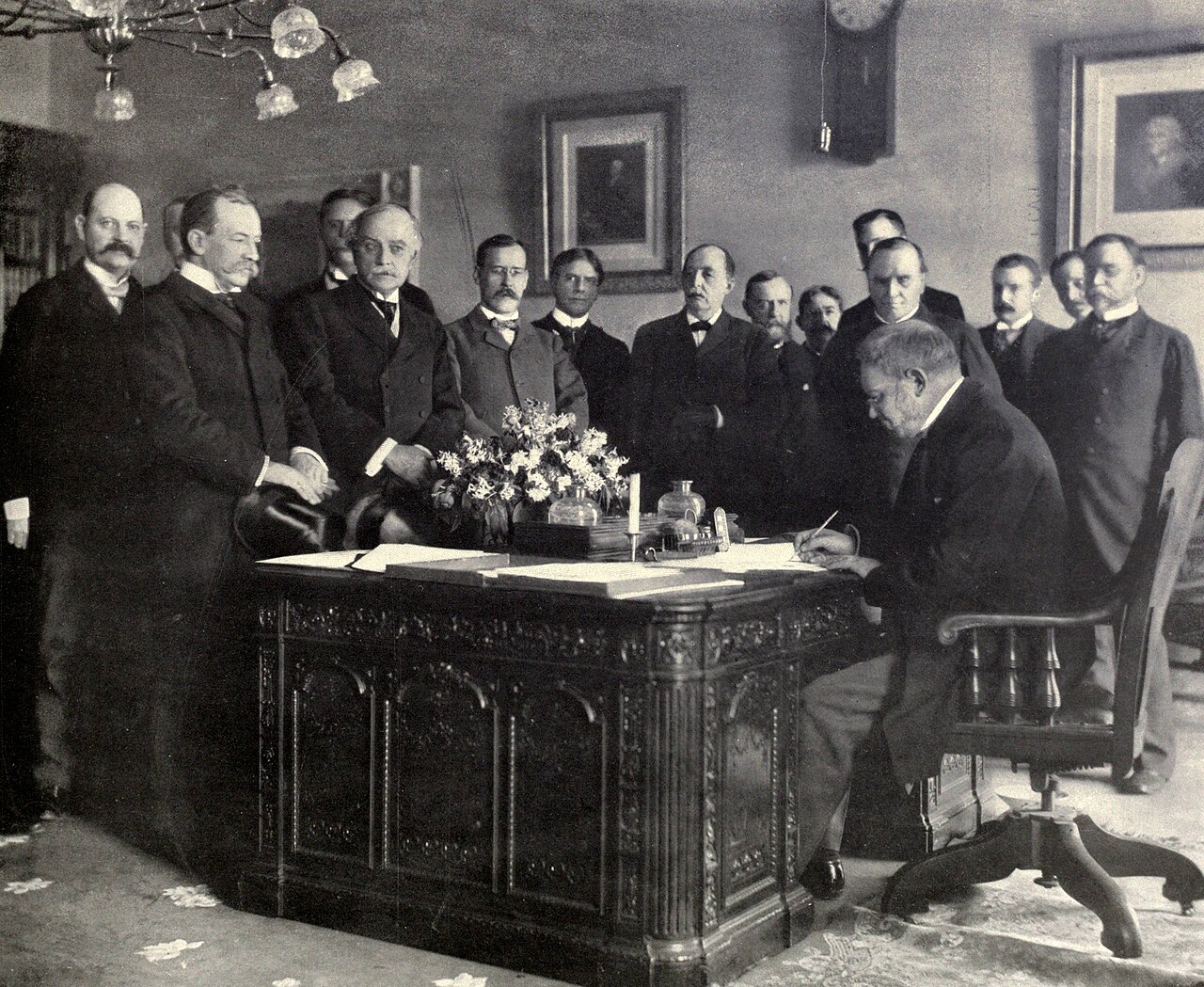

The Foraker Act: a government built in Washington
The Army ran Puerto Rico first. General Nelson Miles was military governor with power to issue orders with the force of law. General John Brooke took over October 18, 1898, then General Guy Henry, then Brigadier General George W. Davis, who served until May 1, 1900. The Library of Congress history records that Henry's attempted curbs on the press led to conflicts whenever critics of the government were threatened and censored, and that the Insular Council lost the autonomous powers Spain had granted it in 1897.6
Congress replaced military rule with the Foraker Act, "An Act Temporarily to provide revenues and a civil government for Porto Rico," approved April 12, 1900, effective May 1, 1900.7 Its sponsor was Senator Joseph Benson Foraker of Ohio.8 Read with an eye on who answered to whom, the act built this:
| Office or body | How chosen | Answered to |
|---|---|---|
| Governor | Appointed by the President with Senate consent | The President |
| Executive council (cabinet officers plus five others, at least five of the eleven native inhabitants) | Appointed by the President with Senate consent, four-year terms | The President |
| House of delegates, 35 members | Elected every two years by qualified voters | Island voters, but sat as one house with the appointed council |
| Resident commissioner | Elected every two years | Island voters; recognized by federal departments, with no vote in Congress |
Those structures are in sections 17, 18, 27 and 39 of the act.7 The upper house of the legislature was the appointed executive council itself. The people of Puerto Rico elected half a legislature and a commissioner who could speak in Washington but not vote. The act made the island's inhabitants "citizens of Porto Rico, and as such entitled to the protection of the United States," which is a different thing from United States citizenship.7 The first civil governor, Charles H. Allen, was inaugurated in San Juan on May 1, 1900.8
The structure resembled the Northwest Ordinance of 1787, with one difference in direction. The Ordinance set out stages toward statehood. The Foraker Act promised nothing of the kind. It called itself temporary instead, a word that aged badly.
Section 3 of the act is what started the lawsuits. It required that goods moving between Puerto Rico and the United States pay "fifteen per centum of the duties which are required to be levied, collected, and paid upon like articles of merchandise imported from foreign countries."7 The Constitution requires that "all Duties, Imposts and Excises shall be uniform throughout the United States." If Puerto Rico was part of the United States, a tariff between it and New York looked unconstitutional. If it was foreign, the treaty had made it American soil anyway. The Court had to pick.
Downes v. Bidwell: one judgment, no majority opinion
The facts were plain. S. B. Downes and Company brought oranges from San Juan into New York in November 1900. The collector of the port, George R. Bidwell, charged duties under the Foraker Act. Downes paid $659.35 under protest and sued to get it back.9 The case was argued January 8 to 11, 1901, and decided May 27, 1901. Solicitor General John K. Richards and Attorney General John W. Griggs argued for the government. Frederic R. Coudert, Jr., and John G. Carlisle argued for Downes, with Paul Fuller on Coudert's brief.9
The Court upheld the duties, 5 to 4. The reporter of decisions added a note to the official report that every reader of the case should know: "there is no opinion in which a majority of the court concurred." He printed separate headnotes for each opinion supporting the judgment, with the names of the justices who joined each one.10 Justice Henry Billings Brown announced the judgment and wrote for himself alone. Justice Edward Douglass White wrote a concurrence joined by Justices George Shiras and Joseph McKenna. Justice Horace Gray wrote a short concurrence. Chief Justice Melville Fuller dissented, joined by Justices John Marshall Harlan, David Brewer and Rufus Peckham, and Harlan added a dissent of his own.10
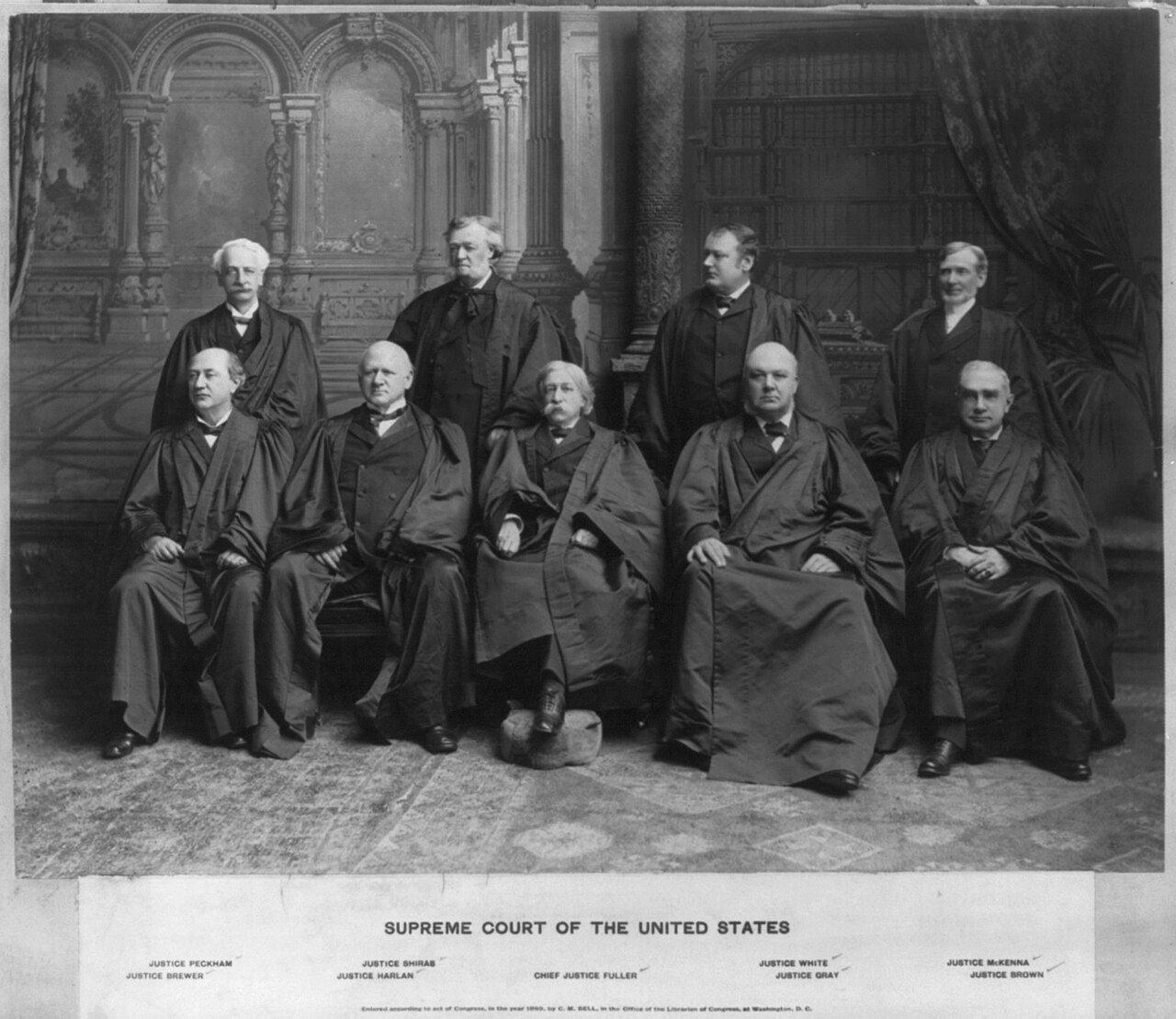

Brown: the Constitution speaks to states
Brown's opinion went the furthest. He read the Constitution as a compact among states. In his words, "we find the Constitution speaking only to States, except in the territorial clause, which is absolute in its terms, and suggestive of no limitations upon the power of Congress in dealing with them."11 For Brown, the territories had always been governed this way. He pointed to the early territorial governments, the Northwest Territory among them, and said Congress had not hesitated "to establish a form of government bearing a much greater analogy to a British crown colony than a republican State of America, and to vest the legislative power either in a governor and council, or a governor and judges, to be appointed by the President."12 He added that in all those cases Congress had chosen to extend the Constitution and laws or to guarantee jury trial, bail and habeas corpus by statute.12 That last point cuts both ways, and Brown let it.
Then came the passage that modern readers find hardest to read, and that later justices have quoted against the Insular Cases:
"If those possessions are inhabited by alien races, differing from us in religion, customs, laws, methods of taxation and modes of thought, the administration of government and justice, according to Anglo-Saxon principles, may for a time be impossible; and the question at once arises whether large concessions ought not to be made for a time, that . . . our own theories may be carried out, and the blessings of a free government under the Constitution extended to them. We decline to hold that there is anything in the Constitution to forbid such action."13
His conclusion was that Puerto Rico "is a territory appurtenant and belonging to the United States, but not a part of the United States within the revenue clauses of the Constitution."13 Brown also suggested, "without intending to decide," a line between "certain natural rights, enforced in the Constitution by prohibitions against interference with them, and what may be termed artificial or remedial rights, which are peculiar to our own system of jurisprudence." Religious liberty, personal liberty, property and free speech fell on the protected side.14 That suggestion became the seed of the later rule that only "fundamental" rights follow the flag.
White: incorporated and unincorporated
White agreed with Brown's result and said so while disagreeing with his reasons. His opinion is long, historical and built around one idea. A territory acquired by the United States does not become part of the United States until Congress, or a treaty Congress accepts, incorporates it. Until then it is held as a possession. His summary:
"The result of what has been said is that whilst in an international sense Porto Rico was not a foreign country, since it was subject to the sovereignty of and was owned by the United States, it was foreign to the United States in a domestic sense, because the island had not been incorporated into the United States, but was merely appurtenant thereto, as a possession."15
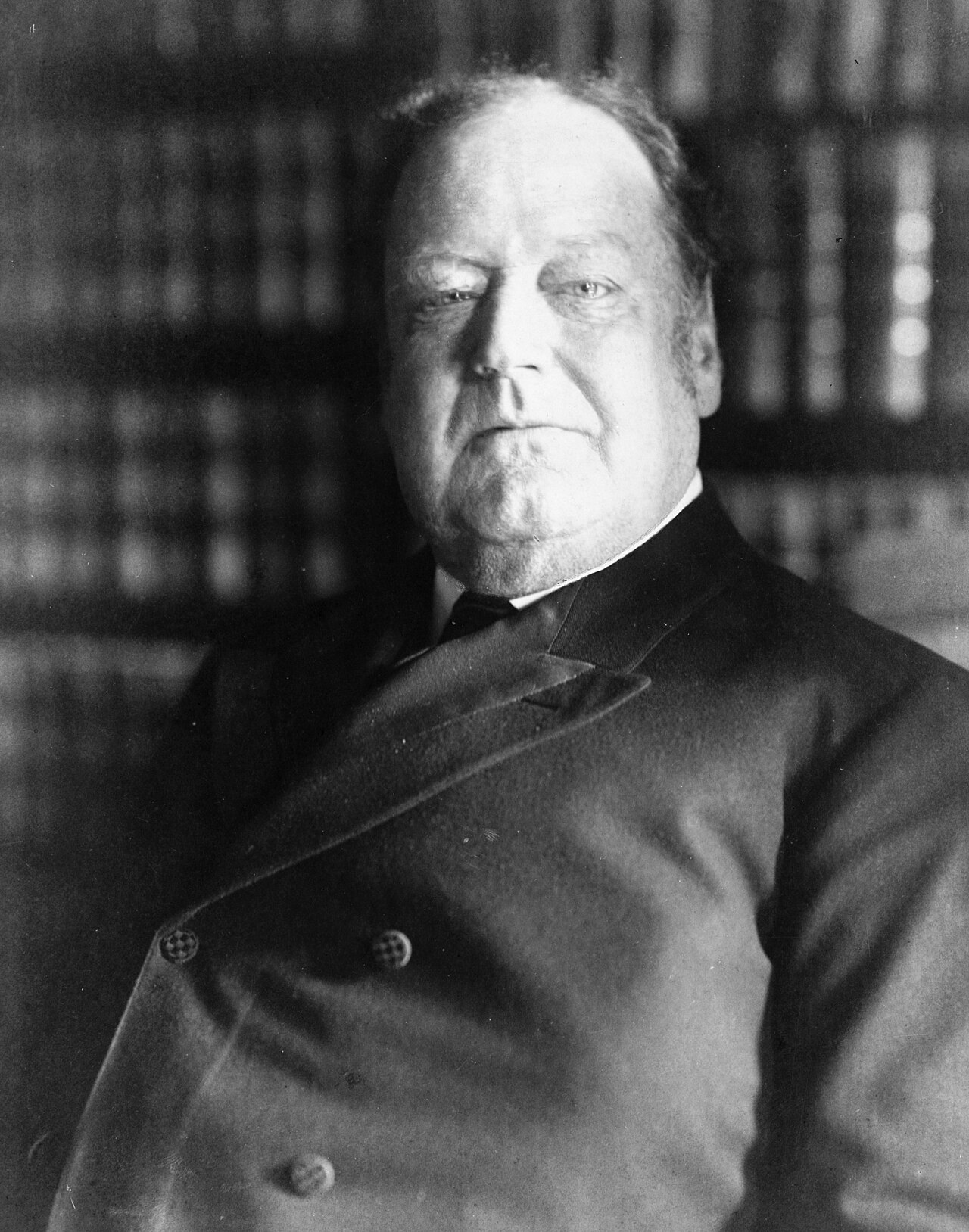

White leaned hard on the history of earlier cessions. He walked through the Northwest Territory, the territory south of the Ohio, the Mississippi Territory, Louisiana, Florida and Mexico, and argued that each time the United States had extended the rights of the Ordinance of 1787 or citizenship by express treaty or statute.4 He also argued that the Ordinance of 1787's promise that the territory would remain part of the Confederacy was binding when the Constitution was formed.16 For White, the Northwest Ordinance proved his point from the other side: Congress had chosen incorporation for the old West and could choose otherwise for the new islands.
White himself became Chief Justice on December 19, 1910, appointed by President Taft.17 By 1922 his concurrence was the law.
Justice Gray concurred "in substance agreeing with the opinion of Mr. Justice White."18
Fuller: "a disembodied shade"
The Chief Justice wrote for four dissenters. He described the government's argument and the White theory in one sentence that has been quoted ever since. The contention, he wrote, "seems to be that, if an organized and settled province of another sovereignty is acquired by the United States, Congress has the power to keep it, like a disembodied shade, in an intermediate state of ambiguous existence for an indefinite period."19 He noted that Attorney General Griggs had argued outright that Congress's power over commerce with the territories was not restricted by the Constitution, a position Fuller credited "with a candor and ability that did him great credit" before rejecting it.19
Fuller's dissent also preserves the government's argument as made at the bar. Counsel had asked the Court to consider that "the question might be as to the powers of this government in the acquisition of Egypt and the Soudan, or a section of Central Africa, or a spot in the Antarctic Circle, or a section of the Chinese Empire."20 Fuller answered that, as Marshall and Story had said, the Constitution "was framed for ages to come."20
Harlan: "a colonial system"
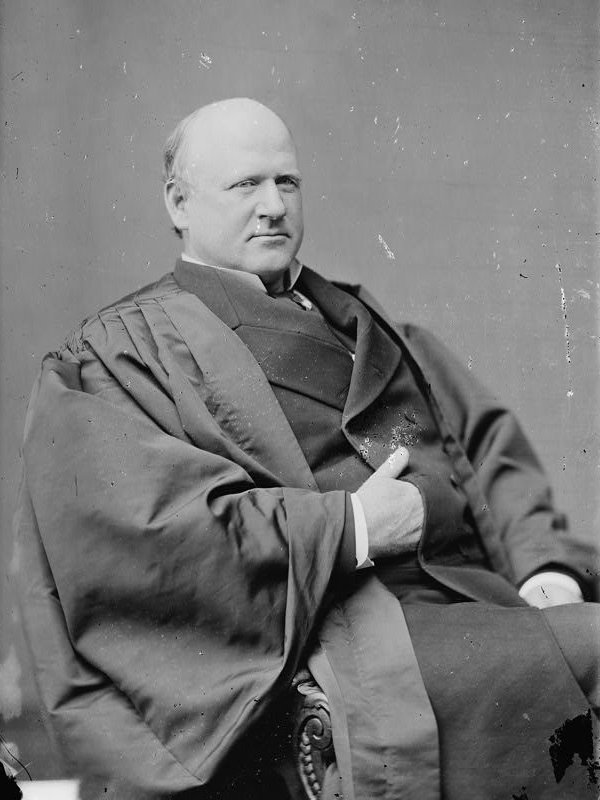

Harlan joined Fuller and then wrote separately because, he said, of "the importance of the questions in this case, and of the consequences that will follow any conclusion reached by the court."21 His dissent is the one most often quoted today. The key passages, word for word from the opinion:
"Monarchical and despotic governments, unrestrained by written constitutions, may do with newly acquired territories what this Government may not do consistently with our fundamental law. To say otherwise is to concede that Congress may, by action taken outside of the Constitution, engraft upon our republican institutions a colonial system such as exists under monarchical governments. Surely such a result was never contemplated by the fathers of the Constitution."22
The next sentence is the one most often quoted. The idea that the country could "acquire territories anywhere upon the earth, by conquest or treaty, and hold them as mere colonies or provinces," with the people there "to enjoy only such rights as Congress chooses to accord to them," was, Harlan wrote, "wholly inconsistent with the spirit and genius as well as with the words of the Constitution."22 (The printed sentence sets off the middle clause with dashes; it is quoted here in pieces.)
Harlan then addressed something said in argument. "The idea prevails with some," he wrote, and it "found expression in arguments at the bar," that "we have in this country substantially or practically two national governments; one, to be maintained under the Constitution, with all its restrictions; the other to be maintained by Congress outside and independently of that instrument, by exercising such powers as other nations of the earth are accustomed to exercise."22 He rejected it: "It is quite a different thing to say that Congress may, if it so elects, proceed outside of the Constitution."22
A note on "two national governments"
The outline Pierson was handed for this module argues that a "Government #2" born in the Northwest Ordinance runs the modern administrative state. Harlan's phrase "two national governments" is the closest the record comes to that idea, and its exact words decide what it can support. Harlan was describing an argument he heard and rejected: that Congress could govern the islands outside the Constitution. He did not say a second government existed. He said the Constitution forbade one. The majority did not claim to be acting outside the Constitution either. Brown and White both said they were applying the Territory Clause. The dispute in 1901 was over how much of the Constitution limits Congress when it governs a territory. Lesson 18 tests the outline's larger thesis claim by claim.
What the Court cited: Canter and the territorial precedent
The link between the Insular Cases and the older territorial law is real and documented. The justices made it themselves. Brown's opinion summarized American Insurance Co. v. 356 Bales of Cotton (1828), the case this module covers in lesson 7 as Canter. A court at Key West made up of a notary and five jurors, created by the Florida territorial legislature, had sold salvaged cotton. The question was whether such a court could exercise admiralty jurisdiction at all. Brown recounted Marshall's answer: the territorial courts were not constitutional courts, their jurisdiction "is not a part of judicial power of the Constitution, but is conferred by Congress, in the exercise of those general powers which that body possesses over the territories of the United States; and that in legislating for them Congress exercises the combined powers of the general and of a state government."23 Gray quoted Marshall's line from the same case that a ceded territory "becomes a part of the nation to which it is annexed; either on the terms stipulated in the treaty of cession, or on such as its new master shall impose."18
So the chain the outline points to has real links: the territorial governments of 1787 onward, Marshall's "legislative courts" in Canter, and the 1901 Court's use of both. What the record does not show is that the chain is a single institution with a will of its own. The 1901 Court wrote five opinions about what the precedents meant. White read the Northwest Ordinance as proof that Congress had always chosen to incorporate. Brown read the same history as proof that Congress could govern territories like crown colonies. Fuller and Harlan read it as proof that the Constitution went wherever the government went. The same documents supported three conclusions.
From plurality to settled law: Dorr and Balzac
Downes was about tariffs. The harder question was about trials. In Hawaii v. Mankichi (1903), the Court had already taken up "the right to a jury trial in outlying territory of the United States."24 In Dorr v. United States, decided May 31, 1904, the question came from the Philippines. Dorr and O'Brien, proprietors and editors of a newspaper in Manila, were convicted of libel against Benito Legarda, a member of the Philippine Commission, without a jury.24 Justice William Day, for the Court, over a dissent by Justice Harlan, wrote that the Insular Cases "cover every phase of the question" and stated the conclusion:
"We conclude that the power to govern territory, implied in the right to acquire it, and given to Congress in the Constitution in article 4, § 3, to whatever other limitations it may be subject, the extent of which must be decided as questions arise, does not require that body to enact for ceded territory not made a part of the United States by Congressional action, a system of laws which shall include the right of trial by jury, and that the Constitution does not, without legislation, and of its own force, carry such right to territory so situated."24
Day quoted with approval Thomas Cooley's description of territorial inhabitants as "in a condition of temporary pupilage and dependence."24
Then Congress changed Puerto Rico's status. The Jones Act, signed by President Wilson on March 2, 1917, made Puerto Ricans United States citizens, created an elected bicameral legislature of a 19-member Senate and a 39-member House, and kept veto power in the governor and the President, with Congress able to annul island legislation.25 Citizenship could have been read as incorporation. The Supreme Court said no.
Jesus M. Balzac edited a daily paper in Arecibo called El Baluarte. In April 1918 he published two articles that led to criminal libel charges. Puerto Rico's code gave jury trials in felonies but not misdemeanors. Balzac demanded a jury under the Sixth Amendment, was refused, and was sentenced to five months in one case and four in the other.26 Chief Justice William Howard Taft, who had headed the colonial government the United States set up in the Philippines in 1900,5 wrote for the Court on April 10, 1922, with no dissent; Justice Holmes concurred in the result.26 He said the Dorr Case "shows that the opinion of Mr. Justice White of the majority, in Downes v. Bidwell, has become the settled law of the court."26 The Jones Act, Taft wrote, did not "indicate by its title that it has a purpose to incorporate the island into the Union."26 Citizenship let Puerto Ricans move to the mainland and enjoy every right there. On the island it changed nothing about the jury: "It is locality that is determinative of the application of the Constitution, in such matters as judicial procedure, and not the status of the people who live in it."26
Taft's explanation of why Congress withheld the jury used the same reasoning Brown had used in 1901. Congress, he wrote, had thought that "a people like the Filipinos, or the Porto Ricans, trained to a complete judicial system which knows no juries, living in compact and ancient communities, with definitely formed customs and political conceptions, should be permitted themselves to determine how far they wish to adopt this institution of Anglo-Saxon origin, and when."26 The sentence describes a decision Congress made for the people of Puerto Rico as a decision the people of Puerto Rico were permitted to make for themselves, at the pace Congress allowed.
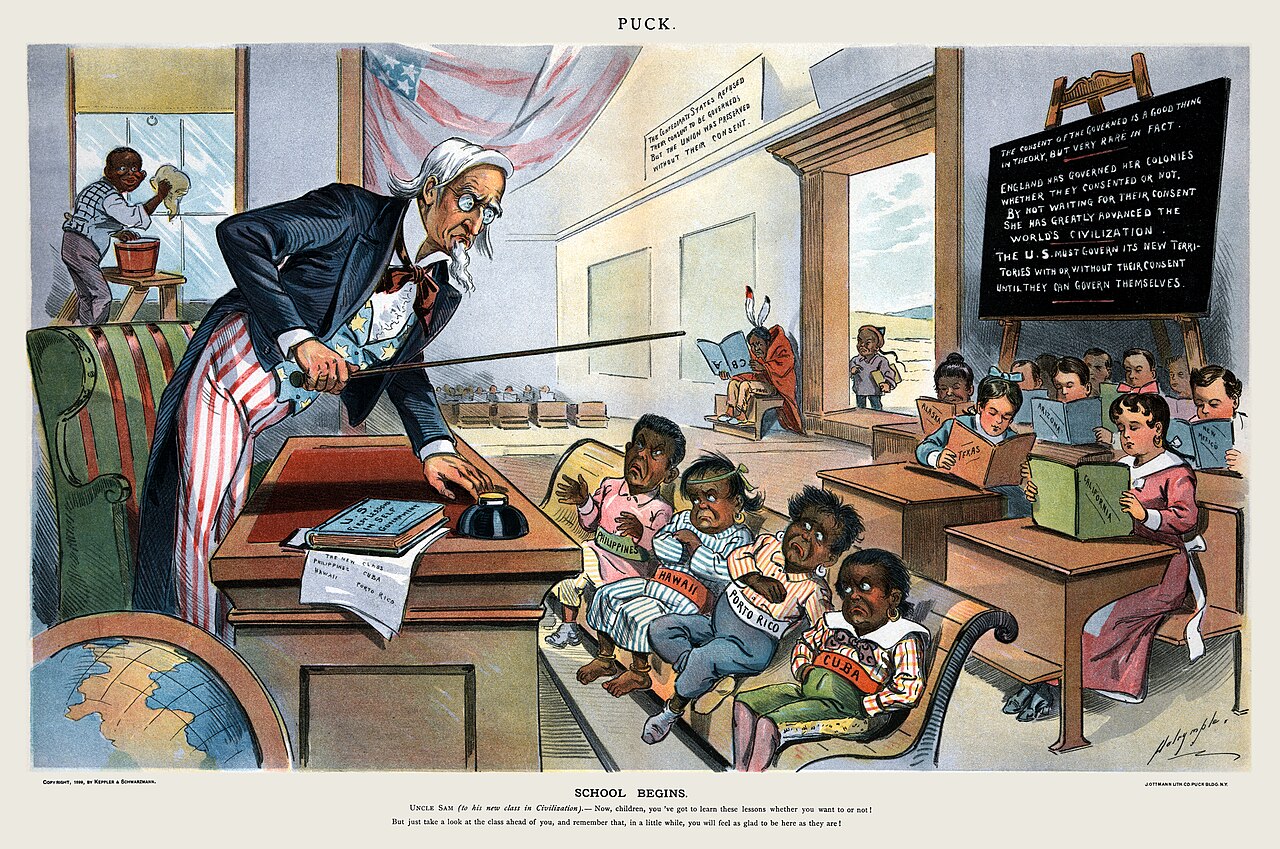

The Philippines: a territory that left
The Philippines followed a different path. Congress passed an organic act for the islands, approved July 1, 1902, cited by Taft in Balzac as 32 Stat. 691.26 The Tydings-McDuffie Act, approved March 24, 1934, was titled "An Act To provide for the complete independence of the Philippine Islands, to provide for the adoption of a constitution and a form of government for the Philippine Islands, and for other purposes."27 The United States recognized the Republic of the Philippines as independent on July 4, 1946, by proclamation of President Truman, and signed a treaty that day renouncing all claims to the islands.28 The Philippines is the one large possession acquired in 1898 that is no longer under American sovereignty.
The doctrine today
The Insular Cases are not a museum piece. The Department of the Interior's Office of Insular Affairs uses White's categories as working definitions. An unincorporated territory is "a United States insular area in which the United States Congress has determined that only selected parts of the United States Constitution apply." Interior lists thirteen: Navassa Island, Puerto Rico and the U.S. Virgin Islands in the Caribbean, and American Samoa, Baker Island, Guam, Howland Island, Jarvis Island, Johnston Atoll, Kingman Reef, Midway Atoll, the Northern Mariana Islands and Wake Atoll in the Pacific. Only one incorporated territory exists, Palmyra Atoll, 1.56 square miles of small islands about a thousand miles south of Honolulu. Interior adds that incorporation "is interpreted as a perpetual state."29
Puerto Rico's own government rests on federal statute. In 1950 Congress passed Public Law 600 authorizing a constitution of the island's own adoption. Congress amended the draft and approved it by the Act of July 3, 1952, and the Commonwealth came into being. In Puerto Rico v. Sanchez Valle, decided June 9, 2016, the Supreme Court held that for double jeopardy purposes "the 'ultimate' source of prosecutorial power remains the U. S. Congress." Justice Kagan wrote: "Congress conferred the authority to create the Puerto Rico Constitution, which in turn confers the authority to bring criminal charges."30
Later Courts have narrowed the Insular Cases without overruling them. In Reid v. Covert (1957), Justice Black's plurality refused to let the government try civilian military dependents abroad by court-martial and said of the Insular Cases that "neither the cases nor their reasoning should be given any further expansion."31 In Boumediene v. Bush (2008), the Court relied on the Insular Cases' functional approach when it held that the writ of habeas corpus reached Guantanamo Bay, while also stating that "the Constitution grants Congress and the President the power to acquire, dispose of, and govern territory, not the power to decide when and where its terms apply."32
In 2020 the Court described them as "much-criticized" and declined to take up requests from some parties to overrule them in Financial Oversight and Management Board for Puerto Rico v. Aurelius Investment.33 In United States v. Vaello Madero, decided April 21, 2022, the Court held 8 to 1 that Congress could exclude Puerto Rico residents from Supplemental Security Income, which by statute goes only to residents of the 50 States and the District of Columbia.34 The government did not rely on the Insular Cases, so the Court did not reach them. Justice Gorsuch joined the majority and wrote separately:
"The flaws in the Insular Cases are as fundamental as they are shameful. Nothing in the Constitution speaks of 'incorporated' and 'unincorporated' Territories."35
"Because no party asks us to overrule the Insular Cases to resolve today's dispute, I join the Court's opinion. But the time has come to recognize that the Insular Cases rest on a rotten foundation. And I hope the day comes soon when the Court squarely overrules them. We should follow Justice Harlan and settle this question right."35
Justice Sotomayor, dissenting on the benefits question, agreed with Gorsuch that the Insular Cases "were premised on beliefs both odious and wrong."35 The objection to the doctrine now comes from justices as far apart as Gorsuch and Sotomayor. In April 2023 a House resolution, H. Res. 314, sponsored by Representative Raul Grijalva with territorial delegates among its cosponsors, asked the House to declare that the Insular Cases "should be rejected as having no place in United States constitutional law." It was referred to committee.36 In February 2026 the Puerto Rico Advisory Committee to the U.S. Commission on Civil Rights issued a report on the effects of the Insular Cases on the civil rights of Puerto Rico's residents after eight public briefings held from 2023 through 2025.37
And still the cases stand. No majority of the Supreme Court has overruled them. Congress has not passed a law incorporating any inhabited territory. The doctrine survives on precedent and on the practical fact that every branch has found it workable.
Through Pierson's Framework
Pierson defines institutionalism as a mindset that defends and preserves institutions on "habit, identity, and survival instinct" in place of performance or morality.38 He adds that institutionalism "is not loyalty to principle; it's loyalty to process. It assumes continuity equals virtue, structure guarantees truth."38 The Insular Cases are an unusually clean place to apply that test, because almost nobody now defends them on their own reasoning.
The Foraker Act called itself temporary. Brown called the concessions he approved concessions "for a time." Cooley's phrase, quoted in Dorr, was "temporary pupilage." The arrangement was named as a bridge. In function it became a destination. Puerto Rico has been held under this arrangement since the Foraker Act of 1900. Judged by what it does, the doctrine sorts American citizens by where they live into those who have every constitutional right and those who have the ones a court calls fundamental. A label that says "temporary" on an arrangement that has lasted since 1900 is the kind of gap between name and function Pierson's method is built to catch.
Who did it answer to? The Foraker Act gave Puerto Ricans an elected lower house and an appointed upper house that was also the governor's cabinet. The governor answered to the President. The resident commissioner could not vote. The people being governed had no vote for the officials who governed them in Washington, and they still do not elect voting members of Congress or presidential electors. Pierson's ordered liberty holds that liberty carries a shared duty of holding government accountable.39 That duty requires a channel. For residents of the unincorporated territories the channel to the national government has always been narrow.
Look at how the doctrine is defended now. Mostly it is not. In the twenty-first century the justices who leave the Insular Cases standing rarely defend them. The government in Vaello Madero "disclaim[ed] any reliance" on them.35 The Court in Aurelius found a way to decide the case without them. The doctrine persists because overruling it would unsettle a great deal of law built on top of it, and because each branch has a working arrangement it knows how to administer. That is a defense from continuity. Pierson's appendix on the Anti-Federalists describes how this works: institutions "entrench policies behind procedure" and become "self-justifying, declaring their actions lawful simply because they are legal."40 A doctrine kept alive as precedent by judges who will not argue it is right fits that description closely.
The framework also asks for mutual restraint. Ordered liberty "insists on mutual restraint: individuals must act with discipline and responsibility, and governments and institutions must operate under law, truth, and justice."41 The territorial governments did real work, from schools and sanitation to a revised legal code, as the Library of Congress history of the military governments records.6 Puerto Rico's 1952 constitution was drafted by its own convention.30 Those are legitimate institutions, and Pierson's ordered liberty includes the duty of supporting legitimate government.39 What habit cannot justify is the doctrine that limits the rights of their citizens. The Constitution's amendment and statehood processes exist for changing it.
Harlan saw the habit forming in 1901. Pierson's phrase for the result is "tyranny by sediment, the slow burial of liberty under layers of unchecked authority."40 The Insular Cases did not seize anything. They layered. A tariff case became a jury case, the jury case became settled law, settled law became an Interior Department glossary, and the glossary became the way five territories are governed.
Hard Questions and Answers
Dropping grand juries and jury trials overnight on islands run under civil law would have been chaos. Weren't the justices simply being realistic?
That was the Court's argument in Dorr and Balzac, and it is not a foolish one. The Philippines and Puerto Rico had Spanish civil-law courts with no jury tradition, and Dorr noted that President McKinley's instructions to the Philippine Commission deliberately reserved the jury right for that reason.24 But the practical argument only explains why Congress might phase rights in. It does not require a constitutional doctrine that lets Congress withhold them indefinitely. Congress could have chosen to extend jury trial by statute, as Brown himself noted it had done for the old continental territories.12 And the practical argument had nothing to say about the tariff in Downes, which was a revenue measure. The record supports the claim that rapid change was hard. It does not support the claim that a permanent second class of constitutional status was needed to manage it.
Isn't attacking the 1901 justices, and Taft after them, for their racial language just presentism, convicting dead men by later standards?
Partly, and the concession is real. The language in Brown's and Taft's opinions was common among educated Americans in 1901 and 1922. The State Department's own history notes that some opponents of annexation objected on racial grounds too, fearing a role for non-white Filipinos in national government.5 So race was on both sides. But the critique of the doctrine does not depend on judging the justices. Harlan made the constitutional objection in 1901, in the same year and the same building, using the same Constitution. Gorsuch's 2022 concurrence rests on text: "Nothing in the Constitution speaks of 'incorporated' and 'unincorporated' Territories."35 The doctrine can be criticized on its own legal terms without any claim about the private views of its authors.
Puerto Ricans pay no federal income tax on island income. They got a deal. Why should they also get every constitutional right?
The Vaello Madero majority made a version of this point, noting that residents of Puerto Rico "are typically exempt from most federal income, gift, estate, and excise taxes," and that not every federal benefit extends to them either.34 That is a fair description of the statutes. It does not settle the constitutional question. The tax treatment is a choice of Congress, which Puerto Rico's residents have no vote in, and a bargain struck by only one party is a policy. The Insular Cases also reach rights that have nothing to do with taxes, such as the jury right in Balzac, and an exemption from federal income tax does nothing for a defendant tried without a jury.
The doctrine is what lets American Samoa keep its communal land system and its own customs. Wouldn't overruling it hurt the very people it supposedly wrongs?
This is the strongest defense of the doctrine still made. Some territorial governments and residents have argued that applying the full Constitution would threaten local land-tenure rules and customs that limit land ownership by outsiders. Gorsuch's concurrence describes this as a "revisionist account" in which withholding full constitutional protection "serves the beneficial end of safeguarding traditional cultures," citing the Tenth Circuit's 2021 decision in Fitisemanu v. United States, which held that the Citizenship Clause does not automatically reach American Samoa.35 That interest is real. Yet the Insular Cases give that protection by leaving the question to Congress and the courts, and the same flexibility that protects Samoan land law also withheld Balzac's jury. Gorsuch's answer was that such questions should be handled through the Constitution's own tools, its text, original meaning and historical practice, "uninfected by the Insular Cases."35 Whether that would protect Samoan customs is an open question the record does not settle.
A doctrine that has governed five territories for more than a century without collapse is doing something right. Isn't survival proof enough?
Survival proves it is administrable. It does not prove it is right, and the justices who keep it alive have mostly avoided saying it is right. Aurelius called the cases "much-criticized" and decided the case on other grounds.33 Vaello Madero noted the government disclaimed them.35 Overruling a doctrine that has governed millions of people for more than a century raises real questions about reliance, about the structure of territorial governments, and about what replaces it. Those are serious reasons for caution. They are also exactly the reasons Pierson's framework describes as institutional: the arrangement is defended on the ground that changing it is hard. Nobody defending it in the record has shown it is just.
Learn more
- Downes v. Bidwell, 182 U.S. 244 (1901), Library of Congress U.S. Reports scan: the official report with all five opinions and the reporter's note that no opinion had a majority
- Treaty of Paris, December 10, 1898: the cession of Puerto Rico, Guam and the Philippines, and Article IX on the status of inhabitants
- Foraker Act, 31 Stat. 77: the 1900 organic act for Puerto Rico in the Statutes at Large
- Balzac v. Porto Rico, 258 U.S. 298 (1922): Taft's unanimous opinion adopting White's incorporation theory
- United States v. Vaello Madero (2022): the majority, the Gorsuch concurrence on the Insular Cases, and the Sotomayor dissent
- Office of Insular Affairs: Definitions of Insular Area Political Organizations: how the federal government classifies the territories today
- Library of Congress: The World of 1898: documents and images on the war, the Foraker Act, the Jones Act and Balzac
- Lesson 7: Territorial government, St. Clair, Ohio and Louisiana: the Northwest Ordinance and American Insurance Co. v. Canter
- Lesson 18: Reading the record: tests the "Government #2" thesis claim by claim
- Module 52: Ordered Liberty: Pierson's framework of accountability and mutual restraint
Notes
- Library of Congress, Hispanic Reading Room, "The World of 1898: International Perspectives on the Spanish American War," introduction (research guide, last updated Aug. 26, 2026). Read it online. ↩
- U.S. Department of State, Office of the Historian, "The Spanish-American War, 1898," Milestones in the History of U.S. Foreign Relations (retired series). On the July 7, 1898, signing of the Hawaii joint resolution, see National Archives, Milestone Documents, "Joint Resolution to Provide for Annexing the Hawaiian Islands to the United States (1898)." Read it online. National Archives. ↩
- Treaty of Peace Between the United States and Spain, signed at Paris, December 10, 1898, arts. I, II, III, IX, 30 Stat. 1754. Text from the Avalon Project, Yale Law School. Read it online. ↩
- Downes v. Bidwell, 182 U.S. 244, 317 to 336 (1901) (White, J., concurring), reviewing the cessions of the Northwest Territory, Louisiana, Florida, the Mexican cession and Alaska; White quotes the Louisiana treaty at 324. The treaty's own text, Article III: Treaty between the United States of America and the French Republic, April 30, 1803, Avalon Project. Read it online. Avalon Project. ↩
- U.S. Department of State, Office of the Historian, "The Philippine-American War, 1899 to 1902," Milestones in the History of U.S. Foreign Relations. Read it online. ↩
- Library of Congress, "The World of 1898: Military Government in Puerto Rico." Read it online. ↩
- An Act Temporarily to provide revenues and a civil government for Porto Rico, and for other purposes, ch. 191, 31 Stat. 77 (approved April 12, 1900), secs. 3, 7, 17, 18, 27, 39, 41. Read it online. ↩
- Library of Congress, "The World of 1898: Foraker Act (Organic Act of 1900)." Read it online. ↩
- Downes v. Bidwell, 182 U.S. 244 (1901), statement of the case and appearance of counsel, 182 U.S. at 247 ("Mr. Frederic R. Coudert, Jr., and Mr. John G. Carlisle for plaintiff in error. Mr. Paul Fuller was on Mr. Coudert's brief.") (argued Jan. 8 to 11, 1901; decided May 27, 1901). The report names "the Solicitor General and Mr. Attorney General" for the government; those offices were held by John K. Richards (Solicitor General, 1897 to 1903) and John W. Griggs (Attorney General, January 1898 to March 1901), per the Department of Justice's official biographies. Read it online. ↩
- Downes v. Bidwell, 182 U.S. 244, 244 n.1 (1901) (reporter's note on the division of the Court). U.S. Reports scan, Library of Congress. Read it online. ↩
- Downes v. Bidwell, 182 U.S. 244, 285 (1901) (opinion of Brown, J.). Read it online. ↩
- Downes v. Bidwell, 182 U.S. 244, 279 (1901) (opinion of Brown, J.). Read it online. ↩
- Downes v. Bidwell, 182 U.S. 244, 287 (1901) (opinion of Brown, J.). The Supreme Court cited this page as the core of the Insular Cases in Financial Oversight and Management Bd. v. Aurelius (2020). Read it online. ↩
- Downes v. Bidwell, 182 U.S. 244, 282 (1901) (opinion of Brown, J.). Read it online. ↩
- Downes v. Bidwell, 182 U.S. 244, 341 to 342 (1901) (White, J., concurring, joined by Shiras and McKenna, JJ.). Read it online. ↩
- Downes v. Bidwell, 182 U.S. 244 (1901) (White, J., concurring), discussion of the Ordinance of 1787 and the Act of Aug. 7, 1789, 1 Stat. 50, at 319 to 321. Read it online. ↩
- Supreme Court of the United States, "Justices 1789 to Present" (Edward Douglass White: Associate Justice from March 12, 1894; Chief Justice from December 19, 1910, to May 19, 1921). Read it online. ↩
- Downes v. Bidwell, 182 U.S. 244, 345 (1901) (Gray, J., concurring), quoting American Insurance Co. v. 356 Bales of Cotton, 1 Pet. 511, 542 (1828). Read it online. ↩
- Downes v. Bidwell, 182 U.S. 244, 372 (1901) (Fuller, C.J., dissenting, joined by Harlan, Brewer and Peckham, JJ.). Read it online. ↩
- Downes v. Bidwell, 182 U.S. 244, 374 (1901) (Fuller, C.J., dissenting), quoting the argument made for the government. Read it online. ↩
- Downes v. Bidwell, 182 U.S. 244, 375 to 376 (1901) (Harlan, J., dissenting). Read it online. ↩
- Downes v. Bidwell, 182 U.S. 244, 380 (1901) (Harlan, J., dissenting). Read it online. ↩
- Downes v. Bidwell, 182 U.S. 244, 263 to 266 (1901) (opinion of Brown, J.), summarizing American Insurance Co. v. 356 Bales of Cotton, 26 U.S. (1 Pet.) 511 (1828). Read it online. ↩
- Dorr v. United States, 195 U.S. 138 (1904) (Day, J., for the Court; decided May 31, 1904), discussing Hawaii v. Mankichi, 190 U.S. 197 (1903), and quoting Cooley, Principles of Constitutional Law 164. Read it online. ↩
- Library of Congress, "The World of 1898: Jones Act." The statute is the Organic Act of Porto Rico, ch. 145, 39 Stat. 951 (March 2, 1917). Read it online. ↩
- Balzac v. Porto Rico, 258 U.S. 298 (1922) (Taft, C.J., for the Court; Holmes, J., concurring in the result; argued March 20, 1922; decided April 10, 1922). The Philippine organic act is ch. 1369, 32 Stat. 691, approved July 1, 1902. Read it online. 32 Stat. 691. ↩
- An Act To provide for the complete independence of the Philippine Islands, ch. 84, 48 Stat. 456 (approved March 24, 1934) (Tydings-McDuffie Act). Read it online. ↩
- U.S. Department of State, Office of the Historian, "A Guide to the United States' History of Recognition, Diplomatic, and Consular Relations, by Country, since 1776: Philippines." Read it online. ↩
- U.S. Department of the Interior, Office of Insular Affairs, "Definitions of Insular Area Political Organizations." Read it online. ↩
- Puerto Rico v. Sanchez Valle, 579 U.S. 59 (2016) (Kagan, J.; decided June 9, 2016), discussing Public Law 600 (1950) and the Act of July 3, 1952, 66 Stat. 327. Read it online. ↩
- Reid v. Covert, 354 U.S. 1 (1957) (plurality opinion of Black, J.; decided June 10, 1957). Read it online. ↩
- Boumediene v. Bush, 553 U.S. 723 (2008) (Kennedy, J.; decided June 12, 2008). Read it online. ↩
- Financial Oversight and Management Board for Puerto Rico v. Aurelius Investment, LLC, 590 U.S. ___ (2020) (Breyer, J.; decided June 1, 2020). Read it online. ↩
- United States v. Vaello Madero, 596 U.S. ___ (2022) (Kavanaugh, J., for the Court; argued Nov. 9, 2021; decided April 21, 2022). Read it online. ↩
- United States v. Vaello Madero, 596 U.S. ___ (2022) (Gorsuch, J., concurring), and id. (Sotomayor, J., dissenting) (n.4, quoting the Gorsuch concurrence). Gorsuch cites Fitisemanu v. United States, 1 F.4th 862 (10th Cir. 2021). The Tenth Circuit's opinion records that the American Samoa government intervenors, pointing to communal land ownership and racial restrictions on land ownership, "worry that these and other traditional elements of the American Samoan culture could run afoul of constitutional protections" (petition appendix, Fitisemanu v. United States, No. 21-1394, p. 9a). Read it online. ↩
- H. Res. 314, 118th Cong. (introduced April 20, 2023, by Rep. Grijalva and others; referred to the Committees on the Judiciary and Natural Resources). Read it online. ↩
- U.S. Commission on Civil Rights, Puerto Rico Advisory Committee, "The Insular Cases and the Doctrine of the Unincorporated Territory and its Effects on the Civil Rights of the Residents of Puerto Rico" (Feb. 26, 2026). Read it online. ↩
- Jeff A. Pierson, "The Acacia Illusion: How Institutionalism Mimics Nature's Most Subtle Manipulation," in The Ordered Liberty Papers (2025). Read it online. ↩
- Pierson's own framing of ordered liberty, as used throughout this course: liberty that recognizes a shared duty of holding government accountable and supporting legitimate government. See Module 52, Ordered Liberty. Read it online. ↩
- Jeff A. Pierson, "The Anti-Federalist Warning: Institutional Power and the Fragility of Liberty," appendix to Ordered Liberty Reclaimed: A Foundation for Liberty. Read it online. ↩
- Jeff A. Pierson, Ordered Liberty Reclaimed: A Foundation for Liberty. Read it online. ↩
Terms in this lesson
- Insular Cases
- A series of Supreme Court decisions beginning in 1901 on the constitutional status of the islands acquired from Spain in 1898; De Lima v. Bidwell and Downes v. Bidwell are the first and best known.
- Incorporated territory
- In Justice White's theory, a territory that Congress has made a part of the United States, where the whole Constitution applies. Interior lists one today: Palmyra Atoll, which has no permanent population.
- Unincorporated territory
- A territory that belongs to the United States without being a part of it for every constitutional purpose; only the provisions the Court treats as fundamental apply of their own force.
- Foraker Act
- The Organic Act of April 12, 1900, 31 Stat. 77, which set up a civil government for Puerto Rico and charged duties on goods moving between the island and the mainland.
- Organic act
- The statute Congress passes to set up the government of a territory, usually including a bill of rights and the structure of local offices.
- Territory Clause
- Article IV, section 3, clause 2 of the Constitution, giving Congress power to make all needful rules and regulations respecting the territory or other property belonging to the United States.
- Legislative court
- A court created by Congress outside Article III, without life tenure for its judges; Chief Justice Marshall used the term for territorial courts in American Insurance Co. v. Canter (1828).
- Uniformity Clause
- Article I, section 8, clause 1, requiring that all duties, imposts and excises be uniform throughout the United States; the clause at issue in Downes v. Bidwell.
Sources
- Downes v. Bidwell, 182 U.S. 244 (1901), U.S. Reports scan checked 2026-10
- Downes v. Bidwell, full text (LII) checked 2026-10
- Treaty of Peace Between the United States and Spain, December 10, 1898 (Avalon Project) checked 2026-10
- Foraker Act, 31 Stat. 77 (1900) checked 2026-10
- Dorr v. United States, 195 U.S. 138 (1904) checked 2026-10
- Balzac v. Porto Rico, 258 U.S. 298 (1922) checked 2026-10
- United States v. Vaello Madero, 596 U.S. ___ (2022) checked 2026-10
- Definitions of Insular Area Political Organizations, Office of Insular Affairs checked 2026-10