Lesson 18 of 19 · about 35 minutes
Reading the Record: Testing the Territorial Thesis
You'll be able to
- Separate documented continuities (territorial lawmaking, legislative courts, public rights, land retention) from analogy and from unsupported claims
- Compare the 1787 territorial judges, the Canter courts and modern ALJs feature by feature using the APA and Lucia v. SEC
- State the status of Utah v. United States and 2025 to 2026 state land measures as of October 2026
- Describe the mechanism of Federalist 28 accurately and apply Pierson's ordered liberty test to proposed remedies
Start here: the short version
In 1787 Congress sent a governor and three judges into the Northwest Territory with power to pick laws from the original states and impose them on settlers who had elected none of them. The outline Pierson was handed claims that arrangement never ended, that a "Government #2" born in the Northwest Ordinance still runs the country through agencies, judges without juries and a permanent federal land estate. Checked against the statutes, cases and government reports, the outline scores real points. Territorial governors and judges did make law under congressional control. The Supreme Court did invent the "legislative court" for territories in 1828, and later courts did reuse that reasoning for public rights, for overseas territories and for agency adjudication. Other claims are analogy that breaks on the details: a modern administrative law judge cannot write laws, as the 1787 judges did, and works under rules the 1787 judges never had. And some claims have no evidence at all: no secret enclaves, no single controlling apparatus and no foreign creditors running the public domain. The remedies people actually pursue today are ordinary and public: jury trials under Article III, congressional review of rules, state lawsuits and memorials over land, Article V applications and fights over PILT money. Federalist 28 belongs in that list, read for what it says: an organized, state-led check on a usurping national government, framed by Hamilton as a last resort inside a defense of the Constitution.
Challenge
If the "Government #2" story feels true, look at how much of it is documented and how little of it is hidden. The legislative court sits in the U.S. Reports. Idaho's disclaimer of the public lands sits in a state constitution. Nobody buried either one. If the story sounds like a crank theory, look again at the record. Marshall did place territorial judges outside Article III. In 1901 the Court did reach back to the Northwest Ordinance and Canter to govern Puerto Rico outside the full Constitution. The outline's fans have to give up the secret enclaves and the hidden creditors, because the record has neither. Its dismissers have to explain why the Court's 2024 jury decision still lists the administration of public lands among the matters Congress may keep from a jury.
Each claim below goes up against the primary record. Some are documented. Some are analogies that hold part way and then break. Some have nothing behind them. Pierson's framework judges an institution by function, not by name. A thesis that names one continuous "Government #2" stands or falls on whether the functions actually carried forward from 1787, and that can be checked by reading the founding documents of each institution side by side.1

The claims, stated fairly
The outline's strongest version runs as follows. The Confederation Congress, needing land revenue to pay war debt, created in 1787 a government for the Northwest Territory that the territory's own residents did not choose: a governor, a secretary and three judges appointed from the East. That government made law without a legislature, held land the settlers could not tax, and answered to Congress and the creditors behind the land sales. The outline then says the same structure was never dismantled. It moved into the territorial courts Marshall upheld in 1828, the "public rights" doctrine of 1856, the Insular Cases of 1901, the hearing examiners of the 1946 Administrative Procedure Act, the federal land retention policy of 1976 and the modern financial system, so that a second government runs beside the constitutional one. In its weakest moments the outline adds secret federal enclaves, an unnamed single apparatus coordinating all of it, and European creditors as the hidden owners of the public domain.1
What the record documents
A governor and judges who made law
The Northwest Ordinance of July 13, 1787 provided that "there shall be appointed from time to time by Congress, a governor, whose commission shall continue in force for the term of three years, unless sooner revoked by Congress," and that the governor must hold "a freehold estate therein in 1,000 acres of land."2 It created "a court to consist of three judges, any two of whom to form a court, who shall have a common law jurisdiction," whose commissions "shall continue in force during good behavior."2 And it joined the two offices into a lawmaking body: "The governor and judges, or a majority of them, shall adopt and publish in the district such laws of the original States, criminal and civil, as may be necessary and best suited to the circumstances of the district, and report them to Congress from time to time," those laws to remain in force "unless disapproved of by Congress."2
On this point the outline is right. The first stage of territorial government fused executive, judicial and lawmaking work in a handful of appointed men. Residents gained an elected house only when the district counted "five thousand free male inhabitants of full age," and even then the governor held an absolute veto: "no bill, or legislative act whatever, shall be of any force without his assent."2 The governor could "convene, prorogue, and dissolve the general assembly, when, in his opinion, it shall be expedient."2 Voting required "a freehold in fifty acres of land."2
The same document also bound that government. Article 2 guaranteed "the benefits of the writ of habeas corpus, and of the trial by jury" and "judicial proceedings according to the course of the common law."2 Article 4 barred territorial legislatures from interfering "with the primary disposal of the soil by the United States in Congress assembled" and declared that "No tax shall be imposed on lands the property of the United States."2 Article 5 promised statehood "on an equal footing with the original States in all respects whatever" at sixty thousand free inhabitants.2 The structure was colonial in form and temporary by design, with an exit written into it.
The first Congress under the Constitution kept the structure and changed its master. The Act of August 7, 1789 provided that "the President shall nominate, and by and with the advice and consent of the Senate, shall appoint all officers which by the said ordinance were to have been appointed by the United States in Congress assembled."3 The territorial officers became presidential appointees under the new Constitution, with removal power moved to the President. That fact cuts both ways. It is continuity of form. It is also the point where the territorial officers were brought under Article II, the same chain of command that runs to every federal officer today.
The legislative court
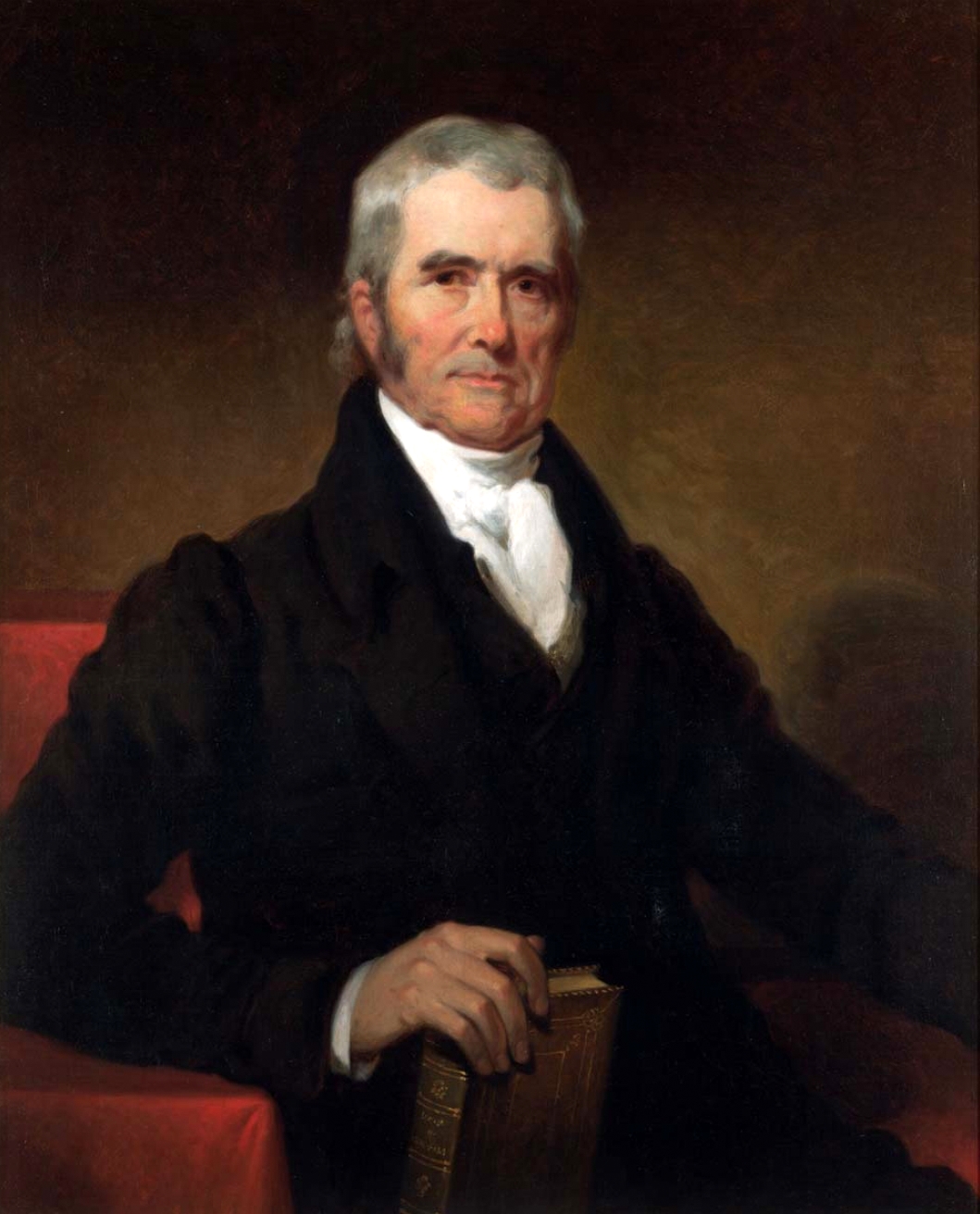
The doctrinal hinge is American Insurance Co. v. Canter, 26 U.S. (1 Pet.) 511 (1828). A territorial court at Key West, created by the Florida territorial legislature, had sold salvaged cotton. The insurers argued that only Article III courts could exercise admiralty jurisdiction. Chief Justice Marshall answered that the Florida judges were not Article III judges at all: "The Judges of the Superior Courts of Florida hold their offices for four years. These Courts, then, are not constitutional Courts, in which the judicial power conferred by the Constitution on the general government, can be deposited. They are incapable of receiving it. They are legislative Courts, created in virtue of the general right of sovereignty which exists in the government, or in virtue of that clause which enables Congress to make all needful rules and regulations, respecting the territory belonging to the United States."4 He added: "In legislating for them, Congress exercises the combined powers of the general, and of a state government."4
That passage is the real seed of the outline's thesis. It established that Congress could create adjudicators outside Article III, without life tenure, and that in territories Congress holds powers no state legislature and no federal Congress holds alone. Notice one detail the outline misses: the 1787 Northwest judges held office "during good behavior," the same tenure Article III gives federal judges.2 The four-year term Marshall relied on came from later territorial statutes, the Florida acts among them, and it became the standard pattern. When Congress organized Idaho Territory by the act of March 3, 1863, its justices held "their offices during the period of four years."5 The legislative court Marshall described rested on those later statutes, which differed from the 1787 model in the very feature he found decisive.

Public rights, 1856 and 1932
In Murray's Lessee v. Hoboken Land & Improvement Co., 59 U.S. (18 How.) 272 (1856), the Court approved a Treasury "distress warrant" against a customs collector's property without a court judgment. It drew a line that still governs: Congress cannot "withdraw from judicial cognizance any matter which, from its nature, is the subject of a suit at the common law, or in equity, or admiralty," but "there are matters, involving public rights, which may be presented in such form that the judicial power is capable of acting on them, and which are susceptible of judicial determination, but which congress may or may not bring within the cognizance of the courts of the United States, as it may deem proper."6
Crowell v. Benson, 285 U.S. 22 (1932), carried that line into the modern agency. Chief Justice Hughes wrote that "Familiar illustrations of administrative agencies created for the determination of such matters are found in connection with the exercise of the congressional power as to interstate and foreign commerce, taxation, immigration, the public lands, public health, the facilities of the post office, pensions, and payments to veterans."7 He upheld fact-finding by a deputy commissioner in a workers' compensation case because "the reservation of full authority to the court to deal with matters of law provides for the appropriate exercise of the judicial function in this class of cases."7 The public lands are on Hughes's list. That is a documented link between the land estate and the agency adjudicator, and it comes from the Court itself. The outline did not have to invent it.
The Insular Cases cite the territorial power
When the Court decided Downes v. Bidwell, 182 U.S. 244 (May 27, 1901), the opinions reached back to the Northwest Ordinance and to Canter by name.8 Justice White's concurrence walked through the Ordinance of 1787 and the territorial acts that extended its guarantees, and Justice Brown's opinion summarized Canter's holding that "in legislating for them Congress exercises the combined powers of the general and of a state government."8 The continuity here is explicit. The justices themselves treated the 1787 to 1828 line as precedent for governing Puerto Rico outside the full Constitution.
Justice Harlan's dissent is the best evidence that the continuity was contested from the start: "In my opinion, Congress has no existence and can exercise no authority outside of the Constitution. Still less is it true that Congress can deal with new territories just as other nations have done or may do with their new territories." He warned that the majority's reasoning would let Congress "engraft upon our republican institutions a colonial system such as exists under monarchical governments."8
Agency adjudication
The Administrative Procedure Act, approved June 11, 1946, created the office the statute called an "examiner," known as the hearing examiner until Congress renamed it administrative law judge in 1978.916 Its section 11 already contained the independence rule that survives today: "Examiners shall be removable by the agency in which they are employed only for good cause established and determined by the Civil Service Commission (hereinafter called the Commission) after opportunity for hearing and upon the record thereof." Their pay was set by the Commission "independently of agency recommendations or ratings."9
The current code repeats the design in five sections. Under 5 U.S.C. 3105, "Each agency shall appoint as many administrative law judges as are necessary," and ALJs "shall be assigned to cases in rotation so far as practicable, and may not perform duties inconsistent with their duties and responsibilities as administrative law judges."10 Under 5 U.S.C. 554(d), the presiding employee may not "consult a person or party on a fact in issue, unless on notice and opportunity for all parties to participate," and may not "be responsible to or subject to the supervision or direction of an employee or agent engaged in the performance of investigative or prosecuting functions for an agency."11 Under 5 U.S.C. 556(b), the hearing "shall be conducted in an impartial manner," and a party may file "a timely and sufficient affidavit of personal bias."12 Under 5 U.S.C. 557(b), the ALJ's initial decision "then becomes the decision of the agency without further proceedings unless there is an appeal to, or review on motion of, the agency," and on review "the agency has all the powers which it would have in making the initial decision."13 Under 5 U.S.C. 7521(a), an agency may act against an ALJ "only for good cause established and determined by the Merit Systems Protection Board on the record after opportunity for hearing before the Board."14
How many of these officials exist? The Office of Personnel Management, which runs the ALJ program office, no longer posts a headcount on its ALJ page as of October 2026.15 The Congressional Research Service reported, citing OPM, "1,422 ALJs assigned to 30 federal agencies as of March 2009."16 The Administrative Conference of the United States put the figure at "about 2,000 federal ALJs" in March 2024.17 The Social Security Administration alone says its Office of Hearings Operations has more than 1,500 ALJs in 163 hearing offices.18 Most federal ALJs decide disability benefit claims, a public benefit the Court has long placed inside the public rights category. The largest body of adjudicators outside Article III spends its days deciding who gets a disability check.
Federal land retention
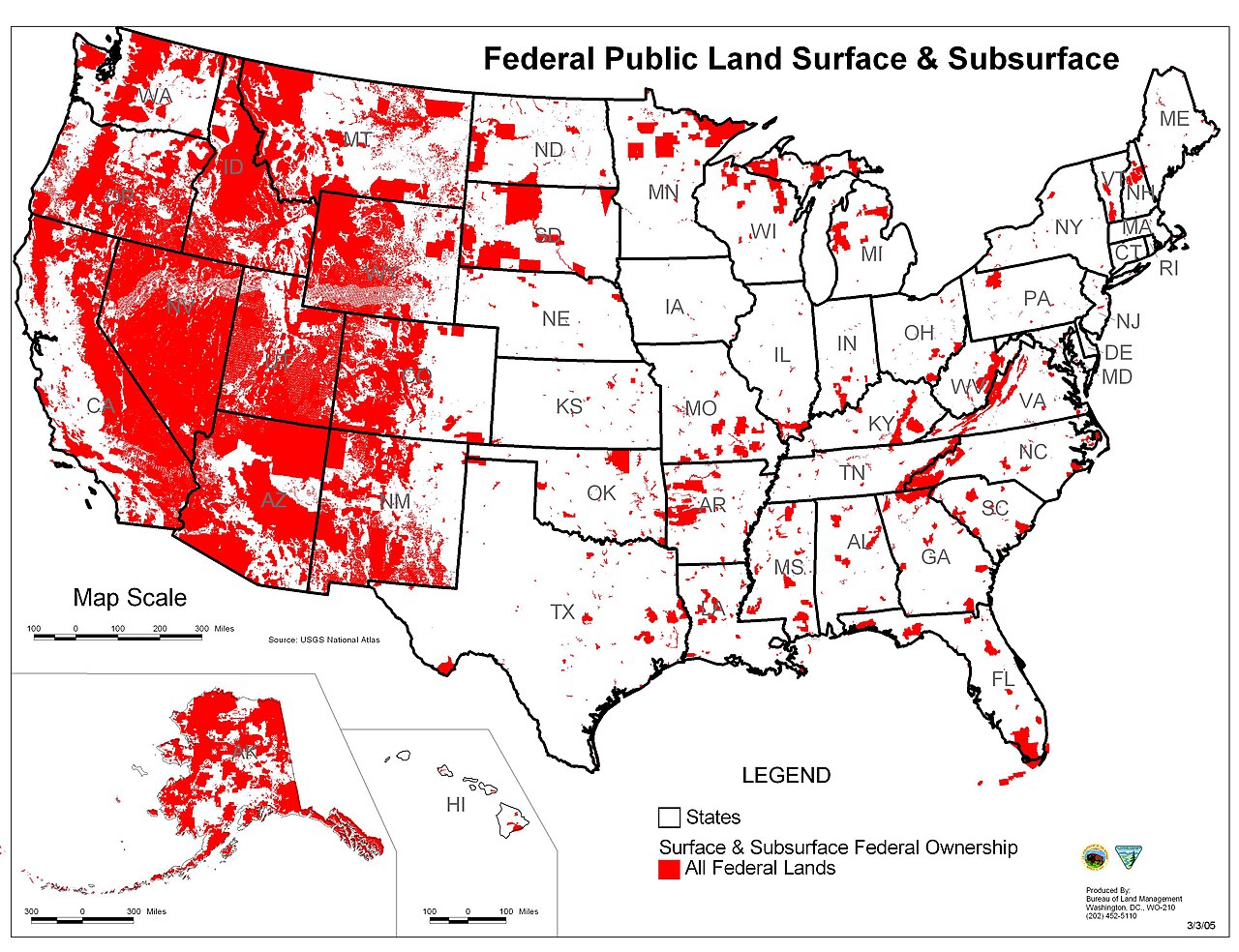
The Property Clause gives Congress "Power to dispose of and make all needful Rules and Regulations respecting the Territory or other Property belonging to the United States."19 For a century and a half Congress mostly disposed. CRS counts about 1.29 billion acres of public domain "transferred out of federal ownership between 1781 and 2024," including 816 million acres to private owners and 328 million to states.20 Statehood came with a price set in the territorial model. Idaho's constitution, ratified by the territory's voters in November 1889 and accepted by Congress when Idaho was admitted on July 3, 1890, provides that "the people of the state of Idaho do agree and declare that we forever disclaim all right and title to the unappropriated public lands lying within the boundaries thereof," and that "no taxes shall be imposed by the state on the lands or property therein belonging to, or which may hereafter be purchased by, the United States."21 That language tracks two promises in Article 4 of the 1787 Ordinance: no interference with "the primary disposal of the soil" by the United States, and no tax on "lands the property of the United States."2
Retention became formal policy with the Federal Land Policy and Management Act of October 21, 1976, which declares "that the public lands be retained in Federal ownership, unless as a result of the land use planning procedure provided for in this Act, it is determined that disposal of a particular parcel will serve the national interest."22 As of September 30, 2024, five federal agencies held 32,785,766 of Idaho's 52,933,120 acres, 61.9 percent.20 The tax exemption and the disclaimer are documented continuities from 1787 to the present. They are written in statutes and a state constitution, and they are public.

Where the analogy holds and where it breaks
The outline's boldest specific claim is that today's administrative law judges "function identically" to the territorial courts. Set side by side, the offices share an ancestor in doctrine and differ in almost every working rule.
| Feature | Northwest Territory judges (1787, 1789) | Florida superior courts in Canter (1828) | Federal ALJs (APA, 2026) |
|---|---|---|---|
| Appointed by | Congress; after 1789 the President with Senate consent3 | Under acts of Congress organizing Florida Territory4 | The agency head, as an "Officer of the United States" after Lucia2317 |
| Tenure | "during good behavior"2 | "four years"4 | Career appointment; removal only for good cause found by the MSPB14 |
| Makes law? | Yes, with the governor, by adopting state laws subject to congressional disapproval2 | No; a territorial legislature existed4 | No; may not perform duties inconsistent with the ALJ role10 |
| Jurisdiction | General "common law jurisdiction"2 | Territorial jurisdiction, including admiralty4 | Only hearings "required by statute to be determined on the record"11 |
| Jury | Guaranteed by Article 2 of the Ordinance2 | Not at issue in the salvage case4 | None; required in court for SEC fraud penalties after Jarkesy24 |
| Separation from prosecutors | None written | None written | Required by 5 U.S.C. 554(d)11 |
| Final word | Congress could disapprove their laws2 | Review in the federal courts, up to the Supreme Court4 | The agency, then review in an Article III court13 |
The table shows why "identical" fails. The 1787 judges were judges, legislators and members of a frontier government at once, with jury trial guaranteed beneath them. An ALJ is a hearing officer inside one agency, barred from taking orders from the agency's prosecutors, with no power to make law and no general jurisdiction. The continuity that does exist is in the theory of authority. Both rest on the idea that Congress may create adjudicators outside Article III, the idea Marshall named in Canter and the Court extended in Murray's Lessee and Crowell. That is a real inheritance, and it is the one current litigation is about.
The Supreme Court has been redrawing that inheritance since 2018. In Lucia v. SEC, decided June 21, 2018, Justice Kagan wrote for the Court that "the Commission's ALJs are 'Officers of the United States,' subject to the Appointments Clause," because they "take testimony," "conduct trials," "rule on the admissibility of evidence," and "have the power to enforce compliance with discovery orders."23 On February 20, 2025, Acting Solicitor General Sarah Harris told the Speaker of the House that the Department of Justice "has concluded that the multiple layers of removal restrictions for administrative law judges (ALJs) in 5 U.S.C. 1202(d) and 7521(a) violate the Constitution" and "will no longer defend them in court."25 In Trump v. Slaughter, decided June 29, 2026, the Court held the FTC commissioners' removal protection unconstitutional and said of Humphrey's Executor, "If anything more is left of Humphrey's, we overrule it."26 The same opinion reserved the question for the judges of non-Article III courts and did not mention administrative law judges at all: "the permissibility of tenure protections for the judges of 'non-Article III courts,' such as the Tax Court and the Court of Federal Claims, is not 'presented' or 'briefed' in this case and poses a 'different set of questions.' ... We leave those questions for another day."26 The Supreme Court has not decided the ALJ removal question as of October 22, 2026, and its granted list for the October 2026 Term includes no case on it.26 A federal district court in Washington, D.C., did strike down the removal protection for National Labor Relations Board ALJs in December 2024, in VHS Acquisition Subsidiary No. 7 v. NLRB.26
What has no evidence
Secret enclaves
The outline speaks of federal enclaves where state law and the Constitution do not reach, and it cites a "1963 Status of Lands and Water Areas" report. No report by that title turned up in searches of the Library of Congress, GovInfo or the federal depository catalog. What does exist is public. Attorney General Herbert Brownell organized an Interdepartmental Committee for the Study of Jurisdiction over Federal Areas within the States on December 15, 1954. Part I of its report, "The Facts and Committee Recommendations," went to President Eisenhower in April 1956, and Part II, "A Text of the Law of Legislative Jurisdiction," followed in 1957.27 The report sorted federal land into four kinds of jurisdiction: exclusive legislative jurisdiction, concurrent legislative jurisdiction, partial legislative jurisdiction and "proprietorial interest only."28 The General Services Administration then published an inventory of the jurisdictional status of federal areas "as of June 30, 1957."29
The constitutional source for exclusive jurisdiction is the Enclave Clause, which lets Congress "exercise like Authority over all Places purchased by the Consent of the Legislature of the State in which the Same shall be, for the Erection of Forts, Magazines, Arsenals, dock-Yards, and other needful Buildings."19 Enclaves are real and catalogued, and the committee listed their uses as "post offices, arsenals, dams, roads, etc."28 For "the great bulk of land owned by the United States, including substantially all lands of the so-called public domain," the committee found that "the Federal Government holds only a proprietorial interest," meaning state law applies to it in most respects.30 The committee's main recommendation pointed away from enclaves: "The most immediate need, in the view of the Committee, is to make provision for the retrocession of unnecessary jurisdiction to the States."30 Nothing in that record supports enclaves that are secret, or areas where the Constitution is suspended. The government catalogued these places in print and recommended handing unneeded jurisdiction back to the states.
A single controlling apparatus
A single apparatus would act with one will. The record shows the opposite: federal institutions fighting each other in public. The Department of Justice defended the SEC's position that its ALJs were employees, then "switched sides" before the Supreme Court in Lucia, so that the Court had to appoint an outside lawyer to defend the judgment below.23 The United States opposed Utah's land suit while the Ute Indian Tribe sought to intervene and states, legislators and counties filed amicus briefs.31 In Slaughter the President fired two commissioners of an independent agency and won.26 In Loper Bright Enterprises v. Raimondo, decided June 28, 2024, the Court wrote "Chevron is overruled," stripping agencies of the deference they had relied on for forty years.32 Rivalry and reversal are the documented pattern. An apparatus with one will does not keep beating itself in the Supreme Court. The outline names no person, office or document that coordinates all of it, and none appears in the record.
European creditors running the domain
Debt did drive land policy. CRS records that early Americans agreed on land measures "to pay soldiers, to reduce the national debt, and to strengthen the nation."20 Hamilton's Report on Public Credit, delivered to the House in January 1790, put the foreign debt at "principal 10,070,307" with arrears of interest of 1,640,071.62, "Making together, dollars 11,710,378 62," against a total debt "amounting together to 54,124,464 dollars, and 56 cents."33 Foreign creditors held about 22 percent of the total. The State Department's history names them: the French government, the Spanish government and "private Dutch investors."34 It records that the United States settled with the French government in 1795 through the banker James Swan and that afterward it "no longer owed money to foreign governments, although it continued to owe money to private investors both in the United States and in Europe."34
A bondholder holds paper. No statute, contract or report in the record gives a foreign creditor title to the public domain, a veto over its use or a role in its management. The Northwest Ordinance put "the primary disposal of the soil" in "the United States in Congress assembled," and FLPMA puts management in the Secretary of the Interior under rules Congress writes.222 The modern version of the creditor claim, that large asset managers own the West, is covered in lesson 16, which reports what their filings show and do not show.35
The remedies people actually propose
The outline's thesis, if true, would suggest that ordinary politics cannot touch the second government. The record of 2023 to 2026 shows ordinary politics touching it constantly and, on the land question, mostly coming up short.
Article III adjudication
In SEC v. Jarkesy, decided June 27, 2024, Chief Justice Roberts wrote for six justices: "When the SEC seeks civil penalties against a defendant for securities fraud, the Seventh Amendment entitles the defendant to a jury trial."24 The opinion traced the right to the founding grievance against "juryless admiralty, vice admiralty, and chancery courts" that lesson 4 covers.24 It held that "matters concerning private rights may not be removed from Article III courts," and it named the historic public rights categories that remain open to agencies: "relations with Indian tribes," "the administration of public lands," and "the granting of public benefits such as payments to veterans."24 For anyone in a land state, that list is the cold water in the ruling. The Court's newest statement on agency adjudication keeps public land administration inside the zone where Congress may skip the jury.
Congressional review of rules
The REINS Act would require that a "major rule," one with an annual economic effect of $100 million or more, take effect only if Congress passes "a joint resolution of approval."36 The House passed it 221 to 210 on June 14, 2023, as H.R. 277 of the 118th Congress, and the Senate did not take it up.37 Representative Kat Cammack reintroduced it on January 3, 2025 as H.R. 142, and the bill was referred to the Judiciary, Rules and Budget committees. No later action could be confirmed.36
State land transfer: Utah v. United States
On August 20, 2024, Utah filed a motion for leave to file a bill of complaint directly in the Supreme Court, docketed as No. 160, Original.31 Utah's argument, as Utah News Dispatch summarized it, was that the Bureau of Land Management's indefinite holding of about 18.5 million acres of "unappropriated" land, roughly 34 percent of the state, is unconstitutional.38 Amicus briefs supporting Utah came from the Utah Legislature, Wyoming legislators, U.S. Senators led by Mike Lee, Iowa and other states, and "Idaho, et al."31 The United States filed its brief in opposition on November 21, 2024.31 On January 13, 2025, the docket records: "Motion for leave to file a bill of complaint DENIED."31 The docket entry records no noted dissent.31
Utah's governor, legislative leaders and attorney general said they were "disappointed in the Supreme Court's decision not to take up this case" and noted that the order did not reach the merits.38 By July 2025 an assistant attorney general told a state judge that refiling in a lower federal court was "under consideration," adding, "there is no federal lawsuit and there may never be one."39 On July 23, 2025, Third District Judge Thaddeus May dismissed a Southern Utah Wilderness Alliance suit that sought to stop the state from refiling, holding that the missing federal suit made the challenge moot: "The non-existence of that suit is fatal."40 Searches of the Supreme Court docket and Utah and national news through October 22, 2026 found no refiled federal suit. The status as of that date is a denied original action and no pending case. Utah's claim to 18.5 million acres ended, for now, in a one-line denial and a refiling that has not come.
State memorials and federal sale proposals, 2025 to 2026
Idaho's legislature has used the joint memorial, a formal request to Congress with no force of law. Senate Joint Memorial 104 of 2025 asked for "a transfer of the ownership" of the Camas National Wildlife Refuge to the state. The Senate adopted it by voice vote on March 17, 2025 and the House by 53 to 15 on March 24, 2025.41 House Joint Memorial 9 of 2026 went the other direction in tone. It urged Congress to "enact legislation reaffirming that FLPMA is the proper and primary avenue to facilitate effective federal land management and disposal, including by land exchange," after "a legal decision originating in Idaho" put land exchanges in doubt. The House adopted it 69 to 0 on February 4, 2026, and the Senate by voice vote on February 17, 2026.42 Utah's 2026 session saw House Concurrent Resolution 5, which urged Congress "to establish a framework for state operation of federal public lands, under a joint management agreement" and asked for transfer of land for a Little Sahara State Park.43 Wyoming lawmakers backed a 2025 resolution asking Congress to hand over all federal land except Yellowstone; it failed.44
In Congress, Senator Mike Lee proposed requiring the sale of 0.5 to 0.75 percent of BLM and Forest Service land in 11 western states. The Senate parliamentarian ruled against a version that would have sold an estimated 2.2 to 3.3 million acres, and on June 28, 2025 Lee withdrew the provision from the reconciliation bill. Lee said he would "withdraw the federal land sales provision from the bill."45
Article V applications
Idaho House Concurrent Resolution 25 of 2026 asked Congress to call a convention to propose a federal balanced budget amendment. The House adopted it 36 to 34 on February 6, 2026.46 The Senate Judiciary and Rules Committee rejected it 5 to 4 on March 2, 2026.47 The count of existing state applications is itself disputed: the Convention of States group counted 20 states, and The Hill counted 28 for a balanced budget convention, according to the Idaho Capital Sun.48
PILT reform
Payments in Lieu of Taxes, created by Public Law 94-565 on October 20, 1976, compensate counties for federal land they cannot tax.49 The statute sets two alternative formulas per acre of "entitlement land," one larger amount reduced by other federal land payments and one smaller unreduced amount, both capped by a population table, with the base figures indexed to inflation.50 For fiscal 2026, Interior set the rates at $3.55 and $0.51 per acre, and the program paid $733,041,949 nationwide, including $49,562,605 to Idaho local governments.49 The live reform fight is about how the money is appropriated. CRS reports that PILT was funded through discretionary appropriations from 1976 through FY2007 and that "For many of the earlier years (e.g., FY1995-FY2007), the discretionary appropriations were not at the full authorized level, so each county received a prorated payment," while FY2008 to FY2025 were mostly mandatory.51 The National Association of Counties asks for full mandatory funding, and bills in the 116th and 118th Congresses would have required mandatory funding for a set period or indefinitely. CRS notes that Congress may also value the flexibility of reviewing PILT each year through annual appropriations.51 Neither side proposes ending federal ownership through PILT.
What Federalist 28 really says
Federalist 28 is often quoted as a charter for state resistance. Its first sentence points the other way. The paper defends the Constitution's power to raise armies, and it opens by defending national force: "THAT there may happen cases in which the national government may be necessitated to resort to force, cannot be denied." Hamilton calls "seditions and insurrections" "maladies as inseparable from the body politic as tumors and eruptions from the natural body," and he cites Massachusetts raising troops "for repressing the disorders within that State," the Shays episode.52
His answer to the fear of a standing army starts with representation: "the whole power of the proposed government is to be in the hands of the representatives of the people. This is the essential, and, after all, only efficacious security for the rights and privileges of the people, which is attainable in civil society."52 Only if that fails does he reach the next step: "If the representatives of the people betray their constituents, there is then no resource left but in the exertion of that original right of self-defense which is paramount to all positive forms of government."52
The mechanism Hamilton describes for that extremity is institutional. In a single state, he says, citizens facing usurpers "must rush tumultuously to arms, without concert, without system, without resource; except in their courage and despair." In the federal system the states supply the missing organization: "Power being almost always the rival of power, the general government will at all times stand ready to check the usurpations of the state governments, and these will have the same disposition towards the general government. The people, by throwing themselves into either scale, will infallibly make it preponderate. If their rights are invaded by either, they can make use of the other as the instrument of redress."52 State legislatures "will have better means of information. They can discover the danger at a distance; and possessing all the organs of civil power, and the confidence of the people, they can at once adopt a regular plan of opposition, in which they can combine all the resources of the community. They can readily communicate with each other in the different States, and unite their common forces for the protection of their common liberty."52
Read accurately, the paper does contemplate armed resistance by organized states against a federal army bent on "erecting a despotism," and it does say "the distant States would have it in their power to make head with fresh forces."52 It does so as a thought experiment meant to reassure New Yorkers that such a despotism could never succeed, and it ends by calling the fear of it "a disease, for which there can be found no cure in the resources of argument and reasoning."52 Its use today is narrow. The trigger is betrayal by the people's representatives, a usurpation, and lawful action by an agency under a statute Congress passed does not qualify. In Hamilton's account the actor is the state government acting through its regular organs, as opposed to citizens who "rush tumultuously to arms" or a private militia. And the first remedy Hamilton names is the vote. The documented state responses of 2024 to 2026, a lawsuit, amicus briefs, memorials, a convention application, are the "regular plan of opposition" Hamilton described, carried out through courts and legislatures. Nullification, the claim that a state may declare a federal law void, appears nowhere in Federalist 28. Hamilton's mechanism works by one government checking another, which assumes both remain lawful.
Through Pierson's Framework
Pierson's test asks what an institution does, not what it calls itself. Applied to the outline, that test turns on the outline's own method. "Government #2" is a name. It bundles a frontier lawmaking council of 1787, a four-year Florida court of 1828, a Treasury distress warrant of 1856, a disability hearing officer of 2026 and a land management statute of 1976 under one label and then asks the reader to oppose the label. Judged by function, the bundle comes apart. Some pieces answer to elected officials more closely than the outline admits. The 1789 act put territorial officers under the President and the Senate, and every ALJ decision can be reviewed by the agency head and then by an Article III court.313 Other pieces show exactly the drift Pierson describes.
That drift is easy to see in the doctrine. Marshall's "legislative court" was a practical answer to governing a sparsely settled territory before statehood.4 It became a category, the category became a habit, and by 1932 the public lands sat on a list of "familiar illustrations" of matters Congress could keep away from juries.7 Nobody re-argued whether the original reason still applied. Pierson's essay on the acacia describes institutionalism as the mindset that "assumes continuity equals virtue, structure guarantees truth, and outside critique is a threat by default."53 A doctrine that survives because it is old fits that description better than any secret apparatus.
Pierson's appendix on the Anti-Federalists offers the phrase that fits the documented record: "This is not tyranny by seizure. It is tyranny by sediment, the slow burial of liberty under layers of unchecked authority."54 Sediment is visible. It is in the U.S. Code, the Idaho Constitution and the Supreme Court reports, and it can be dug through with the same tools that laid it down.
Ordered liberty, as Pierson frames it, carries a double duty: hold government accountable and support legitimate government. His Ordered Liberty Reclaimed says plainly, "This document is not a defense of government nor a license for revolt," and calls for "mutual restraint."55 Applied here, the remedies traced above are the right ones: jury trials won in court, rules sent back to Congress, land claims argued before judges, memorials and votes in state legislatures, and Federalist 28 read as a case for organized, lawful, state-level checks. Pierson's Concord Principle of Resistance sets five standards, innocence, imminence, proportionality, avoidance and reasonableness, for defensive resistance as the final rung of a long ladder of protest. None of the disputes traced here reaches that rung, and the five standards have no application to disputes over agencies, land or courts, which belong to the lower rungs where law and politics still work.56
Hard Questions and Answers
Marshall himself called these courts "not constitutional Courts." Isn't that a confession that a second judiciary exists outside the Constitution?
Partly, yes, and the concession should be made plainly. Canter does say the Florida courts "are not constitutional Courts" and that their jurisdiction "is not a part of that judicial power which is defined in the 3d article."4 But Marshall located their authority inside the Constitution, in the Territory Clause and the "general right of sovereignty," and the validity of the Key West court's sale was decided by the Supreme Court itself.4 The doctrine sits inside the constitutional system and under its highest court. A second judiciary that answered to no one would never have produced a reported Supreme Court opinion. So the outline gets the category right and the independence wrong. The fair criticism is that the category grew far past the territories, and Harlan made that criticism in 1901.8
Unelected men wrote binding law for the Northwest in 1787. Unelected agency staff write binding rules today. What exactly is the difference?
Less than agency defenders like to admit, and more than the outline claims. The resemblance is real at the level of principle: in both cases, people not elected by the governed write binding rules. The differences are in control. The 1787 governor and judges could only "adopt and publish" laws already passed by an original state, and Congress could disapprove them.2 Agency rules rest on a statute, must survive notice and comment, face judicial review, and since Loper Bright get no deference on the meaning of the statute.32 The REINS Act would add the one feature the 1787 model had and modern rulemaking lacks: an affirmative congressional vote on major rules.36 That bill passed the House once and has not become law.37 On this one point the 1787 Congress kept a tighter leash on its appointees than the modern Congress keeps on its agencies.
The Supreme Court would not even hear Utah. Doesn't that prove the courts will protect the land estate no matter what?
No. The denial proves less than either side claims. The Court has discretion over its original docket, and the order was a single sentence with no stated reason and no noted dissent.3138 It did not decide the merits, as Utah's own leaders said the same day.38 The path through a federal district court remained open, and Utah chose, through at least July 2025, not to take it.39 No lower court has ruled on the merits because Utah has not asked one to. What the record does show is that the Supreme Court's 2024 statement in Jarkesy listed "the administration of public lands" as a public rights category, a sign that the current Court sees land management as a field where Congress has broad power.24
Hamilton wrote that the states could "make head with fresh forces." Why pretend Federalist 28 is anything other than a call to arms?
Because Hamilton did not write it as one, though he did not rule force out either. It contemplates force in one scenario: a federal army attempting despotism after the people's representatives have betrayed them.52 Hamilton raised the scenario to show it could not succeed, so that readers would ratify the Constitution and its army clause. He ranks representation as "the essential, and, after all, only efficacious security."52 His mechanism runs through state legislatures with "all the organs of civil power," acting on "a regular plan of opposition."52 Nothing in the paper licenses private violence or state defiance of a lawful statute, and Hamilton opens the same essay by defending the national government's use of force to suppress insurrection.52
Foreign creditors held a fifth of the debt in 1790. Isn't it naive to think they had no say over the land?
Influence and control are different claims, and the record supports only the first in a limited way. Hamilton planned the funding system with an eye on "the European moneylenders, particularly among the Dutch," and the United States borrowed in Amsterdam in 1787 and 1788 and again in the 1790s.3334 Creditors had the ordinary pull any lender has. But the debts to foreign governments were paid off by 1795, the remaining private holders owned bonds rather than land, and every disposal statute from 1785 to 1976 was written and passed by Congress in public.3420 The outline offers no document showing a creditor directing a land decision, and none appears in the sources reviewed. Until one turns up, the claim is a suspicion, and the public record of every disposal statute cuts against it.
Learn more
- Northwest Ordinance, July 13, 1787 (Avalon Project): the full text, including the governor-and-judges lawmaking clause and Articles 1 to 6.
- American Insurance Co. v. Canter, 26 U.S. 511 (1828): Marshall's opinion creating the "legislative court."
- The Federalist No. 28 (Avalon Project): Hamilton's argument on force, representation and the states as a check.
- 5 U.S.C. 554 and following (Cornell LII): the APA's adjudication rules, with links to 556, 557, 3105 and 7521.
- Lucia v. SEC (2018): ALJs as officers of the United States.
- SEC v. Jarkesy (2024): the jury right and the limits of public rights.
- Utah v. United States, No. 160, Original (docket): every filing in Utah's 2024 land action.
- Jurisdiction over Federal Areas within the States (1956, 1957): the real federal report on enclaves and jurisdiction.
- Module 52, Ordered Liberty: Pierson's framework of accountability, resistance and the CPoR standards.
- Lesson 17, The Courts Push Back: the 2022 to 2026 decisions in full.
Notes
- The outline of a "Government #2" thesis handed to Pierson, with its reading list, is described in lesson 1 of this module, "What Institutionalism Is." The outline is an unpublished working document; this lesson tests its claims and does not adopt them. Read it online. ↩
- An Ordinance for the Government of the Territory of the United States North West of the River Ohio, July 13, 1787, sections 3, 4, 5, 9, 11 and Articles 2, 4 and 5. The Avalon Project, Lillian Goldman Law Library, Yale Law School. Read it online. ↩
- An Act to provide for the Government of the Territory North-west of the river Ohio, ch. 8, 1 Stat. 50, 52 to 53 (Aug. 7, 1789), section 1. GovInfo, U.S. Statutes at Large. Read it online. ↩
- American Insurance Co. v. 356 Bales of Cotton (Canter), 26 U.S. (1 Pet.) 511, 546 (1828), opinion of Marshall, C.J. Legal Information Institute, Cornell Law School. Read it online. ↩
- An Act to provide a temporary Government for the Territory of Idaho, ch. 117, 12 Stat. 808 (Mar. 3, 1863), sections 2, 3 and 9. GovInfo, U.S. Statutes at Large. Read it online. ↩
- Murray's Lessee v. Hoboken Land and Improvement Co., 59 U.S. (18 How.) 272, 284 (1856). Legal Information Institute, Cornell Law School. Read it online. ↩
- Crowell v. Benson, 285 U.S. 22, 51, 54 (1932), opinion of Hughes, C.J. Legal Information Institute, Cornell Law School. Read it online. ↩
- Downes v. Bidwell, 182 U.S. 244 (decided May 27, 1901), opinion of Brown, J., concurrence of White, J., and dissent of Harlan, J. Legal Information Institute, Cornell Law School. Read it online. ↩
- Administrative Procedure Act, ch. 324, 60 Stat. 237 (approved June 11, 1946), sections 1 and 11. GovInfo, U.S. Statutes at Large. Read it online. ↩
- 5 U.S.C. 3105, Appointment of administrative law judges. Legal Information Institute, Cornell Law School. Read it online. ↩
- 5 U.S.C. 554, Adjudications, subsections (a) and (d). Legal Information Institute, Cornell Law School. Read it online. ↩
- 5 U.S.C. 556, Hearings; presiding employees, subsection (b). Legal Information Institute, Cornell Law School. Read it online. ↩
- 5 U.S.C. 557, Initial decisions; conclusiveness; review by agency, subsection (b). Legal Information Institute, Cornell Law School. Read it online. ↩
- 5 U.S.C. 7521, Actions against administrative law judges, subsection (a). Legal Information Institute, Cornell Law School. Read it online. ↩
- U.S. Office of Personnel Management, "Administrative Law Judges" (ALJ Program Office page), checked October 22, 2026; the page describes recruitment and the ALJ Loan and Senior ALJ programs but gives no current headcount. Read it online. ↩
- Congressional Research Service, "Administrative Law Judges: An Overview," RL34607, citing OPM data as of March 2009; its note 2 records that in 1978 Congress changed the title "hearing examiners" to "Administrative Law Judges," P.L. 95-251, 92 Stat. 183. Read it online. ↩
- Administrative Conference of the United States, "ALJ Basics," Information Interchange Bulletin No. 035 (March 2024). Read it online. ↩
- Social Security Administration, Office of Hearings Operations, "About Hearings and Appeals" (page certified November 8, 2019). Read it online. ↩
- Constitution of the United States, Art. I, sec. 8, cl. 17; Art. III, sec. 1; Art. IV, sec. 3, cl. 2. National Archives transcript. Read it online. ↩
- Congressional Research Service, "Federal Land Ownership: Overview and Data," R42346 (updated September 14, 2026), summary, history section and Table 1 (acreage as of September 30, 2024). Read it online. ↩
- Constitution of the State of Idaho, Article XXI, section 19. Idaho Legislature. Idaho was admitted by An act to provide for the admission of the State of Idaho into the Union, 26 Stat. 215 (approved July 3, 1890). Read it online. ↩
- Federal Land Policy and Management Act of 1976, Pub. L. 94-579, title I, sec. 102, 90 Stat. 2744 (Oct. 21, 1976), codified at 43 U.S.C. 1701(a)(1). Legal Information Institute, Cornell Law School. Read it online. ↩
- Lucia v. Securities and Exchange Commission, 585 U.S. 237 (decided June 21, 2018), No. 17-130, opinion of Kagan, J., including the syllabus and Part I on the Government's change of position. Legal Information Institute, Cornell Law School. Read it online. ↩
- Securities and Exchange Commission v. Jarkesy, 603 U.S. 109 (decided June 27, 2024), No. 22-859, syllabus and opinion of Roberts, C.J. Legal Information Institute, Cornell Law School. Read it online. ↩
- Sarah M. Harris, Acting Solicitor General, letter to the Honorable Mike Johnson, Speaker of the House, "Multilayer Restrictions on the Removal of Administrative Law Judges," February 20, 2025, under 28 U.S.C. 530D. U.S. Department of Justice. Read it online. ↩
- Trump v. Slaughter, 609 U.S. 422 (decided June 29, 2026), No. 25-332, syllabus and opinion of Roberts, C.J., at 450 (overruling what is left of Humphrey's Executor) and Part III-B, at 456 (reserving non-Article III courts). The majority and dissenting opinions do not mention administrative law judges. Supreme Court of the United States, preliminary print. On ALJs after Slaughter, see the Court's Granted and Noted List, October Term 2026, as of October 13, 2026, which lists no ALJ removal case (granted list), and Proskauer, "Federal District Court in DC Strikes Down Removal Protections for ALJs" (December 13, 2024), on VHS Acquisition Subsidiary No. 7 v. NLRB (D.D.C., Judge Trevor McFadden, December 10, 2024) (article). Opinion: Read it online. ↩
- Interdepartmental Committee for the Study of Jurisdiction over Federal Areas within the States, Jurisdiction over Federal Areas within the States, Part I, The Facts and Committee Recommendations (April 1956), and Part II, A Text of the Law of Legislative Jurisdiction (1957), letter of transmittal of Attorney General Herbert Brownell, Jr., April 27, 1956. Transcription at constitution.org. Read it online. Scans of the printed reports at the Internet Archive: Part I and Part II. On the outline's "1963 Status of Lands and Water Areas": no report by that title was found. The closest 1963 document found is a different kind of report entirely: the U.S. Forest Service's "Land Areas Report as of June 30, 1963," for the National Forest System, an annual acreage table by Forest Service region and state with no discussion of legislative jurisdiction (title page checked October 22, 2026; the Forest Service hosts it under the file name LAR_1962.pdf). Forest Service Land Areas Report, 1963. It sits alongside the GSA "Inventory Report on Jurisdictional Status of Federal Areas within the States, as of June 30, 1962" (GSA 1962 inventory), which is the jurisdiction document the outline most likely meant. ↩
- Jurisdiction over Federal Areas within the States, Part I (1956), chapters 1 to 3, classification of jurisdictional status: exclusive legislative jurisdiction, concurrent legislative jurisdiction, partial legislative jurisdiction, proprietorial interest only. Read it online. ↩
- General Services Administration, Inventory Report on Jurisdictional Status of Federal Areas within the States, as of June 30, 1957 ([1959]), SuDoc GS 1.15/3:957. Catalog of U.S. Government Publications record, University of North Texas. Read it online. ↩
- Jurisdiction over Federal Areas within the States, Part I (1956), chapters 7 and 8: section F, "Views of agencies desiring a proprietorial interest only," and the recommendation on retrocession of unnecessary federal jurisdiction. Read it online. ↩
- Supreme Court of the United States, docket No. 22O160, Utah v. United States: motion for leave to file a bill of complaint filed August 20, 2024; amicus briefs filed October 18 and 22, 2024; brief of the United States in opposition and motion to intervene of the Ute Indian Tribe filed November 21, 2024; motion for leave denied January 13, 2025. Read it online. ↩
- Loper Bright Enterprises v. Raimondo, 603 U.S. 369 (decided June 28, 2024), No. 22-451. Legal Information Institute, Cornell Law School. Read it online. ↩
- Alexander Hamilton, Report Relative to a Provision for the Support of Public Credit, January 9, 1790. Founders Online, National Archives. Read it online. ↩
- Office of the Historian, U.S. Department of State, "U.S. Debt and Foreign Loans, 1775 to 1795," Milestones in the History of U.S. Foreign Relations. Read it online. ↩
- Lesson 16 of this module, "Modern Mercantilism: State and Capital Fused, 2008 to 2026," on the Big Three asset managers and what their filings report. Read it online. ↩
- H.R. 142, 119th Congress, Regulations from the Executive in Need of Scrutiny Act of 2025, introduced January 3, 2025 by Rep. Kat Cammack and referred to the Committees on the Judiciary, Rules and the Budget; text as introduced, proposed 5 U.S.C. 801 and 804. Congress.gov and GovInfo. Read it online. ↩
- Office of the Clerk, U.S. House of Representatives, Roll Call 265, H.R. 277, 118th Congress, REINS Act, on passage, June 14, 2023: passed, yea 221, nay 210. Read it online. ↩
- "U.S. Supreme Court will not hear Utah's lawsuit to control 18.5 million acres of public land," Utah News Dispatch, January 13, 2025, including the joint statement of Gov. Spencer Cox, Senate President Stuart Adams, Speaker Mike Schultz and Attorney General Derek Brown. Read it online. ↩
- "Utah's public lands lawsuit in limbo for now as judge considers environmentalists' litigation," FOX 13 News (Salt Lake City), July 14, 2025, quoting Assistant Utah Attorney General Lance Sorenson. Read it online. ↩
- "Judge dismisses case aimed at stopping Utah from reviving its public land lawsuit," Utah News Dispatch, July 25, 2025, on the ruling of Third District Judge Thaddeus May in Southern Utah Wilderness Alliance v. State of Utah. Read it online. ↩
- Idaho Legislature, 2025 Session, Senate Joint Memorial 104, Camas National Wildlife Refuge, bill history: adopted by the Senate by voice vote March 17, 2025; adopted by the House 53-15-2 March 24, 2025; delivered to the Secretary of State March 26, 2025. Read it online. ↩
- Idaho Legislature, 2026 Session, House Joint Memorial 9, Federal Land Policy and Management Act, text and bill history: adopted by the House 69-0-1 February 4, 2026; adopted by the Senate by voice vote February 17, 2026; delivered to the Secretary of State February 20, 2026. Read it online. ↩
- Utah Legislature, 2026 General Session, H.C.R. 5, House Concurrent Resolution on State Management of Federal Public Lands, chief sponsor Steve Eliason, introduced text. Read it online. ↩
- "Long-thwarted efforts to sell public lands see new life under Trump," Stateline, June 4, 2025. Read it online. ↩
- "Sen. Mike Lee pulls public lands sale from Trump tax bill," KSL.com, June 28 to 29, 2025. Read it online. ↩
- Idaho Legislature, 2026 Session, House Concurrent Resolution 25, Article V Convention, bill history: adopted by the House 36-34-0 February 6, 2026; referred to Senate Judiciary and Rules February 9, 2026. Read it online. ↩
- "Idaho Senate committee rejects call to amend U.S. Constitution through convention," Idaho Press, March 2, 2026. Read it online. ↩
- "Divided Idaho House calls for constitutional convention. Critics warn of risk to U.S. Constitution," Idaho Capital Sun, February 6, 2026. Read it online. ↩
- U.S. Department of the Interior, Payments in Lieu of Taxes, state payment table for FY2024 to FY2026 (FY2026 payments $733,041,949, distributed June 23, 2026); FY2026 appropriation $733.6 million, of which $0.6 million for administration, per CRS R46260 (Aug. 31, 2026); Alternative A rate $3.55 and Alternative B rate $0.51 per acre; Idaho $49,562,605; original law Public Law 94-565, October 20, 1976. Program page with state and county data (state totals and Idaho figure). The per-acre rates and the June 23, 2026 distribution are confirmed in Congressional Research Service, R46260 (updated August 31, 2026) (CRS). Read it online. ↩
- 31 U.S.C. 6903, Payment for entitlement land, subsections (b) and (c). Legal Information Institute, Cornell Law School. Read it online. ↩
- Congressional Research Service, "The Payments in Lieu of Taxes (PILT) Program: An Overview," R46260 (November 19, 2025), summary and funding history. Read it online. ↩
- Alexander Hamilton (Publius), The Federalist No. 28, "The Same Subject Continued (The Idea of Restraining the Legislative Authority in Regard to the Common Defense Considered)," Independent Journal. The Avalon Project, Yale Law School. Read it online. ↩
- Jeff A. Pierson, "The Acacia Illusion: How Institutionalism Mimics Nature's Most Subtle Manipulation," in The Ordered Liberty Papers (2025). Read it online. ↩
- Jeff A. Pierson, "The Anti-Federalist Warning: Institutional Power and the Fragility of Liberty," appendix to Ordered Liberty Reclaimed: A Foundation for Liberty. Read it online. ↩
- Jeff A. Pierson, Ordered Liberty Reclaimed: A Foundation for Liberty. Read it online. ↩
- Module 52, "Ordered Liberty: Civil Anti-Authoritarianism and Resistance," on Pierson's Concord Principle of Resistance and its five standards, and Jeff A. Pierson, Breach of Ordered Liberty Framework. Read it online. ↩
Terms in this lesson
- Legislative court
- A tribunal created by Congress outside Article III, whose judges lack life tenure; named by Chief Justice Marshall in American Insurance Co. v. Canter (1828).
- Public rights
- Matters, such as public land administration or benefits, that Congress may assign to agencies without a jury, as first described in Murray's Lessee (1856).
- Administrative law judge (ALJ)
- An agency hearing officer under the Administrative Procedure Act who presides over on-the-record hearings and issues initial decisions, protected from removal except for good cause found by the MSPB.
- Original action
- A case filed first in the U.S. Supreme Court, usually between states or a state and the United States; the Court may deny leave to file.
- Proprietorial interest
- Federal ownership of land in a state without legislative jurisdiction, so that state law generally applies; the most common status of western federal land.
- Enclave Clause
- Article I, section 8, clause 17, allowing exclusive federal legislation over places bought with a state's consent for forts, arsenals and similar buildings.
- Joint memorial
- A formal request from a state legislature to Congress or federal officials; it states the legislature's view but has no force of law.
- Retention policy
- FLPMA's 1976 declaration that public lands stay in federal ownership unless planning shows that disposal of a parcel serves the national interest.
Sources
- An Ordinance for the Government of the Territory of the United States North West of the River Ohio, July 13, 1787, sections 3, 4, 5, 9, 11 and Articles 2, 4 and checked 2026-10
- An Act to provide for the Government of the Territory North-west of the river Ohio, ch. 8, 1 Stat. 50, 52 to 53 (Aug. 7, 1789), section 1. GovInfo, U.S. Statute checked 2026-10
- American Insurance Co. v. 356 Bales of Cotton (Canter), 26 U.S. (1 Pet.) 511, 546 (1828), opinion of Marshall, C.J checked 2026-10
- An Act to provide a temporary Government for the Territory of Idaho, ch. 117, 12 Stat. 808 (Mar. 3, 1863), sections 2, 3 and 9. GovInfo, U.S. Statutes at Large checked 2026-10
- Murray's Lessee v. Hoboken Land and Improvement Co., 59 U.S. (18 How.) 272, 284 (1856) checked 2026-10
- Crowell v. Benson, 285 U.S. 22, 51, 54 (1932), opinion of Hughes, C.J checked 2026-10
- Downes v. Bidwell, 182 U.S. 244 (decided May 27, 1901), opinion of Brown, J., and dissent of Harlan, J checked 2026-10
- Administrative Procedure Act, ch. 324, 60 Stat. 237 (approved June 11, 1946), sections 1 and 11. GovInfo, U.S. Statutes at Large checked 2026-10
- 5 U.S.C. 3105, Appointment of administrative law judges checked 2026-10
- 5 U.S.C. 554, Adjudications, subsections (a) and (d) checked 2026-10
- 5 U.S.C. 556, Hearings; presiding employees, subsection (b) checked 2026-10
- 5 U.S.C. 557, Initial decisions; conclusiveness; review by agency, subsection (b) checked 2026-10
- 5 U.S.C. 7521, Actions against administrative law judges, subsection (a) checked 2026-10
- U.S. Office of Personnel Management, "Administrative Law Judges" (ALJ Program Office page), checked October 22, 2026; the page describes recruitment and the ALJ checked 2026-10
- Congressional Research Service, "Administrative Law Judges: An Overview," RL34607, citing OPM data as of March 2009 checked 2026-10
- Administrative Conference of the United States, "ALJ Basics," Information Interchange Bulletin No. 035 (March 2024) checked 2026-10
- Social Security Administration, Office of Hearings Operations, "About Hearings and Appeals" (page certified November 8, 2019) checked 2026-10
- Constitution of the United States, Art. I, sec. 8, cl. 17; Art. III, sec. 1; Art. IV, sec. 3, cl. 2. National Archives transcript checked 2026-10
- Congressional Research Service, "Federal Land Ownership: Overview and Data," R42346 (updated September 14, 2026), summary, history section and Table 1 (acreage checked 2026-10
- Constitution of the State of Idaho, Article XXI, section 19. Idaho Legislature. Idaho was admitted by An act to provide for the admission of the State of Idaho checked 2026-10
- Federal Land Policy and Management Act of 1976, Pub. L. 94-579, title I, sec. 102, 90 Stat. 2744 (Oct. 21, 1976), codified at 43 U.S.C. 1701(a)(1) checked 2026-10
- Lucia v. Securities and Exchange Commission, 585 U.S. 237 (decided June 21, 2018), No. 17-130, opinion of Kagan, J., including the syllabus and Part I on the Go checked 2026-10
- Securities and Exchange Commission v. Jarkesy, 603 U.S. 109 (decided June 27, 2024), No. 22-859, syllabus and opinion of Roberts, C.J checked 2026-10
- Sarah M. Harris, Acting Solicitor General, letter to the Honorable Mike Johnson, Speaker of the House, "Multilayer Restrictions on the Removal of Administrative checked 2026-10
- Trump v. Slaughter, 609 U.S. 422 (decided June 29, 2026), No. 25-332, syllabus and opinion of Roberts, C.J., Part III. Supreme Court of the United States, preli checked 2026-10
- Interdepartmental Committee for the Study of Jurisdiction over Federal Areas within the States, Jurisdiction over Federal Areas within the States, Part I, The F checked 2026-10
- Jurisdiction over Federal Areas within the States, Part I (1956), chapters 1 to 3, classification of jurisdictional status: exclusive legislative jurisdiction, checked 2026-10
- Jurisdiction over Federal Areas within the States, Part I (1956), chapters 7 and 8, recommendation on retrocession of unnecessary federal jurisdiction checked 2026-10
- General Services Administration, Inventory Report on Jurisdictional Status of Federal Areas within the States, as of June 30, 1957 ([1959]), SuDoc GS 1.15/3:957 checked 2026-10
- Supreme Court of the United States, docket No. 22O160, Utah v. United States: motion for leave to file a bill of complaint filed August 20, 2024; amicus briefs checked 2026-10
- Loper Bright Enterprises v. Raimondo, 603 U.S. 369 (decided June 28, 2024), No. 22-451 checked 2026-10
- Alexander Hamilton, Report Relative to a Provision for the Support of Public Credit, January 9, 1790. Founders Online, National Archives checked 2026-10
- Office of the Historian, U.S. Department of State, "U.S. Debt and Foreign Loans, 1775 to 1795," Milestones in the History of U.S. Foreign Relations checked 2026-10
- H.R. 142, 119th Congress, Regulations from the Executive in Need of Scrutiny Act of 2025, introduced January 3, 2025 by Rep. Kat Cammack and referred to the Com checked 2026-10
- Office of the Clerk, U.S. House of Representatives, Roll Call 265, H.R. 277, 118th Congress, REINS Act, on passage, June 14, 2023: passed, yea 221, nay 210 checked 2026-10
- "U.S. Supreme Court will not hear Utah's lawsuit to control 18.5 million acres of public land," Utah News Dispatch, January 13, 2025, including the joint statem checked 2026-10
- "Utah's public lands lawsuit in limbo for now as judge considers environmentalists' litigation," FOX 13 News (Salt Lake City), July 14, 2025, quoting Assistant checked 2026-10
- "Judge dismisses case aimed at stopping Utah from reviving its public land lawsuit," Utah News Dispatch, July 25, 2025, on the ruling of Third District Judge Th checked 2026-10
- Idaho Legislature, 2025 Session, Senate Joint Memorial 104, Camas National Wildlife Refuge, bill history: adopted by the Senate by voice vote March 17, 2025; ad checked 2026-10
- Idaho Legislature, 2026 Session, House Joint Memorial 9, Federal Land Policy and Management Act, text and bill history: adopted by the House 69-0-1 February 4, checked 2026-10
- Utah Legislature, 2026 General Session, H.C.R. 5, House Concurrent Resolution on State Management of Federal Public Lands, chief sponsor Steve Eliason, introduc checked 2026-10
- "Long-thwarted efforts to sell public lands see new life under Trump," Stateline, June 4, 2025 checked 2026-10
- "Sen. Mike Lee pulls public lands sale from Trump tax bill," KSL.com, June 28 to 29, 2025 checked 2026-10
- Idaho Legislature, 2026 Session, House Concurrent Resolution 25, Article V Convention, bill history: adopted by the House 36-34-0 February 6, 2026; referred to checked 2026-10
- "Idaho Senate committee rejects call to amend U.S. Constitution through convention," Idaho Press, March 2, 2026 checked 2026-10
- "Divided Idaho House calls for constitutional convention. Critics warn of risk to U.S. Constitution," Idaho Capital Sun, February 6, 2026 checked 2026-10
- U.S. Department of the Interior, Payments in Lieu of Taxes, state payment table for FY2024 to FY2026 (FY2026 payments $733,041,949, distributed June 23, 2026); FY2026 appropriation $733.6 million, of which $0.6 million for administration, per CRS R46260 (Aug. 31, 2026) checked 2026-10
- 31 U.S.C. 6903, Payment for entitlement land, subsections (b) and (c) checked 2026-10
- Congressional Research Service, "The Payments in Lieu of Taxes (PILT) Program: An Overview," R46260 (November 19, 2025), summary and funding history checked 2026-10
- Alexander Hamilton (Publius), The Federalist No. 28, "The Same Subject Continued (The Idea of Restraining the Legislative Authority in Regard to the Common Defe checked 2026-10