Lesson 6 of 19 · about 30 minutes
Land, Debt and the National Domain, 1784 to 1791
You'll be able to
- Describe how state cessions created a national domain and how the Land Ordinance of 1785 turned it into a saleable grid
- Explain the July 1787 Ohio Company and Scioto arrangement from the Journals of Congress, Cutler's journal and Nathan Dane's July 16, 1787 letter
- Summarize Hamilton's 1790 Report on Public Credit, the funding and assumption act, the residence bargain and the 1791 Bank of the United States, with their dollar figures
- Apply Pierson's framework to the mixing of public office and private speculation in this period and test the claim that European creditors controlled the national domain
Start here: the short version
The official who certified the land buyers' letter to the Board of Treasury was a partner in their side deal. He was William Duer, the Board's own secretary, and nothing he did broke a statute then in force. In the 1780s the United States owned two things of value: a war debt it could not pay and western land it had not yet surveyed. The Confederation Congress tried to pay the first with the second. It accepted state cessions, drew a survey grid in 1785, and in July 1787 sold millions of acres on credit to the Ohio Company and to a private speculation organized by Duer and the company's agents. Payment came in depreciated debt certificates. The speculation collapsed, and French families who had bought worthless titles in Paris ended up at Gallipolis on the Ohio. Then, in 1790 and 1791, Alexander Hamilton built a permanent system: funded debt, assumed state debts, a seat of government settled by bargain, and a chartered national bank. These were the first national institutions that defended a financial interest as well as a territory, and the men who built them often had their own money riding on the outcome.
Challenge
If the founding finance looks like sober statesmanship, read Cutler's journal. The Ohio Company gave up its own candidate for governor to buy votes, and the Board's secretary certified a letter from buyers he was partnered with. If it looks like nothing but insiders looting the public, the same contract settled Marietta and retired federal debt, and Hamilton's system restored credit well enough that the country later borrowed cheaply for the Louisiana Purchase. And if the story needs foreign bankers pulling the strings, the one documented meeting of European money and western land left the Europeans holding defective titles sold to them by American promoters. A clean founding and a pure racket are both easier to believe than what the Journals show: public work done through private interests that had to be paid first.
Under the Articles of Confederation, Congress could borrow but could not tax. Article VIII said war costs "shall be defrayed out of a common treasury, which shall be supplied by the several States," with the taxes "laid and levied by the authority and direction of the legislatures of the several States."1 When the states did not pay their requisitions, Congress had nothing. The State Department's historians put the result plainly: the Confederation stopped "payments of interest to France in 1785" and defaulted "on further installments that were due in 1787."2
The one asset Congress could sell without asking the states was land, and only after the states gave it up.
The cessions and the national domain
Several states claimed land beyond the Appalachians under their colonial charters. Virginia's cession of its claim northwest of the Ohio River was completed in Congress on Monday, March 1, 1784. Four Virginia delegates, Thomas Jefferson, Samuel Hardy, Arthur Lee and James Monroe, signed a deed conveying "all right, title and claim, as well of soil as of jurisdiction" to the territory "situate, lying and being to the north-west of the river Ohio."3
The deed carried conditions written into Virginia's act. Land between the Scioto and Little Miami rivers was held back for Virginia's veterans if the bounty land south of the Ohio ran short. Everything else "shall be considered as a common fund for the use and benefit of such of the United States, as have become or shall become members of the confederation," and "shall be faithfully and bona fide disposed of for that purpose, and for no other use or purpose whatsoever."3 The national domain was born as a trust for the benefit of the states, to be sold for the common treasury.
On the same day, a committee of Jefferson, Jeremiah Townley Chase and David Howell reported a plan for temporary government of the western territory, under which the land "shall be formed into distinct States."4 That plan, adopted in amended form in April 1784, was later replaced by the Northwest Ordinance of 1787 (lesson 7).
The grid: the Land Ordinance of May 20, 1785
Before land could be sold it had to be measured. On May 20, 1785, Congress passed "An Ordinance for ascertaining the mode of disposing of Lands in the Western Territory."5 The surveyors were to "divide the said territory into townships of six miles square, by lines running due north and south, and others crossing these at right angles." Each township was marked "into lots of one mile square, or 640 acres," numbered 1 to 36.5 An April draft had called for townships seven miles square, numbered 1 to 49; the final version settled on six.6
The ordinance built the debt into the price. No land was to be "sold under the price of one dollar the acre, to be paid in specie, or loan office certificates, reduced to specie value, by the scale of depreciation, or certificates of liquidated debts of the United States, including interest," plus survey charges "rated at thirty six dollars the township."5 A buyer could bring Continental paper, which traded far below face value, and use it at face value against land. Every acre sold this way retired federal debt.
The ordinance also wrote public purposes into the grid. Congress reserved "the four lots, being numbered 8, 11, 26, 29" in every township "for future sale," and "the lot N 16, of every township, for the maintenance of public schools, within the said township; also one third part of all gold, silver, lead and copper mines."5 One seventh of the land in each block of seven ranges went by lot to the Secretary at War "for the use of the late continental army."5 The rest was to be distributed among the thirteen states by lot and sold at public auction by each state's loan office commissioner.5
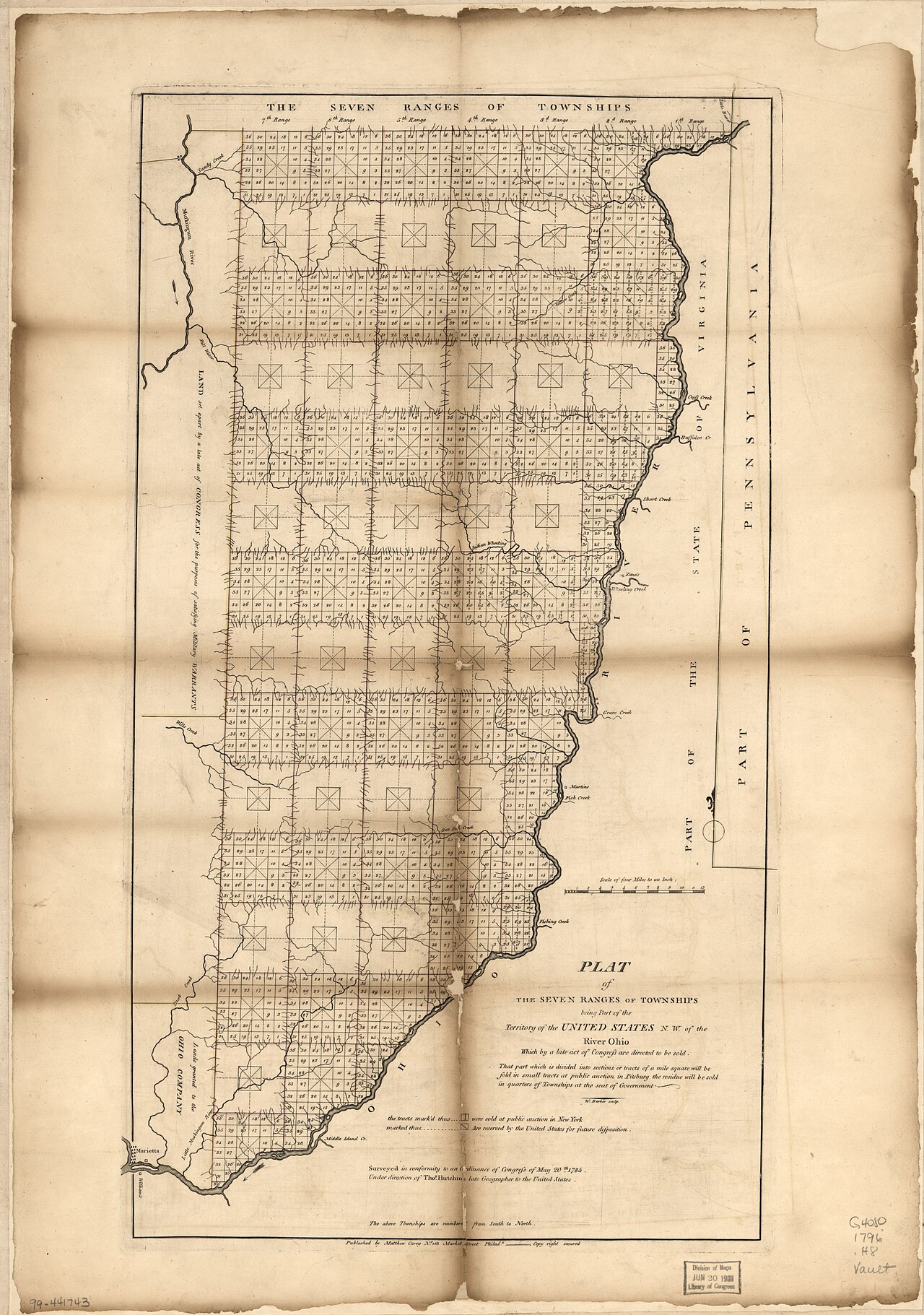
Thomas Hutchins, the Geographer of the United States, ran the first lines. The engraved plat of those first Seven Ranges, published in 1796, shows the grid that would later cover most of the land west of Pennsylvania.8
The Ohio Company of Associates
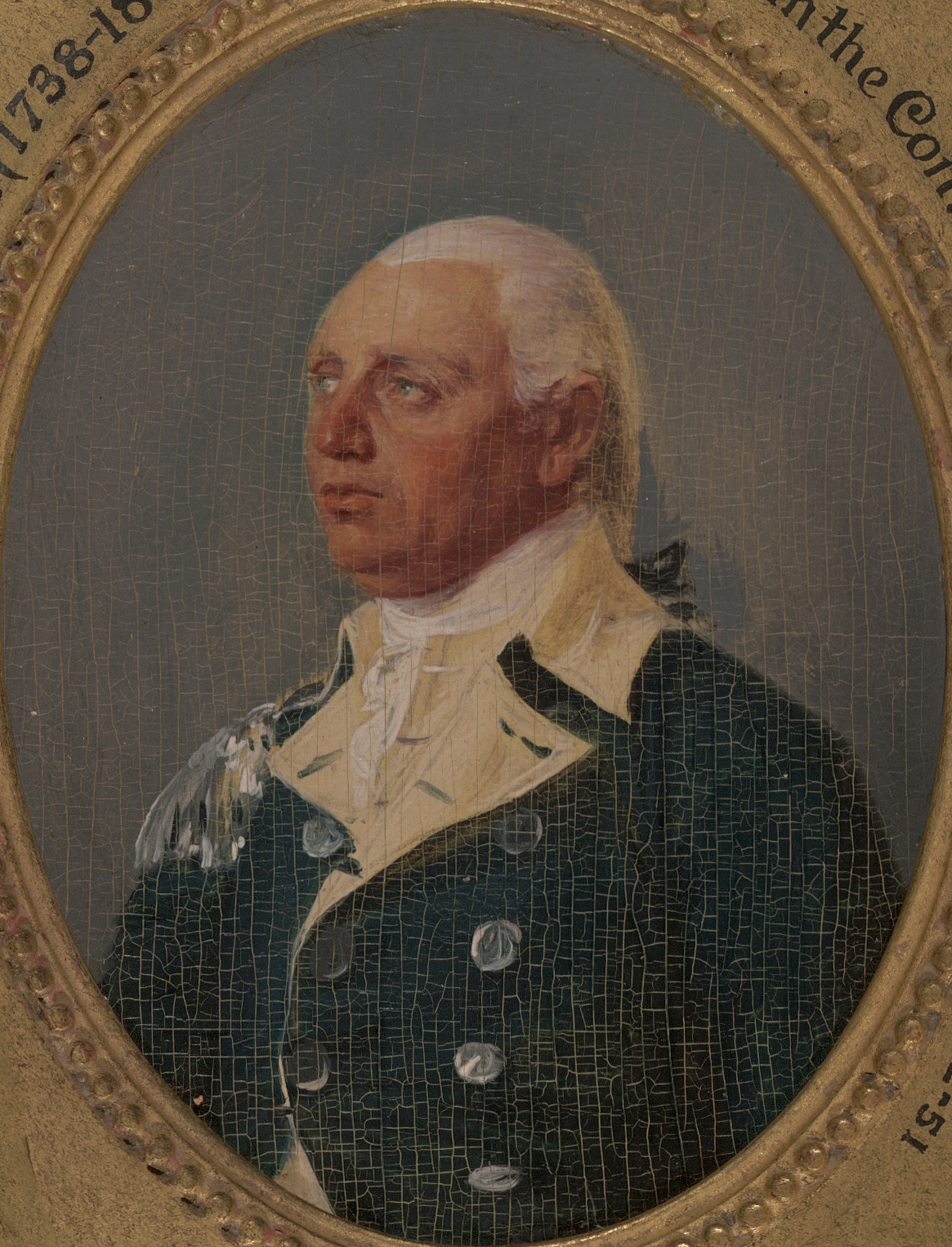
On March 1, 1786, delegates chosen by county meetings across Massachusetts met at the Bunch of Grapes Tavern in Boston. Rufus Putnam was chairman and Winthrop Sargent secretary. Two days later a committee that included the Reverend Manasseh Cutler reported Articles of Agreement for "The Ohio Company."9 The company's design was "to raise a fund in continental certificates for the sole purpose and to be appropriated to the entire use of purchasing lands in the western territory belonging to the United States." The fund was not to exceed one million dollars in certificates, and each share was "one thousand dollars, as aforesaid, and also ten dollars in gold or silver."9
Many members were veterans. Cutler and Sargent later told the Board of Treasury that their associates held "Certificates they received as Specie, at the risque of their lives and fortunes, in support of the Common cause."10 The company's offer to Congress was a straightforward swap: their paper for federal land, with an organized settlement thrown in. The company's first party of settlers arrived at Marietta on April 7, 1788.11

July 1787: the contract and the private speculation
Cutler went to New York in July 1787 to negotiate with Congress. His journal is the most candid source for how the deal was made, and it should be read as one participant's account. On July 19 he learned that Congress had passed terms he found unacceptable. On July 20 he told the committee he "could not contract on the terms proposed" and threatened to buy land from one of the states instead.13 That evening, he wrote, he "spent the evening (closeted) with Colonel Duer, and agreed to purchase more land, if terms can be obtained, for another Company, which will probably forward the negotiations."13
William Duer was Secretary to the Board of Treasury, the three-member body that ran federal finance and was to sign any land contract. The next day, July 21, Cutler offered to extend the purchase "to the tenth township from the Ohio, and to the Scioto inclusively, by which Congress would pay near four millions of the national debt."13
Cutler did not hide the horse-trading. He decided "it was good policy to give up Parsons," the company's own candidate for territorial governor, "and openly to appear solicitous that St. Clair might be appointed Governor." Arthur St. Clair was then President of Congress. Cutler reported that "our matters went on much better since St. Clair and his friends had been informed that we had given up Parsons."13 Then: "I immediately went to Sargent and Duer. We now entered into the true spirit of negotiations with great bodies; every machine in the city that it was possible to set to work we now put in motion."13 Only eight states were represented, "and unless seven of them are in favor no ordinance can pass." Cutler named William Few, William Bingham and "Kearney" as the principal opponents.13
What Congress actually voted
The Journals show the terms. A committee of Edward Carrington, Rufus King, Nathan Dane, James Madison and Egbert Benson reported, and Congress amended, a resolution "That the board of treasury be authorised and empowered to contract with any person or persons for a grant of a tract of land which shall be bounded by the Ohio from the Mouth of Sioto" east to the seventh range and north to the tenth township.14 The price was "not less than one dollar per acre," payable "in specie loan office certificates reduced to specie value or certificates of liquidated debts of the United States," with an allowance "for bad land and all incidental charges" that "shall not exceed in the whole one third of a dollar per acre."14 "Not less than 500,000 dollars of the purchase money" was due when the contract closed.14
The grant also carried the public reservations: lot 16 in each township for schools, "The lot N 29 in each township or fractional part of a township to be given perpetually for the purposes of religion," lots 8, 11 and 26 reserved to Congress, and up to two townships "for the purposes of an university."14 Veterans could pay up to one seventh in army bounty land rights.14
On July 26, Cutler and Sargent wrote to the Board of Treasury proposing payment terms: "half a million of dollars when the Contract is executed; another half million when the tract as described is surveyed," and the rest in six installments.10 They could offer no security "but that of the land itself, as is usual in great land purchases." The copy entered in the Journals is attested at the bottom: "Compared with the Original in the Office of the Board of Treasury (Signed) W. Duer Secy."10 The official who certified the buyers' letter was a partner in the buyers' side deal. Nobody on the record objected.
Congress referred the letter to the Board on July 27. That afternoon, Cutler wrote, he learned that an ordinance had passed "on the terms stated in our letter, without the least variation."13 His summary of the haul is blunt:
"By this Ordinance, we obtained the grant of near 5,000,000 of acres of land, amounting to three millions and a half of dollars, one million and a half of acres for the Ohio Company, and the remainder for a private speculation, in which many of the principal characters in America are concerned. Without connecting this speculation, similar terms and advantages could not have been obtained for the Ohio Company."13
Nathan Dane's letter of July 16, 1787
The outline Pierson was handed listed a letter from Nathan Dane to Rufus King of July 16, 1787. The letter exists. It was printed "from the original" in the first volume of The Life and Correspondence of Rufus King in 1894, and the Library of Congress lists it among the highlights of Letters of Delegates to Congress, volume 24.1516 Dane, a Massachusetts delegate, sat on the committee that produced the Northwest Ordinance, passed three days earlier on July 13.
Dane told King that Congress had been occupied with two things, "the government inclosed and the Ohio purchase; the former you will see is completed and the latter will probably be completed tomorrow."15 He described the committee's work on the government plan and then gave the reason for haste: "We found ourselves rather pressed. The Ohio company appeared to purchase a large tract of federal lands," which he put at "about six or seven millions of acres," "and we wanted to abolish the old system and get a better one for the government of the country, and we finally found it necessary to adopt the best system we could get."15
He claimed authorship and explained the slavery article: "When I drew the ordinance (which passed, a few words excepted, as I originally formed it) I had no idea the States would agree to the sixth article, prohibiting slavery, as only Massachusetts of the Eastern States was present, and therefore omitted it in the draft; but finding the House favorably disposed on this subject, after we had completed the other parts, I moved the article, which was agreed to without opposition."15 On the sale: "The magnitude of the purchase makes us very cautious about the terms of it and the security necessary to insure the performance of it."15
Dane expected the sale to close the next day; in fact the land terms were entered July 23 and the payment terms accepted July 27.14 And Dane's claim to sole authorship has been disputed since the nineteenth century, when Cutler's family and others argued for Cutler's influence; the editor of the St. Clair Papers concluded the ordinance had "many authors."17 What the letter does establish is the order of events from inside the room. The pending land sale pressed Congress to finish a frame of government, and the men drafting the government knew the buyers.
The Scioto speculation and Gallipolis
On October 27, 1787, Cutler and Sargent closed two contracts with the Board of Treasury. One, for the Ohio Company of Associates, was "an absolute purchase of 1,500,000 acres." The other, made by Cutler and Sargent "for themselves and associates," was an option on the remaining land west to the Scioto, estimated at three to three and a half million acres.18 On October 24 they had already "ceded and conveyed" half of that option to "William Duer and his associates." The ownership was split into thirty shares: thirteen to Duer, thirteen to Cutler and Sargent, and four "to be disposed of in Europe for joint account."18
E. C. Dawes, who reconstructed the Scioto history in 1888 from contracts held by the Historical and Philosophical Society of Ohio, wrote that "No formal organization of the Scioto Company in America was ever made."18 The plan was to sell the right of pre-emption "either in Holland or France, where large amounts of the public debt were held," to European holders of American securities "now begging purchasers at four shillings to the pound."18 Duer also lent the Ohio Company money to make its first payment.18
Joel Barlow sailed for France as agent on May 25, 1788. With William Playfair he issued a prospectus and in November 1789 sold rights to 3,000,000 acres to a Paris firm, the Company of the Scioto, at six livres per acre.18 Barlow's powers covered only "the right of pre-emption," yet the Paris company resold land and issued deeds before it had paid for any.18 The first French emigrants reached Alexandria, Virginia, about May 1, 1790, where residents "informed them that their deeds were worthless."18 The first boatload reached Gallipolis about October 20, 1790, on land that the 1792 settlement later placed inside the Ohio Company's tract.18
The money never reached the Treasury. In April 1792 a financial panic hit New York. "Colonel Duer failed, and, after the barbarous fashion of the times, was imprisoned for debt," Dawes wrote.18 On April 21, 1792, Congress confirmed to the Ohio Company title to 750,000 acres, plus 214,285 acres payable in army bounty rights and a 100,000-acre donation tract for settlers.1918 The Scioto option was never paid for, so the land west of the Ohio Company tract stayed in federal hands. On March 3, 1795, Congress passed "An act to authorize a grant of lands to the French inhabitants of Galliopolis," and the settlers received 24,000 acres in what became Scioto County, Ohio; the Ohio Company sold them their own town site, about 900 acres, at a dollar and a quarter an acre.2018
Duer's biography, written by the Cutler editors, states the overlap of roles without embarrassment. He had been Secretary to the Board of Treasury, then Hamilton's Assistant Secretary of the Treasury, an office "created expressly for him," was "largely interested in the establishment of the United States bank," held the army supply contract for the Northwest Territory from 1790 to 1792, and "failed in the panic of 1792, and lost all of his property."21 He died in 1799.
Hamilton's system: the Report on Public Credit, January 1790
The Constitution gave the new Congress the taxing power the Confederation lacked. Its Secretary of the Treasury, Alexander Hamilton, sent the House his "Report Relative to a Provision for the Support of Public Credit," dated January 9, 1790 and communicated January 14.22 The report put the foreign debt at $10,070,307 in principal and $1,640,071.62 in arrears of interest, "Making together, dollars 11,710,378 62." The domestic debt, principal and interest, came to "dollars 40,414,085 94."22 (The report's summary list gives the domestic debt as 42,414,085.94. The difference is exactly the $2,000,000 the report separately estimates for unliquidated domestic debt, and the summary's grand total of $54,124,464.56 uses the larger figure.) The debts of the states, Hamilton estimated, "may be safely stated at 25 millions of dollars, principal and interest."22
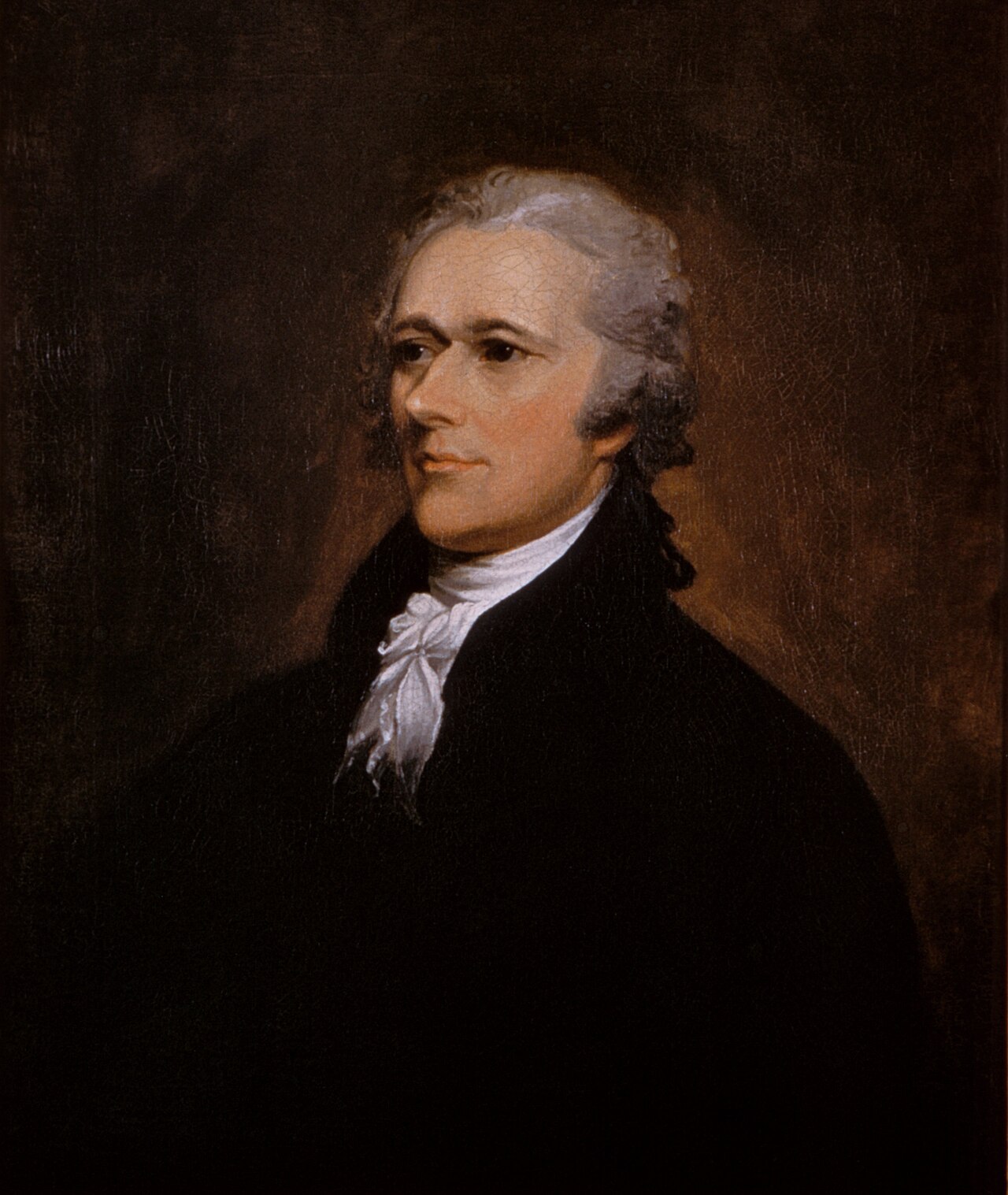

His moral case for paying was short: "It was the price of liberty."22 His economic case was that a funded debt could circulate as capital. "Persuaded as the Secretary is, that the proper funding of the present debt, will render it a national blessing," he warned against the opposite claim that "public debts are public benefits."22
Much of the domestic debt had changed hands, often from soldiers and farmers to buyers paying a fraction of face value. Hamilton refused to pay the original holders more than the current ones. The purchaser, he wrote, "paid what the commodity was worth in the market, and took the risks of reimbursement upon himself."22 Madison answered on February 11, 1790, with a proposal that present holders get "the highest price which has prevailed in the market" and that original holders receive the rest. "This will not do perfect justice; but it will do more real justice," he said.24 The motion lost on February 22, 1790, by 36 to 13.25
Hamilton also proposed assumption: the federal government would take over the state war debts, because "The objects for which both descriptions of the debt were contracted, are in the main the same."22 The First Federal Congress Project summarizes the split: "Northern congressmen supported the proposal as strongly as southerners opposed it."25
The report tied the debt to land and to a sinking fund as well. Subscribers to the new loan could choose to "receive the other third in lands in the Western Territory, at the rate of twenty cents per acre," and Hamilton proposed that "the nett product of the post-office, to a sum not exceeding one million of dollars," be put in trust to buy down the debt.22 The national domain was still being treated as a debt-service asset.
The bargain of 1790: funding, assumption and the residence
Assumption stalled in the House in the spring of 1790. Jefferson later wrote an account, which the editors of his papers date "perhaps" to 1792, of how it was revived.26 Hamilton stopped him in the street and said that if he "had not credit enough to carry such a measure as that, he could be of no use, and was determined to resign."26 Jefferson invited Hamilton and Madison to dinner. The result, as he told it, was that assumption was "finally carried by the change of White's and Lee's votes," two Virginia congressmen, while "the removal to Patowmac could not be carried unless Pennsylvania could be engaged in it," which Hamilton managed "on agreeing to an intermediate residence at Philadelphia."26 It is one participant's later account. The statutes followed in the order Jefferson described.
The Residence Act, approved July 16, 1790, accepted "a district of territory, not exceeding ten miles square, to be located as hereafter directed on the river Potomac" as "the permanent seat of the government of the United States."27 The Funding Act, approved August 4, 1790, opened with the recital that "justice and the support of public credit require" provision for the foreign debt and "funding their domestic debt upon equitable and satisfactory terms."28 It authorized the President to borrow "not exceeding in the whole twelve million of dollars" to pay foreign arrears and, if possible, the whole foreign debt.28 And it assumed state debts up to $21,500,000, with a cap for each state.28
The Bank of the United States, 1791
The bank completed the system. Its charter, approved February 25, 1791, declared that a national bank "will be very conducive to the successful conducting of the national finances; will tend to give facility to the obtaining of loans, for the use of the government, in sudden emergencies; and will be productive of considerable advantages to trade and industry in general."29 Its capital stock was not to exceed "ten millions of dollars, divided into twenty-five thousand shares, each share being four hundred dollars."29
The payment terms tied the bank to the debt. Private subscriptions were "payable one fourth in gold and silver, and three fourths in that part of the public debt" created under the Funding Act.29 Holders of the new federal securities could convert them into bank stock. The United States itself could subscribe "to an amount not exceeding two millions of dollars," paid out of money borrowed under the funding laws.29 The corporation, "The President, Directors and Company, of the Bank of the United States," was chartered "until the fourth day of March, one thousand eight hundred and eleven."29
Lesson 5 covered the constitutional fight inside the cabinet. Jefferson warned against "a boundless field of power." Hamilton read "necessary" to mean "needful, requisite, incidental, useful, or conducive to."3031 The Bank Act shows what the broad reading was used for: a private corporation, partly owned by the government, capitalized with government debt, holding government deposits. Nine months later, on December 5, 1791, Hamilton sent Congress his Report on Manufactures, answering objectors who opposed encouraging industry by "heavy duties, prohibitions, bounties, or by other forced expedients."32 Lesson 16 returns to that argument in its modern form.
Who held the debt, and what about European creditors?
The outline Pierson was handed implied that European creditors stood behind the national domain and the institutions built on it. The record is much narrower.
Foreign governments were creditors. France lent "over two million dollars," most of it negotiated by Benjamin Franklin; Spain also lent; and John Adams "secured a loan from Dutch bankers in 1782."2 Under the Confederation the United States kept paying the Dutch and stopped paying France, because "Amsterdam remained the most likely source of future loans," which it obtained in 1787 and 1788.2 After 1789 Hamilton refinanced through Dutch capital markets. In 1795 the French government debt was settled with the help of the banker James Swan, after which "The United States no longer owed money to foreign governments, although it continued to owe money to private investors both in the United States and in Europe."2
Private Europeans held American securities, and the Scioto plan was built to sell land to them "in Holland or France, where large amounts of the public debt were held."18 That fact cuts against the thesis more than for it. In the one documented case where European money met the national domain, Europeans were the buyers, they were sold defective titles by American promoters, and Congress ended up granting land to the French victims. None of the sources fetched for this lesson shows a European creditor controlling federal land policy, the Board of Treasury or the Ohio territorial government.
What the sources do show is a domestic moneyed interest tied closely to the new government. Madison had listed "a moneyed interest" among the factions in Federalist 10.33 By 1791 the people who held federal securities could swap them for federal land, use them to buy bank stock and collect interest from federal tariff revenue, while some of the officials designing those options held securities or land rights themselves. The sources fetched here do not supply a census of who held how much of the debt. Anyone quoting exact shares needs a specialized study behind the number.
Through Pierson's Framework
Pierson's question about any institution is whether it is defended for what it does or for what it is. The land and finance institutions of 1784 to 1791 show both, sometimes in the same people.
Start with function. The Land Ordinance did real public work: it created a uniform survey, reserved a section of every township for schools and opened land to settlers who had fought the war. The funding system restored the nation's credit to the point where, by the State Department historians' account, it could borrow at low interest for the Louisiana Purchase in 1803.2 Judged by performance, these were legitimate institutions, and ordered liberty in Pierson's sense includes supporting legitimate government, which means saying so when it earns it.
Then look at the machinery. In July 1787 the Secretary to the Board of Treasury negotiated a private share of the land he was officially helping to sell, and attested the buyers' letter to his own Board.10 The company traded its support for a governor in exchange for votes on its contract.13 Cutler wrote that the Ohio Company's terms could not have been obtained "Without connecting this speculation."13 None of this was secret from the participants, and none of it broke a statute then in force. Pierson describes the danger: "somewhere along the line, the mission is replaced by the machinery, and survival becomes the goal."34 In 1787 the mission was settlement and debt reduction. The machinery was a set of private interests that had to be satisfied before the public business could move.
The acacia image fits the funding system better than it fits the land companies. Pierson writes that the acacia's nectar makes its ant defenders unable to digest other sugars, so that "the tree makes itself the only viable food source," and that "In human systems, institutional defenders may appear voluntary but are, in reality, functionally dependent."34 A holder of funded federal securities in 1791 had a direct financial stake in the federal government's survival and solvency. That stake was the point of the design; it gave the new government a constituency. It also created defenders whose loyalty did not depend on whether the government was governing well.
The losses also show where accountability ran out. When the Scioto venture failed, the people who bore the loss were French emigrants with paper deeds and Ohio Company shareholders whose contract had to be renegotiated. Duer went to debtors' prison; the Board of Treasury, as an institution, faced no reckoning. Pierson's appendix warns of institutions that "insulate officials through legal immunity" and "entrench policies behind procedure."35 What survived the collapse was the practice the 1787 sale had modeled: public assets sold through private intermediaries who were also public officers.
Ordered liberty asks for both accountability and support. Pierson's standard is mutual restraint: "governments and institutions must operate under law, truth, and justice."36 Measured that way, Hamilton's refusal to discriminate between holders was lawful and arguably just to contracts, and Madison's alternative was arguably just to soldiers. Congress chose contracts. Lesson 8 follows the Second Bank of the United States into its 1832 fight with Andrew Jackson.
Hard Questions and Answers
Strip away the footnotes and this is insiders looting the public. Why call any of it legitimate?
Because the looting and the public work ran through the same contracts, and the record keeps them apart. The Ohio Company contracted for 1.5 million acres, paid $500,000 in securities, settled Marietta in 1788, and in 1792 received title to 750,000 acres plus bounty and donation tracts.1819 Congress got debt retired and a settled frontier. The Scioto side deal paid the Treasury nothing and defrauded French buyers.18 Call the whole period corruption and that difference vanishes. Pierson's test of function does not let it vanish.
Nobody in 1787 called Duer's role improper. Isn't judging him by modern ethics rules plain anachronism?
On statute, yes. There was no federal conflict-of-interest statute in 1787, and the sources do not show anyone in Congress objecting to Duer's dual role at the time. Cutler's editors praised him.21 On principle, no. Within months the Constitution's chief architect put the problem in print. Federalist 10 says "No man is allowed to be a judge in his own cause, because his interest would certainly bias his judgment, and, not improbably, corrupt his integrity."33 Duer was a public official with a private stake in the transaction he was certifying. Later law would call that a conflict. Madison already did.
Dane admits the buyers had Congress in a hurry. Doesn't that prove the Northwest Ordinance was written for the Ohio Company?
It proves the buyers set the clock. Dane wrote "We found ourselves rather pressed" because the company "appeared to purchase a large tract."15 It does not prove the company dictated the text. Dane claimed he drew the ordinance himself, and several of its central provisions, including the ban on slavery, the religious liberty clause and the compact articles, are matters of principle with no obvious payoff for land buyers.15 A buyer of millions of acres needed a government to exist. The record shows Congress supplied one in a hurry, and the record stops there.
Hamilton paid full value to speculators who bought soldiers' paper at a fraction of face. Wasn't funding a transfer from veterans to financiers?
In effect, it rewarded whoever held the paper in 1790, and many holders had bought cheap. Madison made exactly that case, and the House rejected it 36 to 13.2425 Hamilton's answer was that a buyer "took the risks of reimbursement upon himself," and that paying current holders less than face value would cheapen every future federal promise.22 Both arguments are serious. Congress chose the government's credit over rough justice for the original soldiers, and the institutions built on that choice lasted. Hamilton's admirers should admit that lasting and fair are different measures.
Wasn't the national domain a permanent federal estate from day one, just as the "Government #2" thesis claims?
The thesis has this period backward. The 1784 deed called the land a "common fund" to be "disposed of," the 1785 ordinance was a plan for sale, and the 1787 contracts sold millions of acres to private buyers.3514 The founders' national domain was meant to pass into private hands. Lesson 14 shows when Congress changed that policy in law, with the retention declaration of the Federal Land Policy and Management Act in 1976, almost two centuries later.
Learn more
- Journals of the Continental Congress, vol. 33 (1787): the Ohio and Scioto land resolutions and Board of Treasury correspondence.
- Journals of the Continental Congress, vol. 28 (1785): the Land Ordinance of May 20, 1785.
- Life and Correspondence of Rufus King, vol. 1: Nathan Dane's July 16, 1787 letter, pages 289 to 290.
- Life, Journals and Correspondence of Rev. Manasseh Cutler, vol. 1: Cutler's July 1787 journal and E. C. Dawes's history of the Scioto purchase.
- Hamilton, Report on Public Credit (Founders Online): the full January 1790 report with editorial notes.
- U.S. Statutes at Large, vol. 1 (Library of Congress): the Residence, Funding and Bank Acts.
- Plat of the Seven Ranges (Library of Congress): the first federal survey grid.
- U.S. Debt and Foreign Loans, 1775 to 1795 (Office of the Historian): who the foreign creditors were.
- Module 51: Mercantilism: the state and capital partnership this lesson's institutions resemble.
Notes
- Articles of Confederation, March 1, 1781 (Article VIII on requisitions; Article IX on the powers of Congress). Avalon Project. Read it online. ↩
- U.S. Department of State, Office of the Historian, "U.S. Debt and Foreign Loans, 1775-1795," Milestones in the History of U.S. Foreign Relations (retired series). Read it online. ↩
- Journals of the Continental Congress, vol. 26 (1784), ed. Gaillard Hunt (Washington: Government Printing Office, 1928), entry for Monday, March 1, 1784, pp. 112 to 117, including the Virginia act of cession and the deed signed by Thomas Jefferson, Samuel Hardy, Arthur Lee and James Monroe. Text via Internet Archive scan of the GPO edition. Read it online. ↩
- Journals of the Continental Congress, vol. 26, entry for March 1, 1784, p. 118 and following: report of the committee of Jefferson, Chase and Howell on a plan for temporary government of the western territory. Read it online. ↩
- "An Ordinance for ascertaining the mode of disposing of Lands in the Western Territory," passed May 20, 1785, Journals of the Continental Congress, vol. 28, ed. John C. Fitzpatrick (Washington: Government Printing Office, 1933), pp. 375 to 381. Internet Archive scan. Read it online. ↩
- Journals of the Continental Congress, vol. 28, entry for April 26, 1785, pp. 298 to 301 (earlier draft with townships of seven miles square and sections numbered 1 to 49). Read it online. ↩
- Thomas Hutchins, Plat of the seven ranges of townships, 1796, Library of Congress item 99441743; Wikimedia Commons file record (public domain). Read it online. ↩
- Thomas Hutchins, "Plat of the seven ranges of townships being part of the territory of the United States, N.W. of the River Ohio" (Philadelphia: Mathew Carey, 1796). Library of Congress Geography and Map Division, item 99441743. Read it online. ↩
- Articles of Agreement of the Ohio Company, Boston, March 3, 1786, and account of the March 1, 1786 meeting at the Bunch of Grapes Tavern, in William Parker Cutler and Julia Perkins Cutler, Life, Journals and Correspondence of Rev. Manasseh Cutler, LL.D., vol. 1 (Cincinnati: Robert Clarke and Co., 1888), pp. 180 to 182. Internet Archive. Read it online. ↩
- Journals of the Continental Congress, vol. 33, proceedings entered for July 26 and 27, 1787, pp. 427 to 429 (letter of Manasseh Cutler and Winthrop Sargent to the Board of Treasury, attested by William Duer as Secretary, and the order referring it to the Board). Read it online. ↩
- Editors' note on Ebenezer Sproat, who "came to Marietta with the first party, who arrived April 7, 1788," in Life, Journals and Correspondence of Rev. Manasseh Cutler, vol. 1. Internet Archive. Read it online. ↩
- John Trumbull, Rufus Putnam, about 1790, Yale University Art Gallery. Wikimedia Commons file record (public domain). Read it online. ↩
- Manasseh Cutler, journal entries for July 19 to 27, 1787, in Life, Journals and Correspondence of Rev. Manasseh Cutler, vol. 1, pp. 294 to 305. Internet Archive. Read it online. ↩
- Journals of the Continental Congress, vol. 33, ed. Roscoe R. Hill (Washington: Government Printing Office, 1936), report of the committee of Carrington, King, Dane, Madison and Benson, amended, entered for July 23, 1787, pp. 399 to 401. Internet Archive. Read it online. ↩
- Nathan Dane to Rufus King, New York, July 16, 1787, printed "from the original" in Charles R. King, ed., The Life and Correspondence of Rufus King, vol. 1 (New York: G. P. Putnam's Sons, 1894), pp. 289 to 290. Internet Archive. The letter is also reprinted in Paul H. Smith, ed., Letters of Delegates to Congress, 1774-1789, vol. 24, pp. 357 to 359 (Washington: Library of Congress, 1996), from the recipient's copy at the Wisconsin Historical Society (RC, WHi: Miscellaneous Manuscripts). The text here is quoted from the 1894 King edition. The modern edition transcribes the manuscript more literally and differs in punctuation and some wording: "We found ourselves rather pressed, the Ohio Company appeared to purchase a large tract of the federal lands, about 6 or 7 million of acres"; "When I drew the ordinance which passed (in a few words excepted) as I originally formed it"; and "the security necessary to ensure the performance of them." Read it online (King, 1894). Read it online (Letters of Delegates, vol. 24, Library of Congress). ↩
- Library of Congress, "Northwest Ordinance: Primary Documents in American History," Digital Collections page, listing Letters of Delegates to Congress highlights including "Nathan Dane to Rufus King, July 16. 1787." Read it online. ↩
- William Henry Smith, ed., The St. Clair Papers, vol. 1 (Cincinnati: Robert Clarke and Co., 1882), discussion of the authorship of the Ordinance of 1787, ending p. 135 ("many authors"). Internet Archive. Read it online. ↩
- E. C. Dawes, "The Scioto Purchase," in Life, Journals and Correspondence of Rev. Manasseh Cutler, vol. 1, pp. 494 to 524 (drawing on contracts deposited with the Historical and Philosophical Society of Ohio). Internet Archive. Read it online. ↩
- An act authorizing the grant and conveyance of certain lands to the Ohio Company of Associates, approved April 21, 1792, 1 Stat. 257. U.S. Statutes at Large, vol. 1, Library of Congress. Read it online. ↩
- An act to authorize a grant of lands to the French inhabitants of Galliopolis, and for other purposes therein mentioned, approved March 3, 1795, 1 Stat. 442 (title and page from the Statutes at Large index). U.S. Statutes at Large, vol. 1, Library of Congress. Read it online. ↩
- Editors' note on William Duer, in Life, Journals and Correspondence of Rev. Manasseh Cutler, vol. 1, pp. 240 to 241. Read it online. ↩
- Alexander Hamilton, "Report Relative to a Provision for the Support of Public Credit," Treasury Department, January 9, 1790, communicated January 14, 1790. Founders Online, National Archives. Read it online. ↩
- John Trumbull, Alexander Hamilton, oil on canvas, White House collection; the Wikimedia Commons file record dates it 1805, though the file name says 1806 (public domain). Read it online. ↩
- James Madison, "Discrimination between Present and Original Holders of the Public Debt," House of Representatives, [February 11] 1790. Founders Online, National Archives. Read it online. ↩
- First Federal Congress Project, George Washington University, "Birth of the Nation: The First Federal Congress, 1789-1791," exhibit page on funding and assumption (Madison's motion lost February 22, 1790, by 36 to 13). Read it online. ↩
- "Jefferson's Account of the Bargain on the Assumption and Residence Bills," [1792?], editorial document X in The Papers of Thomas Jefferson, vol. 17. Founders Online, National Archives. Read it online. ↩
- An Act for establishing the temporary and permanent seat of the Government of the United States, ch. 28, 1 Stat. 130, approved July 16, 1790. U.S. Statutes at Large, vol. 1, Library of Congress. Read it online. ↩
- An Act making provision for the [payment of the] Debt of the United States, ch. 34, 1 Stat. 138, approved August 4, 1790 (section 2: borrowing "not exceeding in the whole twelve million of dollars"; section 13: state certificates received up to $21,500,000 with a schedule by state). U.S. Statutes at Large, vol. 1, Library of Congress. Read it online. ↩
- An Act to incorporate the subscribers to the Bank of the United States, ch. 10, 1 Stat. 191, approved February 25, 1791 (capital not over ten million dollars in 25,000 shares of $400; one fourth payable in gold and silver and three fourths in public debt; charter to March 4, 1811; section 11 authorizing a federal subscription not exceeding two million dollars). U.S. Statutes at Large, vol. 1, Library of Congress. Read it online. ↩
- Thomas Jefferson, "Opinion on the Constitutionality of a National Bank," 1791. Avalon Project. Read it online. ↩
- Alexander Hamilton, "Opinion as to the Constitutionality of the Bank of the United States," 1791. Avalon Project. Read it online. ↩
- Alexander Hamilton, Final Version of the Report on the Subject of Manufactures, communicated to the House of Representatives December 5, 1791. Founders Online, National Archives. Read it online. ↩
- James Madison, The Federalist No. 10, New York Packet, November 23, 1787. Avalon Project. Read it online. ↩
- Jeff A. Pierson, "The Acacia Illusion: How Institutionalism Mimics Nature's Most Subtle Manipulation," in The Ordered Liberty Papers (2025). Read it online. ↩
- Jeff A. Pierson, "The Anti-Federalist Warning: Institutional Power and the Fragility of Liberty," appendix to Ordered Liberty Reclaimed: A Foundation for Liberty. Read it online. ↩
- Jeff A. Pierson, Ordered Liberty Reclaimed: A Foundation for Liberty (body text). Read it online. ↩

Terms in this lesson
- Cession
- A state's formal surrender of its claim to western land to the United States; Virginia's deed for land northwest of the Ohio was executed in Congress on March 1, 1784.
- National domain
- The western land held by the United States as a common fund after the state cessions, to be surveyed and sold.
- Township and section
- Units of the 1785 survey grid: a township six miles square, divided into thirty-six lots of one mile square, or 640 acres.
- Loan office certificate
- A Revolutionary War security issued by the Continental loan offices; Congress accepted such paper at face value in payment for western land.
- Ohio Company of Associates
- A Massachusetts association of veterans and investors formed in 1786 that contracted with the Board of Treasury on October 27, 1787 for 1.5 million acres and founded Marietta in 1788.
- Scioto Company
- The informal partnership of William Duer, Manasseh Cutler, Winthrop Sargent and others that held an option on several million acres and resold rights in France; it was never formally organized in America.
- Funding and assumption
- Hamilton's plan, enacted August 4, 1790, to convert old federal debt into new securities and to assume up to $21.5 million of state war debts.
- Discrimination
- Madison's 1790 proposal to split payment on the public debt between original holders and later purchasers; the House rejected it 36 to 13 on February 22, 1790.
Sources
- Journals of the Continental Congress, vol. 33 (1787) checked 2026-10
- Land Ordinance of May 20, 1785, Journals of the Continental Congress, vol. 28 checked 2026-10
- Life and Correspondence of Rufus King, vol. 1 (Dane to King, July 16, 1787) checked 2026-10
- Life, Journals and Correspondence of Rev. Manasseh Cutler, vol. 1 checked 2026-10
- Hamilton, Report on Public Credit, January 9, 1790 (Founders Online) checked 2026-10
- U.S. Statutes at Large, vol. 1 (Library of Congress) checked 2026-10
- U.S. Debt and Foreign Loans, 1775-1795 (Office of the Historian) checked 2026-10
- Jefferson's Account of the Bargain on the Assumption and Residence Bills (Founders Online) checked 2026-10