Lesson 2 of 19 · about 45 minutes
Institutionalism in the Record: Cases, Costs and the Limits of the Idea
You'll be able to
- Describe what official records show about eleven cases of institutional self-defense across churches, science and medicine, government agencies, the military, the press and business
- Match each case to the mechanisms from lesson 1, such as goal displacement, capture, groupthink and normalization of deviance, using the investigators' own findings
- Read the Pew trust series and Gallup confidence data accurately, including what they cannot show
- State the strongest limits on the idea of institutionalism, from Chesterton, Burke and Hayek to the risk of an unfalsifiable insult
- Explain from the SIGIR record why tearing down working institutions quickly is a failure of its own, and why Pierson's ordered liberty keeps both accountability and support for legitimate government
Start here: the short version
By 1943 penicillin was, in the CDC's own words, the treatment of choice for syphilis. The men in the Public Health Service study at Tuskegee were not offered it. The study ran until 1972 and stopped only after an Associated Press story put it in front of the country. Lesson 1 defined institutionalism as the habit of defending an institution's survival, authority and reputation as ends in themselves, apart from whether it still does its job. Tuskegee is what that habit looks like when the job is medicine and the cost is counted in human lives. Here the definition meets the record: eleven documented cases, from the sale of indulgences in 1517 to the Southern Baptist Convention's 2022 abuse investigation and the Boeing 737 MAX prosecution that ended in 2026, told from the institutions' own records, official investigations, and court and congressional documents. Each case ends with the mechanisms from lesson 1 the evidence shows at work. A section on costs follows, with current trust data from Pew and Gallup. The last part gives the idea's limits full weight: Chesterton's fence, Burke, the knowledge institutions carry, the danger of turning "institutionalism" into an all-purpose insult, and the opposite error of tearing down working institutions in a hurry, documented by the U.S. government's own review of the 2003 orders that dissolved the Iraqi army.
Challenge
Readers who trust institutions tend to carry one sentence in with them: the system corrects itself. The record here says it does, from outside and late. Tuskegee ended after a wire story, and the Columbia board found the causes of Challenger still unfixed seventeen years on. Readers who distrust institutions carry a different sentence: the institutions are the problem. Yet every failure in this lesson was exposed by another institution, whether a Senate committee, an inspector general, a state attorney general or a vote of church messengers. And when the United States purged Iraq's ministries and dissolved its army in May 2003, its own inspector general found those decisions made reconstruction considerably harder. Neither sentence survives the documents intact.
The mechanisms in lesson 1 came from scholars: Merton on rules that become ends in themselves, Selznick on institutions "infused with value," Michels on oligarchy, Stigler on capture, Hirschman on loyalty that silences voice, Janis on groupthink, Vaughan on the normalization of deviance, Jost and Banaji on system justification.1 A mechanism on paper proves nothing. The test is whether the documents that institutions and their investigators left behind show those mechanisms operating, and how often the people inside could see what was happening and chose the institution anyway.
The cases span two churches, a federal medical study, a regulatory commission, a police agency, the Defense Department, a space agency, a veterans' hospital system, a prize board and an aircraft maker with its regulator. Most sources are the institutions' own later admissions or the reports of bodies with power to compel documents. Where the course relied on a news account of a report it could not reach, the notes say so.
Pierson's claim, in his own words, is that institutionalism shows up "In churches, universities, bureaucracies, and unions alike."2 The record supports the breadth of that claim. It also shows something his essay does not stress: in nearly every case the failure was found and named by another institution, often a part of the same government or the same church.
Case 1: The sale of indulgences and the Ninety-Five Theses, 1517 to 1563
The Latin disputation that Martin Luther dated October 31, 1517 was an academic challenge on a narrow question, the power and use of indulgences.3 An indulgence was a grant remitting penalties attached to sin, and Luther's fifth thesis already set a limit on it: "The pope does not intend to remit, and cannot remit any penalties other than those which he has imposed either by his own authority or by that of the Canons." By 1517 indulgences were being preached for money, and Luther's own text ties that money to the rebuilding of St. Peter's in Rome.
His complaints were specific. Thesis 27: "They preach man who say that so soon as the penny jingles into the money-box, the soul flies out [of purgatory]." Thesis 28 answers it: "It is certain that when the penny jingles into the money-box, gain and avarice can be increased, but the result of the intercession of the Church is in the power of God alone." Thesis 50 puts the institution's building program against its people: "Christians are to be taught that if the pope knew the exactions of the pardon-preachers, he would rather that St. Peter's church should go to ashes, than that it should be built up with the skin, flesh and bones of his sheep." Thesis 86 voices a question Luther attributes to laymen: "Why does not the pope, whose wealth is to-day greater than the riches of the richest, build just this one church of St. Peter with his own money, rather than with the money of poor believers?"3
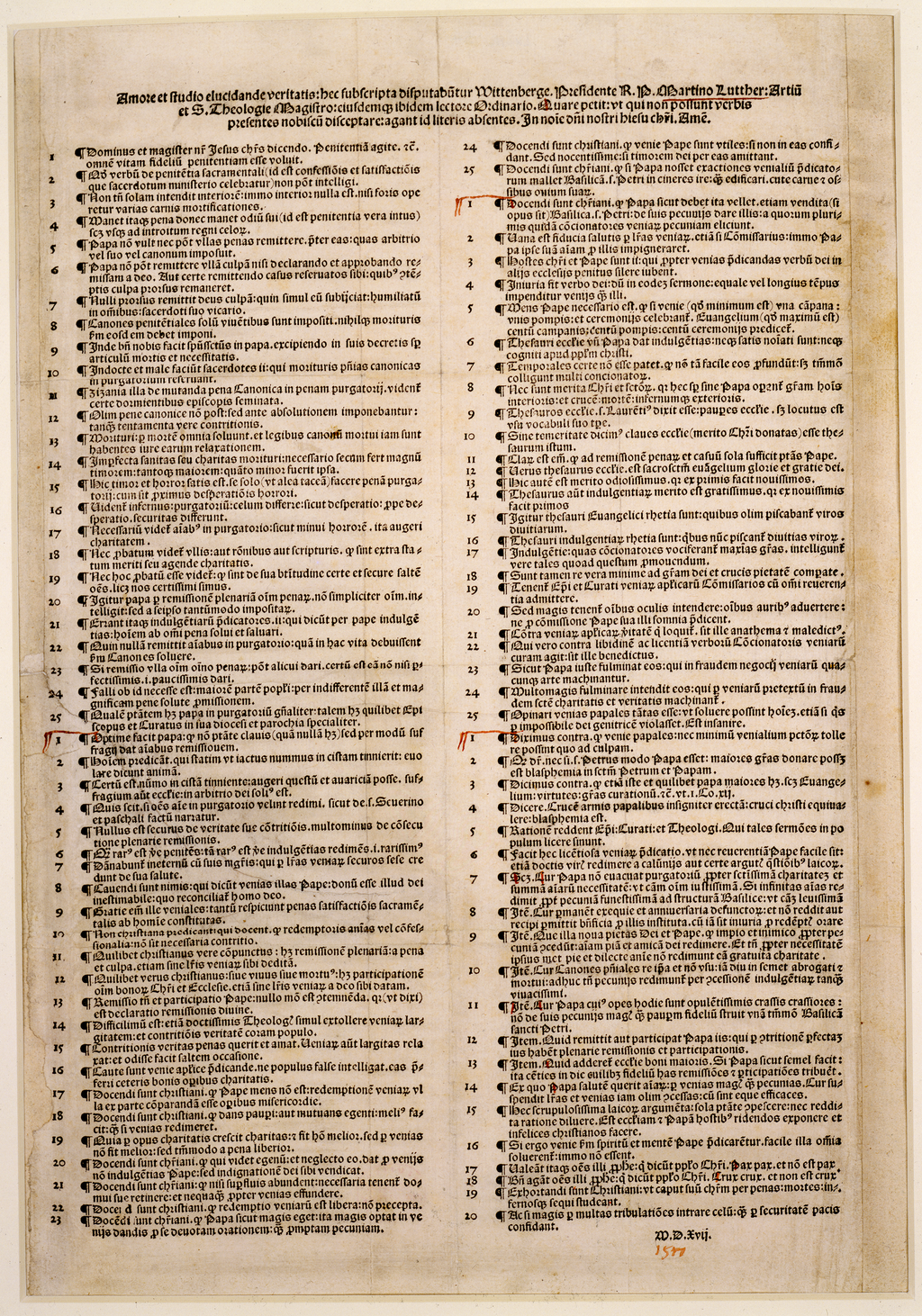

The dispute widened into the split of Western Christianity. The institution's own later act is the best measure of what it conceded. On December 4, 1563, in its twenty-fifth and final session, the Council of Trent issued a "Decree Concerning Indulgences." It kept the doctrine and condemned "with anathema those who either assert, that they are useless; or who deny that there is in the Church the power of granting them." In the same decree it admitted "the abuses which have crept therein" and ordered "that all evil gains for the obtaining thereof,--whence a most prolific cause of abuses amongst the Christian people has been derived,--be wholly abolished."4
Forty-six years separate the theses from the decree that abolished the money-raising Luther attacked. In between, the church defended the practice as part of its authority, and by the time the reform came, a large part of Western Christianity had left.
Mechanisms at work
Goal displacement is the plainest reading: a spiritual practice became a revenue instrument, and defending the revenue was folded into defending the doctrine. Infusion with value explains why a fiscal abuse could not be discussed as a fiscal abuse. Once the practice carried the authority of the papacy, criticism of the preachers was received as criticism of the church itself. The Trent decree is also evidence of the other side: the institution did reform, on the substance Luther raised, though only after the cost had been paid.1
Case 2: Galileo, 1633, and the papal address of 1992
On June 22, 1633, Galileo Galilei, "aged seventy years," knelt before the cardinals of the Holy Office in Rome and read an abjuration.5 The sentence against him declared him "vehemently suspected of heresy, namely, of having believed and held the doctrine ... that the Sun is the center of the world and does not move from east to west and that the Earth moves and is not the center of the world." It ordered "that the book of the 'Dialogues of Galileo Galilei' be prohibited by public edict," and it condemned him "to the formal prison of this Holy office during our pleasure."6 His abjuration repeated the formula of the sentence: "I abjure, curse, and detest the aforesaid errors and heresies."5
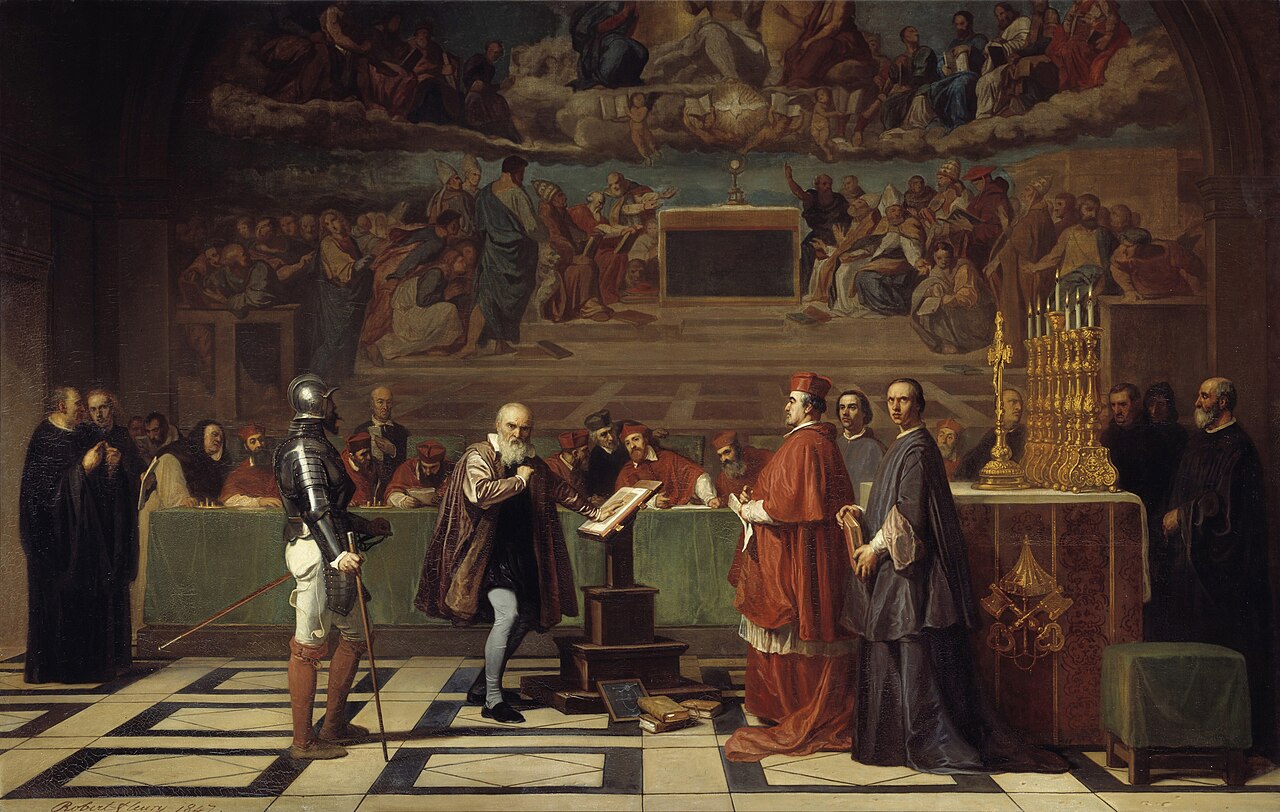

The church's own reckoning took centuries. On October 31, 1992, Pope John Paul II addressed the Pontifical Academy of Sciences at the close of a study commission he had formed on July 3, 1981. He recalled his 1979 hope that "theologians, scholars and historians" would study the case more deeply and, "in frank recognition of wrongs from whatever side they come," dispel the mistrust between science and faith. His address stated: "The majority of theologians did not recognize the formal distinction between Sacred Scripture and its interpretation, and this led them unduly to transpose into the realm of the doctrine of the faith a question which in fact pertained to scientific investigation." He called the long aftermath "a tragic mutual incomprehension," and he said that since the Enlightenment the case had been "a sort of 'myth', in which the image fabricated out of the events was quite far removed from reality."7
The 1992 address is an admission with defenses built in. It also faults Galileo for refusing to present the Copernican system as a hypothesis until proof was in, and it repeats Cardinal Paul Poupard's point that the sentence of 1633 "was not irreformable" and that the debate "was closed in 1820 with the imprimatur given to the work of Canon Settele."7 The address has its own critics inside the church. George V. Coyne, S.J., of the Vatican Observatory, later disputed its account of the theologians: "Since the time of Augustine, this distinction was well-established and it was taught in all the schools of exegesis at the time of Galileo." He also pointed out that the works of Copernicus and Galileo "remained on the Index until 1835."7 Readers can weigh both halves. The admission is real: a pope said the theologians who condemned Galileo made an error of method. The timeline is also real: 359 years passed between the sentence and that statement.
Mechanisms at work
The 1992 address itself names the core problem, a failure to separate the institution's authority from one interpretation of a text. That is infusion with value in a precise form: a contestable reading of physics had been absorbed into the authority of the teaching office, so retreating from the reading felt like retreating from the office. Status quo bias and system justification help explain the long delay after the science was settled. The church's own sentence also used the tools Pierson's essay warns about, prohibition of the book and confinement of the critic, against a man who described himself as a believer.1
Case 3: The Interstate Commerce Commission, 1887 to 1995
Not every case in this lesson involves cruelty or death. Some involve an agency outliving the reason Congress gave for it. Congress approved the Interstate Commerce Act on February 4, 1887. According to the National Archives, the act "created an Interstate Commerce Commission to oversee the conduct of the railroad industry," a "five-member enforcement board," and with it "the railroads became the first industry subject to Federal regulation."8
Ninety-three years later Congress wrote its own judgment of the results into law. The Staggers Rail Act of 1980, approved October 14, 1980, opens with findings. Finding 2 credits the original design: "the enactment of the Interstate Commerce Act was essential to prevent an abuse of monopoly power by railroads and to establish and maintain a national railroad network." Findings 3 and 4 say what had changed: "today, most transportation within the United States is competitive" and "many of the Government regulations affecting railroads have become unnecessary and inefficient." Finding 6 adds that railroad earnings were "the lowest of any transportation mode and are insufficient to generate funds for necessary capital improvements."9
The commission itself survived another fifteen years. The ICC Termination Act of 1995, approved December 29, 1995, says in section 101: "The Interstate Commerce Commission is abolished." The act took effect January 1, 1996.10 It did not abolish rail regulation. Title II of the same act created the Surface Transportation Board, which describes itself as "the successor to the former Interstate Commerce Commission (1887-1995)."11
Mechanisms at work
The ICC is a hard case, and it is useful for that reason. Bureaucratic self-preservation, in Anthony Downs's sense, fits the fifteen-year gap between Congress's finding that much of the regulation was "unnecessary and inefficient" and the commission's abolition.1 Yet the record also shows an institution being reformed and then ended by ordinary law, with its remaining duties handed to a smaller body. Survival of a function is different from institutionalism. The test from lesson 1 is whether an institution defends itself on its age and identity once the performance case is gone. The 1980 findings say the performance case for much of the old regulation was gone. The 1995 act shows the system could act on that finding, slowly.
Case 4: The U.S. Public Health Service syphilis study at Tuskegee, 1932 to 1972
The CDC's own account is the starting point. The U.S. Public Health Service, working with the Tuskegee Institute, began in 1932 a study "to record the natural history of syphilis." It enrolled 600 Black men in Macon County, Alabama: 399 with syphilis and 201 without the disease as controls. The CDC states that informed consent was not collected, that the men were told they were being treated for "bad blood," and that they received free medical exams, meals and burial insurance.12 By 1943, in the CDC's words, penicillin was "the treatment of choice for syphilis" and becoming widely available. The study's participants were not offered it.12 The CDC's summary page says the participants "were not offered available treatments, even after penicillin became widely available."13
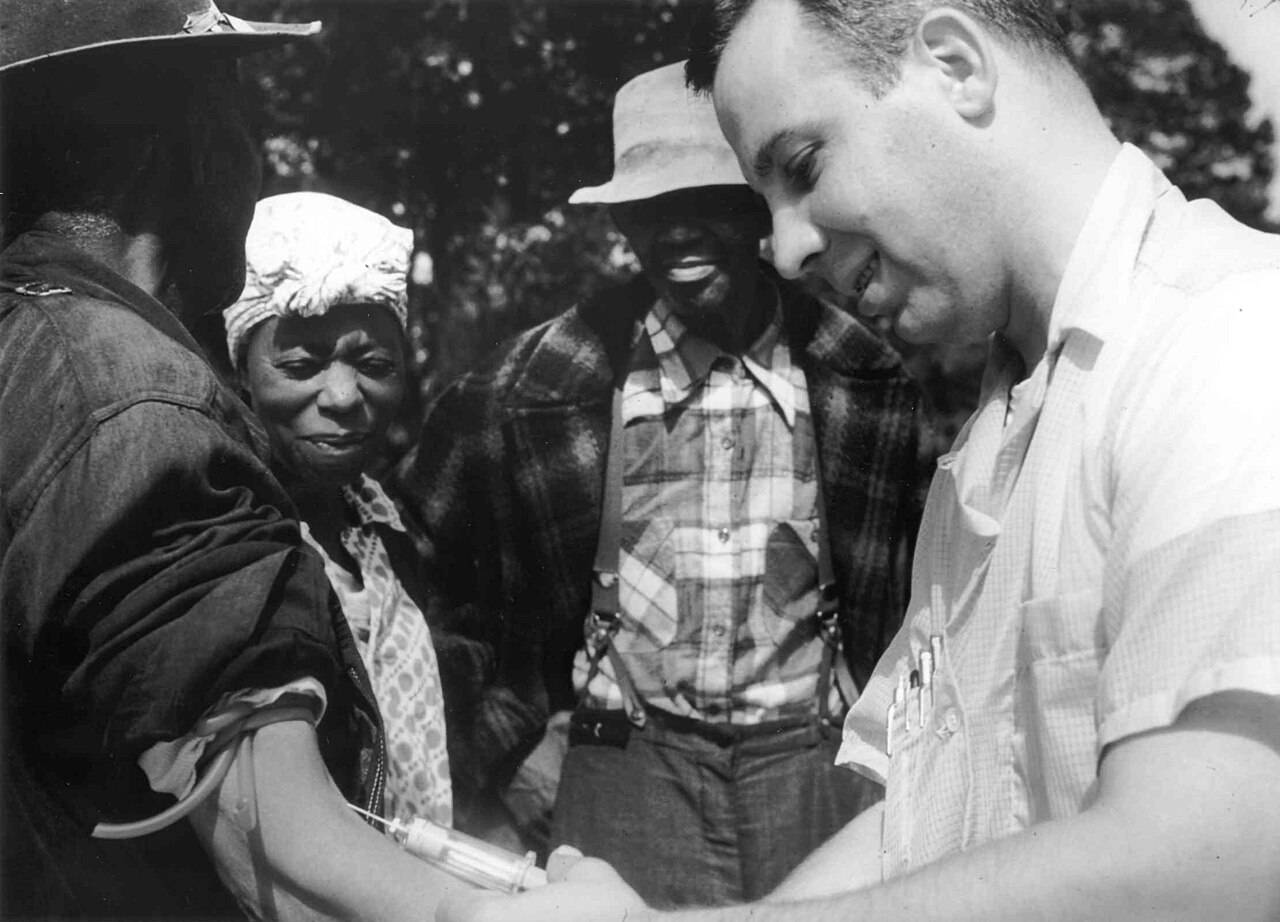

The agency running the study never stopped it on its own review. The public found out, and then it stopped. The CDC timeline records that in 1972 an Associated Press story brought the study to national attention, that the Assistant Secretary for Health and Scientific Affairs then appointed an Ad Hoc Advisory Panel, and that the panel found the study "ethically unjustified" and advised that it stop. The study was ended about a month later. In March 1973 the panel advised that the government provide all necessary medical care to survivors, and the Tuskegee Health Benefit Program was created. A class action filed for the participants and their families ended in a $10 million out-of-court settlement in 1974.12 The CDC lists the payments: $37,500 to each living member of the syphilitic group, $15,000 to heirs of deceased members of that group, $16,000 to each living control, and $5,000 to heirs of deceased controls.13
On May 16, 1997, President Clinton apologized in the East Room with survivors present. "Forty years, hundreds of men betrayed, along with their wives and children," he said. "The United States government did something that was wrong," he said, "deeply, profoundly, morally wrong." And: "what the United States government did was shameful, and I am sorry."14 His remarks also named what the institution changed afterward: "Since the study was halted, abuses have been checked by making informed consent and local review mandatory in federally-funded and mandated research." He linked the study to a cost that outlived it: "The study at Tuskegee served to sow distrust of our medical institutions, especially where research is involved."14
Mechanisms at work
Goal displacement is impossible to read past here. The study's stated end was knowledge about the disease. Once a cure existed, continuing the study became the end, and the men became the means. The normalization of deviance also fits: each year without a decision to treat became the baseline for the next year. On the markers of earned trust in lesson 1, the ending is damning: the institution reformed only after exposure, forced from outside by a reporter and a panel convened in response.1
Case 5: The 1932 Pulitzer Prize to Walter Duranty, and the Board's 2003 decision
The press is an institution too, and its prizes are a way of certifying its own work. In 1932 the Pulitzer Prize for foreign reporting went to Walter Duranty of The New York Times for his reporting from the Soviet Union. His dispatches were later "criticized as gravely defective," in the words of the Pulitzer Board itself. The Board's 2003 statement answering that criticism also addressed the Soviet famine of 1932 and 1933, which came after the articles that won the prize.15
The Board's statement of November 21, 2003 explains why it did not revoke the prize. It confined its review to "the 13 articles that actually won the prize, articles written and published during 1931." It found that "Mr. Duranty's 1931 work, measured by today's standards for foreign reporting, falls seriously short." It also found that "there was not clear and convincing evidence of deliberate deception, the relevant standard in this case." Revoking a prize decades later, it said, "would be a momentous step and therefore would have to rise to that threshold." On the famine, the Board wrote: "The famine of 1932-1933 was horrific and has not received the international attention it deserves."15
Mechanisms at work
This case divides fair readers. One reading is institutionalism in a mild form: a prize board protecting the standing of its own past awards by setting the bar for undoing them very high, and by narrowing the question to thirteen articles from 1931, before the famine. The other reading is that the Board applied a defensible rule. A prize is an award for specific work. A demanding standard of proof protects the dead, who cannot answer, and protects every other winner from retroactive campaigns. Both readings fit the documents. The case shows how close a reasonable procedural rule can sit to reflexive self-protection, and why the course's markers in lesson 1 ask what an institution does with the facts, not only what rule it cites.1
Case 6: The FBI under J. Edgar Hoover and COINTELPRO, 1956 to 1971
J. Edgar Hoover became acting director of the Bureau of Investigation on May 10, 1924, at 29, and was named director by the end of that year. When he died on May 2, 1972, the FBI's own history says, "he had led the FBI for 48 years."16
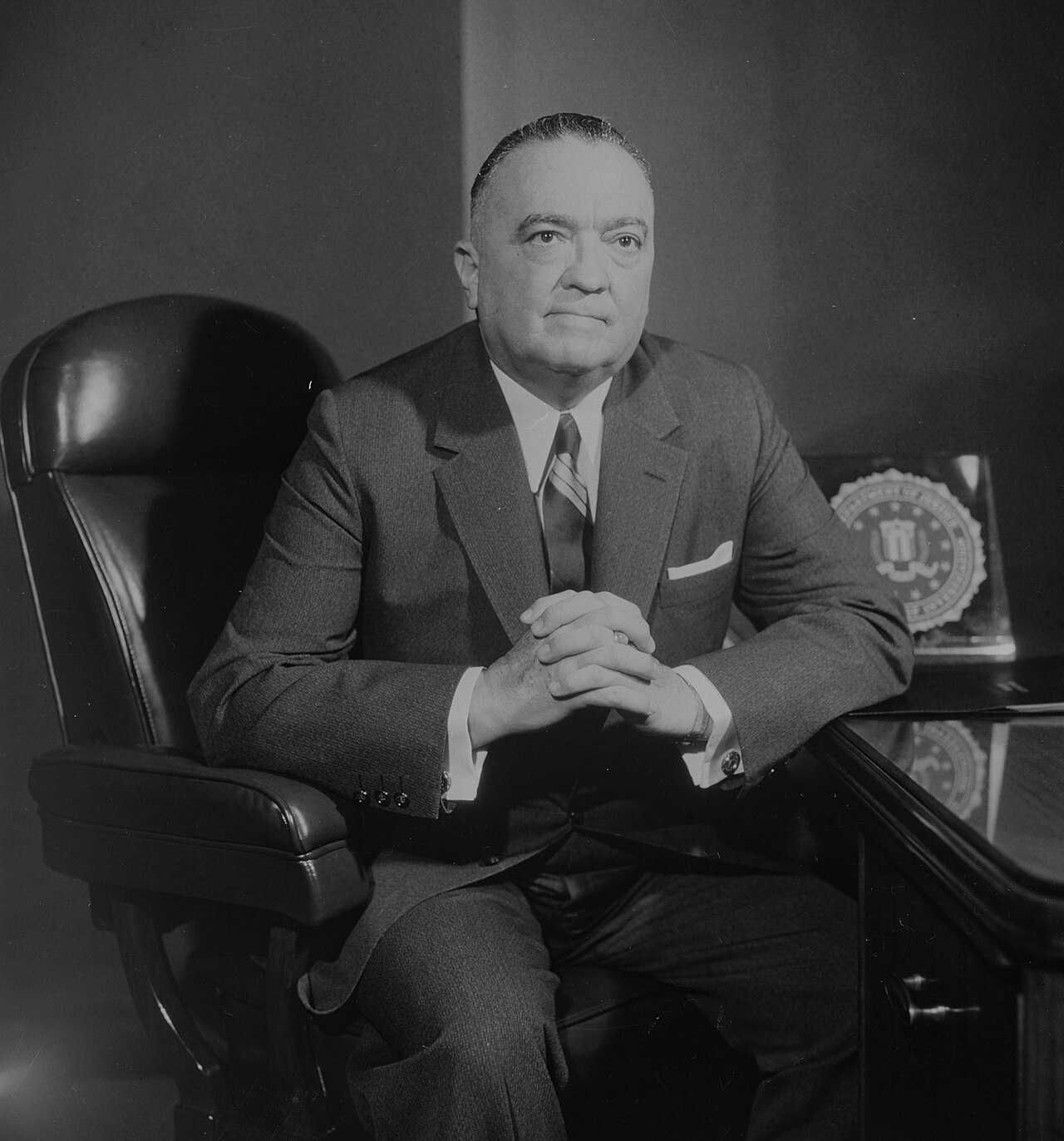

The Senate Select Committee to Study Governmental Operations with Respect to Intelligence Activities, chaired by Senator Frank Church of Idaho, published its staff report on the FBI's counterintelligence programs on April 23, 1976. The report rested on "a staff study of more than 20,000 pages of Bureau documents, depositions of many of the Bureau agents involved in the programs, and interviews of several COINTELPRO targets."17 Its summary is blunt:
COINTELPRO began in 1956, in part because of frustration with Supreme Court rulings limiting the Government's power to proceed overtly against dissident groups; it ended in 1971 with the threat of public exposure. In the intervening 15 years, the Bureau conducted a sophisticated vigilante operation aimed squarely at preventing the exercise of First Amendment rights of speech and association, on the theory that preventing the growth of dangerous groups and the propagation of dangerous ideas would protect the national security and deter violence.17
The committee counted the scale: "The Bureau approved 2,370 separate counterintelligence actions." It described the techniques as ranging "from the trivial (mailing reprints of Reader's Digest articles to college administrators) to the degrading (sending anonymous poison-pen letters intended to break up marriages) and the dangerous (encouraging gang warfare and falsely labeling members of a violent group as police informers)."17 The most notorious example involved Dr. Martin Luther King, Jr. In late 1964 the FBI sent him a tape recording made from microphone surveillance, "with a warning which Dr. King and his close associates interpreted as an invitation to suicide."18
The committee's diagnosis reads like a definition of institutionalism applied to a police agency: "The unexpressed major premise of the programs was that a law enforcement agency has the duty to do whatever is necessary to combat perceived threats to the existing social and political order."17 The ending fits the pattern seen at Tuskegee. A footnote in the report records that the FBI's resident agency in Media, Pennsylvania was broken into on March 8, 1971, that stolen documents carrying the "COINTELPRO" caption were published, that an NBC reporter, Carl Stern, filed a Freedom of Information Act suit, and that the Bureau, citing security reasons, ended the programs on April 27, 1971.17
Mechanisms at work
Goal displacement again: the stated aim was national security and preventing violence, and the committee found the programs moved to protecting "the existing social and political order" itself. Michels's oligarchy is visible in a 48-year directorship. Hirschman's point about loyalty that blocks voice fits a bureau where the programs were secret even from much of the government and ended only when outsiders forced the files into public view. Pierson's phrase from his Anti-Federalist appendix describes the method: institutions that "learn how to appear lawful while suppressing dissent."19
Case 7: The Pentagon Papers and the Vietnam War, 1967 to 1995
The Defense Department commissioned its own history of the war. The National Archives describes the "Report of the Office of the Secretary of Defense Vietnam Task Force" as "commissioned by Secretary of Defense Robert McNamara in 1967." In June 1971 portions were leaked to the press. On the 40th anniversary of the leak, in 2011, the Archives and the Kennedy, Johnson and Nixon libraries released the complete report: "48 boxes and approximately 7,000 declassified pages," with about 34 percent public for the first time.20
The government's response in 1971 was to go to court to stop publication. The Supreme Court decided New York Times Co. v. United States on June 30, 1971, four days after argument, rejecting the injunctions in a short unsigned opinion with three justices dissenting.21 Justice Hugo Black, joined by Justice Douglas, wrote the concurrence most often quoted: "Only a free and unrestrained press can effectively expose deception in government. And paramount among the responsibilities of a free press is the duty to prevent any part of the government from deceiving the people and sending them off to distant lands to die of foreign fevers and foreign shot and shell."21
The official who ordered the study gave his own verdict a quarter century later. Speaking at Harvard's Kennedy School in April 1995 about his book In Retrospect, Robert McNamara said: "We were wrong, terribly wrong." The same words appear in the book, on page xvi. At Harvard he also said, "We did not have public support, and didn't deserve it because of our actions."22
Mechanisms at work
The Pentagon Papers case is less about a single decision than about an institution that knew more than it said, wrote it down for itself, and then fought to keep the record from the public paying for the war. The pattern fits loyalty blocking voice and the habit lesson 1 calls the marker of institutionalism: treating disclosure as the injury instead of the policy. It also shows one institution checking another. A court and two newspapers forced the record into the open over the objection of the executive branch.1
Case 8: NASA, Challenger in 1986 and Columbia in 2003
The space shuttle Challenger broke apart 73 seconds after launch on January 28, 1986, and its seven crew members died. The Presidential Commission chaired by William P. Rogers reported on June 6, 1986.23 Its chapter on the contributing cause opens: "The decision to launch the Challenger was flawed." The decision makers, it found, were unaware of "the initial written recommendation of the contractor advising against the launch at temperatures below 53 degrees Fahrenheit and the continuing opposition of the engineers at Thiokol after the management reversed its position."24
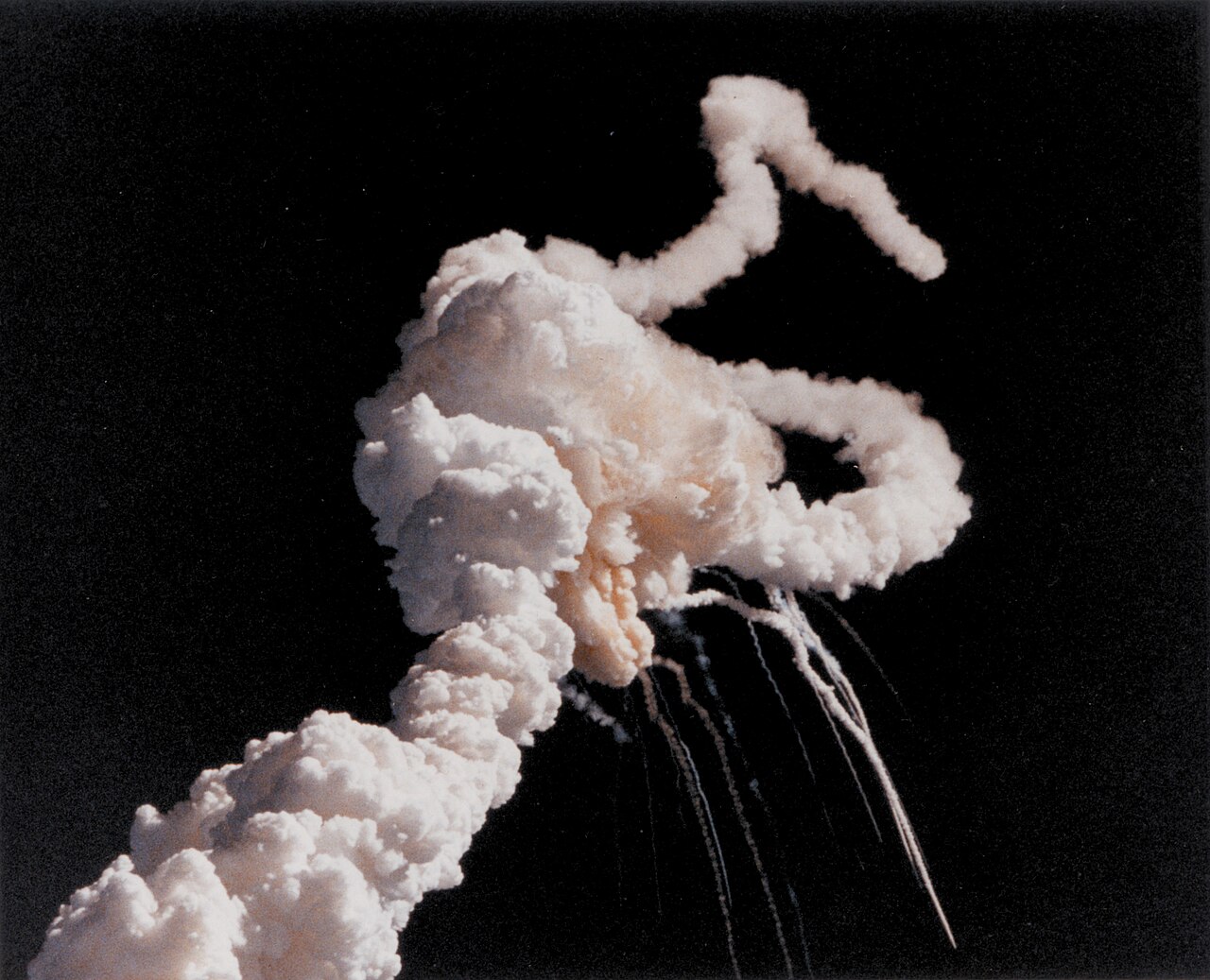

The testimony shows how that reversal happened. Roger Boisjoly, a Thiokol engineer, told the commission that during the night-before teleconference a Thiokol manager "turned to Bob Lund and asked him to take off his engineering hat and put on his management hat." Boisjoly added: "There was never one comment in favor, as I have said, of launching by any engineer or other nonmanagement person in the room before or after the caucus."24 Finding 4 states that "the Thiokol Management reversed its position and recommended the launch of 51-L, at the urging of Marshall and contrary to the views of its engineers in order to accommodate a major customer." Finding 3 says the commission was "troubled by what appears to be a propensity of management at Marshall to contain potentially serious problems and to attempt to resolve them internally rather than communicate them forward."24
Chapter VI traced the failure further back. The booster joint problem "began with the faulty design of its joint and increased as both NASA and contractor management first failed to recognize it as a problem, then failed to fix it and finally treated it as an acceptable flight risk." As damage to the seals appeared in tests and flights, "the reaction by both NASA and Thiokol was to increase the amount of damage considered 'acceptable.'"25 Richard Feynman, a commission member, wrote in his appendix that estimates of the chance of losing a shuttle ranged "from roughly 1 in 100 to 1 in 100,000. The higher figures come from the working engineers, and the very low figures from management." He ended with a sentence that has outlived the report: "For a successful technology, reality must take precedence over public relations, for nature cannot be fooled."26
Seventeen years later Columbia broke apart on reentry on February 1, 2003, and seven more astronauts died. The Columbia Accident Investigation Board, reporting in August 2003, separated physical from organizational cause. The physical cause was a piece of insulating foam that struck the left wing at launch. The organizational causes, in the board's words, "are rooted in the Space Shuttle Program's history and culture," and the board named "reliance on past success as a substitute for sound engineering practices," "organizational barriers that prevented effective communication of critical safety information and stifled professional differences of opinion," and "the evolution of an informal chain of command and decision-making processes that operated outside the organization's rules."27
The board borrowed a term from the sociologist Diane Vaughan, whose study of Challenger appears in lesson 1. Describing years of foam strikes that had not caused disaster, the report says: "The acceptance of events that are not supposed to happen has been described by sociologist Diane Vaughan as the 'normalization of deviance.'"28 Its chapter 8 reached the conclusion an institution least wants to hear about its own reforms: "despite all the post-Challenger changes at NASA and the agency's notable achievements since, the causes of the institutional failure responsible for Challenger have not been fixed."27
One detail in the Columbia record shows the human side of the mechanism. During the flight, NASA engineer Rodney Rocha wanted the damaged wing imaged by outside assets. After program managers declined, he drafted an e-mail calling the decision "the wrong (and bordering on irresponsible) answer" and invoking NASA's own posters: "Remember the NASA safety posters everywhere around stating, 'If it's not safe, say so'? Yes, it's that serious." He did not send it. Asked why, the board reports, "Rocha replied that he did not want to jump the chain of command."29
Mechanisms at work
Normalization of deviance is named in the report itself. Groupthink, in Janis's sense of pressure toward agreement and self-censorship, fits both the 1986 caucus and the unsent 2003 e-mail. Goal displacement shows in the commission's finding that Thiokol reversed "to accommodate a major customer." The CAIB's verdict that the causes of Challenger "have not been fixed" is the strongest official evidence in this lesson that reform after exposure can leave the underlying habits in place.1
Case 9: The Phoenix VA wait lists, 2014
In February 2014 a whistleblower alleged that 40 veterans had died waiting for appointments at the Phoenix VA Health Care System. The VA Office of Inspector General's final report, dated August 26, 2014, is careful on that claim. It identified 40 patients who died while on the electronic wait list from April 2013 to April 2014 and reviewed 3,409 patients in all. It found "28 instances of clinically significant delays in care associated with access to care or patient scheduling. Of these 28 patients, 6 were deceased." It also stated that "we are unable to conclusively assert that the absence of timely quality care caused the deaths of these veterans."30
The scheduling findings are not hedged. Besides about 1,400 veterans properly on the official list, the inspectors "identified over 3,500 additional veterans, many of whom were on what we determined to be unofficial wait lists." Of 79 employees interviewed, "Thirty staff stated they used the wrong desired date of care, resulting in appointments showing a false 0-day wait time," and eleven said they "'fixed' or were instructed to 'fix' appointments with wait times greater than 14 days." Senior leaders "were aware of unofficial wait lists and that access delays existed."30
The report ties the manipulation to the way the institution measured and paid its managers. The Phoenix director's "Wildly Important Goal" on access "resulted in a misleading portrayal of veterans' access to patient care." On the strength of the reported improvements, she received a pay increase from $169,900 to $172,449 and a performance award of $8,495, which VA rescinded during the review. The goal was met on paper, and the paper, the inspectors found, was misleading.31 The problem was not local: "Inappropriate scheduling practices are a nationwide systemic problem," the inspectors wrote, and the practices "became systemic because VHA did not hold senior headquarters and facility leadership responsible and accountable."30 Two network reports, in January 2012 and May 2013, had already found Phoenix out of compliance.30 The report quotes a June 2014 White House review describing "a corrosive culture" with "a history of retaliation toward employees raising issues," and it concludes that "the culture of staff manipulating data is VHA's primary scheduling issue."31
Mechanisms at work
This is goal displacement in textbook form. Merton described rules that become ends in themselves. Phoenix had a number that became the end in itself, and staff made the number true on paper while veterans waited. The two earlier compliance reports that changed nothing fit the normalization of deviance. Retaliation against employees who raised problems is loyalty blocking voice in Hirschman's terms. Veterans, unlike shoppers, had almost no exit.1
Case 10: Boeing, the FAA and the 737 MAX, 2017 to 2026
Two 737 MAX airliners crashed within five months: Lion Air flight 610 on October 29, 2018, and Ethiopian Airlines flight 302 in March 2019. The House Committee on Transportation and Infrastructure's final report, prepared by the majority staff in September 2020, opens: "Technical design flaws, faulty assumptions about pilot responses, and management failures by both The Boeing Company (Boeing) and the Federal Aviation Administration (FAA) played instrumental and causative roles in the chain of errors that led to the crashes," which "resulted in the tragic and preventable deaths of 346 people."32
The committee grouped its findings under five themes. Two bear directly on institutional behavior. Under "Culture of Concealment" it found that "Boeing withheld crucial information from the FAA, its customers, and 737 MAX pilots," including "concealing the very existence of MCAS from 737 MAX pilots." Under "Conflicted Representation" it found that "the FAA's current oversight structure with respect to Boeing creates inherent conflicts of interest." Boeing employees acting as the FAA's Authorized Representatives were surveyed internally in 2016: "39 percent of Boeing ARs that responded perceived 'undue pressure' and 29 percent were concerned about consequences if they reported potential 'undue pressure.'" An FAA draft safety culture survey found that "34 percent said 'fear of retribution' is one reason employees don't report safety issues."32
The criminal side followed. On January 7, 2021, the Justice Department announced that Boeing had been charged with "one count of conspiracy to defraud the United States" and had agreed to a deferred prosecution agreement with "a total criminal monetary amount of over $2.5 billion," including a $243.6 million penalty, $1.77 billion for airline customers and a $500 million fund for crash victims' beneficiaries. The department said two Boeing technical pilots "deceived the FAA AEG about an important aircraft part called the Maneuvering Characteristics Augmentation System (MCAS)," and the acting assistant attorney general said Boeing's employees "chose the path of profit over candor."33
The case did not end there. In May 2024 the department told the court that Boeing had breached the 2021 agreement. A plea agreement reached that summer was rejected by the court on December 5, 2024. On May 29, 2025, the department signed a non-prosecution agreement with Boeing instead and moved to dismiss the charge, and on November 6, 2025 the district court in Fort Worth granted the motion. Families of crash victims who opposed the dismissal asked the Fifth Circuit to intervene. That court denied their petitions on March 31, 2026 and denied rehearing on May 22, 2026.33 No Boeing executive was tried, and the company was never convicted.
Mechanisms at work
Regulatory capture, in Stigler's sense, is the committee's own diagnosis in different words: the regulator delegated so much to the regulated firm that the firm's employees were doing the regulator's work under the firm's pressure. Goal displacement appears in the committee's "Production Pressures" theme. The survey numbers measure voice being blocked. This is a private firm and a federal agency together, which is the fusion of state and capital that later lessons in this module examine.1
Case 11: Church abuse investigations, Boston in 2003 and the Southern Baptist Convention in 2022
Two very different denominations commissioned or faced official investigations of how their leaders handled reports of sexual abuse. The findings below stay within what the investigators wrote.
The Roman Catholic Archdiocese of Boston
Massachusetts Attorney General Thomas F. Reilly released his office's report on July 23, 2003. It reported what the office had learned over the previous eighteen months through an investigation involving prosecutors, State Police, civilian investigators and a grand jury. His cover letter credits the church before it reaches the findings: "Outside of government, it is probably the country's foremost social services provider," and "thousands of devout and honorable priests provide the Church's followers with moral and spiritual guidance every day."34 Then the numbers: "According to the Archdiocese's own files, 789 victims have complained of sexual abuse by members of the clergy; the actual number of victims is no doubt higher," and "250 priests and church workers stand accused of acts of rape or sexual assault of children" over "at least six decades under the administrations of three successive Archbishops."34
The office reported that it did not find evidence sufficient to charge the archdiocese or its senior managers with crimes under applicable state law. It did find "that the widespread abuse of children was due to an institutional acceptance of abuse and a massive and pervasive failure of leadership." Its central sentence describes institutionalism almost exactly: "For decades, Cardinals, Bishops and others in positions of authority within the Archdiocese chose to protect the image and reputation of their institution rather than the safety and well-being of children. They acted with a misguided devotion to secrecy and a mistaken belief that they were accountable only to themselves."34
The Southern Baptist Convention Executive Committee
The Southern Baptist Convention has no bishops and treats each congregation as autonomous. In June 2021 its messengers voted for an outside investigation of the Executive Committee, overseen by a task force, after many said they did not want the committee to oversee a review of itself. Guidepost Solutions delivered its report to the task force on May 15, 2022, and it was released to the public on May 22.3536 The report's appendices are dated May 15, 2022.37
The 288-page report's executive summary says that survivors and others who brought allegations to the Executive Committee were met, "time and time again, with resistance, stonewalling, and even outright hostility from some within the EC." It found that "for many years, a few senior EC leaders, along with outside counsel, largely controlled the EC's response to these reports of abuse" and "were singularly focused on avoiding liability for the SBC." Survivors, it said, were "ignored, disbelieved, or met with the constant refrain that the SBC could take no action due to its polity regarding church autonomy," even when "convicted molesters continued in ministry with no notice or warning to their current church or congregation." An Executive Committee staffer had kept a list of accused ministers, but the report found no indication anyone "took any action to ensure that the accused ministers were no longer in positions of power at SBC churches." The most recent version of that list, the report says, "contained the names of 703 abusers."35 The Associated Press reported the same findings when the report was released.52 The Executive Committee released that list on May 26, 2022: a 205-page document with more than 700 entries, largely covering 2000 to 2019.38
The Guidepost report has itself been contested in court. Michael David Sills, a former seminary professor named in the report, and his wife Mary Sills sued the convention, the Executive Committee, Guidepost, the Southern Baptist Theological Seminary and several leaders in federal court in Nashville in 2023, alleging defamation among other claims. In September 2025 the plaintiffs filed an expert critique of the investigation's methods.36 On September 29, 2026, Chief Judge William L. Campbell, Jr. granted summary judgment on most of the claims, including all of Mary Sills's claims and the claims for conspiracy, negligence and emotional distress, and dismissed four individual defendants. He denied summary judgment on David Sills's defamation claims against Guidepost, the Executive Committee and the convention based on the report. He also let stand Sills's defamation claims against the Executive Committee and the convention based on the published list of accused ministers, and against the seminary and its president, R. Albert Mohler, based on Mohler's tweets. Those claims remain for trial. The scheduled November trial was postponed, and the judge ordered a judicial settlement conference.53 No court has found the report defamatory. The course states the report's findings as the report's findings, attributed to it.
Mechanisms at work
The two churches are organized in opposite ways, one hierarchical and one congregational, and the investigators found the same core behavior in both: leaders putting the institution's legal and public standing ahead of the people it existed to serve. In Boston, the investigators' phrase "accountable only to themselves" names oligarchy and the absence of voice. In the SBC case, a sincere doctrine, congregational autonomy, was used as the reason for doing nothing, which is infusion with value turned into a shield. In both, outside pressure forced the disclosure. The Massachusetts report itself warned in July 2003 that the archdiocese "has yet to demonstrate a commitment to reform proportional to the tragedy it perpetrated," and the SBC's release of its list came only after the Guidepost report was public. Neither case is evidence about the faith of the members, and the reports do not claim it is.1
What institutionalism costs
The gravest cost is harm done while the institution was being defended: men left untreated for decades after a cure existed, fourteen astronauts, 346 airline passengers and crew, children abused by clergy, veterans on lists that did not officially exist. In each case an official body later found that people inside knew enough to act.
Reform also came late, and the gaps are long: 46 years from Luther's theses to Trent's decree on indulgences, 359 years from Galileo's sentence to the 1992 address, fifteen years from Congress's finding that much rail regulation had become "unnecessary and inefficient" to the end of the ICC, about three decades from penicillin to the end of the Tuskegee study, and seventeen years between two shuttle disasters with, in the CAIB's words, causes that "have not been fixed."
Lost trust outlasts the scandal that caused it. President Clinton said the Tuskegee study "served to sow distrust of our medical institutions."14 Survey data show how low trust has fallen across many institutions, though no survey can say how much of the decline any single case caused.
Pew Research Center's long series asks whether people trust the government in Washington to do what is right "just about always" or "most of the time." In 1958 the figure was 73 percent. In October 1964 it was 77 percent. It fell to 36 percent by December 1974, briefly rose to between 48 and 60 percent in polls taken in the last three months of 2001, and in Pew's most recent reading, September 2025, stood at 17 percent, "one of the lowest in the nearly seven decades since the question was first asked."39 A separate survey by the Partnership for Public Service, taken March 31 to April 5, 2026 and published September 16, 2026, found 27 percent trusting the federal government, down from 33 percent in 2025. The Partnership's own chart gives trust in federal civil servants as 44 percent, down from 49 percent in 2025.40 The two surveys ask different questions, so their numbers are not directly comparable.
Gallup has asked since 1973 how much confidence Americans have in a list of institutions. In its June 1-15, 2026 survey, the share saying "a great deal" or "quite a lot" was 9 percent for Congress, 14 percent for television news, 17 percent for newspapers and for big business, 27 percent for the Supreme Court, the presidency and the public schools, 33 percent for the church or organized religion, and 61 percent for the military. Small business led at 67 percent.41 Gallup's first readings for several of these were far higher: 42 percent for Congress in 1973, 65 percent for organized religion in 1973, 58 percent for the public schools in 1973.41
Falling trust is not proof of institutionalism. It can follow from many things, including partisan polarization and changes in media. Low trust is itself a cost borne by institutions that perform well, since public suspicion does not sort the good agencies from the bad. Pierson's essay makes the same point about brittleness from the other side: "Systems that cannot tolerate critique are not strong, they are brittle."2
The limits of the idea
A concept that explains every institutional defense explains nothing. The strongest objections to the idea of institutionalism come from serious thinkers, and several of them come from traditions close to Pierson's own.
Chesterton's fence
G. K. Chesterton, in "The Drift from Domesticity" in his 1929 book The Thing, gave reformers a rule that has become proverbial:
In the matter of reforming things, as distinct from deforming them, there is one plain and simple principle; a principle which will probably be called a paradox. There exists in such a case a certain institution or law; let us say, for the sake of simplicity, a fence or gate erected across a road. The more modern type of reformer goes gaily up to it and says, "I don't see the use of this; let us clear it away." To which the more intelligent type of reformer will do well to answer: "If you don't see the use of it, I certainly won't let you clear it away. Go away and think. Then, when you can come back and tell me that you do see the use of it, I may allow you to destroy it."42
Chesterton's rule does not forbid removal. It requires understanding first. Every case above passes his test in hindsight, because investigators found and stated what the fence was for and why it had failed. The risk his rule guards against is the critic who skips that step and calls an institution's survival proof of its corruption.
Burke and the inheritance
Edmund Burke, writing in 1790 against the French revolutionaries, defended inherited institutions in terms that sound, to a modern ear, close to what Pierson criticizes. He wrote that the English "cherish" their old prejudices "because they are prejudices," and explained why: "We are afraid to put men to live and trade each on his own private stock of reason; because we suspect that the stock in each man is small, and that the individuals would do better to avail themselves of the general bank and capital of nations and of ages."43
Burke did not defend inheritance against change. In the same work he wrote: "A state without the means of some change is without the means of its conservation." He praised a constitution in which "in what we improve we are never wholly new, in what we retain we are never wholly obsolete."43 Read fairly, Burke's position and Pierson's overlap more than they collide: both reject reform by destruction, and both treat an institution as a trust held for later generations. They differ on where to put the burden of proof. Burke puts it on the reformer. Pierson's definition puts it on the institution that has stopped performing.
The knowledge institutions carry
F. A. Hayek argued in 1945 that much of the knowledge a society runs on "never exists in concentrated or integrated form but solely as the dispersed bits of incomplete and frequently contradictory knowledge which all the separate individuals possess," including "the knowledge of the particular circumstances of time and place."44 Hayek's subject was prices and markets, and the course does not claim he wrote about bureaucracies. The point carries over by analogy: procedures, case files, training and habits of practice hold knowledge that no single critic or reformer has. An institution that resists a change may be protecting that knowledge, not itself. The Iraq record below shows what it costs to throw it away.
An insult that cannot be disproved
If every defense of an institution counts as institutionalism, the term stops being testable. A court that follows precedent, a church that keeps its creed, an agency that follows its statute and a newspaper that stands by an accurate story are all defending institutions. None of that is institutionalism under the definition in lesson 1, which turns on defending an institution apart from whether it does its job. Using the word as an insult for any loyalty, or as a way to avoid answering a defender's actual reasons, commits the same error the word describes: it substitutes a label for an examination of performance.
Reading motives
Institutionalism, as Pierson defines it, is a claim about why people defend an institution: "habit, identity, and survival instinct," not "performance or morality."2 Motives are hard to prove. The strongest cases in this lesson rest on documents where the motive was written down, as in Boston's finding that leaders "chose to protect the image and reputation of their institution," or Thiokol's reversal "to accommodate a major customer." Where the record holds no such statement, the honest course is to judge the conduct and leave the motive open.
The opposite error: Iraq, May 2003
The mirror image of institutionalism is tearing down working institutions quickly because they are tainted, without a plan for what they did. The clearest documented example in recent U.S. policy is the first two orders of the Coalition Provisional Authority in Iraq.
CPA Order Number 1, signed by Administrator L. Paul Bremer on May 16, 2003, implemented the disestablishment of the Ba'ath Party. Section 1(2) removed "Full members of the Ba`ath Party holding the ranks of" the top four levels "from their positions" and "banned [them] from future employment in the public sector." Section 1(3) ordered that people in "the top three layers of management in every national government ministry, affiliated corporations and other government institutions (e.g., universities and hospitals)" be interviewed and removed if found to be full party members.45 CPA Order Number 2, dated May 23, 2003, dissolved the entities listed in its annex and provided that "Any person employed by a Dissolved Entity in any form or capacity, is dismissed effective as of April 16, 2003." The same section promised "A termination payment in an amount to be determined by the Administrator" to dismissed employees other than senior party members.46
The Special Inspector General for Iraq Reconstruction, a U.S. government office, published its review in February 2009 under the title Hard Lessons. On Order 1 it found: "Because the vast majority of senior officials in Saddam Hussein's regime were Ba'ath Party members, the order effectively fired most senior leaders in Iraq's government, severely depleting the bureaucracy of key personnel." It recorded that "ORHA's Jay Garner and the CIA station chief in Baghdad urged Ambassador Bremer to modify the order," and that "Bremer refused, saying he had his instructions from Washington." It quoted Lieutenant General Ricardo Sanchez: "The impact of this de-Ba'athification order was devastating."47
On Order 2, SIGIR found that it "abolished seven institutions," among them the Ministry of Defense and the intelligence services, and put the armed forces, "some 500,000 men," "immediately out of work, many without any compensation." It reported that the NSC had not vetted the decision and quoted Secretary of State Colin Powell's account of asking what had happened: "There was no meeting on it." SIGIR also recorded the other side: Under Secretary Douglas Feith later called it an error not to have discussed the order across agencies but maintained it was right on the merits, and Walter Slocombe said the army had already dissolved itself in the invasion.47 SIGIR's conclusion weighed both: "Although there may have been sound reasons for removing members of the Ba'ath party from senior government positions and for dissolving the army, both decisions added considerably to the difficulty of reconstruction and establishing a functioning government." It added that building entirely new Iraqi security forces came to take more than half of all U.S.-appropriated reconstruction dollars.48
The Iraq record teaches a narrow point. The Ba'ath Party and the old army were institutions with ugly records, and most Iraqis, SIGIR notes, agreed that some de-Ba'athification was necessary, though many believed the order "had gone too far." Removing them all at once, without the knowledge they held or a replacement ready, was itself a failure of institutional judgment. Pierson's essay states the same limit: "We don't need to burn down the forest."2
Why ordered liberty keeps both duties
Pierson's ordered liberty, as he states it, joins two duties: holding government accountable and supporting legitimate government.49 The cases in this lesson show what happens when the second duty swallows the first. Tuskegee, COINTELPRO, Boston and Phoenix are records of people who supported their institution and stopped holding it to account. The Iraq orders show the reverse: accountability for a criminal regime pursued with no support for the working parts of the state that any government would need.
The record also shows where accountability actually came from. A reporter and an advisory panel ended Tuskegee. A Senate committee exposed COINTELPRO. A presidential commission and an investigation board named NASA's culture. An inspector general documented Phoenix. A House committee and the Justice Department documented Boeing. A state attorney general documented Boston, and a vote of ordinary church messengers forced the Guidepost investigation. Each is itself an institution. Pierson's remedy, the citizen as "the moral auditor of government," works through institutions like these when it works at all.50
Through Pierson's Framework
Pierson's definition asks whether an institution is defended on "performance or morality" or on "habit, identity, and survival instinct." His essay adds that systems which cannot "tolerate critique" are brittle and that systems which "punish reform" are corrupt.2 Applied to the record, those standards sort the cases more finely than a single verdict would.
Tuskegee, COINTELPRO, the Boston archdiocese and the SBC Executive Committee fail all three on the investigators' own findings. Each protected its standing or its program over the people it served, each treated outside scrutiny as the threat, and each changed course only when exposure left no choice. Pierson's line from the Anti-Federalist appendix fits them: "Institutions, once corrupt, do not collapse. They adapt. They learn how to appear lawful while suppressing dissent."19
NASA, Phoenix and Boeing with the FAA fail in a less deliberate way. Their documents show no plan to do harm. They show a measure, a schedule or a customer relationship that came to matter more than the purpose, and people inside who saw the danger and did not or could not make themselves heard. That is Pierson's "the mission is replaced by the machinery."2
The ICC and the Duranty prize are the borderline cases, and the framework should say so. An agency that outlives part of its purpose and is then reformed and abolished by statute shows the system working slowly. A prize board that applies a high standard of proof may be protecting its brand or may be protecting fairness, and the record supports both readings. The church's statements on indulgences and on Galileo are late, real admissions. Name versus function, the module's method, asks what each body did with the facts once it had them.
Ordered liberty, in Pierson's terms, requires "mutual restraint": "individuals must act with discipline and responsibility, and governments and institutions must operate under law, truth, and justice."51 The Iraq orders are the warning on the other flank. Pierson writes that "Institutions are to be questioned, not worshiped."50 Questioning is the start of the work, and the record shows that destroying an institution without understanding it can do as much harm as defending one without examining it.
Hard Questions and Answers
Eleven scandals, picked by hand. Isn't this cherry-picking failures to prove a thesis decided in advance?
Picked by hand, yes. The cases were chosen because official sources document them well, and that biases the sample toward failures that got caught. They are not a random sample, and they do not show that most institutions behave this way most of the time. What they show is narrower: that the mechanisms described by Merton, Vaughan, Stigler and the others appear in the documentary record across five centuries and very different kinds of organizations, and that investigators with subpoena power repeatedly reached the same conclusion about why. The Gallup data show that some institutions, such as the military at 61 percent and small business at 67 percent in 2026, keep wide public confidence.41
Every one of these failures was exposed and corrected. Doesn't that prove the system works, and that "institutionalism" is a scare word?
The record concedes a real part of this. Every case here was eventually exposed by another institution: a court, a commission, an inspector general, a Senate committee, a state attorney general, a vote of church messengers. That is evidence for institutional checks. The rest of the record cuts the other way. Exposure usually came from outside and late: 40 years at Tuskegee, 15 at COINTELPRO, six decades in Boston by the attorney general's count. And the Columbia board found that reforms after Challenger had not fixed the causes.27 A system that corrects itself after decades and thousands of victims is working, but at a cost no one inside it would have accepted in advance.
Two of the eleven cases are churches. Isn't this an attack on religion dressed up as civics?
No, and the record shows why. Pierson's own definition names churches, along with universities, bureaucracies and unions.2 Leaving them out would make the lesson less honest. The church cases are stated only from the investigators' findings and the institutions' own statements, they come from two very different denominations, and the Massachusetts report itself begins by crediting the Catholic Church's "countless good works."34 The conduct documented is that of leaders managing an institution. Nothing in the reports, or in this lesson, is a judgment of the faith of members, and the Galileo and indulgence cases include the church's own later admissions.
Chesterton and Burke would say this whole approach is the reformer's arrogance. Why isn't defending old institutions simply prudence?
Often it is. Chesterton's rule is that the reformer must first understand what the fence was for.42 Burke held that inherited institutions store "the general bank and capital of nations and of ages," and also that "A state without the means of some change is without the means of its conservation."43 The definition in lesson 1 is consistent with both. It targets defense of an institution apart from whether it does its job. In the cases here, the purpose of the fence was known, investigators stated why it had failed, and the defenders kept it standing for reasons the records describe as reputation, liability or schedule. That is a different thing from prudence.
De-Baathification did exactly what this lesson preaches: it found a corrupt institution and removed it. Why call that a failure?
It did half of it, and the missing half is the point. The Ba'ath Party and Saddam Hussein's security services were instruments of repression, and the CPA's orders said so in their preambles.46 SIGIR found that the trouble lay in the method: a de-Ba'athification order "promulgated with little Iraqi involvement," both orders issued "with insufficient interagency debate," applied so broadly that they removed most of the government's senior managers and put some 500,000 men out of work at once.47 SIGIR allowed that there "may have been sound reasons" for both decisions and still concluded they "added considerably to the difficulty of reconstruction."48 The lesson the record supports is that accountability without a working replacement is its own institutional failure.
Trust fell because of partisan polarization and changing media, not because of Tuskegee. Why drag these numbers in?
The trust numbers do not measure institutionalism, and the text says so where the charts appear. The Pew series began falling in the late 1960s and 1970s, the years of Vietnam and the Pentagon Papers, Watergate and the Church Committee, and that timing fits a link to disclosed failures.39 It does not prove one. The data are included because loss of trust is a cost that institutions themselves name. President Clinton said of Tuskegee that it "served to sow distrust of our medical institutions."14
Learn more
- Church Committee, Final Report, Book III (1976): the Senate staff report on COINTELPRO, built on more than 20,000 pages of FBI files.
- Rogers Commission Report, chapter V (1986): the Challenger launch decision, with the engineers' testimony.
- Columbia Accident Investigation Board Report, Volume I (2003): the report that named NASA's culture as a cause and borrowed "normalization of deviance."
- VA Inspector General, Phoenix report (2014): how a performance measure became the goal.
- House Transportation Committee, Boeing 737 MAX final report (2020): production pressure, concealment and delegated oversight.
- Massachusetts Attorney General, Boston archdiocese report (2003): the official record of an institution that "chose to protect the image and reputation of their institution."
- President Clinton's Tuskegee apology (1997): the government's own admission, with the reforms it cited.
- SIGIR, Hard Lessons (2009): the U.S. government's review of reconstruction in Iraq, including the CPA's first orders.
- Pew Research Center, Public Trust in Government: 1958-2025: the poll-by-poll trust series.
- Lesson 1, What Institutionalism Is: the definitions and scholarship behind every mechanism named here.
Notes
- See lesson 1 of this module, "What Institutionalism Is," for the definitions and sources of each mechanism named in this lesson: goal displacement (Merton), infusion with value (Selznick), oligarchy (Michels), capture (Stigler), loyalty that blocks voice (Hirschman), groupthink (Janis), normalization of deviance (Vaughan) and system justification (Jost and Banaji). Read it online. ↩
- Jeff A. Pierson, "The Acacia Illusion: How Institutionalism Mimics Nature's Most Subtle Manipulation," in The Ordered Liberty Papers (2025). Read it online. ↩
- Martin Luther, Disputation of Doctor Martin Luther on the Power and Efficacy of Indulgences (the Ninety-Five Theses), October 31, 1517, theses 27, 28, 50 and 86, in Works of Martin Luther, trans. and ed. Adolph Spaeth, L. D. Reed, Henry Eyster Jacobs and others (Philadelphia: A. J. Holman Company, 1915), vol. 1, pp. 29-38; Project Gutenberg eBook #274. Read it online. ↩
- Council of Trent, Session XXV (December 3 and 4, 1563), "Decree Concerning Indulgences," in The Canons and Decrees of the Sacred and Oecumenical Council of Trent, ed. and trans. J. Waterworth (London: Dolman, 1848), pp. 277-278; Hanover College Historical Texts Project. Read it online. ↩
- Galileo Galilei, abjuration, June 22, 1633, English translation as published in Linder, Famous Trials: The Trial of Galileo, "Recantation of Galileo (June 22, 1633)." Read it online. ↩
- Sentence of the Holy Office against Galileo Galilei, 1633, English translation as published in Douglas O. Linder, Famous Trials: The Trial of Galileo, University of Missouri-Kansas City School of Law, "Papal Condemnation (Sentence) of Galileo." Read it online. ↩
- John Paul II, address to the plenary session of the Pontifical Academy of Sciences, October 31, 1992, sections 4, 5, 9 and 10, English translation as published in L'Osservatore Romano, weekly English edition, N. 44 (1264), November 4, 1992, reproduced by The Evangelization Station. The address was given in French; the Vatican's English page for it carried no text when fetched on October 22, 2026, and the official French text is on vatican.va. Read it online. French text: vatican.va. Coyne's critique: George V. Coyne, S.J., "The Church's Most Recent Attempt to Dispel the Galileo Myth," in The Church and Galileo, ed. Ernan McMullin (Notre Dame, IN: University of Notre Dame Press, 2005), chapter 13, beginning p. 340, Vatican Observatory copy. Read it online. ↩
- National Archives, "Interstate Commerce Act (1887)," Milestone Documents (Act of February 4, 1887, Public Law 49-41). Read it online. ↩
- Staggers Rail Act of 1980, Pub. L. 96-448, 94 Stat. 1895, approved October 14, 1980, section 2 (findings), govinfo.gov. Read it online. ↩
- ICC Termination Act of 1995, Pub. L. 104-88, 109 Stat. 803, approved December 29, 1995, sections 2 and 101, govinfo.gov. Read it online. ↩
- Surface Transportation Board, "About STB." Read it online. ↩
- Centers for Disease Control and Prevention, "Timeline of Events," USPHS Untreated Syphilis Study at Tuskegee, entries for 1932, 1943, 1972 and 1973 to 1974. Read it online. The panel's own Final Report of the Tuskegee Syphilis Study Ad Hoc Advisory Panel (transmitted April 28, 1973) gives 399 men in the study group and 201 controls and concludes that the study "was ethically unjustified in 1932." Read it online. ↩
- Centers for Disease Control and Prevention, "About the USPHS Untreated Syphilis Study at Tuskegee" and "Timeline of Events," cdc.gov/tuskegee, fetched October 22, 2026. Read it online. ↩
- The White House, Office of the Press Secretary, "Remarks by the President in Apology for Study Done in Tuskegee," East Room, May 16, 1997, Clinton White House archive. Read it online. ↩
- The Pulitzer Prizes, "Statement on Walter Duranty's 1932 Prize," November 21, 2003. Read it online. ↩
- Federal Bureau of Investigation, "J. Edgar Hoover," FBI History: Directors. Read it online. ↩
- U.S. Senate, Select Committee to Study Governmental Operations with Respect to Intelligence Activities (Frank Church, Idaho, chairman), Final Report, Book III: Supplementary Detailed Staff Reports on Intelligence Activities and the Rights of Americans, S. Rep. No. 94-755, April 23, 1976, "COINTELPRO: The FBI's Covert Action Programs Against American Citizens," pp. 3 to 10. Read it online. ↩
- Church Committee, Book III (S. Rep. No. 94-755), "Dr. Martin Luther King, Jr., Case Study," section VI summary, on the 1964 tape and letter (p. 168 of the Senate PDF). Read it online. ↩
- Jeff A. Pierson, "The Anti-Federalist Warning: Institutional Power and the Fragility of Liberty," appendix to Ordered Liberty Reclaimed: A Foundation for Liberty. Read it online. ↩
- National Archives, "Pentagon Papers" (Report of the Office of the Secretary of Defense Vietnam Task Force), release page, 2011. Read it online. ↩
- New York Times Co. v. United States, 403 U.S. 713 (1971), argued June 26 and decided June 30, 1971, per curiam, with Justice Black concurring (joined by Justice Douglas) and Chief Justice Burger and Justices Harlan and Blackmun dissenting. Read it online. ↩
- David Holmstrom, "McNamara Mea Culpa Stirs Vietnam Anger," Christian Science Monitor, April 28, 1995, reporting McNamara's remarks at Harvard's Kennedy School on his book In Retrospect: The Tragedy and Lessons of Vietnam (New York: Times Books, 1995). Read it online. For the same words in the book, see the editorial "Now he tells us," The Virginian-Pilot, April 13, 1995, p. A14, quoting In Retrospect. Read it online. The page is In Retrospect, p. xvi, as cited by Harold P. Ford, "Thoughts Engendered by Robert McNamara's In Retrospect," Studies in Intelligence (Central Intelligence Agency), note 4, which uses "We were wrong, terribly wrong" as its epigraph. Read it online. ↩
- Columbia Accident Investigation Board, Report, Volume I (August 2003), chapter 5, p. 99, on the loss of Challenger "73 seconds into its climb towards orbit" on January 28, 1986, with all seven aboard. Read it online. The commission's report date is from the NASA History Office index of the report. Read it online. ↩
- Report of the Presidential Commission on the Space Shuttle Challenger Accident (Washington, D.C., June 6, 1986), vol. 1, chapter V, "The Contributing Cause of the Accident," pp. 82, 93-94 and 104 (findings 1 to 4), NASA History Office. Read it online. ↩
- Report of the Presidential Commission on the Space Shuttle Challenger Accident, vol. 1, chapter VI, "An Accident Rooted in History," p. 120. Read it online. ↩
- Richard P. Feynman, "Personal Observations on the Reliability of the Shuttle," Appendix F to the Report of the Presidential Commission on the Space Shuttle Challenger Accident, vol. 2. Read it online. ↩
- Columbia Accident Investigation Board, Report, Volume I (August 2003), executive summary, p. 9, and chapter 8, "History as Cause: Columbia and Challenger," p. 195. Read it online. ↩
- Columbia Accident Investigation Board, Report, Volume I, chapter 6, p. 130, on foam-shedding decisions, citing Diane Vaughan for "normalization of deviance." Read it online. ↩
- Columbia Accident Investigation Board, Report, Volume I, chapter 6, pp. 151 to 157, on the imagery requests and Rodney Rocha's unsent e-mail. Read it online. ↩
- Department of Veterans Affairs, Office of Inspector General, Veterans Health Administration: Review of Alleged Patient Deaths, Patient Wait Times, and Scheduling Practices at the Phoenix VA Health Care System, Report No. 14-02603-267, August 26, 2014, executive summary pp. i to iv. Read it online. ↩
- VA Office of Inspector General, Report No. 14-02603-267 (August 26, 2014), pp. 55, 68 and 73. Read it online. ↩
- U.S. House of Representatives, Committee on Transportation and Infrastructure, Final Committee Report: The Design, Development and Certification of the Boeing 737 MAX, prepared by the majority staff for Chair Peter A. DeFazio and Aviation Subcommittee Chair Rick Larsen, September 2020, executive summary pp. 5 to 15. Read it online. ↩
- U.S. Department of Justice, Office of Public Affairs, "Boeing Charged with 737 Max Fraud Conspiracy and Agrees to Pay over $2.5 Billion," January 7, 2021. Read it online. Later events (May 14, 2024 breach notice; December 5, 2024 rejection of the plea agreement; May 29, 2025 non-prosecution agreement; November 6, 2025 dismissal; Fifth Circuit denial of mandamus March 31, 2026 and of rehearing May 22, 2026) are from the Criminal Division's case page, United States v. The Boeing Company, No. 4:21-cr-00005 (N.D. Tex.), fetched October 22, 2026. Read it online. The Fifth Circuit's per curiam opinion of March 31, 2026, In re Ryan, Nos. 25-11253 and 25-11254, recounts the May 2024 breach notice and the non-prosecution agreement and denies the families' petitions. Read it online. ↩
- Office of the Attorney General, Commonwealth of Massachusetts (Thomas F. Reilly), The Sexual Abuse of Children in the Roman Catholic Archdiocese of Boston: A Report by the Attorney General, July 23, 2003, cover letter pp. 1-3 and executive summary. Copy hosted by BishopAccountability.org. Read it online. ↩
- Guidepost Solutions, Report of the Independent Investigation: The Southern Baptist Convention Executive Committee's Response to Sexual Abuse Allegations and an Audit of the Procedures and Actions of the Credentials Committee (May 15, 2022), executive summary, pp. 3 and 5. Copy hosted by Baptist Press (the copy formerly on the task force's own site is no longer online). Read it online. ↩
- Sills v. Southern Baptist Convention, No. 3:23-cv-00478 (M.D. Tenn.), Document 390-7 (expert opinion on the Guidepost report, filed September 30, 2025), pp. 3-4, describing the plaintiffs' defamation claims and Guidepost as a defendant, and stating the report went to the Task Force on May 15, 2022 and to the public "on or about May 22, 2022." Read it online. ↩
- Guidepost Solutions, Report of the Independent Investigation, Appendices Volume 1 (May 15, 2022), title page and contents, Baptist Press. Read it online. ↩
- NPR, "Southern Baptist leaders release a previously secret list of accused sexual abusers," May 27, 2022. Read it online. ↩
- Pew Research Center, "Public Trust in Government: 1958-2025," fact sheet, December 4, 2025, poll-by-poll table (sources: Pew Research Center, National Election Studies, Gallup, ABC/Washington Post, CBS/New York Times and CNN), fetched October 22, 2026. The course chart averages the individual polls within each calendar year. Read it online. ↩
- Partnership for Public Service, "The State of Public Trust in Government 2026," September 16, 2026 (survey of 1,000 adults, March 31 to April 5, 2026). Read it online. The 44 percent and 49 percent figures for civil servants are from the report's chart "Civil servants are trusted more than the federal government as a whole" (Datawrapper data: 42, 46, 49 and 44 percent for 2022, 2024, 2025 and 2026). Chart data. Drew Friedman, "Public trust in government down to 27%, research shows," Federal News Network, September 22, 2026, reported the same 44 percent figure. Read it online. ↩
- Gallup, "Confidence in Institutions," historical trend tables, and Gallup News Service, June Wave 1 Final Topline, June 1-15, 2026 (1,001 adults, margin of error plus or minus 4 points), question 7. Read it online. Topline: 2026 topline PDF. ↩
- G. K. Chesterton, "The Drift from Domesticity," in The Thing (London: Sheed and Ward, 1929; reprinted 1946), chapter 4, p. 29, checked against the 1946 reprint scanned on the Internet Archive and the American Chesterton Society's reproduction, "Taking a Fence Down." Read it online. American Chesterton Society. ↩
- Edmund Burke, Reflections on the Revolution in France (1790), in The Works of the Right Honourable Edmund Burke, vol. 3 (of 12), Project Gutenberg eBook #15679. Read it online. ↩
- F. A. Hayek, "The Use of Knowledge in Society," American Economic Review 35, no. 4 (September 1945): 519-530, Library of Economics and Liberty text. Read it online. ↩
- Coalition Provisional Authority Order Number 1, "De-Ba`athification of Iraqi Society," CPA/ORD/16 May 2003/01, sections 1(2) and 1(3), CPA archive (University of North Texas CyberCemetery). Read it online. ↩
- Coalition Provisional Authority Order Number 2, "Dissolution of Entities," CPA/ORD/23 May 2003/02, sections 1 and 3. Read it online. ↩
- Special Inspector General for Iraq Reconstruction, Hard Lessons: The Iraq Reconstruction Experience (Washington, D.C.: U.S. Government Printing Office, February 2009), chapter 6, pp. 73-76. Copy of the DTIC edition (ADA493696) on the Internet Archive. Read it online. ↩
- Special Inspector General for Iraq Reconstruction, Hard Lessons (2009), conclusion, p. 326. Read it online. ↩
- Pierson's own short statement of ordered liberty, paraphrased here: liberty that carries a shared duty to hold government accountable and to support legitimate government. See module 52, Ordered Liberty. Read it online. ↩
- Jeff A. Pierson, The Ordered Liberty Papers, section on Civic Anti-Authoritarianism (CAA). Read it online. ↩
- Jeff A. Pierson, Ordered Liberty Reclaimed: A Foundation for Liberty. Read it online. ↩
- Associated Press, "Top Southern Baptists stonewalled and denigrated sex abuse victims, report says," as published by NPR, May 22, 2022. Read it online. ↩
- Sills v. Southern Baptist Convention, No. 3:23-cv-00478 (M.D. Tenn.), Memorandum, Document 526, filed September 29, 2026 (Campbell, C.J.), pp. 54-55, copy hosted by Baptist Press (identical copy on CourtListener); and The Baptist Paper, "UPDATE: Defamation claims in Sills' case remain as judge orders settlement conference," September 30, 2026, on the postponed trial and settlement conference. Read it online. The Baptist Paper. ↩
Terms in this lesson
- COINTELPRO
- The FBI's counterintelligence programs against domestic groups, 1956 to 1971, which the Church Committee found aimed at preventing the exercise of First Amendment rights.
- Normalization of deviance
- Diane Vaughan's term, adopted by the Columbia Accident Investigation Board, for the acceptance of events that are not supposed to happen until they seem normal.
- Ad Hoc Advisory Panel (Tuskegee)
- The panel appointed in 1972 by the Assistant Secretary for Health and Scientific Affairs that found the syphilis study ethically unjustified and advised ending it.
- An employee of an aircraft maker granted authority to perform certification work on the FAA's behalf; the House 737 MAX report found Boeing ARs under undue pressure.
- Unofficial wait list
- In the 2014 VA Inspector General report, lists of veterans waiting for care kept outside the official electronic wait list, which hid the true waits.
- Chesterton's fence
- G. K. Chesterton's rule from The Thing (1929) that a reformer should learn why an institution exists before removing it.
- De-Ba'athification
- CPA Order Number 1 (May 16, 2003), which removed senior Ba'ath Party members from Iraq's public sector and screened the top three layers of management in government bodies.
- Indulgence
- In Catholic teaching, a remission of temporal punishment for forgiven sin; their sale for money was the target of Luther's 1517 theses and was abolished by the Council of Trent in 1563.
- Trust in government (Pew)
- The share of Americans who say they trust the government in Washington to do what is right just about always or most of the time: 77 percent in 1964, 17 percent in September 2025.
Sources
- Church Committee, Final Report, Book III (S. Rep. 94-755), 1976 checked 2026-10
- Report of the Presidential Commission on the Space Shuttle Challenger Accident, 1986 checked 2026-10
- Columbia Accident Investigation Board Report, Volume I, 2003 checked 2026-10
- VA OIG, Review of Alleged Patient Deaths ... Phoenix VA Health Care System, 2014 checked 2026-10
- House T&I Committee, Final Committee Report on the Boeing 737 MAX, 2020 checked 2026-10
- Massachusetts Attorney General, The Sexual Abuse of Children in the Roman Catholic Archdiocese of Boston, 2003 checked 2026-10
- Guidepost Solutions, Report of the Independent Investigation (SBC Executive Committee), May 15, 2022 checked 2026-10
- Clinton, Remarks in Apology for Study Done in Tuskegee, May 16, 1997 checked 2026-10
- Pulitzer Prizes, Statement on Walter Duranty's 1932 Prize, 2003 checked 2026-10
- SIGIR, Hard Lessons: The Iraq Reconstruction Experience, 2009 checked 2026-10
- Pew Research Center, Public Trust in Government: 1958-2025 checked 2026-10
- Gallup, Confidence in Institutions (June 2026) checked 2026-10
- ICC Termination Act of 1995, Pub. L. 104-88 checked 2026-10