Lesson 14 of 19 · about 35 minutes
The 1970s Lock-In: Federal Land and the Environmental Statutes, 1964 to 1984
You'll be able to
- Quote and explain FLPMA's retention policy in 43 U.S.C. 1701(a)(1) and how it reversed the disposal era
- Describe the PILT formula in 31 U.S.C. 6903 and what Idaho counties receive under it
- Explain why the Clean Water Act's definition of navigable waters in 33 U.S.C. 1362(7) produced fifty years of litigation, including Sackett v. EPA from Idaho
- Trace the Sagebrush Rebellion and Chevron deference and apply Pierson's name versus function test to the institutions of 1964 to 1984
Start here: the short version
Michael and Chantell Sackett bought a lot near Priest Lake, Idaho, started backfilling it with dirt to build a home, and were told by EPA that they had broken the Clean Water Act. Whether a wet spot on private land needs a federal permit turns on four words Congress wrote in 1972 and never defined: "waters of the United States." The Court decided the Sacketts' case in 2023. The definition is still being rewritten. Between 1964 and 1984 Congress, the President and the Supreme Court built most of the legal machinery that governs western land and American water today. A study commission chaired by Representative Wayne Aspinall of Colorado reported in 1970 that the old policy of selling and giving away the public domain should end. Six years later the Federal Land Policy and Management Act declared that the public lands "be retained in Federal ownership," and a companion law created Payments in Lieu of Taxes to soften the blow to counties that would never collect property tax on most of their acreage. In the same years Congress passed the National Environmental Policy Act, President Nixon assembled the Environmental Protection Agency by reorganization plan, and Congress overrode Nixon's veto to enact the Clean Water Act and its undefined four words. Westerners pushed back in the Sagebrush Rebellion and lost. In 1984 the Supreme Court told judges to defer to reasonable agency readings of unclear statutes. That rule stood for forty years. Idaho sits near the center of all of it: 61.9 percent of its land is federally administered, and in fiscal year 2026 its counties received $49,562,605 in PILT payments.12
Challenge
If federal land retention sounds to you like a western grievance cooked up by ranchers, read FLPMA's first policy line. The land stays federal unless the agency's own planning finds otherwise, and no county or state can make that happen by asking. Fifty years on, no large-scale release. If the environmental statutes sound to you like an unelected power grab, read the votes. The Senate overrode Nixon's Clean Water Act veto 52 to 12 and the House 247 to 23. Congress wrote the statutes by recorded vote and let Nixon's EPA plan stand. And the Sagebrush Rebellion's money came mostly from ranchers fighting grazing reviews, on rangeland that past government studies, the Monitor reported in 1980, suggested was in large part severely overgrazed. Each camp wants a villain outside the room. The record keeps pointing at elected members of Congress who set the reach of federal power in four undefined words and left the rest to agencies and courts.
Earlier lessons in this module followed the federal domain from the state cessions of the 1780s through the Northwest Ordinance, the railroad grants and the Taylor Grazing Act. For most of that history federal ownership of western land was treated, in law and in expectation, as a holding pattern. Land would pass to homesteaders, railroads, miners and states. Between 1964 and 1984 that expectation died on paper, and the agencies that now manage the land and police the water got the statutes they still run on. So the standing questions apply: what was built, by whom, on what authority, answerable to whom, and whether the arrangement later came to defend itself on habit rather than on what it does.
The Public Land Law Review Commission, 1964 to 1970
On September 19, 1964, Public Law 88-606 became law, creating the Public Land Law Review Commission. Section 1 stated the policy the commission was to serve: "the public lands of the United States shall be (a) retained and managed or (b) disposed of, all in a manner to provide the maximum benefit for the general public."3 That phrasing set the terms for what came later. In 1964 Congress still treated retention and disposal as equal options. Section 2 explained why a review was needed: the land laws had "developed over a long period of years through a series of Acts of Congress which are not fully correlated with each other," and administration had "been divided among several agencies of the Federal Government."3
The commission had nineteen members. Six came from the Senate Committee on Interior and Insular Affairs and six from the House committee of the same name, split evenly between majority and minority. Six were presidential appointees who could not have been federal officers or employees in the preceding year. The nineteenth, the chairman, was elected by the other eighteen.3 The act also created an Advisory Council of agency liaison officers plus 25 members "representative of the various major citizens' groups interested in problems relating to the retention, management, and disposition of the public lands."3 Ranchers, miners, timber companies, sportsmen and conservation groups were all expected to have a voice. The original deadline in the act for a final report was December 31, 1968.3


The commission held its organizing meeting in Washington on July 14, 1965, and unanimously elected Representative Wayne N. Aspinall, a Colorado Democrat, as chairman. H. Byron Mock, a presidential appointee, became vice chairman, and Milton A. Pearl was hired as director. Governors of all fifty states named representatives to work with the staff. Public meetings began in June 1966, and over 900 witnesses testified around the country.4 The final report, titled One Third of the Nation's Land, went to President Nixon under a cover letter dated June 20, 1970, well after the deadline written into the 1964 act.4 It contained 137 numbered recommendations, beginning in its third chapter and ending in its twentieth.5
What the commission actually recommended
The commission's central recommendation gets boiled down to "keep the land." The text is more careful. In its opening section, "A Program for the Future," the commission wrote:
For reasons that we will detail, we urge reversal of the policy that the United States should dispose of the so-called unappropriated public domain lands. But we also reject the idea that merely because these lands are owned by the Federal Government, they should all remain forever in Federal ownership. We have also found that by administrative action the disposal policy, although never "repealed" by statute, has been rendered ineffective.6
Its formal recommendation followed: "The policy of large-scale disposal of public lands reflected by the majority of statutes in force today be revised and that future disposal should be of only those lands that will achieve maximum benefit for the general public in non-Federal ownership, while retaining in Federal ownership those whose values must be preserved so that they may be used and enjoyed by all Americans."6 The commission added that "at this time most public lands would not serve the maximum public interest in private ownership."6
Read that again. The passage admits that agencies had already ended disposal "by administrative action" while the statutes still said otherwise. The written law and the working practice had separated. Congress was being asked to ratify, after the fact, a policy the executive branch had adopted without it. The commission also did not ask for permanent retention of everything. It asked for a land-use planning process that would sort parcels, keeping some and releasing others. What Congress enacted in 1976 kept the planning process and the retention default. It did not produce large releases.
The commission also tied retention to money. If the land was going to stay federal, counties would never tax it. The commission wrote that earlier federal policy had not compensated local governments "since such ownership was then transitory," and that new programs had resulted in millions of acres "being set aside for permanent retention by the Federal Government throughout the 50 states with concomitant unpredicted burdens on state and local governments."7 Its recommendation:
The United States make payments in lieu of taxes for the burdens imposed upon state and local governments by reason of the Federal ownership of public lands without regard to the revenues generated therefrom. Such payments should not represent full tax equivalency and the state and local tax effort should be a factor in determining the exact amount to be paid.7
Recommendation 102 put a number on the shortfall it had in mind: a "public benefits discount of at least 10 percent but not more than 40 percent" below what the land would pay if privately owned.7 So the designers of PILT said in writing, before it existed, that the payment would be less than a tax. That is the origin of the gap western counties still talk about.
The environmental statutes: NEPA, the EPA and the Clean Water Act
While the commission was finishing its land report, Congress and the White House were building a second set of institutions aimed at pollution and federal decision-making. These were national in reach, but they fell hardest on the West, where the federal government is the landowner and nearly every road, mine, grazing permit and timber sale is a "Federal action."
The National Environmental Policy Act, January 1, 1970
Public Law 91-190, the National Environmental Policy Act of 1969, became law on January 1, 1970.8 EPA's own history records that Nixon signed it "with fanfare on New Year's Day 1970," saying he had "become further convinced that the 1970s absolutely must be the years when America pays its debt to the past by reclaiming the purity of its air, its waters."9 The statute declared it "the continuing policy of the Federal Government, in cooperation with State and local governments, and other concerned public and private organizations, to use all practicable means and measures" to "create and maintain conditions under which man and nature can exist in productive harmony."10
The declaration of policy was a wish. The working part was section 102(2)(C), which ordered every federal agency to "include in every recommendation or report on proposals for legislation and other major Federal actions significantly affecting the quality of the human environment, a detailed statement by the responsible official" on five subjects, beginning with "the environmental impact of the proposed action" and "alternatives to the proposed action."8 That sentence produced the environmental impact statement, and with it a body of federal litigation over whether an agency had looked hard enough. NEPA also created the three-member Council on Environmental Quality in the Executive Office of the President; Russell E. Train, then Under Secretary of the Interior, agreed to be its first chairman.9
The section is still in force. In 2023 Congress amended it through Public Law 118-5, rewriting the five items to begin with "reasonably foreseeable environmental effects of the proposed agency action" and adding a qualifier that the duty applies "consistent with the provisions of this chapter and except where compliance would be inconsistent with other statutory requirements."11 Fifty-three years passed between enactment and the first major rewrite of its core sentence.

An agency built by reorganization plan, 1970
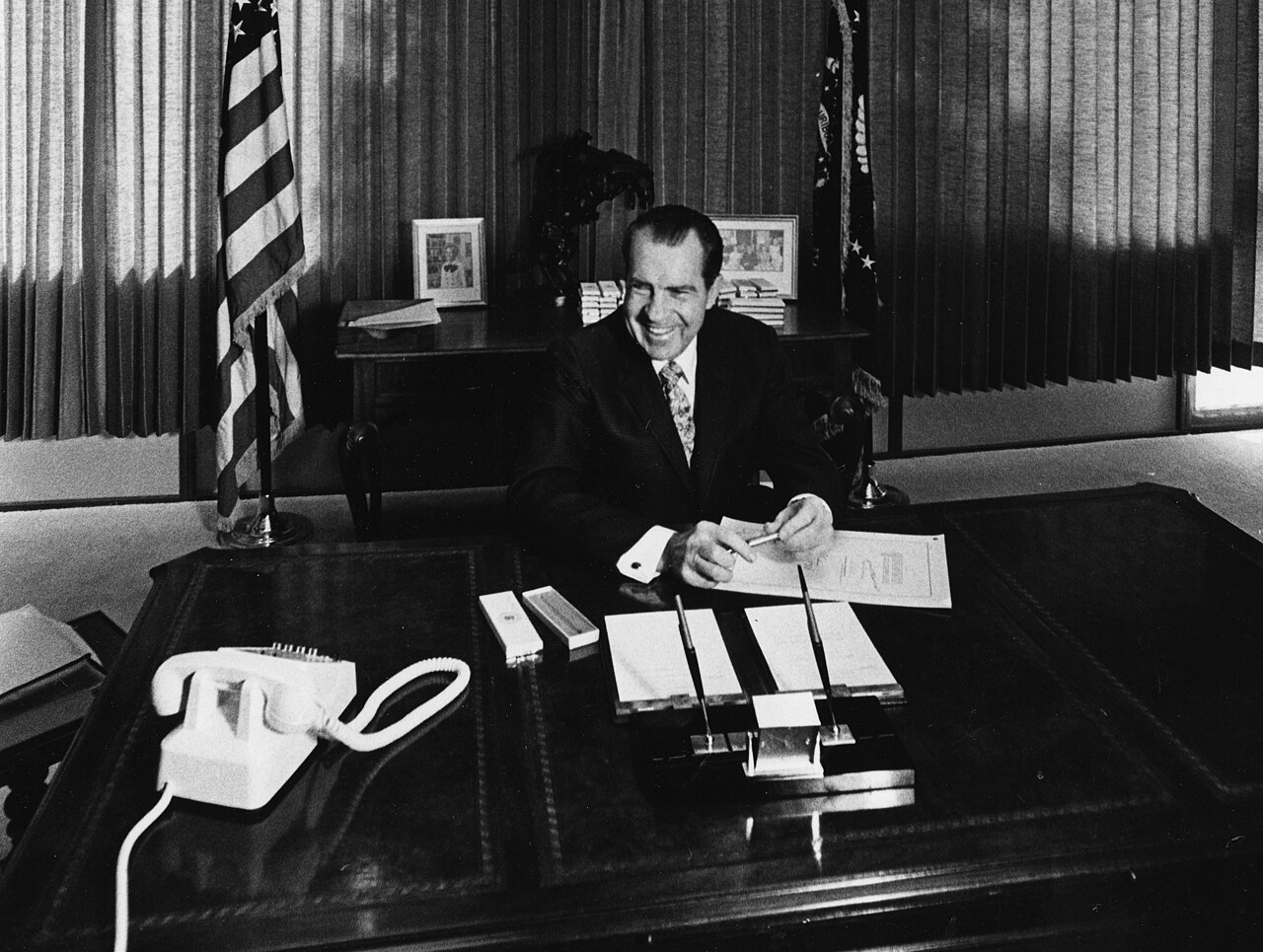
The Environmental Protection Agency was never created by a statute that says "there is established an Environmental Protection Agency." It was assembled under the President's reorganization authority. On July 9, 1970, Nixon sent Congress Reorganization Plan No. 3 with a message explaining that "our national government today is not structured to make a coordinated attack on the pollutants which debase the air we breathe, the water we drink, and the land that grows our food."12 He admitted the plan cut against his own stated view of government: "In proposing that the Environmental Protection Agency be set up as a separate new agency, I am making an exception to one of my own principles: that, as a matter of effective and orderly administration, additional new independent agencies normally should not be created."12
The idea came from the President's Advisory Council on Executive Organization, chaired by Roy L. Ash, founder of Litton Industries.9 The plan pulled together pieces of three departments, three bureaus, three administrations, two councils, one commission and one service. Interior gave up the Federal Water Quality Administration and its pesticide work. Health, Education, and Welfare gave up the National Air Pollution Control Administration and other programs.9 House and Senate subcommittees held hearings in July and August 1970. Representative John Dingell of Michigan proposed a cabinet-level Department of Environmental Quality instead. Both subcommittees approved the President's plan.9
William D. Ruckelshaus, 38, a former Indiana deputy attorney general and state house majority leader, was named by Nixon on November 6, confirmed by the Senate on December 2, and sworn in on December 4, 1970. EPA treats December 2 as its birthday.13 At his confirmation hearing Ruckelshaus told senators that his mission was "to be as forceful as the laws that Congress has provided."9 He described the arrangement exactly. The agency's powers came from statutes, many of them written in the years just after it opened. Its existence as a single independent body came from an executive plan that Congress allowed to stand.
The Clean Water Act, October 18, 1972
The Federal Water Pollution Control Act Amendments of 1972, Senate bill S. 2770, set a national goal "that the discharge of pollutants into the navigable waters be eliminated by 1985."14 Nixon vetoed the bill on October 17, 1972. His objection was cost: "a bill whose laudable intent is outweighed by its unconscionable $24 billion price tag." He had proposed $6 billion over three years. He singled out a provision raising the federal share of sewage plant construction "from 55 percent to 75 percent" and $750 million to reimburse local governments for plants built between 1956 and 1966. "I am prepared for the possibility that my action on this bill will be overridden," he wrote.15
He was. The Senate overrode the veto the same day, 52 to 12, and the House followed on October 18, 247 to 23.16 The law is dated October 18, 1972, as Public Law 92-500.17
Its jurisdictional key sits in section 502(7), now 33 U.S.C. 1362(7):
The term "navigable waters" means the waters of the United States, including the territorial seas.1817
That is the whole definition. All of it. The statute uses the old constitutional and admiralty phrase "navigable waters," then defines it with a phrase, "waters of the United States," that it does not define at all. EPA's own explanatory page says so plainly: "The Clean Water Act does not define 'waters of the United States.' Since the 1970s, EPA and the Department of the Army have defined 'waters of the United States' by regulation."19 The term governs whether a landowner needs a federal permit to fill a wet spot, whether a ditch is regulated, and whether a rancher is liable for civil penalties.
The result was a half-century of litigation. EPA's page lists the Supreme Court decisions: United States v. Riverside Bayview Homes in 1985, Solid Waste Agency of Northern Cook County v. Army Corps of Engineers in 2001, Rapanos v. United States in 2006, and Sackett v. EPA in 2023.19 The last of those began in Idaho. Michael and Chantell Sackett bought a lot near Priest Lake, Idaho, "and began backfilling the lot with dirt to prepare for building a home." EPA told them their property contained wetlands and that the backfilling violated the act.20 On May 25, 2023, the Court held that the act "extends to only those 'wetlands with a continuous surface connection to bodies that are "waters of the United States" in their own right,' so that they are 'indistinguishable' from those waters."20 Even after that ruling, the definition is not settled in practice. As of this writing EPA reports that its 2023 rule, as amended to conform to Sackett, applies in about half the states (23 by the count of Harvard's Environmental and Energy Law Program), the District of Columbia and the territories, while in the rest the agencies use "the pre-2015 regulatory regime" read in light of Sackett. A new proposal issued in November 2025 was supplemented on September 9, 2026.19
Four words, left undefined in 1972, have been defined and redefined by regulation since the 1970s and have reached the Supreme Court in four major cases. Like wetlands protection or hate it, that is a fact about who made the law. Congress set the reach of federal power over private land in a phrase and left the agencies and the courts to supply the content.


The land statutes multiply
The Bureau of Land Management's own timeline shows how fast the statutory layers piled up. The Wilderness Act of 1964 protected 9.1 million acres and created a process for designating more. Then came the Wild and Scenic Rivers Act and National Trails System Act in 1968, NEPA, the Wild Free-Roaming Horses and Burros Act in 1971, the Endangered Species Act in 1973, FLPMA in 1976, the Surface Mining Control and Reclamation Act in 1977, the Public Rangelands Improvement Act in 1978, the Archaeological Resources Protection Act in 1979 and the Alaska National Interest Lands Conservation Act in 1980.21 Each statute added a duty, a review, a permit or a protected class of land or animal. None removed one.
The Supreme Court confirmed how much room Congress had. The horses and burros act was challenged by New Mexico, which argued that the Property Clause let Congress only dispose of federal land, make incidental rules and protect the property itself. In Kleppe v. New Mexico, decided June 17, 1976, the Court rejected that reading. "The decided cases have supported this expansive reading," the Court said, and it repeated an earlier holding that "[t]he power over the public land thus entrusted to Congress is without limitations." It added, more cautiously, that "the furthest reaches of the power granted by the Property Clause have not yet been definitively resolved."22 Four months later Congress used that power to write retention into law.
FLPMA, October 21, 1976: retention becomes the policy
The Federal Land Policy and Management Act, Public Law 94-579, was approved October 21, 1976.23 BLM calls it the bureau's "legislative 'charter.'"21 Section 102 opens with thirteen declarations of policy. The first is the one that ended an era:
Subsection (a) begins "The Congress declares that it is the policy of the United States that" and then lists its items. The first reads:
(1) the public lands be retained in Federal ownership, unless as a result of the land use planning procedure provided for in this Act, it is determined that disposal of a particular parcel will serve the national interest;2423
Look at how that sentence is built. Retention is the rule. Disposal is the exception, and it requires two things: the agency's own planning process must produce it, and it must be found to "serve the national interest." The burden runs one way. A county, a state or a would-be buyer cannot trigger disposal by asking. The same section required that "the United States receive fair market value of the use of the public lands and their resources unless otherwise provided for by statute," and that management be "on the basis of multiple use and sustained yield unless otherwise specified by law."23
FLPMA did more than declare. Section 603 ordered the Secretary, within fifteen years, to review "those roadless areas of five thousand acres or more and roadless islands of the public lands" that had wilderness characteristics and recommend which should become wilderness.23 Those wilderness study areas are managed to protect their wilderness character until Congress acts, which in many cases it has not. Section 702 repealed the homestead laws outright for the lower 48 states, with Alaska given ten more years.23 The Congressional Research Service puts the shift in one line: "It was not until the enactment of the Federal Land Policy and Management Act of 1976 (FLPMA) that Congress expressly declared that the remaining public domain lands generally would remain in federal ownership."1
The numbers show what had already gone before. CRS reports that about 1.29 billion acres of public domain passed out of federal ownership between 1781 and 2024: 816 million acres to private owners, including railroads, 328 million acres to states generally, and 144 million acres in Alaska under state and Native selection laws. Ninety-seven percent of the transfers to private ownership happened before 1940. Homestead entries peaked in 1910 at 18.3 million acres, fell below 200,000 acres a year after 1935, and ended entirely in 1986.1 FLPMA did not stop a flood. It closed a tap that had slowed to a drip, and it made the closure official.
Where the land is today
CRS's September 2026 update counts roughly 640 million federal acres, about 28 percent of the 2.27 billion acres in the United States. Four land agencies manage 606.8 million of those acres: BLM 244.4 million, the Forest Service 193.1 million, the Fish and Wildlife Service 89.3 million and the National Park Service 80.1 million. The Department of Defense manages 8.4 million more.1 The concentration is western. Federal land is 60.8 percent of Alaska and 45.9 percent of the eleven contiguous western states, against 4.1 percent of the other states.1
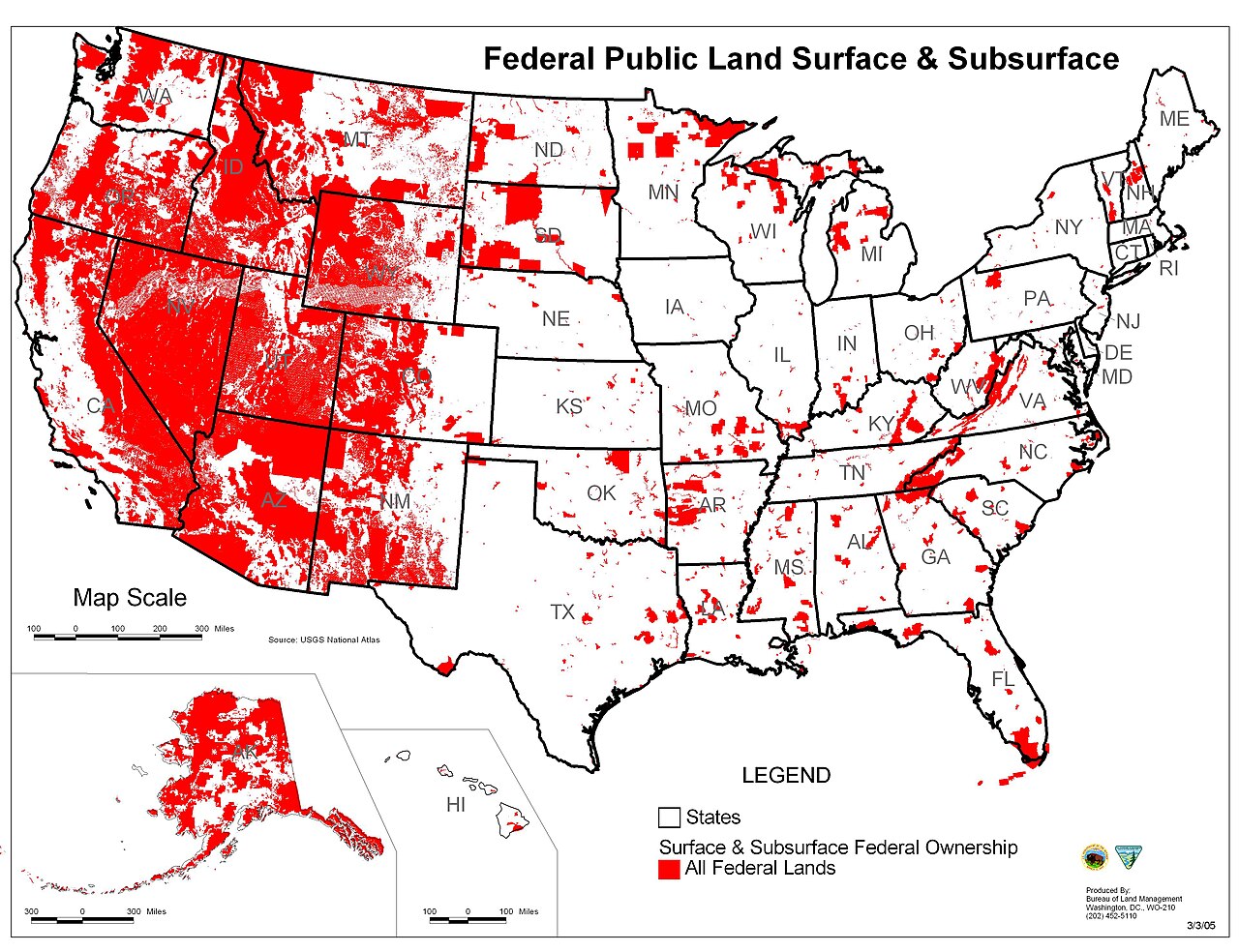

Idaho's line in CRS Table 1 reads 32,785,766 federal acres out of 52,933,120, or 61.9 percent. Of that, the Forest Service manages 20,451,561 acres, BLM 11,768,027, the Park Service 512,086, Fish and Wildlife 51,002 and Defense 3,090.1 Only Nevada and Utah have a larger federal share. CRS notes that its figures cover five agencies and so slightly understate the true total.1
Idaho agreed to this arrangement at statehood, in words written by its own constitutional convention. Article XXI, section 19 of the Idaho Constitution says: "the people of the state of Idaho do agree and declare that we forever disclaim all right and title to the unappropriated public lands lying within the boundaries thereof," which "shall be subject to the disposition of the United States."26 In 1890 "disposition" was the operative expectation. In 1976 Congress chose retention instead. The disclaimer did not change. What changed was the federal policy the disclaimer was written to accommodate.
PILT, October 20, 1976: the price of permanence
One day before FLPMA, on October 20, 1976, Public Law 94-565 became law: the Payment in Lieu of Taxes Act.27 CRS explains its logic in terms that echo the Aspinall commission: PILT "was enacted in response to a shift in federal policy from one that prioritized disposal of federal lands" to "one that prioritized retention of federal lands, in perpetuity, for public benefit." Under the older policy, CRS adds, federal ownership "was considered to be temporary." CRS cites the commission's 1970 report as background.28
The formula as enacted and as it stands
The 1976 act authorized the Secretary of the Interior to pay each unit of local government containing "entitlement lands," and said the payments "may be used by such unit for any governmental purpose." The amount was "the greater of" two figures: 75 cents for each acre of entitlement land, reduced by certain other federal land payments the county had received the year before, or 10 cents per acre with no reduction. Either figure was capped by population. A county with fewer than 5,000 people could receive no more than $50 per resident; larger counties faced a sliding cap per resident that fell as population rose.27
FLPMA itself had promised as much. The last of its thirteen policy declarations said the federal government "should, on a basis equitable to both the Federal and local taxpayer, provide for payments to compensate States and local governments for burdens created as a result of the immunity of Federal lands from State and local taxation."23 PILT was the payment.
The current text, 31 U.S.C. 6903, keeps the same two-track structure. Subsection (b)(1) provides that a payment "is equal to the greater of" (A) a per-acre amount that reached "$1.65 during fiscal year 1999 and thereafter, for each acre of entitlement land located within a unit of general local government (but not more than the limitation determined under subsection (c) of this section) reduced (but not below 0) by amounts the unit received in the prior fiscal year under a payment law," or (B) "22 cents during fiscal year 1999 and thereafter, for each acre of entitlement land located in the unit," subject to the same limitation.29 The "payment laws" whose receipts are deducted are listed in subsection (a)(1) and include Forest Service receipt sharing and the Secure Rural Schools act, the Mineral Leasing Act payments, and Taylor Grazing Act receipts.29 Subsection (a)(3) provides that a unit "may not be credited with a population of more than 50,000." Subsection (c) sets the population cap: $110 per person at a population of 5,000, falling step by step to $44 per person at 50,000.29 Subsection (d) orders the Secretary every October 1 to adjust "each dollar amount specified in subsections (b) and (c) to reflect changes in the Consumer Price Index."29
Because of that inflation clause, the dollar figures printed in the code are not what counties are paid. CRS reports that in fiscal year 2025 the per-acre rates were $3.46 under Alternative A and $0.50 under Alternative B, and in fiscal year 2026 they were $3.55 and $0.51.28 The higher rate is offset by the prior-year receipts; the lower rate is not. A county gets whichever produces more, and neither may exceed its population cap.30
| Element | 1976 act (Pub. L. 94-565) | Current statute, 31 U.S.C. 6903 | FY2026 as applied |
|---|---|---|---|
| Alternative A, per acre | 75 cents, less prior-year receipts | $1.65 base, less prior-year receipts, CPI-adjusted | $3.55 |
| Alternative B, per acre | 10 cents, no offset | 22 cents base, no offset, CPI-adjusted | $0.51 |
| Population cap, small units | $50 per person under 5,000 | $110 per person at 5,000 or fewer, CPI-adjusted | Adjusted annually by Interior |
| Largest population credited | 50,000 | 50,000 | 50,000 |
Sources: Pub. L. 94-565; 31 U.S.C. 6903; CRS R46260.272928
What Idaho receives
Interior's state-by-state table shows Idaho's PILT payments as $41,152,787 in fiscal year 2024, $42,973,738 in fiscal year 2025 and $49,562,605 in fiscal year 2026. The national totals for the same years were $621,235,188, $644,769,260 and $733,041,949.2 Idaho's 2026 payment was about 6.8 percent of the national total. Interior announced the 2026 payments on June 23, 2026, saying more than 1,900 state and local governments would share $733 million, and that "payments are calculated based on the number of acres of Federal land within each county or jurisdiction and the population of that area." The same release notes that Interior collects $18.7 billion a year in revenue from commercial activity on public lands.31 Since payments began in 1977, the department says, it has distributed $13.4 billion in PILT to 49 states, every state but Rhode Island, plus the District of Columbia, Puerto Rico, Guam and the Virgin Islands.32
A rough comparison helps. Idaho's 2026 PILT payment divided by Idaho's 32.8 million federal acres works out to about $1.51 per federal acre. That is a crude ratio, since not every federal acre is entitlement land and many counties also receive receipt-sharing payments that PILT deducts, but it shows the scale. CRS attributes the large jump from 2025 to 2026 mainly to "a decrease in prior-year timber deductions."30 So when other federal payments to a county fall, PILT rises to partly fill the hole, and when they rise, PILT falls.
The money has not always arrived in full. CRS reports that PILT ran on discretionary appropriations from 1976 through fiscal 2007, and that "for many of the earlier years (e.g., FY1995-FY2007), the discretionary appropriations were not at the full authorized level, so each county received a prorated payment." Since fiscal 2008 it has mostly been funded by mandatory appropriations, and from fiscal 2018 through 2026 generally at the full authorized level. As of August 26, 2026, CRS reported, no fiscal 2027 appropriation for PILT had been enacted.2830 A county budget that depends on PILT depends on Congress renewing it.
The Sagebrush Rebellion, 1979 to 1981
The western reaction arrived within three years. CRS describes FLPMA's "declaration of permanent federal land ownership" as "a significant factor in what became known as the Sagebrush Rebellion, an effort in the 1970s and 1980s to strengthen state or local control over federal land and management decisions."1 Nevada moved first, with a 1979 statute claiming the BLM land inside its borders. Arizona, New Mexico, Utah, Washington and Wyoming followed with their own claim statutes, which CRS cites by code section.1 Idaho does not appear on CRS's list of claim statutes.
The Christian Science Monitor, reporting from Denver on November 18, 1980, described the stakes as a possible transfer of "as much as 400 million acres of public lands in West from federal to state hands." It reported that Ronald Reagan, campaigning that summer, had told Utah Republicans in Salt Lake City: "I happen to be one who cheers and supports the sagebrush rebellion. Count me in as a rebel."33 The same story noted that Carter's Interior Secretary was "Idaho environmentalist Cecil Andrus," who had "shown little if any support for the sagebrush rebels," and that bills by Senator Orrin Hatch of Utah and Representative Jim Santini of Nevada would have created a commission and an "orderly process" for transferring BLM and Forest Service lands to the states.33
The Monitor was direct about who was paying for the movement: "The lion's share of the political and financial backing for this movement has come from Western ranchers, reacting to changes in BLM practices." It tied those changes to a 1973 lawsuit by the Natural Resources Defense Council that forced BLM to prepare grazing environmental impact statements, "some 145 impact statements covering 143 million acres of Western rangeland by 1988," and to FLPMA's multiple-use mandate.33 The rebellion was a response to NEPA and FLPMA working as written. Polling was mixed. A survey across eight Rocky Mountain states found about 30 percent favoring state takeover and 60 percent opposed, with Nevada the exception.33
After the election, President-elect Reagan sent a telegram to a "Sagebrush Convention" in Salt Lake City: "I renew my pledge to work toward a 'sagebrush solution.' My administration will work to ensure that states have an equitable share of public lands and their natural resources."34 The pledge produced little. CRS's verdict is short: the rebellion "was not successful in achieving this end, either through legal challenges in the federal courts or through efforts to persuade the Reagan Administration and Congress to transfer the lands to state or private ownership."1 The question returned decades later. In 2024 Utah asked the Supreme Court for leave to file an original suit asking whether "perpetual federal retention of unappropriated public lands in Utah is unconstitutional." The United States opposed it, and in January 2025 the Court denied leave to file.1
Idaho's own record from these years points in a different direction. On July 23, 1980, in the middle of the rebellion, Congress passed the Central Idaho Wilderness Act, designating "approximately two million two hundred and thirty-nine thousand acres" in six national forests as the River of No Return Wilderness. The act's findings called the Salmon River country "the largest block of primitive and undeveloped land in the conterminous United States." One stated purpose was to "end the controversy over which lands within the central Idaho region will be designated wilderness," so that adjacent lands "better suited for multiple uses other than wilderness" would be managed under existing plans.35 The statute was a negotiated settlement: more wilderness, in exchange for certainty about the rest. That is how land policy in Idaho has usually moved. By statute, area by area, rather than by wholesale transfer.
Chevron, June 25, 1984: deference becomes doctrine
The last piece of the lock-in came from the Court. The Clean Air Act Amendments of 1977 required permits for "new or modified major stationary sources" in areas that had not met air quality standards. In 1981, after a new administration took office, EPA issued regulations letting states treat a whole plant as a single "source," the so-called bubble concept, so that a company could add equipment without a permit if total plant emissions did not rise. The Court of Appeals set the rule aside. The Supreme Court reversed.36
Justice John Paul Stevens wrote for a Court of six; Justices Marshall, Rehnquist and O'Connor took no part. His opinion laid down the two-step test that governed federal administrative law for forty years:
When a court reviews an agency's construction of the statute which it administers, it is confronted with two questions. First, always, is the question whether Congress has directly spoken to the precise question at issue. If the intent of Congress is clear, that is the end of the matter; for the court, as well as the agency, must give effect to the unambiguously expressed intent of Congress. If, however, the court determines Congress has not directly addressed the precise question at issue, the court does not simply impose its own construction on the statute, as would be necessary in the absence of an administrative interpretation. Rather, if the statute is silent or ambiguous with respect to the specific issue, the question for the court is whether the agency's answer is based on a permissible construction of the statute.36
Stevens grounded the rule in accountability. "Judges are not experts in the field, and are not part of either political branch of the Government," he wrote. "While agencies are not directly accountable to the people, the Chief Executive is, and it is entirely appropriate for this political branch of the Government to make such policy choices."36
The irony is that Chevron upheld a deregulatory rule from the Reagan EPA. Its logic was neutral as to direction. But its effect on statutes like the Clean Water Act was large. A phrase like "waters of the United States" is the very definition of a statute "silent or ambiguous with respect to the specific issue," and under Chevron the agency's reading would stand if it was permissible. Each new administration could reread the same words. On June 28, 2024, in Loper Bright Enterprises v. Raimondo, the Court wrote: "Chevron is overruled. Courts must exercise their independent judgment in deciding whether an agency has acted within its statutory authority, as the APA requires."37 Lesson 17 takes up that decision and its companions.
Through Pierson's Framework
Pierson defines institutionalism as "a political, educational, and cultural mindset" that "defends and preserves institutions" on "habit, identity, and survival instinct" rather than on "performance or morality."38 He insists that the problem begins after an institution is built, often from sincere motives: "somewhere along the line, the mission is replaced by the machinery, and survival becomes the goal."38 The 1964 to 1984 period is useful for testing that claim because the founding documents are short, public and dated. The mission can be read in the words of those who wrote it.
Start with name versus function. Pierson's method judges an institution by what it does, not what it calls itself. The Clean Water Act is the cleanest example in this lesson. The statute calls its jurisdiction "navigable waters." Its definition removes navigability from the test and replaces it with an undefined phrase. Fifty-four years later the agencies are still revising the definition, and the scope of federal permitting over a backyard in Priest Lake was settled by the Supreme Court, not by Congress. A citizen who reads the name learns nothing about the function. The same is true of "Payments in Lieu of Taxes." The commission that designed the program said in 1970 that the payments "should not represent full tax equivalency."7 The name suggests a substitute for a tax. The design says it is a discounted grant, subject to appropriation and prorated in lean years.
Next, accountability. Pierson's ordered liberty requires that "governments and institutions must operate under law, truth, and justice," and his Anti-Federalist appendix warns of power that becomes "insulated from public accountability" through "bureaucratic complexity."3940 The record here is mixed. FLPMA and PILT were statutes, debated and voted on by elected members, many of them westerners. The Aspinall commission had twelve members of Congress among its nineteen and heard over 900 witnesses. That is accountable lawmaking. But two of the period's most durable institutions were not made that way. EPA exists as a single agency because of a reorganization plan, and the commission itself reported that the disposal policy had been "rendered ineffective" by "administrative action" while the statutes still said otherwise.6 The executive branch changed the policy first. Congress wrote it down later.
Then the habit test. Pierson describes institutionalism as the mindset that says "Trust the system," not because it earns trust daily, "but because it once did."38 Retention in FLPMA was framed as a planning default: keep land unless planning shows disposal serves the national interest. Read as written, it invited ongoing judgment, parcel by parcel. In practice the default became the outcome. The planning process that was supposed to identify parcels for release has produced no large-scale release in fifty years, and a western state that asked the Supreme Court to hear the question in 2024 was turned away without argument. Whether that is wise policy is a separate question. Under Pierson's test, a rule written as a rebuttable presumption now functions as a fixed condition, and its defense rests largely on the fact that it has always been so.
Chevron fits the same pattern. Stevens justified deference by tying agencies to an accountable President. That is a real argument and it deserves respect. Over forty years, though, the doctrine let each administration reread the same statutory words, and agencies came to treat ambiguity as a grant of power rather than a gap for Congress to close. Pierson's appendix describes institutions that "entrench policies behind procedure" and become "self-justifying, declaring their actions lawful simply because they are legal."40 A statute that says nothing precise, read by an agency that is told to fill the silence, is close to that description.
Ordered liberty has a second half. Pierson's framework is a duty to hold government accountable and a duty to support legitimate government. It treats the citizen as "the moral auditor of government," and it rejects the idea that "an enlightened elite must impose order."41 An honest audit of these decades has to record what the institutions were built to fix. Before 1969 federal agencies could approve dams, roads and mines with no written analysis of what they would destroy. Sewage went into rivers. The western rangeland was overgrazed, by the Monitor's own 1980 account of what government studies showed.33 The Sagebrush Rebellion was funded mostly by ranchers who wanted the grazing rules relaxed. Supporting legitimate government means crediting the problems these laws addressed. Holding it accountable means asking whether the institutions still answer to anyone when they get the answer wrong. Pierson's own line is the right standard: institutions "exist to serve liberty, not to redefine it."40
Hard Questions and Answers
FLPMA passed an elected Congress. Isn't calling democratic legislation a "lock-in" just sour grapes from the side that lost the vote?
The vote was legitimate. The word describes the legal structure, and the structure is the problem. FLPMA was lawful and democratic. The Supreme Court had just held in Kleppe that the Property Clause power is "without limitations" in its ordinary reach.22 Idaho's constitution disclaims the unappropriated public lands.26 No serious reading of the record makes retention illegal. The term "lock-in" refers to how the statute allocates the burden. Retention is the default, and disposal requires the managing agency's own planning process to find that a parcel "will serve the national interest."24 The people most affected by the decision, counties and states, have no mechanism in the statute to trigger it. CRS's history confirms that later attempts by states to change the result, through state claim statutes in 1979 and 1980 and through Utah's 2024 Supreme Court filing, all failed.1 FLPMA was democratic. It was also built so that the people who live with it cannot reopen it on their own.
Idaho signed away the land in its own constitution. Isn't the western complaint just buyer's remorse?
Largely, yes, and western readers should take that straight. Idaho's Article XXI, section 19 is explicit: "we forever disclaim all right and title to the unappropriated public lands." The 1980 Monitor story quoted legal experts who gave Nevada's planned suit "a poor chance of success" because "most of the land involved was reserved by the federal government whe[n] territories became states."2633 The Supreme Court's 2025 refusal to hear Utah's complaint leaves that position standing.1 The fair objection to the lesson's framing is that it implies a broken bargain. The record supports something narrower. The disclaimer left the land "subject to the disposition of the United States," and in 1890 disposition was the federal policy. The disclaimer has not been broken. The federal policy it assumed was replaced in 1976, and the states had no say in the replacement beyond their members' votes in Congress.
PILT sent Idaho almost $50 million in fiscal 2026. When does the complaining stop?
It is real money, and in fiscal 2026 it was the highest Idaho has received in the three years Interior's current table shows.2 Whether it is fair depends on the comparison. The program's own designers did not intend it to equal a tax. The Aspinall commission recommended a discount of 10 to 40 percent below tax equivalency.7 The formula offsets other federal payments, so a county's PILT goes down when its timber or mineral receipts go up.2930 Population caps limit large payments to sparsely populated counties with huge federal acreage. And for thirteen years, fiscal 1995 through 2007, Congress appropriated less than the authorized amount and counties were prorated.28 A defender can point to Interior's $13.4 billion in total payments since 1977 and can argue that federal land usually demands fewer county services than private development would, though no study measuring it turned up.32 Both points are fair. Nobody here has run a county-by-county tax comparison, and anyone who quotes a figure in either direction without one is guessing.
The environmental laws did what they were passed to do. Why go after laws that performed?
Performance should count, and Pierson's own definition says so: institutionalism is the defense of institutions "not based on performance."38 An institution that performs is not the target. No water or air quality outcomes from 1972 to 2026 are measured here, and that is a real limit. Readers who want these laws to have failed should notice that nothing in the record reviewed here says they did. The critique is narrower. It concerns who was handed the authority. The Clean Water Act set its reach in an undefined phrase, and the agencies have redefined that phrase repeatedly, with the line still unsettled in about half the states as of September 2026.19 The 1985 zero-discharge goal is still written in the statute as a "national goal."14 A law can succeed at cleaning rivers and still leave its jurisdiction to be supplied by whichever administration holds office.
Chevron saved a Reagan deregulation rule and kept unelected judges out of policy. Isn't calling it a power grab just hindsight from people who disliked what later agencies did?
Partly, and Stevens's opinion backs the objection. He wrote that judges "are not part of either political branch" and that the President is accountable to the people, so policy choices left open by Congress belong with the executive.36 The case itself upheld a Reagan-era rule that loosened permitting. Chevron was not designed as a tool for regulatory expansion and was used in both directions. Defenders who praise it as judicial humility have to own the other half, though: its long-run effect on Congress and the agencies. When ambiguity is resolved by deference, Congress has less reason to resolve it, and agencies have room to change course with each election. In 2024 the Court concluded that the doctrine was inconsistent with the Administrative Procedure Act's instruction that courts decide questions of law.37 That holding is the Court's, and lesson 17 examines its reasoning and its critics.
Strip out the states' rights talk. Wasn't the Sagebrush Rebellion just ranchers wanting cheaper grass?
Mostly, by the contemporary reporting. Ranchers were the core. The Christian Science Monitor wrote in 1980 that "the lion's share of the political and financial backing" came from western ranchers reacting to BLM grazing reviews forced by a 1973 NRDC lawsuit, and that "past government studies suggest that much of this land is being severely overgrazed."33 That is a fair description of the money behind the movement. It does not settle the constitutional and representational question the rebels raised. FLPMA made permanent a federal ownership share that in Idaho is now 61.9 percent and in Nevada 79.8 percent, compared with 4.1 percent outside the West and Alaska.1 A citizen in those states lives with a level of federal landlord power that most Americans never meet. Interested motives and a real structural grievance can sit in the same movement.
Learn more
- Federal Land Policy and Management Act of 1976, Pub. L. 94-579: the statute as enacted, including section 102's retention policy and section 702's homestead repeal.
- Payment in Lieu of Taxes Act, Pub. L. 94-565: the original 75-cent and 10-cent formula and population table.
- One Third of the Nation's Land (1970): the full Public Land Law Review Commission report, with all 137 recommendations.
- CRS, Federal Land Ownership: Overview and Data (R42346): current acreage by state and agency, updated September 2026.
- Interior Department PILT program: payments by state and county, back to 1999.
- 33 U.S.C. 1362: the Clean Water Act's definitions, including "navigable waters."
- Sackett v. EPA (2023): the Priest Lake, Idaho case that narrowed "waters of the United States."
- Chevron v. NRDC (1984): the deference opinion that governed for forty years.
- Module 51: Mercantilism: background on state-directed control of land and resources.
- Module 52: Ordered Liberty: Pierson's framework for accountability and support of legitimate government.
Notes
- Congressional Research Service, Federal Land Ownership: Overview and Data, Report R42346, updated September 14, 2026, summary, historical background and Tables 1, 2 and 4 (data as of September 30, 2024). Text read from the EveryCRSReport mirror because congress.gov blocks automated retrieval. Read it online. Mirror at EveryCRSReport. ↩
- U.S. Department of the Interior, PILT "Payments by State" table, FY2024, FY2025 and FY2026 payments (Idaho and national totals). Read it online. ↩
- Public Land Law Review Commission Act, Pub. L. 88-606, 78 Stat. 982 (Sept. 19, 1964), sections 1 to 4. Read it online. ↩
- Public Land Law Review Commission, One Third of the Nation's Land: A Report to the President and to the Congress (Washington, DC: GPO, 1970), transmittal letter dated June 20, 1970, and introduction. Read it online. ↩
- Public Land Law Review Commission, One Third of the Nation's Land (1970), summary of recommendations ("One hundred thirty-seven specific recommendations"). Read it online. ↩
- Public Land Law Review Commission, One Third of the Nation's Land (1970), "A Program for the Future," on the policy of large-scale disposal. Read it online. ↩
- Public Land Law Review Commission, One Third of the Nation's Land (1970), "A Program for the Future" (payments in lieu of taxes) and summary list of numbered recommendations, Recommendation 102. Read it online. ↩
- National Environmental Policy Act of 1969, Pub. L. 91-190, 83 Stat. 852 (Jan. 1, 1970), sections 101 and 102(2)(C) as enacted. Read it online. ↩
- U.S. Environmental Protection Agency, "The Guardian: Origins of the EPA," EPA Historical Publication, Spring 1992 (archived page). Read it online. ↩
- 42 U.S.C. 4331(a), Congressional declaration of national environmental policy (Legal Information Institute). Read it online. ↩
- 42 U.S.C. 4332(2)(C) and editorial notes on the 2023 amendment by Pub. L. 118-5, section 321 (Legal Information Institute). Read it online. ↩
- Richard Nixon, Special Message to Congress transmitting Reorganization Plan No. 3 of 1970 (July 9, 1970), condensed text posted by EPA; full text in Public Papers of the Presidents: Richard Nixon, 1970, pp. 578 to 586. Read it online. ↩
- U.S. Environmental Protection Agency, "The Origins of EPA" (EPA History). Read it online. ↩
- 33 U.S.C. 1251(a)(1), Congressional declaration of goals and policy (Legal Information Institute). Read it online. ↩
- Richard Nixon, "Veto of the Federal Water Pollution Control Act Amendments of 1972," October 17, 1972, The American Presidency Project. Read it online. ↩
- Senate Committee on Environment and Public Works, Clean Water Restoration Act, S. Rep. No. 111-361 (2010), citing 118 Cong. Rec. 36,879 (Senate override vote, 52 to 12) and 37,060 to 37,061 (House override vote, 247 to 23). The 2010 bill this report accompanied did not become law. Dates from the Voteview roll call files for the 92nd Congress: Senate roll call 955, October 17, 1972, 52 to 12; House roll call 648, October 18, 1972, 247 to 23 (voteview.com, S092 and H092 rollcalls). Read it online. ↩
- Federal Water Pollution Control Act Amendments of 1972, Pub. L. 92-500, 86 Stat. 816 (Oct. 18, 1972), section 502(7). Read it online. ↩
- 33 U.S.C. 1362(7), definition of "navigable waters" (Legal Information Institute). Read it online. ↩
- U.S. Environmental Protection Agency, "About Waters of the United States" (page reflecting the September 9, 2026 supplemental notice of proposed rulemaking and current implementation status). Read it online. ↩
- Sackett v. Environmental Protection Agency, 598 U.S. 651 (2023), slip opinion, decided May 25, 2023. Read it online. ↩
- Bureau of Land Management, "National Timeline" (entries for 1964, 1968, 1970, 1971, 1973, 1976, 1977, 1978, 1979 and 1980). Read it online. ↩
- Kleppe v. New Mexico, 426 U.S. 529 (1976), decided June 17, 1976 (Legal Information Institute). Read it online. ↩
- Federal Land Policy and Management Act of 1976, Pub. L. 94-579, 90 Stat. 2743 (Oct. 21, 1976), sections 102, 603 and 702. Read it online. ↩
- 43 U.S.C. 1701(a)(1), declaration of policy (Legal Information Institute). Read it online. ↩
- Bureau of Land Management, "Map of all U.S. Federal Land" (2005), Wikimedia Commons file page. Read it online. ↩
- Idaho Constitution, Article XXI, Section 19 (Idaho Legislature). Read it online. ↩
- Payment in Lieu of Taxes Act, Pub. L. 94-565, 90 Stat. 2662 (Oct. 20, 1976), sections 1 and 2. Read it online. ↩
- Congressional Research Service, The Payments in Lieu of Taxes (PILT) Program: An Overview, Report R46260, updated August 31, 2026, sections on history, authorizations, and per-acre rates for FY2025 and FY2026. Read it online. Mirror at EveryCRSReport. ↩
- 31 U.S.C. 6903, Payments (Legal Information Institute), subsections (a) to (d). Read it online. ↩
- Congressional Research Service, Payments in Lieu of Taxes (PILT): Section 6902 Payments, In Focus IF11772, updated August 24, 2026. Read it online. Mirror at EveryCRSReport. ↩
- U.S. Department of the Interior, "Interior Department Announces $733 Million to Support Communities," press release, June 23, 2026. Read it online. ↩
- U.S. Department of the Interior, Payments in Lieu of Taxes program home page (history and June 23, 2026 notice). Read it online. ↩
- David F. Salisbury, "Sagebrush rebels see open range in Reagan's victory," Christian Science Monitor, November 18, 1980. Read it online. ↩
- Forest History Society, "1980 Sagebrush Rebellion," States' Rights Timeline, quoting Forest Service Daily News Digest, December 1, 1980. Read it online. ↩
- Central Idaho Wilderness Act of 1980, Pub. L. 96-312, 94 Stat. 948 (July 23, 1980), sections 2 to 4. Read it online. ↩
- Chevron U.S.A. Inc. v. Natural Resources Defense Council, Inc., 467 U.S. 837 (1984), argued Feb. 29, 1984, decided June 25, 1984 (Legal Information Institute). Read it online. ↩
- Loper Bright Enterprises v. Raimondo, 603 U.S. 369 (2024), slip opinion, syllabus, decided June 28, 2024. Read it online. ↩
- Jeff A. Pierson, "The Acacia Illusion: How Institutionalism Mimics Nature's Most Subtle Manipulation," in The Ordered Liberty Papers (2025). Read it online. ↩
- Jeff A. Pierson, Ordered Liberty Reclaimed: A Foundation for Liberty. Read it online. ↩
- Jeff A. Pierson, "The Anti-Federalist Warning: Institutional Power and the Fragility of Liberty," appendix to Ordered Liberty Reclaimed: A Foundation for Liberty. Read it online. ↩
- Jeff A. Pierson, The Ordered Liberty Papers (section on Civic Anti-Authoritarianism). Read it online. ↩
Terms in this lesson
- Retention policy
- FLPMA's 1976 declaration that the public lands be kept in federal ownership unless federal land use planning finds that disposing of a parcel serves the national interest.
- Disposal
- Transfer of federal public domain land out of federal ownership, by sale, homestead, grant to railroads or states, or other means. The dominant federal land policy before the twentieth century.
- Entitlement land
- Federal land, defined in the PILT statute, for which the Interior Department makes payments in lieu of taxes to local governments.
- PILT
- Payments in Lieu of Taxes, the federal program created in 1976 that pays counties a formula amount per acre of entitlement land, limited by population and reduced by certain other federal land payments.
- Waters of the United States
- The phrase the Clean Water Act uses to define navigable waters. The statute does not define it, so EPA and the Army Corps of Engineers define it by regulation.
- Environmental impact statement
- The detailed statement NEPA section 102(2)(C) requires for major federal actions significantly affecting the quality of the human environment.
- Reorganization plan
- A presidential proposal, under authority Congress delegated, to move or combine executive functions. EPA was created this way in 1970.
- Sagebrush Rebellion
- The 1979 to early 1980s movement in western states, backed largely by ranchers, to transfer BLM and other federal lands to state control.
- Chevron deference
- The 1984 rule that courts accept an agency's permissible reading of an ambiguous statute it administers. Overruled in Loper Bright v. Raimondo (2024).
- Wilderness study area
- BLM roadless land reviewed under FLPMA section 603 for possible wilderness designation and managed to protect wilderness character until Congress decides.
Sources
- Federal Land Policy and Management Act of 1976, Pub. L. 94-579 checked 2026-10
- 43 U.S.C. 1701 checked 2026-10
- 31 U.S.C. 6903 checked 2026-10
- 33 U.S.C. 1362 checked 2026-10
- Payment in Lieu of Taxes Act, Pub. L. 94-565 checked 2026-10
- CRS R42346, Federal Land Ownership: Overview and Data (Sept. 14, 2026) checked 2026-10
- CRS R46260, The PILT Program: An Overview (Aug. 31, 2026) checked 2026-10
- Interior Department PILT payments by state checked 2026-10
- One Third of the Nation's Land (1970) checked 2026-10
- National Environmental Policy Act, Pub. L. 91-190 checked 2026-10
- Federal Water Pollution Control Act Amendments of 1972, Pub. L. 92-500 checked 2026-10
- Sackett v. EPA (2023) checked 2026-10
- Chevron v. NRDC (1984) checked 2026-10
- Kleppe v. New Mexico (1976) checked 2026-10