Lesson 5 of 19 · about 30 minutes
The Madisonian Design: Faction, Dual Sovereignty and Checks
You'll be able to
- Explain Madison's argument in Federalist 10 for an extended republic and Brutus's reply that a free republic could not survive over so large a country
- Describe dual sovereignty as Madison presented it in Federalist 39, 45 and 46, and read Hamilton's Federalist 28 accurately on state governments as the people's organized means of redress
- Trace the checks of Federalist 47, 48 and 51 and the judicial argument of Federalist 78 against Brutus 11 and 15
- Apply Pierson's test of function over name to the design, including the uncomfortable fact that the Constitution expected officeholders to defend their offices
Start here: the short version
"Ambition must be made to counteract ambition," Federalist 51 says.1 The men who wrote the Constitution did not trust virtue to restrain power, so they built a government that runs on rival appetites. A large republic would dilute faction. Two levels of government would watch each other. Each department's officers would fight for their own ground. The Anti-Federalists answered that the machine would drift toward one consolidated government, and that federal judges with life tenure would answer to no one. Both sides took it for granted that institutions would defend themselves. They split over whether that self-defense would protect the people or bury them. Pierson's framework asks the same thing more bluntly: is an institution defended because it works, or because it exists?
Challenge
If "checks and balances" sounds like a guarantee, look at what the design runs on: officeholders guarding their own turf, the same reflex Pierson calls institutionalism once it outlives its purpose. The first real test, the constitutional fight over the bank, was settled inside the executive branch, and no state had a voice. If the founders sound like one voice for small government, Hamilton read "necessary" as "useful, or conducive to" in 1791, after Federalist 45 had promised powers "few and defined." And if Federalist 46 reads like a license for private resistance, it routes redress through state governments. Federalist 28 treats citizens who "rush tumultuously to arms" as the failure case. The authors fought over the design from the start. Neither the reverent reading nor the story of a pure founding later betrayed survives the essays themselves.
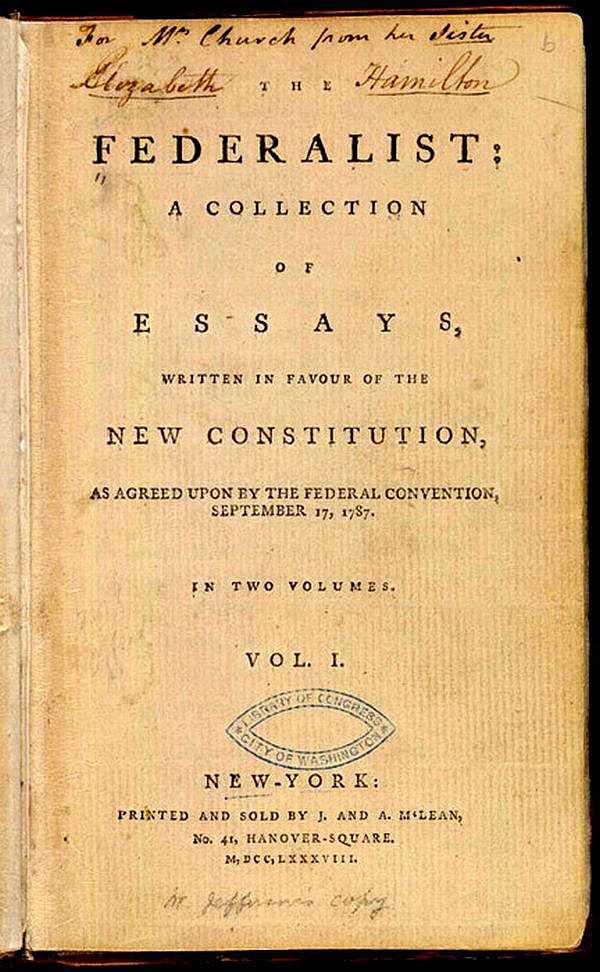
Between October 1787 and the spring of 1788, New York newspapers ran a fight over the proposed Constitution in which nobody signed his real name. One side wrote as "Publius." Behind the mask stood Alexander Hamilton, James Madison and John Jay, who turned out eighty-five essays later collected as The Federalist.2 The other side used pen names too. "Brutus," whose first essay appeared on October 18, 1787, is usually taken to be Robert Yates, a New York delegate to the Philadelphia convention, though Herbert Storing, the leading editor of the Anti-Federalist writings, called that attribution "somewhat questionable."3 The "Federal Farmer" dated his first letter October 8, 1787. Nobody has settled who he was.4
Read side by side, the essays are an engineering dispute. Publius describes a machine. Brutus describes how it breaks. Territorial governors, regulatory commissions and everything after them were bolted onto that machine later, and nobody can judge the additions without knowing how the original was supposed to run.

Faction and the extended republic: Federalist 10
Federalist 10 opens on a problem every state government of the 1780s knew well. Madison defined it with care: "By a faction, I understand a number of citizens, whether amounting to a majority or a minority of the whole, who are united and actuated by some common impulse of passion, or of interest, adversed to the rights of other citizens, or to the permanent and aggregate interests of the community."6
Look at the phrase "majority or a minority." Small cabals were the lesser worry. Madison feared majorities that vote themselves the property or rights of others. His list of such projects was concrete: "A rage for paper money, for an abolition of debts, for an equal division of property, or for any other improper or wicked project."6
He then closed off the easy cures. Faction could be removed only by "destroying the liberty which is essential to its existence" or by "giving to every citizen the same opinions, the same passions, and the same interests."6 The first was worse than the disease. The second was impossible: "The latent causes of faction are thus sown in the nature of man." And the deepest source was economic: "the most common and durable source of factions has been the various and unequal distribution of property." Creditors and debtors, landed and manufacturing, mercantile and moneyed interests "grow up of necessity in civilized nations."6
From there Madison drew a sentence that bears directly on this module: "The regulation of these various and interfering interests forms the principal task of modern legislation, and involves the spirit of party and faction in the necessary and ordinary operations of the government."6 Lawmaking would be a brawl among interests, and Madison said so out loud. And he warned against counting on wise referees: "Enlightened statesmen will not always be at the helm."6
So the cure had to be structural. "The inference to which we are brought is, that the CAUSES of faction cannot be removed, and that relief is only to be sought in the means of controlling its EFFECTS."6 A minority faction could be outvoted. A majority faction was the hard case, and the answer was size. "Extend the sphere, and you take in a greater variety of parties and interests; you make it less probable that a majority of the whole will have a common motive to invade the rights of other citizens."6 Representation would add a filter. A republic, Madison wrote, "by which I mean a government in which the scheme of representation takes place, opens a different prospect."6
Brutus answers: too big to govern freely
Brutus had already made the opposite argument, and made it first. His opening essay, published five weeks before Federalist 10, relied on Montesquieu and concluded "that a free republic cannot succeed over a country of such immense extent, containing such a number of inhabitants, and these increasing in such rapid progression as that of the whole United States."3
His reason was about accountability. "The confidence which the people have in their rulers, in a free republic, arises from their knowing them, from their being responsible to them for their conduct, and from the power they have of displacing them when they misbehave: but in a republic of the extent of this continent, the people in general would be acquainted with very few of their rulers: the people at large would know little of their proceedings, and it would be extremely difficult to change them."3 Where Madison saw distance as a filter against passion, Brutus saw distance as a shield for rulers.
Brutus also predicted the direction of drift. Writing about the necessary and proper clause, he stated a law of behavior that Pierson's acacia essay would echo two centuries later: "it is a truth confirmed by the unerring experience of ages, that every man, and every body of men, invested with power, are ever disposed to increase it, and to acquire a superiority over every thing that stands in their way."7 Whatever the Constitution "wants of being a complete consolidation," he concluded, "it will necessarily acquire in its exercise and operation."7
Neither man was naive. Madison expected factions and built around them. Brutus expected the builders to become a faction themselves.
Two governments watching each other: Federalist 39, 45 and 46
The second layer of friction was federalism. Madison described the plan in Federalist 39 as "in strictness, neither a national nor a federal Constitution, but a composition of both."8 The national government's "jurisdiction extends to certain enumerated objects only, and leaves to the several States a residuary and inviolable sovereignty over all other objects."8
Federalist 45 put the division in the sentence most quoted by later defenders of state power: "The powers delegated by the proposed Constitution to the federal government are few and defined. Those which are to remain in the State governments are numerous and indefinite."9 Federal powers would be "exercised principally on external objects, as war, peace, negotiation, and foreign commerce." State powers would "extend to all the objects which, in the ordinary course of affairs, concern the lives, liberties, and properties of the people."9
The same essay contains a line more useful to this module than the famous one. Madison asked whether "the solid happiness of the people is to be sacrificed to the views of political institutions of a different form," and answered that "the public good, the real welfare of the great body of the people, is the supreme object to be pursued; and that no form of government whatever has any other value than as it may be fitted for the attainment of this object."9 He followed it with a dare: "Were the plan of the convention adverse to the public happiness, my voice would be, Reject the plan. Were the Union itself inconsistent with the public happiness, it would be, Abolish the Union."9 That is a test of function over form, written by the chief architect of the form.
The people as the common superior
Federalist 46, printed January 29, 1788, answered critics who imagined the state and federal governments as rivals with no referee. "They must be told that the ultimate authority, wherever the derivative may be found, resides in the people alone."10 Madison predicted that "the first and most natural attachment of the people will be to the governments of their respective States," because more citizens would hold state office and state governments handled "all the more domestic and personal interests of the people."10
He then described what would happen if federal power overreached. Against an unpopular federal measure, the means of opposition were "powerful and at hand": "The disquietude of the people; their repugnance and, perhaps, refusal to co-operate with the officers of the Union; the frowns of the executive magistracy of the State; the embarrassments created by legislative devices."10 If many states felt the same threat, "They would be signals of general alarm. Every government would espouse the common cause. A correspondence would be opened. Plans of resistance would be concerted."10
Madison went further than many modern readers expect. He counted a federal army of "twenty-five or thirty thousand men" against "a militia amounting to near half a million of citizens with arms in their hands, officered by men chosen from among themselves."10 He wrote this to reassure skeptics that consolidation could not be forced. Read in context, Federalist 46 describes a balance of power in which state governments organize the public, and the threat of force sits at the far end of a long list of lawful obstruction.
Federalist 28, read accurately
Hamilton's Federalist 28 gets quoted as a license for rebellion. Finish the paragraph and it argues the other way. Hamilton began with the premise that "the whole power of the proposed government is to be in the hands of the representatives of the people," which he called "the essential, and, after all, only efficacious security for the rights and privileges of the people."11 Only "If the representatives of the people betray their constituents" did he reach "that original right of self-defense which is paramount to all positive forms of government."11
Then came his point about structure. In a single unified state, citizens resisting usurpation "can take no regular measures for defense. The citizens must rush tumultuously to arms, without concert, without system, without resource."11 A federal system changes that, because the states are already organized governments: "Power being almost always the rival of power, the general government will at all times stand ready to check the usurpations of the state governments, and these will have the same disposition towards the general government. The people, by throwing themselves into either scale, will infallibly make it preponderate. If their rights are invaded by either, they can make use of the other as the instrument of redress."11
The instrument of redress in Federalist 28 is a government. Hamilton's claim is that "the State governments will, in all possible contingencies, afford complete security against invasions of the public liberty by the national authority," because "The legislatures will have better means of information. They can discover the danger at a distance."11 He was describing elected bodies with records, budgets and voices, standing between citizens and a distant power. That is the opposite of a call to private insurrection, and lesson 18 returns to it for that reason.

Departments that defend themselves: Federalist 47, 48 and 51
The third layer of friction ran inside each government. Federalist 47 laid down the premise: "The accumulation of all powers, legislative, executive, and judiciary, in the same hands, whether of one, a few, or many, and whether hereditary, selfappointed, or elective, may justly be pronounced the very definition of tyranny."13 Federalist 48 added that writing the boundaries down would not be enough. Asking whether it would suffice "to trust to these parchment barriers against the encroaching spirit of power," Madison answered that "experience assures us, that the efficacy of the provision has been greatly overrated."14
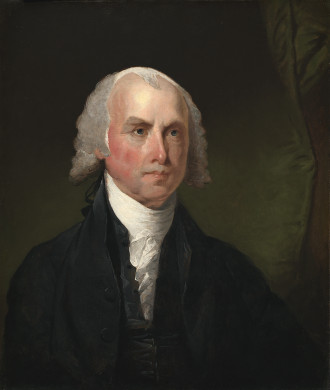
Federalist 51, published February 8, 1788, supplied the working mechanism. Avalon and the Library of Congress both list its author as "Hamilton or Madison," but modern scholarship generally credits Madison. Founders Online prints it in The Papers of James Madison, and Frederick Mosteller and David Wallace's 1963 statistical study of word usage concluded that "Madison rather than Hamilton wrote all 12 of the disputed papers," No. 51 among them.15 The essay states the design in a few lines:
"Ambition must be made to counteract ambition. The interest of the man must be connected with the constitutional rights of the place. It may be a reflection on human nature, that such devices should be necessary to control the abuses of government. But what is government itself, but the greatest of all reflections on human nature? If men were angels, no government would be necessary. If angels were to govern men, neither external nor internal controls on government would be necessary. In framing a government which is to be administered by men over men, the great difficulty lies in this: you must first enable the government to control the governed; and in the next place oblige it to control itself."1
The next sentence sets the order of priority: "A dependence on the people is, no doubt, the primary control on the government; but experience has taught mankind the necessity of auxiliary precautions."1 Elections come first. Structure is the backup.
Federalist 51 also named the whole arrangement. "In the compound republic of America, the power surrendered by the people is first divided between two distinct governments, and then the portion allotted to each subdivided among distinct and separate departments. Hence a double security arises to the rights of the people. The different governments will control each other, at the same time that each will be controlled by itself."1 And it gave the reason for all of it: "Justice is the end of government. It is the end of civil society."1
Each department, the essay said, "should have a will of its own," and its members "should have as little agency as possible in the appointment of the members of the others."1 The Constitution then made exceptions everywhere: the President nominates judges, the Senate confirms them, and Congress creates every federal court below the Supreme Court.16 Those overlaps were deliberate. A department with no handle on the others could not defend itself.
The least dangerous branch: Federalist 78 against Brutus 11 and 15
The judiciary drew the hardest fire. Brutus 11, dated January 31, 1788, predicted that federal judges "will give the sense of every article of the constitution, that may from time to time come before them. And in their decisions they will not confine themselves to any fixed or established rules, but will determine, according to what appears to them, the reason and spirit of the constitution."17 "The opinions of the supreme court, whatever they may be, will have the force of law; because there is no power provided in the constitution, that can correct their errors, or controul their adjudications. From this court there is no appeal."17
He predicted how consolidation would come: "The judicial power will operate to effect, in the most certain, but yet silent and imperceptible manner, what is evidently the tendency of the constitution," which he named as "an entire subversion of the legislative, executive and judicial powers of the individual states."17 Every ruling on "the nature and extent of the general government, will affect the limits of the state jurisdiction."17
Brutus 15, dated March 20, 1788, sharpened the charge. The convention had made judges "independent, in the fullest sense of the word. There is no power above them, to control any of their decisions. There is no authority that can remove them, and they cannot be controlled by the laws of the legislature. In short, they are independent of the people, of the legislature, and of every power under heaven. Men placed in this situation will generally soon feel themselves independent of heaven itself."18 He did not oppose tenure during good behavior. His complaint was tenure combined with final authority over the meaning of the Constitution.
Hamilton's Federalist 78 answered from the other end. Of the three departments, he wrote, "the judiciary, from the nature of its functions, will always be the least dangerous to the political rights of the Constitution; because it will be least in a capacity to annoy or injure them."19 The executive "holds the sword of the community." The legislature "commands the purse." The judiciary "has no influence over either the sword or the purse" and "may truly be said to have neither FORCE nor WILL, but merely judgment."19
From that premise Hamilton built the case for review. "The interpretation of the laws is the proper and peculiar province of the courts. A constitution is, in fact, and must be regarded by the judges, as a fundamental law."19 If a statute conflicts with it, "the Constitution ought to be preferred to the statute." Under "a limited Constitution," courts have the "duty" to "declare all acts contrary to the manifest tenor of the Constitution void."19 Permanent tenure followed, because "nothing will contribute so much as this to that independent spirit in the judges which must be essential to the faithful performance of so arduous a duty."19
Each side was half right about what came next. Courts did become the final word on constitutional meaning, as Brutus feared. Courts were also, for long stretches, the only branch willing to tell Congress or the President no, as Hamilton hoped. Lesson 17 follows that tension into the 2020s, when the Supreme Court began cutting back the deference it had long given agencies. The question both men asked, whether an unelected body can be trusted to police the limits of power, is still open.
A bill of rights: Federalist 84, the Federal Farmer and the Ninth and Tenth Amendments
The Philadelphia draft had no bill of rights. Hamilton defended the omission in Federalist 84: bills of rights "are not only unnecessary in the proposed Constitution, but would even be dangerous. They would contain various exceptions to powers not granted; and, on this very account, would afford a colorable pretext to claim more than were granted. For why declare that things shall not be done which there is no power to do?"20 His closing move was to declare that "the Constitution is itself, in every rational sense, and to every useful purpose, A BILL OF RIGHTS."20
The Federal Farmer took the opposite view, and his argument rested on juries. Federalists said rights already secured by the state constitutions needed no federal guarantee. The Farmer answered in Letter IV that if the Constitution could be read "as to leave the trial by jury in civil causes, for instance, secured; on the same principles it would have left the trial by jury in criminal causes, the benefits of the writ of habeas corpus, &c. secured; they all stand on the same footing; they are the common rights of Americans, and have been recognized by the state constitutions."21 Since the convention had expressly protected habeas corpus and criminal juries, it plainly did not think state constitutions were enough, and leaving out the civil jury was a choice.21 He also defended the local jury, though not because neighbors would be kinder: "the trial of facts in the neighborhood is of great importance in other respects," he wrote, because "when trials of facts are removed to a distance from the homes of the parties and witnesses, oral evidence becomes intolerably expensive."21
The Anti-Federalists lost ratification and won this point. New Hampshire became the ninth state to ratify, and the Confederation Congress received word on July 2, 1788.22 The First Congress proposed twelve amendments, and ten were ratified on December 15, 1791.23 Two of them answered Hamilton's worry directly. The Ninth says the enumeration of rights "shall not be construed to deny or disparage others retained by the people." The Tenth says powers "not delegated to the United States by the Constitution, nor prohibited by it to the States, are reserved to the States respectively, or to the people."23
The machine's first test: the bank, 1791
The design was tested within two years. When Congress passed a bill to charter a national bank in February 1791, President Washington had written opinions on its constitutionality from his Secretary of State and his Attorney General, and then ordered his Secretary of the Treasury to answer them.24 Thomas Jefferson said the bill was unconstitutional. Quoting the proposed amendment that would become the Tenth, not yet ratified, he wrote: "To take a single step beyond the boundaries thus specially drawn around the powers of Congress, is to take possession of a boundless field of power, no longer susceptible of any definition."25
Hamilton said yes, and his reading of "necessary and proper" became the national government's working rule. "According to both, necessary often means no more than needful, requisite, incidental, useful, or conducive to."24 His test: "This criterion is the end, to which the measure relates as a mean. If the end be clearly comprehended within any of the specified powers, and if the measure have an obvious relation to that end, and is not forbidden by any particular provision of the Constitution, it may safely be deemed to come within the compass of the national authority."24
Washington signed the bill on February 25, 1791.26 Lesson 6 follows the money. Brutus had warned that the necessary and proper clause "may receive a construction to justify the passing almost any law."7 In the first serious dispute, broad construction won inside the executive branch before any court was asked. Madison's friction between nation and states did nothing here, because nobody pressed it. Officers of one branch argued it out, the President decided, and no state had a voice.
What the design did not cover
Every part of the Madisonian machine assumed a population organized into states. Article IV gave Congress power "to dispose of and make all needful Rules and Regulations respecting the Territory or other Property belonging to the United States."16 In the territories there were no state legislatures to raise "signals of general alarm," no state courts, and at first no elected assembly at all. Lesson 7 shows what was built there and what the Supreme Court later said about it.
Through Pierson's Framework
Pierson defines institutionalism as "a political, educational, and cultural mindset that defends and preserves institutions," and he names its grounds as "habit, identity, and survival instinct" in place of performance or morality.27 That definition is awkward for anyone who admires Federalist 51. Madison's design depends on officeholders defending their institutions. "The interest of the man must be connected with the constitutional rights of the place."1 A senator guarding the Senate's powers and a judge guarding the court's are doing what the design asks.
The difference is what the defense is for. In the Madisonian scheme, self-defense of an office is a means. It keeps power divided so that dependence on the people stays the "primary control on the government."1 Federalist 45 states the end without hedging: no form of government "has any other value than as it may be fitted for the attainment of" the real welfare of the people.9 An institution that defends its turf in order to keep any single power from swallowing the others is performing its function. An institution that defends its turf because it has always had that turf has crossed into what Pierson describes: "loyalty to process," which "assumes continuity equals virtue, structure guarantees truth, and outside critique is a threat by default."27
The Anti-Federalists saw this coming, and Pierson credits them for it. His appendix to Ordered Liberty Reclaimed says they "foresaw the very dangers modern citizens now face: the gradual accumulation of power by institutions insulated from public accountability, and the erosion of liberty through bureaucratic complexity, judicial arrogance, and executive overreach."28 Brutus's "silent and imperceptible" judicial consolidation is close kin to what Pierson calls "tyranny by sediment, the slow burial of liberty under layers of unchecked authority."28 Both describe power that grows by accretion, through ordinary rulings and routine practice, without a single dramatic seizure.
Pierson's test of function over name applies cleanly. The Constitution names three departments and two levels of government. Judging by function means asking, in each era, whether those names still describe who decides. When a regulatory body writes binding rules, enforces them and adjudicates violations, it performs all three functions Federalist 47 said should never be held "in the same hands," whatever the organization chart calls it.13 Lessons 10, 12 and 17 apply that question to the ICC, the New Deal agencies and the recent cases on agency adjudication.
Ordered liberty, in Pierson's sense, also cuts against the reading of the Federalist that treats it as a manual for resistance. He describes it as "mutual restraint: individuals must act with discipline and responsibility, and governments and institutions must operate under law, truth, and justice."29 Federalist 28 and 46 fit that frame. Both locate redress in organized, lawful, elected bodies, and both treat the people as the "common superior" whose judgment the governments compete for. Under Pierson's Civic Anti-Authoritarianism, "the citizen becomes the moral auditor of government."30 Madison and Hamilton would have recognized the auditor. They expected that auditor to work through state legislatures, elections and juries, the same channels Pierson's framework asks citizens to use first.
Hard Questions and Answers
Federalist 51 tells officeholders to guard their turf. Isn't Madison's machine just institutionalism with better manners?
Partly, yes. Federalist 51 puts self-interest to work on purpose: "supplying, by opposite and rival interests, the defect of better motives."1 The design assumes officeholders will defend their institutions whether or not they perform well. What separates it from Pierson's institutionalism is purpose and control. Madison put elections first and structure second, and he subordinated every form of government to "the real welfare of the great body of the people."9 When rival institutions stop checking each other and start covering for each other, the design has failed by its own terms. Nobody designed the machine to produce institutionalism. It can produce it anyway.
Brutus lost. Why should a losing pamphleteer's predictions count as evidence of anything?
Losing a vote says nothing about whether a forecast came true, and several of his did. He predicted the necessary and proper clause would be read broadly. Hamilton's 1791 bank opinion read it as "needful, requisite, incidental, useful, or conducive to," and that reading became the working rule.24 He predicted the Supreme Court's opinions would "have the force of law" with no appeal, which describes constitutional adjudication today.17 He was flatly wrong that a free republic could not survive over a large country. It did. Credit him with an accurate theory of institutional drift and a failed forecast of collapse.
Federalist 46 counts militia against regulars. Wasn't Madison openly planning for armed resistance to the federal government?
He mentioned force, and pretending he did not is dishonest. Madison wrote that if federal encroachment were not renounced, "the same appeal to a trial of force would be made" as against Britain, and he counted militia against regular troops.10 But the essay was written to persuade skeptics that the new government could never become a military tyranny, and it runs through a long sequence of lawful obstruction before it gets to force: refusal to cooperate, "the frowns of the executive magistracy of the State," legislative devices, and correspondence among states.10 The resistance he describes is organized by state governments. Federalist 28 says the same, contrasting organized state action with citizens who "rush tumultuously to arms, without concert."11 Neither essay supports private violence. Anyone who cites them for it has the order of operations backward.
Federalist 78 promised the weakest branch and delivered the branch with the last word on federal power. Wasn't Brutus simply right?
On reach, yes. Federal courts have decided the boundaries of federal power for two centuries, and Brutus said exactly that would happen.17 On danger, the record is mixed. Hamilton's premise was that courts lack "FORCE nor WILL," and courts still depend on the executive to enforce their judgments.19 Courts have also struck down overreach by the other two branches, which is what Hamilton said review was for. The judiciary grew more powerful than Hamilton promised. It did not become the tyranny Brutus feared. Both men lose something on that scorecard.
If the design was so clever, why didn't it stop the administrative state?
Incentives can line up as easily as they collide. Madison assumed each department would resist encroachment by the others. When Congress delegates rulemaking power to an agency, it gives power away on purpose, and nothing in Federalist 51 makes a department fight to keep work it would rather not do. The design also left the territories outside the federal-state balance entirely, under Article IV.16 Later lessons show agencies, legislative courts and territorial governments growing in exactly those two gaps, where no rival institution had a motive to push back.
The Federalist was campaign literature. Why hold anyone to sales copy?
Because the buyers relied on the sales copy. It was advocacy, written to win the ratification vote in New York, and it should be read that way.2 Its authors sometimes played down powers they later used. Hamilton's broad reading of the necessary and proper clause in 1791 sits badly beside Federalist 45's "few and defined."9 The essays are still the clearest statement of what supporters told the public the system would do, and a citizen can fairly hold the system to that promise. Courts have also cited them for two centuries as evidence of original meaning, so they shape the law whether or not they should.
Learn more
- The Federalist Papers (Avalon Project): full text of all eighty-five essays.
- Federalist Papers research guide (Library of Congress): texts, newspaper printings and digitized early editions.
- Brutus No. 1 (Teaching American History): the opening Anti-Federalist case against an extended republic.
- Brutus No. 11 (Teaching American History): the warning about the federal judiciary.
- The Founders' Constitution (University of Chicago Press): founding-era documents arranged clause by clause.
- Constitution transcription (National Archives): the text the debate was about.
- Hamilton's opinion on the bank (Avalon Project): the founding statement of broad construction.
- Module 53: Founding of the Republic: the convention and ratification in more detail.
- Module 52: Ordered Liberty: Pierson's framework of accountability and mutual restraint.
Notes
- The Federalist No. 51, "The Structure of the Government Must Furnish the Proper Checks and Balances Between the Different Departments," New York Packet, February 8, 1788. Avalon lists the author as "Hamilton or Madison"; the Library of Congress guide does the same. Avalon Project. Read it online. ↩
- Library of Congress, "Federalist Papers: Primary Documents in American History," Introduction (eighty-five essays by Hamilton, Madison and Jay under the name Publius, printed in New York newspapers in 1787 and 1788). Read it online. ↩
- "Brutus" No. 1, October 18, 1787, in Herbert J. Storing, ed., The Complete Anti-Federalist (University of Chicago Press, 1981), 2.9.1 and following; text and editor's note (Brutus "generally assumed to have been Robert Yates") via Teaching American History. Read it online. Storing's own introduction to Brutus, vol. 2, p. 358, notes that the attribution rests on Paul Leicester Ford, who gave no evidence, and calls it "somewhat questionable." Read it online. ↩
- "Federal Farmer" Letter I, dated October 8, 1787, in Storing, The Complete Anti-Federalist, vol. 2; text via Teaching American History. The author's identity is not settled. Read it online. ↩
- Title page, The Federalist: A Collection of Essays, Written in Favour of the New Constitution, vol. 1 (New York: J. and A. M'Lean, 1788). Wikimedia Commons file record (public domain). Read it online. ↩
- James Madison, The Federalist No. 10, "The Same Subject Continued: The Union as a Safeguard Against Domestic Faction and Insurrection," New York Packet, November 23, 1787, as Avalon and the Library of Congress guide give it; Founders Online, in The Papers of James Madison, dates the essay [22 November] 1787. Text from the Avalon Project, Yale Law School. Read it online. ↩
- "Brutus" No. 1, October 18, 1787, excerpt on the necessary and proper clause, in Philip B. Kurland and Ralph Lerner, eds., The Founders' Constitution, vol. 3, Article 1, Section 8, Clause 18, Document 4 (from Storing 2.9.8 to 9). Read it online. ↩
- James Madison, The Federalist No. 39, "The Conformity of the Plan to Republican Principles," Independent Journal, 1788. Avalon Project. Read it online. ↩
- James Madison, The Federalist No. 45, "The Alleged Danger From the Powers of the Union to the State Governments Considered," Independent Journal, 1788. Avalon Project. Read it online. ↩
- James Madison, The Federalist No. 46, "The Influence of the State and Federal Governments Compared," New York Packet, January 29, 1788. Avalon Project. Read it online. ↩
- Alexander Hamilton, The Federalist No. 28, "The Same Subject Continued: The Idea of Restraining the Legislative Authority in Regard to the Common Defense Considered," Independent Journal. Avalon Project. Read it online. ↩
- Gilbert Stuart, James Madison, oil on panel, about 1821, National Gallery of Art, Washington. Wikimedia Commons file record (public domain). Read it online. ↩
- James Madison, The Federalist No. 47, "The Particular Structure of the New Government and the Distribution of Power Among Its Different Parts," New York Packet, February 1, 1788. Avalon Project. Read it online. ↩
- James Madison, The Federalist No. 48, "These Departments Should Not Be So Far Separated as to Have No Constitutional Control Over Each Other," New York Packet, February 1, 1788. Avalon Project. Read it online. ↩
- Library of Congress, Federalist Papers guide, "Federalist Nos. 51-60" (author line for No. 51 reads "Alexander Hamilton or James Madison"). Read it online. On authorship: "The Federalist Number 51," [6 February] 1788, The Papers of James Madison, vol. 10, Founders Online, National Archives, read it online; Frederick Mosteller and David L. Wallace, "Inference in an Authorship Problem," Journal of the American Statistical Association 58, no. 302 (June 1963): 275 to 309 (the twelve disputed papers are Nos. 49 to 58, 62 and 63). ↩
- Constitution of the United States, transcription, National Archives (Article I, Section 8; Article III, Section 1; Article IV, Section 3). Read it online. ↩
- "Brutus" No. 11, January 31, 1788, in Storing, The Complete Anti-Federalist, vol. 2; text via Teaching American History. Read it online. ↩
- "Brutus" No. 15, March 20, 1788, in Storing, The Complete Anti-Federalist, 2:437 to 442; text via Teaching American History. Read it online. ↩
- Alexander Hamilton, The Federalist No. 78, "The Judiciary Department," from McLean's edition, New York, 1788. Avalon Project. Read it online. ↩
- Alexander Hamilton, The Federalist No. 84, "Certain General and Miscellaneous Objections to the Constitution Considered and Answered," from McLean's edition, New York, 1788. Avalon Project. Read it online. ↩
- "Federal Farmer" Letter IV, dated October 12, 1787, in Storing, The Complete Anti-Federalist, vol. 2; text via Teaching American History. Read it online. ↩
- National Archives, "A More Perfect Union: The Creation of the U.S. Constitution" (Confederation Congress received word of New Hampshire's ratification, the ninth, on July 2, 1788). Read it online. ↩
- The Bill of Rights, transcription and note, National Archives (ten of twelve proposed amendments ratified December 15, 1791; Ninth and Tenth Amendments). Read it online. ↩
- Alexander Hamilton, "Opinion as to the Constitutionality of the Bank of the United States," 1791 (opening: the Secretary of the Treasury, "having perused with attention the papers containing the opinions of the Secretary of State and Attorney General," proceeds "according to the order of the President"). Avalon Project. Read it online. ↩
- Thomas Jefferson, "Opinion on the Constitutionality of a National Bank," 1791. Avalon Project. Read it online. ↩
- An Act to incorporate the subscribers to the Bank of the United States, ch. 10, 1 Stat. 191 (approved February 25, 1791). U.S. Statutes at Large, vol. 1, Library of Congress. Read it online. ↩
- Jeff A. Pierson, "The Acacia Illusion: How Institutionalism Mimics Nature's Most Subtle Manipulation," in The Ordered Liberty Papers (2025). Read it online. ↩
- Jeff A. Pierson, "The Anti-Federalist Warning: Institutional Power and the Fragility of Liberty," appendix to Ordered Liberty Reclaimed: A Foundation for Liberty. Read it online. ↩
- Jeff A. Pierson, Ordered Liberty Reclaimed: A Foundation for Liberty (body text). Read it online. ↩
- Jeff A. Pierson, The Ordered Liberty Papers, section on Civic Anti-Authoritarianism (CAA). Read it online. ↩
Terms in this lesson
- Faction
- Madison's word, in Federalist 10, for a group of citizens, majority or minority, united by a passion or interest adverse to the rights of others or to the permanent interests of the community.
- Extended republic
- Madison's claim that a large representative republic takes in so many interests that no single faction is likely to form a lasting oppressive majority.
- Compound republic
- Federalist 51's name for the American system, in which power is first divided between two governments and then subdivided among separate departments within each.
- Dual sovereignty
- The arrangement described in Federalist 39 and 45 in which the national government holds enumerated powers and the states keep a residuary sovereignty over everything else.
- Auxiliary precautions
- Federalist 51's term for the structural checks that back up the primary control on government, which is dependence on the people.
- Parchment barriers
- Federalist 48's phrase for written boundaries between departments that have no practical means of enforcing themselves.
- Judicial review
- The power of courts to declare acts contrary to the Constitution void, defended in Federalist 78 and attacked by Brutus 11 and 15 as unchecked power.
- Anti-Federalists
- Opponents of ratification in 1787 and 1788, including the writers known as Brutus and the Federal Farmer, who warned that the new government would consolidate power and escape popular control.
Sources
- The Federalist No. 10 (Avalon Project) checked 2026-10
- The Federalist No. 28 (Avalon Project) checked 2026-10
- The Federalist No. 39 (Avalon Project) checked 2026-10
- The Federalist No. 45 (Avalon Project) checked 2026-10
- The Federalist No. 46 (Avalon Project) checked 2026-10
- The Federalist No. 51 (Avalon Project) checked 2026-10
- The Federalist No. 78 (Avalon Project) checked 2026-10
- The Federalist No. 84 (Avalon Project) checked 2026-10
- Brutus No. 1 (Teaching American History) checked 2026-10
- Brutus No. 11 (Teaching American History) checked 2026-10
- Brutus No. 15 (Teaching American History) checked 2026-10
- Federal Farmer, Letters I and IV (Teaching American History) checked 2026-10
- Constitution of the United States, transcription (National Archives) checked 2026-10