Lesson 12 of 19 · about 30 minutes
Progressive and New Deal Institutions, 1906 to 1946
You'll be able to
- Date and describe the main Progressive Era institutions: the 1906 food and drug law, the Federal Reserve Act, the Sixteenth Amendment and the Federal Trade Commission.
- Explain what Crowell v. Benson (1932), Panama Refining and Schechter Poultry (1935), and Humphrey's Executor (1935) held, quoting each accurately.
- Describe the Brownlow Committee's 1937 warning about a 'headless fourth branch' and the 1946 Administrative Procedure Act Congress passed in answer to a decade of debate.
- Trace the federal grazing district from the Taylor Grazing Act of 1934 to the creation of the Bureau of Land Management in 1946.
Start here: the short version
In October 1907 the overnight call money rate hit 100 percent, and the New York Stock Exchange stayed open because J. P. Morgan collected cash from large institutions and delivered it to the loan post on the floor. The country had no central bank. In a crisis it leaned on one private banker. The forty years from 1906 to 1946 replaced that kind of improvisation with most of what people now mean by "the federal government." Congress passed a food and drug law in 1906 and handed it to a scientific bureau to enforce. After the panic, a Senate commission and a secret meeting of bankers on a Georgia island produced the plan that became the Federal Reserve in 1913. The income tax amendment took effect the same year. The Federal Trade Commission followed in 1914. The Depression brought a flood of new agencies after 1933, and the Supreme Court spent the 1930s deciding which of them could stand. It let an agency find facts in workers' compensation cases but kept the final word on the facts that defined its power (Crowell v. Benson, 1932). It struck down the National Recovery Administration's codes as "delegation running riot" (Schechter Poultry, 1935). The same day it told President Roosevelt he could not fire a Federal Trade Commissioner at will (Humphrey's Executor, 1935). Roosevelt's own advisers warned in 1937 that the commissions were becoming "a headless fourth branch." Congress answered in 1946 with the Administrative Procedure Act, the rulebook agencies still follow. Out West, the Taylor Grazing Act of 1934 put the open range under federal permits, and in 1946 the Grazing Service merged with the old General Land Office to form the Bureau of Land Management.
Challenge
Anyone who sees the Federal Reserve as a neutral public body should start with Jekyll Island: its working plan was drafted by bankers under a duck-hunting cover story, and the participants did not admit the meeting until the 1930s. Anyone who sees it as a bankers' conspiracy should read on. Congress and Wilson rewrote the governance and gave the board to presidential appointees, and the system it replaced leaned on one private banker in a panic after which industrial output fell 17 percent. Admirers of the New Deal agencies have to explain why Roosevelt's own committee called the commissions a "headless fourth branch." Critics who say nothing checked the agencies have to explain a unanimous Court striking down the NIRA codes in 1935 and a Congress that passed the APA in 1946. Neither the planner nor the skeptic gets a clean win from these years.
Lesson 10 traced the first independent commission, the Interstate Commerce Commission of 1887, and the Civil Service Commission of 1883. Those were small and specific. What changed after 1906 was scale and method. Congress began writing statutes that set a goal and a standard and then assigned an agency to fill in the details, investigate, prosecute and decide cases. The legal fights of the 1930s were about how much of that a constitutional republic could allow.
Food, drugs and the scientific bureau, 1906
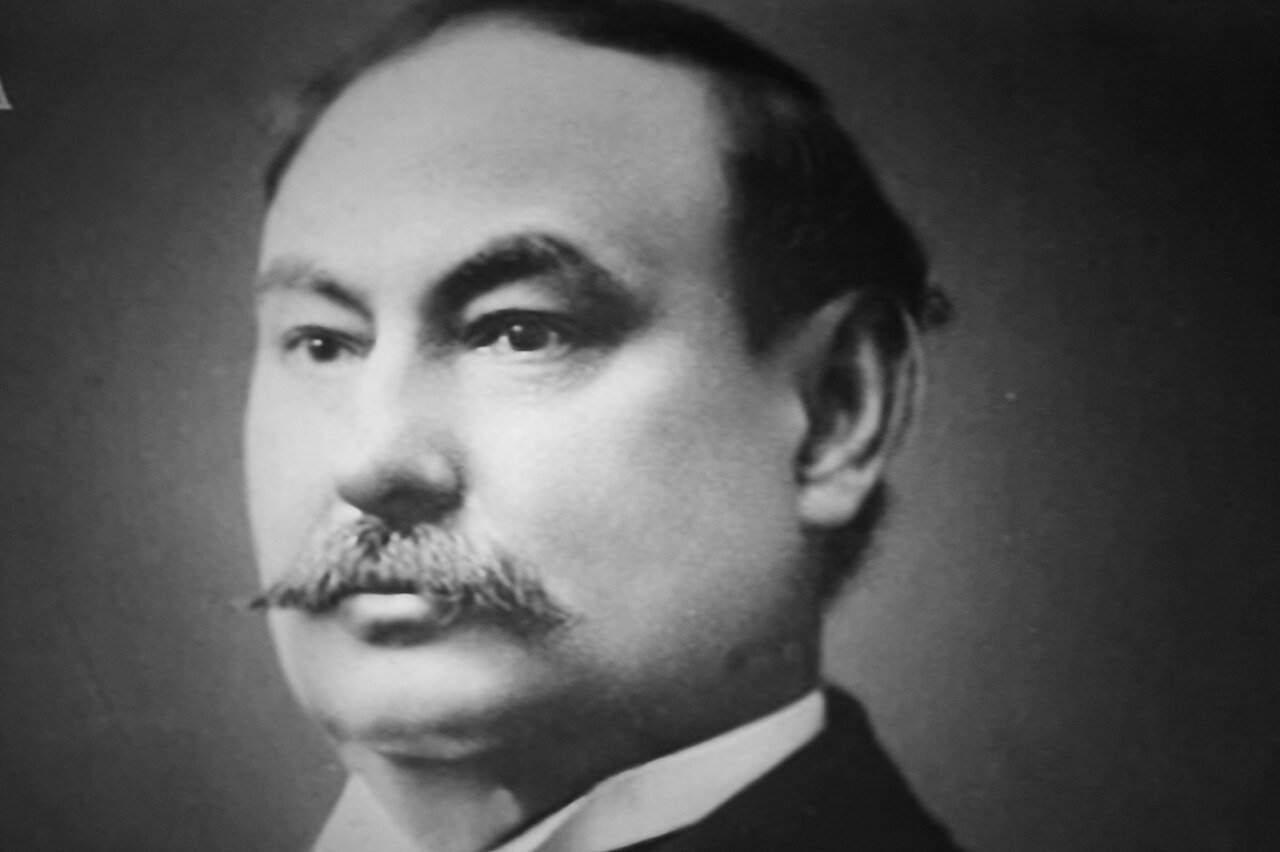

Congress had considered nearly 100 food and drug bills since 1879 before President Theodore Roosevelt signed the Food and Drugs Act on June 30, 1906.1 It was known as the Wiley Act after Harvey Washington Wiley, chief of the Department of Agriculture's Bureau of Chemistry, which administered it.1 The FDA's own history credits muckraking journalists and Upton Sinclair's novel The Jungle as "the final precipitating force" behind both a meat inspection law and the food and drug law that year.1
The 1906 act did not require approval before a product went on sale. It prohibited interstate shipment of adulterated or misbranded food and drugs, backed by seizure and prosecution, and it rested "on the regulation of product labeling rather than pre-market approval."1 Enforcement ran through the courts. The bureaucracy grew around it quickly. In 1907 Secretary of Agriculture James Wilson created a Board of Food and Drug Inspection to set enforcement policy, which the FDA history says diluted Wiley's personal authority, and in 1908 a Referee Board of Consulting Scientific Experts that undercut his scientific authority.1 Wiley resigned in 1912.1 Within six years of its birth, the man the law was named for had been outflanked by two boards his own department created, and he resigned.
The panic of 1907 and the road to the Federal Reserve
The United States had no central bank after Andrew Jackson's war on the Second Bank (lesson 8). When the Panic of 1907 hit, the country turned to one man. The Federal Reserve's own history puts it this way: "Finance mogul J.P. Morgan, who had bailed the government out of a financial crisis in 1895, organized private sector investments and lines of credit to stabilize the banking system."2
The panic began on October 16, 1907, when two speculators, F. Augustus Heinze and Charles W. Morse, failed in an attempt to corner the stock of United Copper. Runs spread to the New York trust companies, state-chartered institutions that held cash reserves of about 5 percent of deposits against 25 percent for national banks. The Knickerbocker Trust suspended operations on October 22 after depositors withdrew nearly $8 million. The overnight call money rate jumped from 9.5 percent to 70 percent that day and to 100 percent two days later. Morgan kept the New York Stock Exchange open by soliciting cash from large institutions and delivering it to the loan post on the floor.3 The damage reached the whole economy. Industrial output fell 17 percent in 1908 and real GNP fell 12 percent.3
Congress passed the Aldrich-Vreeland Act on May 30, 1908. It authorized emergency currency and created an eighteen-member National Monetary Commission chaired by Senator Nelson Aldrich of Rhode Island.2
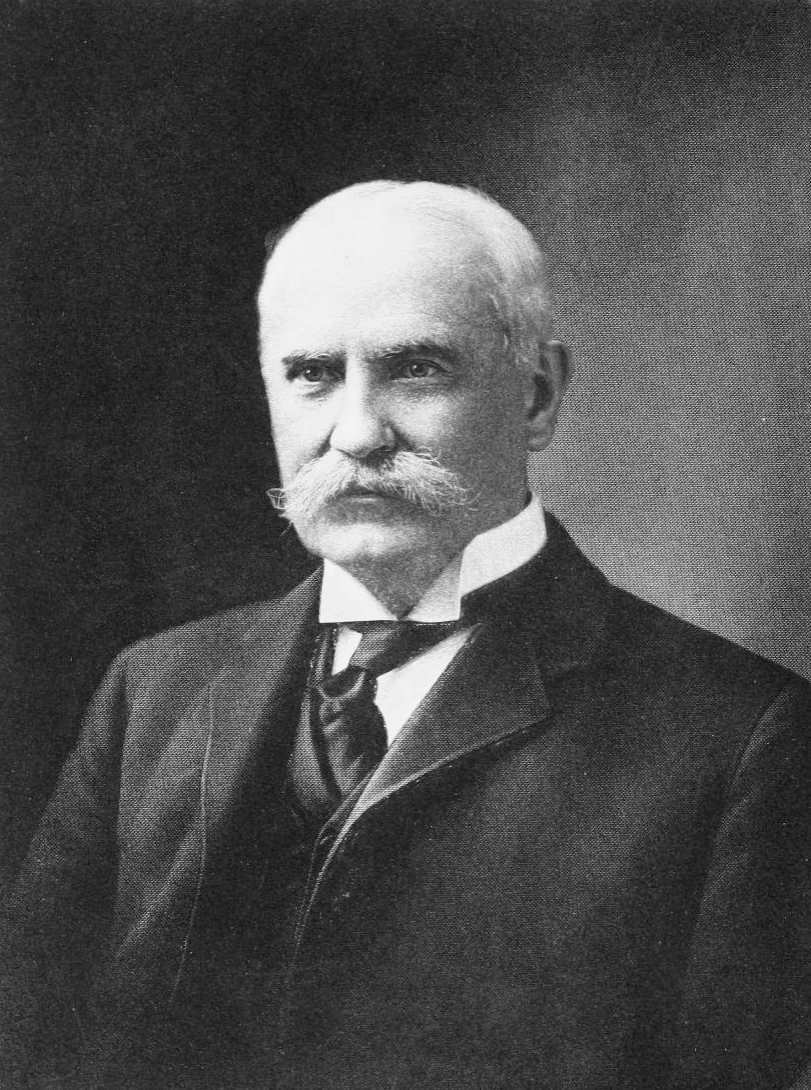

Jekyll Island, November 1910
In November 1910 six men met at the Jekyll Island Club off the Georgia coast to write a plan for a central bank: Senator Aldrich; his private secretary Arthur Shelton; Henry Davison, a partner at J.P. Morgan; A. Piatt Andrew, assistant secretary of the Treasury; Frank Vanderlip, president of National City Bank; and Paul Warburg of Kuhn, Loeb.4 The Federal Reserve History essay is direct about the secrecy. Aldrich "went to great lengths to keep the meeting secret, adopting the ruse of a duck hunting trip," and the men used only first names. "The meeting and its purpose were closely guarded secrets, and participants did not admit that the meeting occurred until the 1930s."4 Journalist B. C. Forbes revealed the trip in Leslie's Weekly in 1916; few readers noticed, and those who did dismissed it.4
The Jekyll Island plan proposed a single Reserve Association with fifteen branches, governed by boards elected by member banks, "with larger banks getting more votes."4 Aldrich presented it to the National Monetary Commission in January 1911 "without telling the commission members how the plan had been developed."4 Congressional committees attacked the plan "for giving too little control to the government and too much power to bankers." It called for a forty-six-member board with only six members appointed by the government.2 Democrats made repudiating it part of their 1912 platform.4
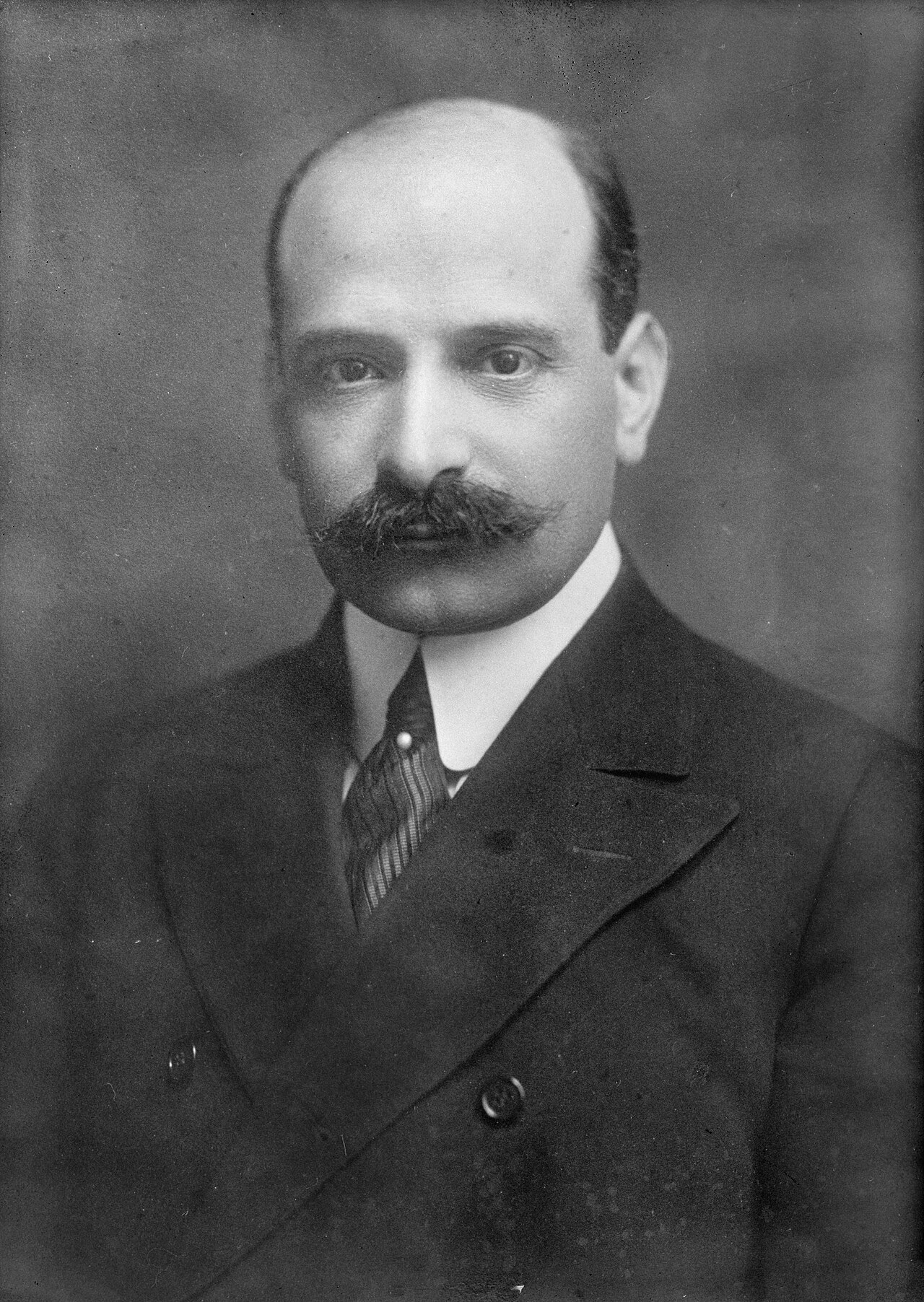

The Federal Reserve Act, December 23, 1913
The Democratic Congress wrote its own bill. Representative Carter Glass and his adviser H. Parker Willis wanted regional banks and little central control. President Woodrow Wilson insisted on a central board of public officials. The Federal Reserve Board as enacted was made up entirely of presidential appointees, ex officio cabinet members and appointed members with staggered ten-year terms, so that no president could appoint all of them during a two-term presidency. Bankers got a voice through a Federal Advisory Council of twelve bankers chosen by the regional banks.2 The act divided the country into between eight and twelve districts, each with one Federal reserve city.5
The statute's long title states its purposes: "An Act To provide for the establishment of Federal reserve banks, to furnish an elastic currency, to afford means of rediscounting commercial paper, to establish a more effective supervision of banking in the United States, and for other purposes."5 It was approved December 23, 1913.5
The Federal Reserve's own historians say the technical details of the final act "closely resembled those of the Aldrich Plan. The major differences were the political and decision-making structures."4 The bankers' design supplied the machinery. The elected government changed who controlled it. Readers who encounter claims that the Fed was "created in secret by bankers" should know that the secret meeting is documented by the Fed itself, and so is the fact that Congress and Wilson rewrote the governance before passage.
In 1935 the structure shifted toward Washington. The Banking Act of 1935, signed August 23, renamed the board the Board of Governors, removed the Secretary of the Treasury and the Comptroller of the Currency from it after 1936, and created the modern Federal Open Market Committee: the seven governors, the president of the New York Fed and four other reserve bank presidents in rotation.6 The reserve banks, the Fed's history says, "lost certain legal powers and much policy independence."6
The income tax and the Federal Trade Commission
The Sixteenth Amendment took effect on February 25, 1913, when Secretary of State Philander Knox certified its ratification. The National Archives tells the story of its passage as "a bit of political maneuvering that went awry": conservatives in 1909 proposed it as an amendment expecting three-fourths of the states would never ratify, and "one state legislature after another" did. In 1913, the Archives notes, fewer than 1 percent of the population paid income tax, at a rate of 1 percent of net income.7
The Federal Trade Commission Act was approved September 26, 1914. It created a commission of five members appointed by the President with Senate consent, no more than three from one party. Section 5 declared that "unfair methods of competition in commerce are hereby declared unlawful" and empowered the commission to prevent them. Section 1 provided that "Any commissioner may be removed by the President for inefficiency, neglect of duty, or malfeasance in office."8 That one sentence would matter in 1935.
The New Deal agencies
The years after 1933 added agencies faster than any period before. A short list with dates from the statutes and the National Archives:
| Date | Statute or act | Institution |
|---|---|---|
| May 18, 1933 | Tennessee Valley Authority Act | TVA, a federal corporation for dams, flood control and power9 |
| June 16, 1933 | National Industrial Recovery Act, 48 Stat. 195 | National Recovery Administration and industry "codes of fair competition"10 |
| June 6, 1934 | Securities Exchange Act, 48 Stat. 881 | Securities and Exchange Commission11 |
| June 28, 1934 | Taylor Grazing Act | Federal grazing districts, later the Grazing Service12 |
| July 5, 1935 | National Labor Relations Act (Wagner Act) | National Labor Relations Board13 |
| August 14, 1935 | Social Security Act | Social Security Board14 |
| August 23, 1935 | Banking Act of 1935 | Board of Governors and the modern FOMC6 |
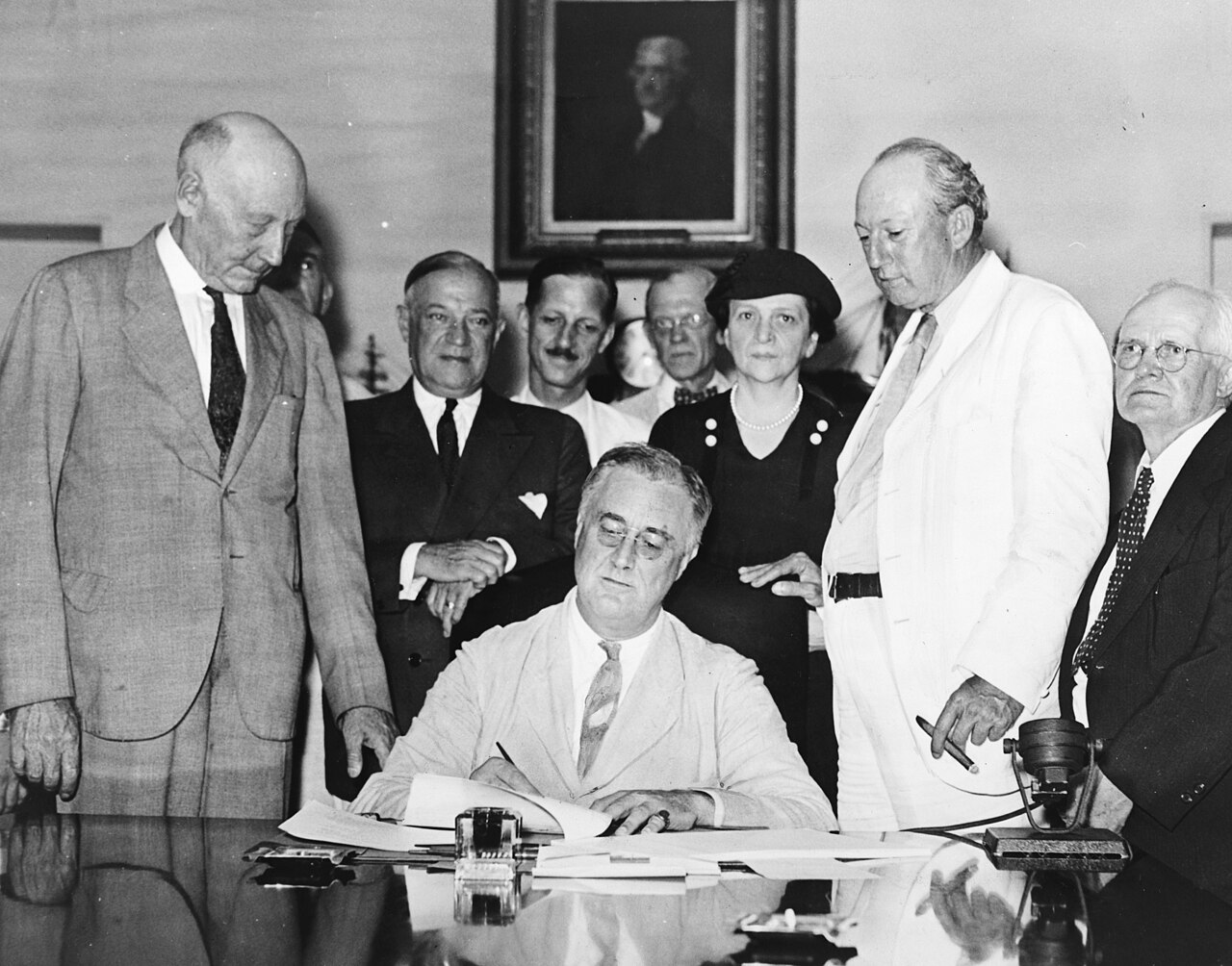

The NLRB shows the design in miniature. Senator Robert Wagner's bill, the NLRB's official history says, proposed "a new independent agency... made up of three members appointed by the President and confirmed by the Senate" to "enforce employee rights rather than to mediate disputes."13 The board would investigate, prosecute and decide unfair labor practice cases. That combination of functions in one body was exactly what critics of the new agencies objected to, and it is what the 1946 APA tried to separate internally.
The Court decides what an agency may do
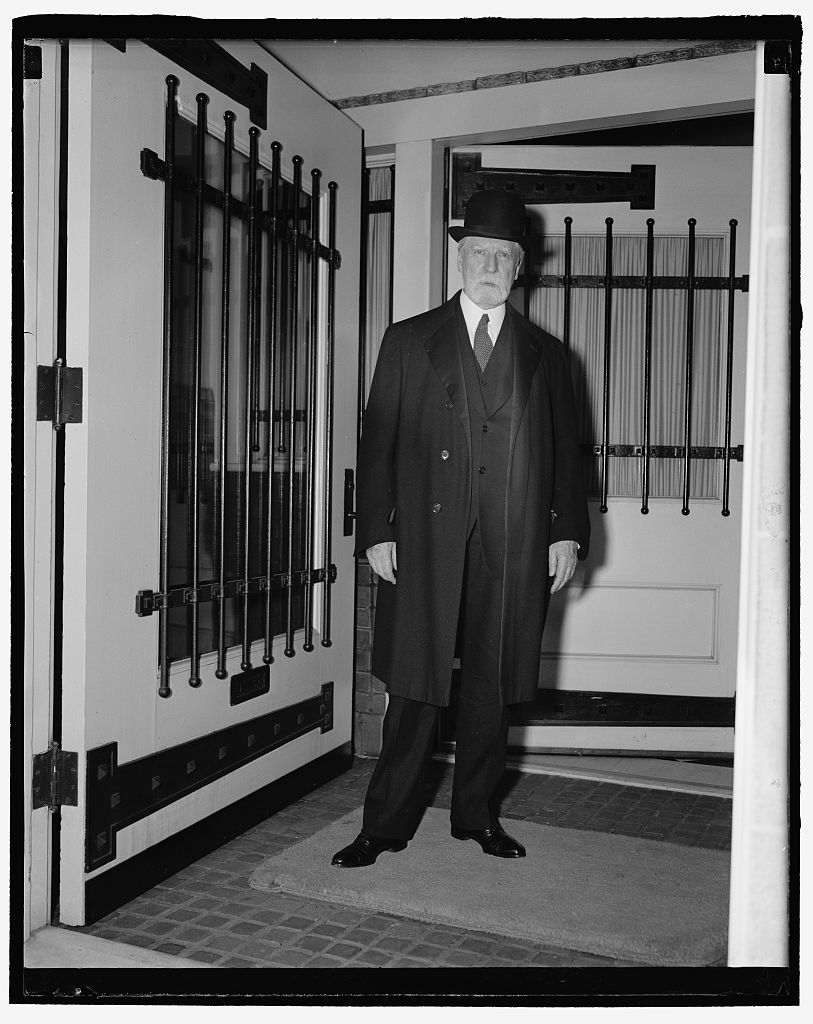

Crowell v. Benson (1932): fact-finding with a judicial check
The Longshoremen's and Harbor Workers' Compensation Act of March 4, 1927, gave injured dockworkers a no-fault compensation claim decided by a deputy commissioner of the U.S. Employees' Compensation Commission. Deputy Commissioner Crowell awarded compensation to a claimant named Knudsen against Benson, his alleged employer. Benson said Knudsen was not his employee at all and sued to stop the award.15
Chief Justice Charles Evans Hughes wrote for the Court on February 23, 1932. He began with the distinction between public and private rights, drawn from Murray's Lessee (lesson 8). In matters "which arise between the government and persons subject to its authority," Congress may create legislative courts "which are to form part of the government of territories or of the District of Columbia," or special tribunals, citing American Insurance Co. v. Canter.16 The Court gave a list of familiar examples: agencies created "in connection with the exercise of the congressional power as to interstate and foreign commerce, taxation, immigration, the public lands, public health, the facilities of the post office, pensions, and payments to veterans."16
The dockworker's claim was different. "The present case does not fall within the categories just described, but is one of private right, that is, of the liability of one individual to another under the law as defined."16 Even so, the Court held that Congress could use an agency to find the ordinary facts of a private claim, much as courts of equity and admiralty had long used masters and commissioners. The agency's findings on the circumstances and extent of injuries were "closely analogous to the findings of the amount of damages that are made according to familiar practice by commissioners or assessors," and the act's "reservation of full authority to the court to deal with matters of law provides for the appropriate exercise of the judicial function in this class of cases."17
Then came the limit. Some facts were "fundamental or 'jurisdictional,' in the sense that their existence is a condition precedent to the operation of the statutory scheme": whether the injury happened on navigable waters and whether Knudsen was Benson's employee.18 On those the federal court could decide for itself, on its own record. Hughes explained why:
"The recognition of the utility and convenience of administrative agencies for the investigation and finding of facts within their proper province, and the support of their authorized action, does not require the conclusion that there is no limitation of their use, and that the Congress could completely oust the courts of all determinations of fact by vesting the authority to make them with finality in its own instrumentalities or in the executive department. That would be to sap the judicial power as it exists under the federal Constitution, and to establish a government of a bureaucratic character alien to our system, wherever fundamental rights depend, as not infrequently they do depend, upon the facts, and finality as to facts becomes in effect finality in law."19
The Court upheld a trial de novo on the employment question and affirmed the decree for Benson.17 Justice Louis Brandeis, joined by Justices Harlan Stone and Owen Roberts, dissented. He would have sent the case back for decision on the record made before the deputy commissioner.20
Crowell is often cited as the case that approved administrative adjudication. It did, for ordinary facts, while keeping courts in charge of the facts that defined the agency's power. Its warning against "a government of a bureaucratic character alien to our system" remains in the U.S. Reports, written by the Chief Justice who upheld the agency.
Panama Refining and Schechter (1935): limits on delegation
Section 9(c) of the National Industrial Recovery Act let the President prohibit interstate shipment of "hot oil," petroleum produced beyond state quotas. On January 7, 1935, the Court struck it down in Panama Refining Co. v. Ryan. Hughes wrote that "the Congress has declared no policy, has established no standard, has laid down no rule."10
On May 27, 1935, the Court decided A.L.A. Schechter Poultry Corp. v. United States. The Schechter corporations ran wholesale poultry slaughterhouse markets in Brooklyn and had been convicted of violating the Live Poultry Code, one of the "codes of fair competition" approved by the President under the NIRA. The government argued the grave national crisis. Hughes answered: "Extraordinary conditions may call for extraordinary remedies. But the argument necessarily stops short of an attempt to justify action which lies outside the sphere of constitutional authority. Extraordinary conditions do not create or enlarge constitutional power."21 The Court held the code-making authority "an unconstitutional delegation of legislative power" and the hours and wages provisions beyond federal power over intrastate business.21 Justice Benjamin Cardozo, who had dissented in Panama Refining, concurred. If the NIRA's approach prevailed, he wrote, "anything that Congress may do within the limits of the commerce clause for the betterment of business may be done by the President upon the recommendation of a trade association by calling it a code. This is delegation running riot."22
Lesson 17 follows the nondelegation idea's partial return in the 2020s through the major questions cases.
Humphrey's Executor (1935): the protected commissioner
William E. Humphrey was confirmed to a seven-year FTC term ending September 25, 1938. On July 25, 1933, President Roosevelt asked him to resign, writing that "the aims and purposes of the Administration with respect to the work of the Commission can be carried out most effectively with personnel of my own selection." Humphrey refused, and Roosevelt removed him on October 7, 1933. Humphrey died February 14, 1934, and his executor sued for back salary.23
The same day as Schechter, Justice George Sutherland wrote for the Court, with no dissent, that the removal was unlawful. The FTC, he wrote, "is an administrative body created by Congress to carry into effect legislative policies embodied in the statute," and "Such a body cannot in any proper sense be characterized as an arm or an eye of the executive. Its duties are performed without executive leave and, in the contemplation of the statute, must be free from executive control."23 In filling in the details of "unfair methods of competition," the commission "acts in part quasi legislatively and in part quasi judicially."23 The Court narrowed Myers v. United States (1926), which had upheld the President's removal of a postmaster, to "purely executive officers."23
The effect was to confirm a type of institution: an agency that makes rules, brings cases and decides them, whose leaders the elected President could not remove for disagreeing with their policy. That rule lasted ninety-one years. On June 29, 2026, in Trump v. Slaughter, the Court held the FTC's for-cause removal provision unconstitutional and overruled Humphrey's Executor; lesson 17 covers that case and the removal cases that led to it.
The Brownlow Committee: "a headless fourth branch"
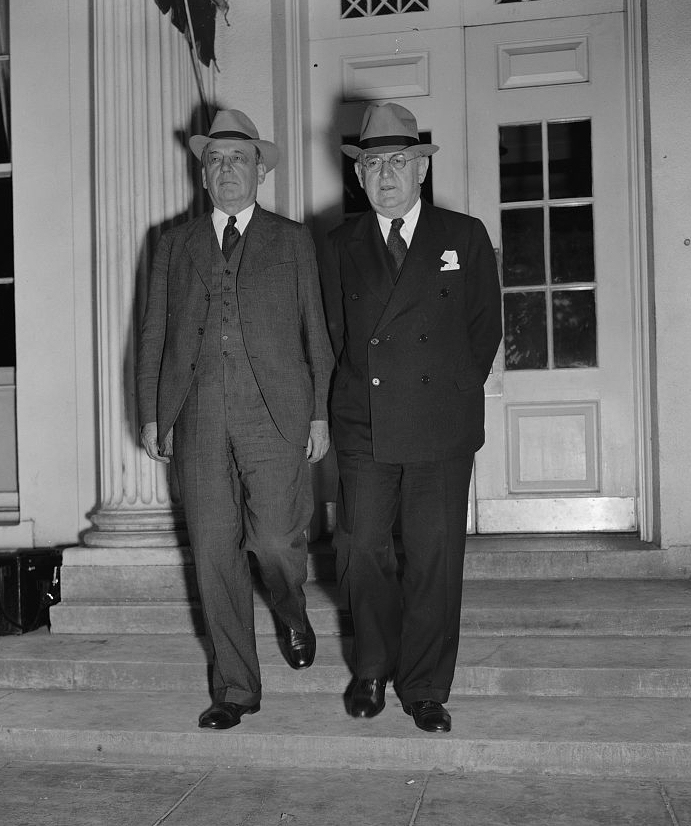

Roosevelt lost both 1935 cases, and he did not like the commissions either. In 1936 he appointed the President's Committee on Administrative Management: Louis Brownlow of the Public Administration Clearing House as chairman, Luther Gulick of the Institute of Public Administration, and Charles E. Merriam of the University of Chicago.24 Their report went to the President in January 1937.25 Its most famous sentence was a complaint from the executive side:
"There are also a dozen agencies which are totally independent, a new and headless 'fourth branch' of the government."25
(The printed report sets off the final phrase with a dash.) The White House summary released with the report quoted the committee's warning that the independent commissions threaten in time to become "a headless fourth branch of the Government, not contemplated by the Constitution, and not responsible administratively either to the President, to the Congress, or to the Courts."24 The report counted over one hundred separately organized establishments reporting to the President, and described the executive branch as having "grown up without plan or design like the barns, shacks, silos, tool sheds, and garages of an old farm."25 Its prescription was blunt: "The president needs help."25
The committee wanted the commissions folded into departments, with their judicial work handled by separate boards inside them.24 Congress balked at the 1937 reorganization bill. The Reorganization Act of 1939, approved April 3, 1939, was narrower. Under it Roosevelt created the Executive Office of the President, and Executive Order 8248 of September 8, 1939, organized it into the White House Office, the Bureau of the Budget and other divisions.26 The independent commissions stayed independent.
The Brownlow complaint belongs beside the modern legal critique. Philip Hamburger's 2014 book Is Administrative Law Unlawful? argues, as its publisher's description puts it, that administrative law has returned American government "to precisely the sort of consolidated or absolute power" constitutions were designed to prevent, and traces it to the English royal prerogative.27 Adrian Vermeule of Harvard answered in a review that the book "makes crippling mistakes about the administrative law of the United States; it misunderstands what that body of law actually holds and how it actually works."28 Brownlow's objection was narrower than Hamburger's: the commissions answered to no one, including the President. That diagnosis of an unaccountable fourth branch came from inside the New Deal itself.
The range comes under permit: Taylor Grazing and the BLM
Most of the federal land in the West was still open "public domain" in 1934, used by stockmen without permits. The Taylor Grazing Act of June 28, 1934, authorized the Secretary of the Interior "to establish grazing districts" on "vacant, unappropriated, and unreserved lands from any part of the public domain of the United States (exclusive of Alaska)," "In order to promote the highest use of the public lands pending its final disposal."12 The original act capped grazing districts at 80 million acres. Congress raised the cap to 142 million acres on June 26, 1936, and removed it on May 28, 1954.12
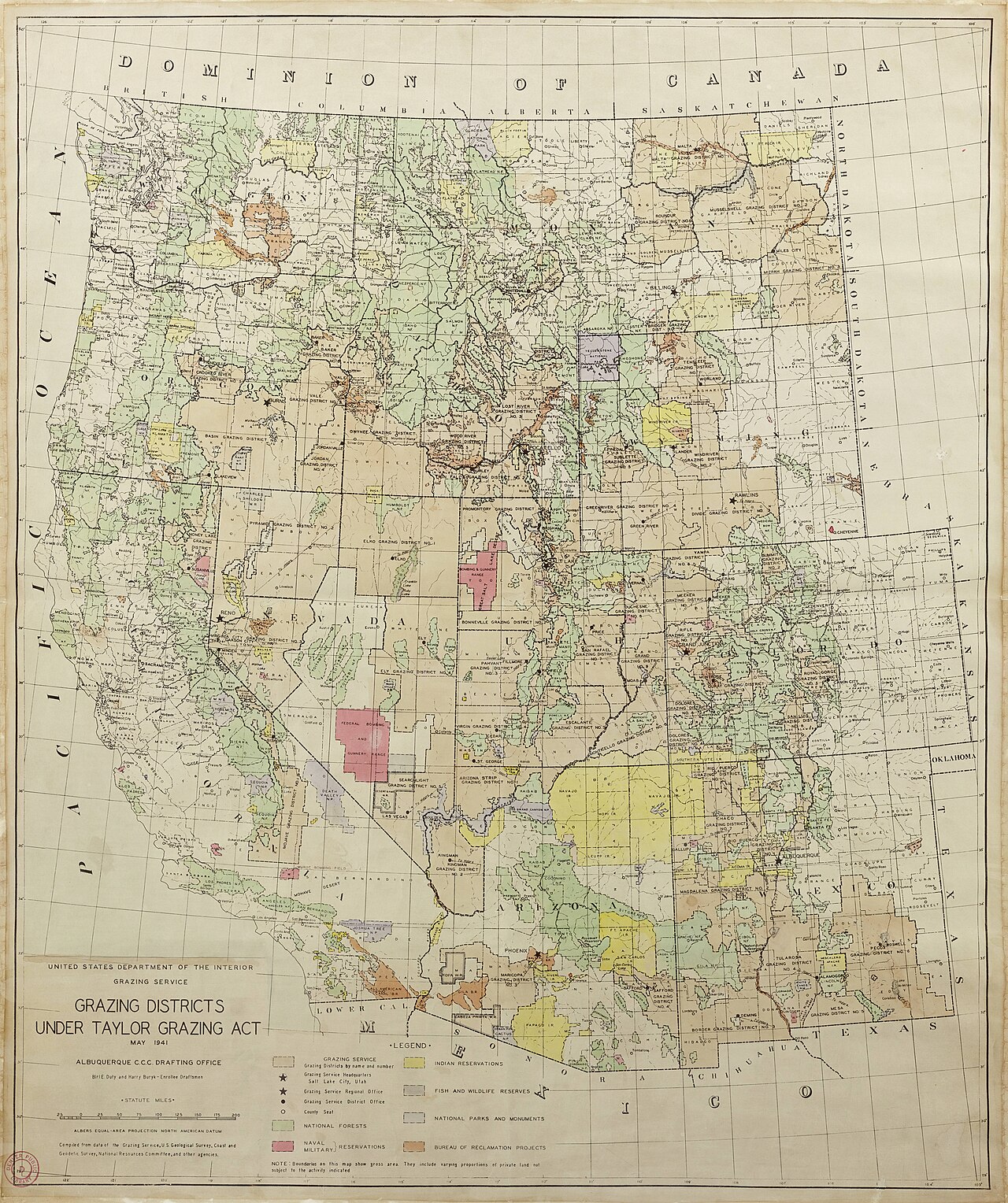

Note the phrase "pending its final disposal." In 1934 the statute still assumed that the public domain would eventually pass out of federal hands, the policy since the Land Ordinance of 1785. Lesson 14 covers the 1976 statute, FLPMA, that reversed that presumption and declared a policy of retention.
On July 16, 1946, Reorganization Plan No. 3 consolidated "the functions of the General Land Office and of the Grazing Service in the Department of the Interior... to form a new agency in the Department of the Interior to be known as the Bureau of Land Management." The plan abolished the General Land Office, which dated to 1812, and the Grazing Service.29 The BLM today describes itself as administering 245 million acres of surface land, "one-tenth of America's land base," and 700 million acres of subsurface mineral estate.30 The agency that manages most of the federal land in the West began as a reorganization plan, a presidential proposal that became law because Congress did not vote it down.
Growth in numbers
Consistent federal employment series begin around 1939 and 1940. The Bureau of Labor Statistics series for federal government employment (all branches, including the Postal Service) shows 912,000 workers in January 1939 and 3,134,000 in January 1945, close to the wartime high of 3,144,000 in November 1944.31 The Office of Personnel Management's historical table, which counts executive branch civilians at the end of each fiscal year and excludes the Postal Service, shows the same arc:
Of the 3,370,000 executive branch civilians in 1945, OPM counts 2,635,000 in the Department of Defense and its predecessors. By 1946 the total had fallen to 2,212,000.32 Most of the wartime peak was military. What did not fall back was the civilian agency count: OPM shows civilian agencies outside Defense at 443,000 in 1940 and 795,000 in 1946.32
The Administrative Procedure Act, June 11, 1946
The fight over agencies ran for a decade in Congress. The Senate Judiciary Committee's 1945 report on the bill opened by saying the subject of administrative law "is not expressly mentioned in the Constitution, and there is no recognizable body of such law."33 It recounted the history: the Walter-Logan bill passed Congress and was "vetoed by the President in 1940," partly to await the Attorney General's Committee on Administrative Procedure, which issued monographs on agency practice in 1940 and 1941 and a final report in 1941. Bills followed in 1941, and "the then emergent international situation prompted a postponement."33
The Administrative Procedure Act, Public Law 404, was approved June 11, 1946.34 Its definition of "agency" covered every authority of the government "other than Congress, the courts, or the governments of the possessions, Territories, or the District of Columbia."34 That exclusion links back to lesson 11: territorial governments were outside the APA. The act set notice-and-comment procedures for rulemaking and formal hearing procedures for adjudication. Section 10 let courts set aside agency action found "unsupported by substantial evidence" in formal cases, or "unwarranted by the facts to the extent that the facts are subject to trial de novo by the reviewing court."34
Section 11 created the hearing examiners who are now called administrative law judges. They were to be "assigned to cases in rotation so far as practicable" and "perform no duties inconsistent with their duties and responsibilities as examiners." They were removable by the agency "only for good cause established and determined by the Civil Service Commission... after opportunity for hearing," and their pay was set by the Commission "independently of agency recommendations or ratings."34 The APA did not abolish the combination of functions in one agency. It walled off the people who decide cases from the people who prosecute them, inside the same institution.
Lesson 18 compares these protections with the territorial courts the outline Pierson was handed claims they "function identically" to.
Through Pierson's Framework
Pierson's definition asks whether an institution is defended on its performance or on "habit, identity, and survival instinct."35 For this era the answer is plain: most of these institutions were defended on performance at their birth, and many delivered. The 1906 act addressed real adulteration. The Fed replaced a system in which one private banker had to save the country in 1907. Pierson's essay grants the point in general terms: "Institutions can and should be valuable, but only when they are rooted in principle, responsive to conscience, and open to reform."35
The framework's harder question is the second half of his sentence. Pierson warns that "the mission is replaced by the machinery, and survival becomes the goal."35 The record of this era shows the machinery being built for durability. Fed governors received ten-year staggered terms so that no two-term President could appoint the whole board. FTC commissioners became removable only for cause. Hearing examiners became removable only through the Civil Service Commission. Each of those protections had a reason: independence from partisan pressure. Each also weakened the line of accountability from the agency to the voters. Ordered liberty, as Pierson frames it, requires a shared duty of holding government accountable and supporting legitimate government.36 An institution built so that no elected official can direct it is harder to hold accountable, whatever its merits.
Name versus function applies with force to the commissions. Humphrey's Executor called the FTC neither executive nor judicial but "quasi legislatively and in part quasi judicially." The Brownlow Committee called it a "headless fourth branch." The Constitution names three branches. Judged by what it does, an agency that writes binding rules, investigates, prosecutes and decides has the functions of all three. The "quasi" label describes the function. It does not change it.
Pierson's appendix warns against institutions that "entrench policies behind procedure."37 The APA can be read two ways under that test. It was Congress reasserting control, writing rules agencies had to follow and giving courts power to review them. It was also the moment the agency model became permanent law, with procedure standing in for constitutional structure. Both readings fit the record. Pierson's ordered liberty insists on "mutual restraint" in which "governments and institutions must operate under law, truth, and justice."38 The APA was an attempt at exactly that: to put law around the agencies without abolishing them.
Crowell supplies the era's own warning in its own words: finality in facts "becomes in effect finality in law," and a government built that way would be "of a bureaucratic character alien to our system." Hughes wrote that sentence while approving the agency.
Hard Questions and Answers
Isn't the "secret Jekyll Island meeting" story just a conspiracy theory dressed up as history?
No. The meeting is documented by the Federal Reserve's own historians, who say it happened in November 1910, who name the six men, and who describe the duck-hunting cover story.4 What is not supported is the claim that the Fed as enacted was the bankers' plan. Congressional committees attacked the Aldrich plan for giving bankers too much power, Democrats ran against it in 1912, and Wilson insisted on a board of presidential appointees.2 The machinery resembled Aldrich's. The governance did not.
The New Deal agencies pulled the country through the Depression. Fussing about "accountability" in the middle of that ignores results, doesn't it?
Results count, and Pierson's framework says so explicitly: it judges institutions by performance. Some of the new institutions had measurable effects, and the Fed's history presents the 1933 and 1935 banking acts as Congress's response to the collapse of cooperation among reserve banks in the 1932 to 1933 contraction.6 Other measures failed: the NIRA codes were struck down unanimously, and Cardozo, who had dissented in Panama Refining, called them "delegation running riot."22 The accountability question is separate from the results question. A successful agency can still be built in a way that makes it hard to correct later. The framework asks both.
The Supreme Court blessed agency fact-finding in Crowell v. Benson. Why reopen a question the Court closed in 1932?
Because Crowell closed only part of it. Crowell held Congress could use an agency to find ordinary facts in a private-right case, with courts keeping full authority over law and an independent look at jurisdictional facts.1718 Much of the modern administrative system goes beyond what Crowell itself approved, and how much of its jurisdictional-fact rule survives is a question lesson 17 takes up. In 2024 the Court returned to the public and private rights line in SEC v. Jarkesy, which lesson 17 covers. Crowell opened the question, and later cases have kept it open.
Humphrey's Executor insulated agencies from the President and kept politics out of technical decisions. Why treat that feature as a flaw?
Sometimes it is a feature. Independence protects technical decisions, such as interest rates, from short-term electoral pressure, and that was the reason for the Fed's long staggered terms.2 The cost is that voters cannot change the agency's direction by electing a new President. The Brownlow Committee, appointed by Roosevelt, identified that cost in 1937 when it said the commissions were "not responsible administratively either to the President, to the Congress, or to the Courts."24 Whether the trade is worth it differs by agency, and the record does not support a single answer for all of them.
The open range was being overgrazed. Wasn't the Taylor Grazing Act plain good sense? Why call it a turning point?
It was good sense on its own terms, and it was a turning point. The statute's own title named the problem: "To stop injury to the public grazing lands by preventing overgrazing and soil deterioration." The Grazing Service's maps show the scale of the districts it organized.12 The turning point is in the institutions: a permit system on federal land, a new federal service, and in 1946 a merged agency with the General Land Office. The statute still spoke of "final disposal," so the intent to eventually transfer the land had not yet been dropped. What began as management pending disposal became, by 1976, permanent federal management. Lesson 14 covers that change.
Learn more
- Crowell v. Benson, 285 U.S. 22 (1932): Hughes on public and private rights, agency fact-finding and jurisdictional facts
- Humphrey's Executor v. United States, 295 U.S. 602 (1935): the removal-protection case for independent commissions
- A.L.A. Schechter Poultry Corp. v. United States, 295 U.S. 495 (1935): the NIRA codes struck down, with Cardozo's concurrence
- Administrative Procedure Act, 60 Stat. 237 (1946): the original statute, including section 11 on hearing examiners
- Federal Reserve History: The Jekyll Island Conference: the Fed's own account of the 1910 meeting
- Federal Reserve History: The Federal Reserve Act: how Congress and Wilson changed the Aldrich plan
- Report of the President's Committee on Administrative Management (1937): excerpts of the Brownlow report
- Senate Report No. 752 (1945) on the APA: the Judiciary Committee's legislative history
- Lesson 8: Legislative courts, the Bank War and nullification: the origin of "public rights" in Murray's Lessee
- Lesson 17: The courts push back: Loper Bright, Jarkesy and the removal cases
Notes
- U.S. Food and Drug Administration, "Part I: The 1906 Food and Drugs Act and Its Enforcement," FDA history. The statute is ch. 3915, 34 Stat. 768 (approved June 30, 1906). Read it online. ↩
- Federal Reserve History, "The Federal Reserve Act," adapted from Tim Todd, The Balance of Power: The Political Fight for an Independent Central Bank, 1790-Present (Federal Reserve Bank of Kansas City, 2012). Read it online. ↩
- Federal Reserve History, "The Panic of 1907." Read it online. ↩
- Federal Reserve History, "The Jekyll Island Conference." Read it online. ↩
- Federal Reserve Act, ch. 6, 38 Stat. 251 (approved December 23, 1913), title and sec. 2. Read it online. ↩
- Federal Reserve History, "Banking Act of 1935." Read it online. ↩
- National Archives, Milestone Documents, "16th Amendment to the U.S. Constitution: Federal Income Tax (1913)." Read it online. ↩
- Federal Trade Commission Act, ch. 311, 38 Stat. 717 (approved September 26, 1914), secs. 1 and 5. Read it online. ↩
- National Archives, Milestone Documents, "Tennessee Valley Authority Act (1933)." Read it online. ↩
- Panama Refining Co. v. Ryan, 293 U.S. 388 (1935) (Hughes, C.J.; decided January 7, 1935), discussing National Industrial Recovery Act of June 16, 1933, sec. 9(c), 48 Stat. 195, 200. Read it online. ↩
- Securities Exchange Act of 1934, ch. 404, 48 Stat. 881 (approved June 6, 1934). Read it online. ↩
- 43 U.S.C. sec. 315 (Taylor Grazing Act, Act of June 28, 1934), with statutory notes on the 1936 and 1954 amendments, Legal Information Institute. The act as passed is ch. 865, 48 Stat. 1269, whose title begins "An Act To stop injury to the public grazing lands by preventing overgrazing and soil deterioration." 48 Stat. 1269. Read it online. ↩
- National Labor Relations Board, "1935 Passage of the Wagner Act," Our History; National Archives, "National Labor Relations Act (1935)." Read it online. ↩
- National Archives, Milestone Documents, "Social Security Act (1935)." Read it online. ↩
- Crowell v. Benson, 285 U.S. 22 (1932) (Hughes, C.J.; argued Oct. 20 and 21, 1931; decided Feb. 23, 1932), statement of facts. Read it online. ↩
- Crowell v. Benson, 285 U.S. 22 (1932), part 2 of the opinion, quoting Murray's Lessee v. Hoboken Land & Improvement Co., 18 How. 272 (1856), and citing American Insurance Co. v. Canter, 1 Pet. 511, 546 (1828). Read it online. ↩
- Crowell v. Benson, 285 U.S. 22 (1932), discussion of findings of fact and the closing disposition. Read it online. ↩
- Crowell v. Benson, 285 U.S. 22 (1932), part 3 of the opinion, on fundamental or jurisdictional facts. Read it online. ↩
- Crowell v. Benson, 285 U.S. 22 (1932), part 3 of the opinion. Read it online. ↩
- Crowell v. Benson, 285 U.S. 22 (1932) (Brandeis, J., dissenting, joined by Stone and Roberts, JJ.). Read it online. ↩
- A.L.A. Schechter Poultry Corp. v. United States, 295 U.S. 495 (1935) (Hughes, C.J.; argued May 2 and 3, 1935; decided May 27, 1935). Read it online. ↩
- A.L.A. Schechter Poultry Corp. v. United States, 295 U.S. 495 (1935) (Cardozo, J., concurring). Cardozo had dissented in Panama Refining. Read it online. ↩
- Humphrey's Executor v. United States, 295 U.S. 602 (1935) (Sutherland, J.; argued May 1, 1935; decided May 27, 1935; McReynolds, J., agreeing in the answers to both certified questions). Overruled by Trump v. Slaughter, 609 U.S. 422 (2026) (No. 25-332; decided June 29, 2026), which held 15 U.S.C. sec. 41's for-cause removal provision "contrary to the separation of powers enshrined in the Constitution" (Supreme Court of the United States, Opinions of the Court, October Term 2025, opinion summary). Slaughter slip opinion. Read it online. ↩
- Franklin D. Roosevelt, "Summary of the Report of the Committee on Administrative Management," January 12, 1937, The American Presidency Project. Read it online. ↩
- President's Committee on Administrative Management, Report of the Committee with Studies of Administrative Management in the Federal Government (GPO, 1937), excerpts at Teaching American History (dated January 8, 1937). Read it online. ↩
- Executive Order 8248, "Establishing the Divisions of the Executive Office of the President and Defining Their Functions and Duties," September 8, 1939, citing the Reorganization Act of 1939, approved April 3, 1939. The American Presidency Project. Read it online. ↩
- Philip Hamburger, Is Administrative Law Unlawful? (University of Chicago Press, 2014), book description, Columbia Law School Scholarship Archive. Read it online. ↩
- Adrian Vermeule, "No," review of Is Administrative Law Unlawful? by Philip Hamburger, 93 Texas Law Review 1547, 1547 (2015). Read it online. ↩
- Reorganization Plan No. 3 of 1946, sec. 403, eff. July 16, 1946, 11 F.R. 7876, 60 Stat. 1100, set out in the notes to 43 U.S.C. sec. 1, Legal Information Institute. Under the Reorganization Act of 1945, ch. 582, sec. 6(a), 59 Stat. 613, a plan took effect after sixty calendar days of continuous session unless both Houses passed a concurrent resolution against it. 59 Stat. 613. Read it online. ↩
- Bureau of Land Management, "History of the BLM: Our Heritage, Our Future." Read it online. ↩
- U.S. Bureau of Labor Statistics, Current Employment Statistics series CES9091000001, All Employees, Federal (thousands, seasonally adjusted), January 1939, November 1944 and January 1945, retrieved from the BLS public data API, October 2026. Read it online. ↩
- U.S. Office of Personnel Management, "Executive Branch Civilian Employment Since 1940" (end of fiscal year, excluding Postal Service, in thousands; 1940 to 1953 data are estimates). Read it online. ↩
- Senate Committee on the Judiciary, Administrative Procedure Act, S. Rep. No. 752, 79th Cong., 1st Sess. (November 19, 1945), pp. 1 to 3 (pp. 186 to 190 of the reprint), reprinted in the Department of Justice APA legislative history. Read it online. ↩
- Administrative Procedure Act, ch. 324, 60 Stat. 237 (approved June 11, 1946), Public Law 404, secs. 2, 10, 11. Read it online. ↩
- Jeff A. Pierson, "The Acacia Illusion: How Institutionalism Mimics Nature's Most Subtle Manipulation," in The Ordered Liberty Papers (2025). Read it online. ↩
- Pierson's framing of ordered liberty as used throughout this course: liberty that recognizes a shared duty of holding government accountable and supporting legitimate government. See Module 52. Read it online. ↩
- Jeff A. Pierson, "The Anti-Federalist Warning: Institutional Power and the Fragility of Liberty," appendix to Ordered Liberty Reclaimed. Read it online. ↩
- Jeff A. Pierson, Ordered Liberty Reclaimed: A Foundation for Liberty. Read it online. ↩
Terms in this lesson
- Independent regulatory commission
- A multi-member agency, such as the FTC, whose members serve fixed terms and, under Humphrey's Executor, could be removed by the President only for causes stated in the statute.
- Nondelegation doctrine
- The principle that Congress may not hand its legislative power to others; the Court applied it to strike down parts of the National Industrial Recovery Act in 1935.
- Public rights
- Matters arising between the government and persons subject to its authority, which Congress may assign to agencies or legislative courts; contrasted with private rights between individuals.
- Jurisdictional fact
- In Crowell v. Benson, a fact on which the agency's power depends, such as whether an injury occurred on navigable waters; the Court held courts could decide such facts for themselves.
- Grazing district
- An area of federal public land organized under the Taylor Grazing Act of 1934, where livestock grazing is managed under federal permits.
- Hearing examiner
- The APA's 1946 name for the officer who presides at formal agency hearings; the position is now called an administrative law judge.
- Quasi-legislative, quasi-judicial
- Phrases the Court used in Humphrey's Executor to describe agency functions that resemble lawmaking and judging but are carried out by an administrative body.
- Elastic currency
- A money supply that can expand and contract with seasonal and emergency demand; the Federal Reserve Act named it as one of its purposes.
Sources
- Crowell v. Benson, 285 U.S. 22 (1932) checked 2026-10
- Humphrey's Executor v. United States, 295 U.S. 602 (1935) checked 2026-10
- A.L.A. Schechter Poultry Corp. v. United States, 295 U.S. 495 (1935) checked 2026-10
- Federal Reserve Act, 38 Stat. 251 (1913) checked 2026-10
- Administrative Procedure Act, 60 Stat. 237 (1946) checked 2026-10
- Federal Reserve History: Jekyll Island Conference checked 2026-10
- OPM: Executive Branch Civilian Employment Since 1940 checked 2026-10