Lesson 13 of 19 · about 30 minutes
The Cold War Settlement: Bases, SOFAs and the Security State, 1945 to 1975
You'll be able to
- Describe what the National Security Act of 1947 created and what it forbade the CIA to do.
- Quote and explain the concurrent-jurisdiction and primary-right rules in Article VII of the NATO Status of Forces Agreement (1951), and how Wilson v. Girard (1957) applied them.
- Identify the real federal reports on jurisdiction over federal land: the Interdepartmental Committee report (Part I, 1956; Part II, 1957) and the GSA inventories as of 1957 and 1962, and explain exclusive, concurrent, partial and proprietorial jurisdiction.
- Quote Eisenhower's farewell address accurately on the military-industrial complex and the scientific-technological elite, and place official continuity-of-government orders in context without speculation.
Start here: the short version
In 1957 the Army handed one of its own soldiers, William Girard, to a Japanese court, and the Supreme Court said it could. That handover is the Cold War settlement in one case. The United States demobilized after 1918. After 1945 it did not. The National Security Act of 1947 created the National Security Council, the Central Intelligence Agency and the defense establishment that became the Department of Defense. The North Atlantic Treaty of 1949 bound the country to treat an attack on any member in Europe or North America as an attack on all. Troops parked abroad for years needed a legal status, and the NATO Status of Forces Agreement, signed in London on June 19, 1951, gave them one: Article VII splits criminal jurisdiction between the country that sends the troops and the country that hosts them. At home, the government's own lawyers, on an interdepartmental committee chaired by the Justice Department, found in 1956 that Washington held "too much legislative jurisdiction over too many areas" and told it to hold most federal land like private property, under state law. The outline Pierson was handed cites a "1963 Status of Lands and Water Areas of the United States." No federal report by that name could be found. What exists is the committee's two-part report of 1956 and 1957 and two General Services Administration inventories, as of 1957 and as of 1962. And in January 1961 President Eisenhower warned against "the acquisition of unwarranted influence, whether sought or unsought, by the military-industrial complex." Each of these institutions was built in the open, by statute or treaty. Several of them still outran the people meant to watch them.
Challenge
If the Cold War state looks to you like a shield that earned trust, start with the CIA's charter: "no police, subpena, law-enforcement powers, or internal-security functions." The Church Committee, a body of the Senate, found the agencies had "undermined the constitutional rights of citizens" anyway. If it looks to you like a hidden second government, start with the paper. The base agreements rest on a treaty the Senate approved 72 to 15, with conditions written into Defense Department regulations to this day. The enclaves rest on state consent, and the government's own lawyers asked to shed most of that jurisdiction. Neither story survives the documents. The CIA came out of an open statute passed by elected officials, and the agencies still went past their limits, with no hidden government required. That should bother the trusting reader more than a plot would, and the suspicious reader too, because nobody has to hide anything for it to happen again.
The National Security Act of 1947
President Truman signed "An Act To promote the national security by providing for a Secretary of Defense; for a National Military Establishment; for a Department of the Army, a Department of the Navy, and a Department of the Air Force" on July 26, 1947.1 It was Public Law 253 of the 80th Congress. Section 101 created the National Security Council, presided over by the President, whose function was "to advise the President with respect to the integration of domestic, foreign, and military policies relating to the national security."1 Section 102 created "under the National Security Council a Central Intelligence Agency with a Director of Central Intelligence," appointed by the President with Senate consent. The same section drew a hard line, in the statute itself: "the Agency shall have no police, subpena, law-enforcement powers, or internal-security functions."1 Title II established the National Military Establishment, with the Secretary of Defense at its head.1
The structure did not hold still. The State Department's history records that the War and Navy Departments were merged under a single Secretary of Defense, and in 1949 the act was amended to give the Secretary more power over the services. The CIA grew out of the wartime Office of Strategic Services and small postwar intelligence groups.2 The NSC itself became whatever each President made of it. Eisenhower used its meetings to make key decisions. Under Nixon, the NSC staff headed by Henry Kissinger "was transformed from a coordinating body into an organization that actively engaged in negotiations with foreign leaders."2
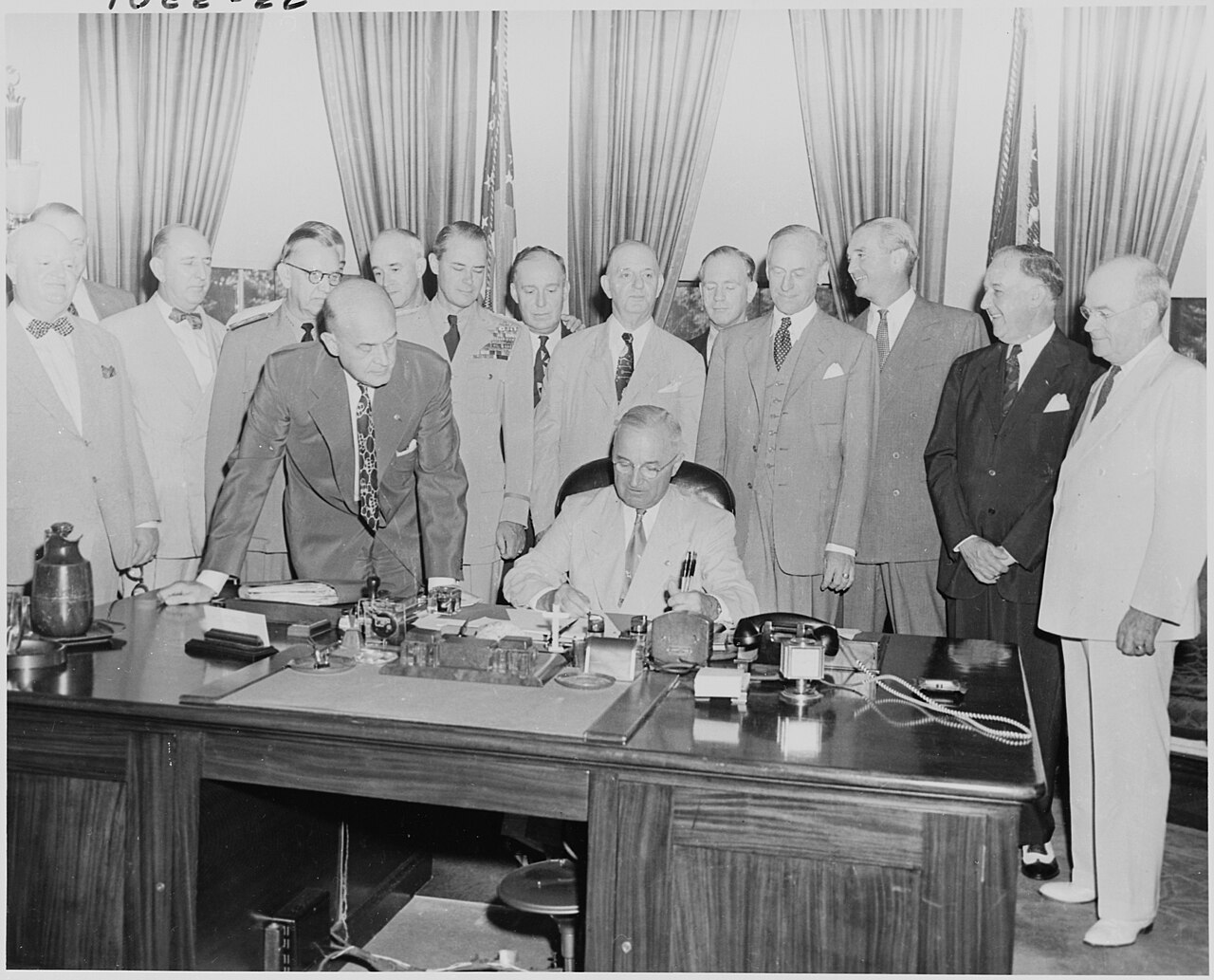

The planning paper that set the scale of the new establishment was NSC-68, completed by the State Department's Policy Planning Staff under Paul Nitze on April 7, 1950, and declassified only in 1975. It argued that the Soviet Union was "animated by a new fanatic faith" and recommended "the rapid building up of the political, economic, and military strength of the free world," funded by higher taxes and lower spending elsewhere.3 Inside the government the plan first met strong opposition, the State Department history records, including from Secretary of Defense Louis Johnson.3 The Korean War began in June 1950, two months after the paper was finished.4
OPM's employment table shows what that meant in people. Executive branch civilian employment fell from 3,370,000 in 1945 to 1,439,000 in 1950. It rose to 2,026,000 in 1953, the last Korean War year, and stayed above the 1950 level in the later years sampled here: 1,860,000 in 1955 and 1,808,000 in 1960. In 1968, at the height of the Vietnam War, it was 2,289,000, of which 1,317,000 worked for the Department of Defense.5
NATO and the base network
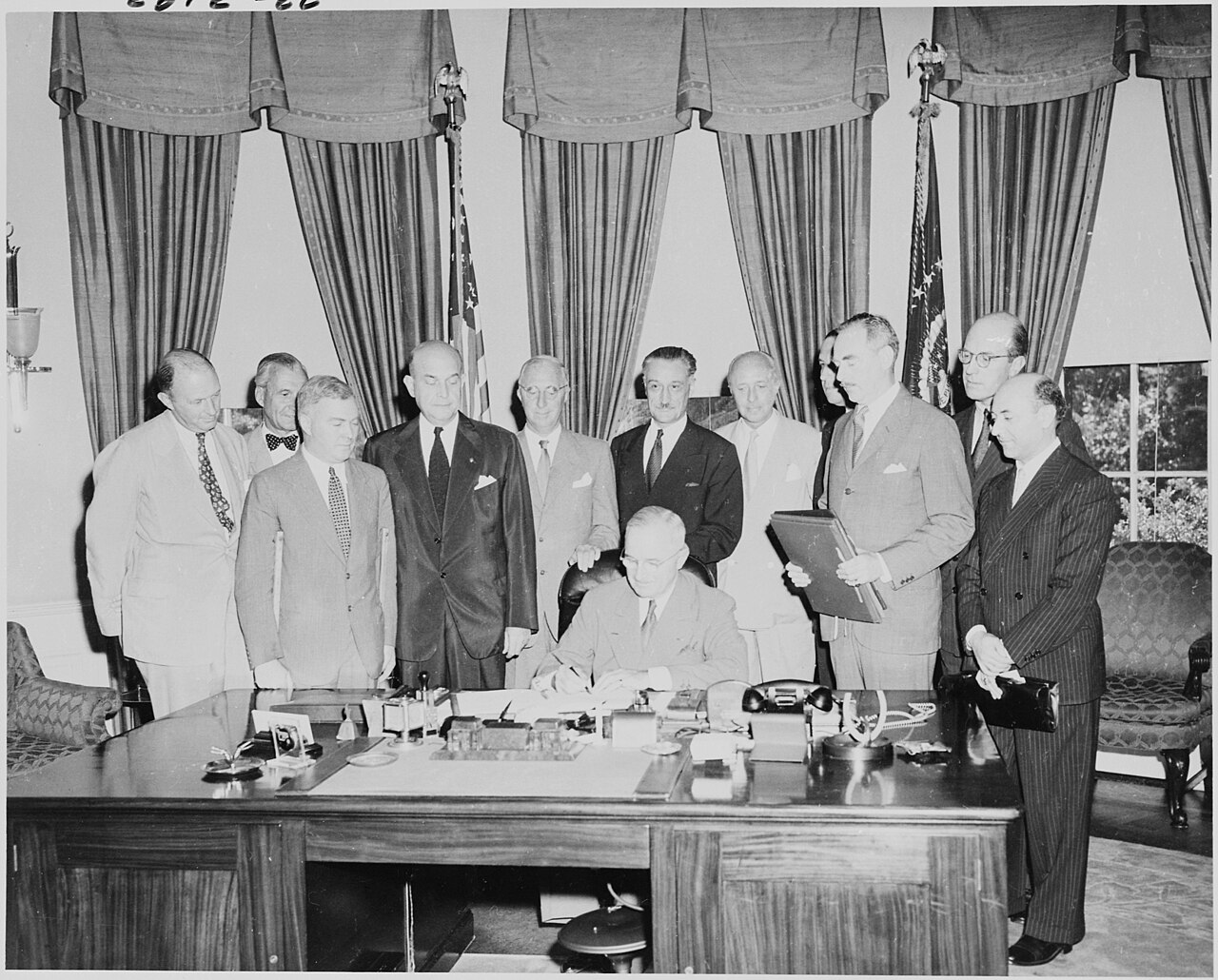
The North Atlantic Treaty was signed in Washington on April 4, 1949.6 Its twelve original signers were the United States, Canada, Belgium, Denmark, France, Iceland, Italy, Luxembourg, the Netherlands, Norway, Portugal and the United Kingdom.7 The State Department calls NATO "the first peacetime military alliance the United States entered into outside of the Western Hemisphere."7 Article 5 reads:
"The Parties agree that an armed attack against one or more of them in Europe or North America shall be considered an attack against them all and consequently they agree that, if such an armed attack occurs, each of them, in exercise of the right of individual or collective self-defence recognised by Article 51 of the Charter of the United Nations, will assist the Party or Parties so attacked by taking forthwith, individually and in concert with the other Parties, such action as it deems necessary, including the use of armed force, to restore and maintain the security of the North Atlantic area."6
The words "such action as it deems necessary" were the product of negotiation. The State Department history explains that European governments wanted an automatic American commitment, but "under the U.S. Constitution the power to declare war rested with Congress," so the drafters looked for language that would reassure Europe without obligating the United States "to act in a way that violated its own laws."7 Later in 1949 Congress passed the Mutual Defense Assistance Program, appropriating about $1.4 billion for Western European defenses.7

The NATO Status of Forces Agreement, 1951
Station American soldiers in allied countries for years and every arrest becomes a sovereignty question. The "Agreement between the Parties to the North Atlantic Treaty regarding the Status of their Forces" was done in London on June 19, 1951, "in the English and French languages, both texts being equally authoritative."8 It entered into force August 23, 1953.9 It uses two key terms: the "sending State" is the country the force belongs to, and the "receiving State" is the country where it is located.8
Article VII is the criminal jurisdiction article. It starts by giving each side jurisdiction in its own sphere. The military authorities of the sending state may exercise "all criminal and disciplinary jurisdiction conferred on them by the law of the sending State over all persons subject to the military law of that State," and the authorities of the receiving state "shall have jurisdiction over the members of a force or civilian component and their dependents with respect to offences committed within the territory of the receiving State and punishable by the law of that State."8
Where only one country's law makes the act a crime, that country's jurisdiction is exclusive. Where both do, the article says "the right to exercise jurisdiction is concurrent" and these rules apply:
"The military authorities of the sending State shall have the primary right to exercise jurisdiction over a member of a force or of a civilian component in relation to offences solely against the property or security of that State, or offences solely against the person or property of another member of the force or civilian component of that State or of a dependent; offences arising out of any act or omission done in the performance of official duty. In the case of any other offence the authorities of the receiving State shall have the primary right to exercise jurisdiction."8
(The treaty sets out the two sending-state categories as numbered sub-items; they are run together here.) A state with the primary right may decline it. "The authorities of the State having the primary right shall give sympathetic consideration to a request from the authorities of the other State for a waiver of its right in cases where that other state considers such waiver to be of particular importance."8
Article VII also guarantees an accused soldier tried by the host country a list of procedural rights: "a prompt and speedy trial"; to be informed in advance of the charges; "to be confronted with the witnesses against him"; compulsory process for witnesses; counsel of his own choice or free or assisted counsel on local terms; an interpreter if needed; and to communicate with a representative of his own government and, when court rules permit, have that representative present.8 A person tried and acquitted or convicted by one party "may not be tried again for the same offence within the same territory by the authorities of another Contracting Party," though the sending state may still discipline its own member for breach of military rules.8 Military police may police the premises the force occupies; outside them, only by arrangement with the host.8
The Senate's conditions
The Senate gave its consent on July 15, 1953, with reservations, by a roll call vote of 72 to 15.11 That resolution still governs Defense Department practice: a federal regulation directs designated commanding officers to invoke "the Senate resolution procedure in each foreign country where dependents of DoD personnel are present, consistent with the U.S. Senate Resolution of Ratification, with reservations, to the North Atlantic Treaty Organization Status of Forces Agreement, as agreed to by the Senate on July 15, 1953."10 A Congressional Research Service report summarizes the four conditions: that Article VII not be a precedent for future agreements; that when a service member is to be tried abroad the U.S. commanding officer review the host country's laws against the procedural safeguards of the U.S. Constitution; that if the commander believes the member will not be protected, he request a waiver of jurisdiction; and that a U.S. representative attend the trial to protect the member's constitutional rights.11
The CRS report says the NATO SOFA "is the only SOFA that was concluded as part of a treaty"; the rest are executive agreements. It counted "more than 100 agreements that may be considered SOFAs."11
Japan: Girard and the 1960 agreement
The NATO rules did not stay in NATO. The 1952 security treaty with Japan authorized an Administrative Agreement on the "conditions which shall govern the disposition of armed forces of the United States of America in and about Japan." That agreement promised that once the NATO SOFA came into force, the United States would conclude with Japan "an agreement on criminal jurisdiction similar to the corresponding provisions of the NATO Agreement." A protocol to that effect was signed September 29, 1953, effective October 29, 1953.9
On January 30, 1957, Specialist Third Class William S. Girard was guarding a machine gun during a unit exercise at the Camp Weir range in Japan. Japanese civilians were in the area gathering spent cartridge cases. Girard put an expended cartridge case in the grenade launcher on his rifle and fired it with a blank. It struck a Japanese woman in the back and killed her.9 Japan claimed the primary right on the ground that the act was outside his official duty. The joint committee under the agreement could not agree. The United States decided to waive "whatever jurisdiction it might have," with the President confirming the decision of the Secretaries of State and Defense.9
A federal district court enjoined Girard's delivery to Japan. The Supreme Court reversed in a per curiam opinion on July 11, 1957, three days after argument. "A sovereign nation has exclusive jurisdiction to punish offenses against its laws committed within its borders, unless it expressly or impliedly consents to surrender its jurisdiction," the Court said, citing The Schooner Exchange (1812). The only question was whether the Constitution or a later statute barred the waiver. "We find no constitutional or statutory barrier to the provision as applied here. In the absence of such encroachments, the wisdom of the arrangement is exclusively for the determination of the Executive and Legislative Branches."9
A month earlier, in Reid v. Covert (decided June 10, 1957), the Court had gone the other way on a related question. Two civilian wives of servicemen, Clarice Covert in England and Dorothy Smith in Japan, had been tried by court-martial for killing their husbands. Justice Black's plurality held they could not be: "When the Government reaches out to punish a citizen who is abroad, the shield which the Bill of Rights and other parts of the Constitution provide to protect his life and liberty should not be stripped away just because he happens to be in another land." On the government's argument that the international agreements required military trials, Black wrote: "no agreement with a foreign nation can confer power on the Congress, or on any other branch of Government, which is free from the restraints of the Constitution."12 Read together, the two 1957 cases set the line. The American government may not use a treaty to escape the Constitution when it prosecutes. It may agree that a foreign sovereign will prosecute on its own soil.
The Treaty of Mutual Cooperation and Security with Japan was signed in Washington on January 19, 1960, and entered into force June 23, 1960, along with a separate SOFA under its Article VI. Article VI grants the United States "the use by its land, air and naval forces of facilities and areas in Japan." The SOFA has been modified at least four times.11
Bases at home: who governs federal land inside a state
The same fight came home in a different form. When the federal government owns a fort, a dam or a national park in a state, whose laws apply there? Article I, section 8, clause 17 gives Congress power "to exercise exclusive Legislation" over the seat of government and "like Authority over all Places purchased by the Consent of the Legislature of the State in which the Same shall be, for the Erection of Forts, Magazines, Arsenals, dock-Yards, and other needful Buildings."13
The Interdepartmental Committee, 1954 to 1957
On the recommendation of Attorney General Herbert Brownell, approved by President Eisenhower and the Cabinet, an Interdepartmental Committee for the Study of Jurisdiction over Federal Areas within the States was organized on December 15, 1954.14 It was chaired by Assistant Attorney General Perry W. Morton of the Lands Division and included the general counsels or solicitors of the Bureau of the Budget, Defense, Interior, Agriculture, Health, Education, and Welfare, the General Services Administration and the Veterans' Administration.1516 It sent questionnaires to every agency that held real property, plus a detailed questionnaire for each federal installation in three sample states: Virginia, Kansas and California.16
Part I, "The Facts and Committee Recommendations," was submitted April 25, 1956, and transmitted to the President April 27, 1956. Part II, "A Text of the Law of Legislative Jurisdiction," followed in June 1957.1517 The Government Printing Office catalog lists Part I at xvi plus 250 pages and Part II at xxxvii plus 351 pages.18 Part I's introduction gave the scale: of the 1,903,824,640 acres in the continental United States, the federal government owned 405,088,566 acres, "or more than 21 percent," including "more than 87 percent of the land in the State of Nevada."16
The committee defined four categories, which GSA still uses:1719
| Category | Definition (from Part II) |
|---|---|
| Exclusive legislative jurisdiction | The federal government "has received, by whatever method, all the authority of the State, with no reservation made to the State except of the right to serve process resulting from activities which occurred off the land involved." |
| Concurrent legislative jurisdiction | The state, in granting what would otherwise be exclusive jurisdiction, "has reserved to itself the right to exercise, concurrently with the United States, all of the same authority." |
| Partial legislative jurisdiction | The federal government holds certain of the state's authority while the state keeps other authority "constituting more than the right to serve civil or criminal process in the area (e.g., the right to tax private property)." |
| Proprietorial interest only | The federal government "has acquired some right of title to an area in a State but has not obtained any measure of the State's authority over the area." |
The committee's history explains how so much federal land came under exclusive jurisdiction. For about a century, federal law, section 355 of the Revised Statutes, effectively required state consent to federal land purchases before federal money could be spent on buildings there, and most states passed general consent laws. The result was that exclusive jurisdiction attached almost automatically. On February 1, 1940, Congress amended section 355 so that exclusive jurisdiction "was not to be required," an agency head could accept whatever jurisdiction he thought desirable by filing notice with the governor, and until he did, "it should be conclusively presumed that no jurisdiction had been accepted by the United States." The committee said this "ended the 100-year period during which nearly all the land acquired by the United States came under the exclusive legislative jurisdiction of the Federal Government."16 The rule survives today at 40 U.S.C. 3112: "It is conclusively presumed that jurisdiction has not been accepted until the Government accepts jurisdiction over land as provided in this section."20
The public domain, the vast western lands that were federal before statehood, was a separate case. The committee noted that the state consent statutes did not affect "lands already under the proprietorship of the United States when these general consent statutes were enacted, such as the lands of the so-called public domain."16
What the committee recommended
The committee's verdict on its own government was blunt:
"No doubt can exist that in the present period the Federal Government has been acquiring and retaining too much legislative jurisdiction over too many areas as the result of the existence of laws and the persistence of practices which were founded on conditions of a century and more ago."21
Its principal conclusions, as GSA later restated them, were that "in the usual case there is an increasing preponderance of disadvantages over advantages as there increases the degree of legislative jurisdiction vested in the United States"; that for "the large bulk of federally owned or operated real property" the government should not "receive, or retain, any measure whatever of legislative jurisdiction" but hold it "in a proprietorial interest status only, with legislative jurisdiction remaining in the several States"; that concurrent jurisdiction should be kept for installations needing federal law enforcement because of great size, large population, remote location or special use; and that even where some exclusivity was needed, the state should keep its powers over taxation, marriage, divorce, adoption, commitment of the mentally incompetent and inheritance, and "residents of such installation or area not be deprived of any civil or political rights."13
The committee recorded that the agencies preferring proprietorial status, including Treasury, Justice (outside prisons), Interior (outside national parks and certain monuments), Agriculture, the Atomic Energy Commission and the Central Intelligence Agency, "control more than 90 percent of the land owned by the United States."22 The military departments, the Veterans' Administration and the National Park Service leaned toward the older policy of exclusive jurisdiction.22 The Navy held about 40 percent of its acreage in proprietorial status already.22 State officials were blunter still. The attorney general of Kentucky called the transfer of jurisdiction to the federal government "an anachronism" and hoped the committee would "recommend a retrocession to Kentucky of all of the Federal enclaves in this State" so that officials "may cease to be vexed with this annoying and useless anachronism."23
The GSA inventories and the "1963" report
Eisenhower's April 27, 1956, letter accepting Part I asked that "the General services Administration will establish as soon as may be possible a central source of information concerning the legislative jurisdictional status of Federal properties."24 GSA did so twice. Its "Inventory report on jurisdictional status of Federal areas within States, as of June 30, 1957," was published in 1959 at 102 pages.25 The second, the "Inventory Report on Jurisdictional Status of Federal Areas within the States, as of June 30, 1962," describes itself as the second such inventory "of its nature ever undertaken," prepared under the Federal Property and Administrative Services Act of 1949. It added the new states of Alaska and Hawaii, covered the same land as GSA's worldwide real property inventory as of the same date, and was based on agency determinations reported under GSA Circular No. 275 of July 18, 1962.13 Its transmittal letter from Administrator Bernard L. Boutin to the President is dated "SEP 3," with the year not legible in the surviving scan. The letter states that "S. 815 and H. R. 4433 pending before Congress would facilitate the adjustment of legislative jurisdiction over Federal areas within the States."13 S. 815 was a bill of the 88th Congress; the Senate Government Operations subcommittee held hearings on it on August 20 to 22, 1963.26 A Department of Agriculture library stamp on the same scan reads December 17, 1964.13
The outline Pierson was handed cites a "1963 Status of Lands and Water Areas of the United States." Searches of the GPO's Monthly Catalog records, GSA's current materials and congressional documents turned up no federal report by that title.27 The documents the citation most likely refers to are the 1962-dated GSA inventory, which was being circulated in 1963 and 1964 while Congress held hearings on S. 815, or the committee's report itself. Neither is about "water areas." Readers who meet the 1963 citation elsewhere should ask for the publisher and a catalog number.
The GSA inventory also records the limit of its own reach. Because legislative jurisdiction concerns the federal government's authority "in relation to that of a State," the inventory "does not deal with property in the territories or possessions, or in the Commonwealth of Puerto Rico."13 The territories of lesson 11 sat entirely outside this framework. Congress governed them directly.
The courts kept applying the old enclaves. In Paul v. United States, decided January 14, 1963, the Supreme Court considered California's attempt to apply its milk price controls to sales at Travis Air Force Base and two other installations. Justice Douglas wrote that "Since a State may not legislate with respect to a federal enclave unless it reserved the right to do so when it gave its consent to the purchase by the United States, only state law existing at the time of the acquisition remains enforceable, not subsequent laws."28 So an enclave can run on state law frozen on the day of cession. That is exactly the kind of oddity the committee wanted gone.
Eisenhower's warning, January 17, 1961
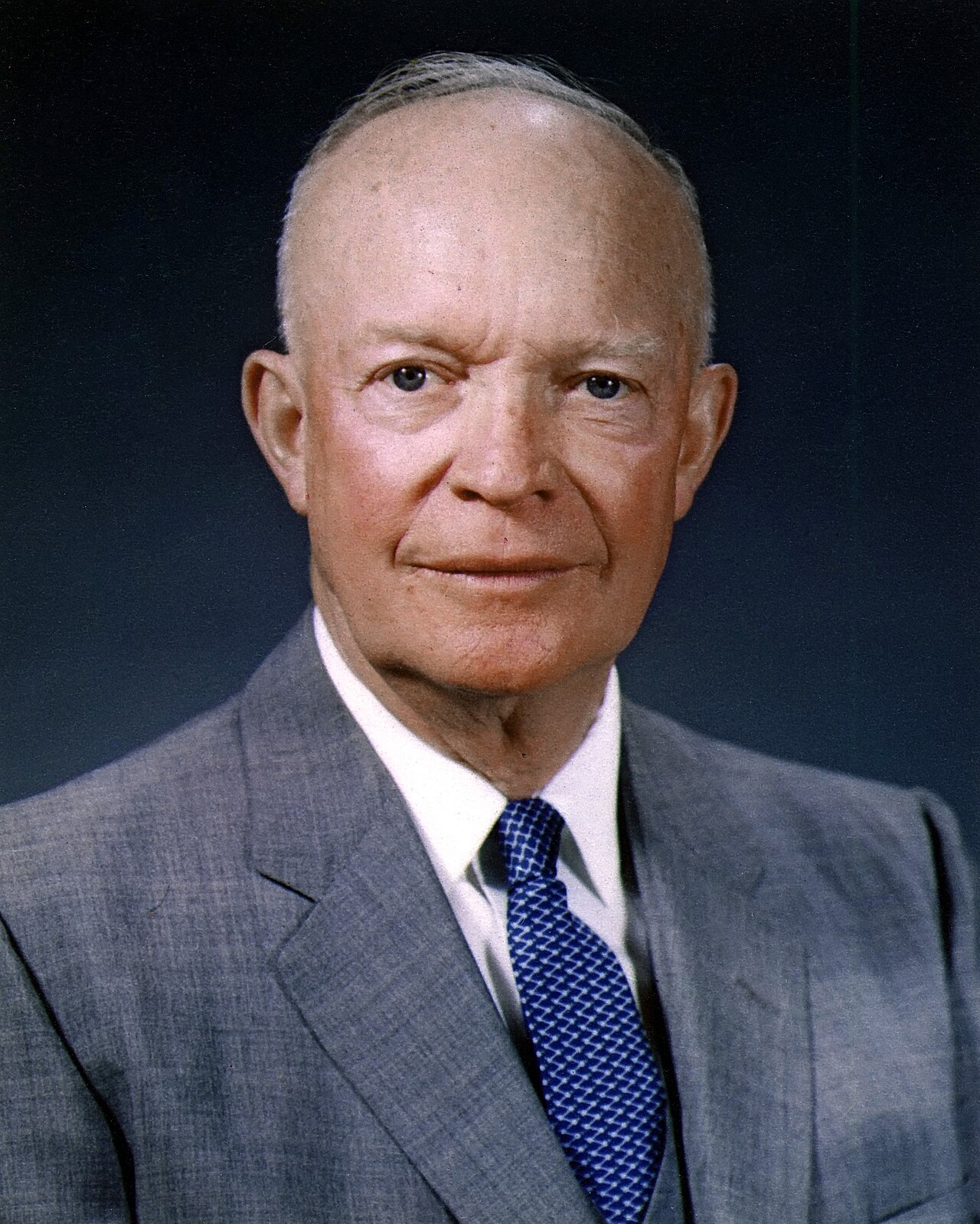

Three days before leaving office, Eisenhower spoke to the nation on television from the Oval Office. The National Archives notes the speech ran less than ten minutes.29 Its central passage, from the National Archives transcript:
"Until the latest of our world conflicts, the United States had no armaments industry. American makers of plowshares could, with time and as required, make swords as well. But now we can no longer risk emergency improvisation of national defense; we have been compelled to create a permanent armaments industry of vast proportions. Added to this, three and a half million men and women are directly engaged in the defense establishment. We annually spend on military security more than the net income of all United State corporations."29
"In the councils of government, we must guard against the acquisition of unwarranted influence, whether sought or unsought, by the military-industrial complex. The potential for the disastrous rise of misplaced power exists and will persist. We must never let the weight of this combination endanger our liberties or democratic processes. We should take nothing for granted. Only an alert and knowledgeable citizenry can compel the proper meshing of the huge industrial and military machinery of defense with our peaceful methods and goals, so that security and liberty may prosper together."29
("United State corporations" is how the National Archives transcript reads. The American Presidency Project transcript reads "United States corporations" and sets off "and is gravely to be regarded" with a dash; the other passages quoted here match word for word.)30 Eisenhower did not oppose the establishment he described. "We recognize the imperative need for this development," he said. "Yet we must not fail to comprehend its grave implications."30
The second warning in the speech is quoted less often. Research, he said, had become "central," "more formalized, complex, and costly," and "a government contract becomes virtually a substitute for intellectual curiosity." Then:
"The prospect of domination of the nation's scholars by Federal employment, project allocations, and the power of money is ever present and is gravely to be regarded. Yet, in holding scientific research and discovery in respect, as we should, we must also be alert to the equal and opposite danger that public policy could itself become the captive of a scientific-technological elite."29
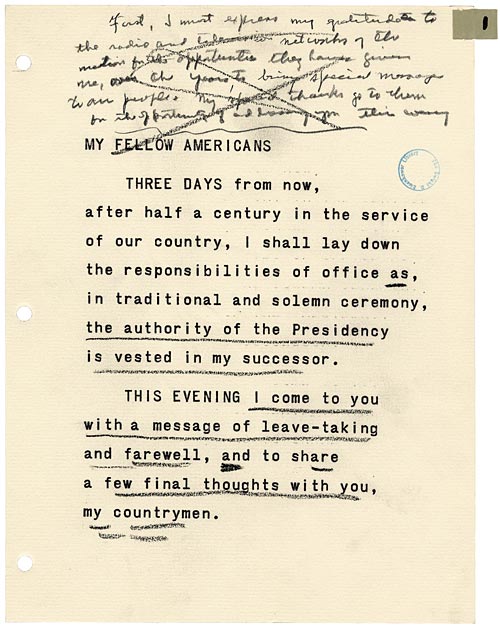

The Eisenhower Library preserves the drafting record: a memo for the record about a "last speech" dated May 20, 1959, drafts from 1960, and a January 7, 1961, draft with handwritten edits by Milton Eisenhower, the President's brother.31 This was no offhand remark. The speech was planned over a year and a half.
Continuity of government: what the official record shows
Planning for the government to survive a nuclear attack is documented in executive orders, and the orders are public. Executive Order 10346 of April 17, 1952, issued by Truman under the Federal Civil Defense Act of 1950, required each department and agency to "prepare plans for maintaining the continuity of its essential functions at the seat of Government and elsewhere during the existence of a civil-defense emergency."32 Executive Order 11490 of October 28, 1969, issued by Nixon, began: "WHEREAS our national security is dependent upon our ability to assure continuity of government, at every level, in any national emergency type situation that might conceivably confront the nation." It directed agencies to plan for "(1) succession to office; (2) predelegation of emergency authority; (3) safekeeping of essential records; (4) emergency relocation sites supported by communications and required services; (5) emergency action steps; (6) alternate headquarters or command facilities; and (7) protection of Government resources, facilities, and personnel," under the guidance of the Director of the Office of Emergency Preparedness.33
That is the documented scope: succession, records and relocation in an emergency. The stories that circulate online about secret "enclaves" or a hidden standing government go past anything in these orders, and no official source for them has turned up. The orders show agencies planning for disaster under published executive orders, answering to the President. Dull, and on paper.
Oversight returns, 1975
The period ends with Congress finally looking hard at the security state it had built. On January 27, 1975, the Senate created the Select Committee to Study Governmental Operations with Respect to Intelligence Activities, chaired by Senator Frank Church of Idaho, with Senator John Tower of Texas as vice chairman. The resolution passed 82 to 4.34 Its final report, issued April 29, 1976, after 126 full committee meetings and interviews with some 800 witnesses, concluded that intelligence excesses were not the "product of any single party, administration, or man," and that "Intelligence agencies have undermined the constitutional rights of citizens, primarily because checks and balances designed by the framers of the Constitution to assure accountability have not been applied."34 It made 96 recommendations. The Senate created a permanent intelligence committee in 1976, and Congress passed the Foreign Intelligence Surveillance Act in 1978.34
One thread from this period runs into lesson 15. In June 1950 a conference of anti-Communist intellectuals in West Berlin founded the Congress for Cultural Freedom. A history published by the CIA's Center for the Study of Intelligence states that the Congress "is widely considered one of the CIA's more daring and effective Cold War covert operations," that the Agency's covert action arm, Frank Wisner's Office of Policy Coordination, approved the Berlin project, and that the CIA sponsorship was publicly exposed in 1967.4 The American delegation in Berlin included Sidney Hook, James Burnham, James T. Farrell, Tennessee Williams, Arthur Schlesinger, Jr., and David Lilienthal.4 Lesson 15 takes up how this history connects to the later neoconservative movement.
Through Pierson's Framework
The Cold War settlement is the hardest era in this module for Pierson's framework, because the threat was real and most of the institutions were built openly by elected officials under statutes and treaties. Pierson's ordered liberty includes the duty of supporting legitimate government.35 The National Security Act, NATO and the SOFA were legitimate in that sense: passed by Congress, ratified by the Senate, signed by Presidents, and reviewed by the Supreme Court.
The framework's other half is the duty of holding government accountable.35 Here the record is mixed in a specific way. The SOFA case shows accountability working: the Senate attached conditions in 1953 that still bind Defense Department regulations, and the Court in Reid refused to let a treaty become a way around the Bill of Rights. The intelligence agencies show it failing. The Church Committee, a body of the Senate itself, found that the framers' "checks and balances" had "not been applied." Pierson's appendix describes this pattern: institutions that "entrench policies behind procedure" and "insulate officials."36 A charter stating that the CIA had "no police, subpena, law-enforcement powers, or internal-security functions" did not stop the domestic programs the Church Committee exposed. Judged by function, not name, the agency's charter and its conduct diverged.
The jurisdiction report is the era's most striking case of an institution examining itself honestly. A committee made up of the government's own lawyers concluded that the government held "too much legislative jurisdiction over too many areas" because of "the persistence of practices which were founded on conditions of a century and more ago." That is very close to Pierson's definition of institutionalism, a system that "assumes continuity equals virtue."37 The committee saw it and said so. Acting on the diagnosis was another matter. GSA's 1962 inventory states that "there does not now exist any administrative machinery for canceling the legislative jurisdiction previously acquired by the Federal Government from the several states."13 The diagnosis was made. The cure required legislation, and the record reviewed here does not show S. 815 becoming law.
Eisenhower's warning fits the framework with almost no translation. He said the influence could come "whether sought or unsought," and he did not accuse anyone of a conspiracy. He described influence that grows from the existence of the institutions themselves, a structure in which, as Pierson puts it, defenders "may appear voluntary but are, in reality, functionally dependent."37 A permanent arms industry depends on permanent orders, and a research establishment depends on federal grants. Eisenhower's remedy, "an alert and knowledgeable citizenry," is the same remedy Pierson's Civic Anti-Authoritarianism prescribes: "the citizen becomes the moral auditor of government."38
Hard Questions and Answers
The SOFA lets a foreign government try an American soldier under foreign law. Why isn't that Washington trading away its own citizens' rights?
Because the host country had that power before the treaty existed. Any sovereign may try any visitor for crimes on its soil. The Supreme Court in Wilson v. Girard said exactly that: a nation "has exclusive jurisdiction to punish offenses against its laws committed within its borders, unless it expressly or impliedly consents to surrender its jurisdiction."9 The SOFA narrows host jurisdiction, giving the United States the primary right over official-duty and internal offenses, and it guarantees a list of trial rights.8 The Senate's 1953 conditions add a U.S. review of local law and a U.S. observer at trial.11 Now the concession. The protection is real, and it is less than the full Bill of Rights. The treaty does not pretend otherwise. And Girard shows the United States handing a soldier over even when the official-duty question is disputed and its own joint committee could not agree.9
Federal enclaves exist, state law cannot reach new matters inside them, and Washington runs them. Why isn't that a second government under another name?
The enclaves are real, documented, and some still exist. The question gets the rest wrong. They rest on Article I, section 8, clause 17 and on state consent given by state legislatures. The federal government's own 1956 committee recommended that most federal land be held with no federal legislative jurisdiction at all, and recorded that agencies controlling more than 90 percent of federal land preferred proprietorial status.22 Since 1940, federal law has presumed that no jurisdiction is accepted unless an agency files formal notice with the state.20 The record shows a messy patchwork that the government itself tried to shrink. A shadow government does not ask the states to take its jurisdiction back.
The outline's "1963 Status of Lands and Water Areas" report cannot be found. Isn't the simplest explanation that someone buried it?
A document by that name could sit in an archive not searched here. That cannot be ruled out. But the related reports are public and cataloged: Parts I and II of the committee report with GPO Superintendent of Documents numbers, the 1957 GSA inventory in the Monthly Catalog, and the 1962 inventory in state and congressional files.182513 None of them is secret, and none supports the idea of hidden jurisdiction. A citation with no publisher and no catalog number is a rumor with a date on it. And the reports that do exist point the opposite way from the outline: toward less federal jurisdiction.
Wasn't Eisenhower blowing the whistle on a cabal of defense contractors?
Not in his words, and the cabal reading lets the institutions off easy. He said the influence could be "sought or unsought," called the defense build-up an "imperative need," and asked for "proper meshing" of the industrial and military machinery with "our peaceful methods and goals."2930 His concern was structural: a permanent establishment of three and a half million people and a permanent arms industry create interests whether or not anyone plots. A conspiracy can be exposed and broken up. A structure that runs on permanent orders keeps its pull with nobody plotting at all, which is why he said the potential "exists and will persist."29 Defenders of the defense establishment who cite the "imperative need" line and stop there are reading half the speech, too.
The Church Committee caught the abuses and Congress fixed them. Isn't the security-state worry a 1970s relic?
The system did correct itself, once Congress acted. Give it that. The Senate created the committee 82 to 4, the committee did its work, and Congress created permanent oversight and the FISA court.34 That is the accountability half of ordered liberty working. Now look at the clock. The committee traced the abuses back to the Roosevelt administration and through the early 1970s.34 Pierson's appendix states that "no institution is self-correcting."36 The Church Committee was not the intelligence agencies correcting themselves. It was outside oversight, set off by press revelations, starting with Seymour Hersh's 1974 front-page New York Times article on CIA spying on antiwar activists.34
Learn more
- NATO Status of Forces Agreement (1951), full text: Article VII on criminal jurisdiction and the rest of the agreement
- National Security Act of 1947, 61 Stat. 495: the statute creating the NSC, the CIA and the National Military Establishment
- Jurisdiction Over Federal Areas Within the States, Parts I and II (1956, 1957): the Interdepartmental Committee report, online by chapter
- GSA Inventory Report on Jurisdictional Status of Federal Areas within the States, as of June 30, 1962: the second GSA inventory, scan hosted by the Montana Legislature
- Wilson v. Girard, 354 U.S. 524 (1957): the Court upholds the waiver of jurisdiction to Japan
- Reid v. Covert, 354 U.S. 1 (1957): no treaty can free Congress from the Constitution
- Eisenhower's Farewell Address (National Archives): the transcript and images of the reading copy
- Eisenhower Library: Farewell Address documents: drafts, memos and audio
- Senate Historical Office: The Church Committee: origins, process and outcome of the 1975 to 1976 investigation
- Lesson 15: Neoconservatism: the policy network that grew out of the anti-Communist left
Notes
- National Security Act of 1947, ch. 343, 61 Stat. 495 (approved July 26, 1947), Public Law 253, secs. 101, 102, 201. Read it online. ↩
- U.S. Department of State, Office of the Historian, "National Security Act of 1947," Milestones in the History of U.S. Foreign Relations (retired series). Read it online. ↩
- U.S. Department of State, Office of the Historian, "NSC-68, 1950," Milestones in the History of U.S. Foreign Relations. Read it online. ↩
- "Origins of the Congress for Cultural Freedom, 1949 to 1950," Studies in Intelligence 38, no. 5, Center for the Study of Intelligence, Central Intelligence Agency. Read it online. ↩
- U.S. Office of Personnel Management, "Executive Branch Civilian Employment Since 1940" (end of fiscal year, excluding Postal Service; 1940 to 1953 data are estimates). Read it online. ↩
- The North Atlantic Treaty, Washington, D.C., April 4, 1949, art. 5, NATO official text. Read it online. ↩
- U.S. Department of State, Office of the Historian, "North Atlantic Treaty Organization (NATO), 1949," Milestones in the History of U.S. Foreign Relations. Read it online. ↩
- Agreement between the Parties to the North Atlantic Treaty regarding the Status of their Forces, London, June 19, 1951, arts. I and VII and closing clause, 4 U.S.T. 1792, T.I.A.S. 2846, NATO official text. Read it online. ↩
- Wilson v. Girard, 354 U.S. 524 (1957) (per curiam; argued July 8, 1957; decided July 11, 1957), including the history of the 1952 Administrative Agreement and the 1953 Protocol with Japan and the entry into force of the NATO SOFA on August 23, 1953. Read it online. ↩
- 32 C.F.R. sec. 151.5(c)(1) (Responsibilities, foreign criminal and civil jurisdiction). Read it online. ↩
- Congressional Research Service, "Status of Forces Agreement (SOFA): What Is It, and How Has It Been Utilized?" RL34531 (March 15, 2012), via EveryCRSReport. The report's footnotes 7 and 8 cite "S.Res. of July 15, 1953, Advising and Consenting to Ratification of the NATO SOFA"; one sentence in its body text says the Senate approved ratification "on March 19, 1970," which is an error. The State Department's Foreign Relations of the United States, 1951, vol. III, part 1, editorial note (document 107), records that the agreement was "ratified by the United States on July 24, 1953" and "entered into force on August 23, 1953," which fits Senate consent on July 15, 1953, and not 1970. The Senate roll call on ratification of Executive T (the NATO Status of Forces treaty) was No. 63 of the 83rd Congress, July 15, 1953, 72 yeas to 15 nays (Voteview, S083 roll call file). FRUS editorial note. Read it online. ↩
- Reid v. Covert, 354 U.S. 1 (1957) (plurality opinion of Black, J., joined by Warren, C.J., Douglas and Brennan, JJ.; decided June 10, 1957). Read it online. ↩
- General Services Administration, Inventory Report on Jurisdictional Status of Federal Areas within the States, as of June 30, 1962, transmittal letter of Administrator Bernard L. Boutin and introduction, secs. 1 to 6 (scanned copy with U.S. Department of Agriculture library stamp of December 17, 1964), hosted by the Montana Legislature, Environmental Quality Council, SJ 15 study references. An excerpt also appears in House Natural Resources Committee hearing documents, October 17, 2019. Read it online. ↩
- Herbert Brownell, Jr., Attorney General, letter of transmittal to the President, April 27, 1956, in Jurisdiction Over Federal Areas Within the States, Part I (GPO, 1956), p. IV. Read it online. ↩
- Interdepartmental Committee for the Study of Jurisdiction over Federal Areas within the States, letter of submission, April 25, 1956, Part I, p. V (signatories); the preface, Part I, chapter I, lists the departments "directly represented on the Committee," including Defense, whose representative does not appear among the letter's signatories. Read it online. ↩
- Jurisdiction Over Federal Areas Within the States, Part I: The Facts and Committee Recommendations (April 1956), preface and chapters 1 to 3, including "Exclusive jurisdiction requirement terminated." Text from the Constitution Society transcription of the GPO edition. Read it online. ↩
- Jurisdiction Over Federal Areas Within the States, Part II: A Text of the Law of Legislative Jurisdiction (June 1957), introduction and chapters 1 to 2, "Jurisdictional Statuses Defined." Constitution Society transcription of a reprint. Read it online. ↩
- Monthly Catalog of U.S. Government Publications records: Part I, SuDoc Y 3.In 8/10:1/956/pt.1, xvi + 250 p.; Part II, SuDoc Y 3.In 8/10:1/957/pt.2, xxxvii + 351 p. (University of North Texas Libraries MoCat database). Read it online. ↩
- General Services Administration, Office of Property Disposal, "Federal Facilities Jurisdictional Status" (code sheet for the Inventory Report on Jurisdictional Status of Federal Areas Within the States). Read it online. ↩
- 40 U.S.C. sec. 3112(c), derived from R.S. sec. 355 as amended by the Act of February 1, 1940, ch. 18, 54 Stat. 19. Read it online. ↩
- Jurisdiction Over Federal Areas Within the States, Part I (1956), chapter VIII, "Conclusions and Recommendations," general observations, pp. 68 to 69 (page break approximate in the transcription). The constitution.org transcription reads "too mush"; the scan of the printed report at the Internet Archive reads "too much," which is the wording quoted here. Read it online. Scan of the printed report (Internet Archive). ↩
- Jurisdiction Over Federal Areas Within the States, Part I (1956), chapter VII, "Analysis of Federal Agency Preferences." Read it online. ↩
- Jurisdiction Over Federal Areas Within the States, Part I (1956), chapter V, quoting the attorney general of Kentucky. Read it online. ↩
- Dwight D. Eisenhower to Attorney General Herbert Brownell, Jr., April 27, 1956, in Jurisdiction Over Federal Areas Within the States, Part I, p. III. Read it online. ↩
- Monthly Catalog record, General Services Administration, "Inventory report on jurisdictional status of Federal areas within States, as of June 30, 1957" ([1959]; [2] + v + 102 p.; SuDoc GS 1.15/3:957), Monthly Catalog issue 780 (January 1960), entry 703. Read it online. ↩
- Adjustment of Legislative Jurisdiction on Federal Enclaves: Hearings before the Subcommittee on Intergovernmental Relations of the Senate Committee on Government Operations, 88th Cong., 1st Sess., on S. 815 (August 20 to 22, 1963), HathiTrust catalog record. Read it online. ↩
- Correction of the record. The module outline cites a "1963 Status of Lands and Water Areas of the United States." Searches conducted October 2026 of the GPO Monthly Catalog (MoCat) database, GSA disposal resources, congress.gov and general web search found no federal publication by that title. The documented reports on this subject are the Interdepartmental Committee report, Part I (1956) and Part II (1957), and the GSA inventories as of June 30, 1957 (published 1959) and June 30, 1962 (transmitted with a letter referring to S. 815 of the 88th Congress, 1963 to 1964). The outline's citation is treated here as an error for one of those documents. Read it online. The closest 1963 document found is a different kind of report entirely: the U.S. Forest Service's "Land Areas Report as of June 30, 1963," for the National Forest System, an annual acreage table by Forest Service region and state with no discussion of legislative jurisdiction (title page checked October 22, 2026; the Forest Service hosts it under the file name LAR_1962.pdf). Forest Service Land Areas Report, 1963. It sits alongside the GSA "Inventory Report on Jurisdictional Status of Federal Areas within the States, as of June 30, 1962" (GSA 1962 inventory), which is the jurisdiction document the outline most likely meant. ↩
- Paul v. United States, 371 U.S. 245 (1963) (Douglas, J.; argued Oct. 17 and 18, 1962; decided Jan. 14, 1963). Read it online. ↩
- Dwight D. Eisenhower, Farewell Address, January 17, 1961, transcript and description, National Archives Milestone Documents (citing Final TV Talk 1/17/61 (1), Box 38, Speech Series, Eisenhower Library). Read it online. ↩
- Dwight D. Eisenhower, "Farewell Radio and Television Address to the American People," January 17, 1961, The American Presidency Project. Read it online. ↩
- Dwight D. Eisenhower Presidential Library, "Farewell Address," online documents (memo for the record, May 20, 1959; draft of January 7, 1961, with edits by Milton Eisenhower). Read it online. ↩
- Executive Order 10346, "Preparation by Federal Agencies of Civil Defense Emergency Plans," April 17, 1952, sec. 2, The American Presidency Project. Read it online. ↩
- Executive Order 11490, "Assigning Emergency Preparedness Functions to Federal Departments and Agencies," October 28, 1969, preamble and sec. 102, The American Presidency Project. Read it online. ↩
- U.S. Senate Historical Office, "Senate Select Committee to Study Governmental Operations with Respect to Intelligence Activities (The Church Committee)" (resolution passed January 27, 1975, by 82 to 4; final report April 29, 1976; Senate Resolution 400 of 1976 created the Senate Select Committee on Intelligence). Read it online. ↩
- Pierson's framing of ordered liberty as used throughout this course: liberty that recognizes a shared duty of holding government accountable and supporting legitimate government. See Module 52. Read it online. ↩
- Jeff A. Pierson, "The Anti-Federalist Warning: Institutional Power and the Fragility of Liberty," appendix to Ordered Liberty Reclaimed. Read it online. ↩
- Jeff A. Pierson, "The Acacia Illusion: How Institutionalism Mimics Nature's Most Subtle Manipulation," in The Ordered Liberty Papers (2025). Read it online. ↩
- Jeff A. Pierson, The Ordered Liberty Papers (2025), section on Civic Anti-Authoritarianism. Read it online. ↩
Terms in this lesson
- Status of Forces Agreement (SOFA)
- An agreement setting the legal status of one country's military personnel stationed in another, especially who may try them for crimes.
- Concurrent jurisdiction (SOFA)
- Under NATO SOFA Article VII, the situation where both the sending and receiving state's laws punish an act, so either could try the case and primary-right rules decide who goes first.
- Primary right
- The SOFA rule giving one state the first claim to try a case: the sending state for official-duty offenses and offenses solely against its own people or property, the receiving state for everything else.
- Exclusive legislative jurisdiction
- The status in which the federal government holds all of a state's authority over an area, apart from the state's right to serve process for acts done off the area; based on Article I, section 8, clause 17.
- Proprietorial interest only
- Federal ownership of land without any of the state's legislative authority; state civil and criminal law apply fully. The 1956 committee recommended this status for the large bulk of federal land.
- Federal enclave
- An area within a state over which the United States holds exclusive or substantial legislative jurisdiction.
- Continuity of government
- Federal planning, ordered by presidents from 1952 on, for agencies to keep essential functions running in a national emergency, including succession, records and relocation sites.
- Military-industrial complex
- Eisenhower's 1961 phrase for the combination of a permanent large military establishment and a permanent arms industry.
Sources
- Agreement between the Parties to the North Atlantic Treaty regarding the Status of their Forces (1951) checked 2026-10
- National Security Act of 1947, 61 Stat. 495 checked 2026-10
- Wilson v. Girard, 354 U.S. 524 (1957) checked 2026-10
- Jurisdiction Over Federal Areas Within the States, Parts I and II (1956, 1957) checked 2026-10
- GSA, Inventory Report on Jurisdictional Status of Federal Areas Within the States, as of June 30, 1962 checked 2026-10
- Eisenhower Farewell Address, January 17, 1961 (National Archives) checked 2026-10
- Executive Order 11490 (1969) checked 2026-10