Lesson 10 of 19 · about 32 minutes
The Gilded Age Builds the Agency, 1877 to 1900
You'll be able to
- Explain how the Pendleton Act of 1883 replaced party patronage with competitive examinations, and what share of federal jobs it first covered
- Describe the Interstate Commerce Act of 1887, the Interstate Commerce Commission's design, and how the Supreme Court narrowed its power by 1897
- Summarize the Sherman Antitrust Act and its early treatment in United States v. E. C. Knight Co. (1895)
- Explain the 1895 gold bond arrangement between the Cleveland administration and a private syndicate, and the Idaho Admission Act's land disclaimer and the Forest Reserve Act of 1891
Start here: the short version
On July 2, 1881, a man who had pressed for the Paris consulship and been told never to mention it again shot President Garfield in a Washington train station. Out of that shooting came the first of the two institutional forms that now carry most of federal administration: the career civil service, chosen by examination and protected from party firing under the Pendleton Act of 1883. The second came in 1887, the independent regulatory commission. The Interstate Commerce Commission had five commissioners with staggered terms, a party balance and protection from removal except for cause, and it was set over the railroads. Congress added the Sherman Antitrust Act in 1890. Before 1900 the courts had cut back both the Commission and the antitrust law. Private finance, meanwhile, did some of the government's work: J. P. Morgan's syndicate restored the Treasury's gold reserve in 1895, and Morgan's firm reorganized much of the bankrupt railroad network. In the West the President began reserving forests by proclamation, and Idaho entered the Union in 1890 after its people agreed to "forever disclaim all right and title to the unappropriated public lands." Every one of these forms was built to check some other power. That left the oldest problem open: who checks the checkers?
Challenge
If the career civil service looks like an unaccountable permanent class, look at what it replaced: clerks paying a cut of their salaries to the party that hired them and facing the sack for refusing. If independent commissions look like the guardrails of good government, read the first one's record. The ICC could not set a rate until 1906, the National Archives calls its first decade "not very effective," and it outlived rail's dominance of freight. Anyone who trusts the market to police itself has to explain rebates for big shippers and higher rates for small towns. Anyone who trusts Washington to police the market has to explain a President telling Congress in writing that his lenders' terms were "not subject to our dictation." Each camp has a chapter in these years it would rather skip.
The federal government counted 51,020 paid civilian employees in 1871 and 100,020 in 1881.1 Almost all of it was staffed through party patronage, the system Jackson had defended as "rotation" and lesson 8 followed into the post offices. The railroads, built with the federal land and credit described in lesson 9, were the largest businesses in the country and largely unregulated by the national government. Two decades later both facts had changed on paper. In practice the change came slower, and stranger, than the statutes promised.
The spoils system ends in a train station
On July 2, 1881, President James A. Garfield was shot by Charles Guiteau in the Baltimore and Potomac Railroad Station in Washington.2 He died at Elberon, New Jersey, at about 10:45 on the night of September 19, 1881, and the War Department announced his death to the Army the next day.373 Guiteau believed his speeches had been critical to Garfield's election and pressed the White House and the State Department for a posting to Paris or Vienna, until Secretary of State James Blaine told him, "Do not ever mention the Paris consulship to me again!"38 Puck put him on its cover on July 13, 1881, holding a pistol and a paper reading "AN OFFICE OR YOUR LIFE!" under the caption "A Model Office Seeker."4
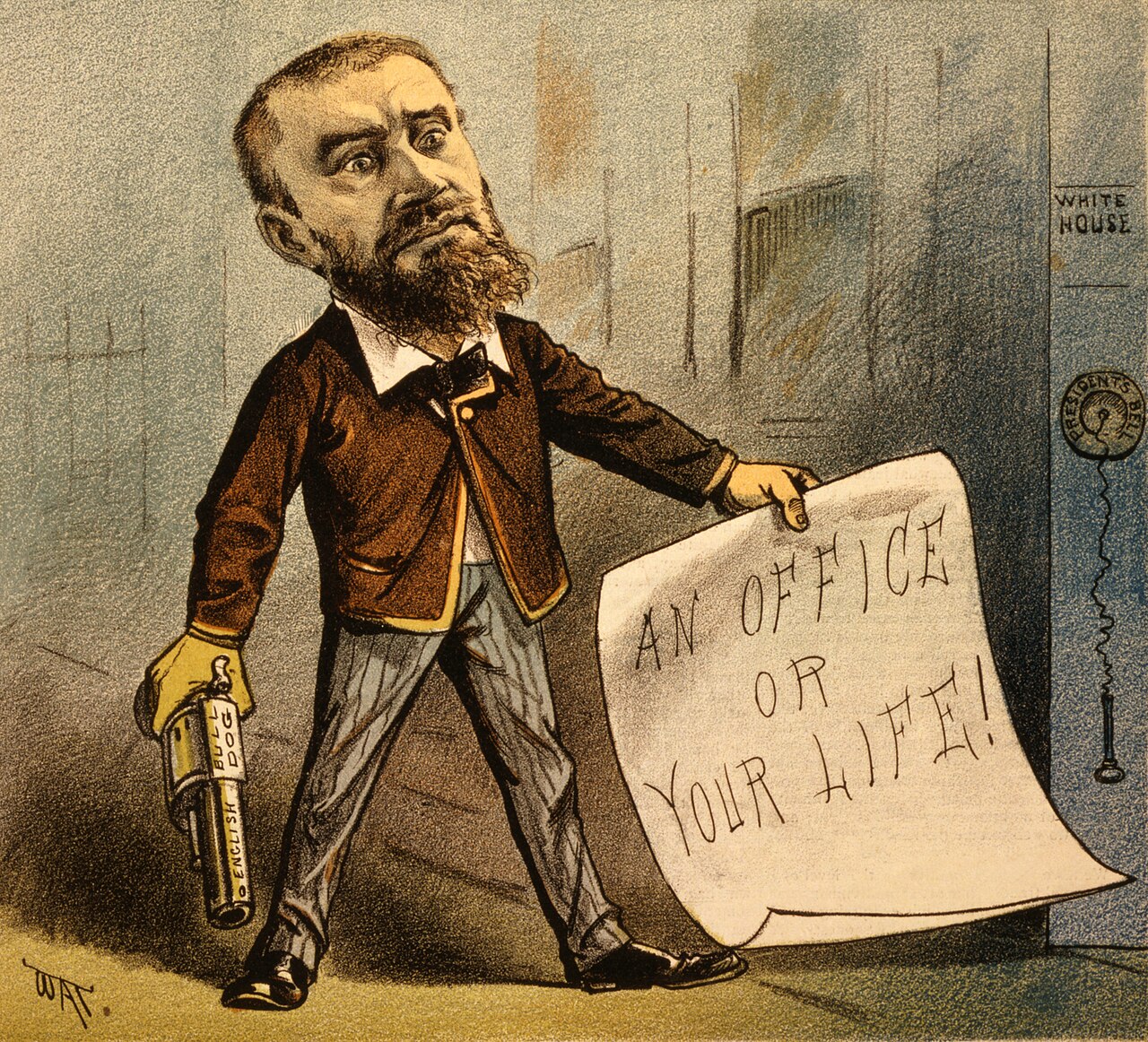

The National Archives summarizes the problem Congress faced. By Jackson's time the "spoils system," in which officials rewarded political friends and supporters with government positions, "was in full force," and its "flaws and abuses" worsened "as candidates required political appointees to spend ever more time and money on political activities."5 The same summary says there were "approximately 20,000 federal employees" in Jackson's time and "over 130,000" by 1884. The Census series gives 11,491 in 1831 and 18,038 in 1841, so the Archives' Jacksonian figure runs high, but both sources show the same growth: 100,020 paid civilian employees by 1881.51
The Pendleton Act, January 16, 1883
The act took the name of Senator George Hunt Pendleton of Ohio and was signed by President Chester Arthur, who, the Archives notes, "had become an ardent reformer after Garfield's assassination."5 Its first section authorized the President, with Senate consent, to appoint "three persons, not more than two of whom shall be adherents of the same party, as Civil Service Commissioners," who "shall hold no other official place under the United States." The President "may remove any commissioner."6 The commission was to help the President write rules, and those rules were to provide "for open, competitive examinations for testing the fitness of applicants for the public service now classified or to be classified hereunder," examinations that "shall be practical in their character."6 The rules also had to declare "that no person in the public service is for that reason under any obligations to contribute to any political fund, or to render any political service, and that he will not be removed or otherwise prejudiced for refusing to do so."6
That last rule went at the money. Under spoils, a postmaster or customs clerk paid an assessment from his salary to the party that appointed him. Pendleton made the assessment voluntary in law and protected the worker who refused.
How far it reached
At first the act barely touched the government it was meant to reform. The National Archives: "When the Pendleton Act went into effect, its hiring reforms covered only 10 percent of the government's 132,000 employees. The law's scope has broadened over the years, however, and today it applies to most of the 2.9 million positions in the federal government."5 The Census series counts the classified ("competitive civil service") employees year by year, and it shows the mechanism of expansion: The act told the Secretary of the Treasury and the Postmaster General to classify clerks in the larger offices and to extend the classification "from time to time, on the direction of the President."6 Growth in the protected service therefore depended on Presidents choosing to extend it.
| Year | Competitive civil service employees (classified) | Total paid federal civilian employees |
|---|---|---|
| 1884 | 13,780 | not reported |
| 1886 | 17,273 | not reported |
| 1891 | 33,873 | 157,442 |
| 1893 | 43,915 | not reported |
| 1896 | 87,044 | not reported |
| 1900 | 94,893 | not reported |
| 1901 | 106,205 | 239,476 |
Figures are from Historical Statistics, Series Y 308 and Y 311. The 1884 figure covers July 16, 1883, to January 15, 1884.1 The jump from 54,222 in 1895 to 87,044 in 1896 falls in Grover Cleveland's second term, before he left office in March 1897.1
The chart's 1885 to 1900 points follow the Series Y 311 values: 15,590; 17,273; 19,345; 22,577; 29,650; 30,626; 33,873; 37,523; 43,915; 45,821; 54,222; 87,044; 85,886; 89,306; 93,144; 94,893.1
The Pendleton Act changed whom a federal worker answered to. Under spoils he answered to the party that hired him, and through the party, loosely, to voters who could throw the party out. Under merit he answered to rules, to examinations and to a supervisor who could not fire him for his politics. That trade bought competence and ended the assessment racket. It also built the first large body of federal officials whom no election could reach. Both results were intended.
The railroad problem and the states
The Granger laws and Munn v. Illinois, 1877
The pressure for railroad regulation came first from farmers and the states. The National Archives notes that "Early political action against these railroad monopolies came in the 1870s from 'Granger' controlled state legislatures in the West and South."7 Railroads competed on long hauls between big cities and had none on short local runs, so they charged a shipper at a small town more than one at a junction city, and gave rebates to large shippers.7
Illinois set a maximum charge for storing and handling grain in public warehouses in its largest cities, two cents a bushel for the first thirty days. Munn and Scott, managers of the North-western Elevator in Chicago, were charged in June 1872 with operating without the required license.8 In Munn v. Illinois, decided in the October Term of 1876, Chief Justice Morrison Waite upheld the law. He drew on Lord Chief Justice Matthew Hale: when private property is "affected with a public interest, it ceases to be juris privati only." He continued: "Property does become clothed with a public interest when used in a manner to make it of public consequence, and affect the community at large. When, therefore, one devotes his property to a use in which the public has an interest, he, in effect, grants to the public an interest in that use."8 Munn gave the states and later Congress a constitutional theory for regulating rates. The theory came from the English common law of public callings, not from any new administrative science.
Wabash, 1886: the states are shut out of interstate rates
Illinois also forbade long and short haul discrimination. The Wabash, St. Louis and Pacific Railway charged 25 cents per hundred pounds to carry goods from Gilman, Illinois, to New York, and 15 cents from Peoria, Illinois, to New York, although Gilman is 86 miles closer to New York.9 Illinois sued under its statute. On October 25, 1886, the Supreme Court, through Justice Samuel Miller, held that Illinois could not regulate the rate for a shipment that ran through several states. "That this species of regulation is one which must be, if established at all, of a general and national character, and cannot be safely and wisely remitted to local rules and local regulations, we think is clear," Miller wrote, and if it is a regulation of commerce, "it must be of that national character."9 Justice Joseph Bradley, the Chief Justice and Justice Horace Gray dissented.9
Wabash created a gap. The states could no longer regulate interstate rates, and Congress had not. The National Archives puts the result plainly: "an important result of Wabash was that the Court clearly established the exclusive power of Congress to regulate interstate commerce."7 Congress filled the gap within four months.
The Interstate Commerce Commission, 1887
What the act required
The Act to Regulate Commerce was approved February 4, 1887.10 It applied to common carriers moving passengers or property by railroad, or by rail and water together, between states, but not to transportation "wholly within one State."10 Section 1 declared that "All charges made for any service rendered or to be rendered in the transportation of passengers or property as aforesaid ... shall be reasonable and just; and every unjust and unreasonable charge for such service is prohibited and declared to be unlawful."10 Section 2 forbade a carrier, "by any special rate, rebate, drawback, or other device," to charge one shipper more or less than another "for doing for him or them a like and contemporaneous service ... under substantially similar circumstances and conditions."10 Section 4 made it unlawful "to charge or receive any greater compensation in the aggregate for the transportation of passengers or of like kind of property, under substantially similar circumstances and conditions, for a shorter than for a longer distance over the same line, in the same direction."10 Section 5 made it unlawful to make any agreement "for the pooling of freights of different and competing railroads."10
How the Commission was built
Section 11 created the commission, and its text is worth reading slowly, because almost every independent agency created since copies some part of it:
That a Commission is hereby created and established to be known as the Inter-State Commerce Commission, which shall be composed of five Commissioners, who shall be appointed by the President, by and with the advice and consent of the Senate. The Commissioners first appointed under this act shall continue in office for the term of two, three, four, five, and six years, respectively ... but their successors shall be appointed for terms of six years ... Any Commissioner may be removed by the President for inefficiency, neglect of duty, or malfeasance in office. Not more than three of the Commissioners shall be appointed from the same political party.11
No commissioner could be employed by or own stock in a carrier, and commissioners "shall not engage in any other business, vocation, or employment." Each was paid $7,500 a year.11 The commission could require "the attendance and testimony of witnesses and the production of all books, papers, tariffs, contracts, agreements, and documents."11
The design was new. Staggered six-year terms meant no single President would appoint the whole body. The party cap of three meant no single party would control it. The removal clause, "inefficiency, neglect of duty, or malfeasance in office," meant the President could not fire a commissioner for disagreeing with him. The same words appear today in the Federal Trade Commission Act: "Any Commissioner may be removed by the President for inefficiency, neglect of duty, or malfeasance in office."12 When the Supreme Court upheld that clause for the FTC in Humphrey's Executor v. United States in 1935, it reasoned that the FTC's duties were "predominantly quasi-judicial and quasi-legislative," and added: "Like the Interstate Commerce Commission, its members are called upon to exercise the trained judgment of a body of experts."13 Lessons 12 and 17 follow that case. On June 29, 2026, in Trump v. Slaughter, the Court held 6 to 3 that the FTC's for-cause removal protection "is contrary to the separation of powers enshrined in the Constitution" and said that "if anything more is left of Humphrey's, we overrule it."39 Justice Sotomayor's dissent, for three Justices, traced the clause to its source: "In 1887, as the railroads grew in strength across the American economy, Congress responded by creating the Interstate Commerce Commission," whose commissioners were removable only "for inefficiency, neglect of duty, or malfeasance in office."39 The clause was written for the railroads.
From the Interior Department to Congress
In its first form the ICC was attached to the executive. The Secretary of the Interior furnished its offices and supplies and approved its expense vouchers, and its annual report went "to the Secretary of the Interior, which shall be by him transmitted to Congress."11 Two years later Congress cut the cord. The amendment of March 2, 1889, rewrote section 21 so that the Commission "shall, on or before the first day of December in each year, make a report, which shall be transmitted to Congress," and the expense vouchers were to be approved by "the chairman of the Commission" alone.14 The National Archives records the ICC as "Established: As an independent agency by the Interstate Commerce Act (24 Stat. 379), February 4, 1887," and "Abolished: Effective December 29, 1995, by 109 Stat. 932," with the Surface Transportation Board as successor. The ICC Termination Act itself was approved December 29, 1995, and took effect January 1, 1996.15
The ICC is the clearest case in this module of a new institutional type defined by what it was protected from. It was protected from the President's removal power, from one-party control and from the railroads' money. It was not given an election. Its accountability ran to the courts that reviewed its orders and to the Congress that funded it and could rewrite its statute.
The courts cut the Commission down
The act told carriers their rates had to be "reasonable and just." It did not say in so many words that the Commission could set the rates. In 1894 the Commission found rates from Cincinnati and Chicago to southern cities unreasonable and ordered the railroads, from July 10, 1894, to charge no more than rates it specified.16 The railroads refused. In Interstate Commerce Commission v. Cincinnati, New Orleans and Texas Pacific Railway Co., decided May 24, 1897, Justice David Brewer held for the Court that "under the interstate commerce act the commission has no power to prescribe the tariff of rates which shall control in the future."16 The Court compared state statutes that had expressly given commissioners "the legislative power of fixing rates" and found no such grant in the federal act.16
The National Archives' assessment of the first decade: "The law's terms often contradicted one another. Some provisions were designed to stimulate competition and others to penalize it. In practice, the law was not very effective." Its most successful provisions were the annual reports railroads had to file and the ban on special rates.7 Congress gave the Commission that power in the Hepburn Act of June 29, 1906, which authorized it, after a hearing on a complaint, "to determine and prescribe what will be the just and reasonable rate or rates" to be "thereafter observed in such case as the maximum to be charged."40 The Archives also judges that the ICC "would become the model for many other regulatory agencies."7
The Sherman Antitrust Act, 1890
Railroads were not the only combination. On January 2, 1882, the Standard Oil Trust was formed: stockholders placed their shares with nine trustees, who received the profits of all the component companies and elected their directors and officers.17 Several states had passed antitrust laws, but in the National Archives' words "they were limited to intrastate businesses."17
The Sherman Act passed the Senate 51 to 1 on April 8, 1890, and the House 242 to 0 on June 20, and President Benjamin Harrison signed it on July 2.17 Section 1: "Every contract, combination in the form of trust or otherwise, or conspiracy, in restraint of trade or commerce among the several States, or with foreign nations, is hereby declared to be illegal." The penalty was a fine "not exceeding five thousand dollars, or by imprisonment not exceeding one year, or by both."18 Section 2 reached "Every person who shall monopolize, or attempt to monopolize, or combine or conspire with any other person or persons, to monopolize any part of the trade or commerce among the several States."18
Unlike the ICC Act, Sherman created no commission. It left enforcement to the Attorney General and to private suits for triple damages in the federal courts.17 Its first big test went badly for the government. The American Sugar Refining Company had bought four Philadelphia refiners in 1892, and the government alleged that it thereby controlled nearly all sugar refining in the country.19 In United States v. E. C. Knight Co., decided January 21, 1895, Chief Justice Melville Fuller held for the Court that manufacturing was not commerce: "Commerce succeeds to manufacture, and is not a part of it."19 The National Archives notes that the company "controlled about 98% of all sugar refining in the United States," and that the decision "seemed to end any government regulation of trusts" until Theodore Roosevelt's suits after 1901.17
Four months later the same Court found the commerce power broad enough to break a strike. In In re Debs, decided May 27, 1895, Justice Brewer upheld the injunction against the American Railway Union during the Pullman strike: "The strong arm of the national government may be put forth to brush away all obstructions to the freedom of interstate commerce or the transportation of the mails."20 President Cleveland had ordered federal troops to Chicago on July 3, 1894, citing interference with the mail, and issued a proclamation on July 8.21 Put the two 1895 decisions side by side. The commerce power was too narrow to reach a sugar refiner that controlled nearly all the refining in the country, and wide enough to enjoin a union in the middle of a strike.
The banker and the Treasury
The Panic of 1893 and the gold reserve
The Federal Reserve's history essay calls the Panic of 1893 "one of the most severe financial crises in the history of the United States." One cause was that "gold reserves maintained by the U.S. Treasury fell to about $100 million from $190 million in 1890," which raised fears that the country would suspend gold convertibility.22 From mid-July to mid-August 1893, 340 banks suspended. Industrial production fell 15.3 percent between 1892 and 1894 and unemployment rose to between 17 and 19 percent, by the estimates the essay cites.22 Cleveland got the Sherman Silver Purchase Act of 1890 repealed on November 1, 1893, to stop the drain.21 Bond sales in January and November 1894 failed to rebuild the reserve.21
The arrangement of February 8, 1895
Cleveland asked Congress on January 28, 1895, for authority to issue gold bonds. Congress did not act.21 On February 8 he told Congress what he had done instead. Acting "in pursuance of section 3700 of the Revised Statutes," the administration had concluded an arrangement "with parties abundantly able to fulfill their undertaking whereby bonds of the United States authorized under the act of July 14, 1875, payable in coin thirty years after their date, with interest at the rate of 4 per cent per annum, to the amount of a little less than $62,400,000, are to be issued for the purchase of gold coin, amounting to a sum slightly in excess of $65,000,000." The gold would bring the reserve to "something more than $100,000,000." The effective interest was 3 3/4 percent, and "At least one-half of the gold to be obtained is to be supplied from abroad."23
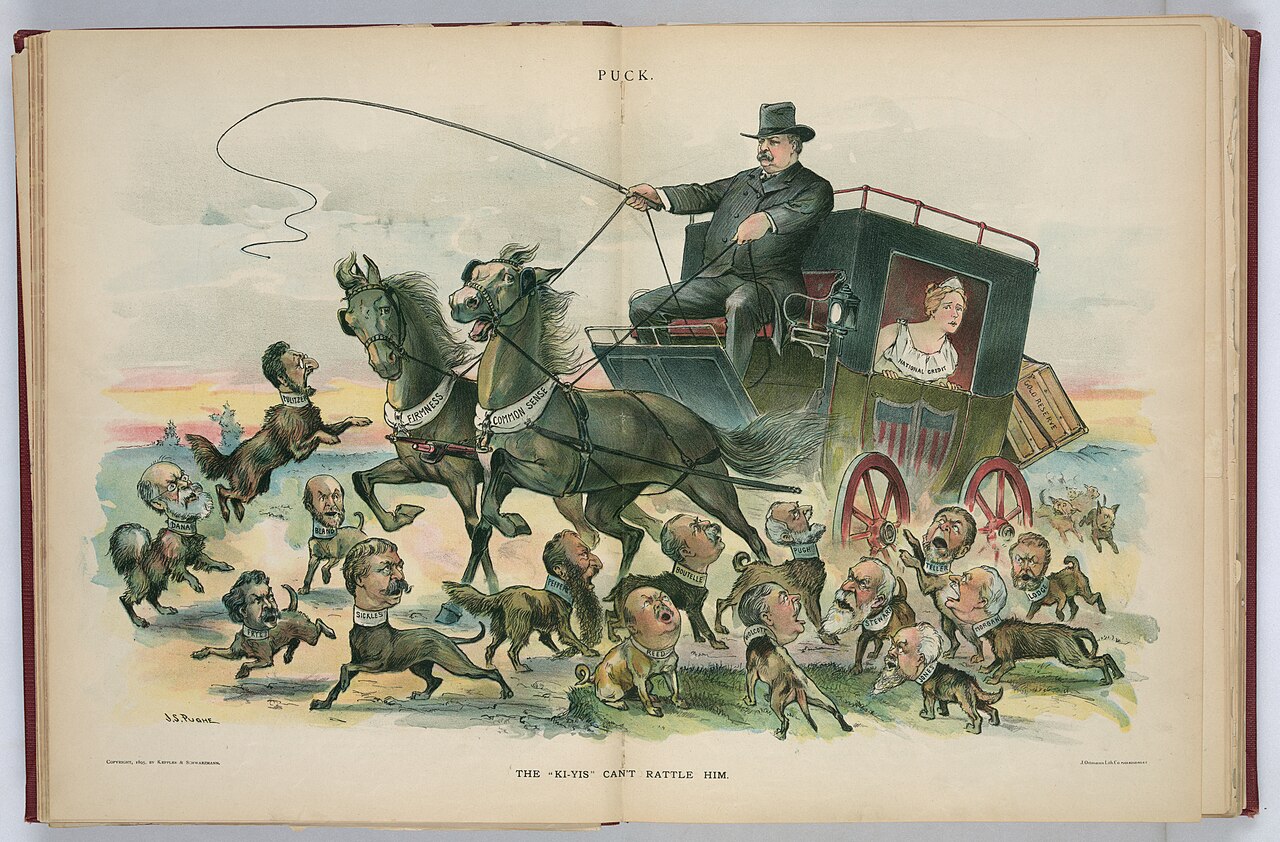
The message does not name the parties. The contract signed that day does. Treasury Secretary John G. Carlisle was the party of the first part. August Belmont and Co., acting for N. M. Rothschild and Sons of London, and J. P. Morgan and Co., acting for J. S. Morgan and Co. of London, were the parties of the second part. They agreed to deliver "three million five hundred thousand ounces of standard gold coin of the United States, at the rate of $17.80441 per ounce," payable in thirty-year 4 percent bonds dated February 1, 1895. At least half of the gold was to be "obtained in and shipped from Europe," no more than 300,000 ounces a month unless the syndicate agreed. The Treasury could swap in 3 percent gold bonds at $18.60465 per ounce if Congress authorized them within ten days. And the syndicate promised that, "as far as lies in their power," it "will exert all financial influence and will make all legitimate efforts to protect the Treasury of the United States against the withdrawals of gold pending the complete performance of this contract."41 The economists Peter Garber and Vittorio Grilli, who reprint the contract, compute an implied price of $104.5 in gold for each $100 bond, a yield of 3.75 percent, about $62.3 million in bonds at par and $65.1 million in gold to the Treasury.41 The American Presidency Project's timeline of Cleveland's second term says that "Cleveland is forced to turn to J.P. Morgan, who buys bonds in exchange for $62 million of European gold," and that the deal "saved the gold reserves, but disappointed opponents of the gold standard."21 Britannica's biography of Morgan gives the same figure: "Morgan formed a syndicate that resupplied the U.S. government's depleted gold reserve with $62 million in gold."24
Cleveland's message made a striking admission about who held the power. Investors priced bonds payable in "coin" lower than bonds payable expressly in gold, a difference of "three-fourths of a cent in annual interest." He offered to swap in 3 percent gold bonds if Congress authorized them within ten days, which he calculated would save $539,159 a year and $16,174,770 over thirty years. Then: "It is hardly necessary to suggest that, whatever may be our views on the subject, the sentiments or preferences of those with whom we must negotiate in disposing of our bonds for gold are not subject to our dictation."23 A President of the United States told Congress, in writing, that the government's lenders set terms the government could not dictate.
"Morganization" of the railroads
The same depression bankrupted a large share of the railroad network that federal land and bonds had built. Britannica's biography says Morgan "began reorganizing railroads in 1885," that after the 1893 panic he was called on to rehabilitate many of the country's leading lines, among them the Southern, the Erie and the Northern Pacific, and that he was controlling about 5,000 miles of American railroads by 1902.24 The Morgan Library and Museum holds the firm's syndicate book for the Philadelphia and Reading Railroad reorganization syndicate, catalogued under the date April 1, 1895, as one of a twelve-volume set of J. P. Morgan and Co. syndicate records.25
A reference account in Gale's American Eras describes the method that came to be called "Morganization": Morgan "acquired bankrupted roads, infused them with enough new capital to survive, implemented strict cost cuts," and "oversaw agreements with competing lines to reduce unnecessary competition," then set up "a voting trust of investors for a period of years following reorganization to ensure that agreements were observed."26 Section 5 of the Interstate Commerce Act had made pooling agreements among competing railroads unlawful.10 Where a public commission was forbidden to set rates, a private banker's voting trust could, in practice, decide how much the roads would compete. Whether shippers came out ahead is a separate question, and the sources here do not answer it. The record does show who did the coordinating. What the ICC could not legally do was done privately, and it answered to bondholders.
The West: forest reserves and Idaho's disclaimer
The Forest Reserve Act, March 3, 1891
Tucked into "An act to repeal timber-culture laws, and for other purposes," approved March 3, 1891, was section 24: "That the President of the United States may, from time to time, set apart and reserve, in any State or Territory having public land bearing forests, in any part of the public lands wholly or in part covered with timber or undergrowth, whether of commercial value or not, as public reservations, and the President shall, by public proclamation, declare the establishment of such reservations and the limits thereof."27 The section did not tell the President how much to reserve or by what standard. It required a proclamation and nothing more.
Harrison used it within a month. Proclamation 303 of March 30, 1891, withdrew Yellowstone Park lands for a forest reserve in Wyoming.28 Later Harrison proclamations recite the statute and a finding "that the public good would be promoted by setting apart and reserving said lands."29 On February 22, 1897, Cleveland signed a batch of reserve proclamations that included the Priest River Forest Reserve in Idaho and Washington and the Bitter Root Forest Reserve in Idaho and Montana.3031
Section 24 is a delegation of the Property Clause power, the power of Congress to "dispose of and make all needful Rules and Regulations respecting the Territory or other Property," to the President, by one sentence, without a standard. It changed the federal role in the West from seller of land to keeper of it. Lesson 14 follows that change to its legal conclusion in the retention policy of 1976.
Idaho's admission, July 3, 1890
Idaho's people met in convention on July 4, 1889, wrote a constitution, and ratified it in November 1889.32 Congress admitted the state on July 3, 1890, "on an equal footing with the original States in all respects whatever," and "accepted, ratified, and confirmed" its constitution.32 The act granted sections 16 and 36 in every township "for the support of common schools," to be "disposed of only at public sale, the proceeds to constitute a permanent school fund, the interest of which only shall be expended."32 It granted fifty sections for public buildings, 90,000 acres for an agricultural college, and lieu grants such as 100,000 acres for a scientific school, 50,000 acres for the State University at Moscow and 50,000 for the penitentiary at Boise City, and it paid the state five percent of the net proceeds of later federal land sales within its borders. Section 12 then closed the door: "the State of Idaho shall not be entitled to any further or other grants of land for any purpose than as expressly provided in this act."32
The Idaho Constitution carries the other half of the bargain in Article XXI, Section 19:
And the people of the state of Idaho do agree and declare that we forever disclaim all right and title to the unappropriated public lands lying within the boundaries thereof, and to all lands lying within said limits owned or held by any Indians or Indian tribes; and until the title thereto shall have been extinguished by the United States, the same shall be subject to the disposition of the United States ... That no taxes shall be imposed by the state on the lands or property therein belonging to, or which may hereafter be purchased by, the United States, or reserved for its use ... That this ordinance shall be irrevocable, without the consent of the United States and the people of the state of Idaho.33
The same section begins with a guarantee that "perfect toleration of religious sentiment shall be secured, and no inhabitant of said state shall ever be molested in person or property on account of his or her mode of religious worship."33 The disclaimer sentence has been argued over since. One reading treats "until the title thereto shall have been extinguished by the United States" as attaching to the Indian lands. Another reads the whole sentence as a temporary arrangement pending federal disposal of the public lands. The text alone does not settle which, and lesson 18 takes the question up with the case law. What the text does settle is that Idaho entered the Union having agreed that the unappropriated public lands were "subject to the disposition of the United States," that it would not tax federal property, and that it could not undo the bargain alone. The territorial Organic Act of 1863 had already forbidden any territorial law "interfering with the primary disposal of the soil."34 Statehood changed who governed Idaho. It did not change who held its public land.
Through Pierson's Framework
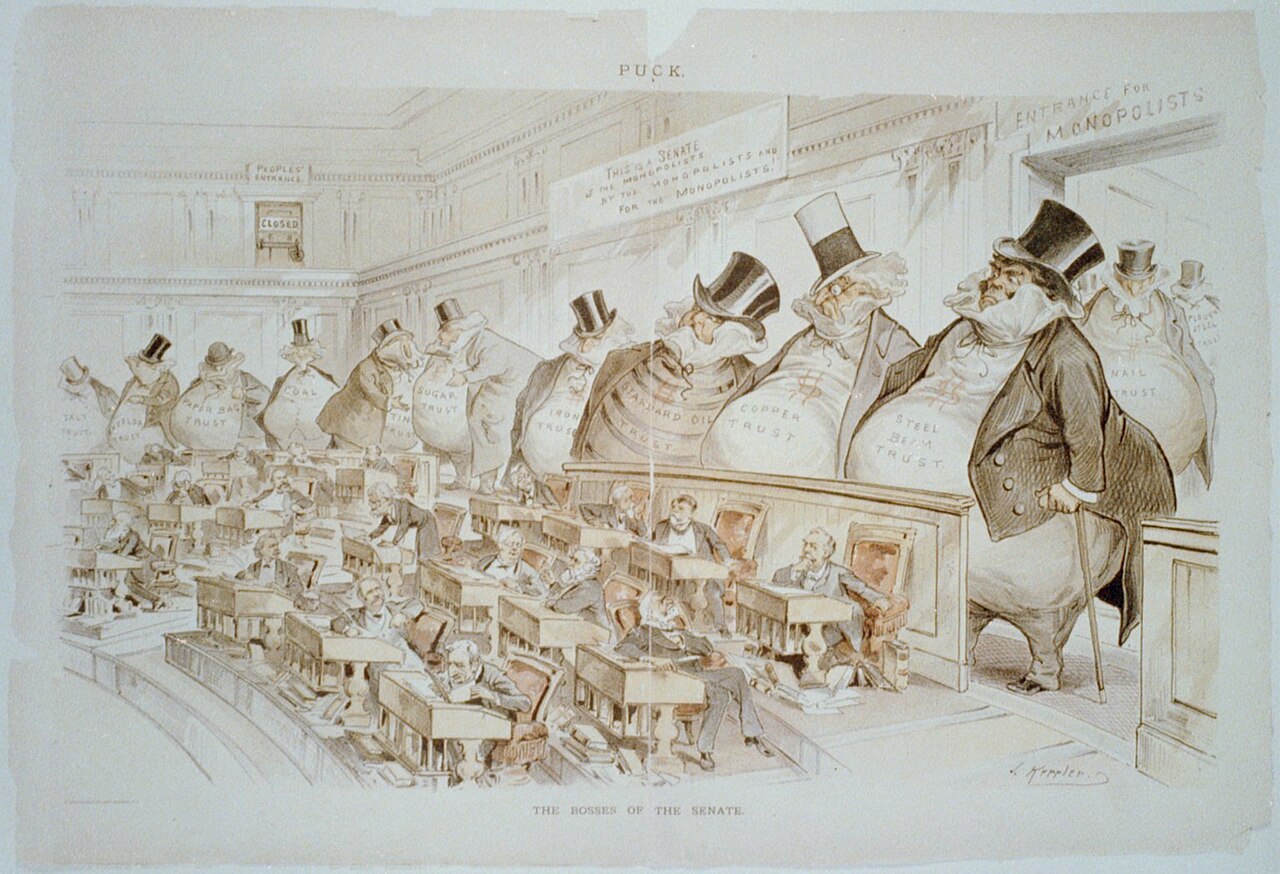
The Gilded Age built institutions to fix institutional failure. Spoils had turned the federal workforce into a party machine. Railroads had captured state legislatures and, as Puck drew it, the Senate. The answers were bodies insulated from politics: a commission chosen by party balance, a civil service protected from removal, a regulatory commission whose members the President could not fire at will. Pierson's framework asks whether a body answers to the people, and whether it is judged by its function or protected by its name.
On function, the grades differ by institution. The merit system ended political assessments and brought examinations into hiring, which the Pendleton Act was built to do. The ICC in its first decade was, in the National Archives' words, "not very effective," and the Supreme Court ruled it could not set rates.716 The Sherman Act was weakened in its first major case.19 None of these failures was hidden. They were argued in open court and drawn in Puck.
On accountability, the new forms introduced something new. The ICC's removal clause and the merit system's protections were designed so that elections could not reach the officials inside them. Pierson's appendix on the Anti-Federalists names the risk that follows: "the gradual accumulation of power by institutions insulated from public accountability, and the erosion of liberty through bureaucratic complexity, judicial arrogance, and executive overreach."35 In 1887 the insulation was thin. The ICC had five members, no rate power and a statute Congress rewrote two years later. The form, though, was set, and later agencies copied it with far broader powers. Pierson's "Acacia Illusion" describes the slow turn by which "the mission is replaced by the machinery, and survival becomes the goal."36 The ICC lasted almost 109 years, from February 1887 to December 1995, long after rail had stopped being the country's dominant mode of freight. An insulated commission can outlive the problem it was built for, and this one did.15
The 1895 gold arrangement is the period's sharpest lesson in name versus function. In name, the Treasury sold bonds under existing law. In function, a private syndicate supplied the gold reserve at terms the President said were "not subject to our dictation."23 The national government depended on a private bank to keep its own currency's promise. That is the state-capital partnership of the old mercantile system, lesson 3, turned around: here the sovereign needed the merchant more than the merchant needed the sovereign. Pierson uses the term "modern mercantilism" for the present-day fusion of state power and favored private capital; he has not set down a written definition, and lesson 16 gives the course's working definition and applies it to the years 2008 to 2026. February 1895 is a forerunner of what he calls modern mercantilism, an early American case of the same dependence, and not an instance of the term itself.
Idaho's disclaimer belongs in the framework too. It was consented to by Idaho's own convention and ratified by its voters, so it carries the legitimacy of the people's choice. Pierson's ordered liberty includes supporting legitimate government. A bargain the people of a state made and wrote into their own constitution is part of that. The same framework gives citizens the duty to hold the federal side of the bargain to its terms, and lesson 14 shows what happened to the "disposition" Idaho expected.
Hard Questions and Answers
Merit hiring ended a shakedown racket. Isn't it a smear to list one of the best reforms in American history as a root of institutionalism?
It was a real gain against a real abuse, and the record says so without qualification. Workers paid assessments to the party that hired them and could be fired for refusing; the Pendleton Act ended that by rule.6 The National Archives credits the act with transforming "the nature of public service."5 The charge against it is narrow: it created the first large group of federal officials whom no election could remove, and the protected class grew by presidential direction, including the jump from 54,222 to 87,044 classified employees between 1895 and 1896 shown in the Series Y data.16 The figures show the jump. They do not show the motive. A reform can be right and still create a new constituency that later defends itself.
The ICC could not even set a rate. Isn't it absurd to trace the administrative state to a toothless commission?
It was toothless at first, and the weakness is documented: no rate-setting power under the 1897 decision, and a law the Archives calls "not very effective."167 Its importance is its form. Five members, staggered six-year terms, a party cap, protection from removal except for "inefficiency, neglect of duty, or malfeasance in office," and reporting directly to Congress after 1889.1114 The Federal Trade Commission Act uses the same removal words today.12 The Archives itself calls the ICC "the model for many other regulatory agencies."7 A weak first instance of a form can still be the template for strong later ones.
Morgan's syndicate saved the gold reserve in 1895 when Congress would not act. Isn't hinting at impropriety just resentment of a banker who did the job?
The deal worked. The arrangement restored the gold reserve to more than $100 million, which is what Cleveland said it would do.23 The Presidency Project's timeline says it "saved the gold reserves."21 No source here shows the deal was corrupt, and no such charge is made. The contract itself is public, and its terms are the ones quoted above.41 Garber and Grilli read it as an efficient answer to a speculative attack on the gold standard, with the syndicate paid to bear six months of exchange risk.41 The problem sits in the President's own message: Congress had not acted and the executive used existing authority instead, and the lenders' terms were "not subject to our dictation."23 The question is structural. A government that cannot keep its currency's promise without a private syndicate has made that syndicate part of the government's working machinery, whatever its motives.
Idaho's own convention wrote a permanent disclaimer into its constitution. Isn't every later complaint about federal land a state trying to back out of its own deal?
Article XXI, Section 19 does say "forever disclaim all right and title to the unappropriated public lands," and makes the ordinance "irrevocable, without the consent of the United States and the people of the state of Idaho."33 That is a strong text. On whether Idaho can walk away alone, it ends the argument. On what the federal side owed, it does not. The sentence says the lands are "subject to the disposition of the United States" until title is "extinguished by the United States," and readers have disagreed about whether that phrase attaches to all the lands or only the Indian lands. And the Admission Act and the Organic Act describe a federal government that was, in 1890, disposing of land through homesteads, grants and sales.3234 Whether the bargain implied continued disposal is a fair question, and still an open one. Whether Idaho can undo it alone is not open at all.
The forest reserves kept public forests public. Why fuss over how the power was handed over?
Reserving forests may well have been right. The objection is to the method. Section 24 let the President reserve any forested public land "whether of commercial value or not," by proclamation, with no acreage limit and no standard beyond the land being forested.27 The Harrison proclamations recite only a finding that "the public good would be promoted."29 A sweeping delegation in one sentence of a general land bill moved a power the Constitution gives Congress to the executive. That method of building institutions, broad grants with thin standards, is what the major questions decisions of 2022 to 2024, covered in lesson 17, push back on.
Admit it: the Gilded Age Court was a servant of capital.
The cases do not fit the slogan. Munn upheld state rate regulation of grain elevators.8 Wabash struck down a state law, but did so by declaring interstate rates a national matter, which Congress then acted on.9 Knight read the Sherman Act narrowly against a sugar trust.19 Debs read federal power broadly against a union.20 The 1897 rate case denied the ICC rate-setting power because the statute did not grant it.16 The pattern is a Court reading commerce power narrowly against manufacturers and broadly against strikers, and refusing to find powers Congress had not plainly given. Knight and Debs, side by side, make the bias charge hard to dismiss. Munn and the rate case make it hard to prove as a blanket rule.
Learn more
- Pendleton Act (National Archives): text and the Archives' summary of its reach.
- Interstate Commerce Act (National Archives): the full text of the 1887 act.
- Act to Regulate Commerce, 24 Stat. 379: the official Statutes at Large page, including section 11.
- Sherman Anti-Trust Act (National Archives): text, votes and early cases.
- Wabash v. Illinois (1886): the case that pushed rate regulation to Congress.
- ICC v. Cincinnati, N.O. and T.P. Ry. (1897): the Maximum Rate case.
- Cleveland's Special Message of February 8, 1895: the gold bond arrangement in the President's words.
- Idaho Admission Act, 26 Stat. 215: the land grants and section 12's limit.
- Idaho Constitution, Article XXI, Section 19: the disclaimer of title.
- Federal Reserve History: Banking Panics of the Gilded Age: 1873, 1884, 1890 and 1893.
Notes
- U.S. Bureau of the Census, Historical Statistics of the United States, Colonial Times to 1970, Part 2 (1975), Series Y 308 to 317, pp. 1102 to 1103, including footnotes on reporting periods for 1884 to 1887. Read it online. ↩
- National Park Service, James A. Garfield National Historic Site, "Assassination and Death of President James A. Garfield." Read it online. ↩
- War Department, General Orders No. 71, "Announcement of the Assassination of President Garfield to the Army," September 20, 1881, The American Presidency Project. Read it online. ↩
- "A Model Office Seeker," Puck, July 13, 1881, file description at Wikimedia Commons (source: Library of Congress). Read it online. ↩
- National Archives, Milestone Documents, "Pendleton Act (1883)," introduction. Read it online. ↩
- An act to regulate and improve the civil service of the United States, ch. 27, 22 Stat. 403 (January 16, 1883), sections 1 and 2, text at the National Archives. Read it online. ↩
- National Archives, Milestone Documents, "Interstate Commerce Act (1887)," introduction. Read it online. ↩
- Munn v. Illinois, 94 U.S. 113 (1877), opinion of Waite, C.J. Read it online. ↩
- Wabash, St. Louis and Pacific Railway Co. v. Illinois, 118 U.S. 557 (1886), opinion of Miller, J., and dissent of Bradley, J. Read it online. ↩
- An act to regulate commerce, ch. 104, 24 Stat. 379 (February 4, 1887), sections 1, 2, 4 and 5, text at the National Archives. Read it online. ↩
- An act to regulate commerce, ch. 104, 24 Stat. 379, 383 to 387 (February 4, 1887), sections 11, 12, 18 and 21, Statutes at Large. Read it online. ↩
- 15 U.S.C. 41, Federal Trade Commission established; membership; vacancies, Legal Information Institute. Read it online. ↩
- Humphrey's Executor v. United States, 295 U.S. 602 (1935), opinion of Sutherland, J. Read it online. Quotations follow the official United States Reports, which hyphenates "quasi-judicial and quasi-legislative" (the Cornell text drops the hyphens). Read it online. ↩
- An act to amend an act entitled "An act to regulate commerce," ch. 382, 25 Stat. 855 (March 2, 1889), sections 7 and 8. Read it online. ↩
- National Archives, Guide to Federal Records, "Records of the Interstate Commerce Commission [ICC], Record Group 134," section 134.1, Administrative History. Read it online. ↩
- Interstate Commerce Commission v. Cincinnati, New Orleans and Texas Pacific Railway Co., 167 U.S. 479 (1897), opinion of Brewer, J. Read it online. ↩
- National Archives, Milestone Documents, "Sherman Anti-Trust Act (1890)," introduction. Read it online. ↩
- An act to protect trade and commerce against unlawful restraints and monopolies, ch. 647, 26 Stat. 209 (July 2, 1890), sections 1 and 2, text at the National Archives. Read it online. ↩
- United States v. E. C. Knight Co., 156 U.S. 1 (1895), statement of the case and opinion of Fuller, C.J. Read it online. ↩
- In re Debs, 158 U.S. 564 (1895), opinion of Brewer, J. Read it online. ↩
- The American Presidency Project, "Grover Cleveland: Second Term Event Timeline," entries for 1893 to 1895. Read it online. ↩
- Federal Reserve History, "Banking Panics of the Gilded Age." Read it online. ↩
- Grover Cleveland, Special Message to Congress, February 8, 1895, The American Presidency Project. Read it online. ↩
- Encyclopaedia Britannica, "J. P. Morgan," Britannica Money (consulted October 2026 through a page-reading tool; the site blocks direct download). Read it online. ↩
- The Morgan Library and Museum, archival record ARC 108, "Philadelphia and Reading R.R. Co. reorganization syndicate: syndicate records, 1895 Apr. 1." Read it online. ↩
- "The Railroads," American Eras (Gale), reprinted at Encyclopedia.com, citing Vincent P. Carosso, The Morgans (1987). This is a secondary reference work; the term "Morganization" is its usage. Read it online. ↩
- An act to repeal timber-culture laws, and for other purposes, ch. 561, section 24, 26 Stat. 1095, 1103 (March 3, 1891). Read it online. ↩
- Benjamin Harrison, Proclamation 303, Withdrawal of Yellowstone Park Lands for Forest Reserve, Wyoming, March 30, 1891, The American Presidency Project. Read it online. ↩
- Benjamin Harrison, Proclamation 344, Setting Apart as a Public Reservation Certain Lands in the State of Colorado, December 24, 1892, The American Presidency Project. Read it online. ↩
- Grover Cleveland, Proclamation 397, Establishment of the Priest River National Forest Reserve, Idaho and Washington, February 22, 1897, The American Presidency Project. Read it online. ↩
- Grover Cleveland, Proclamation 398, Withdrawal of Lands for the Bitter Root Forest Reserve, Idaho and Montana, February 22, 1897, The American Presidency Project. Read it online. ↩
- An act to provide for the admission of the State of Idaho into the Union, ch. 656, 26 Stat. 215 (July 3, 1890), preamble and sections 1, 4 to 12. Read it online. ↩
- Idaho Constitution, Article XXI, Section 19, Idaho State Legislature. Read it online. ↩
- An Act to provide a temporary Government for the Territory of Idaho, ch. 117, section 6, 12 Stat. 808 (March 3, 1863). Read it online. ↩
- Jeff A. Pierson, "The Anti-Federalist Warning: Institutional Power and the Fragility of Liberty," appendix to Ordered Liberty Reclaimed: A Foundation for Liberty. Read it online. ↩
- Jeff A. Pierson, "The Acacia Illusion: How Institutionalism Mimics Nature's Most Subtle Manipulation," in The Ordered Liberty Papers (2025). Read it online. ↩
- National Park Service, James A. Garfield National Historic Site, "'The Most Impressive Funeral Ever Witnessed': The Funeral of President Garfield," by Joan Kapsch (2012). Read it online. ↩
- National Park Service, "The Execution of Charles Guiteau." Read it online. ↩
- Trump v. Slaughter, No. 25-332, 609 U.S. 422 (2026), decided June 29, 2026, syllabus and opinion of Roberts, C.J., for the Court; Sotomayor, J., dissenting, joined by Kagan and Jackson, JJ. The ICC passage is from the dissent. Page proof pending publication. Read it online. ↩
- An Act To amend an Act entitled "An Act to regulate commerce," approved February fourth, eighteen hundred and eighty-seven, and all Acts amendatory thereof, and to enlarge the powers of the Interstate Commerce Commission (Hepburn Act), ch. 3591, section 4 (amending section 15), 34 Stat. 584, 589 (June 29, 1906). Read it online. ↩
- Contract of February 8, 1895, between the Secretary of the Treasury and August Belmont and Co. and J. P. Morgan and Co., reprinted in facsimile in Peter M. Garber and Vittorio U. Grilli, "The Belmont-Morgan Syndicate as an Optimal Investment Banking Contract," Documento de Trabajo No. II-1985, El Colegio de Mexico (University of Rochester, March 1985), pp. 14 to 15 and 15 to 17 for the computed terms. The facsimile is a scan of a printed copy, checked visually. Read it online. ↩
Terms in this lesson
- Pendleton Act
- The Civil Service Act of January 16, 1883, which created a three-member bipartisan Civil Service Commission and required open competitive examinations for classified federal positions.
- Classified service
- The federal positions placed under the Pendleton Act's merit rules; the President could extend the classification by order.
- Interstate Commerce Commission
- The five-member commission created by the Act to Regulate Commerce of February 4, 1887, the first federal independent regulatory commission; abolished by an act of December 29, 1995, that took effect January 1, 1996.
- For cause removal
- The ICC Act's provision that a commissioner could be removed by the President only for inefficiency, neglect of duty, or malfeasance in office, wording later copied into the Federal Trade Commission Act.
- Long and short haul
- The practice of charging more for a short trip than for a longer trip over the same line in the same direction, forbidden under similar conditions by section 4 of the 1887 act.
- Sherman Antitrust Act
- The act of July 2, 1890, declaring illegal every contract, combination or conspiracy in restraint of interstate or foreign trade, and making monopolization a misdemeanor.
- Morganization
- A name later applied to J. P. Morgan's method of reorganizing bankrupt railroads in the 1890s: new capital, cost cuts, agreements with rivals and control through a voting trust.
- Forest reserve
- Public forest land set apart by presidential proclamation under section 24 of the act of March 3, 1891; the forerunner of the national forests.
Sources
- Pendleton Act, January 16, 1883, 22 Stat. 403 checked 2026-10
- Interstate Commerce Act, February 4, 1887, 24 Stat. 379 checked 2026-10
- Wabash, St. Louis and Pacific Railway Co. v. Illinois, 118 U.S. 557 (1886) checked 2026-10
- Sherman Antitrust Act, July 2, 1890, 26 Stat. 209 checked 2026-10
- Grover Cleveland, Special Message, February 8, 1895 checked 2026-10
- Idaho Admission Act, July 3, 1890, 26 Stat. 215 checked 2026-10
- Idaho Constitution, Article XXI, Section 19 checked 2026-10
- Act of March 3, 1891, section 24 (Forest Reserve Act), 26 Stat. 1103 checked 2026-10
- Federal Reserve History, Banking Panics of the Gilded Age checked 2026-10