Lesson 5 of 12 · about 50 minutes · Updated November 21, 2026
Fire Inspections and the Wildland-Urban Interface
You'll be able to
- Identify which fire authority reviews access and water supply for a new house in a city, in a fire protection district and where no department exists, under Idaho Code 41-256
- Explain what the 2018 International Fire Code covers for one- and two-family homes and what the Idaho residential code covers instead
- Apply the IFC Appendix B fire-flow table and Idaho's driveway rules in IDAPA 18.08.01 to a described house
- Describe Idaho's sprinkler exemption (Idaho Code 39-4116(3)) and the five-acre and ten-mile exemptions from fire-code water and access rules
- Read Wildfire Risk to Communities data for an Idaho county or town and explain its limits
- Compare Idaho's local approach to wildland-urban interface rules with California, Oregon, Utah and Colorado
Start here: the short version
- The state fire code is the 2018 International Fire Code. Idaho Code 41-253 adopts the International Fire Code (IFC) and later editions the State Fire Marshal adopts; the Fire Marshal's Bulletin 20-14 (Nov. 4, 2020) adopted the 2018 edition effective Jan. 1, 2021, with Appendices B (fire flow), C (hydrants) and D (access roads), and Idaho's amendments sit in IDAPA 18.08.01.123
- Local fire chiefs enforce it. Under Idaho Code 41-256 the chief of every city fire department and every fire protection district is an "assistant to the state fire marshal"; where no organized department exists, the county sheriff is. In the Magic Valley that means the Jerome City Fire Department, Jerome Rural Fire District 1, the Twin Falls Fire Department, Rock Creek Rural Fire Protection District (Kimberly), the Buhl Fire Department, the Gooding Fire District and the Hagerman Fire Protection District, among others.45
- No home sprinkler mandate. Idaho Code 39-4116(3) exempts all single-family homes and two-unit dwellings from any provision of the IFC, the International Building Code or the Idaho residential code that would require automatic fire sprinklers; owners may still install them voluntarily.6
- Rural homes on 5 acres or more are exempt from fire-code water and access rules. Idaho Code 41-253(2) exempts a detached single-family house on five acres or more outside a city and outside an area of city impact, unless a county ordinance requires compliance; a county may lower the acreage only after a public hearing and 21 days' mailed notice to fire agencies.1
- The fire code's numbers for a house: 1,000 gallons per minute for one hour for an unsprinklered house up to 3,600 square feet of fire-flow area, or 500 gallons per minute for half an hour with a sprinkler system (IFC 2018 Table B105.1(1)); Idaho's driveway rule requires a 12-foot wide, 13-foot-6-inch clear driveway when any part of the first-story wall is more than 150 feet from a fire apparatus access road (IDAPA 18.08.01, adding IFC 503.7).73
- Idaho has no statewide wildland-urban interface code. The Fire Marshal's code page lists the 2018 IFC and NFPA standards only. Boise is the leading local example: ignition-resistant construction rules in its fire code (Ordinance 48-20, effective Jan. 1, 2021) and a zoning overlay that requires Class A roofs in its foothills subdistrict.8910
- The risk is measured, and it is high. The U.S. Forest Service's Wildfire Risk to Communities data (April 15, 2026 release) ranks Idaho's risk to homes higher than 96 percent of states and places 45.0 percent of Idaho's 996,427 mapped buildings in its "direct exposure" zone. The Idaho Department of Insurance counts more than 200 structures burned in Idaho's 2024 fire season and 14 in 2025.1112
Law: Idaho Code and IDAPA rules as amended through the 2026 regular session; fire code: the 2018 International Fire Code as adopted by the Idaho State Fire Marshal effective Jan. 1, 2021, with Idaho amendments in IDAPA 18.08.01 (sections dated July 1, 2024 and July 1, 2025); local codes and district forms as posted when read; wildfire data: USDA Forest Service Wildfire Risk to Communities, data download last updated April 15, 2026; insurance figures from the Idaho Department of Insurance (December 2025 and May 15, 2026). Checked Nov. 21, 2026. Fees, forms and district standards change; check the issuing office.
Fire is the one part of a new house's paperwork that most buyers never see. The building department reviews the walls, the roof and the wiring. The fire authority looks at something else: whether a fire engine can get to the house, turn around and leave, and whether there is enough water within reach to put out a fire once it gets there. In a city, those questions were usually answered when the subdivision was platted and the water mains and hydrants went in. On a rural lot in Jerome County, on a foothills parcel above Boise, or on a new private lane off a county road in Gooding County, they are answered one house at a time, often by a volunteer or part-time fire district with a two-page form.
This lesson explains who those fire authorities are under Idaho law, what the fire code covers for a one- or two-family home and what it leaves to the residential building code, the numbers behind fire flow, hydrants, access roads, driveways and gates, the long-running Idaho decision against sprinkler mandates in houses, the wildland-urban interface (the zone where homes meet flammable grass, brush and forest), the data on wildfire risk to Idaho homes, the 2024 and 2025 fire seasons, what the Idaho Department of Insurance has said and done about wildfire and home insurance, and how California, Oregon, Utah and Colorado have handled the same questions. It describes the rules; it does not tell any reader how to build or where.
The lesson connects to others in this course. The full list of offices that touch a new house is in lesson 01, Who Touches a New House: The Permit Map. How Idaho adopts the building, residential and energy codes, and who may amend them, is in lesson 02, The Codes: What Idaho Adopts and Who Decides. The step-by-step permit path in Jerome and Jerome County is in lesson 03, Getting a Residential Permit: City vs. County. Wells and water outside city systems are in lesson 04, Septic, Wells and Water, and how to report on all of this is in lesson 12, How to Report on Building Quality and Permitting. From Part A of this series, the pressure that growth puts on water systems, schools and roads is in Water, Schools and Roads.

Who the fire authorities are
The State Fire Marshal
Idaho's State Fire Marshal is a division of the Idaho Department of Insurance. Under Idaho Code 41-254 the Fire Marshal is appointed by the director of the Department of Insurance, with the governor's approval, and serves at the director's pleasure. The statute gives the office seven powers and duties: to enforce the International Fire Code, to write additional regulations "deemed necessary for the prevention of fires and protection of life and property," to issue interpretations of the code's intent, to adopt and amend rules, to send the governor and Legislature an annual report by July 15, to recommend amendments to the code's publisher, and to hold "exclusive jurisdiction over single service integrated fire sprinkler systems" (the piping that runs from the first connection to a public water system to the sprinkler heads, when it is used only for fire protection). The same section sets qualifications: at least 12 years of paid fire agency experience with five as a chief officer, or a four-year physical science degree plus five years in fire protection, or membership in the American Society of Fire Protection Engineers.13
Idaho Code 41-255 adds administrative duties, including keeping "a record of all fires occurring in the state" with the extent of damage and whether losses were insured, records the statute declares public (except testimony the Fire Marshal chooses to withhold), and setting uniform training rules for the local officials who act as the Fire Marshal's assistants.14 The Fire Marshal's office lists its divisions as fire prevention, fire investigation, plan reviews and licensing and certification (sprinkler and fire alarm contractors among them), and its rules include IDAPA 18.08.02 for fire protection sprinkler contractors.8 That rule, written under Idaho Code 41-254(2) and (3) and IFC Chapter 9, applies to "any person or entity involved in fire protection sprinkler systems" and covers license qualifications, financial responsibility, design requirements, service tags and fitters.15
The code itself: Idaho Code 41-253
Idaho Code 41-253 states the purpose of the state fire law, "to protect human life from fire, and to prevent fires," and adopts "the 'International Fire Code,' 2000 edition, with appendices thereto, published by the International Code Council, Inc. and such later editions as may be so published and adopted by the state fire marshal, as the minimum standards for the protection of life and property from fire and explosions in the state of Idaho." The statute was first enacted in 1970 (as section 39-3501), moved to its present place in Title 41 in 1982, and amended in 2002, 2008 and 2010 (Session Laws 1970 ch. 190; 1982 ch. 120; 2002 ch. 86; 2008 ch. 402; 2010 ch. 219).1
Because the statute adopts later editions "as may be so published and adopted by the state fire marshal," the edition in force is set by the Fire Marshal, not by a new bill. In Bulletin 20-14, dated Nov. 4, 2020, then-State Fire Marshal Knute C. Sandahl told fire chiefs, fire code officials and fire protection contractors that "Effective January 1, 2021, the Idaho State Fire Marshal's office intends to adopt the 2018 edition of the International Fire Code," described the adoption as "the agency interpretation of existing law ... authorized by Section 41-254, Idaho Code," and said it "coincides with the adoption of the International Building and Residential Codes administered by the Idaho Division of Building Safety." The bulletin adopted Appendices B, C, D, E and F and the NFPA standards referenced in Chapter 80 of the IFC.2 As of Nov. 21, 2026 the Fire Marshal's Statutes, Rules, Codes and Standards page still lists the "2018 International Fire Code" as the adopted code.8 The International Code Council has published 2021 and 2024 editions since; Idaho has not moved to either on the Fire Marshal's page as of this check.
The Fire Marshal's amendments live in IDAPA 18.08.01, "Adoption of the International Fire Code." The current rule's purpose statement still repeats the statute's reference to the 2000 edition, while most of its sections carry the history date July 1, 2024 (and section 017 on penalties, July 1, 2025). Its key amendments for houses are a new definition of "driveway," a set of driveway standards added as IFC section 503.7, a replacement water supply section 507.2, and the adoption of Appendices B, C and D, each covered below.3
Local fire chiefs as assistants to the State Fire Marshal
The Fire Marshal's office in Boise does not inspect most Idaho houses. Idaho Code 41-256(1) makes "the chief of the fire department, or his deputy, of every city or county, or fire protection district organized under state law in which a fire department is established" an assistant to the State Fire Marshal "in carrying out the provisions of the International Fire Code and rules of the state fire marshal," and in areas "where no organized fire department exists the county sheriff, or his deputy." Subsection (2) requires that any final decision by an assistant interpreting the fire code tell the affected party that it may be appealed through "a local appeal procedure that is substantially similar to the one set forth in the International Fire Code."4 Idaho Code 41-253(3) adds that assistants "shall apply a reasonable interpretation" of the code and rules when taking enforcement action.1
The State Fire Marshal's inspection power has a limit that matters for houses. Idaho Code 41-259 lets the Fire Marshal, deputies and assistants inspect buildings and premises in their jurisdiction on a written complaint or when they deem it necessary, "except the interior of private dwellings, private garages appertaining to such residences, or buildings on farms of more than five (5) acres."16 Fire code review of a new house is therefore mostly a review of the site: the road, the driveway, the address sign, the water supply and the hydrant. What happens inside the walls is the building department's job under the residential code.
Fire protection districts
Outside cities, most of Idaho is covered by fire protection districts formed under the "Fire Protection District Law," Idaho Code Title 31, Chapter 14, first enacted in 1943 (Session Laws 1943 ch. 161). Idaho Code 31-1401 declares fire protection and "enforcement of any of the fire codes and other rules that are adopted by the state fire marshal" a public purpose and says any part of a county not already in a district may be organized into one; districts are funded by property tax on all taxable property inside them.17 Under Idaho Code 31-1417 an elected board of fire protection commissioners may, among other powers, "adopt such rules and resolutions as may be necessary," "enforce the fire code and rules adopted by the state fire marshal," appoint appeals boards "for the purpose of handling ... disputes concerning fire code enforcement issues," and "charge and collect reasonable fees for services" under Idaho Code 63-1311 and 63-1311A.18 Section 63-1311 limits such fees to amounts "reasonably related to, but ... not [exceeding], the actual cost of the service."19 That is the legal basis for the plan review and access-and-water permit fees some districts charge on a new house. A separate section, Idaho Code 31-1430, lets districts sign mutual aid agreements with cities, counties and other districts, lets a district or city fire department charge a reasonable fee for responding to property outside its taxing area, and gives it a lien on the property served, filed like a contractor's lien.20
The State Fire Marshal's Fire Department Directory lists about 188 fire agencies statewide with chief, address and county. Its Magic Valley entries show the mix of city departments and rural districts a builder may deal with.5
| Area | Fire agency listed by the State Fire Marshal | Type | Address (as listed) |
|---|---|---|---|
| Jerome (city) | Jerome City Fire Department | City department | 110 W. Yakima Ave., Jerome |
| Rural Jerome County | Jerome Rural Fire District 1 | Fire protection district | 143 East A, Jerome |
| Eden area (Jerome County) | First Segregation Fire District | Fire district | 235 East Wilson Ave., Eden |
| Twin Falls (city) | Twin Falls Fire Department | City department | 345 2nd Ave. E., Twin Falls |
| Kimberly area | Rock Creek Rural Fire Protection District | Fire protection district | 1559 Main St. N., Kimberly |
| Rural Twin Falls County (north and east) | Salmon Tract Rural Fire Protection District | Fire protection district | 2411 East 2450 North, Twin Falls |
| Buhl | Buhl Fire Department | City department | 201 Broadway Ave. N., Buhl |
| Filer | Filer Fire Department | City department | 228 Main St., Filer |
| Gooding | Gooding Fire District | Fire district | 2155 Montana St., Gooding |
| Hagerman (Gooding County) | Hagerman Fire Protection District | Fire protection district | 150 Salmon St. E., Hagerman |
| Wendell (Gooding County) | Wendell Fire Department/Wendell Rural Fire District | Combined | 169 East Ave. A, Wendell |
| Meridian | Meridian Fire Department | City department | 33 E. Broadway Ave., Meridian |
| Kuna | Kuna Rural Fire District | Fire district | 150 W. Boise St., Kuna |
| Nampa | Nampa Fire Protection District | Fire protection district | 9 12th Ave. S., Nampa |
The directory does not say which agency covers a given address. District boundaries are recorded with the county, and the county assessor's tax roll shows which fire district levy applies to a parcel, so the tax bill is the simplest public record of which district serves a lot. How to read a levy line is in Reading Your Assessment and Levy. Whether a city or county building department issues a building permit for the same address, or none does because neither runs a program (the state Division of Occupational and Professional Licenses, DOPL, permits only state buildings), is a separate question, covered in lessons 01 and 03.

Who reviews a residential site plan
Put together, the statutes produce a simple rule with local variations. Inside a city with its own fire department, the city fire marshal or fire prevention office reviews subdivision plats, hydrant layouts and access for the fire code, usually during platting rather than at each house. In unincorporated areas and in cities served by a district, the fire protection district does it, sometimes for several cities at once. Where no organized department exists, the county sheriff is the assistant by law. The State Fire Marshal's own plan review staff handle state-owned buildings and places without a local fire code official, and fire sprinkler work under the office's exclusive jurisdiction.1348
Some Treasure Valley districts have turned this into a single "access and water supply" permit for houses that are not in a city water system. The Caldwell Rural Fire District's 2025 instructions, shared by the Nampa Fire Protection District, Upper Deer Flat Fire Protection District, Middleton-Star Fire Department, Caldwell Fire Department and Wilder Rural Fire Protection District, state that "Homes in new subdivisions of 5 lots or more shall meet access and water supply requirements of the 2018 IFC," apply the residential permit to lots created by an administrative land division of up to four lots, require a site plan and building plans with a square-footage diagram, require an engineer's certification of roads and bridges for an 80,000-pound fire apparatus before a certificate of occupancy, and set a plan review response target of 10 business days.21 The Kuna Rural Fire District's 2021 form marks homes "on 5+ acres" and homes "10+ miles from a fire station" as "EXEMPT," cites "Idaho Fire Code 102.5" for the rule that residential-code buildings must include "premises identification, fire apparatus access, and fire fighting water supply," and lists water supply choices: a municipal system, a private or community well with a hydrant within 1,200 feet driving distance, a hydrant on a 180,000-gallon tank within 1,200 feet, a water source designed to NFPA 1142, or an NFPA 13D home sprinkler system.22
We did not find a posted residential access and water supply form for the Jerome, Twin Falls, Gooding or Hagerman fire agencies. That does not mean they lack one; small districts often handle these reviews by phone and paper. A reader who wants the record can ask the district for its fire code adoption resolution, its plan review form and fee resolution, and any access and water decisions on a parcel under the Idaho Public Records Act (see Idaho Public Records Requests).
What the fire code covers for a house, and what it does not
Two codes, two jobs
A one- or two-family house in Idaho is built under the Idaho residential code, which Idaho Code 39-4109(1)(b) defines as the International Residential Code (IRC) "adopted by the Idaho building code board, together with the amendments, revisions or modifications" the board makes, minus the IRC's energy, mechanical, fuel gas, plumbing and electrical parts, which Idaho handles separately.23 The residential code governs the building: smoke and carbon monoxide alarms, the fire-resistant separation between the house and an attached garage, emergency escape windows from bedrooms, stairs and exits, and structural fire safety. Lesson 02 covers which IRC edition Idaho uses and how the Building Code Board amends it.
The International Fire Code (IFC), written by the same International Code Council, governs fire safety in the use and occupancy of buildings and premises. For a single house, its reach is mostly outside the walls: the fire apparatus access road that lets an engine reach the house, the fire flow (the amount of water, measured in gallons per minute for a set duration, that firefighters need), the location of fire hydrants, address numbers visible from the road, gates across access roads, and, in its rural water supply provisions, what substitutes for a hydrant where there is no water main. The Kuna Rural Fire District's form quotes the link between the two codes as "Idaho Fire Code 102.5": "All structures designed under the residential code shall include provisions for premises identification, fire apparatus access, and fire fighting water supply."22
The Idaho Building Code Act keeps the two codes in separate lanes. Idaho Code 39-4109(1)(a)(ii) adopts the International Building Code "excluding the incorporated ... fire codes ... other than specifically referenced subjects or sections of the International Fire Code."23 The building code board does not adopt the fire code; the State Fire Marshal does.
| Subject | Which code governs a one- or two-family house in Idaho | Who enforces | Source |
|---|---|---|---|
| Walls, roof, structure, stairs, egress windows, smoke and CO alarms, garage separation | Idaho residential code (IRC as adopted by the Idaho Building Code Board) | City or county building department where one runs a program; no building permit where none does (DOPL permits state buildings) | Idaho Code 39-4109, 39-4116236 |
| Fire apparatus access roads, driveways, gates, turnarounds | 2018 IFC Section 503 and Appendix D, as amended by IDAPA 18.08.01 | Local fire chief or district as assistant to the State Fire Marshal | IDAPA 18.08.01; Idaho Code 41-25634 |
| Fire flow (water supply) | 2018 IFC Section 507 (Idaho replacement 507.2) and Appendix B | Same | IDAPA 18.08.013 |
| Hydrant location and spacing | 2018 IFC Appendix C | Same, usually at subdivision platting | IDAPA 18.08.01; Bulletin 20-142 |
| Address markers at driveway entrances | IFC 503.7.5 as added by IDAPA 18.08.01 | Same | IDAPA 18.08.013 |
| Automatic fire sprinklers in the house | Not required; exempt by statute | Not applicable (voluntary systems reviewed by the fire jurisdiction when installed) | Idaho Code 39-4116(3)6 |
| Wildland-urban interface construction (roofs, vents, siding) | No statewide code; local only (for example Boise) | City fire and building officials where adopted | State Fire Marshal code page; Boise City Code810 |
Fire flow: how much water
Appendix B of the 2018 IFC sets minimum fire flow for buildings, and Idaho adopted it without amendment (IDAPA 18.08.01, section 056.01).3 For one- and two-family dwellings, Group R-3 and R-4 buildings and townhouses, section B105.1 points to Table B105.1(1). The table's rows, as printed in the 2018 model text: a fire-flow calculation area of 0 to 3,600 square feet with no automatic sprinkler system needs 1,000 gallons per minute for 1 hour; 3,601 square feet and greater without sprinklers takes the larger value from Table B105.1(2), which rises with floor area and construction type; with a sprinkler system installed under IFC 903.3.1.3 or IRC P2904, a house up to 3,600 square feet needs 500 gallons per minute for half an hour, and a larger house needs half the Table B105.1(2) value for one hour.7 The fire-flow calculation area is not the same as heated living space: the Caldwell Rural Fire District's 2025 instructions say it counts "total occupiable space under the roof deck, including garages, bonus rooms, basements, and exterior porches/patios," and that dwellings over 3,600 square feet "must have approved fire suppression water supply," with "separation through construction" not accepted.21
Idaho's rule changes where that water may come from. IDAPA 18.08.01 replaces IFC section 507.2 with a rule that a water supply may consist of water delivered by fire apparatus, reservoirs, pressure tanks, raised storage tanks, water mains or other sources the fire code official approves, so long as they can provide the needed fire flow, and adds an exception: "The water supply prescribed by this code needs to apply to structures served by a municipal fire department or a fire protection district and within ten miles (16093m) of a responding fire station."3 Read with the five-acre statute, a house that is more than 10 miles from a responding station, or that sits on five acres or more outside cities and impact areas, is outside the fire code's water supply requirement unless a county ordinance pulls it back in. The 2018 IFC also lets fire officials in "rural and suburban areas in which adequate and reliable water supply systems do not exist" use NFPA 1142 (the National Fire Protection Association's standard on water supplies for suburban and rural firefighting) or the International Wildland-Urban Interface Code (B103.3).724
How we figured it: fire flow as a volume of water, a hypothetical example
Hypothetical houses. Two made-up houses on lots that the fire code's water supply rules do reach: House A with a fire-flow calculation area of 3,200 square feet (living space, garage and covered porch), and House B with 4,000 square feet. These are illustrations, not any real permit.
Rule. IFC 2018 Table B105.1(1): up to 3,600 square feet without sprinklers, 1,000 gallons per minute for 1 hour; with an IFC 903.3.1.3 or IRC P2904 sprinkler system, 500 gallons per minute for 30 minutes.7
Arithmetic. House A without sprinklers: 1,000 gallons per minute times 60 minutes equals 60,000 gallons available at the required rate. House A with sprinklers: 500 times 30 equals 15,000 gallons, one quarter of the unsprinklered volume. House B is over 3,600 square feet, so its unsprinklered fire flow comes from Table B105.1(2), which depends on its construction type; we did not compute it because the table values for each construction type were not part of the text we read.
Comparison with local forms. The Kuna and Caldwell-area district forms accept, as one option, a hydrant supplied by a tank of 180,000 gallons within 1,200 feet of the house.2122 That tank holds three times the 60,000 gallons of our hypothetical House A; the forms do not explain how the 180,000 figure was chosen, and we did not find a published rationale.

Hydrants
Appendix C of the IFC, "Fire Hydrant Location and Distribution," is adopted in Idaho by IDAPA 18.08.01 section 056.02 with no Idaho amendments.3 It ties the number and spacing of hydrants to the fire flow a development needs, which is why hydrant layout is mostly settled during subdivision review, when the water purveyor, the city engineer and the fire authority sign off on mains and hydrant locations, rather than at each building permit. The step-by-step platting process is in Subdivisions and Plats, Step by Step. On rural lots without a water system, the Kuna and Caldwell-area forms accept a hydrant on a private or community well only if "the owner/applicant ... provide[s] fire flow information from the water purveyor that verifies the well is capable of the required fire flow."22 A domestic well sized for one household rarely produces fire flow; how domestic wells are permitted, and their limits, is in lesson 04.
Fire apparatus access roads, driveways and turnarounds
A fire apparatus access road is the road a fire engine uses to reach a building. Idaho adopts IFC Appendix D, "Fire Apparatus Access Roads," with amendments: IDAPA 18.08.01 section 056.03 excludes driveways covered by the Idaho driveway rules from Appendix D, modifies D102.1, and replaces D103.2 (grade) with a gradient standard set by the fire code official.3 The Caldwell-area districts apply a 20-foot minimum improved driving surface "for all access roads serving dwellings," 13 feet 6 inches of vertical clearance, roads and bridges designed for an 80,000-pound fire apparatus, and a turnaround "if the access road exceeds 150 feet, placed within 150 feet of the dwellings."21 The Kuna district's 2021 guidelines were narrower for small lanes: a 12-foot surface for access roads serving one or two dwellings and 20 feet for three or more, gravel or asphalt at least 2 inches thick over at least 6 inches of pit run.22 Those differences are a real feature of Idaho fire code enforcement: each district reads and applies the same state code, and their forms are not identical.
Idaho's own addition is the driveway. IDAPA 18.08.01 defines a driveway as a route serving no more than five single-family dwellings (not counting accessory buildings) and adds a new IFC section 503.7. Its text:
- "503.7 Driveways. Need be provided when any part of an exterior wall of the first story of a building is more than 150 feet (45720mm) from a fire apparatus access road. Driveways will provide a minimum unobstructed width of 12 feet (3658mm) and a minimum unobstructed height of 13 feet 6 inches (4115mm). Driveways over 150 feet (45720mm) will have turnarounds. Driveways over 200 feet (60960mm) long and less than 20 feet (6096mm) wide may need turnouts in addition to turnarounds."
- 503.7.1: "A driveway cannot serve more than five single family dwellings."
- 503.7.2: turnarounds "will have at least a 30 feet (9144mm) inside turning radius and at least a 45 feet (13716mm) outside turning radius."
- 503.7.3: turnouts where a natural or man-made feature blocks the line of sight, "of an all-weather road surface at least 10 feet (3048mm) wide and 30 feet (9144mm) long."
- 503.7.4: vehicle load limits posted at both ends of bridges on driveways and private roads, with design loads set by the fire code official.
- 503.7.5: a permanently posted address at every driveway entrance, "visible from both directions of travel," posted "at the beginning of construction and maintained thereafter," with multiple addresses on one post where a driveway serves several homes.
- 503.7.6: grades "may not exceed 10 % unless approved by the fire code official."
- 503.7.7: security gates must have "an approved means of emergency operation" and be "operational at all times."
- 503.7.8: driveways designed and maintained "to support the imposed loads of local responding fire apparatus and be surfaced to allow all weather driving."3
The same rule deletes from IFC 503.6 the sentence requiring fire code official approval of security gates across a fire apparatus access road, so in Idaho the gate requirement is the operational standard in 503.7.7 rather than a prior approval.3
The five-acre and ten-mile exemptions
Two Idaho provisions take many rural houses out of the fire code's water and access requirements altogether. The first is statutory. Idaho Code 41-253(2): "A detached single family dwelling, to be constructed upon lands of five (5) acres or more outside an incorporated city and not within a designated area of city impact, shall be exempt from the water supply and access requirements of the adopted version of the International Fire Code unless a county land use or subdivision ordinance requires such compliance." A county may widen the exemption by lowering the five-acre minimum, but only "after first conducting a public hearing subject to public notice that complies with the requirements set forth in section 67-6509, Idaho Code, and after providing notice by mail to all fire agencies providing services to areas outside an incorporated city and not within a designated area of city impact that might be affected by any such proposal at least twenty-one (21) days prior to such public hearing."1 Section 67-6509, the planning statute the notice must follow, requires notice of the hearing to be published in the official newspaper at least 15 days before it and sent to political subdivisions serving the jurisdiction.25 An area of city impact is the zone around a city, set by agreement between the city and county under the Local Land Use Planning Act, where the city's plans and sometimes its ordinances apply before annexation; how those agreements work is in Annexation Fights.
The second is the ten-mile exception in Idaho's replacement IFC section 507.2, which applies the water supply rule only to structures "served by a municipal fire department or a fire protection district and within ten miles (16093m) of a responding fire station."3 The Kuna district form marks both cases "EXEMPT," and the Caldwell-area form asks applicants to check either box.2221 Neither exemption reaches the residential code: an exempt house still needs a building permit where one is required, smoke alarms and the rest of the IRC's fire safety provisions.
We could not find a published list of which Idaho counties have used their power under 41-253(2) to require compliance or to lower the acreage. Jerome, Twin Falls and Gooding counties' zoning ordinances would show it; we list it under what we don't know.
Sprinklers in one- and two-family homes
What Idaho law says
Idaho Code 39-4116(3), in full: "All single family homes and multiple family dwellings up to two (2) units are hereby exempted from the provisions of the International Fire Code, the International Building Code and the Idaho residential code that require such dwellings to have automatic fire sprinkler systems installed. Nothing in this section shall prevent any person from voluntarily installing an automatic fire sprinkler system in any residential dwelling."6 The State Fire Marshal's code page lists the subsection by name, "39-4116(3) Sprinkler Exemption (1- and 2-Family Dwellings)."8 The statute's own wording acknowledges that the model codes contain sprinkler requirements for these homes (the model IRC's section R313.2, which the Building Code Board's rule, IDAPA 24.39.30, also deletes, as lesson 02 explains) and overrides them for Idaho.
Two other provisions of the Building Code Act reinforce the exemption. Idaho Code 39-4109(3) bars the Idaho Building Code Board from amending the residential code to set "standards that are more restrictive than those published by the International Code Council," and Idaho Code 39-4116(4)(b) bars a city or county from adopting any part of the IRC "that [has] not been adopted or that [has] been expressly rejected or exempted from the adopted version of those codes by the Idaho building code board."236 Section 39-4116 was enacted in 2002 and amended in 2004, three times in 2009, 2010, 2014, 2018, 2022, 2025 (Session Laws ch. 40) and 2026 (ch. 320); we did not confirm which of those session laws added the sprinkler exemption.6
Where sprinklers still show up
Sprinklers still appear on Idaho house permits as a choice. The Kuna and Caldwell-area forms list an NFPA 13D system (the National Fire Protection Association standard for sprinkler systems in one- and two-family dwellings) as an alternative to a hydrant or tank, with plans "submitted to the fire jurisdiction for review and approval" and installation inspections by the fire jurisdiction; Caldwell's form requires a signed letter of intent.2122 The IFC's own fire-flow table gives the same choice a number: installing a sprinkler system cuts the required fire flow for a house up to 3,600 square feet from 1,000 gallons per minute for an hour to 500 gallons per minute for half an hour.7 For a house beyond a water main, the decision between a sprinkler system and a hydrant on a large tank is an engineering and cost choice the owner makes, not a mandate. Idaho's rule also adds "If prescribed by the authority having jurisdiction" to the start of IFC 904.1.1 on alternative automatic fire-extinguishing systems.3
The wildland-urban interface
What the term means
The wildland-urban interface (WUI) is the zone where houses meet or mix with undeveloped land that can burn: forest, brush, sagebrush and grass. Codes written for it, chiefly the International Code Council's International Wildland-Urban Interface Code (IWUIC), do two things the ordinary fire code does not. They regulate the house itself, through "ignition-resistant construction" rules for roofs, siding, vents, decks and eaves that aim to keep embers from starting fires in or on the building, and they regulate the land around it, through "defensible space," a cleared or managed zone where vegetation is thinned, kept low or removed so a fire loses energy before it reaches the house and firefighters have room to work.
The 2018 IFC already points to the IWUIC as one tool: Appendix B section B103.3 says that in rural and suburban areas without reliable water systems, the fire code official "is authorized to utilize NFPA 1142 or the International Wildland-Urban Interface Code."24 But the IWUIC itself is not adopted statewide in Idaho. The State Fire Marshal's Statutes, Rules, Codes and Standards page lists the 2018 IFC, NFPA codes and standards, the fire statutes and two rules (IDAPA 18.08.01 and 18.08.02); it lists no wildland-urban interface code, and IDAPA 18.08.01 contains no WUI provisions.83 WUI rules in Idaho are local.
Boise: the leading local example
Boise has the most developed WUI rules in the state, in two layers. The first is in its fire code. Boise City Code's wildland-urban interface provisions, numbered 4101 to 4115 and carrying the history note "Ord. 48-20, 12-8-2020, eff. 1-1-2021," set three classes of ignition-resistant construction. In the highest-risk class, section 4109.2 says "Roofs shall have a roof assembly or roof covering, which shall comply with a Class A rating" (Class A is the most fire-resistant roof rating under national test standards); in the lowest, roofs must be at least Class B (4111.2). The provisions set a fuel modification distance of "at least 30 feet" measured from the building (4115.3), require "A fuel-free area of 5 feet ... around all structures" (4115.3.4), require 10 feet of horizontal clearance between tree crowns and structures (4115.3.2), and set a 30-foot setback from structures to undeveloped natural open space (4107.4).10 Boise Fire's code update page said the adoption would "more closely match the 2018 International Wildland-Urban Interface Code" and that "updated boundaries will more closely match our projected wildfire risk," linking a 2019 WUI map.26 The amendments document the city posted with that update shows the structure: Boise City Code Title 5, Chapter 12 adopts the 2018 IFC as Boise's fire code, adds a Chapter 41 for the wildland-urban interface (sections 4101 to 4121), adopts 2018 IWUIC standards, requires a "Wildfire Safety and Mitigation Plan" with a preliminary plat or annexation in WUI areas (4103.2), and amends IFC Appendix D so a development with fewer than 60 dwelling units on one access road may skip a second access if every unit has an approved automatic sprinkler system.27
The second layer is zoning. Boise's Wildland Urban Interface Overlay (WUI-O), Boise City Code 11-02-07.3.H, applies to all new structures and additions in the overlay and to renovations that increase gross floor area by more than 49 percent, with exceptions for interior-only work, some historic buildings and some agricultural accessory buildings. It divides the overlay into subdistricts: IR1 areas, "generally ... foothills fire hazard areas," require Class 1 ignition-resistant construction, and IR2 areas, generally "valley, desert, and other occluded fire hazard areas," require Class 2. The page says the IR1 boundary "will expand to include annexed land north and west of Hill Road," that the city's Fire Code Official has final authority over which parcels fall inside, and that where provisions conflict "the more restrictive shall control."9
Boise's approach raises a legal question that Idaho has not squarely answered in a reported court decision we found: Idaho Code 39-4116(4)(b) bars local governments from adopting IRC provisions the Building Code Board has not adopted, but cities and fire districts also hold fire code and zoning powers, and Boise placed its WUI construction rules in its fire code and its zoning overlay rather than in an amendment to the residential code. It is taken up under Hard questions below.
Ada County defensible space rules
Ada County's code, in the part of its zoning title that covers wildland-urban interface standards (amended by ordinances from Ord. 389 in 2000 through Ord. 699 in 2008), requires a 50-foot defensible space around any habitable structure for new construction, alterations, moving or change of use. Inside it, only single specimen trees, ornamental plants and ground cover are allowed; grass and weeds must be kept to 4 inches or less; tree limbs must be pruned up to 6 feet above grade; tree crowns must keep 10 feet of clearance from structures and chimney outlets; firewood must be at least 20 feet from structures and may not be stored under decks or eaves; vegetation must be cleared 5 feet on each side of driveways; and private roads need turnouts at least 8 by 30 feet no more than 700 feet apart. Subdivisions and planned unit developments need a fire protection plan prepared by a licensed fire protection engineer and reviewed by the local fire district, or the Ada County Sheriff where there is no district, with advice from the State Fire Marshal.28

Defensible space zones
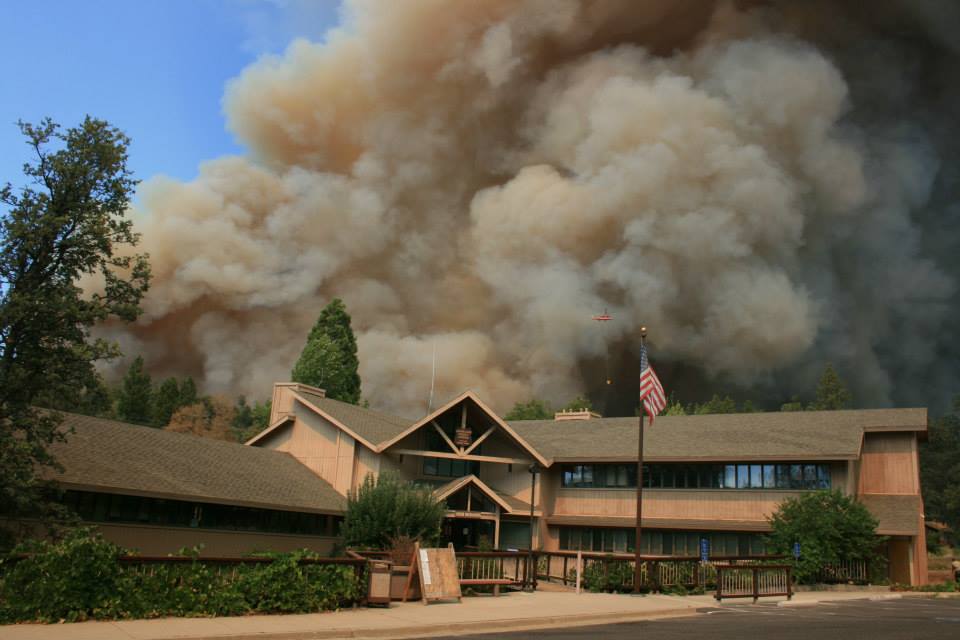
Defensible space is usually described in rings measured outward from the house. The numbers differ by jurisdiction. Boise's code uses a 5-foot fuel-free area and at least 30 feet of fuel modification.10 Ada County uses a single 50-foot ring for new construction in its interface areas.28 California's state fire agency, CAL FIRE, describes three zones under Public Resources Code 4291, which it says requires 100 feet of defensible space: Zone 0 in the first 5 feet ("the most important" for keeping embers from igniting materials near the home), Zone 1 within 30 feet, and Zone 2 within 100 feet, and it notes that some counties go further (San Diego County requires 50 feet of clearance in Zone 1).29 The Idaho Department of Insurance and State Fire Marshal, in a May 21, 2025 consumer alert, told residents to remove dead vegetation "especially within the first five feet of your home," prune shrubs and branches within five feet, and trim trees so the lowest limbs are 6 to 10 feet above ground level; that is guidance, not a code requirement.30
How much wildfire risk Idaho homes face
The Wildfire Risk to Communities data
The best public measure of wildfire risk to homes across the country is Wildfire Risk to Communities, a free website and dataset built by the USDA Forest Service "under the direction of Congress in the 2018 Consolidated Appropriations Act (H.R. 1625, Section 210)." Its data download, last updated April 15, 2026, gives for every state, county and Census place the total number of mapped buildings, the share of those buildings in each of three exposure zones the project defines (minimal, indirect and direct exposure), and percentile ranks for burn probability and for mean "risk to potential structures," which the website presents as risk to homes. A national rank of 0.96 means the place's mean risk is greater than or equal to that of 96 percent of places at the same level.11 The project's methods page explains how buildings were mapped and how exposure zones were drawn; buildings on open water, permanent ice and protected lands were removed from the counts.11 The project's download page offers the spreadsheet and GIS layers free.31 Its methods page says that in version 2.0 the earlier "Exposure Type" layer was replaced by "Risk Reduction Zones," and that risk-to-homes figures are summarized over a "Risk Calculation Area, which includes a 2.4 km buffer around communities," which is one reason a town's figure reflects land just outside its limits.32
Idaho, by that measure, is among the highest-risk states. Its 996,427 mapped buildings are 36.9 percent in the minimal exposure zone, 18.2 percent in the indirect zone and 45.0 percent in the direct exposure zone, and its risk to homes ranks at the 96th percentile among states. Nevada ranks at the top (1.00), California at 0.98, Washington 0.94, Oregon 0.92, Utah 0.90, Montana 0.74 and Colorado 0.72.11
| Place | Mapped buildings | Direct exposure | Indirect exposure | Risk to homes, national percentile | Risk to homes, percentile within Idaho |
|---|---|---|---|---|---|
| Idaho (state) | 996,427 | 45.0% | 18.2% | 96 (among states) | n/a |
| Jerome County | 15,374 | 51.3% | 8.4% | 91.2 | 44.2 |
| Twin Falls County | 45,802 | 32.8% | 10.1% | 96.6 | 65.1 |
| Gooding County | 12,848 | 53.7% | 32.5% | 97.5 | 74.4 |
| Lincoln County | 4,649 | 62.6% | 35.9% | 97.1 | 69.8 |
| Minidoka County | 15,025 | 27.9% | 1.4% | 81.8 | 16.3 |
| Cassia County | 16,538 | 43.6% | 7.6% | 98.7 | 93.0 |
| Ada County | 200,711 | 26.9% | 16.3% | 98.5 | 88.4 |
| Canyon County | 103,855 | 44.8% | 5.6% | 80.7 | 11.6 |
| Kootenai County | 86,057 | 43.6% | 23.5% | 66.7 | 0 |
| Blaine County | 15,267 | 49.5% | 50.0% | 90.4 | 41.9 |
| Valley County | 15,996 | 82.4% | 16.6% | 98.4 | 86.0 |
| Elmore County | 16,430 | 43.5% | 55.8% | 99.2 | 97.7 |
Source: USDA Forest Service, Wildfire Risk to Communities data download (counties tab), last updated April 15, 2026; percentages and percentiles converted from the file's decimal fractions by us.11
The town-level figures for the Magic Valley core cities, from the same file's communities tab, show how much the picture changes inside city limits:
| City | Mapped buildings | Direct exposure | Indirect exposure | Risk to homes, national percentile |
|---|---|---|---|---|
| Jerome | 4,611 | 12.1% | 0% | 46.4 |
| Twin Falls | 19,368 | 6.3% | 8.2% | 90.6 |
| Kimberly | 1,766 | 10.9% | 0% | 18.1 |
| Gooding | 1,841 | 6.4% | 78.7% | 77.9 |
| Buhl | 2,294 | 10.3% | 53.1% | 89.4 |
| Hagerman | 613 | 13.5% | 11.6% | 98.3 |
| Boise City | 93,704 | 14.8% | 26.0% | 97.5 |
| Meridian | 42,213 | 22.4% | 0% | 78.3 |
| Nampa | 36,616 | 22.2% | 0% | 65.0 |
| Ketchum | 2,246 | 22.3% | 77.7% | 90.3 |
| McCall | 3,644 | 57.9% | 41.6% | 96.2 |
Source: same file, communities tab; national percentile compares each place with all Census places nationally.11 The pattern matters for building rules. Kimberly and Jerome, surrounded by irrigated farmland, have low mean risk; Hagerman, on the Snake River canyon and its grass and sage slopes, ranks higher than 98 percent of places nationally. The rural parts of Jerome, Gooding and Lincoln counties, where much of the new rural housing goes, have more than half their buildings in the direct exposure zone. That is the same rural land where Idaho Code 41-253(2) exempts houses on five acres or more from the fire code's water and access rules.
How we figured it: wildfire risk figures
Data. USDA Forest Service, Wildfire Risk to Communities, file wrc_download_20260415.xlsx (README: "last update 4/15/2026"), tabs States, Counties and Communities. Fields used: TOTAL_BUILDINGS, BUILDINGS_FRACTION_DE (direct exposure), BUILDINGS_FRACTION_IE (indirect exposure), RISK_NATIONAL_RANK and RISK_STATE_RANK (percentile of mean risk to potential structures).11
Method. We multiplied each fraction by 100 and rounded to one decimal place (Jerome County's direct exposure fraction 0.513074021 becomes 51.3 percent; its national risk rank 0.912 becomes the 91.2nd percentile). For the statewide count of directly exposed buildings we multiplied 996,427 by 0.449753971, which gives about 448,147 buildings; this is our calculation and assumes the fraction applies to the same building count the file reports.
Limits. These are modeled estimates of risk, not records of fires. The percentile ranks compare places with each other; a low percentile in a national ranking is not the same as no risk. The exposure zones are the project's definitions, explained on its methods page.
The 2024 and 2025 fire seasons
The Idaho Department of Insurance's December 2025 infographic on wildfires and property insurance gives three years of figures: structures burned, fewer than 5 in 2023, more than 200 in 2024 and 14 in 2025; acres burned, 97,504 in 2023, about 1 million in 2024 and 195,275 in 2025.12 In its May 21, 2025 consumer alert the department described 2024 as "one of the most destructive wildfire seasons in Idaho's recent history."30
The best-documented home losses of 2024 were in north-central Idaho. The federal InciWeb page for the Gwen Fire, managed by the Idaho Department of Lands, says lightning on Wednesday, July 24, 2024 started multiple fires northeast of Lewiston; the Gwen and River fires were combined as one incident, about 5 miles east of Lapwai, affecting Juliaetta, Lapwai and Culdesac. It reports that "Primary residences, outbuildings and a commercial building are among the structures lost," and its final size entry is 28,820 acres.33 The page does not give a final count of homes destroyed. We did not find a 2024 or 2025 fire that destroyed homes in Jerome, Twin Falls or Gooding counties in the records we read; that is a gap in our search, not a finding that none occurred.
Insurance and wildfire risk in Idaho
Building rules and insurance are linked: a house's roof class, vents, defensible space and distance to a hydrant and fire station can affect whether an insurer will write a policy and at what price. The same December 2025 Department of Insurance infographic reports that 689,774 homeowners policies were issued in Idaho in 2024, that 100 companies offered homeowners coverage in 2024, that 12 carriers had submitted block non-renewal notices for homeowners policies since the start of 2024, and that Idahoans paid $168,000,000 in premiums to surplus lines companies for property coverage in 2024, double the 2022 amount. (Surplus lines insurers are companies not licensed as admitted insurers in Idaho that may write coverage the admitted market will not; their rates and forms are not approved the same way.)12
On May 15, 2026 the department announced Bulletin 26-02, a second data call (after a similar one in 2025) requiring every insurer authorized to write homeowners and fire property insurance in Idaho to report detailed policy and claims data, "with a particular focus on wildfire-related impacts." The release says insurers have adjusted premiums, modified coverage and in some cases paused or stopped writing new business in higher-risk regions, and quotes Director Dean L. Cameron: "Some insurers have scaled back or exited certain areas, and Idahoans are feeling those impacts." It reports no findings yet.34 The department's consumer advice has focused on owners rather than builders: an Aug. 1, 2024 release during the fire season urged residents to make a home inventory, keep insurance papers accessible, keep contact information current with their insurer and check that the value of their property is accurately covered.35 We did not find a 2025 or 2026 Idaho statute that ties insurance to wildfire mitigation standards the way Utah's 2025 law does (below).
How other states handle WUI building rules
California
California has the longest-running statewide WUI building code. The Office of the State Fire Marshal says its wildland-urban interface construction requirements apply "to all new buildings for which an application for a building permit is submitted on or after July 1, 2008," in State Responsibility Area lands the State Board of Forestry and Fire Protection designates as Moderate, High or Very High Fire Hazard Severity Zones, and in land that cities and other local agencies designate as High or Very High zones. Those standards were long known as Chapter 7A of the California Building Code; the office now identifies them as the "2025 California Wildland-Urban-Interface Code (CWUI), Title 24, Part 7."36 Defensible space is separate: CAL FIRE describes Public Resources Code 4291 as requiring 100 feet of it, in the three zones described above.29
Oregon
Oregon tried a statewide map and then undid it. Senate Bill 762 (2021), Oregon Laws 2021 chapter 592, an emergency measure effective on passage, directed the State Board of Forestry to set criteria for a statewide wildfire risk map, required the Department of Consumer and Business Services to adopt building code standards for the wildland-urban interface, and required the State Fire Marshal to set defensible space requirements.37 Senate Bill 83 (2025), chapter 590, also effective on signing, "eliminates certain building code standards and mapping requirements for wildfire hazard mitigation," voids State Forestry Department orders that had assigned property to a wildfire hazard zone, changes the membership of the Wildfire Programs Advisory Council and directs the State Fire Marshal to develop a model defensible space code, according to the legislature's measure summary.38 The measure page did not show the final votes or the signing date when we read it.
Utah
Utah ties WUI building rules to state firefighting money and to insurance. House Bill 48 (2025), "Wildland Urban Interface Modifications," chief sponsor Rep. Casey Snider and Senate sponsor Sen. Michael K. McKell, effective Jan. 1, 2026, requires counties (for unincorporated areas) and municipalities (for incorporated areas) to adopt and enforce "the edition of the Utah Wildland Urban Interface Code adopted under Section 15A-2-103"; if the state adopts a different standard, local governments have two years to follow, and the state forestry division may stop paying a noncomplying government's costs under a cooperative agreement. Beginning Jan. 1, 2026, county officers must assess an annual fee on owners of high-risk WUI property, set by the division by structure square footage, with past-due fees able to become a lien. The bill has the division maintain a public wildfire risk mapping tool, requires insurers to use its boundary when deciding whether a property is high risk, and requires an insurer that cancels or nonrenews for wildfire risk to state the facts behind the decision.39 We did not check whether Utah's 2026 session changed the fee.
Colorado
Colorado's Senate Bill 23-166, approved by the governor and effective May 12, 2023 (Colorado Session Laws 2023, chapter 174), created a Wildfire Resiliency Code Board in the Division of Fire Prevention and Control with 21 appointed voting members and 3 nonvoting members to adopt statewide minimum codes for hardening structures and reducing fire risk in defensible space in the wildland-urban interface. Any local government with jurisdiction in the interface that can adopt building or fire codes must adopt and enforce a code that meets or exceeds the board's minimum within three months after the board adopts its codes.40 We did not confirm the date the board adopted its code.
| State | Statewide WUI building code? | How it is set | Home sprinkler rule (one- and two-family) | Risk to homes, percentile among states (2026 data) |
|---|---|---|---|---|
| Idaho | No; local only (Boise, Ada County) | State Fire Marshal adopts IFC (2018); WUI by city or county ordinance | Exempt by statute, Idaho Code 39-4116(3) | 96 |
| California | Yes, since July 1, 2008 permits | Title 24, Part 7 (formerly CBC Chapter 7A) in designated hazard zones | Not checked for this lesson | 98 |
| Oregon | Statewide map and code standards required in 2021, eliminated in 2025 | SB 762 (2021, ch. 592); SB 83 (2025, ch. 590) | Not checked | 92 |
| Utah | Yes, local adoption required from Jan. 1, 2026 | HB 48 (2025): Utah Wildland Urban Interface Code; fee on high-risk WUI property | Not checked | 90 |
| Colorado | Board-set minimum; local adoption within 3 months of board code | SB 23-166 (2023, ch. 174) | Not checked | 72 |
Sources: Idaho Code 39-4116 and the State Fire Marshal code page; California OSFM; Oregon OLIS; Utah HB 48 enrolled; Colorado SB 23-166; Wildfire Risk to Communities.63638394011
Idaho fire law timeline
| Year | Law or event | What changed | Source |
|---|---|---|---|
| 1943 | Fire Protection District Law (Session Laws 1943, ch. 161) | Counties may organize fire protection districts with elected commissioners and property tax funding | Idaho Code 31-140117 |
| 1970 | State fire safety act (1970, ch. 190) | State fire code and State Fire Marshal powers enacted, first as Idaho Code 39-3501 onward | Idaho Code 41-253, 41-254113 |
| 1982 | 1982, ch. 120 | Fire code sections moved to Title 41 (Insurance), 41-253 onward | Idaho Code 41-2531 |
| 2002 | 2002, ch. 86; Idaho Building Code Act (2002, ch. 345) | 41-253 amended (it now adopts the IFC "2000 edition ... and such later editions"); Building Code Act enacted, including 39-4109 and 39-4116 | Idaho Code 41-253, 39-4109, 39-41161236 |
| 2008 and 2010 | 2008, ch. 402; 2010, ch. 219 | 41-253 amended (current text includes the five-acre exemption and the "reasonable interpretation" duty); 41-256 and 41-259 also amended in 2008 | Idaho Code 41-253, 41-256, 41-2591416 |
| 2020 to 2021 | State Fire Marshal Bulletin 20-14 (Nov. 4, 2020) | 2018 IFC adopted effective Jan. 1, 2021, with Appendices B, C, D, E and F | Bulletin 20-142 |
| 2020 to 2021 | Boise Ordinance 48-20 (Dec. 8, 2020; effective Jan. 1, 2021) | Boise WUI ignition-resistant construction and fuel modification rules | Boise City Code10 |
| 2024 | IDAPA 18.08.01 (sections dated July 1, 2024) | Current Idaho amendments to the IFC, including the driveway rules (503.7) and water supply (507.2) | IDAPA 18.08.013 |
| 2024 | Fire season | About 1 million acres and more than 200 structures burned in Idaho; Gwen Fire near Lapwai destroys homes | Department of Insurance; InciWeb1233 |
| 2025 | Fire season; first insurance data call | 195,275 acres and 14 structures burned; Department of Insurance's first wildfire-focused data call | Department of Insurance1234 |
| 2025 and 2026 | Session Laws 2025 ch. 40; 2026 ch. 320 | Idaho Code 39-4116 amended (sprinkler exemption in subsection (3) remains) | Idaho Code 39-41166 |
| 2026 | Department of Insurance Bulletin 26-02 (announced May 15, 2026) | Second data call on homeowners and fire insurance with a wildfire focus | Department of Insurance34 |
Pictures, Numbers and Infographics
| Measure | Idaho | U.S. or other states | Place or year | Source |
|---|---|---|---|---|
| Fire code in force | 2018 International Fire Code with IDAPA 18.08.01 amendments | ICC has published 2021 and 2024 editions | Effective Jan. 1, 2021 | 28 |
| Fire flow, unsprinklered house up to 3,600 sq ft | 1,000 gpm for 1 hour | Same model table nationally where Appendix B is adopted | IFC 2018 Table B105.1(1) | 7 |
| Fire flow, sprinklered house up to 3,600 sq ft | 500 gpm for 30 minutes | Seattle amends this to 300 gpm | IFC 2018 Table B105.1(1) | 7 |
| Driveway trigger distance | More than 150 ft from first-story wall to access road | n/a (Idaho addition) | IDAPA 18.08.01, IFC 503.7 | 3 |
| Driveway width and height | 12 ft wide, 13 ft 6 in clear | Caldwell-area districts: 20 ft access roads | 2024 rule; 2025 district form | 321 |
| Rural exemption | 5 acres or more outside cities and impact areas | n/a | Idaho Code 41-253(2) | 1 |
| Water supply distance exception | More than 10 miles from a responding station | n/a | IDAPA 18.08.01, IFC 507.2 | 3 |
| Home sprinklers | Exempt (one- and two-family) | Model IRC requires them | Idaho Code 39-4116(3) | 6 |
| Buildings in direct wildfire exposure zone | 45.0% of 996,427 | California 17.7%; Montana 54.9%; Oregon 36.5%; Utah 24.2% | 2026 data | 11 |
| Risk to homes, percentile among states | 96 | California 98; Nevada 100; Colorado 72 | 2026 data | 11 |
| Structures burned | More than 200 (2024); 14 (2025) | n/a | Idaho | 12 |
| Homeowners carriers filing block non-renewals since 2024 | 12 | n/a | Through December 2025 | 12 |
| Surplus lines property premiums | $168 million (2024), double 2022 | n/a | Idaho | 12 |
| Defensible space | Boise 5 ft fuel-free, 30 ft fuel modification; Ada County 50 ft | California 100 ft (PRC 4291) | Local codes | 102829 |
Common mistakes
Assuming the building permit covers fire access and water
A building permit from a city or county building program, where one exists, covers the house under the residential code. Fire access and water supply are enforced by the fire chief or district as assistant to the State Fire Marshal (Idaho Code 41-256), and some districts issue their own access and water supply permit with its own application, site plan and, where adopted, fee.421 The Caldwell-area districts tie an engineer's road certification and a compaction report to the certificate of occupancy, so a missed fire step can hold up occupancy even after the building inspections pass.21
Reading the five-acre exemption too broadly
Idaho Code 41-253(2) is narrow. It covers only a detached single-family dwelling, only on five acres or more, only outside a city and outside a designated area of city impact, and only the fire code's water supply and access requirements, and it disappears where "a county land use or subdivision ordinance requires such compliance."1 It does not exempt a duplex, a lot inside an impact area, the residential code, a county's own road standards or the subdivision process.
Treating the sprinkler exemption as a ban
Idaho Code 39-4116(3) exempts one- and two-family homes from sprinkler mandates and says in the same breath that nothing in the section "shall prevent any person from voluntarily installing an automatic fire sprinkler system." Fire districts list NFPA 13D systems as one way to meet fire flow on rural lots, and the IFC fire-flow table halves or quarters the water a sprinklered house needs.6722
Measuring the house by living space for fire flow
The fire-flow calculation area is not the advertised living area. The Caldwell-area districts count garages, bonus rooms, basements and covered porches and patios under the roof deck.21 A house marketed at 3,000 square feet can exceed the 3,600-square-foot line in Table B105.1(1) once the garage and porches are added, which moves it to the higher fire-flow table.7
Reading a city's low wildfire ranking as true for the county around it
Kimberly's risk to homes ranks at the 18th percentile nationally and Jerome's at the 46th, but Jerome County as a whole has 51.3 percent of its buildings in the direct exposure zone and ranks at the 91st percentile.11 The data describe averages over a place; a rural lot outside town can face a very different risk from the town itself.
Expecting the fire inspector to inspect inside the house
Idaho Code 41-259 excludes "the interior of private dwellings" and their private garages from fire code inspections.16 Smoke alarms, garage separation and escape windows are building inspection items under the residential code, not fire inspection items.
Assuming every fire district applies the code the same way
Kuna's 2021 form allowed a 12-foot surface for roads serving one or two dwellings, while the Caldwell-area districts' 2025 instructions apply 20 feet "for all access roads serving dwellings."2221 Each district is a separate assistant to the State Fire Marshal with its own interpretations and appeal board (Idaho Code 31-1417(8)).18
What we know, what we don't, and what the data can show
What we know
- Idaho's fire code is the 2018 IFC, in force since Jan. 1, 2021, with Idaho amendments in IDAPA 18.08.01 and Appendices B, C and D adopted.23
- Local fire chiefs and districts enforce it as assistants to the State Fire Marshal; where no department exists, the county sheriff does.4
- One- and two-family homes are exempt from sprinkler mandates by statute, and rural houses on five acres or more outside cities and impact areas are exempt from fire-code water and access rules unless the county says otherwise.61
- Idaho has no statewide wildland-urban interface building code; Boise and Ada County have local rules.81028
- Federal modeling places Idaho among the highest-risk states for wildfire risk to homes, and the 2024 fire season burned more than 200 Idaho structures.1112
What we don't know
- Which Idaho counties have used Idaho Code 41-253(2) to require fire-code compliance on large rural lots or to lower the five-acre threshold. No statewide list is published; Jerome, Twin Falls and Gooding county ordinances would have to be read one by one.
- How many new Idaho houses each year are built outside the fire code's water supply rules because of the five-acre or ten-mile exceptions. No agency counts them.
- Whether houses built in Boise's WUI overlay since 2021 have fared better in fires than older houses nearby. No Idaho study we found measures it.
- The access and water supply standards, forms and fees of the Jerome, Twin Falls, Gooding, Buhl, Hagerman and Rock Creek fire agencies; we did not find them posted online.
- What the Department of Insurance's 2025 and 2026 data calls will show about premiums and non-renewals by county.
What the data can show
- Wildfire Risk to Communities (USDA Forest Service data download): building counts, exposure shares and risk percentiles by state, county and Census place, comparable across places and releases.11
- State Fire Marshal fire records under Idaho Code 41-255(5): a public record of fires, damage and insured losses; the office's annual reports under 41-254(5).1413
- Fire district access and water supply permit files: how many permits, how many used tanks, wells or NFPA 13D sprinklers, how many exemptions were claimed, and review times, obtainable by public records request.
- Department of Insurance data calls (2025 and Bulletin 26-02 in 2026): policy counts, non-renewals and claims, if the department publishes summaries.34
- InciWeb and Idaho Department of Lands incident records: fire size, cause and structures lost for individual fires.33
Questions people ask
Does Idaho require fire sprinklers in a new house?
No. Idaho Code 39-4116(3) exempts all single-family homes and two-unit dwellings from any sprinkler requirement in the IFC, the IBC and the Idaho residential code. A sprinkler system may still be installed voluntarily, and some fire districts accept an NFPA 13D system in place of a hydrant or tank on a rural lot.622
Which fire code edition applies in Idaho?
The 2018 International Fire Code, adopted by the State Fire Marshal effective Jan. 1, 2021 under Idaho Code 41-253 and 41-254, with Idaho's amendments in IDAPA 18.08.01. Cities may adopt local amendments in their own fire codes, as Boise has.2326
Who checks whether a long driveway meets the fire code?
The fire chief or fire protection district serving the address, acting as assistant to the State Fire Marshal (Idaho Code 41-256), using the Idaho driveway rules in IDAPA 18.08.01 (IFC 503.7): a driveway where any part of the first-story wall is more than 150 feet from an access road, at least 12 feet wide and 13 feet 6 inches clear, a turnaround if over 150 feet, grade of 10 percent or less unless approved, and a posted address.43
Is there a statewide wildfire building code in Idaho?
No. The State Fire Marshal's code list contains the 2018 IFC and NFPA standards, not the International Wildland-Urban Interface Code. Local governments set WUI rules: Boise in its fire code (Ord. 48-20) and its WUI zoning overlay, and Ada County in its defensible space standards.891028
What happens if there is no hydrant near a new rural house?
If the house is within the fire code's reach (not exempt by the five-acre statute or the ten-mile exception), the fire code official may approve other water sources under Idaho's IFC 507.2, including water delivered by fire apparatus, reservoirs, pressure tanks, raised storage tanks and water mains. District forms list tanks of 180,000 gallons within 1,200 feet, a well-fed hydrant with verified fire flow, an NFPA 1142 water supply or an NFPA 13D sprinkler system.32122
How can someone find the wildfire risk for a place?
The free Wildfire Risk to Communities website and its spreadsheet give risk percentiles and exposure shares by state, county and community; the Boise WUI overlay map shows Boise's subdistricts. Neither is a parcel-level guarantee of risk or of insurability.119
Can a fire district charge a fee to review a house?
Yes, within limits. Idaho Code 31-1417(10) lets fire protection districts charge "reasonable fees for services" under Idaho Code 63-1311, which limits fees to amounts "reasonably related to, but ... not [exceeding], the actual cost of the service."1819
How is a fire code decision appealed?
Idaho Code 41-256(2) requires a final decision by an assistant to the State Fire Marshal to tell the affected party it may be appealed through a local procedure "substantially similar" to the one in the IFC; districts may appoint appeals boards for fire code disputes under 31-1417(8). Under Idaho Code 41-260, an owner, occupant or aggrieved party may appeal an assistant's order or local appeal decision to the State Fire Marshal within 20 days of service; the Fire Marshal reviews it within 10 days, and a party may then appeal to the district court within 30 days after the Fire Marshal makes or affirms the decision.41841
Hard questions
Should Idaho require sprinklers in new one- and two-family homes?
The case for a mandate: the model IRC includes a sprinkler requirement that Idaho had to override by statute; sprinklers act before firefighters arrive, which matters most in rural areas with long response times; and the IFC itself rewards sprinklers by cutting required fire flow from 1,000 gallons per minute for an hour to 500 for half an hour.7 The case against: a system adds cost to every new house, may require a larger water service, and on a rural well raises supply and freeze-protection questions, so the choice can be left to owners; the Legislature wrote that choice into Idaho Code 39-4116(3), and Idaho Code 39-4109(3) bars the Building Code Board from making the residential code more restrictive than the ICC model. What the record shows: Idaho law settled the question for now in 39-4116(3); we did not find an Idaho study comparing deaths or losses in sprinklered and unsprinklered homes, and this lesson does not cite national studies on sprinkler cost or effectiveness because we did not review them for this edition.623
Should Idaho adopt a statewide wildland-urban interface code?
For: Idaho's modeled risk to homes ranks at the 96th percentile among states and 45 percent of its buildings sit in the direct exposure zone; California has applied WUI construction rules to new permits since 2008 and Utah now requires local adoption.113639 Against: Oregon's experience shows the political cost of statewide maps that assign parcels to hazard zones; Oregon's Legislature eliminated its map-based standards in 2025 after four years.38 Rural Idaho counties and builders can argue that local fire districts know local fuels and that a statewide code would add cost in places, such as irrigated farmland around Jerome and Kimberly, where modeled risk is low.11 What the evidence shows: the risk data exist and are public; Idaho has no study of how locally adopted WUI rules have performed.
Does the five-acre exemption put rural homes at risk, or protect rural owners from urban rules?
The case for the exemption: rural owners on large lots should not have to build a 180,000-gallon tank or a 20-foot road to serve one house, and counties can opt in to stricter rules after a public hearing. The case against: the rural counties of the Magic Valley have the highest shares of buildings in the direct wildfire exposure zone (Jerome County 51.3 percent, Gooding 53.7, Lincoln 62.6), and an exempt house may have neither engine access nor water.111 What we can say: nobody publishes how many houses use the exemption, so its effect is not measured.
Can an Idaho city impose WUI construction rules on houses?
Boise's position, by its actions: it adopted WUI construction rules in its fire code effective Jan. 1, 2021 and in a zoning overlay, relying on fire code and land use powers.910 The argument the other way: Idaho Code 39-4116(4)(b) bars local governments from adopting IRC provisions not adopted by the Building Code Board, and 39-4109(3) bars more restrictive residential code amendments at the state level, so a builder could argue that roof and siding rules for houses belong only to the state board.623 What the record shows: we found no Idaho appellate decision on the question.
Should insurance pricing follow mitigation?
For: Utah's 2025 law requires insurers to use a state risk map boundary and to state the facts behind wildfire non-renewals, giving owners a reason to harden homes.39 Against or cautious: insurers price risk with their own models; Oregon's Legislature eliminated its map-based standards in 2025, four years after creating them.38 Idaho's status: the Department of Insurance is collecting data through 2025 and 2026 data calls and has reported 12 block non-renewal filings since 2024; it has not announced a mitigation-pricing rule.1234
For reporters and advocates
Records that exist. Fire district and city fire department records: the board's fire code adoption resolution and local amendments, fee resolutions under Idaho Code 63-1311, access and water supply permit applications and approvals, plan review comment letters on subdivisions, and appeals board decisions (31-1417(8)). Board minutes and budgets are public under the open meetings law (see Idaho Open Meetings). State Fire Marshal records: the fire incident record under 41-255(5), annual reports to the governor and Legislature due by July 15 under 41-254(5), bulletins and plan reviews. City records: Boise's WUI overlay map and permit conditions in WUI-O parcels. County records: zoning and subdivision ordinances showing whether the county has used 41-253(2). Department of Insurance: data call bulletins, news releases and any published summaries. Federal: Wildfire Risk to Communities data and InciWeb incident pages.18141311
Requests under the Idaho Public Records Act. Records requests go to the custodian under Idaho Code Title 74, Chapter 1; how to write and track one is in Idaho Public Records Requests. Useful wording for a fire district: "all residential access and water supply permit applications and decisions from Jan. 1, 2023 to the present, showing the parcel, the water supply option chosen, any exemption claimed under Idaho Code 41-253(2) or IDAPA 18.08.01 section 022.04, and the date of approval."
Questions to ask. For a fire chief: how many residential site reviews did the district do last year, how many claimed an exemption, how many chose a sprinkler system, and what happens when a driveway or water supply does not pass. For a county commission: has the county ever considered requiring compliance on five-acre lots, or lowering the threshold, under 41-253(2), and what did the hearing record show. For a city: does its fire code include WUI provisions, and if so, which areas and what construction class. For the Department of Insurance: when will data call results be published, and by county.
The Magic Valley angle. The Magic Valley's towns sit in irrigated farmland with low modeled risk, while the counties around them rank above the 90th percentile nationally for risk to homes. Rural growth outside Jerome, Twin Falls and Gooding happens where the five-acre and ten-mile exceptions most often apply and where fire districts are small. Hagerman, on the canyon rim, ranks higher than 98 percent of places nationally. Records from the Jerome Rural Fire District 1, Rock Creek Rural Fire Protection District, Gooding Fire District and Hagerman Fire Protection District are a story no one has told in public data.511 For how to frame such stories fairly and how to read local government structure, see lesson 12 and Local Government; for testifying at a county hearing on a fire-code ordinance, Testifying and Public Comment.
Where to go next
- Wildfire Risk to Communities: Free USDA Forest Service website with maps and a downloadable spreadsheet of wildfire risk to homes for every state, county and community; useful for comparing an Idaho town or county with others. Free.
- Idaho State Fire Marshal: Statutes, Rules, Codes and Standards: The official list of the fire code edition, NFPA standards, fire statutes and rules in force in Idaho, with links. Free; for builders, fire officials, reporters and owners.
- Idaho State Fire Marshal Fire Department Directory: Lists about 188 Idaho fire departments and districts with chief, address, phone and county; a starting point for finding the agency that reviews access and water for an area. Free.
- Idaho Department of Insurance: Home and Renters insurance help: The state insurance regulator's site, with consumer alerts on wildfire, data call bulletins and a complaint process for insurance problems. Free.
- Boise Wildland Urban Interface Overlay: Boise's explanation of its WUI overlay, subdistricts and map, with links to roof, siding, vent and defensible space pages. Free; for Boise owners and builders and anyone comparing local WUI rules.
- CAL FIRE: Defensible Space: California's state fire agency page describing Zone 0, Zone 1 and Zone 2 defensible space; useful as a comparison with Idaho's local rules. Free.
- Idaho Legislature: Idaho Code Title 41, Chapter 2: Full text of the state fire code statutes, 41-253 to 41-269, including appeals under 41-260. Free.
Still being checked (12 items)
These points could not be fully confirmed against a primary source when this lesson was written and fact checked in November 2026. The text above states each one as uncertain.
- Which session law added the sprinkler exemption now in Idaho Code 39-4116(3); the section was amended in 2004, 2009 (three times), 2010, 2014, 2018, 2022, 2025 and 2026, and we did not read those session laws.
- The ICC's own 2018 IFC Appendix B page did not load; the 2018 Table B105.1(1) values come from the City of Seattle's printing of the 2018 model text (with Seattle's amendments marked) and match ICC's 2015 text.
- We did not read the text of IFC Appendix C (hydrant spacing) or Appendix D (dead-end lengths, turnaround dimensions, two-access thresholds) in the 2018 edition, so this lesson gives no model numbers from them except Boise's amendment as described in its posted document.
- The exact Ada County Code section number for its WUI vegetation control standards; the page we read did not display it.
- Boise's posted amendments document is undated and lists WUI sections 4101 to 4121; the codified provisions we read show sections through 4115 with Ord. 48-20. We did not confirm whether the adopted ordinance differs from the posted document.
- Final votes and signing dates for Oregon SB 762 (2021) and SB 83 (2025); the OLIS history page returned an error.
- The date Colorado's Wildfire Resiliency Code Board adopted its code, and whether Utah's 2026 session amended HB 48's WUI fee.
- That California's WUI construction standards were first adopted in 2008; the State Fire Marshal page confirms only that they apply to permits applied for on or after July 1, 2008.
- The number of homes destroyed in the 2024 Gwen Fire; InciWeb says primary residences were lost but gives no count.
- Whether any 2024 or 2025 wildfire destroyed homes in Jerome, Twin Falls or Gooding counties.
- Residential access and water supply standards, forms and fees of the Jerome, Twin Falls, Gooding, Buhl, Hagerman and Rock Creek fire agencies; none were found online.
- Which Idaho counties, if any, have used Idaho Code 41-253(2) to require fire-code compliance on large lots or to lower the five-acre threshold.
Last verified November 21, 2026. General education, not legal, tax, financial or real estate advice; every figure names its source and year in the Notes and Sources below. Data is revised: check the newest release before relying on any number.
Notes
- Idaho Code 41-253, Statement of purpose, adoption of international fire code (1970 ch. 190; am. 1982 ch. 120; 2002 ch. 86; 2008 ch. 402; 2010 ch. 219), Idaho Legislature (read Nov. 21, 2026). Read it online. ↩
- Idaho State Fire Marshal, Bulletin No. 20-14: Adoption of the 2018 edition of the International Fire Code, Knute C. Sandahl, Nov. 4, 2020, Idaho Department of Insurance (read Nov. 21, 2026). Read it online. ↩
- IDAPA 18.08.01, Adoption of the International Fire Code, Idaho Department of Insurance, State Fire Marshal; sections 019 (driveway definition), 022 (IFC 503.6, 503.7 to 503.7.8, 507.2), 027 (IFC 904.1.1) and 056 (Appendices B, C, D), history dates July 1, 2024 and July 1, 2025 (read Nov. 21, 2026). Read it online. ↩
- Idaho Code 41-256, Assistants to state fire marshal, local appeal procedure (am. 2008 ch. 402), Idaho Legislature (read Nov. 21, 2026). Read it online. ↩
- Idaho Department of Insurance, State Fire Marshal, Fire Department Directory (agency, chief, address, county) (read Nov. 21, 2026). Read it online. ↩
- Idaho Code 39-4116, Local government adoption and enforcement of building codes, including subsection (3) sprinkler exemption and subsection (4) local amendments (added 2002 ch. 345; last am. 2025 ch. 40 and 2026 ch. 320), Idaho Legislature (read Nov. 21, 2026). Read it online. ↩
- International Code Council, 2018 International Fire Code, Appendix B, section B105.1 and Table B105.1(1), as printed (with local amendments marked) in the City of Seattle 2018 Seattle Fire Code Appendix B; the unamended model values are 1,000 gpm for 1 hour and 500 gpm for 1/2 hour, and Seattle substitutes 300 gpm (read Nov. 21, 2026). Read it online. ↩
- Idaho Department of Insurance, State Fire Marshal, "Statutes, Rules, Codes and Standards" page (lists the 2018 International Fire Code, NFPA standards, Idaho Code 41-253 to 41-269, 39-4116(3) sprinkler exemption, IDAPA 18.08.01 and 18.08.02) (read Nov. 21, 2026). Read it online. ↩
- City of Boise, Planning and Development Services, "Wildland Urban Interface Overlay" (Boise City Code 11-02-07.3.H; IR1 and IR2 subdistricts) (read Nov. 21, 2026). Read it online. ↩
- Boise City Code, wildland-urban interface fire code provisions, sections 4101 to 4115 (4107.4, 4109.2, 4111.2, 4115.3, 4115.3.2, 4115.3.4), history "Ord. 48-20, 12-8-2020, eff. 1-1-2021," American Legal Publishing (read Nov. 21, 2026). Read it online. ↩
- USDA Forest Service, Wildfire Risk to Communities, data download spreadsheet wrc_download_20260415.xlsx (README "last update 4/15/2026"; tabs States, Counties, Communities; fields TOTAL_BUILDINGS, BUILDINGS_FRACTION_ME, _IE, _DE, RISK_NATIONAL_RANK, RISK_STATE_RANK) (read Nov. 21, 2026). Read it online. ↩
- Idaho Department of Insurance, "Wildfires and Idaho property insurance" infographic (December 2025): structures and acres burned 2023 to 2025; 2024 policies, companies, block non-renewals, surplus lines premiums (read Nov. 21, 2026). Read it online. ↩
- Idaho Code 41-254, Powers and duties of state fire marshal, international fire code, enforcement and regulations, reports, Idaho Legislature (read Nov. 21, 2026). Read it online. ↩
- Idaho Code 41-255, Duties of state fire marshal (fire records, training of assistants), Idaho Legislature (read Nov. 21, 2026). Read it online. ↩
- IDAPA 18.08.02, Fire Protection Sprinkler Contractors, Idaho Department of Insurance, State Fire Marshal (read Nov. 21, 2026). Read it online. ↩
- Idaho Code 41-259, Inspection of buildings, order of remedy or removal, service of order (excludes interior of private dwellings), Idaho Legislature (read Nov. 21, 2026). Read it online. ↩
- Idaho Code 31-1401, Fire Protection District Law, purpose and policy (added 1943 ch. 161), Idaho Legislature (read Nov. 21, 2026). Read it online. ↩
- Idaho Code 31-1417, Corporate powers and duties of board of fire protection commissioners, Idaho Legislature (read Nov. 21, 2026). Read it online. ↩
- Idaho Code 63-1311, Fees for services (taxing districts), Idaho Legislature (read Nov. 21, 2026). Read it online. ↩
- Idaho Code 31-1430, Cooperation and reciprocating use of firefighting forces and apparatus of districts and cities (added 2006 ch. 318; am. 2020 ch. 183), Idaho Legislature (read Nov. 21, 2026). Read it online. ↩
- Caldwell Rural Fire District, 2025 Residential Access and Water Supply Instructions and Application (also used by Nampa Fire Protection District, Upper Deer Flat FPD, Middleton-Star Fire, Caldwell Fire and Wilder Rural FPD) (read Nov. 21, 2026). Read it online. ↩
- Kuna Rural Fire District, Access and Water Supply Permit Application (2021), with access road guidelines and water supply options (read Nov. 21, 2026). Read it online. ↩
- Idaho Code 39-4109, Application of codes (Idaho residential code defined; subsection (3) bars more restrictive residential amendments), Idaho Legislature (read Nov. 21, 2026). Read it online. ↩
- International Code Council, International Fire Code (2015 edition), Appendix B, sections B103.3 and B105.1, ICC Digital Codes (read Nov. 21, 2026). Read it online. ↩
- Idaho Code 67-6509, Recommendation and adoption, amendment, and repeal of the plan (notice requirements), Idaho Legislature (read Nov. 21, 2026). Read it online. ↩
- Boise Fire Department, "Repeal and Replace of City of Boise Fire Code, Title 5, Chapter 12 BCC" code update page (updated Jan. 1, 2022) (read Nov. 21, 2026). Read it online. ↩
- City of Boise, Boise City Code Title 5, Chapter 12 amendments to the 2018 International Fire Code (posted with the fire code update; sections 5-12-2, 5-12-46, 5-12-49, 5-12-55; Chapter 41 sections 4101 to 4121; undated as posted) (read Nov. 21, 2026). Read it online. ↩
- Ada County Code, Title 8, wildland-urban interface vegetation control and defensible space standards (Ord. 389, 2000, through Ord. 699, 2008), American Legal Publishing (read Nov. 21, 2026). Read it online. ↩
- CAL FIRE, "Defensible Space" (Zones 0, 1 and 2; 100 feet required under Public Resources Code 4291) (read Nov. 21, 2026). Read it online. ↩
- Idaho Department of Insurance, news release, "Consumer Alert: Wildfire season is approaching; take steps today to protect your home and property," May 21, 2025 (read Nov. 21, 2026). Read it online. ↩
- USDA Forest Service, Wildfire Risk to Communities, "Download" page (read Nov. 21, 2026). Read it online. ↩
- USDA Forest Service, Wildfire Risk to Communities, "Methods" page (version 2.0 changes; Risk Calculation Area with 2.4 km buffer) (read Nov. 21, 2026). Read it online. ↩
- InciWeb (National Wildfire Coordinating Group), "2024 Gwen Fire" incident page, Idaho Department of Lands (origin July 24, 2024; cause lightning; 28,820 acres; structures lost) (read Nov. 21, 2026). Read it online. ↩
- Idaho Department of Insurance, news release, "Idaho Department of Insurance Issues Data Call to Assess Wildfire Impacts on Property Insurance Market" (Bulletin 26-02), May 15, 2026 (read Nov. 21, 2026). Read it online. ↩
- Idaho Department of Insurance, news release, "Protect yourself and your property from wildfires," Aug. 1, 2024 (read Nov. 21, 2026). Read it online. ↩
- California Office of the State Fire Marshal, "Building in the Wildland" (2025 California Wildland-Urban-Interface Code, Title 24, Part 7; applies to permits applied for on or after July 1, 2008 in designated hazard zones) (read Nov. 21, 2026). Read it online. ↩
- Oregon Legislature (OLIS), SB 762 (2021 regular session), measure overview, Oregon Laws 2021 chapter 592 (read Nov. 21, 2026). Read it online. ↩
- Oregon Legislature (OLIS), SB 83 (2025 regular session), measure overview and summary, chapter 590 (read Nov. 21, 2026). Read it online. ↩
- Utah Legislature, H.B. 48, Wildland Urban Interface Modifications (2025 General Session), enrolled copy, chief sponsor Casey Snider, Senate sponsor Michael K. McKell (read Nov. 21, 2026). Read it online. ↩
- Colorado General Assembly, SB23-166, Establishment of a Wildfire Resiliency Code Board, signed May 12, 2023, Session Laws chapter 174 (read Nov. 21, 2026). Read it online. ↩
- Idaho Code 41-260, Appeal from order of remedy or removal, appeal from local appeal decision, Idaho Legislature (read Nov. 21, 2026). Read it online. ↩
Check yourself
1. Which edition of the International Fire Code is in force in Idaho as of November 2026?
State Fire Marshal Bulletin 20-14 adopted the 2018 IFC effective Jan. 1, 2021, under Idaho Code 41-253 and 41-254, and the Fire Marshal's code page still lists the 2018 IFC.
2. Under Idaho Code 41-256, who acts as assistant to the State Fire Marshal where no organized fire department exists?
Idaho Code 41-256(1) names city and district fire chiefs as assistants and, where no organized fire department exists, the county sheriff or deputy.
3. What does Idaho Code 39-4116(3) do?
Idaho Code 39-4116(3) exempts all single-family homes and dwellings up to two units from IFC, IBC and Idaho residential code sprinkler requirements, while allowing voluntary installation.
4. Under IFC 2018 Table B105.1(1), what is the minimum fire flow for an unsprinklered house with a fire-flow calculation area of 3,200 square feet?
Table B105.1(1) of the 2018 IFC (Appendix B, adopted in Idaho by IDAPA 18.08.01) sets 1,000 gpm for 1 hour for 0 to 3,600 square feet without sprinklers.
5. Idaho Code 41-253(2) exempts a detached single-family house from the fire code's water supply and access requirements when it is built on how much land outside a city and outside an area of city impact?
Idaho Code 41-253(2) applies to lands of five acres or more outside an incorporated city and not within a designated area of city impact, unless a county ordinance requires compliance.
6. Under Idaho's driveway rule (IDAPA 18.08.01, adding IFC 503.7), when is a driveway required?
IDAPA 18.08.01 section 022 adds IFC 503.7: driveways are needed when any part of a first-story exterior wall is more than 150 feet from a fire apparatus access road, at least 12 feet wide with 13 feet 6 inches of clearance.
7. What does Idaho Code 41-259 say about fire code inspections of houses?
Idaho Code 41-259 lets the Fire Marshal and assistants inspect buildings and premises except the interior of private dwellings, private garages of residences and buildings on farms of more than five acres.
8. According to the USDA Forest Service Wildfire Risk to Communities data (April 15, 2026), what share of Idaho's mapped buildings is in the direct exposure zone?
The States tab of wrc_download_20260415.xlsx gives Idaho 996,427 buildings with a direct exposure fraction of 0.4498, or 45.0 percent.
9. Which state enacted a 2025 law requiring counties and cities to adopt its wildland urban interface code and assess a fee on high-risk WUI property starting Jan. 1, 2026?
Utah H.B. 48 (2025), Wildland Urban Interface Modifications, requires local adoption of the Utah Wildland Urban Interface Code and an annual fee on high-risk WUI property beginning Jan. 1, 2026.
10. According to the Idaho Department of Insurance's December 2025 infographic, how many structures burned in Idaho wildfires in 2024?
The Department of Insurance infographic reports fewer than 5 structures burned in 2023, more than 200 in 2024 and 14 in 2025.
Terms in this lesson
- International Fire Code (IFC)
- The model fire code published by the International Code Council; Idaho adopts it by Idaho Code 41-253 and the State Fire Marshal, currently the 2018 edition with amendments in IDAPA 18.08.01.
- Assistant to the State Fire Marshal
- Under Idaho Code 41-256, a city, county or fire protection district fire chief (or deputy), or the county sheriff where no fire department exists, who enforces the fire code locally.
- Fire protection district
- A local taxing district formed under Idaho Code Title 31, Chapter 14, governed by elected fire commissioners, that provides fire service and enforces the fire code outside or across cities.
- Fire flow
- The flow of water, in gallons per minute for a set duration, available for fighting a fire at a building; IFC Appendix B sets minimums by building size and sprinkler status.
- Fire-flow calculation area
- The floor area used to look up required fire flow; district forms count garages, basements, bonus rooms and covered porches, not just living space.
- Fire apparatus access road
- A road that provides fire engine access to a building, governed by IFC Section 503 and Appendix D as amended in Idaho.
- Driveway (Idaho fire code)
- Under IDAPA 18.08.01, a route serving no more than five single-family dwellings, required when a first-story wall is more than 150 feet from an access road.
- Turnaround
- An area at the end of a long access road or driveway where a fire engine can turn; Idaho's driveway rule requires a 30-foot inside and 45-foot outside turning radius.
- NFPA 13D
- The National Fire Protection Association standard for sprinkler systems in one- and two-family dwellings and manufactured homes, accepted by some Idaho fire districts as an alternative to a hydrant or tank.
- NFPA 1142
- The National Fire Protection Association standard on water supplies for suburban and rural firefighting, which IFC Appendix B lets fire officials use where reliable water systems do not exist.
- Wildland-urban interface (WUI)
- The area where homes meet or mix with undeveloped land that can burn, such as grass, sagebrush, brush or forest.
- Ignition-resistant construction
- Building rules for roofs, siding, vents, decks and eaves meant to keep embers and flames from igniting a building, set in WUI codes such as Boise's in classes IR1, IR2 and IR3.
- Defensible space
- Managed or cleared vegetation around a building that slows a wildfire and gives firefighters room to work; Boise requires a 5-foot fuel-free area and 30 feet of fuel modification in WUI areas.
- Class A roof
- The most fire-resistant rating for a roof covering or assembly under national test standards; required in Boise's highest-risk WUI class.
- Surplus lines insurer
- An insurer not admitted (licensed) in Idaho that may write coverage the admitted market will not; Idahoans paid $168 million in surplus lines property premiums in 2024.
Sources
- Idaho Code 41-253, Adoption of international fire code (2026-11-21) checked 2026-11
- Idaho Code 39-4116, Local government adoption and enforcement of building codes (2026-11-21) checked 2026-11
- IDAPA 18.08.01, Adoption of the International Fire Code (2026-11-21) checked 2026-11
- State Fire Marshal Bulletin 20-14, Adoption of the 2018 IFC (2026-11-21) checked 2026-11
- Idaho Code 41-256, Assistants to state fire marshal (2026-11-21) checked 2026-11
- Idaho Code Title 31, Chapter 14, Fire Protection District Law (2026-11-21) checked 2026-11
- State Fire Marshal Fire Department Directory (2026-11-21) checked 2026-11
- USDA Forest Service, Wildfire Risk to Communities data download (April 15, 2026) (2026-11-21) checked 2026-11
- Boise City Code WUI provisions (Ord. 48-20) (2026-11-21) checked 2026-11
- City of Boise Wildland Urban Interface Overlay (2026-11-21) checked 2026-11
- Idaho Department of Insurance, data call news release (Bulletin 26-02), May 15, 2026 (2026-11-21) checked 2026-11
- Utah H.B. 48 (2025), Wildland Urban Interface Modifications, enrolled (2026-11-21) checked 2026-11
- Colorado SB23-166, Wildfire Resiliency Code Board (2026-11-21) checked 2026-11
- Oregon SB 83 (2025) (2026-11-21) checked 2026-11