Lesson 10 of 13 · about 50 minutes · Updated November 17, 2026
Water, Schools and Roads: The Hidden Limits on Growth
You'll be able to
- Explain how the Eastern Snake Plain Aquifer, the Surface Water Coalition delivery call and IDWR curtailment orders from 2024 to 2026 limit new ground water use in the Magic Valley.
- Apply the 2025 and 2026 domestic well rules to a new subdivision and identify when irrigation needs a water right.
- Compare Idaho, Magic Valley district and Treasure Valley school enrollment from 1991 to 2026 with population estimates and building permits, using the right series for each comparison.
- Describe how school buildings and roads are paid for in Idaho, including the two-thirds bond rule, House Bill 521, TECM bonds and development impact fees.
- Find and read the public records (IDWR dockets, SDE enrollment files, facilities plans, impact fee studies and ITD programs) that show how close a town is to its limits.
- Weigh each side's case on who should pay for the water, schools and roads that growth needs.
Start here: the short version
- The Eastern Snake Plain Aquifer has lost about 14 million acre-feet of stored water since the 1950s, and Thousand Springs, near Hagerman, now averages about 4,650 cubic feet per second, down from 6,750 in the 1950s, according to the Idaho Department of Water Resources (IDWR). The aquifer lost another 600,000 acre-feet before the 2026 irrigation season.12
- Junior ground water rights have been ordered shut off three years running. IDWR ordered curtailment of about 6,400 rights in May 2024, of rights junior to Oct. 11, 1900 in July 2025, and of 924 rights in May 2026 unless the holders joined an approved mitigation plan. The predicted 2026 shortfall to senior canal companies reached 741,100 acre-feet in July 2026, ten times the 2024 figure.3456
- New subdivisions lost part of the well exemption in 2025. In a moratorium, critical ground water or ground water management area, a subdivision application filed on or after July 1, 2025 can use exempt wells for in-home use only; watering yards needs a water right (Senate Bill 1083, 2025, and Senate Bill 1222, 2026).78
- Idaho built homes faster than it added students. Builders took out permits for 113,061 housing units in Idaho from 2020 through 2025, but fall public school enrollment rose only from 310,653 (2020-21) to 314,063 (2025-26), after peaking at 318,979 in 2022-23.910
- Every Magic Valley core district but Hagerman had fewer students in fall 2025 than in fall 2019: Twin Falls fell from 9,620 to 8,774 and Jerome from 4,141 to 3,866, while Twin Falls County grew by an estimated 7,174 people from 2020 to 2025.1011
- The state stepped in on school buildings and roads, then pulled back on roads. House Bill 521 (2024) sent about $1.09 billion in bond money to districts by April 2025. In July 2026 the Idaho Transportation Department (ITD) moved nearly $1.3 billion in planned highway work to an "unfunded" list after lawmakers cut $275 million.1213
- A new home in Twin Falls pays $4,982 in city impact fees (2026); in Ada County the road fee alone is $5,803. Idaho law does not let school districts charge impact fees.141516
Data and rules: IDWR Surface Water Coalition delivery call orders through July 21, 2026 and IDWR news releases through Aug. 26, 2026; the 2015 SWC-IGWA settlement agreement; Idaho Code 42-111, 42-227, 31-3805, 50-1334 and 67-8203 as amended through Senate Bill 1222 (2026); Idaho State Department of Education historical fall enrollment file (1991-92 to 2025-26, updated July 2026); NCES Digest of Education Statistics 2025, table 203.20 (fall 2000 to fall 2024); Census Vintage 2025 population estimates; Census Building Permits Survey annual files 2020 to 2025; ITD TECM FAQs (2025) and draft 2027 to 2033 program news coverage (July 2026); ACHD Ordinance 254 (effective March 1, 2026); City of Twin Falls impact fee schedule effective Jan. 1, 2026; CPI-U 2025 annual average 321.943. Checked Nov. 17, 2026. Agencies revise data and orders change each irrigation season; newer releases may differ.
Most arguments about growth in Idaho start with houses: how many, how fast, how expensive. This lesson is about the three things a house needs before anyone can live in it and that a city cannot build overnight: water from a well or a city system, a school seat for the children who move in, and a road that can carry the extra cars. Each one has its own agency, its own rules and its own way of passing the bill to someone. In the Magic Valley, where Jerome, Twin Falls, Kimberly, Gooding, Buhl and Hagerman sit over or beside the Eastern Snake Plain Aquifer, water is the hardest limit of the three.
The lesson walks through the aquifer and the water fight that has run since 2005, the 2025 and 2026 changes to the domestic well exemption, city water and sewer plants as a cap on growth, school enrollment from 1991 to 2026 and what it says about who is moving in, how Idaho pays for school buildings, and how roads get built and who pays for them. It ends with what the data can and cannot show, the questions people ask, the hard questions, and the records a reporter or advocate can pull.
It builds on other courses and does not repeat them. Water law basics (prior appropriation, priority dates, beneficial use) are in Water in Idaho: Prior Appropriation Basics, and the full legal history of the aquifer fight is in Eastern Snake Plain Aquifer Curtailment and Settlements and Conjunctive Management. Domestic wells get a full lesson in Domestic Wells and Exempt Uses. School bonds and levies are covered in Bonds and the Two-Thirds Rule. Road money is in Idaho Roads and Highway Funding, especially Growth, Impact Fees and Who Pays. Zoning and subdivision review are in Idaho Planning and Zoning. Inside this module, the town-by-town numbers are in The Magic Valley Case Study, farmland and irrigated acres are in Farmland to Rooftops, and how to read permits and estimates is in How to Measure Growth Without Fooling Yourself.
Why water, schools and roads set the pace
A building permit tells you someone plans to build. It does not tell you whether the city has sewer capacity for the toilet, whether the subdivision's wells have a legal right to water the lawn, whether the elementary school down the road has a classroom free, or whether the county road at the subdivision entrance can take 400 more trips a day. Planners call this the question of "adequate public facilities." Some states require a finding that facilities are adequate before a subdivision can be approved. Idaho leaves most of it to the local land use plans and subdivision ordinances required by the Local Land Use Planning Act, which the planning and zoning course explains.
Each of the three limits works differently:
- Water is governed by state law and a state agency. IDWR, not the city or county, decides who may pump ground water and when junior users must stop. A city can annex land and approve a plat, but it cannot create a water right.
- Sewer and city water are local. A city or a sewer district owns the treatment plant, sets connection fees, and can stop new hookups when the plant is full, as a regional sewer authority near Idaho Falls did in 2022.17
- Schools are run by elected trustees, but most operating money comes from the state, and buildings are paid for by voter-approved bonds (which need a two-thirds vote), plant facilities levies and, since 2024, a large state bond program. School districts cannot charge new homes an impact fee.1816
- Roads belong to ITD (state highways), counties, cities or highway districts. Growth-related improvements can be funded by development impact fees charged by cities, counties and countywide highway districts, by state sales tax money through the Transportation Expansion and Congestion Mitigation (TECM) program, and by federal aid.1619
The common feature is timing. A house can be framed in a few months. A new well field, a sewer plant expansion, a new high school or an interstate widening takes five to ten years to plan, finance and build, and the people who pay for it are often not the people who will use it. The rest of this lesson takes each limit in turn.
Water: the Eastern Snake Plain Aquifer
What the aquifer is
An aquifer is underground rock or gravel that holds and passes water. The Eastern Snake Plain Aquifer (ESPA) lies under the volcanic plain that runs about 225 miles from St. Anthony to Hagerman and covers about 10,800 square miles. IDWR estimates it holds 200 to 300 million acre-feet of water. One acre-foot is the water that would cover one acre of land a foot deep.1
| Measure | Figure | Year or period | Source |
|---|---|---|---|
| Area of the Eastern Snake River Plain | about 10,800 square miles | current | IDWR hydrology profile1 |
| Water stored in the aquifer | 200 to 300 million acre-feet (estimate) | current | IDWR hydrology profile1 |
| Storage gained as canals and flood irrigation recharged it | about 17 million acre-feet | 1912 to 1950 | IDWR hydrology profile1 |
| Storage lost since | about 14 million acre-feet | 1950s to 2024 | IDWR hydrology profile1 |
| Change in aquifer volume | no change | 2024 to 2025 | IDWR news release2 |
| Change in aquifer volume (329 monitoring wells, spring measurement) | minus 600,000 acre-feet | 2026 | IDWR news release2 |
| Thousand Springs complex discharge | 6,750 cubic feet per second (cfs) then; 4,650 cfs average now | 1950s; 2024 profile | IDWR hydrology profile1 |
| Irrigated farmland on the plain | about 2 million acres, about half irrigated from the aquifer | current | IDWR hydrology profile1 |
| People whose only safe drinking water source is the aquifer | more than 400,000 | current | IDWR hydrology profile1 |
| Share of Idaho's goods and services produced in the region | about 21 percent, about $10 billion a year | current | IDWR hydrology profile1 |
| Monitoring wells | 215 in the early 2000s; more than 551 in 2022 | 2000s; 2022 | IDWR hydrology profile1 |
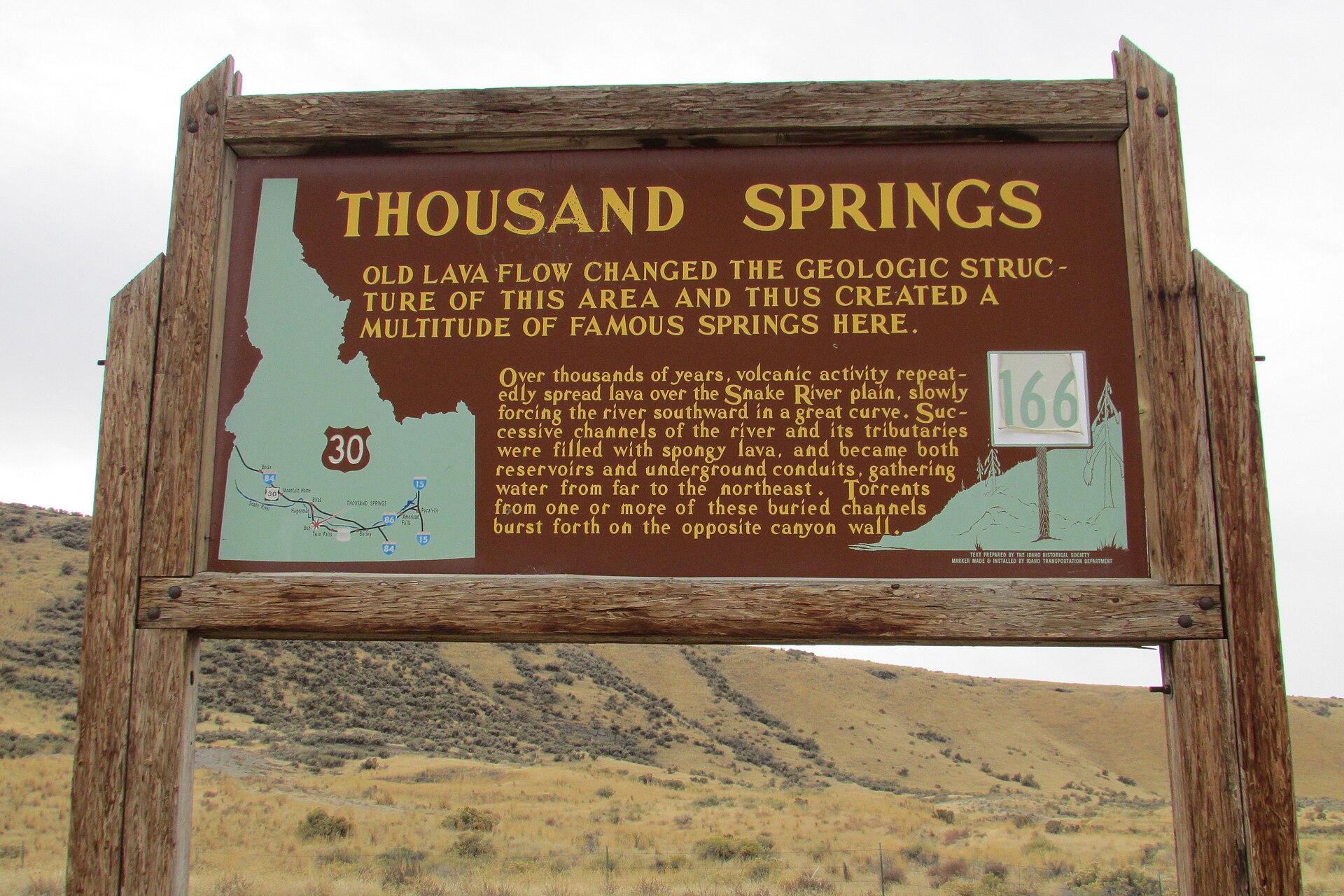
The water history matters for growth. In the early 1900s, canal seepage and flood irrigation leaked huge volumes into the aquifer and raised it. Two changes reversed that: farmers switched from flood irrigation to sprinklers and lined canals, which cut seepage, and from the 1950s on, farmers drilled wells and pumped the aquifer directly. Lower aquifer levels mean less water emerges at the springs along the Snake River canyon between Twin Falls and Hagerman and in the reach between Blackfoot and Minidoka, and that spring water is part of the supply that senior canal companies count on.1

Priority and the delivery call
Idaho water law follows "first in time, first in right." A water right with an older priority date gets its full amount before a newer, or junior, right gets any. When ground water pumping reduces the water that reaches a river, the holders of older surface water rights on that river can ask the state to shut off junior wells. That request is a delivery call. Treating surface and ground water as one connected supply is called conjunctive management.4
In 2005 the Surface Water Coalition, a group of seven canal companies and irrigation districts that IDWR says serve about 550,000 acres, filed a delivery call against junior ground water pumpers on the plain. Since 2010 IDWR has applied a court-approved "Methodology" each season to compare the water each coalition member is likely to have with what its crops reasonably need. The gap is the in-season demand shortfall (IDS). If junior pumping is found to cause injury, the Director orders curtailment of junior rights, starting with the newest, until the shortfall is covered, unless the pumpers have an approved mitigation plan. The Methodology has been revised six times; the sixth order is dated July 19, 2023.2021
The 2015 settlement
Rather than litigate every season, the coalition and the Idaho Ground Water Appropriators, Inc. (IGWA), which represents ground water districts, signed a settlement on June 30, 2015. Its terms were large, and they set goals with dates that fall inside this module's time frame.22
| Term (section of the agreement) | What it said |
|---|---|
| Ground water diversion cut (3.a.i) | Total ground water diversion reduced by 240,000 acre-feet a year starting in 2016, shared among ground water and irrigation districts, or equivalent private recharge. |
| Storage water (3.b.i) | IGWA supplies 50,000 acre-feet of storage water a year to the coalition. |
| State recharge (3.f) | The parties back a state managed recharge program averaging 250,000 acre-feet a year. |
| Aquifer goal (3.e.i) | Stabilize and reverse declines, returning levels to the average of 1991 to 2001, measured at a preliminary list of 19 wells. |
| Benchmarks (3.e.ii) | April 2020: stabilize at 2015 levels. April 2023: halfway to the goal. April 2026: reach the goal. |
| Moratorium (3.k) | The state reviews and continues the existing moratoriums on new ground water applications on the plain. |
| Season (3.c) and meters (3.d) | Irrigation season April 1 to Oct. 31; flow meters installed by the 2018 season. |
The April 2026 benchmark fell in a drought year in which IDWR measured a 600,000 acre-foot drop in aquifer volume before irrigation started. We found no IDWR statement saying the 1991 to 2001 level goal had been met, and the 2026 measurements point the other way.2 In 2019, cities joined in: a settlement mediated by then-House Speaker Scott Bedke committed signatory cities to an average of 7,650 acre-feet a year of mitigation water for the state's recharge program, in exchange for protection ("safe harbor") from future delivery calls.23
Curtailment orders, 2024 to 2026
The settlement held off curtailment for most of a decade. It came back after a dispute over whether ground water districts met their share: the June 2024 stipulation refers to a 2022 breach of the mitigation plan that the districts cured with extra conservation in 2023. The last three seasons look like this:
| Date | Order or event | Predicted shortfall (IDS) | Rights junior to this date curtailed unless mitigated | Outcome |
|---|---|---|---|---|
| Apr. 18, 2024 | Methodology order, Director Mathew Weaver | 74,100 acre-feet | (notice) | Ground water users told to show mitigation.3 |
| May 30, 2024 | Final curtailment order | 74,100 acre-feet | March 31, 1954 | About 6,400 rights in six ground water districts (Bingham, Bonneville-Jefferson, Jefferson-Clark, Magic Valley, Carey Valley and North Snake) found out of compliance.3 |
| June 20, 2024 | 2024 stipulation approved | Districts agree to conserve 240,000 acre-feet and deliver 50,000 acre-feet of storage; curtailment avoided for 2024.24 | ||
| Nov. 14, 2024 | New long-term plan announced | Governor Brad Little and Lt. Gov. Scott Bedke announce the 2024 mitigation plan.25 | ||
| Apr. 16, 2025 | April forecast order | 63,000 acre-feet | Aug. 28, 1955 (notice) | Mitigation due by May 1.20 |
| May 16, 2025 | Final curtailment order | Aug. 28, 1955 | Effective May 31, 2025.20 | |
| July 10 and 25, 2025 | Revised forecast; final curtailment order | 75,300 acre-feet | Oct. 11, 1900 | Several hundred more water users added; 15 days to join a plan.264 |
| Sept. 11, 2025 | Revised forecast | 63,700 acre-feet (59,600 Twin Falls Canal Co.; 4,100 American Falls Reservoir District No. 2) | Oct. 11, 1900 (continued) | 743 junior rights subject to the July order; 469 resolved by Sept. 11.21 |
| Nov. 21 and Dec. 8, 2025 | Reasonable carryover order; curtailment order | Carryover shortfall 86,756 acre-feet | Aug. 15, 1952 | Carryover is water held in reservoirs for the next year.206 |
| April 2026 | April forecast order | 181,600 acre-feet | Oct. 11, 1900 (notice) | IDWR declared drought in April 2026.5 |
| May 14, 2026 | Final curtailment order | Oct. 11, 1900 | 924 rights held by 736 people or entities listed, including the City of Chubbuck, the J.R. Simplot Co. and Jefferson School District 251.5 | |
| July 21, 2026 | Revised forecast, curtailment continued | 741,100 acre-feet | Oct. 11, 1900 | Crop water need through June ran 137 percent of the 2000 to 2025 average.6 |
Two things in the table matter for anyone thinking about growth. First, the priority date that gets cut off moved from 1954 (2024) to 1900 (2025 and 2026). IDWR dates the aquifer's decline to the pumping that began in the 1950s, so most wells on the plain, including city wells and the wells under subdivisions built since 1980, carry priority dates junior to Oct. 11, 1900. What protects most of them is membership in a mitigation plan, not their priority. Second, curtailment orders exclude some uses. IDWR's 2024 release said non-consumptive uses, in-house culinary use and exempt domestic and livestock uses are not curtailed, and the 2026 order exempts de minimis domestic and stock water.2420 A household on its own well is usually not shut off. A subdivision that waters 40 acres of lawns from a community well under a junior right can be, unless its water supplier belongs to an approved plan.
Enforcement is real. By Sept. 11, 2025, IDWR had as many as 15 staff in the field working with holders of 743 junior rights: 158 joined a ground water district plan, 204 stopped pumping on their own, three received notices of violation, and IDWR said it would seek civil penalties of $300 per illegally irrigated acre.21
The 2024 mitigation plan
The long-term deal reached in November 2024 replaced the 2015 terms with a smaller conservation target that now counts cities and other non-IGWA users separately, plus more storage water and a higher recharge goal. The plan's terms below are as described by the parties to an agricultural trade publication; the state's own release did not list them.2725
| Item | 2015 settlement | 2024 mitigation plan |
|---|---|---|
| Ground water conservation | 240,000 acre-feet a year | 205,000 acre-feet a year, averaged over four years; each user gets a four-year block |
| Storage water to the coalition | 50,000 acre-feet a year, fixed | Up to 75,000 acre-feet a year, set by the Director's injury findings |
| State recharge target the parties support | 250,000 acre-feet a year | Ask the Water Resource Board to raise it to 350,000 acre-feet a year |
| Term | Ongoing | Four-year terms starting Jan. 1, 2024, renewable; either side may exit at four-year marks (2027 is the first) |
| Accountability | One district's breach could affect others | Each district and each farmer accountable for its own share |
In 2026 the 2024 plan's safe harbor protected members who complied, and East Idaho News reported that the plan is due to be renegotiated in 2027 and that the drought left no water for recharge in 2026.5 IDWR hydrologists said in August 2026 that the state's recharge program, city and district recharge, and pumping cuts together had added a net 2.8 million acre-feet to storage, which slowed but did not stop the decline.2

What water rules mean for new homes
The domestic well exemption
Many rural homes in Idaho get water from a private well that needs no water right permit. Idaho Code 42-227 exempts domestic wells from the permit requirement, and Idaho Code 42-111 defines what counts as domestic: household and livestock use, including irrigation of up to one half acre, totaling no more than 13,000 gallons a day. Other domestic purposes are capped at 2.8 acre-feet a year. Apartment buildings, mobile home and RV parks, commercial uses and, with the exceptions described below, subdivisions are not "domestic" unless they stay under the 2.8 acre-foot limit. Only one domestic exemption is allowed per parcel.7288
For growth, the exemption has been the quiet way houses got water without anyone asking IDWR. Each well is small. Thousands of them, each allowed to water half an acre of lawn, are not. The 2015 settlement kept a moratorium on new ground water applications on the plain, but a domestic well needs no application, so the moratorium did not stop subdivisions served by exempt wells.22
The 2025 and 2026 subdivision rules
The Legislature changed that in two steps. Senate Bill 1083 (2025), signed March 20, 2025 and effective July 1, 2025, and Senate Bill 1222 (2026), signed by Gov. Little on Feb. 17, 2026 with an emergency clause, rewrote parts of Idaho Code 42-111, 42-227, 31-3805 and 50-1334 and added penalties in a new Idaho Code 42-1701C.82930
| Situation | Rule after the 2025 and 2026 bills |
|---|---|
| Single home, outside a subdivision | Unchanged: up to 13,000 gallons a day, including up to one half acre of lawn and garden; one exemption per parcel. |
| Subdivision (five or more lots) in a moratorium area, critical ground water area or ground water management area, completed application filed on or after July 1, 2025 | Exempt wells may serve in-home use (drinking, cooking, bathing, cleaning) and livestock only. Irrigating lawns, gardens or open space needs a water right. Community wells follow the same rule. |
| Same, application completed before July 1, 2025 | Prior law applies. |
| Agricultural land divisions with every lot 5 acres or larger and kept in farming | Not a "subdivision" under the definition. |
| Plats where surface irrigation water is reasonably available (Idaho Code 31-3805) | The plat is not approved unless it provides irrigation with that water; inside a municipal service area, the subdivision must meet city design rules and convey water rights on connection. |
| Plat certification (Idaho Code 50-1334) | Before recording, the plat must certify compliance with 31-3805 and name its water source: individual wells, an existing water system with a written agreement, or a new system with enough contributed capital. |
| Penalties (Idaho Code 42-1701C) | After notice and 90 days to fix it, $500 per tenth of an acre irrigated over the limit; other excess use, the lesser of $100 a day or $100 per acre-foot; capped at $5,000 a year, renewing yearly, and a lien on the property if unpaid. A county may collect and keep half. |
The rule reaches the Magic Valley because the Eastern Snake Plain Aquifer ground water management area, designated Nov. 2, 2016, stretches from Ashton to King Hill, and older management areas and a moratorium cover parts of Twin Falls County.31 IDWR keeps an online map that shows whether a parcel falls inside one of these areas, and its June 2026 letter to Cassia County urged counties to deal with irrigation supply and mitigation during subdivision review, before lots are sold.78
Management areas and moratoria in and near the Magic Valley
IDWR designates ground water management areas (GWMAs) and critical ground water areas where an aquifer needs closer management, and it can issue a moratorium, an order that stops or limits new water right applications in an area. The dates below are the designation and order dates IDWR lists.31
| Area | Type | Date | Where |
|---|---|---|---|
| Banbury Hot Springs | GWMA; moratorium on approvals ordered Dec. 4, 1985 (new domestic use allowed) | Apr. 12, 1983 | Twin Falls County |
| Twin Falls | GWMA | Jan. 11, 1984 | Twin Falls County |
| Twin Falls | Moratorium for a limited area | July 24, 1987; extended 1992, 1997, 2002, 2007, 2008, 2013 and 2018 | Twin Falls County |
| Big Wood River | GWMA; moratorium on new surface and ground water permits May 17, 2022 (domestic uses excepted) | June 28, 1991 | Big Wood River drainage above Magic Dam, Camas Prairie and upper Silver Creek |
| Eastern Snake Plain Aquifer | Moratorium on new ground water development for irrigation | 1992 | The plain |
| Eastern Snake Plain Aquifer | GWMA | Nov. 2, 2016 | Ashton to King Hill |
| Cassia County areas (Artesian City, Cottonwood, West Oakley Fan, Oakley Kenyon, Raft River) | Critical ground water areas, as listed by IDWR | various | Cassia County |
Sources: IDWR ground water management area page; Big Wood River moratorium order; ESPA hydrology profile; IDWR letter to Cassia County.313218
Cities on the plain
Cities pump ground water too, and their rights are mostly junior. Their protection comes from the 2019 cities agreement and the Coalition of Cities mitigation plan, under which participating cities report their aquifer pumping and pay for recharge water. IDWR's Oct. 7, 2025 filing lists 21 signatory cities: Ammon, Blackfoot, Bliss, Burley, Carey, Declo, Dietrich, Firth, Gooding, Hazelton, Heyburn, Idaho Falls, Iona, Jerome, Paul, Pocatello, Rexburg, Richfield, Rupert, Shoshone and Wendell, plus non-signatory participants Dubois, Minidoka and Mud Lake.3323 Of the six Magic Valley core towns, Jerome and Gooding are on that list; Twin Falls, Kimberly, Buhl and Hagerman are not. That does not mean those four are unprotected or exposed; their water supplies, wells and any separate mitigation are questions to ask each city, and we did not find them in the documents we read.
Candice McHugh, who represented the cities in 2019, told IDWR the agreement "provides room for all of the cities in the ESPA region to grow."23 The fine print matters: a city's growth room depends on its share of the 7,650 acre-foot recharge commitment and on what it pumps, and the 2024 conservation target of 205,000 acre-feet is now set apart from city obligations.27
Water and sewer plants as a cap on growth
A city that has water rights still needs wells, tanks, pipes and a wastewater plant that can treat what comes back. Treatment plants are permitted by the U.S. Environmental Protection Agency or the Idaho Department of Environmental Quality to discharge only so much of each pollutant. When a plant is near its limit, the city has three choices: expand it, slow new connections, or violate its permit. Idaho has examples of all three.
Jerome: the cost of falling behind
From April 2010 to July 2011, the City of Jerome's wastewater plant repeatedly exceeded its Clean Water Act discharge permit limits for biological oxygen demand, suspended solids, chlorine, fecal coliform, E. coli, pH, phosphorus and dissolved oxygen, with discharges reaching the Snake River and the J8 canal. Under a consent decree signed July 30, 2015, the city agreed to pay an $86,000 civil penalty and make about $43 million in plant improvements over six years: two more membrane basins and blower capacity, a new sludge dewatering building, another aeration basin, a pump station, yard piping and better biotower ventilation. It had already built a 21-million-gallon emergency storage pond.34
How we figured it: Jerome's plant in 2025 dollars
This module uses one inflation measure, the Bureau of Labor Statistics Consumer Price Index for All Urban Consumers (CPI-U), U.S. city average, all items, annual average (series CUUR0000SA0). Real dollars remove general inflation so amounts from different years can be compared.35
Formula: real (2025 dollars) = nominal x (CPI 2025 / CPI of the year).
Inputs: CPI-U annual average 2015 = 237.017; 2024 = 313.689; 2025 = 321.943.35
Jerome: $43 million x (321.943 / 237.017) = about $58.4 million in 2025 dollars. The EPA release gave the figure as an approximate total spread over six years, so treating it all as 2015 dollars is a simplification.
HB 521: $1 billion (2024) x (321.943 / 313.689) = about $1.03 billion in 2025 dollars.
Construction costs rose faster than general prices in the early 2020s, so the CPI-U understates what the same plant would cost to build today. We use the CPI-U anyway so every lesson in the module uses the same yardstick.
Jerome's mayor, David Davis, later told KTVB the upgrade was "a $36 million cost to the community, but we've learned from that"; the KTVB story did not give a date, and the gap between $36 million and EPA's $43 million is not explained in either source.3634 Davis told the station that a dairy processor's chief executive had said "in one square mile in Jerome, more milk is processed than any other place in the world," which is the reason the city's wastewater load is unusually heavy for a town of its size; the claim is the executive's, as repeated by the mayor, and we could not verify it.36 Jerome's employers and jobs are covered in the Magic Valley case study and Where People Work.
Ammon and Shelley: a hookup freeze
On June 16, 2022, the Eastern Idaho Regional Waste Water Authority, which runs the Oxbow treatment plant west of Shelley and serves Shelley, parts of Ammon and parts of Bonneville and Bingham counties, stopped approving new sewer connections. It cited fast growth and stronger incoming wastewater, an illegal chemical discharge in February 2022 that upset the treatment process, and lack of money to expand. The authority had been adding about 100 to 300 connections a year, had about 500 approved, and estimated an upgrade at $35 million based on a 2018 study. Ammon's planning director said the city could not issue building permits in the district until the moratorium lifted; homes already approved to connect were exempt.17
Ammon's city administrator, Micah Austin, said, "This is not a city of Ammon decision."17 That line sums up the problem for residents: the body that controls a growth limit is often a special district or a state agency, not the city council people elect to manage growth.
Reading capacity
Water and sewer capacity are usually expressed in a city's facility plan as gallons per day and as "equivalent dwelling units," the flow of one typical home. The questions that matter are how many units of capacity remain, how many are already promised to approved but unbuilt subdivisions, and when the next expansion is scheduled and funded. Approved plats and development agreements can commit capacity years before a house is built, so a plant that looks half full on today's flows may be fully spoken for. City facility plans, DEQ permits and the capital improvement plans that support impact fees (described below) are public records; the public records course explains how to request them.
Schools: enrollment versus population
The usual fear about growth and schools is overcrowding: new subdivisions fill classrooms faster than districts can build. In parts of the Treasure Valley, enrollment did double or triple between 2000 and 2025, as the tables below show. The newest data tell a different story for Idaho as a whole and for most of the Magic Valley: since about 2022, the state has kept adding people and homes while public school enrollment has slipped.
How enrollment is counted
Two official series count Idaho students, and they do not match exactly:
- The Idaho State Department of Education (SDE) publishes fall enrollment by district and charter school from 1991-92 on. Its historical file counts "non-weighted" enrollment, meaning a student enrolled in two districts or charters at once is counted in both, and it reports net enrollment (enrollments minus withdrawals). The file used here was updated in July 2026 and ends with fall 2025 (school year 2025-26).10
- The National Center for Education Statistics (NCES) publishes fall counts for every state, including prekindergarten, from the Common Core of Data. Its newest state table runs through fall 2024.37
- SDE also files an annual enrollment report under Idaho Code 33-1028 with counts as of Oct. 1 and Dec. 1. It counted 313,160 students in kindergarten through grade 12 on Oct. 1, 2024.38
The three figures for fall 2024 are 318,067 (SDE historical file), 315,626 (NCES) and 313,160 (SDE Oct. 1 report). Each is correct for its own definition. Never subtract one series from another to get a "change."
Statewide enrollment, 1991 to 2026
| Fall of school year | Idaho enrollment (SDE, districts plus charters) | Change from row above |
|---|---|---|
| 1991-92 | 225,680 | |
| 1995-96 | 243,097 | +17,417 |
| 2000-01 | 245,377 | +2,280 |
| 2005-06 | 261,179 | +15,802 |
| 2010-11 | 281,861 | +20,682 |
| 2015-16 | 283,332 (lower than both neighboring years; shown as published) | +1,471 |
| 2019-20 | 311,991 | +28,659 |
| 2020-21 | 310,653 | -1,338 |
| 2021-22 | 316,159 | +5,506 |
| 2022-23 | 318,979 (peak) | +2,820 |
| 2023-24 | 318,660 | -319 |
| 2024-25 | 318,067 | -593 |
| 2025-26 | 314,063 | -4,004 |
Source: SDE historical fall enrollment file, statewide totals row; changes are our arithmetic.10 From fall 2000 to fall 2025, enrollment rose 68,686 students, or 28.0 percent. From the 2022-23 peak to 2025-26 it fell 4,916, or 1.5 percent.
Idaho, the U.S. and the neighbors
Over the longer run, Idaho's enrollment grew much faster than the nation's. NCES counts show Idaho up 28.8 percent from fall 2000 to fall 2024, against 4.6 percent for the United States. Utah and Nevada grew faster than Idaho; Montana and Wyoming shrank or held flat.37
| Area | Fall 2000 | Fall 2010 | Fall 2019 | Fall 2024 | Change 2000 to 2024 | Change 2019 to 2024 |
|---|---|---|---|---|---|---|
| United States | 47,203,539 | 49,484,181 | 50,796,445 | 49,387,403 | +4.6% | -2.8% |
| Idaho | 245,117 | 275,859 | 311,096 | 315,626 | +28.8% | +1.5% |
| Utah | 481,485 | 585,552 | 684,694 | 684,604 | +42.2% | 0.0% |
| Nevada | 340,706 | 437,149 | 496,934 | 477,563 | +40.2% | -3.9% |
| Washington | 1,004,770 | 1,043,788 | 1,142,073 | 1,094,502 | +8.9% | -4.2% |
| Oregon | 546,231 | 570,720 | 610,648 | 570,233 | +4.4% | -6.6% |
| Wyoming | 89,940 | 89,009 | 94,616 | 89,915 | 0.0% | -5.0% |
| Montana | 154,875 | 141,693 | 149,917 | 147,208 | -5.0% | -1.8% |
Source: NCES Digest of Education Statistics 2025, table 203.20; 2000 to 2024 changes are our calculation, and 2019 to 2024 changes are as NCES printed them.37 Idaho was the only state in this group whose count rose from fall 2019 to fall 2024; Utah's fell by 90 students, which NCES shows as rounding to zero.
Magic Valley districts
| District (number) | 2000-01 | 2010-11 | 2019-20 | 2020-21 | 2022-23 | 2025-26 | Change 2019-20 to 2025-26 |
|---|---|---|---|---|---|---|---|
| Twin Falls (411) | 6,841 | 7,778 | 9,620 | 9,180 | 9,362 | 8,774 | -846 |
| Jerome (261) | 3,102 | 3,580 | 4,141 | 4,076 | 4,155 | 3,866 | -275 |
| Kimberly (414) | 1,237 | 1,468 | 2,097 | 1,883 | 2,024 | 2,029 | -68 |
| Gooding (231) | 1,314 | 1,231 | 1,372 | 1,298 | 1,246 | 1,192 | -180 |
| Buhl (412) | 1,439 | 1,305 | 1,279 | 1,221 | 1,268 | 1,202 | -77 |
| Hagerman (233) | 392 | 407 | 305 | 383 | 381 | 346 | +41 |
| Wendell (232) | 1,017 | 1,138 | 1,142 | 1,105 | 1,126 | 1,126 | -16 |
| Filer (413) | 1,313 | 1,400 | 1,647 | 1,597 | 1,595 | 1,469 | -178 |
| Hansen (415) | 421 | 398 | 333 | 348 | 335 | 311 | -22 |
| Minidoka County (331) | 4,482 | 3,984 | 4,315 | 4,264 | 4,420 | 4,110 | -205 |
| Cassia County (151) | 5,127 | 5,304 | 5,487 | 5,434 | 5,586 | 5,468 | -19 |
Source: SDE historical fall enrollment file; changes are our arithmetic.10 District boundaries do not match city or county lines, so a district's count is not a town's count. Charter schools, which are counted separately, have grown in the same area. Idaho Education News reported in August 2026 that Gem Prep Twin Falls, Rise Charter and Pinecrest Academy of Idaho had grown 149.7, 130 and 94 percent since opening.39
Treasure Valley and other large districts
| District | 2000-01 | 2010-11 | 2019-20 | 2025-26 | Change 2000-01 to 2025-26 |
|---|---|---|---|---|---|
| West Ada (2) | 23,803 | 34,625 | 40,326 | 37,953 | +59% |
| Boise (1) | 26,589 | 25,269 | 25,484 | 21,722 | -18% |
| Nampa (131) | 11,177 | 14,976 | 14,039 | 12,462 | +11% |
| Vallivue (139) | 3,598 | 6,955 | 9,540 | 10,701 | +197% |
| Caldwell (132) | 5,755 | 6,214 | 6,125 | 4,933 | -14% |
| Kuna (3) | 2,951 | 5,002 | 5,618 | 5,695 | +93% |
| Middleton (134) | 2,196 | 3,052 | 4,066 | 4,400 | +100% |
| Bonneville (93) | 7,691 | 10,304 | 13,325 | 13,489 | +75% |
| Idaho Falls (91) | 10,767 | 10,318 | 10,272 | 9,739 | -10% |
| Pocatello (25) | 12,000 | 12,411 | 12,505 | 11,486 | -4% |
| Coeur d'Alene (271) | 9,237 | 10,197 | 11,075 | 9,677 | +5% |
| Post Falls (273) | 4,527 | 5,638 | 6,175 | 5,833 | +29% |
| Lakeland (272) | 4,060 | 4,457 | 4,590 | 4,648 | +14% |
Source: SDE historical fall enrollment file; percent changes are our calculation, rounded to whole percents.10 The pattern is the same across the state: the districts on the growing edge of a metro area (Vallivue, Middleton, Kuna, Bonneville) kept adding students, while the older core districts (Boise, Caldwell, Idaho Falls, Pocatello) lost them, and even West Ada, the state's largest, is below its 2019-20 count.

Why more homes did not mean more students
From July 1, 2020 to July 1, 2025, Idaho's population grew by an estimated 180,405 people, 9.8 percent, to 2,029,733 (Census Vintage 2025). Measured from the April 1, 2020 estimates base of 1,839,123, the starting point other lessons in this module use, the estimated growth was 10.4 percent. Builders took out permits for 113,061 housing units over 2020 to 2025. Fall enrollment over almost the same span went from 310,653 to 314,063, up 3,410.40910 Several things explain the gap, and the data support some better than others:
- Fewer births. Idaho Education News, citing Census data, reported Idaho births per 1,000 residents fell from over 16 in 2007 to under 12 in 2024, and that the Idaho Department of Labor's economist Lisa Grigg tied about 8 percent of 2020 to 2025 population growth to school-age children.39 Fewer births in 2010 to 2020 mean smaller kindergarten classes now, no matter how many homes are built.
- Who moves in. Many arrivals since 2020 have been older or without children at home; lesson 06, Who Is Moving In and From Where, and lesson 08, Who Idahoans Are Now, cover the age data.
- Where students go. Charter schools, which the SDE file counts with their own numbers, grew quickly. Our sum of the SDE rows for charter school numbers 450 and above is 10,687 in 2010-11, 17,749 in 2015-16, 31,703 in 2020-21 and 43,036 in 2025-26. Because charters are inside the statewide total, this shift moves students between districts and charters without changing the total. Home schooling is not counted in either series, and we did not find an official count.10
- Attendance. Idaho Education News reported 309,254 students enrolled and 291,494 in average daily attendance last school year, a gap of 17,760 that it valued at about $172.2 million at a per-student rate.39
How we figured it: students added per 100 homes permitted
Planners estimate "student generation rates," the number of public school students each new home produces, to project school needs. A rough check from public data: change in district fall enrollment from 2020-21 to 2025-26 divided by housing units permitted in the county in 2020 to 2025, times 100.109
| Area | Units permitted, 2020 to 2025 (Census BPS) | Enrollment 2020-21 | Enrollment 2025-26 | Change | Change per 100 units permitted |
|---|---|---|---|---|---|
| Idaho (all districts and charters) | 113,061 | 310,653 | 314,063 | +3,410 | +3.0 |
| Twin Falls County / Twin Falls district | 3,917 | 9,180 | 8,774 | -406 | -10.4 |
| Jerome County / Jerome district | 667 | 4,076 | 3,866 | -210 | -31.5 |
| Gooding County / Gooding district | 274 | 1,298 | 1,192 | -106 | -38.7 |
These are not student generation rates. A rate counts students living in new homes; this ratio nets new students against students lost from existing homes, ignores charter schools and district lines that cross county lines, and starts in a pandemic year (2020-21) when enrollment dipped. It is useful for one point only: in these places, permits did not translate into district enrollment growth over 2020 to 2025. Permit totals are Census estimates that include imputation for places that did not report every month, and they cover only permit-issuing places.9
The Magic Valley comparison is plain. Twin Falls County's estimated population rose from 90,365 (July 2020) to 97,539 (July 2025), up 7.9 percent; Jerome County's from 24,269 to 26,362, up 8.6 percent; Gooding County's from 15,647 to 16,446, up 5.1 percent.11 Over roughly the same years, the Twin Falls district lost 4.4 percent of its students, Jerome 5.2 percent and Gooding 8.2 percent; Kimberly gained 7.8 percent.10 Growth puts pressure on schools in particular neighborhoods, where a new subdivision lands next to a full elementary school, more than on district totals. That is why district facility plans, not statewide totals, are the records to read.
Paying for school buildings
The two-thirds rule and levies
Article VIII, section 3 of the Idaho Constitution says no school district may take on debt beyond the year's income "without the assent of two-thirds of the qualified electors thereof voting at an election to be held for that purpose," except for ordinary and necessary expenses.18 A school bond for a new building therefore needs a two-thirds supermajority. Districts can also ask voters for plant facilities levies and supplemental levies by simple majority. Bonds and the Two-Thirds Rule, Plant Facilities and Other Levies and Supplemental Levies explain each. Property tax effects are in Idaho Property Taxes.
House Bill 521 (2024)
House Bill 521, sponsored through the House Revenue and Taxation Committee by Rep. Jason Monks, Sen. Doug Ricks and House Speaker Mike Moyle, passed the House 61-6-3 on Feb. 23, 2024 and the Senate 23-11-1 on March 21, 2024, and was signed by Gov. Little on March 29, 2024 (Session Law chapter 237).4142 As described when it was introduced, it:
- authorized a 10-year, $1 billion bond for school facilities, repaid with $125 million a year of state sales tax, with proceeds sent to districts based on average daily attendance;
- added $75 million a year to the school district facilities fund created by the 2023 property tax bill (House Bill 292), $50 million of it from existing lottery money;
- cut individual and corporate income tax rates from 5.8 to 5.695 percent;
- required each district to file a 10-year facilities plan to receive money;
- wound down the bond levy equalization fund over two years and removed the August election date for bonds and levies.42
The money moved fast. SDE said the first payment went out Oct. 30, 2024, more than $514 million had been distributed by Nov. 12, 2024, about $1 billion by the end of February 2025, and an added $91.6 million on April 22, 2025, for a total of roughly $1.09 billion, the extra coming from favorable bond pricing.4312 Idaho Education News reported that the Twin Falls district's lump sum was $35,680,340.52, that Buhl's plan listed $8.8 million in needs, and that only nine of Idaho's 115 districts would receive at least $30 million, which it cited as the estimated cost of a new elementary school.44
The state money helps, but it is allocated by attendance, not by growth. A district that is shrinking gets money to fix roofs and heating systems; a district on the growing edge gets the same per-student amount even if it needs a whole new school. The facilities plans districts filed under HB 521 are public records and are the best source on where buildings are short.
No school impact fees
Idaho's Development Impact Fee Act lets cities, counties, single countywide highway districts, fire protection districts and ambulance service districts charge new development for water, wastewater, roads, stormwater, parks and public safety facilities. Schools are not on the list.16 So a new subdivision pays toward the road outside it but not toward the school its children attend; that cost falls on the district's existing taxpayers through bonds and levies, and since 2024 partly on state sales tax.
Roads
Who owns the road
Idaho's roads belong to several owners. ITD builds and maintains interstates and state highways. Local roads belong to cities, counties or highway districts. Ada County has a single countywide highway district, the Ada County Highway District (ACHD), which sets one road impact fee for the whole county; elsewhere, local roads are split among cities, counties and highway districts. Who Owns Your Road and Highway Districts Up Close explain the map. For growth, ownership decides who can charge an impact fee, who sets the traffic standards a new subdivision must meet, and whose budget absorbs the cost when traffic outgrows a road.
TECM and the state highway program
The Legislature created the Transportation Expansion and Congestion Mitigation (TECM) fund in 2017 and later let it pay debt service on bonds. In May 2021 TECM's share of state sales tax rose from 1 percent to 4.5 percent, about $80 million a year, and the 2025 Legislature added $20 million a year for fiscal 2026, 2027 and 2028, bringing the total available for debt service on future bonds to $140 million. ITD has issued four TECM bond series at an average interest rate of 3.89 percent with 25-year terms, and counts more than $2 billion in state funds over the program's life.19 TECM Bonds and the Strategic Initiatives Fund covers the program in depth.
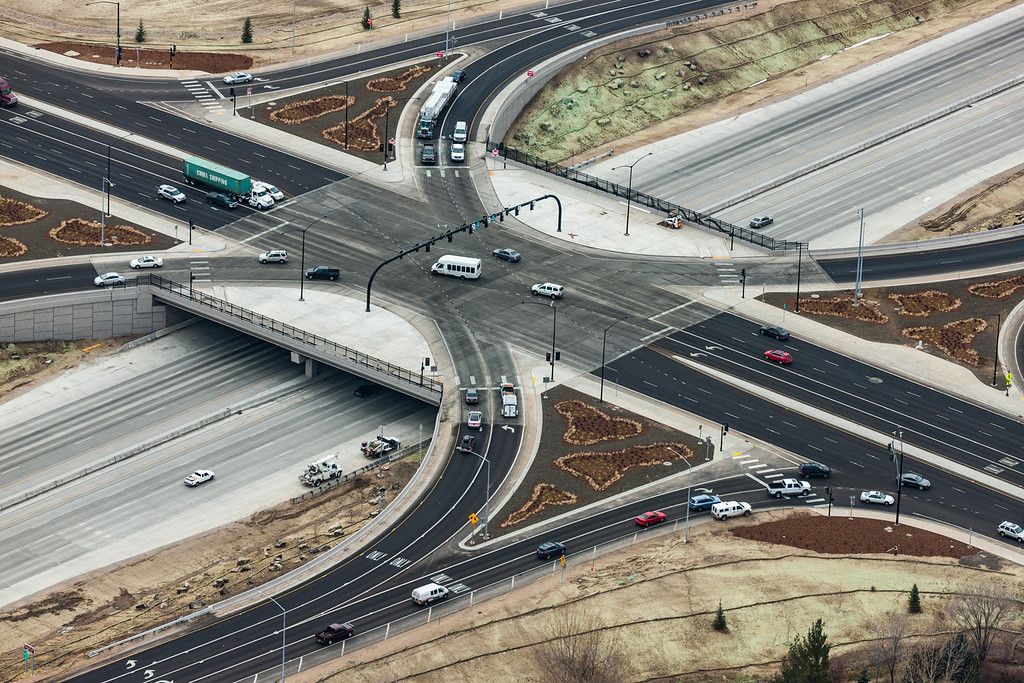
Of the 11 TECM corridors with funding, two are in the Magic Valley: I-84 from Jerome to Twin Falls, and the I-84 Burley and Heyburn interchanges.19 The Jerome to Twin Falls project widens I-84 to three lanes in each direction between the South Jerome interchange (Exit 168) and the Twin Falls interchange (Exit 173), with new concrete paving and rebuilt, raised 400 South Road bridges. Construction began in April 2023. The third lane in each direction opened in March 2026, when ITD called the widening substantially complete; a separate project replacing the South Jerome interchange was expected to be finished by the end of 2026.454650 Neither ITD page we read gave a project cost. The corridor carries the commute between Jerome County and Twin Falls that Where People Work measures with Census commuting data.
The 2026 cuts
In 2026 the money turned. The Idaho Statesman reported on July 5, 2026 that ITD's draft seven-year program put nearly $1.3 billion in planned highway work in an "unfunded" early development category and that about $1.5 billion in congestion projects would not move forward through TECM bonds, together nearly $2.8 billion. The Legislature cut $275 million for the coming fiscal year: $165 million for state highways and $110 million for local highway districts. The Strategic Initiatives Fund, about 18 percent of ITD's revenue in 2025, was assumed to stay at zero through 2033. ITD highway division administrator Amy Schroeder pointed to "this unprecedented growth that the state has experienced," and ITD said it would focus on pavement preservation, bridges and maintenance while keeping design work going on unfunded projects. The story did not name the Magic Valley projects affected; the draft program on ITD's site lists them.13 The Constitution and the 2025 Budget Fight and Reading ITD's Seven-Year Plan explain how to read it.

Impact fees
Development impact fees are one-time charges on new construction to pay a "proportionate share" of the cost of system improvements (new capacity, not repairs) needed to serve growth. Under the Idaho Development Impact Fee Act (Idaho Code Title 67, chapter 82), an entity must adopt a capital improvements plan as an element of its land use plan, consult an advisory committee, charge no more than new development's proportionate share, keep the money in interest-bearing accounts, and spend it within eight years unless it shows reasonable cause, as the City of Twin Falls' consultant summarized the law in the city's 2021 impact fee study.1647
| Entity | Fee | Single-family home | Multifamily unit | Effective | Source |
|---|---|---|---|---|---|
| City of Twin Falls | Streets | $1,683 | $901 | Jan. 1, 2026 | City schedule14 |
| City of Twin Falls | Parks | $1,918 | $1,918 | Jan. 1, 2026 | City schedule14 |
| City of Twin Falls | Fire | $1,105 | $1,105 | Jan. 1, 2026 | City schedule14 |
| City of Twin Falls | Police | $276 | $276 | Jan. 1, 2026 | City schedule14 |
| City of Twin Falls | Total | $4,982 | $4,200 | Jan. 1, 2026 | City schedule14 |
| Ada County Highway District | Roads (Ordinance 254, single service area) | $5,803 | $2,371 | March 1, 2026 | ACHD bulletin; KIVI1548 |
The Twin Falls City Council adopted the 2026 schedule on Dec. 8, 2025.14 ACHD's board adopted Ordinance 254 by a 4 to 1 vote on Dec. 3, 2025, with a 20-year capital improvements plan of $1.2 billion in impact-fee-eligible projects; ACHD's fees had last been updated in 2022. Commission President Miranda Gold said the update "reflects our commitment to ensuring growth pays for itself."154948 ACHD also charges $7,363 per 1,000 square feet of office space and $12,082 per 1,000 square feet of shopping center space.48
Two cautions. First, an impact fee covers only the share of a new road, park or fire station attributable to growth; maintenance and the share that serves existing residents come from property taxes, state fuel taxes and registration fees. Second, the fee a city charges is a policy choice capped by its study. A city may charge less than its study supports, so comparing fees across cities compares policy choices as much as costs. Whether "growth pays for itself" is the subject of the hard questions below.
Who pays
Each limit has a different payer, and many of them pay over different time frames. This table summarizes what the documents in this lesson show for Idaho.
| Facility | Who decides | Paid up front by | Paid over time by | Can new homes be charged a fee? |
|---|---|---|---|---|
| Aquifer water and mitigation | IDWR Director; ground water districts; Coalition of Cities | Ground water district members (assessments), cities (recharge water), state (recharge program) | Farmers who conserve, city water customers, state taxpayers | Not as an impact fee; cities pass mitigation costs into water rates and connection fees |
| City water and sewer plants | City council or sewer district; DEQ or EPA permits | City bonds, state revolving fund loans | Utility ratepayers; connection fees on new homes | Yes, impact fees for water and wastewater are allowed |
| School buildings | School trustees and voters (two-thirds for bonds) | District bonds; HB 521 state bond | District property taxpayers; state sales tax (HB 521) | No; schools are not in the impact fee act |
| State highways and interchanges | Idaho Transportation Board | TECM bonds, federal aid | State sales tax (TECM), fuel taxes, registration fees | No state highway impact fee; local fees can fund local pieces |
| Local roads | City, county or highway district | Impact fees, local budgets, developer-built improvements | Property taxes, state fuel tax distributions | Yes (cities, counties, countywide highway districts) |
Sources: IDWR orders and releases; Idaho Code 67-8203; Idaho Constitution art. VIII, sec. 3; HB 521; ITD TECM FAQs.2016184219 Whether cities pass water mitigation costs into rates varies by city; we did not survey Magic Valley rate schedules.
Each side has a fair case. Builders and new residents point out that buyers of new homes already pay impact fees, connection fees and the same property taxes as everyone else, and that a home's price includes those costs. Longtime residents point out that they paid for the existing plant, school and road, that state money for growth (TECM, HB 521) comes from everyone's sales tax, and that the 2026 road cuts fell hardest where growth was fastest. Farmers on junior wells carry the water conservation that makes room for everyone else. Renters pay all of these costs through rent without voting on most of them. The data in this lesson can show the size of each piece; how to split the bill is a political choice.
Pictures, Numbers and Infographics
The key numbers from this lesson, at three levels where the data exist. Where a level has no matching figure, the cell says so.
| Measure | United States | Idaho | Place | Year | Source |
|---|---|---|---|---|---|
| Public school enrollment, change fall 2000 to fall 2024 (NCES) | +4.6% | +28.8% | Utah +42.2%; Montana -5.0% (neighbors; no town figure in NCES state table) | 2000 to 2024 | NCES table 203.20; our calculation37 |
| Fall enrollment, SDE file | no matching series | 314,063 | Twin Falls district 8,774; Jerome 3,866; Kimberly 2,029; Gooding 1,192; Buhl 1,202; Hagerman 346 | 2025-26 | SDE historical file10 |
| Change in fall enrollment from 2019-20 | -2.8% (NCES, fall 2019 to fall 2024) | +0.7% (SDE, to 2025-26) | Twin Falls district -8.8%; Jerome -6.6% | 2019 to 2025 | NCES; SDE; our calculation3710 |
| Population change, July 2020 to July 2025 (estimate) | 341,784,857 in 2025 | +9.8% to 2,029,733 | Twin Falls County +7.9%; Jerome County +8.6%; Gooding County +5.1% | 2020 to 2025 | Census Vintage 20254011 |
| Housing units permitted, total 2020 to 2025 | 9,309,209 | 113,061 | Twin Falls County 3,917; Jerome County 667; Gooding County 274 | 2020 to 2025 | Census BPS; our sum9 |
| Aquifer storage change | no matching figure | ESPA: about -14 million acre-feet since the 1950s; -600,000 in 2026 | Thousand Springs, Hagerman: 6,750 to 4,650 cfs | 1950s to 2026 | IDWR12 |
| Predicted shortfall to senior surface water users | no matching figure | 741,100 acre-feet (July 2026); 63,700 (Sept. 2025); 74,100 (April 2024) | Twin Falls Canal Co. share 59,600 acre-feet (Sept. 2025) | 2024 to 2026 | IDWR6213 |
| Ground water rights named in curtailment orders | no matching figure | about 6,400 (May 2024); 924 (May 2026) | no town breakdown published | 2024; 2026 | IDWR; East Idaho News35 |
| Impact fees on one new single-family home | no national figure used | Ada County roads only: $5,803 | Twin Falls (all city fees): $4,982 | 2026 | ACHD; City of Twin Falls1514 |
| State school facility bond proceeds | not applicable | about $1.09 billion distributed (about $1.03 billion per $1 billion in 2025 dollars) | Twin Falls district $35.68 million (reported) | 2024 to 2025 | SDE; Idaho Education News1244 |
Percent changes in this table are our calculation from the cited counts: Twin Falls district 8,774 vs. 9,620 is -8.8 percent; Jerome 3,866 vs. 4,141 is -6.6 percent; Idaho 314,063 vs. 311,991 is +0.7 percent.
Common mistakes
- Treating a curtailment order as a count of wells shut off. The orders list rights subject to curtailment unless the holder is in an approved mitigation plan. In 2025, of 743 junior rights subject to the July order, 158 holders joined a plan and 204 stopped pumping by Sept. 11; others were small domestic users covered by the exemption.21 Report the number named, the number resolved and how, not "743 wells shut off."
- Comparing shortfalls across years without the forecast date. The in-season shortfall is revised during the season: 63,000 acre-feet in April 2025, 75,300 in July and 63,700 in September.2621 An April figure from one year and a July figure from another are not comparable.
- Mixing enrollment series. SDE's historical file (318,067 for fall 2024), NCES (315,626) and SDE's Oct. 1 report (313,160) measure different things.103738 A story that takes one year from each series and reports a "drop" is measuring the difference between definitions.
- Using a pandemic year as the base. Fall 2020 enrollment dipped in most places. Comparing 2025-26 to 2020-21 makes Idaho look like it grew 3,410 students; comparing to 2022-23 shows a loss of 4,916.10 Say which base you used and why.
- Reading a county permit total as a town's growth. Census BPS county totals include every permit-issuing jurisdiction in the county, and places that do not issue permits are not counted at all.9 Jerome County's 667 units over 2020 to 2025 are not all inside the City of Jerome.
- Calling an impact fee the cost of growth. A fee is capped by the entity's study and set by its board; it covers only the growth share of new capacity and nothing for schools.1647
- Comparing dollar figures from different years without adjusting. Jerome's $43 million plant commitment in 2015 is about $58.4 million in 2025 dollars by the CPI-U; construction cost indexes would put it higher still.3435
- Assuming the domestic exemption is unchanged. Older guides describe the half-acre exemption as if it applied to every new lot. For subdivision applications completed on or after July 1, 2025 in a management, critical or moratorium area, that is no longer true.78
What we know, what we don't, and what the data can show
What we know
- The Eastern Snake Plain Aquifer has lost about 14 million acre-feet since the 1950s, held even from 2024 to 2025, and dropped 600,000 acre-feet before the 2026 season; recharge and pumping cuts have added a net 2.8 million acre-feet, slowing the decline.12
- IDWR has ordered curtailment of junior ground water rights in 2024, 2025 and 2026, reaching rights junior to Oct. 11, 1900, with most users protected by mitigation plans.20
- Since July 1, 2025, new subdivisions in management, critical or moratorium areas cannot irrigate from exempt wells without a water right.7
- Idaho's public school enrollment peaked in fall 2022 (SDE) and has fallen since, while population and permits kept rising; most Magic Valley core districts are below their 2019-20 counts.10409
- The state distributed about $1.09 billion in HB 521 facility money by April 2025 and cut $275 million from transportation for the coming year in 2026.1213
What we don't know
- How many homes in each Magic Valley town rely on exempt domestic wells, community wells or city water, and how much each draws. No public dataset we found counts this by town.
- Whether the 2015 settlement's April 2026 aquifer level goal was met at the 19 benchmark wells; we did not find an IDWR report on it.
- How much sewer and water capacity remains in Jerome, Twin Falls, Kimberly, Gooding, Buhl and Hagerman, and how much is already committed to approved but unbuilt lots.
- How many school-age children live in homes built since 2020, which would give a true student generation rate.
- Which Magic Valley road projects moved to ITD's unfunded list in 2026; the news coverage we read did not name them.
What the data can show
- Whether a district's enrollment is keeping up with its county's population and permits, using the SDE historical fall enrollment file, Census Vintage population estimates and Census BPS county permits.
- How close a town sits to the aquifer's limits, using IDWR's curtailment lists and status reports (rights by holder and priority date), its mitigation plan dockets and its ground water management area maps.
- How much each new home pays and for what, using city and highway district impact fee schedules and the capital improvement plans behind them.
- Where state highway money is going and where it stopped, using ITD's draft and adopted seven-year Idaho Transportation Investment Program.
- Where school buildings are short, using the 10-year facilities plans districts filed with SDE under HB 521.
Questions people ask
Will my house well be shut off in a curtailment?
Usually not. Curtailment orders exclude exempt domestic and livestock use; IDWR's 2024 release said in-house culinary and exempt domestic uses are not curtailed, and the 2026 order exempts de minimis domestic and stock water.2420 Irrigating more than the exempt amount under a junior right is a different matter, and the rules for new subdivisions changed in 2025.
Can a city stop approving homes because of water or sewer?
A city or sewer district can stop new connections when a plant lacks capacity, as the Eastern Idaho Regional Waste Water Authority did in June 2022, which led Ammon to stop issuing building permits in the affected area.17 A city must still follow state land use law when it denies or conditions a subdivision; Idaho Planning and Zoning covers that.
Why are some schools losing students if Idaho is growing?
Births have fallen, many newcomers are older, more students attend charter and online schools, and families move to new subdivisions on the edges of metro areas, leaving older neighborhoods with fewer children. Statewide enrollment fell 4,916 from fall 2022 to fall 2025 even as the population grew.1039
Do new homes pay anything toward schools?
Not through impact fees, which Idaho does not allow for schools.16 New homes pay school bond and levy property taxes like any other home once they are on the tax roll, and since 2024 part of school facility money comes from state sales tax under HB 521.42
How big is an acre-foot, and how much is 741,100 of them?
An acre-foot covers one acre of land a foot deep. The 2.8 acre-foot annual cap for non-household domestic uses equals 912,000 gallons, according to IDWR's 2026 letter.8 The July 2026 predicted shortfall of 741,100 acre-feet is more than 264,000 times that cap, by our arithmetic. It is a measure of the gap between what senior canal companies were forecast to receive and what their crops needed in a drought year.6
Is Twin Falls in the Coalition of Cities mitigation plan?
The City of Twin Falls is not on the October 2025 list of signatory or participating cities, which does include Jerome, Gooding, Wendell, Shoshone, Hazelton, Bliss and Burley.33 The city's own water rights and mitigation arrangements are a question for the city; we did not find them in the IDWR documents we read.
Hard questions
Should new subdivisions on the plain wait until the aquifer stabilizes?
For waiting: the aquifer has lost about 14 million acre-feet since the 1950s, the 2015 goal date has passed in a year of decline, and every new lawn in a management area competes with senior rights. Against: exempt household use is excluded from curtailment orders, cities are already paying for recharge, and the 2025 law already requires new subdivisions in these areas to bring water rights for irrigation. What the evidence shows: the legislature chose to regulate outdoor water use by new subdivisions rather than stop them, and IDWR's numbers show irrigation conservation and recharge are what move aquifer volume. Whether that is enough depends on future snowpack as much as on growth.127
Should Idaho let school districts charge impact fees?
For: new subdivisions bring the students who fill new schools, and existing taxpayers now carry the cost through two-thirds bonds. Against: statewide enrollment is falling, so a fee would charge new homes for capacity the state may not need; fees raise home prices; and since 2024 the state has put about $1 billion into school buildings. What the evidence shows: growth is uneven; Vallivue, Middleton and Kuna roughly doubled or tripled since 2000 while Boise and Caldwell shrank, so a statewide answer fits neither.101612
Does growth pay for itself on roads?
For: ACHD's 2026 fee of $5,803 per house and Twin Falls' street fee of $1,683 are designed to cover the growth share of new road capacity, and ACHD's president called its update a commitment to "ensuring growth pays for itself." Against: fees cannot pay for state highways, maintenance, or the share of a project that serves existing traffic, and the 2026 state cuts left nearly $1.3 billion of highway work unfunded. What the evidence shows: impact fees fund a defined slice; the state highway program, built largely on sales tax and bonds, carries the rest, and it is now short.151413
When water is short, should farms or new homes give way?
Farm side: senior canal companies and ground water irrigators carry the conservation burden under the 2024 plan, and IDWR credits the plain's region with about 21 percent of Idaho's goods and services. Growth side: builders argue that converting irrigated farmland to homes can reduce water use if surface water rights move with the land, which Idaho Code 31-3805 tries to require. What the evidence shows: the law already ties new subdivisions to available irrigation water and to water rights in management areas; how much farmland conversion changes pumping is not measured in any dataset we found. Farmland to Rooftops covers the farmland side.827
For reporters and advocates
Almost every number in this lesson comes from a public record you can pull yourself.
- IDWR delivery call docket CM-DC-2010-001. Methodology orders, curtailment orders, the curtailment list (Attachment A names holders and priority dates) and status reports. Search the list for your city, school district, county and large employers.20
- Mitigation plan dockets. CM-MP-2016-001 (ground water districts) and CM-MP-2019-001 (Coalition of Cities) show who is protected and on what terms.33
- Well and subdivision records. IDWR's mapping tool for management, critical and moratorium areas; county plats, which since July 2025 must certify the water source under Idaho Code 50-1334; and county or city subdivision staff reports.78
- School records. SDE's historical enrollment files; each district's 10-year facilities plan filed under HB 521; bond and levy election results and ballot language. Records, Meetings and Real Examples lists more.10
- Utility records. City water and wastewater facility plans, DEQ or EPA discharge permits and compliance records, consent decrees like Jerome's, connection fee schedules and capacity reports to council.34
- Road records. ITD's draft and adopted seven-year program, TECM project lists, highway district budgets, and every impact fee study, capital improvements plan and annual impact fee report (the act requires the money to be tracked and spent within eight years).1947
Requests go through the Idaho Public Records Act, Idaho Code Title 74, chapter 1; Idaho Public Records Requests explains how.
Questions to ask officials: How many equivalent dwelling units of water and sewer capacity remain, and how many are committed to approved plats? Is the city in an approved mitigation plan, and what does it pay each year? Which subdivisions approved since July 1, 2025 needed a water right for irrigation, and did they get one? Which schools are over capacity, and what does the district's HB 521 plan say about them? Which local road projects lost state money in 2026? When was the impact fee study last updated, and does the fee charged match what the study supports?
The Magic Valley angle: Jerome and Gooding are in the Coalition of Cities plan; Twin Falls, Kimberly, Buhl and Hagerman are not on that list. Twin Falls Canal Co. is the senior right holder whose shortfall drove the 2025 orders. Thousand Springs at Hagerman is where the aquifer's decline shows on the surface. I-84 between Jerome and Twin Falls was widened to three lanes each way with TECM money, with the new lanes open since March 2026. These are local stories with statewide stakes.3321145
Where to go next
- IDWR Surface Water Coalition delivery call page: Free. The state's index of every methodology order, curtailment order, curtailment list and status report since 2005. Residents, reporters and city staff can check whether a well, city or business is on the current list.
- IDWR Domestic Exemption page and restricted-area map: Free. Explains the 2025 and 2026 well rules with a flow chart, decision table and a map of moratorium, critical and management areas. Useful for anyone buying a rural lot or reviewing a subdivision.
- Idaho SDE attendance and enrollment data: Free Excel files of fall enrollment by district, charter, building and grade back to 1991, plus attendance histories. School board members and parents can track their district's trend.
- NCES Digest of Education Statistics tables: Free federal tables comparing every state's public school enrollment; download the Excel version to compare Idaho with its neighbors.
- ITD TECM program FAQs: Free. ITD's summary of how sales tax funds highway bonds and which corridors are funded. Pair it with ITD's seven-year program to see which projects are moving.
- Census Building Permits Survey: Free monthly and annual permit counts by state, county and permit-issuing place. Use the annual files to compare a county's new homes with its school and water capacity.
- ACHD impact fees page: Free. ACHD's ordinance, capital improvements plan and fee forms; a model for reading any Idaho entity's impact fee documents.
Still being checked (7 items)
These points could not be fully confirmed against a primary source when this lesson was written and fact checked in November 2026. The text above states each one as uncertain.
- We found no IDWR statement on whether the 2015 settlement's April 2026 goal (aquifer levels at the 1991 to 2001 average at 19 benchmark wells) was met.
- The 2024 mitigation plan's terms (205,000 acre-feet, up to 75,000 acre-feet of storage, 350,000 acre-foot recharge proposal, four-year terms) are as reported by Ag Proud and East Idaho News; we did not read the signed plan itself.
- The Twin Falls School District HB 521 lump sum ($35,680,340.52) and Buhl's $8.8 million in needs are as reported by Idaho Education News; we did not read SDE's allocation table.
- Jerome's wastewater upgrade cost appears as about $43 million in EPA's 2015 release and $36 million in Mayor David Davis's undated KTVB interview; we could not reconcile the two.
- The water supply and mitigation arrangements of Twin Falls, Kimberly, Buhl and Hagerman, which are not on the Coalition of Cities list, were not found in the documents we read.
- The Magic Valley projects on ITD's July 2026 unfunded list were not named in the news coverage we read; ITD's draft program was not read for this lesson.
- Charter school enrollment totals (43,036 in 2025-26) are our sum of SDE rows numbered 450 and above and may include or omit a few LEAs differently from SDE's own charter totals.
Last verified November 17, 2026. General education, not legal, financial or real estate advice; every figure names its source and year in the Notes and Sources below. Data is revised: check the newest release before relying on any number.
Notes
- Idaho Department of Water Resources, Working toward a Sustainable Water Supply, Issue No. 2, "IDWR Modeling and Monitoring of the Eastern Snake Plain Aquifer" (ESPA hydrology profile, layout dated May 31, 2024): plain of about 10,800 square miles from St. Anthony to Hagerman; 200 to 300 million acre-feet stored; about 17 million acre-feet gained 1912 to 1950 and about 14 million lost since the 1950s; Thousand Springs 6,750 cfs in the 1950s and 4,650 cfs average now; about 2 million irrigated acres, half from ground water; more than 400,000 residents; about 21 percent of Idaho's goods and services; 1992 moratorium; 215 monitoring wells in the early 2000s and more than 551 in 2022. (read Nov. 17, 2026; the file loaded again when rechecked the same day). Read it online. ↩
- IDWR news release, "IDWR hydrologists provide update on water volume in Eastern Snake Plain Aquifer, spring flows, reach gains and impact of managed recharge activities," Aug. 26, 2026: no change in aquifer volume 2024 to 2025; net reduction of 600,000 acre-feet in 2026 from 329 monitoring wells; net storage gain of 2.8 million acre-feet from recharge and pumping cuts (read Nov. 17, 2026). Read it online. ↩
- IDWR news release, "IDWR Director issues curtailment order for 6 groundwater districts," May 30, 2024: about 6,400 ground water rights; 74,100 acre-foot shortfall; rights junior to March 31, 1954; districts named (read Nov. 17, 2026). Read it online. ↩
- IDWR news release, "IDWR Director issues final curtailment order on July 25," July 25, 2025: rights junior to Oct. 11, 1900; 75,300 acre-foot shortfall for Twin Falls Canal Co.; protected groups; "first in time, first in right" (read Nov. 17, 2026). Read it online. ↩
- East Idaho News, "Curtailment order targets 924 groundwater rights across eastern Idaho," May 28, 2026 (news report; 924 rights and 736 holders per IDWR spokesman Steve Stuebner; 181,600 acre-foot shortfall; 205,000 acre-foot conservation obligation; April 2026 drought declaration; 2027 renegotiation of the 2024 plan) (read Nov. 17, 2026). Read it online. ↩
- IDWR, Director Mathew Weaver, Order Revising April 2026 Forecast Supply and Continuing May 14, 2026 Curtailment Order (Methodology Steps 5 and 6), Docket CM-DC-2010-001, July 21, 2026: April IDS 181,600 acre-feet; July IDS 741,100 acre-feet; 2025 reasonable carryover shortfall 86,756 acre-feet; crop water need 137 percent and reasonable in-season demand 142 percent of the 2000 to 2025 average. Local copy in the module downloads (read Nov. 17, 2026). Read it online. ↩
- IDWR, "Domestic Exemption" web page, summarizing Idaho Code 42-111 and 42-227 as amended by Senate Bill 1083a (2025) and Senate Bill 1222 (signed Feb. 17, 2026), with links to the online map of moratorium, critical ground water and ground water management areas (read Nov. 17, 2026). Read it online. ↩
- IDWR letter on domestic water legislation, June 10, 2026, posted by Cassia County Building and Zoning: SB 1083a signed March 20, 2025, effective July 1, 2025, adding Idaho Code 42-1701C penalties; SB 1222 signed Feb. 17, 2026 with an emergency clause, amending Idaho Code 42-111, 42-227, 31-3805 and 50-1334; 2.8 acre-feet equals 912,000 gallons; Cassia County restricted areas. Local copy in the module downloads (read Nov. 17, 2026). Read it online. ↩
- U.S. Census Bureau, Building Permits Survey, annual state files and county files for 2020 through 2025 (estimates with imputation), units in 1-unit, 2-unit, 3 and 4 unit and 5 or more unit buildings summed by us: Idaho 19,130 (2020), 21,732 (2021), 18,706 (2022), 17,919 (2023), 17,630 (2024), 17,944 (2025); United States total 9,309,209 for 2020 to 2025; Twin Falls County 959, 899, 518, 380, 634, 527; Jerome County 94, 169, 87, 75, 99, 143; Gooding County 32, 57, 46, 51, 52, 36. Counts cover permit-issuing places only (read Nov. 17, 2026). Read it online. ↩
- Idaho State Department of Education, Historical Fall Non-Weighted Enrollment by District or Charter for Idaho Public Schools, 1991 to 2026, Excel summary file, updated July 2026 (statewide totals row and district rows; students concurrently enrolled in more than one district or charter are counted in each; net of withdrawals). Charter totals are our sum of rows numbered 450 and above. Local copy in the module downloads (read Nov. 17, 2026). Read it online. ↩
- U.S. Census Bureau, Vintage 2025 county population estimates, file CO-EST2025-ALLDATA, Idaho counties: Twin Falls 90,365 (July 1, 2020) and 97,539 (July 1, 2025); Jerome 24,269 and 26,362; Gooding 15,647 and 16,446. Estimates, not counts (read Nov. 17, 2026). Read it online. ↩
- Idaho State Department of Education news release, "Idaho School Districts Receive an Additional $91.6 Million in School Modernization Facilities Proceeds," April 25, 2025: about $1 billion distributed by the end of February 2025 plus $91.6 million on April 22, 2025, roughly $1.09 billion in all (read Nov. 17, 2026). Read it online. ↩
- Rose Evans, Idaho Statesman, republished by East Idaho News, "More than $1B in Idaho highway projects meant for growth put on 'unfunded' list," July 5, 2026 (news report on ITD's draft seven-year program: nearly $1.3 billion moved to unfunded; about $1.5 billion of TECM projects not bonded; $275 million legislative cut, $165 million state highways and $110 million local highway districts; Strategic Initiatives Fund about 18 percent of 2025 revenue) (read Nov. 17, 2026). Read it online. ↩
- City of Twin Falls Planning and Zoning Department, impact fee schedule "to be in effect on January 1, 2026" per City Council decision of Dec. 8, 2025 (posted under the file name "Impact Fee Rates Effective Jan 1 2025"): single-family total $4,982, multifamily $4,200; streets $1,683 single-family and $901 multifamily; parks $1,918, fire $1,105 and police $276 per dwelling unit. Local copy in the module downloads (read Nov. 17, 2026). Read it online. ↩
- Ada County Highway District, "ACHD NEWS: Impact Fee, CIP Update Approved," GovDelivery bulletin, Dec. 5, 2025: Ordinance 254 adopted 4 to 1; single-family fee $5,803; effective March 1, 2026; $1.2 billion of impact-fee-eligible projects over 20 years; quotation from Commission President Miranda Gold (read Nov. 17, 2026). Read it online. ↩
- Idaho Code 67-8203 (definitions, Development Impact Fee Act): "governmental entities" are cities, counties, single countywide highway districts, fire protection districts and ambulance service districts; "public facilities" are water, wastewater, roads (including local components of state or federal highways), stormwater, parks and public safety facilities. Local copy in the module downloads (read Nov. 17, 2026). Read it online. ↩
- East Idaho News, "Building permits put on hold after waste water authority curtails connections," June 23, 2022 (news report on the Eastern Idaho Regional Waste Water Authority moratorium effective June 16, 2022; quotations from Ammon and Shelley officials) (read Nov. 17, 2026). Read it online. ↩
- Idaho Constitution, article VIII, section 3 (limitations on county and municipal indebtedness), Idaho Legislature website (read Nov. 17, 2026). Read it online. ↩
- Idaho Transportation Department, "TECM FAQs" (2025): fund created 2017; sales tax share raised from 1 to 4.5 percent in May 2021, about $80 million a year; 2025 Legislature added $20 million a year for FY26 to FY28, $140 million total for debt service; four bond series averaging 3.89 percent over 25 years; more than $2 billion in state funds; 11 funded corridors. Local copy in the module downloads (read Nov. 17, 2026). Read it online. ↩
- IDWR, "Surface Water Coalition Delivery Call" overview page, Docket CM-DC-2010-001, last updated Oct. 14, 2026: 2005 call by entities serving about 550,000 acres; Methodology since 2010, sixth order July 19, 2023; SB 1341 (2024) expansion of the area of common ground water supply; 2025 and 2026 order dates and shortfalls; May 14, 2026 order excluding de minimis domestic and stock uses (read Nov. 17, 2026). Read it online. ↩
- IDWR news release, "IDWR issues updated methodology order, enforcement outreach brings 469 water users into compliance," Sept. 12, 2025: 63,700 acre-foot shortfall (59,600 Twin Falls Canal Co.; 4,100 American Falls Reservoir District No. 2); 743 junior rights; 469 resolved; 158 joined plans; 204 stopped pumping; three notices of violation; $300 per acre penalties; seven senior entities. Local copy in the module downloads (read Nov. 17, 2026). Read it online. ↩
- Surface Water Coalition and Idaho Ground Water Appropriators, Inc., Settlement Agreement, June 30, 2015, sections 3.a (240,000 acre-foot reduction), 3.b (50,000 acre-feet of storage), 3.c, 3.d, 3.e (aquifer goal and 2020, 2023 and 2026 benchmarks), 3.f (250,000 acre-foot state recharge) and 3.k (moratoriums), posted by IDWR. Local copy in the module downloads (read Nov. 17, 2026). Read it online. ↩
- IDWR news release 2019-01, Jan. 31, 2019, on the cities' mitigation agreement: 16 signatory cities, an average of 7,650 acre-feet a year of mitigation water for ESPA recharge, mediation by House Speaker Scott Bedke, quotation from Candice McHugh (read Nov. 17, 2026). Read it online. ↩
- IDWR news release, "Settlement reached between SWC and groundwater users," June 20, 2024: districts to conserve 240,000 acre-feet and deliver 50,000 acre-feet of storage under the 2016 plan; recognition of 2023 conservation curing a 2022 breach; uses not subject to curtailment (read Nov. 17, 2026). Read it online. ↩
- Office of the Lieutenant Governor, "Farmers got it done! New water agreement officially completed," Nov. 14, 2024 (statements from Gov. Brad Little, Lt. Gov. Scott Bedke, Water Resource Board Chairman Jeff Raybould, coalition chair Alan Hansten and Rep. Stephanie Mickelsen; terms not listed) (read Nov. 17, 2026). Read it online. ↩
- IDWR news release, "IDWR Director finds water 75,300 acre-foot shortfall in July Methodology order," July 10, 2025 (read Nov. 17, 2026). Read it online. ↩
- Ag Proud (agricultural trade publication), "Agreement reached: breaking down the 2024 water mitigation plan" (terms as described by representatives of the parties: 205,000 acre-feet a year averaged over four years; up to 75,000 acre-feet of storage; proposed 350,000 acre-foot recharge target; four-year renewable terms from Jan. 1, 2024) (read Nov. 17, 2026). Read it online. ↩
- Idaho Code 42-111 (domestic purposes), as amended in 2025 (ch. 129) and 2026 (ch. 2): 13,000 gallons a day with up to one half acre of irrigation; 2.8 acre-feet a year for other domestic purposes; definitions of in-home use and subdivision. Local copy in the module downloads (read Nov. 17, 2026). Read it online. ↩
- Idaho Legislature, Senate Bill 1083, engrossed (2025 session), bill text. Local copy in the module downloads (read Nov. 17, 2026). Read it online. ↩
- Idaho Legislature, Senate Bill 1222 (2026 session), bill text. Local copy in the module downloads (read Nov. 17, 2026). Read it online. ↩
- IDWR, ground water management areas, critical ground water areas and moratoria page: designation dates for Banbury Hot Springs (Apr. 12, 1983), Twin Falls (Jan. 11, 1984), Big Wood River (June 28, 1991) and Eastern Snake River Plain Aquifer (Nov. 2, 2016) GWMAs; Banbury moratorium (Dec. 4, 1985) and Twin Falls moratorium (July 24, 1987, with extensions); ESPA described as stretching from Ashton to King Hill (read Nov. 17, 2026). Read it online. ↩
- IDWR, Order Establishing Moratorium, Big Wood River Ground Water Management Area, May 17, 2022 (domestic, non-consumptive and certain other uses excepted) (read Nov. 17, 2026). Read it online. ↩
- IDWR Docket CM-MP-2019-001, Second Amended Notice of Additional Non-Signatory Cities Participating, Oct. 7, 2025 (21 signatory cities and three non-signatory participants listed) (read Nov. 17, 2026). Read it online. ↩
- U.S. Environmental Protection Agency, Region 10 news release, "City of Jerome, Idaho, settles wastewater permit violations with EPA," Aug. 27, 2015 (archived): violations April 2010 to July 2011; consent decree signed July 30, 2015; $86,000 civil penalty; about $43 million of improvements over six years; 21-million-gallon emergency pond (read Nov. 17, 2026). Read it online. ↩
- U.S. Bureau of Labor Statistics, Consumer Price Index for All Urban Consumers (CPI-U), U.S. city average, all items, not seasonally adjusted, series CUUR0000SA0, annual averages: 2015 = 237.017; 2024 = 313.689; 2025 = 321.943 (1982-84=100). Values from BLS Public Data API pulls saved in the module downloads (read Nov. 17, 2026). Read it online. ↩
- KTVB, "Jerome's expansion: exploding economy led by food processing industry" (Growing Idaho series; no publication date shown on the page), quotations from Mayor David Davis (read Nov. 17, 2026). Read it online. ↩
- National Center for Education Statistics, Digest of Education Statistics 2025, table 203.20, "Enrollment in public elementary and secondary schools, by region, state, and jurisdiction: Selected years, fall 1990 through fall 2024" (Common Core of Data; includes prekindergarten). Local copy in the module downloads (read Nov. 17, 2026). Read it online. ↩
- Idaho State Department of Education, Student Enrollment Report under Idaho Code 33-1028(3), Jan. 15, 2025: 313,160 students in kindergarten through grade 12 on Oct. 1, 2024 (read Nov. 17, 2026). Read it online. ↩
- Emma Epperly and Colby Kistner, "Idaho schools are losing thousands of students even as the state grows," Idaho Education News, Aug. 12, 2026 (news report; birth rates citing Census data; Department of Labor economist Lisa Grigg on school-age share of growth; charter growth in Twin Falls; enrollment and attendance figures) (read Nov. 17, 2026). Read it online. ↩
- U.S. Census Bureau, Vintage 2025 state population estimates, file NST-EST2025-ALLDATA: Idaho 1,839,123 (April 1, 2020 estimates base), 1,849,328 (July 1, 2020) and 2,029,733 (July 1, 2025); United States 331,578,104 and 341,784,857. Estimates, not counts. Local copy in the module downloads (read Nov. 17, 2026). Read it online. ↩
- Idaho Legislature, House Bill 521 (2024) bill status page: passed House 61-6-3 on Feb. 23, 2024 and Senate 23-11-1 on March 21, 2024; signed by the governor March 29, 2024; Session Law chapter 237. Local copy in the module downloads (read Nov. 17, 2026). Read it online. ↩
- Logan Finney, "House unveils its take on Little's school facilities pitch," Idaho Reports (Idaho Public Television), Feb. 8, 2024 (news report on HB 521's terms and sponsors) (read Nov. 17, 2026). Read it online. ↩
- Idaho State Department of Education news release, "Idaho Schools Receive First in Series of Payments for School Facilities Improvements," Nov. 12, 2024: first payment Oct. 30, 2024; more than $514 million distributed; allocation by average daily attendance; 10-year plans required (read Nov. 17, 2026). Read it online. ↩
- Ryan Suppe, "Newly required facilities plans 'eye-opening' for future costs, superintendents say," Idaho Education News, Aug. 27, 2024 (news report; Twin Falls lump sum $35,680,340.52; Buhl needs $8.8 million; nine of 115 districts receive at least $30 million) (read Nov. 17, 2026). Read it online. ↩
- Idaho Transportation Department, "I-84 Jerome to Twin Falls" project page (construction began April 2023; completion anticipated fall 2026 in the page FAQ; funded by TECM under the Leading Idaho program) (read Nov. 17, 2026). Read it online. ↩
- Idaho Transportation Department, "I-84 Improvements, South Jerome to Twin Falls," 2025 fact sheet, key number 23343 (Exit 168 to Exit 173; three lanes each direction; 400 South Road bridges; schedule 2023 to 2026) (read Nov. 17, 2026). Read it online. ↩
- Galena Consulting for the City of Twin Falls, Impact Fee Study and Capital Improvement Plans, final report, September 2021 (posted as "Twin Falls Impact Fee Report Final 2022"), pages 3 to 5, summarizing Idaho Code 67-8202 to 67-8210: proportionate share, eight-year expenditure limit, interest-bearing accounts, advisory committee and 10-year capital improvement plan. Local copy in the module downloads (read Nov. 17, 2026). Read it online. ↩
- KIVI-TV, "ACHD approves update to impact fees and long-range transportation plan," Dec. 5, 2025 (news report: $5,803 single-family; $2,371 multifamily; $7,363 per 1,000 square feet of office; $12,082 per 1,000 square feet of shopping center; last update 2022) (read Nov. 17, 2026). Read it online. ↩
- Ada County Highway District, "Impact Fees" page: Ordinance 254 approved Dec. 3, 2025, effective March 1, 2026 (read Nov. 17, 2026). Read it online. ↩
- KIVI-TV, "I-84 third lane opens between Twin Falls and Jerome after two years of work," March 11, 2026 (news report: third lane in each direction open along about 5 miles; ITD calls the project substantially complete with ramp connections, striping and repairs remaining; South Jerome (Jerome) interchange project expected to be complete by the end of 2026) (read Nov. 17, 2026). Read it online. ↩
Check yourself
1. In July 2026, what in-season demand shortfall did IDWR predict for the Surface Water Coalition?
IDWR's July 21, 2026 order in Docket CM-DC-2010-001 says the Director predicts an in-season IDS of 741,100 acre-feet; 181,600 was the April 2026 forecast and 74,100 the April 2024 figure.
2. Under the June 30, 2015 SWC-IGWA settlement, by how much did ground water diversions have to fall each year starting in 2016?
Section 3.a.i of the 2015 settlement agreement sets a 240,000 acre-foot annual reduction; 50,000 was the storage water delivery, 205,000 is the 2024 plan's target and 350,000 the proposed recharge target.
3. For a subdivision application completed on or after July 1, 2025 in a ground water management area, what may exempt wells supply without a water right?
IDWR's domestic exemption page and its June 10, 2026 letter say that, under Idaho Code 42-227 as amended by SB 1083a (2025) and SB 1222 (2026), exempt use in such subdivisions is limited to in-home use and livestock; irrigation needs a water right.
4. What daily limit does Idaho Code 42-111 set for a household domestic well, including up to one half acre of irrigation?
Idaho Code 42-111(1)(a)(i)1 allows household and related uses, including irrigation of up to one half acre, if total use does not exceed 13,000 gallons per day.
5. According to the SDE historical fall enrollment file (updated July 2026), in which school year did Idaho public school enrollment peak?
The SDE file's statewide totals row shows 318,979 in 2022-23, higher than 2023-24 (318,660), 2024-25 (318,067) and 2025-26 (314,063).
6. From fall 2000 to fall 2024, how much did Idaho's public school enrollment grow by NCES counts, compared with the nation?
NCES Digest 2025 table 203.20 shows Idaho at 245,117 (fall 2000) and 315,626 (fall 2024), up 28.8 percent by our calculation, and the U.S. at 47,203,539 and 49,387,403, up 4.6 percent.
7. Which of these Magic Valley core cities is listed as a signatory in IDWR's Oct. 7, 2025 Coalition of Cities filing?
IDWR Docket CM-MP-2019-001, Second Amended Notice of Oct. 7, 2025, lists Jerome and Gooding among 21 signatory cities; Twin Falls, Kimberly, Buhl and Hagerman are not listed.
8. Which of these can an Idaho school district NOT charge new homes for, under Idaho Code 67-8203?
Idaho Code 67-8203 limits impact fees to cities, counties, countywide highway districts, fire and ambulance districts and to water, wastewater, roads, stormwater, parks and public safety facilities; schools are not included.
9. What single-family road impact fee did the Ada County Highway District adopt in Ordinance 254, effective March 1, 2026?
ACHD's Dec. 5, 2025 bulletin and KIVI's report give $5,803 per single-family home; $1,683 is the Twin Falls street fee, $4,982 the Twin Falls total and $2,371 ACHD's multifamily fee.
10. Using CPI-U annual averages (2015 = 237.017; 2025 = 321.943), what is Jerome's 2015 wastewater commitment of about $43 million in 2025 dollars?
$43 million x (321.943 / 237.017) = about $58.4 million, using BLS series CUUR0000SA0 annual averages and the EPA's Aug. 27, 2015 release for the $43 million figure.
Terms in this lesson
- Acre-foot
- The volume of water that would cover one acre of land one foot deep. IDWR's 2026 letter equates 2.8 acre-feet with 912,000 gallons.
- Aquifer
- Underground rock, gravel or sand that holds water and lets it move to wells and springs. The Eastern Snake Plain Aquifer is Idaho's largest.
- Priority date
- The date that ranks a water right. Under 'first in time, first in right,' older (senior) rights are filled before newer (junior) rights.
- Delivery call
- A request by holders of senior water rights asking the state to curtail junior rights that are reducing their supply.
- Conjunctive management
- Managing connected ground water and surface water as one supply, so that pumping that depletes a river can be curtailed to protect senior river rights.
- Curtailment
- An IDWR order requiring holders of junior water rights to stop diverting water unless they are covered by an approved mitigation plan.
- Mitigation plan
- An IDWR-approved plan under which junior users offset their harm to senior users, for example by conserving water, delivering storage water or paying for recharge, in exchange for protection from curtailment.
- In-season demand shortfall (IDS)
- IDWR's predicted gap between the water a senior surface water user is forecast to receive and what its crops reasonably need in a season.
- Managed recharge
- Deliberately putting surface water into the ground, usually through canals or basins in high-flow months, to raise aquifer storage.
- Domestic exemption
- The rule in Idaho Code 42-111 and 42-227 that lets a household well supply up to 13,000 gallons a day, with up to one half acre of irrigation, without a water right permit; narrowed for new subdivisions in restricted areas from July 1, 2025.
- Ground water management area
- An area IDWR designates for closer management of ground water; the Eastern Snake Plain Aquifer area was designated Nov. 2, 2016.
- Moratorium (water)
- An IDWR order stopping or limiting new water right applications in an area, often with exceptions for domestic use.
- Non-weighted enrollment
- SDE's count of students in which a student enrolled in two districts or charters at once is counted in each.
- Development impact fee
- A one-time charge on new construction to pay the growth share of new public facilities, allowed in Idaho for water, wastewater, roads, stormwater, parks and public safety but not schools.
- TECM
- Transportation Expansion and Congestion Mitigation, a state program funded by 4.5 percent of sales tax that pays debt service on bonds for major highway projects.
- Equivalent dwelling unit
- A planning unit equal to the water or sewer demand of one typical home, used to state how much capacity a plant has left.
Sources
- IDWR, Surface Water Coalition Delivery Call overview (Docket CM-DC-2010-001) (2026-10-14) checked 2026-11
- IDWR, Order Revising April 2026 Forecast Supply and Continuing May 14, 2026 Curtailment Order (2026-07-21) checked 2026-11
- SWC-IGWA Settlement Agreement (2015-06-30) checked 2026-11
- IDWR news release on ESPA water volume, spring flows and recharge (2026-08-26) checked 2026-11
- IDWR, Domestic Exemption (Idaho Code 42-111 and 42-227 as amended 2025 and 2026) (2026-11-17) checked 2026-11
- Idaho State Department of Education, Historical Fall Enrollment by District or Charter, 1991 to 2026 (2026-07-01) checked 2026-11
- NCES, Digest of Education Statistics 2025, table 203.20 (2026-11-17) checked 2026-11
- U.S. Census Bureau, Vintage 2025 population estimates (state and county) (2026-11-17) checked 2026-11
- U.S. Census Bureau, Building Permits Survey annual files (2026-11-17) checked 2026-11
- Idaho Legislature, House Bill 521 (2024) (2024-03-29) checked 2026-11
- Idaho Code 67-8203, Development Impact Fee Act definitions (2026-11-17) checked 2026-11
- Idaho Transportation Department, TECM FAQs (2025-06-01) checked 2026-11
- City of Twin Falls, impact fees effective Jan. 1, 2026 (2025-12-08) checked 2026-11
- U.S. EPA, City of Jerome settles wastewater permit violations (2015-08-27) checked 2026-11
- BLS, CPI-U U.S. city average, all items (CUUR0000SA0) (2026-11-17) checked 2026-11