Lesson 2 of 12 · about 50 minutes · Updated November 19, 2026
Owning a Rental Legally in Idaho
You'll be able to
- Explain why Idaho requires no landlord or property management license and what the real estate license law does and does not cover
- Apply the Idaho Code 6-321 deposit rules, including the 21-day and 30-day deadlines, itemization and the wear-and-tear limit, and compare them with eight other states
- List the six repair and safety duties in Idaho Code 6-320 and the three-day notice and 12-day trial procedure
- Describe a landlord's federal duties on fair housing advertising, reasonable accommodations, consumer report adverse action notices and lead-based paint disclosure
- Distinguish what Idaho cities may regulate from what Idaho Code 55-306 and House Bill 583 (2026) forbid, using Boise's ordinances as the example
- Explain how the homeowner's exemption, income tax depreciation and lodging sales tax apply to a rental
Start here: the short version
- Idaho has no landlord license and no property manager license. No state law requires an owner to register as a landlord, and the state real estate regulator says plainly that "Property management (leasing) is not regulated in Idaho." A real estate license is required to sell, list or buy property for others under Idaho Code 54-2002 and 54-2004(39), not to lease it.123
- The deposit clock is 21 days, 30 at the most. Idaho Code 6-321(2) requires the refund within 21 days after the tenant surrenders the home unless the lease sets another time, and never later than 30 days, with a signed, itemized statement for anything kept. Normal wear and tear may not be charged. Idaho sets no cap on the size of a deposit; Nevada (3 months' rent), Colorado (2 months) and Arizona (1.5 months) do.4567
- Six repair duties are written into the statute. Idaho Code 6-320(a) lets a tenant sue over waterproofing and weather protection; electrical, plumbing, heating, ventilating, cooling and sanitary facilities; hazards to health or safety; the deposit; lease terms affecting health and safety; and missing smoke detectors. The tenant must first give 3 days' written notice.8
- Cities may not regulate rent, fees or deposits on private rentals, or force owners to take federal housing vouchers, under Idaho Code 55-306 (House Bill 545 (2024), renumbered by Senate Bill 1043 (2025)). Boise still enforces its own 2023 anti-retaliation and notice-of-rights ordinance, Boise City Code Title 5, Chapter 17.91011
- Federal law follows every rental. The Fair Housing Act's advertising ban, 42 U.S.C. 3604(c), applies even to the small owners exempt from the rest of the act; landlords who turn down an applicant because of a credit or background report owe an adverse action notice under 15 U.S.C. 1681m; and pre-1978 homes need a lead-based paint disclosure under 42 U.S.C. 4852d.121314
- HUD withdrew its assistance animal and criminal records guidance. A Federal Register notice of April 6, 2026 (91 FR 17291) lists eight withdrawn fair housing documents, including notice FHEO 2020-01 on assistance animals (Jan. 28, 2020) and HUD's June 10, 2022 memo on criminal records screening, withdrawn effective Sept. 17, 2025. The statute itself did not change.15
- A rental does not get the homeowner's exemption. Idaho Code 63-602G exempts up to $125,000 or 50 percent of a home's assessed value, whichever is less, only for an owner-occupied primary dwelling; the federal tax rules for rent income, deductions and 27.5-year depreciation are in IRS Publication 527.1617
Law: Idaho Code as amended through the 2026 regular session of the 68th Idaho Legislature, read on the Legislature's statute pages Nov. 19, 2026; bill histories and session law chapters from legislature.idaho.gov; the Idaho Attorney General's Landlord and Tenant Manual, July 2026 edition; federal statutes as published by the Legal Information Institute and the Federal Register as of Nov. 19, 2026; IRS Publication 527 for tax year 2025 (dated Jan. 8, 2026); Boise city ordinances and pages as posted Nov. 19, 2026; other states' statutes as published on their legislatures' sites (Colorado from the 2024 uncertified printout). Checked Nov. 19, 2026. Laws and data change; check the current statute and the newest release.
About 221,000 Idaho households rented their homes in 2025, by the Census Bureau's estimate, and most of those homes belong to someone who chose to be a landlord: a retiree with a duplex in Twin Falls, a family that kept its first house in Meridian when it moved, an investor with a dozen units in Nampa, a company that owns thousands.18 Idaho asks very little of them on the way in. There is no landlord license, no state registry, no required lease form and no state agency that enforces the landlord-tenant statutes. What the law does ask is spread across a dozen Idaho Code sections, a handful of federal statutes and, in Boise, a city ordinance.
This lesson collects those duties from the owner's side of the lease: what it takes to enter the business, what a lease may and may not say, how deposits must be handled, what repairs the law requires, what fair housing law demands of advertising and screening, the federal lead paint and credit report rules, what Idaho cities may and may not regulate, and how taxes, insurance and property managers fit. It describes the law; it does not tell any owner or tenant what to do in a particular case.
It builds on the other lessons in Part C and does not repeat them. The statutes themselves, their history from 1863 to 2026, the full table of day counts and the comparison with the Uniform Residential Landlord and Tenant Act are in Landlord and Tenant Law Basics. The tenant's side, including the repair remedy step by step and help available, is in Renting Safely: Tenant Rights. Notices, court filings and the sheriff's role are in Evictions Step by Step. Stays of less than 30 days are in Short-Term Rentals After HB 583. How a rental's property tax bill is figured is in Part B's Reading Your Assessment and Levy.

Getting into the business
No landlord license, no state registry
Nothing in Idaho Code Title 6, Chapter 3 or Title 55, Chapters 2 and 3 requires a person to obtain a license, permit or registration before renting a home to a tenant for 30 days or more.89 The Idaho Attorney General's office, which publishes the state's Landlord and Tenant Manual, says it "does not enforce Idaho's landlord-tenant laws and cannot advise tenants or landlords about their rights."19 The statutes are enforced by the parties themselves in court: a landlord through an eviction or a suit for unpaid rent and damage, a tenant through a suit under 6-320 for repairs or a deposit.
That makes Idaho a state where the first legal document many landlords sign is the lease itself. It also means there is no state count of landlords or rental units. The Census Bureau's American Community Survey counts renter households, as lesson 01 shows, but nobody in state government counts who owns them.18
Property managers and the real estate license law
Idaho Code 54-2002 says no one may "engage in the business or act in the capacity of real estate broker or real estate salesperson in this state without an active Idaho real estate license."2 The definition of "real estate broker" in 54-2004(39) covers a person who, for compensation, "sells, lists, buys, or negotiates, or offers to sell, list, buy or negotiate the purchase, sale, option or exchange of real estate." Leasing and renting are not on that list.3 The Idaho Real Estate Commission, now part of the Division of Occupational and Professional Licenses, says on its consumer page (updated Sept. 29, 2026): "Property management (leasing) is not regulated in Idaho."1
Two consequences follow. First, a company that only finds tenants, collects rent and arranges repairs does not need a real estate license, and the commission does not take complaints about it as a licensing matter. Second, a property manager who also lists or sells homes for owners does need a license for that work, and a licensee "must comply with this chapter" whatever else it does, under 54-2003(2).20 Owners who rent their own property, and their regular employees, are exempt from licensing for transactions on the owner's own account under 54-2003(1)(a) and (b).20
The one statute aimed at unlicensed managers concerns money. House Bill 152 (2021) added subsection (4) to Idaho Code 6-321: a deposit for a residential rental "managed by a third-party manager of a landlord shall be maintained in a separate account at a federally insured financial institution," apart from the manager's operating account. The rule does not apply to the owner, to managers who share members or principals with the owning entity, to real estate licensees (who have their own trust account rules) or to nonprofit corporations.421
City business licenses and short stays
Short stays are a different business under Idaho law. Rentals of less than 30 days are lodging: Idaho Code 63-3612(2)(g) makes hotel and motel charges taxable sales "except where residence is maintained continuously under the terms of a lease or similar agreement for a period in excess of thirty (30) days."22 The rules on short-term rentals, including House Bill 583 (2026), which bars cities and counties from requiring a license, permit or registration to operate one, are in lesson 05 and Part B's The 2026 Housing Laws.2324
For long-term rentals, Boise's renter protection page describes rules on landlord conduct (below) but no rental license.11 This lesson did not survey other cities' business license codes, so a city that requires a general business license from a rental business is possible; that is listed as unverified.
The lease
A lease (or rental agreement) is the contract that sets the rent, the term and the rules. Idaho allows oral leases for a year or less; the one-year writing rule, the differences between a fixed-term lease and a month-to-month tenancy, and the notice periods to end each are in lesson 01. The Attorney General's manual says the lease is "the sole contract that will govern the landlord-tenant relationship for the duration of the tenancy," absent a violation of public policy, and that "When a dispute between the parties arises, look first to the lease for a resolution."19
The twelve terms the AG manual lists
No Idaho statute prescribes a lease form. The manual lists twelve terms a written lease "should include":19
| Term | What the manual says it covers | Statute that bears on it |
|---|---|---|
| 1. Contact information | Names, addresses and phone numbers of the landlord or management company, the owner if managed, the tenant, emergency and after-hours maintenance | 6-323 (service of a tenant's notice on the landlord)25 |
| 2. Property information | The address and the purpose for which it will be used | None specific |
| 3. Dates | Beginning and ending dates | 55-208 (tenancy at will); 9-505 (writing for terms over a year)2627 |
| 4. Rent and fees | Rent, due date, late fee amount | 55-305 (fees "shall be reasonable"; 30 days' notice to change a fee in a written lease)28 |
| 5. Deposit | Amount, the financial institution holding it, how it will be used at move-out | 6-3214 |
| 6. Rental and liability insurance | Whether the tenant must buy insurance | None specific |
| 7. Utilities and repairs | Who pays each utility; who maintains indoor and outdoor areas, garages, carports, storage | 6-320 (landlord's statutory duties cannot be shifted where they protect health and safety)8 |
| 8. Policies | Occupancy limits, pets, smoking, quiet hours, subletting | Fair Housing Act; 67-5909(8)2930 |
| 9. Termination | How the tenant gives notice to leave | 55-208; 55-30431 |
| 10. Move-out inspection | Terms that let the tenant attend | 6-321 (itemized statement) |
| 11. Entrance | When and how the landlord may enter | No Idaho statute; lease controls |
| 12. Signatures | Signatures and dates of all parties | 9-505 for leases over a year |
The manual also recommends a move-in checklist covering "every room in the home or apartment and the items located in each of those rooms," an inspection done together, and video: "The best way to record the condition of a rental is to videotape the inspection." Its Appendix C is a move-in and move-out checklist.19 That record matters most at the end of the tenancy, when the landlord must show that anything kept from the deposit was damage and not wear and tear.
Lease terms the AG calls improper
The manual lists provisions that are "unlawful or unenforceable," including terms that:19
- misrepresent or conflict with the tenant's rights under Idaho's landlord and tenant laws, or the tenant's right to appear in court;
- limit the landlord's liability where Idaho law imposes a duty;
- allow the landlord to enter "without providing proper notice as provided by law or the lease agreement";
- require the deposit to cover damage the tenant or guests did not cause;
- require the tenant to pay the landlord's attorney fees "unless the judge rules in the landlord's favor"; and
- allow the landlord to seize the tenant's personal property for unpaid rent.
A second list covers "restrictive" provisions that are not unlawful but "severely" limit a tenant's ability to recover a deposit or challenge the landlord: barring the tenant from the move-out inspection, charging for replacing or cleaning items subject to normal wear and tear ("faded carpet or toilet rings"), and large nonrefundable upfront fees.19 The attorney fee point tracks the statute: under Idaho Code 6-324 "the prevailing party shall be entitled to an award of attorney fees" in a Chapter 3 case, whoever that is, and the court decides who prevailed.32
Rent increases and fee changes
Idaho does not limit how much rent may rise. It does regulate notice. Idaho Code 55-304(2) requires written notice of a rent increase, or of the landlord's intent not to renew, "at least thirty (30) days before" the increase or nonrenewal takes effect, for "all leases of residential property." Under 55-304(1), other changes to a month-to-month lease take effect at the end of a month if the landlord gives written notice "at least fifteen (15) days before the expiration of the month."31
Fees are governed by 55-305, added by Senate Bill 1039 (2023) and renumbered by Senate Bill 1043 (2025). Any fee "imposed on a residential tenant, including fees for the late payment of rent, shall be reasonable." An owner may not charge a fee, fine, assessment, interest or other cost greater than the lease states, or one the lease does not include, unless the agreement is oral or the owner gives "a written thirty (30) day notice of the change." The section applies to rental agreements "entered into or renewed on or after July 1, 2023," and "Nothing in this section shall be construed to limit the amount that can be charged for rent."283334 The statute does not define "reasonable" or set a dollar figure for a late fee; a court decides in a given case.
Application fees
No Idaho statute limits rental application fees. Senate Bill 1042 (2025) would have limited fees to two applicant households at a time and required landlords to actually run the checks they charge for; it passed the Senate 23-12 on Feb. 19, 2025, and stopped in the House Business Committee. House Bill 701 (2026), with a similar purpose, was referred to the same committee on Feb. 17, 2026, with no further action.3536 Boise adopted an application fee ordinance in 2019: the city's renter protection page says landlords must disclose screening criteria and the fee, charge a reasonable fee, explain how it was used and give a receipt with copies of screening paperwork, and take applications only for units available "within a reasonable time."11 Whether that ordinance survives Idaho Code 55-306, which bars a city from enforcing any "program or law that would otherwise regulate rent, fees, or deposits" on private rentals, has not been decided by any court this lesson found; the city still lists it.9
Security deposits from the owner's side
Idaho Code 6-321 treats any amount a tenant deposits "for any purpose other than the payment of rent" as a security deposit. The four subsections, quoted in full in lesson 01, set what an owner may keep, when the rest is due, who owes it after a sale, and how a third-party manager must hold it.4 From the owner's side, the statute sets five practical rules.
- Write down the contingencies. At the end of the tenancy the owner may keep only "amounts necessary to cover the contingencies specified in the deposit arrangement." A lease that says what the deposit covers (unpaid rent, damage beyond wear and tear, cleaning to move-in condition) gives the owner something to point to.
- Do not charge for normal wear and tear. The statute defines it as deterioration from the intended use "without negligence, carelessness, accident, or misuse or abuse of the premises or contents by the tenant or members of his household, or their invitees or guests." The AG manual's examples of wear and tear are faded curtains, carpet and paint and minor marks or nicks in walls; its examples of damage include cigarette burns, broken tiles and pet damage to carpets and curtains.19
- Count from surrender. The clock starts at "surrender of the premises by the tenant": 21 days if the lease fixes no time, and "in any event, within thirty (30) days."
- Itemize and sign. A partial refund must come with "a signed statement itemizing the amounts lawfully retained by the landlord, the purpose for the amounts retained, and a detailed list of expenditures made from the deposit."
- Carry the deposit through a sale. If the property changes owners during a tenancy, "the new owner shall be liable for refund of the deposits." A buyer of an occupied rental takes on the seller's deposit obligations.
The stakes are set by other sections. Failure to return a deposit "as and when required by law" is a ground for a tenant's suit under 6-320(a)(4); 6-317 allows judgment for three times actual damages in an action under 6-320; and 6-324 awards attorney fees to the prevailing party.83732 Idaho's statute does not set a fixed penalty for a late or missing statement the way Colorado (forfeiture of the right to withhold) and Florida (forfeiture of the claim) do; the court decides damages.638
For income tax purposes, IRS Publication 527 says an owner does not report a security deposit as income "if you plan to return it to your tenant at the end of the lease," but must report any part kept in the year it is kept. A deposit that is really advance rent is income when received.17
How we figured it: a sample move-out statement
A hypothetical, to show the arithmetic the statute requires; the figures are ours, not from any case. A tenant paid a $1,500 deposit on a lease that says nothing about refund timing and lists unpaid rent, damage beyond normal wear and tear and cleaning as the deposit's purposes. The tenant surrenders the keys on Friday, July 31, 2026, owing $150 in prorated rent. The owner finds a broken window ($240 invoice), a carpet burn needing a $180 patch, faded paint throughout and ordinary carpet traffic wear.
Lawful deductions: $150 rent + $240 window + $180 carpet patch = $570. The faded paint and carpet traffic wear are normal wear and tear under 6-321(1) and cannot be charged. Refund due: $1,500 minus $570 = $930, with a signed statement listing the three items, their purpose and the invoices. Deadline: 21 days after July 31, 2026, is Friday, Aug. 21, 2026, because the lease fixes no time.
Inputs and method: Idaho Code 6-321(1) and (2); calendar days counted from the day after surrender. The statute does not say whether to count calendar or business days; this is an illustration, not a court's reading. Lesson 01 shows a second sample with a 30-day lease term.
Deposits in other states
Idaho's approach (no cap, 21 days by default, 30 at most, no fixed statutory penalty) sits near the middle of the West. The table compares eight states, from each state's own statute.
| State | Cap on deposit | Return deadline | Penalty written into the statute | Statute |
|---|---|---|---|---|
| Idaho | None | 21 days if lease silent; 30 days at most, after surrender | None fixed; suit under 6-320, treble damages possible under 6-317 | Idaho Code 6-3214 |
| Utah | None in 57-17-3 | 30 days after the renter vacates and returns possession | Tenant may serve a notice; owner then has 5 business days | Utah Code 57-17-3 (effective May 7, 2025)39 |
| Washington | None in 59.18.280 | 30 days after termination and vacating | Up to two times the deposit for intentional refusal | RCW 59.18.28040 |
| Oregon | None in 90.300 | 31 days after termination and delivery of possession | Twice the amount withheld without accounting or in bad faith | ORS 90.300(12), (16)41 |
| Montana | None in 70-25-202 | 30 days; 10 days if no damage, cleaning, rent or utilities owed | Set in other sections (not read here) | MCA 70-25-20242 |
| Nevada | 3 months' rent, including last month's rent | 30 days after the end of the tenancy | Entire deposit plus up to the deposit amount again | NRS 118A.242(1), (6)5 |
| Arizona | 1.5 months' rent | 14 days, excluding weekends and holidays, after termination, delivery of possession and the tenant's demand | Twice the amount wrongfully withheld | A.R.S. 33-1321(A), (D), (E)7 |
| Colorado | 2 months' rent (on and after Aug. 7, 2023) | One month; a lease may set up to 60 days | Failure to give a statement forfeits the right to withhold; willful retention, treble | C.R.S. 38-12-102.5, 38-12-1036 |
| Florida | None in 83.49 | 15 days if no claim; notice of a claim within 30 days by certified mail or e-mail | Late notice forfeits the right to impose a claim on the deposit | Fla. Stat. 83.49(3)38 |
Repairs and habitability
Idaho has no general "warranty of habitability" statute by that name. Its repair law is the list in Idaho Code 6-320(a), added in 1977 and last amended in 1994. A tenant may sue a landlord "for damages and specific performance" for:8
- "Failure to provide reasonable waterproofing and weather protection of the premises";
- "Failure to maintain in good working order electrical, plumbing, heating, ventilating, cooling, or sanitary facilities supplied by the landlord";
- "Maintaining the premises in a manner hazardous to the health or safety of the tenant";
- "Failure to return a security deposit as and when required by law";
- "Breach of any term or provision of the lease or rental agreement materially affecting the health and safety of the tenant, whether explicitly or implicitly a part thereof"; and
- "Failure to install approved smoke detectors in each dwelling unit, to include mobile homes, under the landlord's control."
Item 2 covers facilities "supplied by the landlord." An owner who rents a house with no air conditioner has not supplied a cooling facility; an owner who supplies one must keep it in good working order. The statute does not set temperatures, response times or a list of appliances; the AG manual adds that landlords "must comply with city and county ordinances and state laws regarding housing conditions" and gives examples of conditions that may violate them, from "Structural deterioration" and "Exposed wiring" to "Insect infestations" and "Dismantling or not installing smoke detectors."19
Smoke detectors
The smoke detector rule is the most specific duty in the section. "Upon commencement of a rental agreement, the landlord shall verify that smoke detectors have been installed and are in good working order in the dwelling unit." The tenant then "shall maintain the smoke detectors in good working order." An approved detector is "a battery-operated device" that detects particles of combustion and carries a label from an approved testing agency. If the landlord does not install working detectors, the tenant may send a certified letter, return receipt requested, and if working detectors are not installed "within seventy-two (72) hours of receipt of the letter," the tenant may install them and deduct the cost from the next month's rent. Detectors bought that way "become the property of the landlord and shall not be removed."8 This is the only repair-and-deduct remedy in Idaho Code Title 6, Chapter 3; the Boise city page says Idaho law does not allow tenants to withhold rent for unmade repairs.11

The three-day notice and the 12-day trial
Before a tenant has standing to sue under 6-320, the tenant "must give his landlord three (3) days written notice, listing each failure or breach" and demanding cure. If a listed item is not "performed or cured" within three days after service, the tenant may sue. In a case "exclusively for specific performance" (an order to fix the problem), the court "shall schedule a trial within twelve (12) days from the filing of the complaint," and the tenant must serve the landlord at least five days before trial. A tenant who sues for money damages, alone or combined with specific performance, does not get the early trial.8 Notice to a landlord may be served in person, by certified mail, or by leaving it with an employee at the landlord's usual place of business, the manual says, following 6-323.1925
The section "shall not apply to tracts of land of five (5) acres or more used for agricultural purposes" (6-320(e)), which matters in farm counties like Jerome, Gooding and Twin Falls where a rented house may sit on farm ground.8 The tenant's side of this process, with a flowchart, is in lesson 03.
Retaliation
Idaho Code Title 6, Chapter 3 contains no anti-retaliation section. The AG manual nevertheless says: "Landlords may not evict a tenant because the tenant requests that repairs be made or because the tenant joins a tenants' association."19 The manual does not cite a statute for that sentence; the Manufactured Home Residency Act has its own retaliation section, 55-2015, for parks, which lesson 06 covers.19 In Boise, Boise City Code Title 5, Chapter 17 (Ordinance ORD-35-23, 2023) bars landlords from retaliating against tenants who raise code, safety or health concerns, request repairs, join a resident association or obtain legal representation; the city lists terminating or refusing to renew a tenancy, raising rent, decreasing services and harassment as prohibited retaliation. A first violation is an infraction, and a second within a year a misdemeanor.1143
Entry and privacy
No Idaho statute sets a notice period before a landlord enters an occupied rental, as lesson 01 explains. The AG manual tells both sides to put entry terms in the lease ("When and how the landlord can enter the property") and lists as improper any term that would "allow the landlord to enter the rental unit without providing proper notice as provided by law or the lease agreement."19 In practice the lease is the rule: an owner who writes "24 hours' notice except in an emergency" is held to it, and a tenant who agreed to it must allow entry on those terms. Manufactured home parks have a statutory entry rule: the park landlord may enter a lot without consent only in an emergency or on suspected abandonment.19
Entering without the tenant's agreement can cross into other law. Idaho Code 6-317 allows treble damages to a party who recovers for a forcible or unlawful entry or detention, and lockouts and utility shutoffs to force a tenant out are covered in lesson 04.37
Fair housing duties
Who the federal act covers
The federal Fair Housing Act, 42 U.S.C. 3601 onward, bars discrimination in renting because of race, color, religion, sex, familial status, national origin and handicap (the statute's word for disability). Lesson 01 covers its history and the Idaho Human Rights Act. For an owner, the practical question is coverage. Section 3603(b) exempts two groups from section 3604, "other than subsection (c)":12
- a "single-family house sold or rented by an owner" who owns no more than three such houses at a time, if it is rented without a broker or anyone "in the business of selling or renting dwellings" and without discriminatory advertising; and
- rooms or units in a building with living quarters for no more than four families, if the owner lives in one of them.
The exception "other than subsection (c)" matters. Section 3604(c) makes it unlawful "To make, print, or publish, or cause to be made, printed, or published any notice, statement, or advertisement" for a rental "that indicates any preference, limitation, or discrimination based on race, color, religion, sex, handicap, familial status, or national origin." Every owner, exempt or not, is covered by the advertising ban.29 An owner who hires a property manager loses the single-family exemption because the manager is in the business of renting dwellings.12
The Idaho Human Rights Act separately makes it a prohibited act "For an owner or any other person engaging in a real estate transaction" to refuse to deal with a person or discriminate in terms or services because of race, color, religion, sex, national origin or disability, under Idaho Code 67-5909(8).30 Complaints go to the Idaho Human Rights Commission or to HUD; lesson 01 gives the filing deadlines.
Assistance animals after the 2025 withdrawal
The Fair Housing Act defines discrimination to include "a refusal to make reasonable accommodations in rules, policies, practices, or services, when such accommodations may be necessary to afford such person equal opportunity to use and enjoy a dwelling" (42 U.S.C. 3604(f)(3)(B)), and a refusal to permit reasonable modifications at the tenant's expense (3604(f)(3)(A)).29 A no-pets rule is a "rule" or "policy," which is why assistance animal requests arise under this subsection.
For five years the detailed federal guidance on those requests was HUD notice FHEO 2020-01, "Assessing a Person's Request to Have an Animal as a Reasonable Accommodation Under the Fair Housing Act," dated Jan. 28, 2020. A Federal Register notice published April 6, 2026 (91 FR 17291, docket FR-6571-N-01), signed by Craig W. Trainor, Assistant Secretary for Fair Housing and Equal Opportunity, lists FHEO 2020-01 and the earlier FHEO Notice 2013-01 on service and assistance animals among eight guidance documents withdrawn effective Sept. 17, 2025. The notice says the withdrawn documents "should not be relied upon as authoritative" and that the Fair Housing Act still allows private civil actions; "Nothing in this memo affects the rights of parties to seek redress in the proper court."15
What changed is HUD's guidance, not the statute. The reasonable accommodation language of 3604(f)(3)(B) still applies, and the Idaho AG manual still tells readers that support, service and companion animals "are not legally considered 'pets'" and that tenants "are entitled to a support animal regardless of the landlord's policy on pets."2919 How courts will judge a landlord's request for documentation, now that the HUD framework is withdrawn, is unsettled.
Criminal history screening
The AG manual says a landlord "may reject an applicant based on the person's inability to pay rent or the person's criminal history," and may not use any criterion "that serves only as an excuse for discriminating against a protected class."19 HUD's Office of General Counsel issued guidance on April 4, 2016, on how the Fair Housing Act's discriminatory effects standard applies to criminal records screening. The same April 6, 2026 Federal Register notice lists as withdrawn HUD's June 10, 2022 memo implementing that guidance.15 The notice does not name the 2016 guidance itself, and this lesson could not confirm its current status (HUD's old link to it no longer works). The National Association of Realtors, a trade group, reported that a separate HUD memo of Sept. 16, 2025, said HUD would not use the disparate impact theory in its own enforcement.44 Private parties may still sue under the act, and courts, not HUD memos, decide what the statute requires.
Source of income and vouchers
Idaho Code 55-306 bars cities and counties from forcing owners "to participate in an optional federal housing assistance program," which means no Idaho city may require landlords to accept Housing Choice Vouchers.9 Boise's 2023 source-of-income ordinance (ORD-37-23) bars landlords from denying a tenancy based on an applicant's lawful, verifiable source of income, but exempts landlords who self-manage two or fewer units and exempts income sources that require participation in an optional federal housing program, which keeps it inside the state line.11 The AG manual notes that voucher programs in Idaho are run by the Idaho Housing and Finance Association and regional housing authorities, and that waiting lists run "2 months to 2 ½ years."19 Part D of this series, coming later, covers housing authorities and assistance in depth.
Screening and credit reports
"Idaho law does not require landlords to check a prospective tenant's credit before approving the tenant's rental application," the AG manual says, but most do, and "Before running a credit check, the landlord should obtain the prospective tenant's written consent."19 The federal Fair Credit Reporting Act governs what happens after.
Under 15 U.S.C. 1681m(a), any person who "takes any adverse action with respect to any consumer that is based in whole or in part on any information contained in a consumer report" must give the applicant notice of the adverse action; any numerical credit score used; the name, address and phone number of the consumer reporting agency; a statement that the agency "did not make the decision" and cannot explain it; and notice of the applicant's right to a free copy of the report within 60 days and to dispute its accuracy.13 Denying an application, requiring a cosigner or a larger deposit, or charging higher rent because of a report are the common adverse actions. The AG manual summarizes the same duty in three items: the reason, the agency's name and address, and the right to a free copy.19
Screening criteria themselves are mostly the owner's choice in Idaho. The manual says an owner "may select prospective tenants based on any lawful business criteria," may set smoking and pet policies that are not discriminatory, and may apply an occupancy limit "based on health and safety standards."19 The limits are the fair housing laws above and, in Boise, the application fee and source-of-income ordinances.11
Lead-based paint in older rentals
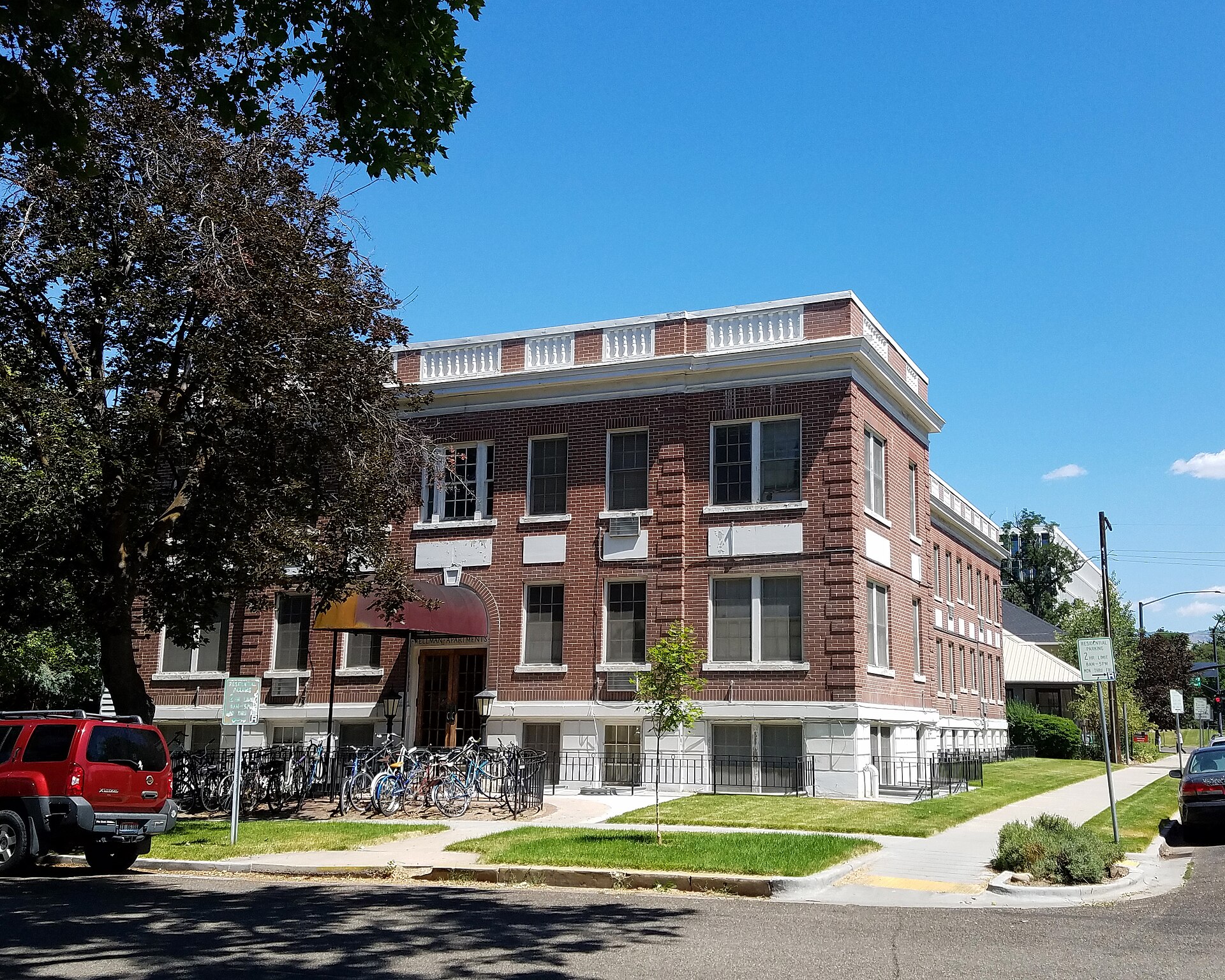
Rentals built before 1978, such as the 1929 Wellman Apartments pictured above, fall under a federal disclosure rule; the EPA notes that lead-based paint for use in homes was banned in the U.S. in 1978.45 Federal law, 42 U.S.C. 4852d, enacted in 1992, requires that before a lessee "is obligated under any contract to ... lease the housing," the lessor must provide an EPA lead hazard pamphlet and "disclose to the purchaser or lessee the presence of any known lead-based paint, or any known lead-based paint hazards," with any available evaluation report.14
The EPA's summary of the rule says landlords, agents and property managers must give the pamphlet "Protect Your Family From Lead In Your Home," disclose known lead-based paint and hazards, provide available records, and include a "Lead Warning Statement" in or attached to the lease, and must keep a signed copy of the disclosures "for three years after the sale is completed or the lease begins." The rule does not apply to zero-bedroom units, leases of 100 days or less with no renewal, housing for the elderly or people with disabilities (unless a child under six lives there), housing certified lead-free, foreclosure sales, or "Housing built after 1977."45 A person who "knowingly violates" the section is liable to the lessee for three times the damages, plus costs and attorney fees, under 4852d(b).14
What cities may and may not regulate
Idaho's local-control line for rentals is drawn by two statutes. Idaho Code 55-306 bars any "local governmental unit" from enacting, maintaining or enforcing an ordinance that would force owners into an optional federal housing assistance program "or any other program or law that would otherwise regulate rent, fees, or deposits charged for leasing private residential property." It leaves a city free to manage housing it owns.9 House Bill 545 (2024), from the House State Affairs Committee and Rep. Brandon Mitchell, wrote that language into then-section 55-307; its statement of purpose says it was meant "to prohibit local governments from mandating Idaho property owners to be forced to participate in an optional Federal Housing Assistance program or any program that would have the effect of regulating rent, fees or deposits." It was signed April 1, 2024, as Session Laws 2024, ch. 257, effective July 1, 2024. Senate Bill 1043 (2025) moved it to 55-306.1034
The second statute, 67-6539, governs short-term rentals and was rewritten by House Bill 583 (2026), explained in Part B's lesson 03 and in this module's lesson 05.2324
Boise's landlord rules
Boise has gone furthest of Idaho's cities, within the state's limits. Its renter protection page, read Nov. 19, 2026, lists five rules: the 2023 anti-retaliation ban and notice-of-rights requirement (ORD-35-23, Boise City Code Title 5, Chapter 17); a rebuttable presumption that the full deposit comes back when a tenant is permanently displaced by demolition or a substantial remodel (also ORD-35-23); the source-of-income ordinance (ORD-37-23); and the 2019 application fee ordinance. Complaints must be filed within six months of the alleged violation, and the city investigates only within city limits.1143 Landlords meet the notice rule by giving new tenants a link to the city's notice of rights and responsibilities or a printed copy on request.46 On Sept. 9, 2026, Mayor McLean's office announced a fall education campaign for renters on paying rent, repair requests and evictions, noting that downtown, North End and East End neighborhoods have up to 50 percent renter-occupied homes. "We have to support renters as our city continues to grow," the mayor said in the release.47
Two parts of the Boise package touch "deposits" and "fees," the words in 55-306, which took effect after Boise's 2019 and 2023 votes. The advocacy group National Low Income Housing Coalition reported the 2023 package as adopted unanimously on Aug. 15, 2023.48 No court decision on whether 55-306 displaces the deposit presumption or the fee ordinance was found for this lesson.
The Magic Valley and smaller cities
In Twin Falls, Jerome, Kimberly, Gooding, Buhl and Hagerman, an owner's duties are the state and federal ones in this lesson plus each city's building, zoning and nuisance codes; this lesson did not find a landlord-specific ordinance in those towns, but it did not read every chapter of every code, so that is listed as unverified. Rented farmhouses on five acres or more used for agriculture fall outside 6-320's repair remedy, as noted above.8
HOAs and rentals
An owner whose rental sits in a subdivision with a homeowner's association answers to a fourth rulebook: the recorded covenants. Idaho Code 55-3211, a rule that began as House Bill 511 (2016) (Session Laws 2016, ch. 209, then 55-115(3)) and was moved into the Homeowner's Association Act by House Bill 703 (2022) (Session Laws 2022, ch. 323), says no homeowner's association "may add, amend, or enforce any covenant, condition, or restriction in such a way that limits or prohibits the rental, for any amount of time," of property in the association "unless expressly agreed to in writing at the time of such addition or amendment by the owner of the affected property." The section's last sentence saves "valid covenants, conditions, or restrictions limiting a property owner's right to transfer" that applied when the owner acquired the property, but in North Henry's Lake Homeowners Ass'n v. Norton (Jan. 6, 2026) the Idaho Supreme Court read 55-3211 as having no time limit and held that a 2016 rental ban could not be enforced against owners who bought later.49 How that rule has played out in court, including the Idaho Supreme Court's 2026 decision in North Henry's Lake HOA v. Norton, is in lessons 08 and 09.

Taxes on a rental
This section describes how the tax rules work. It is not tax advice, and the IRS publication and the county assessor decide each case.
Property tax and the homeowner's exemption
Idaho's homeowner's exemption is the largest property tax difference between a home and a rental. Idaho Code 63-602G(1) exempts "the first one hundred twenty-five thousand dollars ($125,000) of the market value for assessment purposes of the homestead ... or fifty percent (50%) of the market value ... whichever is the lesser." Subsection (2)(a) allows it only if "The homestead is owner-occupied and used as the primary dwelling place of the owner," and adds that a homestead "may consist of part of a multidwelling or multipurpose building and shall include all of such dwelling or building except any portion used exclusively for anything other than the primary dwelling of the owner."16 A house rented to a tenant gets no exemption; an owner who lives in one half of a duplex can claim it on the owner's half. The section has been amended more than 20 times since 1996, most recently in 2026 (Session Laws 2026, ch. 236); how the exemption and levy rates combine on a tax bill is in Part B's lesson 09.1650
How we figured it: the exemption on an owner-occupied duplex
A hypothetical, using the statute's words; figures are ours. A duplex is assessed at $500,000, and the two units are equal. The owner lives in one unit and rents the other.
Value of the owner's unit: $500,000 divided by 2 = $250,000. Exemption: the lesser of $125,000 or 50 percent of $250,000 ($125,000) = $125,000. Taxable value: $500,000 minus $125,000 = $375,000. If the owner moved out and rented both units, the exemption would be $0 and the taxable value $500,000. If the whole building were a single home worth $500,000 with no rented part, the exemption would also be $125,000 (the lesser of $125,000 and $250,000).
Inputs and method: Idaho Code 63-602G(1) and (2)(a), read Nov. 19, 2026. How a county assessor splits a building's value between the owner's unit and the rented unit is the assessor's call; the equal split is our assumption for illustration. Levy rates and other exemptions are not included.
Income tax on rent
IRS Publication 527, Residential Rental Property, for tax year 2025 (dated Jan. 8, 2026), lays out the federal rules. Rent income and expenses are generally reported on Schedule E (Form 1040). Ordinary expenses of renting, "such as maintenance, insurance, taxes, and interest," can generally be deducted from rental income. The building itself (not the land) is depreciated: under the general system, residential rental property "over 27.5 years." A home rented "less than 15 days during the tax year" that the owner also uses as a home is treated differently: the rent is not included in income and the expenses are not rental expenses. The publication also flags the 3.8 percent Net Investment Income Tax.17 This lesson did not review Idaho's state income tax return.
How we figured it: what 27.5 years means in dollars
A hypothetical, to show the arithmetic; figures are ours, not advice. An owner buys a rental for $400,000, and $100,000 of the price is land, which is not depreciated. The building basis is $300,000. Straight-line over 27.5 years: $300,000 divided by 27.5 = about $10,909 per full year. The first and last years are partial under the mid-month convention described in Publication 527, so the first-year figure is smaller depending on the month the home is placed in service.
Inputs and method: IRS Publication 527 (2025), chapter 2, recovery period of 27.5 years for residential rental property under the general depreciation system. The land and building split is our assumption; in practice it comes from the assessor's values, an appraisal or the purchase documents.
Sales and lodging taxes
A lease of 30 days or more is not a taxable sale. Idaho Code 63-3612(2)(g) taxes hotel, motel and similar lodging "except where residence is maintained continuously under the terms of a lease or similar agreement for a period in excess of thirty (30) days."22 An owner who switches a unit between monthly tenants and nightly guests moves between two tax systems; the short-stay rules and rates are in lesson 05.
Insurance and liability
No Idaho statute requires a landlord to carry insurance on a rental, and none requires a tenant to carry renter's insurance; a lease may require either. The AG manual lists "Rental & Liability Insurance" as a lease term covering "Requirements and restrictions regarding the tenant's responsibility to purchase insurance," and describes renter's insurance as covering a tenant's belongings and possibly claims against the tenant, with most policies excluding vehicles and animals and some excluding floods or earthquakes.19 A tenant's policy does not cover the owner's building. Owners' policies for rented homes are written differently from homeowner policies that assume the owner lives there; the Idaho Department of Insurance licenses insurers and agents and takes consumer complaints.51
Liability follows the statutory duties. A landlord who fails to keep "electrical, plumbing, heating, ventilating, cooling, or sanitary facilities" in working order, or keeps the premises "in a manner hazardous to the health or safety of the tenant," faces suit under 6-320, possible treble damages under 6-317 and the prevailing party's attorney fees under 6-324.83732 Injury claims by tenants or visitors are ordinary negligence cases decided under general Idaho law, outside Chapter 3.
Who owns Idaho's rentals
No Idaho agency publishes a count of rental owners by size, and county assessor rolls list owners by name, often as limited liability companies, without saying how many units each controls. Part B's How Houses Changed, 1979 to 2026 covers the rise of build-to-rent subdivisions and apartment construction, and Part A's Prices and Rents vs. Inflation shows what rents did. The legal duties in this lesson are the same for a one-unit owner and a national company; what differs is who is exempt from the Fair Housing Act (only small owners, under 3603(b)) and who handles deposits through a third-party manager (6-321(4)).124

Pictures, Numbers and Infographics
The table gathers the numbers an Idaho landlord works with, with the comparable rule elsewhere.
| Measure or rule | Idaho | U.S. or other states | Place or year | Source |
|---|---|---|---|---|
| Deposit return deadline | 21 days if the lease is silent; 30 days at most | Utah, Washington, Nevada 30 days; Oregon 31; Arizona 14 business days; Colorado one month (up to 60 by lease) | Statutes current Nov. 2026 (Colorado 2024 printout) | 4394041576 |
| Deposit cap | None | Nevada 3 months; Colorado 2 months; Arizona 1.5 months | Current statutes | 567 |
| Notice of rent increase or nonrenewal | 30 days, written | Oregon limits the size of increases (SB 608, 2019); Idaho does not | Idaho since 2020; Oregon 2019 | 3152 |
| Notice to change a fee in a written lease | 30 days, written | (state rules vary) | Leases on or after July 1, 2023 | 28 |
| Tenant's repair notice before suit | 3 days, written | Since 1977 | 8 | |
| Trial in a repair case for specific performance only | Within 12 days of filing; service 5 days before | Since 1977 | 8 | |
| Smoke detector cure after certified letter | 72 hours, then tenant may install and deduct | Current statute | 8 | |
| Treble damages | Up to 3 times actual damages in a 6-320 action | Colorado treble for willful deposit retention | Current | 376 |
| Homeowner's exemption | Lesser of $125,000 or 50% of value; owner-occupied only | (none for rentals) | Current statute | 16 |
| Depreciation period, residential rental building | 27.5 years (federal) | Same nationwide | Tax year 2025 | 17 |
| Lead disclosure records kept | 3 years after the lease begins | Same nationwide; pre-1978 housing | Federal rule | 45 |
| Adverse action: free report window | 60 days | Same nationwide | FCRA | 13 |
| Fair Housing Act single-family exemption | Owner of 3 or fewer houses, no broker, no discriminatory ad | Same nationwide | Since 1968 | 12 |
| Boise complaint window under its renter ordinances | 6 months | Boise, 2023 to 2026 | 11 | |
| Idaho renter households | 220,973 (28.9% of occupied homes) | U.S. 34.7% | ACS 2025 1-year | 18 |
The comparison grid below restates the deposit table as a picture; the bar chart of deposit caps and the deposit flowchart appear earlier in the lesson.
Common mistakes
- Treating 30 days as the deposit deadline. Thirty days is the outer limit. If the lease does not fix a time, 6-321(2) gives 21 days.4
- Charging for faded paint and worn carpet. The statute bars keeping any part of a deposit "to cover normal wear and tear," and the AG manual lists faded paint and carpet as wear and tear and calls lease terms charging for them "restrictive."419
- Sending a total instead of an itemized statement. A partial refund needs "a signed statement itemizing the amounts lawfully retained," the purpose, and "a detailed list of expenditures."4
- Assuming a property manager must hold a real estate license. Leasing is not on the license list in 54-2004(39), and the Real Estate Commission says property management is not regulated; a third-party manager who is not a licensee must still keep deposits in a separate insured account under 6-321(4).314
- Thinking a small owner can advertise "adults only" or "ideal for a single professional." The 3603(b) exemptions do not reach 3604(c); the advertising ban covers everyone.1229
- Reading HUD's 2025 withdrawal of guidance as repeal of the accommodation rule. The withdrawal notice covers HUD documents; 42 U.S.C. 3604(f)(3)(B) still makes refusing a reasonable accommodation discrimination, and private suits remain available.1529
- Skipping the adverse action notice when a screening company "recommended" denial. The duty applies when the action is "based in whole or in part" on a consumer report.13
- Raising rent with 15 days' notice on a month-to-month home. The 15-day rule in 55-304(1) covers other changes; rent increases and nonrenewals of residential leases need 30 days' written notice under 55-304(2).31
- Adding a new fee mid-lease. A fee not in a written lease needs 30 days' written notice, and every residential fee must be reasonable under 55-305.28
- Assuming the homeowner's exemption follows the owner to a rental. It covers only the owner-occupied primary dwelling under 63-602G(2)(a).16
- Confusing a city rule with an HOA rule. A city may not license a short-term rental after HB 583, but an HOA covenant in place when the owner bought may still limit rentals under 55-3211.2349
What we know, what we don't, and what the data can show
What we know
- Idaho requires no landlord or property management license and keeps no landlord registry; the AG publishes a manual but does not enforce the statutes.119
- The deposit, repair, notice and fee rules are in Idaho Code 6-320, 6-321, 55-304 and 55-305, as amended through 2025; the 2026 session did not change those four sections (their history lines end in 1994, 2021 and 2025).843128
- Cities may not regulate rent, fees or deposits or force voucher participation (55-306), and Boise's 2023 ordinances are the most detailed city rules for long-term landlords.911
- HUD withdrew its 2020 assistance animal notice and its 2022 criminal records memo, effective Sept. 17, 2025, as published April 6, 2026.15
What we don't know
- How many landlords Idaho has, how many units each owns, or how many homes are managed by third parties. No state agency collects it.
- How often deposits are returned late or with improper deductions. Deposit disputes are small claims and magistrate cases without a separate case type in public statistics.
- Whether Idaho courts will treat Boise's deposit presumption and application fee ordinance as displaced by 55-306.
- How federal courts will handle assistance animal documentation and criminal history screening without HUD's withdrawn guidance.
What the data can show
- County assessor parcel rolls and homeowner's exemption flags (Idaho Code 63-602G) can show which homes are not owner-occupied, a rough proxy for rentals and second homes, parcel by parcel.16
- Idaho Secretary of State business filings can show the limited liability companies that hold rental property and their registered agents.
- Idaho iCourt case search can show small claims and civil suits naming a landlord or management company; see Civil, Small Claims, Family and Probate Records.
- Boise's code compliance complaint records under Title 5, Chapter 17 can show how many retaliation and notice complaints the city has received, through a public records request.11
- The Census Bureau's American Community Survey tables B25003 and B25064 show renter households and median rents by county and city, as lesson 01 does.18
Questions people ask
Does an owner need a license to rent out a house in Idaho?
Not from the state for rentals of 30 days or more. No statute requires one, and the Real Estate Commission does not regulate leasing.1 Cities and counties may not license short-term rentals after HB 583 (2026).23 A city may require a general business license of businesses within its limits; this lesson did not check every city's rule.
Is there a limit on late fees?
No dollar limit. Idaho Code 55-305(1) requires that fees, "including fees for the late payment of rent, shall be reasonable," and that a fee not in a written lease be preceded by 30 days' written notice.28
Can a lease call part of the deposit "nonrefundable"?
Idaho Code 6-321(1) treats any amount deposited "for any purpose other than the payment of rent" as a security deposit, refundable except for the contingencies in the deposit arrangement and never for normal wear and tear. The AG manual lists large nonrefundable upfront fees among "restrictive" lease provisions. Arizona, by contrast, requires that the purpose of nonrefundable fees be stated in writing and treats any fee not so designated as refundable (A.R.S. 33-1321(B)).4197
Must an Idaho landlord accept housing vouchers?
No. Idaho Code 55-306 bars local governments from mandating participation in an optional federal housing assistance program, and Boise's source-of-income ordinance exempts income sources that require such participation.911
What happens to the deposit when a rental is sold?
"The new owner shall be liable for refund of the deposits," under 6-321(3). The statute does not say how buyer and seller settle the money between themselves; that is a term of the sale contract.4
Does the lead paint rule apply to a house built in 1975?
Yes, unless an exemption applies (for example a lease of 100 days or less with no renewal, or housing certified lead-free). The EPA says the rule does not apply to "Housing built after 1977."45
Can a landlord require renter's insurance?
Idaho law does not forbid it, and the AG manual lists insurance requirements as a lease term.19
Hard questions
Should Idaho license landlords or property managers?
For licensing: managers hold other people's money, and the Legislature's own 2021 trust-account rule for non-licensee managers (HB 152) shows the concern is real; a registry would let tenants and cities know who is responsible for a building.21 Against: licensing adds cost that can be passed into rent, Idaho's statutes already give tenants a fast repair trial and treble damages, and the House and Senate votes on HB 152 (37-31 and 20-15) show how divided legislators are even on narrow rules.21837 What the evidence shows: there is no Idaho data on manager misconduct or deposit losses to settle the question either way.
Should Idaho cap deposits?
For a cap: Nevada, Colorado and Arizona cap deposits at 3, 2 and 1.5 months' rent, and move-in costs are a barrier for renters with little savings.567 Against: a deposit is an owner's main protection against damage and unpaid rent, especially for small owners who cannot absorb a loss, and higher-risk applicants may be approved only with a larger deposit. What the evidence shows: Idaho collects no data on deposit amounts; the AG manual says only that "Idaho does not restrict the amount of rent or deposits."19
How far may a city go before 55-306 stops it?
The city's case: Boise argues its 2023 rules regulate conduct (retaliation, notice of rights, displacement) under its police power, citing Idaho Code 50-301 and 50-302 in the ordinance itself.43 The state's case: the Legislature has said cities may not regulate "rent, fees, or deposits," and a deposit presumption or fee ordinance arguably does just that.910 What the evidence shows: no appellate decision found for this lesson has drawn the line.
Did withdrawing HUD's guidance help or hurt small landlords?
One view: the withdrawn documents went beyond the statute and invited costly disputes over online animal letters and screening policies, and their withdrawal returns the question to the statute's text. The other view: the guidance gave owners a checklist; without it, owners face the same statute and private suits with less direction. What the evidence shows: the Federal Register notice itself says the act's private right of action is unchanged; court results under the new posture are not yet available.15
For reporters and advocates
Records that exist. Idaho iCourt (small claims and civil suits over deposits and repairs; eviction filings, see lesson 04 and The Idaho iCourt Portal); county assessor rolls with homeowner's exemption status; county recorder deeds showing LLC buyers; Idaho Secretary of State filings for those LLCs; Boise code compliance complaints under Title 5, Chapter 17; Idaho Human Rights Commission case files and annual reports; HUD fair housing complaint data; legislative minutes and recordings for HB 545 (2024), SB 1042 (2025) and HB 701 (2026).103536
Questions to ask. Of a city: how many renter complaints it received last year and how many were resolved; whether its attorney has reviewed its rules against 55-306. Of the AG's office: how many landlord-tenant consumer contacts it logs, given that it does not enforce the statutes. Of legislators: why application fee bills stalled in committee in 2025 and 2026. Of large owners: who manages the units, where deposits are held, and whether screening is done in house or by a vendor.
Public records. City and county records are open under the Idaho Public Records Act, Idaho Code Title 74, Chapter 1; how to ask is in Idaho Public Records Requests.
The Magic Valley angle. Twin Falls County had 10,266 renter households and Jerome County 2,049 in the 2020 to 2024 ACS, and median gross rents were $1,089 and $966, well below Ada County's $1,577 (lesson 01's table).18 Rented farmhouses on five acres or more used for agriculture are outside 6-320's repair remedy, a detail that matters for dairy and farm workers who rent from employers or neighbors.8 Story leads include the use of LLCs to buy single-family homes in Twin Falls and Jerome, and how many pre-1978 rentals in the original townsites change hands each year. Lesson 12, How to Report on Housing, has the full workflow.
Where to go next
- Idaho Attorney General, Landlord and Tenant Manual (July 2026): Free 45-page state guide for landlords and tenants, with a pre-rental checklist (Appendix B) and a move-in and move-out checklist (Appendix C). Read the lease and deposit chapters together with the statutes.
- Idaho Legislature, Idaho Statutes search: Free official text of every Idaho Code section with its history line; use it to check the current version of 6-320, 6-321 and 55-304 to 55-306 before relying on any summary.
- EPA, Real Estate Disclosures about Potential Lead Hazards: Free federal page with the lead pamphlet, sample lessor disclosure forms in English and Spanish, and the list of exemptions.
- IRS Publication 527, Residential Rental Property: Free annual IRS guide to reporting rent, deducting expenses and depreciating rental buildings; check the edition for the tax year in question.
- City of Boise, Renter Protections: Free city page summarizing Boise's landlord rules, the notice of rights landlords must provide, and the complaint form; applies only inside Boise city limits.
- Idaho Human Rights Commission: State agency that takes housing discrimination complaints under the Idaho Human Rights Act; free filing, with publications and annual reports online.
- Idaho Legal Aid Services: Nonprofit that provides free civil legal help to eligible low-income Idahoans and posts free self-help articles and forms on housing.
- Idaho Court Assistance Office and Self-Help Center: Free court-run site with landlord-tenant and small claims forms and instructions for people handling their own cases.
Still being checked (8 items)
These points could not be fully confirmed against a primary source when this lesson was written and fact checked in November 2026. The text above states each one as uncertain.
- Whether any Idaho city other than Boise has a landlord-specific ordinance or requires a general business license from long-term rental businesses; this lesson did not survey every city code, including Twin Falls, Jerome, Kimberly, Gooding, Buhl and Hagerman.
- The current status of HUD's April 4, 2016 Office of General Counsel guidance on criminal records screening; the April 6, 2026 Federal Register notice withdraws the June 10, 2022 implementation memo but does not name the 2016 guidance, and HUD's old link to the 2016 document returns an error.
- The Sept. 16, 2025 HUD memo on disparate impact enforcement is described from a National Association of Realtors report, not from the memo itself.
- The effective date of Boise ordinance ORD-35-23: the city's ordinance document says it takes effect on passage, approval and publication, while the National Low Income Housing Coalition reported Jan. 1, 2024; the exact Boise City Code chapter number for the 2019 application fee ordinance was not confirmed.
- Whether Idaho Code 55-306 displaces Boise's deposit presumption or application fee ordinance; no court decision was found.
- Texas and California deposit statutes could not be read (the official sites refused automated access), so they are left out of the comparison; Colorado's figures come from the 2024 uncertified printout and later sessions were not checked.
- Montana's penalty for late deposit returns (set in sections other than 70-25-202) was not read.
- The Idaho state income tax treatment of rental income was not reviewed.
Last verified November 19, 2026. General education, not legal, tax, financial or real estate advice; every figure names its source and year in the Notes and Sources below. Data is revised: check the newest release before relying on any number.
Notes
- Idaho Division of Occupational and Professional Licenses, Idaho Real Estate Commission, FAQs and Consumer Info page, stating "Property management (leasing) is not regulated in Idaho"; page last updated Sept. 29, 2026 (read Nov. 19, 2026). Read it online. ↩
- Idaho Code section 54-2002, Licensure required, Idaho Legislature statute page; history: added 2000, ch. 285; am. 2015, ch. 51 (read Nov. 19, 2026). Read it online. ↩
- Idaho Code section 54-2004, Definitions, Idaho Legislature statute page; history: added 2000, ch. 285; last am. 2021, ch. 261; subsection (39), "Real estate broker" (read Nov. 19, 2026). Read it online. ↩
- Idaho Code section 6-321, Security deposits, Idaho Legislature statute page; history: added 1977, ch. 45, sec. 5; am. 2021, ch. 197 (read Nov. 19, 2026). Read it online. ↩
- Nevada Revised Statutes 118A.242, Security deposit: Limitation on amount or value ..., subsections 1 and 6, chapter 118A, Nevada Legislature (read Nov. 19, 2026). Read it online. ↩
- Colorado Revised Statutes 38-12-102.5 (Security deposits, maximum amount) and 38-12-103 (Return of security deposit), in Colorado Revised Statutes 2024, Title 38, uncertified printout, Colorado Office of Legislative Legal Services, pages 81 to 82; the 2025 and 2026 sessions were not checked (read Nov. 19, 2026). Read it online. ↩
- Arizona Revised Statutes 33-1321, Security deposits, subsections A, B, D and E, Arizona State Legislature (read Nov. 19, 2026). Read it online. ↩
- Idaho Code section 6-320, Action for damages and specific performance by tenant, Idaho Legislature statute page; history: added 1977, ch. 45, sec. 4; am. 1994, ch. 418 (read Nov. 19, 2026). Read it online. ↩
- Idaho Code section 55-306, Local government, no rent control, Idaho Legislature statute page; history: added 2025, ch. 65, sec. 6 (read Nov. 19, 2026). Read it online. ↩
- Idaho Legislature, bill page and statement of purpose (RS31242) for House Bill 545 (2024), State Affairs Committee (contact Rep. Brandon Mitchell); amended then-section 55-307 and 55-2006; signed by the governor April 1, 2024; Session Laws 2024, ch. 257; effective July 1, 2024 (read Nov. 19, 2026). Read it online. ↩
- City of Boise, Planning and Development Services, Code Compliance, Renter Protections page (anti-retaliation and notice of rights, ORD-35-23; source of income, ORD-37-23; deposit presumption on demolition or substantial remodel; 2019 rental application fee ordinance; six-month complaint window) (read Nov. 19, 2026). Read it online. ↩
- 42 U.S.C. 3603, Effective dates of certain prohibitions, subsection (b), exemptions, Legal Information Institute (read Nov. 19, 2026). Read it online. ↩
- 15 U.S.C. 1681m, Requirements on users of consumer reports, subsection (a), Fair Credit Reporting Act, Legal Information Institute (read Nov. 19, 2026). Read it online. ↩
- 42 U.S.C. 4852d, Disclosure of information concerning lead upon transfer of residential property, subsections (a) and (b) (Residential Lead-Based Paint Hazard Reduction Act of 1992), Legal Information Institute (read Nov. 19, 2026). Read it online. ↩
- U.S. Department of Housing and Urban Development, Office of Fair Housing and Equal Opportunity, Notice of the Withdrawal of FHEO Guidance Documents, 91 Fed. Reg. 17291 (April 6, 2026), Docket No. FR-6571-N-01, FR Doc. 2026-06624, signed by Assistant Secretary Craig W. Trainor; lists eight documents withdrawn effective Sept. 17, 2025, including FHEO 2020-01 (Jan. 28, 2020), FHEO Notice 2013-01 (April 25, 2013) and the June 10, 2022 memo implementing OGC criminal records guidance (read Nov. 19, 2026). Read it online. ↩
- Idaho Code section 63-602G, Property exempt from taxation, homestead, Idaho Legislature statute page; history: added 1996, ch. 98, sec. 7; amended 23 times through 2026, ch. 236 (read Nov. 19, 2026). Read it online. ↩
- Internal Revenue Service, Publication 527, Residential Rental Property (Including Rental of Vacation Homes), for use in preparing 2025 returns, dated Jan. 8, 2026 (security deposits; rental expenses; property used as a home and rented less than 15 days; 27.5-year recovery period; Net Investment Income Tax) (read Nov. 19, 2026). Read it online. ↩
- U.S. Census Bureau, American Community Survey: 2025 1-year table B25003, Tenure (Idaho 765,200 occupied units, 220,973 renter-occupied), and 2020 to 2024 5-year tables B25003 and B25064, Median Gross Rent, table-based summary files, as tabulated in lesson 01 of this module; shares are our calculation (read Nov. 19, 2026). Read it online. ↩
- Idaho Office of the Attorney General, Consumer Protection Division, Landlord and Tenant Manual, July 2026 edition: purpose and scope (p. 1); support animals, rent and deposits, screening (pp. 2 to 4); discrimination (pp. 4 to 5); "Section 8" (pp. 5 to 6); lease terms and improper and restrictive provisions (pp. 6 to 9); move-in inspection (p. 10); landlord duty to keep property safe (pp. 11 to 13); retaliatory evictions (p. 25); manufactured home parks (pp. 29 to 30); Appendix A statute list (read Nov. 19, 2026). Read it online. ↩
- Idaho Code section 54-2003, Exceptions to licensure, active licensees, transactions involving personal property, Idaho Legislature statute page; history: added 2000, ch. 285; am. 2003, ch. 65 (read Nov. 19, 2026). Read it online. ↩
- Idaho Legislature, bill page for House Bill 152 (2021), Security Deposits, Judiciary, Rules and Administration Committee; passed House 37-31-2 on March 3, 2021, and Senate 20-15-0 on April 8, 2021; signed April 13, 2021; Session Laws 2021, ch. 197; effective July 1, 2021 (read Nov. 19, 2026). Read it online. ↩
- Idaho Code section 63-3612, Sale, Idaho Legislature statute page; history: subsection (2)(g), hotel, motel and lodging charges (read Nov. 19, 2026). Read it online. ↩
- Idaho Code section 67-6539, Short-term rentals and vacation rentals, Idaho Legislature statute page; history: added 2017 (House Bill 216); am. 2026 by House Bill 583, Session Laws 2026, ch. 22 (read Nov. 19, 2026). Read it online. ↩
- Jeff A. Pierson, The 2026 Housing Laws, lesson 3 of Idaho Zoning, Building and Property Tax (Housing series Part B), jeffapierson.com (read Nov. 19, 2026). Read it online. ↩
- Idaho Code section 6-323, Service of notice to landlord, Idaho Legislature statute page; history: added 1977, ch. 45, sec. 7 (read Nov. 19, 2026). Read it online. ↩
- Idaho Code section 55-208, Termination of tenancy at will, Idaho Legislature statute page; history: R.S., sec. 2857; am. 2002, ch. 295 (read Nov. 19, 2026). Read it online. ↩
- Idaho Code section 9-505, Certain agreements to be in writing, Idaho Legislature statute page; history: C.C.P. 1881, sec. 937; am. 1919, 1993, 1996 (read Nov. 19, 2026). Read it online. ↩
- Idaho Code section 55-305, Limitation on fees for tenants of a rental property, Idaho Legislature statute page; history: formerly 55-314, added 2023, ch. 67; am. and redesignated 2025, ch. 65, sec. 14 (read Nov. 19, 2026). Read it online. ↩
- 42 U.S.C. 3604, Discrimination in the sale or rental of housing and other prohibited practices, subsections (c) and (f)(3), Legal Information Institute (read Nov. 19, 2026). Read it online. ↩
- Idaho Code section 67-5909, Acts prohibited, Idaho Legislature statute page; history: added 1969, ch. 459, sec. 9; subsection (8), real estate transactions (read Nov. 19, 2026). Read it online. ↩
- Idaho Code section 55-304, Change in terms of lease, notice, Idaho Legislature statute page; history: formerly 55-307; R.S., sec. 2881; am. 1990, ch. 185; am. 2020, ch. 254; am. 2024, ch. 257; am. and redesignated 2025, ch. 65, sec. 7 (read Nov. 19, 2026). Read it online. ↩
- Idaho Code section 6-324, Attorney fees, Idaho Legislature statute page; history: added 1985, ch. 144, sec. 1 (read Nov. 19, 2026). Read it online. ↩
- Idaho Legislature, bill page and statement of purpose for Senate Bill 1039 (2023), as amended, Senate Judiciary and Rules Committee (contact Sen. Alison Rabe); signed March 20, 2023; Session Laws 2023, ch. 67; effective July 1, 2023 (read Nov. 19, 2026). Read it online. ↩
- Idaho Legislature, bill page for Senate Bill 1043 (2025), Landlords and Tenants, Senate Judiciary and Rules Committee; reorganized Title 55, Chapter 3; signed March 13, 2025; Session Laws 2025, ch. 65; effective July 1, 2025 (read Nov. 19, 2026). Read it online. ↩
- Idaho Legislature, bill page for Senate Bill 1042 (2025), as amended, Rental Applications, Senate Judiciary and Rules Committee; passed Senate 23-12-0 on Feb. 19, 2025; referred to House Business Committee; no further action (read Nov. 19, 2026). Read it online. ↩
- Idaho Legislature, bill page for House Bill 701 (2026), Housing (rental application fees), House Business Committee; printed and referred Feb. 17, 2026; no further action (read Nov. 19, 2026). Read it online. ↩
- Idaho Code section 6-317, Treble damages, Idaho Legislature statute page; history: C.C.P. 1881, sec. 475; am. 1977, ch. 45; am. 2017, ch. 276 (read Nov. 19, 2026). Read it online. ↩
- Florida Statutes 83.49, Deposit money or advance rent; duty of landlord and tenant, subsection (3), Online Sunshine, Florida Legislature (read Nov. 19, 2026). Read it online. ↩
- Utah Code 57-17-3, Deductions from deposit, written itemization, time for return (effective May 7, 2025), Utah Legislature (read Nov. 19, 2026). Read it online. ↩
- Revised Code of Washington 59.18.280, Moneys paid as deposit or security for performance by tenant, subsections (1) and (2), Washington State Legislature (read Nov. 19, 2026). Read it online. ↩
- Oregon Revised Statutes 90.300, Security deposits; prepaid rent, subsections (12) and (16), in ORS chapter 90 (2025 edition), Oregon Legislature (read Nov. 19, 2026). Read it online. ↩
- Montana Code Annotated 70-25-202 (2025), List of damages and refund, delivery to departing tenant, Montana Legislature (read Nov. 19, 2026). Read it online. ↩
- City of Boise, Ordinance ORD-35-23, enacting Boise City Code Title 5, Chapter 17, Tenant Protections (sections 5-17-1 to 5-17-10, including 5-17-2 legal authority citing Idaho Code 50-301 and 50-302, and 5-17-10 penalty), council memo dated Aug. 22, 2023 (read Nov. 19, 2026). Read it online. ↩
- National Association of Realtors (a real estate trade association), Washington Report, HUD Withdraws Fair Housing Guidance Documents, describing HUD memos of Sept. 16 and 17, 2025 (read Nov. 19, 2026). Read it online. ↩
- U.S. Environmental Protection Agency, Real Estate Disclosures about Potential Lead Hazards (Lead-Based Paint Disclosure Rule summary, exemptions, three-year record rule) (read Nov. 19, 2026). Read it online. ↩
- City of Boise, Notice of Tenant Rights and Responsibilities (English), PDF (read Nov. 19, 2026). Read it online. ↩
- City of Boise, Office of the Mayor, news release, Boise Launches Renter's Protection Education Campaign, Sept. 9, 2026 (read Nov. 19, 2026). Read it online. ↩
- National Low Income Housing Coalition (an advocacy group), City of Boise Enacts Three New Tenant Protections; Advocates Continue Push for Source-of-Income Ordinance, 2023 (read Nov. 19, 2026). Read it online. ↩
- Idaho Code section 55-3211, Prohibited conduct, rental restrictions, Idaho Legislature statute page; history: added 2022, ch. 323, sec. 4 (read Nov. 19, 2026). Read it online. ↩
- Jeff A. Pierson, Reading Your Assessment and Levy, lesson 9 of Idaho Zoning, Building and Property Tax (Housing series Part B), jeffapierson.com (read Nov. 19, 2026). Read it online. ↩
- Idaho Department of Insurance, home page (licensing of insurers and agents, consumer assistance) (read Nov. 19, 2026). Read it online. ↩
- Oregon Legislature, Senate Bill 608 (2019 regular session), overview page (Oregon Laws 2019, chapter 1): rent increases limited to one per 12 months and to 7 percent plus the consumer price index, with exemptions (read Nov. 19, 2026). Read it online. ↩
Check yourself
1. A lease says nothing about when the deposit will be returned. Under Idaho Code 6-321(2), the refund is due within:
Idaho Code 6-321(2): refunds are due within 21 days if no time is fixed by agreement and in any event within 30 days after surrender.
2. Which statement about property managers in Idaho is correct?
The Real Estate Commission's FAQ says property management (leasing) is not regulated in Idaho; Idaho Code 6-321(4), added by HB 152 (2021), requires separate deposit accounts for third-party managers who are not licensees or otherwise exempt.
3. Which of these is NOT one of the conditions listed in Idaho Code 6-320(a)?
Idaho Code 6-320(a) lists waterproofing, facilities supplied by the landlord, hazards, deposits, health and safety lease terms and smoke detectors; it does not require any particular appliance.
4. After a tenant's certified letter about missing smoke detectors, how long does the landlord have before the tenant may install them and deduct the cost from rent?
Idaho Code 6-320(a)(6): if working detectors are not installed within 72 hours of receipt of the letter, the tenant may install them and deduct the cost from the next month's rent.
5. An owner of two single-family houses rents one without a broker. Which part of the federal Fair Housing Act still applies?
42 U.S.C. 3603(b) exempts such owners from section 3604 'other than subsection (c)', so the ban on discriminatory notices and advertisements still applies.
6. What did the Federal Register notice of April 6, 2026 (91 FR 17291) do?
The notice, FR Doc. 2026-06624, lists eight withdrawn FHEO documents including FHEO 2020-01 and says the act's private right of action is unaffected; the statute's text did not change.
7. A landlord denies an application because of information in a tenant screening report. Under 15 U.S.C. 1681m(a), the landlord must tell the applicant, among other things:
15 U.S.C. 1681m(a) requires notice of the adverse action, any score used, the agency's contact information, a statement that the agency did not make the decision, and notice of the right to a free report within 60 days and to dispute it.
8. Which rental is exempt from the federal lead-based paint disclosure rule, according to the EPA?
The EPA's summary of the rule says it does not apply to housing built after 1977; 42 U.S.C. 4852d covers target housing built before 1978.
9. Under Idaho Code 55-306, an Idaho city may NOT:
Idaho Code 55-306 bars local ordinances that would regulate rent, fees or deposits on private residential property or force participation in optional federal housing programs, and preserves a city's control of property it owns.
10. An owner lives in one half of a duplex assessed at $500,000 (equal halves) and rents the other half. Using Idaho Code 63-602G, what is the largest homeowner's exemption the owner's half could receive?
The owner's half is worth $250,000; 63-602G(1) exempts the lesser of $125,000 or 50 percent ($125,000), and (2)(a) excludes the rented portion. See the lesson's methods box.
Terms in this lesson
- Third-party manager
- A person or company that manages a rental for the owner. Under Idaho Code 6-321(4), one that is not exempt must keep tenant deposits in a separate account at a federally insured institution.
- Normal wear and tear
- Deterioration from a rental's intended use without negligence, carelessness, accident, misuse or abuse (Idaho Code 6-321(1)). A deposit may not be kept to cover it.
- Itemized statement
- The signed list a landlord must send with any partial deposit refund, showing amounts kept, their purpose and a detailed list of expenditures (Idaho Code 6-321(2)).
- Specific performance
- A court order requiring a party to do what the law or the lease requires, such as making a repair. Idaho Code 6-320 sets a trial within 12 days when a tenant sues only for this.
- Treble damages
- A judgment of three times actual damages, available under Idaho Code 6-317 in certain landlord-tenant cases, including a tenant's action under 6-320.
- Reasonable accommodation
- A change in a rule, policy, practice or service needed for a person with a disability to have equal use of a home. Refusing one can be discrimination under 42 U.S.C. 3604(f)(3)(B).
- Assistance animal
- An animal that does work or provides support for a person with a disability. The Idaho AG manual says such animals are not legally pets; HUD's 2020 guidance on them was withdrawn effective Sept. 17, 2025.
- Adverse action notice
- The notice a landlord must give under 15 U.S.C. 1681m(a) when a consumer report contributes to denying an application or setting worse terms.
- Target housing
- Housing built before 1978 that is covered by the federal lead-based paint disclosure rule, with exemptions such as zero-bedroom units and leases of 100 days or less.
- Lead Warning Statement
- Required lease language or attachment explaining the hazards of lead-based paint and confirming the landlord's compliance with the disclosure rule.
- Source of income
- The lawful origin of an applicant's money, such as wages, benefits or support. Boise's 2023 ordinance bars source-of-income discrimination with exemptions; Idaho Code 55-306 bars forcing voucher participation.
- Homeowner's exemption
- The Idaho property tax exemption in Idaho Code 63-602G for an owner-occupied primary dwelling: the lesser of $125,000 or 50 percent of assessed value. Rented homes do not qualify.
- Depreciation
- A yearly tax deduction for the wear of a rental building over time; IRS Publication 527 sets 27.5 years for residential rental buildings under the general system. Land is not depreciated.
- Owner-occupant exemption
- The Fair Housing Act exemption in 42 U.S.C. 3603(b)(2) for buildings with living quarters for four or fewer families when the owner lives in one; the advertising ban still applies.
Sources
- Idaho Code 6-321, Security deposits (2026-11-19) checked 2026-11
- Idaho Code 6-320, Action for damages and specific performance by tenant (2026-11-19) checked 2026-11
- Idaho Code 55-304, 55-305 and 55-306 (Title 55, Chapter 3) (2026-11-19) checked 2026-11
- Idaho Code 54-2004, Real estate license law definitions (2026-11-19) checked 2026-11
- Idaho Code 63-602G, Homestead exemption (2026-11-19) checked 2026-11
- Idaho Attorney General, Landlord and Tenant Manual, July 2026 (2026-11-19) checked 2026-11
- HUD, Notice of the Withdrawal of FHEO Guidance Documents, 91 FR 17291 (April 6, 2026) (2026-11-19) checked 2026-11
- 42 U.S.C. 3603 and 3604, Fair Housing Act (2026-11-19) checked 2026-11
- 15 U.S.C. 1681m, Fair Credit Reporting Act duties of users (2026-11-19) checked 2026-11
- 42 U.S.C. 4852d, Lead disclosure in sale or lease of target housing (2026-11-19) checked 2026-11
- IRS Publication 527 (2025), Residential Rental Property (2026-11-19) checked 2026-11
- City of Boise, Renter Protections and Ordinance ORD-35-23 (2026-11-19) checked 2026-11
- House Bill 545 (2024), Idaho Legislature bill page (2026-11-19) checked 2026-11