Lesson 1 of 11 · about 55 minutes · Updated November 18, 2026
How Zoning Came to Idaho
You'll be able to
- Trace Idaho zoning from the 1916 New York resolution, the 1924 and 1926 model act and Euclid v. Ambler (1926) to Idaho's first zoned cities in 1928.
- Explain what Senate Bill 1094 (1975) required of every city and county and which earlier laws it repealed.
- Identify when each item in Idaho Code 67-6508 entered the required plan list and find the session law behind it.
- Compare the 1975 and 2024 rules for areas of city impact and explain who controls the land around a city today.
- Determine whether the 2026 starter home and accessory dwelling unit laws apply to a given city using Census estimates.
- Compare Idaho's local planning system with Oregon's 1973 and Washington's 1990 state planning laws.
Start here: the short version
- Idaho zoned before Idaho required it. Boise, Idaho Falls and Twin Falls each adopted a zoning ordinance in 1928, and American Falls followed in 1930, according to a May 1933 federal survey of zoned towns.1 By 1925 Idaho was already on the U.S. Commerce Department's list of 19 states that had written its model zoning act into state law, wholly or in part.2
- The 1975 law made planning mandatory. Senate Bill 1094, the Local Planning Act of 1975, was approved March 28, 1975 and took effect July 1, 1975 (Idaho Session Laws 1975, chapter 188). It repealed the older city and county zoning chapters and told every city and county to plan and zone. That one-sentence duty is still Idaho Code 67-6503.34
- The required plan grew from 12 subjects to 18. The 1975 act listed 12 subjects a local plan had to cover, from population to implementation. Today Idaho Code 67-6508 lists 18, lettered (a) to (r). The Legislature added schools (1992), property rights (1995), electric transmission corridors (2007), agriculture (2011) and public airports (2014), and in 2025 moved a groundwater duty into the list.356
- The ring around each city changed hands in 2024. From 1975 until 2024, a city and its county chose by ordinance whether the city's plan, the county's plan or a joint plan governed the area of city impact. Senate Bill 1403 (2024) rewrote Idaho Code 67-6526 so that the county's plan and ordinances apply there, and it ordered every impact area reestablished by Dec. 31, 2025.78
- The 2026 laws reach only cities over 10,000. Senate Bills 1352 and 1354 (2026) require those cities to allow starter home subdivisions and accessory dwelling units by Feb. 1, 2027. By the Census Bureau's July 1, 2025 estimates, Twin Falls (56,216) and Jerome (13,731) are over the line; Kimberly (5,798), Buhl (4,801), Gooding (3,855) and Hagerman (994) are not.91011
- Idaho has no state agency that reviews local plans. Oregon (1973) requires every local plan to conform to statewide goals and be acknowledged by a state commission, and Washington (1990) requires its fastest-growing counties to plan under state goals. Idaho's 1975 law left the work, and the judgment, to cities and counties.121314
Law: Idaho Code Title 67, Chapter 65 as amended through the 2026 regular session (bills signed through March 31, 2026, effective July 1, 2026), read on the Idaho Legislature's website; Idaho Session Laws for 1957, 1975, 1992, 1994, 1995, 1996, 1999, 2007, 2010, 2011, 2014, 2023, 2024, 2025 and 2026; U.S. Department of Commerce zoning publications of 1924 to 1933; U.S. Census Bureau Vintage 2025 city population estimates (released May 2026). Checked Nov. 18, 2026. Laws and data change; check the current statute and the newest release before you rely on a number.
Every argument about housing in Idaho, from a backyard cottage in Meridian to a 145-acre rezone near Wilder, runs through a set of rules most residents have never read. Those rules did not arrive all at once. They were borrowed from New York and Washington, D.C., in the 1920s, adopted city by city in Idaho in the late 1920s, extended to a few counties in 1957, rebuilt into one statewide law in 1975, and amended almost every few years since. In 2024 and 2026 the Legislature changed them more than it had in decades.
This lesson tells that history from the primary record: the model acts the federal government printed, the Bureau of Standards surveys that counted Idaho's first zoned towns, the 1957 and 1975 session laws, and the amendments that turned a 12-subject plan into an 18-item one. It is written for planning and zoning commissioners, council members, county commissioners, legislators and their staff, reporters, advocates and residents who want to know where a rule came from before they argue about where it should go.
It builds on, and does not repeat, the module Idaho Planning and Zoning. That course explains how the act works today: who sits on a commission and how conflicts of interest work in The Planning Act and Who Decides, what each plan subject means in The Plan: Components and Amendments, notice and rezone mechanics in Zoning Ordinances, Maps and Rezones, and the 2024 impact area and annexation rules in Areas of City Impact and Annexation. This lesson adds the history, the session-law trail behind each change, the Magic Valley and Treasure Valley record, and the comparison with neighboring states. Annexation fights are in Annexation Fights; the Legislature's power over cities in State Preemption and Local Control; standing, takings and the Right to Farm Act in Property Rights and Land Use Law; and how to take part in your city's 2026 and 2027 code rewrite in Shaping Your City's Code Rewrite. For the growth numbers behind all of it, see Part A of this series, especially Idaho Since 1979: The Long View and Farmland to Rooftops.
Where American zoning came from, 1916 to 1928
Zoning means dividing a city or county into districts and setting different rules for each: which uses are allowed, how tall buildings may be, how much of a lot they may cover, how far back from the street they must sit. The rules are adopted as a local law called a zoning ordinance, with a map showing which district covers each parcel. Idaho's version of that idea came almost word for word from a federal model written in the early 1920s, which in turn grew out of one city's experiment.
New York, 1916
On July 25, 1916, New York City's Board of Estimate and Apportionment adopted its Building Zone Resolution, the first citywide zoning law in the United States. It split the city into three kinds of districts that overlapped on the map: use districts (residence, business and unrestricted), height districts in five classes tied to street width, and area districts lettered A to E that controlled yards and courts.15 The use, height and area structure is still visible in Idaho codes. A Twin Falls or Nampa zoning ordinance today has a use table, height limits and setback and lot coverage rules, the same three families of regulation New York drew in 1916.
Herbert Hoover's committee and the model act
In September 1921, Commerce Secretary Herbert Hoover appointed an Advisory Committee on Zoning. Its nine members included Edward M. Bassett, counsel to New York's zoning committee; Frederick Law Olmsted, a park and city planner; Lawrence Veiller, a housing reformer; Irving B. Hiett, a former president of the National Association of Real Estate Boards; and John M. Gries, chief of the Division of Building and Housing at the Bureau of Standards. The committee circulated a draft state law in mimeographed form in August 1922, revised it in January 1923, and the Government Printing Office published it in 1924 as A Standard State Zoning Enabling Act.16
An "enabling act" is a state law that gives local governments a power. The model's Section 1 granted it in one long sentence. For "the purpose of promoting health, safety, morals, or the general welfare of the community," a city council could "regulate and restrict the height, number of stories, and size of buildings and other structures, the percentage of lot that may be occupied, the size of yards, courts, and other open spaces, the density of population, and the location and use of buildings, structures, and land for trade, industry, residence, or other purposes."16 Section 2 let the council divide the city into districts and required that the rules "be uniform for each class or kind of buildings throughout each district, but the regulations in one district may differ from those in other districts." Section 3 required that zoning be done "in accordance with" an overall plan for the city.16
The idea spread fast. Hoover's foreword reported that only 48 cities and towns, with fewer than 11 million residents, had zoning ordinances when the committee formed in September 1921, and that by the end of 1923 zoning was in effect in 218 places with more than 22 million residents. The 1926 revised edition added two footnotes: by 1925, 19 states "had used the standard act wholly or in part in their laws," and Idaho is on that list, between Georgia and Illinois; and on Jan. 1, 1926, at least 425 municipalities, home to more than half the nation's urban population, were zoned.2
Euclid v. Ambler Realty, 1926
Whether zoning was constitutional was still open. Ambler Realty owned 68 acres in the village of Euclid, Ohio, a Cleveland suburb, and claimed the village's six-class zoning ordinance had cut the land's value from about $10,000 an acre for industry to no more than $2,500 for homes. On Nov. 22, 1926, the U.S. Supreme Court upheld the ordinance, 6 to 3, in Village of Euclid v. Ambler Realty Co., 272 U.S. 365. Justice George Sutherland wrote that a nuisance "may be merely a right thing in the wrong place, like a pig in the parlor instead of the barnyard," and the opinion described the apartment house in a single-family neighborhood as, in many cases, "a mere parasite." Justices Van Devanter, McReynolds and Butler dissented.17
Euclid matters in Idaho today for two reasons. It is the reason a city may separate uses at all without paying owners for lost value, the "police power" basis that every Idaho zoning ordinance rests on. It also put the national government's seal on a model that treated the detached single-family home as the most protected use, with apartments allowed only in other districts. The 2026 Idaho laws on accessory dwelling units and small-lot starter homes, covered in The 2026 Housing Laws, are the Legislature's first broad move to loosen that rule inside residential zones.
The planning model of 1928, and the national count by 1933
Hoover's committee followed with A Standard City Planning Enabling Act, printed in 1928. It covered four subjects: making a city plan and organizing a planning commission, control of subdivisions, control of buildings in mapped streets, and regional planning. Its Section 6 made it "the function and duty of the commission to make and adopt a master plan."18 The idea of a planning commission that prepares a long-range plan, which every Idaho city and county now has, starts here.
By January 1, 1933, the Bureau of Standards counted 1,236 zoned cities, towns, villages and unincorporated areas in the country, with 48,441,040 residents, and reported that 47 states and the District of Columbia had zoning enabling acts.19

Zoning arrives in Idaho, 1920 to 1974
Idaho cities did not wait for the Legislature to tell them they could regulate land. The Idaho Constitution of 1890 gave them a general power that still matters, and the first zoning maps in Idaho were drawn under a mix of that power and state statutes that changed several times before 1975.
The police power in the 1890 constitution
Article XII, Section 2 of the Idaho Constitution says: "Any county or incorporated city or town may make and enforce, within its limits, all such local police, sanitary and other regulations as are not in conflict with its charter or with the general laws."20 "Police power" here means the general power to protect health, safety and welfare, not just law enforcement. Because the grant comes straight from the constitution, the Idaho Supreme Court held in State v. Clark (1965), as later opinions and treatises describe the case, that counties and cities are not limited to the police powers the Legislature grants them, so long as a local rule does not conflict with state law. (We could not read the full 1965 opinion; see "Still being checked.")21 That is a different starting point from states that follow a strict "Dillon's Rule," under which local governments have only the powers a statute spells out. How far the Legislature can now override local rules is the subject of State Preemption and Local Control.
A Twin Falls test case: the 1920 gas station ordinance
One of the first Idaho Supreme Court cases about a land use rule came from the Magic Valley. In November 1920 Twin Falls passed Ordinance No. 322, which made it unlawful to run a public gasoline station within 500 feet of a school where customers' cars had to cross a sidewalk to reach the pumps. In April 1927 it passed Ordinance No. 435, which said no building permit would issue without the city council's favorable vote. Continental Oil Co. sued. On March 22, 1930, in Continental Oil Co. v. City of Twin Falls, 49 Idaho 89, 286 P. 353, the court ruled for the oil company. It found "no express authority in our codes" for an ordinance like No. 322, looked instead to the general police power, and held that the ordinance was unreasonable as applied to the company's lot and discriminated against drive-in stations. It held that No. 435, by itself, was invalid because it left the right to build to the council's uncontrolled discretion.22
The lesson the court drew in 1930 is still the backbone of Idaho land use law: a local rule must rest on stated standards that apply to everyone in the same situation, not on a council's case-by-case preference. The same idea appears in the model act's uniformity clause and in Idaho Code 67-6511's requirement, quoted below, that zoning standards "be uniform for each class or kind of buildings throughout each district."
The first Idaho zoning ordinances, 1928 to 1930
The Bureau of Standards published a national list of every zoned municipality it knew of at the close of 1932. Four Idaho towns were on it.1
| Idaho municipality | 1930 Census population | Type of zoning ordinance | Year adopted, and later amendments |
|---|---|---|---|
| Boise | 21,544 | Full ordinance (use, height and area) | 1928; amended 1929, 1930, 1931 and 1932 |
| Idaho Falls | 9,429 | Use and area | 1928 |
| Twin Falls | 8,787 | Use and area | 1928 |
| American Falls | 1,280 | Use only | 1930 |
Source: U.S. Bureau of Standards, Letter Circular LC-374, Zoned Municipalities in the United States (May 5, 1933), page 27. The circular calls Boise's ordinance "Comp.", its label for an ordinance that regulates use, height and area together.1
A separate Bureau survey of ordinances adopted or changed during 1932 lists Boise again, with the same 1928 adoption and amendments in each year from 1929 to 1932.19 Neither list includes Pocatello, Nampa, Lewiston, Caldwell or Coeur d'Alene, which suggests (but does not prove) that those cities had no zoning ordinance on file with the Bureau by the end of 1932. The Bureau's 1932 survey of city planning laws noted that "city planning legislation is under consideration" in Idaho and four other states.23
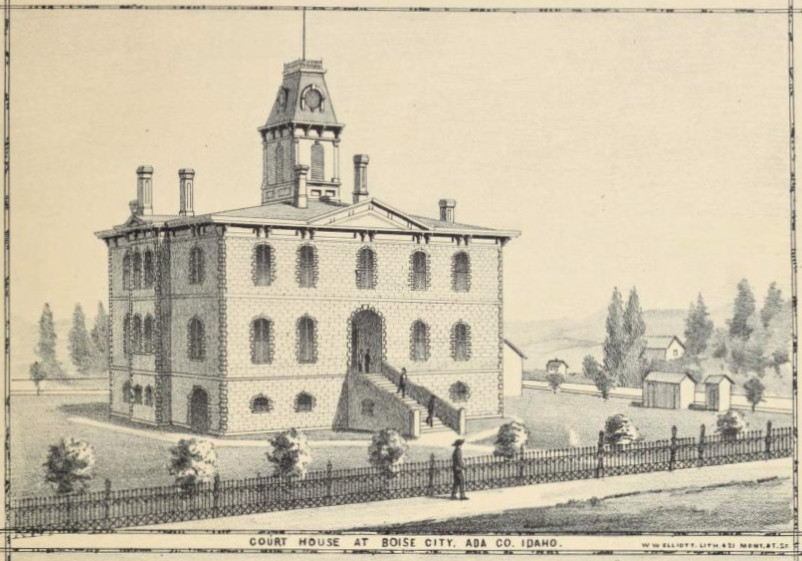
Exactly which Idaho statute gave cities their first express zoning power, and in what year, is a gap in this lesson. The Commerce Department's 1926 edition puts Idaho among the states that had used the model act by 1925.2 By 1957 the city grant sat at Idaho Code 50-401 through 50-409, because the 1957 county zoning law, discussed next, borrowed "all the powers" those sections gave city councils.24 Idaho session laws before 1945 are not online at the Legislature's website, and we could not confirm the original chapter number. It is listed in "Still being checked" at the end of this lesson.

1957: some counties get zoning power
For the first half of the 20th century, zoning in Idaho was a city power. Senate Bill 64, approved March 15, 1957 (Idaho Session Laws 1957, chapter 225), gave county commissioners the same powers city councils had under 50-401 through 50-409, but only in "urban counties" and only outside city limits.24 The bill defined an urban county two ways:
- a county of 50,000 or more people, counting city residents; or
- a county of 20,000 or more that contained at least one city of 10,000 or more. These counties had to win a majority of voters at a general or special election on the question "Shall the county commissioners be authorized to enact zoning and land use regulations?" before they could zone.
The 1957 law carried two exemptions that shaped county zoning for decades. Commissioners could not adopt any rule that "deprives any owner of full and complete use of agricultural land for production of any agricultural product," with agricultural land defined as a tract of at least five acres used only for farming, and they could not regulate heavy industry sites for forest products or minerals as they existed on March 15, 1957, plus room to expand.24 The farmland sentence survived. It moved into the 1975 act as Idaho Code 67-6529, which still says no county power may be read to deprive an owner of "full and complete use of agricultural land for production of any agricultural product," though since 1975 the local ordinance, not the statute, defines agricultural land.325
The 1957 thresholds explain why rural Idaho went without county zoning for so long. A county such as Gooding or Lincoln met neither test. Even a county that did meet the second test needed a vote of the people first.
1967: the municipal code rewrite
In 1967 the Legislature rewrote the laws governing cities (Idaho Session Laws 1967, chapter 429). Section 214 of that law enacted Idaho Code 50-1206, under which a city "shall zone such land immediately upon annexation." The Idaho Supreme Court applied that section in Ben Lomond, Inc. v. City of Idaho Falls, 92 Idaho 595, 448 P.2d 209 (1968), a dispute over a service station in an Idaho Falls shopping center zone, and the dissent in that case cited Idaho Code 31-3801 as the source of county zoning power at the time.26 The city zoning chapters of Title 50 and the county zoning chapter of Title 31 are what the 1975 act repealed.
Boise's own code history shows how long the pre-1975 framework lasted on the ground. The city says the zoning code it adopted in 2023 was its "first new zoning code since 1966."27 The council approved the rewrite in June 2023 and it took effect Dec. 1, 2023.28
1975: the Local Planning Act
Senate Bill 1094, as amended, became chapter 188 of the 1975 Idaho Session Laws, pages 515 to 528. It was approved March 28, 1975, and took effect July 1, 1975.3 The act's first section repealed "Chapters 11 and 12, Title 50, and Chapter 38, Title 31, Idaho Code," the city and county planning and zoning laws, and its second section created a new Chapter 65 in Title 67 called "Local Planning." The short title was "Local Planning Act of 1975."3 In 1995 the Legislature renamed it the "Local Land Use Planning Act of 1975" (House Bill 212, chapter 181), and in 1999 Senate Bill 1201 corrected the name again to the current "Local Land Use Planning Act."2930 People in the field say "LLUPA."
What the 1975 act required of every city and county
The change that mattered most was one sentence: "Every city and county shall exercise the powers conferred by this chapter." It is unchanged today as Idaho Code 67-6503.4 Before 1975, zoning was something a city could do and a few counties could do. After July 1, 1975, planning and zoning was something every city and every county had to do. The act then set out the machinery, most of which is still in place:
- A planning and zoning commission or the governing board. A city council or board of county commissioners could do the work itself or create, by ordinance, a planning commission and a zoning commission or one combined planning and zoning commission, with 3 to 12 members appointed by the mayor or the county chair and confirmed by the board (Idaho Code 67-6504).331
- A long-range plan with 12 subjects (67-6508), adopted after hearings before both the commission and the governing board (67-6509). The 1975 text allowed a plan to be adopted "by resolution or ordinance."3
- A zoning ordinance with districts "in accordance with the adopted plan" (67-6511), special use permits (67-6512), subdivision ordinances (67-6513), planned unit developments (67-6515) and variances (67-6516).3
- Areas of city impact around each city (67-6526), discussed below.3
- State agencies bound by local plans. Section 67-6528 required the state, its agencies and local special purpose districts to "comply with all plans and ordinances adopted under this chapter unless otherwise provided by law," with exceptions for transportation systems of statewide importance and certain utility orders. That section has never been amended.332
- Remedies. A person adversely affected by a permit decision could seek judicial review (67-6521).3
The act gave local governments deadlines. A governing board using an existing plan had to review it and make "necessary amendments" before Jan. 1, 1977 (67-6510). Existing zoning and subdivision ordinances had to be reviewed and amended before Jan. 1, 1978 (67-6514). Each county and each city in it had to adopt an area of city impact map by ordinance before Jan. 1, 1977, a date they could extend by mutual agreement to Jan. 1, 1978.3
Why the Legislature acted in 1975
The session law itself does not include a statement of reasons, and Idaho's 1975 committee minutes and bill files are not online. What the record does show is the setting. Neighboring Oregon had passed Senate Bill 100 in 1973, creating a state commission and statewide planning goals that every local plan had to meet.12 A Boise State University Public Policy Center paper calls the 1960s (1960 to 1969) the "Quiet Revolution" in state growth management, a period of mostly single-purpose state environmental mandates such as shoreline protection; Oregon's broader 1973 law followed it.14 Idaho's answer was to require every city and county to plan, but to keep the decisions local.
Civic groups pressed for a law. The League of Women Voters of Idaho, a nonpartisan advocacy organization, says its 1973 convention adopted a two-year study of state land use planning, that it adopted a position in March 1975, and that it "supported legislation which became the Local Planning Act of 1975." The League also reports that in 1981 it opposed an effort to repeal or weaken the act.33 We did not find the 1981 bill in the record, and we have not confirmed who else testified for or against Senate Bill 1094; both are listed as unverified.
The 1975 purposes section gives the clearest picture of what the Legislature was balancing. It listed 11 purposes, (a) through (k), beginning with "To protect property rights and enhance property values" and including adequate public facilities "at reasonable cost," protecting "prime agricultural, forestry, and mining lands," encouraging "urban and urban-type development within incorporated cities," avoiding "undue concentration of population and overcrowding of land," and avoiding "undue water and air pollution."3 Those goals pull in different directions on purpose. A rezone that turns a farm on the edge of Jerome into houses can be defended under the property rights purpose and the purpose of putting urban growth near cities, and opposed under the farmland purpose. The statute does not rank them.
The purposes, 1975 and today
Idaho Code 67-6502 now lists 13 purposes, (a) through (m).34 Comparing them with the 1975 list shows what the Legislature added and what it took out.
| Purpose | 1975 wording (S.B. 1094) | Current wording (67-6502) | What changed, and the session law |
|---|---|---|---|
| (a) Property | "To protect property rights and enhance property values." | "To protect property rights while making accommodations for other necessary types of development such as low-cost housing and mobile home parks." | Low-cost housing and mobile home parks added by House Bill 759 (1994, ch. 245); "enhance property values" removed by Senate Bill 1201 (1999, ch. 396) |
| (c), (d) Economy and environment | "protected and enhanced" | "protected" | "and enhanced" removed in 1999 (S.B. 1201) |
| (e) Farm, forest and mining land | Protect prime lands "for production of food, fibre, and minerals" | Adds "as well as the economic benefits they provide to the community" | House Bill 148 (2011, ch. 89) |
| (f) Urban development | "within incorporated cities" | Same | Unchanged |
| (l) Schools | None | Let school districts take part in planning "so as to address public school needs and impacts on an ongoing basis" | House Bill 763 (1992, ch. 269) |
| (m) Airports | None | Protect public airports "as essential community facilities" | Senate Bill 1265 (2014, ch. 93) |
Sources: 1975 Idaho Session Laws ch. 188; Idaho Code 67-6502 and its history note; session laws named in the table.3343536373839
The commission, 1975 and today
The commission rules have been tightened over 50 years, mostly to give rural residents more say on county commissions.
| Rule in 67-6504 | 1975 | Today |
|---|---|---|
| Residency before appointment | Five years in the county | At least two years in the county |
| County commission members living in cities | No more than one-third may live in any incorporated city | No more than one-third may live in a city of 1,500 or more, with those seats rotating among such cities |
| County members outside impact areas | No rule | At least half must live outside every city's area of impact, with a fallback if no applicants (added by H.B. 212, 1995) |
| Term limits | Terms of 3 to 6 years, no limit on renewals | Same terms; no more than two full consecutive terms without a two-thirds vote of the governing board (added 1995) |
| What a commission cannot do | Adopt ordinances | Adopt ordinances or finally approve land subdivisions |
| Meetings | Open to the public; at least one regular meeting a month for at least nine months a year; quorum a majority of voting members | Same, except the quorum is a majority of currently appointed voting members |
Sources: 1975 Idaho Session Laws ch. 188, section 67-6504; Idaho Code 67-6504 as amended through 2015; 1995 Idaho Session Laws ch. 181.33129 For how appointments, conflicts of interest and hearing examiners work now, see The Planning Act and Who Decides.

After 1975, zoning only through the act
The 1975 act did more than add duties. In Gumprecht v. City of Coeur d'Alene, 104 Idaho 615, 661 P.2d 1214 (1983), Coeur d'Alene residents had used the initiative process to propose a shoreline measure limiting building heights and construction near Lake Coeur d'Alene, and shoreline owners asked the Idaho Supreme Court to stop the election. The court barred the election. It described the Local Planning Act as a full "recodification and revision" of Idaho's planning and zoning law and held that the statute's detailed scheme leaves "no room for direct legislation by electors through an initiative election." Zoning changes, the court said, must be made by the governing board through the act's notice and hearing steps.40 A 2006 decision, City of Boise City v. Keep the Commandments Coalition, overruled part of Gumprecht on a different question (when courts may review a ballot measure before an election); the holding about zoning by initiative has continued to be cited.40
The long-range plan: 12 subjects in 1975, 18 items today
The act calls the local plan "the plan" and makes it the commission's job to prepare, carry out, review and update it. Idaho Code 67-6508 says the plan "shall include all land within the jurisdiction of the governing board" and must be based on a list of subjects "unless the plan specifies reasons why a particular component is unneeded."5 (Planners call it the comp plan; this lesson says long-range plan.) The statute ends: "Nothing herein shall preclude the consideration of additional planning components or subject matter." That sentence has been there since 1975.3
The 1975 list
In 1975 the list had 12 subjects, lettered (a) to (l): population; economic development; land use, with a map of "suitable projected land uses"; natural resources; hazardous areas (faults, landslides, avalanche paths, floodplains); public services, facilities and utilities, including "power plant sites" and "utility transmission corridors"; transportation; recreation; special areas or sites; housing; community design; and implementation.3 The 1975 housing subject asked only for "an analysis of housing conditions and needs; plans for improvement of housing standards; and plans for the provision of safe, sanitary, and adequate housing." It said nothing about low-cost or manufactured housing.
What the Legislature added, and when
| Item in 67-6508 today | Subject | When it entered the list | Bill and session law |
|---|---|---|---|
| (a) | Property rights: make sure policies, conditions and fees "do not violate private property rights, adversely impact property values or create unnecessary technical limitations on the use of property" | 1995 | House Bill 212, as amended (1995 ch. 181) |
| (b) | Population | 1975 | S.B. 1094 (1975 ch. 188) |
| (c) | School facilities and transportation | 1992 | House Bill 763 (1992 ch. 269) |
| (d) to (k) | Economic development, land use, natural resources, hazardous areas, public services, transportation, recreation, special areas | 1975 (transportation revised in 1996 to require coordination with highway authorities) | 1975 ch. 188; House Bill 672 (1996 ch. 201) |
| (l) | Housing, now including "low-cost conventional housing" and the siting of manufactured and mobile homes | 1975; expanded 1994 | House Bills 669 and 759 (1994 chs. 212 and 245) |
| (m) | Community design | 1975 | 1975 ch. 188 |
| (n) | Agriculture: the farm base, farming-related businesses and agriculture's role in the community | 2011 | House Bill 148 (2011 ch. 89) |
| (o) | Implementation | 1975 | 1975 ch. 188 |
| (p) | National interest electric transmission corridors (lines of 115,000 volts or more on structures 40 feet or taller), after notice from the Public Utilities Commission | 2007 | House Bill 152 (2007 ch. 186) |
| (q) | Public airport facilities | 2014 | Senate Bill 1265, as amended (2014 ch. 93) |
| (r) | Groundwater: before adopting, amending or repealing a plan, the governing board must consider the effect on "the source, quantity, and quality of ground water in the area" | 2025 (moved from 67-6537(4)) | Senate Bill 1083, as amended (2025 ch. 129), approved March 19, 2025 |
Sources: session laws named in the table, read in the Legislature's scanned volumes; Idaho Code 67-6508 and its history note.529384142353743396
The 1994 housing amendments were the first time the Legislature told cities what their zoning had to allow for a kind of housing. House Bill 669 (1994) added Idaho Code 67-6509A, which required each governing board, on or before July 1, 1996, to amend its plan and land use rules for single-family zones "to allow for siting of manufactured homes," while letting local governments set standards for them.42 Thirty-two years later, the 2026 accessory dwelling unit and starter home laws used the same tool: a statewide mandate with a deadline, aimed at the residential zones of the plan and code.
How we figured it: counting the plan items
Inputs: the text of Idaho Code 67-6508 as enacted in 1975 (Idaho Session Laws 1975, ch. 188, pages 519 to 520) and each amending session law listed in the table, read from the Legislature's scanned volumes, checked against the history line at the bottom of the current statute (1975 ch. 188; 1992 ch. 269; 1994 chs. 212 and 245; 1995 chs. 181 and 305; 1996 ch. 201; 2007 ch. 186; 2011 ch. 89; 2014 ch. 93; 2025 ch. 129).
Method: we counted lettered items after each law. Laws that rewrote an existing item without adding a letter (1994, 1996) do not change the count. 1995 chapter 305 (House Bill 248) deleted a duplicate housing paragraph left in the list by the two 1994 amendments and exempted historic districts from the manufactured home rule; it did not add a letter.
Limits: item (r), groundwater, is a duty the governing board must "consider" when it acts on a plan, worded differently from the other items, and some readers will not count it as a plan "component." Without it the current count is 17.
How much the plan binds a zoning decision
The model act of the 1920s said zoning should be "in accordance with" a plan. Idaho's 1975 act said zoning districts "shall be in accordance with the adopted plan," and today's 67-6511 says they "shall be in accordance with the policies set forth in the adopted" plan.16344 A special use (conditional use) permit cannot be granted if it is "in conflict with the plan," a rule that dates to 1975 and is now in 67-6512.45
The Idaho Supreme Court has read those words as making the plan a strong guide, not a zoning map. In Bone v. City of Lewiston, 107 Idaho 844, 693 P.2d 1046 (1984), a landowner argued that Lewiston had to rezone his land from residential to commercial because the plan's map showed commercial use there. The court disagreed, saying a plan "does not operate as legally controlling zoning law." In Urrutia v. Blaine County, 134 Idaho 353, 2 P.3d 738 (2000), the court said a board may refer to the plan as a general guide when it adopts or revises a zoning ordinance, while the zoning ordinance itself sets the uses allowed on each parcel.4647 The Legislature pushed back in one direction in 2011: House Bill 148 told the governing board to "analyze proposed changes to zoning ordinances to ensure that they are not in conflict with the policies of the adopted" plan.37 Lesson 2 of the planning course, The Plan: Components and Amendments, walks through the 2015 Payette County nuclear plant case on how much detail each subject needs.
Two procedural changes made plans easier to change. The 1975 text let a governing board adopt a plan "by resolution or ordinance"; today Idaho Code 67-6509(3) says no plan is effective "unless adopted by resolution by the governing board."348 And the 1975 rule that a commission could recommend plan amendments "not more frequently than every six (6) months" (later narrowed to the land use map) was replaced by House Bill 608 (2010, ch. 253). Anyone could already petition for an amendment "at any time"; since 2010 the only waiting period is one the governing board sets by resolution, which "shall not exceed six (6) months."34948
The zoning ordinance: a 1920s model in a 2026 statute
Idaho Code 67-6511 tells each governing board to adopt, by ordinance after notice and hearings, "one (1) or more zones or zoning districts where appropriate."44 Read it next to the 1924 model act and the family resemblance is plain. The 1975 Legislature kept the model's list of what zoning may regulate and its uniformity rule almost word for word.
The amendment steps have changed more than the substance. In 1975 a rezone request "in accordance with the adopted plan" went through the commission and the governing board; one that was not had to wait for a plan amendment first. Mailed notice went to "property owners and residents" within the land and within 300 feet of it.3 Today's 67-6511(2) sends notice to "property owners or purchasers of record" within the land and 300 feet, requires posting on the site at least one week before the hearing, and, since Senate Bill 1061 (2023, ch. 140), requires notice to an interstate natural gas or petroleum pipeline company whose line runs within 1,000 feet, if the company has filed its line location with the county under Idaho Code 62-1104.4450 Section 67-6511(2)(d) protects an owner who wins a rezone: the board may not reverse it for four years without the current owner's written consent.44 The current text also requires "clear and objective standards" for overlay districts and says applying them must not amount to a regulatory taking.44 How the notice math works on a real parcel is in Zoning Ordinances, Maps and Rezones.
Policy maker or judge: the 1980 line
The 1975 act did not say whether a rezone is a policy decision or a ruling on one owner's rights. The courts drew that line. In Cooper v. Board of County Commissioners of Ada County, 101 Idaho 407, 614 P.2d 947 (1980), the Idaho Supreme Court said adopting a plan or general zoning rules is legislative, but a rezone of a particular parcel, decided by applying general rules to specific facts, is quasi-judicial, so neighbors and applicants are owed due process: notice, a fair hearing, a record and a decision based on that record.51 The Legislature built on that line in 1999. Senate Bill 1201 (chapter 396) required written decisions with reasoned findings and added rules for hearing procedures and verbatim records. The bill passed the Senate 27 to 6 and the House 38 to 28, and Gov. Dirk Kempthorne signed it March 29, 1999.36
Who decides: city, county and the ring between them
Under the 1975 act, and still today, a city zones inside its limits and a county zones the unincorporated area: "The powers of the board of county commissioners conferred by this chapter shall apply to the unincorporated area of the county."31 The hard cases are at the edge of town, where farms and acreages sit next to subdivisions that will eventually ask to be annexed. Idaho's answer since 1975 has been the area of city impact, usually called the impact area: a mapped ring outside city limits where growth is expected. Who controls that ring is the biggest change in Idaho land use law in 50 years.
Impact areas, 1975 to 2024: the city and county chose
The 1975 version of Idaho Code 67-6526 required "the governing board of each county and each city therein" to adopt by ordinance a map of an area of city impact. The same ordinance had to choose one of three options: apply the city's plan and ordinances, apply the county's, or apply "any mutually agreed upon plan and ordinances." Impact areas could cross a county line if the city was within three miles of the neighboring county. If the city and county could not agree, the county commissioners and three city officials picked three residents, and those nine people recommended an area and rules; if the governments still did not act, either could ask a district court for a declaratory judgment. The factors were "trade area," "geographic factors" and "areas that can reasonably be expected to be annexed to the city in the future."3
That framework allowed different answers in different counties, depending on what each city and county wrote into its impact area ordinance. The section was amended in 1977, 1979, 1993, 1995, 1996, 1999 and 2002 before the 2024 rewrite.8
Impact areas since July 1, 2024: the county decides
Senate Bill 1403, sponsored by the Senate Judiciary and Rules Committee, passed the Senate 34 to 0 with one absent on March 12, 2024 and the House 69 to 1 on March 25, 2024. Gov. Brad Little signed it March 28, 2024, and it took effect July 1, 2024 (Idaho Session Laws 2024, chapter 227).7 It rewrote 67-6526 around a legislative finding that "areas of impact are properly under the jurisdiction of the county because the elected representatives of citizens in areas of impact are county officials, not city officials." Cities "should receive notice of, and may provide input on," applications in the ring, but "do not govern or control decisions on those applications."8
| Question | 1975 act (67-6526 as enacted) | Since July 1, 2024 (S.B. 1403) |
|---|---|---|
| Who adopts the boundary? | Each county and each city in it, by ordinance | The board of county commissioners, by ordinance, after notice to each owner in the area |
| Whose plan and zoning apply inside? | City's, county's, or a jointly agreed set, chosen in the ordinance | The county's plan, zoning and subdivision ordinances; the county may adopt area-specific provisions |
| How big? | Factors: trade area, geography, land reasonably expected to be annexed "in the future" | No larger than land "very likely to be annexed" within five years; generally no more than two miles from city limits; may not split a parcel |
| Deadline | Before Jan. 1, 1977 (extendable to Jan. 1, 1978) | Existing areas reviewed and reestablished by Dec. 31, 2025, or the boundaries are nullified; review at least every five years |
| If the governments disagree | A nine-person committee recommends; then district court declaratory judgment | A four-person committee recommends; a city may petition district court only in limited cases |
| Can residents challenge the boundary in court? | Not addressed | No: boundary decisions are legislative and "not subject to judicial review" except city petitions under subsection (5) |
| City planning beyond the ring | Not addressed | A city may plan for infrastructure and capital improvements beyond its impact area |
Sources: 1975 Idaho Session Laws ch. 188, section 67-6526; Idaho Code 67-6526 as amended by 2024 ch. 227.38
The same 2024 session rewrote annexation. Senate Bill 1293 repealed the old Idaho Code 50-222, with its Category A, B and C annexations, and enacted a new section for annexations on or after July 1, 2024.52 Idaho Code 67-6526 still says a city must have an impact area before it annexes adjacent territory, and also that the section does not prevent annexation of land outside any impact area.8 The details, the 2026 amendments and the court fights are in Annexation Fights and in Areas of City Impact and Annexation. In the Magic Valley, Twin Falls and Jerome sit on opposite sides of the Snake River Canyon in different counties, so each city's ring is governed by a different county commission. Whether Twin Falls County and Jerome County met it for each of their cities is a local fact to check in each county's ordinance book.
Who can go to court: the "affected person" rule
The 1975 act let a person "adversely affected" by a permit decision seek review. The Legislature rewrote the rule in House Bill 605 (2010, ch. 175), which revised the definition of "affected person" in Idaho Code 67-6521 and clarified judicial review of final decisions.5354 Who counts as affected has been one of the most litigated questions in Idaho land use law. That case law, including the newest Idaho Supreme Court decisions on farmers and neighbors challenging rezones, is in Property Rights and Land Use Law.
Fifty years of amendments, 1975 to 2026
The Local Land Use Planning Act has been amended in most sessions since 1975. The table lists the changes that altered what cities and counties must do, with the session law for each. It is not a list of every amendment; each statute's history note on the Legislature's website has the full chain.
| Year | Law or event | What changed | Source |
|---|---|---|---|
| 1975 | S.B. 1094 (ch. 188), approved March 28, effective July 1 | Every city and county must plan and zone; 12-subject plan; commissions; impact areas by Jan. 1, 1977; old city and county zoning chapters repealed | 1975 Session Laws, pp. 515 to 5283 |
| 1977, 1979 | Chapters 155 (1977) and 87 (1979) | First amendments to the impact area section | 67-6526 history note8 |
| 1980 | Cooper v. Ada County | Site-specific rezones are quasi-judicial and owe due process | 101 Idaho 40751 |
| 1983 | Gumprecht v. Coeur d'Alene | No zoning by voter initiative; the act's procedures control | 104 Idaho 61540 |
| 1992 | H.B. 763 (ch. 269) | School capacity and transportation added to the plan; school purpose added; notice to service providers | 1992 Session Laws38 |
| 1994 | H.B. 669 (ch. 212); H.B. 759 (ch. 245) | Manufactured homes must be allowed in single-family zones by July 1, 1996 (67-6509A); low-cost housing and manufactured homes added to the housing analysis | 1994 Session Laws4235 |
| 1995 | H.B. 212 (ch. 181) | Renamed the Local Land Use Planning Act; property rights added to the plan; county commission seat rules; two-term limit | 1995 Session Laws29 |
| 1999 | S.B. 1201 (ch. 396) | Cleanup of the whole act; written, reasoned decisions; verbatim records; development agreements need a hearing to modify | Bill page36 |
| 2000 | Chapter 217 | Counties must adopt ordinances on siting large confined animal feeding operations, with a public hearing on each proposed site | 67-6529 history note25 |
| 2007 | H.B. 152 (ch. 186) | National interest electric transmission corridors added to the plan | 2007 Session Laws43 |
| 2010 | H.B. 605 (ch. 175); H.B. 608 (ch. 253) | "Affected person" and judicial review rewritten; plan amendments may be requested at any time unless a board sets an interval of up to six months | 2010 Session Laws5349 |
| 2011 | H.B. 148 (ch. 89) | Agriculture added to the plan; boards must check rezones against plan policies | 2011 Session Laws37 |
| 2014 | S.B. 1265 (ch. 93) | Public airport facilities added to the plan and purposes; older airport zoning sections repealed | 2014 Session Laws39 |
| 2017 | Chapter 239 | New 67-6539 limits local regulation of short-term rentals (amended 2018 and 2026) | 67-6539 history note55 |
| 2023 | S.B. 1061 (ch. 140) | Interstate pipeline companies get rezone notice; plats must show those pipelines | 2023 Session Laws50 |
| 2024 | S.B. 1403 (ch. 227); S.B. 1293 | Counties govern impact areas; annexation statute replaced | Bill pages752 |
| 2025 | S.B. 1083 (ch. 129) | Groundwater consideration moved into the plan list as 67-6508(r) | 2025 Session Laws6 |
| 2026 | S.B. 1352 (ch. 264); S.B. 1354 (ch. 265) | Cities over 10,000 may not ban starter home subdivisions or accessory dwelling units; codes due Feb. 1, 2027 | Bill pages; 67-654156910 |
What each decade added
1970s: the framework. The 1975 act and its first fixes set up commissions, plans, zoning and impact areas in every county.
1980s: the courts fill gaps. The statute said little about procedure, so the Idaho Supreme Court supplied it: due process for site-specific rezones (Cooper, 1980), no zoning by initiative (Gumprecht, 1983) and the plan as a guide rather than a zoning map (Bone, 1984).514046
1990s: schools, housing and property rights. The Legislature added schools (1992), required cities and counties to allow manufactured homes in single-family zones (1994), added property rights to the plan (1995) and rewrote hearing and decision procedures (1999). The 1995 property rights item was tied to the Idaho Regulatory Takings Act in Chapter 80 of Title 67.29
2000s: farms, animals and power lines. County authority over large animal feeding operations (2000) and federal transmission corridors (2007) came into the act.2543 For Magic Valley counties, the section as amended in 2000 and 2003 means each new large confined animal feeding operation site goes to a public hearing before the county commission, where comment is limited by statute to residents within one mile unless the board widens it.
2010s: who can sue, and what the plan must weigh. The 2010 standing rewrite, the 2011 agriculture item and the 2014 airport item all came in this decade, along with a statewide limit on local short-term rental rules, the 2017 short-term rental section.53373955
2020s: the state takes a firmer hand. The Legislature moved impact areas to county control (2024), replaced the annexation statute (2024), moved groundwater into the plan list (2025) and told larger cities what their residential zones must allow (2026).
The 2026 laws in this history
Senate Bill 1352 (starter home subdivisions) and Senate Bill 1354 (accessory dwelling units) were both introduced by the Senate State Affairs Committee, sent to the Senate Local Government and Taxation Committee, carried on the Senate floor by Sen. Toews, amended in the Senate, and signed by the governor on March 31, 2026. Both took effect July 1, 2026. Senate Bill 1352 passed the Senate 25 to 10 and the House 36 to 34 (House floor sponsor Rep. Redman) and became chapter 264. Senate Bill 1354 passed the Senate 25 to 10 and the House 47 to 23 (House floor sponsor Rep. Bingham) and became chapter 265.569
Each law adds a section to the 1975 act. Idaho Code 67-6541 says no city may ban accessory dwelling units in residential zones and, by Feb. 1, 2027, each covered city must amend its plan and land use rules to allow one internal or one detached unit per single-family lot, with no off-street parking requirement in most cases, no owner-occupancy rule, and no size cap below 1,000 square feet or 75 percent of the main house. The starter home section, printed by the code revisor as 67-6541 [67-6542] because two 2026 bills used the same number, says no city may ban starter home subdivisions (at least four acres, lots no larger than 1,500 square feet) and caps the minimum lot size, setbacks, lot width and lot depth a city may require in them. Both sections apply "only to cities with a population greater than ten thousand (10,000)" and both leave building codes, fire and flood rules, and water, sewer and road capacity rules in place.1057
In the long view, the 2026 laws join earlier statewide housing rules written into a law that began as a framework, among them the 1994 manufactured home rule and the 2017 short-term rental limit. The new ones reach further into the residential zones Euclid-style codes protected most, the single-family districts, and they use the 1975 act's own steps (notice and hearing under 67-6509) to make cities change their plans and codes. What each law requires, city by city, is in The 2026 Housing Laws; how to follow your city's rewrite is in Shaping Your City's Code Rewrite.
How Idaho compares with Oregon and Washington
Idaho's two western neighbors went another way in the same era. Both decided that the state, not only each city and county, should set planning goals and draw lines around urban growth.
Oregon: statewide goals and state acknowledgment since 1973
Oregon's Senate Bill 100 (1973) created the Land Conservation and Development Commission (LCDC) and charged it with adopting statewide land use goals, and required every city and county to adopt and carry out a long-range plan. LCDC adopted 14 goals in 1974 and five more over the next three years, for 19 in all. Local plans "must conform with the statewide planning goals," and LCDC is "the acknowledging body for local plans." Every Oregon city is surrounded by an urban growth boundary, a line marking where the city expects to grow over 20 years, and a companion 1973 law, Senate Bill 101, required counties to adopt exclusive farm use zones.12
Washington: the Growth Management Act of 1990
Washington's Growth Management Act (Laws of 1990, 1st extraordinary session, chapter 17) does not reach every county. Under RCW 36.70A.040, a county with 50,000 or more people that has grown more than 17 percent in the previous ten years (10 percent before May 16, 1995), and any county of any size that has grown more than 20 percent, must plan under the act, along with the cities in it; other counties may opt in.13 Those counties and cities must adopt plans and "development regulations that are consistent with and implement" the plan. The act's planning goals, in RCW 36.70A.020, include encouraging development in urban areas, reducing sprawl, planning for "housing affordable to all economic segments of the population," and protecting property rights "from arbitrary and discriminatory actions."58 Each planning county must designate urban growth areas, outside of which "growth can occur only if it is not urban in nature," sized for 20 years of projected growth.59
Idaho's choice
Idaho's 1975 act requires every city and county to plan, as Oregon's does, but sets no binding statewide goals beyond the purposes in 67-6502 and creates no state body to review local plans. A 2011 Boise State University Public Policy Center paper put it plainly: "Unlike many states, Idaho does not have a state agency to ensure local implementation" of its planning requirements. The same paper reported a survey in which respondents split almost evenly on whether the state should take a more active role in guiding growth (40 percent agreed, 46 percent disagreed), while larger shares said technical information for planning was not sufficient (49 percent) and that the cost of carrying out plans was not adequately covered (58 percent).14 Idaho's edge-of-city tool, the area of impact, is also different in kind from an Oregon urban growth boundary or a Washington urban growth area. It marks where a city is likely to annex within five years and, since 2024, puts that land under county rules until it is annexed; it does not forbid urban development outside the line.8
Each model has a record to weigh. Oregon's system has faced voter pushback: the Boise State paper notes that Oregon voters approved Measure 37 in 2004 with 61 percent of the vote, requiring compensation for land use rules that reduced property values, after which, the paper says, "local planning faced serious setbacks" as governments let development proceed to avoid paying claims.14 Idaho's approach keeps decisions with elected local boards that know the ground, at the cost of very different rules from one county to the next and no state check on whether a plan's housing or farmland analysis is realistic. The 2024 and 2026 laws show the Idaho Legislature choosing a third path: no state planning agency, but more direct statutory commands about what local codes must and must not do. That trend is the subject of State Preemption and Local Control.

Pictures, Numbers and Infographics
The key dates and numbers from this lesson, with the comparison for each and its source.
| Measure or rule | Idaho | U.S. or other states | Place or year | Source |
|---|---|---|---|---|
| First citywide zoning law | Boise, Idaho Falls, Twin Falls ordinances | New York City Building Zone Resolution | Idaho 1928; New York July 25, 1916 | 115 |
| State use of the federal model zoning act | On Commerce's list | 19 states by 1925; 47 states and D.C. with enabling acts by Jan. 1, 1933 | 1925; 1933 | 219 |
| Zoned municipalities | 4 (American Falls, Boise, Idaho Falls, Twin Falls) | 1,236 nationally, with 48,441,040 residents | End of 1932 | 119 |
| County zoning first allowed | "Urban counties" only: 50,000+, or 20,000+ with a 10,000+ city and a public vote | 1957 (S.B. 64, ch. 225) | 24 | |
| Statewide planning law | Local Planning Act, effective July 1, 1975 | Oregon S.B. 100 (1973); Washington GMA (1990) | 1973 to 1990 | 31213 |
| Required plan subjects | 12 in 1975; 18 lettered items in 2025 | Oregon: 19 statewide goals | 1975 to 2025 | 3512 |
| Purposes of the act | 11 in 1975; 13 today | 1975; 2014 | 334 | |
| Commission size | 3 to 12 voting members (may exceed 12 for impact area representation) | 1975 to now | 318 | |
| Impact area size limit | Land very likely annexed in 5 years; generally 2 miles | Oregon and Washington: 20-year growth areas | Since July 1, 2024 | 81259 |
| Impact area reestablishment deadline | Dec. 31, 2025 | 2024 law | 8 | |
| 2026 housing laws' population threshold | Cities over 10,000; 27 Idaho cities by July 1, 2025 estimates | Deadline Feb. 1, 2027 | 1011 | |
| Votes on S.B. 1352 (starter homes) | Senate 25 to 10; House 36 to 34 | March 2026 | 56 | |
| Votes on S.B. 1354 (accessory dwelling units) | Senate 25 to 10; House 47 to 23 | March 2026 | 9 | |
| Votes on S.B. 1403 (impact areas) | Senate 34 to 0; House 69 to 1 | March 2024 | 7 | |
| Boise's zoning code | New code in effect Dec. 1, 2023, first since 1966 | 2023 | 2728 |
How we figured it: which cities are over 10,000
Inputs: the Census Bureau's Vintage 2025 estimates for Idaho incorporated places (file sub-est2025_16.csv, rows with summary level 162, field POPESTIMATE2025, the July 1, 2025 estimate), released May 2026.
Method: we compared each city's estimate with the 10,000 figure in Idaho Code 67-6541(6) and in the starter home section, 67-6541 [67-6542](4), and counted the Idaho cities above it: 27. Bar lengths are drawn at 0.009 pixels per resident (Twin Falls: 56,216 x 0.009 = 505.9).
Limits: neither section says which population count controls (the 2020 Census count, a later estimate, or another figure). A city near the line, or one that grows past it after the Feb. 1, 2027 deadline, may face a question the statutes do not answer on their face. Middleton shows how quickly a town can cross: its April 1, 2020 estimates base was 9,451 and its July 1, 2025 estimate is 12,600.11
Common mistakes
"Idaho had no zoning until 1975." Boise, Idaho Falls and Twin Falls adopted zoning ordinances in 1928 and American Falls in 1930, under the constitution's police power and state law in effect then.1 What 1975 changed was that planning and zoning became mandatory for every city and county (Idaho Code 67-6503).4
"The plan map is the zoning map." A parcel shown as "future commercial" on a plan map is not zoned commercial. The Idaho Supreme Court rejected exactly that argument in Bone v. City of Lewiston (1984), holding that the plan "does not operate as legally controlling zoning law." The zoning ordinance and map decide what is allowed now; the plan guides changes to them.46
"Inside the impact area, the city's rules apply." That was one of three options under the 1975 version of 67-6526, and many local ordinances adopted under it said so. Since July 1, 2024, the county's plan, zoning and subdivision ordinances apply in the area of impact, and the city has notice and comment rights only.8 Old city code chapters, county agreements and news stories written before 2024 may describe the old rule.
"This parcel can be annexed as Category B." The A, B and C categories were repealed by Senate Bill 1293 (2024) for annexations on or after July 1, 2024.52 See Annexation Fights.
"Voters can rezone land by initiative." Under Gumprecht v. City of Coeur d'Alene (1983), zoning in Idaho must go through the governing board and the act's notice and hearing steps, not a ballot initiative.40
"A state agency approves our plan." No Idaho agency reviews or approves local plans. Neighbors in Oregon and Washington have state goals and review; Idaho does not.1412 A plan's legal test in Idaho comes when someone challenges a decision under it in court.
"The 2026 accessory dwelling unit law covers our town." It covers only cities "with a population greater than ten thousand." By the 2025 estimates that includes Twin Falls, Jerome and Burley but not Kimberly, Buhl, Gooding, Hagerman or Rupert, and it does not apply to counties.1011
Calling the act by an old name or citing a repealed section. The act was the "Local Planning Act of 1975" until 1995 and is now the "Local Land Use Planning Act."30 City and county zoning sections in Title 50, chapters 11 and 12, and Title 31, chapter 38, were repealed in 1975, and the old 50-222 was repealed in 2024. Older court opinions quote the 1975 text of 67-6511, which said zoning had to be "in accordance with the adopted plan"; the current text says "in accordance with the policies set forth in the adopted" plan.344
What we know, what we don't, and what the data can show
What we know
- The national model zoning act was printed in 1924 and revised in 1926, and Idaho was among 19 states that had used it by 1925.162
- At the end of 1932, four Idaho municipalities had zoning ordinances: Boise (1928), Idaho Falls (1928), Twin Falls (1928) and American Falls (1930).1
- County zoning began with Senate Bill 64 (1957), limited to "urban counties."24
- Senate Bill 1094 (1975, ch. 188) made planning and zoning mandatory for every city and county, effective July 1, 1975.3
- The required plan list grew from 12 subjects to 18 lettered items through laws passed in 1992, 1995, 2007, 2011, 2014 and 2025.5
- Since July 1, 2024, the county's rules govern areas of city impact, and existing areas had to be reestablished by Dec. 31, 2025.8
What we don't know
- The year and session law chapter of Idaho's first express city zoning statute (before 1925, by the Commerce Department's list), because pre-1945 session laws are not online at the Legislature.
- Who testified for and against Senate Bill 1094 in 1975, and the vote counts; the 1975 journals and committee minutes were not available online to us.
- Which Idaho cities zoned between 1933 and 1975, and which counties used the 1957 urban county law, including whether any county held the required election.
- Whether every Idaho county and city met the Dec. 31, 2025 deadline to reestablish impact areas, and what happened where they did not.
- How the 10,000-population threshold in the 2026 laws will be measured for cities near the line.
What the data can show
- The Bureau of Standards letter circulars (LC-374, LC-375 and later editions) can show when other Idaho towns adopted zoning in the 1930s, if later editions are found.1
- Each statute's history line on the Legislature's website, with the scanned session laws back to 1945, can show every amendment to a section of the act and who sponsored it.5
- County ordinance books and the minutes of county commissions can show each area of impact ordinance and its 2025 reestablishment.
- Census Bureau population estimates (the Vintage file for Idaho places) can show which cities cross the 10,000 line each year.11
- City plan documents can show whether a plan addresses all 18 items in 67-6508 or explains why one is unneeded, as the statute requires.5
Questions people ask
Does every Idaho town have to have zoning?
Yes. Idaho Code 67-6503 says "every city and county shall exercise the powers conferred by this chapter," which includes adopting a plan and a zoning ordinance.4 A small city can have its council do the work itself instead of creating a commission (67-6504).31 Hagerman, with an estimated 994 residents in 2025, has the same duty to plan and zone as Boise.11
Why does everyone call it the "comp plan"?
"Comp plan" is planners' shorthand for the full name Idaho Code 67-6508 gives the document. The name traces to Section 3 of the 1920s model act, which required zoning to follow an overall plan for the whole city.516 This lesson calls the same document the long-range plan.
Can a county zoning rule stop me from farming my land?
Idaho Code 67-6529 says no county power under the act may be read to deprive an owner of "full and complete use of agricultural land for production of any agricultural product," a rule that dates to the 1957 county zoning law. Since 2000 the same section also requires counties to regulate the siting of large confined animal feeding operations.2524 The Right to Farm Act and nuisance law are in Property Rights and Land Use Law.
I live just outside city limits. Whose zoning applies to me?
The county's. If your land is in the city's area of impact, the county's plan and ordinances still apply, though the county may adopt rules specific to that area and must give the city notice of hearings.8 If the city later annexes your land, the city's plan and zoning apply after annexation.
Do state agencies have to follow local zoning?
Generally yes. Idaho Code 67-6528, unchanged since 1975, requires the state and its agencies to "comply with all plans and ordinances adopted under this chapter unless otherwise provided by law," with exceptions for transportation systems of statewide importance and certain Public Utilities Commission orders.32
How often can our long-range plan be changed?
Anyone may petition for a plan amendment at any time unless the governing board has set, by resolution, a minimum interval between requests, which cannot exceed six months (67-6509(4)).48 Before House Bill 608 (2010), the statute itself limited how often amendments could be recommended.49
Where can I read the 1975 act as passed?
In the 1975 Idaho Session Laws, chapter 188, pages 515 to 528, a free scanned PDF on the Legislature's website. Session laws from 1945 forward are posted there.3
Hard questions
Should Idaho have statewide planning goals and review?
The case for: growth crosses city and county lines, plans vary widely in quality, and small towns lack staff. Oregon and Washington set goals for housing, farmland and urban growth that every covered plan must meet.1258 The case against: local boards answer to the people affected, and Idaho's tradition from the 1890 constitution forward has been local police power. Oregon's experience includes a 2004 voter measure requiring compensation for land use rules.14 What the evidence shows: the 2011 Boise State survey found respondents nearly evenly split on a larger state role (40 percent for, 46 percent against), with clearer support for technical help and funding than for state regulation.14
Was it right to move impact areas to county control?
For county control: residents of the ring vote for county commissioners, not city councils, which is the reason the Legislature wrote into 67-6526(1)(a).8 For city control: the ring is where the city will pay for roads, sewer and water within five years, so the city has a strong interest in how it develops before annexation. What the evidence shows: the 2024 law passed both chambers with one dissenting vote in total, and it also lets cities plan beyond the ring and requires county notice to cities.78 How the change has worked on the ground, county by county, has not been studied.
Should the state tell cities what their residential zones must allow?
For: the 1975 act's own purposes include "low-cost housing" (added 1994) and urban development inside cities, and the 1994 manufactured home rule is a precedent for a statewide housing mandate.3442 Against: the act's design since 1975 has been local plans adopted after local hearings; statewide rules override plans written by residents. What the evidence shows: the 2026 starter home bill passed the House 36 to 34, the closest of the votes cited in this lesson, which shows how divided legislators were.56 Whether the laws produce more homes is a question for future permit data, covered in The 2026 Housing Laws and in Part A's Prices and Rents vs. Inflation.
Should the plan bind zoning more tightly?
For: if the plan is only a guide, residents who spend years on it may see it set aside rezone by rezone; Washington requires regulations "consistent with and implement" the plan.13 Against: a binding map would freeze land uses drawn years earlier and could lock owners out of uses the community later wants. What the evidence shows: Idaho courts have treated the plan as a guide since at least 1984 (Bone), and the Legislature in 2011 told boards to check rezones against plan policies without making the plan controlling law.4637
For reporters and advocates
Records that exist and where to find them.
- Idaho Session Laws, 1945 forward, free on the Legislature's website: the text of every amendment as passed, with bill numbers. Statute pages carry a history line listing each chapter that changed the section.3
- Bill pages on legislature.idaho.gov (1998 forward) with statements of purpose, fiscal notes, floor sponsors, votes and signing dates.7
- The city's and county's long-range plan, the adopting resolutions, and the zoning ordinance and map, from the city or county clerk or planning department.
- Area of impact ordinances, including the 2025 reestablishment ordinance and the written decision 67-6526(4)(j) requires the county to issue.8
- Commission rosters, bylaws and minutes, which 67-6504 requires to be kept and open to the public.31
- Historic city records: the 1928 zoning ordinances of Boise, Idaho Falls and Twin Falls should be in each city's ordinance books; the Idaho State Archives and city clerks are the places to ask.
Questions to ask officials. When did this city or county last update its plan, and does it address all 18 items in 67-6508 or explain why one is not needed? Was the area of impact reestablished by Dec. 31, 2025, and where is the ordinance and written decision? Is the city over 10,000 people, and what is its schedule for the Feb. 1, 2027 code changes? Which parts of the zoning code date from before 1975?
All of these are public records. Anything not posted online can be requested under the Idaho Public Records Act, Idaho Code Title 74; see Idaho Public Records Requests. Meetings of commissions and governing boards are subject to the open meeting law; see Idaho Open Meetings.
The Magic Valley angle. Twin Falls was one of Idaho's first zoned cities in 1928, and one of the state's first land use cases (Continental Oil, 1930) came from a Twin Falls ordinance.122 Today Twin Falls, Jerome and Burley are covered by the 2026 housing laws; Kimberly, Buhl, Gooding, Hagerman and Rupert are not.11 Twin Falls County and Jerome County each now control the impact areas around their cities.8 Growth numbers for these towns are in Part A's The Magic Valley Case Study.
Where to go next
- Idaho Statutes (Idaho Legislature): Free official text of the Idaho Code. Open Title 67, Chapter 65 for the Local Land Use Planning Act; the History line at the bottom of each section lists every session law that changed it.
- Idaho Session Laws archive (Idaho Legislature): Free scanned volumes from 1945 forward. Use them to read a law exactly as passed, such as 1975 chapter 188, by going to the page number in the statute's history line.
- Legislation by session (Idaho Legislature): Free bill pages from 1998 forward with bill text, statements of purpose, fiscal notes, votes and signing dates. Useful for tracking 2026 and 2027 land use bills.
- Idaho Supreme Court and Court of Appeals opinions: Free official opinions from the Idaho courts, searchable by date and name. Use it to read current land use decisions such as standing and rezone cases.
- Census Bureau population estimates program: Free annual city and county population estimates. Use the newest city file to check whether a town is above the 10,000 line in the 2026 housing laws.
- Idaho Planning and Zoning (module 36): Free nine-lesson course on how the act works today: commissions, the plan, rezones, permits, subdivisions, impact areas, hearings and appeals.
- Washington Growth Management Act, RCW 36.70A: Free official text of Washington's 1990 law, useful for comparing a state-goals system with Idaho's local system.
Still being checked (9 items)
These points could not be fully confirmed against a primary source when this lesson was written and fact checked in November 2026. The text above states each one as uncertain.
- The year and session law chapter of Idaho's first express city zoning enabling statute. The U.S. Commerce Department's 1926 edition lists Idaho among 19 states that had used the model act by 1925, and the 1957 county zoning law refers to the city powers in Idaho Code 50-401 through 50-409, but Idaho session laws before 1945 are not online at the Legislature and we could not confirm the original enactment.
- The vote counts, sponsors and testimony on Senate Bill 1094 (1975); the 1975 House and Senate journals and committee minutes were not available online.
- The 1981 effort to repeal or weaken the act, reported by the League of Women Voters of Idaho; we did not find the bill.
- Whether Idaho cities other than Boise, Idaho Falls, Twin Falls and American Falls had zoning before 1933 but did not report it to the Bureau of Standards, and when other cities (Pocatello, Nampa, Lewiston, Caldwell, Coeur d'Alene, Jerome) first zoned.
- Whether any county used the 1957 urban county law, and whether any held the required election.
- The quoted language from State v. Clark (1965), Bone v. City of Lewiston (1984) and the characterizations of Urrutia v. Blaine County (2000) and Cooper v. Ada County (1980) were checked against later court quotations and secondary sources, not against the full original opinions, which are not on the Idaho courts' website.
- Whether the Gumprecht (1983) holding on zoning by initiative remains fully intact after the partial overruling in City of Boise City v. Keep the Commandments Coalition (2006); we relied on later citations.
- Whether Twin Falls County, Jerome County and other counties reestablished each city's area of impact by the Dec. 31, 2025 deadline in Idaho Code 67-6526(6).
- How the 10,000-population threshold in Idaho Code 67-6541 and the starter home section will be measured (decennial census count, annual estimate or other figure); the sections do not say.
Last verified November 18, 2026. General education, not legal, tax, financial or real estate advice; every figure names its source and year in the Notes and Sources below. Data is revised: check the newest release before relying on any number.
Notes
- U.S. Department of Commerce, Bureau of Standards, Division of Building and Housing, Zoned Municipalities in the United States, Letter Circular LC-374 (May 5, 1933), report prepared by Norman L. Knauss; Idaho entries on page 27 (American Falls, 1,280, use, 1930; Boise, 21,544, "Comp.", 1928-9-30-31-32; Idaho Falls, 9,429, use and area, 1928; Twin Falls, 8,787, use and area, 1928); 1,236 zoned municipalities at the close of 1932 (introduction) (read Nov. 18, 2026). Read it online. ↩
- U.S. Department of Commerce, Advisory Committee on Zoning, A Standard State Zoning Enabling Act Under Which Municipalities May Adopt Zoning Regulations, Revised Edition, 1926 (Washington: Government Printing Office), foreword by Herbert Hoover and footnotes listing the 19 states (including Idaho) that had used the act by 1925 and counting at least 425 zoned municipalities on Jan. 1, 1926 (read Nov. 18, 2026). Read it online. ↩
- Idaho Session Laws 1975, chapter 188 (S.B. No. 1094, As Amended), pages 515 to 528: Local Planning Act of 1975; section 1 repeals Chapters 11 and 12, Title 50, and Chapter 38, Title 31, Idaho Code; section 2 enacts Chapter 65, Title 67 (sections 67-6501 to 67-6529 as originally enacted, including 67-6508, 67-6510, 67-6511, 67-6514 and 67-6526); section 4 effective July 1, 1975; approved March 28, 1975 (read Nov. 18, 2026). Read it online. ↩
- Idaho Code section 67-6503, Participation of local governments, current text as amended through the 2026 regular session; history line: "[67-6503, added I.C., sec. 67-6503, as added by 1975, ch. 188, sec. 2, p. 515.]" (read Nov. 18, 2026). Read it online. ↩
- Idaho Code section 67-6508, Planning duties, items (a) to (r), current text as amended through the 2026 regular session; history line: 1975, ch. 188; am. 1992, ch. 269; am. 1994, chs. 212 and 245; am. 1995, chs. 181 and 305 (ch. 305, H.B. 248, deleted a conflicting duplicate housing provision, 1995 Session Laws pp. 1054 to 1056); am. 1996, ch. 201; am. 2007, ch. 186; am. 2011, ch. 89; am. 2014, ch. 93; am. 2025, ch. 129, sec. 10, p. 669 (read Nov. 18, 2026). Read it online. ↩
- Idaho Session Laws 2025, Volume 1, chapter 129 (S.B. No. 1083, As Amended), relating to domestic water uses; section 10 amends Idaho Code 67-6508 to add item (r) on groundwater; section 11 amends 67-6537; effective July 1, 2025; approved March 19, 2025 (read Nov. 18, 2026). Read it online. ↩
- Idaho Legislature, Senate Bill 1403 (2024), "Planning and Zoning: amends existing law to revise provisions regarding comprehensive plans and areas of impact" (official title), Judiciary and Rules Committee; passed Senate 34-0-1 on March 12, 2024 (floor sponsor Lakey) and House 69-1-0 on March 25, 2024 (floor sponsor Manwaring); signed by the governor March 28, 2024; Session Laws 2024, chapter 227; effective July 1, 2024 (read Nov. 18, 2026). Read it online. ↩
- Idaho Code section 67-6526, Areas of impact, including legislative findings in subsection (1), boundary criteria in subsection (4), and the Dec. 31, 2025 reestablishment deadline in subsection (6), current text as amended through the 2026 regular session; history line: 1975, ch. 188; am. 1977, ch. 155; am. 1979, ch. 87; am. 1993, ch. 55; am. 1995, ch. 118; am. 1996, ch. 116; am. 1999, ch. 251; am. 2002, ch. 333; am. 2024, ch. 227, sec. 2, p. 796 (read Nov. 18, 2026). Read it online. ↩
- Idaho Legislature, Senate Bill 1354 (2026), Accessory Dwelling Units, State Affairs Committee; passed Senate 25-10-0 on March 20, 2026 (floor sponsor Toews) and House 47-23-0 on March 26, 2026 (floor sponsor Bingham); signed by the governor March 31, 2026; Session Laws 2026, chapter 265; effective July 1, 2026 (read Nov. 18, 2026). Read it online. ↩
- Idaho Code section 67-6541, Accessory dwelling units, subsections (1) to (7), including the Feb. 1, 2027 deadline in (2) and the population limit in (6), current text as amended through the 2026 regular session; history line: "[67-6541, added 2026, ch. 265, sec. 2, p. 1118.]" (read Nov. 18, 2026). Read it online. ↩
- U.S. Census Bureau, Vintage 2025 Population Estimates, Annual Estimates of the Resident Population for Incorporated Places and Minor Civil Divisions, Idaho file sub-est2025_16.csv, summary level 162, fields ESTIMATESBASE2020 and POPESTIMATE2025 (Twin Falls 56,216; Jerome 13,731; Burley 12,409; Middleton 12,600; Rupert 6,460; Kimberly 5,798; Buhl 4,801; Gooding 3,855; Hagerman 994), released May 2026 (read Nov. 18, 2026). Read it online. ↩
- Oregon Legislative Policy and Research Office, Land Use, Background Brief (September 2016): Senate Bill 100 (1973), the Land Conservation and Development Commission, 14 goals adopted in 1974 and five more later (19 in all), local plans that "must conform with the statewide planning goals," LCDC as "the acknowledging body for local plans," urban growth boundaries around every city, and Senate Bill 101 (1973) exclusive farm use zones (read Nov. 18, 2026). Read it online. ↩
- Revised Code of Washington 36.70A.040, Who must plan, subsections (1) to (4) (history: 1990 1st ex.s. c 17 s 4; 1995 c 400 s 1, effective May 16, 1995; later amendments through 2022) (read Nov. 18, 2026). Read it online. ↩
- Stephanie Witt and Carole Nemnich, The Role of the State in Idaho Land Use Planning, white paper, Boise State University Public Policy Center, March 2011 (survey and focus group results; "Quiet Revolution 1960-1969"; comparison with Oregon and Washington; Oregon Measure 37 of 2004 approved by 61 percent) (read Nov. 18, 2026). Read it online. ↩
- City of New York, Board of Estimate and Apportionment, Building Zone Resolution, adopted July 25, 1916 (use districts, section 2; height districts, section 8; area districts, section 10), New York City Department of City Planning history archive (read Nov. 18, 2026). Read it online. ↩
- U.S. Department of Commerce, Advisory Committee on Zoning, A Standard State Zoning Enabling Act (Washington: Government Printing Office, 1924), foreword by Herbert Hoover dated Feb. 15, 1924, committee roster, Sections 1 (grant of power), 2 (districts) and 3 (purposes in view) (read Nov. 18, 2026). Read it online. ↩
- Village of Euclid v. Ambler Realty Co., 272 U.S. 365 (decided Nov. 22, 1926), opinion of the Court by Justice Sutherland; Justices Van Devanter, McReynolds and Butler dissenting (read Nov. 18, 2026). Read it online. ↩
- U.S. Department of Commerce, Advisory Committee on City Planning and Zoning, A Standard City Planning Enabling Act (Washington: Government Printing Office, 1928), foreword dated Oct. 17, 1927; Section 6 on the master plan (read Nov. 18, 2026). Read it online. ↩
- U.S. Department of Commerce, Bureau of Standards, Survey of Zoning Laws and Ordinances Adopted During 1932, Letter Circular LC-375 (May 4, 1933): 1,236 zoned places with 48,441,040 residents by Jan. 1, 1933; enabling acts in 47 states and the District of Columbia; Boise listed as "Comp." 1928-9-30-1-2 (read Nov. 18, 2026). Read it online. ↩
- Idaho Constitution, Article XII, Section 2, Local police regulations authorized (read Nov. 18, 2026). Read it online. ↩
- State v. Clark, 88 Idaho 365 (1965), Idaho Supreme Court, upholding an Ada County subdivision ordinance under Article XII, Section 2; quoted sentence at 88 Idaho 373 as reproduced in later opinions and treatises (see "Still being checked") (read Nov. 18, 2026). Read it online. ↩
- Continental Oil Co. v. City of Twin Falls, 49 Idaho 89, 286 P. 353 (Idaho Supreme Court, No. 5268, decided March 22, 1930), Twin Falls Ordinances No. 322 (November 1920) and No. 435 (April 4, 1927) (read Nov. 18, 2026). Read it online. ↩
- U.S. Department of Commerce, Bureau of Standards, Survey of City Planning and Related Laws in 1932, Letter Circular LC-369, prepared by Lester G. Close (1933), section on pending legislation listing Arizona, Florida, Idaho, Maryland and Texas (read Nov. 18, 2026). Read it online. ↩
- Idaho Session Laws 1957, chapter 225 (S.B. No. 64), pages 505 to 508: county zoning in "urban counties" under the powers granted cities by Idaho Code 50-401 through 50-409; election requirement; exemption of agricultural land of at least five acres and certain heavy industry sites; zoning commission; emergency clause; approved March 15, 1957 (read Nov. 18, 2026). Read it online. ↩
- Idaho Code section 67-6529, Applicability to agricultural land; counties may regulate siting of certain animal operations and facilities, current text as amended through the 2026 regular session; history line: 1975, ch. 188; am. 2000, ch. 217, sec. 1, p. 605; am. 2003, ch. 297 (read Nov. 18, 2026). Read it online. ↩
- Ben Lomond, Inc. v. City of Idaho Falls, 92 Idaho 595, 448 P.2d 209 (Idaho Supreme Court, No. 10094, decided Dec. 6, 1968), discussing Idaho Code 50-1206 (S.L. 1967, ch. 429, sec. 214) and, in the dissent, Idaho Code 31-3801 (read Nov. 18, 2026). Read it online. ↩
- City of Boise, Planning and Development Services, Boise Zoning Code page ("In 2023, Boise adopted its first new zoning code since 1966.") (read Nov. 18, 2026). Read it online. ↩
- City of Boise, Planning and Development Services, Updating Boise's Zoning Code, project timeline (council approval June 2023; implementation date Dec. 1, 2023) (read Nov. 18, 2026). Read it online. ↩
- Idaho Session Laws 1995, Volume 1, chapter 181 (H.B. No. 212, As Amended), pages 664 to 668: chapter renamed Local Land Use Planning; act renamed "Local Land Use Planning Act of 1975"; county commission residency and term rules; property rights analysis added to 67-6508 (read Nov. 18, 2026). Read it online. ↩
- Idaho Code section 67-6501, Short title ("Local Land Use Planning Act"), current text as amended through the 2026 regular session; history line: 1975, ch. 188; am. 1995, ch. 181, sec. 2; am. 1999, ch. 396, sec. 1 (read Nov. 18, 2026). Read it online. ↩
- Idaho Code section 67-6504, Planning and zoning commission: creation, membership, organization, rules, records, expenditures, staff, current text as amended through the 2026 regular session; history line: 1975, ch. 188; am. 1982, ch. 130; am. 1992, ch. 96; am. 1995, ch. 181; am. 1999, ch. 396; am. 2003, ch. 84; am. 2015, ch. 205 (read Nov. 18, 2026). Read it online. ↩
- Idaho Code section 67-6528, Applicability of ordinances, current text as amended through the 2026 regular session; history line: "[67-6528, added I.C., sec. 67-6528, as added by 1975, ch. 188, sec. 2, p. 515.]" (read Nov. 18, 2026). Read it online. ↩
- League of Women Voters of Idaho (a nonpartisan advocacy organization), Land-Use Planning position and history: 1973 convention study, position adopted March 1975, support for the Local Planning Act of 1975, opposition to a 1981 repeal effort (read Nov. 18, 2026). Read it online. ↩
- Idaho Code section 67-6502, Purpose, items (a) to (m), current text as amended through the 2026 regular session; history line: 1975, ch. 188; am. 1992, ch. 269; am. 1994, ch. 245; am. 1999, ch. 396; am. 2011, ch. 89; am. 2014, ch. 93 (read Nov. 18, 2026). Read it online. ↩
- Idaho Session Laws 1994, Volume 1, chapter 245 (H.B. No. 759, As Amended), pages 764 to 766: purpose (a) and housing analysis amended to include low-cost conventional housing, manufactured housing and mobile homes (read Nov. 18, 2026). Read it online. ↩
- Idaho Legislature, Senate Bill 1201 (1999), State Affairs Committee, amending the Local Land Use Planning Act; passed Senate 27-6-2 on March 9, 1999 and House 38-28-4 on March 19, 1999; signed March 29, 1999; Session Laws 1999, chapter 396; effective July 1, 1999; statement of purpose (read Nov. 18, 2026). Read it online. ↩
- Idaho Session Laws 2011, Volume 1, chapter 89 (H.B. No. 148), beginning page 192: amends 67-6502, 67-6508 (agriculture component; compatibility of land uses), 67-6511 and 67-6512 (read Nov. 18, 2026). Read it online. ↩
- Idaho Session Laws 1992, chapter 269 (H.B. No. 763), pages 830 to 837, amending Idaho Code 67-6502, 67-6508, 67-6509, 67-6511, 67-6512, 67-6513 and 67-6520 regarding schools (read Nov. 18, 2026). Read it online. ↩
- Idaho Session Laws 2014, Volume 1, chapter 93 (S.B. No. 1265, As Amended), beginning page 253: airport zoning; amends 67-6502 and 67-6508 for public airports and repeals older airport zoning sections of Title 21 (read Nov. 18, 2026). Read it online. ↩
- Gumprecht v. City of Coeur d'Alene, 104 Idaho 615, 661 P.2d 1214 (Idaho Supreme Court, No. 14238, decided April 6, 1983), original proceeding for a writ of prohibition against a shoreline initiative election, overruled in part on other grounds by City of Boise City v. Keep the Commandments Coalition, 143 Idaho 254, 141 P.3d 1123 (2006) (read Nov. 18, 2026). Read it online. ↩
- Idaho Session Laws 1996, Volume 1, chapter 201 (H.B. No. 672), pages 622 to 624: transportation analysis to be prepared in coordination with highway jurisdictions (read Nov. 18, 2026). Read it online. ↩
- Idaho Session Laws 1994, Volume 1, chapter 212 (H.B. No. 669), pages 668 to 670: siting of manufactured homes; new Idaho Code 67-6509A with a July 1, 1996 deadline (read Nov. 18, 2026). Read it online. ↩
- Idaho Session Laws 2007, Volume 1, chapter 186 (H.B. No. 152), beginning page 535: siting of electrical transmission facilities (new Chapter 17, Title 61) and amendment of 67-6508 for national interest electric transmission corridors (read Nov. 18, 2026). Read it online. ↩
- Idaho Code section 67-6511, Zoning ordinance, subsections (1)(a), (1)(b), (2)(b) and (2)(d), current text as amended through the 2026 regular session; history line: 1975, ch. 188; am. 1983, ch. 121; am. 1985, ch. 141; am. 1987, ch. 329; am. 1992, ch. 269; am. 1999, ch. 396; am. 2003, ch. 142; am. 2011, ch. 89; am. 2013, ch. 216; am. 2023, ch. 140, sec. 3, p. 386 (read Nov. 18, 2026). Read it online. ↩
- Idaho Code section 67-6512, Special use permits, conditions, and procedures, current text as amended through the 2026 regular session; history line: 1975, ch. 188; am. 1985, ch. 141; am. 1992, ch. 269; am. 1999, ch. 396; am. 2003, ch. 142; am. 2011, ch. 89; am. 2012, ch. 334; am. 2014, ch. 93 (read Nov. 18, 2026). Read it online. ↩
- Bone v. City of Lewiston, 107 Idaho 844, 693 P.2d 1046 (Idaho Supreme Court, 1984), at 107 Idaho 850 (read Nov. 18, 2026). Read it online. ↩
- Urrutia v. Blaine County, 134 Idaho 353, 2 P.3d 738 (Idaho Supreme Court, 2000), at 134 Idaho 357 to 358 (read Nov. 18, 2026). Read it online. ↩
- Idaho Code section 67-6509, Recommendation and adoption, amendment, and repeal of the plan, subsections (3) and (4), current text as amended through the 2026 regular session; history line: 1975, ch. 188; am. 1992, ch. 269; am. 1999, ch. 396; am. 2010, ch. 253; am. 2014, ch. 93; am. 2024, ch. 227 (read Nov. 18, 2026). Read it online. ↩
- Idaho Session Laws 2010, Volume 2, chapter 253 (H.B. No. 608, As Amended), page 643: amends 67-6509 regarding recommendations for amendments to the plan (read Nov. 18, 2026). Read it online. ↩
- Idaho Session Laws 2023, Volume 1, chapter 140 (S.B. No. 1061), relating to pipelines: amends 50-1304, adds 62-1104, amends 67-6511 and 67-6519 to require notice to certain interstate pipeline companies (read Nov. 18, 2026). Read it online. ↩
- Cooper v. Board of County Commissioners of Ada County, 101 Idaho 407, 614 P.2d 947 (Idaho Supreme Court, 1980) (read Nov. 18, 2026). Read it online. ↩
- Idaho Legislature, Senate Bill 1293 (2024), as amended in the House, relating to city annexations: repeals and reenacts Idaho Code 50-222 for annexations on or after July 1, 2024 (section 2, subsection (14); section 3) (read Nov. 18, 2026). Read it online. ↩
- Idaho Session Laws 2010, Volume 1, chapter 175 (H.B. No. 605), beginning page 359: amends 67-6519, 67-6520 and 67-6521, revising the definition of "affected person" and judicial review of final decisions (read Nov. 18, 2026). Read it online. ↩
- Idaho Code section 67-6521, Actions by affected persons, current text as amended through the 2026 regular session; history line: 1975, ch. 188; am. 1993, ch. 216; am. 1996, ch. 199; am. 2010, ch. 175, sec. 3, p. 361 (read Nov. 18, 2026). Read it online. ↩
- Idaho Code section 67-6539, Short-term rentals and vacation rentals, current text as amended through the 2026 regular session; history line: 2017, ch. 239, sec. 2, p. 592; am. 2018, ch. 79; am. 2026, ch. 22 (read Nov. 18, 2026). Read it online. ↩
- Idaho Legislature, Senate Bill 1352 (2026), Housing: starter home subdivisions, State Affairs Committee; amended in the Senate; passed Senate 25-10-0 on March 19, 2026 (floor sponsor Toews) and House 36-34-0 on March 26, 2026 (floor sponsor Redman); signed by the governor March 31, 2026; Session Laws 2026, chapter 264; effective July 1, 2026 (read Nov. 18, 2026). Read it online. ↩
- Idaho Code section 67-6541 [67-6542], Starter home subdivisions (printed as 67-6541 [67-6542]), current text as amended through the 2026 regular session; history line: "[(67-6542) 67-6541, added 2026, ch. 264, sec. 1, p. 1115.]" (read Nov. 18, 2026). Read it online. ↩
- Revised Code of Washington 36.70A.020, Planning goals (read Nov. 18, 2026). Read it online. ↩
- Revised Code of Washington 36.70A.110, Comprehensive plans: urban growth areas (official section title), subsections (1) and (2) (read Nov. 18, 2026). Read it online. ↩
Check yourself
1. According to the Bureau of Standards' 1933 list of zoned municipalities, which three Idaho cities adopted zoning ordinances in 1928?
Letter Circular LC-374 (May 5, 1933), page 27, lists Boise (1928), Idaho Falls (1928), Twin Falls (1928) and American Falls (1930).
2. What did Senate Bill 1094 (1975 Idaho Session Laws, chapter 188) require?
Section 67-6503 as enacted in 1975 and still in force says: 'Every city and county shall exercise the powers conferred by this chapter.'
3. When did the Local Planning Act of 1975 take effect?
Section 4 of 1975 Session Laws chapter 188 made the act effective July 1, 1975; it was approved March 28, 1975. Jan. 1, 1977 was the deadline to review existing plans.
4. Which item was added to the required plan list in Idaho Code 67-6508 by House Bill 148 (2011)?
2011 Session Laws chapter 89 (H.B. 148) provided that agriculture is a component of the plan; property rights came in 1995, airports in 2014 and groundwater in 2025.
5. Since July 1, 2024, whose plan and zoning ordinances apply in a city's area of impact?
Idaho Code 67-6526(4)(e), as rewritten by S.B. 1403 (2024, ch. 227), says the county's plan, zoning and subdivision ordinances apply in the area of impact.
6. Under Senate Bill 64 (1957), which Idaho counties could adopt zoning?
1957 Session Laws chapter 225, section 2, defined urban counties and required an election in the second category.
7. What did the U.S. Supreme Court decide in Village of Euclid v. Ambler Realty Co. (1926)?
272 U.S. 365, decided Nov. 22, 1926, upheld Euclid's ordinance 6 to 3 in an opinion by Justice Sutherland.
8. Which Magic Valley city is covered by the 2026 accessory dwelling unit law (Idaho Code 67-6541), based on July 1, 2025 Census estimates?
67-6541(6) applies only to cities over 10,000; Jerome's July 1, 2025 estimate is 13,731, while Kimberly (5,798), Buhl (4,801) and Gooding (3,855) are below the line (Census sub-est2025_16.csv).
9. In Gumprecht v. City of Coeur d'Alene (1983), what did the Idaho Supreme Court hold about zoning by voter initiative?
104 Idaho 615 (1983) barred a Coeur d'Alene shoreline initiative election, holding that the statute's detailed scheme leaves 'no room for direct legislation by electors through an initiative election.'
10. How does Idaho's planning system differ from Oregon's?
Oregon's Senate Bill 100 (1973) created LCDC and statewide goals (Oregon LPRO background brief, 2016); the Boise State Public Policy Center (2011) notes Idaho has no state agency to ensure local implementation.
Terms in this lesson
- Zoning ordinance
- A local law, with a map, that divides a city or county into districts and sets the uses, building sizes, heights, setbacks and density allowed in each (Idaho Code 67-6511).
- Enabling act
- A state law that gives local governments a power, such as the power to zone. The 1920s federal model was the Standard State Zoning Enabling Act.
- Police power
- The general power of government to protect public health, safety and welfare. Idaho Constitution Article XII, Section 2 grants it to counties and cities for local regulations that do not conflict with state law.
- Local Land Use Planning Act (LLUPA)
- Idaho Code Title 67, Chapter 65, enacted in 1975 as the Local Planning Act and renamed in 1995 and 1999. It requires every city and county to plan and zone.
- Long-range plan
- The plan Idaho Code 67-6508 requires each city and county to adopt, covering all land in its jurisdiction and the 18 lettered items in the statute, adopted by resolution. Planners call it the comp plan.
- Governing board
- The statute's term for a city council or board of county commissioners (Idaho Code 67-6504).
- Planning and zoning commission
- An appointed board of 3 to 12 residents that holds hearings and recommends or decides land use matters, created by ordinance under Idaho Code 67-6504. It cannot adopt ordinances or finally approve subdivisions.
- Area of city impact
- A mapped area outside city limits where the city is expected to grow and annex. Since July 1, 2024 it is set by county ordinance and governed by county rules (Idaho Code 67-6526).
- Urban county (1957)
- Under 1957 Session Laws chapter 225, a county of 50,000 or more, or of 20,000 or more with a city of 10,000 or more, which could adopt county zoning (the second kind only after a public vote).
- Quasi-judicial decision
- A land use decision that applies general rules to a specific parcel or applicant, such as a site-specific rezone or a permit. It requires notice, a fair hearing and a decision based on the record (Cooper v. Ada County, 1980).
- Overlay district
- A zoning district laid over base zones to add rules for a purpose such as an airport or floodplain. Idaho Code 67-6511(1)(b) requires clear and objective standards for overlays.
- Session law
- A law as passed by the Legislature in a given year, published by chapter number in the Idaho Session Laws; the Idaho Code is the arranged, current version of those laws.
- Urban growth boundary
- In Oregon, a line around each city marking where it expects to grow over 20 years; development outside it is limited. Idaho has no equivalent.
- Starter home subdivision
- Under the 2026 law printed as Idaho Code 67-6541 [67-6542], a residential subdivision of at least four acres with lots no larger than 1,500 square feet, which cities over 10,000 may not ban.
Sources
- Idaho Session Laws 1975, chapter 188 (S.B. 1094), Local Planning Act of 1975 (1975-03-28) checked 2026-11
- Idaho Code 67-6508, Planning duties (2026-11-18) checked 2026-11
- Idaho Code 67-6511, Zoning ordinance (2026-11-18) checked 2026-11
- Idaho Code 67-6526, Areas of impact (2026-11-18) checked 2026-11
- Idaho Session Laws 1957, chapter 225 (S.B. 64), county zoning (1957-03-15) checked 2026-11
- Senate Bill 1403 (2024), areas of impact (2024-03-28) checked 2026-11
- Senate Bill 1354 (2026), accessory dwelling units (2026-03-31) checked 2026-11
- Senate Bill 1352 (2026), starter home subdivisions (2026-03-31) checked 2026-11
- A Standard State Zoning Enabling Act, revised edition (U.S. Department of Commerce) (1926-01-01) checked 2026-11
- Zoned Municipalities in the United States, Letter Circular LC-374 (Bureau of Standards) (1933-05-05) checked 2026-11
- Village of Euclid v. Ambler Realty Co., 272 U.S. 365 (1926-11-22) checked 2026-11
- Oregon Legislative Policy and Research Office, Land Use Background Brief (2016-09-01) checked 2026-11
- RCW 36.70A.040, Who must plan (Washington Growth Management Act) (2026-11-18) checked 2026-11
- U.S. Census Bureau, Vintage 2025 population estimates, Idaho places (2026-05-01) checked 2026-11