U.S. CONSTITUTION · Module 11
Module 11: Voting, Taxes and the Later Amendments
Who could vote in 1789, who writes the election rules, and the thirteen later amendments that rewrote the franchise, the income tax, the Senate and the presidency
How We Got Here: The Vote in 1789
The original Constitution never says who may vote. No voting age, no property test, nothing about sex or race. The Framers left that to the states, and they argued about it first.
On August 7, 1787, Gouverneur Morris moved to strike the draft clause tying House voters to each state's rules so the Convention could "restrain the right of suffrage to freeholders," men who owned land. Oliver Ellsworth asked, "How shall the freehold be defined?" and said "taxation & representation ought to go together." George Mason warned that "Eight or nine States have extended the right of suffrage beyond the freeholders." Benjamin Franklin said the elected had no right "to narrow the privileges of the electors." James Madison called suffrage "one of the fundamental articles of republican Government."1
Morris lost. Only Delaware voted yes; seven states voted no, Maryland split, Georgia was absent.2 Federalist No. 52 explained the result: one national rule "would probably have been as dissatisfactory to some of the States as it would have been difficult to the convention."3
So the 1789 franchise differed state by state. Property and taxpaying tests were common. New Jersey's 1776 constitution let propertied "Inhabitants" vote, and some women did until an 1807 law ended it.4 Voters chose only the House directly. Legislatures chose Senators and decided how presidential electors were picked. The Fourteenth Amendment's penalty for denying the vote is in Module 10. This lesson starts with the Fifteenth.
The Text
Text and dates are from the National Archives transcription.5 Each voting amendment also has a second section: "The Congress shall have power to enforce this article by appropriate legislation."
"The House of Representatives shall be composed of Members chosen every second Year by the People of the several States, and the Electors in each State shall have the Qualifications requisite for Electors of the most numerous Branch of the State Legislature."
Art. I, sec. 2, cl. 1
"The Times, Places and Manner of holding Elections for Senators and Representatives, shall be prescribed in each State by the Legislature thereof; but the Congress may at any time by Law make or alter such Regulations, except as to the Places of chusing Senators."
Art. I, sec. 4, cl. 1 (the Elections Clause)
"Each State shall appoint, in such Manner as the Legislature thereof may direct, a Number of Electors, equal to the whole Number of Senators and Representatives to which the State may be entitled in the Congress ..."
Art. II, sec. 1, cl. 2 (the Electors Clause)
"No Capitation, or other direct, Tax shall be laid, unless in Proportion to the Census or enumeration herein before directed to be taken."
Art. I, sec. 9, cl. 4 (modified by the Sixteenth Amendment)
XV, sec. 1: "The right of citizens of the United States to vote shall not be denied or abridged by the United States or by any State on account of race, color, or previous condition of servitude--"
XIX: "The right of citizens of the United States to vote shall not be denied or abridged by the United States or by any State on account of sex."
XXIII, sec. 1: "The District constituting the seat of Government of the United States shall appoint in such manner as the Congress may direct: A number of electors of President and Vice President equal to the whole number of Senators and Representatives in Congress to which the District would be entitled if it were a State, but in no event more than the least populous State ..."
XXIV, sec. 1: "The right of citizens of the United States to vote in any primary or other election for President or Vice President, for electors for President or Vice President, or for Senator or Representative in Congress, shall not be denied or abridged by the United States or any State by reason of failure to pay any poll tax or other tax."
XXVI, sec. 1: "The right of citizens of the United States, who are eighteen years of age or older, to vote shall not be denied or abridged by the United States or by any State on account of age."
Ratified February 3, 1870 (XV); August 18, 1920 (XIX); March 29, 1961 (XXIII); January 23, 1964 (XXIV); July 1, 1971 (XXVI)
XVI: "The Congress shall have power to lay and collect taxes on incomes, from whatever source derived, without apportionment among the several States, and without regard to any census or enumeration."
XVII: "The Senate of the United States shall be composed of two Senators from each State, elected by the people thereof, for six years; and each Senator shall have one vote. The electors in each State shall have the qualifications requisite for electors of the most numerous branch of the State legislatures."
XVIII, sec. 1: "After one year from the ratification of this article the manufacture, sale, or transportation of intoxicating liquors within, the importation thereof into, or the exportation thereof from the United States and all territory subject to the jurisdiction thereof for beverage purposes is hereby prohibited."
XXI, secs. 1-2: "The eighteenth article of amendment to the Constitution of the United States is hereby repealed." "The transportation or importation into any State, Territory, or possession of the United States for delivery or use therein of intoxicating liquors, in violation of the laws thereof, is hereby prohibited."
Ratified February 3, 1913 (XVI); April 8, 1913 (XVII); January 16, 1919 (XVIII, repealed by XXI); December 5, 1933 (XXI)
XX, sec. 1: "The terms of the President and Vice President shall end at noon on the 20th day of January, and the terms of Senators and Representatives at noon on the 3d day of January, of the years in which such terms would have ended if this article had not been ratified; and the terms of their successors shall then begin."
XXII, sec. 1: "No person shall be elected to the office of the President more than twice, and no person who has held the office of President, or acted as President, for more than two years of a term to which some other person was elected President shall be elected to the office of the President more than once. ..."
XXV, secs. 1-2: "In case of the removal of the President from office or of his death or resignation, the Vice President shall become President." "Whenever there is a vacancy in the office of the Vice President, the President shall nominate a Vice President who shall take office upon confirmation by a majority vote of both Houses of Congress."
XXV, sec. 4 (first paragraph): "Whenever the Vice President and a majority of either the principal officers of the executive departments or of such other body as Congress may by law provide, transmit to the President pro tempore of the Senate and the Speaker of the House of Representatives their written declaration that the President is unable to discharge the powers and duties of his office, the Vice President shall immediately assume the powers and duties of the office as Acting President."
XXVII: "No law, varying the compensation for the services of the Senators and Representatives, shall take effect, until an election of Representatives shall have intervened."
Ratified January 23, 1933 (XX); February 27, 1951 (XXII); February 10, 1967 (XXV); May 7, 1992 (XXVII, proposed September 25, 1789). XXV, sec. 3 covers a President's own declaration of inability; the second paragraph of sec. 4 lets Congress settle a dispute by a two-thirds vote of both Houses.
In plain words: states set voter qualifications and write the "Times, Places and Manner" rules, and Congress may override those rules for congressional races. Legislatures choose how electors are appointed. Every voting amendment is written as a ban on denying the vote "on account of" one thing. None grants the vote to every citizen. And the Twenty-Fourth reaches federal races only.
Widening the Vote
Minor v. Happersett (1875)
On October 15, 1872, Virginia Minor, a native-born Missouri citizen, asked the registrar, Happersett, to enroll her. He refused because Missouri gave the vote to "Every male citizen." She argued the Fourteenth Amendment made voting a privilege of her citizenship. On March 29, 1875, Chief Justice Morrison Waite wrote for a unanimous Court that "the Constitution of the United States does not confer the right of suffrage upon any one." And: "Our province is to decide what the law is, not to declare what it should be."67 The Nineteenth Amendment superseded the result for sex. The citizenship point still stands.
Common Misconception: "The Constitution Guarantees Everyone the Right to Vote"
Not in so many words. Four amendments forbid denying the vote for named reasons, and Article I borrows each state's qualifications. Today's protection is a stack: those amendments, the Equal Protection Clause as read in Harper and Reynolds, the Voting Rights Act and the state constitution. Idaho's says who "is a qualified elector" in Article VI, section 2.
Leser v. Garnett (1922)
Maryland refused to ratify the Nineteenth. On October 12, 1920, Cecilia Streett Waters and Mary D. Randolph registered in Baltimore anyway, and Oscar Leser sued to strike them. Justice Louis Brandeis answered for the Court on February 27, 1922. The Nineteenth is "precisely similar to the Fifteenth," and "One cannot be valid and the other invalid." Ratifying is "a federal function" that "transcends any limitations sought to be imposed by the people of a state."8 Module 6 covers the ratification side.
Poll taxes and Harper (1966)
Poll taxes spread through eleven Southern states after Reconstruction; five still had them when the Twenty-Fourth was ratified.9 Virginia kept a $1.50 tax for state elections. On March 24, 1966, in Harper v. Virginia State Board of Elections, Justice William O. Douglas wrote for six Justices: "Wealth, like race, creed, or color, is not germane to one's ability to participate intelligently in the electoral process." Breedlove v. Suttles (1937) was overruled to the extent it allowed a poll tax as a voting prerequisite.10
Justice Hugo Black, who had joined Breedlove, dissented: the Court was "giving that clause a new meaning which it believes represents a better governmental policy," when only Article V could change it. Douglas's answer was that equal protection "is not shackled to the political theory of a particular era." Justices Harlan and Stewart also dissented.10 So the amendment drew a federal line, and two years later the Court carried the rule to state elections through a different clause.
Oregon v. Mitchell (1970) and the Twenty-Sixth
The 1970 Voting Rights Act amendments set an 18-year-old vote for every election, banned literacy tests and limited residency rules in presidential races. The United States sued Arizona and Idaho; Idaho then required 60 days of state residency.11 On December 21, 1970, four Justices said Congress could set the age for all elections and four said for none. Justice Black said federal elections only, and his lone view decided it. The literacy-test ban was unanimous.11
States now faced two ages and two voter rolls. Congress proposed the Twenty-Sixth on March 23, 1971, and ratification was complete on July 1.512
Liberty Perspective: One Justice Set the Voting Age
Article I, section 2 gives qualifications to the states. In Oregon v. Mitchell, eight Justices split evenly on whether a statute could override that, and one Justice's middle position became national law. In 2013 the Court said plainly that "the Elections Clause empowers Congress to regulate how federal elections are held, but not who may vote in them."13 The country reached 18 the way the text expects, through Article V, in about three months. Remember that when someone proposes changing who votes by ordinary statute.
Idaho's Own Voting History
Idaho women voted 24 years before the Nineteenth. In November 1896, Idaho's male voters were asked: "Shall section 2 of article 6 of the constitution of the state of Idaho be so amended as to extend to women the equal right of suffrage?" The answer was 12,126 yes, 6,282 no.14
The State Board of Canvassers declared it failed anyway. Article XX, section 1 requires "a majority of the electors," and the board counted against everyone who voted in the election, including those who skipped the question. A suffrage advocate, Kate Green in historian Katherine Aiken's account, sued. Her counsel included W. E. Borah, later a long-serving U.S. Senator, and Aiken says they worked free.1415 In December 1896 the Idaho Supreme Court ruled for her. Section 3, for calling a convention, says "a majority of all the electors voting at said election." Section 1 does not. Holding otherwise "is virtually to say that no amendment of the constitution is practicable."14
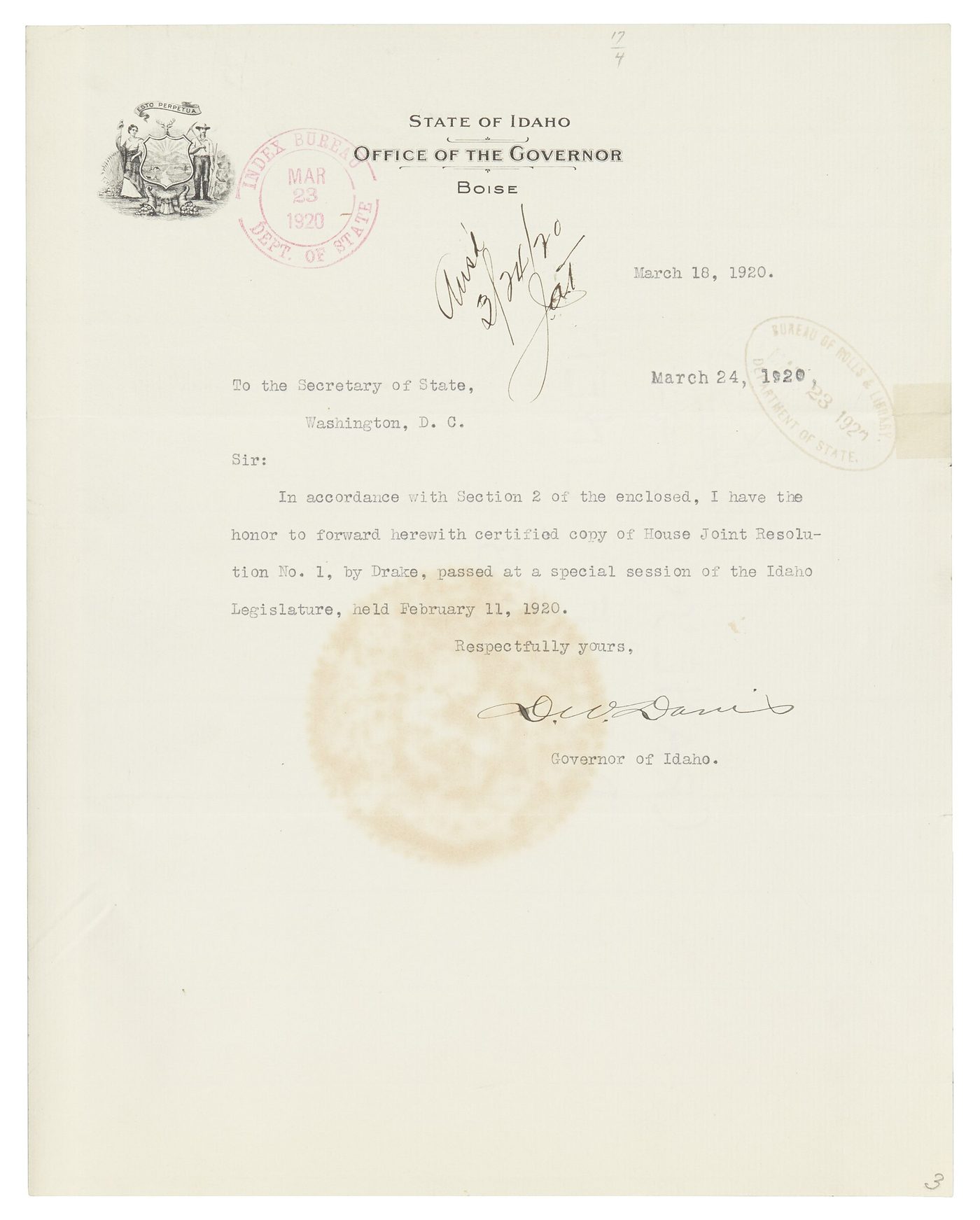
Idaho was the fourth state to give women the vote, and Idaho news coverage of the 2022 suffrage monument calls it the first to do so by amending its constitution.1617 The legislature ratified the Nineteenth on February 11, 1920.18
There is a darker entry. Idaho Territory's 1884 test oath barred from voting anyone belonging to an "order, organization, or association which teaches, advises, counsels, or encourages" polygamy, aimed at Latter-day Saints. Justice Stephen Field upheld it for the Court in Davis v. Beason (1890).19 The 1889 state constitution carried a similar clause; the 1893 legislature lifted the restriction, and the clause stayed in the text until 1982.20 In Romer v. Evans (1996) the Court said that "To the extent Davis held that persons advocating a certain practice may be denied the right to vote, it is no longer good law."21
The latest change came in November 2024, when voters added this sentence to Article VI, section 2: "No person who is not a citizen of the United States shall be a qualified elector in any election held within the state of Idaho."2223
Taxes, Senators, Prohibition and the Presidency
Pollock, the Sixteenth and Brushaber
The tariff act of August 28, 1894 taxed incomes without apportionment. Stockholder Charles Pollock sued. On April 8, 1895 the Court held a tax on income from real estate was a direct tax; on the rest, the Justices were "equally divided."24 On rehearing, May 20, 1895, Chief Justice Melville Fuller, for five Justices, held income from personal property taxed directly as well, and the whole "entire scheme of taxation" fell. Justices Harlan, Brown, Jackson and White dissented.25
The Sixteenth answered in 1913. Frank Brushaber, a Union Pacific stockholder, then claimed it created a strange new direct tax. On January 24, 1916, Chief Justice Edward White, a Pollock dissenter, rejected that: the amendment does not "confer power to levy income taxes in a generic sense," a power Congress already had. Its "whole purpose" was to free income taxes from apportionment.26
Common Misconception: "The Sixteenth Amendment Created the Income Tax"
Congress always could tax incomes. Pollock held that a tax on income from property had to be apportioned by population, which makes an income tax unworkable. Brushaber says the amendment only removed that rule. The mirror-image claim heard at public meetings, that the amendment is invalid so the tax is too, runs into the amendment's text and Brushaber.
Senators by popular vote
The Senate's historians count 45 legislative deadlocks in 20 states between 1891 and 1905. Delaware sent no Senator for four years after 1899. Oregon perfected a system in 1907 that let voters tell legislators whom to pick, and by 1912 as many as 29 states effectively let voters choose their Senators. Joseph Bristow of Kansas offered the amendment in 1911 with strong support from Idaho's Borah, "himself a product of direct election." Connecticut's approval on April 8, 1913 completed ratification.27
Prohibition and repeal
The Eighteenth took effect a year after its 1919 ratification. The Twenty-First repealed it in 1933 and is the only amendment sent to state conventions instead of legislatures.5 Its section 2 is why states still control liquor at their borders, and why Idaho's Article III, section 26 gives the legislature "full power and authority to permit, control and regulate or prohibit" liquor sales after December 31, 1934.28
Terms, limits and succession
Terms once began March 4, and a new Congress might not meet for 13 months while the defeated one kept working. The Twentieth moved the dates to January 3 and January 20.29 The Twenty-Second followed Franklin Roosevelt's third and fourth terms in 1940 and 1944. It limits elections, "elected ... more than twice," not service.30
Section 2 of the Twenty-Fifth was used almost at once: Gerald Ford filled Spiro Agnew's vacancy in 1973, and as President named Nelson Rockefeller, confirmed in 1974. For a time neither had faced voters in a national election. A few Presidents have used section 3 while sedated for medical procedures. Section 4 has never been used.31
The Twenty-Seventh waited more than 202 years. Gregory Watson, a University of Texas undergraduate, wrote a paper on it, got a C, and started a campaign that finished in 1992. His grade was changed to an A in 2017.32
One Person, One Vote and the Gerrymander
Alabama's legislative map dated from 1901, and every party in Reynolds v. Sims agreed that "legislative inaction for some 60 years" had left it "completely lacking in rationality."33 Federal courts had mostly treated such claims as political questions after Colegrove v. Green (1946).34
Then four cases in three years. Baker v. Carr (1962) held a malapportionment claim states "a justiciable cause of action."35 Gray v. Sanders (1963) gave the rule its name: "one person, one vote."36 Wesberry v. Sanders (1964) read "by the People" in Article I to require that "as nearly as is practicable one man's vote in a congressional election is to be worth as much as another's."34 And on June 15, 1964, Chief Justice Earl Warren in Reynolds held both houses of a state legislature must be apportioned by population: "Legislators represent people, not trees or acres." The test is "an honest and good faith effort." Justice Harlan dissented alone.33 Avery v. Midland County (1968) extended the rule to local bodies "having general governmental powers over the entire geographic area," county boards included.37
Equal districts moved the fight to where the lines go. In Rucho v. Common Cause, June 27, 2019, Chief Justice John Roberts, for five Justices, held that "partisan gerrymandering claims present political questions beyond the reach of the federal courts," while adding, "Our conclusion does not condone excessive partisan gerrymandering," and noting "there is no 'Fair Districts Amendment' to the Federal Constitution." Justice Elena Kagan, for four, opened: "For the first time ever, this Court refuses to remedy a constitutional violation because it thinks the task beyond judicial capabilities."38 Racial gerrymanders remain reviewable.
Liberty Perspective: The Elections Clause Already Names the Remedy
After Rucho, officials often talk as if nobody can touch partisan line-drawing. The text says "the Congress may at any time by Law make or alter such Regulations." Congress has done it before: since 1967, federal law has required single-member House districts.39 The Rucho majority itself pointed to Congress and state constitutions. Whether Congress should set districting standards is a policy question. That it may is in the text.
Idaho chose a commission. Article III, section 2 creates a six-member Commission for Reapportionment after each census or court order. Legislative leaders of the two largest parties name four members and the two state party chairs name two. No member may be an Idaho elected or appointed official, and none may serve in the legislature for five years after. Final action needs "a vote of two-thirds of the members." "All deliberations of the commission shall be open to the public." Challenges go straight to the Idaho Supreme Court.40
The Voting Rights Act and the Court
The Voting Rights Act of 1965 is Congress's largest use of the Fifteenth Amendment's enforcement power, aimed at a "blight of racial discrimination in voting" that had "infected the electoral process in parts of our country for nearly a century."41 Section 5 made covered places get federal preclearance for any voting change; section 4(b) chose who was covered. Section 2 applies everywhere:
"(b) A violation of subsection (a) is established if, based on the totality of circumstances, it is shown that the political processes leading to nomination or election in the State or political subdivision are not equally open to participation by members of a class of citizens protected by subsection (a) in that its members have less opportunity than other members of the electorate to participate in the political process and to elect representatives of their choice. ..."
52 U.S.C. sec. 10301(b) (as amended 1982)42
Shelby County v. Holder (June 25, 2013, 5-4) struck the section 4(b) formula. Chief Justice Roberts: "Our country has changed," and Congress must legislate for "current conditions." "We issue no holding on §5 itself, only on the coverage formula." Justice Ruth Bader Ginsburg, dissenting for four: "Throwing out preclearance when it has worked and is continuing to work to stop discriminatory changes is like throwing away your umbrella in a rainstorm because you are not getting wet."41 Without a new formula, preclearance applies to no one.
The action moved to section 2. Brnovich v. DNC (2021) upheld two Arizona ballot rules, 6-3.43 Allen v. Milligan (2023) affirmed, 5-4, a finding that Alabama's congressional map likely violated section 2.44
Then Louisiana v. Callais, decided April 29, 2026 after a rare reargument. Louisiana had drawn a second majority-Black district because a court said section 2 likely required it, and other voters called it a racial gerrymander. Justice Samuel Alito, for six Justices, held that section 2 "imposes liability only when the evidence supports a strong inference that the State intentionally drew its districts to afford minority voters less opportunity because of their race." The Court updated the Gingles test: plaintiffs' maps may not use race and must meet all the state's legitimate goals, political ones included, and their analysis must control for party. Section 2 did not require the district, so the map was unconstitutional.45
Justice Kagan, with Justices Sotomayor and Jackson, dissented, describing a 90 percent Black district sliced into six, where "Election after election, Black citizens' votes are, by every practical measure, wasted." Idaho Attorney General Raúl Labrador joined a multistate brief urging the Court to affirm.45 On June 2, 2026 the Court applied Callais to stay an injunction against Alabama's map.46
Liberty Perspective: Who Decides What "Appropriate Legislation" Means
The Fifteenth Amendment hands enforcement to Congress. Congress rewrote section 2 in 1982 to reach results and reauthorized the Act in 2006. Shelby and Callais both rest on the Court's judgment that those choices no longer fit the amendment, the first because the data were stale, the second because the majority reads the amendment to reach only intentional discrimination. The dissents say the text leaves that judgment to Congress. It is a separation of powers question that fits no slogan. If you cover it, give the votes and quote both sides.
Who Writes the Rules
On August 9, 1787, Madison warned that "times places & manner" "were words of great latitude," and that "Whenever the State Legislatures had a favorite measure to carry, they would take care so to mould their regulations as to favor the candidates they wished to succeed."47 Hamilton defended the federal override in Federalist No. 59: "EVERY GOVERNMENT OUGHT TO CONTAIN IN ITSELF THE MEANS OF ITS OWN PRESERVATION."48 Congress has used it, setting election day by statute.49
The Electors Clause gives legislatures what McPherson v. Blacker (1892) called "plenary" power over choosing electors.50 In Chiafalo v. Washington (2020), the Court held without dissent that "A State may enforce an elector's pledge to support his party's nominee."51
Does "the Legislature thereof" free legislatures from their own state constitutions? In Moore v. Harper (June 27, 2023), Chief Justice Roberts, for six Justices, said no: "The Elections Clause does not insulate state legislatures from the ordinary exercise of state judicial review." But "state courts do not have free rein" and may not "transgress the ordinary bounds of judicial review." Justice Thomas, dissenting with Justice Gorsuch and in part Justice Alito, argued the case was moot. The Court distinguished Leser: ratifying is a federal function, while writing election rules is lawmaking bound by the state constitution.52
Most recently, Watson v. Republican National Committee (June 29, 2026, 5-4) held that "the federal election-day statutes do not preempt Mississippi's law." Justice Amy Coney Barrett wrote that "the defining element of an 'election'" in those statutes "has always been the electorate's choice of candidate," so Mississippi may count ballots postmarked by election day and received within five business days. Justice Alito dissented.53 Idaho chose otherwise: under Idaho Code § 34-1005, an absentee ballot "must be received by the issuing officer by 8:00 p.m. on the day of election before such ballot may be counted."54 Watson leaves that choice with Idaho.
Landmark Cases
| Case | Citation | Holding | Effect today |
|---|---|---|---|
| Minor v. Happersett | 88 U.S. 162 (1875) | Citizenship does not carry the vote | Sex rule superseded by XIX |
| Davis v. Beason | 133 U.S. 333 (1890) | Upheld Idaho Territory's test oath | Not good law on advocacy (Romer, 1996) |
| Pollock v. Farmers' Loan & Trust | 157 U.S. 429; 158 U.S. 601 (1895) | 1894 income tax void as unapportioned direct tax | Displaced by XVI |
| Brushaber v. Union Pacific | 240 U.S. 1 (1916) | XVI removed apportionment, added no new power | Basis of the modern income tax |
| Leser v. Garnett | 258 U.S. 130 (1922) | XIX valid; ratification is a federal function | Distinguished in Moore |
| Reynolds v. Sims | 377 U.S. 533 (1964) | Both legislative houses apportioned by population | Applies to county boards (Avery) |
| Harper v. Virginia Bd. of Elections | 383 U.S. 663 (1966) | State poll taxes violate equal protection, 6-3 | No fee may condition voting |
| Oregon v. Mitchell | 400 U.S. 112 (1970) | Congress may set 18 for federal, not state, elections | Superseded by XXVI |
| Shelby County v. Holder | 570 U.S. 529 (2013) | VRA coverage formula unconstitutional, 5-4 | Preclearance dormant |
| Rucho v. Common Cause | 588 U.S. 684 (2019) | Partisan gerrymandering nonjusticiable, 5-4 | Left to states and Congress |
| Moore v. Harper | 600 U.S. 1 (2023) | Legislatures remain subject to state judicial review, 6-3 | Strong independent legislature theory rejected |
| Louisiana v. Callais | 608 U.S. 85 (2026) | Section 2 requires strong inference of intent; SB8 struck, 6-3 | Gingles test updated |
Where This Shows Up for Officials, Reporters and Citizens
Every Idaho officer swears under Idaho Code § 59-401 to "support the Constitution of the United States, and the Constitution of the State of Idaho," and legislators take the same oath under Article III, section 25.55 On elections that oath gets specific.
A county board redraws. Commissioner Dana Ruiz sees that one district now holds nearly half the county. Idaho Code § 31-704 requires three districts "as nearly equal in population as may be," drawn at the January meeting before a general election, and Avery says the same under the U.S. Constitution.5637 Keeping old lines because rural voters like them fails Reynolds.
A clerk gets a late ballot. County Clerk Sam Ellery receives an absentee ballot the morning after the election, postmarked election day. A voter who read about Watson insists it counts. It does not. Watson says federal law sets no receipt deadline; Idaho Code § 34-1005 sets 8:00 p.m. on election day, and the clerk stamps the date and hour of receipt on every envelope.54
A sheriff and the jail. Sheriff Lee Tran is asked whether inmates may vote. Article VI, section 3 disqualifies those convicted of a felony and not restored to citizenship, or "confined in prison on conviction of a criminal offense."57 Someone held awaiting trial has not been convicted. Work out absentee requests with the clerk before election season.
A reporter covers redistricting. Jordan Pike's questions write themselves from Article III, section 2: who appointed each member, and within 15 days or by the Idaho Supreme Court? Did the plan get four of six votes? Were all deliberations public?40 After Rucho, a partisan-fairness challenge lives in state court, if anywhere.
A citizen at a town hall. A resident says the Twenty-Fourth bans charging for anything tied to voting; a legislator says it covers only federal races. The legislator has the text right. But Harper bars any fee as a condition of voting in state elections too. Whether a particular charge is that kind of fee is the real question, and it turns on the law in front of you.
Pictures, Numbers and Infographics
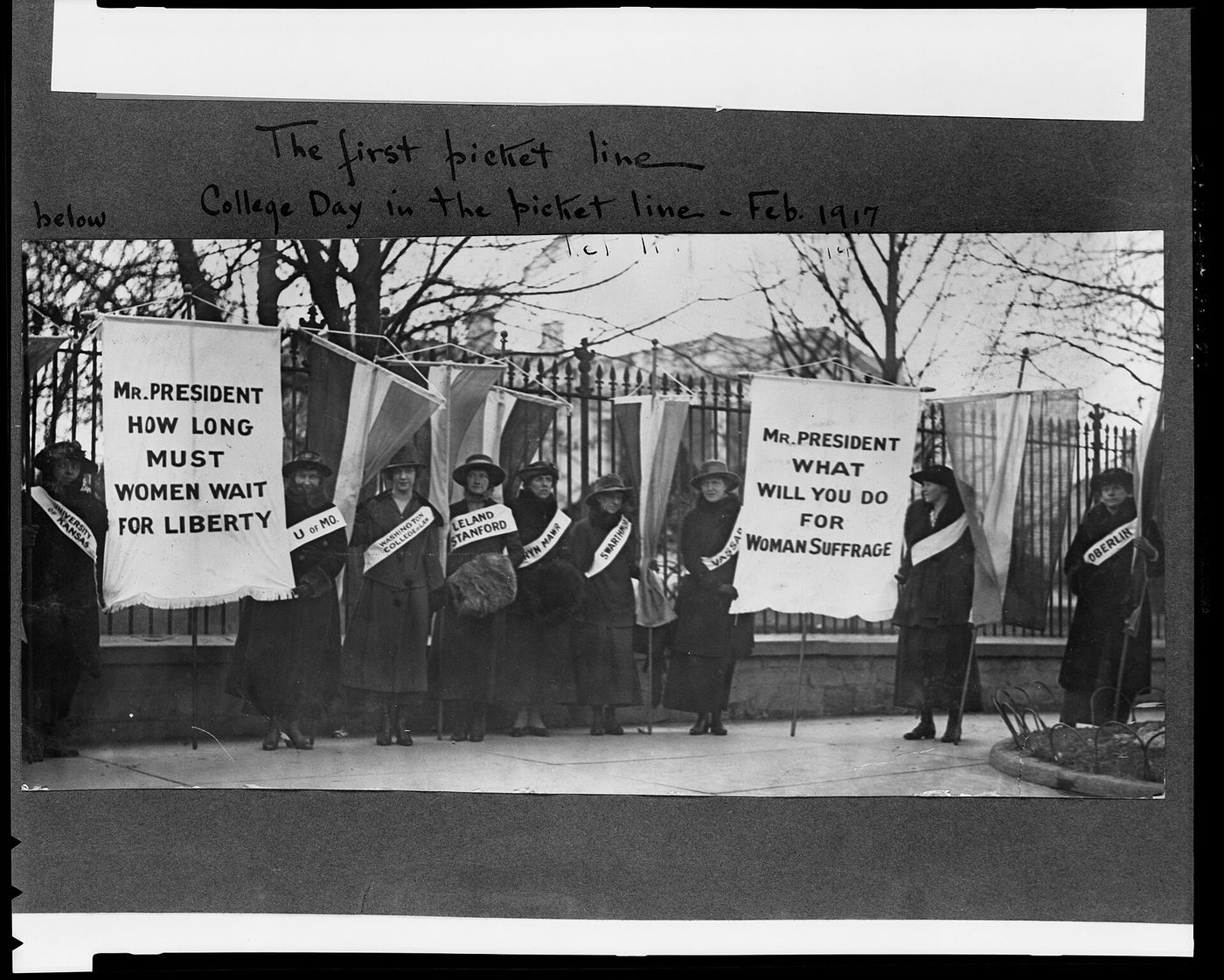
Idaho amended its constitution to let women vote 24 years before the Nineteenth Amendment. The photos come from the suffrage fight. The numbers trace who votes now, in Idaho and nationally, and how the franchise widened one amendment at a time.
By the numbers
- 65.3%: of voting-age U.S. citizens reported voting in the 2024 presidential election, compared with 66.8% in 2020 and 52.2% in the 2022 midterm. U.S. Census Bureau, Current Population Survey, Table A-1
- 65.2%: of Idaho's voting-age citizens reported voting in 2024 (61.4% of all voting-age residents). U.S. Census Bureau, CPS Table A-5a
- 917,469: ballots cast in Idaho's November 2024 general election, 77.8% of 1,178,750 registered voters. Idaho Secretary of State, 2024 General Election Canvass
- 121,015: Idahoans who registered at the polls on Election Day 2024. Idaho Secretary of State, 2024 Canvass
- 12,126 to 6,282: Idaho's November 1896 vote on the women's suffrage amendment. The canvassers called it failed, and the Idaho Supreme Court ruled in December 1896 that it had passed. Green v. State Board of Canvassers, 5 Idaho 130 (1896)
- 49.6% then 43.9%: reported turnout among 18 to 24 year olds in 1972, the first presidential election after the Twenty-Sixth Amendment, and in 2024. U.S. Census Bureau, CPS Table A-1
- 100 days: from congressional passage of the Twenty-Sixth Amendment (March 23, 1971) to ratification (July 1, 1971). National Archives, Amendments 11-27
Verify Independently
Every citation, quotation and case in this course should be verified independently against the official source (the U.S. Reports or the Court's own opinion, the National Archives transcription, the statute book) before you rely on it, quote it or act on it.
Check these in particular:
- Louisiana v. Callais, 608 U.S. 85 (2026) and Watson v. Republican National Committee, 609 U.S. 672 (2026), both decided in 2026. Check the final official text, page numbers, votes and holdings.
- Green v. State Board of Canvassers (Idaho 1896): the reporter gives December 24, 1896 and a news account gives December 11, so the page says December 1896.
- The 2024 Idaho constitutional amendment vote count is the Associated Press election-night tally, not the certified result.
Sources & Further Reading
Constitutional Text and Founding Records
- National Archives, The Constitution of the United States: A Transcription
- National Archives, The Constitution: Amendments 11-27
- Constitution Annotated (Library of Congress edition, LII mirror)
- Madison's Notes of Debates, August 7, 1787 (voter qualifications)
- Madison's Notes of Debates, August 9, 1787 (Elections Clause)
- The Federalist No. 52 and No. 59
- U.S. Senate Historical Office, Direct Election of Senators
Supreme Court Opinions
- Minor v. Happersett, 88 U.S. 162 (1875)
- Davis v. Beason, 133 U.S. 333 (1890)
- Pollock v. Farmers' Loan & Trust Co., 157 U.S. 429 (1895) and 158 U.S. 601 (1895)
- Brushaber v. Union Pacific R. Co., 240 U.S. 1 (1916)
- Leser v. Garnett, 258 U.S. 130 (1922)
- Reynolds v. Sims, 377 U.S. 533 (1964) (Oyez)
- Harper v. Virginia State Board of Elections, 383 U.S. 663 (1966)
- Oregon v. Mitchell, 400 U.S. 112 (1970)
- Shelby County v. Holder, 570 U.S. 529 (2013) (Oyez)
- Arizona v. Inter Tribal Council of Arizona, 570 U.S. 1 (2013)
- Rucho v. Common Cause, 588 U.S. 684 (2019) (Oyez)
- Chiafalo v. Washington, 591 U.S. 578 (2020)
- Moore v. Harper, 600 U.S. 1 (2023)
- Louisiana v. Callais, 608 U.S. 85 (2026)
- Watson v. Republican National Committee, 609 U.S. 672 (2026)
- Romer v. Evans, 517 U.S. 620 (1996)
Idaho Sources
- Idaho Const. art. VI, sec. 2 (qualifications of electors)
- Idaho Const. art. III, sec. 2 (commission for reapportionment)
- Idaho Code sec. 34-1005 (return of absentee ballots)
- Idaho Code sec. 59-401 (official oath)
- Green v. State Board of Canvassers, 5 Idaho 130 (1896), Caselaw Access Project
- National Park Service, Idaho and the 19th Amendment
- University of Idaho Library, Idaho Test Oath
- BYU-Idaho Special Collections, Idaho Women Vote!
Commentary
Related Lessons
Knowledge Check
Test your understanding of voting, the later amendments and the cases that read them. No scores are saved: this is for your own review.
1. On August 7, 1787, Gouverneur Morris moved to limit voting for the House to which group, and what happened?
Right. Morris wanted to "restrain the right of suffrage to freeholders." Delaware voted yes, seven states no, Maryland divided, and Georgia was absent, so the state-qualifications rule in Article I, section 2 stayed. Morris moved to limit the vote to freeholders, landowners. Mason, Ellsworth, Franklin and others objected, and the motion failed with only Delaware voting yes.
2. What does the text of the Twenty-Fourth Amendment cover?
Correct. The amendment names federal offices only. Harper v. Virginia Board of Elections (1966) reached state poll taxes through the Equal Protection Clause. The text lists federal offices only: President, Vice President, electors, Senators and Representatives. State poll taxes fell later, in Harper (1966), under the Equal Protection Clause.
3. What did the Court hold in Brushaber v. Union Pacific R. Co. (1916)?
Yes. Chief Justice White wrote that the amendment does not "confer power to levy income taxes in a generic sense," a power Congress already had, and that its purpose was to relieve income taxes from apportionment. Brushaber upheld the 1913 income tax. The amendment conferred no new power; it removed the apportionment rule that Pollock had applied.
4. What did Moore v. Harper (2023) hold about the Elections Clause?
Right. Chief Justice Roberts, for six Justices, rejected the strong independent state legislature theory and added that "state courts do not have free rein." Moore held that legislatures writing federal election rules remain bound by their state constitutions and subject to state judicial review, within ordinary bounds. Rucho (2019) is the case that closed federal courts to partisan gerrymandering claims.
5. In 1896, Idaho voters approved women's suffrage 12,126 to 6,282, but the Board of Canvassers declared it failed. Why did the Idaho Supreme Court rule the amendment had passed?
Correct. In Green v. State Board of Canvassers, the court read the different words in sections 1 and 3 of Article XX to mean different things. Otherwise, it said, no amendment would be "practicable." The canvassers counted the amendment against everyone who voted in the election. The court held that section 1 requires only a majority of those voting on the amendment, and contrasted the stricter wording of section 3.
Reference Materials
Use your browser's print function (Ctrl+P / Cmd+P) to save this page as a PDF for offline reference.
- How We Got Here: jump to section
- The Text: jump to section
- Widening the Vote: jump to section
- Idaho's Voting History: jump to section
- Taxes, Senators, Prohibition and the Presidency: jump to section
- One Person, One Vote: jump to section
- The Voting Rights Act: jump to section
- Elections and Electors Clauses: jump to section
- Landmark Cases: jump to section
- Practice Points: jump to section
Footnotes
- James Madison, Notes of Debates in the Federal Convention, August 7, 1787 (Avalon Project, Yale Law School), https://avalon.law.yale.edu/18th_century/debates_807.asp. Quotations of Morris, Ellsworth, Mason, Madison and Franklin are from this day. Madison recorded Franklin's point in the third person: "He did not think that the elected had any right in any case to narrow the privileges of the electors."
- Madison, Notes, August 7, 1787: "On the question for striking out as moved by Mr. Govr. Morris ... N. H. no. Mas. no. Ct. no. Pa. no. Del. ay. Md. divd. Va. no. N. C. no. S. C. no. Geo. not prest."
- The Federalist No. 52 (New York Packet, February 8, 1788), Avalon Project, https://avalon.law.yale.edu/18th_century/fed52.asp. Avalon lists the author as "Hamilton or Madison"; the paper is signed Publius.
- Constitution Annotated, Amend. XIX, "Women's Suffrage from the Founding Era to the Civil War" (LII mirror of the Library of Congress edition), https://www.law.cornell.edu/constitution-conan/amendment-19/womens-suffrage-from-the-founding-era-to-the-civil-war, quoting N.J. Const. of 1776, art. IV, and citing the National Park Service on the 1807 law.
- National Archives, The Constitution of the United States: A Transcription, https://www.archives.gov/founding-docs/constitution-transcript, and The Constitution: Amendments 11-27, https://www.archives.gov/founding-docs/amendments-11-27. Dates of passage and ratification are the Archives' own. The Archives notes that the 20th Amendment modified art. I, sec. 4 and that its section 3 superseded part of the 12th. The 21st is the only amendment whose text calls for ratification "by conventions in the several States"; every other ratified amendment went to state legislatures.
- Minor v. Happersett, 88 U.S. (21 Wall.) 162 (1875), https://www.law.cornell.edu/supremecourt/text/88/162. Opinion of Chief Justice Waite.
- National Constitution Center, "On this day, Supreme Court refuses women right to vote" (March 29, 2020), https://constitutioncenter.org/blog/on-this-day-supreme-court-refuses-women-right-to-vote (decision date March 29, 1875; unanimous opinion by Chief Justice Morrison Waite).
- Leser v. Garnett, 258 U.S. 130 (1922), decided February 27, 1922, https://www.law.cornell.edu/supremecourt/text/258/130. Opinion of Justice Brandeis. The opinion gives the proclamation date of August 26, 1920.
- Constitution Annotated, "Overview of Twenty-Fourth Amendment, Abolition of Poll Tax," https://www.law.cornell.edu/constitution-conan/amendment-24/overview-of-twenty-fourth-amendment-abolition-of-poll-tax ("instituted in eleven states of the South following the end of Reconstruction, although at the time of the ratification of this Amendment only five states still retained it").
- Harper v. Virginia State Board of Elections, 383 U.S. 663 (1966), decided March 24, 1966, https://www.law.cornell.edu/supremecourt/text/383/663. Douglas, J., for the Court; Black, J., dissenting; Harlan, J., joined by Stewart, J., dissenting. The $1.50 figure appears in the opinions.
- Oregon v. Mitchell, 400 U.S. 112 (1970), decided December 21, 1970, https://www.law.cornell.edu/supremecourt/text/400/112 (consolidated with Texas v. Mitchell, United States v. Arizona and United States v. Idaho). Justice Black's opening opinion lists how each Justice voted on each provision. Idaho's 60-day residency requirement is described in the separate opinions; Robert M. Robson of Boise argued for Idaho.
- Constitution Annotated, "Ratification of the Twenty-Sixth Amendment," https://www.law.cornell.edu/constitution-conan/amendment-26/ratification-of-the-twenty-sixth-amendment.
- Arizona v. Inter Tribal Council of Arizona, Inc., 570 U.S. 1 (2013), decided June 17, 2013, https://www.law.cornell.edu/supremecourt/text/12-71. Scalia, J., for the Court; Thomas and Alito, JJ., dissenting.
- Green v. State Board of Canvassers, 5 Idaho 130, 47 P. 259 (1896), Harvard Caselaw Access Project, https://static.case.law/idaho/5/cases/0130-01.json. The reporter dates the decision December 24, 1896; the 2022 news account in note 17 gives December 11, 1896, so this lesson says only "December 1896." The quoted ballot question, vote totals (12,126 to 6,282), counsel and the contrast between art. XX secs. 1 and 3 are from the opinions.
- Katherine G. Aiken, "Seeking Suffrage: The Idaho Story," Context podcast, University of Idaho Library, https://www.lib.uidaho.edu/digital/context/items/context_96.html (transcript: legislature proposed the amendment in 1895; Idaho was the fourth state; canvassers' majority theory; Kate Green's suit; Borah, Tate and Hawley served pro bono).
- Brigham Young University-Idaho, McKay Library Special Collections, "Idaho Women Vote!", https://archives.byui.edu/s/public/page/Idaho-Women-Vote ("Idaho became the 4th state or territory to grant suffrage to women").
- Idaho Capital Sun, republished by KISU, "'Remarkable ability to persevere': Idaho unveils monument to women's right to vote" (December 13, 2022), https://www.kisu.org/2022-12-13/remarkable-ability-to-persevere-idaho-unveils-monument-to-womens-right-to-vote.
- National Park Service, "Idaho and the 19th Amendment," https://www.nps.gov/articles/idaho-and-the-19th-amendment.htm ("On February 11, 1920, Idaho ratified the 19th Amendment").
- Davis v. Beason, 133 U.S. 333 (1890), decided February 3, 1890, https://www.law.cornell.edu/supremecourt/text/133/333. Opinion of Justice Field, quoting sec. 501 of the Revised Statutes of Idaho Territory.
- University of Idaho Library, "Idaho Test Oath," Idaho Harvester (May 31, 2021), https://harvester.lib.uidaho.edu/posts/2021/05/31/idaho-test-oath.html (1884 oath; 1893 legislature removed the restrictions; constitutional provision removed in 1982).
- Romer v. Evans, 517 U.S. 620 (1996), https://www.law.cornell.edu/supremecourt/text/517/620. The same passage says that to the extent Davis held a convicted felon may be denied the vote, "its holding is not implicated by our decision and is unexceptionable."
- Idaho Const. art. VI, sec. 2, https://legislature.idaho.gov/statutesrules/idconst/ArtVI/Sect2/ (current text).
- KMVT/KSVT, "Idaho to pass new amendment prohibiting non-citizens from voting" (November 6, 2024), https://www.kmvt.com/2024/11/06/idaho-passes-new-amendment-prohibiting-non-citizens-voting (HJR 5; Associated Press count as of 1:30 a.m.). Final certified totals were not separately checked for this lesson.
- Pollock v. Farmers' Loan & Trust Co., 157 U.S. 429 (1895), decided April 8, 1895, https://www.law.cornell.edu/supremecourt/text/157/429. Opinion of Chief Justice Fuller.
- Pollock v. Farmers' Loan & Trust Co., 158 U.S. 601 (1895), decided May 20, 1895, https://www.law.cornell.edu/supremecourt/text/158/601 (summary of conclusions; dissents by Justices Harlan, Brown, Jackson and White). See also Constitution Annotated, "Historical Background on Sixteenth Amendment," https://www.law.cornell.edu/constitution-conan/amendment-16/historical-background-on-sixteenth-amendment.
- Brushaber v. Union Pacific R. Co., 240 U.S. 1 (1916), decided January 24, 1916, https://www.law.cornell.edu/supremecourt/text/240/1. Opinion of Chief Justice White.
- U.S. Senate Historical Office, "Direct Election of Senators," https://www.senate.gov/artandhistory/history/common/briefing/Direct_Election_Senators.htm.
- Idaho Const. art. III, sec. 26, https://legislature.idaho.gov/statutesrules/idconst/ArtIII/Sect26/.
- Constitution Annotated, Amend. XX, "Presidential and Congressional Terms," https://www.law.cornell.edu/constitution-conan/amendment-20/presidential-and-congressional-terms (Congress commenced March 4, 1789). The 13-month gap follows from the old text: terms began March 4, and art. I, sec. 4, cl. 2 set the regular meeting on "the first Monday in December."
- Constitution Annotated, "Overview of Twenty-Second Amendment, Presidential Term Limits," https://www.law.cornell.edu/constitution-conan/amendment-22/overview-of-twenty-second-amendment-presidential-term-limits (Roosevelt's "unprecedented third and fourth terms of office, in 1940 and 1944").
- Constitution Annotated, "Implementation of the Twenty-Fifth Amendment," https://www.law.cornell.edu/constitution-conan/amendment-25/implementation-of-the-twenty-fifth-amendment (Section 2 use in 1973 and 1974; Rockefeller confirmation votes; "a few presidents have invoked Section 3"; Section 4 "has never been used").
- Constitution Annotated, "Ratification of the Twenty-Seventh Amendment," https://www.law.cornell.edu/constitution-conan/amendment-27/ratification-of-the-twenty-seventh-amendment.
- Reynolds v. Sims, 377 U.S. 533 (1964), decided June 15, 1964, https://www.law.cornell.edu/supremecourt/text/377/533. Warren, C.J., for the Court; Clark and Stewart, JJ., concurring; Harlan, J., dissenting. The "60 years" language is from Justice Stewart's concurrence describing the parties' agreement.
- Wesberry v. Sanders, 376 U.S. 1 (1964), decided February 17, 1964, https://www.law.cornell.edu/supremecourt/text/376/1. Opinion of Justice Black. The opinion describes the lower court's reliance on Justice Frankfurter's opinion in Colegrove v. Green, 328 U.S. 549 (1946).
- Baker v. Carr, 369 U.S. 186 (1962), decided March 26, 1962, https://www.law.cornell.edu/supremecourt/text/369/186. Opinion of Justice Brennan.
- Gray v. Sanders, 372 U.S. 368 (1963), decided March 18, 1963, https://www.law.cornell.edu/supremecourt/text/372/368. Opinion of Justice Douglas.
- Avery v. Midland County, 390 U.S. 474 (1968), decided April 1, 1968, https://www.law.cornell.edu/supremecourt/text/390/474. Opinion of Justice White; Justices Harlan and Fortas dissented.
- Rucho v. Common Cause, 588 U.S. 684 (2019), decided June 27, 2019, slip opinion https://www.supremecourt.gov/opinions/18pdf/18-422_9ol1.pdf. Roberts, C.J., joined by Thomas, Alito, Gorsuch and Kavanaugh, JJ.; Kagan, J., joined by Ginsburg, Breyer and Sotomayor, JJ., dissenting.
- 2 U.S.C. sec. 2c (Pub. L. 90-196, Dec. 14, 1967), https://www.law.cornell.edu/uscode/text/2/2c.
- Idaho Const. art. III, sec. 2, https://legislature.idaho.gov/statutesrules/idconst/ArtIII/Sect2/. The year the commission provision was adopted was not verified for this lesson and is omitted.
- Shelby County v. Holder, 570 U.S. 529 (2013), decided June 25, 2013, https://www.law.cornell.edu/supremecourt/text/12-96. Roberts, C.J., joined by Scalia, Kennedy, Thomas and Alito, JJ.; Thomas, J., concurring; Ginsburg, J., joined by Breyer, Sotomayor and Kagan, JJ., dissenting. The "blight" passage quotes South Carolina v. Katzenbach, 383 U.S. 301, 308 (1966).
- 52 U.S.C. sec. 10301, https://www.law.cornell.edu/uscode/text/52/10301 (Voting Rights Act sec. 2, as amended by Pub. L. 97-205 in 1982). Sections 4 and 5 are described as in Shelby County.
- Brnovich v. Democratic National Committee, 594 U.S. 647 (2021), decided July 1, 2021, slip opinion https://www.supremecourt.gov/opinions/20pdf/19-1257_g204.pdf. Alito, J., for six Justices; Kagan, J., joined by Breyer and Sotomayor, JJ., dissenting.
- Allen v. Milligan, 599 U.S. 1 (2023), decided June 8, 2023, slip opinion https://www.supremecourt.gov/opinions/22pdf/21-1086_1co6.pdf. Roberts, C.J., for the Court except as to Part III-B-1, joined by Sotomayor, Kagan and Jackson, JJ., and by Kavanaugh, J., except Part III-B-1.
- Louisiana v. Callais, 608 U.S. 85 (2026), decided April 29, 2026 (argued March 24, 2025; reargued October 15, 2025), preliminary print https://www.supremecourt.gov/opinions/25pdf/608us1r29_n648.pdf. Alito, J., joined by Roberts, C.J., and Thomas, Gorsuch, Kavanaugh and Barrett, JJ.; Thomas, J., joined by Gorsuch, J., concurring; Kagan, J., joined by Sotomayor and Jackson, JJ., dissenting. The amicus list names Idaho Attorney General Raúl R. Labrador among the states joining the Alabama brief urging affirmance. The June 27, 2025 order restoring the case for reargument is at https://www.law.cornell.edu/supremecourt/text/24-109.
- Allen v. Milligan, 608 U.S. 511 (2026) (per curiam, on application for stay), decided June 2, 2026, https://www.supremecourt.gov/opinions/25pdf/608us2r42_q8l1.pdf.
- Madison, Notes of Debates, August 9, 1787, Avalon Project, https://avalon.law.yale.edu/18th_century/debates_809.asp.
- The Federalist No. 59 (New York Packet, February 22, 1788) (Hamilton), Avalon Project, https://avalon.law.yale.edu/18th_century/fed59.asp. Capitals as in the source.
- 2 U.S.C. sec. 7, https://www.law.cornell.edu/uscode/text/2/7. Watson cites 2 U.S.C. secs. 1 and 7 and 3 U.S.C. sec. 1 as the federal election-day statutes.
- McPherson v. Blacker, 146 U.S. 1 (1892), decided October 17, 1892, https://www.law.cornell.edu/supremecourt/text/146/1. Opinion of Chief Justice Fuller.
- Chiafalo v. Washington, 591 U.S. 578 (2020), decided July 6, 2020, slip opinion https://www.supremecourt.gov/opinions/19pdf/19-465_i425.pdf. Kagan, J., for eight Justices; Thomas, J., joined in part by Gorsuch, J., concurring in the judgment.
- Moore v. Harper, 600 U.S. 1 (2023), decided June 27, 2023, slip opinion https://www.supremecourt.gov/opinions/22pdf/21-1271_3f14.pdf. Roberts, C.J., joined by Sotomayor, Kagan, Kavanaugh, Barrett and Jackson, JJ.; Kavanaugh, J., concurring; Thomas, J., joined by Gorsuch, J., and by Alito, J., as to Part I, dissenting. The syllabus addresses McPherson and Leser.
- Watson v. Republican National Committee, 609 U.S. 672 (2026), decided June 29, 2026, preliminary print https://www.supremecourt.gov/opinions/25pdf/609us2r65_g314.pdf. Barrett, J., joined by Roberts, C.J., and Sotomayor, Kagan and Jackson, JJ.; Alito, J., joined by Thomas and Gorsuch, JJ., and by Kavanaugh, J., except Parts II-C-2 and III, dissenting.
- Idaho Code sec. 34-1005, https://legislature.idaho.gov/statutesrules/idstat/Title34/T34CH10/SECT34-1005/.
- Idaho Code sec. 59-401, https://legislature.idaho.gov/statutesrules/idstat/Title59/T59CH4/SECT59-401/; Idaho Const. art. III, sec. 25, https://legislature.idaho.gov/statutesrules/idconst/ArtIII/Sect25/.
- Idaho Code sec. 31-704, https://legislature.idaho.gov/statutesrules/idstat/Title31/T31CH7/SECT31-704/. Scenario people are invented.
- Idaho Const. art. VI, sec. 3, https://legislature.idaho.gov/statutesrules/idconst/ArtVI/Sect3/.