U.S. CONSTITUTION · Module 13 · Preamble
Module 13: The Preamble
We the People, the six purposes, and what the Preamble does and does not do
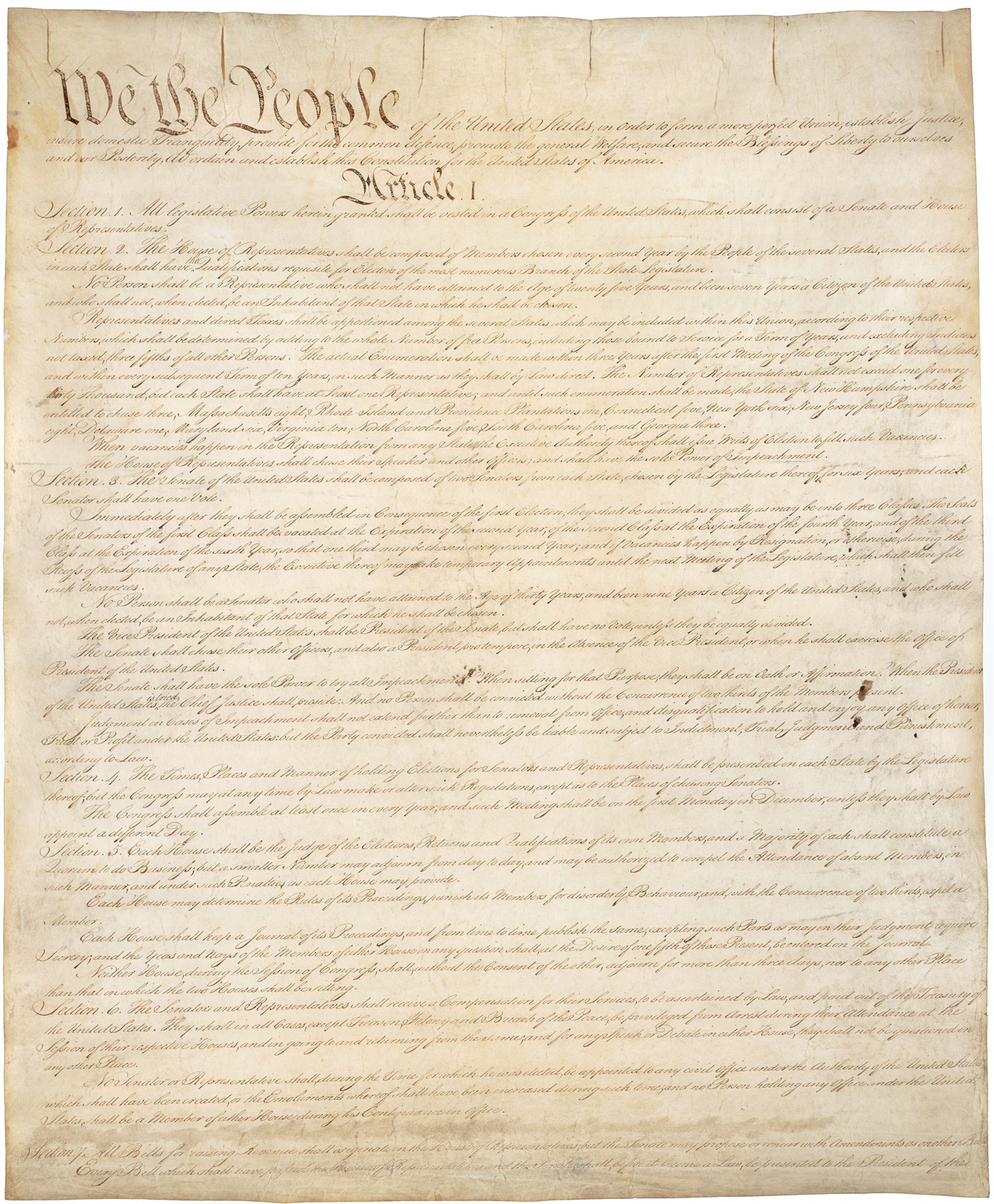
The Text
The Preamble is one sentence of 52 words. The National Archives transcription of the engrossed Constitution gives it this way:
"We the People of the United States, in Order to form a more perfect Union, establish Justice, insure domestic Tranquility, provide for the common defence, promote the general Welfare, and secure the Blessings of Liberty to ourselves and our Posterity, do ordain and establish this Constitution for the United States of America."
U.S. Const. pmbl. (National Archives transcription)
The grammar carries the lesson.1 The subject is "We the People of the United States." The verb is "do ordain and establish." Everything between them, the six purposes, is a clause explaining why the People acted. Congress, the President and the courts do not appear anywhere in the sentence. Nothing in it speaks to a government, because in the sentence no government exists yet. The People are the only actor.
The six purposes, in the order the sentence gives them:
- to form a more perfect Union
- to establish Justice
- to insure domestic Tranquility
- to provide for the common defence
- to promote the general Welfare
- to secure the Blessings of Liberty to ourselves and our Posterity
Two oddities first. "Insure" is the spelling in the engrossed copy, and the word does the job a modern writer gives to "ensure." And the Preamble contains no grant of power and no individual right. A reader looking for the authority to build a post road or the right to speak will not find either here. Those live in Articles I through III and in the Bill of Rights. The Preamble says who made the Constitution and what they wanted from it.
It is one of the most quoted passages in American law and one of the least used. Students memorize it, speakers open with it, and judges rarely decide anything by it. How it got that way is the subject of this module.
Preambles Before Philadelphia
A preamble was not a Philadelphia invention. English statutes that Americans treated as the roots of their rights, among them the Petition of Right of 1628, the Habeas Corpus Act of 1679 and the Bill of Rights of 1689, opened with prefatory text explaining the law's objects. The Declaration of Independence is a preamble with a list of charges and a verdict attached. Several of the first state constitutions began with statements of purpose, among them the Pennsylvania Constitution of 1776, the Virginia Declaration of Rights and the Massachusetts Constitution of 1780.2
The Articles of Confederation, the government the Constitution replaced, began with a salutation and no statement of purpose at all: "To all to whom these Presents shall come, we the undersigned Delegates of the States affixed to our Names send greeting." The purposes appear later, in Article III, where the States "enter into a firm league of friendship with each other, for their common defense, the security of their liberties, and their mutual and general welfare."3 Put that beside the Preamble. The "common defense," the "liberties" and the "general welfare" of 1781 are still there six years later.
They were there when the Convention opened its real business. On May 29, 1787, Edmund Randolph opened the Virginia Plan with a resolution that the Articles "ought to be so corrected & enlarged as to accomplish the objects proposed by their institution; namely, 'common defence, security of liberty and general welfare.'" The next day he moved, seconded by Gouverneur Morris, to say that a union of the States "merely foederal" would not reach those objects, and the Convention was on its way to a national government.4 Three of the Preamble's six purposes, defense, liberty and general welfare, had clear ancestors in the document the delegates had come to repair.
Randolph's note to the Committee of Detail
For two months nobody proposed a preamble. In late July the Convention handed its resolutions to a Committee of Detail to turn into a draft constitution, and Randolph wrote notes for the committee on how to do it. Two of them survive. The draft should use "simple and precise language, and general propositions, according to the example of the constitutions of the several states." And then: "A preamble seems proper."4
He was just as clear about what the preamble should leave out. It should not designate "the ends of government and human polities," he wrote, because that kind of "display of theory" was fine for the first state constitutions but "unfit here," where the delegates were not "working on the natural rights of men not yet gathered into society." The preamble's job was to declare that the present federal government was insufficient, that this conviction "gave birth to this convention," and that the cure was a supreme legislative, executive and judiciary. Randolph wanted a short statement of why the Convention existed. The six-purpose list that Americans know came later, from other hands.42
From Thirteen States to "We the People"
The Committee of Detail reported on August 6, 1787, and its preamble was short. Madison's notes give it:
"We the people of the States of New Hampshire, Massachussetts, Rhode-Island and Providence Plantations, Connecticut, New-York, New-Jersey, Pennsylvania, Delaware, Maryland, Virginia, North-Carolina, South-Carolina, and Georgia, do ordain, declare, and establish the following Constitution for the Government of Ourselves and our Posterity."
Committee of Detail report, August 6, 1787 (Madison's notes; Farrand 2:177)
That draft runs 41 words and names all thirteen States. Article I of the draft supplied the country's name: "The stile of the Government shall be, 'The United States of America.'"5 It lists no purposes. It reaches the people only through their States.
The Committee of Style
The Convention spent August debating the draft clause by clause. On September 8 it chose a committee by ballot "to revise the stile of and arrange the articles which had been agreed to by the House." The members were William Samuel Johnson of Connecticut, Alexander Hamilton, Gouverneur Morris, James Madison and Rufus King.6 The committee met after dinner on September 8 and again on the 10th and 11th, according to Johnson's diary, as the National Park Service summarizes it, and on September 12 Johnson reported "a digest of the plan" and printed copies went to every delegate.78
The printed digest opened this way:
"We, the People of the United States, in order to form a more perfect union, to establish justice, insure domestic tranquility, provide for the common defence, promote the general welfare, and secure the blessings of liberty to ourselves and our posterity, do ordain and establish this Constitution for the United States of America."
Report of the Committee of Style, September 12, 1787 (Madison's notes, capitalization of the original aside)
Set the two versions next to each other and count the changes.84 The thirteen State names are gone, replaced by "the United States." The sentence grew from 41 words to 52. A list of six purposes appeared where the August draft had none. "Ordain, declare, and establish" shrank to "ordain and establish." The Constitution that was "the following" became "this Constitution for the United States of America." And one small thing happened between the printed report and the engrossed copy: the second "to" in "to establish justice" dropped out, so the signed text reads "establish Justice." This lesson could not find a recorded vote on that change.
Who wrote it
Gouverneur Morris did. The evidence is better than for most pieces of the Constitution. Madison, writing to Jared Sparks on April 8, 1831, said the finish given to the style and arrangement "fairly belongs to the pen of Mr. Morris," and added that the task had probably been handed to Morris by the committee's chairman with the others' concurrence.9 Morris claimed the credit himself. On December 22, 1814 he wrote to Timothy Pickering that the Constitution "was written by the fingers, which write this letter," and that having "rejected redundant and equivocal terms" he believed it as clear as the language allowed, with an exception for parts of the judiciary article.10
The National Park Service's account adds a caution that fits the record: historians have long suspected that Morris, through careful choice and arrangement of words and punctuation, bent some provisions toward his own views, and he later said as much, but the other four members were hard to fool.7 The Constitution Annotated reports that it is "generally acknowledged" the Preamble's author was Morris, and cites Richard Brookhiser's statement that the Preamble was the one part of the Constitution Morris wrote from scratch.2
Why the States came out
The Convention's record does not say. It is silent about why the Committee of Style changed the Preamble, and the Constitution Annotated notes there is no evidence anyone objected.2 The usual explanation comes from two historians. Max Farrand wrote in 1913, and Charles Warren in 1928, that it was necessary to cut the State names because nobody knew, on the day the delegates signed, which of the thirteen would ratify.211
The Convention's own votes support that explanation. On August 31 the delegates filled the blank in the ratification article with "nine" over "ten" and "thirteen," and added the words "between the said States" so that the Constitution would bind only those that adopted it (Module 16 gives the votes in full). A preamble that listed all thirteen States as the authors of the document would have been untrue the moment the ninth State acted without the other four.12 The Convention knew its limits. On September 10, James Wilson reminded the delegates that Maryland's delegation had voted for unanimous consent of all thirteen States and that "N. York has not been represented for a long time past in the Convention." Hamilton signed alone for his State.131
Both sides of the 1995 Term Limits decision, which fought over what "We the People" means, agreed on one thing about the change. The majority treated the Committee of Style's edits as stylistic, and Justice Thomas, dissenting, wrote that "in this instance, at least" he agreed that "the Committee's edits did not work a substantive change in the Constitution."11 Whether a change this size is merely stylistic is the question that the next section answers.
The letter that went with it
On September 17 the Convention approved the engrossed Constitution and sent it to the Congress of the Confederation with a letter from President Washington. The letter gives the reason for the whole exercise in five words, "the consolidation of our Union," which it describes as involving "our prosperity, felicity, safety, perhaps our national existence."14 Thirty-nine delegates signed the document that day.1 Madison's note records that the Constitution was signed by all the members present except Edmund Randolph, George Mason and Elbridge Gerry, who declined.15
The Fight Over Three Words
Philadelphia barely discussed the Preamble. The ratifying conventions argued about little else for a week at a time, because the first three words answered the question every Anti-Federalist wanted to ask: who is doing this?
Wilson in Pennsylvania, December 11, 1787
James Wilson took the question head on. "This, Mr. President, is not a government founded upon compact; it is founded upon the power of the people." The Preamble's words, he said, "declare, in a practical manner, the principle of this constitution." He called the opening "not an unmeaning flourish," and he told the convention that its members were "merely the proxies of our constituents."16 A compact, in Wilson's argument, binds the parties who signed it and can only be changed with their consent. A constitution ordained by the People can be amended by the People, and that was the principle he wanted on the record.
Henry in Virginia, June 4, 1788
Patrick Henry answered for the other side, and the Constitution Annotated treats his speech as the classic complaint. "What right had they to say, We, the people?" he asked the Virginia convention. "Who authorized them to speak the language of, We, the people, instead of, We, the states? States are the characteristics and the soul of a confederation." If the States were not the parties, Henry argued, the result "must be one great, consolidated, national government."17 Edmund Pendleton answered him in the same convention: "who but the people can delegate powers? Who but the people have a right to form government?"2
Brutus and Hamilton
Two essayists read the same words in opposite directions. Brutus, in his twelfth essay on February 7, 1788, told readers the Preamble showed "the spirit of the constitution." The ends it names, he argued, embrace "every object which is embraced by any government," and he predicted the courts would "give every part of it such an explanation, as will give latitude to every department under it." In his reading the Preamble was a warrant for broad power.18 Alexander Hamilton, writing in The Federalist No. 84 on May 28, 1788, used the same sentence to argue the opposite point about rights. The People "surrender nothing," he said, so they needed no list of reservations, and the Preamble was "a better recognition of popular rights than volumes of those aphorisms" that filled the state bills of rights.19
Keep Brutus in mind. Two centuries of judges would turn his prediction down, and the case that did it most plainly, Jacobson v. Massachusetts, is covered below.
Madison tries to add to it, 1789
James Madison nearly changed the Preamble within two years. On June 8, 1789 he asked the House to prefix to the Constitution "a declaration, that all power is originally vested in, and consequently derived from, the people," that government exists "for the benefit of the people," and that the people hold an "indubitable, unalienable, and indefeasible right to reform or change their Government."20 New York, Virginia and North Carolina had asked for something like it. A select committee of eleven shortened it to a single clause to go before the words "We the people": "Government being intended for the benefit of the people, and the rightful establishment thereof being derived from their authority alone."21
The House took it up on August 13 and 14. Roger Sherman objected to the method, arguing Congress should not "interweave our propositions into the work itself," and Elbridge Gerry objected to the content: he did not believe "one out of fifty" governments was intended for the people's benefit. Thomas Tudor Tucker said a preamble "is no part of the constitution," John Page praised the "neatness and simplicity" of "We the people," and Madison defended the addition as a "solemn truth" that three States wanted.22 The Committee of the Whole struck the addition by a vote of 27 to 23.21 When Congress sent twelve articles to the States on September 25, none touched the Preamble.2324
Liberty Perspective: A Preamble That the People Own
Wilson's argument has a consequence that gets less attention than the slogan. If the People ordained the Constitution and not the States or a compact among rulers, then officials hold their offices under a document the People wrote and can rewrite. Madison's 1789 draft said so outright: government is "instituted" for the people's benefit and the people may "reform or change" it. The House dropped his words by four votes. The Preamble's own grammar already puts the People in the subject slot and every officer later in the document below them. Idaho's Constitution says it in a plain sentence: "All political power is inherent in the people."25
The Six Purposes
Each purpose has a history before 1787 and a later life in the operative text. None gives government a power. Together they say what the powers are for.
To form a more perfect Union
The Articles of Confederation called themselves "Articles of Confederation and perpetual Union," so the Preamble's phrase assumes a union that already existed and promises a better one.3 The Union, in Lincoln's first inaugural address of March 4, 1861, was older than the Constitution: "formed, in fact, by the Articles of Association in 1774," matured by the Declaration and the Articles, and finally in 1787 "one of the declared objects for ordaining and establishing the Constitution was 'to form a more perfect Union.'"26
The Supreme Court used the Preamble's words in the same way after the war. In Texas v. White (1869), Chief Justice Salmon Chase wrote that the Articles had declared the Union "perpetual," that the Constitution was meant to make it "more perfect," and that "the Constitution, in all its provisions, looks to an indestructible Union, composed of indestructible States." Texas, once admitted, "entered into an indissoluble relation."27 In 1995 Justice Stevens's opinion in U.S. Term Limits v. Thornton said that letting each State set its own qualifications for Congress would "erode the structure envisioned by the Framers, a structure that was designed, in the words of the Preamble to our Constitution, to form a 'more perfect Union.'"28 The Union clause is the one the courts cite most when the question is how far States may go on their own. Article IV (Module 14) and Article VI (Module 15) are its operative text.
To establish Justice
The Confederation had almost no national courts. Hamilton listed that among its defects in The Federalist No. 22: "Laws are a dead letter without courts to expound and define their true meaning and operation."29 The Constitution answered in Article III, which vests the judicial power in "one supreme Court, and in such inferior Courts as the Congress may from time to time ordain and establish," and in Article I, section 8, which lets Congress "constitute Tribunals inferior to the supreme Court."1 Module 4 covers the courts. The Preamble contributes the point that justice here means something delivered by a national institution and not a hope.
To insure domestic Tranquility
The delegates met in the shadow of Shays' Rebellion. In the fall of 1786 farmers in western Massachusetts forced some county courts closed, the courts through which debts were collected. Governor James Bowdoin ordered 4,400 troops raised under General Benjamin Lincoln in January 1787, and on January 25, at Springfield, the Hampshire militia fired on the insurgents who approached the arsenal there, which held federal property.30 The Constitution answered with two clauses. It gave Congress power "to provide for calling forth the Militia to execute the Laws of the Union, suppress Insurrections and repel Invasions" and promised each State protection "against domestic Violence" on application of its legislature or governor.1 Module 14 takes up the Article IV guarantee. Tranquility has operative text behind it in both Article I and Article IV.
To provide for the common defence
This is the oldest of the six. The Articles named "common defense" as the reason for the league of friendship in 1781, and Randolph's Virginia Plan named it again in 1787.34 The operative text runs from Article I, section 8 (declaring war, raising armies, maintaining a navy, calling forth the militia) to the commander-in-chief clause of Article II. The Supreme Court has used the Preamble when defense is the reason for a restriction. In Greer v. Spock (1976), upholding limits on political campaigning on a military base, the Court wrote that "one of the very purposes for which the Constitution was ordained and established was to 'provide for the common defence.'" In Holder v. Humanitarian Law Project (2010), upholding the material-support law, Chief Justice Roberts quoted the same words.3132
To promote the general Welfare
This purpose has caused more mischief than the other five, because the same two words appear again in a power clause. Article I, section 8, clause 1 gives Congress power "to lay and collect Taxes, Duties, Imposts and Excises, to pay the Debts and provide for the common Defence and general Welfare of the United States."1 Madison and Hamilton disagreed about it from the 1790s. Madison thought the words only pointed to the powers listed after them. Hamilton thought they were a separate grant to tax and spend for the general welfare. The Court settled that in United States v. Butler (1936), adopting the reading Hamilton and Justice Story favored as "the correct one," and later said that when Congress uses the power it must act "in pursuit of 'the general welfare,'" though courts defer heavily to Congress on what that means.3334
All of that concerns clause 1. The Preamble's "promote the general Welfare" is a different thing. It is a statement of purpose, and Jacobson says plainly that it gives no power. A town council cannot cite it as authority for a zoning ordinance, and Congress cannot cite it as authority for a regulation. The power has to come from somewhere in the text.
To secure the Blessings of Liberty to ourselves and our Posterity
The last purpose is the one the Anti-Federalists said the Constitution left unprotected, and the demand behind it produced the Bill of Rights. Hamilton believed the Preamble already did the work. Madison, who had resisted amendments before ratification, brought forward a list anyway. His June 8, 1789 package, whose first item was the declaration he wanted prefixed to the Preamble, became after a House committee and the Senate twelve articles sent to the States on September 25, 1789, and ten of them became the Bill of Rights in 1791.192023
The purpose does not protect any particular liberty, and the Court said so in 1905 when a litigant tried to use it that way. Jacobson argued the Massachusetts vaccination law violated "rights secured by the preamble." The Court answered that although "one of the declared objects of the Constitution was to secure the blessings of liberty to all," no power could be exerted to that end "unless, apart from the preamble, it be found in some express delegation of power."35 The clause is a goal. The liberties themselves are in the Bill of Rights and the Fourteenth Amendment.
"Ourselves and our Posterity" also raises a question the document itself answered slowly. Justice Thurgood Marshall said in a May 6, 1987 speech marking the bicentennial that "We the people" did not, in 1787, include most of the nation's inhabitants, and that the credit for widening it "does not belong to the framers."36 The Fourteenth Amendment (Module 28) and the later suffrage amendments are the answer to that part of the question.
Who Are "the People"? Compact or Nation
Henry's complaint did not die in 1788. It became one of the oldest arguments in constitutional law: did the Constitution come from one American people, or from the peoples of thirteen States acting separately?
The national reading
Joseph Story gave it its fullest early statement in his Commentaries of 1833. The Preamble, he wrote, "is an act of the people, and not of the states in their political capacities," an "ordinance or establishment of government and not a compact." The language is "We, the people of the United States," he noted, "not, We, the states." The "obvious object was to substitute a government of the people, for a confederacy of states; a constitution for a compact."37 Chief Justice Marshall had said much the same in McCulloch v. Maryland (1819). The Convention that framed the Constitution was chosen by State legislatures, but its work "was a mere proposal, without obligation." The authority came from the ratifying conventions: "The government proceeds directly from the people; is 'ordained and established,' in the name of the people."38
Justice Story, writing for the Court three years earlier in Martin v. Hunter's Lessee, had put it this way: the Constitution "was ordained and established, not by the states in their sovereign capacities, but emphatically, as the preamble of the constitution declares, by 'the people of the United States.'"39 And Chief Justice John Jay in Chisholm v. Georgia (1793) described how it happened: the people "in their collective and national capacity, established the present Constitution."40
The State-centered reading
The other side has its own evidence, and it is in the document. Article VII makes the Constitution effective "between the States so ratifying the Same," and Madison wrote in The Federalist No. 39 that ratification was the act of "the people, not as individuals composing one entire nation, but as composing the distinct and independent States to which they respectively belong." Justice Thomas built on those two passages in his dissent in U.S. Term Limits v. Thornton (1995). The Constitution took effect when nine State conventions ratified, he noted, and it "did not bind the people of North Carolina until they had accepted it." The Preamble's opening words, he wrote, "convey something of the same idea," and he pointed out that in the Constitution "the United States" is consistently a plural noun.11
Justice Kennedy wrote separately in the same case for the other view. The "whole people of the United States asserted their political identity and unity of purpose when they created the federal system," he wrote, and "federalism was our Nation's own discovery. The Framers split the atom of sovereignty."28 The case came out 5 to 4.28 Both opinions started from "We the People," and they ended in different places.
Where this stands
The People ordained the Constitution. Nobody on the Court disputes that and nobody has since 1819. The live question is which People, one national body or the people of each State, and that question still moves outcomes in cases about State power over federal officers, ballot access, and what States may add to federal rules. The Preamble does not settle it. Reading it for an answer is like reading the first line of a contract to find out what the later clauses mean.
Who counted
There is also the question of who was inside "the People" in 1787. Chief Justice Taney in Dred Scott v. Sandford (1857) held that the "people of the United States" and "citizens" were "synonymous terms," and went on to find that the Framers did not count enslaved people of African descent or their descendants among them. That holding was overturned by the Fourteenth Amendment, which begins by declaring that "all persons born or naturalized in the United States, and subject to the jurisdiction thereof, are citizens of the United States and of the State wherein they reside."4142 Justice Marshall's 1987 bicentennial speech made the same point about the whole founding generation: the phrase meant less in 1787 than it means now, and the difference came from amendments, a civil war and social change.36 Module 10 covers the Civil War amendments and Module 28 the Fourteenth.
What Courts Have Done With the Preamble
The Constitution Annotated puts it plainly: the Preamble has had "a relatively minor role as a matter of legal doctrine, but an outsized role" outside courts. A study it cites counted 24 Supreme Court citations from 1825 to 1990, mostly in dissents.31 The citations fall into a few groups.
1793 to 1819: the Preamble as proof of who made the Constitution
In the first generation the Court cited the Preamble to answer who made the Constitution. In Chisholm v. Georgia (1793), Justice Wilson reasoned that the people, "in order to form a more perfect union, to establish justice" and so on, ordained a Constitution that vested legislative, executive and judicial power, and that Georgia's people were among them. Chief Justice Jay listed the six "objects."4031 Martin v. Hunter's Lessee (1816) used the Preamble to uphold Supreme Court review of State court judgments on federal questions, and McCulloch (1819) used it against the argument that federal powers came from the States. All three treat the Preamble as evidence of source. None relies on it to supply a power.3938
Jay stated the limiting rule himself in a circuit case in 1800: "A preamble cannot annul enacting clauses; but when it evinces the intention of the legislature and the design of the act, it enables us, in cases of two constructions, to adopt the one most consonant to their intention and design."31
1833: Story's rule
Story put the same idea as a rule. The preamble of a statute is "a key to open the mind of the makers," he wrote in section 459, but section 462 gives the limit: "The preamble never can be resorted to, to enlarge the powers confided to the general government, or any of its departments. It cannot confer any power per se." Its "true office is to expound the nature, and extent, and application of the powers actually conferred by the constitution, and not substantively to create them."37
1905: Jacobson v. Massachusetts
The Supreme Court adopted Story's rule in Jacobson v. Massachusetts. Smallpox was spreading in Cambridge, Massachusetts in 1902. A Massachusetts statute let any city board of health require vaccination of all inhabitants when it thought public health demanded, and fined an adult who refused $5. On February 27, 1902 the Cambridge board ordered everyone who had not been successfully vaccinated since March 1, 1897 to be vaccinated or revaccinated. Jacobson refused after the board's chairman told him the penalty, and he was fined $5. At trial he asked the judge to instruct the jury that the statute was "in derogation of the rights secured to the defendant by the Preamble to the Constitution of the United States." The Court heard argument on December 6, 1904 and decided the case on February 20, 1905, seven to two (Justices Brewer and Peckham dissenting). Justice Harlan's opinion for the Court disposed of the Preamble argument in one paragraph:35
"Although that preamble indicates the general purposes for which the people ordained and established the Constitution, it has never been regarded as the source of any substantive power conferred on the government of the United States, or on any of its departments. Such powers embrace only those expressly granted in the body of the Constitution, and such as may be implied from those so granted."
Jacobson v. Massachusetts, 197 U.S. 11, 22 (1905)
Harlan went on: although "one of the declared objects of the Constitution was to secure the blessings of liberty to all under the sovereign jurisdiction and authority of the United States, no power can be exerted to that end by the United States, unless, apart from the preamble, it be found in some express delegation of power, or in some power to be properly implied therefrom." He cited Story, section 462.35 The Jacobson paragraph cuts in both directions. It stops officials from reading powers into the Preamble. And it stops challengers from reading rights into it, which is what Jacobson tried. The Court dealt with his Fourteenth Amendment claims separately and upheld the State's power to require vaccination during an epidemic.
After 1905: purposes, not powers
Later opinions use the Preamble to explain why a power exists, never to create one. Texas v. White (1869) read "more perfect Union" as a promise of permanence. Hawke v. Smith (1920), a case about State referendums on constitutional amendments, noted that the Constitution "was ordained by the people, and, when duly ratified, it became the Constitution of the people of the United States."2743 Greer v. Spock (1976) and Wayte v. United States (1985) cited the defense purpose, and Holder (2010) cited it again.3132 In Arizona State Legislature v. Arizona Independent Redistricting Commission (2015), Justice Ginsburg's opinion for a 5 to 4 Court, upholding Arizona's voter-created redistricting commission, said that "our fundamental instrument of government derives its authority from 'We the People.'"44 In each case the clause served as support for a reading that had other legs to stand on.
One more rule belongs here. In District of Columbia v. Heller (2008), the Court explained how it treats prefatory language, in a discussion of the Second Amendment, by quoting an old principle: "in America the settled principle of law is that the preamble cannot control the enacting part of the statute in cases where the enacting part is expressed in clear, unambiguous terms."45 The Preamble and the Second Amendment's prefatory clause are different kinds of text, but the Court's handling of both follows the same pattern. The introduction states a purpose, and the operative words do the work.
The Rule in Practice: A Purpose Is Not a Power
The Preamble's most useful modern function is as a test. When someone says a government may do a thing because it "promotes the general welfare" or "secures the blessings of liberty," ask which operative clause grants the power. If the answer is "the Preamble," the claim fails under Jacobson, and the same applies to rights claims.
Where powers actually live
- Federal powers: Articles I, II and III and the later amendments that grant enforcement power, such as Section 5 of the Fourteenth. Congress's powers are enumerated in Article I, section 8, and in McCulloch Chief Justice Marshall wrote that the federal government "is acknowledged by all, to be one of enumerated powers."38
- State powers: the State constitution, subject to the federal Constitution (Module 5 and Module 15).
- Individual rights: the Bill of Rights, the Reconstruction amendments and State declarations of rights. The Ninth Amendment (Module 23) says the list is not complete, and the Tenth (Module 24) reserves powers not delegated.
Where the Preamble does real work
- When two readings of an ambiguous clause are both plausible, the one that fits a stated purpose has the edge, as Jay said in 1800.31
- When a question concerns who the Constitution's authority comes from, the Preamble is the opening evidence, as in McCulloch and Term Limits.3828
- When a court wants to describe why a power exists, it can cite a purpose, as in Greer and Holder.3132
Liberty Perspective: Brutus Lost This Argument
Brutus predicted in 1788 that courts would read the Preamble as a grant covering "every case for which any government is instituted." The Court rejected that reading in 1905 and has held to it. For anyone who wants to hold government to its enumerated powers, Jacobson is useful in an unexpected way: the same sentence that blocks an individual from claiming a "right" under the Preamble blocks an official from claiming a "power" under it.1835
Myths and Misreadings
Common Misconception: The Preamble Gives the Government Its Powers
It does not, and the Court said so in 1905. Powers come from the body of the Constitution. The Preamble says why they were given.35
Common Misconception: The Preamble Is Part of the Declaration of Independence
The two are separate documents, written 11 years apart. "Life, Liberty and the pursuit of Happiness" is in the Declaration. The Preamble speaks of "the Blessings of Liberty." People mix them up because the Declaration's second paragraph is also treated as a preamble to the Revolution.2
Common Misconception: The Convention Debated the Preamble at Length
It did not. The Constitution Annotated says the Convention's record is "silent" about why the Committee of Style changed it and that no objection was recorded.2 The argument came afterward, in the State conventions.
Questions Readers Ask
Is the Preamble part of the Constitution?
Yes, it is part of the engrossed text, and courts treat it as a statement of purpose with no operative force of its own. Representative Tucker said in 1789 that a preamble "is no part of the constitution," and others disagreed. In practice, courts read it and then look at the clauses that follow.2235
Can a court strike down a law for violating the Preamble?
No court has done it. Jacobson tells litigants the Preamble supplies no rights to enforce, and the Court's later cases use it for background. A law that undermines liberty or the general welfare is judged under the clauses that protect them, such as due process or equal protection.35
Does the Preamble apply to the States?
It describes the federal Constitution. Each State has its own, and Idaho's is quoted in the Idaho section below.46
Who wrote it?
Gouverneur Morris wrote the final text for the Committee of Style, and he said so. Madison credited him in 1831. Randolph first proposed that a preamble was "proper" in notes to the Committee of Detail.9104
Why does it say "United States" and not list the States?
The record does not say. The usual explanation is that nobody knew which States would ratify, and Article VII let the Constitution take effect with nine.212
Landmark Cases
Each opinion was checked against its text. The Preamble is cited here for what it says about who made the Constitution and what the Constitution is for. None of these cases holds that the Preamble grants a power.
| Case | Citation | Year | What it says about the Preamble | Effect today |
|---|---|---|---|---|
| Chisholm v. Georgia | 2 U.S. (2 Dall.) 419 | 1793 | Wilson and Jay cite the six purposes to show the People created a national government that reaches the States. | The result on suits against States was reversed by the Eleventh Amendment; the source-of-authority reasoning is still quoted. |
| Martin v. Hunter's Lessee | 14 U.S. (1 Wheat.) 304 | 1816 | The Constitution was ordained "by the people of the United States," not by the States in their sovereign capacities. | Basis for Supreme Court review of State court rulings on federal law. |
| McCulloch v. Maryland | 17 U.S. (4 Wheat.) 316 | 1819 | The government "proceeds directly from the people"; the ratifying conventions gave the Constitution its authority. | Standard statement of the national reading of "We the People." |
| Dred Scott v. Sandford | 60 U.S. (19 How.) 393 | 1857 | Read "people of the United States" as "citizens" and held enslaved people and their descendants were outside it. | Superseded by the Thirteenth and Fourteenth Amendments. |
| Texas v. White | 74 U.S. (7 Wall.) 700 | 1869 | "More perfect Union" confirms an "indestructible Union, composed of indestructible States." | Cited for the rule that a State cannot leave by its own act. |
| Jacobson v. Massachusetts | 197 U.S. 11 | 1905 | The Preamble "has never been regarded as the source of any substantive power." | Controlling statement; rejects power claims and rights claims based on the Preamble alone. |
| Hawke v. Smith (No. 1) | 253 U.S. 221 | 1920 | The Constitution "was ordained by the people." | Cited on who may ratify amendments. |
| United States v. Butler | 297 U.S. 1 | 1936 | Not a Preamble case. It reads "general Welfare" in Art. I, sec. 8, cl. 1 as a power to tax and spend. | Spending Clause reading still used; see South Dakota v. Dole, 483 U.S. 203 (1987). |
| Greer v. Spock | 424 U.S. 828 | 1976 | Defense is "one of the very purposes" of the Constitution; limits on campaigning on a base upheld. | Cited for deference to military needs. |
| U.S. Term Limits v. Thornton | 514 U.S. 779 | 1995 | Majority invokes "more perfect Union"; the dissent and a concurrence fight over what "We the People" means. Decided 5 to 4. | States cannot add qualifications for Congress. |
| District of Columbia v. Heller | 554 U.S. 570 | 2008 | Footnote 3: a preamble "cannot control the enacting part" where that part is clear. | Rule for prefatory text generally. |
| Holder v. Humanitarian Law Project | 561 U.S. 1 | 2010 | The Preamble names the "common defence" as a purpose; material-support law upheld. | Defense purpose cited in national-security cases. |
| Arizona State Legislature v. Arizona Independent Redistricting Commission | 576 U.S. 787 | 2015 | "Our fundamental instrument of government derives its authority from 'We the People.'" Decided 5 to 4. | Supports voter-created redistricting commissions. |
Idaho's Own Preamble
The Idaho Constitution has a preamble of 28 words:
"We, the people of the state of Idaho, grateful to Almighty God for our freedom, to secure its blessings and promote our common welfare do establish this Constitution."
Idaho Const., Preamble
The Legislature's published text prints it above Article I.46 Line it up against the federal sentence and the differences are plain. Idaho names itself, which is exactly what the Committee of Style took out of the federal draft. Idaho invokes gratitude "to Almighty God for our freedom," where the federal Preamble names no deity. (The engrossed Constitution's only reference is the dating phrase "in the Year of our Lord" in the attestation clause.1) Idaho uses one verb, "establish," where the federal sentence says "ordain and establish." Idaho lists two purposes, "to secure its blessings" and "promote our common welfare," against the federal six.
The Idaho Constitution came out of an irregular process. The Idaho State Historical Society's reference series on the convention and ratification describes a convention held without the usual enabling act from Congress, with Mormons barred from voting for delegates, and says the people ratified the Constitution on November 5, 1889 and that Idaho became a State on July 3, 1890.47 Secondary sources put the convention at July 4 to August 6, 1889, with 72 delegates, and the ratification vote at 12,398 to 1,773; this lesson could not confirm those figures in a primary or official source, so treat them as approximate. Module 15 returns to the Mormon question, because it connects to Article VI and its ban on religious tests.
The sections that carry the preamble's ideas
Idaho puts the substance of the preamble in the Declaration of Rights, where it can be enforced. Article I, section 1: "All men are by nature free and equal, and have certain inalienable rights, among which are enjoying and defending life and liberty; acquiring, possessing and protecting property; pursuing happiness and securing safety." Section 2: "All political power is inherent in the people. Government is instituted for their equal protection and benefit, and they have the right to alter, reform or abolish the same whenever they may deem it necessary; and no special privileges or immunities shall ever be granted that may not be altered, revoked, or repealed by the legislature." Section 3: "The state of Idaho is an inseparable part of the American Union, and the Constitution of the United States is the supreme law of the land."48
Section 2 is the closest Idaho text to "We the People," and it does not leave the idea in the preamble. It says where power sits and gives the people the right to change the government. Section 3 is Idaho's own version of the Union and Supremacy ideas (Module 15). The preamble introduces them, and the sections do the work.
Does Idaho treat its preamble as a source of power?
This lesson could not find an Idaho Supreme Court decision that treats the Idaho preamble as a source of power or rights, and it did not locate a decision that squarely rules on the question. Idaho courts read the operative sections of the Idaho Constitution and the Idaho Code, and the safest working rule is the federal one: the preamble states purposes, and the powers have to be found in the articles.
The oaths
Every Idaho officer swears to "support the Constitution of the United States, and the Constitution of the State of Idaho," under Idaho Code § 59-401, and legislators swear the same words under art. III, § 25.4950 The oath names the Constitution. It does not name the Preamble, and an officer who treats the oath as a promise to act on the Preamble's purposes has added words the oath does not contain.
Where This Shows Up for Officials, Reporters and Citizens
The county board and "the general welfare"
Commissioner Dale Whitcomb moves a resolution that opens "Pursuant to the Constitution's command to promote the general welfare" and then sets rules for fireworks sales. The resolution cites the wrong source. The Preamble gives the county nothing, and under Jacobson it cannot. The authority is Idaho Const. art. XII, § 2, which lets a county "make and enforce, within its limits, all such local police, sanitary and other regulations as are not in conflict with its charter or with the general laws," plus whatever statute covers fireworks. A resolution that cites the real clause survives a challenge. One that cites the Preamble invites one.3551
The reporter checking a quote
A candidate says on a podcast that "the Constitution requires government to ensure domestic tranquility." A reporter checking it should find three facts. The sentence is in the Preamble. The engrossed copy says "insure," so a direct quote needs that spelling. And the Preamble is a statement of purpose, so "requires" overstates it. Operative authority sits in Art. I, § 8, cl. 15 (calling out the militia to suppress insurrections) and Art. IV, § 4 (protection against "domestic Violence").1
The citizen at a public meeting
A resident tells a city council that its new rule violates "the blessings of liberty." The question that gets a useful answer is the one Jacobson points to: which clause of the Idaho or U.S. Constitution does the rule violate? The Preamble will not carry the argument by itself. The Declaration of Rights in Idaho Const. art. I and the federal Bill of Rights might.3548
The legislator drafting findings
Bills often begin with findings or a statement of intent, a small preamble of their own. The rule Jay stated in 1800 applies to them: a preamble "cannot annul enacting clauses," but where the text is ambiguous it can tip a court toward the reading that fits the stated purpose. A drafter who wants a purpose to count should make it clear, and one who wants a power to exist should put it in an enacting clause.31
Where the Constitution's authority comes from
When the question is who has the last word, Idaho Const. art. I, § 2 and the federal Preamble point the same direction: the People. The ballot box, the amendment process and the right to "alter, reform or abolish" government are the ways that authority is exercised. The amendment module covers the formal route.48
Pictures, Numbers and Infographics
The Preamble is 52 words long, and it is the most quoted passage in the Constitution. The numbers below show how the sentence changed in drafting, how the Convention voted on the rule that likely drove the change, and how rarely the Supreme Court has used it.
By the numbers
- 52 words: the length of the Preamble in the National Archives transcription of the engrossed Constitution. The Committee of Detail's August 6, 1787 draft had 41. National Archives, Constitution transcription; Madison's notes, Aug. 6, 1787
- 39 signatures: the number of delegates who signed on September 17, 1787, counting George Washington as presiding officer and deputy from Virginia. Madison's note records three present delegates who declined. National Archives, signers; Madison's notes, Sept. 17, 1787
- 8 to 3: the State-by-State vote on August 31, 1787 to fill the ratification blank with "nine." The same day, a vote for "ten" lost 4 to 7. Madison's notes, Aug. 31, 1787
- 27 to 23: the House Committee of the Whole vote in August 1789 that struck Madison's proposed addition to the Preamble. Center for the Study of the American Constitution, UW-Madison
- 24 times: how often the Supreme Court cited the Preamble from 1825 to 1990, mostly in dissents, according to a study the Constitution Annotated cites. Constitution Annotated, Legal Effect of the Preamble
- $5 and 7 to 2: the fine and the vote in Jacobson v. Massachusetts (1905), the case that holds the Preamble is not a source of power. Cornell LII, Jacobson opinion
- 70%: the share of U.S. adults who could name all three branches of government in an August 2025 survey (n=1,684), up from 65% in 2024. Annenberg Public Policy Center, 2025 civics survey
Verify Independently
Every citation, quotation and case in this course should be verified independently against the official source (the U.S. Reports or the Court's own opinion, the National Archives transcription, the statute book) before you rely on it, quote it or act on it.
Sources & Further Reading
Primary Sources
- National Archives, The Constitution of the United States: A Transcription
- National Archives, The Bill of Rights: A Transcription
- National Archives, The Constitution: Amendments 11-27
- Madison's Notes of the Debates, August 6, 1787 (Committee of Detail report)
- Madison's Notes, August 31, 1787 (ratification votes)
- Madison's Notes, September 8, 1787 (Committee of Style appointed)
- Madison's Notes, September 10, 1787
- Madison's Notes, September 12, 1787 (Committee of Style report)
- Madison's Notes, September 17, 1787 (signing)
- Letter of the Convention to Congress, September 17, 1787
- Articles of Confederation (Avalon Project)
- The Founders' Constitution, Preamble (University of Chicago Press)
- The Founders' Constitution, Preamble, Doc. 7: Records of the Federal Convention
- The Founders' Constitution, Preamble, Doc. 8: James Wilson, Pennsylvania convention, Dec. 11, 1787
- The Founders' Constitution, Preamble, Doc. 12: Brutus, no. 12
- The Founders' Constitution, Preamble, Doc. 13: The Federalist No. 84
- The Founders' Constitution, Preamble, Doc. 14: Patrick Henry, Virginia convention, June 4, 1788
- The Founders' Constitution, Preamble, Doc. 17: House debate, Aug. 14, 1789
- The Founders' Constitution, Preamble, Doc. 21: Story, Commentaries, 1833
- The Founders' Constitution, Bill of Rights, Doc. 11: House of Representatives, June 8 to Aug. 19, 1789
- The Founders' Constitution, Bill of Rights, Doc. 12: Proposed amendments, 1789
- The Federalist No. 22 (Avalon Project)
- The Federalist No. 39 (Avalon Project)
- James Madison to Jared Sparks, April 8, 1831
- Gouverneur Morris to Timothy Pickering, December 22, 1814 (ConSource)
- Lincoln's First Inaugural Address, March 4, 1861 (Avalon Project)
- Thurgood Marshall, Reflections on the Bicentennial of the U.S. Constitution, May 6, 1987
Supreme Court Opinions
- Chisholm v. Georgia, 2 U.S. 419 (1793)
- Martin v. Hunter's Lessee, 14 U.S. 304 (1816)
- McCulloch v. Maryland, 17 U.S. 316 (1819)
- Dred Scott v. Sandford, 60 U.S. 393 (1857)
- Texas v. White, 74 U.S. 700 (1869)
- Jacobson v. Massachusetts, 197 U.S. 11 (1905) and the U.S. Reports page images (Library of Congress)
- Hawke v. Smith (No. 1), 253 U.S. 221 (1920) (Library of Congress)
- United States v. Butler, 297 U.S. 1 (1936)
- Greer v. Spock, 424 U.S. 828 (1976) (Library of Congress)
- South Dakota v. Dole, 483 U.S. 203 (1987)
- U.S. Term Limits, Inc. v. Thornton, 514 U.S. 779 (1995)
- District of Columbia v. Heller, 554 U.S. 570 (2008) (Library of Congress)
- Holder v. Humanitarian Law Project, 561 U.S. 1 (2010)
- Arizona State Legislature v. Arizona Independent Redistricting Commission, 576 U.S. 787 (2015)
Secondary Sources and Further Reading
- Constitution Annotated, Preamble (Cornell LII edition of the Congressional Research Service essays): Historical Background, Legal Effect
- National Park Service, The Committee of Style and Arrangement
- Center for the Study of the American Constitution, Dueling Preambles (2025)
- Founders Online, Benjamin Lincoln and Shays' Rebellion (editorial note, Papers of George Washington)
- Annenberg Public Policy Center, civics knowledge survey, 2025
- Idaho State Historical Society, Reference Series No. 476: Constitutional Convention and Ratification
Idaho Sources
- Idaho Constitution (Idaho Legislature), including the Preamble
- Idaho Const. art. I, § 1 (inalienable rights)
- Idaho Const. art. I, § 2 (political power inherent in the people)
- Idaho Const. art. I, § 3 (inseparable part of the Union)
- Idaho Const. art. XII, § 2 (local police regulations)
- Idaho Const. art. III, § 25 (oath of legislators)
- Idaho Code § 59-401 (official oath)
Knowledge Check
Test your understanding of the Preamble. No scores are saved: this is for your own review.
1. Who gave the Preamble its final wording?
The five-member Committee of Style (Johnson, Hamilton, Morris, Madison and King) reported on September 12, 1787, and Madison and Morris both credited Morris with the writing. The August 6 draft named the thirteen States and had no list of purposes. The final wording came from the Committee of Style, and the First Congress declined to change it in 1789.
2. What did the Supreme Court say about the Preamble in Jacobson v. Massachusetts (1905)?
Justice Harlan wrote that the Preamble indicates general purposes but "has never been regarded as the source of any substantive power conferred on the government of the United States." Jacobson says the Preamble states purposes and gives no power, and the Court also rejected the rights claim Jacobson built on it. It is not meaningless: courts use it as evidence of purpose and source.
3. How did the Committee of Detail's August 6, 1787 draft differ from the final Preamble?
The August draft opened "We the people of the States of New Hampshire, Massachussetts" and went through all thirteen, then said "do ordain, declare, and establish the following Constitution." The August draft named every State and had no purposes. The words "of the United States" and the six purposes were added by the Committee of Style.
4. What happened to Madison's 1789 proposal to add language about the people's authority before "We the people"?
After Sherman, Gerry and Tucker spoke against it and Page praised the original wording, the committee struck the addition, and no preamble amendment went to the States. The addition died in the House committee, 27 to 23. The twelve articles Congress sent to the States on September 25, 1789 did not touch the Preamble.
5. How does Idaho's preamble differ from the federal one?
Idaho's preamble begins "We, the people of the state of Idaho, grateful to Almighty God for our freedom," and names two purposes, to secure its blessings and promote the common welfare. Idaho's is short: the people of the State, gratitude to God for freedom, and two purposes. It grants no powers, and it was written in 1889 by Idaho's own convention.
Footnotes
- U.S. Const. pmbl. and art. VII, as transcribed by the National Archives. The transcription reads "insure domestic Tranquility" and "establish Justice."
- Constitution Annotated, Preamble: Historical Background, which also notes that the record is silent on why the State names were dropped and that no objection to the change is recorded.
- Articles of Confederation, preamble and art. III, Avalon Project text.
- Randolph's resolutions of May 29, 1787 and the motion that followed, in The Founders' Constitution, Preamble, Doc. 7 (Records of the Federal Convention). Randolph's Committee of Detail notes there say "A preamble seems proper."
- Madison's notes, August 6, 1787 (report of the Committee of Detail, delivered by John Rutledge); Farrand's Records 2:177. The 41-word count is this lesson's own.
- Madison's notes, September 8, 1787.
- National Park Service, The Committee of Style and Arrangement. The NPS page describes Morris as the draftsman.
- Madison's notes, September 12, 1787, which print the Committee of Style's report. That version reads "to establish justice" with a second "to," making it 53 words; the engrossed copy has 52. This lesson found no recorded vote on the change.
- James Madison to Jared Sparks, April 8, 1831, constitution.org.
- Gouverneur Morris to Timothy Pickering, December 22, 1814, ConSource.
- U.S. Term Limits, Inc. v. Thornton, 514 U.S. 779, 846 n.1 (1995) (Thomas, J., dissenting), citing Farrand (1913) and Warren (1928) for the usual explanation. The explanation is an inference from the historians; the Convention's records give no reason.
- Madison's notes, August 31, 1787: "ten" lost 4 to 7 and "nine" carried 8 to 3.
- Madison's notes, September 10, 1787 (Wilson's remarks on Maryland and New York).
- Letter of the Convention to the President of Congress, September 17, 1787, Avalon Project.
- Madison's notes, September 17, 1787, note to the signing.
- James Wilson, Pennsylvania ratifying convention, December 11, 1787, The Founders' Constitution, Preamble, Doc. 8.
- Patrick Henry, Virginia ratifying convention, June 4, 1788, The Founders' Constitution, Preamble, Doc. 14.
- Brutus, no. 12 (February 7, 1788), The Founders' Constitution, Preamble, Doc. 12.
- The Federalist No. 84 (Hamilton), The Founders' Constitution, Preamble, Doc. 13.
- Madison's June 8, 1789 proposal, The Founders' Constitution, Bill of Rights, Doc. 11.
- Center for the Study of the American Constitution, Dueling Preambles (2025), which gives the 27 to 23 vote and the committee's shortened clause.
- House debate, August 13 and 14, 1789, The Founders' Constitution, Preamble, Doc. 17.
- National Archives, The Bill of Rights: A Transcription, which reproduces the twelve articles sent to the States on September 25, 1789.
- The Founders' Constitution, Bill of Rights, Doc. 12 (proposed amendments, 1789).
- Idaho Const. art. I, § 2, Idaho Legislature.
- Lincoln, First Inaugural Address, March 4, 1861, Avalon Project.
- Texas v. White, 74 U.S. (7 Wall.) 700, 725-26 (1869), Cornell LII.
- U.S. Term Limits, Inc. v. Thornton, 514 U.S. 779, 838 (1995) (Stevens, J.), Cornell LII.
- The Federalist No. 22 (Hamilton), Avalon Project.
- Editorial note on Shays' Rebellion, Papers of George Washington, Founders Online.
- Constitution Annotated, Preamble: Legal Effect. It cites a study counting 24 Supreme Court citations of the Preamble from 1825 to 1990, and quotes Jay's circuit opinion in Jones v. Walker, 13 F. Cas. 1059, 1065 (C.C.D. Va. 1800). This lesson relied on the Constitution Annotated for the Jay quotation and did not open the opinion itself.
- Holder v. Humanitarian Law Project, 561 U.S. 1, 40 (2010), Cornell LII; Greer v. Spock, 424 U.S. 828, 837 (1976).
- United States v. Butler, 297 U.S. 1, 65-66 (1936), Cornell LII.
- South Dakota v. Dole, 483 U.S. 203, 207 (1987), Cornell LII.
- Jacobson v. Massachusetts, 197 U.S. 11, 22 (1905), Cornell LII. Jacobson paid a $5 fine; the vote was 7 to 2. (The Constitution Annotated gives the year as 1908 in one place, which appears to be a typographical slip; the decision is dated February 20, 1905.)
- Thurgood Marshall, Reflections on the Bicentennial of the U.S. Constitution, May 6, 1987.
- Joseph Story, Commentaries on the Constitution §§ 459, 462-63 (1833), The Founders' Constitution, Preamble, Doc. 21.
- McCulloch v. Maryland, 17 U.S. (4 Wheat.) 316, 403-05 (1819), Cornell LII.
- Martin v. Hunter's Lessee, 14 U.S. (1 Wheat.) 304, 324 (1816), Cornell LII.
- Chisholm v. Georgia, 2 U.S. (2 Dall.) 419 (1793), Cornell LII. Pin cites (Wilson at 463, Jay at 474-75) come from the Constitution Annotated and were not checked against the page images.
- Dred Scott v. Sandford, 60 U.S. (19 How.) 393, 404 (1857), Cornell LII. The pin cite was not checked against the page images. The decision was superseded by the Fourteenth Amendment.
- U.S. Const. amend. XIV, § 1, National Archives.
- Hawke v. Smith (No. 1), 253 U.S. 221, 226 (1920), Library of Congress.
- Arizona State Legislature v. Arizona Independent Redistricting Commission, 576 U.S. 787, 820 (2015), Cornell LII.
- District of Columbia v. Heller, 554 U.S. 570, 578 n.3 (2008), Library of Congress.
- Idaho Constitution, Idaho Legislature, Preamble.
- Idaho State Historical Society, Reference Series No. 476: Constitutional Convention and Ratification (1974).
- Idaho Const. art. I, §§ 1-3, Idaho Legislature.
- Idaho Code § 59-401, Idaho Legislature.
- Idaho Const. art. III, § 25, Idaho Legislature.
- Idaho Const. art. XII, § 2, Idaho Legislature.