U.S. CONSTITUTION · Module 9
Module 9: Search, Due Process and Fair Trials (Amendments 4 to 8)
Why the founders feared the general warrant, what the Fourth through Eighth Amendments say word for word, and the cases that set the rules sheriffs, prosecutors, commissioners and reporters work under today
How We Got Here: Writs, Warrants and a Flame of Fire
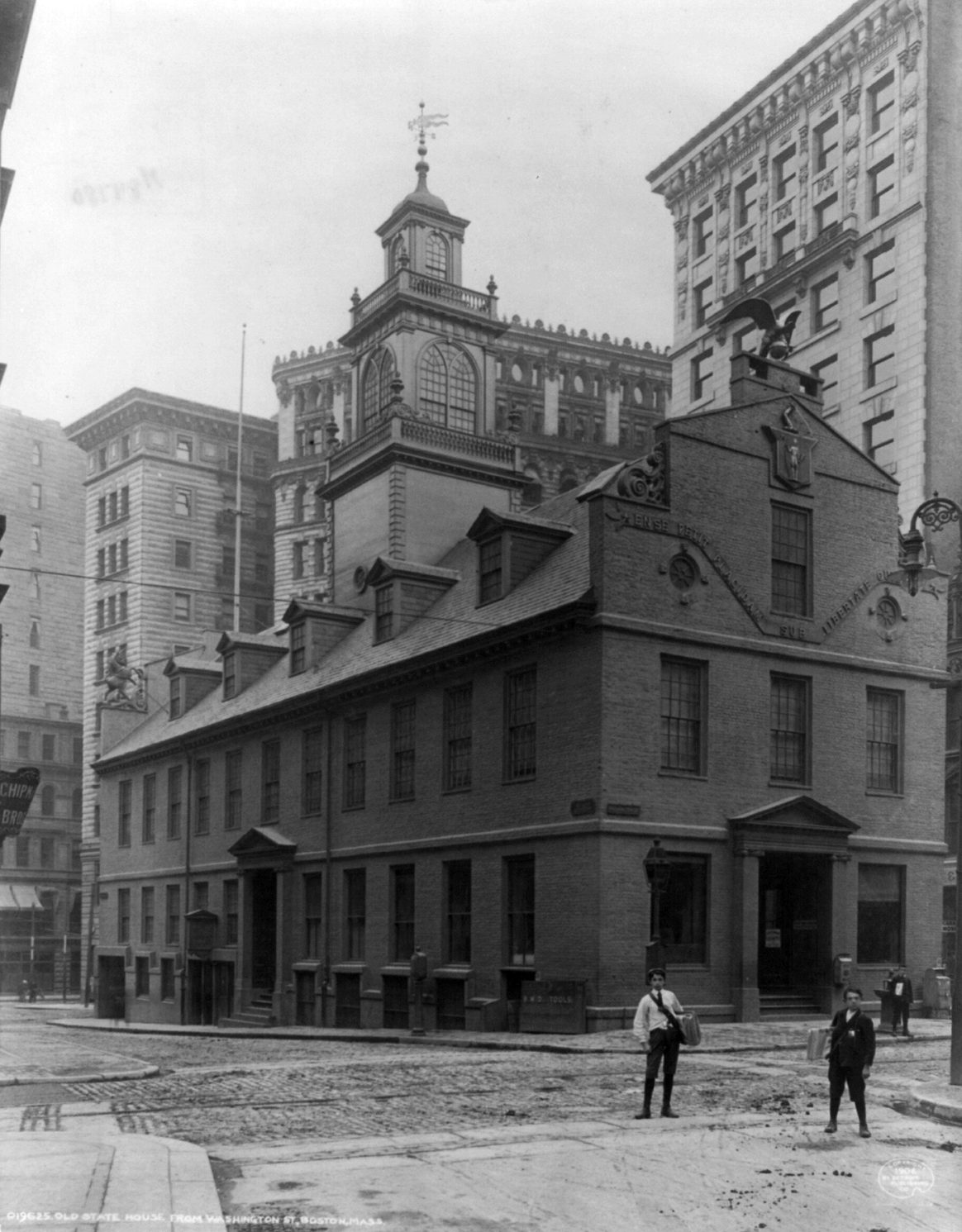
Almost every clause in this lesson answers a grievance the colonists could name. The loudest was the writ of assistance. British customs officers in Massachusetts used these writs to search suspected places for smuggled goods at their own discretion. A writ named no house and no owner. In February 1761 James Otis argued against them before the Superior Court in Boston. As the Supreme Court later retold it, Otis called the writ "the worst instrument of arbitrary power, the most destructive of English liberty and the fundamental principles of law, that ever was found in an English law book," because it placed "the liberty of every man in the hands of every petty officer."1 The argument began on 24 February 1761 in what is now the Old State House.2
Otis lost. The writs issued anyway. But a young lawyer named John Adams sat in the room taking notes, and 56 years later he wrote to William Tudor: "But Otis was a flame of fire!" And then: "Then and there the Child Independence was born."3 Adams's notes caught the line that became the theme of the Fourth Amendment: "A Man who is quiet, is as secure in his House, as a Prince in his Castle."4
England was fighting the same fight at home. Issues of The North Briton, especially No. 45, had been "very bold in denunciation of the government." On a general warrant from the secretary of state, officers searched John Wilkes's house, and his papers "were indiscriminately seized." Wilkes sued and won verdicts against the officer and against Lord Halifax, who signed the warrant.5 Then came John Entick. The King's messengers entered his house in November 1762 and carried off his papers. Ruling for Entick in 1765, Lord Camden wrote that a man's papers "are his dearest property, and are so far from enduring a seizure, that they will hardly bear an inspection."6 In 1886 the Supreme Court said every American statesman of the founding era knew Entick v. Carrington and treated it as "the true and ultimate expression of constitutional law."7
The punishment clauses came from the same distrust. Patrick Henry told the Virginia ratifying convention on June 14, 1788, that "when we come to punishments, no latitude ought to be left, nor dependence put on the virtue of representatives."8
James Madison carried those objections into the First Congress. On June 8, 1789, he proposed a ban on "warrants issued without probable cause, supported by oath or affirmation," a jury "of freeholders of the vicinage, with the requisite of unanimity for conviction," and the bail, fines and punishment clause word for word as ratified. He also proposed that "No state shall violate the equal rights of conscience, or the freedom of the press, or the trial by jury in criminal cases." Congress left that one out.9 Congress sent twelve amendments out on September 25, 1789, and ten were ratified on December 15, 1791.10 Module 6 covers that ratification.
The Text
As transcribed by the National Archives. None has been amended or repealed.
Amendment IV. The right of the people to be secure in their persons, houses, papers, and effects, against unreasonable searches and seizures, shall not be violated, and no Warrants shall issue, but upon probable cause, supported by Oath or affirmation, and particularly describing the place to be searched, and the persons or things to be seized.
Amendment V. No person shall be held to answer for a capital, or otherwise infamous crime, unless on a presentment or indictment of a Grand Jury, except in cases arising in the land or naval forces, or in the Militia, when in actual service in time of War or public danger; nor shall any person be subject for the same offence to be twice put in jeopardy of life or limb; nor shall be compelled in any criminal case to be a witness against himself, nor be deprived of life, liberty, or property, without due process of law; nor shall private property be taken for public use, without just compensation.
Amendment VI. In all criminal prosecutions, the accused shall enjoy the right to a speedy and public trial, by an impartial jury of the State and district wherein the crime shall have been committed, which district shall have been previously ascertained by law, and to be informed of the nature and cause of the accusation; to be confronted with the witnesses against him; to have compulsory process for obtaining witnesses in his favor, and to have the Assistance of Counsel for his defence.
Amendment VII. In Suits at common law, where the value in controversy shall exceed twenty dollars, the right of trial by jury shall be preserved, and no fact tried by a jury, shall be otherwise re-examined in any Court of the United States, than according to the rules of the common law.
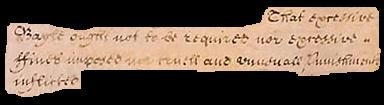
Amendment VIII. Excessive bail shall not be required, nor excessive fines imposed, nor cruel and unusual punishments inflicted.
U.S. Const. amends. IV through VIII (ratified December 15, 1791), National Archives, The Bill of Rights: A Transcription
The Fourth bans unreasonable searches of persons, houses, papers and effects, then sets the rules for a warrant: probable cause, a sworn statement, and a particular description of the place and the things. That last part is the writ of assistance turned inside out.
The Fifth stacks five protections in one sentence: grand jury indictment for serious federal crimes, no double jeopardy, no compelled self-incrimination, due process, and payment when government takes property.
The Sixth covers criminal trials: speed, openness, a local impartial jury, notice, confrontation, subpoenas for the defense, and a lawyer.
The Seventh keeps the civil jury for suits at common law above twenty dollars, and limits how a federal court may revisit a jury's findings. The twenty dollars has never been adjusted.
The Eighth bars excessive bail and fines and cruel and unusual punishment.
As written, all five bound only the federal government. The Court has since applied most of them to the states through the Fourteenth Amendment's Due Process Clause, one clause at a time. The grand jury clause and the Seventh Amendment still do not bind the states.11 Module 10 covers that incorporation story.
Searches, Warrants and the Exclusionary Rule
The Fourth Amendment says nothing about what happens when government breaks it. The Court filled that silence in 1914. Police and a United States marshal entered Fremont Weeks's Kansas City house without a warrant and took letters later used to convict him of mailing lottery tickets. A unanimous Court, in an opinion by Justice Day, held that if papers "can thus be seized and held and used in evidence against a citizen accused of an offense, the protection of the 4th Amendment ... is of no value."12 That is the federal exclusionary rule. It did not reach state police: Wolf v. Colorado (1949) held that "in a prosecution in a State court for a State crime the Fourteenth Amendment does not forbid the admission of evidence obtained by an unreasonable search and seizure."13
Then, on May 23, 1957, Cleveland officers looking for a bombing suspect broke into Dollree Mapp's home, waved a paper they called a warrant, searched the house and found obscene materials. At trial the prosecution produced no warrant. Justice Clark wrote for the Court: "We hold that all evidence obtained by searches and seizures in violation of the Constitution is, by that same authority, inadmissible in a state court." Justice Harlan, joined by Justices Frankfurter and Whittaker, dissented.14
The Court has since cut exceptions into the rule. In United States v. Leon (1984), officers relied on a judge's warrant later found to lack probable cause. Justice White's opinion called exclusion "a judicially created remedy" aimed at deterrence and held that evidence obtained "in objectively reasonable reliance on a subsequently invalidated search warrant" need not be suppressed. Justice Brennan, joined by Justice Marshall, wrote that he had watched "the Court's gradual but determined strangulation of the rule." Justice Stevens also dissented.15
Liberty Perspective: Idaho Kept the Older Rule
The Idaho Supreme Court rejected Leon under its own constitution. In State v. Guzman, 122 Idaho 981 (1992), it disavowed its 1989 adoption of the good-faith exception and held that exclusion under Article I, § 17 serves, among other ends, to "provide an effective remedy to persons who have been subjected to an unreasonable government search" and to "encourage thoroughness in the warrant issuing process." The court said it saw "no reason to depart from the exclusionary rationale set out in Weeks" and Idaho's own State v. Arregui (1927).16 A bad warrant can sink an Idaho case that would survive in federal court. Both courts read the same 1914 opinion and disagree about what it was for.
For decades a "search" meant a trespass. Then FBI agents attached a recorder to the outside of a public phone booth Charles Katz used to send wagering information from Los Angeles. No physical entry. Justice Stewart's opinion held it was a search anyway: "the Fourth Amendment protects people, not places." Justice Harlan's concurrence supplied the test courts still use, a "twofold requirement, first that a person have exhibited an actual (subjective) expectation of privacy and, second, that the expectation be one that society is prepared to recognize as 'reasonable.'" The vote was 7 to 1, Justice Black dissenting.17
The next year Cleveland Detective Martin McFadden's case reached the Court. On October 31, 1963, he watched two men take turns walking past the same store window, stopped and frisked them, and found two revolvers. Chief Justice Warren's opinion in Terry v. Ohio held that when an officer "observes unusual conduct which leads him reasonably to conclude in light of his experience that criminal activity may be afoot and that the persons with whom he is dealing may be armed and presently dangerous," he may make a limited pat-down for weapons.18 Justice Douglas dissented. The "reasonable suspicion" standard grew from that sentence.
Common Misconception: A Warrant Is Required for Every Search
The text bans unreasonable searches and then sets rules for warrants. It does not say every search needs one. The Court has approved Terry stops, searches incident to arrest, consent searches and more. It also treats warrantless searches as exceptions, and in Riley (below) it refused to stretch one to cover a phone. Which exception the government claims is usually the whole fight.
Privacy, Location Data and the Phone in Your Pocket
United States v. Jones (2012). Agents investigating nightclub owner Antoine Jones had a warrant to put a GPS tracker on his wife's Jeep within 10 days in the District of Columbia. They installed it on day 11, in Maryland, then argued no warrant was needed. All nine Justices disagreed, on two theories. Justice Scalia's opinion for five Justices relied on property: the government "physically occupied private property for the purpose of obtaining information," so attaching the device and using it was a "search." Justice Alito, joined by Justices Ginsburg, Breyer and Kagan, concurred in the judgment on privacy grounds; as Carpenter later summarized, the concurring Justices concluded that "longer term GPS monitoring in investigations of most offenses impinges on expectations of privacy." Justice Sotomayor joined both lines of reasoning.19
Riley v. California (2014). Police arrested David Riley after a traffic stop turned up guns, then went through his smartphone. The Court refused to extend the search-incident-to-arrest rule to a phone's contents. The holding "is not that the information on a cell phone is immune from search; it is instead that a warrant is generally required before such a search, even when a cell phone is seized incident to arrest." Chief Justice Roberts's shorter version: "get a warrant."20
Carpenter v. United States (2018). Investigating robberies, the FBI got Stored Communications Act orders for Timothy Carpenter's cell-site records. The orders required only "reasonable grounds," short of probable cause. Carriers turned over 12,898 location points across 127 days. Chief Justice Roberts, for a 5 to 4 Court, held that getting those historical records was a search and that the government "must generally obtain a warrant supported by probable cause." He also called the decision "a narrow one." It did not address real-time tracking or "tower dumps," and it did not "call into question conventional surveillance techniques and tools, such as security cameras."21
Four Justices dissented in four opinions. Justice Kennedy, joined by Justices Thomas and Alito, relied on United States v. Knotts (1983) (a driver on public streets "voluntarily conveyed to anyone who wanted to look" where he went) and on the third-party rule for business records. Justice Thomas argued that the Katz privacy test "reads the words 'persons, houses, papers, and effects' out of the text." Justice Alito separated a real search from an order to produce records. Justice Gorsuch questioned both the third-party rule and Katz and looked to property law.22
Today's arguments over license plate readers and purchased phone location data start from that split. The Supreme Court has not decided whether a camera network that logs every passing plate and stores the reads for later search is a Fourth Amendment search. Supporters point to Knotts and to Carpenter's carve-out for conventional tools like security cameras: a plate on a public road is in plain view. Opponents point to Carpenter's aggregation reasoning: enough sightings, stored and searched together, can rebuild a person's movements much as cell-site records did, which is what the Jones concurrences worried about. Lower courts and legislatures will likely settle much of this first.
Liberty Perspective: Two Ways to Read Four Words
The Fourth Amendment protects "persons, houses, papers, and effects." Since 1967 the Court has mostly asked instead whether a person had a reasonable expectation of privacy. Justices Thomas and Gorsuch argued in Carpenter that this test drifts from the text, and Justice Scalia's Jones opinion revived the property test beside it. Under either test, ask Otis's 1761 question: did a neutral judge approve this particular search, or did an officer decide alone?
The Fifth Amendment: Grand Juries, Jeopardy, Silence and Due Process
The grand jury
A serious federal charge needs a grand jury indictment. States are not bound. In 1882 a Sacramento County prosecutor charged Joseph Hurtado with murder by information, a charge filed after a magistrate's examination, with no grand jury. Hurtado v. California (1884) held that procedure is due process. Justice Harlan dissented.23 Idaho's constitution allows either route: a felony may be charged by grand jury indictment "or on information of the public prosecutor, after a commitment by a magistrate." If a grand jury refuses to charge, the information route closes for that charge.24
Double jeopardy
No one may be twice put in jeopardy for "the same offence," and those last two words do the work. Terance Gamble pleaded guilty to an Alabama felon-in-possession charge, and federal prosecutors then charged him for the same gun. In Gamble v. United States (2019), Justice Alito, for seven Justices, declined to overturn the dual-sovereignty doctrine: "where there are two sovereigns, there are two laws and two 'offences.'" Justices Ginsburg and Gorsuch dissented separately.25
Common Misconception: An Acquittal Ends Every Prosecution for the Same Act
It ends that sovereign's prosecution for that offense. Under Gamble, a county prosecutor and a United States Attorney may each charge the same conduct under their own laws. Any limit on that comes from statute or policy. The Double Jeopardy Clause does not supply one.
Self-incrimination and Miranda
On March 13, 1963, Phoenix officers questioned Ernesto Miranda in "Interrogation Room No. 2" and came out two hours later with a signed confession. No one had told him he could have a lawyer. Chief Justice Warren, for a 5 to 4 Court, held that a person in custody "must be warned prior to any questioning that he has the right to remain silent, that anything he says can be used against him in a court of law, that he has the right to the presence of an attorney, and that if he cannot afford an attorney one will be appointed for him prior to any questioning if he so desires." Justices Clark, Harlan, Stewart and White dissented.26
Common Misconception: No Miranda Warning Means the Case Gets Thrown Out
Miranda applies to a person "in custody" who is "to be subjected to interrogation." An officer who arrests someone and asks nothing owes no warning. When warnings are skipped, the usual consequence is that the prosecution loses the statements. The arrest stands, and other evidence can still come in.
Due process
"Due process of law" traces to Magna Carta's "law of the land," as Hurtado discussed at length. It means fair procedure, chiefly notice and a real chance to be heard, and, more contested, some limits on what government may do at all. The Fourteenth Amendment repeats the words against the states, and they carry most of this lesson's rights to your county.
Takings and Just Compensation
The Takings Clause assumes government will sometimes take property and sets two conditions: "public use" and "just compensation."
New London, Connecticut, had been declared a "distressed municipality" in 1990 and lost the Naval Undersea Warfare Center in 1996. When Pfizer announced a $300 million research facility in 1998, the city adopted a development plan for the Fort Trumbull neighborhood next door. Susette Kelo and other owners would not sell. No one alleged their properties were blighted. In Kelo v. City of New London (2005), Justice Stevens, for five Justices, upheld the condemnations as part of an integrated economic development plan. He added: "nothing in our opinion precludes any State from placing further restrictions on its exercise of the takings power."27
Justice O'Connor, joined by Chief Justice Rehnquist and Justices Scalia and Thomas, dissented: "Nothing is to prevent the State from replacing any Motel 6 with a Ritz-Carlton, any home with a shopping mall, or any farm with a factory."
Liberty Perspective: Public Use or Public Purpose?
The text says "public use." The Kelo majority read it as "public purpose," following older cases, and applied that to a transfer from one private owner to another. Justice O'Connor said it would "wash out any distinction between private and public use of property." Idaho answered in 2006 with Idaho Code § 7-701A. It bars eminent domain "for any alleged public use that is merely a pretext for the transfer of the condemned property ... to a private party" and "for the purpose of promoting or effectuating economic development," with exceptions, and it demands clear and convincing evidence before urban renewal property is taken.28 The federal floor is low. Idaho's statute sits well above it.
The newest compensation case came from a county. Geraldine Tyler's Minneapolis condo ran up about $2,300 in unpaid taxes and $13,000 in interest and penalties after she moved to a senior community. Hennepin County took it, sold it for $40,000 and kept the $25,000 surplus. Chief Justice Roberts, for a unanimous Court in Tyler v. Hennepin County (2023), held that the county could sell the home to collect the debt but "could not use the tax debt to confiscate more property than was due." Keeping the surplus was "a classic taking." His closing line: "The taxpayer must render unto Caesar what is Caesar's, but no more."29
Trial Rights: Speed, Publicity, Counsel, Confrontation and the Civil Jury
Speedy trial. The Sixth Amendment sets no deadline. Willie Barker's murder trial was continued 16 times over more than five years. In Barker v. Wingo (1972), Justice Powell's opinion set four factors to weigh: "Length of delay, the reason for the delay, the defendant's assertion of his right, and prejudice to the defendant." Barker lost: the Court found that for most of that time he "definitely did not want to be tried."30
Public trial and the jury. The public trial right belongs to the accused; the press and public have their own interest under the First Amendment (Module 7). Duncan v. Louisiana (1968) held that "trial by jury in criminal cases is fundamental to the American scheme of justice," so the Fourteenth Amendment guarantees it in state cases that would get a jury in federal court.31
Counsel. Clarence Earl Gideon, charged in Florida with breaking into a poolroom, asked for a lawyer and was told Florida appointed counsel only in capital cases. He defended himself and lost. Justice Black wrote for the Court in 1963 that "lawyers in criminal courts are necessities, not luxuries," and that Betts v. Brady (1942), which let states deny counsel, "should be overruled." No Justice dissented.32 Every county public defender budget traces to Gideon.
Confrontation. Michael Crawford stabbed a man he said had tried to rape his wife, Sylvia. Marital privilege kept her off the stand, so the prosecution played her recorded police statement, which Crawford could not cross-examine. Ohio v. Roberts (1980) allowed that if a judge found the statement reliable. Justice Scalia, for seven Justices in Crawford v. Washington (2004), rejected that test: "Where testimonial statements are at issue, the only indicium of reliability sufficient to satisfy constitutional demands is the one the Constitution actually prescribes: confrontation." Chief Justice Rehnquist, joined by Justice O'Connor, concurred in the judgment only.33
The civil jury. The Seventh Amendment binds federal courts only. In 1916 the Court said the first ten amendments, "including, of course, the 7th, are not concerned with state action, and deal only with Federal action." That is why Idaho can let three-fourths of a civil jury return a verdict.34 In SEC v. Jarkesy (2024), Chief Justice Roberts, for six Justices, held that when the SEC seeks civil penalties for securities fraud, the Seventh Amendment entitles the defendant to a jury. Justice Sotomayor, joined by Justices Kagan and Jackson, dissented.35
Bail, Fines and Punishment
Bail. Bail secures the accused's return. Stack v. Boyle (1951): "Bail set at a figure higher than an amount reasonably calculated to fulfill this purpose is 'excessive' under the Eighth Amendment."36 Idaho's constitution adds that all persons "shall be bailable by sufficient sureties, except for capital offenses, where the proof is evident or the presumption great."
Fines and forfeiture. Indiana sought forfeiture of the $42,000 Land Rover Tyson Timbs bought with life insurance money after his father died; the maximum fine for his drug crime was $10,000. The Indiana Supreme Court said the Excessive Fines Clause did not bind states. Justice Ginsburg, for the Court in Timbs v. Indiana (2019), held that the clause is "fundamental to our scheme of ordered liberty," with "dee[p] root[s] in [our] history and tradition," and is "therefore incorporated by the Due Process Clause of the Fourteenth Amendment." No Justice dissented; Justice Thomas would have used the Privileges or Immunities Clause instead.37
Liberty Perspective: The Fine as Revenue
Timbs warns that excessive fines can be used "to retaliate against or chill the speech of political enemies" and "as a source of revenue." More than two centuries passed before the clause bound a single state. Civil forfeiture, fees stacked on fines, and surplus kept after tax sales all pay the government doing the punishing. Timbs and Tyler did not end those programs. They set a constitutional ceiling. In both, the government held property worth far more than the debt or the maximum fine.
Cruel and unusual punishment. Death penalty and prison law are beyond this lesson. One recent case lands on local government, and it started in Idaho. In Martin v. Boise (2019), the Ninth Circuit held that the Eighth Amendment barred enforcing Boise's public-camping ordinance against homeless people when they outnumbered available shelter beds. In City of Grants Pass v. Johnson (2024), Justice Gorsuch, for six Justices, held that enforcing generally applicable camping laws on public property is not cruel and unusual punishment. The clause, he wrote, "focuses on the question what 'method or kind of punishment' a government may impose after a criminal conviction, not on the question whether a government may criminalize particular behavior in the first place." Justice Sotomayor, joined by Justices Kagan and Jackson, dissented: "Sleep is a biological necessity, not a crime," and punishing people with nowhere else to go "punishes them for being homeless."38 The Martin rule is gone, and the choice is back with local officials, subject to state law.
Landmark Cases
| Case | Citation and year | Holding | Effect today |
|---|---|---|---|
| Weeks v. United States | 232 U.S. 383 (1914) | Illegally seized papers excluded in federal court. | Federal exclusionary rule. |
| Mapp v. Ohio | 367 U.S. 643 (1961), 6 to 3 | Exclusion applies in state court. | Overruled Wolf on that point; narrowed by Leon. |
| Katz v. United States | 389 U.S. 347 (1967), 7 to 1 | Bugging a phone booth was a search. | Privacy test; displaced Olmstead's trespass rule. |
| Terry v. Ohio | 392 U.S. 1 (1968), 8 to 1 | Stop and frisk on reasonable suspicion. | Basis of every investigative stop. |
| United States v. Jones | 565 U.S. 400 (2012), 9 to 0 judgment | Attaching and using a GPS tracker is a search. | Revived the property test. |
| Riley v. California | 573 U.S. 373 (2014), 9 to 0 | Searching an arrestee's phone generally needs a warrant. | Every phone taken at booking. |
| Carpenter v. United States | 585 U.S. 296 (2018), 5 to 4 | Historical cell-site records need a warrant. | Narrow; starting point for location data. |
| Miranda v. Arizona | 384 U.S. 436 (1966), 5 to 4 | Warnings before custodial interrogation. | Standard police practice. |
| Gamble v. United States | 587 U.S. 678 (2019), 7 to 2 | State and federal prosecutions may both proceed. | Dual sovereignty kept. |
| Kelo v. City of New London | 545 U.S. 469 (2005), 5 to 4 | Planned economic development is a public use. | Idaho Code § 7-701A sets a higher bar. |
| Tyler v. Hennepin County | 598 U.S. 631 (2023), 9 to 0 | Keeping tax-sale surplus is a taking. | Counties return the excess. |
| Gideon v. Wainwright | 372 U.S. 335 (1963), 9 to 0 | States must appoint counsel in felony cases. | Overruled Betts v. Brady. |
| Crawford v. Washington | 541 U.S. 36 (2004), 9 to 0 judgment | Testimonial statements require confrontation. | Replaced the Roberts reliability test. |
| SEC v. Jarkesy | 603 U.S. 109 (2024), 6 to 3 | SEC fraud penalties require a jury. | Limits agency in-house penalties. |
| Timbs v. Indiana | 586 U.S. 146 (2019), 9 to 0 | Excessive Fines Clause binds states. | Reaches punitive local forfeitures. |
| City of Grants Pass v. Johnson | 603 U.S. 520 (2024), 6 to 3 | Camping bans are not cruel and unusual punishment. | Displaced Martin v. Boise. |
Also discussed: Wolf, 338 U.S. 25 (1949); Leon, 468 U.S. 897 (1984); Boyd, 116 U.S. 616 (1886); Hurtado, 110 U.S. 516 (1884); Barker, 407 U.S. 514 (1972); Duncan, 391 U.S. 145 (1968); Stack, 342 U.S. 1 (1951); Bombolis, 241 U.S. 211 (1916); State v. Guzman, 122 Idaho 981 (1992).
Where This Shows Up for Officials, Reporters and Citizens
Every Idaho officer swears to "support the Constitution of the United States, and the Constitution of the State of Idaho."39 For these amendments the oath gets tested in ordinary county business. The people below are invented.
The sheriff and the warrant affidavit. Sheriff Dana Whitlock's deputies write warrant affidavits every week. Article I, § 17 requires "probable cause shown by affidavit," and under Guzman a thin one can cost the state its evidence even where Leon would save it federally. Affidavit training is cheaper than a lost case. After Riley, a phone taken at booking goes in an evidence bag and its contents wait for a warrant.
The commissioners and the camera contract. A vendor offers the county license plate reader cameras on subscription, and Commissioner Ray Ostrander has to vote. Carpenter does not decide the question. What a board does control is in the contract: how long reads are kept, who may search them, whether a search needs a case number, whether reads are shared with other agencies, and whether audit logs are public. Write them down before signing.
The prosecutor and the charging decision. Idaho prosecutors may charge a felony by information after a preliminary hearing, which Article I, § 8 allows and Hurtado permits. A prosecutor who tries a grand jury first should remember § 8's one-way door.
The treasurer and the tax deed. After Tyler, a county that sells tax-deeded property may not keep more than it was owed. The treasurer should be able to show where every dollar above the debt went.
The commissioners and the budget. Gideon is a line item. So is the jail, whose headcount depends on bail, which under Stack v. Boyle exists to secure appearance.
The reporter covering an arrest. Reporter Lena Marsh is covering a felony case. She asks: Was there a warrant, and is the affidavit public? Was the defendant questioned in custody, and warned? Is a suppression motion pending, and on what theory? Who is defense counsel? And when someone says a case "was thrown out on a technicality," she checks which amendment the technicality came from.
The citizen at a city council meeting. After Grants Pass, a city deciding how to enforce camping rules is making a policy choice the Eighth Amendment no longer forecloses. Neither side can tell the council the Constitution decided it for them.
Related lessons: Module 4 on the federal courts and Article III's jury clause, Module 5 on state and federal power, and Module 12 on how to read a clause and an opinion.
Pictures, Numbers and Infographics
These amendments were written for searches, trials and punishments, and the numbers show how they work now. In the federal system almost every conviction comes from a guilty plea, and most people sitting in local jails on a given day have not been convicted of anything.
By the numbers
- 97.2%: of people sentenced in federal court in fiscal year 2024 pleaded guilty (59,922 of 61,678). The other 1,756, or 2.8%, went to trial. U.S. Sentencing Commission, 2024 Sourcebook, Table 12
- 298 of 304: people sentenced in the federal District of Idaho in fiscal year 2024 pleaded guilty (98.0%). Six went to trial. U.S. Sentencing Commission, Idaho District Statistics, FY2024
- 658,700: people held in local jails at midyear 2024, a 12% decrease from 744,600 in 2014. Bureau of Justice Statistics, Jail Inmates in 2024, 2026
- 68%: of people in local jails at midyear 2024 were unconvicted (450,700 people), up from 59% in 2014 and down from a peak of 71% in 2021. Bureau of Justice Statistics, 2026
- 2,297: wiretaps reported as authorized in 2024: 1,290 by federal judges and 1,007 by state judges, 9% more than in 2023. Administrative Office of the U.S. Courts, Wiretap Report 2024
- 31 days: average time a person admitted to jail between July 2023 and June 2024 spent there before release, up from 25 days in 2015. Bureau of Justice Statistics, 2026
Verify Independently
Every citation, quotation and case in this course should be verified independently against the official source (the U.S. Reports or the Court's own opinion, the National Archives transcription, the statute book) before you rely on it, quote it or act on it.
Sources & Further Reading
Primary Sources
- National Archives, The Bill of Rights: A Transcription
- National Archives, The Constitution of the United States: A Transcription
- Constitution Annotated, Seventh Amendment (Library of Congress)
- Founders Online, John Adams to William Tudor, Sr., 29 March 1817
- Founders Online, Adams Papers, editorial note on the writs of assistance argument
- Founders Online, James Madison, Amendments to the Constitution, 8 June 1789
- Idaho Constitution, Article I, § 6, § 7, § 8, § 13, § 14, § 17
- Idaho Code § 7-701A (limits on eminent domain) and § 59-401 (oath of office)
Court Opinions
- Cornell LII: Weeks, Wolf, Mapp, Leon, Katz, Terry, Boyd, Hurtado, Miranda, Barker, Duncan, Gideon, Crawford, Bombolis, Stack
- Cornell LII: Jones, Riley, Carpenter, Kelo, Gamble, Timbs, Tyler, Jarkesy, Grants Pass
- Supreme Court of the United States, opinions of the 2022 and 2023 Terms
- Oyez: Mapp v. Ohio, Riley v. California, Carpenter v. United States
- Caselaw Access Project, State v. Guzman, 122 Idaho 981 (1992)
- National Constitution Center, Interactive Constitution
Related Training Modules
Knowledge Check
Test your understanding of the Fourth through Eighth Amendments. No scores are saved: this is for your own review.
1. James Otis argued against writs of assistance in Boston in February 1761. What made those writs so objectionable?
Right. The writ was general: it left the choice of where to search to the officer, which Otis said put "the liberty of every man in the hands of every petty officer." The Fourth Amendment's particularity requirement answers it. Not quite. The writs were general search authority for customs officers, choosing places at their own discretion. The Fourth Amendment's demand that a warrant "particularly" describe the place answers that.
2. Which of these is NOT in the text of the Fourth Amendment?
Correct. The exclusionary rule comes from the Court, starting with Weeks v. United States (1914). Leon (1984) called it "a judicially created remedy." The Amendment includes the other three. The exclusionary rule is court-made, from Weeks (1914) and Mapp (1961), and Idaho applies its own version under Article I, § 17.
3. In Carpenter v. United States (2018), what did the Court hold?
Yes. By a 5 to 4 vote the Court required a warrant for historical cell-site records and called its decision "a narrow one," leaving conventional tools like security cameras alone. It did not decide license plate readers. Carpenter held that acquiring historical cell-site records is a search requiring a warrant, 5 to 4. It called itself narrow and did not rule on security cameras or plate readers.
4. A county takes a home for $15,000 in unpaid taxes and sells it for $40,000. Under Tyler v. Hennepin County (2023), what may the county keep?
Correct. A unanimous Court held the county could sell to collect the debt but "could not use the tax debt to confiscate more property than was due." Tyler was unanimous: the county may collect the debt, but keeping the $25,000 surplus was "a classic taking." The Takings Clause binds counties through the Fourteenth Amendment.
5. Which Bill of Rights protection covered in this lesson still does NOT apply to the states?
Right. Hurtado v. California (1884) let states charge felonies by information. Idaho allows indictment or information under Article I, § 8. Timbs (2019) applied the fines clause to the states, Gideon (1963) the counsel right, and Mapp (1961) the exclusionary rule. The grand jury clause still binds only federal prosecutions, under Hurtado (1884).
Reference Materials
Use your browser's print function (Ctrl+P / Cmd+P) to save this page as a PDF for offline reference.
- How We Got Here: jump to section
- The Text of Amendments IV through VIII: jump to section
- Searches and the Exclusionary Rule: jump to section
- Privacy and Location Data: jump to section
- The Fifth Amendment: jump to section
- Takings and Just Compensation: jump to section
- Trial Rights: jump to section
- Bail, Fines and Punishment: jump to section
- Landmark Cases table: jump to section
Footnotes
- Boyd v. United States, 116 U.S. 616 (1886), recounting Otis's argument and placing it "in February, 1761, in Boston." Text fetched from Cornell LII.
- Founders Online, Adams Papers, editorial note on the writs of assistance case (Petition of Lechmere): argued before the Superior Court in "the Council Chamber of what is now the Old State House in Boston"; "The argument actually began on 24 February 1761."
- John Adams to William Tudor, Sr., 29 March 1817, Founders Online, Adams/99-02-02-6735.
- Quoted from John Adams's notes of the argument in Carpenter v. United States, 585 U.S. 296 (2018) (Thomas, J., dissenting), citing M. Smith, The Writs of Assistance Case 339 (1978). Justice Thomas also notes that Adams later drafted Article XIV of the Massachusetts Constitution, a model for the Fourth Amendment.
- Boyd, 116 U.S. 616, describing the general warrants against The North Briton, No. 45, the search of Wilkes's house, and his verdicts against the officer Wood and against Lord Halifax, the secretary of state who issued the warrant.
- Entick v. Carrington, 19 How. St. Tr. 1029 (C.P. 1765), as quoted in Boyd, 116 U.S. 616. Boyd dates the entry to November 1762 and the judgment to Michaelmas term, 1765. United States v. Jones, 565 U.S. 400 (2012), also relies on Entick.
- Boyd, 116 U.S. 616.
- Timbs v. Indiana, 586 U.S. 146 (2019), quoting Brutus II (Nov. 1, 1787) and Patrick Henry, Virginia ratifying convention (June 14, 1788), 3 Elliot's Debates 447. Timbs also quotes L. Friedman calling fines "the drudge-horse of criminal justice" in colonial times.
- James Madison, Amendments to the Constitution, 8 June 1789, Founders Online, Madison/01-12-02-0126. Compare the twelve articles in the 1789 Joint Resolution, National Archives transcription.
- National Archives, The Bill of Rights: A Transcription: Congress proposed 12 amendments on September 25, 1789; ten were ratified December 15, 1791.
- Hurtado v. California, 110 U.S. 516 (1884) (grand jury); Minneapolis & St. Louis R. Co. v. Bombolis, 241 U.S. 211 (1916) (Seventh Amendment). Timbs, 586 U.S. 146, notes that "With only 'a handful' of exceptions" the Bill of Rights has been incorporated, citing McDonald v. Chicago, 561 U.S. 742 (2010).
- Weeks v. United States, 232 U.S. 383 (1914) (argued December 2 and 3, 1913; decided February 24, 1914). The count of conviction charged use of the mails to transport lottery tickets.
- Wolf v. Colorado, 338 U.S. 25 (1949) (Frankfurter, J.). Justices Douglas, Murphy and Rutledge dissented.
- Mapp v. Ohio, 367 U.S. 643 (1961) (decided June 19, 1961). Vote of 6 to 3 per Oyez; Justice Black concurred, Justice Douglas concurred, and Justice Stewart wrote separately without reaching the Fourth Amendment question.
- United States v. Leon, 468 U.S. 897 (1984) (White, J.); Brennan, J., joined by Marshall, J., dissenting; Stevens, J., dissenting in No. 82-1771. Vote of 6 to 3 per Oyez. The quoted "judicially created remedy" language is from United States v. Calandra, 414 U.S. 338 (1974), quoted in Leon.
- State v. Guzman, 122 Idaho 981, 842 P.2d 660 (1992) (decided November 5, 1992), disavowing State v. Prestwich, 116 Idaho 959 (1989), and relying on State v. Arregui, 44 Idaho 43 (1927). Text from the Caselaw Access Project.
- Katz v. United States, 389 U.S. 347 (1967) (decided December 18, 1967) (Stewart, J.); id. (Harlan, J., concurring); Black, J., dissenting; Marshall, J., took no part. Katz held that the trespass doctrine of Olmstead v. United States, 277 U.S. 438 (1928), and Goldman v. United States "can no longer be regarded as controlling."
- Terry v. Ohio, 392 U.S. 1 (1968) (decided June 10, 1968) (Warren, C.J.); Douglas, J., dissenting.
- United States v. Jones, 565 U.S. 400 (2012) (decided January 23, 2012) (Scalia, J., joined by Roberts, C.J., and Kennedy, Thomas and Sotomayor, JJ.); Sotomayor, J., concurring; Alito, J., joined by Ginsburg, Breyer and Kagan, JJ., concurring in the judgment. The "longer term GPS monitoring" language is quoted from the concurrences in Carpenter, 585 U.S. 296. Citation confirmed through CourtListener and Carpenter's own citation of "565 U.S., at 404-405."
- Riley v. California, 573 U.S. 373 (2014) (decided June 25, 2014, with United States v. Wurie) (Roberts, C.J.); Alito, J., concurring in part and in the judgment. Citation confirmed through Oyez.
- Carpenter v. United States, 585 U.S. 296 (2018) (decided June 22, 2018) (Roberts, C.J., joined by Ginsburg, Breyer, Sotomayor and Kagan, JJ.). The orders issued under 18 U.S.C. § 2703(d).
- Carpenter, 585 U.S. 296 (Kennedy, J., joined by Thomas and Alito, JJ., dissenting, quoting United States v. Knotts, 460 U.S. 276, 281-282 (1983)); (Thomas, J., dissenting); (Alito, J., joined by Thomas, J., dissenting); (Gorsuch, J., dissenting). Knotts is cited as quoted in Carpenter.
- Hurtado v. California, 110 U.S. 516 (1884); Harlan, J., dissenting. The information was filed February 20, 1882, in Sacramento County.
- Idaho Const. art. I, § 8.
- Gamble v. United States, 587 U.S. 678 (2019) (decided June 17, 2019) (Alito, J., joined by Roberts, C.J., and Thomas, Breyer, Sotomayor, Kagan and Kavanaugh, JJ.); Thomas, J., concurring; Ginsburg, J., and Gorsuch, J., dissenting. Citation confirmed through CourtListener.
- Miranda v. Arizona, 384 U.S. 436 (1966) (decided June 13, 1966) (Warren, C.J.); Clark, J., dissenting in Miranda's case and three companions, concurring in the result in California v. Stewart; Harlan, J., joined by Stewart and White, JJ., dissenting; White, J., joined by Harlan and Stewart, JJ., dissenting.
- Kelo v. City of New London, 545 U.S. 469 (2005) (decided June 23, 2005) (Stevens, J., joined by Kennedy, Souter, Ginsburg and Breyer, JJ.); Kennedy, J., concurring; O'Connor, J., joined by Rehnquist, C.J., and Scalia and Thomas, JJ., dissenting; Thomas, J., dissenting. Citation confirmed through CourtListener and Oyez.
- Idaho Code § 7-701A(2) (added 2006, ch. 96; amended 2015 and 2021).
- Tyler v. Hennepin County, 598 U.S. 631 (2023) (decided May 25, 2023) (Roberts, C.J., for a unanimous Court); Gorsuch, J., joined by Jackson, J., concurring. Citation confirmed through CourtListener.
- Barker v. Wingo, 407 U.S. 514 (1972) (decided June 22, 1972) (Powell, J.). The opinion describes 16 continuances, and the reporter's syllabus notes a trial "more than five years after he had been arrested."
- Duncan v. Louisiana, 391 U.S. 145 (1968) (decided May 20, 1968).
- Gideon v. Wainwright, 372 U.S. 335 (1963) (decided March 18, 1963) (Black, J.), overruling Betts v. Brady, 316 U.S. 455 (1942). Justices Douglas, Clark and Harlan wrote separately; none dissented.
- Crawford v. Washington, 541 U.S. 36 (2004) (decided March 8, 2004) (Scalia, J., joined by Stevens, Kennedy, Souter, Thomas, Ginsburg and Breyer, JJ.); Rehnquist, C.J., joined by O'Connor, J., concurring in the judgment. The prior test came from Ohio v. Roberts, 448 U.S. 56 (1980).
- Minneapolis & St. Louis R. Co. v. Bombolis, 241 U.S. 211 (1916) (decided May 22, 1916); Idaho Const. art. I, § 7 ("in civil actions, three-fourths of the jury may render a verdict").
- SEC v. Jarkesy, 603 U.S. 109 (2024) (decided June 27, 2024) (Roberts, C.J., joined by Thomas, Alito, Gorsuch, Kavanaugh and Barrett, JJ.); Gorsuch, J., joined by Thomas, J., concurring; Sotomayor, J., joined by Kagan and Jackson, JJ., dissenting. Citation confirmed through CourtListener.
- Stack v. Boyle, 342 U.S. 1 (1951) (decided November 5, 1951); Idaho Const. art. I, § 6.
- Timbs v. Indiana, 586 U.S. 146 (2019) (decided February 20, 2019) (Ginsburg, J., joined by Roberts, C.J., and Breyer, Alito, Sotomayor, Kagan, Gorsuch and Kavanaugh, JJ.); Gorsuch, J., concurring; Thomas, J., concurring in the judgment. Timbs declined to reconsider Austin v. United States, 509 U.S. 602 (1993), which treats civil in rem forfeitures as fines when at least partly punitive. Citation confirmed through CourtListener.
- City of Grants Pass v. Johnson, 603 U.S. 520 (2024) (decided June 28, 2024) (Gorsuch, J., joined by Roberts, C.J., and Thomas, Alito, Kavanaugh and Barrett, JJ.); Thomas, J., concurring; Sotomayor, J., joined by Kagan and Jackson, JJ., dissenting. Martin v. Boise, 920 F.3d 584 (9th Cir. 2019), is described from the Grants Pass opinion.
- Idaho Code § 59-401 (oath of office). Idaho Const. art. III, § 25 sets the oath for legislators.