U.S. CONSTITUTION · Module 16 · Article VII
Module 16: Article VII: Ratification
Nine states, the conventions, the Federalist and Anti-Federalist fight and how the Constitution took effect
The Text of Article VII
Article VII is the shortest article in the Constitution and the only one that finished its work before the government it created began to operate. The whole text is a single sentence:
"The Ratification of the Conventions of nine States, shall be sufficient for the Establishment of this Constitution between the States so ratifying the Same."
U.S. Const. art. VII
The sentence sets a number, names the bodies that must act, and limits the effect.1 The number is nine of the thirteen States, a little under seven in ten. The bodies are conventions, assemblies elected for the single purpose of considering the Constitution, and not the ordinary State legislatures. The effect is limited: the Constitution would be established "between the States so ratifying the Same." A State that stayed out was not bound, and a State that came in later would join something already running.
The article also differs from every other part of the document in how it was meant to be used. The rest of the Constitution governs how the government works once it exists. Article VII governed how the government came to exist. No State has acted under it since Rhode Island's convention voted on May 29, 1790, and States admitted afterward, Idaho among them, came in under Article IV, section 3 (Module 14).2 The article still matters for what it says about where the Constitution's authority comes from, a question courts, scholars and candidates keep returning to.
This lesson follows the rule from its origin in the Confederation's unanimity requirement, through the Convention's votes of July, August and September 1787, to the thirteen State conventions and the first Wednesday of March 1789, when the new government began its work. It also reports the arguments each side made, in their own words where the record allows. The Preamble's opening words, "We the People," are covered in Module 13, and the amendment process in Article V is covered in the amendment module.
The Problem: Unanimity Under the Articles
The Articles of Confederation took effect only after all thirteen legislatures had agreed to them, and they said the same about changing them. Article XIII ended with a promise and a condition: "the Union shall be perpetual; nor shall any alteration at any time hereafter be made in any of them; unless such alteration be agreed to in a Congress of the United States, and be afterwards confirmed by the legislatures of every State."3 Every State legislature had to confirm any change. One State could block it.
The Convention that met in Philadelphia in May 1787 had been authorized by Congress on February 21, 1787 for "the sole and express purpose of revising the Articles of Confederation and reporting to Congress and the several legislatures such alterations and provisions therein as shall when agreed to in Congress and confirmed by the states render the federal constitution adequate to the exigencies of Government & the preservation of the Union."4 That language points toward the Article XIII route: a report to Congress, then confirmation by the States. Under it, Rhode Island, which had sent no delegates to Philadelphia, could have stopped the project alone.
The delegates knew the danger. During the July 23 debate on how to ratify, Nathaniel Gorham of Massachusetts put it bluntly: "will any one say, that all the States are to suffer themselves to be ruined, if Rho. Island should persist in her opposition to general measures." He added that other States "might also tread in her steps" and named New York, which profited from taxing its neighbors' trade.5 Edmund Randolph of Virginia made the same point in his own State's convention in June 1788, calling Rhode Island "in rebellion against integrity" and noting that a rule of unanimity "would have been tantamount to returning without having done any thing."6
The opposing view had real force. Luther Martin of Maryland told his State's House of Delegates on November 29, 1787 that the Articles "expressly directs that all the States must agree before it can be dissolved," and in his published account he described the position of the Maryland delegation: an agreement among States could not be changed except as the agreement itself provided.7 The argument was that a compact binds everyone who signed it, and that the Convention was proposing to replace it by the action of a part of the signers.
Drafting the Rule, May to September 1787
The popular-ratification idea
The proposal that the Constitution be ratified by assemblies chosen by the people is as old as the Convention. Edmund Randolph's Virginia Plan, presented May 29, 1787, said in its fifteenth resolution that the amendments to the Confederation "ought at a proper time, or times, after the approbation of Congress to be submitted to an assembly or assemblies of Representatives, recommended by the several Legislatures to be expressly chosen by the people, to consider & decide thereon."8 When the Convention took up that resolution on June 5, Roger Sherman thought popular ratification unnecessary because the Articles already provided for changes through Congress and the State legislatures.8 The question came back on July 23, and the debate that day is the fullest statement of why the Convention chose conventions.
July 23: legislatures or conventions
Oliver Ellsworth of Connecticut moved that the plan go to the State legislatures. William Paterson seconded him. George Mason answered that the legislatures "have no power to ratify it. They are the mere creatures of the State Constitutions, and can not be greater than their creators." The authority had to be sought "To the people with whom all power remains that has not been given up in the Constitutions derived from them." A second reason followed: if the legislatures ratified, "succeeding Legislatures having equal authority could undo the acts of their predecessors; and the National Govt. would stand in each State on the weak and tottering foundation of an Act of Assembly."5
Ellsworth's reply was practical. The Articles had been ratified by legislatures and "acquiesced in without complaint." An act by which States made themselves parties by their legislatures "becomes a compact from which no one of the parties can recede of itself." Madison closed the debate with the distinction that explains the whole article. A system founded on the legislatures alone, he said, differs from one founded on the people in the way that "a league or treaty" differs from "a Constitution." A law that violated a treaty could still be respected by judges as a law, while "a law violating a constitution established by the people themselves, would be considered by the Judges as null & void." And under the law of nations a breach of one treaty article by one party frees the others, but "In the case of a union of people under one Constitution, the nature of the pact has always been understood to exclude such an interpretation."5
Ellsworth's motion lost. Delaware and Maryland voted for it and Connecticut's delegation divided, while New Hampshire, Massachusetts, Pennsylvania, Virginia, North Carolina, South Carolina and Georgia voted no. The Convention then agreed to the nineteenth resolution, referring the new Constitution to "assemblies to be chosen by the people for the express purpose of ratifying it," by nine States to one, with only Delaware opposed.5
August 6: a blank in the draft
The Committee of Detail turned the resolution into text. Its report of August 6 contained an article reading: "The ratifications of the Conventions of [blank] States shall be sufficient for organizing this Constitution." A separate article provided that the Constitution "shall be laid before the United States in Congress assembled, for their approbation" and then submitted to a convention in each State. The number was left blank.9
August 30 and 31: filling the blank
The Convention took up the blank on August 30. James Wilson proposed seven, "that being a majority of the whole number." Sherman, thinking of the Articles' unanimity rule, wanted ten. Randolph proposed nine, "a respectable majority of the whole, and being a number made familiar by the constitution of the existing Congress." That last point has a basis in the text: the Articles required the assent of nine States for the most important acts of Congress, including war, treaties, borrowing, coining money and admitting a new colony.3 Mason made the same observation the next day, saying that "Nine States had been required in all great cases under the Confederation & that number was on that account preferable."1011
Two exchanges on August 30 shaped the final text. Madison pointed out that as drafted, with any of those numbers, "the Constitution as it stands might be put in force over the whole body of the people, tho' less than a majority of them should ratify it." Wilson answered that "As the Constitution stands, the States only which ratify can be bound." In a case like this, he said, the delegates had to go back to "the original powers of Society," and "The House on fire must be extinguished, without a scrupulous regard to ordinary rights."10 Daniel Carroll of Maryland moved to fill the blank with thirteen, because "unanimity being necessary to dissolve the existing confederacy which had been unanimously established," and Rufus King agreed that something had to be added because otherwise "it will operate on the whole though ratified by a part only."10 The session ended there.
On August 31 King moved to add the words "between the said States." The Convention agreed, nine States to one, with only Maryland opposed. The words limited the Constitution's reach to the ratifying States and answered Madison's worry.11 Then came the vote on the number itself. Madison had proposed a double test, seven or more States "entitled to thirty three members at least in the House," which he said would require "a majority both of the States and people," but no separate vote on it appears in his notes. Carroll and Martin moved thirteen, and every State except Maryland voted no. Sherman and Jonathan Dayton moved ten, which lost four States to seven (Connecticut, New Jersey, Maryland and Georgia in favor). Then nine carried, eight States to three. Virginia, North Carolina and South Carolina voted no.11
Sherman's objection, which he made before the vote, was that "Perhaps all the States may concur, and on that supposition it is needless to hold out a breach of faith."11 The vote on the number had the following shape.
| Number proposed | Proposed by | States for | States against | Result |
|---|---|---|---|---|
| Thirteen | Carroll and Martin (Md.) | 1 (Md.) | 10 | Lost |
| Ten | Sherman and Dayton | 4 (Conn., N.J., Md., Ga.) | 7 | Lost |
| Nine | Randolph (proposed Aug. 30) | 8 | 3 (Va., N.C., S.C.) | Carried |
The Convention also took up the matter of Congress. The draft article said the Constitution should be laid before Congress "for their approbation." Gouverneur Morris and Charles Pinckney moved to strike those words, and the motion carried, eight States to three, with Massachusetts, Maryland and Georgia opposed. Thomas Fitzsimons explained the reason on September 10: the words had been struck "in order to save Congress from the necessity of an Act inconsistent with the Articles of Confederation under which they held their authority."1112 Congress would transmit the plan, without being asked to approve it.
September 10: Gerry and Hamilton Try Again
On September 10 Elbridge Gerry moved to reconsider the two articles. He objected to changing the Government without the approbation of Congress and to "an annulment of the confederation with so little scruple or formality." Alexander Hamilton joined him, for a different reason. He thought it "wrong also to allow nine States as provided by art XXI. to institute a new Government on the ruins of the existing one," and proposed a different route: send the plan to Congress, have Congress pass it to the legislatures, and have each legislature direct its convention to decide whether the plan "ought to take effect between the States so assenting" once nine States agreed.12
The objections that followed came from both sides. Gorham warned that "different and conditional ratifications will defeat the plan altogether." Hamilton answered that "No Convention convinced of the necessity of the plan will refuse to give it effect on the adoption by nine States." Gerry replied with the sentence critics would quote for the next year: "If nine out of thirteen can dissolve the compact, Six out of nine will be just as able to dissolve the new one hereafter." Randolph said that if no change were made he "should be obliged to dissent from the whole of it," and proposed that the State conventions be free to offer amendments, to be considered by a second general convention. Wilson, who spoke against Hamilton's plan, called it "worse than folly to rely on the concurrence of the Rhode Island members of Congs." and noted that Maryland had voted for unanimity and that "N. York has not been represented for a long time past in the Convention."12
The Convention voted to reconsider by seven States to three, with New Hampshire divided. It then rejected Hamilton's motion to postpone Article XXI in favor of his substitute, with only Connecticut in favor and ten States against. Article XXI passed unanimously as it stood, and a motion to restore "for the approbation of Congress" failed without dissent.12 The Convention had considered the alternatives and kept its rule. On September 13 it adopted the resolutions that accompanied the Constitution: it should be laid before Congress and "afterwards be submitted to a Convention of Delegates chosen in each State by the people thereof, under the recommendation of its Legislature, for their assent & ratification"; each ratifying convention should notify Congress; and once nine States ratified, Congress should fix a day for the appointment of presidential electors, a day for them to vote, and "the time and place for commencing proceedings under this Constitution."13
September 17 and 28
On the last day Randolph explained his refusal to sign: "Nine States will fail to ratify the plan and confusion must ensue."14 Mason had said on August 31 that he "would sooner chop off his right hand than put it to the Constitution as it now stands."11 Thirty-nine delegates signed anyway.1 Congress debated the plan from September 26 to 282 and on the 28th "Resolved Unanimously that the said Report with the resolutions and letter accompanying the same be transmitted to the several legislatures in Order to be submitted to a convention of Delegates chosen in each state by the people thereof in conformity to the resolves of the Convention made and provided in that case." It neither endorsed nor condemned the document. It sent it on.15
The Critics: Breaking a Perpetual Union
The opponents of the Constitution found a legal argument in Article VII that did not depend on disliking any of the powers the Constitution granted. It said the process was invalid.
Luther Martin described the Maryland delegation's position in his published report to the Maryland House of Delegates. In forming a government, he said the delegation argued, "it was necessary that every individual should agree to it to become bound thereby," and a compact "could not be dissolved by consent, unless with the consent of every individual who was party to the original agreement." The States had each "expressly consented" to the Articles, and under those Articles "no alterations are to be made... unless after they are approved by Congress, they are agreed to and ratified by the legislature of every State; but by the resolve of the convention this constitution is not to be ratified by the legislatures of the respective States." He also objected to the removal of "for their approbation," saying the advocates of the plan feared Congress would reject it and meant "to force it upon them, if possible, through the intervention of the people at large."16
An anonymous writer who signed himself "Samuel" put the same point in a January 10, 1788 essay, quoting Article XIII back at the Convention. The proposed Constitution, he wrote, "does not appear to be agreed to by Congress, neither is it a Confederation of the States; but professedly of the people, as in the very first words of it." Ratification by nine conventions "is expressly repugnant to the Confederation, the sacred national covenant we are under; and to set up a schism in the nation."17 The writer known as the Federal Farmer, in a letter of January 25, 1788, made the practical version. The States "all agreed about seven years ago, that the confederation should remain unaltered, unless every state should agree to alterations: but we now see it agreed by the convention, and four states, that the old confederacy shall be destroyed, and a new one, of nine states, be erected, if nine only shall come in." He worried about "a nearly equal and dangerous division of the people for and against the constitution," and asked whether "nine states, under a new federal compact, can claim the benefits of any treaties made with a confederation of thirteen" or collect the debts owed to the old confederacy.18
Edmund Randolph's objection was about the all-or-nothing choice. In a letter to the Speaker of the Virginia House of Delegates dated October 10, 1787, he explained why he had not signed. He had moved in the Convention that the State conventions "should be at liberty to amend, and that a second general convention should be holden, to discuss the amendments," and the motion had been "negatived." He feared that if the people were given only the choice of adopting or rejecting the Constitution as a whole, they would reject it and "bid a lasting farewell to the union."19 The Pennsylvania minority said the same thing about its own convention. They were "prohibited by an express vote of the Convention, from taking any question on the separate articles of the plan, and reduced to the necessity of adopting or rejecting in toto."20
A friend of the Constitution reached the same worry from the other side. William Short, writing to James Madison on December 21, 1787, thought nine was the wrong number: "the adoption by nine & the refusal by four of the States is the worst possible situation to which the new plan can give birth." He suggested eleven or twelve, which "would have been either refused altogether or adopted by such a commanding majority as would almost necessarily have brought in the others in the end."21
The Defenders: Necessity and the Authority of the People
The defenders conceded that the Articles said what they said. Their answer rested on necessity and on reciprocity, and they made both arguments in public.
Madison's essay in The Federalist No. 43, published January 23, 1788, begins its treatment of the article by saying that it "speaks for itself. The express authority of the people alone could give due validity to the Constitution." Unanimity "would have subjected the essential interests of the whole to the caprice or corruption of a single member." On how the Confederation could be set aside "without the unanimous consent of the parties to it," Madison answered "by recurring to the absolute necessity of the case; to the great principle of self-preservation; to the transcendent law of nature and of nature's God, which declares that the safety and happiness of society are the objects at which all political institutions aim, and to which all such institutions must be sacrificed."22
The reciprocity argument came next. Madison noted that many States had ratified the Articles only by legislative act, and a compact "founded on ordinary acts of legislative authority, can pretend to no higher validity than a league or treaty between the parties." Under the law of nations, he added, a treaty's articles "are mutually conditions of each other; that a breach of any one article is a breach of the whole treaty." If it came to an appeal to those truths, he asked, would not "the complaining parties find it a difficult task to answer the MULTIPLIED and IMPORTANT infractions with which they may be confronted?"22 Madison does not list the infractions in this essay. The Confederation's record is covered in the Articles of Confederation lessons.
The other Federalist arguments came from the delegates who made them in their own States. Randolph, in the Virginia convention on June 4, 1788, asked what number would have been right: "Ought we to have required the concurrence of all the thirteen? Rhode Island... would then have it in her power to defeat the Union." Twelve would have left "it in the power of any one state to dissolve the Union." "A majority of the whole would have been too few. Nine states therefore seem to be a most proper number."6 George Washington, writing Randolph on January 8, 1788, said he did "now most firmly believe, that, in the aggregate, it is the best Constitution that can be obtained at this Epocha, and that this, or a dissolution of the Union awaits our choice, and are the only alternatives before us."23
Madison's earlier statement of the point, in the Convention on July 23, did not defend nine as such. It defended the people as the source. The people, he said on August 31 in the debate over conventions, "were in fact, the fountain of all power, and by resorting to them, all difficulties were got over. They could alter constitutions as they pleased. It was a principle in the Bills of rights, that first principles might be resorted to."11
Liberty Perspective: The Constitution Depends on Consent
Article VII is a short lesson in how a free people give a government its authority. A government that rested on its own say-so, or on the say-so of the legislatures it would limit, would hold power on the same footing as the people it governs. The Convention chose a process in which delegates chosen by voters for that single question decided whether the new government would exist. Whatever one concludes about the legal argument over unanimity, the instinct behind the choice, that the voters should authorize their government and not the officeholders it will constrain, appears in the Preamble, in Idaho's Constitution (art. I, § 2, "All political power is inherent in the people") and in the later amendments that put the vote in more hands.24
The Thirteen Conventions
Each legislature called an election for delegates, and each convention met, debated, and voted. The dates and votes below come from the Teaching American History timeline of ratification, checked against the ratification instruments published by the Avalon Project where the instrument gives a date. The sources differ on a few dates, and the table says where.
| Order | State | Date | Vote | Notes |
|---|---|---|---|---|
| 1 | Delaware | Dec. 7, 1787 | 30 to 0 | First to ratify. |
| 2 | Pennsylvania | Dec. 12, 1787 | 46 to 23 | The minority published a dissent on Dec. 18. |
| 3 | New Jersey | Dec. 18, 1787 | 38 to 0 | |
| 4 | Georgia | Jan. 2, 1788 | 26 to 0 | The instrument is dated Jan. 2. Some sources give Dec. 31, 1787. |
| 5 | Connecticut | Jan. 9, 1788 | 128 to 40 | Signed Jan. 8, certified Jan. 9. |
| 6 | Massachusetts | Feb. 6, 1788 | 187 to 168 | Recommended nine amendments. |
| 7 | Maryland | Apr. 28, 1788 | 63 to 11 | The vote was taken Apr. 26. |
| 8 | South Carolina | May 23, 1788 | 149 to 73 | |
| 9 | New Hampshire | June 21, 1788 | 57 to 47 | The ninth State. Recommended twelve amendments. |
| 10 | Virginia | June 25, 1788 | 89 to 79 | The instrument is dated June 26. Recommended twenty amendments. |
| 11 | New York | July 26, 1788 | 30 to 27 | Recommended thirty-one amendments. |
| 12 | North Carolina | Nov. 21, 1789 | 194 to 77 | The first convention (Aug. 2, 1788) voted 184 to 84 against ratifying without a declaration of rights. |
| 13 | Rhode Island | May 29, 1790 | 34 to 32 | After Congress had sent the first amendments to the States. |
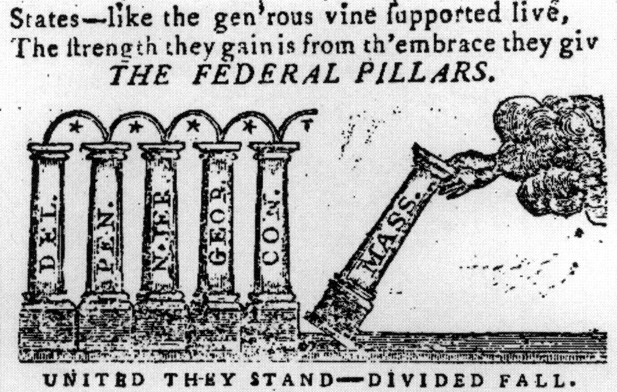
The first five States ratified in under four months, and three of them by unanimous vote. Delaware's 30 to 0 on December 7, 1787 came 81 days after the Convention adjourned. The next group was harder. Massachusetts ratified by 19 votes out of 355, and the ratification came with nine recommended amendments (the TAH timeline marks January 30, 1788 as the day the "Massachusetts Compromise" was proposed). New Hampshire's convention first met in February, voted 56 to 51 on February 22 to adjourn until June, and ratified on its second session. New York's margin was three votes, Virginia's ten.2
The ratification documents themselves are worth reading, because many of them echo the Preamble. Massachusetts, New Hampshire and South Carolina each recited the Preamble's purposes in the opening of their instruments. Massachusetts and New Hampshire "acknowledg[ed] with grateful hearts, the goodness of the Supreme Ruler of the Universe in affording the People of the United States in the course of his providence an opportunity deliberately & peaceably without fraud or surprize of entering into an explicit & solemn Compact with each other by assenting to & ratifying a New Constitution, in order to form a more perfect Union, establish Justice, insure Domestic tranquillity, provide for the common defence, promote the general welfare & secure the blessings of Liberty to themselves & their posterity."2526 South Carolina's instrument recited the same words and ratified "in the name and behalf of the people of this State."27 The phrases "the People of the Commonwealth" and "an explicit & solemn Compact with each other" sit in the same sentence of the Massachusetts and New Hampshire instruments. The argument over whether the Constitution is a compact among States or the creation of one people did not end there (see Module 13).
Pennsylvania's instrument is shorter. It is headed "In the Name of the People of Pennsylvania" and says the delegates "Do in the Name and by the authority of the Same People, and for ourselves, assent to, and ratify the foregoing Constitution for the United States of America."28 Georgia's recites Congress's September 28 resolution and ratifies "in virtue of the powers and authority to Us given by the People of the said State for that purpose."29 The language of "the people" is everywhere in the instruments, though in each case it is the people of a particular State.
The delegate counts help explain why these were serious bodies. According to the TAH timeline, the States elected 69 delegates in Pennsylvania, 168 in Connecticut, 355 in Massachusetts, 30 in Delaware, 38 in New Jersey, 26 in Georgia, 76 in Maryland, 222 in South Carolina, 268 in North Carolina, 168 in Virginia, 67 in New York and 110 in New Hampshire. That is 1,597 delegates in twelve conventions.2
The Ninth State and Congress
New Hampshire's ratification on June 21, 1788 was the ninth. The Constitution had reached the threshold Article VII set, and the question became what Congress would do.
Congress's part in the process raised a legal question. The ratification reached the Confederation Congress, then sitting in New York City, on July 2. The journal for that day records that "the president reminded Congress that this was the ninth ratification transmitted and laid before them," and on motion of Mr. Clarke the Congress ordered the ratifications referred to a committee "to examine the same, and report an act to Congress for putting the said Constitution into operation, in pursuance of the resolutions of the late Federal Convention." Mr. Yates asked for the yeas and nays, and New York's delegation divided, with Mr. L'Hommedieu voting for the motion and Mr. Yates against it.30 Nothing in the Constitution gave Congress a veto, and the Convention's September 13 resolutions had told it only to set the dates. The committee reported an act on July 14 and Congress debated it until September 13.30
The other four States had not yet acted. Virginia ratified four days after New Hampshire, on June 25. New York was still deliberating at Poughkeepsie and North Carolina and Rhode Island had not voted. The new government could begin with nine States, but Virginia and New York were large States and both were doubtful, and Madison and Hamilton were both working to bring them in.
Can a State Ratify on Conditions?
The question of conditional ratification was the real contest of 1788. Virginia and New York each had a strong group that wanted to make ratification depend on amendments. Article VII did not say whether a ratification could carry conditions. It said only that "the Ratification of the Conventions" of nine States would be sufficient.
Virginia, June 1788
Patrick Henry and his allies wanted Virginia to adopt "previous amendments," meaning amendments approved before ratification. James Monroe, speaking on June 25, said he could not "conceive that a conditional ratification would, in the most remote degree, endanger the Union," because it was "as clearly the interest of the adopting states to be united with Virginia, as it could be her interest to be in union with them." Madison, on the same day, asked the delegates "to consider the distance to which they throw the ultimate settlement, and the extreme risk of perpetual disunion." Amendments after adoption could be obtained by the Article V route: they "can be proposed when the legislatures of two thirds of the states shall make application for that purpose; and the legislatures of three fourths of the states, or conventions in the same, can fix the amendments so proposed."31 Madison had put the other side of the case the day before. If nine States, "having freely and fully considered the subject," had adopted the Constitution, could they be expected, "upon the demand of a single state, agree that they acted wrong, and could not see its defects," and "tread back the steps which they have taken"?31
The Virginia convention's instrument shows how it resolved the matter. The instrument, dated June 26, 1788, declares in the name of the people of Virginia "that the powers granted under the Constitution being derived from the People of the United States may be resumed by them whensoever the same shall be perverted to their injury or oppression and that every power not granted thereby remains with them and at their will." Then it ratifies unconditionally, "under the conviction that whatsoever imperfections may exist in the Constitution ought rather to be examined in the mode prescribed therein than to bring the Union into danger by a delay with a hope of obtaining Amendments previous to the Ratification." It recommends amendments afterward.32 The vote was 89 to 79.
New York, July 1788
New York's Poughkeepsie convention met with a majority opposed to the Constitution. Alexander Hamilton, writing to Madison on July 19, 1788, described a proposed compromise: "the only qualification will be the reservation of a right to recede in case our amendments have not been decided upon in one of the modes pointed out in the Constitution within a certain number of years," and he guessed the period would be "perhaps five or seven." He asked whether New York could be "received on that plan."33
Madison answered the next day: "My opinion is that a reservation of a right to withdraw if amendments be not decided on under the form of the Constitution within a certain time, is a conditional ratification, that it does not make N. York a member of the New Union, and consequently that she could not be received on that plan. Compacts must be reciprocal, this principle would not in such a case be preserved. The Constitution requires an adoption in toto, and for ever. It has been so adopted by the other States. An adoption for a limited time would be as defective as an adoption of some of the articles only. In short any condition whatever must viciate the ratification." He added that the idea of a right to withdraw "was started at Richmd. & considered as a conditional ratification which was itself considered as worse than a rejection."34
New York ratified on July 26, 30 votes to 27, in a form that avoided the problem. The instrument declared that "all Power is originally vested in and consequently derived from the People," and that the explanations it set out "are consistent with the said Constitution." It then said that "in confidence that the Amendments which shall have been proposed to the said Constitution will receive an early and mature Consideration" the delegates "Do by these presents Assent to and Ratify the said Constitution." The delegates added an "In full Confidence nevertheless" paragraph about the militia and elections, a statement of expectation, and not a condition. The TAH timeline records that on July 25 the convention rejected a conditional ratification.352
Madison's letter had no authority in itself, but it recorded the working understanding among the Constitution's supporters. A State could attach recommendations, express confidence, even add a long list of proposed amendments, and still count as a ratifying State. A reservation of a right to leave would not count. Whether Congress would have accepted a New York conditional ratification is a question nobody had to answer.
The amendments the States asked for
Five of the conventions that ratified in 1788 recommended amendments: Massachusetts (nine), New Hampshire (twelve), Virginia (twenty), New York (thirty-one) and South Carolina, whose declarations included that the manner of holding congressional elections should stay with the States. Rhode Island, ratifying in 1790, did the same, and North Carolina's first convention had drawn up its own declaration of rights and list of amendments in August 1788.22527 The recommendations that recurred most often were that powers not delegated were reserved to the States, that Congress should limit its use of direct taxes, and that a list of individual rights be added. Madison introduced his proposed amendments in the First Congress on June 8, 1789.36 Thomas Jefferson, writing from Paris on February 7, 1788, had hoped for a middle road: "I wish with all my soul that the nine first Conventions may accept the new Constitution, because this will secure to us the good it contains, which I think great and important. But I equally wish that the four latest conventions, whichever they be, may refuse to accede to it till a declaration of rights be annexed."37 Jefferson's wish was not what happened. The Bill of Rights followed ratification instead of preceding it, and the individual amendment modules trace its drafting.
North Carolina and Rhode Island: Outside the Union, 1789 to 1790
Article VII said the Constitution would be established "between the States so ratifying the Same." That meant what it said. When the new Congress met in March 1789, North Carolina and Rhode Island had not ratified, and for a time they stood outside the Union the other eleven States had formed.
North Carolina's first convention, which convened on July 21, 1788, took up the question after the ninth State had already ratified. It voted 184 to 84 on August 2, 1788 against ratifying, and the convention's published resolution of August 1 explains the terms: "a Declaration of Rights, asserting and securing from encroachment the great Principles of civil and religious Liberty, and the unalienable Rights of the People, together with Amendments to the most ambiguous and exceptional Parts of the said Constitution of Government, ought to be laid before Congress, and the Convention of the States that shall or may be called for the Purpose of Amending the said Constitution, for their consideration, previous to the Ratification of the Constitution aforesaid, on the part of the State of North Carolina."382 That was a conditional position, and Article VII left North Carolina free to take it. A second convention met in November 1789, after Congress had sent twelve amendments to the States on September 25, and ratified on November 21 by 194 to 77. The instrument is brief: the convention, "in behalf of the freemen, citizens and inhabitants of the State of North Carolina, do adopt and ratify the said Constitution and form of Government."38
Rhode Island's path was longer. The TAH timeline records that on March 24, 1788 Rhode Island "rejects call for a state ratifying convention." The State's convention did not meet until May 26, 1790, and it ratified on May 29 by 34 votes to 32, a margin of two. The instrument follows the pattern of New York's, with a declaration of rights and "In full confidence nevertheless" paragraphs, and it expresses confidence that the amendments it proposed would "receive an early and mature consideration, and conformably to the fifth article of said constitution, speedily become a part thereof."392 Rhode Island's vote came 451 days after Congress first met under the Constitution.
Madison had anticipated the situation in The Federalist No. 43. The second delicate question, he wrote, was "What relation is to subsist between the nine or more States ratifying the Constitution, and the remaining few who do not become parties to it?" He wrote that "the flattering prospect of its being merely hypothetical, forbids an over-curious discussion of it," and that it was "one of those cases which must be left to provide for itself." His general observation was that "although no political relation can subsist between the assenting and dissenting States, yet the moral relations will remain uncancelled."22 Justice Thomas relied on the point in his dissent in U.S. Term Limits, Inc. v. Thornton (1995), saying the Constitution "did not bind the people of North Carolina until they had accepted it."40
March 4, 1789: When the Constitution Took Effect
The question of when the Constitution took effect has more than one answer, and the dates are close enough to get confused.
The Constitution's own text gives no date. The Convention's September 13, 1787 resolutions left the dates to Congress, and Congress acted on September 13, 1788, in an act the Founders' Constitution reproduces from the Journal. After reciting the history, it resolved "That the first Wednesday in January next be the day for appointing electors in the several states which, before the said day, shall have ratified the said Constitution; that the first Wednesday in February next be the day for the electors to assemble in their respective states, and vote for a President: and that the first Wednesday in March next be the time, and the present seat of Congress the place, for commencing proceedings under the said Constitution."30 The first Wednesday in March 1789 was March 4. The first Wednesday in January was January 7 and the first Wednesday in February was February 4.
Congress's handling of the process left a legal question, and Chief Justice Marshall answered it in Owings v. Speed (1820). The case turned on whether the Contracts Clause of the Constitution applied to a Virginia statute of 1788. Marshall reasoned that "Both Governments could not be understood to exist at the same time. The new Government did not commence until the old Government expired." The new government did not begin on the ninth ratification, he explained, because the ratifications "were to be reported to Congress, whose continuing existence was recognised by the Convention, and who were requested to continue to exercise their powers for the purpose of bringing the new government into operation." In fact "Congress did continue to act as a government until it dissolved on the first of November, by the successive disappearance of its members. It existed potentially until the 2d of March, the day preceding that on which the members of the new Congress were directed to assemble." His conclusion was that the operation of the Constitution "did not commence before the first Wednesday in March, 1789."41 The statute was passed before then, so the Contracts Clause did not reach it.
The House counts the same way. Hinds' Precedents, its compilation of its own rulings, says that "By resolution of the Continental Congress the First Congress under the Constitution met on March 4, 1789," and that "The term of a Congress begins on the fourth of March of the odd-numbered years." On April 30, 1790 the House appointed a committee to join one from the Senate to report "when, according to the Constitution, the terms for which the President, Vice-President, Senators, and Representatives have been respectively chosen, shall be deemed to have commenced." The pages this lesson read do not say how that committee answered.42 The March 4 date for the end of presidential terms lasted until the Twentieth Amendment, which provides that the terms of the President and Vice President "shall end at noon on the 20th day of January."43
The actual start was slower than the schedule. The National Archives account says that "the early months of 1789 proved to be unseasonably cold and snowy and bad weather delayed many members of the First Federal Congress from arriving promptly in New York City." Until a quorum could be established in both houses, no business could be conducted. The House reached a quorum on April 1, according to the National Constitution Center. On April 6, "enough members had reached New York to tally the electoral ballots," and "George Washington won unanimously with 69 electoral votes." Washington took the oath on April 30, 1789, on a balcony of Federal Hall in New York, from Robert R. Livingston, Chancellor of New York.4445
The result is a sequence of dates that all have a claim to be "the" date: September 17, 1787 (the Convention signs), June 21, 1788 (the ninth ratification), September 13, 1788 (Congress sets the transition), March 4, 1789 (proceedings commence), April 6, 1789 (electors' votes counted), and April 30, 1789 (the President takes office). Owings v. Speed treats March 4, 1789 as the date the new government began to operate.
Who Made the Constitution? Nation, Compact, or Both
Article VII feeds the oldest argument in American constitutional theory. Was the Constitution made by one American people, or by the peoples of the several States, each acting for itself? The text and the history both support parts of each answer.
The State-by-State reading
The Constitution was approved State by State, by conventions elected in each State, and it was to take effect "between the States so ratifying." A State that ratified bound its own people and no one else's. Madison's The Federalist No. 39 draws the conclusion. The Constitution, he wrote, is "to be founded on the assent and ratification of the people of America, given by deputies elected for the special purpose." But that assent "is to be given by the people... as composing the distinct and independent States to which they respectively belong." He called the act of establishing the Constitution "a FEDERAL act," because it would result "neither from the decision of a MAJORITY of the people of the Union, nor from that of a MAJORITY of the States." It would come instead "from the UNANIMOUS assent of the several States that are parties to it."46
Madison's phrase in the same essay, that the foundation of the Constitution "is federal, not national," is the best-known statement of the State-based view, and Justice Thomas leaned on it in U.S. Term Limits.4640
The national reading
The other reading begins with who the conventions spoke for. Chief Justice Marshall dealt with the argument directly in McCulloch v. Maryland (1819). The Convention that framed the document was chosen by the State legislatures, but "the instrument, when it came from their hands, was a mere proposal, without obligation, or pretensions to it." It was submitted to the people, who "acted upon it in the only manner in which they can act safely, effectively and wisely, on such a subject, by assembling in convention. It is true, they assembled in their several states," and, he asked, "where else should they have assembled? No political dreamer was ever wild enough to think of breaking down the lines which separate the states, and of compounding the American people into one common mass. Of consequence, when they act, they act in their states. But the measures they adopt do not, on that account, cease to be the measures of the people themselves, or become the measures of the state governments." The conclusion: "From these conventions, the constitution derives its whole authority. The government proceeds directly from the people."47
The McCulloch passage accepts the State-by-State process and denies the conclusion drawn from it. The conventions met in States because that is where people lived and voted, and what they approved was a Constitution for the United States. Marshall had already stated the foundation in Marbury v. Madison (1803): "That the people have an original right to establish, for their future government, such principles as, in their opinion, shall most conduce to their own happiness, is the basis on which the whole American fabric has been erected."48 And in Martin v. Hunter's Lessee (1816) Justice Story wrote that the Constitution "was ordained and established, not by the states in their sovereign capacities, but emphatically, as the preamble of the constitution declares, by 'the people of the United States.'"49
The synthesis the Court reached after the Civil War
In Texas v. White (1869) the Court held that Texas had not left the Union. Chief Justice Chase wrote that "The Union of the States never was a purely artificial and arbitrary relation. It began among the Colonies... It was confirmed and strengthened by the necessities of war, and received definite form, and character, and sanction from the Articles of Confederation. By these the Union was solemnly declared to 'be perpetual.' And when these Articles were found to be inadequate to the exigencies of the country, the Constitution was ordained 'to form a more perfect Union.' It is difficult to convey the idea of indissoluble unity more clearly than by these words. What can be indissoluble if a perpetual Union, made more perfect, is not?" The States, in turn, survived as States: "The Constitution, in all its provisions, looks to an indestructible Union, composed of indestructible States."50 Texas, once admitted, "entered into an indissoluble relation," and the Court called its admission "the incorporation of a new member into the political body. And it was final." Of the union between Texas and the other States the Court said: "There was no place for reconsideration, or revocation, except through revolution, or through consent of the States."50
The original States came in by ratification, and States admitted later came in by Congress under Article IV, section 3. The Court's reasoning in Texas v. White is stated about Texas, and Idaho's own Constitution takes the same view of Idaho in article I, section 3: "The state of Idaho is an inseparable part of the American Union."51
Common Misconception: Article VII Let a State Leave Later
Some writers read Article VII's phrase "between the States so ratifying the Same" as proof that a State that joined could leave. The phrase describes the starting rule for a Constitution that was not yet in force, and it says nothing about leaving. Texas v. White, decided in 1869, held that after ratification the relation is indissoluble except through revolution or the consent of the States, and the Constitution has no clause allowing a State to withdraw.50
Common Misconceptions About Ratification
Common Misconception: The Constitution Was Ratified on September 17, 1787
September 17, 1787 is the date the delegates signed. A signature on the Convention's final text did not bind anyone. The Constitution was ratified State by State from December 1787 to May 1790. The ninth ratification, which met Article VII's threshold, came on June 21, 1788 (New Hampshire), and the government began its work on March 4, 1789.230
Common Misconception: All Thirteen States Had to Approve
Article VII required nine, and the Convention considered and rejected both thirteen (on August 31, only Maryland voted for it) and ten (4 States for, 7 against). North Carolina and Rhode Island did not ratify until after the new government was operating.112
Common Misconception: The State Legislatures Ratified the Constitution
The legislatures called the conventions and set the rules for electing delegates, and the conventions did the ratifying. The Convention voted for that rule on July 23, 1787 after Mason, Madison and others argued that legislatures were the "creatures of the State Constitutions" and could not give the new government the authority of the people. A legislative ratification would also have been open to repeal by later legislatures, Mason argued.5 Article V, by contrast, allows ratification of amendments by legislatures or conventions.
Common Misconception: Ratification Was a Landslide
Three small States ratified unanimously, but the large States were close. Massachusetts voted 187 to 168, Virginia 89 to 79, New York 30 to 27 and New Hampshire 57 to 47. Rhode Island's convention voted 34 to 32. The delegates, not the voters, cast these votes, and the sources used for this lesson do not give the number of voters who took part in electing them.2
Questions and Answers
Was Article VII legal under the Articles of Confederation?
The text of Article XIII did not authorize it. The Articles required Congress's agreement and the confirmation of every legislature, and the Convention's rule required neither.3 The Convention's defenders argued necessity and reciprocity, as Madison did in The Federalist No. 43, and the critics replied that a compact cannot be dissolved by a part of the parties.2216 Congress did not endorse the Constitution. It voted unanimously to send it to the legislatures, and eleven States had ratified by the end of July 1788.
Why did the Convention choose nine, and not twelve or thirteen?
Nine was a number the delegates already knew from the Articles, where it governed Congress's most important decisions. Randolph and Mason both said so, and Randolph added that thirteen would let Rhode Island block everything and twelve would let any single State do the same.10116 Critics such as William Short thought a higher number, eleven or twelve, would have forced a clearer answer.21
Could New York have ratified with a right to leave later?
Madison said no. His July 20, 1788 letter to Hamilton called a reservation of "a right to withdraw if amendments be not decided on" a "conditional ratification" that "does not make N. York a member of the New Union," and said that "The Constitution requires an adoption in toto, and for ever."34 The point was never tested, because New York ratified without a right to withdraw.
Why does Article VII say "between the States so ratifying"?
The words were added on August 31, 1787 on Rufus King's motion, by a vote of nine States to one, to answer a worry Madison had stated the day before: without them, the Constitution as drafted "might be put in force over the whole body of the people, tho' less than a majority of them should ratify it."1011 The words limited the Constitution to the ratifying States, and they explain why North Carolina and Rhode Island could stand outside it in 1789.
Does Article VII matter today?
It has no remaining operation, because all thirteen original States ratified and later States joined under Article IV. It remains the Constitution's own statement of where its authority came from, and the Supreme Court cites the ratification history when it addresses who made the Constitution and whether a State may leave it (McCulloch, Texas v. White, Term Limits).
Landmark Cases
None of these cases applies Article VII as a rule of decision. They use the ratification history to answer who made the Constitution, when it took effect, and whether the Union can be dissolved. Each description follows the text of the opinion or, where noted, a secondary summary.
| Case | Citation | Year | Holding or statement | Effect today |
|---|---|---|---|---|
| Chisholm v. Georgia | 2 U.S. (2 Dall.) 419 | 1793 | Chief Justice Jay described the people "in their collective and national capacity" as having established the Constitution. | Result on suits against States reversed by the Eleventh Amendment; the description of the Constitution's source is still cited. |
| Marbury v. Madison | 5 U.S. (1 Cranch) 137 | 1803 | The people have "an original right to establish, for their future government, such principles as, in their opinion, shall most conduce to their own happiness." | Foundation for judicial review and for the idea of popular authority. |
| Martin v. Hunter's Lessee | 14 U.S. (1 Wheat.) 304 | 1816 | The Constitution was ordained "not by the states in their sovereign capacities" but by "the people of the United States." | Basis for Supreme Court review of State court decisions on federal law. |
| McCulloch v. Maryland | 17 U.S. (4 Wheat.) 316 | 1819 | The State conventions gave the Constitution "its whole authority"; the people acted in their States without becoming State governments. | Leading statement of the national reading of ratification. |
| Owings v. Speed | 18 U.S. (5 Wheat.) 420 | 1820 | The new government did not begin until the first Wednesday in March 1789, so the Contracts Clause did not reach a Virginia statute of 1788. | Fixes March 4, 1789 as the start of the Constitution's operation. |
| Texas v. White | 74 U.S. (7 Wall.) 700 | 1869 | The Union is "perpetual" and "indissoluble"; a State's admission is "final" absent revolution or consent of the States. | A State cannot leave by its own act. |
| Hawke v. Smith (No. 1) | 253 U.S. 221 | 1920 | "Legislatures" in Article V means the representative body, so a referendum cannot ratify an amendment; the Constitution "was ordained by the people." | Governs who may ratify amendments. |
| National Organization for Women v. Idaho | 459 U.S. 809 | 1982 | Vacated the district court's judgment in the Idaho ERA case as moot after the extended deadline passed (from a secondary summary; the opinion was not read). | Left open whether a State may rescind a ratification. |
| U.S. Term Limits, Inc. v. Thornton | 514 U.S. 779 | 1995 | Five to four. Dissent relied on Article VII and Federalist No. 39 to argue the Constitution rests on the people of each State. | The State-based and national readings both remain in the opinions. |
Idaho and the Ratification Principle
Idaho entered the Union under Article IV, so Article VII never applied to it. The Idaho Constitution carries the same ratification principle in several places.
Ratified by the people
The Idaho State Historical Society's reference series on the convention and ratification describes how the delegates drafted the Constitution in 1889 and how the people approved it: the voters ratified the Constitution on November 5, 1889, and Idaho became a State on July 3, 1890.52 The convention, like the Philadelphia Convention, produced a proposal. The voters made it law. The vote total in secondary sources is 12,398 to 1,773; this lesson could not confirm that figure in an official source.
Amendments need a vote of the people
Idaho's amendment article keeps the same shape. Article XX, section 1 provides that an amendment proposed by two-thirds of each house of the Legislature goes to "the electors of the state at the next general election," and "if a majority of the electors shall ratify the same, such amendment or amendments shall become a part of this Constitution." Section 2 requires that if several amendments are proposed, "the electors shall vote for or against each of them separately."53 The Legislature proposes and the voters ratify, which is the Article VII relationship between the proposing body and the people.
The Union is permanent
Article I, section 3 of the Idaho Constitution says that "The state of Idaho is an inseparable part of the American Union, and the Constitution of the United States is the supreme law of the land."51 The first clause fits the Texas v. White holding on indissoluble Union, and the second is the Idaho echo of the Supremacy Clause (Module 15).
Idaho and the Equal Rights Amendment
Idaho's best-known ratification dispute came under Article V, which lets a proposed federal amendment be ratified by the State legislatures. According to a summary of the litigation, Idaho ratified the Equal Rights Amendment soon after Congress proposed it in March 1972 and had rescinded its ratification by 1977. Congress extended the original seven-year deadline, and Idaho sued. A federal district court in Idaho ruled in 1981 in Idaho v. Freeman, 529 F. Supp. 1107, and the Supreme Court vacated that judgment as moot in National Organization for Women v. Idaho, 459 U.S. 809 (1982), after the extended period expired without enough ratifications.54 This lesson relied on a secondary summary for these facts and did not read either opinion, so verify the details before relying on them. The case touches Madison's 1788 view that "any condition whatever must viciate the ratification," although Article V ratifications by State legislatures and the Article VII ratifications by conventions are different processes with different texts.
Where This Shows Up for Officials, Reporters and Citizens
The classroom date
Teacher Marcus Ellery tells his class that the Constitution "became law on September 17, 1787." The Convention signed on that date. Ratification ran from Delaware's convention on December 7, 1787 to Rhode Island's on May 29, 1790, the ninth State acted on June 21, 1788, and the government began on March 4, 1789. A lesson that gives each date its own event is accurate on all of them.241
The reporter checking "unanimous"
A reporter, Dana Whitfield, hears a candidate say the Constitution was "ratified unanimously." The accurate description is that the Convention's attestation says "the Unanimous Consent of the States present," and thirty-nine delegates signed, while the State conventions split, in some cases narrowly.12 Three of thirteen conventions voted unanimously. The close ones were Massachusetts (187 to 168), Virginia (89 to 79) and New York (30 to 27).
The legislator drafting a compact
Representative Tessa Vandermeer is drafting a bill to join a water compact that takes effect once four of six States enact it, a threshold-triggered structure with the same logic as Article VII. A bill with that structure has to say whether the compact binds only the States that enacted it, the question Article VII answered with the words "between the States so ratifying." It also has to account for the Compact Clause, under which "No State shall, without the Consent of Congress... enter into any Agreement or Compact with another State."1 Article VII faced no such requirement, because it created the Constitution that contains the clause.
The voter and the ballot
An Idaho voter reading the November ballot sees three proposed amendments to the Idaho Constitution. Article XX, section 2 requires that they be voted on separately, and section 1 makes the voter's majority the final step, "if a majority of the electors shall ratify the same."53 The voter holds the position the State convention delegates held in 1788: the proposing body drafts and the people decide.
The council member and "the people"
Council Member Harlan Pike says at a public meeting that the city's ordinance is "the will of the people." The Constitution's own source of authority, the people acting through conventions elected for the purpose, is the model Pike has in mind, but an ordinance has its own source. It derives from the city's charter and State law, and the voters who elected the council act through those. A reporter or citizen who wants to test the claim asks which clause of the charter or State law authorizes the ordinance. The Idaho Constitution puts the same point in article I, section 2: "Government is instituted for their equal protection and benefit."24
Pictures, Numbers and Infographics
The ratification of the Constitution took 985 days from the Convention's last session to the last of the original thirteen States. The government began 534 days after the Convention adjourned, with eleven States.
By the numbers
- 9 of 13: States whose conventions had to ratify under Article VII, a threshold of 69 percent. National Archives, Constitution transcription
- 8 to 3 and 4 to 7: the August 31, 1787 State votes for "nine" and for "ten" as the number. Madison's notes, Aug. 31, 1787
- 278 days: the time from the Convention's adjournment to the ninth ratification (New Hampshire, June 21, 1788). Computed from the Teaching American History timeline.
- 187 to 168, 89 to 79, 30 to 27: Massachusetts, Virginia and New York, the closest of the large States. Teaching American History
- 1,597: delegates elected to twelve conventions (excluding Rhode Island's 1790 convention), summed from the timeline's election entries. Teaching American History
- 256 days: from the ninth ratification (June 21, 1788) to March 4, 1789, the day proceedings were to commence. Owings v. Speed (Cornell LII)
- 69: electoral votes cast for George Washington, all of them, counted April 6, 1789. National Archives, Washington's first inaugural
- 451 days: how long after Congress first met under the Constitution (March 4, 1789) Rhode Island ratified (May 29, 1790). Hinds' Precedents; TAH
Verify Independently
Every citation, quotation and case in this course should be verified independently against the official source (the U.S. Reports or the Court's own opinion, the National Archives transcription, the statute book) before you rely on it, quote it or act on it.
Sources & Further Reading
Primary Sources
- National Archives, The Constitution of the United States: A Transcription
- National Archives, The Constitution: Amendments 11-27
- Articles of Confederation (Avalon Project)
- Resolution of Congress, Feb. 21, 1787 (Founders' Constitution, Art. 7, Doc. 1)
- Records of the Federal Convention on ratification (Founders' Constitution, Art. 7, Doc. 2)
- Madison's Notes, July 23, 1787 (the debate on conventions)
- Madison's Notes, August 6, 1787 (Committee of Detail report)
- Madison's Notes, August 30, 1787
- Madison's Notes, August 31, 1787
- Madison's Notes, September 10, 1787
- Madison's Notes, September 13, 1787
- Madison's Notes, September 17, 1787
- Resolution of Congress, September 28, 1787, Submitting the Constitution to the Several States
- Edmund Randolph to the Speaker of the Virginia House of Delegates, Oct. 10, 1787 (Art. 7, Doc. 4)
- Luther Martin, Maryland House of Delegates, Nov. 29, 1787 (Art. 7, Doc. 5)
- William Short to James Madison, Dec. 21, 1787 (Art. 7, Doc. 6)
- Luther Martin, Genuine Information (Art. 7, Doc. 7)
- George Washington to Edmund Randolph, Jan. 8, 1788 (Art. 7, Doc. 8)
- "Samuel," Jan. 10, 1788 (Art. 7, Doc. 9)
- The Federalist No. 43, excerpt (Art. 7, Doc. 10) and full text (Avalon Project)
- The Federalist No. 39 (Avalon Project) and No. 40
- Federal Farmer No. 18, Jan. 25, 1788 (Art. 7, Doc. 11)
- Thomas Jefferson to Alexander Donald, Feb. 7, 1788 (Art. 7, Doc. 12)
- Edmund Randolph, Virginia convention, June 4, 1788 (Art. 7, Doc. 13)
- Debate in the Virginia ratifying convention, June 12, 24 and 25, 1788 (Art. 7, Doc. 14)
- Act of the Continental Congress Putting the Constitution into Effect, Sept. 13, 1788 (Art. 7, Doc. 15)
- The Dissent of the Minority of the Convention of Pennsylvania, Dec. 18, 1787
- Alexander Hamilton to James Madison, July 19, 1788, with Madison's reply of July 20 and Madison to Hamilton, July 20, 1788 (constitution.org)
- State ratification instruments (Avalon Project): Delaware, Pennsylvania, New Jersey, Georgia, Connecticut, Massachusetts, South Carolina, New Hampshire, Virginia, New York, North Carolina, Rhode Island
Supreme Court Opinions
- Chisholm v. Georgia, 2 U.S. 419 (1793)
- Marbury v. Madison, 5 U.S. 137 (1803)
- Martin v. Hunter's Lessee, 14 U.S. 304 (1816)
- McCulloch v. Maryland, 17 U.S. 316 (1819)
- Owings v. Speed, 18 U.S. 420 (1820)
- Texas v. White, 74 U.S. 700 (1869)
- Hawke v. Smith (No. 1), 253 U.S. 221 (1920) (Library of Congress)
- U.S. Term Limits, Inc. v. Thornton, 514 U.S. 779 (1995)
Secondary Sources and Further Reading
- Teaching American History, Timeline of the Ratification of the Constitution
- National Archives, George Washington's First Inaugural Address, April 30, 1789
- National Constitution Center, on the First Congress and on the transition of September 13, 1788
- Hinds' Precedents of the House of Representatives, vol. 1, ch. 1: The Meeting of Congress
- Center for the Study of the American Constitution, The Federal Pillars
- Point of Order, "Still More on Article V Justiciability: Idaho v. Freeman" (secondary summary of the ERA litigation)
- National Constitution Center, Article VII (interactive Constitution)
Idaho Sources
- Idaho State Historical Society, Reference Series No. 476: Constitutional Convention and Ratification
- Idaho Const. art. I, § 2 (political power inherent in the people)
- Idaho Const. art. I, § 3 (inseparable part of the Union)
- Idaho Const. art. XX, § 1 (how amendments may be proposed and ratified) and § 2 (separate submission)
Knowledge Check
Test your understanding of Article VII and ratification. No scores are saved: this is for your own review.
1. How many States had to ratify for the Constitution to be established "between the States so ratifying"?
Nine carried on August 31, 1787, eight States to three, after ten lost 4 to 7 and thirteen lost with only Maryland in favor. The number was nine. Thirteen, which would have matched the Articles' unanimity rule, got one vote, and ten lost 4 to 7.
2. Why did the Convention choose State conventions instead of State legislatures to ratify?
On July 23, 1787 Mason said the legislatures "can not be greater than their creators," and Madison said the difference was that between "a league or treaty" and "a Constitution." The Articles required legislative ratification, and Congress had not ordered conventions. The Convention chose conventions after the July 23 debate because of the authority argument.
3. What did Madison tell Hamilton in July 1788 about a conditional ratification by New York?
Madison wrote on July 20, 1788 that "any condition whatever must viciate the ratification." Madison answered that a right to withdraw would be a conditional ratification and would not make New York a member of the Union.
4. On what date did proceedings commence under the Constitution, according to Congress's act of September 13, 1788 and Owings v. Speed?
Congress set the first Wednesday in March for "commencing proceedings," and Marshall held in Owings that the government's operation "did not commence before the first Wednesday in March, 1789." September 17, 1787 is the signing and June 21, 1788 the ninth ratification. April 30, 1789 is when Washington took the oath. Proceedings commenced March 4, 1789.
5. How does the Idaho Constitution use the ratification principle for its own amendments?
Idaho Const. art. XX, sec. 1 provides that "if a majority of the electors shall ratify the same, such amendment or amendments shall become a part of this Constitution," and sec. 2 requires separate votes on each. The Legislature proposes, but the voters ratify. Article XX, section 1 makes the majority of electors the final step.
Footnotes
- U.S. Const. art. VII, art. I, § 10, cl. 3, and the attestation clause, as transcribed by the National Archives. The engrossed text lists four corrections made on its first two pages after Article VII and before the signatures. The attestation reads "done in Convention by the Unanimous Consent of the States present the Seventeenth Day of September."
- Teaching American History, Timeline of the Ratification of the Constitution, source for State convention dates, votes, delegate elections, the New Hampshire adjournment vote of Feb. 22, 1788, the Massachusetts Compromise (Jan. 30, 1788), New York's July 25, 1788 rejection of conditional ratification and Rhode Island's March 24, 1788 rejection of a call for a convention. The day counts and the sum of delegates in this lesson are computed from its entries. The sources differ slightly on the Georgia and Maryland dates; see the instruments below.
- Articles of Confederation, arts. III, IX and XIII, Avalon Project text.
- Resolution of Congress, Feb. 21, 1787, The Founders' Constitution, Art. 7, Doc. 1 (Documentary History 4:78).
- Madison's notes, July 23, 1787 (Farrand 2:88). Ellsworth's motion: Connecticut divided, Delaware and Maryland aye, seven States no. Resolution 19 carried nine States to one (Delaware no); the notes list ten States voting.
- Edmund Randolph, Virginia ratifying convention, June 4, 1788, The Founders' Constitution, Art. 7, Doc. 13 (Elliot 3:28).
- Luther Martin, Maryland House of Delegates, Nov. 29, 1787, The Founders' Constitution, Art. 7, Doc. 5 (Farrand 3:159).
- The Founders' Constitution, Art. 7, Doc. 2, reproducing Madison's notes of May 29 and June 5, 1787 (Farrand 1:22, 1:122).
- Madison's notes, August 6, 1787, Articles XXI and XXII of the Committee of Detail report.
- Madison's notes, August 30, 1787 (Farrand 2:468). Madison's notes there record no vote on the numbers seven, eight or nine; Carroll's motion to postpone the article failed 3 to 8.
- Madison's notes, August 31, 1787 (Farrand 2:475). The vote on King's "between the said States" was nine States to one; on "thirteen," one to ten; on "ten," four to seven; on "nine," eight to three; on striking "for their approbation," eight to three.
- Madison's notes, September 10, 1787 (Farrand 2:559). The vote to reconsider was seven States to three, with New Hampshire divided; the vote on Hamilton's motion was one to ten.
- Madison's notes, September 13, 1787, the Convention's resolutions to accompany the Constitution.
- Madison's notes, September 17, 1787. Thirty-nine delegates signed, per the National Archives transcription.
- Resolution of Congress, Sept. 28, 1787, Avalon Project.
- Luther Martin, Genuine Information (1788), The Founders' Constitution, Art. 7, Doc. 7 (Storing 2.4.110-14).
- "Samuel," Jan. 10, 1788, The Founders' Constitution, Art. 7, Doc. 9 (Storing 4.14.9).
- Federal Farmer No. 18, Jan. 25, 1788, The Founders' Constitution, Art. 7, Doc. 11 (Storing 2.8.229).
- Edmund Randolph to the Speaker of the Virginia House of Delegates, Oct. 10, 1787, The Founders' Constitution, Art. 7, Doc. 4.
- The Address and Reasons of Dissent of the Minority of the Convention of the State of Pennsylvania (Dec. 18, 1787), reproduced by Teaching American History from the Library of Congress broadside.
- William Short to James Madison, Dec. 21, 1787, The Founders' Constitution, Art. 7, Doc. 6 (Madison Papers 10:342).
- The Federalist No. 43 (Madison), Avalon Project; excerpt at The Founders' Constitution, Art. 7, Doc. 10.
- George Washington to Edmund Randolph, Jan. 8, 1788, The Founders' Constitution, Art. 7, Doc. 8.
- Idaho Const. art. I, § 2, Idaho Legislature.
- Massachusetts ratification, Feb. 6, 1788, Avalon Project.
- New Hampshire ratification, June 21, 1788, Avalon Project.
- South Carolina ratification, May 23, 1788, Avalon Project.
- Pennsylvania ratification, Dec. 12, 1787, Avalon Project.
- Georgia ratification, Jan. 2, 1788, Avalon Project.
- Act of the Continental Congress Putting the Constitution into Effect, Sept. 13, 1788, with the Journal of July 2, 1788, The Founders' Constitution, Art. 7, Doc. 15 (Elliot 1:332-33).
- Debate in the Virginia ratifying convention, June 12, 24 and 25, 1788, The Founders' Constitution, Art. 7, Doc. 14 (Elliot 3:303-05, 314-18, 616-22, 629-31, 637-40).
- Virginia ratification, June 26, 1788 (the instrument; the vote was June 25), Avalon Project.
- Alexander Hamilton to James Madison, July 19, 1788, Teaching American History, from Founders Online.
- James Madison to Alexander Hamilton, July 20, 1788, constitution.org.
- New York ratification, July 26, 1788, Avalon Project.
- The Founders' Constitution, Bill of Rights, Doc. 11 (House of Representatives, June 8 to Aug. 19, 1789).
- Thomas Jefferson to Alexander Donald, Feb. 7, 1788, The Founders' Constitution, Art. 7, Doc. 12.
- North Carolina, resolutions of Aug. 1, 1788 and ratification of Nov. 21, 1789, Avalon Project.
- Rhode Island ratification, May 29, 1790, Avalon Project.
- U.S. Term Limits, Inc. v. Thornton, 514 U.S. 779, 846 n.1 (1995) (Thomas, J., dissenting), Cornell LII.
- Owings v. Speed, 18 U.S. (5 Wheat.) 420, 422-23 (1820), Cornell LII. The pin cite is from the Library of Congress page images' sequence, not from a printed pagination.
- Hinds' Precedents of the House of Representatives, vol. 1, ch. 1, sec. 3, GPO.
- U.S. Const. amend. XX, § 1, National Archives.
- National Archives, George Washington's First Inaugural Address, April 30, 1789.
- National Constitution Center, on the First Congress, which gives April 1 as the date the House reached a quorum. This lesson read the page through a summarizing tool and did not find a primary source for the April 1 date.
- The Federalist No. 39 (Madison), Avalon Project.
- McCulloch v. Maryland, 17 U.S. (4 Wheat.) 316, 403-05 (1819), Cornell LII.
- Marbury v. Madison, 5 U.S. (1 Cranch) 137, 176 (1803), Cornell LII. The pin cite is the conventional one and was not checked against the page images.
- Martin v. Hunter's Lessee, 14 U.S. (1 Wheat.) 304, 324 (1816), Cornell LII.
- Texas v. White, 74 U.S. (7 Wall.) 700, 724-26 (1869), Cornell LII.
- Idaho Const. art. I, § 3, Idaho Legislature.
- Idaho State Historical Society, Reference Series No. 476: Constitutional Convention and Ratification (1974).
- Idaho Const. art. XX, §§ 1 and 2, Idaho Legislature.
- Idaho v. Freeman, 529 F. Supp. 1107 (D. Idaho 1981), vacated sub nom. National Organization for Women v. Idaho, 459 U.S. 809 (1982). Facts taken from Point of Order's summary; neither opinion was read for this lesson, and the summary gives no exact ratification or rescission dates.