U.S. CONSTITUTION · Module 10
Module 10: The Civil War Amendments and the Fourteenth
How the Constitution went from protecting slavery to promising citizenship, due process and equal protection, and what the Court has done with that promise since 1868
The Text
The word "slavery" does not appear in the Constitution of 1787. The institution is there anyway. The drafters wrote around it with "other Persons," "such Persons" and "Service or Labour." Here are the four clauses, as the National Archives transcribes them.1
Representatives and direct Taxes shall be apportioned among the several States which may be included within this Union, according to their respective Numbers, which shall be determined by adding to the whole Number of free Persons, including those bound to Service for a Term of Years, and excluding Indians not taxed, three fifths of all other Persons.
U.S. Const. art. I, sec. 2, cl. 3 (first sentence)
The Migration or Importation of such Persons as any of the States now existing shall think proper to admit, shall not be prohibited by the Congress prior to the Year one thousand eight hundred and eight, but a Tax or duty may be imposed on such Importation, not exceeding ten dollars for each Person.
U.S. Const. art. I, sec. 9, cl. 1
No Person held to Service or Labour in one State, under the Laws thereof, escaping into another, shall, in Consequence of any Law or Regulation therein, be discharged from such Service or Labour, but shall be delivered up on Claim of the Party to whom such Service or Labour may be due.
U.S. Const. art. IV, sec. 2, cl. 3
...Provided that no Amendment which may be made prior to the Year One thousand eight hundred and eight shall in any Manner affect the first and fourth Clauses in the Ninth Section of the first Article...
U.S. Const. art. V (excerpt)
In plain words: three of every five enslaved people counted toward a state's House seats, though none could vote. Congress could not ban the import trade before 1808, and Article V shielded that clause until then. A person who escaped into a free state had to be "delivered up." Three amendments, ratified between 1865 and 1870, wrote the word in and the institution out.2
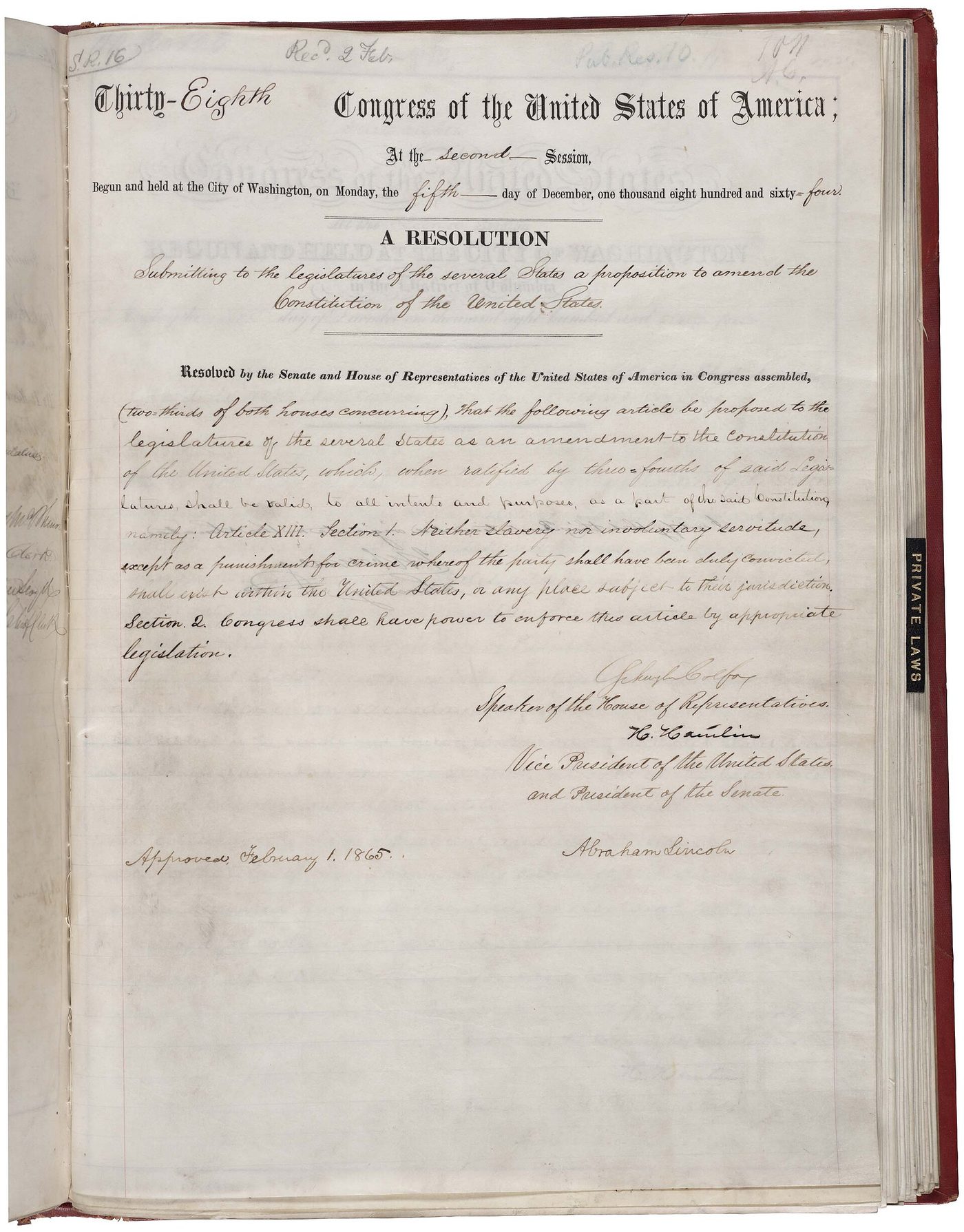
Section 1. Neither slavery nor involuntary servitude, except as a punishment for crime whereof the party shall have been duly convicted, shall exist within the United States, or any place subject to their jurisdiction.
Section 2. Congress shall have power to enforce this article by appropriate legislation.
U.S. Const. amend. XIII (passed by Congress January 31, 1865; ratified December 6, 1865)
Section 1. All persons born or naturalized in the United States, and subject to the jurisdiction thereof, are citizens of the United States and of the State wherein they reside. No State shall make or enforce any law which shall abridge the privileges or immunities of citizens of the United States; nor shall any State deprive any person of life, liberty, or property, without due process of law; nor deny to any person within its jurisdiction the equal protection of the laws.
Section 2. Representatives shall be apportioned among the several States according to their respective numbers, counting the whole number of persons in each State, excluding Indians not taxed. But when the right to vote at any election for the choice of electors for President and Vice-President of the United States, Representatives in Congress, the Executive and Judicial officers of a State, or the members of the Legislature thereof, is denied to any of the male inhabitants of such State, being twenty-one years of age, and citizens of the United States, or in any way abridged, except for participation in rebellion, or other crime, the basis of representation therein shall be reduced in the proportion which the number of such male citizens shall bear to the whole number of male citizens twenty-one years of age in such State.
Section 3. No person shall be a Senator or Representative in Congress, or elector of President and Vice-President, or hold any office, civil or military, under the United States, or under any State, who, having previously taken an oath, as a member of Congress, or as an officer of the United States, or as a member of any State legislature, or as an executive or judicial officer of any State, to support the Constitution of the United States, shall have engaged in insurrection or rebellion against the same, or given aid or comfort to the enemies thereof. But Congress may by a vote of two-thirds of each House, remove such disability.
Section 4. The validity of the public debt of the United States, authorized by law, including debts incurred for payment of pensions and bounties for services in suppressing insurrection or rebellion, shall not be questioned. But neither the United States nor any State shall assume or pay any debt or obligation incurred in aid of insurrection or rebellion against the United States, or any claim for the loss or emancipation of any slave; but all such debts, obligations and claims shall be held illegal and void.
Section 5. The Congress shall have power to enforce, by appropriate legislation, the provisions of this article.
U.S. Const. amend. XIV (passed by Congress June 13, 1866; ratified July 9, 1868). "Twenty-one years of age" in Section 2 was changed by Section 1 of the Twenty-sixth Amendment.
Section 1. The right of citizens of the United States to vote shall not be denied or abridged by the United States or by any State on account of race, color, or previous condition of servitude.
Section 2. The Congress shall have power to enforce this article by appropriate legislation.
U.S. Const. amend. XV (passed by Congress February 26, 1869; ratified February 3, 1870)
The Thirteenth is, in Justice Bradley's 1883 words, "an absolute declaration," so it reaches private owners too,3 with an exception for punishment after conviction. The Fourteenth's first sentence makes citizens by birth or naturalization. Its second sentence gives three commands to every state. Watch the nouns: privileges or immunities belong to "citizens," while due process and equal protection belong to "any person." Section 2 ended the three-fifths count. Section 3 bars oath-breaking insurrectionists from office. Section 4 voided the Confederate debt and any claim for "the loss or emancipation of any slave." Section 5, like the last sections of the Thirteenth and Fifteenth, gives enforcement to Congress. The Fifteenth bars race as a voting test and says nothing about who else may vote (see Module 11).
How We Got Here
Philadelphia, 1787
The convention argued about slavery in the open, and Madison wrote it down. On July 11, James Wilson said he "did not well see on what principle the admission of blacks in the proportion of three fifths could be explained."4 On August 22, George Mason said, "Every master of slaves is born a petty tyrant."5
August 25 settled the trade. General Pinkney, as Madison spells it, moved to protect it until 1808 instead of 1800. Madison objected: "Twenty years will produce all the mischief that can be apprehended from the liberty to import slaves." The motion passed seven states to four. Later that day Madison "thought it wrong to admit in the Constitution the idea that there could be property in men."6 So the text says "Persons." The fugitive clause passed on August 29 with no state voting no.7 Congress banned the import trade as soon as it could, effective January 1, 1808.8
Dred Scott, 1857
In 1846 Dred Scott and his wife Harriet sued for their freedom in St. Louis. The Supreme Court decided the case on March 6, 1857.9 Chief Justice Roger B. Taney wrote that people of African descent "were not intended to be included, under the word 'citizens' in the Constitution," and described the founding-era view that they were "so far inferior, that they had no rights which the white man was bound to respect." Scott, he held, was "not a citizen of Missouri" and could not sue in federal court. He also held the Missouri Compromise ban on slavery "void." Justices McLean and Curtis dissented.10
War and the Thirteenth
The bombardment of Fort Sumter began April 12, 1861. The Army of Northern Virginia surrendered at Appomattox Court House on April 9, 1865.11 Between those dates Lincoln issued the Emancipation Proclamation, on January 1, 1863.12
A war measure could be undone, so Lincoln pushed for an amendment. The Senate passed it in April 1864. The House balked, then passed it in January 1865 by 119 to 56.13 Ratification was complete December 6, 1865. Delaware did not ratify until 1901, Kentucky until 1976, and Mississippi, which had rejected it in 1865, until 1995.14
Common Misconception: Lincoln's Proclamation Ended Slavery
It did not. The Proclamation reached only areas in rebellion on January 1, 1863. People enslaved in the loyal border states, and in Confederate areas already under Union control, were outside it. The Thirteenth Amendment ended slavery everywhere in December 1865, and even it keeps one door open: involuntary servitude remains lawful "as a punishment for crime whereof the party shall have been duly convicted."
The Reconstruction Congress and Ratification
The 39th Congress met December 4, 1865, and Thaddeus Stevens of Pennsylvania moved at once for a Joint Committee on Reconstruction. The House agreed within minutes, 133 to 36.15 Congress tried a statute first. The Civil Rights Act of 1866 declared "all persons born in the United States," except American Indians, to be citizens. President Andrew Johnson vetoed it, and the House overrode him April 9, 1866, 122 to 41.16
But a statute can be repealed. As the Supreme Court put it in 2026, the aim was to put the "great question of citizenship" "beyond the legislative power" altogether.17 Representative John Bingham of Ohio was the primary author of Section 1. Senator Jacob Howard of Michigan told the Senate the privileges or immunities clause would carry to the states "the personal rights guaranteed and secured by the first eight amendments." Historians disagree on how widely that view was shared.18 The Senate passed the amendment June 8, 1866, and the House June 13.19
A contested ratification
Connecticut ratified first, on June 30, 1866. Congress made ratification a condition for the former Confederate states to regain representation.19 New Jersey ratified, then voted in 1868 to rescind, over its governor's veto. It revoked that rescission in 2003. Ohio also voted to withdraw.20 On July 20, 1868, Secretary of State Seward proclaimed the amendment ratified if the withdrawals were ineffective. Congress answered the next day with a concurrent resolution that counted Ohio and New Jersey and declared the amendment "a part of the Constitution." Seward's final proclamation, July 28, 1868, counted 28 states.14 In 1939 the Supreme Court cited this history in treating withdrawal as a question for Congress.20
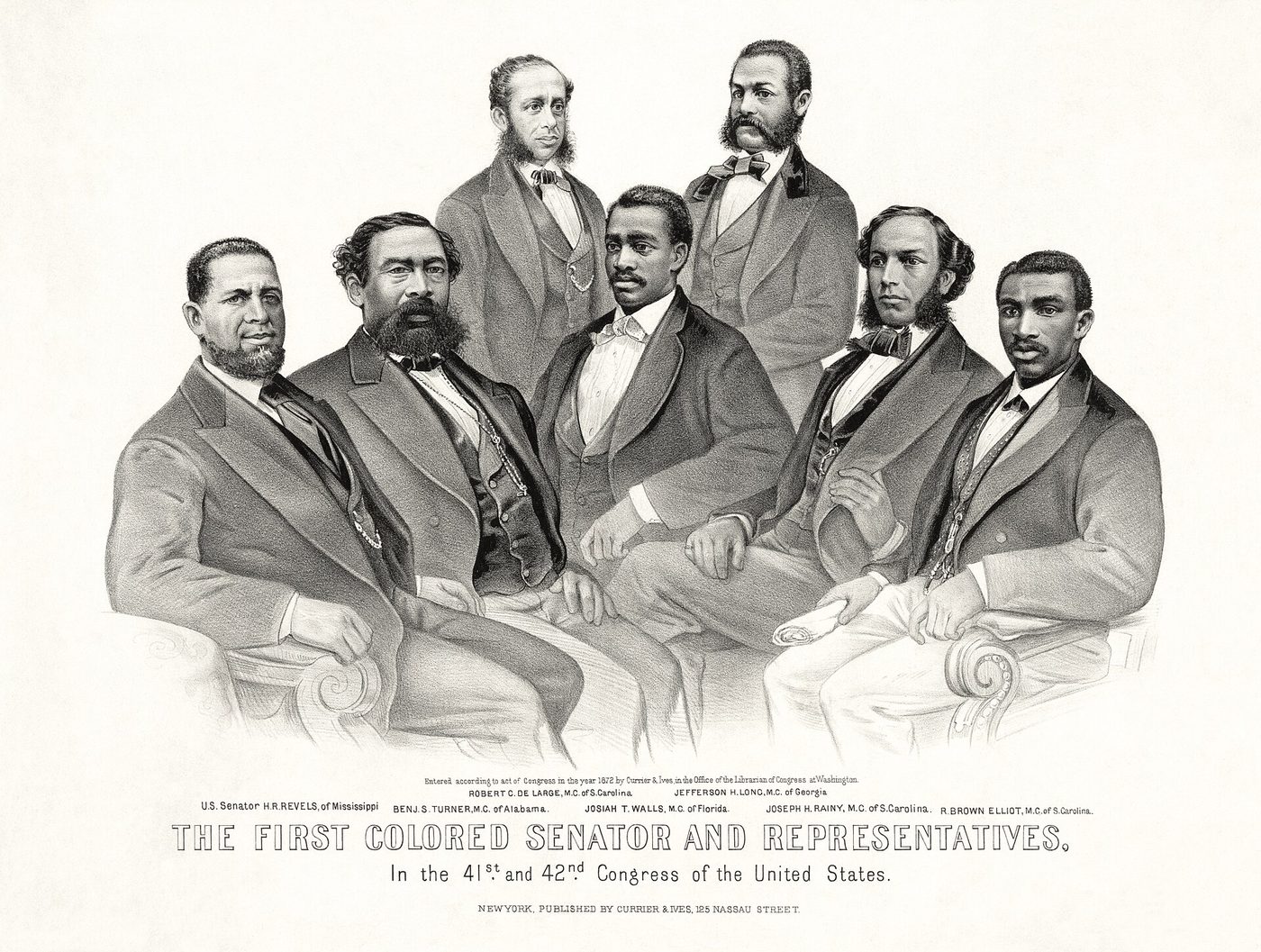
The Fifteenth Amendment passed Congress February 26, 1869, and was ratified February 3, 1870.21 Weeks later Hiram Revels of Mississippi became the first Black member of Congress.22
Collapse, Segregation and the Long Road Back
On Easter Sunday, April 13, 1873, after a disputed election in Grant Parish, Louisiana, an armed white force attacked the Black men holding the Colfax courthouse. At least sixty, and perhaps 150, were killed, nearly all African American, many of them prisoners. Federal prosecutors charged the leaders under the Enforcement Acts, and a jury convicted three of conspiracy.23
The Supreme Court threw out the convictions in United States v. Cruikshank on March 27, 1876. Chief Justice Waite read the Fourteenth as a limit on states only: it "adds nothing to the rights of one citizen as against another." Protecting the right to assemble, he wrote, was the state's job.24 In the Civil Rights Cases, October 15, 1883, the Court struck the public accommodations sections of the Civil Rights Act of 1875. Justice Bradley wrote for eight Justices: "Individual invasion of individual rights is not the subject-matter of the amendment." Justice Harlan dissented alone.3
By 1877 the Democratic Party, led by many of the officials who had pushed secession, had regained control of the southern state governments. Literacy tests and "grandfather clauses" followed in the early 1890s.21 After George Henry White left the House in 1901, no Black member was elected to Congress until 1928.22
Separate but equal, and its end
On June 7, 1892, Homer Plessy sat in a whites-only rail car in Louisiana and was arrested under a law requiring "equal but separate accommodations for the white, and colored races." On May 18, 1896, the Court upheld the law, 7 to 1. Harlan, alone again: "Our Constitution is color-blind, and neither knows nor tolerates classes among citizens."25
Fifty-eight years later, on May 17, 1954, a unanimous Court held through Chief Justice Warren that "in the field of public education the doctrine of 'separate but equal' has no place. Separate educational facilities are inherently unequal."26 The same day Bolling v. Sharpe reached the District of Columbia's schools through the Fifth Amendment.27 Brown II, in 1955, ordered desegregation "with all deliberate speed." Congress followed with the Civil Rights Act of 1964 and the Voting Rights Act of 1965.28
Liberty Perspective: The Enforcement Clauses Were Written for This
Each amendment ends by handing enforcement to Congress. In the 1870s Congress used that power against organized terror, and the Court narrowed it. Waite and Bradley rested on the words "No State," and their state action rule still governs. Harlan read the same text as a promise of national citizenship that Congress could protect directly. Accept the rule and the cost is still plain: a federal case over a massacre failed, and the job went back to the states.
Common Misconception: The Fourteenth Amendment Governs Everyone
Section 1 restrains governments. A private store or club does not violate the Equal Protection Clause; since 1883 the rule has been that "it is State action of a particular character that is prohibited." But state action is broad. It covers a county, a school board, a deputy on duty and a clerk at the counter.3
Section 1: Citizenship, Privileges or Immunities, Equal Protection
Born here
The first sentence overruled Dred Scott. Wong Kim Ark was born in San Francisco in 1873 to parents who were subjects of the Emperor of China and lived in the city. Returning from a visit to China in August 1895, he was refused entry as a noncitizen. On March 28, 1898, the Court held that such a child "becomes at the time of his birth a citizen of the United States." The phrase, Justice Gray wrote, excludes only narrow groups such as children of diplomats. Chief Justice Fuller and Justice Harlan dissented.29
Executive Order 14160, issued January 20, 2025, declared that children born here to parents unlawfully or temporarily present are not "subject to the jurisdiction" of the United States. On June 30, 2026, in Trump v. Barbara, the Court held that those children "are citizens at birth." Chief Justice Roberts, writing for five Justices, said the clause "uses jurisdiction in its ordinary sense," meaning the government's power over people within its territory, and kept Wong Kim Ark. Justice Kavanaugh found the order invalid under the immigration statute instead. Justices Thomas, Alito and Gorsuch dissented; Alito read the clause to cover "only those children who, at birth, owe allegiance solely to this country."17
Privileges or immunities
In 1869 Louisiana gave one company a twenty-five-year slaughterhouse monopoly around New Orleans, and the butchers it shut out sued. Justice Miller, for five Justices, found "one pervading purpose" in the new amendments, "the freedom of the slave race," and held that national and state citizenship "are distinct." The clause protected only the national kind. Justice Field, for the four dissenters, called that "a vain and idle enactment, which accomplished nothing."30 When the Court relied on the clause in 1999, Thomas called it "previously dormant."31 He and Justice Gorsuch have since written that it may be the better textual home for incorporation, as Howard said in 1866.3233
Equal protection
Equal protection runs to "any person." San Francisco denied laundry permits to Yick Wo and 200 other Chinese applicants while about 80 others worked freely. On May 10, 1886, the Court held the guarantee "universal in their application, to all persons within the territorial jurisdiction." A law "fair on its face" still fails if "applied and administered by public authority with an evil eye and an unequal hand."34
Idaho supplied a leading sex discrimination case. Richard Lynn Reed died in Ada County in 1967. His mother, Sally, and his father, Cecil, each petitioned to administer the estate, and Idaho Code sec. 15-314 said "males must be preferred to females." On November 22, 1971, Chief Justice Burger called that "the very kind of arbitrary legislative choice forbidden by the Equal Protection Clause."35
Richard Loving and Mildred Jeter married in Washington, D.C., in June 1958 and were convicted under Virginia's ban on interracial marriage. On June 12, 1967, a unanimous Court held that "restricting the freedom to marry solely because of racial classifications violates the central meaning of the Equal Protection Clause," and that the ban also denied due process.36
On June 29, 2023, in Students for Fair Admissions v. Harvard, the Court held race-conscious admissions at Harvard and the University of North Carolina unconstitutional. Roberts wrote for six Justices that the programs lacked measurable goals, used race as a negative and a stereotype, and had no end point: "Eliminating racial discrimination means eliminating all of it." Justice Sotomayor, dissenting, said the Court "cements a superficial rule of colorblindness as a constitutional principle in an endemically segregated society." The votes were 6 to 3 in the North Carolina case and 6 to 2 in Harvard's, where Justice Jackson did not sit.37
Idaho was back in 2026. Its Fairness in Women's Sports Act "prohibits male students from participating on female teams." In Little v. Hecox, decided with West Virginia v. B. P. J. on June 30, 2026, Kavanaugh wrote for six Justices that sex classifications must be "substantially related" to an "important" objective and that safety and fair competition qualify. Sotomayor, joined by Justices Kagan and Jackson, would have sent B. P. J.'s claim back for fact-finding.38
Due Process: Incorporation and the Substance Debate
Before 1868 the Bill of Rights bound only the federal government. In 1833 Chief Justice Marshall held that the Fifth Amendment's takings clause "is not applicable to the legislation of the states," since the amendments "contain no expression indicating an intention to apply them to the state governments."39
The Fourteenth changed that slowly, through the due process clause, one right at a time. In 1925 the Court said "we may and do assume" that freedom of speech and press are among the liberties due process protects.40 In 2010, 5 to 4, it applied the Second Amendment to the states.32 In 2019, ruling on Indiana's attempt to take Tyson Timbs's $42,000 Land Rover, Justice Ginsburg wrote that due process carries rights "fundamental to our scheme of ordered liberty," or "deeply rooted in this Nation's history and tradition," and that "with only 'a handful' of exceptions" the Bill of Rights now binds the states.33
Common Misconception: The Bill of Rights Has Always Bound Your County
For 77 years it did not bind states at all, and counties are creatures of the states. Barron said so in 1833. Today its protections reach state and local officials only because the Court has held, right by right, that the Fourteenth carries them. A free speech claim against a county runs through the Fourteenth.
Substance through process
The harder fight is over unwritten rights. In 1905, 5 to 4, the Court struck a New York limit of sixty hours a week for bakers as an interference with liberty of contract. Justice Holmes, dissenting: "The Fourteenth Amendment does not enact Mr. Herbert Spencer's Social Statics."41 In 1937 the Court upheld a minimum wage law and overruled the precedent that had blocked such laws.42 The current test comes from Washington v. Glucksberg (1997): due process protects rights "deeply rooted in this Nation's history and tradition," and a court must give "a 'careful description'" of the right claimed.43
Applying that test on June 24, 2022, the Court in Dobbs v. Jackson Women's Health Organization wrote, "We hold that Roe and Casey must be overruled," ending the constitutional abortion right recognized in Roe v. Wade, 410 U.S. 113 (1973). Alito, for five Justices, said the ruling casts no "doubt on precedents that do not concern abortion"; Roberts concurred in the judgment. Thomas called substantive due process "an oxymoron" and urged the Court to "reconsider all of this Court's substantive due process precedents, including Griswold, Lawrence, and Obergefell." Justices Breyer, Sotomayor and Kagan, dissenting, wrote that "the Framers defined rights in general terms, to permit future evolution in their scope and meaning."44
Liberty Perspective: One Phrase, Two Jobs
"Due process of law" reads like a promise about procedure. The Court also uses it to carry the Bill of Rights to the states and to protect unwritten rights such as marriage. Both sides have a textual case. Thomas says a clause about process cannot hold substance, and the drafters put substance in privileges or immunities. The Dobbs dissenters say the drafters chose broad words on purpose. Glucksberg splits the difference by tying unwritten rights to history. When someone calls a right "constitutional," ask which clause holds it.
Section 3, Section 5 and Who Enforces
Every local official should know one product of Section 5, a sentence from the Ku Klux Klan Act of April 20, 1871, now 42 U.S.C. sec. 1983. Anyone who, "under color of any statute, ordinance, regulation, custom, or usage, of any State," deprives a person of "any rights, privileges, or immunities secured by the Constitution and laws, shall be liable to the party injured."45
City of Boerne v. Flores sets the outer limit. Boerne, Texas, denied a church a building permit, and the Archbishop of San Antonio sued under the Religious Freedom Restoration Act. On June 25, 1997, the Court held 6 to 3 that Congress had exceeded its Section 5 power in applying the Act to the states. Justice Kennedy: "There must be a congruence and proportionality between the injury to be prevented or remedied and the means adopted to that end."46
Section 3
The Enforcement Act of 1870 let federal prosecutors sue to remove disqualified nonlegislative officeholders and made holding office in violation of Section 3 a crime. Those provisions were later repealed. A successor to the 1862 Confiscation Act survives as 18 U.S.C. sec. 2383: anyone convicted of insurrection "shall be incapable of holding any office under the United States."47
In 2023 Colorado voters sued to keep former President Donald Trump off the 2024 primary ballot, and the Colorado Supreme Court agreed, 4 to 3. On March 4, 2024, the U.S. Supreme Court reversed with no dissent: "Because the Constitution makes Congress, rather than the States, responsible for enforcing Section 3 against federal officeholders and candidates, we reverse." States "may disqualify persons holding or attempting to hold state office," the per curiam said, but have no such power over federal offices. Five Justices added that federal enforcement requires legislation under Section 5. Justice Barrett would have stopped short of that. Sotomayor, Kagan and Jackson concurred only in the judgment, objecting that the majority "shuts the door on other potential means of federal enforcement."48
Liberty Perspective: The Oath Clause With Teeth
Section 3 targets people who swore "to support the Constitution of the United States" and then rose against it. The text names no enforcer. The Court's reason, which all nine Justices accepted, was that states could reach conflicting answers about one presidential candidate. The result is that Section 3, against federal candidates, waits on Congress, and the Court knew of no enforcing law besides the 1870 Act and sec. 2383.
Landmark Cases
Votes appear where the opinions or Oyez confirm them. A blank page means the U.S. Reports page is not final.
| Case | Year | Holding | Effect |
|---|---|---|---|
| Dred Scott v. Sandford, 60 U.S. 393 | 1857 | Black Americans could not be citizens; Missouri Compromise ban void (7 to 2). | Overruled by the Citizenship Clause. |
| Slaughter-House Cases, 83 U.S. 36 | 1873 | Privileges or immunities covers only national rights (5 to 4). | Still law. |
| United States v. Cruikshank, 92 U.S. 542 | 1876 | The amendment limits states, not private actors; Colfax convictions void. | State action rule remains. |
| Civil Rights Cases, 109 U.S. 3 | 1883 | 1875 public accommodations law exceeded Congress's power (8 to 1). | Private conduct now reached by statute. |
| Yick Wo v. Hopkins, 118 U.S. 356 | 1886 | Equal protection covers noncitizens and unequal enforcement. | Neutral laws must be applied evenly. |
| Plessy v. Ferguson, 163 U.S. 537 | 1896 | "Equal but separate" rail cars upheld (7 to 1). | Rejected for schools by Brown. |
| United States v. Wong Kim Ark, 169 U.S. 649 | 1898 | Born here to resident Chinese subjects means citizen at birth. | Reaffirmed in Barbara (2026). |
| Brown v. Board of Education, 347 U.S. 483 | 1954 | Segregated schools "inherently unequal" (9 to 0). | Ended Plessy's rule in public schools. |
| Loving v. Virginia, 388 U.S. 1 | 1967 | Interracial marriage bans violate equal protection and due process (9 to 0). | Rests on due process too. |
| Reed v. Reed, 404 U.S. 71 | 1971 | Idaho's male preference for estate administrators unconstitutional. | An Idaho case. |
| City of Boerne v. Flores, 521 U.S. 507 | 1997 | Section 5 laws need "congruence and proportionality" (6 to 3). | Applied to Section 3 in Anderson. |
| Students for Fair Admissions v. Harvard, 600 U.S. 181 | 2023 | Race-conscious admissions violate equal protection. | Cited in Louisiana v. Callais (2026). |
| Trump v. Anderson, 601 U.S. 100 | 2024 | States may not enforce Section 3 against federal candidates. | Federal enforcement runs through Congress. |
| Trump v. Barbara, 609 U.S. ___ | 2026 | Children of parents unlawfully or temporarily present are citizens at birth. | Executive Order 14160 invalid. |
| Little v. Hecox, 609 U.S. ___ | 2026 | Idaho's sex-based sports law survives intermediate scrutiny (6 to 3). | Idaho Code sec. 33-6203 enforceable. |
In April 2026 the Court cited Students for Fair Admissions in holding a Louisiana congressional map an unconstitutional racial gerrymander.49
Where This Shows Up for Officials, Reporters and Citizens
Every Idaho officer swears to "support the Constitution of the United States, and the Constitution of the State of Idaho," and legislators take nearly the same oath under Article III, section 25.50 The people below are invented. The rules are not.
The commissioner and the permit. Commissioner Dale Harmon's board hears two nearly identical permit requests. It grants the longtime family's and denies the newcomer's without a reason tied to the ordinance. The newcomer will cite Yick Wo: a neutral rule applied "with an evil eye and an unequal hand" still violates equal protection.34 Findings tied to the ordinance are the board's record.
The deputy and the lawsuit. Sheriff Marisol Vega's deputy tows and keeps a resident's truck with no notice and no chance to contest it. That is a due process claim, filed under sec. 1983 because the deputy acted "under color of" state law. Idaho's constitution has its own guarantee against deprivation of "life, liberty or property without due process of law."51
The clerk at the counter. County Clerk Rachel Ostrander issues marriage licenses and registers voters. No racial test on a marriage license, since Loving. And no asking an Idaho-born registrant about a parent's immigration status: under Barbara, a child born here is a citizen at birth, apart from narrow exceptions such as children of diplomats.2917
The reporter and the ballot challenge. Tom Ridley covers a petition claiming a county candidate is barred by Section 3. Get the holding right. Anderson said states "may disqualify persons holding or attempting to hold state office"; it barred states only from acting against federal candidates.48 Whether Idaho law supplies a procedure is a separate question, answered by Idaho statutes and courts.
The citizen at the meeting. A resident at public comment says a new county rule singles out one group. That is an equal protection argument. How hard a court looks depends on the line drawn: race gets strict scrutiny, and sex lines must be "substantially related" to an "important" objective.4938 Ask the board to state the rule's purpose on the record.
Idaho parallels. Idaho's Declaration of Rights opens, "All men are by nature free and equal," and says government "is instituted for their equal protection and benefit."51 Reed v. Reed began in Ada County probate court, and Little v. Hecox was brought by a Boise State University student.3538
Pictures, Numbers and Infographics
The three Civil War amendments cleared Congress and the states within five years. The numbers show the votes and the time each took, and the chart of Black members of Congress shows how the Fifteenth Amendment's promise rose and then nearly vanished by 1901.
By the numbers
- 38 to 6: the Senate vote passing the Thirteenth Amendment on April 8, 1864. U.S. Senate, The Senate Passes the Thirteenth Amendment
- 119 to 56: the House vote passing it in January 1865, after two earlier test votes had failed. The states ratified it by December 6, 1865. National Archives, 13th Amendment; U.S. Senate
- 309, 757 and 342 days: time from proposal to ratification for the Thirteenth, Fourteenth and Fifteenth Amendments. Congressional Research Service, Ratification of Amendments, 1997
- July 28, 1868: the date the Secretary of State certified the Fourteenth Amendment, passed by Congress June 13, 1866 and ratified July 9, 1868. National Archives, 14th Amendment
- February 3, 1870: ratification of the Fifteenth Amendment, passed by Congress February 26, 1869. National Archives, 15th Amendment
- 8 members: Black members in the 44th Congress (1875 to 1877), seven in the House and one in the Senate, the Reconstruction high. Only six new Black members were elected after 1874. U.S. House, Black American Members by Congress; U.S. House, The Fifteenth Amendment in Flesh and Blood
- 0 from 1901 to 1929: no Black member sat in the 57th through 70th Congresses. Oscar De Priest of Illinois broke the gap in 1929. U.S. House, Black American Members by Congress
Verify Independently
Every citation, quotation and case in this course should be verified independently against the official source (the U.S. Reports or the Court's own opinion, the National Archives transcription, the statute book) before you rely on it, quote it or act on it.
Check these in particular:
- Louisiana v. Callais, 608 U.S. 85 (2026), a recent decision referred to here and in Module 11.
Sources & Further Reading
Primary Sources: Text and Founding Records
- National Archives, Constitution of the United States: A Transcription
- National Archives, The Constitution: Amendments 11-27
- Constitution Annotated (Library of Congress text, Cornell LII edition): Fourteenth Amendment
- Avalon Project, Madison's Notes of Debates in the Federal Convention of 1787
- National Archives Milestone Documents: 13th Amendment; 14th Amendment; 15th Amendment
- U.S. House History: The Civil Rights Bill of 1866; The Joint Committee on Reconstruction
- U.S. Senate, Landmark Legislation: Fourteenth Amendment
Court Opinions
- Supreme Court of the United States, opinions of the October 2025 Term (includes Trump v. Barbara and West Virginia v. B. P. J.)
- Trump v. Anderson, 601 U.S. 100 (2024); Students for Fair Admissions v. Harvard (2023); Dobbs v. Jackson Women's Health Organization (2022)
- Cornell LII Supreme Court collection: Dred Scott, Slaughter-House, Cruikshank, Civil Rights Cases, Yick Wo, Plessy, Wong Kim Ark, Brown, Loving, Reed, Boerne
- Oyez (votes and decision dates)
History and Context
- 64 Parishes, "Colfax Massacre"
- U.S. House, Black Americans in Congress: "The Fifteenth Amendment in Flesh and Blood"
- National Constitution Center, Interactive Constitution: Fourteenth Amendment
Idaho
- Idaho Code sec. 59-401 (official oath)
- Idaho Const. art. I, sec. 13 (due process); art. III, sec. 25 (oath)
Related Training Modules
- Module 1: Constitution Origins
- Module 2: Article I, Congress
- Module 5: Federalism and the States
- Module 6: Amending the Constitution
- Module 7: The First Amendment
- Module 8: The Second Amendment
- Module 9: The Fourth Through Eighth Amendments
- Module 11: Voting and the Later Amendments
- Module 12: Reading the Constitution
Knowledge Check
Test your understanding of the Civil War Amendments. No scores are saved: this is for your own review.
1. At the Constitutional Convention on August 25, 1787, what did the delegates do with the clause protecting the import trade in enslaved people?
Madison's notes record the motion to replace 1800 with 1808 passing seven states to four, over Madison's objection that "Twenty years will produce all the mischief." The motion moved the date from 1800 to 1808. It passed seven states to four, and Article V then shielded that clause from amendment until 1808.
2. Which words in Section 1 of the Fourteenth Amendment protect "any person," not only citizens?
The privileges or immunities clause protects "citizens of the United States." Due process and equal protection run to "any person," which is why Yick Wo protected noncitizen laundry owners. Read the nouns. Privileges or immunities belong to "citizens." Due process and equal protection belong to "any person."
3. What did the Slaughter-House Cases (1873) hold about the privileges or immunities clause?
Justice Miller, for five Justices, held that national and state citizenship are distinct and that the clause protects only the former. Justice Field called that reading "a vain and idle enactment." The 5 to 4 majority read the clause narrowly, to cover only rights of national citizenship. That reading still stands.
4. In Trump v. Anderson (2024), what did the Supreme Court hold about Section 3?
The per curiam said States "may disqualify persons holding or attempting to hold state office" but "have no power under the Constitution to enforce Section 3 with respect to federal offices, especially the Presidency." The Court reversed Colorado because enforcement against federal candidates belongs to Congress. States keep the power over their own offices.
5. Reed v. Reed (1971), an Idaho case, struck down what?
Idaho Code sec. 15-314 said "males must be preferred to females." Chief Justice Burger called that "the very kind of arbitrary legislative choice forbidden by the Equal Protection Clause." The case began when Sally and Cecil Reed both sought to administer their son's estate in Ada County and the statute required the court to prefer the father.
Reference Materials
Use your browser's print function (Ctrl+P / Cmd+P) to save this page as a PDF for offline reference.
- The Text: jump to section
- How We Got Here: jump to section
- The Reconstruction Congress and Ratification: jump to section
- Collapse, Segregation and the Long Road Back: jump to section
- Section 1: Citizenship, Privileges or Immunities, Equal Protection: jump to section
- Due Process: Incorporation and the Substance Debate: jump to section
- Section 3, Section 5 and Who Enforces: jump to section
- Landmark Cases: jump to section
- Where This Shows Up for Officials, Reporters and Citizens: jump to section
Footnotes
- U.S. Const. art. I, sec. 2, cl. 3; art. I, sec. 9, cl. 1; art. IV, sec. 2, cl. 3; art. V. National Archives, The Constitution of the United States: A Transcription, https://www.archives.gov/founding-docs/constitution-transcript. Spelling and capitals are the transcription's.
- National Archives, The Constitution: Amendments 11-27, https://www.archives.gov/founding-docs/amendments-11-27. The transcription gives the dates passed and ratified, notes that the Thirteenth superseded part of Article IV, section 2, that section 2 of the Fourteenth modified Article I, section 2, and that "twenty-one years of age" in section 2 was changed by section 1 of the Twenty-sixth Amendment. It prints the end of the Fifteenth Amendment, section 1, with a double hyphen; the Constitution Annotated text at https://www.law.cornell.edu/constitution/amendmentxv ends the sentence with a period, which this page uses.
- Civil Rights Cases, 109 U.S. 3 (1883), opinion of Bradley, J.; dissent of Harlan, J., https://www.law.cornell.edu/supremecourt/text/109/3. Decided October 15, 1883, 8 to 1, per Oyez.
- Madison's Notes, July 11, 1787 (Wilson: he "did not well see on what principle the admission of blacks in the proportion of three fifths could be explained"), Avalon Project, https://avalon.law.yale.edu/18th_century/debates_711.asp.
- Madison's Notes, Aug. 22, 1787 (Mason on the slave trade), Avalon Project, https://avalon.law.yale.edu/18th_century/debates_822.asp. "Trafic" is spelled as in the notes.
- Madison's Notes, Aug. 25, 1787, Avalon Project, https://avalon.law.yale.edu/18th_century/debates_825.asp. The motion to change 1800 to 1808 passed with New Hampshire, Massachusetts, Connecticut, Maryland, North Carolina, South Carolina and Georgia voting ay, and New Jersey, Pennsylvania, Delaware and Virginia voting no.
- Madison's Notes, Aug. 28 and 29, 1787 (Pinckney's motion on Aug. 28; the fugitive clause "agreed to nem: con:" on Aug. 29), Avalon Project, https://avalon.law.yale.edu/18th_century/debates_828.asp and https://avalon.law.yale.edu/18th_century/debates_829.asp.
- An Act of March 2, 1807, 9th Cong., 2d Sess., 2 Stat. 426, to Prohibit the Importation of Slaves "from and after the first day of January" 1808. National Archives, DocsTeach, https://docsteach.org/document/act-prohibit-importation-slaves/.
- National Archives, Dred Scott v. Sandford (1857), https://www.archives.gov/milestone-documents/dred-scott-v-sandford (suit begun 1846 in St. Louis; decision March 6, 1857).
- Dred Scott v. Sandford, 60 U.S. (19 How.) 393 (1857), opinion of Taney, C.J.; dissents of McLean and Curtis, JJ. Text from Harvard Caselaw Access Project, https://static.case.law/us/60/cases/0393-02.json; also https://www.law.cornell.edu/supremecourt/text/60/393. Vote of 7 to 2 per Oyez, https://www.oyez.org/cases/1850-1900/60us393.
- National Park Service, Fort Sumter and Fort Moultrie National Historical Park, Civil War Sesquicentennial (bombardment April 12, 1861), https://www.nps.gov/fosu/learn/news/civil-war-sesquicentennial.htm; Appomattox Court House National Historical Park (surrender April 9, 1865), https://www.nps.gov/apco/index.htm.
- National Archives, The Emancipation Proclamation, https://www.archives.gov/exhibits/featured-documents/emancipation-proclamation (issued January 1, 1863; applied only to states in rebellion; almost 200,000 Black soldiers and sailors served by war's end).
- National Archives, 13th Amendment to the U.S. Constitution: Abolition of Slavery (1865), https://www.archives.gov/milestone-documents/13th-amendment (Senate passage April 1864; House passage January 1865 by 119 to 56; Lincoln approved the joint resolution February 1, 1865).
- U.S. House of Representatives, Constitution, Jefferson's Manual, and Rules, H. Doc. 116-177 (117th Cong.), sec. 224 n.4 and sec. 225 n.5, https://www.govinfo.gov/content/pkg/HMAN-117/pdf/HMAN-117-pg101.pdf and https://www.govinfo.gov/content/pkg/HMAN-117/pdf/HMAN-117-pg102.pdf. The notes give the Secretary of State's December 18, 1865 proclamation (27 of 36 States), later ratifications (Delaware 1901, Kentucky 1976, Mississippi 1995), and the 1868 proclamations and New Jersey and Oregon rescissions for the Fourteenth.
- U.S. House of Representatives, History, Art & Archives, The Joint Committee on Reconstruction (December 4, 1865; nine House Members and six Senators; approved 133 to 36), https://history.house.gov/Historical-Highlights/1851-1900/The-Joint-Committee-on-Reconstruction/.
- U.S. House of Representatives, History, Art & Archives, The Civil Rights Bill of 1866 (veto overridden April 9, 1866, 122 to 41), https://history.house.gov/Historical-Highlights/1851-1900/The-Civil-Rights-Bill-of-1866/.
- Trump v. Barbara, No. 25-365, 609 U.S. ___ (June 30, 2026) (slip opinion), https://www.supremecourt.gov/opinions/25pdf/25-365_new_5if6.pdf. Summary checked against Congressional Research Service, Legal Sidebar LSB11468 (Aug. 13, 2026), https://www.everycrsreport.com/reports/LSB11468.html.
- National Archives, 14th Amendment to the U.S. Constitution: Civil Rights (1868), https://www.archives.gov/milestone-documents/14th-amendment (Bingham as primary author of section 1; Howard's statement on "the first eight amendments"; certificate of July 28, 1868, 28 of 37 States).
- U.S. Senate, Landmark Legislation: Fourteenth Amendment (Senate passage June 8, 1866; ratification required of former Confederate States as a condition of regaining representation), https://www.senate.gov/about/origins-foundations/senate-and-constitution/14th-amendment.htm.
- Coleman v. Miller, 307 U.S. 433 (1939) (recounting that "Ohio and New Jersey first ratified and then passed resolutions withdrawing their consent" and that Congress counted them), https://static.case.law/us/307/cases/0433-01.json. See Module 6, Amending the Constitution.
- National Archives, 15th Amendment to the U.S. Constitution: Voting Rights (1870), https://www.archives.gov/milestone-documents/15th-amendment (literacy tests and "grandfather clauses" in the early 1890s; President Johnson's March 15, 1965 address).
- U.S. House of Representatives, Office of the Historian, "The Fifteenth Amendment in Flesh and Blood": 1870-1901, in Black Americans in Congress, 1870-2007 (2008) (Revels seated February 25, 1870; Rainey sworn in December 12, 1870; by 1877 southern state governments back in Democratic control; George Henry White left office in 1901; no Black member elected again until 1928), https://history.house.gov/Exhibitions-and-Publications/BAIC/Historical-Essays/Fifteenth-Amendment/Introduction/.
- LeeAnna Keith, "Colfax Massacre," 64 Parishes (Louisiana Endowment for the Humanities), https://64parishes.org/entry/colfax-massacre. Death toll "at least sixty and perhaps as many as 150"; state officials buried fifty-nine bodies.
- United States v. Cruikshank, 92 U.S. 542 (1876), opinion of Waite, C.J., https://www.law.cornell.edu/supremecourt/text/92/542. October Term 1875; decided March 27, 1876, per Supreme Court Historical Society, https://civics.supremecourthistory.org/article/united-states-v-cruikshank/.
- Plessy v. Ferguson, 163 U.S. 537 (1896), opinion of Brown, J.; dissent of Harlan, J.; Brewer, J., did not participate, https://www.law.cornell.edu/supremecourt/text/163/537. Decided May 18, 1896, 7 to 1, per Oyez and National Archives, https://www.archives.gov/milestone-documents/plessy-v-ferguson.
- Brown v. Board of Education, 347 U.S. 483 (1954), https://www.law.cornell.edu/supremecourt/text/347/483; Brown v. Board of Education, 349 U.S. 294 (1955) (Brown II). Both unanimous per National Archives, https://www.archives.gov/milestone-documents/brown-v-board-of-education.
- Bolling v. Sharpe, 347 U.S. 497 (1954) (District of Columbia schools; Fifth Amendment due process), https://static.case.law/us/347/cases/0497-01.json.
- National Archives, Civil Rights Act (1964) (signed July 2, 1964), https://www.archives.gov/milestone-documents/civil-rights-act; Voting Rights Act (1965) (signed August 6, 1965), https://www.archives.gov/milestone-documents/voting-rights-act.
- United States v. Wong Kim Ark, 169 U.S. 649 (1898), opinion of Gray, J.; dissent of Fuller, C.J., joined by Harlan, J.; McKenna, J., took no part, https://www.law.cornell.edu/supremecourt/text/169/649. Decided March 28, 1898.
- Slaughter-House Cases, 83 U.S. (16 Wall.) 36 (1873), opinion of Miller, J.; dissents of Field, Bradley and Swayne, JJ., https://www.law.cornell.edu/supremecourt/text/83/36. Decided April 14, 1873, by 5 to 4 per Oyez, https://www.oyez.org/cases/1850-1900/83us36.
- Saenz v. Roe, 526 U.S. 489 (1999), opinion of Stevens, J.; dissents of Rehnquist, C.J., and Thomas, J., https://static.case.law/us/526/cases/0489-01.json. See Module 5, Federalism and the States.
- McDonald v. City of Chicago, 561 U.S. 742 (2010), opinion of Alito, J. (plurality as to the Privileges or Immunities discussion); Thomas, J., concurring in part and in the judgment; dissents of Stevens, J., and Breyer, J., joined by Ginsburg and Sotomayor, JJ., https://static.case.law/us/561/cases/0742-01.json. See Module 8, The Second Amendment.
- Timbs v. Indiana, 586 U.S. 146 (2019), opinion of Ginsburg, J.; Gorsuch, J., concurring; Thomas, J., concurring in the judgment. U.S. Reports, vol. 586 (bound volume), https://www.supremecourt.gov/opinions/boundvolumes/586BV.pdf.
- Yick Wo v. Hopkins, 118 U.S. 356 (1886), opinion of Matthews, J., https://www.law.cornell.edu/supremecourt/text/118/356. Decided May 10, 1886.
- Reed v. Reed, 404 U.S. 71 (1971), opinion of Burger, C.J. (Idaho Code sec. 15-314 as then written), https://www.law.cornell.edu/supremecourt/text/404/71. Decided November 22, 1971.
- Loving v. Virginia, 388 U.S. 1 (1967), opinion of Warren, C.J.; Stewart, J., concurring, https://www.law.cornell.edu/supremecourt/text/388/1. Decided June 12, 1967, 9 to 0, per Oyez.
- Students for Fair Admissions, Inc. v. President and Fellows of Harvard College, 600 U.S. 181 (2023), with No. 21-707 (University of North Carolina), slip opinion https://www.supremecourt.gov/opinions/22pdf/20-1199_hgdj.pdf. U.S. Reports page confirmed by its citation in Alexander v. South Carolina State Conference of the NAACP, 602 U.S. 1 (2024), https://www.supremecourt.gov/opinions/23pdf/602us1r24_j4ek.pdf.
- West Virginia v. B. P. J., No. 24-43, together with Little v. Hecox, No. 24-38, 609 U.S. ___ (decided June 30, 2026) (slip opinion), https://www.supremecourt.gov/opinions/25pdf/24-43_2b35.pdf. Opinion of Kavanaugh, J.; Sotomayor, J., joined by Kagan and Jackson, JJ., concurring in the judgment in part and dissenting in part; Jackson, J., concurring in the judgment in part and dissenting in part.
- Barron v. Mayor of Baltimore, 32 U.S. (7 Pet.) 243 (1833), opinion of Marshall, C.J., https://static.case.law/us/32/cases/0243-01.json.
- Gitlow v. New York, 268 U.S. 652 (1925), opinion of Sanford, J., https://static.case.law/us/268/cases/0652-01.json. See Module 7, The First Amendment.
- Lochner v. New York, 198 U.S. 45 (1905), opinion of Peckham, J.; dissents of Harlan, J. (joined by White and Day, JJ.) and Holmes, J., https://static.case.law/us/198/cases/0045-01.json.
- West Coast Hotel Co. v. Parrish, 300 U.S. 379 (1937), opinion of Hughes, C.J. (overruling Adkins v. Children's Hospital, 261 U.S. 525 (1923)); dissent of Sutherland, J., joined by Van Devanter, McReynolds and Butler, JJ., https://static.case.law/us/300/cases/0379-01.json.
- Washington v. Glucksberg, 521 U.S. 702 (1997), opinion of Rehnquist, C.J., https://static.case.law/us/521/cases/0702-01.json. Judgment 9 to 0 per Oyez.
- Dobbs v. Jackson Women's Health Organization, 597 U.S. 215 (2022), opinion of Alito, J.; Thomas, J., and Kavanaugh, J., concurring; Roberts, C.J., concurring in the judgment; Breyer, Sotomayor and Kagan, JJ., dissenting, slip opinion https://www.supremecourt.gov/opinions/21pdf/19-1392_6j37.pdf. The U.S. Reports page is confirmed by the citation "597 U. S. 215" in Trump v. Anderson (concurring opinion).
- 42 U.S.C. sec. 1983, https://www.law.cornell.edu/uscode/text/42/1983 (source note: R.S. sec. 1979, derived from Act of Apr. 20, 1871, ch. 22, sec. 1, 17 Stat. 13).
- City of Boerne v. Flores, 521 U.S. 507, 520 (1997), opinion of Kennedy, J.; dissents of O'Connor, Souter and Breyer, JJ., https://www.law.cornell.edu/supremecourt/text/521/507. Decided June 25, 1997, 6 to 3, per Oyez.
- 18 U.S.C. sec. 2383 (rebellion or insurrection; "shall be incapable of holding any office under the United States"), https://www.law.cornell.edu/uscode/text/18/2383.
- Trump v. Anderson, 601 U.S. 100 (2024) (per curiam); Barrett, J., concurring in part and in the judgment; Sotomayor, Kagan and Jackson, JJ., concurring in the judgment. U.S. Reports preliminary print, https://www.supremecourt.gov/opinions/23pdf/601us1r06_a86c.pdf; slip opinion https://www.supremecourt.gov/opinions/23pdf/23-719_19m2.pdf.
- Louisiana v. Callais, 608 U.S. 85 (2026), opinion of Alito, J.; Kagan, J., joined by Sotomayor and Jackson, JJ., dissenting. U.S. Reports preliminary print, https://www.supremecourt.gov/opinions/25pdf/608us1r29_n648.pdf. See Module 11, Voting and the Later Amendments.
- Idaho Code sec. 59-401 (official oath), https://legislature.idaho.gov/statutesrules/idstat/Title59/T59CH4/SECT59-401/; Idaho Const. art. III, sec. 25 (legislators' oath), https://legislature.idaho.gov/statutesrules/idconst/ArtIII/Sect25/.
- Idaho Const. art. I, sec. 1 ("All men are by nature free and equal"), https://legislature.idaho.gov/statutesrules/idconst/ArtI/Sect1/; art. I, sec. 2 (government "instituted for their equal protection and benefit"), https://legislature.idaho.gov/statutesrules/idconst/ArtI/Sect2/; art. I, sec. 13 (due process), https://legislature.idaho.gov/statutesrules/idconst/ArtI/Sect13/.