U.S. CONSTITUTION · Module 1
Module 1: From the Charters to Philadelphia
How colonial charters, a failed confederation and a summer in Philadelphia produced the Constitution, and how the first Justices read it
How We Got Here: Charters and the Declaration
Colonial government began on paper. The First Charter of Virginia, issued April 10, 1606, told the settlers that they and their children would enjoy all "Liberties, Franchises, and Immunities" of English subjects, "as if they had been abiding and born, within this our Realm of England."1
Self-government grew on the ground. On July 30, 1619, burgesses elected from the plantations met with the governor and council in the church at Jamestown, the colony's first legislative assembly.2 Settlers also wrote frames of their own. On November 11, 1620, the Mayflower passengers at Cape Cod agreed to "covenant and combine ourselves together into a civil Body Politick" and promised obedience to the "just and equal Laws, Ordinances, Acts, Constitutions, and Officers" they would frame.3
By 1776 the quarrel with Parliament was about who may tax. The Declaration of Independence, adopted July 4, 1776, lists among its grievances "imposing Taxes on us without our Consent."4 Its larger claim is about where a government gets its authority: "We hold these truths to be self-evident, that all men are created equal, that they are endowed by their Creator with certain unalienable Rights," and "Governments are instituted among Men, deriving their just powers from the consent of the governed."
No court enforces the Declaration. Idaho's Constitution repeats its reasoning. Article I, section 2 says "All political power is inherent in the people" and that the people may "alter, reform or abolish" their government "whenever they may deem it necessary."5
The Articles of Confederation and Why They Failed
Congress agreed to the Articles of Confederation on November 15, 1777, and they took effect on March 1, 1781, when Maryland ratified.6 The design favored the states. Article II says "Each state retains its sovereignty, freedom, and independence," and Article III calls the arrangement "a firm league of friendship." Each state had one vote. No change could take effect unless it was "confirmed by the legislatures of every State."
Then came the money. Congress could spend, borrow and ask. It could not tax. Common expenses came from a treasury "supplied by the several States," and the taxes to fill it were "laid and levied by the authority and direction of the legislatures of the several States." A request from Congress was only a request. On May 29, 1787, Madison's notes record Edmund Randolph telling the Convention that the federal government "could not check the quarrels between states, nor a rebellion in any."7
Treaties showed the same weakness. Article 4 of the Treaty of Paris, signed September 3, 1783, promised that British creditors "shall meet with no lawful impediment to the recovery of the full value in sterling money of all bona fide debts heretofore contracted." Several states passed laws letting debtors satisfy those debts by paying into a state treasury, and Congress had no way to make them stop.8
Shays' Rebellion brought the problem home. From August 1786, farmers in western Massachusetts, many of them veterans squeezed by debt and taxes, shut down courts that were foreclosing on their land. On January 25, 1787, about 1,200 men advanced on the federal arsenal at Springfield. The defenders fired, four of the marchers died, and the rest scattered. Massachusetts ended the uprising with some 4,400 men paid for by Boston businessmen.9
The way out began with a meeting that mostly failed. In September 1786 twelve commissioners from five states, Alexander Hamilton and James Madison among them, met at Annapolis to discuss trade. Too few states had come to act. On September 14 they instead proposed a convention at Philadelphia on the second Monday in May to "render the constitution of the Federal Government adequate to the exigencies of the Union." Congress agreed on February 21, 1787, but described the job narrowly: a convention "for the sole and express purpose of revising the Articles of Confederation."10
Common Misconception: "The delegates were sent to write a new Constitution"
Their instructions said revise the Articles, and a revision needed approval from every state legislature. The delegates produced a new frame of government, and Article VII asked for the ratifying conventions of nine states instead.
Philadelphia, 1787
The Convention was set for Monday, May 14, 1787. Too few delegates arrived, and a quorum of seven states did not assemble until Friday, May 25. Washington was elected president of the Convention that day by unanimous ballot. Rhode Island never sent anyone. The other twelve states appointed seventy delegates, and fifty-five attended. Votes were taken by state, one vote each. The delegates also adopted a secrecy rule: "nothing spoken in the House be printed, or otherwise published or communicated without leave."11
On May 29 Randolph laid out the Virginia Plan in fifteen resolutions. The first said the Articles "ought to be so corrected & enlarged as to accomplish the objects proposed by their institution." The rest described a different government. Its legislature would have two branches, with representation "proportioned to the Quotas of contribution, or to the number of free inhabitants." It would be empowered "to legislate in all cases to which the separate States are incompetent" and to negative state laws, with a national executive and judiciary beside it.12
On June 15 William Paterson of New Jersey offered a rival plan. It kept the Articles and added to them, chiefly a power to raise revenue by "levying a duty or duties on all goods or merchandizes of foreign growth or manufacture, imported into any part of the U. States," by stamps, and by postage. Its sixth resolution said acts and treaties of the United States "shall be the supreme law of the respective States" and that the state judiciaries "shall be bound thereby in their decisions." Those words came back, reworded, in Article VI.13
The dispute was about votes. Large states wanted representation by population. Small states wanted to keep the one-state, one-vote rule of the Articles. Madison recorded John Dickinson of Delaware telling him that small-state delegates wanted two branches and a good national government, "But we would sooner submit to a foreign power than submit to be deprived of an equality of suffrage, in both branches of the legislature."13
The Great Compromise and the Compromises on Slavery
The Convention nearly broke over representation. On July 2 the delegates voted on giving each state an equal vote in the second chamber, a motion Oliver Ellsworth of Connecticut had made. The result was a tie, five states to five, with Georgia divided. A committee with one member from each state went to work. Its report, adopted July 16 by five states to four with Massachusetts divided, gave the House representation by population and every state an equal vote in the Senate, and it provided that money bills "shall originate in the first branch of the Legislature of the U. S."14 The final text keeps both bargains. Revenue bills start in the House (Article I, section 7), and Article V forbids any amendment that would deprive a state, without its consent, of "its equal Suffrage in the Senate."
Slavery was harder, and the Constitution handles it by never using the word. The clause that counted people for the House and for direct taxes reads:
"Representatives and direct Taxes shall be apportioned among the several States which may be included within this Union, according to their respective Numbers, which shall be determined by adding to the whole Number of free Persons, including those bound to Service for a Term of Years, and excluding Indians not taxed, three fifths of all other Persons." U.S. Const. art. I, sec. 2, cl. 3.
The ratio was not invented in Philadelphia. Madison's notes tie it to a rule Congress had recommended on April 18, 1783. On July 12 William Davie of North Carolina said he "was sure that N. Carola. would never confederate on any terms that did not rate them at least as 3/5." A motion by Pinckney to count enslaved people equally with whites drew only South Carolina and Georgia. The three-fifths proposal passed with six states in favor, two against and two divided.15
Common Misconception: "The Constitution said a slave was three-fifths of a person"
The clause is a counting rule for House seats and direct taxes, and it never uses the word slave. Delegates from slaveholding states wanted every enslaved person counted, because more people meant more seats. Some delegates wanted them left out entirely, as Davie's warning shows. Three-fifths was the middle. The enslaved had no vote in the House whose size they helped set, so the effect was more weight for the people who held them.
The slave trade was settled in August. Rutledge of South Carolina told the delegates on August 22: "The people of those States will never be such fools as to give up so important an interest." On August 25 the Convention moved the earliest date Congress could end the trade from 1800 to 1808, seven states to four. Madison said "Twenty years will produce all the mischief that can be apprehended from the liberty to import slaves," and thought it "wrong to admit in the Constitution the idea that there could be property in men."16 The text that resulted:
"The Migration or Importation of such Persons as any of the States now existing shall think proper to admit, shall not be prohibited by the Congress prior to the Year one thousand eight hundred and eight, but a Tax or duty may be imposed on such Importation, not exceeding ten dollars for each Person." U.S. Const. art. I, sec. 9, cl. 1.
Article IV, section 2 required that a person "held to Service or Labour in one State, under the Laws thereof, escaping into another" be "delivered up on Claim of the Party to whom such Service or Labour may be due." Together these clauses protected slavery inside the Union and gave it added weight in the House. Some delegates made them the price of joining. The Thirteenth Amendment, ratified December 6, 1865, ended slavery and superseded the fugitive clause. Section 2 of the Fourteenth, ratified July 9, 1868, replaced the three-fifths rule with "the whole number of persons in each State, excluding Indians not taxed."17
The Text: The Preamble
"We the People of the United States, in Order to form a more perfect Union, establish Justice, insure domestic Tranquility, provide for the common defence, promote the general Welfare, and secure the Blessings of Liberty to ourselves and our Posterity, do ordain and establish this Constitution for the United States of America." U.S. Const. pmbl.
The August 6 draft from the Committee of Detail opened "We the people of the States of New Hampshire," followed by every state's name. The Committee of Style, named September 8 to revise the wording, reported on September 12 a text beginning "WE, THE PEOPLE OF THE UNITED STATES."18 Article VII, which put the Constitution into effect once nine states ratified, would have made a roll call of thirteen awkward.
What the Preamble does not do is hand out power. In Jacobson v. Massachusetts, 197 U.S. 11 (1905), Henning Jacobson refused a Cambridge order to be vaccinated against smallpox and was prosecuted, with a $5 penalty. He argued the order violated rights "secured by the preamble." Justice Harlan, for a seven to two Court, wrote that "Although that preamble indicates the general purposes for which the people ordained and established the Constitution, it has never been regarded as the source of any substantive power conferred on the government of the United States, or on any of its departments." Justices Brewer and Peckham dissented.19 The Preamble says why the document exists. The grants of power, and the limits on them, are in the Articles and Amendments that follow.
Ratification: Federalists, Anti-Federalists and the Bill of Rights
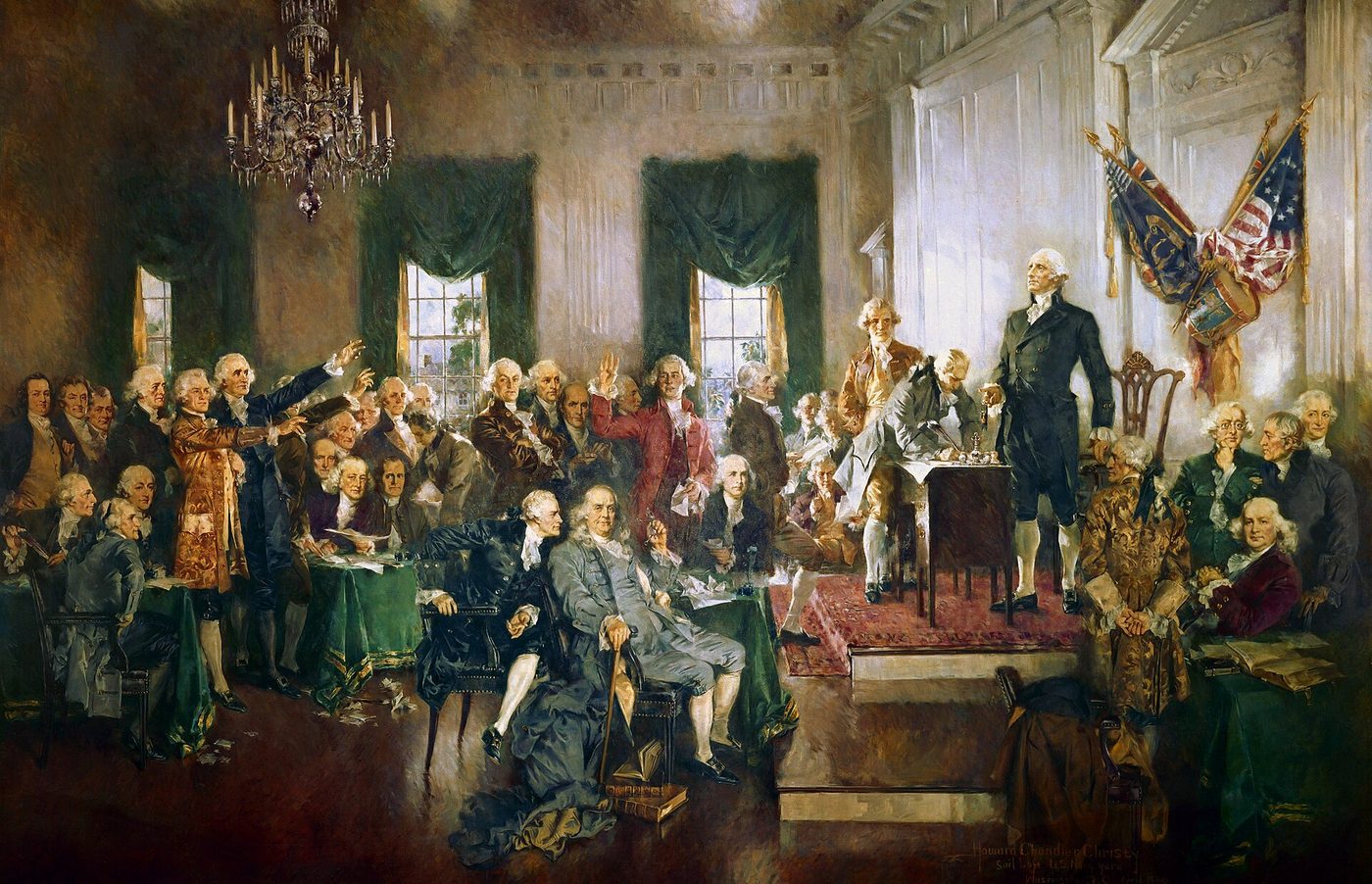
On September 17, 1787, thirty-nine of the forty-two delegates still present signed. Edmund Randolph, George Mason and Elbridge Gerry did not.20 Franklin, in a speech James Wilson read for him, said: "I confess that there are several parts of this constitution which I do not at present approve, but I am not sure I shall never approve them." Five days earlier Mason, who "wished the plan had been prefaced with a Bill of Rights," and Gerry had asked for a committee to write one. Ten state delegations voted no, and Massachusetts abstained.21
Article VII set the rule: "The Ratification of the Conventions of nine States, shall be sufficient for the Establishment of this Constitution between the States so ratifying the Same." The Articles had demanded every state legislature. The Constitution went around the legislatures to conventions chosen for the purpose. Delaware ratified first, on December 7, 1787, and New Hampshire was the ninth state, on June 21, 1788.20
| State | Ratified | Convention vote (yes to no) |
|---|---|---|
| Delaware | Dec. 7, 1787 | 30 to 0 |
| Pennsylvania | Dec. 12, 1787 | 46 to 23 |
| New Jersey | Dec. 18, 1787 | 38 to 0 |
| Georgia | Jan. 2, 1788 | 26 to 0 |
| Connecticut | Jan. 9, 1788 | 128 to 40 |
| Massachusetts | Feb. 6, 1788 | 187 to 168 |
| Maryland | Apr. 28, 1788 | 63 to 11 |
| South Carolina | May 23, 1788 | 149 to 73 |
| New Hampshire (ninth state) | June 21, 1788 | 57 to 47 |
| Virginia | June 25, 1788 | 89 to 79 |
| New York | July 26, 1788 | 30 to 27 |
| North Carolina | Nov. 21, 1789 | 194 to 77 |
| Rhode Island | May 29, 1790 | 34 to 32 |
Sources differ by a day or a vote in places. The Bill of Rights Institute gives Connecticut as January 8, Virginia as June 26, New Hampshire as 57 to 46 and North Carolina as 195 to 77.22
No national vote was held. Delegates chosen in each state met in conventions, and each convention voted for its own state. Chief Justice Marshall later wrote in McCulloch v. Maryland that "when they act, they act in their states."23
The argument played out in newspapers. In The Federalist No. 10, published November 22, 1787, Madison argued that a society where citizens "assemble and administer the government in person" can admit of "no cure for the mischiefs of faction," while a republic of elected representatives offers one. No. 51 answers abuse of power with structure: "Ambition must be made to counteract ambition," because "If men were angels, no government would be necessary." In No. 78 Hamilton called the judiciary the branch with "neither FORCE nor WILL, but merely judgment," and argued that where a statute conflicts with the Constitution, "the judges ought to be governed by the latter rather than the former."24
The Anti-Federalists answered. "Brutus," writing on October 18, 1787 (the author is still debated), said "a free republic cannot succeed over a country of such immense extent, containing such a number of inhabitants, and these increasing in such rapid progression as that of the whole United States." He also called the power to tax "the great engine of oppression and tyranny in a bad one."25
Liberty Perspective: The Promise That Federal Power Was Limited
The Constitution was ratified on a promise. Supporters argued that a bill of rights was unnecessary because, in the National Archives' summary, "the government can only exert the powers specified by the Constitution." When ratification was in danger in Massachusetts, they agreed to consider amendments. The Archives says that compromise "secured ratification and paved the way for the passage of the Bill of Rights." Madison introduced amendments on June 8, 1789, Congress proposed twelve on September 25, and ten were ratified on December 15, 1791. The Tenth reads: "The powers not delegated to the United States by the Constitution, nor prohibited by it to the States, are reserved to the States respectively, or to the people."26
Brutus and Madison were both predicting how far federal power would reach. How far it has reached is still argued, with serious readers on each side. Module 2 and Module 5 take up that argument. The record settles the basis of acceptance: enumerated powers, and a written list of rights added to say so.
Landmark Cases
The first Justices had no precedent. They had the new text and memories of the debates: Paterson, who wrote in Ware and Hylton, had signed the Constitution. Most decisions came seriatim, one opinion per Justice.
| Case | Year | Holding | Effect |
|---|---|---|---|
| Chisholm v. Georgia, 2 U.S. 419 | 1793 | A state may be sued by a citizen of another state. | Reversed by the Eleventh Amendment. |
| Ware v. Hylton, 3 U.S. 199 | 1796 | A treaty overrides a conflicting state law. | First major use of the Supremacy Clause. |
| Hylton v. United States, 3 U.S. 171 | 1796 | A carriage tax is not a direct tax. | Pollock (1895) and the Sixteenth Amendment (1913) followed. |
| Calder v. Bull, 3 U.S. 386 | 1798 | Ex post facto covers criminal and penal laws only. | Chase's four categories still apply (Stogner, 2003). |
| Hollingsworth v. Virginia, 3 U.S. 378 | 1798 | The Eleventh Amendment reaches pending suits. | Amendments need no presidential signature. |
| McCulloch v. Maryland, 17 U.S. 316 | 1819 | The Constitution rests on the people in state conventions. | Reads "We the People" as the people in conventions. |
| Jacobson v. Massachusetts, 197 U.S. 11 | 1905 | The Preamble is not a source of power. | Standard citation on the Preamble. |
Chisholm v. Georgia, 2 U.S. (2 Dall.) 419 (1793)
Alexander Chisholm, a South Carolina citizen suing as an executor, sued Georgia in the Supreme Court on a promise to pay. Georgia protested the Court's jurisdiction and declined to argue. Four Justices (Blair, Wilson, Cushing and Chief Justice Jay) held that Article III's jurisdiction over controversies "between a State and Citizens of another State" meant a state could be sued. Wilson wrote that "To the Constitution of the United States the term SOVEREIGN, is totally unknown." Justice Iredell dissented: "no such action as this before the Court can legally be maintained."27
Congress answered with the Eleventh Amendment, proposed March 4, 1794 and ratified February 7, 1795: "The Judicial power of the United States shall not be construed to extend to any suit in law or equity, commenced or prosecuted against one of the United States by Citizens of another State, or by Citizens or Subjects of any Foreign State." In Hollingsworth v. Virginia, 3 U.S. (3 Dall.) 378 (1798), a unanimous Court applied it to pending suits, and Justice Chase added that the President "has nothing to do with the proposition, or adoption, of amendments to the Constitution." Hans v. Louisiana, 134 U.S. 1 (1890), said Chisholm had "created such a shock of surprise throughout the country" and extended the immunity to suits by a state's own citizens.28
Ware v. Hylton, 3 U.S. (3 Dall.) 199 (1796)
Daniel Hylton and Francis Eppes, Virginians, owed a bond dated July 7, 1774 to a British firm. They defended on Virginia's 1777 law, which let debtors discharge such debts by paying into the state treasury. The creditor relied on Article 4 of the Treaty of Paris. The Court reversed the circuit court and held for the creditor. Justice Chase wrote that "A treaty cannot be the supreme law of the land, that is of all the United States, if any act of a State Legislature can stand in its way." Chase, Paterson, Wilson and Cushing agreed. Justice Iredell, who had ruled for the debtors on circuit, dissented in part.29
The Convention had seen this coming. On August 25 it voted without objection to add "or which shall be made" after "all treaties made," an insertion Madison's notes say was "meant to obviate all doubt concerning the force of treaties preexisting." Article VI now makes treaties, with the Constitution and federal statutes, "the supreme Law of the Land." A later federal statute can override an earlier treaty: courts "have typically held later-in-time statutes" to prevail when a conflict cannot be avoided.
Hylton v. United States, 3 U.S. (3 Dall.) 171 (1796)
A federal law of June 5, 1794 taxed carriages kept for private use. Daniel Hylton owned 125 and refused to pay, arguing that the tax was a "direct tax" that Article I required Congress to apportion among the states by population. Alexander Hamilton argued for the government. Justices Chase, Paterson and Iredell each wrote that the tax was valid, and the judgment was affirmed. Wilson had sat below, and Cushing was ill. Paterson explained the apportionment rule: "The southern states, if no provision had been introduced in the Constitution, would have been wholly at the mercy of the other states," since Congress might otherwise tax slaves "at discretion or arbitrarily." Chase added that if the Court could declare an act of Congress void, "I will never exercise it, but in a very clear case."30
Liberty Perspective: The Fence Around the Taxing Power
Article I, section 8 gives Congress power "To lay and collect Taxes, Duties, Imposts and Excises" and fences it: duties, imposts and excises must be "uniform throughout the United States," and no direct tax may be laid "unless in Proportion to the Census or enumeration." In Pollock v. Farmers' Loan & Trust Co., 158 U.S. 601 (1895), a five to four Court held that taxes on income from real and personal property were direct taxes that had to be apportioned. Justices Harlan, Brown, Jackson and White dissented. The people then changed the text. The Sixteenth Amendment, ratified February 3, 1913, reads: "The Congress shall have power to lay and collect taxes on incomes, from whatever source derived, without apportionment among the several States, and without regard to any census or enumeration." In Brushaber v. Union Pacific Railroad Co., 240 U.S. 1 (1916), the Court said "the whole purpose of the Amendment was to relieve all income taxes when imposed from apportionment from a consideration of the source whence the income was derived."31 The income tax came by amendment, the method the text provides for changing the text. The apportionment rule still governs other direct taxes.
Calder v. Bull, 3 U.S. (3 Dall.) 386 (1798)
In 1795 the Connecticut legislature set aside a probate decree that had refused to approve Normand Morrison's will and ordered a new hearing. The new hearing approved the will and moved property away from Calder and his wife. They argued the resolution was an ex post facto law, barred to the states by Article I, section 10. The Court affirmed. Chase, Paterson, Iredell and Cushing each wrote; Chief Justice Ellsworth was absent. The Justices read the clause as reaching criminal and penal laws. Chase listed four kinds: laws that criminalize past innocent acts, make a crime greater, increase the punishment, or change the rules of evidence to convict more easily. This civil resolution was none of them.32
The Convention had debated the clause on August 22. Williamson of North Carolina said it "may do good here, because the Judges can take hold of it." The vote to include it was seven states to three, with North Carolina divided. The Court still treats Chase's list as authoritative. In Stogner v. California, 539 U.S. 607 (2003), five Justices held that a law reviving prosecutions after the limitations period had run fell within Chase's second category; Justice Kennedy, joined by three others, dissented.33 Idaho's Constitution carries the same ban at Article I, section 16.
Liberty Perspective: When the Written Text Runs Out
Chase went further than the clause. He wrote that "An ACT of the Legislature (for I cannot call it a law) contrary to the great first principles of the social compact, cannot be considered a rightful exercise of legislative authority." Iredell answered that a court "cannot pronounce it to be void, merely because it is, in their judgment, contrary to the principles of natural justice," since "The ideas of natural justice are regulated by no fixed standard." The question is whether a legislature can be held to limits nobody wrote down. Neither view became the holding in Calder, which turned on the text of the clause. The disagreement has not gone away.
McCulloch v. Maryland, 17 U.S. (4 Wheat.) 316 (1819)
Maryland taxed every bank in the state not chartered by its legislature, and the Baltimore branch of the Bank of the United States was the target. Chief Justice Marshall, for the Court, rejected the idea that the Constitution was a compact among state governments. The Philadelphia convention "was indeed elected by the state legislatures," but its work "was a mere proposal, without obligation, or pretensions to it" until the people acted. The Union's government is "emphatically and truly, a government of the people. In form, and in substance, it emanates from them." The Court also held the bank constitutional and the tax invalid, which Module 2 and Module 5 take up.23
Where This Shows Up for Officials, Reporters and Citizens
A newly elected Idaho county clerk, call her Dana Whitfield, takes the oath in Idaho Code section 59-401: to swear "that I will support the Constitution of the United States, and the Constitution of the State of Idaho." Article I, section 3 of Idaho's Constitution says the state "is an inseparable part of the American Union, and the Constitution of the United States is the supreme law of the land." Ware v. Hylton shows what that means when a state law gets in the way.34
A county commissioner is asked to vote on an ordinance that would fine landlords for something they did last year, before the ordinance existed. Idaho's Article I, section 16 says "No bill of attainder, ex post facto law, or law impairing the obligation of contracts shall ever be passed." Under Calder, counsel should ask whether the rule punishes past conduct or only changes civil rights.
A reporter covering a budget fight hears a candidate say the Founders warned about faction. No. 10 is Madison's. No. 51 is attributed to Hamilton or Madison, and "Brutus" is a pen name with a disputed author. Attribute by number, link the text, and check the quote against the whole argument. If someone says the Preamble grants a power, Jacobson answers it.
A citizen at a county meeting, told the board decides everything, can point to the Idaho declaration of rights. Section 1 says all men "have certain inalienable rights," and section 2 says "Government is instituted for their equal protection and benefit."
Pictures, Numbers and Infographics
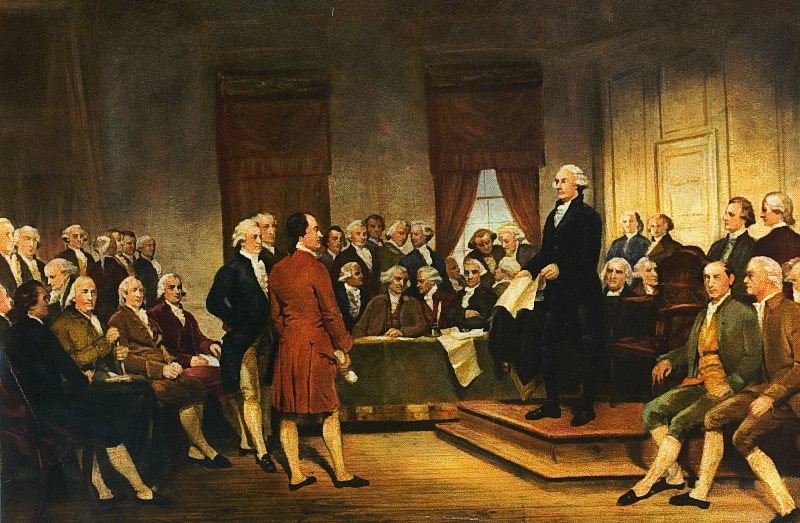
Fifty-five delegates wrote the Constitution over one summer, and thirteen state conventions took two and a half years to accept it. The pictures show the signing as later painters imagined it; the charts show how fast the states moved and how close some votes were.
By the numbers
- 55 attended, 39 signed: delegates who took part in the Convention sessions and those who signed the Constitution. National Archives, Meet the Framers of the Constitution
- 26 to 81: the delegates' age range, from Jonathan Dayton of New Jersey to Benjamin Franklin, who was carried to sessions in a sedan chair. National Archives
- December 7, 1787: Delaware ratifies first. U.S. Government Publishing Office, Ben's Guide, States Ratification
- June 21, 1788: New Hampshire becomes the ninth state, the number Article VII required, ending government under the Articles of Confederation. Ben's Guide
- May 29, 1790: Rhode Island ratifies last, more than a year after Washington took office. Ben's Guide
- 187 to 168: the Massachusetts convention vote, the largest convention. New York ratified 30 to 27 and Rhode Island 34 to 32. Teaching American History (Ashland University), Dates of Ratification of the Constitution
Verify Independently
Every citation, quotation and case in this course should be verified independently against the official source (the U.S. Reports or the Court's own opinion, the National Archives transcription, the statute book) before you rely on it, quote it or act on it.
Sources & Further Reading
Primary Sources
- National Archives: Constitution, Declaration of Independence, Amendments 11-27, Bill of Rights, How Did It Happen?, Meet the Framers
- Avalon Project, Yale Law School: Madison's Notes by date, Articles of Confederation, Annapolis Report, Treaty of Paris, Virginia Charter, Mayflower Compact, Federalist 10, 51, 78
- Brutus No. 1, TeachingAmericanHistory.org
- Congress Calls a Convention, 21 February 1787, UW-Madison CSAC
- The First Legislative Assembly, National Park Service
- Shays' Rebellion, HISTORY
- States and Dates of Ratification, GPO Ben's Guide, Clearinghouse vote table, Bill of Rights Institute summary
- Idaho Legislature: Idaho Constitution, Idaho Code 59-401
Court Opinions and Court Histories
- Cornell Legal Information Institute: Chisholm, Hylton, Hollingsworth, Calder, McCulloch, Hans, Pollock, Jacobson, Brushaber, Stogner
- Ware v. Hylton, United States Reports vol. 3, Library of Congress
- Foreign Treaties in the Federal Courts, Federal Judicial Center
Related Training Modules
Knowledge Check
Test your understanding of the road to the Constitution and the early cases. No scores are saved: this is for your own review.
1. According to the February 21, 1787 resolution of the Confederation Congress, what was the Philadelphia convention for?
Congress called the meeting "for the sole and express purpose of revising the Articles of Confederation." The delegates produced a new Constitution, and Article VII set a different rule for approving it. Congress's call said the meeting was for the sole and express purpose of revising the Articles of Confederation. The delegates went on to write a new frame of government.
2. As originally written in Article I, section 2, how were persons other than free persons counted when apportioning Representatives and direct taxes?
The text counts the free population, including those bound to service for a term of years and excluding Indians not taxed, plus "three fifths of all other Persons." Section 2 of the Fourteenth Amendment replaced the rule in 1868. The clause adds "three fifths of all other Persons" to the free population. It was replaced by Section 2 of the Fourteenth Amendment in 1868.
3. Which state's ratification on June 21, 1788 supplied the ninth vote needed under Article VII?
Article VII required the conventions of nine states. New Hampshire was the ninth. Virginia followed on June 25 and New York on July 26. New Hampshire was the ninth state, on June 21, 1788. Virginia and New York ratified afterward.
4. In Ware v. Hylton (1796), how did the Supreme Court resolve the conflict between a Virginia debt law and the Treaty of Paris?
The Court reversed the circuit court. Justice Chase wrote that a treaty cannot be the supreme law of the land if an act of a state legislature can stand in its way. The Court held for the British creditor. A treaty is the supreme law of the land, and a state statute cannot defeat it.
5. In Calder v. Bull (1798), what did the Court conclude about the Ex Post Facto Clause?
Justice Chase listed four kinds of ex post facto laws, all tied to crime and punishment, and said not every retrospective law qualifies. The Connecticut resolution was civil, so the judgment was affirmed. The clause covers criminal and penal laws. Chase's four categories deal with crimes and punishments, and the Connecticut probate resolution was not one of them.
Reference Materials
Use your browser's print function (Ctrl+P / Cmd+P) to save this page as a PDF for offline reference.
Footnotes
- First Charter of Virginia (1606), Avalon Project.
- National Park Service, The First Legislative Assembly.
- Mayflower Compact (Nov. 11, 1620), Avalon Project.
- Declaration of Independence, National Archives transcript.
- Idaho Const. art. I, secs. 1-2.
- Articles of Confederation, arts. II, III, V, VIII, XIII.
- Madison's Notes, May 29, 1787.
- Treaty of Paris, art. 4 (Sept. 3, 1783); Federal Judicial Center, Foreign Treaties in the Federal Courts.
- HISTORY, Shays' Rebellion.
- Annapolis Report (Sept. 14, 1786); Resolution of Congress (Feb. 21, 1787), UW-Madison CSAC.
- Madison's Notes, May 14, 25 and 29, 1787; National Archives, Meet the Framers.
- Madison's Notes, May 29, 1787, Resolutions 1, 2, 3, 6.
- Madison's Notes, June 15, 1787, Resolutions 2 and 6. Madison spells the name "Patterson."
- Madison's Notes, July 2 and 16, 1787.
- Madison's Notes, July 12, 1787.
- Madison's Notes, Aug. 22 and 25, 1787.
- National Archives, Amendments 11-27.
- Madison's Notes, Aug. 6, Sept. 8 and 12, 1787.
- Jacobson v. Massachusetts, 197 U.S. 11 (1905).
- GPO, Ben's Guide: States and Dates of Ratification; State Constitutional Convention Clearinghouse.
- Madison's Notes, Sept. 12 and 17, 1787.
- Bill of Rights Institute, State-by-State Ratification Summary.
- McCulloch v. Maryland, 17 U.S. (4 Wheat.) 316 (1819).
- The Federalist Nos. 10, 51 (Hamilton or Madison) and 78, Avalon Project.
- Brutus No. 1 (Oct. 18, 1787), TeachingAmericanHistory.org.
- National Archives, The Bill of Rights: How Did It Happen?; A Transcription.
- Chisholm v. Georgia, 2 U.S. (2 Dall.) 419 (1793).
- U.S. Const. amend. XI; Hollingsworth, 3 U.S. (3 Dall.) 378 (1798); Hans, 134 U.S. 1 (1890).
- Ware v. Hylton, 3 U.S. (3 Dall.) 199 (1796); Madison's Notes, Aug. 25, 1787.
- Hylton v. United States, 3 U.S. (3 Dall.) 171 (1796).
- Pollock, 157 U.S. 429, rehearing, 158 U.S. 601 (1895); U.S. Const. amend. XVI; Brushaber, 240 U.S. 1 (1916).
- Calder v. Bull, 3 U.S. (3 Dall.) 386 (1798); Madison's Notes, Aug. 22, 1787.
- Stogner v. California, 539 U.S. 607 (2003).
- Idaho Code sec. 59-401; Idaho Const. art. I, sec. 3.