U.S. CONSTITUTION · Module 6
Module 6: Amending the Constitution
How the Constitution changes, who has to agree, and what has stopped changes that nearly happened
The Text: Article V
Article V is one sentence. This is the National Archives transcription.1
"The Congress, whenever two thirds of both Houses shall deem it necessary, shall propose Amendments to this Constitution, or, on the Application of the Legislatures of two thirds of the several States, shall call a Convention for proposing Amendments, which, in either Case, shall be valid to all Intents and Purposes, as Part of this Constitution, when ratified by the Legislatures of three fourths of the several States, or by Conventions in three fourths thereof, as the one or the other Mode of Ratification may be proposed by the Congress; Provided that no Amendment which may be made prior to the Year One thousand eight hundred and eight shall in any Manner affect the first and fourth Clauses in the Ninth Section of the first Article; and that no State, without its Consent, shall be deprived of its equal Suffrage in the Senate."
U.S. Const. art. V
Take it in order. Congress proposes an amendment when two thirds of both Houses deem it necessary. The Supreme Court reads that as two thirds of the members present, so long as a quorum is there.2 Or the legislatures of two thirds of the states, 34 of 50, apply, and Congress "shall call a Convention for proposing Amendments." Either way, nothing joins the Constitution until three fourths of the states, 38 of 50, ratify. Congress picks the method: state legislatures or state conventions.
Two limits close the sentence. Before 1808, no amendment could touch the first and fourth clauses of Article I, section 9. And no state can lose its equal vote in the Senate without its own consent.
What Article V leaves out matters as much. It gives the President no part. It sets no deadline. It says nothing about a state that ratifies and then changes its mind, or rejects and then reverses. And it supplies no rules for a convention: who attends, how votes count, who sets the agenda. Most of the legal fights in this lesson live in those gaps.
How We Got Here
The Articles of Confederation made change nearly impossible. An alteration had to be "agreed to in a Congress of the United States, and be afterwards confirmed by the legislatures of every State." One state could say no for all thirteen. Charles Pinckney blamed that unanimity for the Union's "depressed situation."3
The Virginia Plan, introduced May 29, 1787, proposed that amendment go forward "and that the assent of the National Legislature ought not to be required thereto."4 The committee draft of August 6 gave the job to the states: on application of two thirds of them, the Legislature "shall call a Convention."
On September 10 that draft fell apart. Elbridge Gerry feared a convention could "subvert the State-Constitutions altogether." Alexander Hamilton wanted the opposite: state legislatures would apply only to increase their own powers, while Congress would be first to see what needed fixing. James Madison asked how a convention would even work: "by what rule decide? what the force of its acts?" Madison then offered a substitute letting Congress propose on a two-thirds vote, or on application of two thirds of the states, with ratification by three fourths. It carried, nine states to one, New Hampshire divided.5
Five days later George Mason attacked the result. Both routes, he said, ended with Congress, so "no amendments of the proper kind would ever be obtained by the people, if the Government should become oppressive." Gouverneur Morris and Gerry moved to require a convention on application of two thirds of the states. Madison saw no great need but no objection either, only worry about "the form, the quorum &c." The motion passed with no one dissenting. That is how the state convention route got in: late, as a check on the body that would otherwise hold every key.6
The same day Roger Sherman's proviso shielding each state's "internal police" lost, 3 to 8, and so did his motion to strike Article V altogether.
In the ratification debates Madison defended the design in Federalist 43: it "guards equally against that extreme facility, which would render the Constitution too mutable; and that extreme difficulty, which might perpetuate its discovered faults."7 Hamilton, in Federalist 85, stressed the state route: "The words of this article are peremptory. The Congress 'shall call a convention.' Nothing in this particular is left to the discretion of that body."8
Liberty Perspective: The Convention Route Was Built as a Check on Congress
Mason's complaint is the reason the state route exists. The delegates did not trust Congress to propose the limits on itself that the states might want. Hamilton said Congress had no option once the states applied. No convention has ever been called, and Congress has never found the threshold met. Article V supplies no procedure, and bills to supply one have been introduced since the 1960s.9 Some scholars read "shall" as a command to Congress. Others think Congress may review applications first. No court has decided it, and the Constitution Annotated notes it seems unlikely the Supreme Court would order Congress to act. The text says "shall." What follows when the body bound by that word stays silent is an open question.
Proposing and Ratifying: Four Paths, Two Used
Article V sets up two ways to propose and two ways to ratify. That makes four combinations.
| Proposed by | Ratified by | Times used |
|---|---|---|
| Congress, two thirds of both Houses | Legislatures of three fourths of the states | 26 amendments |
| Congress, two thirds of both Houses | Conventions in three fourths of the states | 1 amendment (the Twenty-First) |
| A convention called on application of two thirds of the states | Legislatures or conventions, as Congress directs | Never |
Congress chooses the ratification method, and the Court has said so flatly: "The choice, therefore, of the mode of ratification, lies in the sole discretion of Congress."10 Challengers in 1931 argued that an amendment adding federal power over individuals had to go to conventions. The Court refused to add words Article V does not contain.
Congress used the convention method once. It proposed the Twenty-First Amendment, repealing Prohibition, on February 20, 1933, and the Acting Secretary of State certified it December 5, 1933. Its own text says it is inoperative unless "ratified as an amendment to the Constitution by conventions in the several States." The Constitution Annotated records two accounts of why. Many politicians thought amendments touching individual rights and morals belonged before conventions elected for the purpose. And Congress may have wanted to bypass the temperance lobby, which still had weight in state legislatures.1112
The President appears nowhere in this process. Presidents have sometimes signed amendment resolutions anyway, with no legal effect.
Common Misconception: The President Signs or Vetoes Amendments
No. In Hollingsworth v. Virginia (1798) the Court upheld the Eleventh Amendment even though Congress never sent it to the President. Abraham Lincoln signed the resolution proposing the Thirteenth, and Jimmy Carter signed the 1978 Equal Rights Amendment extension, but neither signature was needed.
The 27 Amendments, 1789 to 1992
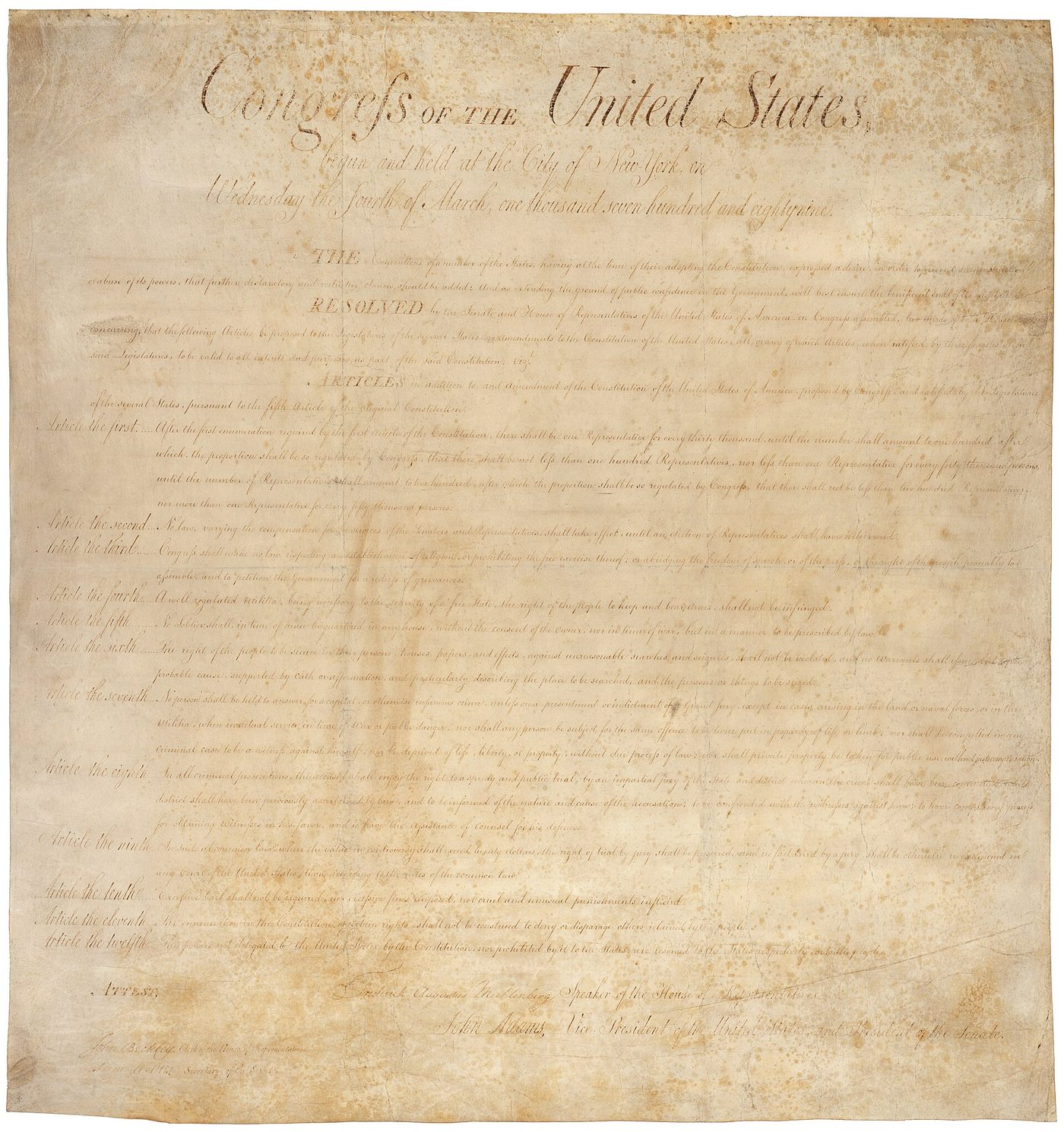
The First Congress proposed twelve amendments on September 25, 1789. Madison had introduced his list on June 8, built mostly from the more than 200 amendments the state ratifying conventions had suggested. Sherman won the point that they should be added at the end instead of woven into the text. The House passed seventeen on August 24, the Senate revised them, and a conference committee settled on twelve.13
Ratification crawled. New Jersey acted first, on November 20, 1789. Vermont, admitted March 4, 1791 as the fourteenth state, ratified that November 3. Virginia acted December 15, 1791, the eleventh of fourteen, and Articles 3 through 12 became the first ten amendments.14
The two left over had different fates. The first set a formula for the size of the House and came one state short. The second said: "No law, varying the compensation for the services of the Senators and Representatives, shall take effect, until an election of Representatives shall have intervened." Six states ratified it early. Then it sat, until a University of Texas student, Gregory Watson, began lobbying legislatures in 1982. Maine ratified in 1983. Michigan's vote on May 7, 1992 was taken to be the thirty-eighth, since Kentucky's 1792 ratification had been forgotten. Archivist Don Wilson certified it May 18, 1992, the only time an Archivist has done so.15 On May 20 the House voted 414 to 3 and the Senate 99 to 0 to declare it adopted.16 It became the Twenty-Seventh Amendment, 202 years after it was proposed.
| Amendment | Year ratified | Subject |
|---|---|---|
| I | 1791 | Religion, speech, press, assembly, petition |
| II | 1791 | Right to keep and bear arms |
| III | 1791 | Quartering of soldiers |
| IV | 1791 | Searches and seizures |
| V | 1791 | Grand jury, double jeopardy, self-incrimination, due process, takings |
| VI | 1791 | Rights of the accused in criminal prosecutions |
| VII | 1791 | Jury trial in civil suits |
| VIII | 1791 | Excessive bail and fines; cruel and unusual punishments |
| IX | 1791 | Other rights retained by the people |
| X | 1791 | Powers reserved to the states or the people |
| XI | 1795 | Limits on suits against a state by out-of-state or foreign citizens |
| XII | 1804 | Separate electoral ballots for President and Vice President |
| XIII | 1865 | Abolition of slavery |
| XIV | 1868 | Citizenship, due process, equal protection |
| XV | 1870 | Vote not denied on account of race |
| XVI | 1913 | Income tax without apportionment |
| XVII | 1913 | Direct election of Senators |
| XVIII | 1919 | Prohibition (repealed by XXI) |
| XIX | 1920 | Vote not denied on account of sex |
| XX | 1933 | Start dates for terms of President and Congress; succession |
| XXI | 1933 | Repeal of Prohibition (ratified by state conventions) |
| XXII | 1951 | Two-term limit for President |
| XXIII | 1961 | Electors for the District of Columbia |
| XXIV | 1964 | No poll tax in federal elections |
| XXV | 1967 | Presidential vacancy and inability |
| XXVI | 1971 | Vote at age 18 |
| XXVII | 1992 | Congressional pay changes wait for an election (proposed 1789) |
Years come from the National Archives transcriptions.17
Liberty Perspective: Who Declares an Amendment Adopted?
Article V says an amendment is "valid to all Intents and Purposes" when ratified. It does not say anyone must announce it. Practice added a step: the Archivist, under 1 U.S.C. § 106b, publishes and certifies. In Coleman the Court suggested Congress has the last word on whether ratification came in time. Congress then voted on the Twenty-Seventh in 1992 after the Archivist had already certified it. The Office of Legal Counsel has said no such congressional role is found in Article V.1819 The text puts the decision with the thirty-eight states. Everything after that is record-keeping, and who may say the record is wrong has never been settled.
Proposals That Fell Short, Deadlines and Rescission
Congress has sent the states thirty-three amendments. Six did not make it.20 A House size formula (1789). A ban on titles of nobility (1810), which passed 87-3 in the House and 19-5 in the Senate. A ban on amendments letting Congress interfere with slavery in the states (1861), approved 133-65 and 24-12 and ratified by only two states.21 A child labor amendment (1924). The Equal Rights Amendment (1972). And D.C. representation (1978).
The Child Labor Amendment would have given Congress the power to "limit, regulate, and prohibit the labor of persons under eighteen years of age." Congress set no deadline. It reached 28 of the 36 states then needed.21 D.C. representation, proposed in August 1978 with a seven-year limit, drew 16 ratifications before the clock ran out in 1985.
The Equal Rights Amendment is the longest story. Congress proposed it March 22, 1972, with a seven-year limit written into the resolution, not into the amendment. By 1977 thirty-five states had ratified, three short. Five of them, Idaho among them, later voted to rescind.22 In 1978 Congress, by simple majorities, extended the deadline to June 30, 1982. No further state ratified in time.23 Then Nevada (2017), Illinois (2018) and Virginia (2020) ratified on the premise that the deadline could be disregarded. The Office of Legal Counsel concluded in January 2020 that the deadline had expired, and the National Archives said it would follow that opinion absent a court order. The states sued. The district court dismissed for lack of standing, and the D.C. Circuit affirmed in 2023 on mandamus grounds. In April 2023 a Senate vote to end debate on a resolution declaring the amendment valid drew 51 votes, fewer than the 60 needed. Check the Archives for the current status before relying on any summary, this one included.
Time limits and rescission
Article V says nothing on either. The Court filled the first gap in Dillon v. Gloss (1921) by letting Congress set a limit. Congress has used seven years since the Eighteenth Amendment in 1917, for everything but the Nineteenth.24 The Twenty-Seventh shows what happens with no limit: it stayed open for more than two centuries. The Office of Legal Counsel said in 1992 that without a congressional deadline, an amendment stays pending.
On rescission, Coleman v. Miller (1939) treated the effect of an earlier rejection or an attempted withdrawal as a question for Congress, pointing to 1868, when Congress counted the Fourteenth Amendment despite Ohio and New Jersey trying to withdraw.25 But three Southern states that had rejected it were then under new governments set up at Congress's direction, so the precedent is muddy. The Idaho case, below, took the question straight on.
Liberty Perspective: A Deadline the Text Never Mentions
The people who vote on an amendment are the legislators of thirty-eight states, and the sentence that governs them contains no clock. The clock came from the Court's reasoning in 1921 and from Congress. The Eighteenth, Twentieth, Twenty-First and Twenty-Second Amendments carry their deadlines in their own text. From the Twenty-Third on, Congress put the clock in the resolution that sends the amendment out, so the deadline sits outside what the states vote on. Dillon reasoned that three fourths of the states should agree at about the same period. The Office of Legal Counsel concluded in 2020 that Congress cannot revive an amendment once its deadline runs. The Idaho court found the 1978 extension invalid on two counts: Congress cannot change a limit once set, and it cannot act under Article V by less than two thirds.
Common Misconception: Amendments Must Be Ratified Within Seven Years
Seven years is Congress's habit, adopted in 1917. Article V has no deadline. Amendments proposed without one, like the Twenty-Seventh, remain open. The Nineteenth Amendment also had none.
The Article V Convention Debate
No Article V convention has ever met. Since 1960 states have filed more than 180 applications on subjects ranging from legislative apportionment to a balanced federal budget, and Congress has never treated the two-thirds threshold as met.9 The 1787 Convention was not one. It wrote Article V.
Common Misconception: The 1787 Convention Was an Article V Convention
Article V took its final shape in that convention's last weeks, on September 10 and 15, 1787. No convention called under it has ever been held. Amendments from any such convention would still need ratification by 38 states.
The disputes are real and run in several directions. Supporters point to Mason's argument and Hamilton's Federalist 85: the route exists so the states can act when Congress will not. They cite the 1893 to 1912 campaign for direct election of Senators, which preceded Congress proposing the Seventeenth Amendment.26 Skeptics point to Gerry's fear and Madison's questions about form and quorum: the text sets no rules, so a convention might range past its stated subject. Scholars divide on whether Congress must call a convention, whether applications can limit the subject, how delegates would be chosen, how votes would be counted, and whether applications expire or can be withdrawn.9 On the last question a Congressional Research Service report found opinion divided: some hold a state may rescind an application until two thirds is reached, others hold an application is as binding as a ratification.27 In 2017 the CRS counted advocacy groups across the political spectrum pushing conventions on topics including a balanced budget and limits on federal authority.
Idaho's part
Idaho's record is public. In 1999, in Senate Concurrent Resolution 129, the Legislature rescinded "any and all extant applications" to Congress for a convention, listing eight earlier memorials and resolutions from 1901 through 1980. The Senate adopted it by voice vote and the House by 38 to 31. The resolution cites Warren E. Burger and Arthur J. Goldberg for the view that a convention "may propose sweeping changes to the Constitution," and in the same text reaffirms a request that Congress itself propose a balanced budget amendment. A similar resolution in 1998 passed the House and died in a 17-17 Senate tie.28 In March 2025 the Idaho House defeated a proposal for a convention on congressional term limits and a federal balanced budget amendment, 26 to 44.29
Idaho's own amendment rule is art. XX, § 1 of the state constitution: two thirds of each house, then a majority of voters at the next general election. Federal ratification skips the voters and goes to the Legislature.30
What Article V Puts Off Limits
Article V fenced off two subjects. The first fence expired. Article I, section 9 said:
"The Migration or Importation of such Persons as any of the States now existing shall think proper to admit, shall not be prohibited by the Congress prior to the Year one thousand eight hundred and eight, but a Tax or duty may be imposed on such Importation, not exceeding ten dollars for each Person."
"No Capitation, or other direct, Tax shall be laid, unless in Proportion to the Census or enumeration herein before directed to be taken."
U.S. Const. art. I, § 9, cls. 1 and 4
Article V barred amendments to those two clauses before 1808.31 John Rutledge of South Carolina said on September 10 that he could never agree to a power "by which the articles relating to slaves might be altered by the States not interested in that property and prejudiced against it." The bar kept the slave-trade compromise safe from amendment until 1808, and then lapsed. The second clause, on direct taxes, rode along. The Sixteenth Amendment later permitted income taxes without apportionment.
The second fence has not expired: "that no State, without its Consent, shall be deprived of its equal Suffrage in the Senate." Madison's notes show how it passed, with no objection, because the small states were uneasy. In Federalist 43 Madison thought the exception was "probably meant as a palladium to the residuary sovereignty of the States." The Seventeenth Amendment kept the rule: the Senate is "composed of two Senators from each State." Scholars have debated how firm these last two sentences really are.
Landmark Cases
| Case | Citation | Year | Holding | Effect |
|---|---|---|---|---|
| Hollingsworth v. Virginia | 3 U.S. 378 | 1798 | Eleventh Amendment validly adopted though never sent to the President. | No presidential role in amendments. |
| Hawke v. Smith (No. 1) | 253 U.S. 221 | 1920 | Ohio could not put ratification to a popular referendum. | States cannot add steps to ratification. |
| Dillon v. Gloss | 256 U.S. 368 | 1921 | Congress may set a reasonable ratification deadline. | Source of the seven-year practice. |
| Leser v. Garnett | 258 U.S. 130 | 1922 | Nineteenth Amendment valid; state limits cannot bind a ratifying legislature. | Ratification is a federal act. |
| United States v. Sprague | 282 U.S. 716 | 1931 | Congress alone chooses legislatures or conventions. | Basis for the Twenty-First route. |
| Coleman v. Miller | 307 U.S. 433 | 1939 | Effect of earlier rejection and of delay is for Congress. | Courts defer on timing questions. |
| Idaho v. Freeman | 529 F. Supp. 1107 (D. Idaho) | 1981 | Rescission valid; ERA extension by simple majority void. | Vacated; no binding force. |
| NOW v. Idaho | 459 U.S. 809 | 1982 | District judgment vacated as moot. | Merits never decided. |
Hollingsworth v. Virginia, 3 U.S. 378 (1798)
After Chisholm v. Georgia let a citizen sue a state, Congress proposed what became the Eleventh Amendment. With a suit against Virginia pending, counsel resisting the amendment's reach argued it was void because Congress never presented it to the President under Article I, section 7. The Court, in what the reporter calls a unanimous opinion, held it constitutionally adopted and that no jurisdiction survived over such suits, past or future. The reporter's note records Justice Chase: the President's veto "applies only to the ordinary cases of legislation: He has nothing to do with the proposition, or adoption, of amendments." Hawke later called the point settled.32
Hawke v. Smith (No. 1), 253 U.S. 221 (1920)
Ohio's 1918 constitutional amendment let voters review any ratification by the General Assembly. After the legislature ratified the Eighteenth Amendment in January 1919, a citizen sued to stop the referendum ballots. Justice Day wrote that "the fifth article is a grant of authority by the people to Congress," limited to two methods, and that "it is not the function of courts or legislative bodies, national or state, to alter the method which the Constitution has fixed." The Court reversed. A state cannot make its voters a step in federal ratification.33
Dillon v. Gloss, 256 U.S. 368 (1921)
Dillon was arrested for transporting liquor the day after the Eighteenth Amendment took effect. He argued the amendment was void because Congress had made it inoperative unless ratified within seven years. Justice Van Devanter held that Congress may fix a period "as an incident of its power to designate the mode of ratification," and found seven years reasonable. The opinion went further and suggested ratification must be "sufficiently contemporaneous." Coleman later read that part narrowly, and the Office of Legal Counsel rejected it in 1992.34
Leser v. Garnett, 258 U.S. 130 (1922)
Two Maryland women registered to vote in October 1920. Oscar Leser sued to remove them: Maryland's constitution limited the vote to men, and its legislature had refused to ratify the Nineteenth Amendment. Justice Brandeis held the amendment valid, because a legislature's function in ratifying "is a federal function derived from the federal Constitution; and it transcends any limitations sought to be imposed by the people of a state." The Secretary of State's proclamation of ratification was conclusive on the courts.35
United States v. Sprague, 282 U.S. 716 (1931)
A district court quashed a Prohibition indictment on the theory that the Eighteenth Amendment, which added federal power over individuals, had to be ratified by conventions. Justice Roberts wrote that "a mere reading demonstrates" Article V is clear and refused to read in a limit drawn from the framers' views on ratifying the original Constitution. Congress alone picks the mode. That is why the Twenty-First Amendment's convention route was Congress's call.10
Coleman v. Miller, 307 U.S. 433 (1939)
Congress proposed the Child Labor Amendment in 1924 without a deadline. Kansas rejected it in 1925. In 1937 the Kansas Senate tied 20-20 and the Lieutenant Governor broke the tie for ratification, and twenty-four legislators sued. Chief Justice Hughes wrote that the effect of earlier rejection or attempted withdrawal, and of the passage of time, was "a political question pertaining to the political departments, with the ultimate authority in the Congress." On whether the Lieutenant Governor counted, the Court was equally divided. Four Justices, Black, Roberts, Frankfurter and Douglas, concurred in the result and would have gone further: the amending process is "'political' in its entirety." Justices Butler and McReynolds dissented. Since then, commentators and the Office of Legal Counsel have questioned whether Article V gives Congress that role at all.36
Idaho v. Freeman, 529 F. Supp. 1107 (D. Idaho 1981)
Idaho ratified the Equal Rights Amendment in March 1972. In February 1977 its Legislature voted to rescind, 44-26 in the House and 18-17 in the Senate. The court recorded that Idaho requires two thirds of the Legislature to ratify an amendment, while the rescission passed by simple majorities. Idaho and Arizona officials and legislators, joined by Washington legislators, sued the Administrator of General Services. The Administrator and the National Organization for Women moved to dismiss. Chief Judge Callister rejected the argument that the questions belonged to the political branches and ruled for Idaho: a state may rescind before three fourths have ratified, and Congress's extension to June 30, 1982 by simple majorities was "void and of no effect." He distinguished rescission from the rejection at issue in Coleman, reasoning that a rescinding state withdraws its consent, leaving nothing for Congress to coordinate.22
NOW v. Idaho, 459 U.S. 809 (1982)
The Supreme Court postponed the question of jurisdiction, and the extended deadline passed with the amendment short of 38. On the Administrator's suggestion of mootness, the Court on October 4, 1982 vacated the district court's judgment and sent the cases back with instructions to dismiss as moot, citing Munsingwear. The order gives no other reasons. The result: the Idaho decision is on the books but binds no one, and the Supreme Court has not decided whether a state may rescind.37
Where This Shows Up for Officials, Reporters and Citizens
A county commissioner. Constituents ask the board to pass a resolution "calling" an Article V convention. Article V counts "the Legislatures." A county resolution can state a position. It adds nothing to the 34 states needed. And a county vote on a federal amendment would not count either, since Hawke v. Smith says the Constitution gave ratification to legislatures.
A sheriff. A deputy asks whether a newly announced amendment is enforceable. An amendment is valid when the thirty-eighth state ratifies, and until then a proposal binds no one. Contested cases like the ERA are why you check the National Archives instead of social media.
A county clerk. Preparing oath forms for newly elected officers, the clerk follows Idaho Code § 59-401: "I do solemnly swear (or affirm, as the case may be) that I will support the Constitution of the United States, and the Constitution of the State of Idaho." What an officer swears to support includes all twenty-seven amendments, and it changes only through Article V.30
A reporter. A post says an amendment has "passed." Three questions sort it out: did two thirds of both Houses vote, did legislatures in 38 states ratify, and has the Archivist certified? For Idaho stories, remember the state's 1972 ratification and 1977 rescission of the ERA, and that the Supreme Court never ruled on whether rescission counts.
A citizen at a town hall. A speaker urges the Legislature to apply for a convention. Ask which subject, whether the application would be limited, who would choose delegates, and what the Legislature's 1999 rescission means for any new application. Then check the Idaho Legislature's own bill records for the actual text.
Liberty Perspective: The Oath Points to a Text That Can Change
You swear to support the Constitution, which means the text. The amendment path is slow on purpose: two thirds, then three fourths. Madison thought the mode "stamped with every mark of propriety." In places practice has gone past the text, with deadlines and a congressional announcing role that Article V never mentions. And the convention route sits unused. An official who knows the text can say which parts are settled and which are habit.
Pictures, Numbers and Infographics
Article V has been used 27 times in more than 230 years, and Congress has sent the states only 33 amendments out of thousands proposed. The figures here show how many ideas get introduced, how few leave Congress and how long the states take once one does.
By the numbers
- About 11,985: measures introduced in Congress to amend the Constitution from 1789 through January 3, 2025. The Senate calls the count an approximation because early indexing was poor and identical resolutions are common. U.S. Senate, Measures Proposed to Amend the Constitution, 2025
- 33 sent, 27 ratified: of the proposals introduced through 1997, Congress sent 33 to the states and 27 became amendments. None has been proposed by a convention of the states. Congressional Research Service, Ratification of Amendments to the U.S. Constitution, 1997; National Archives, Constitutional Amendment Process
- 100 days: the fastest ratification, the 26th Amendment (vote at 18), proposed March 23, 1971 and ratified July 1, 1971. CRS, 1997
- 3 years, 9 months and 4 days: the longest ratification other than the 27th, for the 22nd Amendment (presidential term limit). CRS, 1997
- 74,003 days: the 27th Amendment's wait, from September 25, 1789 to May 7, 1992, more than 202 years. CRS, 1997; National Archives, Amendments 11 to 27
- 1 year, 8 months and 7 days: average ratification time, leaving out the 27th Amendment. CRS, 1997
- 10,431 then 69: proposals introduced in the 1st through 101st Congresses combined (1789 to 1990), against 69 in the 118th Congress (2023 to 2024). U.S. Senate, 2025
Verify Independently
Every citation, quotation and case in this course should be verified independently against the official source (the U.S. Reports or the Court's own opinion, the National Archives transcription, the statute book) before you rely on it, quote it or act on it.
Check these in particular:
- The House vote on the ERA deadline extension: Idaho v. Freeman gives 253 to 189 and a Congressional Research Service report gives 233 to 189, so the tally is left out.
- Idaho's 1972 ERA ratification vote counts are left out because the sources conflict.
Sources & Further Reading
Primary Sources
- National Archives, The Constitution of the United States: A Transcription
- National Archives, Bill of Rights transcript (the twelve articles of 1789)
- National Archives, Amendments 11-27
- Madison's Notes, September 10, 1787 (Avalon Project)
- Madison's Notes, September 15, 1787 (Avalon Project)
- The Federalist No. 43 and No. 85
- Constitution Annotated, Article V (Cornell LII)
- Idaho Senate Concurrent Resolution 129 (1999)
- Idaho Code § 59-401 (official oath)
Cases
- Hollingsworth v. Virginia, 3 U.S. 378 (1798)
- Hawke v. Smith, 253 U.S. 221 (1920)
- Dillon v. Gloss, 256 U.S. 368 (1921)
- Leser v. Garnett, 258 U.S. 130 (1922)
- United States v. Sprague, 282 U.S. 716 (1931)
- Coleman v. Miller, 307 U.S. 433 (1939)
- Idaho v. Freeman, 529 F. Supp. 1107 (D. Idaho 1981)
- NOW v. Idaho, 459 U.S. 809 (1982)
Secondary Sources
- CRS R47959, Proposals to Amend the U.S. Constitution: Fact Sheet
- CRS R47619, The Equal Rights Amendment: Background and Recent Legal Developments
- CRS R44435, The Article V Convention: Current Developments
- Office of Legal Counsel, Ratification of the Equal Rights Amendment (2020)
- National Archives, A Record-Setting Amendment
- National Constitution Center, Twenty-Seventh Amendment
- Oyez
Related Training Modules
Knowledge Check
Test your understanding of how the Constitution is amended. No scores are saved: this is for your own review.
1. How many states must ratify a proposed amendment today, and where does that number come from?
Article V requires ratification by three fourths of the several states. Three fourths of 50 is 37.5, so 38 states. Article V requires three fourths of the states, which is 38 of 50 today. Two thirds (34) is the number of states needed to apply for a convention.
2. At the Philadelphia Convention, what moved the delegates to add the state convention route on September 15, 1787?
Mason made that argument, and Gouverneur Morris and Elbridge Gerry moved the convention requirement. It passed with no one dissenting. Madison's notes show Mason raising the objection, then Morris and Gerry moving to require a convention on application of two thirds of the states.
3. What did Hollingsworth v. Virginia (1798) decide about the amendment process?
The Court held the Eleventh Amendment constitutionally adopted. Justice Chase's note says the President "has nothing to do with the proposition, or adoption, of amendments." The Court upheld the Eleventh Amendment although it was never sent to the President, so the President has no role in the amendment process.
4. What did Dillon v. Gloss (1921) hold?
The Court upheld Congress's power to set a ratification period as part of choosing the mode of ratification. Dillon upheld the seven-year limit on the Eighteenth Amendment and the principle that Congress may fix a reasonable period for ratification.
5. In Idaho v. Freeman (D. Idaho 1981) and what followed, which statement is accurate?
Chief Judge Callister ruled for Idaho. In NOW v. Idaho (1982) the Supreme Court vacated the judgment as moot, so the merits were never decided. The district court ruled for Idaho, but the Supreme Court vacated that judgment as moot in 1982 and never decided the merits.
Reference Materials
Use your browser's print function (Ctrl+P / Cmd+P) to save this page as a PDF for offline reference.
- The Text: Article V: jump to section
- How We Got Here: jump to section
- Four Paths: jump to section
- The 27 Amendments: jump to section
- Proposals That Fell Short: jump to section
- The Convention Debate: jump to section
- What Article V Puts Off Limits: jump to section
- Landmark Cases: jump to section
- Where This Shows Up: jump to section
Footnotes
- U.S. Const. art. V, National Archives transcription, archives.gov/founding-docs/constitution-transcript.
- National Prohibition Cases, 253 U.S. 350, 386 (1920), quoted in Constitution Annotated, Art. V Overview (LII).
- Articles of Confederation art. XIII; Pinckney, Observations (May 28, 1787), 3 Records of the Federal Convention 120-21; both quoted in Constitution Annotated, ArtV.2 (LII).
- 1 Records of the Federal Convention 22 (Farrand ed. 1911) (Madison's notes, May 29, 1787), quoted in Constitution Annotated, ArtV.2.
- Madison's Notes, Sept. 10, 1787, Avalon Project, avalon.law.yale.edu/18th_century/debates_910.asp.
- Madison's Notes, Sept. 15, 1787, Avalon Project, avalon.law.yale.edu/18th_century/debates_915.asp. Sherman's proviso lost 3 to 8; Dillon v. Gloss, 256 U.S. 368, 374 n.9 (1921), reports the same tally.
- The Federalist No. 43 (Madison), Avalon Project, avalon.law.yale.edu/18th_century/fed43.asp.
- The Federalist No. 85 (Hamilton), Avalon Project. Hamilton wrote "nine States" because that was two thirds of the thirteen.
- Constitution Annotated, ArtV.3.3 (LII), including the count of more than 180 applications since 1960.
- United States v. Sprague, 282 U.S. 716, 730 (1931) (Roberts, J.). The Chief Justice took no part.
- Constitution Annotated, ArtV.4.4 and ArtV.1 (LII): legislatures ratified 26 of the 27 amendments.
- Constitution Annotated, Amdt21.S3.1 (LII). The temperance-lobby explanation is attributed there to commentators and framed as a possibility.
- National Archives, "The First Amendments to the U.S. Constitution," Pieces of History (Sept. 25, 2019), prologue.blogs.archives.gov.
- National Archives, Bill of Rights transcript, archives.gov/founding-docs/bill-of-rights-transcript; ratified December 15, 1791.
- National Archives, "A Record-Setting Amendment," Pieces of History (Apr. 11, 2016).
- CRS Report R47959, Proposals to Amend the U.S. Constitution: Fact Sheet (Dec. 17, 2024), n.12.
- National Archives, Amendments 11-27 transcript, archives.gov/founding-docs/amendments-11-27, and the Bill of Rights transcript.
- Constitution Annotated, ArtV.4.2.2 n.10, quoting 16 Op. O.L.C. 85, 98-99 (1992) ("congressional promulgation is neither required by Article V nor consistent with constitutional practice").
- Office of Legal Counsel, Ratification of the Equal Rights Amendment, 44 Op. O.L.C. 1 (Jan. 6, 2020).
- CRS R47959, Table 1 (votes on the six unratified proposals; none available for 1789).
- CRS Report 97-922 (Sept. 30, 1997), Table 3 (ratifying states: Child Labor 28, ERA 35, D.C. representation 16). Its extended-ERA end date conflicts with the joint resolution quoted in Idaho v. Freeman (June 30, 1982), which this lesson uses.
- Idaho v. Freeman, 529 F. Supp. 1107 (D. Idaho 1981) (Callister, C.J.), decided Dec. 23, 1981, judgment stayed Jan. 25, 1982. The opinion and CRS differ on the House tally for the extension (253-189 or 233-189), so this lesson omits it.
- CRS Report R47619 (July 11, 2023), covering Virginia v. Ferriero, 525 F. Supp. 3d 36 (D.D.C. 2021), and Illinois v. Ferriero, 60 F.4th 704 (D.C. Cir. 2023).
- Constitution Annotated, ArtV.4.2.1 (LII).
- Constitution Annotated, ArtV.4.2.2 (LII).
- CRS Report R42592, The Article V Convention for Proposing Constitutional Amendments: Historical Perspectives for Congress.
- CRS Report R44435 (Nov. 15, 2017). The report is dated; check Congress.gov and the Clerk of the House for current counts.
- Idaho S.C.R. 129 (1999) (Senate voice vote Mar. 1; House 38-31-1 on Mar. 15); Idaho H.C.R. 48 (1998) (Senate 17-17-1, Mar. 19). legislature.idaho.gov.
- James Dawson, "Idaho House rejects call for constitutional convention," Boise State Public Radio (Mar. 12, 2025). The report does not name the bill.
- Idaho Code § 59-401; Idaho Const. art. III, § 25 (legislators' oath); Idaho Const. art. XX, § 1.
- U.S. Const. art. I, § 9, cls. 1 and 4; Constitution Annotated, "Unamendable Subjects," ArtV.5 (LII).
- Hollingsworth v. Virginia, 3 U.S. (3 Dall.) 378 (1798); Hawke v. Smith, 253 U.S. 221, 229 (1920).
- Hawke v. Smith (No. 1), 253 U.S. 221 (1920) (Day, J.), decided June 1, 1920.
- Dillon v. Gloss, 256 U.S. 368 (1921) (Van Devanter, J.), decided May 16, 1921; see 375-76.
- Leser v. Garnett, 258 U.S. 130 (1922) (Brandeis, J.), decided Feb. 27, 1922.
- Coleman v. Miller, 307 U.S. 433 (1939), decided June 5, 1939. Black, J., concurring (joined by Roberts, Frankfurter, Douglas); Butler, J., dissenting (joined by McReynolds).
- National Organization for Women, Inc. v. Idaho, 459 U.S. 809 (Oct. 4, 1982), citing United States v. Munsingwear, Inc., 340 U.S. 36 (1950); noted as "vacated as moot" in Constitution Annotated, ArtV.4.2.2 n.9.