U.S. CONSTITUTION · Module 5
Module 5: Federalism and the States
How the Constitution divides power between the nation and the states, and what that division means for the sheriff, the clerk and the commissioner who swore to support it
The Text
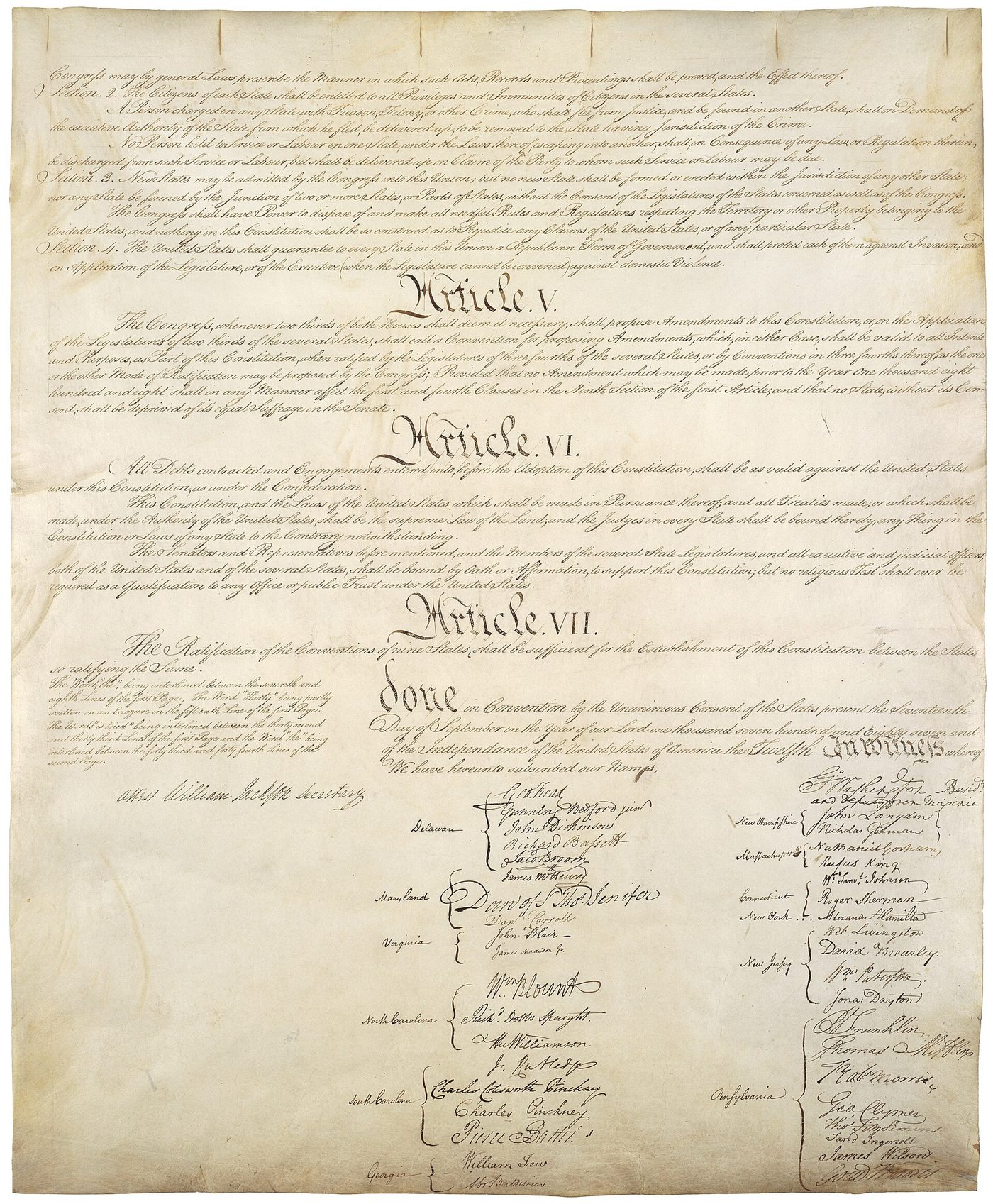
Article IV governs how the states deal with each other and with the Union. Article VI makes the Constitution supreme and puts every officer under oath. The Tenth and Eleventh Amendments mark the boundary.1
Article IV
"Full Faith and Credit shall be given in each State to the public Acts, Records, and judicial Proceedings of every other State. And the Congress may by general Laws prescribe the Manner in which such Acts, Records and Proceedings shall be proved, and the Effect thereof."
U.S. Const. art. IV, § 1
"The Citizens of each State shall be entitled to all Privileges and Immunities of Citizens in the several States."
"A Person charged in any State with Treason, Felony, or other Crime, who shall flee from Justice, and be found in another State, shall on Demand of the executive Authority of the State from which he fled, be delivered up, to be removed to the State having Jurisdiction of the Crime."
U.S. Const. art. IV, § 2, cls. 1 and 2
Clause 3 of that section, on persons "held to Service or Labour," protected slavery. The Thirteenth Amendment superseded it in 1865.2
"New States may be admitted by the Congress into this Union; but no new State shall be formed or erected within the Jurisdiction of any other State; nor any State be formed by the Junction of two or more States, or Parts of States, without the Consent of the Legislatures of the States concerned as well as of the Congress."
"The Congress shall have Power to dispose of and make all needful Rules and Regulations respecting the Territory or other Property belonging to the United States; and nothing in this Constitution shall be so construed as to Prejudice any Claims of the United States, or of any particular State."
U.S. Const. art. IV, § 3, cls. 1 and 2
"The United States shall guarantee to every State in this Union a Republican Form of Government, and shall protect each of them against Invasion; and on Application of the Legislature, or of the Executive (when the Legislature cannot be convened) against domestic Violence."
U.S. Const. art. IV, § 4
Article VI
"All Debts contracted and Engagements entered into, before the Adoption of this Constitution, shall be as valid against the United States under this Constitution, as under the Confederation."
"This Constitution, and the Laws of the United States which shall be made in Pursuance thereof; and all Treaties made, or which shall be made, under the Authority of the United States, shall be the supreme Law of the Land; and the Judges in every State shall be bound thereby, any Thing in the Constitution or Laws of any State to the Contrary notwithstanding."
"The Senators and Representatives before mentioned, and the Members of the several State Legislatures, and all executive and judicial Officers, both of the United States and of the several States, shall be bound by Oath or Affirmation, to support this Constitution; but no religious Test shall ever be required as a Qualification to any Office or public Trust under the United States."
U.S. Const. art. VI, cls. 1 to 3
The Tenth and Eleventh Amendments
"The powers not delegated to the United States by the Constitution, nor prohibited by it to the States, are reserved to the States respectively, or to the people."
U.S. Const. amend. X (ratified December 15, 1791)
"The Judicial power of the United States shall not be construed to extend to any suit in law or equity, commenced or prosecuted against one of the United States by Citizens of another State, or by Citizens or Subjects of any Foreign State."
U.S. Const. amend. XI (ratified February 7, 1795)
How We Got Here
The Articles of Confederation started from state independence. Article II said "Each state retains its sovereignty, freedom, and independence, and every power, jurisdiction, and right, which is not by this Confederation expressly delegated to the United States, in Congress assembled."3 Congress could set each state's share of expenses, but the taxes were "laid and levied by the authority and direction of the legislatures of the several States." It could not reach a citizen directly.4
The Convention of 1787 fixed that by letting the national government reach individuals. Alexander Hamilton sold the idea in Federalist No. 27: the plan "will enable the government to employ the ordinary magistracy of each, in the execution of its laws."5 Remember that sentence. It came back in 1997 in a Supreme Court fight about county sheriffs.
The delegates argued over who would referee a collision between state and national law. On June 15, 1787, William Paterson presented the New Jersey Plan, which already said national statutes and treaties "shall be the supreme law of the respective States" and that state judges "shall be bound thereby."6 On July 17 the Convention considered a stronger tool. James Madison wanted Congress to hold a veto over state laws, "essential to the efficacy & security of the Genl. Govt." Roger Sherman replied that state courts "would not consider as valid any law contravening the Authority of the Union." The Convention rejected the veto, three states to seven. Luther Martin then moved the supremacy language, and it passed with no one opposed.7 That is the origin of Article VI's second clause. The check on the states became their own judges, not a veto in Philadelphia.
In the ratification debate Madison wrote that the new government's jurisdiction "extends to certain enumerated objects only, and leaves to the several States a residuary and inviolable sovereignty over all other objects."8 Federal powers were "few and defined," state powers "numerous and indefinite."9 The First Congress proposed twelve amendments on September 25, 1789. What became the Tenth traveled as "Article the twelfth," and the ten that were ratified took effect December 15, 1791.10 Module 6 explains that process.
The Eleventh Amendment has a sharper origin. In Chisholm v. Georgia (1793), the Supreme Court let the executor of a South Carolina estate sue Georgia in federal court. Justices Blair, Wilson, Cushing and Chief Justice Jay each wrote for jurisdiction. Justice Iredell dissented. Ninety-seven years later, in Hans v. Louisiana, the Court said the decision "created such a shock of surprise throughout the country" that an amendment was almost unanimously proposed at the next Congress.11 Ratification came February 7, 1795.12
Idaho joined on July 3, 1890, as the 43rd state.13 Its constitution says it plainly: "The state of Idaho is an inseparable part of the American Union, and the Constitution of the United States is the supreme law of the land."14
Article IV, Sections 1 and 2: How the States Deal with Each Other
Full Faith and Credit
The clause covers judgments, public acts and records. It does not make one state's statutes govern in another. In Baker v. General Motors Corp., 522 U.S. 222 (1998), Michigan had entered a stipulated injunction barring a former GM engineer from testifying in litigation involving the company. Plaintiffs in a Missouri case subpoenaed him anyway. Justice Ginsburg wrote that the Court's decisions "support no roving 'public policy exception' to the full faith and credit due judgments," but that enforcement measures "remain subject to the even-handed control of forum law." The engineer could testify in Missouri.15
For a county clerk this is routine. Idaho's foreign-judgment statute lets a creditor file a certified out-of-state judgment with the clerk of the district court, and "the clerk shall treat the foreign judgment in the same manner as a judgment of the district court of this state."16 Idaho's constitution makes that clerk the ex-officio county auditor and recorder.17
Privileges and Immunities
The clause descends from Article IV of the Articles of Confederation and aims at a national economic union. In Supreme Court of New Hampshire v. Piper, 470 U.S. 274 (1985), a Vermont woman passed the New Hampshire bar exam but was refused admission because she lived out of state. Justice Powell wrote that the residency rule violated the clause. Justice Rehnquist dissented.18 The clause has limits. The Court let Montana charge nonresidents far more for an elk license, because, in the Court's words, "Equality in access to Montana elk is not basic to the maintenance or well-being of the Union." Baldwin v. Fish and Game Commission of Montana, 436 U.S. 371 (1978).19
Saenz v. Roe, 526 U.S. 489 (1999), asked the question for new residents. California capped welfare for families who had lived in the state less than a year at what their prior state would have paid. Justice Stevens, for a seven-Justice majority, held the cap unconstitutional under the Fourteenth Amendment because it treated new citizens worse than old ones, including "the right to be treated like other citizens of that State" for those who become permanent residents. Chief Justice Rehnquist and Justice Thomas dissented.20 Module 10 covers that amendment.
Extradition
The text says the fugitive "shall on Demand ... be delivered up." Kentucky v. Dennison, 24 How. 66 (1861), said federal courts could not order a governor to act. Puerto Rico v. Branstad, 483 U.S. 219 (1987), held that rule "may stand no longer," so the federal Extradition Act, 18 U.S.C. § 3182, can be enforced against a governor.21 Idaho's statute makes it "the duty of the governor of this state to have arrested and delivered up" any person charged elsewhere who has fled to Idaho.22
Common Misconception: Full Faith and Credit Means Every State Must Follow Every Other State's Laws
The clause protects judgments, records and public acts. It does not export one state's regulations across the border. A court may weigh its own state's public policy when choosing which state's law governs a dispute. What it may not do, Baker says, is refuse to honor another state's final judgment because it dislikes the policy behind it.
New States, Territories and the Guarantee Clause
Article IV, section 3 lets Congress admit states and bars carving a new one out of an old one without both legislatures' consent. It also gives Congress the rule-making power over "the Territory or other Property belonging to the United States." That is why Congress, not a county board, writes the rules for federal land.
Once a state is in, it is a full member. In Coyle v. Smith, 221 U.S. 559 (1911), a taxpayer argued that a 1910 Oklahoma law moving the capital from Guthrie to Oklahoma City was void under the enabling act of June 16, 1906, which admitted the state "on an equal footing with the original states." The Court upheld the law, and Justice Lurton wrote: "the constitutional equality of the states is essential to the harmonious operation of the scheme upon which the Republic was organized." Justices McKenna and Holmes dissented.23 Idaho stands on that footing.
The Guarantee Clause promises a "Republican Form of Government," and courts have mostly declined to enforce it. Luther v. Borden, 48 U.S. 1 (1849), grew out of Rhode Island's upheaval in 1841 and 1842, when the charter government declared martial law against supporters of a rival constitution. The case turned on which government was lawful. Chief Justice Taney wrote that "it rests with Congress to decide what government is the established one in a State."24 In Pacific States Telephone & Telegraph Co. v. Oregon, 223 U.S. 118 (1912), a company argued that Oregon's initiative process destroyed the state's republican form. Chief Justice White answered that such questions had long been held "political in character, and therefore not cognizable by the judicial power, but solely committed by the Constitution to the judgment of Congress."25 In New York v. United States (1992), the Court assumed without deciding that a state could sue under the clause and found no violation.26
Liberty Perspective: The Guarantee Nobody Enforces
Article IV, section 4 is a promise to every state, and the text puts the duty on "the United States" without naming a branch. Since Luther the Court has treated enforcement as Congress's job. In practice no judge measures a state government against the clause. The framers thought a republican form of government was worth guaranteeing. Under the working rule, the guarantee has no judicial remedy. Whether that reading honors the text is a fair thing to argue about.
Article VI: Debts, Supremacy and the Oath
Debts
The first clause answered creditors: debts of the Confederation survived the change of government. It reads like bookkeeping, and it also says the new Union was the old one's successor.
Supremacy
The Supremacy Clause names three supreme laws: the Constitution, federal laws "made in Pursuance thereof," and treaties. "In Pursuance" matters. A federal law must come from a power the Constitution grants. In McCulloch v. Maryland, 17 U.S. 316 (1819), a unanimous Court held Maryland could not tax the Bank of the United States, because states have "no power, by taxation or otherwise, to retard, impede, burden, or in any manner control, the operations of the constitutional laws enacted by congress."27
Lawyers call the result preemption. In Arizona v. United States, 567 U.S. 387 (2012), Arizona's S.B. 1070 created new state crimes and arrest powers. Justice Kennedy, for five Justices (Justice Kagan took no part), described the categories. Under field preemption, Congress has left "no room for the States to supplement" federal law. Under conflict preemption, a state law stands "as an obstacle to the accomplishment and execution of the full purposes and objectives of Congress." The Court held three provisions preempted: a state crime for failing to comply with federal alien-registration requirements (§3), a state crime for unauthorized work (§5(C)), and warrantless state arrests for removable offenses (§6). It declined to block the status-check provision, §2(B), before Arizona's courts had construed it. Justices Scalia, Thomas and Alito each concurred in part and dissented in part.28
The clause grants Congress no power of its own. Murphy v. NCAA says the Supremacy Clause "is not an independent grant of legislative power to Congress. Instead, it simply provides 'a rule of decision.'"29 Congress needs an enumerated power first.
The Oath
Idaho Code § 59-401 applies to "any officer elected or appointed to fill any office created by the laws of the state of Idaho" and reads:
"I do solemnly swear (or affirm, as the case may be) that I will support the Constitution of the United States, and the Constitution of the State of Idaho, and that I will faithfully discharge the duties of (insert office) according to the best of my ability."
Idaho Code § 59-401
Idaho Const. art. III, § 25 sets nearly identical words for legislators. Section 59-402 gives an officer ten days after notice of election or appointment, or until fifteen days after the term begins when no notice was given, to take, subscribe and file the oath, unless other law sets a different time.30 Article XVIII, section 6 names the county offices of commissioner, sheriff, assessor, coroner, treasurer and clerk of the district court.17 Each is an office Idaho law created, so each carries this oath. A sheriff, clerk or commissioner swears to support the Constitution of the United States first and Idaho's second.
Article VI bars any "religious Test" for federal office. In Torcaso v. Watkins, 367 U.S. 488 (1961), Maryland refused a notary commission to a man who would not declare a belief in God. Justice Black wrote that the test "unconstitutionally invades the appellant's freedom of belief and religion," applying the principle to the states.31 Idaho's constitution likewise bars denying any "civil or political right, privilege, or capacity on account of his religious opinions," while preserving "oaths or affirmations."32 The oath is required. A particular belief is not.
Cooper v. Aaron, 358 U.S. 1 (1958), tied the oath to a crisis. After Brown v. Board of Education, Arkansas officials acted as if they were not bound by Brown, and the Little Rock school board asked to pause its court-approved desegregation plan for two and a half years. All nine Justices joined the opinion, which said "Every state legislator and executive and judicial officer is solemnly committed by oath taken pursuant to Art. VI, ¶3 'to support this Constitution,'" and that Brown's reading of the Fourteenth Amendment "is the supreme law of the land."33
Liberty Perspective: Who Decides When the Law Collides
Madison wanted a national veto over state laws and lost. Sherman's view carried: state courts would refuse to apply state laws that contradicted the Union. That put the decision in the hands of judges, one case at a time. Cooper goes a step further. The Court rested on Marbury v. Madison and the Supremacy Clause to say its interpretation of the Fourteenth Amendment is itself supreme law that binds officers through their oath. Article VI's text names "This Constitution" and laws made "in Pursuance thereof." It does not mention judicial opinions. Whether Cooper's step follows from the text is a question the oath puts to every officer. Nine Justices answered it one way for the officers of Arkansas.
The Tenth Amendment and the Anti-Commandeering Rule
The Tenth Amendment drops a word the Articles had. Article II of the Articles reserved powers "not ... expressly delegated." The Tenth says only "not delegated." Chief Justice Marshall noticed in McCulloch that the amendment "omits the word 'expressly,'" which leaves each contested power to "depend on a fair construction of the whole instrument."34
Liberty Perspective: The Word the Tenth Amendment Left Out
Marshall read the omission as room for implied powers. Justice Thomas, concurring in Printz, read the same amendment as confirming that "the Federal Government is one of enumerated, hence limited, powers." Both start from the text. They part ways on how much the missing word matters, and a speaker who cites the Tenth Amendment is usually relying on one reading or the other. Module 2 covers the enumerated powers behind the argument.
New York v. United States (1992)
Congress's 1985 low-level radioactive waste law made each state responsible for disposing of its own waste and added three "incentives." The third, the "take title" provision, said a state that missed a deadline had to take ownership of the waste and answer for damages. New York and two counties sued. In New York v. United States, 505 U.S. 144 (1992), Justice O'Connor wrote that Congress may attach conditions to federal money and may regulate private parties directly, but may not order a state to legislate. The money and access incentives stood. The take-title provision fell: "The Federal Government may not compel the States to enact or administer a federal regulatory program." Six Justices made up the majority on that point, and Justices White, Blackmun and Stevens dissented in part.35
Printz v. United States (1997)
This is the case that matters most to sheriffs. The Brady Handgun Violence Prevention Act required the "chief law enforcement officer" of each local jurisdiction to "make a reasonable effort to ascertain within 5 business days whether receipt or possession would be in violation of the law" for a handgun buyer. Jay Printz, sheriff of Ravalli County, Montana, and Richard Mack, chief law enforcement officer of Graham County, Arizona, sued. In Printz v. United States, 521 U.S. 898 (1997), the Court ruled 5 to 4 that the command was unconstitutional. Justice Scalia, for Chief Justice Rehnquist and Justices O'Connor, Kennedy and Thomas, wrote:
"We held in New York that Congress cannot compel the States to enact or enforce a federal regulatory program. Today we hold that Congress cannot circumvent that prohibition by conscripting the State's officers directly. The Federal Government may neither issue directives requiring the States to address particular problems, nor command the States' officers, or those of their political subdivisions, to administer or enforce a federal regulatory program."
Printz v. United States, 521 U.S. 898 (1997)
Justice Stevens, joined by Justices Souter, Ginsburg and Breyer, wrote that Congress, using a delegated power, "may impose affirmative obligations on executive and judicial officers of state and local governments." Justice Souter leaned on Federalist No. 27. Justice O'Connor's concurrence marks the edges of the majority: states and chief law enforcement officers "may voluntarily continue to participate," Congress may run a program "on a contractual basis with the States," and the Court did not decide whether "purely ministerial reporting requirements" are valid.36
Murphy v. NCAA (2018)
A federal law, PASPA, made it unlawful for a state to "authorize by law" sports betting. New Jersey repealed parts of its own ban, and the sports leagues sued. In Murphy v. National Collegiate Athletic Association, 584 U.S. 453 (2018), Justice Alito wrote that the ban on state authorization commandeered the legislature: "conspicuously absent from the list of powers given to Congress is the power to issue direct orders to the governments of the States." Five Justices joined him in full, Justice Breyer joined all but Part VI-B, and Justice Ginsburg dissented with Justice Sotomayor. The Court added that "the distinction between compelling a State to enact legislation and prohibiting a State from enacting new laws is an empty one."37
Common Misconception: The Tenth Amendment Lets a State or County Ignore Any Federal Law It Dislikes
The Tenth Amendment limits what Congress may command a government to do. It does not suspend a valid federal law that applies to private people. When Congress acts within its powers, the Supremacy Clause makes the federal rule control, as McCulloch and Arizona hold. The remedy for a federal law you think exceeds Congress's powers is a lawsuit or a vote. The amendment gives no license to refuse compliance.
Common Misconception: Printz Means a Sheriff Can Refuse Federal Agents or Federal Court Orders
Printz decided one question: Congress may not conscript a county officer into administering a federal program. It did not address whether a sheriff may obstruct federal officers, set aside a federal court order, or choose which federal statutes apply in the county. Cooper v. Aaron says the opposite about court orders. And Justice O'Connor's Printz concurrence says states and chief law enforcement officers "may voluntarily continue to participate" in the federal program.
State Sovereign Immunity and the Eleventh Amendment
The Eleventh Amendment trimmed the Article III language described in Module 4. Then the Court kept going. Hans v. Louisiana, 134 U.S. 1 (1890), turned away a Louisiana citizen's federal suit against his own state, though the amendment's words cover only citizens of other states and foreign countries. Ex parte Young, 209 U.S. 123 (1908), supplied the release valve: a suit against an officer to stop enforcement of an unconstitutional law is not a suit against the state, because the officer "is stripped of his official or representative character."38
Seminole Tribe of Florida v. Florida, 517 U.S. 44 (1996), began when the Seminole Tribe sued Florida and its governor under the Indian Gaming Regulatory Act for refusing to negotiate in good faith. Chief Justice Rehnquist, for five Justices, held that Congress cannot use its Article I Indian Commerce power to strip a state of immunity from suit in federal court, overruling Pennsylvania v. Union Gas Co. (1989). Justice Souter, joined by Justices Ginsburg and Breyer, wrote that the Court "holds for the first time since the founding of the Republic that Congress has no authority to subject a State to the jurisdiction of a federal court at the behest of an individual asserting a federal right." Justice Stevens also dissented.39
Alden v. Maine, 527 U.S. 706 (1999), carried the principle into state court. Probation officers sued Maine in its own courts for overtime under the Fair Labor Standards Act. Justice Kennedy, writing 5 to 4, held that Article I powers "do not include the power to subject nonconsenting States to private suits for damages in state courts."40
The limits matter for local officials. Alden says the immunity "bars suits against States but not lesser entities" and "does not extend to suits prosecuted against a municipal corporation or other governmental entity which is not an arm of the State." Prospective relief under Ex parte Young remains, and a damages suit against an officer in his individual capacity can proceed when the money comes from the officer personally.41 Idaho has its own case. Idaho v. Coeur d'Alene Tribe of Idaho, 521 U.S. 261 (1997), held that a tribe's suit against Idaho officials over submerged lands in Lake Coeur d'Alene could not proceed in federal court, though it was pleaded against officers.42
Liberty Perspective: Two Eleventh Amendments
The amendment's words are narrow. Alden says state immunity "neither derives from nor is limited by the terms of the Eleventh Amendment" and draws it from the Constitution's structure, its history and the Court's decisions. Souter's Seminole dissent described the result as "two Eleventh Amendments, the one ratified in 1795, the other (so-called) invented by the Court nearly a century later in Hans v. Louisiana," a line he credited to Justice Stevens. The Seminole majority answered with Hamilton's Federalist No. 81 and Hans's appeal to the "jurisprudence in all civilized nations." A citizen with a claim against a state agency ends up with fewer remedies than the amendment's plain words suggest.
Landmark Cases
| Case | Citation and year | Holding | Effect and where the law moved |
|---|---|---|---|
| McCulloch v. Maryland | 17 U.S. 316 (1819) | A state may not tax the national bank. | Foundation of preemption. |
| Cooper v. Aaron | 358 U.S. 1 (1958) | State officers are bound by oath and cannot nullify a federal court order. | Still the leading statement on officers and federal court orders. |
| Torcaso v. Watkins | 367 U.S. 488 (1961) | A state may not require a declaration of belief in God for office. | Carries the Article VI principle to the states. |
| New York v. United States | 505 U.S. 144 (1992) | Congress may not compel a state to enact or administer a federal program. | Source of the anti-commandeering rule. |
| Seminole Tribe v. Florida | 517 U.S. 44 (1996) | Congress cannot abrogate state immunity under its Article I powers. | Overruled Union Gas. Fourteenth Amendment abrogation remains. |
| Printz v. United States | 521 U.S. 898 (1997) | Congress may not command county officers to run a federal background-check program. | Voluntary cooperation remains open. The interim provisions were set to end November 30, 1998. |
| Alden v. Maine | 527 U.S. 706 (1999) | Congress cannot subject nonconsenting states to private damages suits in state court. | Immunity does not reach entities that are not arms of the state. |
| Saenz v. Roe | 526 U.S. 489 (1999) | A 12-month limit on welfare for new residents violates the Fourteenth Amendment. | Protects the right to be treated like other residents. |
| Arizona v. United States | 567 U.S. 387 (2012) | Three S.B. 1070 provisions preempted; status checks left for state courts to construe. | Leading modern case on field and conflict preemption. |
| Murphy v. NCAA | 584 U.S. 453 (2018) | Congress may not forbid a state from repealing its own laws. | Anti-commandeering covers prohibitions as well as orders. |
Where This Shows Up for Officials, Reporters and Citizens
The sheriff and a federal request
Sheriff Ruth Calloway (an invented name) receives a form from a federal agency asking her jail to hold an inmate past his release date. The federal detainer rule calls a detainer "a request" in one paragraph and says the receiving agency "shall maintain custody" for up to 48 hours in another.43 Federal law says no written agreement is needed for local officers to share status information or "otherwise to cooperate" with the Attorney General, and that officers working under a § 1357(g) agreement act under his direction.44 Printz bars Congress from commanding county officers to administer a federal program. It does not say how a given regulation reads or which paragraph controls. Whatever she decides, she should find the statute or rule behind the paper, work out whether it is a court order, a request, a grant condition or an agreement, and write the decision down. Arizona adds a caution from the other direction: a locally invented arrest power that goes beyond the federal scheme can be preempted.
The commissioner and federal money
Commissioner Dale Hutchins (invented) moves to accept a federal grant. Congress may attach conditions to funds if they meet the Court's tests.45 Accepting the grant is a choice, and so are its terms. Read the conditions before the vote. A commissioner who later says "Washington made us do it" has a hard time squaring that with the vote to accept.
The clerk and an out-of-state judgment
A creditor hands the clerk of the district court a certified judgment from another state. Idaho Code § 10-1302 directs the clerk to treat it like a local district court judgment once filed. The clerk does not retry the underlying dispute. Full faith and credit already did that work.
The reporter
A commissioner tells a reporter the county "will not enforce" a new federal rule. Ask which of four things it is: a federal law applying to private people, a federal order to the county, a funding condition, or a request. The answer tells you whether Printz, McCulloch or a contract is the controlling authority. Ask also where the oath is on file; Idaho Code § 59-402 requires it to be taken, subscribed and filed.
The citizen at the meeting
You hear a speaker say "the Tenth Amendment means we do not have to follow that." Ask which federal action he means. If Congress told the county to do something, New York and Printz may apply. If a federal law regulates private people in the county, the Supremacy Clause applies.
Common Misconception: "No Religious Test" Means Officials Do Not Take an Oath
Article VI requires an oath or affirmation and forbids a religious test. Idaho Code § 59-401 writes the choice into the text: "swear (or affirm, as the case may be)." Torcaso struck a belief requirement. The oath stands.
Pictures, Numbers and Infographics
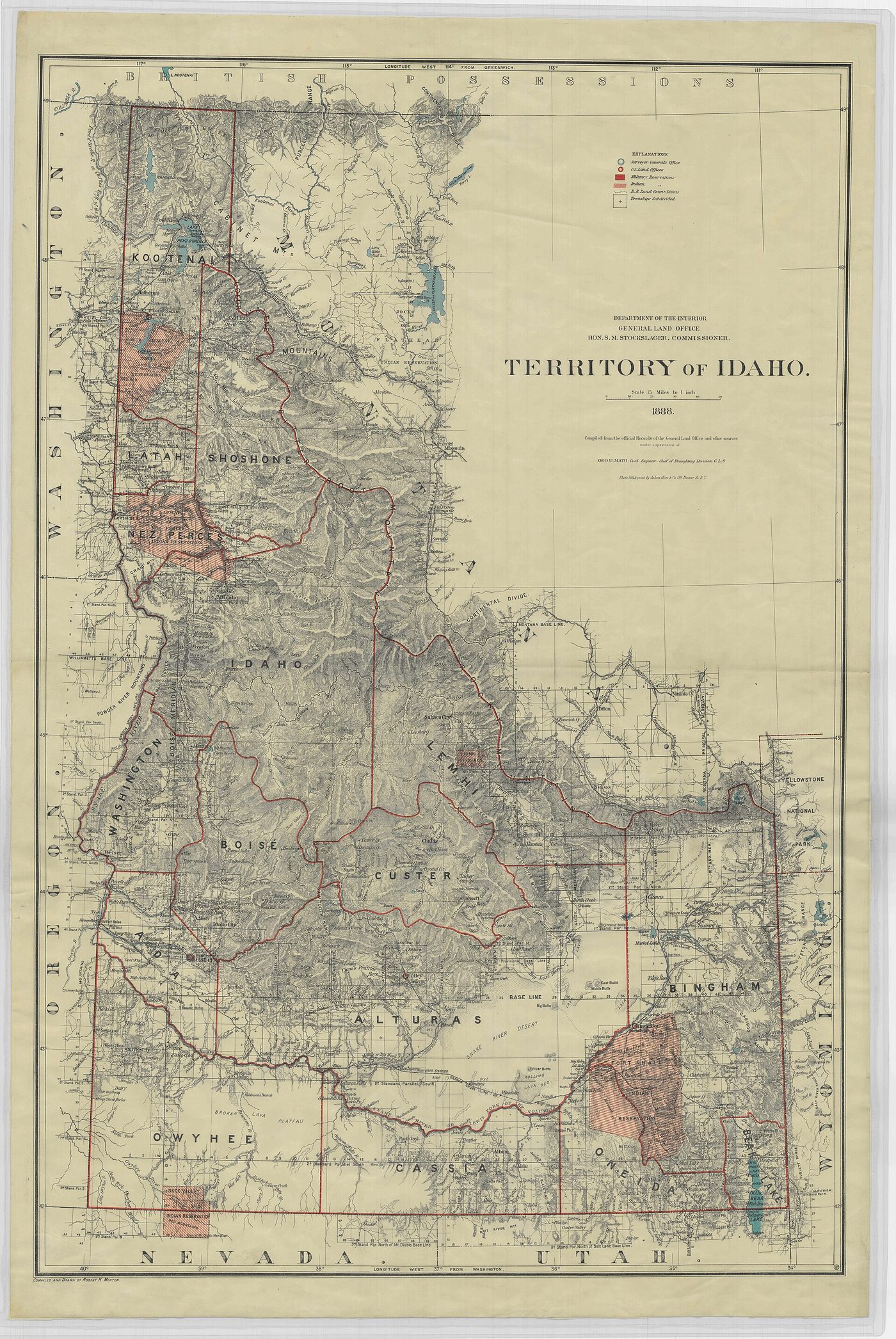
Idaho spent 27 years under Congress's territory power before it became a state. Today the Census Bureau counts more than 91,000 local governments inside the federal system, and federal grants to state and local governments topped $1.2 trillion in fiscal 2025.
By the numbers
- 91,438: local governments counted in the United States in 2025, up from 90,837 in the 2022 Census of Governments. U.S. Census Bureau, Government Organization Summary Report, 2026
- 40,199: special district governments in 2025, the largest single type of local government in the country. U.S. Census Bureau, 2026
- 1,168: local governments in Idaho in 2022: 44 counties, 199 cities, 118 school districts and 807 special districts. Idaho has no townships. U.S. Census Bureau, 2022 Census of Governments: Organization
- $1,214,777 million: federal grant outlays to state and local governments in fiscal year 2025, equal to 17.3% of all federal outlays. White House Office of Management and Budget, Historical Table 12.1, 2026
- $7,019 million: the same grant outlays in fiscal year 1960, when they equaled 7.6% of federal outlays. OMB Historical Table 12.1, 2026
- 27 years: how long Idaho was a federal territory, from the act of March 3, 1863 that created it to statehood on July 3, 1890, as the 43rd state. National Archives DocsTeach; U.S. Senate, Idaho
Verify Independently
Every citation, quotation and case in this course should be verified independently against the official source (the U.S. Reports or the Court's own opinion, the National Archives transcription, the statute book) before you rely on it, quote it or act on it.
Check these in particular:
- Murphy v. NCAA, 584 U.S. 453 (2018): the U.S. Reports page number was confirmed only from a secondary source.
Sources & Further Reading
Primary Sources
- National Archives, The Constitution of the United States: A Transcription
- National Archives, The Bill of Rights: A Transcription
- National Archives, Amendments 11-27
- Constitution Annotated, Article IV (Congress.gov)
- Madison's Notes of Debates, July 17, 1787 (Avalon Project)
- Madison's Notes of Debates, June 15, 1787 (Avalon Project)
- Articles of Confederation (Avalon Project)
- The Federalist No. 39 (Avalon Project)
- The Federalist No. 45 (Avalon Project)
- The Federalist No. 27 (Avalon Project)
- Supreme Court of the United States, opinions (Term 2017 slip opinions, including Murphy)
- National Constitution Center, Interactive Constitution
Idaho Law
- Idaho Const. art. I, § 3 (Union and the supreme law of the land)
- Idaho Const. art. I, § 4 (religious liberty)
- Idaho Const. art. III, § 25 (oath of members of the legislature)
- Idaho Const. art. XVIII, § 6 (county officers)
- Idaho Code § 59-401 (official oath)
- Idaho Code § 59-402 (time of taking oath)
- Idaho Code § 10-1302 (foreign judgments)
- Idaho Code § 19-4502 (extradition)
- Idaho Code § 31-2202 (duties of sheriff)
Federal Statutes and Regulations
- 8 U.S.C. § 1357 (powers of immigration officers; agreements under subsection (g))
- 8 C.F.R. § 287.7 (detainer provisions)
Cases
- Printz v. United States, 521 U.S. 898 (1997)
- New York v. United States, 505 U.S. 144 (1992)
- Murphy v. NCAA, 584 U.S. 453 (2018)
- Alden v. Maine, 527 U.S. 706 (1999)
- Seminole Tribe of Florida v. Florida, 517 U.S. 44 (1996)
- Idaho v. Coeur d'Alene Tribe of Idaho, 521 U.S. 261 (1997)
- Arizona v. United States, 567 U.S. 387 (2012)
- Cooper v. Aaron, 358 U.S. 1 (1958)
- Saenz v. Roe, 526 U.S. 489 (1999)
- Supreme Court of New Hampshire v. Piper, 470 U.S. 274 (1985)
- Baker v. General Motors Corp., 522 U.S. 222 (1998)
- Puerto Rico v. Branstad, 483 U.S. 219 (1987)
- Coyle v. Smith, 221 U.S. 559 (1911)
- Torcaso v. Watkins, 367 U.S. 488 (1961)
- Ex parte Young, 209 U.S. 123 (1908)
- Hans v. Louisiana, 134 U.S. 1 (1890)
- Chisholm v. Georgia, 2 U.S. 419 (1793)
- Luther v. Borden, 48 U.S. 1 (1849)
- Pacific States Telephone & Telegraph Co. v. Oregon, 223 U.S. 118 (1912)
- McCulloch v. Maryland, 17 U.S. 316 (1819)
- Oyez: Printz v. United States
Related Training Modules
- Course index: The United States Constitution
- Module 1: Constitution Origins
- Module 2: Article I and Congress
- Module 3: Article II and the President
- Module 4: Article III and the Courts
- Module 6: Amending the Constitution
- Module 7: The First Amendment
- Module 8: The Second Amendment
- Module 9: The Fourth through Eighth Amendments
- Module 10: The Civil War Amendments
- Module 11: Voting and Later Amendments
- Module 12: Reading the Constitution
Knowledge Check
Test your understanding of federalism and the states. No scores are saved: this is for your own review.
1. What happened at the Convention on July 17, 1787, when the delegates took up a national veto over state laws?
Madison's notes show Massachusetts, Virginia and North Carolina voting for the negative and seven states against it. Luther Martin's resolution making national laws the supreme law, binding state judges, was agreed to with no dissent. That became the Supremacy Clause. Madison's notes record the veto losing three states to seven. The Convention then adopted Luther Martin's supremacy resolution without opposition, which became the second clause of Article VI.
2. Under Idaho Code § 59-401, what must an officer swear or affirm before entering office?
The statute's form reads "I do solemnly swear (or affirm, as the case may be) that I will support the Constitution of the United States, and the Constitution of the State of Idaho, and that I will faithfully discharge the duties of (insert office) according to the best of my ability." The statutory oath names both constitutions, federal first, and adds a pledge to discharge the duties of the office faithfully. It contains no religious declaration, and Torcaso v. Watkins bars such a test.
3. What did Printz v. United States (1997) hold about the Brady Act's background-check provisions?
Justice Scalia wrote for a 5 to 4 Court that the Federal Government may not "command the States' officers, or those of their political subdivisions, to administer or enforce a federal regulatory program." Printz was narrow. It barred Congress from conscripting local officers into a federal program. It did not bar federal regulation of handgun sales, and it did not let sheriffs ignore federal court orders. Justice O'Connor's concurrence left voluntary cooperation open.
4. According to Alden v. Maine (1999), does a state's sovereign immunity automatically cover a county?
Alden says the immunity "bars suits against States but not lesser entities" and "does not extend to suits prosecuted against a municipal corporation or other governmental entity which is not an arm of the State." Alden did extend state immunity to suits in state court, but it also drew a line: counties and other entities that are not arms of the State are outside the immunity.
5. What did Torcaso v. Watkins (1961) decide about religious tests for public office?
Maryland refused a notary commission to a man who would not declare a belief in God. Justice Black wrote that the test "unconstitutionally invades the appellant's freedom of belief and religion." Torcaso struck down a belief requirement imposed by a state. It did not touch the oath or affirmation, which Article VI itself requires of state officers.
Reference Materials
Use your browser's print function (Ctrl+P / Cmd+P) to save this page as a PDF for offline reference.
- The Text: jump to section
- How We Got Here: jump to section
- Article IV, Sections 1 and 2: jump to section
- New States and the Guarantee Clause: jump to section
- Debts, Supremacy and the Oath: jump to section
- Anti-Commandeering: jump to section
- State Sovereign Immunity: jump to section
- Landmark Cases: jump to section
- Practice Points: jump to section
Footnotes
- National Archives, The Constitution of the United States: A Transcription, archives.gov/founding-docs/constitution-transcript. Every Article IV and Article VI clause quoted in this lesson follows that transcription, including its capitalization and punctuation.
- U.S. Const. art. IV, § 2, cl. 3, superseded in part by U.S. Const. amend. XIII, § 1 (passed by Congress January 31, 1865; ratified December 6, 1865). National Archives, Amendments 11-27, note to the Thirteenth Amendment.
- Articles of Confederation, art. II (1781), Avalon Project, avalon.law.yale.edu/18th_century/artconf.asp.
- Articles of Confederation, art. VIII (1781): common expenses "shall be defrayed out of a common treasury, which shall be supplied by the several States in proportion to the value of all land," and the taxes "shall be laid and levied by the authority and direction of the legislatures of the several States."
- The Federalist No. 27 (Alexander Hamilton), avalon.law.yale.edu/18th_century/fed27.asp. Justice Souter relied on this essay in his Printz dissent, 521 U.S. 898 (1997).
- Madison's Notes of Debates, June 15, 1787 (New Jersey Plan, resolution 6), Avalon Project, debates_615.asp. Madison's notes spell the delegate's name "Patterson."
- Madison's Notes of Debates, July 17, 1787, Avalon Project, debates_717.asp. On the negative on state laws, Massachusetts, Virginia and North Carolina voted aye; Connecticut, New Jersey, Pennsylvania, Delaware, Maryland, South Carolina and Georgia voted no. Luther Martin's resolution was "agreed to nem: con:" (no one dissenting).
- The Federalist No. 39 (James Madison), avalon.law.yale.edu/18th_century/fed39.asp.
- The Federalist No. 45 (James Madison), avalon.law.yale.edu/18th_century/fed45.asp.
- National Archives, Bill of Rights: A Transcription. The First Congress proposed twelve articles on September 25, 1789; the Tenth Amendment appears there as "Article the twelfth"; ten were ratified, effective December 15, 1791.
- Chisholm v. Georgia, 2 U.S. (2 Dall.) 419 (1793) (opinions delivered seriatim; Iredell, J., dissenting). The quotation is from Hans v. Louisiana, 134 U.S. 1 (1890), which describes the reaction to Chisholm.
- U.S. Const. amend. X, National Archives, Bill of Rights transcription (ratified December 15, 1791). U.S. Const. amend. XI, National Archives, Amendments 11-27 (passed by Congress March 4, 1794; ratified February 7, 1795).
- U.S. Senate, "Idaho," senate.gov/states/ID/intro.htm (Idaho admitted July 3, 1890, as the 43rd state).
- Idaho Const. art. I, § 3, legislature.idaho.gov/statutesrules/idconst/ArtI/Sect3.
- Baker v. General Motors Corp., 522 U.S. 222 (1998) (decided January 13, 1998; Ginsburg, J., for the Court; separate opinions concurred in the judgment).
- Idaho Code § 10-1302 (filing of foreign judgment with clerk of district court; effect of filing). legislature.idaho.gov.
- Idaho Const. art. XVIII, § 6 (county officers), legislature.idaho.gov/statutesrules/idconst/ArtXVIII/Sect6.
- Supreme Court of New Hampshire v. Piper, 470 U.S. 274 (1985) (decided March 4, 1985; Powell, J., for the Court; White, J., concurring in the result; Rehnquist, J., dissenting).
- Baldwin v. Fish and Game Commission of Montana, 436 U.S. 371 (1978) (decided May 23, 1978; Blackmun, J., for the Court).
- Saenz v. Roe, 526 U.S. 489 (1999) (decided May 17, 1999; Stevens, J., joined by O'Connor, Scalia, Kennedy, Souter, Ginsburg and Breyer, JJ.; Rehnquist, C.J., and Thomas, J., each dissenting).
- Puerto Rico v. Branstad, 483 U.S. 219 (1987) (decided June 23, 1987), overruling in part Kentucky v. Dennison, 24 How. (65 U.S.) 66 (1861).
- Idaho Code § 19-4502 (fugitives from justice; duty of governor), legislature.idaho.gov.
- Coyle v. Smith, 221 U.S. 559 (1911) (decided May 29, 1911; Lurton, J., for the Court; McKenna and Holmes, JJ., dissenting).
- Luther v. Borden, 48 U.S. (7 How.) 1 (1849) (Taney, C.J.).
- Pacific States Telephone & Telegraph Co. v. Oregon, 223 U.S. 118 (1912) (decided February 19, 1912; White, C.J.).
- New York v. United States, 505 U.S. 144 (1992) (syllabus, syllabus holding 1(j): "Even assuming that the Guarantee Clause provides a basis upon which a State or its subdivisions may sue to enjoin the enforcement of a federal statute, petitioners have not made out a claim").
- McCulloch v. Maryland, 17 U.S. (4 Wheat.) 316 (1819) (Marshall, C.J., for a unanimous Court).
- Arizona v. United States, 567 U.S. 387 (2012) (decided June 25, 2012; Kennedy, J., joined by Roberts, C.J., and Ginsburg, Breyer and Sotomayor, JJ.; Scalia, Thomas and Alito, JJ., each concurring in part and dissenting in part; Kagan, J., took no part).
- Murphy v. National Collegiate Athletic Association, 584 U.S. 453 (2018), Part V (the Supremacy Clause "is not an independent grant of legislative power to Congress"). The U.S. Reports page was confirmed through a secondary source; the opinion text was read at Cornell LII.
- Idaho Code § 59-401 (form of oath), § 59-402 (time of taking oath); Idaho Const. art. III, § 25 (oath of members of the legislature). legislature.idaho.gov. Spacing in the blank for the office name is normalized in the quotation.
- Torcaso v. Watkins, 367 U.S. 488 (1961) (decided June 19, 1961; Black, J., for the Court; Frankfurter and Harlan, JJ., concurring in the result).
- Idaho Const. art. I, § 4 (guaranty of religious liberty), legislature.idaho.gov/statutesrules/idconst/ArtI/Sect4.
- Cooper v. Aaron, 358 U.S. 1 (1958) (argued September 11, 1958; per curiam order September 12; opinion of all nine Justices issued September 29, 1958).
- McCulloch v. Maryland, 17 U.S. (4 Wheat.) 316 (1819), Marshall, C.J., for the Court (the Tenth Amendment "omits the word 'expressly'").
- New York v. United States, 505 U.S. 144 (1992) (decided June 19, 1992; O'Connor, J., for the Court, joined by Rehnquist, C.J., and Scalia, Kennedy, Souter and Thomas, JJ.; White, Blackmun and Stevens, JJ., joining Parts III-A and III-B and dissenting in part).
- Printz v. United States, 521 U.S. 898 (1997) (consolidated with Mack v. United States; argued December 3, 1996; decided June 27, 1997; Scalia, J., for the Court; O'Connor and Thomas, JJ., concurring; Stevens, J., dissenting, joined by Souter, Ginsburg and Breyer, JJ.; Souter and Breyer, JJ., also dissenting separately).
- Murphy v. NCAA, 584 U.S. 453 (2018) (Nos. 16-476 and 16-477; argued December 4, 2017; decided May 14, 2018; Alito, J., for the Court; Thomas, J., concurring; Breyer, J., concurring in part and dissenting in part; Ginsburg, J., dissenting).
- Hans v. Louisiana, 134 U.S. 1 (1890); Ex parte Young, 209 U.S. 123 (1908) (Peckham, J., for the Court; Harlan, J., dissenting).
- Seminole Tribe of Florida v. Florida, 517 U.S. 44 (1996) (argued October 11, 1995; decided March 27, 1996; Rehnquist, C.J., joined by O'Connor, Scalia, Kennedy and Thomas, JJ.; Stevens, J., dissenting; Souter, J., dissenting, joined by Ginsburg and Breyer, JJ.), overruling Pennsylvania v. Union Gas Co., 491 U.S. 1 (1989).
- Alden v. Maine, 527 U.S. 706 (1999) (argued March 31, 1999; decided June 23, 1999; Kennedy, J., joined by Rehnquist, C.J., and O'Connor, Scalia and Thomas, JJ.; Souter, J., dissenting, joined by Stevens, Ginsburg and Breyer, JJ.).
- Alden, 527 U.S. 706, Part III (limits on the immunity), citing Mt. Healthy City Bd. of Ed. v. Doyle, 429 U.S. 274 (1977), Lincoln County v. Luning, 133 U.S. 529 (1890), Ex parte Young, and Scheuer v. Rhodes, 416 U.S. 232 (1974).
- Idaho v. Coeur d'Alene Tribe of Idaho, 521 U.S. 261 (1997) (decided June 23, 1997; Kennedy, J., delivering the opinion of the Court as to Parts I, II-A and III).
- 8 C.F.R. § 287.7(a) ("The detainer is a request that such agency advise the Department, prior to release of the alien ...") and § 287.7(d) ("such agency shall maintain custody of the alien for a period not to exceed 48 hours, excluding Saturdays, Sundays, and holidays"). Cornell LII.
- 8 U.S.C. § 1357(g)(1), (g)(3), (g)(10) (agreements with states and political subdivisions; direction and supervision of the Attorney General; communication and cooperation without an agreement). Cornell LII.
- New York v. United States, 505 U.S. 144 (1992) (syllabus 1(c): Congress may attach conditions to the receipt of federal funds "so long as such conditions meet four requirements," citing South Dakota v. Dole, 483 U.S. 203 (1987)).