U.S. CONSTITUTION · Module 12
Module 12: Reading the Constitution, Rights, Methods and Your Oath
The Ninth Amendment, the rights the Constitution never lists, the ways Justices read the text, how precedent stands and falls, Idaho's own Declaration of Rights, and the oath you took to support both constitutions
How We Got Here: Hamilton's Warning and Madison's Answer
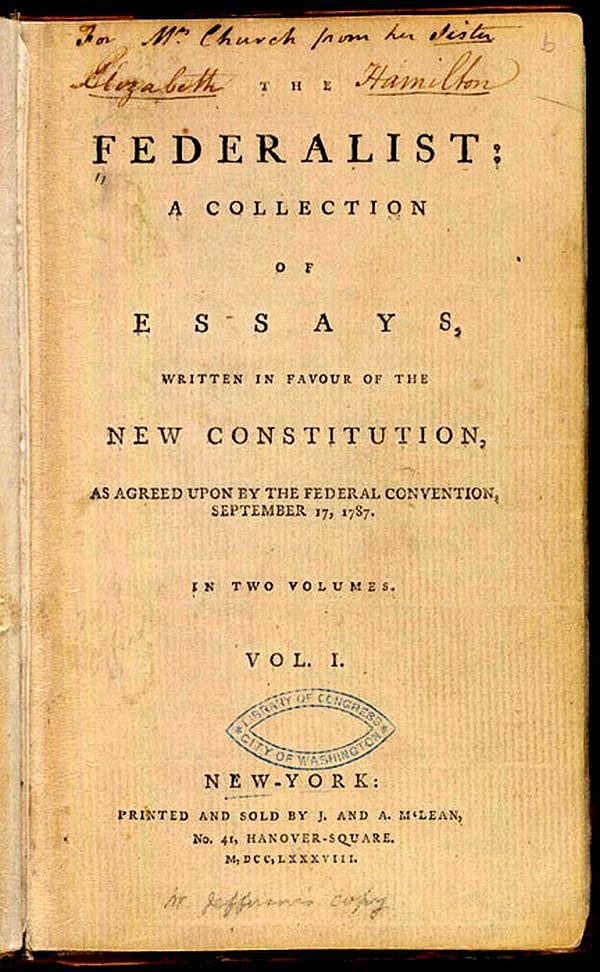
The Constitution signed in September 1787 had no bill of rights. Opponents of ratification pressed that point hard. Alexander Hamilton answered in The Federalist No. 84 that a bill of rights would be "not only unnecessary in the proposed Constitution, but would even be dangerous."1
The new government had only the powers the Constitution gave it. List a right, Hamilton argued, and you imply some power over that subject to begin with. "For why declare that things shall not be done which there is no power to do?"1
Hamilton lost that argument. State conventions had asked for amendments, and on June 8, 1789, James Madison proposed a list in the House of Representatives. He took Hamilton's objection head on:
"It has been objected also against a bill of rights, that, by enumerating particular exceptions to the grant of power, it would disparage those rights which were not placed in that enumeration, and it might follow by implication, that those rights which were not singled out, were intended to be assigned into the hands of the general government, and were consequently insecure. This is one of the most plausible arguments I have ever heard urged against the admission of a bill of rights into this system; but, I conceive, that may be guarded against. I have attempted it, as gentlemen may see by turning to the last clause of the 4th resolution."
James Madison, speech in the House of Representatives, June 8, 1789
That "last clause of the 4th resolution" was Madison's first draft of the Ninth Amendment. It read: "The exceptions here or elsewhere in the constitution, made in favor of particular rights, shall not be so construed as to diminish the just importance of other rights retained by the people; or as to enlarge the powers delegated by the constitution; but either as actual limitations of such powers, or as inserted merely for greater caution."2
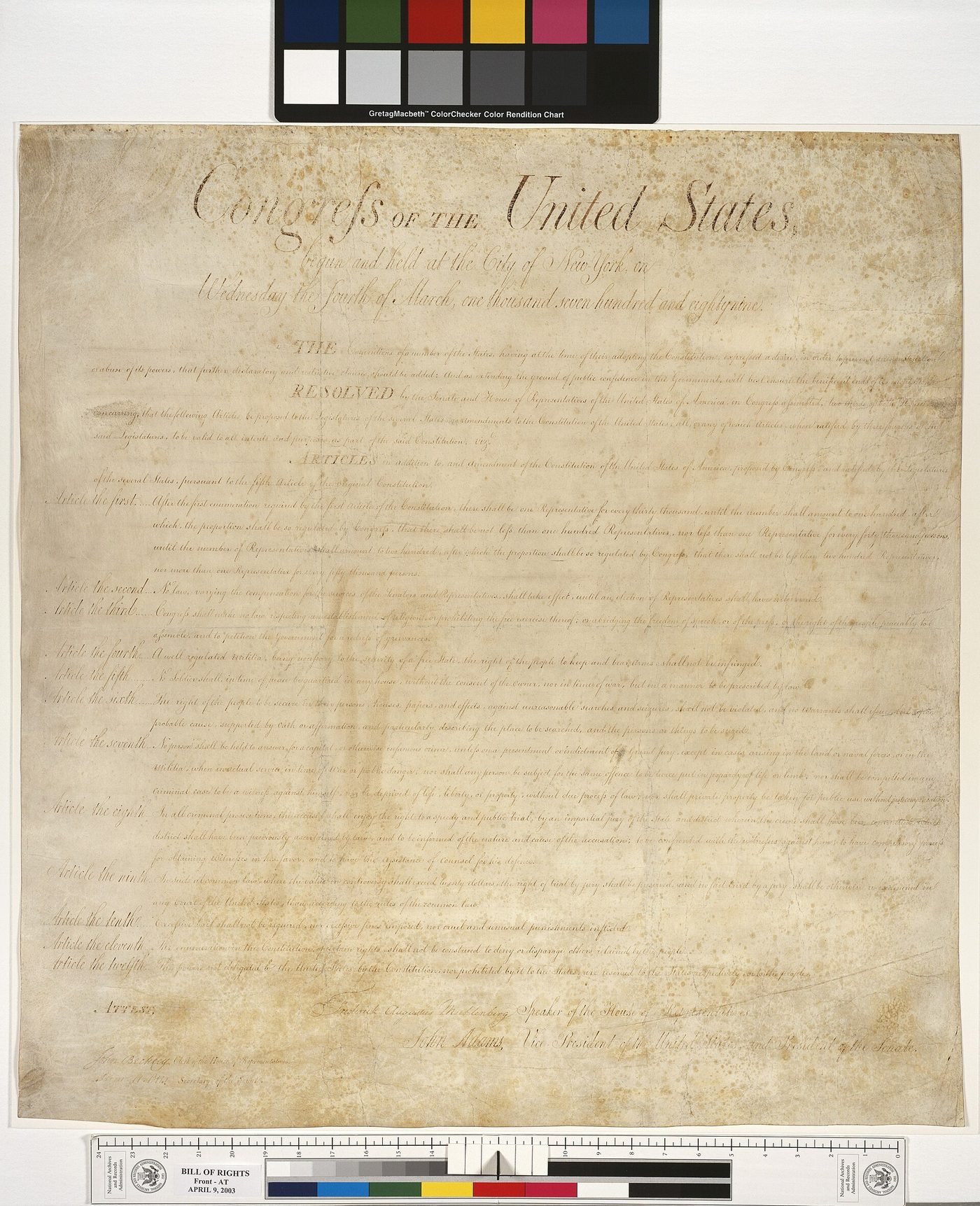
The draft said two things: listing some rights does not shrink the others, and listing rights does not grow federal power. The ratified Ninth Amendment keeps only the first idea. Congress proposed twelve amendments on September 25, 1789. Ten were ratified on December 15, 1791.3 The Ninth was among them, in one sentence of twenty-one words.
Madison made one more prediction in the same speech. If rights were written into the Constitution, he said, "independent tribunals of justice will consider themselves in a peculiar manner the guardians of those rights."2 The next two centuries of argument would be about which rights, and who decides.
Justice Joseph Story's Commentaries (1833) read the Ninth as the answer to that objection: "a positive declaration in such a bill of rights that the enumeration of certain rights shall not be construed to deny or disparage others retained by the people."4
The Text
The Ninth Amendment, as the National Archives transcribes it:
The enumeration in the Constitution, of certain rights, shall not be construed to deny or disparage others retained by the people.
U.S. Const. amend. IX (ratified December 15, 1791)
"Enumeration" means the list. "Construed" means interpreted. "Disparage" means belittle. So the sentence tells every reader: the list of rights is not the complete list, and the people kept the others. It names no right, sets no test and does not say who decides. That silence is why Justices read it so differently.
The Tenth Amendment, next to it, speaks of powers "reserved to the States respectively, or to the people." The Ninth speaks of rights. Both end with the people.
Two clauses of Article VI close this course, the Supremacy Clause and the oath:
This Constitution, and the Laws of the United States which shall be made in Pursuance thereof; and all Treaties made, or which shall be made, under the Authority of the United States, shall be the supreme Law of the Land; and the Judges in every State shall be bound thereby, any Thing in the Constitution or Laws of any State to the Contrary notwithstanding.
The Senators and Representatives before mentioned, and the Members of the several State Legislatures, and all executive and judicial Officers, both of the United States and of the several States, shall be bound by Oath or Affirmation, to support this Constitution; but no religious Test shall ever be required as a Qualification to any Office or public Trust under the United States.
U.S. Const. art. VI, cls. 2-3
"All executive and judicial Officers ... of the several States." That phrase reaches a county commissioner, a sheriff, a county clerk and a magistrate. The oath is owed to "this Constitution," the document itself.5
Two more clauses come up in the cases below. Article I, section 10 says no State shall "pass any ... Law impairing the Obligation of Contracts." The Fourteenth Amendment says no State shall "deprive any person of life, liberty, or property, without due process of law." Most fights over unenumerated rights have been fought over that one word, "liberty."6
Enumerated and Unenumerated Rights
An enumerated right is one the text names, like speech or a jury trial. An unenumerated right is one the text does not name but that a court or legislature recognizes anyway. The Ninth Amendment says the second kind exists. The Supreme Court has mostly decided which ones through the Due Process Clause, by asking what "liberty" includes. The record is uneven.
In Lochner v. New York (1905), five Justices read "liberty" to include a "liberty of contract" that struck down a limit on bakers' hours. Holmes dissented: "The 14th Amendment does not enact Mr. Herbert Spencer's Social Statics."7 The Court dropped that approach by 1937, which Justice Souter later called "the repudiation of Lochner's progeny."8
In Griswold v. Connecticut (1965), the Court found a right of marital privacy. Justice Douglas wrote that "specific guarantees in the Bill of Rights have penumbras." Justice Goldberg, joined by Chief Justice Warren and Justice Brennan, wrote separately to lean on the Ninth Amendment directly: "The language and history of the Ninth Amendment reveal that the Framers of the Constitution believed that there are additional fundamental rights, protected from governmental infringement, which exist alongside those fundamental rights specifically mentioned in the first eight constitutional amendments."9
Justice Black, dissenting, saw it the other way. "I like my privacy as well as the next one," he wrote, "but I am nevertheless compelled to admit that government has a right to invade it unless prohibited by some specific constitutional provision." Justice Stewart said applying the Ninth Amendment to the case "is to turn somersaults with history."9
Washington v. Glucksberg (1997) set a two-part test. A right not named in the text gets special protection only if it is "deeply rooted in this Nation's history and tradition," and the claimed right must be given a "careful description."8 In 2015, Obergefell v. Hodges said that approach "may have been appropriate for the asserted right there involved (physician-assisted suicide)" but did not fit the Court's cases on marriage and intimacy.10 In 2022, Dobbs applied the Glucksberg test again and held there is no federal constitutional right to abortion.11
Liberty Perspective: The Amendment Written for This Question
Madison wrote the Ninth Amendment for exactly the problem of rights left off the list. Yet the Court's unenumerated-rights cases have run almost entirely through the word "liberty" in a due process clause ratified 77 years later. In Griswold, the majority quoted the Ninth but only a concurrence leaned on it, and Justice Stewart could write that "Until today no member of this Court has ever suggested that the Ninth Amendment meant anything else" than a guard for limited federal power.9
The text says the other rights are "retained by the people." Practice has placed the question of which rights almost wholly in the hands of judges reading one word in a different amendment. Whether you think the Court has gone too far or not far enough, the provision written for this job has done very little of the work.
Common Misconception: "If It's Not Written in the Constitution, You Don't Have the Right"
The Ninth Amendment exists to reject that claim, and Idaho's article I, section 21 says the same. The real dispute is narrower: which unlisted rights a court will enforce against a law, and by what test. On that, Goldberg and Black disagreed in print, and so did Rehnquist and Souter.
Six Ways Justices Read the Constitution
Labels for judges are cheap and usually misleading. Learn the methods instead, with the reasons given for them and the opinions that used them. Most Justices use several. They divide over which one wins when the methods disagree.
1. The Text
Start with the words. Marshall in Marbury built judicial review on the written Constitution: those who "have framed written constitutions contemplate them as forming the fundamental and paramount law of the nation."12 Justice Black's Griswold dissent is the plain-text position at full strength: government "has a right to invade" privacy "unless prohibited by some specific constitutional provision."9 Defenders say the text is what the people ratified and what officials swore to support.
2. Original Meaning
Ask what the words meant to those who adopted them. Justice Sutherland, dissenting in Blaisdell (1934), granted that the provisions reach new conditions, "But, their meaning is changeless; it is only their application which is extensible." Three years later, dissenting in West Coast Hotel, he wrote that "the meaning of the Constitution does not change with the ebb and flow of economic events."1314 Its defenders say a constitution that changes meaning without an amendment limits no one. Article V exists for change.
3. Structure
Read a clause in light of the whole design. In McCulloch v. Maryland (1819), Marshall reasoned from the relationship between the nation and the states that "the power to tax involves the power to destroy," so a state could not tax a federal bank.15 No clause said that in words. The structure did. Defenders say structure protects liberty as much as the Bill of Rights does.
4. Precedent
Follow what the Court already decided, absent strong reason. Chief Justice Rehnquist in Payne v. Tennessee (1991) called it "the preferred course" and also wrote, "Stare decisis is not an inexorable command."16 The Casey joint opinion (1992) opened with the reason: "Liberty finds no refuge in a jurisprudence of doubt."17 Defenders say people and governments plan around the law, and a Court that changes with its membership stops looking like a court.
5. Evolving or Living Interpretation
Read broad words in light of the whole national experience. Justice Holmes in Missouri v. Holland (1920) wrote that "The case before us must be considered in the light of our whole experience and not merely in that of what was said a hundred years ago."18 Chief Justice Warren's plurality in Trop v. Dulles (1958) read the Eighth Amendment by "the evolving standards of decency that mark the progress of a maturing society."19 The three dissenters in Dobbs stated the claim directly: "the Framers defined rights in general terms, to permit future evolution in their scope and meaning."11 Defenders say the Framers chose broad words on purpose.
6. History and Tradition
Ask whether a claimed right has deep roots in the nation's practice. Chief Justice Rehnquist's opinion in Glucksberg is the modern statement: rights "deeply rooted in this Nation's history and tradition," carefully described.8 Justice Harlan, dissenting in Poe v. Ullman (1961), used tradition differently. "That tradition is a living thing," he wrote, and he called for "judgment and restraint" in place of any formula.20 The Glucksberg version aims to keep judges' preferences out of the word "liberty"; Harlan's counts the traditions the country broke from as well as those it kept.
Liberty Perspective: Every Method Has Been Used to Reach Both Results
Hughes's reading in Blaisdell let a state rewrite mortgage contracts despite the Contract Clause. The Lochner majority found an unwritten liberty that blocked a labor law, and later Courts used the same clause to find rights the Lochner Justices never imagined. No method guarantees an outcome you like. So judge a method by whether it keeps faith with the text the people ratified, and be suspicious of anyone, judge or official, who switches methods whenever the result requires it.
Precedent, Stare Decisis and Overruling
Stare decisis means a court stands by its earlier rulings. It is a policy, and the Court says so. In Payne, Rehnquist wrote that the Court "has never felt constrained to follow precedent" when "governing decisions are unworkable or are badly reasoned," and he counted: the Court had "during the past 20 Terms overruled in whole or in part 33 of its previous constitutional decisions."16
The Court now names its factors. Dobbs listed five: "the nature of their error, the quality of their reasoning, the 'workability' of the rules they imposed on the country, their disruptive effect on other areas of the law, and the absence of concrete reliance."11 Loper Bright (2024) relied on "the quality of [the precedent's] reasoning, the workability of the rule it established, ... and reliance on the decision."21
Dissenters pressed the other side. Justice Marshall's Payne dissent began, "Power, not reason, is the new currency of this Court's decisionmaking."16 The joint dissent in Dobbs said the Court "reverses course today for one reason and one reason only: because the composition of this Court has changed."11 Justice Kagan called Chevron "entrenched precedent" that Congress could have changed at any time.21
Here is a short list of major overrulings, each checked against the overruling opinion:22
| Earlier decision | Overruled or rejected by | What changed |
|---|---|---|
| Plessy v. Ferguson, 163 U.S. 537 (1896) | Brown v. Board of Education, 347 U.S. 483 (1954) | "Separate but equal" has "no place" in public education. Brown "rejected" Plessy's contrary language rather than saying "overruled." |
| Adkins v. Children's Hospital, 261 U.S. 525 (1923) | West Coast Hotel Co. v. Parrish, 300 U.S. 379 (1937) | Minimum wage law for women upheld. |
| Minersville School Dist. v. Gobitis, 310 U.S. 586 (1940) | West Virginia Bd. of Ed. v. Barnette, 319 U.S. 624 (1943) | Schools may not compel students to salute the flag. |
| Betts v. Brady, 316 U.S. 455 (1942) | Gideon v. Wainwright, 372 U.S. 335 (1963) | States must provide counsel to poor defendants in felony cases. |
| Booth v. Maryland, 482 U.S. 496 (1987); South Carolina v. Gathers, 490 U.S. 805 (1989) | Payne v. Tennessee, 501 U.S. 808 (1991) | Victim impact evidence allowed; earlier cases overruled "to the extent" they held otherwise. |
| Bowers v. Hardwick, 478 U.S. 186 (1986) | Lawrence v. Texas, 539 U.S. 558 (2003) | "Bowers v. Hardwick should be and now is overruled." |
| Roe v. Wade, 410 U.S. 113 (1973); Planned Parenthood v. Casey, 505 U.S. 833 (1992) | Dobbs v. Jackson Women's Health Org., 597 U.S. 215 (2022) | No federal constitutional right to abortion. |
| Chevron U.S.A. v. NRDC, 467 U.S. 837 (1984) | Loper Bright Enterprises v. Raimondo, 603 U.S. 369 (2024) | Courts no longer defer to an agency's reading of an ambiguous statute. |
Common Misconception: "Once the Supreme Court Rules, That's Permanent"
A ruling binds until the Court changes it or the people amend the Constitution. The Court changes its mind more often than most people assume. Gobitis lasted three years. Roe lasted forty-nine. When you report or rely on a constitutional rule, check whether it still stands, and read the later case that touched it.
Landmark Cases
Nine cases, oldest first.
Marbury v. Madison, 5 U.S. 137 (1803)
Module 4 covers the facts. One sentence matters here: "It is emphatically the province and duty of the judicial department to say what the law is."12 Every method in this lesson is a theory of how to do that job.
Lochner v. New York, 198 U.S. 45 (1905)
New York limited bakery employees to sixty hours a week and ten a day. Joseph Lochner, a Utica bakery owner, was convicted of a second offense. Decided April 17, 1905, the Court reversed, 5-4: Justice Peckham held the law was no valid health measure and violated the "liberty of contract." Harlan, White and Day dissented, and so did Holmes, who wrote that "a Constitution is not intended to embody a particular economic theory."7 West Coast Hotel ended its approach to economic laws.
Home Building & Loan Assn. v. Blaisdell, 290 U.S. 398 (1934)
Minnesota's Mortgage Moratorium Law, approved April 18, 1933, let courts extend the time to redeem foreclosed property, "in no event beyond May 1, 1935." The Blaisdells, who owned a lot in Minneapolis, got an extension; the lender said the law impaired its contract. Decided January 8, 1934, the Court upheld the law, 5-4. Chief Justice Hughes conceded that "Emergency does not create power" but allowed "temporary and conditional relief." Justice Sutherland, joined by Justices Van Devanter, McReynolds and Butler, answered that a provision "does not mean one thing at one time and an entirely different thing at another time."13 Read the two opinions side by side.
West Coast Hotel Co. v. Parrish, 300 U.S. 379 (1937)
Elsie Parrish, a chambermaid, sued for the difference between her pay and Washington's minimum wage for women, $14.50 for a 48-hour week. The hotel relied on Adkins. Decided March 29, 1937, the Court upheld the law, 5-4, and said Adkins "should be, and it is, overruled." Hughes wrote, "The Constitution does not speak of freedom of contract."14 The same four Justices dissented as in Blaisdell. The Dobbs majority and dissent later fought over what this overruling proved.
Griswold v. Connecticut, 381 U.S. 479 (1965)
Estelle Griswold of the Planned Parenthood League of Connecticut and its medical director, Dr. Buxton, advised married couples on preventing conception. They were convicted as accessories under a law punishing "Any person who uses" contraceptives, and fined $100 each. Decided June 7, 1965, the Court reversed, 7-2.9 In Dobbs, the majority said "Nothing in this opinion should be understood to cast doubt on precedents that do not concern abortion." Justice Thomas, concurring alone, wrote that the Court "should reconsider all of this Court's substantive due process precedents, including Griswold, Lawrence, and Obergefell."11
Payne v. Tennessee, 501 U.S. 808 (1991)
Pervis Payne was convicted of murdering Charisse Christopher and her two-year-old daughter and assaulting her three-year-old son. At sentencing the boy's grandmother testified that he missed his mother and sister. Decided June 27, 1991, the Court held, 6-3, that the Eighth Amendment does not bar victim impact evidence. Rehnquist added that "Considerations in favor of stare decisis are at their acme in cases involving property and contract rights," and that "the opposite is true" for "procedural and evidentiary rules."16 Loper Bright quoted Payne in 2024.
Washington v. Glucksberg, 521 U.S. 702 (1997)
Washington made promoting a suicide attempt a felony. Physicians, gravely ill patients and a nonprofit sued, claiming a liberty interest in assisted suicide. Decided June 26, 1997, the Court rejected the claim; Rehnquist wrote for five Justices and all nine agreed in the judgment. Justice Souter's concurrence defended Harlan's flexible approach from Poe, so one case holds both modern tests.8
Dobbs v. Jackson Women's Health Organization, 597 U.S. 215 (2022)
Mississippi barred most abortions after fifteen weeks, and a Jackson clinic sued under Roe and Casey. Decided June 24, 2022, the Court upheld the law and overruled both.11 Justice Alito, joined by Justices Thomas, Gorsuch, Kavanaugh and Barrett, held that "The Constitution makes no reference to abortion, and no such right is implicitly protected by any constitutional provision." Applying Glucksberg, it found that in 1868 "three-quarters of the States, 28 out of 37," made abortion a crime even before quickening. "It is time to heed the Constitution," Alito wrote, "and return the issue of abortion to the people's elected representatives." Justice Kavanaugh, concurring, called the Constitution "neutral."
Chief Justice Roberts would have upheld the law without overruling Roe entirely: "I would take a more measured course." So the vote was 6-3 on the law and 5-4 on overruling.
Justices Breyer, Sotomayor and Kagan, dissenting, argued that the Framers wrote rights "in general terms, to permit future evolution in their scope and meaning," that Casey had already weighed the same arguments, and that the Court changed course "because the composition of this Court has changed."11
Loper Bright Enterprises v. Raimondo, 603 U.S. 369 (2024)
A federal rule could make Atlantic herring fishermen pay for government-certified observers, at up to an estimated $710 a day; the D.C. Circuit upheld it under Chevron. Decided June 28, 2024, the Court overruled Chevron: "Courts must exercise their independent judgment in deciding whether an agency has acted within its statutory authority, as the APA requires." Roberts wrote for six; the majority said it did "not call into question prior cases that relied on the Chevron framework." Justice Kagan, dissenting with Justice Sotomayor and, in the companion case, Justice Jackson, wrote, "A rule of judicial humility gives way to a rule of judicial hubris."21
Liberty Perspective: Who Says What the Law Means
For forty years, Chevron told judges to accept an agency's reasonable reading of an unclear statute even when the judge read it differently. Yet the Administrative Procedure Act tells "the reviewing court" to "decide all relevant questions of law." Loper Bright brought practice back to that text. Kagan's dissent gives the fair counterpoint: Congress could have changed Chevron for forty years and did not, and such gaps are "more fit for the agency" because they call on "the agency's subject-matter expertise."
Two Constitutions: Idaho's Declaration of Rights
Idaho's constitution, framed in 1889, opens with a Declaration of Rights. Three of its sections bear on this lesson:
Section 1. Inalienable rights of man. All men are by nature free and equal, and have certain inalienable rights, among which are enjoying and defending life and liberty; acquiring, possessing and protecting property; pursuing happiness and securing safety.
Section 3. State inseparable part of Union. The state of Idaho is an inseparable part of the American Union, and the Constitution of the United States is the supreme law of the land.
Section 21. Reserved rights not impaired. This enumeration of rights shall not be construed to impair or deny other rights retained by the people.
Idaho Const. art. I, §§ 1, 3, 21
Section 21 is Idaho's Ninth Amendment, nearly word for word. Section 3 is the Supremacy Clause in Idaho's voice.23
The federal Constitution sets a floor, and a state may protect more under its own constitution. In State v. Guzman, 122 Idaho 981, 842 P.2d 660 (1992), Justice Bistline wrote: "It is by now beyond dispute that this Court is free to interpret our state constitution as more protective of the rights of Idaho citizens than the United States Supreme Court's interpretation of the federal constitution." The court rejected the federal "good faith" exception under article I, section 17, disavowing its own 1989 decision.24 Idaho overrules itself too.
In State v. Clarke, 165 Idaho 393, 446 P.3d 451 (2019), the court held unanimously that article I, section 17 forbids a warrantless arrest for a completed misdemeanor committed outside the officer's presence. Justice Horton's opinion found the section had been adopted without debate and turned to the common law the framers knew. The court said the strong policy reasons behind an Idaho statute allowing such arrests in domestic violence cases "must yield to the requirements of the Idaho Constitution."25
Then came the reverse case. After Dobbs, abortion providers asked the court to find a right to abortion in the Idaho Constitution. In Planned Parenthood Great Northwest v. State, 522 P.3d 1132 (Idaho 2023), filed January 5, 2023, the court refused, 3-2. Justice Brody, joined by Chief Justice Bevan and Justice Moeller, held that an unlisted right is protected under article I, section 1 only if it is "so 'deeply rooted' in the traditions and history of Idaho at the time of statehood" that the framers intended to protect it. On section 21, the court said it "serves as an interpretive instruction" and is "properly viewed as nothing more than Idaho's version of the Ninth Amendment." Justice Zahn, joined by Justice Stegner, dissented: the inalienable rights to life and safety protect abortion to preserve a woman's life or health. Stegner also wrote for a broader right.26
Idaho's court reads its constitution on its own terms, by original meaning tied to 1889. Sometimes that finds more protection than federal law, as in Clarke. Sometimes none.
Common Misconception: "The Idaho Constitution Can't Give More Than the Federal One"
It can, and it does. A sheriff's deputy in Idaho who follows only federal search-and-seizure rules can still lose evidence under article I, section 17, as Guzman and Clarke show. What a state cannot do is give less than the federal floor, because article I, section 3 and Article VI both make the U.S. Constitution supreme.
The Oath Every Officer Takes
Article VI requires every state legislator and every state executive and judicial officer to be "bound by Oath or Affirmation, to support this Constitution." It sets no wording for them. Idaho does. Legislators swear the oath in article III, section 25 of the Idaho Constitution. Every other officer "elected or appointed to fill any office created by the laws of the state of Idaho" takes the official oath in Idaho Code § 59-401:
"I do solemnly swear (or affirm, as the case may be) that I will support the Constitution of the United States, and the Constitution of the State of Idaho, and that I will faithfully discharge the duties of (insert office) according to the best of my ability."
Idaho Code § 59-401
Unless other law sets a different time, the oath must be "taken, subscribed and filed" within ten days of notice of election or appointment, or within fifteen days of the start of the term if no notice was given.27
"Support" is the Article VI word. It means acting within the document's limits and keeping its structure intact. The two constitutions come before the duties of the office, and the federal one comes first, as article I, section 3 also says.
On an ordinary Tuesday, support looks small. Reading the clause before the vote. Asking counsel whether a policy is constitutional before adopting it, instead of after the lawsuit. Obeying a court order you dislike while you appeal it. Getting the warrant. The duty to think about the Constitution belongs to you, personally, from the day you sign.
Liberty Perspective: The Oath Is Not Only for Judges
Article VI binds legislators and executive officers by the same oath it requires of judges. Yet a common habit in public bodies is to pass a measure of doubtful constitutionality and say "let the courts sort it out." The text does not support that habit. Marbury gave courts the duty to decide cases under the Constitution; it did not relieve anyone else of the oath. An official who votes for something he believes is unconstitutional, hoping a judge will stop it, has handed off a duty he swore to carry himself.
Where This Shows Up for Officials, Reporters and Citizens
The commissioner and the new ordinance
Commissioner Dana Whitlock must vote on an ordinance limiting signs on private property, and the county attorney says a federal case allows it. Her oath covers both constitutions, so she should ask a second question: has the Idaho Supreme Court read article I, section 9 of the Idaho Constitution, "Every person may freely speak, write and publish on all subjects," the same way? And is the federal case still good law? The overruling list above shows how fast that can change.
The sheriff and the misdemeanor call
A deputy takes a report that a man shoved a neighbor an hour ago, then left. In Clarke, the district court upheld that kind of arrest under both constitutions; the Idaho Supreme Court vacated the conviction under the Idaho Constitution. Training built only on the Fourth Amendment will cost cases in Idaho, so policies should cite article I, section 17 too.
The clerk and the oath
Clerk Maria Ostrander swears in a newly appointed commissioner. Use the § 59-401 text, fill in the office, have it signed and file it within the statutory time in § 59-402. If the officer asks to affirm instead of swear, the oath allows it. Check the date against the § 59-402 deadline before the first meeting.
The reporter and the ruling
Before writing a headline on an appellate ruling, find out which constitution the court relied on, federal or Idaho. Get the vote and the author. Check whether a precedent fell, and whether the opinion says "overruled" or something narrower, like Brown's "rejected" or Payne's "to the extent." And know whether your quote comes from the majority or from a concurrence nobody joined, like Thomas's in Dobbs. Quote the opinion, not a press release about it.
The citizen at the meeting
Ray Kessler tells a city council that a proposed rule "violates my constitutional rights." He would do better to name the clause, give the case if he has one, and ask the council to explain on the record how the rule fits. They swore to support the Constitution. Asking how a vote does that is fair game.
Pictures, Numbers and Infographics
Filings in the Supreme Court fell by more than half between the 2009 and 2024 Terms, while the number of cases argued stayed in the 70s and low 80s. The pictures go back to the 1788 and 1789 argument over whether to list rights at all.
By the numbers
- 3,856: cases filed in the U.S. Supreme Court in the 2024 Term, down 9% from 4,223 in the 2023 Term. Chief Justice's 2025 Year-End Report on the Federal Judiciary
- 73 and 56: cases argued (73) and signed opinions issued (56) in the 2024 Term. 2025 Year-End Report
- 8,159: cases filed in the 2009 Term, when the Court heard 82 arguments. 2010 Year-End Report
- 33: of its own constitutional decisions the Court had overruled in whole or in part during the 20 Terms before 1991, as counted in Payne v. Tennessee. Payne v. Tennessee, 501 U.S. 808 (1991)
- 21 words: the length of the Ninth Amendment, counted from the National Archives transcription. National Archives, Bill of Rights transcription
- 70%: of U.S. adults could name all three branches of government in August 2025, up from 65% in 2024. In 2018 the figure was 32%, under a phone survey method the center says is not directly comparable. Annenberg Public Policy Center, 2025
Verify Independently
Every citation, quotation and case in this course should be verified independently against the official source (the U.S. Reports or the Court's own opinion, the National Archives transcription, the statute book) before you rely on it, quote it or act on it.
Sources & Further Reading
Primary Sources
- National Archives, The Constitution of the United States: A Transcription
- National Archives, The Bill of Rights: A Transcription
- National Archives, The Constitution: Amendments 11-27
- The Founders' Constitution, Amendment IX documents, including Madison's speech of June 8, 1789
- Avalon Project, The Federalist No. 84
- Idaho Legislature, Idaho Constitution, Article I, Declaration of Rights
- Idaho Legislature, Idaho Code § 59-401, official oath
Court Opinions
- Cornell LII, Supreme Court opinions: Lochner, Blaisdell, West Coast Hotel, Griswold, Payne, Glucksberg, Dobbs, Loper Bright
- Supreme Court of the United States, slip opinions: Dobbs (2022), Loper Bright (2024)
- Oyez case pages: Dobbs, Loper Bright
- Harvard Caselaw Access Project: State v. Guzman (Idaho 1992)
- State Court Report, Planned Parenthood Great Northwest v. State (Idaho 2023)
- Idaho State Bar, Idaho Supreme Court on Warrantless Misdemeanor Arrests (State v. Clarke)
Commentary
- Constitution Annotated (Cornell LII mirror), Amendment IX: Unenumerated Rights
- National Constitution Center, Ninth Amendment interpretations
Related Training Modules
- Course index: The United States Constitution
- Module 1: From the Charters to Philadelphia
- Module 4: Article III, the Courts
- Module 5: Federalism and the States
- Module 6: Amending the Constitution
- Module 9: The Fourth through Eighth Amendments
- Module 10: The Civil War Amendments
- Module 11: Voting and the Later Amendments
Knowledge Check
Test your understanding of the capstone module. No scores are saved: this is for your own review.
1. In his June 8, 1789 speech, what objection to a bill of rights did Madison call "one of the most plausible arguments" he had heard?
Right. Madison said enumerating rights "would disparage those rights which were not placed in that enumeration," and offered the clause that became the Ninth Amendment as the guard. Madison was answering the objection, pressed by Hamilton in Federalist No. 84, that listing some rights would imply the rest were given to the general government. His fix was the clause that became the Ninth Amendment.
2. Which Idaho constitutional provision is, in the Idaho Supreme Court's words, "Idaho's version of the Ninth Amendment"?
Right. Article I, section 21 says "This enumeration of rights shall not be construed to impair or deny other rights retained by the people." The court called it an "interpretive instruction" in 2023. It is article I, section 21. Section 3 is Idaho's supremacy clause, article III, section 25 is the legislators' oath, and section 17 covers searches and seizures.
3. In Payne v. Tennessee (1991), how did Chief Justice Rehnquist describe stare decisis?
Right. Rehnquist wrote that "Stare decisis is not an inexorable command" and that its considerations "are at their acme in cases involving property and contract rights." Rehnquist called stare decisis "not an inexorable command," and said reliance counts most for property and contract rights and least for procedural and evidentiary rules. Loper Bright quoted the line in 2024.
4. Which case held that Article I, section 17 of the Idaho Constitution forbids a warrantless arrest for a completed misdemeanor committed outside the officer's presence?
Right. Clarke, 165 Idaho 393 (2019), read the Idaho Constitution in light of the common law the framers knew in 1889. It was State v. Clarke (2019). Guzman rejected the federal good-faith exception, the 2023 case declined to find an abortion right, and Glucksberg is a federal case on assisted suicide.
5. Under Idaho Code § 59-401, what does every Idaho officer swear to support?
Right. The official oath names "the Constitution of the United States, and the Constitution of the State of Idaho," then the faithful discharge of the office, matching the Article VI requirement. The official oath is to support "the Constitution of the United States, and the Constitution of the State of Idaho." Article VI requires state officers to support the U.S. Constitution, and Idaho adds its own.
Reference Materials
Use your browser's print function (Ctrl+P / Cmd+P) to save this page as a PDF for offline reference.
- How We Got Here: jump to section
- The Text: jump to section
- Enumerated and Unenumerated Rights: jump to section
- Six Ways Justices Read the Constitution: jump to section
- Precedent, Stare Decisis and Overruling: jump to section
- Landmark Cases: jump to section
- Two Constitutions: jump to section
- The Oath Every Officer Takes: jump to section
- Where This Shows Up for Officials, Reporters and Citizens: jump to section
Footnotes
- The Federalist No. 84 (Hamilton), Avalon Project, https://avalon.law.yale.edu/18th_century/fed84.asp. Quoted passages from the paragraph beginning "I go further, and affirm that bills of rights."
- James Madison, Speech in the House of Representatives, June 8, 1789, in The Founders' Constitution, vol. 1, ch. 14, doc. 50 (from The Papers of James Madison 12:196-209), https://press-pubs.uchicago.edu/founders/documents/v1ch14s50.html. The fourth resolution's last clause and the "independent tribunals" passage are quoted from this text. Justice Goldberg's Griswold concurrence quotes the same passage from 1 Annals of Congress 439 (Gales and Seaton ed. 1834), with slightly different wording ("that it may be guarded against"; "the fourth resolution").
- National Archives, The Bill of Rights: A Transcription, https://www.archives.gov/founding-docs/bill-of-rights-transcript (Congress proposed 12 amendments on September 25, 1789; ten were ratified December 15, 1791; preamble notes that state conventions "expressed a desire" for "further declaratory and restrictive clauses"). Amendments IX and X quoted from this transcription.
- Joseph Story, Commentaries on the Constitution of the United States (1833), as quoted in Griswold v. Connecticut, 381 U.S. 479 (1965) (Goldberg, J., concurring) (citing II Story, Commentaries 626-627 (5th ed. 1891)). The 1833 date is from the Founders' Constitution index for Amendment IX, https://press-pubs.uchicago.edu/founders/tocs/amendIX.html.
- National Archives, The Constitution of the United States: A Transcription, https://www.archives.gov/founding-docs/constitution-transcript. Article VI, clauses 2 and 3, and Article I, section 10, compared word for word.
- U.S. Const. art. I, § 10, cl. 1 (National Archives transcription); U.S. Const. amend. XIV, § 1, National Archives, The Constitution: Amendments 11-27, https://www.archives.gov/founding-docs/amendments-11-27.
- Lochner v. New York, 198 U.S. 45 (1905) (decided April 17, 1905; Peckham, J., for the Court; Harlan, J., dissenting, joined by White and Day, JJ.; Holmes, J., dissenting), https://www.law.cornell.edu/supremecourt/text/198/45. The statute limited bakery work to sixty hours a week and ten hours a day.
- Washington v. Glucksberg, 521 U.S. 702 (1997) (argued Jan. 8, decided June 26, 1997; Rehnquist, C.J., joined by O'Connor, Scalia, Kennedy and Thomas, JJ.; Stevens, Souter, Ginsburg and Breyer, JJ., concurring in the judgments), https://www.law.cornell.edu/supremecourt/text/521/702. The phrase "the repudiation of Lochner's progeny" is from Justice Souter's concurrence in the judgment.
- Griswold v. Connecticut, 381 U.S. 479 (1965) (argued Mar. 29, decided June 7, 1965; Douglas, J., for the Court; Goldberg, J., concurring, joined by Warren, C.J., and Brennan, J.; Harlan, J., and White, J., concurring in the judgment; Black, J., dissenting, joined by Stewart, J.; Stewart, J., dissenting, joined by Black, J.), https://www.law.cornell.edu/supremecourt/text/381/479.
- Obergefell v. Hodges, 576 U.S. 644 (2015) (Kennedy, J., for the Court), https://www.law.cornell.edu/supremecourt/text/14-556. The quoted sentence discusses Glucksberg.
- Dobbs v. Jackson Women's Health Organization, 597 U.S. 215 (2022) (No. 19-1392; argued Dec. 1, 2021, decided June 24, 2022; Alito, J., for the Court, joined by Thomas, Gorsuch, Kavanaugh and Barrett, JJ.; Thomas, J., and Kavanaugh, J., concurring; Roberts, C.J., concurring in the judgment; Breyer, Sotomayor and Kagan, JJ., dissenting jointly), https://www.law.cornell.edu/supremecourt/text/19-1392; slip opinion, https://www.supremecourt.gov/opinions/21pdf/19-1392_6j37.pdf. The U.S. Reports page (597 U.S. 215) is confirmed by the citation in Loper Bright, which quotes the Dobbs joint dissent at 597 U.S. 388.
- Marbury v. Madison, 5 U.S. (1 Cranch) 137 (1803) (February Term 1803; Marshall, C.J.), https://www.law.cornell.edu/supremecourt/text/5/137. See Module 4, Article III: The Courts.
- Home Building & Loan Assn. v. Blaisdell, 290 U.S. 398 (1934) (argued Nov. 8-9, 1933, decided Jan. 8, 1934; Hughes, C.J., for the Court; Sutherland, J., dissenting, joined by Van Devanter, McReynolds and Butler, JJ.), https://www.law.cornell.edu/supremecourt/text/290/398. Hughes quotes McCulloch v. Maryland and Missouri v. Holland. The Minnesota act was approved April 18, 1933.
- West Coast Hotel Co. v. Parrish, 300 U.S. 379 (1937) (argued Dec. 16-17, 1936, decided Mar. 29, 1937; Hughes, C.J., for the Court; Sutherland, J., dissenting, joined by Van Devanter, McReynolds and Butler, JJ.), https://www.law.cornell.edu/supremecourt/text/300/379.
- McCulloch v. Maryland, 17 U.S. (4 Wheat.) 316 (1819) (Marshall, C.J.), https://www.law.cornell.edu/supremecourt/text/17/316. See Module 5, Federalism and the States.
- Payne v. Tennessee, 501 U.S. 808 (1991) (argued Apr. 24, decided June 27, 1991; Rehnquist, C.J., joined by White, O'Connor, Scalia, Kennedy and Souter, JJ.; O'Connor, Scalia and Souter, JJ., concurring; Marshall, J., dissenting, joined by Blackmun, J.; Stevens, J., dissenting, joined by Blackmun, J.), https://www.law.cornell.edu/supremecourt/text/501/808. Quotations are from the opinion of the Court, not the syllabus.
- Planned Parenthood of Southeastern Pa. v. Casey, 505 U.S. 833 (1992) (decided June 29, 1992; joint opinion of O'Connor, Kennedy and Souter, JJ.), https://www.law.cornell.edu/supremecourt/text/505/833. Overruled by Dobbs; quoted here for its statement about precedent, not as current law on its subject.
- Missouri v. Holland, 252 U.S. 416 (1920) (decided Apr. 19, 1920; Holmes, J., for the Court; Van Devanter and Pitney, JJ., dissenting), https://www.law.cornell.edu/supremecourt/text/252/416. The LII text of this passage has scanning errors ("out whole experience"); the quotation follows the same passage as reproduced in Chief Justice Hughes's opinion in Blaisdell.
- Trop v. Dulles, 356 U.S. 86 (1958) (decided Mar. 31, 1958; plurality opinion of Warren, C.J., joined by Black, Douglas and Whittaker, JJ.), https://www.law.cornell.edu/supremecourt/text/356/86.
- Poe v. Ullman, 367 U.S. 497 (1961) (decided June 19, 1961; Harlan, J., dissenting), https://www.law.cornell.edu/supremecourt/text/367/497. Justice Souter relied on this dissent in Glucksberg.
- Loper Bright Enterprises v. Raimondo, 603 U.S. 369 (2024) (No. 22-451, with Relentless, Inc. v. Department of Commerce, No. 22-1219; argued Jan. 17, decided June 28, 2024; Roberts, C.J., joined by Thomas, Alito, Gorsuch, Kavanaugh and Barrett, JJ.; Thomas, J., and Gorsuch, J., concurring; Kagan, J., dissenting, joined by Sotomayor, J., and by Jackson, J., as to No. 22-1219; Jackson, J., took no part in No. 22-451), https://www.law.cornell.edu/supremecourt/text/22-451; slip opinion, https://www.supremecourt.gov/opinions/23pdf/22-451_7m58.pdf. The U.S. Reports page (603 U.S. 369) is confirmed by McLaughlin Chiropractic Associates, Inc. v. McKesson Corp. (2025), https://www.law.cornell.edu/supremecourt/text/23-1226, which cites "Loper Bright Enterprises v. Raimondo, 603 U. S. 369, 402 (2024)."
- Overruling language checked in each later opinion: Brown v. Board of Education, 347 U.S. 483 (1954) (decided May 17, 1954), Harvard Caselaw Access Project, https://static.case.law/us/347/cases/0483-01.json ("Any language in Plessy v. Ferguson contrary to this finding is rejected"; Plessy, 163 U.S. 537, decided May 18, 1896, https://www.law.cornell.edu/supremecourt/text/163/537); West Coast Hotel, 300 U.S. 379 (Adkins v. Children's Hospital, 261 U.S. 525 (1923), https://www.law.cornell.edu/supremecourt/text/261/525); West Virginia State Bd. of Ed. v. Barnette, 319 U.S. 624 (1943) (decided June 14, 1943), https://www.law.cornell.edu/supremecourt/text/319/624 (Gobitis, 310 U.S. 586, decided June 3, 1940, https://www.law.cornell.edu/supremecourt/text/310/586); Gideon v. Wainwright, 372 U.S. 335 (1963) (decided Mar. 18, 1963), https://www.law.cornell.edu/supremecourt/text/372/335 ("Betts v. Brady should be overruled"; Betts, 316 U.S. 455 (1942)); Payne, 501 U.S. 808 (Booth, 482 U.S. 496, decided June 15, 1987, https://www.law.cornell.edu/supremecourt/text/482/496; Gathers, 490 U.S. 805, decided June 12, 1989, https://www.law.cornell.edu/supremecourt/text/490/805); Lawrence v. Texas, 539 U.S. 558 (2003) (decided June 26, 2003), https://www.law.cornell.edu/supremecourt/text/539/558 (Bowers, 478 U.S. 186, decided June 30, 1986, https://www.law.cornell.edu/supremecourt/text/478/186); Dobbs (Roe, 410 U.S. 113, decided Jan. 22, 1973, https://www.law.cornell.edu/supremecourt/text/410/113); Loper Bright (Chevron, 467 U.S. 837, decided June 25, 1984, https://www.law.cornell.edu/supremecourt/text/467/837).
- Idaho Const. art. I, §§ 1, 2, 3, 9, 17 and 21, Idaho Legislature, https://legislature.idaho.gov/statutesrules/idconst/ArtI/ (individual sections at /ArtI/Sect1/ and following). Text quoted as posted, read October 13-14, 2026.
- State v. Guzman, 122 Idaho 981, 842 P.2d 660 (1992) (decided Nov. 5, 1992; Bistline, J., for the court; Bakes, C.J., dissenting; Johnson, J., concurring in part and dissenting in part), Harvard Caselaw Access Project, https://static.case.law/idaho/122/cases/0981-01.json. The court disavowed State v. Prestwich, 116 Idaho 959, 783 P.2d 298 (1989), and cited State v. Thompson, 114 Idaho 746, 760 P.2d 1162 (1988), for reading art. I, § 17 independently of the Fourth Amendment.
- State v. Clarke, 165 Idaho 393, 446 P.3d 451 (2019) (Docket No. 45062, June 12, 2019; Horton, J.). Holding, unanimity, author and the quoted "must yield" sentence are from Jessica A.H. Howell, Idaho Supreme Court on Warrantless Misdemeanor Arrests, Idaho State Bar, https://isb.idaho.gov/?p=18379. The reporter citation is confirmed by its citation in Planned Parenthood Great Northwest v. State (Zahn, J., dissenting). The full Clarke opinion could not be retrieved this session.
- Planned Parenthood Great Northwest v. State, 522 P.3d 1132 (Idaho 2023) (Docket Nos. 49615, 49817, 49899; opinion filed Jan. 5, 2023; Brody, J., joined by Bevan, C.J., and Moeller, J.; Zahn, J., dissenting, joined by Stegner, J.; Stegner, J., dissenting), opinion text via State Court Report, https://statecourtreport.org/case-tracker/planned-parenthood-great-northwest-v-state. The Idaho Reports volume and page were not confirmed and are omitted.
- Idaho Code § 59-401 (official oath), https://legislature.idaho.gov/statutesrules/idstat/Title59/T59CH4/SECT59-401/; Idaho Code § 59-402 (time of taking oath), https://legislature.idaho.gov/statutesrules/idstat/Title59/T59CH4/SECT59-402/; Idaho Const. art. III, § 25 (legislators' oath), https://legislature.idaho.gov/statutesrules/idconst/ArtIII/Sect25/. U.S. Const. art. VI, cl. 3 (National Archives transcription).