Lesson 12 of 12 · about 60 minutes · Updated November 20, 2026
How to Report on Affordable Housing
You'll be able to
- Find which public body holds each affordable housing record in Idaho, from housing authority minutes at the city clerk to HUD data files
- Read a PHA annual or five-year plan, the Administrative Plan and the 45-day public review under 24 CFR 903.17
- Search the Federal Audit Clearinghouse and read a single audit finding, and interpret SEMAP and PHAS scores
- Use HUD's Picture of Subsidized Households, LIHTC database and point-in-time files correctly, including codes, dates and limits
- Trace federal housing dollars on USAspending.gov and in IHFA's tax credit lists and city CAPERs
- Write fair, accurate stories that protect voucher holders, applicants and people who are homeless
Start here: the short version
- Housing authority minutes sit at city hall too. Idaho Code 50-1921 requires a city housing authority to file the minutes of all meetings with the city clerk within 10 days after the board approves them, plus a yearly activity report, its financial reports, claims against it and its employee handbooks.1
- The plan clock is 45 days. Under 24 CFR 903.17, a housing authority must post its proposed PHA plan and publish notice at least 45 days before the board's public hearing. The Boise City and Ada County authorities ran their 2026 comment period from May 22 to July 6, 2026, with a virtual hearing on July 6.23
- Audits are online once spending hits $1 million. Under 2 CFR 200.501, an entity that spends $1,000,000 or more in federal awards in a fiscal year starting on or after Oct. 1, 2024, needs a single audit, filed with the Federal Audit Clearinghouse. Twin Falls Housing Authority reported $1,028,066 for 2025; Pocatello's authority has a repeat finding on late reinspections.4567
- Scores are now on one HUD dashboard. HUD launched its PHA Accountability Dashboard on Oct. 30, 2026, showing SEMAP and PHAS scores and designations (high performer at 90 percent or more, troubled below 60), units, leasing and budget authority for each authority.89
- Idaho's HUD picture in one line. HUD's Picture of Subsidized Households for 2025 counts 12,942 HUD-subsidized units in Idaho, 11,165 occupied. Of 8,065 Housing Choice Vouchers under contract, 6,702 (83 percent) were in use.10
- Follow the dollars by program number. USAspending.gov shows $84.2 million in federal fiscal year 2025 voucher obligations (assistance listing 14.871) to six Idaho recipients, led by the Idaho Housing and Finance Association at $33.6 million.11
- Tax credits are rationed. For its 2026 round, IHFA received 21 applications asking for $23,270,414 in annual credits and, as of Jan. 9, 2026, awarded six developments $6,341,944, including El Milagro V, 20 units in Twin Falls.1213
Rules and data as of Nov. 20, 2026: Idaho Code as amended through the 2026 regular session; HUD rules in 24 CFR parts 5, 91, 902, 903, 982 and 985 and OMB's 2 CFR part 200 as shown on eCFR; HUD Picture of Subsidized Households 2025 (snapshot as of Dec. 31, 2025); HUD LIHTC database (projects placed in service 1987 to 2024); HUD point-in-time counts 2007 to 2025; IHFA tax credit lists for 2025 and 2026; USAspending.gov obligations for federal fiscal year 2025; Federal Audit Clearinghouse records read Nov. 20, 2026. Data are revised and new releases come out every year; check the newest release before relying on any figure.
Affordable housing in Idaho runs on paper. A family's voucher, a senior apartment in Jerome, a tax credit project in Boise and a shelter bed count in Twin Falls each leave a trail of public plans, board minutes, audits, federal data files and award lists. Most of it is free and online. Some of it sits in a city clerk's filing cabinet because a 1967 Idaho law put it there. A small part of it is closed by statute, and some of it is closed because it is about people who have a right not to be named.
This lesson is a working guide to that trail for reporters, advocates, housing authority commissioners, city council members and anyone else who wants to check what the agencies say. It goes record by record: housing authority boards and their minutes, the PHA annual and five-year plans, audits and HUD's performance scores, the big HUD data downloads, Idaho Housing and Finance Association (IHFA) tax credit records, federal grant data on USAspending.gov, city block grant reports, public records requests and federal Freedom of Information Act requests, then interviewing and privacy, story checklists and the Magic Valley angle. Each section shows real Idaho numbers pulled from the records in November 2026 so the method can be checked.
It builds on, and does not repeat, Part C's lesson 12, How to Report on Housing, which covers eviction court records, county recorder and assessor records, HOA records, code enforcement, the Idaho Public Records Act's clock and fees, and fair interviewing in rental stories. Who Idaho's housing authorities are is in lesson 04, Idaho's Housing Authorities; who lives in subsidized housing is lesson 05, Who Is Served; the federal and state money is lesson 06, Where the Money Comes From; and homeless counts and shelters are lesson 08, Homelessness and Supportive Housing. The site's Idaho Public Records Requests and Idaho Open Meetings courses explain those two laws in depth, and the data and statistics course covers percentages, rates and margins of error.
The records map: who holds what
Start every affordable housing story by asking who holds the record. Four kinds of public bodies hold most of it in Idaho, plus HUD and the U.S. Department of Agriculture in Washington.
- Local housing authorities. HUD's contact list for Idaho names nine: the Twin Falls Housing Authority (HUD code ID001), Nampa Housing Authority (ID002), Housing Alliance and Community Partnerships in Pocatello (ID005), the Housing Authority of the City of Buhl (ID010), the Housing Authority of the City of Jerome (ID011), the Housing Authority of the City of American Falls (ID012), Boise City Housing Authority (ID013), Southwestern Idaho Cooperative Housing Authority in Middleton (ID016) and Ada County Housing Authority (ID021).14
- The Idaho Housing and Finance Association. An "independent public body corporate and politic" created by the Legislature in 1972 under Idaho Code 67-6202, with seven commissioners appointed by the governor for four-year terms under 67-6203. It runs the voucher program in 34 of Idaho's 44 counties (HUD code ID901), allocates the federal low-income housing tax credit, and administers HOME, the national Housing Trust Fund and other federal money.151617
- Cities and counties. City clerks hold housing authority minutes and reports under 50-1921. Entitlement cities hold their own Community Development Block Grant plans and reports. Councils approve housing authority appointments. Planning departments hold the land use files for tax credit projects (see Part B, Impact Fees, Urban Renewal and Who Pays).1
- Tribal housing entities. Tribal housing authorities under the Native American Housing Assistance and Self-Determination Act file single audits like other grantees, with one difference covered below: a tribe may choose not to make its audit package public.4
- Federal agencies. HUD publishes program data, scores and plans; USDA Rural Development publishes its rural rental property list; and federal spending is on USAspending.gov.
| Record | Who holds it | Where to get it | Rule behind it |
|---|---|---|---|
| Board agendas, minutes, resolutions | Housing authority; copy of minutes with city clerk | Authority website or office; city clerk; records request | Idaho Code 50-1921; Title 74, Chapter 2 |
| PHA 5-year and annual plans, Administrative Plan, ACOP | Housing authority; HUD | Authority's main office and website during the 45-day review; HUD PIH plan pages | 42 U.S.C. 1437c-1; 24 CFR part 903; 24 CFR 982.54 |
| Single audit and findings | Auditee; Federal Audit Clearinghouse | fac.gov search | 2 CFR 200.501, 200.512 |
| SEMAP and PHAS scores | HUD | PHA Accountability Dashboard (since Oct. 30, 2026) | 24 CFR parts 985 and 902 |
| Who lives in HUD housing | HUD | Picture of Subsidized Households | HUD tenant reporting (forms 50058 and 50059) |
| Tax credit projects | HUD; IHFA | LIHTC database; IHFA allocation and application lists, QAP | 26 U.S.C. 42; 26 CFR 1.42-5 |
| Federal grants and payments | Treasury and agencies | USAspending.gov | Federal spending transparency laws |
| City block grant plans and results | Entitlement city; Idaho Commerce for the state program | City website; records request | 24 CFR 91.105, 91.520 |
| Homeless counts | Continuums of care; HUD | AHAR and point-in-time files | HUD continuum of care rules |
| Rural rental properties | USDA Rural Development | MFH Rentals property search | Housing Act of 1949, Section 515 |
Housing authority boards and their paper trail
Who sits on the board
A city housing authority is created when a city council adopts a resolution finding that unsafe or unsanitary housing exists or that there is a shortage of safe housing that low-income people can afford. Twenty-five residents can petition the council to make that finding. The authority that results is "an independent public body corporate and politic," and the statute adds that it "shall not be an agency of the city."18
Under Idaho Code 50-1910, the mayor appoints five or seven commissioners with the council's approval, for five-year terms. No commissioner may be an officer or employee of the city. Commissioners serve without pay but are reimbursed for expenses. A majority of the appointed commissioners is a quorum, and action takes a majority of those present. The board picks its chair and vice chair after the first chair's term and may hire an executive director, who serves "as an at-will employee of the commissioners." A commissioner appointed as a housing assistance recipient under the federal resident-commissioner rule, 42 U.S.C. 1437(b), keeps the seat only while still receiving assistance.19
For reporters, three things follow. Appointments are council agenda items, so a council packet shows who was named and when. A certificate of each appointment must be filed with the clerk, so the clerk can say who holds each seat. And the executive director answers to the board, not the mayor, so questions about management go to the board chair as well as the director.
IHFA is different. Its seven commissioners are appointed by the governor, who names the chair. The governor, state treasurer, state controller and the administrator of the Division of Financial Management serve as advisors, and the Legislative Council appoints four legislators, one from each party in each chamber, as advisors.16
Minutes at city hall
Idaho Code 50-1921 is the most useful housing statute most reporters have never read. It has three parts. An authority "shall file a copy of the minutes of all meetings with the city clerk within ten (10) days after their approval." At least once a year it "shall file a report with the city clerk of its activities for the preceding year." And it "shall file with the clerk a copy of the authority's financial reports, any claims and causes of action against the authority, the authority's employee policy handbooks and any changes, modifications, or deletions to the handbooks." The section was added in 1967 and last amended in 1998.1
That gives two routes to the same paper. If a housing authority is slow to answer, the city clerk holds a copy that is plainly a city record. Ask the clerk of Twin Falls, Jerome, Buhl or Boise for the housing authority filings for a date range. If the clerk has nothing, that is itself a finding worth a question to the authority and the council: the statute says the filings "shall" be made.

Does the open meetings law apply?
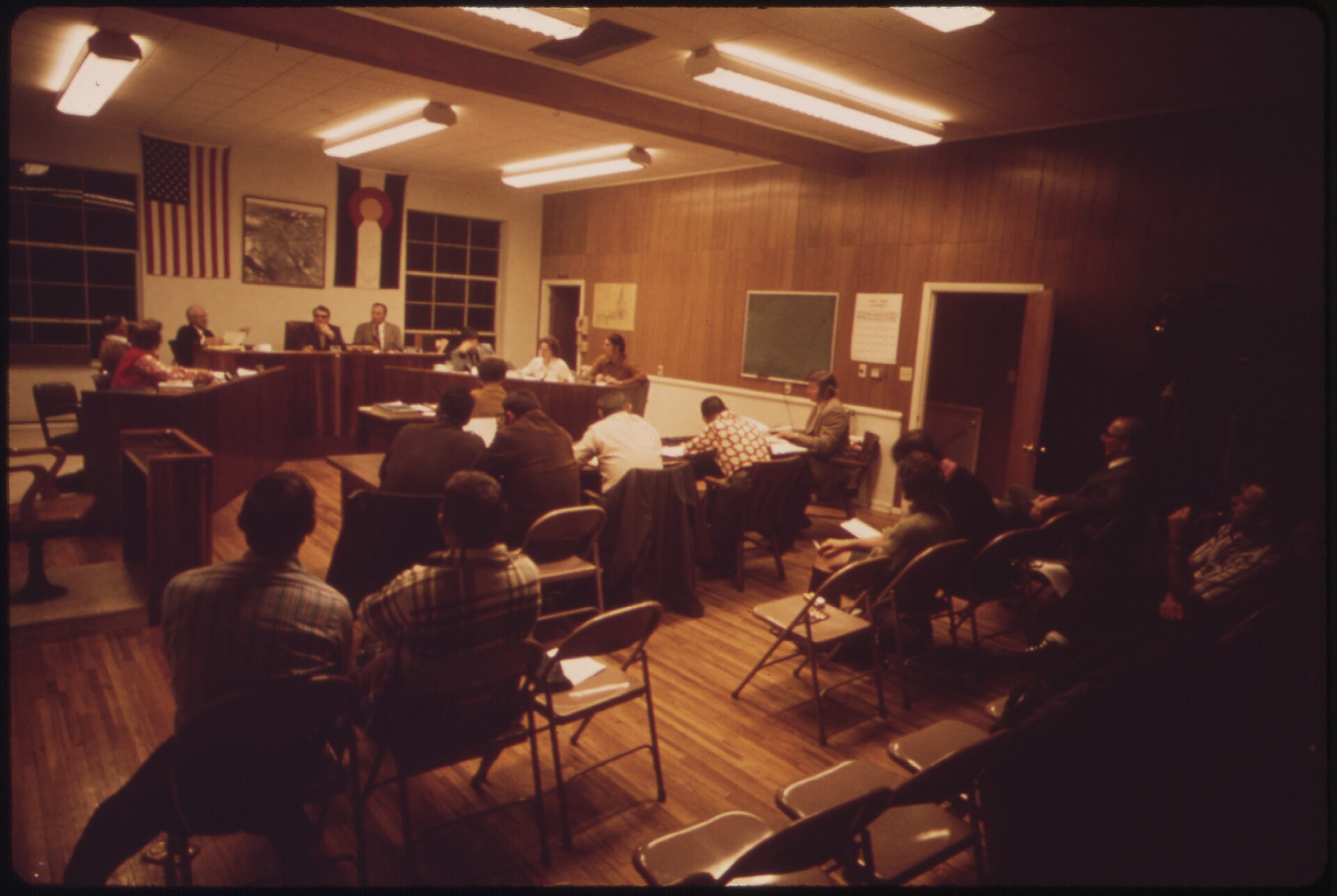
Idaho's Open Meetings Law applies to the "governing body" of a "public agency." Idaho Code 74-202 defines public agency to include "any regional board, commission, department or authority created by or pursuant to statute" and "any county, city, school district, special district, or other municipal corporation or political subdivision of the state of Idaho." A housing authority is created by a city resolution under a statute, has a board, and exercises public powers, including bonds and eminent domain. The statute does not name housing authorities, and we found no Idaho appellate decision or Attorney General opinion that settles whether every housing authority board is covered.2018
The Public Records Act has a parallel wrinkle. Idaho Code 74-101 defines "local agency" to include a "municipal corporation, independent public body corporate and politic, district, ... political subdivision, or any agency thereof," but defines "independent public body corporate and politic" as IHFA alone. IHFA is plainly covered. A city housing authority is described in its own statute with the same words, "independent public body corporate and politic," while 74-101 assigns those words to IHFA. In practice, Idaho's larger authorities post notices and agendas: the Boise City and Ada County authorities post board agendas and plan notices on their shared website. Lesson 01 of the open meetings course, Who the Law Covers, explains how the tests are applied. When an authority treats its meetings as open, cite the agenda and minutes; when it does not, the 50-1921 filings and HUD's own plan rules (which require a public hearing) give independent routes in.213
What to read in a board packet
Board packets show decisions before they become numbers in HUD data. Items to watch for:
- The SEMAP certification. Under 24 CFR 985.101, a voucher agency must submit its SEMAP certification within 60 calendar days after its fiscal year ends, and the certification "must be approved by PHA board resolution and signed by the PHA executive director." The resolution is a board item every year, and the certification states how the authority rated itself on each indicator.22
- The annual budget and HUD funding letters. Look for statements that voucher funding is prorated below the authority's eligibility. In August 2026 Elisa Velasco, executive director of the Southwestern Idaho Cooperative Housing Authority, told the Idaho Capital Sun her agency was funded at 86 percent of what it is entitled to receive.23
- Audit acceptance. Boards accept the annual audit; the packet often includes the auditor's letter and any findings and the corrective action plan.
- Policy changes. Changes to the Administrative Plan (vouchers) and the Admissions and Continued Occupancy Policy (public housing) set waitlist preferences, rent rules and screening. These must be approved by the board.24
- Property actions. Demolition, disposition, conversions under the Rental Assistance Demonstration (RAD), project-basing vouchers and new development partnerships all start as board resolutions and then appear in the PHA plan.
- Write-offs, claims and contracts. Uncollectible rent write-offs, litigation reports and large contracts. Claims against the authority must also be filed with the city clerk under 50-1921(3).1
Reading a PHA plan, step by step
The PHA plan is a housing authority's yearly public statement of its policies, needs and capital work. It is required by section 5A of the U.S. Housing Act of 1937, 42 U.S.C. 1437c-1, and HUD's rules in 24 CFR part 903. HUD's rule says the plans exist to provide "local accountability" and "an easily identifiable source by which public housing residents, participants in the tenant-based and project-based assistance program, and other members of the public may locate basic PHA policies, rules and requirements."225
Which plan your authority files
There are two plans. The 5-Year Plan covers the authority's mission and goals for five fiscal years. The Annual Plan covers the coming year's discretionary policies, the statement of housing needs (including the families on waiting lists), capital improvements and any demolition, disposition or conversion plans. Both are due to HUD no later than 75 days before the authority's fiscal year begins.2
Not every authority files an Annual Plan. The Housing and Economic Recovery Act of 2008 exempted "qualified PHAs": those whose public housing units plus vouchers total 550 or fewer, that are not designated troubled and that have not had a failing SEMAP score in the prior 12 months. HUD's plan form for small agencies (form HUD-50075-SM) adds categories: a "Small PHA" has fewer than 250 public housing units and more than 550 combined units, and an "HCV-Only PHA" administers more than 550 vouchers and no public housing.226
Applied to Idaho's 2025 counts from HUD's Picture of Subsidized Households, the Twin Falls (196 public housing units), Jerome (50), Buhl (40) and American Falls (40) authorities fall well under the 550 line, so they can qualify for the annual plan exemption if they are not troubled. The Boise City Housing Authority (160 public housing units and 1,406 vouchers) files the small-PHA form; its 2026 draft identifies capital work at Capitol Plaza and Franklin Plaza, its two public housing properties (HUD asset management project ID013000001), including water and waste line replacement and new air conditioning units. IHFA, with 4,017 vouchers and no public housing in HUD's file, fits the voucher-only category. These category placements are our reading of HUD's definitions against the 2025 unit counts; the authority's own plan cover page is the final word, because it reports units under its Annual Contributions Contract at the start of the fiscal year.2726
Two Idaho authorities are also Moving to Work agencies. HUD's list of Moving to Work agencies includes the Housing Authority of Pocatello (designated 2021, in the cohort for flexibility for smaller agencies) and the Twin Falls Housing Authority (designated 2022, in the asset building cohort). Moving to Work lets an agency waive some HUD rules to test local policies. HUD's MTW Supplement to the Annual PHA Plan collects information about the policies expansion agencies put in place, so it is the place to look for those waivers.2860 One data caution: HUD's 2025 Picture of Subsidized Households tags both agencies' public housing and voucher rows "non-MTW," so ask each agency which waivers it has actually put in place and when.27
The 45-day clock
Under 24 CFR 903.17, the board "must conduct a public hearing to discuss the PHA plan" at a location convenient to residents. Not later than 45 days before the hearing, the authority must make the proposed plan and "all information relevant to the public hearing" available at its principal office and publish a notice of the hearing's date, time and place. Once approved, the plan and its attachments must be available at the principal office during business hours. A Resident Advisory Board, made up of people who "adequately reflect and represent the residents assisted by the PHA," must be consulted, and its comments must be attached with the authority's response.2
The Boise City and Ada County authorities' 2026 cycle shows the clock in action. The notice was posted May 21, 2026. Public comment ran from May 22 to July 6, 2026, and the virtual hearing was set for 9 a.m. on July 6. The draft Boise and Ada plans, a full draft of the Administrative Plan and an outline of changes were posted on the authorities' website.3
How we figured it: the plan dates
Inputs. Comment period May 22 to July 6, 2026, from the authorities' notice. Fiscal year end Sept. 30 for both the Boise City and Ada County authorities, from their 2025 single audit records in the Federal Audit Clearinghouse, so the next fiscal year begins Oct. 1, 2026. Rule: plans are due no later than 75 days before the fiscal year begins (24 CFR 903.5).
Steps. May 22 to June 22 is 31 days; June 22 to July 6 is 14 more, for 45. Counting back 75 days from Oct. 1: 30 days to Sept. 1, 31 more to Aug. 1 (61), and 14 more to July 18 (75). July 18 is our calculation, not a date the authorities published.
Reading the plan itself takes about an hour. A method that works:
- Cover page. Note the HUD code, fiscal year, plan type and the counts of public housing units and vouchers. Compare them with the HUD Picture of Subsidized Households for the same agency.
- Statement of housing needs and waiting lists. 24 CFR 903.7 requires a statement covering families who live in the jurisdiction and "families who are on the public housing and Section 8 tenant-based and project-based assistance waiting lists," including extremely low-income families. Note whether the list is open or closed and when it last opened.2
- Policy changes. Find the list of changes to rent policy, admissions preferences, screening and inspections. The Boise and Ada outline for 2026, for example, lists updates for the HOTMA voucher rule, the NSPIRE inspection standards compliance date, removal of earned income disallowance language "as this has now fully sunset," revised arrest record guidance under Notice PIH 2025-26, and new sections on owner incentive and retention payments.24
- Capital Fund five-year action plan. Each line is a project with a year and dollar estimate. Compare it with last year's plan to see what slipped.
- Demolition, disposition, conversion and project-based vouchers. These are the decisions that change who can live where. Note any plan to project-base vouchers at a specific property, which moves subsidy from tenants to buildings.
- Resident Advisory Board comments and challenged elements. Form HUD-50075-SM asks "Did the public challenge any elements of the Plan?" and requires the authority's response. A blank or "pending public hearing" box means the final version is the one to read.26
- Certifications. Form HUD-50077-SL is the certification by a state or local official that the plan is consistent with the city's or state's consolidated plan. Note who signed it.26
The Administrative Plan and the ACOP
The detailed rules are in two companion documents. The Administrative Plan, required by 24 CFR 982.54, sets the voucher program's discretionary policies: how applicants are selected, which local preferences apply, how long a voucher search lasts and how extensions work. The Admissions and Continued Occupancy Policy (ACOP) does the same for public housing. The Boise and Ada outline describes them as plans that "outline the BCACHA policies where the housing authority has discretion to set a policy," and says they "must be approved by the Board of Commissioners and then updated in the PHA Plan."2924
Under 24 CFR 982.54, the Administrative Plan and every revision "must be formally adopted by the PHA Board of Commissioners," is "a supporting document to the PHA Plan" and "must be available for public review." Waiting list rules live here too. Under 24 CFR 982.206, when an authority opens its voucher waiting list it "must give public notice that families may apply," stating "where and when to apply," by publication in a local newspaper of general circulation and also through minority media and other suitable means. It may stop taking applications when it decides the list holds an adequate pool for the funding available. That makes each opening a datable event: ask for every opening notice for the past five years, the closing date and the number of applications received each time.30
Audits, SEMAP and PHAS
Single audits and the Federal Audit Clearinghouse
Under 2 CFR 200.501, a state, local government, tribe or nonprofit that "expends $1,000,000 or more during the non-Federal entity's fiscal year in Federal awards must have a single or program-specific audit." The Federal Audit Clearinghouse says the $1,000,000 figure applies to fiscal years starting on or after Oct. 1, 2024; the threshold was $750,000 for earlier years. The audit, a data collection form and the reporting package are due within 30 calendar days after the auditee receives the auditor's report or nine months after the end of the fiscal year, whichever is earlier, and the auditee "must make copies available for public inspection." The clearinghouse, run by the General Services Administration, posts the packages, except for Indian tribes that use their option to keep the package from public release.45
The clearinghouse search at app.fac.gov lets anyone filter by state and auditee name. A search of Idaho auditees with "housing" in the name on Nov. 20, 2026, returned these fiscal year 2025 audits:6
| Auditee (as filed) | Fiscal year end | Federal awards expended | Accepted by FAC |
|---|---|---|---|
| Idaho Housing and Finance Association | June 30, 2025 | $4,574,459,680 | July 30, 2026 |
| Boise City Housing Authority | Sept. 30, 2025 | $15,943,438 | April 23, 2026 |
| Southwestern Idaho Cooperative Housing Authority | June 30, 2025 | $13,601,514 | March 31, 2026 |
| Ada County Housing Authority | Sept. 30, 2025 | $10,473,248 | April 23, 2026 |
| Housing Alliance and Community Partnership (Pocatello) | June 30, 2025 | $5,508,570 | Jan. 14, 2026 |
| Nez Perce Tribal Housing Authority | Dec. 31, 2025 | $3,524,024 | Sept. 24, 2026 |
| Fort Hall Housing Authority | Dec. 31, 2025 | $3,053,454 | Sept. 30, 2026 |
| Coeur d'Alene Tribal Housing Authority | Sept. 30, 2025 | $2,273,137 | March 27, 2026 |
| Twin Falls Housing Authority | Dec. 31, 2025 | $1,028,066 | Sept. 3, 2026 |
The search also returns nonprofits that are not housing authorities (Boise Housing Corporation, NeighborWorks Boise, Interfaith Sanctuary Housing Services, The Housing Company and Gooding Senior Housing Association, among others), which shows how far federal housing money reaches. It did not return audits for the Jerome, Buhl or American Falls authorities. Their federal public housing operating and capital fund obligations in fiscal year 2025 were about $218,000, $213,000 and $237,000 on USAspending.gov, far below the $1 million threshold, so a missing single audit for them is expected. The authority's own annual financial statements, which 50-1921 requires to be filed with the city clerk, fill the gap.311
The accepted date is when the clearinghouse accepted a submission, not always when it was first sent, because revised packages replace earlier ones. IHFA's fiscal 2025 package (year ended June 30, 2025) shows an accepted date of July 30, 2026, about four months after the nine-month mark of March 31, 2026, and its fiscal 2024 package shows June 17, 2026. Those dates are a question to put to IHFA and to HUD (did the agency get an extension, or were these resubmissions?) before they are a story.6
Reading an audit
- Schedule of expenditures of federal awards. It lists every federal program by assistance listing number and amount spent. It shows the authority's real program mix.
- Summary of auditor's results. Look for the type of opinion on the financial statements (unmodified is clean), whether any material weakness or significant deficiency was found, and which programs were tested as major programs.
- Findings. Each finding has criteria, condition, cause, effect and recommendation, and is coded for the compliance requirement involved.
- Repeat findings and the corrective action plan. A finding marked as a repeat with a prior reference number is the strongest signal; the summary schedule of prior audit findings says what the agency did last time.
A real Idaho example: the fiscal 2025 audit of Housing Alliance and Community Partnerships in Pocatello reports finding 2025-001, a significant deficiency (not a material weakness), marked as a repeat of finding 2024-001, with no questioned costs. The auditor wrote that HUD requires units under its Moving to Work program to meet housing quality standards and that "in two (2) instances, a unit that failed its HQS inspection did not undergo a subsequent re-inspection within required time frame," so the required abatement of the housing assistance payment or voucher cancellation was not carried out. The auditor noted it found the problem in two of the three files it tested. That is the kind of finding to report with the authority's corrective action plan and response, and with the sample size stated.7
IHFA's audit needs its own warning. Its $4.57 billion in federal expenditures for fiscal 2025 is not grant money. The largest line, about $4.11 billion, is assistance listing 14.117, "Mortgage Insurance Homes," which reflects FHA-insured home loans; another $288.5 million is VA guaranteed loans and $77.5 million is USDA's guaranteed and direct home loan program. Vouchers (14.871) were $28.1 million and project-based rental assistance (14.195) $25.4 million. In other words, about 90 percent of the headline total is federal loan insurance and guarantees on mortgages.32
How we figured it: IHFA's loan share
Inputs. Federal Audit Clearinghouse report 2025-06-GSAFAC-0000424960: total federal expenditures $4,574,459,680; assistance listing 14.117 $4,109,841,422.
Step. $4,109,841,422 divided by $4,574,459,680 = 0.898, or about 90 percent. Adding VA loan guarantees (64.114, $288,519,448) and USDA housing loans (10.410, $77,499,784) brings the loan-related share to about 98 percent.
SEMAP and PHAS scores
HUD grades voucher programs with the Section Eight Management Assessment Program (SEMAP, 24 CFR part 985) and public housing with the Public Housing Assessment System (PHAS, 24 CFR part 902). SEMAP indicators include selection from the waiting list, rent reasonableness, determining adjusted income, utility allowances, inspection quality control and enforcement, payment standards, annual reexaminations, correct rent calculations, lease-up and family self-sufficiency. A SEMAP score of at least 90 percent is a high performer, 60 to 89 percent is standard, and under 60 percent is troubled.9
PHAS is a 100-point score: physical condition 40 points, financial condition 25, management operations 25 and the Capital Fund program 10. A high performer needs 90 percent overall plus at least 60 percent on each of the first three indicators and 50 percent on the Capital Fund. A substandard performer scores 60 percent or more overall but under 60 percent on one of the three main indicators. Under 60 percent overall is troubled. HUD may score a small authority (fewer than 250 public housing units) that is a high performer only every three years, and a standard or substandard one every other year.33
HUD's new accountability dashboard
On Oct. 30, 2026, HUD announced a "Nationwide Accountability Dashboard for Public Housing." The PHA Accountability Dashboard can be searched by housing authority, state or the nation and shows PHAS and SEMAP scores and designations, public housing units and vouchers, voucher leasing and funding use, budget authority, 2025 shortfall awards and whether an agency is in monitorship or receivership.834
HUD's glossary for the dashboard carries warnings every reporter should quote. Voucher leasing and funding data run about two months behind. Leasing utilization is leased vouchers divided by total vouchers, and "PHAs may not have enough money to lease all of these units as this is a budget-based program." Scores shown are the most recent since 2023, so an older score appears blank. And for public housing, "PHAS scores are excluded for MTW, RAD, and Small and Rural." The glossary adds that "MTW PHAs do not have scores for SEMAP." A blank PHAS score for Twin Falls or Pocatello, or a blank SEMAP score for Pocatello's voucher program, means no score in that system, not a failing one.3428
HUD data downloads, one by one
HUD's research office, HUD User, publishes the data sets most housing stories need. They are free, need no account, and come as Excel or CSV files. Each has a data dictionary. Read it first: most mistakes in housing data stories come from a column that means something other than its name suggests.
The Picture of Subsidized Households
The Picture of Subsidized Households describes the units and households in HUD's main rental programs: public housing, Housing Choice Vouchers, Moderate Rehabilitation, project-based Section 8, older programs such as Section 236, Section 202 housing for the elderly and Section 811 housing for people with disabilities. It is published for the nation, states, housing authorities, metro areas, counties, cities, ZIP codes, congressional districts, census tracts and individual projects. Data for 2025 (on 2020 census geography) are the newest; earlier years go back to the 1970s. HUD says it does not cover USDA rural rental housing unless it also gets HUD subsidy, Indian housing, HOME or CDBG.35
Lesson 05, Who Is Served, uses the file to describe Idaho's tenants. For reporting, three rules from HUD's 2025 data dictionary matter most:36
- "Subsidized units available" is the "number of units under contract for federal subsidy and available for occupancy." For vouchers that is the number of vouchers under contract, not apartments. "% Occupied" is occupied units as a share of that number.
- Missing values are coded. "-1" means missing; "-4" means suppressed "where the cell entry is less than 11 for reported families"; "-5" means non-reporting, where fewer than half of households were reported. A chart that plots -4 as a number is wrong. In the 2025 file, Ada County Housing Authority's 10 public housing units carry -4 in every characteristic column.
- Waiting time is narrow. "Average months on waiting list" uses the date entered on the list and the admission date, for households admitted, and "excludes programs that do not report waiting list dates." It describes the people who got in, not those still waiting.
Here is what the 2025 PHA-level file shows for Idaho's authorities. The file's snapshot date is Dec. 31, 2025.27
| Authority (HUD code) | Program | Units or vouchers under contract | Occupied or leased | Percent | Avg. months on waitlist |
|---|---|---|---|---|---|
| Idaho Housing and Finance Association (ID901) | Vouchers | 4,017 | 3,150 | 78 | 22 |
| Boise City Housing Authority (ID013) | Vouchers | 1,406 | 1,216 | 86 | 17 |
| Boise City Housing Authority (ID013) | Public housing | 160 | 153 | 96 | 13 |
| Southwestern Idaho Cooperative (ID016) | Vouchers | 1,086 | 1,030 | 95 | 31 |
| Southwestern Idaho Cooperative (ID016) | Public housing | 42 | 39 | 93 | 4 |
| Ada County Housing Authority (ID021) | Vouchers | 804 | 679 | 84 | 18 |
| Housing Alliance and Community Partnerships, Pocatello (ID005) | Vouchers | 752 | 627 | 83 | 9 |
| Housing Alliance and Community Partnerships, Pocatello (ID005) | Public housing | 72 | 70 | 97 | 3 |
| Twin Falls Housing Authority (ID001) | Public housing | 196 | 186 | 95 | 23 |
| Housing Authority of the City of Jerome (ID011) | Public housing | 50 | 47 | 94 | 12 |
| Housing Authority of the City of Buhl (ID010) | Public housing | 40 | 38 | 95 | 9 |
| Housing Authority of the City of American Falls (ID012) | Public housing | 40 | 38 | 95 | 19 |
| All Idaho | Vouchers | 8,065 | 6,702 | 83 | 20 |
| All Idaho | Public housing | 610 | 580 | 95 | 14 |
The Nampa Housing Authority, which is on HUD's contact list, has no row in the 2025 file, and its fiscal 2025 public housing operating and capital fund obligations on USAspending.gov are small negative numbers (downward adjustments). That pairing is a question to put to the agency and to HUD, not a conclusion.1431
How we figured it: voucher use
Inputs. HUD Picture of Subsidized Households 2025, PHA-level file (PHA_2025_2020census.xlsx), rows with program "Housing Choice Vouchers" and sub-program "N/A" (all vouchers, tenant-based and project-based). Columns total_units and total_occupied.
Steps. Percent = total_occupied divided by total_units. IHFA 3,150 / 4,017 = 78.4 percent; Pocatello 627 / 752 = 83.4; Ada County 679 / 804 = 84.5; Boise City 1,216 / 1,406 = 86.5; SWICHA 1,030 / 1,086 = 94.8; Idaho 6,702 / 8,065 = 83.1. The five agencies' vouchers add to 8,065 and their occupied counts to 6,702, matching the state row. HUD's own pct_occupied column, rounded, agrees.
Limits. This is a December snapshot. HUD's dashboard measures leasing monthly and warns that agencies may not have money to lease every voucher. It is not a voucher success rate, which measures how many families issued a voucher found a unit.
The LIHTC database
HUD's national database of low-income housing tax credit projects holds 55,345 projects and about 3.9 million units placed in service from 1987 to 2024; HUD says 2025 data are expected in spring 2027. It comes as one ZIP file with an Access database, an Excel file and a data dictionary. It lists each project's name, address, units, low-income units, year placed in service and allocated, credit type, whether a nonprofit sponsored it, whether it has USDA Section 515 or HUD financing, and its target population.3738
For Idaho, the 2024 release lists 288 projects with 13,093 units, 11,928 of them low-income. The file needs cleaning before any count is published:
- Missing county codes. 41 of the 288 Idaho records (14 percent) have no county code. Six are in Boise and one is Hagerman Country Homes (12 units, placed in service 1988) in Hagerman, which is in Gooding County.
- Spelling. The same city appears three ways: "COEUR DALENE" (19 records), "COEUR D ALENE" (1) and "COEUR D'ALENE" (1). Grouping by the raw city field would show Coeur d'Alene with one project instead of 21.
- Codes for unknowns. Year placed in service 8888 means the status was not confirmed; two Idaho records in Hailey carry it.
- Coded answers. Credit type 1 is the 30 percent present value credit (the "4 percent" credit), 2 is the 70 percent present value credit (the "9 percent" credit), 3 is both and 4 is the Tax Credit Exchange Program (TCEP) only. Yes and no fields use 1 for yes and 2 for no.38
| Area (HUD LIHTC database, placed in service 1987 to 2024) | Projects | Total units | Low-income units |
|---|---|---|---|
| Idaho | 288 | 13,093 | 11,928 |
| Twin Falls County (coded) | 14 | 663 | 632 |
| Jerome County (coded) | 8 | 276 | 272 |
| Gooding County (coded, plus 1 uncoded Hagerman project of 12 units) | 3 + 1 | 55 + 12 | 55 + 12 |
| City of Twin Falls | 11 | 583 | 554 |
| City of Jerome | 8 | 276 | 272 |
The Magic Valley records show the history. Fawnbrook and Fawnbrook II in Twin Falls (94 and 64 units, placed in service 1993 and 1994) are among the oldest. Jerome has eight projects, from Baltray, Prestwick and Western Gailes (all at 1285 South Lincoln Avenue, 1998) to Windwood (30 units, 2011). Gooding County's coded projects are Gracehill in Gooding (30 units, 2012) and the Clover Creek II and III projects in Bliss and Wendell (17 and 8 units, 2009), which, like Clover Creek in Jerome and Northside Court in Jerome, are flagged as having USDA Section 515 loans. Kimberly Sunset (24 units, 2006) is in Kimberly and Kacy Meadows (36) and Meadowbrook (20) are in Buhl. The newest Magic Valley record is El Milagro Apartments, 60 units at 1122 Washington in Twin Falls, placed in service in 2021; El Milagro V, at the same street address, won 2026 credits.3713
How we figured it: LIHTC counts
Inputs. HUD LIHTC database ZIP (lihtcpub.zip, 2024 release, read Nov. 20, 2026), file LIHTCPUB.xlsx, rows where proj_st is ID. Fields n_units, li_units, cnty2020 (county FIPS), proj_cty.
Steps. Summed n_units and li_units for all Idaho rows, then by cnty2020 (Twin Falls 83, Jerome 53, Gooding 47) and by city name. Counted rows with cnty2020 shown as "." (no code): 41. Listed city name variants by hand. Hagerman Country Homes is added to Gooding County separately because its county code is missing.
Limits. The database counts projects when placed in service and does not drop projects that have left the program, so it is a record of what was built with credits, not of what is still restricted today.
CHAS, fair market rents and income limits
Three more HUD files appear in nearly every affordable housing story, and each has a date trap:
- CHAS is HUD's special tabulation of Census American Community Survey data on housing problems and cost burden by income. HUD released the newest edition on Dec. 23, 2025, based on 2018 to 2022 five-year ACS estimates, for the nation, states, counties, places and smaller areas. A story in 2026 that uses it is describing conditions centered on 2020, before the sharpest rent increases (see Part A, Prices and Rents vs. Inflation).39
- Fair market rents set voucher payment standards. FY2026 fair market rents took effect Oct. 1, 2025, for most areas. HUD has published FY2027 fair market rents in a notice at 91 FR 56156; fair market rents normally take effect at the start of the federal fiscal year, Oct. 1. Check which year a voucher agency is using before comparing.40
- Income limits decide who qualifies. FY2026 income limits took effect May 1, 2026, and stay in effect until HUD publishes FY2027 limits. So in November 2026 a reporter may correctly be using FY2027 rents with FY2026 income limits. Lesson 02, What Low Income and Affordable Mean, has the Idaho limits.41
Homeless counts: the AHAR and point-in-time files
HUD's Annual Homeless Assessment Report (AHAR) Part 1 reports the January point-in-time count. The 2025 Part 1 was published in May 2026, with Excel files of counts by state and by continuum of care for 2007 to 2025. Idaho has two continuums of care in each year we checked (2007, 2015, 2019, 2020 and 2023 to 2025). The state file shows Idaho at 2,697 people counted in January 2025 (1,349 sheltered, 1,348 unsheltered), down from 2,750 in 2024 and up from 1,749 in 2007. The national count was 745,652 in 2025, down from 771,480 in 2024. Lesson 08, Homelessness and Supportive Housing, covers what the counts mean and the shelter system behind them.4243
How we figured it: the point-in-time changes
Inputs. HUD file 2007-2025-PIT-Counts-by-State.xlsb, row ID on each year's sheet, columns Overall Homeless, Sheltered Total Homeless and Unsheltered Homeless; row Total for the nation.
Steps. Idaho 2024 to 2025: 2,697 minus 2,750 = -53, or -1.9 percent. Idaho 2007 to 2025: 2,697 minus 1,749 = 948, or +54.2 percent. Unsheltered share 2025: 1,348 / 2,697 = 50.0 percent. Nation 2024 to 2025: 745,652 minus 771,480 = -25,828, or -3.3 percent; unsheltered share 266,320 / 745,652 = 35.7 percent.
Limits. The 2021 count was taken during COVID-19, and the national file shows only 54,504 unsheltered people that year against 226,080 in 2020, a sign that many communities did not do a full street count. Methods and volunteer coverage vary by year and by continuum of care.
IHFA, the QAP and tax credit awards
The QAP and its hearing
The federal low-income housing tax credit (LIHTC) is allocated in Idaho by IHFA under a qualified allocation plan (QAP). Under 26 U.S.C. 42(m)(1), credits must be allocated under a plan approved by the governmental unit of which the agency is a part; the agency must notify the chief executive of the local jurisdiction where a project would be built and give that official a chance to comment; and a market study is required. The plan must also include a procedure for monitoring noncompliance, including habitability "through regular site visits," and for notifying the IRS.44
IHFA's tax credit page posts its QAPs back to 2021, the 2026 final QAP (labeled as pending the governor's approval, dated May 18, 2026), a notice of funding availability, allocation lists from 2019 to 2026 and lists of applications received from 2021 to 2027. It also posts the transcript of the 2026 QAP hearing, held virtually at 10 a.m. on March 19, 2026, with written comments. At that hearing IHFA's Cory Phelps said the agency is "on a two-year QAP cycle" but made cleanup changes, mostly about the 4 percent credit and private activity bond volume cap; a developer questioned a proposed change on how to count projected rent from permanent supportive housing units for people at or below 30 percent of area median income. Reading the transcript is the fastest way to see which developers and advocates are paying attention and what they want changed.4546
Applications versus awards
Comparing the applications list with the allocations list shows how hard the competition is and who wins. For the 2026 round (applications due Aug. 15, 2025), IHFA listed 21 applications for 863 units, 788 of them affordable, asking for $23,270,414 in annual credits. Its allocation list dated Jan. 9, 2026, shows six awards for 231 units (210 affordable) and $6,341,944 in annual credits. Owners may claim the annual credit for 10 years.121345
| 2026 award (IHFA list as of Jan. 9, 2026) | City, county | Type, set-aside | Score | Units (affordable) | Annual credit |
|---|---|---|---|---|---|
| El Milagro V, Syringa Housing Corp. (new construction) | Twin Falls, Twin Falls | Family, nonprofit | 92.5 | 20 (20) | $493,871 |
| Blue Sky Commons, The Housing Company (new) | Boise, Ada | Family, nonprofit | 92.0 | 45 (39) | $1,200,000 |
| Ustick and Lake, SMRI LLC (new) | Caldwell, Canyon | Family, non-targeted | 90.5 | 35 (31) | $1,200,000 |
| Ridgeview Senior, Tailwater Development (new) | Idaho Falls, Bonneville | Senior, non-targeted | 89.5 | 55 (49) | $1,350,000 |
| Finch II, Roundhouse Affordable LLC (new) | Boise, Ada | Family, non-targeted | 88.0 | 46 (41) | $1,350,000 |
| Sycamore Commons II, LEAP Charities (acquisition and rehab) | Boise, Ada | Senior, preservation and nonprofit | 87.0 | 30 (30) | $748,073 |
| Total | 231 (210) | $6,341,944 |
The 2025 round, by comparison, funded seven developments (259 units, 239 affordable) with $6,389,837 in annual credits, plus $648,000 in HOME and $1,041,096 in national Housing Trust Fund reservations, as of Jan. 10, 2025. Two of those 2025 awards were Juniper Heights I and II in Pocatello; Juniper Heights III applied in 2026 and is not on the 2026 award list.4712
How we figured it: the tax credit round
Inputs. IHFA lists: 2026 applications received (21 rows, totals 863 units, 788 affordable, $23,270,414); 2026 allocations as of Jan. 9, 2026 (6 rows, 231 units, 210 affordable, $6,341,944); 2025 allocations as of Jan. 10, 2025 (7 rows, 259 units, 239 affordable, $6,389,837).
Steps. $6,341,944 / $23,270,414 = 0.273 (27 percent); the inverse is 3.67 dollars requested per dollar awarded. Units 231 / 863 = 0.268 (27 percent). We counted the application rows by hand (11 on page one, 10 on page two).
Limits. Lists are as of their dates; IHFA may award more credits later in a year from returned or national pool credits, and award amounts can differ from requests (Blue Sky Commons asked for $1,265,457 and was listed at $1,200,000).
Compliance: what is public and what is not
After a project opens, IHFA monitors it. Under the IRS rule at 26 CFR 1.42-5, the agency must inspect units and review tenant income certifications by the end of the second calendar year after the last building is placed in service and at least once every three years after that, using a minimum sample (for example, 16 units in a project with 35 to 40 low-income units). When it finds noncompliance, it notifies the owner, allows a correction period of up to 90 days (extendable up to six months for good cause), and must file IRS Form 8823, the "Low-Income Housing Credit Agencies Report of Noncompliance," no later than 45 days after the correction period ends, whether or not the problem was fixed. The federal compliance period is 15 years, and the extended use commitment runs at least 15 years beyond it.4844
The IRS does not publish Forms 8823, and we found no Idaho statute or ruling on whether IHFA's own copies are open to the public. What reporters can get is the paper around them: the recorded extended use agreement (a restrictive covenant at the county recorder), IHFA's compliance manual and inspection schedule, a project's rent and income limits, the owner's annual certifications, city and county code enforcement files for the address, and HUD's LIHTC tenant data, which summarizes household characteristics by state. Records of IHFA "containing personal financial, family, health or similar personal information," mortgage loan files and loan portfolio documents are exempt under Idaho Code 74-106(20), but the exemption expressly does not cover the employment contracts or pay of IHFA's executive director, executive officers or commissioners.4937
USDA rural rentals
Much of the Magic Valley's older affordable rental housing was built with USDA Rural Development Section 515 loans and carries USDA rental assistance. USDA's Multi-Family Housing Rentals site lets anyone search properties by state, town, ZIP code, property name or management agency. It is a property finder, not a data file, so building a list means searching town by town (Jerome, Gooding, Wendell, Buhl, Kimberly, Hagerman) and saving each result with the date. Lesson 03, Low-Income Housing Issues in Idaho, covers maturing 515 mortgages.50
Following the federal dollars
USAspending.gov
Every federal grant and loan program has an assistance listing number (formerly called a CFDA number). USAspending.gov can be searched by that number, by recipient and by the recipient's state, and it can be filtered by federal fiscal year (Oct. 1 to Sept. 30). The numbers most housing stories need: 14.871 Section 8 Housing Choice Vouchers; 14.850 Public Housing Operating Fund; 14.872 Public Housing Capital Fund; 14.195 Project-Based Rental Assistance; 14.239 HOME Investment Partnerships; 14.218 CDBG entitlement grants; 14.228 the state CDBG program; 14.267 Continuum of Care; 14.231 Emergency Solutions Grants; 14.275 Housing Trust Fund; 14.867 Indian Housing Block Grants; and USDA's 10.427 Rural Rental Assistance Payments.11
For federal fiscal year 2025, voucher obligations to Idaho recipients totaled $84,156,881:11
| Recipient (as named on USAspending.gov) | FY2025 obligations, 14.871 Housing Choice Vouchers |
|---|---|
| Idaho Housing and Finance Association | $33,645,083 |
| Boise City Ada County Housing | $18,812,908 |
| Southwestern ID Cooperative Housing | $15,418,368 |
| Ada County Housing Authority | $10,565,149 |
| Housing Alliance and Community Partnerships, Inc. | $5,583,827 |
| Fort Hall Housing Authority | $131,546 |
| Total | $84,156,881 |
How we figured it: USAspending totals
Inputs. USAspending.gov API, spending by category (recipient), filters: assistance listing 14.871, recipient location state Idaho, time period Oct. 1, 2024, to Sept. 30, 2025; run Nov. 20, 2026. Six recipients returned.
Steps. $33,645,083 + $18,812,908 + $15,418,368 + $10,565,149 + $5,583,827 + $131,546 = $84,156,881. The same query for 14.850 and 14.872 gave the public housing figures in this lesson; for example, Jerome's operating fund ($81,052) plus capital fund ($137,362) = $218,414.
Limits. Obligations are commitments recorded in the federal fiscal year, not checks cashed, and an authority's own fiscal year (June 30, Sept. 30 or Dec. 31 in Idaho) differs. Negative amounts are downward adjustments. A recipient whose address is outside Idaho does not appear under an Idaho filter.
The same method shows other money. In federal fiscal year 2025, Indian Housing Block Grant obligations to Idaho recipients were $6,542,417 to the Coeur d'Alene Tribal Housing Authority, $2,321,413 to the Fort Hall Housing Authority, $1,968,356 to the Nez Perce Tribal Housing Authority and $124,857 to the Kootenai Tribe of Idaho. The Shoshone-Paiute Tribes of the Duck Valley Reservation straddle the Idaho-Nevada line, so a state filter can miss them; search by name. Continuum of Care obligations went to IHFA ($4,257,115), Ada County Housing Authority ($1,605,101), Charitable Assistance to Community's Homeless, Inc. (CATCH, $1,076,233) and the City of Boise ($91,202).51
City block grant plans and CAPERs
Cities that receive CDBG directly from HUD (entitlement cities) and the state, which runs the non-entitlement program through the Idaho Department of Commerce, must adopt a consolidated plan, an annual action plan and an annual performance report. HUD's rule at 24 CFR 91.520 says the performance report, usually called the CAPER (Consolidated Annual Performance and Evaluation Report), must describe "the resources made available, the investment of available resources, the geographic distribution and location of investments, the families and persons assisted (including the racial and ethnic status of persons assisted)," and must be submitted "within 90 days after the close of the jurisdiction's program year." The citizen participation rules in 24 CFR 91.105 require at least 30 days for comment on a consolidated plan, at least 15 days for comment on a performance report and at least two public hearings a year.52
USAspending.gov shows fiscal year 2025 CDBG entitlement obligations to Boise ($1,367,844), Nampa ($653,242), Meridian ($523,218), Caldwell ($464,994), Twin Falls ($341,417) and Coeur d'Alene ($290,998), and $8,658,249 to the State of Idaho for the state program. Idaho Falls shows a $27 downward adjustment, and no other Idaho city appears in that year's results, a reminder that obligations follow grant agreement dates, not program years. Ask each city for its most recent CAPER and action plan, and compare what the action plan promised with what the CAPER reports.51
Records requests to authorities and cities, and FOIA to HUD
Part C's lesson 12 explains the Idaho Public Records Act's request rules, response deadlines and fees, including the different deadlines for nonresidents added by House Bill 253 (2025); the public records course covers deadlines and extensions and fees and fee waivers. In short, Idaho Code 74-103 requires an agency to grant or deny a resident's request within three working days, extendable to ten working days with written notice. This section covers what to ask for in affordable housing stories.53
Requests that work
- Waiting list counts. "The number of applicants on each waiting list (Housing Choice Voucher, public housing by property, project-based voucher by property) on the first day of each month from Jan. 1, 2021, to Oct. 31, 2026, with the dates each list opened and closed and the number of applications received during each opening." Ask for counts only; no names.
- Voucher issuance and lease-up. "For each month from Jan. 2023 to Oct. 2026: vouchers issued, vouchers that resulted in a lease, vouchers that expired unused, and extensions granted." This is how to compute a voucher success rate, which HUD scores only for agencies that set success rate payment standards before June 6, 2024 (24 CFR 985.3(p)).54
- Funding and proration. HUD's annual funding letters and any shortfall award notices for 2024 to 2026.
- Inspections. A log of housing quality or NSPIRE inspections with date, result, reinspection date and abatement, by unit address with tenant names removed. The Pocatello audit finding shows why.7
- Board records. Minutes, packets, SEMAP certification resolutions and the annual report filed with the city clerk under 50-1921, from both the authority and the clerk.1
- Management agreements. Where one staff runs several authorities (as in the Magic Valley), the management or cooperation agreements and how costs are split.
- Executive pay. Contracts and pay of the executive director. For IHFA, Idaho Code 74-106(20) expressly keeps these open.49
- City housing money. CDBG and HOME action plans and CAPERs, any city housing trust or land trust budget, and council resolutions approving tax credit projects or local official comments under 26 U.S.C. 42(m).44
What is closed, and why
- Individual applicant and tenant files. HUD's rule at 24 CFR 5.212 requires that the collection and use of Social Security numbers and income information be handled in compliance with the federal Privacy Act "and all other provisions of Federal, State, and local law," and applicants get a Privacy Act notice. Expect authorities to refuse names, incomes and files; ask for counts and de-identified data instead.55
- IHFA borrower and personal records. Exempt under Idaho Code 74-106(20).49
- Domestic violence survivors. Under the Violence Against Women Act's confidentiality rule, 34 U.S.C. 12291(b)(2), grantees may not disclose personally identifying information about people they serve without informed, written, time-limited consent, and may share only aggregate, non-identifying data for reporting.56
Federal FOIA to HUD
HUD records, including field office correspondence with an Idaho authority, monitoring letters, corrective action plans and recovery agreements, are reached through the federal Freedom of Information Act, 5 U.S.C. 552. An agency has 20 working days to decide on a request, with extensions for unusual circumstances. HUD takes requests through its online FOIA portal, requires them in writing, asks requesters to state a fee category and the most they will pay, and posts frequently requested records in a FOIA library and reading room. Search the library first.5758 The records course's lesson Federal FOIA, Tracking and the Big Picture covers how to track a federal request.
Interviewing fairly and protecting people
Part C's lesson 12 covers fair interviewing of tenants, landlords, managers and boards. Affordable housing adds four groups with their own pressures.
- Voucher holders and public housing residents depend on an agency that can end their assistance for rule violations, so many will not talk on the record. Ask before naming anyone, say plainly where the story will appear, and never identify a voucher holder, an applicant on a waiting list or a person who is homeless without that person's consent. Describe them by situation ("a mother of two who has waited 30 months") when consent is not given.
- Landlords who take vouchers, or who stopped, can explain inspection delays, payment timing and paperwork. Ask for documents (an inspection report, a payment history) and give the authority a chance to answer each specific complaint.
- Housing authority staff and commissioners work under HUD rules they did not write. Ask which rule requires a practice, get the citation, and read it. Quote the director by name, as the Idaho Capital Sun did in August 2026 when it asked the heads of Idaho's authorities about HUD's proposed work requirements and time limits: Sunny Shaw, who leads the Twin Falls, American Falls, Jerome and Buhl authorities, said most of her residents are elderly or disabled; Jared Mangum of Pocatello's Housing Alliance and Community Partnerships said he applauded the effort; Deanna Watson of the Boise City and Ada County authorities questioned whether jobs pay a living wage; and an IHFA spokesman said the agency would wait for a final rule.23
- Builders and nonprofit developers know the economics of a tax credit deal. Ask for the sources and uses of funds from the application, the developer fee and how rents compare with the limits.
The federal work requirement proposals are a moving story; the site's Medicaid course lesson The 2027 Work Requirements shows how to report a benefit rule that is not yet final.



Story checklists
Each checklist lists the records to pull, the numbers to compute and the people to call, in order. They assume the reader has the records map above.
A waiting list story
- Identify which authority serves the area (lesson 04 and IHFA's county list: IHFA runs vouchers in 34 counties, including all eight in its Twin Falls branch: Blaine, Camas, Cassia, Gooding, Jerome, Lincoln, Minidoka and Twin Falls).17
- Pull the current PHA plan's statement of housing needs and waiting list section, and the Administrative Plan's preference rules.
- Pull HUD's Picture of Subsidized Households for the authority: average months on the waiting list for people admitted, and the share of vouchers in use.
- Request monthly waiting list counts and every opening notice for five years. Ask how the authority purges the list (letters to update contact information) and how many names each purge removed.
- Compute: applicants per available voucher or unit; months the list was open versus closed; change over time. Show the method.
- Ask the authority what limits issuance: money (proration), turnover or landlords. Compare its answer with HUD's dashboard leasing and budget figures.
- Find people on the list who agree to be named, and landlords who do and do not take vouchers. Do not name anyone without consent.
- Do not write "X people need housing" from a list count. A list counts applications, includes people who have moved or found housing, and excludes people who never applied because it was closed.
A tax credit property story
- Find the project in HUD's LIHTC database and IHFA's allocation list: year, units, credit type, set-aside, score, developer.
- Pull the application packet if IHFA releases it, the city's land use file and any local official comment letter under 26 U.S.C. 42(m).44
- Pull the recorded extended use agreement from the county recorder and note how long the restrictions last.
- Check rents against the income and rent limits for the project's set-aside (lesson 02).
- Check code enforcement and police call records for the address; ask IHFA for its inspection dates and any finding letters it will release.
- Talk to tenants, the management company, the owner and the city. Ask the owner what happens when the 15-year compliance period ends.44
A buyer assistance story
- Name the program and its rules from the program's own page (lesson 09, First-Time Buyer Assistance), with the year of each limit.
- Get aggregate numbers: loans made by county and year, average assistance, share repaid or forgiven. IHFA's individual loan files are exempt under Idaho Code 74-106(20), so ask for counts and totals.49
- Read IHFA's single audit and financial statements for loan volume and loan performance.32
- Compare price limits with actual sale prices (lesson 10, Problems With Buyer Assistance).
- Interview buyers who used the program and agree to be named, a lender and the program staff. Give no advice to readers on whether to borrow.
A homeless count story
- Pull HUD's point-in-time counts by state and by continuum of care for every year, not just two.43
- Read the continuum's methodology for the year: date, volunteers, areas covered, whether it did a full unsheltered count.
- Compare with the Housing Inventory Count (beds) and with school-district counts of homeless students, which use a broader definition (lesson 08).
- Compute changes with the 2021 caveat. Say the count is one night in January.
- Ask the continuum of care lead what changed in shelter capacity, funding or methods. Never photograph or name people in camps or shelters without consent.
An audit or performance score story
- Pull the last three single audits from the clearinghouse and the authority's scores and designation from HUD's dashboard.68
- For each finding, note whether it is a repeat, whether it is a material weakness or significant deficiency, the sample size and any questioned costs.
- Get the corrective action plan and ask HUD by FOIA for any monitoring letters.58
- Check whether the authority is exempt from a score (MTW, RAD, small and rural) before reporting a blank as a failure.34
- Give the executive director and board chair the specific findings and time to answer.
The Magic Valley angle
The Magic Valley has the state's densest cluster of small housing authorities, and they are easy to misread from a distance. HUD lists the Twin Falls (ID001), Jerome (ID011) and Buhl (ID010) authorities as separate agencies with separate codes, and lists American Falls (ID012), just east of the Magic Valley in Power County. HUD's contact list gives the same contact email and phone numbers for Twin Falls and Jerome, and one website, which calls itself the Snake River Housing Alliance, offers "Income-based housing for people who need it in Twin Falls, Jerome, American Falls, and Buhl." The Idaho Capital Sun identified Sunny Shaw as the leader of all four. Each authority still has its own board appointed by its own city's mayor and council under 50-1910, its own HUD funding and its own filings with its own city clerk under 50-1921.14592319
In HUD's 2025 data, these four authorities hold 326 of Idaho's 610 public housing units, more than half. Twin Falls' 196 units were 95 percent occupied, with half of households headed by someone 62 or older and an average wait of 23 months for those admitted. Jerome's 50 units had 74 percent older households and Buhl's 40 had 86 percent. None runs vouchers: Magic Valley voucher holders are served by IHFA's Twin Falls branch. IHFA's voucher program as a whole had 78 percent of its vouchers in use in the 2025 data; HUD's file does not break that out by branch. Twin Falls is also one of Idaho's two Moving to Work agencies.271728
The money trail is short and checkable: fiscal 2025 public housing operating and capital fund obligations of about $809,000 for Twin Falls, $218,000 for Jerome, $213,000 for Buhl and $237,000 for American Falls; a Twin Falls single audit for 2025 of $1,028,066 in federal spending; CDBG entitlement money to the City of Twin Falls ($341,417 obligated in fiscal 2025); and 2026 tax credits for El Milagro V. Questions worth asking: how costs and staff are shared among the four authorities, what the Moving to Work designation has changed in Twin Falls, how long the IHFA Twin Falls branch's voucher list is, and how many USDA Section 515 properties in Jerome, Gooding and Twin Falls counties are near the end of their loans.3165113
Pictures, Numbers and Infographics
| Measure | Idaho | U.S. or other states | Place or year | Source |
|---|---|---|---|---|
| HUD-subsidized units (all programs) | 12,942 (11,165 occupied) | U.S. 5,132,918; Montana 14,113; Utah 20,331; Oregon 57,559; Washington 96,312 | Dec. 31, 2025 | 10 |
| Average months on waitlist, all HUD programs (households admitted) | 20 | U.S. 25; Montana 20; Utah 25; Oregon 33; Washington 15 | 2025 | 10 |
| Vouchers in use / under contract | 6,702 / 8,065 (83%) | U.S. all programs 87% occupied | 2025 | 10 |
| Public housing units | 610 | Magic Valley four authorities: 326 | 2025 | 27 |
| Voucher obligations (14.871) | $84,156,881 to 6 recipients | IHFA $33,645,083 | FY2025 | 11 |
| LIHTC projects placed in service | 288 projects, 13,093 units | U.S. 55,345 projects, about 3.9 million units | 1987 to 2024 | 37 |
| Tax credits requested vs. awarded | $23,270,414 vs. $6,341,944 | 2025 round: $6,389,837 awarded | 2026 round | 12 |
| Point-in-time count | 2,697 (50% unsheltered) | U.S. 745,652 (36% unsheltered) | January 2025 | 43 |
| Single audit threshold | $1,000,000 in federal spending | Same nationwide; $750,000 before | Fiscal years from Oct. 1, 2024 | 5 |
| PHA plan public notice | 45 days before hearing | Same nationwide | 24 CFR 903.17 | 2 |
| Housing authority minutes to city clerk | Within 10 days of approval | Idaho rule | Idaho Code 50-1921 | 1 |
Common mistakes
- Reading voucher "occupancy" as a landlord shortage. HUD's own glossary warns that agencies "may not have enough money to lease all of these units as this is a budget-based program." Low leasing can be money, turnover, processing or landlords. Ask which.34
- Treating a waiting list count as the number of people in need. Lists open and close, include stale names and exclude people who could not apply. Average months on the list in HUD's file describes only people who were admitted.36
- Plotting suppression codes as numbers. In the Picture of Subsidized Households, -1, -4 and -5 mean missing, suppressed and non-reporting.36
- Calling IHFA's $4.57 billion "federal grants." About 90 percent is FHA mortgage insurance on home loans (assistance listing 14.117).32
- Reporting a blank PHAS score as a failure. HUD excludes Moving to Work, RAD and small and rural agencies from PHAS on its dashboard; Twin Falls and Pocatello are Moving to Work agencies.3428
- Mixing fiscal years. Federal obligations run Oct. 1 to Sept. 30; Idaho authorities' fiscal years end June 30, Sept. 30 or Dec. 31; fair market rents and income limits change on different dates.4041
- Counting LIHTC projects by raw city name. Coeur d'Alene appears three ways in HUD's file, and 41 Idaho records have no county code.38
- Comparing 2021 homeless counts with other years without a caveat. Many communities did not do a full unsheltered count during COVID-19.43
- Reading a single audit finding as fraud. A significant deficiency in a sample of three files is a control problem to report precisely, with the sample size, the agency's response and no inflation.7
- Assuming every authority must post an Annual Plan. Qualified agencies with 550 or fewer combined units are exempt from the Annual Plan, though not from the 5-Year Plan and public hearing rules for that plan.2
What we know, what we don't, and what the data can show
What we know
- Idaho law sends housing authority minutes, annual reports, financial reports, claims and handbooks to the city clerk (Idaho Code 50-1921).1
- HUD's plan rules require a 45-day public review and a board hearing; the Boise and Ada authorities followed that schedule in 2026.23
- In December 2025, 83 percent of Idaho's 8,065 vouchers under contract were in use, from 78 percent at IHFA to 95 percent at SWICHA.27
- IHFA's 2026 tax credit round funded about 27 percent of the dollars requested.1213
- Idaho's January 2025 count found 2,697 people homeless, half unsheltered.43
What we don't know
- Whether Idaho's Open Meetings Law and Public Records Act reach every city housing authority as a "public agency" or "local agency"; the statutes do not name them and we found no ruling.
- Each authority's current SEMAP and PHAS scores: HUD's new dashboard holds them, and we did not extract them for this lesson.
- True waiting list sizes and voucher success rates, which most Idaho authorities do not publish.
- Why IHFA's fiscal 2024 and 2025 single audits show acceptance dates past the nine-month mark.
- The legal arrangement among the four Magic Valley authorities that share leadership and a website.
- Whether the Jerome, Buhl and American Falls authorities filed any audit in the clearinghouse under another name.
What the data can show
- Who lives in HUD housing, by authority, since 2004: HUD Picture of Subsidized Households, PHA files by year.35
- Where tax credit housing was built and when: HUD LIHTC database, 1987 to 2024.37
- Who won tax credits each year and who lost: IHFA application and allocation lists, 2019 to 2027.45
- Federal housing dollars by recipient and year: USAspending.gov by assistance listing.11
- Control problems and repeat findings: Federal Audit Clearinghouse findings tables.6
- Homeless counts by year and continuum: HUD PIT files 2007 to 2025.43
- Cost burden by income: HUD CHAS, 2018 to 2022 ACS edition.39
Questions people ask
Can I attend a housing authority board meeting?
Idaho's larger authorities post agendas and hold public meetings, and HUD requires a public hearing on the PHA plan. Whether the state open meetings law covers every authority has not been settled by a court; ask the authority for its meeting schedule and policy, and read the approved minutes at the city clerk's office under Idaho Code 50-1921.2012
Can I find out who is on a waiting list?
No. Applicant names, incomes and files are personal information that housing authorities keep confidential; HUD's rule at 24 CFR 5.212 requires Privacy Act compliance for the Social Security numbers and income data they collect. Counts by month, dates lists opened and closed, and the number of applications received are the records to request.55
How do I know if my housing authority is troubled?
Search HUD's PHA Accountability Dashboard for its SEMAP and PHAS designations, which HUD began publishing there on Oct. 30, 2026. Troubled means a score under 60 percent. A blank score may mean the agency is exempt from that system.834
Where are the tax credit apartments in my town?
HUD's LIHTC database lists projects placed in service through 2024 with addresses; IHFA's allocation lists cover newer awards. USDA's rental property search covers rural properties. Check spelling variants of the town's name.3750
Are IHFA records public?
Yes, with exceptions. The Public Records Act names IHFA expressly, and Idaho Code 74-106(20) exempts personal and loan records while keeping executive and commissioner pay and contracts open.2149
How do I get HUD records about an Idaho authority?
File a Freedom of Information Act request through HUD's FOIA portal after searching HUD's FOIA library. Name the authority, its HUD code and the type of record (monitoring letters, corrective action plans, recovery agreements).58
Hard questions
Should Idaho require housing authorities to publish waiting list data?
For: Waiting lists are the most-cited measure of need and the least standardized; public monthly counts would let councils and the Legislature compare areas. Against: Small authorities with one or two staff members already carry HUD reporting loads, and raw counts are easily misread. What the evidence shows: HUD's own data report waiting time only for people admitted, and the new dashboard does not show list sizes; without a local rule, the public record depends on requests.3634
Should IHFA publish tax credit compliance findings?
For: Tenants and cities would know which properties have income, rent or habitability problems, and investors' compliance would face public pressure. Against: Many findings are paperwork errors fixed in the correction period, and publication could deter private investors that the program relies on. What the evidence shows: Federal rules require IHFA to report noncompliance to the IRS on Form 8823 whether or not it is corrected, but they do not require publication, and the IRS does not publish the forms.48
How much should HUD's scores count in coverage?
For heavy weight: SEMAP and PHAS are the only national, rule-based grades, and HUD now publishes them in one place. For caution: Scores lag, exempt some agencies, and SEMAP is built on self-certification checked later by audit. What the evidence shows: The SEMAP rule says indicator ratings may change after HUD receives the audit or a confirmatory review, so pair any score with the latest audit.934
Should small towns keep their own housing authorities?
For: A local board keeps decisions close to residents, and Idaho law lets each city create its own. Against: Authorities with 40 or 50 units have small budgets and may struggle with HUD's rules; shared management, as in the Magic Valley, or merger into a larger agency can cut costs. What the evidence shows: Idaho Code 50-1905 lets governing bodies jointly create an authority, and the Magic Valley shows one model of shared leadership with separate boards; there is no published Idaho study comparing costs or outcomes.1859
For reporters and advocates
Records that exist. Housing authority agendas, minutes and annual reports (also filed with city clerks under 50-1921); PHA 5-Year and Annual Plans, Administrative Plans and ACOPs; SEMAP certifications and board resolutions; single audits in the Federal Audit Clearinghouse; HUD's PHA Accountability Dashboard; HUD's Picture of Subsidized Households, LIHTC database, CHAS, fair market rents, income limits and point-in-time files; IHFA's QAPs, hearing transcripts and tax credit lists; city CDBG action plans and CAPERs; USAspending.gov award records; legislative hearing minutes on housing bills.164552
Questions to ask officials.
- To each housing authority: how many applicants are on each list today, when did each list last open, and what share of vouchers issued last year led to a lease?
- To IHFA: what is the voucher waiting list at each branch, why were its single audits accepted after the nine-month mark, and what compliance findings has it issued on tax credit properties in each county?
- To city clerks: does the clerk have the housing authority's minutes, annual reports and financial reports for the last three years?
- To HUD: what monitoring or corrective action letters has the field office sent Idaho authorities since 2023?
- To city councils: when are housing authority seats up, and who applied?
Public records. Use the Idaho Public Records Act, Title 74, Chapter 1 (see Idaho Public Records Requests), for authorities, IHFA and cities, and the federal FOIA for HUD. Ask for counts and de-identified data, not tenant files. Testimony and public comment on housing plans are covered in Testifying and Public Comment, and how local governments are organized is in Local Government.5357
The Magic Valley angle. Four authorities (Twin Falls, Jerome, Buhl and American Falls) share leadership and a website but keep separate boards, HUD codes and city filings; together they hold more than half of Idaho's public housing units. Twin Falls is a Moving to Work agency, vouchers in eight Magic Valley counties run through IHFA's Twin Falls branch, and the region's newest tax credit award is El Milagro V. Start with the city clerks in Twin Falls, Jerome and Buhl, and with the Twin Falls single audit.27281713
Where to go next
- Federal Audit Clearinghouse: Free public search of single audits by state, entity name and year, run by the General Services Administration. Results include the audit PDF, findings and federal award tables. No account is needed to search.
- HUD User: Picture of Subsidized Households: Free HUD data on who lives in HUD-assisted housing, by state, housing authority, county, city and project, with a query tool and Excel downloads and a data dictionary for each year.
- HUD User: LIHTC database: Free national list of tax credit projects placed in service since 1987, with an online query tool and a downloadable ZIP file; useful for finding tax credit properties in a town or county.
- USAspending.gov: Free federal spending search run by the U.S. Treasury. Searches by assistance listing number, recipient, place and fiscal year show grants and payments to Idaho housing agencies, cities and tribes.
- Idaho Legislature: Idaho Statutes: Free official text of Idaho Code, including the Housing Authorities and Cooperation Law (Title 50, Chapter 19), the IHFA Act (Title 67, Chapter 62) and the Public Records Act (Title 74, Chapter 1).
- eCFR: Title 24, Housing and Urban Development: Free, current text of HUD's regulations, including PHA plans (part 903), vouchers (part 982), SEMAP (part 985) and PHAS (part 902), updated daily by the Office of the Federal Register.
- HUD Freedom of Information Act office: HUD's FOIA page with its online request portal, fee information and a FOIA library of records HUD already posts. Federal FOIA requests are free to file; fees depend on the requester's category.
Still being checked (11 items)
These points could not be fully confirmed against a primary source when this lesson was written and fact checked in November 2026. The text above states each one as uncertain.
- Whether Idaho's Open Meetings Law (Idaho Code 74-202) and Public Records Act (74-101) reach every city housing authority: Idaho Code 50-1905 says an authority is an independent public body corporate and politic that is not an agency of the city, and 74-101(4) assigns that phrase to IHFA alone. We found no Idaho appellate ruling or Attorney General opinion deciding the question.
- Whether IHFA's own copies of IRS Forms 8823 are open under Idaho law; we found no statute or ruling.
- Why IHFA's fiscal 2024 and fiscal 2025 single audits show Federal Audit Clearinghouse accepted dates of June 17, 2026, and July 30, 2026; an extension or a resubmission would explain them, and we did not confirm either.
- Whether the Jerome, Buhl and American Falls housing authorities have audits in the clearinghouse under other names; our search used names containing 'housing' and the FAC API rate limit stopped further name searches.
- The current status of the Nampa Housing Authority (ID002): it is on HUD's contact list but has no row in the 2025 Picture of Subsidized Households and shows negative fiscal 2025 public housing obligations.
- The plan category (qualified, small or voucher-only) of each Idaho authority except Boise City, which uses form HUD-50075-SM; the others are our reading of HUD definitions against 2025 unit counts.
- The exact effective date of FY2027 fair market rents in Idaho; HUD's page lists the FY2027 notice (91 FR 56156) but we did not confirm the date.
- Each Idaho authority's current SEMAP and PHAS scores on HUD's PHA Accountability Dashboard, which we did not extract.
- The legal arrangement (management agreement, joint powers or other) among the Twin Falls, Jerome, Buhl and American Falls authorities.
- That the low 2021 unsheltered count reflects communities skipping full street counts; we infer it from the national drop in HUD's file and did not quote HUD's explanation.
- Whether the Shoshone-Paiute Tribes' Indian Housing Block Grant is recorded under a Nevada address on USAspending.gov.
Last verified November 20, 2026. General education, not legal, tax, financial or real estate advice; every figure names its source and year in the Notes and Sources below. Data is revised: check the newest release before relying on any number.
Notes
- Idaho Code section 50-1921, Filing of minutes of meetings and reports, Idaho Legislature statute page; history: added 1967, ch. 429, sec. 411; am. 1998, ch. 367, sec. 10 (read Nov. 20, 2026). Read it online. ↩
- 24 CFR part 903, Public Housing Agency Plans, including 903.3 (qualified PHAs under HERA 2008, sec. 2702), 903.5 (plans due 75 days before the fiscal year), 903.7 (statement of housing needs and waiting lists), 903.13 (Resident Advisory Board) and 903.17 (45-day notice and public hearing), eCFR current text (read Nov. 20, 2026). Read it online. ↩
- Boise City and Ada County Housing Authorities, Public Notice: Draft Public Housing Agency (PHA) Annual Plan, May 21, 2026: comment period May 22 to July 6, 2026; virtual hearing July 6, 2026, 9 a.m.; links to the Boise and Ada PHA plans, draft Administrative Plan and outline of changes (read Nov. 20, 2026). Read it online. ↩
- 2 CFR part 200, subpart F, Audit Requirements: 200.501 ($1,000,000 single audit threshold), 200.512 (submission within 30 days of the auditor's report or nine months after fiscal year end; public inspection; Federal Audit Clearinghouse; option for Indian tribes), eCFR current text (read Nov. 20, 2026). Read it online. ↩
- Federal Audit Clearinghouse (General Services Administration), help article Is my organization required to conduct a Single Audit?: $1,000,000 for fiscal years starting on or after Oct. 1, 2024; $750,000 for fiscal years starting before that date (read Nov. 20, 2026). Read it online. ↩
- Federal Audit Clearinghouse, search of Idaho auditees with "housing" in the name, audit years 2022 to 2025 (general table: auditee, fiscal year end, total federal awards expended, accepted date, auditor); query run through the FAC public API Nov. 20, 2026; results saved in the module downloads folder (read Nov. 20, 2026). Read it online. ↩
- Federal Audit Clearinghouse, report 2025-06-GSAFAC-0000384861, Housing Alliance and Community Partnership (Pocatello), fiscal year ended June 30, 2025, accepted Jan. 14, 2026: finding 2025-001, significant deficiency, repeat of 2024-001, no questioned costs; finding text on HQS reinspection and HAP abatement (read Nov. 20, 2026). Read it online. ↩
- U.S. Department of Housing and Urban Development, news release HUD No. 26-089, HUD Launches Nationwide Accountability Dashboard for Public Housing, Oct. 30, 2026 (read Nov. 20, 2026). Read it online. ↩
- 24 CFR part 985, Section 8 Management Assessment Program (SEMAP): 985.3 (indicators) and 985.103 (high performer at least 90 percent, standard 60 to 89, troubled under 60; ratings may change after audit), eCFR current text, last amended 90 FR 56689 (Dec. 8, 2025) (read Nov. 20, 2026). Read it online. ↩
- HUD User, Picture of Subsidized Households 2025 (based on 2020 Census geography), state file STATE_2025_2020census.xlsx and U.S. total file US_2025_2020census.xlsx, quarter 31DEC2025: Idaho, Montana, Oregon, Utah, Washington and U.S. rows (read Nov. 20, 2026). Read it online. ↩
- USAspending.gov (U.S. Department of the Treasury), spending by recipient, assistance listing 14.871 Section 8 Housing Choice Vouchers, recipient location Idaho, federal fiscal year 2025 (Oct. 1, 2024, to Sept. 30, 2025), queried through the USAspending API Nov. 20, 2026; program titles confirmed with the API's assistance listing lookup (read Nov. 20, 2026). Read it online. ↩
- Idaho Housing and Finance Association, 2026 Low-Income Housing Tax Credit Applications Received, Aug. 15, 2025 deadline (21 applications; totals 863 units, 788 affordable, $23,270,414 requested) (read Nov. 20, 2026). Read it online. ↩
- Idaho Housing and Finance Association, 2026 Low-Income Housing Tax Credit Allocations, as of Jan. 9, 2026 (six developments; 231 units, 210 affordable; $6,341,944) (read Nov. 20, 2026). Read it online. ↩
- HUD Office of Public and Indian Housing, PHA Contact Information, Idaho (from the IMS/PIC system) (read Nov. 20, 2026). Read it online. ↩
- Idaho Code section 67-6202, Idaho housing and finance association created; history: added 1972, ch. 324, sec. 2; am. 1974, ch. 104; am. 1996, ch. 253 (read Nov. 20, 2026). Read it online. ↩
- Idaho Code section 67-6203, Commissioners, chairman, appointments (seven commissioners appointed by the governor for four-year terms; state officer and legislative advisors); history through 1996, ch. 253 (read Nov. 20, 2026). Read it online. ↩
- Idaho Housing and Finance Association, Housing Choice Voucher Program page: "Idaho Housing administers vouchers for 34 of 44 Idaho counties"; counties not served; branch offices and counties, including the Twin Falls branch (Blaine, Camas, Cassia, Gooding, Jerome, Lincoln, Minidoka, Twin Falls) (read Nov. 20, 2026). Read it online. ↩
- Idaho Code section 50-1905, Creation of housing authorities ("an independent public body corporate and politic ... which shall not be an agency of the city"; petition of 25 residents; joint creation); history: added 1967, ch. 429, sec. 395; am. 1998, ch. 367, sec. 7 (read Nov. 20, 2026). Read it online. ↩
- Idaho Code section 50-1910, Appointment, qualifications and tenure of commissioners; history: added 1967, ch. 429, sec. 400; am. 1998, ch. 367, sec. 8; am. 2001, ch. 257, sec. 2 (read Nov. 20, 2026). Read it online. ↩
- Idaho Code section 74-202, Open public meetings, definitions ("public agency" and "governing body"); history: added 2018, ch. 142, sec. 3, as shown on the statute page (read Nov. 20, 2026). Read it online. ↩
- Idaho Code section 74-101, Public Records Act definitions, subsections (4) "independent public body corporate and politic" (the Idaho Housing and Finance Association), (8) local agency and (13) public record; history through 2025, ch. 298 (read Nov. 20, 2026). Read it online. ↩
- 24 CFR 985.101, SEMAP certification (due within 60 calendar days after fiscal year end; approved by board resolution and signed by the executive director), eCFR (read Nov. 20, 2026). Read it online. ↩
- Idaho Capital Sun, Idaho public housing authorities approach proposed work requirements with caution, Aug. 10, 2026 (interviews with Sunny Shaw, Jared Mangum, Elisa Velasco, Deanna Watson and IHFA spokesperson Jason Lantz) (read Nov. 20, 2026). Read it online. ↩
- Boise City and Ada County Housing Authorities, 2026 Policy Revisions to the Housing Choice Voucher Administrative Plan and Admissions and Continued Occupancy Plan (outline of changes) (read Nov. 20, 2026). Read it online. ↩
- 42 U.S.C. 1437c-1, Public housing agency plans (section 5A of the U.S. Housing Act of 1937), Legal Information Institute (read Nov. 20, 2026). Read it online. ↩
- Boise City Housing Authority, draft 2026 Streamlined Annual PHA Plan (Small PHAs), form HUD-50075-SM, with Capital Fund activities at Capitol Plaza and Franklin Plaza (AMP ID013000001), deconcentration policy and certification form HUD-50077-SL (read Nov. 20, 2026). Read it online. ↩
- HUD User, Picture of Subsidized Households 2025, PHA-level file PHA_2025_2020census.xlsx, rows for Idaho codes ID001, ID005, ID010, ID011, ID012, ID013, ID016, ID021 and ID901 (read Nov. 20, 2026). Read it online. ↩
- HUD, Moving to Work (MTW): Participating Agencies (Housing Authority of Pocatello, designated 2021, MTW Flexibility for Smaller PHAs cohort; Twin Falls Housing Authority, designated 2022, Asset Building cohort) (read Nov. 20, 2026). Read it online. ↩
- 24 CFR 982.54, Administrative plan (adopted by the board; supporting document to the PHA plan; available for public review), eCFR (read Nov. 20, 2026). Read it online. ↩
- 24 CFR 982.206, Waiting list: Opening and closing; public notice, eCFR (read Nov. 20, 2026). Read it online. ↩
- USAspending.gov, spending by recipient, assistance listings 14.850 Public Housing Operating Fund and 14.872 Public Housing Capital Fund, recipient location Idaho, federal fiscal year 2025, queried Nov. 20, 2026 (Twin Falls $225,742 and $582,870; Jerome $81,052 and $137,362; Buhl $87,676 and $124,963; American Falls $109,859 and $126,768; Nampa Housing Authority -$97,395 and -$763) (read Nov. 20, 2026). Read it online. ↩
- Federal Audit Clearinghouse, report 2025-06-GSAFAC-0000424960, Idaho Housing and Finance Association, fiscal year ended June 30, 2025: total federal awards expended $4,574,459,680; federal awards table including 14.117 Mortgage Insurance Homes $4,109,841,422, 64.114 $288,519,448, 10.410 $77,499,784, 14.871 $28,101,464, 14.195 $25,447,351 (read Nov. 20, 2026). Read it online. ↩
- 24 CFR part 902, Public Housing Assessment System: 902.9 (physical 40, financial 25, management 25, Capital Fund 10 points), 902.11 (designations), 902.13 (assessment frequency for PHAs with fewer than 250 units), eCFR current text (read Nov. 20, 2026). Read it online. ↩
- HUD Office of Public and Indian Housing, PHA Accountability Dashboard Glossary of Terms (definitions of leasing utilization, PHAS and SEMAP designations, reporting lags and exclusions) (read Nov. 20, 2026). Read it online. ↩
- HUD User, Assisted Housing: National and Local (Picture of Subsidized Households data page: years 1970s to 2025, programs covered and excluded, geographies), revised Feb. 17, 2026 (read Nov. 20, 2026). Read it online. ↩
- HUD User, Data Dictionary for Picture of Subsidized Households: 2025 (definitions of subsidized units available, percent occupied, average months on waiting list; missing value codes -1, -4 and -5) (read Nov. 20, 2026). Read it online. ↩
- HUD User, LIHTC Database Access, property data page: 55,345 projects and 3.9 million units placed in service 1987 to 2024; 2025 data expected spring 2027; download lihtcpub.zip (read Nov. 20, 2026). Read it online. ↩
- HUD, LIHTC Data Dictionary 2024 and LIHTCPUB.xlsx inside lihtcpub.zip (codes for CREDIT, NON_PROF, FMHA_515, YR_PIS 8888 and RECORD_STAT); Idaho rows analyzed for this lesson (read Nov. 20, 2026). Read it online. ↩
- HUD User, Consolidated Planning/CHAS Data page (CHAS is the Comprehensive Housing Affordability Strategy special tabulation): release of Dec. 23, 2025, based on 2018 to 2022 ACS five-year estimates (read Nov. 20, 2026). Read it online. ↩
- HUD User, Fair Market Rents page: FY2026 FMRs effective Oct. 1, 2025, for most areas; FY2027 FMR notice at 91 FR 56156 (read Nov. 20, 2026). Read it online. ↩
- HUD User, Income Limits page: FY2026 income limits effective May 1, 2026 (read Nov. 20, 2026). Read it online. ↩
- HUD User, 2025 AHAR: Part 1, PIT Estimates of Homelessness in the U.S., published May 2026, with data files (read Nov. 20, 2026). Read it online. ↩
- HUD, 2007-2025 Point-in-Time Counts by State (XLSB), row ID and row Total on each year's sheet: Overall Homeless, Sheltered Total Homeless, Unsheltered Homeless, Number of CoCs (read Nov. 20, 2026). Read it online. ↩
- 26 U.S.C. 42, Low-income housing credit: (h)(6) extended use commitment; (i)(1) 15-year compliance period; (m)(1) qualified allocation plan, local official comment, market study and compliance monitoring; Legal Information Institute (read Nov. 20, 2026). Read it online. ↩
- Idaho Housing and Finance Association, Low Income Housing Tax Credits page (QAPs 2021 to 2026, allocation lists 2019 to 2026, applications received 2021 to 2027; credit claimed for 10 years) (read Nov. 20, 2026). Read it online. ↩
- Idaho Housing and Finance Association, Public Hearing Transcript, 2026 Low-Income Housing Tax Credit Qualified Allocation Plan, 10 a.m. (MDT), March 19, 2026, with written comments (read Nov. 20, 2026). Read it online. ↩
- Idaho Housing and Finance Association, 2025 Low-Income Housing Tax Credit Allocations, as of Jan. 10, 2025 (seven developments; 259 units, 239 affordable; $6,389,837 LIHTC; $648,000 HOME; $1,041,096 HTF) (read Nov. 20, 2026). Read it online. ↩
- 26 CFR 1.42-5, Monitoring compliance with low-income housing credit requirements (inspection and certification review schedule and sample sizes; correction period up to 90 days, extendable up to 6 months; Form 8823 within 45 days after the correction period), eCFR (read Nov. 20, 2026). Read it online. ↩
- Idaho Code section 74-106(20), records of the Idaho Housing and Finance Association exempt from disclosure, with the exception for contracts and pay of the executive director, executive officers and commissioners; history through 2026, ch. 3 (read Nov. 20, 2026). Read it online. ↩
- U.S. Department of Agriculture Rural Development, Multi-Family Housing Rentals property search (by state, town, ZIP code, property name or management agency) (read Nov. 20, 2026). Read it online. ↩
- USAspending.gov, spending by recipient, recipient location Idaho, federal fiscal year 2025: 14.867 Indian Housing Block Grants, 14.267 Continuum of Care, 14.218 CDBG entitlement grants, 14.228 state CDBG program, queried Nov. 20, 2026 (read Nov. 20, 2026). Read it online. ↩
- 24 CFR part 91, Consolidated Submissions for Community Planning and Development Programs: 91.105 (citizen participation: 30-day comment on consolidated plan, 15-day comment on performance report, two hearings a year) and 91.520 (performance reports within 90 days after the program year), eCFR (read Nov. 20, 2026). Read it online. ↩
- Idaho Code section 74-103, Response to request, denial, appeal (three working days for residents, extendable to ten working days with written notice; longer deadlines for nonresidents under House Bill 253 (2025)) (read Nov. 20, 2026). Read it online. ↩
- 24 CFR 985.3(p), Success rate of voucher holders (applies only to PHAs that established success rate payment standards under 982.503(f) before June 6, 2024), eCFR (read Nov. 20, 2026). Read it online. ↩
- 24 CFR 5.212, Compliance with the Privacy Act and other requirements, eCFR (read Nov. 20, 2026). Read it online. ↩
- 34 U.S.C. 12291(b)(2), Nondisclosure of confidential or private information (Violence Against Women Act grant conditions), Legal Information Institute (read Nov. 20, 2026). Read it online. ↩
- 5 U.S.C. 552(a)(6)(A), Freedom of Information Act response time (20 days, excepting Saturdays, Sundays and legal public holidays), Legal Information Institute (read Nov. 20, 2026). Read it online. ↩
- HUD, Freedom of Information Act page (online FOIA portal; requests in writing; fee category; FOIA library and reading room) (read Nov. 20, 2026). Read it online. ↩
- Snake River Housing Alliance website (Twin Falls, Jerome, American Falls and Buhl housing portals): "Income-based housing for people who need it in Twin Falls, Jerome, American Falls, and Buhl" (read Nov. 20, 2026). Read it online. ↩
- HUD Office of Public and Indian Housing, MTW Supplement page (form HUD-50075-MTW, the MTW Supplement to the Annual PHA Plan, which "collects information about policies implemented by MTW expansion agencies") (read Nov. 20, 2026). Read it online. ↩
Check yourself
1. Under Idaho Code 50-1921, how soon after the board approves them must a city housing authority file its meeting minutes with the city clerk?
Idaho Code 50-1921(1): an authority shall file a copy of the minutes of all meetings with the city clerk within ten (10) days after their approval.
2. How long before the public hearing must a housing authority make its proposed PHA plan available and publish notice?
24 CFR 903.17(b): not later than 45 days before the public hearing, the PHA must make the proposed plan available and publish a notice. The 75 days in 903.5 is the deadline for submitting the plan to HUD.
3. For fiscal years starting on or after Oct. 1, 2024, what level of federal spending triggers a single audit?
2 CFR 200.501 sets the threshold at $1,000,000; the Federal Audit Clearinghouse says $750,000 applies to fiscal years starting before Oct. 1, 2024.
4. What SEMAP score makes a voucher program 'troubled'?
24 CFR 985.103: at least 90 percent is high performer, 60 to 89 percent is standard, and under 60 percent is troubled.
5. In HUD's Picture of Subsidized Households, what does a value of -4 mean?
HUD's 2025 data dictionary: -1 is missing, -4 is suppressed where the cell entry is less than 11 for reported families, and -5 is non-reporting where reporting rates are under 50 percent.
6. What makes up most of IHFA's $4.57 billion in federal awards expended in its fiscal 2025 single audit?
Federal Audit Clearinghouse report 2025-06-GSAFAC-0000424960 lists $4,109,841,422 under 14.117 Mortgage Insurance Homes, about 90 percent of the total; vouchers were $28.1 million.
7. If HUD's PHA Accountability Dashboard shows no PHAS score for the Twin Falls Housing Authority, what is the most likely reason?
HUD's dashboard glossary says PHAS scores are excluded for MTW, RAD and small and rural agencies, and HUD lists Twin Falls as a Moving to Work agency designated in 2022. Twin Falls has 196 public housing units, so the last option is wrong.
8. In IHFA's 2026 tax credit round, about what share of the annual credits requested was awarded as of Jan. 9, 2026?
IHFA's lists: $23,270,414 requested by 21 applications; $6,341,944 awarded to six developments. $6,341,944 / $23,270,414 = 27 percent (our calculation).
9. Under 26 CFR 1.42-5, when must a state housing finance agency file IRS Form 8823 reporting tax credit noncompliance?
26 CFR 1.42-5(e)(3): the agency must file Form 8823 no later than 45 days after the end of the correction period, whether or not the noncompliance is corrected.
10. Which Idaho housing authorities share leadership and one website (the Snake River Housing Alliance) while keeping separate HUD codes and boards?
The Snake River Housing Alliance site serves Twin Falls, Jerome, American Falls and Buhl; HUD lists them as ID001, ID011, ID010 and ID012; the Idaho Capital Sun (Aug. 10, 2026) identified Sunny Shaw as leading all four.
Terms in this lesson
- PHA plan
- A housing authority's 5-Year Plan and Annual Plan required by 42 U.S.C. 1437c-1 and 24 CFR part 903, describing its goals, policies, housing needs and capital work, with a 45-day public review and a board hearing.
- Administrative Plan
- The board-adopted document that sets a voucher program's local policies, including waiting list preferences and search time (24 CFR 982.54).
- ACOP
- Admissions and Continued Occupancy Policy: the public housing counterpart to the Administrative Plan, setting admission, rent and lease rules where the authority has discretion.
- Resident Advisory Board
- A board of assisted residents that the housing authority must consult on its PHA plan; its comments are attached to the plan with the authority's response (24 CFR 903.13).
- Qualified PHA
- An authority with 550 or fewer combined public housing units and vouchers that is not troubled; it is exempt from filing an Annual Plan under the Housing and Economic Recovery Act of 2008.
- Single audit
- An audit of an entity's financial statements and federal programs required when it spends $1,000,000 or more in federal awards in a fiscal year (2 CFR 200.501).
- Federal Audit Clearinghouse
- The General Services Administration's public database of single audits, searchable at fac.gov, with findings and federal award tables.
- SEMAP
- Section Eight Management Assessment Program: HUD's annual rating of a voucher program on indicators such as waiting list selection, rent reasonableness, inspections and lease-up (24 CFR part 985).
- PHAS
- Public Housing Assessment System: HUD's 100-point rating of public housing on physical condition, finances, management and the Capital Fund (24 CFR part 902).
- Moving to Work
- A HUD demonstration that lets selected housing authorities waive some program rules to test local policies; in Idaho, Pocatello (2021) and Twin Falls (2022).
- Picture of Subsidized Households
- HUD's yearly data set describing units and households in public housing, vouchers, project-based Section 8 and other HUD programs, by state, housing authority and smaller areas.
- Leasing utilization
- Vouchers leased divided by vouchers authorized; HUD warns it can be limited by funding, not only by the supply of landlords.
- Qualified allocation plan
- The plan, approved by the state, under which a housing credit agency such as IHFA scores and awards low-income housing tax credits (26 U.S.C. 42(m)).
- Form 8823
- The IRS form a housing credit agency files to report noncompliance at a tax credit property; the IRS does not publish it.
- Obligation
- In federal spending data, a binding commitment of funds recorded in a federal fiscal year; it differs from money actually paid out and can be adjusted down later.
- CAPER
- Consolidated Annual Performance and Evaluation Report: a CDBG or HOME grantee's yearly report to HUD on money spent and people served, due within 90 days after its program year (24 CFR 91.520).
Sources
- Idaho Code Title 50, Chapter 19, Housing Authorities and Cooperation Law (50-1905, 50-1910, 50-1921) (2026-11-20) checked 2026-11
- Idaho Code 74-101, 74-106 and 74-202 (Public Records Act and Open Meetings Law definitions and exemptions) (2026-11-20) checked 2026-11
- 24 CFR part 903, Public Housing Agency Plans (eCFR) (2026-11-20) checked 2026-11
- 24 CFR part 985 (SEMAP) and part 902 (PHAS) (eCFR) (2026-11-20) checked 2026-11
- 2 CFR part 200, subpart F, Audit Requirements (eCFR) (2026-11-20) checked 2026-11
- Federal Audit Clearinghouse search (2026-11-20) checked 2026-11
- HUD News No. 26-089, PHA Accountability Dashboard, and dashboard glossary (2026-11-20) checked 2026-11
- HUD User, Picture of Subsidized Households 2025 and data dictionary (2026-11-20) checked 2026-11
- HUD User, LIHTC property database (1987 to 2024) (2026-11-20) checked 2026-11
- HUD, 2007 to 2025 Point-in-Time Counts by State (AHAR 2025 Part 1) (2026-11-20) checked 2026-11
- Idaho Housing and Finance Association, Low Income Housing Tax Credits: QAPs, applications and allocations (2026-11-20) checked 2026-11
- USAspending.gov, federal awards by assistance listing and recipient (2026-11-20) checked 2026-11
- 26 CFR 1.42-5, LIHTC compliance monitoring (eCFR) (2026-11-20) checked 2026-11
- Boise City and Ada County Housing Authorities, 2026 PHA plan notice and drafts (2026-11-20) checked 2026-11