Lesson 2 of 12 · about 55 minutes · Updated November 20, 2026
What "Low Income" and "Affordable" Mean
You'll be able to
- Explain what HUD's area median income measures and how HUD builds the FY2026 figure from Census survey data
- Read HUD's FY2026 extremely low, very low and low income limits for an Idaho county and explain why some differ from a simple percentage of the median
- Describe the history of the 30 percent affordability standard and the definitions of cost burden and severe cost burden
- Compute a total tenant payment and voucher subsidy from adjusted income, the deductions, the payment standard and the gross rent
- Compare FY2026 and FY2027 fair market rents and explain how payment standards relate to them
- Compare how Idaho statutes, the City of Boise and Washington State define affordable, workforce and attainable housing
Start here: the short version
- "Area median income" in housing programs is HUD's median family income. For fiscal year 2026 HUD set it at $110,700 for the Boise City metro area (Ada and Canyon counties), $100,200 for Twin Falls County, $79,000 for Jerome County and $80,300 for Gooding County. The U.S. figure is $107,900. The FY2026 numbers took effect May 1, 2026, a month late because the Census Bureau delayed its 2024 survey data.1234
- The income ladder has three main rungs set by federal law. Low income is up to 80 percent of the area median, very low income up to 50 percent and extremely low income up to the greater of 30 percent or the federal poverty guideline (42 U.S.C. 1437a). For a family of four in FY2026: $88,550, $55,350 and $33,200 in Ada and Canyon counties; $76,150, $47,600 and $33,000 in Twin Falls County; $70,400, $44,000 and $33,000 in Jerome and Gooding counties.52
- The limits are not always a straight percentage of the median. Jerome and Gooding counties sit on a state floor of $44,000 for a family of four, which is half of Idaho's FY2026 nonmetro median of $88,000. Twin Falls County's very low limit was held to a 10 percent yearly increase, so it is $47,600 even though half its median is $50,100.467
- Thirty percent is the federal affordability line. Public housing and voucher tenants generally pay the highest of 30 percent of monthly adjusted income, 10 percent of monthly gross income, a welfare rent or a minimum rent of up to $50 (24 CFR 5.628 and 5.630). The rule grew from the 1969 Brooke Amendment's 25 percent cap to 30 percent in 1981.8910
- About 4 in 10 Idaho renter households are cost burdened. HUD's CHAS tabulation of the 2018 to 2022 American Community Survey counts 75,980 of Idaho's 189,045 renter households (40.2 percent) paying more than 30 percent of income for housing and 32,840 (17.4 percent) paying more than half. Among extremely low-income renters it is 76.8 percent. The U.S. renter figure is 44.5 percent.1112
- Fair market rents changed Oct. 1, 2026. HUD's FY2027 fair market rent for a two-bedroom unit is $1,540 in the Boise City metro area, $1,285 in Twin Falls County, $1,166 in Jerome County and $1,053 in Gooding County. Boise's figure fell from $1,655 in FY2026. Voucher payment standards are set by each housing authority at 90 to 110 percent of the fair market rent (24 CFR 982.503).13141516
- "Workforce" and "attainable" have no single meaning in Idaho law. Idaho's 2022 Workforce Housing Fund law, Idaho Code 67-6227, does not define workforce housing; IHFA's draft allocation plan used 60 to 120 percent of area median income. The 2026 starter home law (67-6542) speaks of "attainable homeownership" without an income test. Boise's housing incentive guide defines affordable housing as 80 percent of AMI for rentals and 120 percent for homes sold.17181920
Programs: HUD FY2026 income limits and Multifamily Tax Subsidy Project limits (effective May 1, 2026), HUD FY2027 fair market rents (effective Oct. 1, 2026) with FY2026 figures for comparison, USDA Rural Development FY2026 income limits (Procedure Notice 657, July 13, 2026), HUD rules in 24 CFR as published on eCFR Nov. 18, 2026; Idaho Code as amended through the 2026 regular session; data as named in each table; checked Nov. 20, 2026. Limits change every year, and FY2027 income limits are expected in spring 2027: check the newest release before using any figure.
Almost every housing program in Idaho starts with the same two questions: how much does this household earn, and how does that compare with other households in the same place? The answers come from a small set of numbers that the U.S. Department of Housing and Urban Development (HUD) publishes each year: an area median income for every metro area and rural county, a ladder of income limits built on it, and a fair market rent for each size of apartment. Those numbers decide who can get a housing choice voucher, who can rent a tax credit apartment, who can borrow from USDA Rural Development, how much rent a public housing tenant pays and how much a city can call "affordable" when it hands out a density bonus.
This lesson explains each of those definitions, with the actual FY2026 and FY2027 figures for Ada, Canyon, Twin Falls, Jerome, Gooding, Bonneville and Blaine counties. It shows how HUD builds the median, why some counties' limits are not what the simple percentage would give, where the 30 percent rule came from, how a voucher holder's rent is computed, what the HUD-tabulated census data say about how many Idahoans pay too much for housing, and what Idaho law and city codes mean when they say "workforce" or "attainable." It explains rules and numbers; it does not tell any reader whether they qualify for a program or what to do.
Later lessons use these terms constantly. The shortage of homes for the lowest-income renters is in lesson 03, Low-Income Housing Issues in Idaho. The people housing programs actually serve are in lesson 05, Who Is Served. The federal and state money behind the programs is in lesson 06, Where the Money Comes From, and how to apply is in lesson 07, Getting Help Step by Step. Idaho's housing authorities are in lesson 04, Idaho's Housing Authorities. For Idaho's household incomes and who lives here, see Part A of this series, Who Idahoans Are Now; for how rents and prices have run ahead of inflation, see Prices and Rents vs. Inflation.

Why the definitions matter
A housing program is a set of eligibility lines. Federal law says, for example, that at least 75 percent of the families a housing authority admits to its voucher program from its waiting list each year must be extremely low income (24 CFR 982.201(b)(2)), and at least 40 percent of new public housing admissions must be (24 CFR 960.202(b)). A tax credit apartment owner must rent a set share of units to households at or below 50 or 60 percent of the area median, or an average of 60 percent, to keep the credit (26 U.S.C. 42(g)). A USDA direct home loan is open only to low- and very low-income households, using USDA's own table. A city's density bonus may require that a share of units be "affordable" at 80 percent of the median for 50 years.2122232420
Move any of those lines and the number of households who qualify changes. A family of four in Twin Falls County earning $50,000 a year was above the FY2025 very low-income limit of $43,300 and is still above the FY2026 limit of $47,600, though it would have been under the limit if HUD had used half the new county median ($50,100) without its 10 percent cap. A one-person household in Jerome County earning $20,000 a year is above that county's FY2026 extremely low-income limit of $18,500 for one person, so it counts as very low income; a two-person household with the same $20,000 is extremely low income, because the two-person limit there is set by the federal poverty guideline, $21,640. Small definitional details decide which list a household is on, which waiting-list preference it may get and what rent it may be charged.72
Definitions also shape the public debate. When a reporter writes that a project is "affordable," a reader in Jerome and a reader in Boise may picture different rents, because 80 percent of the area median is $70,400 for a Jerome family of four and $88,550 for a Boise-area family of four. When an advocate cites the share of renters who are "cost burdened," the figure depends on whether utilities are counted, whose income is used and whether households with no income are included. The rest of this lesson takes those choices one at a time.
Area median income: what HUD actually measures
Median family income, not household income
"Area median income," or AMI, is the phrase nearly everyone uses. HUD's own documents call the number median family income (MFI) and note that other programs often call it AMI. The difference matters. HUD starts from the Census Bureau's median income of families: a householder living with at least one person related by birth, marriage or adoption. One-person households and roommates are left out. Families tend to have more earners than households in general, so median family income runs well above the median household income most news stories quote. HUD then treats its median as the income of a four-person family and adjusts it up or down for other household sizes.254
So "80 percent of AMI" in a housing program does not mean 80 percent of what a typical Idaho household earns. It means 80 percent of a HUD-computed figure for a four-person family, after HUD's caps, floors and size adjustments. Part A's lesson Who Idahoans Are Now covers Census household incomes for Idaho; the numbers in this lesson are HUD's program figures and should not be mixed with those.
How HUD builds the FY2026 median
HUD's FY2026 median methodology lays out the steps:25
- Draw the map. HUD computes a median for each metropolitan area and each nonmetropolitan county, starting from the Office of Management and Budget's July 21, 2023, metro area delineations (Bulletin 23-01). HUD may split a metro area into smaller "HUD Metro FMR Areas." In Idaho, the Twin Falls metro area (Census code 46300) is split: Twin Falls County and Jerome County each get their own HUD area and their own median. Ada and Canyon counties share the Boise City HUD Metro FMR Area.2
- Start from the 2024 American Community Survey. HUD uses special Census tabulations of median family income from the 2024 one-year survey or the 2020 to 2024 five-year survey, whichever passes HUD's reliability test: the margin of error must be less than half the estimate and the median must rest on at least 100 survey responses.
- Fall back when the data are thin. If neither current estimate is reliable, HUD averages the reliable ones among the current and two prior five-year estimates. If fewer than two qualify, the area gets the median of the next larger area, such as the nonmetro part of the state.
- Bring it forward to 2026. Through FY2024, HUD inflated the survey number with a Congressional Budget Office inflation forecast. Since FY2025 it uses CBO's forecast of wage growth instead. For FY2026 the factor is $48,641 divided by $46,125, or 1.05, a 5 percent increase.
- Publish. HUD posts the medians and the limits built on them with documentation for every area on HUD USER. The FY2026 release was planned for April 1, 2026, and moved to May 1, 2026, after the Census Bureau delayed its 2024 five-year data from Dec. 11, 2025, to Jan. 29, 2026.31
Idaho's FY2026 medians
HUD's FY2026 median family income for Idaho as a whole is $101,600: $106,800 for the metro parts of the state and $88,000 for the nonmetro part. Nearby states for comparison: Montana $103,100, Nevada $101,600, Wyoming $100,100, Oregon $110,300, Utah $118,000 and Washington $126,800. The national figure is $107,900. Idaho's nonmetro median is the important one for rural counties, because it sets the floor described below.64
| HUD area (counties) | FY2025 median | FY2026 median | Change |
|---|---|---|---|
| Boise City HUD Metro FMR Area (Ada, Canyon) | $108,800 | $110,700 | +1.7% |
| Blaine County (nonmetro) | $100,400 | $108,500 | +8.1% |
| Idaho Falls HUD Metro FMR Area (Bonneville) | $103,000 | $101,100 | -1.8% |
| Twin Falls County HUD Metro FMR Area | $84,800 | $100,200 | +18.2% |
| Gooding County (nonmetro) | $81,800 | $80,300 | -1.8% |
| Jerome County HUD Metro FMR Area | $80,100 | $79,000 | -1.4% |
| Idaho, all areas | not compared | $101,600 | |
| United States | not compared | $107,900 |
Source: HUD Section 8 income limit data files for FY2025 and FY2026 (column "median2025" and "median2026") and HUD's FY2026 state median attachment. The FY2025 and FY2026 columns are shown side by side only to show the change; each year's limits apply only during that year.726
How we figured it: median changes
Inputs. HUD's published four-person median family income for each area in the FY2025 file (Section8-FY25.xlsx) and the FY2026 file (Section8-FY26.xlsx). Method. Percent change = (FY2026 median divided by FY2025 median) minus 1, rounded to one decimal. Example: Twin Falls County, $100,200 / $84,800 = 1.1816, an increase of 18.2 percent. Jerome County, $79,000 / $80,100 = 0.9863, a decrease of 1.4 percent. Caution. HUD's documents do not explain the change for any single area. In a county of about 94,000 people, a one-year jump this large can come from survey sampling error as well as real income growth. HUD's caps keep the program limits from moving as fast (see the next section).
Income limits: the ladder
What the law says
The income categories come from Section 3 of the U.S. Housing Act of 1937, now 42 U.S.C. 1437a(b)(2). HUD's FY2026 methodology summarizes them this way:54
- Low-income families have incomes that do not exceed 80 percent of the median family income for the area.
- Very low-income families have incomes that do not exceed 50 percent of the area median.
- Extremely low-income families are very low-income families whose incomes do not exceed the greater of 30 percent of the area median or the federal poverty guideline published by the Department of Health and Human Services, but never more than the very low-income limit.
The extremely low-income category is the newest. The Quality Housing and Work Responsibility Act of 1998 created a 30 percent standard, a 1999 change tied it to the very low-income limits, and the Consolidated Appropriations Act, 2014, added the rule that the limit can never fall below the poverty guideline. For 2026 the HHS poverty guidelines for the 48 contiguous states are $15,960 for one person, $21,640 for two, $27,320 for three, $33,000 for four, $38,680 for five and $5,680 more for each added person. That is why so many Idaho counties show exactly $33,000 as the four-person extremely low-income limit: the poverty guideline is higher there than 30 percent of the local median.426
The adjustments that move a limit off the simple percentage
HUD does not just take half the median for the very low-income limit. Its FY2026 methodology applies five tests to the four-person figure, in order:4
- Start at 50 percent of the area median family income.
- Raise it for high rents. If the result is less than the income at which 35 percent of income equals 85 percent of the area's annual two-bedroom fair market rent, HUD raises it to that amount.
- Lower it for unusually high incomes. HUD caps it at the greater of 80 percent of the U.S. median ($107,900 for FY2026) or the income at which 30 percent equals the two-bedroom fair market rent.
- Apply the state floor. The limit may not be less than 50 percent of the state's nonmetro median. A 1987 amendment required this for nonmetro areas; HUD applies it to metro areas too. For Idaho in FY2026 the floor is half of $88,000, or $44,000.6
- Cap the yearly change. The limit may not drop more than 5 percent below last year's limit, and it may not rise more than the greater of 5 percent or twice the national change in median income, with an absolute cap of 10 percent. Twice the national change for FY2026 was about 10.09 percent, so the 10 percent cap applied.
Nationally, HUD's FY2026 tally shows the floor set the very low-income limit in 1,114 nonmetro counties and 120 metro areas, while the 10 percent cap held down 111 nonmetro counties and 110 metro areas. Only 667 nonmetro counties and 375 metro areas got a limit equal to half their own median.4
Low income is then usually set at 1.6 times the very low-income limit (80 divided by 50), not at 80 percent of the median, so that the two rungs move together. The four-person low-income limit may not exceed the U.S. median of $107,900 unless high housing costs justify it, and it has the same 5 percent floor and 10 percent cap. Extremely low income is computed as 60 percent of the very low-income limit (30 divided by 50), then compared with the poverty guideline; the caps and floors do not apply to it.4
Household size. HUD adjusts the four-person limit with fixed percentages: 70 percent for one person, 80 for two, 90 for three, 108 for five, 116 for six, 124 for seven and 132 for eight, plus 8 percentage points for each person beyond eight, rounded up to the nearest $50. Extremely low-income limits set by the poverty guideline instead follow the guideline's fixed dollar steps.4
FY2026 limits for seven Idaho counties
| HUD area | Category | 1 person | 2 persons | 3 persons | 4 persons |
|---|---|---|---|---|---|
| Ada and Canyon (Boise City HMFA) | Extremely low | $23,250 | $26,600 | $29,900 | $33,200 |
| Very low (50%) | $38,750 | $44,300 | $49,850 | $55,350 | |
| Low (80%) | $62,000 | $70,850 | $79,700 | $88,550 | |
| Twin Falls County | Extremely low | $20,000 | $22,850 | $27,320 | $33,000 |
| Very low (50%) | $33,350 | $38,100 | $42,850 | $47,600 | |
| Low (80%) | $53,350 | $60,950 | $68,550 | $76,150 | |
| Jerome County | Extremely low | $18,500 | $21,640 | $27,320 | $33,000 |
| Very low (50%) | $30,800 | $35,200 | $39,600 | $44,000 | |
| Low (80%) | $49,300 | $56,350 | $63,400 | $70,400 | |
| Gooding County | Extremely low | $18,500 | $21,640 | $27,320 | $33,000 |
| Very low (50%) | $30,800 | $35,200 | $39,600 | $44,000 | |
| Low (80%) | $49,300 | $56,350 | $63,400 | $70,400 | |
| Bonneville (Idaho Falls HMFA) | Extremely low | $21,250 | $24,300 | $27,350 | $33,000 |
| Very low (50%) | $35,400 | $40,450 | $45,500 | $50,550 | |
| Low (80%) | $56,650 | $64,750 | $72,850 | $80,900 | |
| Blaine County | Extremely low | $22,800 | $26,050 | $29,300 | $33,000 |
| Very low (50%) | $38,000 | $43,400 | $48,850 | $54,250 | |
| Low (80%) | $60,800 | $69,450 | $78,150 | $86,800 |
Source: HUD FY2026 Section 8 income limits, effective May 1, 2026 (Section8-FY26.xlsx, columns ELI_1 to ELI_4, l50_1 to l50_4 and l80_1 to l80_4). Limits for five to eight persons are in the same file. Gooding County is a nonmetro county; Jerome County is its own HUD area inside the Twin Falls metro area; the two happen to have identical limits because both sit on the state floor.2
Floors and caps in the Magic Valley
The three Magic Valley areas show every rule at work. Half of Jerome County's FY2026 median is $39,500 and half of Gooding County's is $40,150, but both get a four-person very low-income limit of $44,000, the state floor. Twin Falls County went the other way. Its median jumped 18.2 percent, but its four-person very low-income limit could rise only 10 percent from FY2025's $43,300, to $47,600, which is less than half its new median ($50,100). In the Boise City area and in Bonneville and Blaine counties none of the adjustments bound, so the very low-income limit equals exactly half the median.274
How we figured it: the floor and the cap
Floor. HUD's FY2026 nonmetro median for Idaho is $88,000; 50 percent is $44,000. Jerome: 50 percent of $79,000 is $39,500, below the floor, so the limit is $44,000. Gooding: 50 percent of $80,300 is $40,150, also below, so $44,000. Cap. Twin Falls County's FY2025 four-person very low-income limit was $43,300. Times 1.10 is $47,630; HUD rounds the cap down to the nearest $50, giving $47,600, the published figure. Half the FY2026 median would have been $50,100. Low income. 1.6 times $47,600 is $76,160; HUD published $76,150. The $10 difference comes from HUD's rounding, which we could not reproduce exactly from the methodology; the 10 percent cap on this rung ($69,300 x 1.10 = $76,230) did not bind. Sources: HUD FY2025 and FY2026 Section 8 income limit files and the FY2026 methodology.46
Separate tables for separate programs
The "Section 8" limits above govern public housing, vouchers, project-based Section 8, and HUD's Section 202 elderly and Section 811 disability programs. Other programs publish their own versions on the same base, and the numbers do not always match:41
- HOME Investment Partnerships. HUD's FY2026 HOME limits for Idaho use the same very low and low limits and add a 60 percent column, but HOME's "30% limits" do not use the poverty guideline. In Jerome County the HOME 30 percent limit for a family of four is $26,400, while the Section 8 extremely low-income limit is $33,000.27
- Emergency Solutions Grants and homeless programs. HUD publishes a separate set of 30 percent limits for "all areas," effective June 1, 2026, calculated with the housing-cost adjustments and state floor but without the poverty-guideline increase.1
- Tribal housing. Under the Native American Housing Assistance and Self-Determination Act, "low income" is the greater of 80 percent of the median for the Indian area or 80 percent of the U.S. median, according to HUD's list of programs that use its limits. Lesson 04 covers the tribal housing authorities.4
Other ladders: tax credits, USDA and the 60 percent line
Tax credit apartments and the Multifamily Tax Subsidy Project limits
The Low-Income Housing Tax Credit (LIHTC), the main federal subsidy for building rental housing, is run by the Internal Revenue Service and in Idaho allocated by the Idaho Housing and Finance Association (IHFA); lesson 06 explains the money. Its income rules are in 26 U.S.C. 42(g)(1). An owner elects one of three tests for the life of the compliance period:23
- 20-50: at least 20 percent of the units are rent-restricted and occupied by households at or below 50 percent of area median gross income.
- 40-60: at least 40 percent of the units are rent-restricted and occupied by households at or below 60 percent.
- Average income: at least 40 percent of the units are rent-restricted and occupied by households under limits designated unit by unit at 20, 30, 40, 50, 60, 70 or 80 percent of median, with the designations averaging no more than 60 percent.
HUD computes the limits the IRS uses and calls them Multifamily Tax Subsidy Project (MTSP) limits. The 60 percent limit is 120 percent of the very low-income limit, so it inherits the floors and caps above. HUD's FY2026 MTSP limits took effect May 1, 2026. For a family of four, the 60 percent limit is $66,420 in Ada and Canyon counties, $65,100 in Blaine, $60,660 in Bonneville, $57,120 in Twin Falls and $52,800 in Jerome and Gooding counties. Projects placed in service before 2009 in some areas, including Bonneville and Twin Falls counties, can use higher "HERA special" limits that hold them harmless from past decreases: $61,800 and $60,120 for a family of four at 60 percent.2829
The rent cap is tied to the income limit. A unit is rent-restricted if the gross rent, including a utility allowance and excluding any Section 8 payment, is no more than 30 percent of the "imputed income limitation" for the unit. The imputed income assumes 1 person in a unit with no separate bedroom and 1.5 persons per bedroom otherwise (26 U.S.C. 42(g)(2)). A two-bedroom unit is therefore priced off a three-person household.23
| Area | FY2026 60% limit, 3 persons | Maximum gross rent, 2-bedroom at 60% (our calculation) | FY2027 fair market rent, 2-bedroom |
|---|---|---|---|
| Ada and Canyon | $59,820 | $1,495 | $1,540 |
| Blaine | $58,620 | $1,465 | $1,673 |
| Bonneville | $54,600 | $1,365 | $1,274 |
| Twin Falls | $51,420 | $1,285 | $1,285 |
| Jerome | $47,520 | $1,188 | $1,166 |
| Gooding | $47,520 | $1,188 | $1,053 |
How we figured it: tax credit rent ceilings
Inputs. HUD FY2026 MTSP 60 percent limit for three persons (column Lim60_26p3, regular limits) and HUD FY2027 two-bedroom fair market rents (FY27_FMRs.xlsx, column fmr_2). Method. Maximum gross rent = 60 percent limit for 3 persons times 0.30, divided by 12, rounded down to the dollar. Ada: $59,820 x 0.30 / 12 = $1,495.50, shown as $1,495. Twin Falls: $51,420 x 0.30 / 12 = $1,285.50, shown as $1,285. Cautions. This is the legal ceiling for gross rent; the tenant's actual rent is lower by the utility allowance, and the market can set rents below the ceiling. IHFA's published rent tables and each property's regulatory agreement govern real properties. Projects using HERA special limits have higher ceilings. The comparison with fair market rents mixes a FY2026 income limit with a FY2027 rent because those are the figures in effect on Nov. 20, 2026.2914
The table shows a pattern that matters outside the big metro areas: the 60 percent tax credit rent ceiling equals the FY2027 two-bedroom fair market rent in Twin Falls County and is above it in Bonneville, Jerome and Gooding counties. A tax credit two-bedroom in Gooding County can legally rent for $135 a month more than HUD's estimate of a typical recent-mover rent there. Lesson 03 looks at what that means for the lowest-income renters, and lesson 06 at how tax credit deals are financed.
USDA Rural Development limits
USDA Rural Development's single family housing programs use their own income tables. Procedure Notice 657, dated July 13, 2026, revised the limits for the Section 502 direct and Section 504 repair programs (Handbook HB-1-3550, Appendix 9) and for the Section 502 guaranteed loan program (HB-1-3555, Appendix 5). USDA's July 16, 2026, bulletin to lenders announced that its underwriting system and income calculator had been updated to the new limits.3031
USDA's table gives one limit for households of one to four people and another for five to eight, in three categories: very low and low (used by the direct program) and moderate (the ceiling for the guaranteed program). In the FY2026 table for Idaho:24
| USDA area | Very low, 1 to 4 | Low, 1 to 4 | Moderate (guaranteed), 1 to 4 | Moderate (guaranteed), 5 to 8 |
|---|---|---|---|---|
| Boise City HUD Metro FMR Area (Ada, Canyon) | $55,350 | $88,550 | $127,300 | $168,050 |
| Blaine County | $54,250 | $86,800 | $124,800 | $164,750 |
| Idaho Falls HUD Metro FMR Area (Bonneville) | $50,550 | $80,900 | $122,800 | $162,100 |
| Twin Falls County | $47,600 | $76,150 | $122,800 | $162,100 |
| Jerome County | $44,000 | $70,400 | $122,800 | $162,100 |
| Gooding County | $44,000 | $70,400 | $122,800 | $162,100 |
Two points stand out. First, USDA's very low and low limits for one to four people equal HUD's four-person limits, so a one-person household is measured against the four-person line. Second, the guaranteed program's moderate limit of $122,800 for one to four people is the same in most Idaho counties, well above the HUD low-income limit. Income eligibility is only half the test: the home must also be in an area USDA classifies as rural, which USDA maps on its eligibility website. This lesson does not say whether any Idaho town qualifies; lesson 09, First-Time Buyer Assistance, covers the loan programs and their area rules.2432
The 30 percent rule
Where 30 percent came from
Housing is "affordable," in federal usage, when a household spends no more than 30 percent of its income on it. The Congressional Research Service traced the standard in an Oct. 1, 2026, report, Measuring Housing Affordability (R49457). It began as an observation: 19th-century studies found households typically spent 20 to 25 percent of income on housing. Congress then wrote ratios into law, first as an eligibility test and later as a cap on what assisted tenants pay. CRS notes that the choice of threshold "has historically been based on observed household expenditure patterns rather than theory about what ratio increases the likelihood of adverse outcomes."10
| Year | Law or event | What changed | Source |
|---|---|---|---|
| 1937 | U.S. Housing Act of 1937 (P.L. 75-412) | Public housing limited to households whose incomes did not exceed five times the rent, a ratio that implies rent of about 20 percent of income | CRS R49457 |
| 1969 | Brooke Amendment, Housing and Urban Development Act of 1969 (P.L. 91-152) | Public housing rent capped at 25 percent of adjusted family income | CRS R49457 |
| 1979 | Housing and Community Development Amendments of 1979 (P.L. 96-153) | Rent in public housing and Section 8 raised to 30 percent of adjusted income for all but very low-income families | CRS R49457 |
| 1981 | Housing and Community Development Amendments of 1981 (P.L. 97-35) | 30 percent of adjusted income for all families in public housing and Section 8 | CRS R49457 |
| 1990 | Cranston-Gonzalez National Affordable Housing Act (P.L. 101-625) | States and cities must file a housing affordability strategy to get certain federal funds; HUD builds the CHAS data on the 30 percent standard | CRS R49457 |
| 1991 | First Worst Case Housing Needs report to Congress | Households paying more than 50 percent of income, or in severely inadequate housing, counted as having worst case needs | CRS R49457 |
| 1998 | Quality Housing and Work Responsibility Act | Extremely low-income standard at 30 percent of median created; voucher and public housing targeting follow | HUD FY2026 methodology |
| 2014 | Consolidated Appropriations Act, 2014 | Extremely low-income limit may not fall below the HHS poverty guideline | HUD FY2026 methodology |
| 2016 | Housing Opportunity Through Modernization Act (HOTMA, P.L. 114-201), signed July 29, 2016 | Rewrote income and asset rules, raised the elderly and disability deduction and the medical expense threshold | Notice PIH 2026-15 |
| 2024 | HOTMA income rule (88 FR 9600) takes effect Jan. 1, 2024 | New definitions of income and adjusted income in 24 CFR part 5 | Notice PIH 2026-15 |
| 2027 | Full HOTMA enforcement for most housing authorities, Jan. 1, 2027 | All Form HUD-50058 actions effective on or after that date must follow HOTMA | Notice PIH 2026-15 |
Sources for the table: CRS report R49457; HUD's FY2026 income limits methodology; HUD Notice PIH 2026-15 (May 14, 2026).10433
Cost burden and severe cost burden
The same 30 percent line is the basis of the most-cited housing statistic. A household is cost burdened when housing costs exceed 30 percent of income and severely cost burdened when they exceed 50 percent. For renters, "housing costs" in census data means gross rent, which is contract rent plus utilities and fuels. For owners it includes the mortgage, taxes, insurance, utilities and association fees.1012
The best source for Idaho is HUD's CHAS data, special tabulations of the American Community Survey that HUD builds for local housing plans. The newest edition, released Dec. 23, 2025, covers the 2018 to 2022 five-year survey. Unlike ordinary census tables, CHAS sorts households by income as a share of HUD Area Median Family Income (HAMFI), so it can show cost burden for extremely low-income renters, very low-income renters and so on. CHAS Table 8 crosses tenure, HAMFI band and cost burden.341112
| Area (CHAS 2018 to 2022) | Renter households | Cost burdened (over 30%) | Severely burdened (over 50%) | Owner households cost burdened |
|---|---|---|---|---|
| Idaho | 189,045 | 75,980 (40.2%) | 32,840 (17.4%) | 90,895 of 486,280 (18.7%) |
| United States (50 states and D.C.) | 44,238,610 | 44.5% | 22.6% | 20.7% |
| Ada County | 54,625 | 22,695 (41.5%) | 10,300 (18.9%) | 17.8% |
| Canyon County | 20,120 | 8,440 (41.9%) | 3,415 (17.0%) | 18.5% |
| Twin Falls County | 10,205 | 4,364 (42.8%) | 1,774 (17.4%) | 21.2% |
| Jerome County | 2,180 | 525 (24.1%) | 205 (9.4%) | 15.9% |
| Gooding County | 1,510 | 597 (39.5%) | 204 (13.5%) | 16.0% |
| Bonneville County | 12,295 | 4,655 (37.9%) | 1,960 (15.9%) | 16.9% |
| Blaine County | 2,315 | 749 (32.4%) | 169 (7.3%) | 22.4% |
How we figured it: cost burden from CHAS Table 8
Inputs. HUD CHAS 2018 to 2022 state file (summary level 040) and county file (050), Table 8, with column meanings from HUD's CHAS data dictionary for 2018 to 2022. Renter households are T8_est68. For each of the five HAMFI bands, the dictionary gives counts with cost burden at or below 30 percent, over 30 but at or below 50 percent, over 50 percent, and "not computed (no/negative income)." Method. Cost burdened = the over-30-to-50 count plus the over-50 count, summed across the five bands; severely burdened = the over-50 counts. Shares use all renter (or owner) households as the denominator, including the small group whose burden is not computed (2,790 Idaho renter households). The U.S. row sums every state and D.C. and excludes Puerto Rico. Example. Idaho renters: (4,865 + 20,000) + (14,800 + 9,405) + (17,540 + 2,860) + (4,410 + 310) + (1,525 + 265) = 75,980; 75,980 / 189,045 = 40.2 percent. Cautions. CHAS counts are rounded and come from a sample; small counties such as Jerome, Gooding and Blaine have wide margins of error, and a difference of a few points between counties may not be real. These are 2018 to 2022 averages and predate much of the 2022 to 2024 rent increase described in Part A, lesson 09.113512
The averages hide where the burden falls. Of Idaho's 32,360 extremely low-income renter households (at or below 30 percent of HAMFI), 24,865, or 76.8 percent, were cost burdened and 20,000, or 61.8 percent, paid more than half their income for rent. Among renters above the median (over 100 percent of HAMFI), 3.3 percent were cost burdened. The U.S. pattern is the same: 75.7 percent of extremely low-income renters cost burdened and 63.6 percent severely.11
What the ratio misses
The CRS report lists the main objections to the 30 percent ratio, and they matter when reading Idaho numbers:10
- It ignores how much is left. A household earning $150,000 that spends 35 percent on housing has far more left for food and transportation than a household earning $25,000 that spends 30 percent. The ratio can overstate hardship for higher-income households and understate it for lower-income ones.
- It ignores household size. A single adult and a parent with two children are held to the same 30 percent, though the family needs more for other costs.
- It cannot separate choice from constraint. Some households choose to spend more on a larger or better-located home.
- The threshold has no agreed theory behind it. CRS reports no consensus on where harm begins: one line of research found that, for households below 200 percent of the poverty line, spending on child enrichment and children's cognitive performance were highest when housing took 30 to 35 percent of income, while other researchers found material hardship kept rising until housing took about 50 percent.
The main alternative is a residual income approach, which asks whether a household has enough left after paying for housing to cover a basic budget. CRS describes versions based on the poverty threshold and on family budgets and notes they have their own weaknesses: the budgets vary by researcher and the poverty-based versions ignore price differences by place. In a restricted national sample of working-age households from the 2023 survey, CRS found 35.1 percent cost burdened under the ratio and 43.6 percent "shelter poor" under a residual-income test. No agency publishes a residual-income measure for Idaho counties, so the ratio remains the standard in every program and data set in this lesson.10
How rent is set in public housing and vouchers
Total tenant payment
Federal law turns the 30 percent standard into a formula. Under 24 CFR 5.628, a family's total tenant payment in public housing and the voucher program is the highest of four amounts, rounded to the dollar:85
- 30 percent of the family's monthly adjusted income;
- 10 percent of the family's monthly gross income;
- for a family on welfare assistance where part of the payment is designated for housing, that designated amount (the "welfare rent"); or
- the minimum rent.
Public housing adds a fifth amount for families over the income limit (the "alternative non-public housing rent"). The minimum rent, under 24 CFR 5.630, may be set by the housing authority at up to $50 a month for public housing and vouchers; it is $25 for other Section 8 programs. A family that cannot pay because it lost a job, lost or is awaiting benefits, faces eviction or had a death in the family can ask for a hardship exemption, and the rule suspends the minimum rent while the request is decided.9
Adjusted income and the deductions
"Adjusted income" is annual income minus the deductions in 24 CFR 5.611. As rewritten by the 2016 HOTMA law and HUD's 2023 rule, the mandatory deductions are:36
- $480 for each dependent, adjusted by HUD each year for inflation (Consumer Price Index for Urban Wage Earners and Clerical Workers) and rounded down to a multiple of $25;
- $525 for any elderly or disabled family, also inflation-adjusted;
- unreimbursed health and medical care expenses of an elderly or disabled family, plus attendant care and auxiliary apparatus expenses that let a family member work, to the extent the total exceeds 10 percent of annual income (the old threshold was 3 percent; families who had the deduction on Jan. 1, 2024, get phased relief, first at 5 percent, then 7.5 percent); and
- reasonable child care expenses that let a family member work or go to school.
A housing authority may adopt more deductions, but it gets no extra federal money to pay for them. HUD enforced a first set of HOTMA provisions starting July 1, 2025, and in Notice PIH 2026-15 (May 14, 2026) set Jan. 1, 2027, as the date it will enforce all of sections 102 and 104 for most housing authorities, so authorities that start annual reviews 120 days ahead began collecting income under the new rules in September 2026. Moving to Work agencies and agencies using HUD's own Family Reporting Software will follow later. For HUD's community planning programs (HOME, the Housing Trust Fund, CDBG and Continuum of Care), HUD extended the HOTMA compliance date again in a Dec. 30, 2025, notice. Housing authorities' administrative plans say which rules they apply on a given date.333738
A worked example (hypothetical)
The family below is made up to show the arithmetic. It is not a real household and the numbers do not predict any family's rent or eligibility, which depend on verified income, the housing authority's payment standards and utility allowances, and its written policies.
How we figured it: a hypothetical voucher rent in Twin Falls County
Household (hypothetical). A parent and two children in Twin Falls County with $30,000 a year in wages, no child care costs, no elderly or disabled member. Eligibility check. FY2026 three-person limits for Twin Falls County: extremely low $27,320, very low $42,850. At $30,000 the family is very low income, which is eligible for a voucher under 24 CFR 982.201(b), but it does not count toward the 75 percent extremely low-income admission target.221
Step 1, adjusted income. $30,000 minus 2 dependents x $480 = $29,040 a year, or $2,420 a month. We use the $480 base amount written in 24 CFR 5.611(a)(1); HUD's inflation-adjusted amount for a given year can be higher. Step 2, the four amounts. 30 percent of $2,420 = $726. 10 percent of monthly gross income ($2,500) = $250. No welfare rent. Minimum rent no more than $50. Step 3, total tenant payment. The highest is $726.
Step 4, the subsidy. The family rents a two-bedroom unit for $1,100 a month and pays its own utilities, for which the housing authority's schedule allows $150 (both hypothetical), so the gross rent is $1,250. We assume a payment standard of $1,285, which is 100 percent of the FY2027 two-bedroom fair market rent for Twin Falls County; a real authority can set it anywhere from $1,157 to $1,413 (90 to 110 percent) without HUD approval. Under 24 CFR 982.505, the housing assistance payment is the lower of the payment standard minus the total tenant payment ($1,285 minus $726 = $559) or the gross rent minus the total tenant payment ($1,250 minus $726 = $524): $524 a month, paid to the owner.391614
Step 5, what the family pays. Rent to owner $1,100 minus $524 = $576, plus about $150 in utilities, totals $726, or 29.0 percent of gross income ($8,712 / $30,000). Because the gross rent is below the payment standard, the 40 percent cap on the family's share at initial lease-up (24 CFR 982.508) is not an issue here: $726 is 30 percent of adjusted monthly income.40
Payment standard range check: 90 percent of $1,285 is $1,156.50 and 110 percent is $1,413.50, shown rounded as $1,157 and $1,413. Lesson 07 walks through the voucher process itself, from waiting list to lease, including the 40 percent rule; it does not repeat the formula.
Fair market rents and payment standards
What a fair market rent is
A fair market rent (FMR) is HUD's estimate of the 40th percentile gross rent, rent plus utilities except telephone, paid by recent movers into standard-quality units in an area, excluding public housing and substandard units (24 CFR 888.113). Forty percent of recent-mover rents fall below it. HUD generally sets the FMR at that percentile but "no lower than 90 percent of the previous year's FMR." Federal law (42 U.S.C. 1437f) requires HUD to publish FMRs at least 30 days before they take effect at the start of the federal fiscal year, Oct. 1.4142
FMRs do several jobs. They are the base for voucher payment standards (24 CFR 982.503); they feed the high-housing-cost adjustment in the income limits; they help set initial rents for some project-based Section 8 renewals; and the year-over-year change in FMRs is one input to the inflation factors that drive housing authorities' voucher renewal funding.134
Idaho fair market rents, FY2026 and FY2027
The FY2026 FMRs took effect Oct. 1, 2025 (90 FR 41096); HUD republished revised FY2026 figures for some areas effective May 21, 2026 (91 FR 21301), but the Idaho values in the revised file match the original. HUD published the FY2027 FMRs on Sept. 1, 2026 (91 FR 56156), effective Oct. 1, 2026, unless a housing authority filed a valid reevaluation request. HUD's list of areas where such requests kept FY2026 FMRs in effect contains no Idaho area, so the FY2027 figures below are the ones in effect in Idaho on Nov. 20, 2026.42151343
| HUD area | Year | 0 BR | 1 BR | 2 BR | 3 BR | 4 BR |
|---|---|---|---|---|---|---|
| Boise City HMFA (Ada, Canyon) | FY2026 | $1,170 | $1,381 | $1,655 | $2,318 | $2,772 |
| FY2027 | $1,152 | $1,295 | $1,540 | $2,132 | $2,574 | |
| Twin Falls County | FY2026 | $885 | $979 | $1,284 | $1,786 | $2,154 |
| FY2027 | $895 | $982 | $1,285 | $1,779 | $2,148 | |
| Jerome County | FY2026 | $819 | $986 | $1,186 | $1,599 | $1,990 |
| FY2027 | $812 | $913 | $1,166 | $1,605 | $1,791 | |
| Gooding County | FY2026 | $846 | $851 | $1,026 | $1,427 | $1,721 |
| FY2027 | $894 | $899 | $1,053 | $1,458 | $1,760 | |
| Idaho Falls HMFA (Bonneville) | FY2026 | $1,034 | $1,095 | $1,305 | $1,815 | $2,189 |
| FY2027 | $1,013 | $1,064 | $1,274 | $1,764 | $2,129 | |
| Blaine County | FY2026 | $1,103 | $1,219 | $1,600 | $2,101 | $2,401 |
| FY2027 | $1,165 | $1,279 | $1,673 | $2,183 | $2,796 |
Source: HUD FY26_FMRs_revised.xlsx and FY27_FMRs.xlsx, county-level files, columns fmr_0 to fmr_4. FY2026 was in effect Oct. 1, 2025, to Sept. 30, 2026; FY2027 from Oct. 1, 2026.1514
The Boise-area two-bedroom FMR fell 6.9 percent, from $1,655 to $1,540, and the one-bedroom fell 6.2 percent, from $1,381 to $1,295. Both stayed above HUD's 90 percent floor ($1,489.50 and $1,242.90). Jerome County's one-bedroom fell 7.4 percent and its four-bedroom 10.0 percent, which sits at the 90 percent floor ($1,990 x 0.9 = $1,791). Twin Falls County's figures barely moved; Gooding and Blaine counties rose. A falling FMR does not mean voucher holders' subsidies drop at once: under 24 CFR 982.505(c)(3) a housing authority may keep the old payment standard for a family that stays in its unit, and if it reduces it, the reduction cannot apply until two years after the effective date of the decrease.4139
How we figured it: fair market rent changes
Inputs. HUD county-level FMR files for FY2026 (revised) and FY2027. Method. Percent change = FY2027 / FY2026 minus 1. Boise City two-bedroom: $1,540 / $1,655 = 0.9305, a 6.9 percent decrease; one-bedroom $1,295 / $1,381 = 0.9377, 6.2 percent. Jerome one-bedroom $913 / $986 = 0.9260, 7.4 percent; four-bedroom $1,791 / $1,990 = 0.9000, 10.0 percent. Floor = 0.9 x the FY2026 figure. HUD's notice explains its method (ACS rents updated with local and national trend factors) but not the reason for any one area's change.13
Payment standards and Small Area FMRs
A payment standard is the most a housing authority will count toward a voucher holder's gross rent when computing the subsidy. Each authority adopts a schedule by bedroom size. Any amount from 90 to 110 percent of the FMR is the "basic range" and needs no HUD approval; above that is an "exception payment standard" that needs HUD's approval or must meet HUD's criteria (24 CFR 982.503). Payment standards are in each authority's administrative plan or posted schedule; lesson 04 explains where to find them for each Idaho authority.16
Small Area FMRs are FMRs set by ZIP code inside a metro area, so a voucher pays more in high-rent neighborhoods and less in low-rent ones. HUD requires them in designated metro areas: 24 areas chosen in 2016 and 41 more named in an Oct. 25, 2023, notice (88 FR 73352) with an implementation date of Oct. 1, 2024. The 2023 list includes no Idaho metro area. A housing authority anywhere may opt in voluntarily under 24 CFR 888.113(c)(3) and 982.503(a)(1)(i)(B). HUD publishes Small Area FMRs for every metro ZIP code, including Boise's, but whether any Idaho authority has opted in is not shown in the files reviewed for this lesson.441641
Affordable, workforce, attainable: the words in Idaho law and city codes
Federal programs define their terms in dollars. Idaho's statutes mostly do not, and local governments fill the gap in different ways. The table below collects the definitions in force on Nov. 20, 2026.
| Term | Where | What it says | Income test |
|---|---|---|---|
| Person of low income | Idaho Code 50-1903(i), Housing Authorities and Cooperation Law (1967; amended 1993 and 2001) | Persons or families who lack the income needed, "as determined by the authority undertaking the housing project," to live in decent, safe and sanitary housing without overcrowding and without financial help | Set by each housing authority; federal programs then impose HUD limits |
| Persons of low income | Idaho Code 67-6201, Idaho Housing and Finance Association Act (1972) | Legislative finding that there is a shortage of safe or sanitary housing "which persons of low incomes can afford" | None in the purpose section; IHFA programs follow federal limits |
| Workforce housing | Idaho Code 67-6227, Idaho Workforce Housing Fund (House Bill 701, 2022) | Fund "for the purpose of providing financial assistance for workforce housing development"; gap financing; preference for local matches; at least 20 percent for rural areas | Not defined in the statute; IHFA's 2022 draft allocation plan used 60 to 120 percent of area median income |
| Attainable homeownership | Idaho Code 67-6542, starter home subdivisions (Senate Bill 1352, 2026) | Subdivisions of at least four acres "designed to provide attainable homeownership opportunities" with lots no larger than 1,500 square feet | None; the law regulates lot size, setbacks and fees, not buyers' incomes |
| Affordable housing | City of Boise, Housing Incentive Guide (effective April 2026), for the affordable housing community benefit in Boise City Code 11-04-03.7B(3) | Housing restricted to households earning no more than 80 percent of AMI for rentals and 120 percent of AMI for units sold, for a 50-year period of affordability | 80 percent (rental), 120 percent (for sale); sale price capped at 95 percent of the Ada County median sales price for the home type |
Sources: the statute pages for each section, the House Bill 701 (2022) bill page, IHFA's draft Workforce Housing Fund allocation plan and the City of Boise guide.45461747181920
The Workforce Housing Fund
House Bill 701, from the House Ways and Means Committee, created the Idaho Workforce Housing Fund in the state treasury and named IHFA, an independent public body created in 1972 under Idaho Code 67-6202, to run it. The House passed it 37 to 31 with 2 absent on March 4, 2022; the Senate passed it 26 to 9 on March 22; Gov. Brad Little signed it March 28, 2022, as Session Laws chapter 277. Boise State Public Radio reported the signing on March 31, 2022. IHFA's draft plan says the Legislature "appropriated $50 million in 2022 for the initial starting fund balance" from Idaho's American Rescue Plan Act state fiscal recovery allocation. The statute's text is marked effective until Dec. 31, 2026; the Idaho Code as updated after the 2026 session still carries that end date, and the 2026 session law list shows no bill extending it (the one 2026 law on IHFA, Senate Bill 1347, changed its reporting duties in Idaho Code 67-6223). Lesson 06 follows the money and the projects.474849181753
The statute itself says only that the money goes to "workforce housing development." The 60 to 120 percent range comes from IHFA's draft allocation plan, which said lower income targeting may be required to meet other affordability tests and pointed to a 20-year affordability period. Whether the final plan IHFA's board adopted kept those terms is not confirmed in the records reviewed for this lesson.18

How other states write it
Washington's Growth Management Act puts the definitions in statute. RCW 36.70A.030, as amended through 2026, defines "affordable housing" as housing whose monthly costs, including utilities other than telephone, do not exceed 30 percent of the monthly income of a household at 60 percent of the county's median household income adjusted for household size for rentals, or 80 percent for owner-occupied housing, "as reported by the United States department of housing and urban development." The same section defines extremely low-income (30 percent), very low-income (50 percent), low-income (80 percent) and moderate-income (120 percent) households. Washington's rental definition (60 percent) is stricter than Boise's (80 percent); its owner definition (80 percent) is stricter than Boise's (120 percent).5020
Idaho has no statewide statutory definition of affordable, workforce or attainable housing. A city that wants to give a density bonus or fee waiver for "affordable" units sets its own terms, as Boise has, and a reader comparing cities must check each code.
How definitions change who counts
The same Idaho renters can be described as a small group or a large one depending on the line drawn. Using CHAS 2018 to 2022 Table 8:11
- At or below 30 percent of HAMFI (extremely low income): 32,360 renter households, 17.1 percent of Idaho renters.
- At or below 50 percent (very low income, the voucher line): 64,920, or 34.3 percent.
- At or below 80 percent (low income, Boise's rental line): 110,790, or 58.6 percent.
The burden is concentrated at the bottom. Renter households at or below 80 percent of HAMFI hold 69,470 of Idaho's 75,980 cost-burdened renter households, or 91.4 percent. Households at or below 50 percent hold 29,405 of the 32,840 severely burdened renter households, or 89.5 percent. A program aimed at 80 percent of AMI covers almost every burdened renter on paper, but the households most likely to pay more than half their income are the ones at the bottom of that range.11
How we figured it: who counts
Inputs. CHAS 2018 to 2022, Idaho, Table 8 renter bands: at or below 30 percent of HAMFI 32,360 households (24,865 burdened, 20,000 severe); over 30 to 50 percent 32,560 (24,205; 9,405); over 50 to 80 percent 45,870 (20,400; 2,860). Method. At or below 50 percent = 32,360 + 32,560 = 64,920; 64,920 / 189,045 = 34.3 percent. At or below 80 percent = 64,920 + 45,870 = 110,790; / 189,045 = 58.6 percent. Burdened at or below 80 percent = 24,865 + 24,205 + 20,400 = 69,470; / 75,980 = 91.4 percent. Severe at or below 50 percent = 20,000 + 9,405 = 29,405; / 32,840 = 89.5 percent. Note. CHAS assigns each household to a HAMFI band using HUD's income limits for its household size, so these bands follow the program definitions, not a simple percentage of the county median.12
The same logic applies to rents. A family of four at Twin Falls County's very low-income limit ($47,600) paying the FY2027 three-bedroom fair market rent ($1,779) would spend 44.8 percent of income on housing. In Jerome County, at $44,000 with a $1,605 three-bedroom FMR, it is 43.8 percent; in the Boise area, at $55,350 with a $2,132 FMR, 46.2 percent. A typical recent-mover rent is beyond 30 percent of income for a very low-income family in all three places, which is the gap vouchers are designed to fill.214
How we figured it: rent as a share of income at the very low-income limit
Inputs. FY2026 four-person very low-income limits and FY2027 three-bedroom FMRs. Method. Annual rent = FMR x 12; share = annual rent / income limit. Twin Falls: $1,779 x 12 = $21,348; $21,348 / $47,600 = 44.8 percent. Jerome: $1,605 x 12 = $19,260; / $44,000 = 43.8 percent. Boise City area: $2,132 x 12 = $25,584; / $55,350 = 46.2 percent. A four-person family can be housed in a two-bedroom unit under many authorities' occupancy standards; at the two-bedroom FMR the Twin Falls share would be 32.4 percent ($15,420 / $47,600). This is an illustration, not a statement about any family's actual rent.
Pictures, Numbers and Infographics
| Measure | Idaho | U.S. or other states | Place or year | Source |
|---|---|---|---|---|
| HUD median family income (4 persons) | $101,600 statewide; $110,700 Boise City area; $100,200 Twin Falls; $79,000 Jerome | $107,900 U.S.; $118,000 Utah; $126,800 Washington | FY2026, effective May 1, 2026 | 6 |
| Very low-income limit (4 persons) | $55,350 Ada and Canyon; $47,600 Twin Falls; $44,000 Jerome and Gooding | Floor for Idaho: $44,000 (50% of $88,000 nonmetro median) | FY2026 | 2 |
| Extremely low-income limit (4 persons) | $33,200 Ada and Canyon; $33,000 Twin Falls, Jerome, Gooding | 2026 HHS poverty guideline, 4 persons: $33,000 | FY2026 | 26 |
| Tax credit 60% limit (4 persons) | $66,420 Ada and Canyon; $52,800 Jerome and Gooding | Washington "affordable" rental line: 60% of median | FY2026 MTSP | 29 |
| USDA guaranteed loan moderate limit (1 to 4 persons) | $122,800 most counties; $127,300 Ada and Canyon; $124,800 Blaine | FY2026, PN 657, July 13, 2026 | 24 | |
| Two-bedroom fair market rent | $1,540 Boise City area; $1,285 Twin Falls; $1,166 Jerome; $1,053 Gooding | FY2027, effective Oct. 1, 2026 | 14 | |
| Renter households cost burdened | 40.2% (17.4% severe) | 44.5% U.S. (22.6% severe) | CHAS 2018 to 2022 | 11 |
| Extremely low-income renters cost burdened | 76.8% (61.8% severe) | 75.7% U.S. (63.6% severe) | CHAS 2018 to 2022 | 11 |
| Federal tenant rent share | 30% of adjusted income, or 10% of gross, or minimum rent up to $50 | Same nationwide | Since 1981 (30%) | 8 |
| Full HOTMA income rules enforced | Jan. 1, 2027 for most authorities | Same nationwide | Notice PIH 2026-15 | 33 |
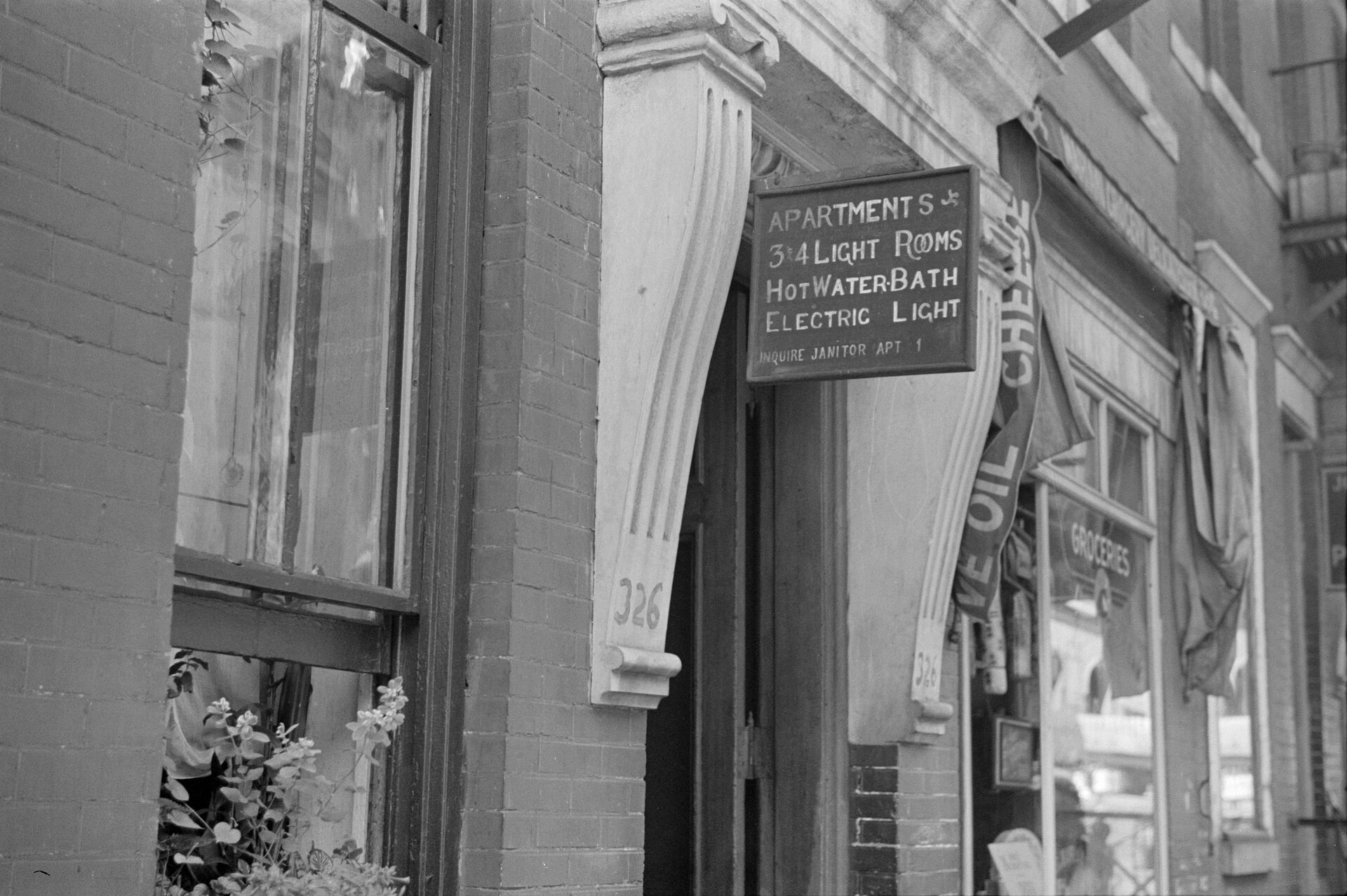
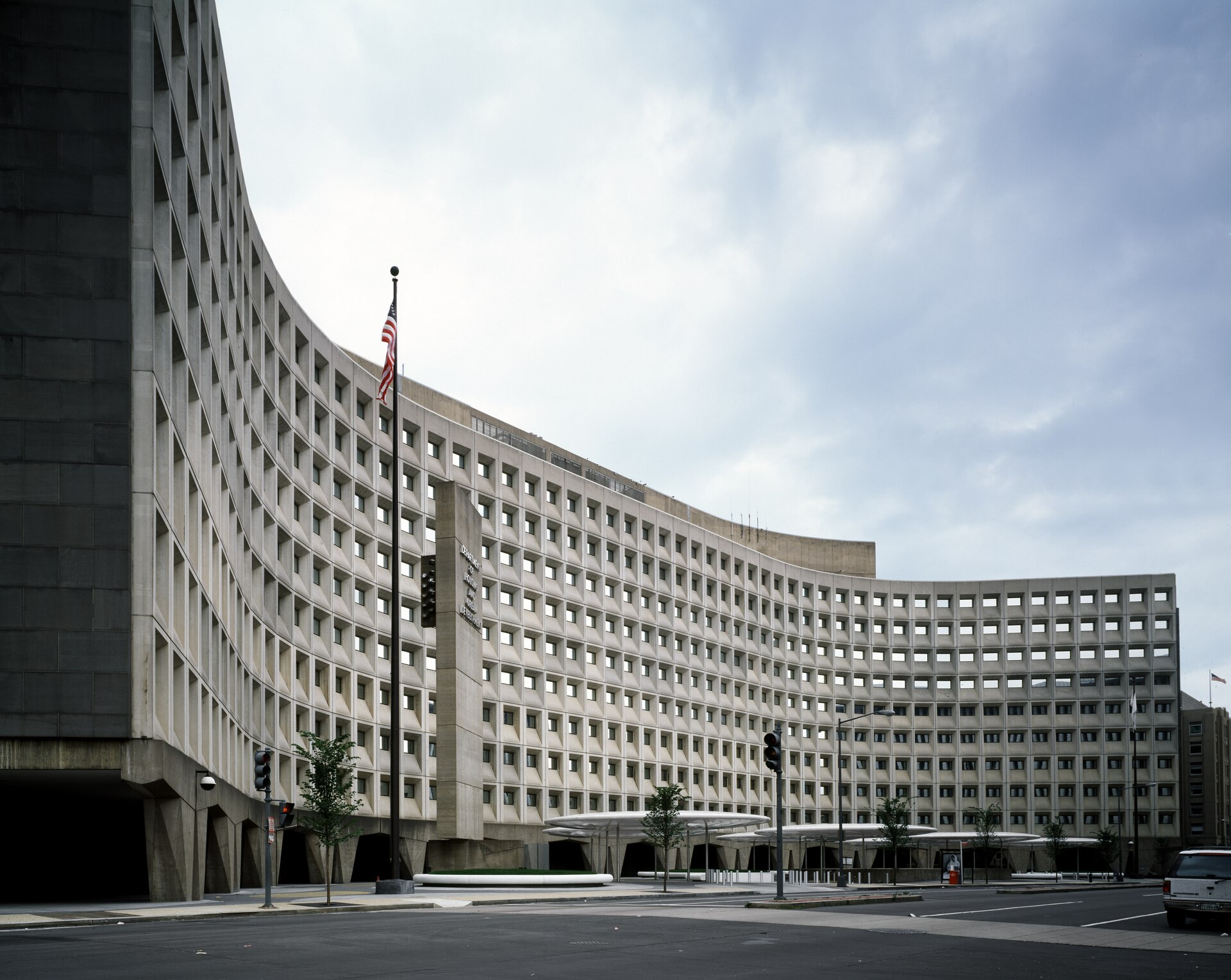
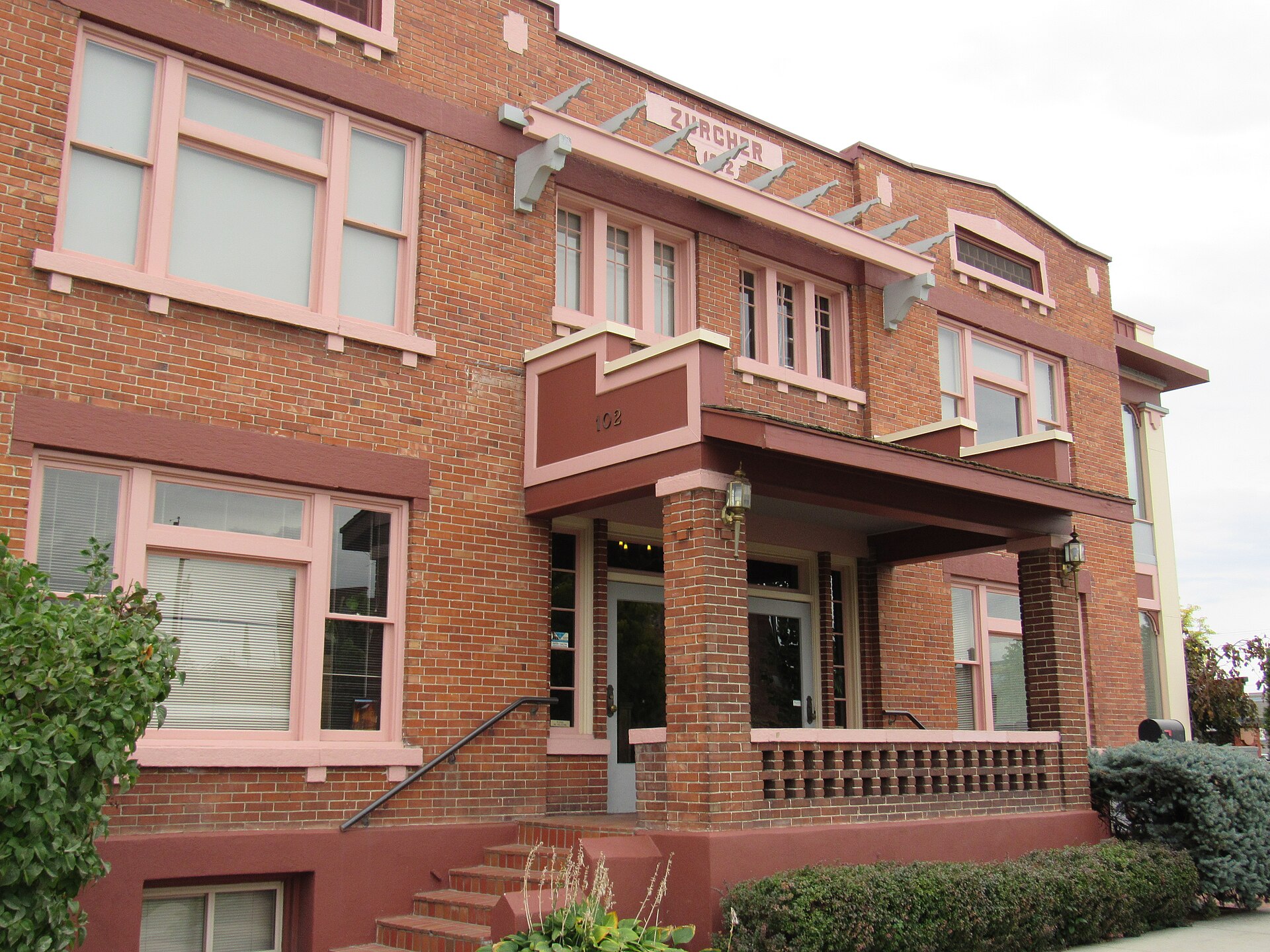
The seven graphics in this lesson are: the income ladder for three Idaho areas, the very low-income limit against half the median, the history of the federal rent share, cost burden by income band, the voucher rent flowchart, the change in two-bedroom fair market rents and the program comparison grid above. The photographs show a 1938 rental sign, HUD's headquarters, a Boise apartment building and a 2011 housing conference.
Common mistakes
- Treating "AMI" as the median household income in the news. HUD's figure is a median family income, assigned to a four-person family and brought forward with a wage forecast; HUD's own methodology says one-person households and unrelated roommates are excluded from the Census family median it starts from. Comparing an income limit with a Census household median will make the limits look higher than they are relative to typical households.25
- Assuming every limit is exactly 50 or 80 percent of the local median. Floors and caps move many limits. Jerome and Gooding counties' FY2026 four-person very low-income limit ($44,000) is above half their medians; Twin Falls County's ($47,600) is below half its median. Check HUD's documentation page for the area before computing a percentage.42
- Mixing years. FY2026 income limits took effect May 1, 2026, not the usual April 1. FY2026 fair market rents ran from Oct. 1, 2025, to Sept. 30, 2026; FY2027 FMRs apply from Oct. 1, 2026. A table that pairs an FY2025 income limit with an FY2027 rent, without saying so, will mislead.113
- Using the four-person limit for every household. A single person in the Boise City area is very low income at $38,750, not $55,350. USDA's tables are the exception, with one limit for one to four persons.224
- Reading eligibility as a right to help. Being under an income limit makes a household eligible to apply. Vouchers and public housing units are limited by funding and by turnover, and housing authorities keep waiting lists; lesson 03 covers the waits and lesson 07 the application steps.
- Swapping HOME and Section 8 limits. HOME's FY2026 "30% limits" for Idaho do not include the poverty-guideline increase. In Jerome County the HOME four-person 30 percent limit is $26,400; the Section 8 extremely low-income limit is $33,000.272
- Calling a tax credit unit "affordable" to every eligible tenant. The rent cap is fixed to the unit's income limit, not the tenant's income. A three-person household in Ada County at 40 percent of AMI ($39,880 by our calculation, two-thirds of the $59,820 60 percent limit) renting a 60 percent two-bedroom at the $1,495 ceiling would pay 45.0 percent of income, unless it also has a voucher.2923
- Comparing cost-burden figures from different sources. CHAS uses five-year data and HUD income bands; the Census Bureau's one-year tables and private reports use other years and may drop households with no income. Our Idaho renter figure (40.2 percent) counts every renter household in the denominator, including 2,790 whose burden cannot be computed.12
What we know, what we don't, and what the data can show
What we know
- The FY2026 HUD income limits for every Idaho county, effective May 1, 2026, and the rules that set them, including the $44,000 state floor and the 10 percent cap.24
- The FY2027 fair market rents in effect in Idaho since Oct. 1, 2026, and the fact that no Idaho area filed a reevaluation that kept FY2026 rents in place.1443
- The federal rent formula (24 CFR 5.628) and HUD's Jan. 1, 2027, deadline for full HOTMA compliance by most housing authorities.833
- About 40 percent of Idaho renter households and about 77 percent of extremely low-income renter households were cost burdened in the 2018 to 2022 survey period.11
- Idaho statutes do not define affordable, workforce or attainable housing in income terms; Boise does for its incentives.171920
What we don't know
- How cost burden has changed since 2022 at the county level. CHAS lags several years, and the 2019 to 2023 edition was not out when this lesson was checked.
- Which Idaho housing authorities use payment standards above or below 100 percent of the FMR in 2026 and 2027, and whether any has adopted Small Area FMRs voluntarily; those choices are in each authority's administrative plan.
- Whether the final IHFA Workforce Housing Fund plan kept the 60 to 120 percent range in the 2022 draft, and what happens to any unspent money and the fund itself after the Dec. 31, 2026, end date in Idaho Code 67-6227, which no 2026 law we found extended.
- How many Idaho households were moved across an eligibility line by the FY2026 floor and cap rules; HUD does not publish that count.
- What definitions other Idaho cities use for "affordable" in incentive or fee-waiver programs; each code must be read.
What the data can show
- Who is eligible for which program in any county: HUD's income limits documentation system and the Section8-FY26 and MTSP-Data-FY26 files, and USDA's income eligibility site.12832
- Cost burden by income band, tenure, household type and race: CHAS tables at state, county, place and tract level, with HUD's data dictionary.3412
- How rents and limits have moved since 1983: HUD's FMR history files and prior-year income limit files on HUD USER.42
- How a city defines "affordable": city codes and incentive guides, such as Boise's 2026 guide and its covenant terms.20
Questions people ask
Why do Jerome and Gooding counties have the same limits?
Both counties' medians are low enough that half of them falls below Idaho's state floor, 50 percent of the $88,000 nonmetro median. Every limit that rests on the floor is the same, so both counties show $44,000 for a very low-income family of four and $70,400 for a low-income family of four in FY2026.46
Does the 30 percent include utilities?
Yes, in the federal programs. The total tenant payment covers rent plus a utility allowance when the tenant pays utilities, fair market rents are gross rents including utilities except telephone, and tax credit rent caps include a utility allowance. Census cost-burden tables also use gross rent.84123
When do new limits and rents come out?
Income limits usually take effect in the spring; the FY2026 limits came out May 1, 2026, after a one-month delay. Fair market rents take effect Oct. 1 each year. USDA's single family limits for FY2026 were revised July 13, 2026. Each release replaces the last one for new decisions, though programs have their own rules for when existing tenants or projects switch.31330
What is the difference between a fair market rent and a payment standard?
HUD sets the fair market rent for the area. The housing authority sets the payment standard, usually from 90 to 110 percent of the FMR, and it is the payment standard that caps the subsidy in a voucher calculation.1639
Why did the Boise-area fair market rent fall for FY2027?
HUD's FY2027 notice explains the method (survey rents brought forward with trend factors and, for FY2027, a new way of estimating utility cost inflation after the Bureau of Labor Statistics stopped publishing a local utility price index) but not the reason for any single area's change. The decrease stayed within HUD's rule that an FMR cannot fall below 90 percent of the prior year's.1341
Does a higher income limit mean more people get help?
It means more households are eligible to apply. The number of vouchers, public housing units and tax credit units is set by funding and construction, not by the limits. The targeting rules (75 percent of new voucher admissions and 40 percent of new public housing admissions extremely low income) decide who goes first among eligible applicants.2122
Are federal rules on who qualifies changing?
Two 2026 actions affect eligibility apart from income. HUD proposed on March 2, 2026 (91 FR 10016), to let housing authorities and some owners adopt work requirements and time limits for non-elderly, non-disabled families; that is a proposal, not a final rule. On Nov. 12, 2026 (91 FR 72978), HUD issued a final rule effective Dec. 14, 2026, requiring verification of citizenship or eligible immigration status for all applicants and recipients regardless of age. The site's Medicaid course covers federal work requirements in The 2027 Work Requirements.5152
Hard questions
Should "affordable" mean 80 percent of AMI?
The case for 80 percent. Builders and many cities argue that incentives aimed at 80 percent of the median reach teachers, nurses and service workers who are priced out, and that projects can pencil out at those rents with modest help, such as a density bonus, instead of deep subsidy. Boise's 2026 guide uses 80 percent for rentals and 120 percent for homes sold. The case for lower lines. Tenant advocates argue that rents set at 80 percent of AMI are close to market rents in many Idaho areas and do little for the households most burdened. What the evidence shows. In CHAS, 89.5 percent of Idaho's severely burdened renter households are at or below 50 percent of HAMFI. In Jerome and Gooding counties, even the 60 percent tax credit rent ceiling is at or above the FY2027 two-bedroom fair market rent. A line at 80 percent counts many households as served by units they could rent in the market already; a line at 30 to 50 percent requires deeper subsidy per unit.20112914
Should the 30 percent ratio be replaced?
Keep it: it is simple, it is written into federal rent law, and every program and data set uses it, which allows comparisons over time and across places. Replace or supplement it: a residual-income measure asks whether a household has enough left after rent, which better captures hardship for large, low-income families. Evidence: CRS reports that the threshold rests on spending patterns, not research on harm, and that the two approaches give different national counts (35.1 percent cost burdened vs. 43.6 percent shelter poor in its 2023 sample). No public Idaho data set uses a residual-income measure.10
Should HUD cap and floor the income limits?
For the rules: the state floor keeps rural limits from falling so low that almost no one qualifies, and the 10 percent cap and 5 percent floor keep limits from jumping with survey noise in small areas, which protects tenants and owners who plan around them. Against: the cap left Twin Falls County's FY2026 limits below what its new median would give, and the floor lifts Jerome County's limits so that its low-income line is 89 percent of its own median. Evidence: HUD's FY2026 tally shows the floor or the cap set the very low-income limit in 1,455 of 2,635 areas nationwide (1,114 + 120 floored, 111 + 110 capped), more than the 1,042 set at exactly half the median.4
How we figured it: areas set by the floor or the cap
Inputs. HUD's FY2026 methodology, Table 1. Floor (state nonmetro median): 1,114 nonmetro counties and 120 metro areas. Cap (10 percent): 111 and 110. Half of median: 667 and 375. Totals: 1,960 nonmetro counties and 675 metro areas. Method. Floor plus cap = 1,114 + 120 + 111 + 110 = 1,455. Half of median = 667 + 375 = 1,042. All areas = 1,960 + 675 = 2,635. The remaining 138 areas were set by the high-rent adjustment, the high-income cap or the 95 percent floor.
Should Idaho define workforce and attainable housing in law?
For a definition: public money and land-use preferences tied to a word with no income test are hard to audit, and a statutory range (as Washington has in RCW 36.70A.030) lets reporters and legislators check who benefits. Against: a single state definition may not fit both Blaine County, with a $108,500 median, and Jerome County, at $79,000, and a fixed range could make some projects ineligible. Evidence: Idaho Code 67-6227 and 67-6542 use "workforce" and "attainable" without income terms; IHFA's 2022 draft plan supplied 60 to 120 percent for the fund it runs; Boise supplies its own for its incentives.17191850


For reporters and advocates
Records that exist. HUD's income limits and MTSP documentation pages for each Idaho area, which show every step from the survey median to the published limit. HUD's FMR documentation system and the Federal Register notices (90 FR 41096 for FY2026, 91 FR 56156 for FY2027). CHAS tables for each county and city with HUD's data dictionary. USDA Rural Development procedure notices and handbook appendices. Each housing authority's administrative plan (payment standards, utility allowances, deductions, minimum rent), annual and five-year PHA plans and board minutes. IHFA's Workforce Housing Fund allocation plan and award lists. City incentive guides, covenants and monitoring reports, such as Boise's.1423420
Questions to ask.
- To a housing authority: what are your current payment standards as a percent of the FY2027 FMR, did you lower them after the Boise-area FMR fell, and how are you applying the two-year rule for current tenants?
- To a housing authority: which HOTMA provisions do you apply now, and what changes for tenants on Jan. 1, 2027?
- To a city: what income line does "affordable" mean in your code, who checks tenant incomes and sale prices, and how many covenant units exist?
- To IHFA: what income range did the final Workforce Housing Fund plan use, how many units were funded at each income level, and what happens to the fund after Dec. 31, 2026?
- To a tax credit owner: what share of units is set at each income level, and how many tenants also hold vouchers?
Public records. Housing authority and city records are reachable under the Idaho Public Records Act, Idaho Code Title 74, Chapter 1; see Idaho Public Records Requests. Lesson 12, How to Report on Affordable Housing, has story checklists, and Part C's How to Report on Housing covers rental and eviction records. For help reading the data tables, see the site's data and statistics course.
The Magic Valley angle. Twin Falls County's HUD median rose 18.2 percent for FY2026 while Jerome's and Gooding's fell, and the 10 percent cap kept Twin Falls limits below half its median. Jerome and Gooding sit on the state floor, so their limits are higher relative to local incomes than Ada County's. In all three, the 60 percent tax credit rent ceiling for a two-bedroom ($1,188 to $1,285) is at or above the FY2027 fair market rent, a point worth testing against actual rents at local tax credit properties before writing that new units are "affordable."22914
Where to go next
- HUD Income Limits Documentation System: Free HUD tool. Pick a state and county to see the FY2026 median, every income limit and each adjustment HUD applied. Useful for anyone checking eligibility lines or reporting on them.
- HUD Fair Market Rent Documentation System: Free HUD tool and data files for FY2026 and FY2027 fair market rents, Small Area FMRs and history back to 1983.
- HUD CHAS data query tool and downloads: Free HUD tables on cost burden by income, tenure and household type for states, counties, cities and tracts; download the data dictionary with the files.
- USDA single family housing eligibility site: Free USDA tool that shows income limits by county and maps the areas USDA treats as rural for its home loan programs. It describes rules; a lender or USDA office makes eligibility decisions.
- Idaho Housing and Finance Association: The state's housing finance agency, which allocates tax credits, runs the Workforce Housing Fund and administers vouchers in counties without a local authority. Its site lists programs, rent and income tables and contacts. Free.
- Idaho 211 CareLine: A free statewide information and referral service run by the Idaho Department of Health and Welfare that lists housing, rent and utility help by area.
- CFPB housing counselor search: A free federal search tool listing HUD-approved housing counseling agencies by ZIP code; most counseling is free or low cost.
- Idaho Legal Aid Services: A nonprofit that provides free civil legal help to eligible low-income Idahoans, including on housing issues, and publishes self-help information.
Still being checked (8 items)
These points could not be fully confirmed against a primary source when this lesson was written and fact checked in November 2026. The text above states each one as uncertain.
- USDA FY2026 income limits: the Idaho rows of HB-1-3555 Appendix 5 (PN 657, dated 07-13-2026) were re-read online by the fact checker on Nov. 20, 2026, and match the table for Twin Falls, Jerome, Gooding, Blaine and the Boise City HUD Metro FMR Area; USDA's site refused automated downloads, so the file is not saved locally, the Bonneville County row was not individually located, and the separate Appendix 9 table for the Section 502 direct program was not checked line by line.
- Whether IHFA's final Workforce Housing Fund allocation plan kept the 60 to 120 percent of AMI range and 20-year affordability term in the 2022 draft.
- What happens to the Idaho Workforce Housing Fund after Idaho Code 67-6227's Dec. 31, 2026, end date: the statute as posted after the 2026 session still carries the end date and the 2026 session law list shows no extension (Senate Bill 1347 of 2026 amended IHFA reporting in 67-6223 only), but a 2027 session could act.
- Whether any Idaho housing authority has voluntarily adopted Small Area FMRs, and the current payment standard percentages of each Idaho authority.
- HUD's inflation-adjusted 2026 amounts for the dependent and elderly or disabled family deductions; the worked example uses the $480 base amount in 24 CFR 5.611.
- The exact rounding HUD used to reach the FY2026 Twin Falls County four-person low-income limit ($76,150 vs. 1.6 x $47,600 = $76,160).
- The 1937, 1979 and 1981 steps in the history of the 30 percent rule are as described by CRS report R49457; the session laws themselves were not checked. The Brooke Amendment's namesake is not named in the CRS text, so the lesson no longer names him.
- The count of 24 metro areas in HUD's 2016 Small Area FMR designation was not re-read; the 2023 list of 41 additional areas was checked and has no Idaho area.
Last verified November 20, 2026. General education, not legal, tax, financial or real estate advice; every figure names its source and year in the Notes and Sources below. Data is revised: check the newest release before relying on any number.
Notes
- HUD Office of Policy Development and Research, Income Limits data page, HUD USER: FY2026 documents and data "Effective May 01, 2026"; HUD 30% income limits for all areas (Emergency Solutions Grants) effective June 1, 2026 (read Nov. 20, 2026). Read it online. ↩
- HUD, FY2026 Section 8 income limits data file, Section8-FY26.xlsx (columns median2026, ELI_1 to ELI_8, l50_1 to l50_8, l80_1 to l80_8), Idaho rows for Ada, Canyon, Blaine, Bonneville, Gooding, Jerome and Twin Falls counties, effective May 1, 2026 (downloaded Nov. 20, 2026). Read it online. ↩
- HUD, Statement on FY 2026 Median Family Income Estimates and Income Limits: release delayed from April 1, 2026, to May 1, 2026, after the Census Bureau moved the 2024 ACS five-year release from Dec. 11, 2025, to Jan. 29, 2026 (read Nov. 20, 2026). Read it online. ↩
- HUD, Methodology for Determining FY 2026 Section 8 Income Limits, including Table 1 (very low-income determinations), Table 2, family size adjustments, cap and floor rules, U.S. median of $107,900, and Attachment 1 (programs using HUD limits) (read Nov. 20, 2026). Read it online. ↩
- 42 U.S.C. 1437a, Rental payments; definitions (Section 3 of the U.S. Housing Act of 1937, as amended), Legal Information Institute (read Nov. 20, 2026). Read it online. ↩
- HUD, FY 2026 Median Family Incomes for States, Metropolitan and Nonmetropolitan Portions of States (attachment): Idaho total $101,600, metro $106,800, nonmetro $88,000; Montana, Nevada, Oregon, Utah, Washington and Wyoming rows (read Nov. 20, 2026). Read it online. ↩
- HUD, FY2025 Section 8 income limits data file, Section8-FY25.xlsx, effective April 1, 2025, Idaho rows (downloaded Nov. 20, 2026). Read it online. ↩
- 24 CFR 5.628, Total tenant payment, as amended at 88 FR 9661 (Feb. 14, 2023), eCFR (read Nov. 20, 2026). Read it online. ↩
- 24 CFR 5.630, Minimum rent (up to $50 for public housing and vouchers; $25 for other Section 8; hardship exemptions), eCFR (read Nov. 20, 2026). Read it online. ↩
- Congressional Research Service, Measuring Housing Affordability, report R49457, Oct. 1, 2026: history of the 30 percent standard (1937, 1969, 1979, 1981, 1990, 1991), ratio and residual income approaches, 2023 ACS estimates (copy via EveryCRSReport) (read Nov. 20, 2026). Read it online. ↩
- HUD, CHAS 2018 to 2022 state-level data (summary level 040), Table 8 (tenure by HAMFI by cost burden by facilities), file 2018thru2022-040-csv.zip, Idaho and all states; our tabulation (downloaded Nov. 20, 2026). Read it online. ↩
- HUD, CHAS data dictionary for 2018 to 2022, CHAS-data-dictionary-18-22.xlsx, sheet Table 8 (variable definitions T8_est1 to T8_est133) (downloaded Nov. 20, 2026). Read it online. ↩
- HUD, Fair Market Rents for the Housing Choice Voucher Program, Moderate Rehabilitation Single Room Occupancy Program, and Other Programs, Fiscal Year 2027, 91 FR 56156, Sept. 1, 2026, Docket FR-6553-N-03: effective Oct. 1, 2026 (read Nov. 20, 2026). Read it online. ↩
- HUD, FY2027 fair market rents, county-level data file FY27_FMRs.xlsx (columns fmr_0 to fmr_4), Idaho rows (downloaded Nov. 20, 2026). Read it online. ↩
- HUD, revised FY2026 fair market rents, county-level data file FY26_FMRs_revised.xlsx, Idaho rows; Idaho values identical to the original FY26_FMRs.xlsx (downloaded Nov. 20, 2026). Read it online. ↩
- 24 CFR 982.503, Payment standard areas, schedule, and amounts (basic range 90 to 110 percent of FMR), eCFR (read Nov. 20, 2026). Read it online. ↩
- Idaho Code section 67-6227, Idaho workforce housing fund [effective until Dec. 31, 2026]; history: added 2022, ch. 277, sec. 1 (read Nov. 20, 2026). Read it online. ↩
- Idaho Housing and Finance Association, Draft Allocation Plan for the Idaho Workforce Housing Fund (2022), sections 1.6 (60 to 120 percent of AMI), 3.2.1 ($50 million ARPA appropriation) and 6.5.3 (20-year affordability) (read Nov. 20, 2026). Read it online. ↩
- Idaho Code section 67-6542, Starter home subdivisions (Senate Bill 1352, 2026; 2026 Session Laws ch. 264; effective July 1, 2026) (read Nov. 20, 2026). Read it online. ↩
- City of Boise, Housing and Community Development Division, Housing Incentive Guide to Income Determination, Rents, Compliance, and Monitoring, effective April 2026 (posted as the July 2026 policy guide), citing Boise City Code 11-04-03.7B(3) (read Nov. 20, 2026). Read it online. ↩
- 24 CFR 982.201, Eligibility and targeting, paragraph (b) (income eligibility; 75 percent of admissions extremely low income), eCFR (read Nov. 20, 2026). Read it online. ↩
- 24 CFR 960.202, Tenant selection policies, paragraph (b) (40 percent of public housing admissions extremely low income), eCFR (read Nov. 20, 2026). Read it online. ↩
- 26 U.S.C. 42, Low-income housing credit, subsection (g)(1) (20-50, 40-60 and average income tests) and (g)(2) (rent restriction at 30 percent of the imputed income limitation; 1.5 persons per bedroom), Legal Information Institute (read Nov. 20, 2026). Read it online. ↩
- USDA Rural Development, HB-1-3555, Appendix 5, FY2026 income limits by state and county (very low, low and moderate, 1 to 4 and 5 to 8 persons), PN 657, dated 07-13-2026, Idaho section (read Nov. 20, 2026; the agency's site refused automated downloads, so the file is not in the download folder). Read it online. ↩
- HUD, Methodology for Calculating FY 2026 Medians: 2024 ACS one-year and 2020 to 2024 five-year median family income, reliability tests, CBO per capita wage factor of 1.05, OMB Bulletin 23-01 area definitions (read Nov. 20, 2026). Read it online. ↩
- U.S. Department of Health and Human Services, Office of the Assistant Secretary for Planning and Evaluation, Poverty Guidelines: 2026 guidelines for the 48 contiguous states and D.C., $15,960 for one person plus $5,680 per added person; published in the Federal Register Jan. 15, 2026 (read Nov. 20, 2026). Read it online. ↩
- HUD, FY2026 Adjusted HOME Income Limits, State of Idaho (30% limits, very low income, 60% limits, low income by HUD area) (downloaded Nov. 20, 2026). Read it online. ↩
- HUD, Multifamily Tax Subsidy Income Limits data page: FY2026 MTSP income limits "Effective May 01, 2026"; income averaging file updated May 18, 2026 (read Nov. 20, 2026). Read it online. ↩
- HUD, FY2026 MTSP income limits data file, MTSP-Data-FY26.xlsx (columns Lim60_26p1 to p8, HERA_Lim_type26 and HERA special limits), Idaho rows (downloaded Nov. 20, 2026). Read it online. ↩
- USDA Rural Development, Procedure Notice 657, July 13, 2026, revising HB-1-3550 Appendix 9 (Section 502 direct and 504) and HB-1-3555 Appendix 5 (Section 502 guaranteed) income limits (read Nov. 20, 2026). Read it online. ↩
- USDA Rural Development, GovDelivery bulletin, Single Family Housing Guaranteed Loan Program Updated Income Limits for 2026, July 16, 2026 (read Nov. 20, 2026). Read it online. ↩
- USDA, Single Family Housing income and property eligibility site, income eligibility by state and county (read Nov. 20, 2026). Read it online. ↩
- HUD, Notice PIH 2026-15, Public Housing Agency Compliance Deadline for Sections 102 and 104 of the Housing Opportunity Through Modernization Act (HOTMA), issued May 14, 2026 (full enforcement Jan. 1, 2027; select provisions from July 1, 2025) (read Nov. 20, 2026). Read it online. ↩
- HUD, Consolidated Planning/CHAS Data page, HUD USER: 2018 to 2022 CHAS released Dec. 23, 2025 (read Nov. 20, 2026). Read it online. ↩
- HUD, CHAS 2018 to 2022 county-level data (summary level 050), Table 8, file 2018thru2022-050-csv.zip, Ada, Blaine, Bonneville, Canyon, Gooding, Jerome and Twin Falls counties; our tabulation (downloaded Nov. 20, 2026). Read it online. ↩
- 24 CFR 5.611, Adjusted income, as amended at 88 FR 9600 (Feb. 14, 2023), eCFR, current as of Nov. 18, 2026 (read Nov. 20, 2026). Read it online. ↩
- HUD, Notice PIH 2026-09 / H 2026-05, HOTMA implementation guidance, amendment to Attachment I on interim reexaminations, issued April 13, 2026 (read Nov. 20, 2026). Read it online. ↩
- HUD, Housing Opportunity Through Modernization Act: Implementation of Sections 102 and 104; Further Extension of Compliance Date (CPD programs), 90 FR 61062, Dec. 30, 2025, Federal Register (read Nov. 20, 2026). Read it online. ↩
- 24 CFR 982.505, How to calculate housing assistance payment, including (c)(3) on payment standard decreases, eCFR (read Nov. 20, 2026). Read it online. ↩
- 24 CFR 982.508, Maximum family share at initial occupancy (40 percent of adjusted monthly income), eCFR (read Nov. 20, 2026). Read it online. ↩
- 24 CFR 888.113, Fair market rents for existing housing: Methodology (40th percentile; 90 percent floor; Small Area FMRs), eCFR (read Nov. 20, 2026). Read it online. ↩
- HUD, Fair Market Rents data page, HUD USER: FY2026 FMRs effective Oct. 1, 2025 (90 FR 41096); revised FY2026 FMRs effective May 21, 2026 (91 FR 21301); FY2027 documents and FMR history files 1983 to 2027 (read Nov. 20, 2026). Read it online. ↩
- HUD, Reevaluation Requests for FY 2027 Fair Market Rents (areas where FY2026 FMRs remain in effect as of Oct. 1, 2026; no Idaho area listed) (read Nov. 20, 2026). Read it online. ↩
- HUD, Small Area Fair Market Rents in the Housing Choice Voucher Program: Metropolitan Areas Subject to Small Area Fair Market Rents, 88 FR 73352, Oct. 25, 2023 (41 additional areas; implementation Oct. 1, 2024; no Idaho area) (read Nov. 20, 2026). Read it online. ↩
- Idaho Code section 50-1903, Definitions, Housing Authorities and Cooperation Law; history: added 1967, ch. 429, sec. 393; am. 1993, ch. 215; am. 2001, ch. 260 (read Nov. 20, 2026). Read it online. ↩
- Idaho Code section 67-6201, Purpose, Idaho Housing and Finance Association Act (read Nov. 20, 2026). Read it online. ↩
- Idaho Legislature, House Bill 701 (2022), Ways and Means Committee, Idaho Workforce Housing Fund: House passed 37-31-2 March 4, 2022; Senate passed 26-9-0 March 22, 2022; signed by the governor March 28, 2022; Session Law chapter 277 (read Nov. 20, 2026). Read it online. ↩
- Idaho Code section 67-6202, Idaho housing and finance association created; history: added 1972, ch. 324, sec. 2; am. 1974, ch. 104; am. 1996, ch. 253 (read Nov. 20, 2026). Read it online. ↩
- Boise State Public Radio, "Gov. Little signs bill to create workforce housing fund in Idaho," March 31, 2022 (news report) (read Nov. 20, 2026). Read it online. ↩
- Revised Code of Washington 36.70A.030, Definitions, subsections (5), (18), (26), (30) and (51), as amended through 2026 c 232 (read Nov. 20, 2026). Read it online. ↩
- HUD, Establishing Flexibility for Implementation of Work Requirements and Term Limits, proposed rule, 91 FR 10016, March 2, 2026, Federal Register (read Nov. 20, 2026). Read it online. ↩
- HUD, Housing and Community Development Act of 1980: Verification of Eligible Status, final rule, 91 FR 72978, Nov. 12, 2026, effective Dec. 14, 2026, Federal Register (read Nov. 20, 2026). Read it online. ↩
- Idaho Legislature, 2026 Session Laws list (law number, bill, subject, signing and effective dates), and Senate Bill 1347 (2026), Idaho Housing and Finance Association, amending Idaho Code 67-6223 on reporting requirements (read Nov. 20, 2026). Read it online. ↩
Check yourself
1. When did HUD's FY2026 income limits take effect?
HUD's income limits page lists FY2026 data as effective May 1, 2026; HUD's statement says the release moved from April 1 to May 1 because the Census Bureau delayed the 2024 ACS five-year data.
2. Why is Jerome County's FY2026 very low-income limit for a family of four $44,000 when half its median is $39,500?
HUD's FY2026 methodology raises a four-person very low-income limit that is below 50 percent of the state nonmetro median; HUD's state median attachment gives Idaho's nonmetro median as $88,000.
3. Twin Falls County's FY2026 median rose 18.2 percent. Why is its four-person very low-income limit $47,600 rather than $50,100?
HUD's FY2026 methodology caps increases at the greater of 5 percent or twice the national median change, with an absolute 10 percent cap; FY2025's $43,300 times 1.10 is $47,630, rounded down to $47,600.
4. Under 42 U.S.C. 1437a as HUD applies it, which is the extremely low-income limit?
HUD's FY2026 methodology: extremely low-income families are very low-income families whose incomes do not exceed the greater of 30 percent of median or the poverty guideline, a rule added by the Consolidated Appropriations Act, 2014.
5. Under 24 CFR 5.628, a voucher or public housing family's total tenant payment is the highest of which amounts?
24 CFR 5.628(a) lists 30 percent of monthly adjusted income, 10 percent of monthly income, the designated welfare rent and the minimum rent (and, for public housing, the alternative non-public housing rent).
6. What share of adjusted income did the 1969 Brooke Amendment set as the cap on public housing rent?
CRS report R49457 (Oct. 1, 2026): the Brooke Amendment to the Housing and Urban Development Act of 1969 capped public housing rent at 25 percent of adjusted family income; 30 percent came in 1979 and 1981.
7. Under 24 CFR 888.113, a fair market rent is set at what point in the rent distribution?
24 CFR 888.113(a) sets FMRs at the 40th percentile rent of standard-quality units occupied by recent movers, with a floor of 90 percent of the previous year's FMR in (b).
8. Without HUD approval, a housing authority may set its voucher payment standard within what range of the fair market rent?
24 CFR 982.503(c): a basic range payment standard is any amount from 90 percent up to 110 percent of the published FMR.
9. In HUD's CHAS data for 2018 to 2022, about what share of Idaho renter households paid more than 30 percent of income for housing?
CHAS 2018 to 2022, Table 8: 75,980 of 189,045 Idaho renter households (40.2 percent) were cost burdened; 76.8 percent is the figure for extremely low-income renters and 18.7 percent for owners.
10. How does the City of Boise's 2026 Housing Incentive Guide define affordable housing?
Boise's Housing Incentive Guide (effective April 2026) defines affordable housing as restricted to households earning no more than 80 percent of AMI in rental units and 120 percent in for-sale units, with a 50-year period of affordability.
Terms in this lesson
- Area median income (AMI)
- In HUD programs, HUD's median family income for a metro area or nonmetro county, treated as the income of a four-person family and adjusted for household size; not the Census median household income.
- HUD Area Median Family Income (HAMFI)
- The term HUD's CHAS data use for the median family income and income limits that sort households into bands such as at or below 30 percent.
- Income limit
- The maximum income for eligibility in a program, published by HUD (or USDA) each year by area and household size.
- Extremely low income
- Income at or below the greater of 30 percent of area median or the HHS poverty guideline, capped at the very low-income limit.
- Very low income
- Income at or below HUD's very low-income limit, nominally 50 percent of area median after HUD's adjustments; the main eligibility line for vouchers.
- Low income
- Income at or below HUD's low-income limit, nominally 80 percent of area median, usually set at 1.6 times the very low-income limit.
- Multifamily Tax Subsidy Project (MTSP) limits
- HUD's income limits for tax credit and tax-exempt bond rental housing, including the 60 percent limit (120 percent of the very low-income limit).
- Imputed income limitation
- The income limit used to cap a tax credit unit's rent, assuming 1 person for a unit without a bedroom and 1.5 persons per bedroom.
- Cost burden
- Paying more than 30 percent of household income for housing; severe cost burden is paying more than 50 percent.
- Total tenant payment
- What a public housing or voucher family must contribute toward rent and utilities: the highest of 30 percent of monthly adjusted income, 10 percent of monthly gross income, a designated welfare rent or the minimum rent.
- Adjusted income
- Annual income minus the deductions in 24 CFR 5.611 for dependents, elderly or disabled families, certain medical and disability costs and child care.
- Minimum rent
- A floor on tenant rent that a housing authority may set at up to $50 a month in public housing and vouchers, with hardship exemptions.
- Fair market rent (FMR)
- HUD's estimate of the 40th percentile gross rent paid by recent movers into standard-quality units in an area, published each year effective Oct. 1.
- Payment standard
- The most a housing authority will count toward gross rent in computing a voucher subsidy, usually 90 to 110 percent of the FMR.
- Small Area FMR
- A fair market rent set by ZIP code within a metro area, required in HUD-designated areas and optional elsewhere.
- Workforce housing
- A term used in Idaho Code 67-6227 without a statutory income definition; IHFA's 2022 draft plan for the state fund used 60 to 120 percent of AMI.
Sources
- HUD Income Limits (FY2026 data and documents) (2026-11-20) checked 2026-11
- HUD, Methodology for Determining FY 2026 Section 8 Income Limits (2026-11-20) checked 2026-11
- HUD, Methodology for Calculating FY 2026 Medians (2026-11-20) checked 2026-11
- HUD, FY2026 Section 8 income limits data file (2026-11-20) checked 2026-11
- HUD, Multifamily Tax Subsidy Project income limits (2026-11-20) checked 2026-11
- HUD, Fiscal Year 2027 Fair Market Rents notice, 91 FR 56156 (2026-11-20) checked 2026-11
- HUD, Fair Market Rents data page (2026-11-20) checked 2026-11
- HUD, CHAS data (2018 to 2022) (2026-11-20) checked 2026-11
- 24 CFR 5.628, Total tenant payment (eCFR) (2026-11-20) checked 2026-11
- HUD Notice PIH 2026-15, HOTMA compliance deadline (2026-11-20) checked 2026-11
- Congressional Research Service, Measuring Housing Affordability (R49457) (2026-11-20) checked 2026-11
- 26 U.S.C. 42, Low-income housing credit (2026-11-20) checked 2026-11
- USDA Rural Development, Procedure Notice 657 (FY2026 income limits) (2026-11-20) checked 2026-11
- Idaho Code 67-6227, Idaho Workforce Housing Fund (2026-11-20) checked 2026-11
- City of Boise, Housing Incentive Guide (2026) (2026-11-20) checked 2026-11