Lesson 6 of 10 · about 26 minutes
The Chicago School: Price Theory Applied to Everything
You'll be able to
- Describe what the Chicago school of economics is and name its main figures and their Nobel citations
- Explain Stigler's theory of regulatory capture and the airline deregulation of 1978 as a test of it
- State the Coase theorem correctly, including why Coase himself stressed transaction costs
- Explain what the efficient-market hypothesis and rational expectations claim, and what challenged them
- Describe the Chilean episode accurately and the criticism of Chicago economics from within Chicago
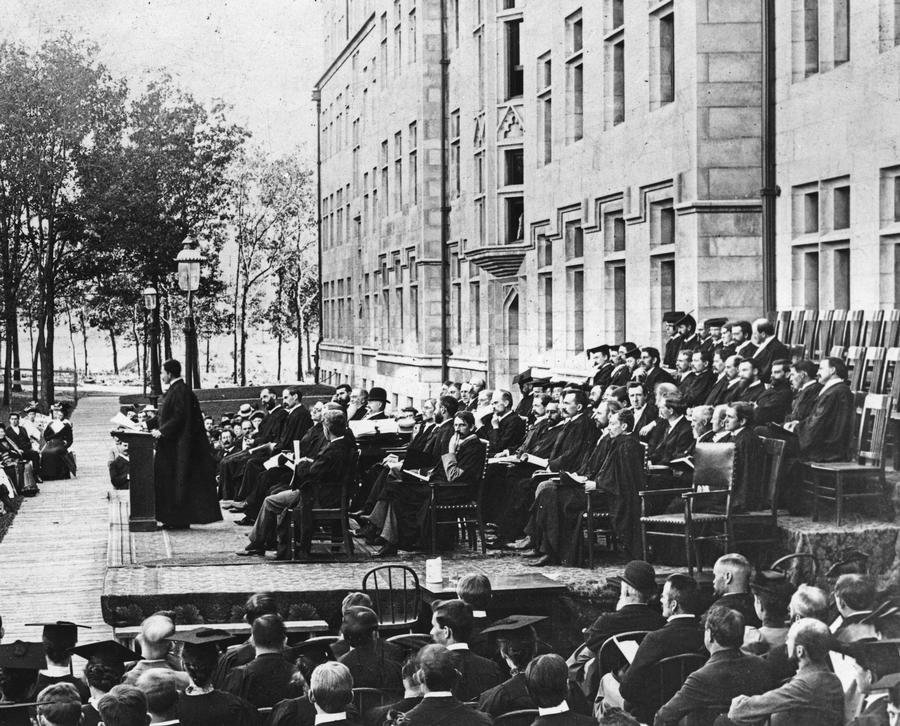
On October 15, 1991, the Royal Swedish Academy of Sciences announced that Ronald Coase would receive the year's prize in economics "for his discovery and clarification of the significance of transaction costs and property rights for the institutional structure and functioning of the economy."1 The two papers behind the prize were published in 1937 and 1960, and in the Academy's words it took a long time for his approach to gain a foothold.2 By 1991 Coase taught at the University of Chicago law school. That is a fair place to begin, because the thing people call the Chicago school was never a creed handed down by one founder. It was a way of working, picked up in one university over about eight decades by people who often disagreed.
Milton Friedman's life is covered in Lesson 5 of Economic Systems, and his scholarship and public campaigns in Lessons 2 and 3 of this module, so this lesson takes the rest of the department: the teachers who came before him, and the colleagues and students who carried the method into law, regulation, family life, finance and macroeconomics. It ends with a Chicago economist who won a Nobel Prize for showing where the method breaks down.
What "Chicago" means
The shared habit is price theory. Take a puzzle, ask how prices, costs and incentives would shape what people do, write the answer in a form that predicts something, and check the prediction against data. A Chicago economist looking at a rule, a tax or a cartel starts by asking who gains, who pays and how people will adjust. The answers have often favored markets. They have not always favored big business, as the first generation shows.
Knight, Viner and Simons
Frank Knight, Jacob Viner and Henry Simons were on the faculty when Friedman arrived as a student in 1932, as Lesson 5 of Economic Systems records. Knight's best-known book, Risk, Uncertainty and Profit (1921), separated risks that can be priced from uncertainty that cannot, and argued that profit is the reward for bearing the second.3 Simons wrote a pamphlet in 1934 called A Positive Program for Laissez Faire. Despite the title he wanted a strong state at work on competition: break up very large corporations, apply antitrust law to labor unions, and replace the discretion of central bankers with fixed rules for money. He died in June 1946 at the age of 46.4
Director and the antitrust turn
Aaron Director joined the Chicago law school in 1946, led its Antitrust Project from 1953 and founded the Journal of Law and Economics in 1958. He was also Friedman's brother-in-law, since Friedman had married his sister Rose.5 In the account of one reference source, Director and his students argued that most durable monopolies owed their staying power to government (licenses, tariffs, franchises) and that size alone proves little about harm to consumers.5 Compare that with Simons, who wanted giant firms broken up on sight. Whether the shift from Simons to Director corrected an old suspicion or loosened a useful one is still argued among antitrust scholars, and the argument has not gone away in the cases brought against large technology companies.
Stigler: information, regulation and capture
George Stigler took the 1982 prize "for his seminal studies of industrial structures, functioning of markets and causes and effects of public regulation."6 Two of his papers carry the weight. In "The Economics of Information" (1961) he asked why the same product sells at different prices in the same town. His answer was that finding the lowest price costs time, so the buyer searches until the next store is not worth the walk, and a spread of prices survives.7 A shopper comparing gas prices on both sides of Twin Falls is running Stigler's model.
The second paper, "The Theory of Economic Regulation" (1971), took on a comfortable belief: that regulatory agencies exist to protect the public from business. Stigler proposed the opposite as a working hypothesis. A regulated industry has a large, concentrated interest in the rules and a strong motive to organize. The public's interest in any one rule is thin. So, as a rule, regulation is acquired by the industry and designed and operated for its benefit. He pointed to licensing, entry limits and rate-setting as the tools.8 Lesson 7 returns to this logic under the name of concentrated benefits and dispersed costs.
The airline test
The best-known test came from the airlines. Through the 1970s the Civil Aeronautics Board set fares and decided which carriers could fly which routes. President Jimmy Carter signed the Airline Deregulation Act on October 24, 1978, after Alfred Kahn, a Cornell economist, had been put in charge of the board in 1977. The board itself was wound down and closed on January 1, 1985.9 A 1996 report of the General Accounting Office (since renamed the Government Accountability Office), as summarized in a standard reference account, found the average fare per passenger mile about 9 percent lower in 1994 than in 1979. Stephen Breyer, who worked on the bill as a Senate staff lawyer and later became a Supreme Court justice, wrote in 2011 that the cheapest inflation-adjusted round-trip fare regulators allowed between New York and Los Angeles, $1,442 in 1974, had fallen to $268 and that inflation-adjusted revenue per passenger mile dropped from 33.3 cents in 1974 to about 13 cents in 2010.9 Stigler's hypothesis predicted something close to this: a board that protected incumbent carriers would be holding fares up.
The record has a ledger on the other side. Between 1978 and mid-2001 eight major carriers and more than 100 smaller airlines went bankrupt or were liquidated.9 Passengers also gave up some comfort and gained crowded hub airports. And the theory does not describe every agency. Sam Peltzman of Chicago refined it in 1976 to say that regulators weigh the interests of several groups, consumers among them, and that the outcome depends on who can organize at what cost.10 The theory also strains to explain rules that an industry fought hard and lost. A fair use of Stigler is as a question to ask about any rule: who asked for this, and who profits from it?
Gary Becker: prices outside the market
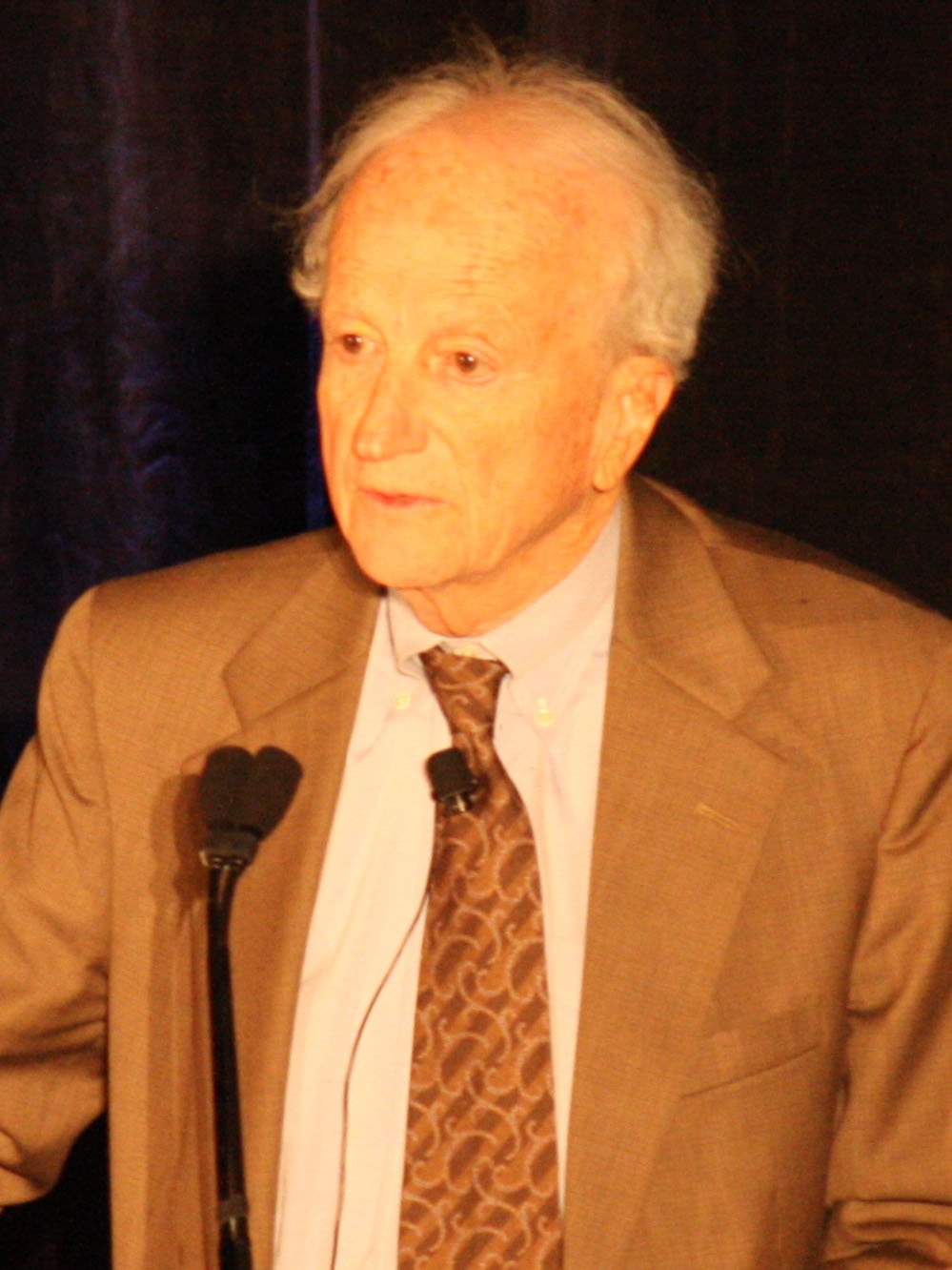
Gary Becker took the 1992 prize "for having extended the domain of microeconomic analysis to a wide range of human behaviour and interaction, including nonmarket behaviour."11 Born in Pottsville, Pennsylvania, in 1930, he finished a Chicago doctorate in 1955, taught at Columbia from 1957, returned to Chicago and stayed until his death in Chicago on May 3, 2014.12 If Stigler turned price theory on government, Becker turned it on everything else: prejudice, schooling, crime, marriage and the size of families.
He knew what people would say about that, and his Nobel lecture answers before anyone could ask.
"Unlike Marxian analysis, the economic approach I refer to does not assume that individuals are motivated solely by selfishness or gain. It is a method of analysis, not an assumption about particular motivations."
Gary S. Becker, "The Economic Way of Looking at Life," Nobel Lecture, December 9, 1992.13
People, in his account, "maximize welfare as they conceive it, whether they be selfish, altruistic, loyal, spiteful, or masochistic." And the tightest limit on everyone is time. Goods multiply as a country grows rich, but the day still has twenty-four hours.13
Discrimination
Becker's dissertation became The Economics of Discrimination (1957). He began, he said, to worry about racial, religious and gender discrimination as a graduate student, at a time when economists had written almost nothing about it. His device was the "discrimination coefficient," a measure of how much an employer, a worker or a customer would give up to avoid dealing with someone of another race or sex.13 Once prejudice has a price, the analysis can ask who pays it. The Academy summarized one answer: discrimination "tends to be economically detrimental not only to those who are discriminated against," but to the discriminators as well, since an employer who refuses to hire good workers for their color leaves money on the table for a competitor who will.14 Becker added that the outcome depends on the degree of competition and on civil rights law, and that in markets where a minority is small, prejudice by the majority can do real damage.13 Competition can wear discrimination down. It does not guarantee that it will.
Human capital
Until the 1950s, Becker wrote, economists generally treated labor power as given. He and T. W. Schultz, another Chicago economist, treated schooling, training and health as investments: a person spends money and, above all, time, in return for higher earnings and other gains later. The idea now sounds obvious. It did not then. "The very concept of human capital was alleged to be demeaning because it treated people as machines," Becker recalled, and "I hesitated a long time before deciding to call my book Human Capital, and hedged the risk by using a long subtitle."13 The 1964 book gave economists a way to measure the return to a high school diploma, a college degree or an apprenticeship. Every argument about student loans, community colleges and job training since then has used his tools, whether or not it names him.
Crime and a parking ticket
The crime paper began with a parking space. In the 1960s Becker was late for an oral examination of a student at Columbia. He had to decide quickly whether to pay for a lot or park illegally on the street.
"I calculated the likelihood of getting a ticket, the size of the penalty, and the cost of putting the car in a lot. I decided it paid to take the risk and park on the street. (I did not get a ticket.)"
Becker, Nobel Lecture, 1992.13
Walking to the examination room, he thought that the city had probably done the same arithmetic in deciding how often to check parked cars and how large to make the fine. The first question he put to the hapless student, he admitted, was to work out the optimal behavior of both the offenders and the police, something he had not yet done himself.13 The result was "Crime and Punishment: An Economic Approach" (1968). Empirical studies in the line of work it started, in the Academy's summary, have shown that "the probability of getting caught has a more deterrent effect on criminality than the term of the punishment."14 A county that adds deputies on the road may get more from its budget than one that adds years to sentences. Becker wrote against a climate in which, as he put it, crime was widely blamed on mental illness and social oppression and criminals were treated as helpless victims. He thought that view did the victims of crime no favors.13
The family as a small factory
Becker's A Treatise on the Family (1981) treated the household as, in the Academy's phrase, "a 'small factory' which produces what he calls basic goods," such as meals, rest and the raising of children, out of purchased goods and the time of its members.14 The approach helps explain why birth rates fall as women's wages rise: the time a child takes becomes more costly. It also drew the sharpest objections of his career. Sociologists and many feminists said that marriage and child-rearing rest on love, duty and custom that no price can capture. Religious readers can add that a family is a covenant before it is a firm. Becker's answer, from the lecture, is the one he gave to every critic: the method assumes people pursue what they value, and love and duty can be among the things valued.13 Whether the method sees enough of those things is the question Richard Thaler would later press.
In December 2004 Becker and Judge Richard Posner began a joint weblog, the Becker-Posner Blog, which ran for a decade as a public seminar in Chicago thinking.12
Ronald Coase: the costs of doing business
Ronald Coase was born in a London suburb in December 1910 and died in Chicago on September 2, 2013, at the age of 102.15 He was never a Chicago student. He came from the London School of Economics by way of American universities, including the University of Virginia from 1958, and joined the University of Chicago Law School in 1964, where he edited the Journal of Law and Economics through 1982.15 At 101 he published How China Became Capitalist (2012), written with his former student Ning Wang.
Why firms exist
The first paper is "The Nature of the Firm" (1937). Its question sounds childish and is not. If markets coordinate so well, why does so much economic activity happen inside firms, where a manager gives orders and no prices change hands? Coase's answer was that using the market costs something: finding partners, bargaining, writing and enforcing contracts. A firm exists, he said in his Nobel lecture, because it can perform some of that coordination at a lower cost than market transactions. He called the firm "that little planned society," and said that an efficient economy needs both markets and "areas of planning within organizations of the appropriate size," with competition deciding the mix.16 He had the essentials, he recalled, in a lecture in Dundee in October 1932: "I was then twenty-one years of age and the sun never ceased to shine."16
The dinner at Aaron Director's house
The second paper began with an argument. Coase's 1959 paper on the Federal Communications Commission said that radio frequencies could be sold as property, like land, instead of handed out by an agency. The Chicago economists thought he had made a mistake, and they invited him to defend it at Aaron Director's home. By George Stigler's account in his 1988 memoir, the evening began with twenty-one economists against Coase and one for him, and ended with twenty-one for him. Stigler called the paper's view "this heresy."15 Coase wrote the argument out at length as "The Problem of Social Cost" (1960).
The standard view, from the British economist A. C. Pigou, held that when one party harms another, a cattle herd trampling a neighbor's crops or a factory's smoke settling on a laundry, government must tax or regulate the one who causes the harm. Coase pointed out that harm runs both ways. Stopping the rancher harms the rancher. The question is which arrangement produces more value, and that can be settled by bargaining if the right is clear.
Cattle, crops and a fence
A rancher's cattle stray onto a neighbor's grain and do $1,000 of damage a season. A fence costs $300. Suppose the law says the farmer has a right to an untrampled field. The rancher builds the fence, since $300 is cheaper than $1,000 in damages. Now suppose the law gives the rancher the right to let cattle roam. The farmer builds the fence, or pays the rancher to, since $300 is cheaper than losing $1,000 of grain. Either way the fence gets built. The law decides who pays for it, which matters a great deal to the two neighbors, but in this frictionless case it does not change what gets done. Now add a lawyer's fee of $800 to make any agreement. The farmer who has no right to a clean field cannot afford to bargain, and the fence may never be built. That last step is the one Coase cared about.
What the Coase theorem says, and what Coase said
Stigler gave the result its name. In Coase's own words, the paper showed that "in a regime of zero transaction costs, an assumption of standard economic theory, negotiations between the parties would lead to those arrangements being made which would maximise wealth and this irrespective of the initial assignment of rights. This is the infamous Coase Theorem, named and formulated by Stigler, although it is based on work of mine."16 The Academy noted the paradox: the theorem carries his name for a world he thought did not exist.1
Coase regarded the theorem as "a stepping stone on the way to an analysis of an economy with positive transaction costs." His conclusion was plain: "let us study the world of positive transaction costs," a world in which "the crucial importance of the legal system" becomes obvious, because the law decides who must buy the right from whom, and the costs of buying may be too high.16 He had little patience with theory detached from facts. He called much of what economists studied "a system which lives in the minds of economists but not on earth," and gave it a name: "blackboard economics."16 Popular summaries that use Coase to argue that the law never matters have the man exactly backward.
Coase on an Idaho canal
Idaho water law is a working lesson in Coase. A water right in Idaho is property with a priority date, and because the right is clear it can be rented. The Idaho Water Supply Bank, run by the Idaho Water Resource Board and administered by the Director of the Department of Water Resources, is "a water exchange market operated by the Board to assist in marketing the water rights of natural flow and water stored in Idaho reservoirs." Owners can offer rights for lease, renters can pay to use the water, and rentals can move water to a new point of diversion, place of use or kind of use, usually for a short term. Local committees run rental pools for stored reservoir water.17 A farmer with more water than he needs in a wet year and a neighbor short of water can each come out ahead, and the bank exists to cut the cost of finding each other and making the deal. That is Coase's world of positive transaction costs, with an institution built to lower them.
Posner and law and economics
Director, Coase and Becker made law and economics possible. Richard Posner made it a movement. Born in New York in 1939, he graduated from Yale College in 1959 and Harvard Law School in 1962, clerked for Justice William Brennan, worked at the Federal Trade Commission and the Solicitor General's office, and joined the Chicago law faculty in 1969.18 He was a founding editor of the Journal of Legal Studies in 1972, and his textbook Economic Analysis of Law first appeared in 1973.19 President Reagan nominated him to the U.S. Court of Appeals for the Seventh Circuit on October 27, 1981. The Senate confirmed him on November 24, and he served from December 1, 1981 until he retired on September 2, 2017, including seven years as chief judge, 1993 to 2000.18
The core claim of the field is that many legal rules, especially in the common law of property, contracts and accidents, can be understood as ways of reducing the total cost of harms and of preventing them. Judge Learned Hand's opinion in United States v. Carroll Towing Co., 159 F.2d 169 (2d Cir. 1947), had already framed negligence as a comparison: a party is careless if the burden of a precaution is less than the probability of harm times its size.20 Posner read that formula as a key to much of tort law, and the habit of asking what a rule costs and who can avoid a harm most cheaply has spread into antitrust, regulation and the training of almost every American law student. Legal scholar Fred Shapiro's citation studies have ranked Posner the most-cited legal scholar in the United States by a wide margin.19
The criticism comes from two sides. Philosophers of law, most prominently Ronald Dworkin, asked whether maximizing wealth can be the goal of a legal system at all, since justice concerns rights that do not depend on what they would fetch in a market. Conservatives with a natural-law view of the common law raise a related point: a rule against fraud exists because fraud is wrong, whatever its costs. And Posner himself changed. In A Failure of Capitalism (2009), written after the financial crisis, he said the crash had led him to question the rational-choice, laissez-faire model at the heart of his own theory.19 A movement's founder who revises his views when the evidence turns is behaving the way Chicago says a scientist should.
Fama and efficient markets
Eugene Fama, born in Boston in 1939, teaches at the University of Chicago's Booth School of Business. In 2013 he shared the prize with Lars Peter Hansen of Chicago and Robert Shiller of Yale, "for their empirical analysis of asset prices."21 The pairing was deliberate, and it shows the Academy's sense of humor. In the 1960s Fama and his collaborators showed that stock prices are very hard to predict in the short run and that new information is very quickly incorporated into prices, work that helped inspire index funds. In the early 1980s Shiller found that stock prices move much more than the dividends they are supposed to reflect, and that when prices are high relative to dividends they tend to fall, and when low they tend to rise, over a span of years.21 Next week is close to a coin toss. The next five years are somewhat foreseeable.
Fama's 1970 survey, "Efficient Capital Markets: A Review of Theory and Empirical Work," in the Journal of Finance, set the terms of the debate.22 Richard Thaler, his colleague and longtime opponent, divides the efficient-market hypothesis into two claims he calls "No Free Lunch" and "The Price is Right." The first says you cannot beat the market except by bearing more risk. The second says that prices equal true value.23 The first has held up remarkably well. Fama's Nobel lecture points to four decades of evidence, from Michael Jensen's 1968 study to Fama and French in 2010, that active management is a bad deal for investors once fees are counted, which is part of why so many ordinary savers now buy index funds.24 The second is the one in dispute.
The word "bubble"
After 2008 many economists said the efficient-market view had blinded regulators to a housing bubble. Fama did not retreat. In his Nobel lecture he argued that no reliable research shows that market declines can be predicted, so "confident statements about 'bubbles' and what should be done about them are based on beliefs, not reliable evidence." He listed the five largest declines in American stocks from 1925 to 2013, including August 1929 to June 1932 and October 2007 to February 2009, and observed that each came with a recession, with stock prices tending to anticipate the real economy.24 His critics answer that a market can be impossible to time and still be wrong about value for years, which is close to Shiller's position. Fama's reply is that "wrong" needs a test, and that a claim no data could refute is not evidence. With Kenneth French he later showed that a few measurable factors, such as company size and the ratio of book value to market price, explain much of the difference in returns across stocks, which is how he has kept the hypothesis testable.23
Lucas and rational expectations
Robert E. Lucas Jr. was born in Yakima, Washington, on September 15, 1937, took his Chicago bachelor's degree in 1959 and his doctorate in 1964, spent eleven years at the Carnegie Institute of Technology, now Carnegie Mellon, and returned to Chicago in 1975.25 He won the 1995 prize "for having developed and applied the hypothesis of rational expectations, and thereby having transformed macroeconomic analysis and deepened our understanding of economic policy."26 He died in May 2023, at 85.27
Lucas took Friedman's 1968 argument, covered in Lesson 2, one step further. Friedman had said that workers and firms catch on to inflation after a while, so the trade-off between inflation and unemployment fades. Lucas asked why it should take a while. If people use all the information they have, including what they know about how the central bank behaves, they will not keep making the same mistake. In the Academy's words, people "exploit available information without making the systematic mistakes implied by earlier theories." The conclusion was stark: "regardless of how it is pursued, stabilization policy cannot systematically affect long-run employment."26 His 1972 paper "Expectations and the Neutrality of Money" in the Journal of Economic Theory worked this out in formal terms.28
The Lucas critique
His most lasting idea is a warning about models. In "Econometric Policy Evaluation: A Critique" (1976), Lucas argued that the statistical relationships economists used to forecast the effect of a new policy had been estimated under the old policy, and people change their behavior when the policy changes.28 As the Academy put it, relations treated as fixed features of the economy were in fact influenced by past policy, so "shifts in economic policy often produce a completely different outcome" than the model predicts.26 A state that raises a tax on a product, using last year's sales to estimate the revenue, will be disappointed if buyers cross the border to shop. Every serious forecaster now has to answer the Lucas critique, on the left as well as the right.
Lucas was modest about the larger question. His Nobel lecture begins by admitting that the problem of how monetary policy affects inflation and employment had not been solved in the 1970s, "and even now this question has not been given anything like a fully satisfactory answer."29 He was less modest in January 2003, when he told the American Economic Association that macroeconomics "has succeeded: Its central problem of depression prevention has been solved, for all practical purposes, and has in fact been solved for many decades."30 Five years later came the worst financial crisis since the 1930s. Paul Krugman, in a 2009 essay in The New York Times Magazine, quoted that sentence early in a broad attack on Chicago-style macroeconomics, arguing that the profession had fallen in love with elegant models of rational markets and missed the dangers in front of it.31 Defenders of Chicago replied that no school of economists had forecast the crash, and that the Fed's response in 2008, flooding the system with money, followed the lesson of Friedman and Schwartz, which Bernanke had publicly accepted in 2002. Lesson 9 takes up that argument.
The Chicago Boys in Chile
No episode in the school's history is more often misstated. Lesson 5 of Economic Systems covers Friedman's own week in Chile in 1975, his letter to Pinochet and what he said later. The story of the Chicago Boys is larger and older than Friedman.
It began as American foreign aid. In the 1950s a State Department program arranged for the University of Chicago's economics department to train students from the Catholic University of Chile. Between 1955 and 1973, by one count, 126 Chilean students took part, first in Chile and then in graduate study at Chicago, with funding from the U.S. aid agency in the first wave and the Ford Foundation in the second. Arnold Harberger and Larry Sjaastad were central figures among their teachers.32 A group of them drafted a long economic program, known as El Ladrillo ("the brick"), which Jorge Alessandri set aside during his unsuccessful campaign for the presidency in the 1970 election.32
General Augusto Pinochet seized power in the coup of September 11, 1973. In 1975, with inflation still raging, he gave several Chicago-trained economists powerful posts. Sergio de Castro served as finance minister from 1977 to 1982. They cut spending, freed prices, privatized state companies and cut tariffs sharply.32 In 1979, against the floating-rate advice of their teacher's teacher, they pegged the peso to the dollar. An overvalued peso and high interest rates followed, foreign lending dried up in 1982, and output fell 14.3 percent while unemployment reached 23.7 percent. On January 13, 1983, the government took over or dissolved eight banks.33 After the crash the government let the peso float and added some price bands for foodstuffs, while keeping the open economy. From 1985 the finance ministry was run by Hernan Buchi, an economist with a more pragmatic reputation. Chile then grew faster than most of its neighbors for the better part of two decades, a record the Chilean economist Sebastian Edwards weighs in the book discussed below.
- 1955 Exchange program between the University of Chicago and the Catholic University of Chile begins.
- 1969-70 El Ladrillo program is set aside by the Alessandri campaign.
- 1973 Military coup of September 11; Pinochet takes power.
- 1975 Chicago-trained economists are given key economic posts; Friedman visits Chile for about a week.
- 1979 Peso pegged to the dollar.
- 1982 Crash: output falls 14.3 percent, unemployment reaches 23.7 percent.
- 1985 Hernan Buchi becomes finance minister; recovery under a floating peso.
- 1988 Plebiscite of October 5: "No" wins 55.99 percent against continued rule by Pinochet.
- 1990 Patricio Aylwin takes office on March 11; democracy restored, market economy kept.
- 2019 Mass protests lead to a constitutional referendum.
Then the hard facts on the other side. The economic program ran under a dictatorship. Truth commissions later found that agents of the state and its collaborators killed or forcibly disappeared more than 3,000 people.34 Inequality stayed high. On October 5, 1988, Chileans voted 55.99 percent to 44.01 percent against eight more years of Pinochet, and on March 11, 1990, Patricio Aylwin took office.34 The democratic governments that followed, mostly of the center-left, kept the open economy. Edwards argues in The Chile Project (Princeton University Press, 2023) that the Chicago program helped make Chile the richest country in Latin America by the early 2000s and also entrenched the inequality that fed the mass protests of 2019.35
An honest account holds all of it at once. The Chicago Boys did not stage the coup. They chose to serve the government it produced, and the reforms came to Chileans without their consent. By the growth figures the reforms outperformed the socialist program before them and most of their neighbors' policies after, and they also failed spectacularly once, in 1982, when the planners broke their own rule about exchange rates. Friedman's later conclusion that economic freedom helped bring political freedom back in 1988 is a defensible reading. So is the critic's reply that a free economy should never have needed a dictator to begin.36
Thaler: the critic down the hall
Richard Thaler, born in 1945, won the 2017 prize "for his contributions to behavioural economics." He was a professor at Chicago's Booth School of Business when he won it.37 The Academy summarized three findings. People have limited rationality, keeping money in separate mental accounts and judging each decision narrowly. They care about fairness, so that firms may hold back price increases that customers would resent. And they lack self-control, which Thaler described as a tension between a long-term planner and a short-term doer, the reason so many plans to save or eat better fail.37 His work grew from the psychologists Daniel Kahneman and Amos Tversky, whose 1974 paper on heuristics and biases showed that human errors in judgment are predictable.38
He did his work in the house that Becker built, and he said so with some relish. He quotes Becker's own concession that his work "may have sometimes assumed too much rationality," and Becker's reply to behavioral economics in the alumni magazine: the ten percent of people who can do the hard calculations "will end up in the jobs where it's required." Thaler calls this the "Becker Conjecture" and treats it as a hypothesis to test, asking whether managers of firms actually behave like Becker's rational agents. His example is Eastman Kodak, whose employee invented the first digital camera and whose managers did not think it worth pursuing.38
Save More Tomorrow and the nudge
Thaler's best-known contribution is practical. With Shlomo Benartzi he designed a retirement plan called Save More Tomorrow, built on three observations: people have more self-control about the future than the present, they hate to see take-home pay fall, and once enrolled they rarely change anything. Workers agreed in advance to raise their savings rate at each future raise. At the first small Chicago company to try it, about 80 percent of those offered the plan signed up, and after four raises their savings rate had gone from 3.5 percent to 13.6 percent.38
When he presented the results at a University of Chicago conference, the economist Casey Mulligan, whom Thaler describes as holding orthodox Chicago views, asked, "Isn't this paternalism?" Thaler answered that the program was voluntary: "If this is paternalism, it must be a different sort of paternalism, I don't know, maybe we should call it, 'Libertarian Paternalism'." With Cass Sunstein of the Chicago law school he turned the phrase into the book Nudge (2008). A nudge, in their definition, changes the way a choice is presented without changing the payoffs or forbidding anything. Automatic enrollment in a pension plan, with an easy way out, is the classic case.38
The Chicago reply to Thaler is still worth hearing. If people make predictable mistakes, so do the officials who design the nudges, and they have less reason to get the design right, since they do not bear the cost of a wrong default. Public choice economists, the subject of Lesson 7, push that objection hard. Thaler's answer is that someone has to set the default on every form, and it may as well be set with the evidence in view. The argument is a good one to have, and that it took place inside one university is the best thing about Chicago.
| Year | Laureate | Prize citation, in brief | Idea in this lesson |
|---|---|---|---|
| 1976 | Milton Friedman | Consumption analysis, monetary history and theory, complexity of stabilization policy | Lessons 2 and 3 |
| 1982 | George Stigler | Industrial structures, functioning of markets, causes and effects of public regulation | Search costs; regulatory capture |
| 1991 | Ronald Coase | Transaction costs and property rights in the structure of the economy | Why firms exist; the Coase theorem |
| 1992 | Gary Becker | Microeconomic analysis extended to nonmarket behavior | Discrimination, human capital, crime, family |
| 1995 | Robert Lucas | Rational expectations and economic policy | The Lucas critique |
| 2013 | Eugene Fama (shared) | Empirical analysis of asset prices | Efficient markets |
| 2017 | Richard Thaler | Behavioural economics | Limits of rationality; nudges |
Remember: The Chicago method is a set of questions. Who gains from this rule, who pays, how will people adjust, and what do the data show? The school's own members have used those questions against each other, and Thaler used them against the school itself.
Lesson 7 follows a Chicago graduate, James Buchanan, who carried the same questions into the study of government itself.
Learn more
- Becker, The Economic Way of Looking at Life: His Nobel lecture, including the parking story, in plain language.
- Coase, The Institutional Structure of Production: Coase explains what his theorem means and what it does not.
- Thaler's Nobel lecture: Behavioral economics told as a story, with Becker, Fama and the origin of the word nudge.
- Fama, Two Pillars of Asset Pricing: The case for efficient markets, including his skeptical section on bubbles.
- Lucas, Monetary Neutrality: Starts with David Hume in 1752 and ends with modern macroeconomics.
- Stigler, The Theory of Economic Regulation: The 1971 paper on capture, with abstract.
- Peltzman, Toward a More General Theory of Regulation: The 1976 refinement of Stigler's theory.
- The Economist and the Dictator: Brian Doherty on Friedman, Chile and the critics.
- Idaho Water Supply Bank: How Idaho rents water rights, a Coase lesson in a state program.
Notes
- Royal Swedish Academy of Sciences, press release on the 1991 prize to Ronald Coase, October 15, 1991, including the prize citation and the statement that it took a long time for his approach to gain a foothold. Read it online. ↩
- Ronald H. Coase, "The Nature of the Firm," Economica 4, no. 16 (November 1937), pp. 386-405; "The Problem of Social Cost," Journal of Law and Economics 3 (October 1960), pp. 1-44. See the Academy's 1991 press release. Read it online. ↩
- Frank H. Knight, Risk, Uncertainty and Profit (Boston: Houghton Mifflin, 1921), Library of Economics and Liberty edition. Read it online. ↩
- "Henry Calvert Simons," on his birth on October 9, 1899, his death in Chicago on June 19, 1946, at age 46, and the proposals of A Positive Program for Laissez Faire (1934). Read it online. ↩
- "Aaron Director," on his appointment to the Chicago law school in 1946, the Antitrust Project from 1953, the founding of the Journal of Law and Economics in 1958, his sister Rose's marriage to Milton Friedman in 1938, and his view that private monopolies arose mainly from government action. Read it online. ↩
- Nobel Prize, George J. Stigler, Facts, prize motivation for 1982; and the Academy's press release of October 20, 1982. Read it online. ↩
- George J. Stigler, "The Economics of Information," Journal of Political Economy 69, no. 3 (June 1961), pp. 213-225; summarized in the Academy's 1982 press release on search costs and price dispersion. Read it online. ↩
- George J. Stigler, "The Theory of Economic Regulation," Bell Journal of Economics and Management Science 2, no. 1 (Spring 1971), pp. 3-21. Read the abstract. See also the Library of Economics and Liberty biography of Stigler on capture theory. Read it online. ↩
- "Airline Deregulation Act," on the signing on October 24, 1978, Alfred Kahn's appointment in 1977, the closing of the Civil Aeronautics Board on January 1, 1985, the 1996 GAO finding, Stephen Breyer's 2011 figures, and airline bankruptcies from 1978 to mid-2001. Read it online. ↩
- Sam Peltzman, "Toward a More General Theory of Regulation," Journal of Law and Economics 19, no. 2 (August 1976), pp. 211-240. Read it online. ↩
- Nobel Prize, Gary S. Becker, Facts: prize motivation, born December 2, 1930, Pottsville, Pennsylvania, died May 3, 2014, Chicago. Read it online. ↩
- "Gary Becker," on his Chicago doctorate (1955), his years at Columbia from 1957, the Presidential Medal of Freedom (2007) and the Becker-Posner Blog (begun December 2004). Read it online. ↩
- Gary S. Becker, "The Economic Way of Looking at Life," Nobel Lecture, December 9, 1992, sections 1 (The Economic Approach), 2 (Discrimination Against Minorities), 3 (Crime and Punishment) and 4 (Human Capital). Read it online. ↩
- Royal Swedish Academy of Sciences, press release on the 1992 prize to Gary Becker, October 13, 1992. Read it online. ↩
- University of Chicago Law School, "Ronald H. Coase, Founding Scholar in Law and Economics, 1910-2013," on his life, the dinner at Aaron Director's home as told in George Stigler's Memoirs of an Unregulated Economist (1988), his editorship of the Journal of Law and Economics and How China Became Capitalist (2012). Read it online. See also "Ronald Coase" on his move to the University of Virginia in 1958. Read it online. ↩
- Ronald H. Coase, "The Institutional Structure of Production," Nobel Lecture, December 9, 1991. Read it online. ↩
- Idaho Department of Water Resources, "Idaho Water Supply Bank," as reproduced by Idaho LandCAN (updated August 2020). Read it online. ↩
- Federal Judicial Center, Biographical Directory of Article III Federal Judges, "Posner, Richard Allen." Read it online. ↩
- "Richard Posner," on the Journal of Legal Studies (1972), his books including Economic Analysis of Law and A Failure of Capitalism (2009), and Fred Shapiro's citation studies (2000 and 2021). Dworkin's critique is "Is Wealth a Value?" Journal of Legal Studies 9 (1980). Read it online. ↩
- United States v. Carroll Towing Co., 159 F.2d 169 (2d Cir. 1947), opinion of Judge Learned Hand. ↩
- Royal Swedish Academy of Sciences, press release on the 2013 prize to Eugene Fama, Lars Peter Hansen and Robert Shiller, October 14, 2013; and Nobel Prize, Eugene F. Fama, Facts (born February 14, 1939, Boston; one-third share). Read it online. ↩
- Eugene F. Fama, "Efficient Capital Markets: A Review of Theory and Empirical Work," The Journal of Finance 25, no. 2 (May 1970), pp. 383-417, as cited in Thaler's Nobel lecture. Read the citation. ↩
- Richard H. Thaler, "From Cashews to Nudges: The Evolution of Behavioral Economics," Nobel Prize lecture (2017), section VI, Finance, and references, including Eugene F. Fama and Kenneth R. French, "Common Risk Factors in the Returns on Stocks and Bonds" (1993). Read it online. ↩
- Eugene F. Fama, "Two Pillars of Asset Pricing," Nobel Prize Lecture, December 8, 2013, section E, "Bubbles," and the passage on active and passive managers. Read it online. ↩
- University of Chicago Division of the Social Sciences, "In Memoriam, Robert E. Lucas, Jr. (1937-2023)," August 2, 2023; and Nobel Prize, Robert E. Lucas Jr., Facts (born September 15, 1937, Yakima, Washington). Read it online. ↩
- Royal Swedish Academy of Sciences, press release on the 1995 prize to Robert E. Lucas Jr., October 10, 1995, and the prize motivation. Read it online. ↩
- American Economic Association, announcement of the death of Robert Lucas, May 16, 2023. Read it online. ↩
- Robert E. Lucas Jr., "Expectations and the Neutrality of Money," Journal of Economic Theory 4 (1972), pp. 103-124; and "Econometric Policy Evaluation: A Critique," Carnegie-Rochester Conference Series on Public Policy 1 (1976), pp. 19-46, as listed in his Nobel lecture references. Read the references. ↩
- Robert E. Lucas Jr., "Monetary Neutrality," Nobel Lecture, December 7, 1995, Introduction. Read it online. ↩
- Robert E. Lucas Jr., "Macroeconomic Priorities," presidential address to the American Economic Association, January 4, 2003, American Economic Review 93, no. 1 (March 2003), p. 1. Read it online. ↩
- Paul Krugman, "How Did Economists Get It So Wrong?" The New York Times Magazine, September 6, 2009. Paraphrased. Read it online. ↩
- "Chicago Boys," on the Chile Project, the 126 students trained between 1955 and 1973, Harberger and Sjaastad, El Ladrillo, the 1975 appointments and the ministers, including Sergio de Castro (finance, 1977-1982) and Hernan Buchi (finance, 1985-1989); see also Juan Gabriel Valdes, Pinochet's Economists: The Chicago School of Economics in Chile (Cambridge University Press, 1995). Read it online. ↩
- "Crisis of 1982," on the 1979 peg, the fall in GDP of 14.3 percent, unemployment of 23.7 percent, the bank intervention of January 13, 1983, the later floating rate, and the competing explanations of Friedman and Ricardo Ffrench-Davis. Read it online. ↩
- "1988 Chilean presidential referendum," on the vote of October 5, 1988 (No 55.99 percent, Yes 44.01 percent), the transfer of power on March 11, 1990, and the findings of the Rettig and Valech commissions. Read it online. ↩
- Sebastian Edwards, The Chile Project: The Story of the Chicago Boys and the Downfall of Neoliberalism (Princeton University Press, 2023), as summarized in Publishers Weekly, January 31, 2023. Read the review. ↩
- Brian Doherty, "The Economist and the Dictator," Reason, December 15, 2006, including Friedman's 1991 remarks on Chile. Read it online. ↩
- Royal Swedish Academy of Sciences, press release on the 2017 prize to Richard H. Thaler, October 9, 2017; and Nobel Prize, Richard H. Thaler, Facts (born September 12, 1945; University of Chicago). Read it online. ↩
- Richard H. Thaler, Nobel Prize lecture (2017), sections I (the Kahneman and Tversky insight), VII (Behavioral Firms) and the sections on Save More Tomorrow and libertarian paternalism. Read it online. ↩
Check yourself
1. What did the Royal Swedish Academy cite in awarding Ronald Coase the 1991 prize?
The Academy's 1991 citation reads 'for his discovery and clarification of the significance of transaction costs and property rights for the institutional structure and functioning of the economy.'
2. Which statement about the Coase theorem is accurate?
The theorem, named by George Stigler, describes a world without transaction costs. Coase used it to show that real transaction costs are what make the law's assignment of rights matter.
3. What did empirical studies building on Gary Becker's 1968 economic analysis of crime find, in the Royal Swedish Academy's summary?
The Academy's 1992 press release says that empirical studies in this line of work have shown that 'the probability of getting caught has a more deterrent effect on criminality than the term of the punishment.' Becker traced the idea to a decision about parking illegally on the way to an oral examination at Columbia.
4. In 2013 Eugene Fama and Robert Shiller shared a prize 'for their empirical analysis of asset prices.' What did each find?
The Academy's announcement said there is no way to predict stock and bond prices over days or weeks, but the broad course over three to five years is quite possible to foresee. Fama established the first finding and Shiller the second.
5. Why is Richard Thaler, the 2017 laureate, a useful example for a lesson on the Chicago school?
The Academy awarded Thaler the 2017 prize 'for his contributions to behavioural economics,' and its summary says people do not always behave fully rationally, care about fairness and often lack self-control. He was at the University of Chicago at the time.
6. Which statement about the Chicago Boys and Chile is accurate?
About 126 Chilean students trained through the exchange between 1955 and 1973. Chicago-trained economists took key posts in 1975, the 1979 peso peg was followed by the 1982 crash, and the democratic governments after 1990 kept the open economy.
Terms in this lesson
- Price theory
- The core Chicago toolkit: explain behavior by how prices, costs and incentives shape choices, then test the explanation against evidence.
- Transaction costs
- The costs of finding a trading partner, bargaining, drawing up an agreement and enforcing it. Coase argued that they explain why firms exist and why legal rules matter.
- Human capital
- Skills, knowledge and health that raise a person's productivity. Becker treated schooling and training as investments with returns.
- Regulatory capture
- The pattern in which an agency created to serve the public comes to serve the industry it oversees.
- Efficient-market hypothesis
- The claim that asset prices reflect available information so quickly that consistently beating the market is very hard.
- Rational expectations
- The assumption that people use all available information, including what they know about government policy, when forming forecasts.
- Law and economics
- The use of economic reasoning to explain and evaluate legal rules, developed at Chicago by Director, Coase, Posner and others.
- Behavioral economics
- The study of how limited attention, self-control and fairness norms change economic choices, using evidence from psychology.
Sources
- Nobel Prize in Economics 1991, press release (Coase) checked 2026-10
- Ronald Coase, The Institutional Structure of Production, Nobel Lecture (1991) checked 2026-10
- Nobel Prize in Economics 1982, press release (Stigler) checked 2026-10
- Gary Becker, The Economic Way of Looking at Life, Nobel Lecture (1992) checked 2026-10
- Nobel Prize in Economics 1992, press release (Becker) checked 2026-10
- Federal Judicial Center, Posner, Richard Allen checked 2026-10
- Eugene Fama, Two Pillars of Asset Pricing, Nobel Lecture (2013) checked 2026-10
- Nobel Prize in Economics 1995, press release (Lucas) checked 2026-10
- Robert E. Lucas Jr., Macroeconomic Priorities (American Economic Review, 2003) checked 2026-10
- Richard Thaler, From Cashews to Nudges, Nobel Lecture (2017) checked 2026-10
- Airline Deregulation Act checked 2026-10
- Idaho Water Supply Bank, Idaho Department of Water Resources checked 2026-10
- Chicago Boys checked 2026-10
- Brian Doherty, The Economist and the Dictator (Reason, 2006) checked 2026-10
- Paul Krugman, How Did Economists Get It So Wrong? (New York Times Magazine, 2009) checked 2026-10